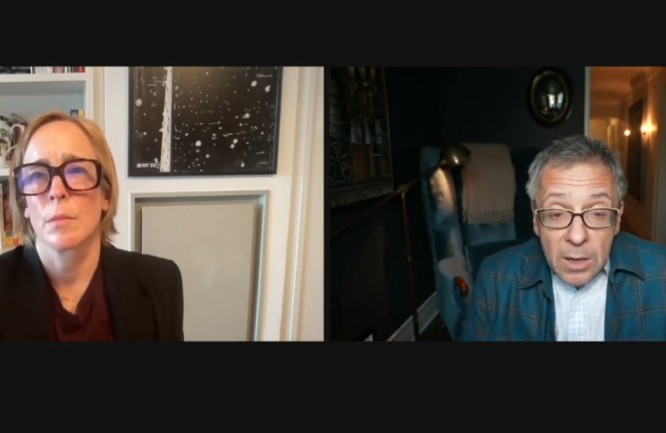
Editor’s Notes: In this urgent TED Explains the World segment, Eurasia Group founder Ian Bremmer joins host Helen to break down the sudden military strikes by the United States and Israel against key Iranian targets. Bremmer explores the complex motivations behind this escalation, including the reported death of Supreme Leader Ali Khamenei and the Trump administration’s broader goals for regime change. The discussion also examines the potential for internal collapse within Iran, the likely response from the IRGC, and the significant impact on global oil prices and regional stability. This insightful interview provides a comprehensive look at a rapidly evolving crisis and the geopolitical shifts that could follow. (March 1, 2026)
TRANSCRIPT:
Opening: The Strikes Begin
HELEN WALTERS: This morning, after weeks of escalating threats, the United States and Israel bombed several parts of Iran, including the Supreme Leader Ali Khamenei’s compound in Tehran. Iran responded in kind with missiles launched towards Israel and four Gulf Arab countries which host US Military bases, Bahrain, Kuwait, Qatar and the UAE.
Now, this is a fast moving situation which feels extraordinarily tenuous. So we obviously returned immediately to Eurasia Group’s founder, Ian Bremmer, to help us make sense of what is happening now and what is to come. Ian. Hi.
IAN BREMMER: Helen. Good to see you as always.
Why Is Trump Acting Now?
HELEN WALTERS: So, Ian, as I mentioned, the threats have been stacking up for weeks now, so this escalation isn’t exactly a surprise. But tell us why Trump is doing this now.
IAN BREMMER: Well, there are a couple reasons. First, there is a level of confidence that Trump has both on the back of his success in Venezuela, having removed Nicolas Maduro, not assassinated him, actually bringing him to justice. Though a lot of Venezuelans and Cubans were killed in the operation. No Americans were. It’s gone over well, the Americans find it popular. Most of the Latin American countries find it popular. And he’s like, well, I can do this in other places, too. So part of it is that.
Part of it is that he’s had experience with Iran before, military experience after withdrawing from the Iranian nuclear deal, the JCPOA, in his first term. He’s put the Iranians on notice on a couple of occasions. And when he is engaged in military strikes against Iran, the Iranians have not been able or willing to hit him back. And so he doesn’t feel like there’s a deterrent capability here. So he’s not taking a particularly big risk.
Finally, he did engage in negotiations, but his demands were much greater than the Iranians were willing to engage. And that’s been clear for months now, frankly. But he did want to ensure that there was adequate military capabilities in the region, both in terms of the strikes that the Americans were going to engage in, that we’re now seeing the beginning of, but also in terms of America’s ability to help defend Israel and its own bases and its allies across the region.
That final component only got into place days ago. And then this was the first window of opportunity after that when the Americans and Israelis had a clean shot at the Supreme Leader and the top military leadership and they gave the order. So that’s what precipitated all of this.
There’s a broader question about how do we feel about the United States exercising unilateral military power all over the world, engaging in a policy of regime change, assassinating political leaders. What does that mean going forward for the US? What does it mean for other countries around the world?
But in terms of what led to this series of strikes, this did not certainly surprise us. I don’t think it was a big surprise to the markets. The scale of the military strikes were greater than were generally anticipated. But nobody credible following this believed that the negotiations were heading for breakthrough. Nor did they believe that this was a taco moment, that Trump was going to chicken out. They did feel, and we did feel, that he was going to make good, as it were, on his threats, as were the Israelis. And they’ve been coordinating on this very closely for a couple of months now.
Khamenei Is Dead: What Does It Mean?
HELEN WALTERS: So, as you know, Trump just announced a few minutes ago on Truth Social that Khamenei is dead. What happens now? That feels huge.
IAN BREMMER: I think it is a big deal. And there are a few things to say about it.
The first is that let us remember that this is an incredibly brutal regime and that Khamenei has not only been personally responsible for the brutality of the regime, but also has been a hardliner in terms of refusing effective negotiations with the Americans over the past months. Certainly many thousands of Iranian civilians, and believed tens of thousands of Iranian civilians, were killed under the order of Khamenei in January when they were demonstrating. And most of these were unarmed and not posing a direct security threat to the troops that they were facing off against.
And that is, frankly, we haven’t seen that kind of short term brutality in the region anywhere. You’d have to look to Sudan, you’d have to look to Rwanda before you saw that kind of killing. You’re talking about the sort of deaths over the course of a couple weeks that you saw in Gaza over an entire year of fighting. So that’s really an extraordinary brutality. And as a consequence, there aren’t a lot of people that are going to shed a tear over the death of Khamenei.
Having said that, he is not the regime. He’s 86 years old. They’ve been planning for transition for a long time. The fact that he has been killed will make him seem to be more of a martyr in the eyes certainly of those that support the regime inside Iran, of whom there are many — a minimum of probably 15 to 20% of the population that are hardened regime supporters and will become more so on the back of this assassination.
The Iranian military leadership has taken substantial strikes over the 12 day war last year, and they reconstituted themselves quite quickly.
It didn’t affect their ability and willingness to repress internally. It does appear that a number of other military leaders may well be dead. Probably not the president, but others. The president’s not a very important figure, frankly, in the eyes of the Iranian people or in driving power. But the head of the IRGC may well be dead. The Islamic Revolutionary Guard Corps. The Israelis have announced that he has been killed as well as other top advisers to the Supreme Leader on the military side.
But it’s very far to go from that to saying it’s the end of the regime. Because remember, when Trump launched these strikes with the Israelis, he said, “We’re attacking all of the military installations,” and they’ve certainly done that. They’re attacking all the ballistic missile installations that they can find, that they can get to. They’re certainly doing that. But he also said this is meant to be an operation of regime change. He said, “Now that we’re taking out the leadership, it is your once in a generation opportunity, the Iranian people, to take your government.”
But taking the government requires overthrowing those members of the IRGC, the military, the Basij, the paramilitary groups, the police officers on the streets, and others that have been very willing and capable of using lethal force against the Iranian civilians. And there’s no reason to believe that that’s about to change. It might, we can hope that it’s about to change, but there’s no reason yet. There’s no evidence that makes us believe that. And there’s certainly no American boots on the ground. There are no Israeli boots on the ground. There’s no coordinated opposition with leadership the way there has been in Venezuela, for example.
So, on the one hand in Venezuela, Trump was fully prepared to continue to work with the same regime, having removed Maduro. And that has so far proven to be a pretty effective short term strategy at least. But in Iran, Trump isn’t prepared to work with the existing regime. And understandably, in many ways. But it’s not clear how we get from that to the government of the people, which would be an extraordinary thing for Iran and for the entire region and for the world. But someone’s got to actually make that happen. And for now, as of today, it would be quite a stretch to say that the Iranian people have the capacity to do that.
Could Reza Pahlavi Return From Exile?
HELEN WALTERS: So Reza Pahlavi, who is of course the son of the Shah, has said that he’s willing to come back from exile. How realistic do you think that is?
IAN BREMMER: With sufficient support, with policing around him, it is perhaps plausible that he could be there and he could set up camp someplace. I think it’s plausible. It’s not today, but it’s perhaps plausible. But that requires some level of intervention. Right? It’s not as if you’re able to right now fly in friendlies and you’re going to be welcomed at the Tehran International Airport like that. That’s not a thing.
And again, Trump has been very careful. Everyone is talking about how Trump is a hawk and Trump is a hardliner and he’s willing to use military force. And clearly there are lots of countries that have been on the wrong side of American bombs and missiles over the last year, just as they have in the Biden administration, as they have in previous administrations. But Trump does not want American troops getting killed. He doesn’t want forever wars. Remember, he brought the war in Afghanistan after some 20 years to an end. Biden concluded it, but it was Trump that took a deal with the Taliban that in many ways was one sided because he just wanted the American troops out.
And so Trump is going to continue to be extremely reluctant to commit any American forces on the ground. And absent that, we are pretty far, at least again as of today, from a place that you would say, “I predict that this regime is over and the Shah can come back and the Iranians can have democratic elections and they can actually put in place a regime that would represent them.” We’re very far from that now.
There’s still going to be a lot of military attacks and the Americans expect this to go on probably for a matter of several days to a little over a week in terms of destroying all of Iran’s naval capabilities, extinguishing their UAV — the unmanned aerial vehicles — and their missile capabilities. It is possible that they’ve already fired off a lot of what they still have. But if they haven’t, within a week that capacity will be done.
So I think it is plausible that in very short order Iran will no longer have direct capacity to threaten other regimes in the region. They may have asymmetric capabilities through proxies. They could certainly fund terrorist activities, that sort of thing. They could engage in espionage, but conventional military activities — we are nearing the end of Iran’s capacity to project power and that’s a big deal.
But that’s very, very different, Helen, from saying that Iran won’t have the capacity to repress their people on the ground. That is not something that the Americans right now have a military plan for. And right now there’s no reason to believe, there’s no evidence that would show that the Iranian regime is going to be incapable of continuing to repress, absent such a plan.
Who Leads Iran Now? Is There a Plan for the Iranian People?
HELEN WALTERS: I have so many follow up questions to that, but one I guess is who do you see emerging then as a leader? Or is it just too early to say, given the chaos that is happening on the ground in Iran? And I guess the other question is what’s the plan for tomorrow, or what’s the plan for after the strikes stop for the Iranian people? Does Trump care about that? It just seems like this is all happening and there is actually no plan for the people on the ground.
IAN BREMMER: So those are two different questions. As of right now, your expectation would be that the IRGC will still be in charge. A number of their top leaders will be killed. There will be new leaders that will come and replace them. We have seen that with Hezbollah with complete decapitation by Israel over the last year, the pager attacks and all of that. And they have refilled their ranks. Right. And they are nowhere near as capable as they used to be. They don’t pose a significant threat to Israel today, but they still have a lot of capacity to govern on the ground in southern Lebanon. And the Lebanese government and army has been incapable, unwilling to disarm them, which is why the ceasefire has been hard to maintain.
So that’s what you would expect to see right now. Now that recognizes that it’s going to be very hard for them to communicate with each other for the near term. It might be hard for them to actually have orders that are given in a centralized way that are then followed out across the country. But still, for now, that’s what we’re looking at. And that’s kind of the way the country has been run for the past years. So this is not a regime that is new to figuring out how to effectively repress its people domestically.
HELEN WALTERS: And sorry to interrupt you, but given that state — you don’t see the IRGC actually kind of falling apart. You think they’ll maintain their power. They’re not organized. Obviously there’s total disarray happening in the country, but the IRGC will actually stick together as a unit and will continue to run the country. Is it too early to imagine that you might see democratic leaders emerging? The organization on the ground in Iran — I know that many leaders have been put into prison. Do you think they would get out? Like what?
Iran’s Goals and Trump’s Objectives
IAN BREMMER: Yeah. All of this is too soon. I hope I am wrong. It is too early for me to be saying the IRGC is going to be in charge of this country in three months time. It is too early to say that. I am responding to your question, saying right now, who do I expect is in charge? That’s right now. That is less than 24 hours after these strikes have begun and it is still the IRGC.
There are many things that could change over time and there is very little information on the ground. But the key point here is that unlike in Venezuela, where the Americans had active, ongoing engagement with senior leaders that they were prepared to work with after taking Maduro out, they do not have that in Iran. They have tried. They have gotten some support from some IRGC members who have given them information and intelligence on the whereabouts of the Supreme Leader and other senior leaders in Iran that has been helpful in getting them the success that they have just seen in these strikes. So it’s not like they haven’t engaged in intelligence collection. But what they don’t have is a group inside the government that they’re prepared to work with. And the opposition at this point is very fragmented, doesn’t really exist on the ground in an organized way at all, even though most people oppose the regime.
So then your other question, what does Trump do? What does this mean? Well, Trump has a series of goals. And think about the way he’s presented them because he wants this to be a big win. One goal is the destruction of Iran’s nuclear capabilities. He did a fair amount of that last year. He said they were obliterated. Some of them were, but not all of them. And they rebuilt as quickly as they could without oversight from the International Atomic Energy Agency inspectors.
So there’s that. The ballistic missiles the Iranians will refuse to even negotiate on — a lot of those have now been blown up. And those that haven’t, a lot have been. A lot of them have been launched against Israel, but also against Gulf states. And yes, they do host American military bases. But most of the strikes that we’ve seen so far have actually been against civilian targets in those countries, like in Dubai, like in Riyadh, which does not actually host any American bases itself. Those bases are far outside.
And so the ballistic missiles are no longer the threat that they used to be. So you already have two of the three goals that Trump announced in his decision to go ahead with a war against Iran that Trump can say, “I’ve already achieved, and I will have achieved by the time these military operations have concluded, I will have achieved those goals.”
Now, the third goal, which is regime change, he’s given himself an out. He said, “Okay, I’ve done all of these strikes, and right now it’s too dangerous because I’m still going to hit and Israel is still going to hit all these military and leadership targets. But once we’re done, Iranian people take it over.” And if they don’t, then he’ll say, “Well, I did everything I could. I gave them the opportunity. They didn’t do it.”
Does he want to say that? He doesn’t want to say that. But he’s not going to take responsibility for this himself because he is not intending to engage in the direct regime change himself. He has already said in the initial hours of these operations that the actors that will engage in changing the regime will be the Iranian people. He has no control over the Iranian people. He has no influence over the Iranian people. A lot of the Iranian people don’t particularly trust him. He said he was going to rescue the Iranian people, and tens of thousands of Iranians died after he said that was going to rescue them. And it was over a month later before he took military action.
So I think that if you’re an Iranian citizen today, you’re feeling pretty squeezed. You’re not necessarily feeling like there are great opportunities in front of you in any circumstance, and it’s going to be very dangerous what you decide to do going forward.
Again, my hope is that this regime collapses with a minimum of violence. I think that’s everyone’s hope. It’s everyone’s hope. Whether you supported the US attacks or you didn’t, everyone hopes that the Iranian people can have a government that actually respects and reflects their values, their rights, their hopes and aspirations. But we are very far from that. And the United States may have facilitated that to a degree, but they certainly are not causing it. And again, we’re very far from here to there.
Why Is Iran Bombing Arab States?
HELEN WALTERS: Right. There is a very long way to go. I am curious, and this is probably a really stupid question, so you’re welcome, but why did Iran — why have they bombed Dubai, Riyadh? Why are they bombing other Arab states, especially without the kind of the US base? Like, I get that, but I’m hearing about the Dubai airport being hit. Like, what’s —
IAN BREMMER: Yeah. Now, the Dubai airport looks like it was hit, and clearly — I’m not surprised that they sent missiles and drones into the Gulf states, but I would have expected, as we saw after the 12 Day War, that the attacks would have been against American bases there, as we saw in Qatar. And maybe they fail, maybe they get knocked down, maybe in the process of getting knocked down, those Iranian weapons or the air defense, the missile defense ends up hitting other targets. That can certainly happen, but that’s not what we’re seeing. We’re already seeing drones that are directly targeting civilian areas in Dubai, in Kuwait, in Saudi Arabia. That I have to tell you, we’ve not seen that before from Iran.
So why would they do that? Well, on the one hand, these countries are seen by Iran as belligerents. They are in principle neutral. They’ve not joined the fight with the United States and Israel, but they didn’t prevent it. Over the past couple of weeks they increasingly went from opposing it to quietly saying that they would provide support for the United States and Israel in helping facilitate strikes. So Iran now, I think, accurately sees them as hostile to Iran’s survival.
I think if you are a leader in Iran today, you recognize that you may not be long for this world. There is an active attempt to assassinate every decision maker, every active top level decision maker that is still alive in Iran today, which is a staggering thing to say. And so they may not be acting quite as rationally, they may not be thinking quite as long term. And they also can’t communicate very well.
So this to me feels like desperation. If you know that anything you do against hardened facilities like bases or like critical energy infrastructure is likely to be shot down, and you want to show that you can do something, that you’re not going to just sit and take it, that there will be costs and consequences — that is, perhaps, the logic that leads you to engage in those strikes against civilian targets among countries that are presently non-combatants. That’s the only logic I can come up with. I don’t believe these are rogue actions by missile operators and drone operators in Iran that are not getting orders from anyone. I don’t believe that. I think there’s still sufficient centralized control.
The European Response
HELEN WALTERS: All right, let’s talk about the response from around the world. Tell us about your dealings with the Europeans on this. I saw some pretty funny interactions that you had had. The Europeans are talking about convening on Monday. Today is Saturday. This does feel like something that maybe would bring, you know, come to the top of your attention. But what are the Europeans doing?
IAN BREMMER: They’re basically acting concerned. It’s kind of like they’ll write a strong letter. They’re not really relevant here. And that doesn’t mean they’re not relevant on anything. I mean, we saw that when Trump threatened them on Greenland — they said that they were going to hit back with reciprocal tariffs and they were going to hit back with the anti-coercion instrument. And Trump backed down. He backed down without getting anything. So it’s not as if the Europeans are uniquely factless on everything.
But on this issue, Trump made his decision and he wasn’t taking any advice from the Europeans. He was not asking them to join. They are functionally irrelevant to American military decision making vis-à-vis Iran. And that is an uncomfortable position for the Europeans to be in. And so if you’re Ursula von der Leyen and you say you’re going to convene a council to discuss it on Monday, you’re going to have probably just about as much effect on Monday as you did on Saturday.
Now, I would have displayed more urgency. The Brits did a bit of that, saying that we’ve got planes in the air and we want to make sure that we’re part of a collective defense of our allies in the region. So they could have done that. That would have been an important thing to do. Secondarily, there are lots of European citizens on the ground, and so they obviously want to make sure that they are taking care, they’re all secure, that they’re evacuating as best as they possibly can, all of these sorts of things. But they don’t really have a collective position on Iran. They don’t have anything that they can functionally do to change the trajectory of this conflict. And unlike in Iraq, unlike in Afghanistan, they’re not actually playing a role. There is no coalition of the willing here. So the Europeans are irrelevant to this outcome.
And more broadly, there is the reality that the Chinese are irrelevant to this outcome, the Russians — Iran has no friends externally. We’ve seen since October 7th that Israel and the United States have been able to target whether it’s the Houthis in Yemen or whether it’s Hezbollah or whether it’s Iran last year or just now or whether it’s Hamas in Gaza — in all of these cases, the Israelis and the Americans on occasion have engaged in military strikes, and there’s been really no effective response whatsoever, either by Iran and its proxies, the so-called axis of resistance, or their friends and supporters around the world.
Whether it’s global south countries that really oppose the United States, or it’s the Russians who have been working with Iran closely to get more support for drones to help them fight against Ukraine in the war that they started four years ago, or whether it’s China that buys a lot of oil from Iran — they’ve all expressed great criticism. Right now, as you and I are talking, there is a Security Council emergency session that is going on. And I am quite certain that the Chinese and Russians are expressing their disagreement with what has been ordered by the US and by Israel, but they’re not prepared to do anything.
In fact, I don’t even believe that the Chinese will postpone the upcoming summit meeting of President Trump to visit Beijing in April on the back of these strikes. There’s really virtually nothing that anyone is doing as a consequence of the Americans and the Israelis establishing military dominance against Iran and in the region.
And that’s wildly different than the first year of Trump’s second administration when he focused primarily on tariffs and economic tools and where many countries around the world were very capable of hitting back — not just capitulating and actively negotiating, but also using their own coercive tools and mechanisms and getting to a place that they felt was better than what they were initially being demanded. That is not the case militarily, either in Venezuela or in Iran or, I suspect, in Cuba going forward. And where else might President Trump decide that he really likes taking unilateral military action that no one is willing or capable to respond against?
MAGA, Boots on the Ground, and the Definition of War
HELEN WALTERS: How does that play, though, with MAGA? How does that play with people who really didn’t want America to get involved? Is the fact that he manages to make this kind of short, sharp kind of invasions and there’s no boots on the ground — is that kind of the way that Trump skirts round that? Because it feels like in the last presidential campaign he actually campaigned on not starting wars. And instead that really has not been the case. Although of course, the definition of war is a little different if there aren’t actually soldiers and troops on the ground, right?
Trump’s Domestic Political Vulnerabilities
IAN BREMMER: I mean, if no American soldiers are getting killed, then it’s a much easier proposition for him to square with his MAGA supporters. And in Venezuela, knock on wood, no American servicemen and women have been killed. There were a few injuries, but no one was killed. And so far, again, early hours, no Americans have been killed.
But certainly Trump is prepared for Americans to be killed — combatants and quite plausibly non-combatants on the back of this. And large numbers of Americans killed because of a war of choice in Iran will be unpopular with significant numbers of Trump’s MAGA base.
There’s also a break in MAGA on Israel. There are a number of strong MAGA supporters — and you’ve seen this with Tucker Carlson in particular, but there have been others — that have been out there publicly saying, absolutely not. Why are we carrying so much water for Israel? Why are we providing them billions and billions of dollars in military support? Why are we engaging in military actions that are supporting what they want in their backyard?
I mean, on Ukraine, the United States has stopped providing military aid. Why? Because it’s far away and we think the Europeans should do it. So why are we supporting Israel? And there’s a lot of MAGA supporters that don’t like that. There are a lot of MAGA supporters that do, and there are a lot of MAGA donors that do — Miriam Adelson in particular. But there are many, and that many that go to Mar-a-Lago all the time, just as there are those that support military operations in Venezuela and Cuba among the Miami exile community. But it is not uniquely popular.
Trump’s Broken Promises and Eroding Support
And here there’s a broader issue we should address, which is because you asked me how is Trump dealing with the fact that he made these promises, he campaigned on this stuff. And there were so many people pro-MAGA that were saying that Kamala Harris was going to be the war candidate, but Trump wouldn’t be. Trump’s not a hawk. And Charlie Kirk — he was extremely opposed to the idea of attacking Iran and is on record in doing so. And I’m sure that there are many opponents to Trump, including some in MAGA, that are going to be using that.
Now, Trump has made good on a number of his promises. He promised that he was going to use tariffs and he was going to work to bring manufacturing back to the US and force other countries to spend money in the US, and he’s cut a bunch of deals — with promises from the Japanese and the South Koreans and the UK and the Europeans and the Saudis and others to start spending a lot more money in the US. So he’s, whether you like the policy or not, whether you think tariffs are a good idea or not — and certainly there’s an affordability problem on the back of it — he’s made good on that.
He promised he was going to close the border, and he has done a lot of work in closing the border. He promised he was going to fight fentanyl. He’s done a lot of work in fighting fentanyl. The Mexicans have been very significant partners of the US on that.
But he also promised that he was going to put America first and end these wars. And while there are no troops on the ground, it is now clear that unilateral American military power is being used to project outcomes that he wants — that a lot of MAGA is clearly uncomfortable with, especially in the Middle East.
It’s also clear that the Epstein files — where Trump said, “I’m going to clean this place up and we’re going to release those files because there’s a two-tier justice system” — and yet Bill and Hillary Clinton will be brought in to testify, but not Howard Lutnick. And so he’s protecting his own and everyone sees that. And he said he was going to drain the swamp. He doesn’t talk about that anymore. In fact, it turns out not only was there a lot of corruption in the US under previous administrations, but it’s even more corrupt now under Trump. It’s kleptocratic, benefiting him and his family directly and many insiders in the administration and their families.
So I do think that the fact that Trump, on a number of issues, has absolutely not followed through on promises that matter deeply to MAGA are why he is hemorrhaging support and why he is very likely — overwhelmingly likely — to lose the House, probably by a substantial margin in November. And he’s running out of time. It’s getting harder for him to turn that around every day.
And I don’t think that unilateral strikes on Iran with Israel are going to change that. I don’t think the Supreme Court’s ruling on IPA is going to change that. I don’t think that the Minneapolis ICE efforts are going to change that. I think that he’s in more trouble. Over the last couple of months, the trajectory has been negative for him, and he’s likely to become much more risk-acceptant as a consequence of that, which may well play out in other military episodes internationally.
HELEN WALTERS: But why — if things are going badly and your numbers are down, I mean, I understand why you become more risk-acceptant, but actually leaning into doing even more reckless things feels like maybe the wrong direction to head in.
Trump’s Short-Termism and Lack of Strategic Discipline
IAN BREMMER: It is something he can do. It’s power that he has. If he were listening to his top advisors, he would be acting very differently. I think the Venezuelan issue he would have handled very similarly. But the IPA tariffs — he was told by his Secretary of Treasury and by his US Trade rep, “Don’t use this. It won’t stand up.” And he obviously knows better than they do because he’s the president, he’s the one that won. And so he went ahead and he did it. And then less than a year later, the Supreme Court, including his own nominees, vote against him. And now it’s going to be harder for him. He’s going to be more constrained.
I think the problem is that Trump is very short-term. He’s very attached to the latest shiny object. He constantly wants to make headlines, and he’s incredibly undisciplined. So he does not have the temperament to engage in the strategic political revolution that would allow him to more effectively build a presidency that sits above checks and balances.
I think what we’re finding is that increasingly he’s failing on a bunch of issues, and as a consequence, you start to see — whether it’s justices, or members of the military, or Republican leaders — start to take public steps against him. And that wasn’t happening three months ago, six months ago, but now it is. We’ve seen it on a number of occasions, and I think we’re going to see more of it going forward.
HELEN WALTERS: I think it’s also true, isn’t it, that some of the people who’ve been giving him advice, particularly on this war — some of his military advisors — actually then got cast out.
IAN BREMMER: Cast out. That’s right.
HELEN WALTERS: Right. So does he really believe that he can just do this all by himself because he’s the president?
Trump’s Inner Circle: Loyalty Over Competence
IAN BREMMER: Well, these are relatively junior people, most of them. Because keep in mind that what Trump has hired for this time around — some of his advisors are very capable in my estimation, like Marco Rubio and Jameson Greer. Some of them are incredibly incompetent in my estimation, like Pete Hegseth, for example, or RFK. But they all are incredibly loyal.
So unlike Trump’s first term, where it was a revolving door with a lot of people that were then talking, were leaking, were extremely opposed to Trump, this time around we’ve seen virtually none of that. It’s been a relatively tight ship because they all recognize that they’re going to do exactly what Trump wants — or else. The only major blow-up we’ve seen in the first year-plus of the administration was Elon Musk, who came out in spectacular fashion, dished on the Epstein files, said he was going to create a third party, and basically grabbed onto the third rail — but backed away from it. J.D. Vance facilitated a rapprochement, and now he’s working with Trump again.
So really, at the top level, there’s been continued alignment and willingness to go along with whatever Trump is saying among that inner circle — and that willingness to facilitate even things that fail. We’ve seen how many instances now where Trump has launched lawsuits on the six Democrats that did that video opposing him, and that lawsuit blew up and he failed because he wasn’t listening to advisors. Same thing with the lawsuit against James Comey and Letitia James — he failed and wasn’t listening to advisors.
But they are willing to do whatever he says in all of these instances, whether it’s about military strikes, economic tariffs, or taking efforts to ensure that the next election is not, quote unquote, “rigged” — like the FBI investigation and the seizing of the ballot boxes in Fulton County in Georgia. All of these are unprecedented acts, but they’re unprecedented acts that President Trump is ordering and that his inner circle, his direct reports, and his cabinet are 100% behind. Not even an inch of space between Trump and those people.
Asymmetric Warfare and the Straits of Hormuz
HELEN WALTERS: All right, let’s head back to the Middle East. You mentioned earlier the idea of asymmetric warfare. If Iran has used up its missile armory, the reality is that no one can actually dictate what happens with asymmetric warfare. What do you think is happening, for instance, with the Houthis or with the Straits of Hormuz? Is that going to get closed? What do you think is going to happen? What are the ripple effects of this in the region?
IAN BREMMER: Yeah, that’s the most significant market impact, and it might be the most significant vulnerability that American servicemen and women have — to the ships, both tanker traffic directly and military ships going through the Straits of Hormuz, the Red Sea, and more broadly. And the Houthis have shown that they have a capacity to make strikes against these boats, including off the Horn of Africa in the Indian Ocean, even more broadly.
I do think that there is a pretty high likelihood that for at least a period of time the Straits of Hormuz will be impassable. And that means that oil prices — which have already spiked on these strikes and in anticipation of these strikes — with lots of oil on the market right now and with relatively low demand for oil, those prices are going up. Natural gas, same thing. You’re going to have difficulty in getting that gas to Europe, and that means those prices are going up too.
There’s a huge amount of American military capability — minesweepers and the rest. I don’t believe that the Straits will be impassable for long. I’d be surprised if it was more than a matter of, inside a few days to outside a couple of weeks. I’d be surprised if it went longer than that. But there’ll be a continuing threat to tankers, and that means that a lot of those tankers may end up having to go the long way, costing an awful lot more money as a consequence.
HELEN WALTERS: All right, to wrap this up, I’m curious what you’re watching most closely in the next few days and over the next few weeks.
What to Watch: Key Indicators Going Forward
IAN BREMMER: Most closely, I’m watching internally, Iran. I want to see what kind of demonstrations we see, what kind of instability and how much of that gets out vis-a-vis Telegram and other sources, because it’s not like there’s an open media that can actually report on it.
Do we see some towns that are farther away from Tehran, where you have ethnic minorities — where there are Kurds, where there are others — where it’s much harder for the Iranian central government to actually have complete control? We’ve seen with the Green Revolution before, there were much bigger demonstrations and a lot of violence outside of Tehran. That would be interesting to watch.
We also want to see what kind of statements are being made by the Iranian leadership and who’s making them. So far, in these early hours, we’ve seen very little. We’ve seen fog of war and the foreign minister make some statements, but that’s about it. It really is early, early days. You want to see what’s left of the Iranian regime and what kind of opposition you see internally.
More broadly than that, we want to see what kind of reaction we get across the region. Do we see effective activity by the Houthis in Yemen? Do we see terrorist activity that leads to bigger strikes against civilians? Do we see the Hezbollah-Lebanon front open up completely, with Israel deciding that this is a great opportunity to just mop that up after only limited strikes over the past months? That’s certainly very plausible in this environment.
So lots of things to watch. But again, in an environment where it’s hard to imagine major escalation — this is not going to become a regional war, this is certainly not going to become World War Three — it’s much more about what happens on the ground, frankly, in Iran. That is the biggest thing we’re looking at. And in that regard, it’s very similar to right after Maduro was captured, what we were watching, what was happening on the ground in Caracas and across Venezuela. There’s a lot more uncertainty for Iran than there is for Venezuela, but the basic sorts of questions are actually very similar.
HELEN WALTERS: Ian, thank you so much for, unlike the Europeans, taking time on your Saturday to come and talk about this. We are so grateful to have your wisdom, and thank you for tracking all of this. We will, I’m sure, see you again soon.
IAN BREMMER: Always great to talk to you.
Related Posts