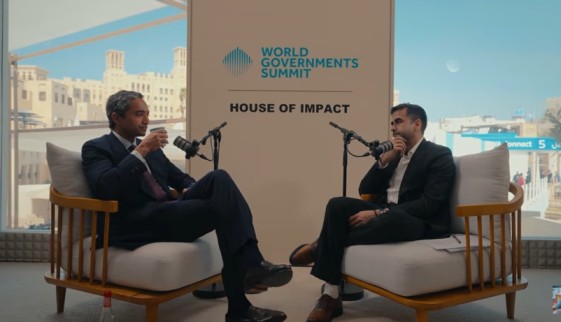
Editor’s Notes: In this deep-dive conversation, Nikhil Kamath sits down with venture capitalist Chamath Palihapitiya to explore the complex relationship between past pain and the drive for capitalistic success. Chamath opens up about his personal journey, from his childhood in Canada to his experiences at Facebook, while sharing his unfiltered views on why traditional metrics like wealth and fame are often “contrived” games. The episode covers a vast array of topics, including the future of AI as a productivity accelerant, the importance of national sovereignty in a tech-driven world, and practical advice for solo investing. Whether you’re interested in macroeconomics, the evolving political landscape, or the psychological traits of world-class entrepreneurs, this dialogue offers a thought-provoking look at the games nobody—and everybody—is playing. (Mar 2, 2026)
TRANSCRIPT:
Introduction & The Grant Program
NIKHIL KAMATH: When do we start recording? Oh, it’s on. Okay, perfect.
CHAMATH PALIHAPITIYA: Do you monetize your pod?
NIKHIL KAMATH: No.
CHAMATH PALIHAPITIYA: No ads, no nothing.
NIKHIL KAMATH: No ads, no sponsorship, nothing. In fact, I make my guests give money to a charity I like and I donate with them and we match it. So we have a grant program. I’ll tell you what kind of charity.
CHAMATH PALIHAPITIYA: I don’t care it is not doing.
NIKHIL KAMATH: It is giving money directly to young kids in India who want to start a business but don’t have startup capital. There are that initial capital, even if it’s like 50 grand, 100 grand in India, is very, very hard to.
CHAMATH PALIHAPITIYA: How do you choose, though, who to give it to? That seems like a complicated problem we have. Because if you just give it.
NIKHIL KAMATH: Yeah.
CHAMATH PALIHAPITIYA: You know, you’re making it harder for that person that actually shouldn’t probably have it.
NIKHIL KAMATH: But nobody has it there. I mean, you’re talking a different ecosystem with no risk capital whatsoever.
CHAMATH PALIHAPITIYA: And do you do like YC? You take 7%?
NIKHIL KAMATH: No. No equity. Nothing. It’s just a grant.
CHAMATH PALIHAPITIYA: Oh, just a grant. And they don’t have to pay you back?
NIKHIL KAMATH: They don’t have to pay us back.
CHAMATH PALIHAPITIYA: Wow. But that’s great that you do that. How many people do you put through this program?
NIKHIL KAMATH: A dozen kids every couple of months.
CHAMATH PALIHAPITIYA: And anything interesting come out of it? Like commercial success?
NIKHIL KAMATH: Yes, a couple. Like there’s a pet protein company called Possible which is now worth maybe 40, 50 million. There have been like 3, 4, 50 million kind of outcomes, which is not bad.
CHAMATH PALIHAPITIYA: And does it kind of pay itself back so that you can kind of make it or. No, it’s just you funding it.
NIKHIL KAMATH: Yeah, me. And then whenever my friends want to join, they come along.
CHAMATH PALIHAPITIYA: Does it give you a sense of fulfillment?
NIKHIL KAMATH: Not particularly. I think it gives me access to a lot of talent that I work with in other ways in the future. Because even when things don’t work out and they shut down, it’s tough to find these people.
CHAMATH PALIHAPITIYA: I agree with that. And are they generally technical or no?
NIKHIL KAMATH: Yeah, they’re generally technical and they’re all under the age of 25.
CHAMATH PALIHAPITIYA: Yeah, that’s the key. Yeah, that’s honestly probably my single biggest filter. If you’re young, it’s great. If you’re not, it’s harder.
NIKHIL KAMATH: You know, another thing I found with these young kids — the docile, subservient people never turn out to be good. The arrogant ones are the ones who do better.
CHAMATH PALIHAPITIYA: I totally agree with that too.
NIKHIL KAMATH: Right.
Pain as a Catalyst for Success
CHAMATH PALIHAPITIYA: Yeah. I think you need to have some kind of grit or pain in your past. Pain is a fantastic amplifier of capability. Some sort of grudge, pain, anger. But the child that had a wonderful upbringing is a wonderful human being and not a great entrepreneur in many cases, at least at scale, at mega scale, because it just requires a level of self-flagellation almost. And people who aren’t used to pain don’t want to incur pain. People who are used to pain don’t think anything of it and they just keep going through it.
NIKHIL KAMATH: People who are used to pain almost want pain.
CHAMATH PALIHAPITIYA: I think it’s a weird way in which we feel normal.
NIKHIL KAMATH: I find that when somebody is used to drama growing up, they seek out drama later in life as well.
CHAMATH PALIHAPITIYA: I can see that. Yeah, I can see that.
Who Is Chamath Palihapitiya?
NIKHIL KAMATH: Maybe we should start today with telling our audience who Chamath is, in Chamath’s words.
CHAMATH PALIHAPITIYA: Yeah, I am a —
NIKHIL KAMATH: This is a tough question.
CHAMATH PALIHAPITIYA: I’m just a guy and I like games, I like risk, I like learning and I like growing. And none of it matters, none of it.
NIKHIL KAMATH: What you like is part of who you are. Maybe what you dislike is the other half. What do you dislike?
CHAMATH PALIHAPITIYA: Honestly, not much of anything. I don’t like staying still. And actually, yeah, I probably dislike that the most. I don’t think there’s much value in just the status quo of anything. Now that’s not always a good thing, but I think the status quo in many cases is actually quite structurally important. But generally it’s better to try things and change things.
The Origins of Hunger and Pain
NIKHIL KAMATH: We spoke about pain. I wouldn’t like to say a prerequisite to success in the capitalistic world, but it helps if you’re being pained. What is your story? Where did the hunger come from?
CHAMATH PALIHAPITIYA: Well, the hunger and the pain are two different things.
There was alcoholism, there’s abuse, there’s all of these things that are the byproduct of just dealing with a life unfulfilled, at least from my dad’s side. And then there was a lot of codependency and complacency that my mom lived out. And then the byproduct of that was I was a curious, loud sometimes, and generally overachieving kid. Not in school, but in every other realm.
And I think it touched a lot of my father’s insecurities. And so the way that he dealt with it was painful for me, but also for him, probably. And then my mom just kind of didn’t really do much to intervene. So that’s where it all started.
NIKHIL KAMATH: What in the eyes of a young Chamath would make it look like your parents had a life that was fulfilled? Is it just the absence of conflict?
CHAMATH PALIHAPITIYA: I think my father was an incredibly smart, capable man who just didn’t get a chance to live out his potential. And then he made the greatest sacrifice possible. I can say this now as an almost 50-year-old, which is he just gave everything up.
And could you imagine that — your life isn’t going the way that you thought it would, you feel you have this potential, so you’re frustrated, and then you say, “You know what? I’m just going to completely give up on my life and I’m going to live it through these three kids.” How do you do that? Because you have no idea what these kids are capable of. These kids could be idiots.
NIKHIL KAMATH: He did that.
CHAMATH PALIHAPITIYA: And so, by immigrating to Canada, he did that. You give up everything. And so I gave him a lot of respect and obviously appreciation. But that’s probably the memory that I hold the strongest because it forgives all the other stuff. All the other stuff is kind of just noise, it all just kind of gets in the way.
Because again, I go back to it — none of it really matters. Let’s pick a random year. Pick any year. 2020. Who was the 87th richest person in the world in 2020?
NIKHIL KAMATH: No idea.
CHAMATH PALIHAPITIYA: Okay, pick another random year. 2010. Who was the 14th richest person then?
NIKHIL KAMATH: No idea.
CHAMATH PALIHAPITIYA: Okay. Pick a different year. 2005. Who was the 9th most followed human being then?
NIKHIL KAMATH: No idea.
CHAMATH PALIHAPITIYA: Okay. This is just to point out that none of it matters. It’s all contrived and in your own mind. And in that moment, it feels like it’s a matter of life and death. External validation becomes this thing that is the crucible. But I try to remind myself none of it matters. It’s just a complete game. And if you can do that, you can have a very interesting life.
What Really Matters
NIKHIL KAMATH: It’s interesting that the parameters you used to form your questions were the richest and the most influential. Is that what matters today?
CHAMATH PALIHAPITIYA: No. But I think that that’s what we are conditioned to think matters.
NIKHIL KAMATH: By society.
CHAMATH PALIHAPITIYA: By society. And I think the overwhelming majority of people will use that as the two simplest ways of determining the value of a human being. Which is wrong.
I would say that the real thing is — from where you started to where you are, how have you evolved as a human being? There’s no quantity or metric that you can share, and it’s your own internal sense of whether that journey has been well lived. Unfortunately, most people don’t appreciate that because you can’t share that in a language that’s easily understood by everybody else.
So society has developed simple frameworks to say whether you’ve had a life that has been well lived. And it reduces down to these two things — some combination of fame, influence, and capital. Proximity to power, fame, influence, and capital. All of those things are sort of byproducts of those things because it allows society to organize itself. The problem is that it kind of misses the point.
But that’s why I try to remind myself — if those are the externally validated measures of success, the true reality is it doesn’t matter. And so it takes a lot of courage to decide that it doesn’t matter.
NIKHIL KAMATH: So what matters outside of change or the rate of change?
CHAMATH PALIHAPITIYA: I think that, for me, that’s probably the thing that matters the most. And then after that, how that manifests for me is my relationship with my wife, my relationship with my children, and then my relationship with my friends.
What gets cluttered along the way is all of the things that I do in business and then all of these other ways that people try to tell me that things are going well if I don’t feel that it is, or they try to tell me that things aren’t going well when I think that they actually are. And the way that they do that is, again, they go back to these externally validated but very fragile and brittle measures.
The whole goal that I try to do for myself is to break that chain of dependency where I hear it and it just kind of dings off me. And that’s a very liberating thing. I don’t get that all the time, but when I can do it, I feel very, very grounded and happy. Not an effusive happy — it’s just a warm, grounded sense that I’m right where I need to be.
Legacy, Procreation, and Children
NIKHIL KAMATH: Procreation and legacy have always mattered for centuries. Maybe capitalism defined that winning this game helps in order to achieve that end. The wealthier you are, more people want to have children with you. So in a way, they’re both the same thing, or one is a conduit to the other.
CHAMATH PALIHAPITIYA: Well, I can tell you that having kids for me is a completely selfless desire to be around these little humans that I just love. I have five kids. If I could have had five more, I would have had five more.
NIKHIL KAMATH: Do you think it could also be ego? Like, when you see a child, you see a reflection of yourself?
CHAMATH PALIHAPITIYA: My kids are — well, my boys are pretty stupid, so no. My girls are just superb. Oh, my God. No, I’m just kidding. I mean, they’re all great, and I love them equally. Mostly. But yeah, kids are just amazing. They’re a really great way of reminding me that these external measures are traps that society lays for you. They don’t have a perception of how many followers you have or how much money you have, whether you won or you lost, whether you had a good deal or a bad deal.
NIKHIL KAMATH: Maybe not yet, but soon they will because they live in the same world that we do.
CHAMATH PALIHAPITIYA: But then they’re not children anymore.
NIKHIL KAMATH: When does —
On Self-Awareness and Personal Evolution
CHAMATH PALIHAPITIYA: And they’re adults. I can see my oldest child getting into that transitionary phase. Then it’s less about me being a parent and them being a child. It’s about us being peers. And there’s a good chance that, with all things, I don’t know what the relationship will be like in the future. It’s not the case that all siblings are really close. You don’t choose those people. It’s not the case that you’re close to your parents. You don’t choose that relationship. It’s given to you. And then it’s your choice how you deal with it. I would hope that they are less reductive than everybody else. But you’re right, there is that risk. And then I think our relationship may suffer, but hopefully it doesn’t.
NIKHIL KAMATH: Why would it suffer?
CHAMATH PALIHAPITIYA: I mean, I think I’ve tried to surround myself with the kind of influence that makes me feel like I’m on a good path. And so if my children — it would have my children.
NIKHIL KAMATH: Can you elaborate on that? When you say you’ve surrounded yourself with influence that makes you think you’re on a good path. The good path to change. The good path to capitalistic success. The good path to influence.
CHAMATH PALIHAPITIYA: The good path to a structural sense of being an evolved human being. It’s independent of —
NIKHIL KAMATH: You mean emotionally?
CHAMATH PALIHAPITIYA: Yeah. Being reliable, being thoughtful, being self-aware. I think maybe that’s the key word. Being very self-aware. Like, where am I in my evolution? Where am I in this moment? Am I grounded? Am I insecure? Am I egotistical?
NIKHIL KAMATH: Are you able to catch that?
CHAMATH PALIHAPITIYA: Yeah, a lot more than I used to. Not all the time, but a lot more than I used to. Why? Because of the influence of my wife, predominantly, but then the reaction of my children and my friends. They don’t treat me better or worse because of something that happens in the traditional way in which society tells you you had a good day. They treat me better or worse based on how I’m treating them and how I am treating myself. And that’s very powerful if you listen to that signal. It takes a lot of time to sort that out. But then if you can do that and you can foster that, it’s a superpower. It’s a huge unlock.
NIKHIL KAMATH: I’m trying to learn how to do this myself. Can you give me an example of how you’ve got yourself changing in, say, the last five years?
CHAMATH PALIHAPITIYA: Well, I was still, you know —
NIKHIL KAMATH: What did you believe in five years ago that you think now was a stupid thing to believe in? Don’t say socialism or the Democrats, because I think that’s too binary. Something more evolved than that.
On Letting Go of the Scoreboard
CHAMATH PALIHAPITIYA: What have I changed my mind about? I think I’m much more circumspect about the games that I play and that they are games. Meaning — I thought that business success was a matter of life and death. And so the whole goal was you run up the score and you get the highest score and you have the most chips. And now I see it just as a game. It’s like playing poker. There are hands you win, there are hands you lose. Sometimes you’re on a heater and everything works. And sometimes, no matter how flawless the execution, nothing works.
And I can step away from it now and be normal. I can also be around my friends and it doesn’t make me a different person based on that. Not all the time, but most of the time. That’s been a huge change in the last five years.
Five years ago I was still so much a part of — I was just grist for the mill. I was like everybody else, just kind of walking around, trying to get the atta boys, trying to get that tap on the shoulder saying, “You did a great job.” And the problem is, other people are telling you superficial stuff when they tell you that. Nobody sits you down and says, “You know what, Nikhil, you just seem so self-aware, and it’s really changed over the last few years.” Whoever that person is who has ever told you that — don’t ever lose that person.
Everybody else is like, “Wow, dude, great investment. Oh my gosh, you’re so great. Wow, look at how many views you got for this video. You must feel so awesome.” And I’m like, now I feel nothing. Nothing, nothing.
Do you understand what it means? I told you this story last night. I did a deal at the end of 2025. I helped start this business 10 years ago — a chip company, an AI chip company. We sold it to Nvidia for $20 billion. Huge win for me. And I woke up on a Tuesday, and I remember getting a screenshot, and Nvidia had wired the first big payment — $13 billion into the company’s account. And I was just like, “Okay.”
And I thought to myself, it was like zero impact. I almost felt a little depressed because I was like, “Now I’m going to have to spend the next three weeks with all these people giving me these atta boys.” And I hadn’t thought about this in years because it’s been a 10-year journey and I’ve already moved on to other problems that I’m working on that captivate my energy — problems that people probably think are a stupid waste of time now. And so now I have to fight all these people telling me, “Oh, why are you doing it? What’s the point? You’ve already won. Just take a break, relax.” And they don’t get it. And so I was like, “Ugh, these next two months are just going to be a pain.”
NIKHIL KAMATH: All prophecies are self-fulfilling in a way, because you said what you said. Now people will say you’re self-aware a lot more than they did up until now, because you put it out there.
The Machine That Makes the Machine
CHAMATH PALIHAPITIYA: I mean, I hope so. I launched a product — I started a company 18 months ago and we launched a product these last couple of days that I’ve been here in Dubai. And so I’m with the team and we’re just working on it.
NIKHIL KAMATH: Andy was telling me about this last night, that you were busy with the product launch before you came for dinner. What was it?
CHAMATH PALIHAPITIYA: I think the best way to describe it is — in the Industrial Revolution, what was the key unit of change? It was a factory. So what did Henry Ford really bring to the world?
NIKHIL KAMATH: Assembly —
CHAMATH PALIHAPITIYA: Not a car, but the assembly line. It’s the machine that makes the machine.
I’ve been obsessed with that idea. Nine or ten years ago, Elon sent an email to a bunch of us and said, “Hey, I’m opening the Gigafactory. Let’s have a party.” So we all go to Nevada, somewhere outside of Reno. And it’s incredible — I just remembered I still have the video on my phone. You start to drive, and you turn the corner and it’s the beginning of the Gigafactory. And you just keep driving and driving and driving and driving. This building is just there and it keeps going and going and going forever. And then you pull in, and literally raw material was coming in the front and the Model 3 was coming out the back.
And he said, “Chamath, I want to show you something.” And he shows me this schematic and I’m like, “Wow, what is this? Is this your next chip or something?” He’s like, “No, dummy, this is the machine that makes the machine.” And it just seared in my mind — the machine that makes the machine.
So when this AI thing started, and I had been kind of toiling around in the silicon layer — this is in mid-2024 — I was like, “Okay, well if all of this stuff is real and we have silicon and we have models, what is the machine that makes the machines? What is that?”
Well, it’s a software factory. A factory that can make software. Because software is what runs the world. It runs everything. And so we made one. Not sure it’s the right one, not sure it’ll be the ultimate one, not sure if it’s a good one, but we made one.
And so what does a software factory do? It gives and imparts control to humans to be able to be a part of whatever this productivity loop is that we’re about to embark on. It allows people to collaborate in an assembly line to make software — whatever software you want. You want it to run a plane, great. You want it to operate a hospital, fantastic. You want it to use it for accounting, sure. But you don’t need to care about the intent. We can build tooling that allows all of that intent to manifest.
I think it’s a very potentially big idea. So we built it, we launched it, we’ve been using it, we’ve been deploying it with a lot of customers, so I know that it works. But I launch it, and the first comment is, “Hey, goofball, why are you wasting your time?” The guy said it in a really condescending way, too. “Honest question — but as a billionaire, why would you be doing this?” And I’m like, “First of all, that’s a stupid label. Second of all, this is not how I measure myself. And third of all, I’m here to make things.”
NIKHIL KAMATH: Why do you care?
CHAMATH PALIHAPITIYA: Because I was annoyed.
NIKHIL KAMATH: Why?
The Duality Within
CHAMATH PALIHAPITIYA: Because it makes me feel like I have to justify myself. The reason is that I have this duality in my personality. The thing that drives me to work 20 hours a day sometimes is this deep sense that something is unaccomplished. And then the other part of my life is to try to put that at rest so that I can be aware enough and enjoy this moment and say, “Wow, what a fun game. This is great, this is awesome. My wife’s awesome. My kids are awesome. My friends are awesome.”
But for me, it is a challenge. The structural challenge of my personality is to balance that duality. This gives me an enormous well of creativity and energy to work. This gives me enjoyment and fulfillment. But I vacillate between the two. And so when I read it, my instinctual reaction is, “I’m worthless and I’m wasting my time. I need to justify to this random person why it’s not a waste of time.” Then I try to catch myself, and I compose myself and I go back to work because I actually believe in the work. But it is a challenge for me. I’m self-aware about it. Doesn’t mean I’ve solved it. But that’s the back and forth.
NIKHIL KAMATH: It’s a big contradiction to kind of live with.
CHAMATH PALIHAPITIYA: Huge.
NIKHIL KAMATH: Probably makes you less productive than you could be if you didn’t care at all.
CHAMATH PALIHAPITIYA: Oh yeah. I mean, if I had a little touch of autism or Asperger’s, I’d be 10 times more successful — like some friends of yours. My friends have the TISM in just the right quantity to be unstoppable.
NIKHIL KAMATH: Are you talking about the older friend or the younger friend?
CHAMATH PALIHAPITIYA: I have a few friends with TISM and they are all off the charts productive.
On Game Theory and Political Consequences
NIKHIL KAMATH: We were planning to play poker last night, and we didn’t — we had dinner. But you know game theory. There’s something called the prisoner’s dilemma. It teaches you through a lot of back testing what is a good way to negotiate. It talks about tit for tat — works as long as you’re willing to reprimand the person quickly enough in a clear, concise, nice manner. The direction in which the politics of the country where you reside is moving — don’t you think you as a country are allowing or fostering a lot of tats for the tits of today?
On Investing, Politics, and Breaking Conventional Wisdom
CHAMATH PALIHAPITIYA: It’s a little too abstract for me to answer that question. Love tits, love tats. Don’t exactly know. Here’s what I’ll say. I think that Covid was a real wake up call for me and a lot of others in America.
What was that wake up call? I think there are two dimensions of it at a conceptual level. I think it exposed that there is an externally validated way of organizing the world based on this notion of expertise and credential that was a lot more brittle and fragile than we gave it credit for in the end. What do we know about COVID? None of us knew what was going on. Everything was a guess. Most of the guesses were shoddy, and even by the “quote unquote experts.” But the downstream implications to those are severe and have been severe. So that’s number one. We expose the fragility of these externally validated systems.
And the second is that we demonstrated our economic and national sovereignty fragility. There was nothing that we could do to take control of our own destiny. We needed almost the charity of others. I think from that, what I would say is we needed somebody, a vessel that allowed us to make the structural change. Which is hard. I think it can be very bursty. But necessary.
And I’ve said this before, I think the best way to think about our current political climate in the United States is we are led by a transcendent political athlete.
NIKHIL KAMATH: Transcendent how?
CHAMATH PALIHAPITIYA: Donald Trump is the most effective and capable political athlete we have ever seen. Why? He understands how to connect at the one-on-one level. He understands retail politics better than frankly anybody. And you can just see this if you go to a rally. The way that he can connect with individual people, he has an affability that’s very disarming.
And yet because of his business acumen, he has a way of negotiating that I think is just very hard for the learned non-business person to compete with. You know, there’s a very famous Mike Tyson quote: “Everybody’s got a plan until they get punched in the face.” I think the President has an incredible ability to negotiate. Howard Lutnick has an incredible ability to negotiate. Scott Bessant has an ability to negotiate because of their grounding in business. And when you apply it to the realm of politics, I think it has some very consequential outcomes.
And in this specific case, what they are doing is they are allowing us to question these two sets of beliefs. What should the organizational model of the world be? Is it a bunch of—
NIKHIL KAMATH: Of the world or America?
CHAMATH PALIHAPITIYA: Well, it’s of the world because the consequences of America are for the world. Is it a bunch of—
NIKHIL KAMATH: What if the world doesn’t believe that America has that right to decide?
CHAMATH PALIHAPITIYA: I think America only has the right to decide for itself, and I think that that is what it does. But the ripple effects of that are very clear. And I think that that’s a very important decision that other countries can make.
AI is actually a perfect and emblematic example of this decision. And I think in the microcosm of AI you can see this duality. There’s open source, mostly Chinese, some American alternatives, Nvidia being the biggest one. And then there’s closed source, which is like these large foundational models. If you believe that AI is the cornerstone of productivity and GDP, there is an argument to be made that every country has a sovereign responsibility to determine what they should do. There is no path dependency where the only path is America. And I think that that’s true militarily. I think that that’s true in every which way.
So I think what America has done has said, “Here are the boundary conditions that we are going to now change in order to partner with us. Historic trade deficits are no more. The sovereignty of our supply chain is now a critical dependency. We will make sure American resilience is the number one focus of the administration.” Those are huge changes and it has broad ramifications. But we needed somebody who was willing to break the norms in order to say that.
And I personally believe that America needed that wake up call because we were all subsuming ourselves to a monocultural global elite that wasn’t necessarily making decisions from first principles anymore. And I think it’s important to have an opportunity to re-underwrite those decisions every few decades.
On America, Europe, and the Shifting Global Order
NIKHIL KAMATH: I hear you. I don’t know how far I can debate this line of politics without getting into trouble. But sure, the deficit numbers are down, the debt is not going to go down. It’s only going to increase with time. Sure, maybe you depreciate the currency to a point where it becomes more feasible, or you grow your way out of it, or you have an alternate currency of exchange which helps you pay for it. All of that could happen.
But when I look from the outside, like I was telling you last night at Davos, I was seeing how the Europeans were reacting to what the Americans were saying. It feels like you are in a way—
CHAMATH PALIHAPITIYA: —way—
NIKHIL KAMATH: —creating a block. The world had many blocks. I wouldn’t be, it wouldn’t be too far-fetched today to extrapolate that there might be one block which is America and another block which is the rest of the world, which I don’t think would be a good thing for America.
CHAMATH PALIHAPITIYA: I don’t think it’s going to be like that. And the reason is that at the end of the day, America is still the heartbeat of so many really important innovative technologies, medicines, capabilities, culture. And I don’t think any of that changes. Will there be other forms of it over time? Yeah, and I think that that’s okay.
So I don’t think that this is something where — look, what should the Europeans have done? I suspect if I was a European leader and I was sitting there in Davos, I would be really upset with some of the decisions that I have made. I would think to myself, was it smart of me to have turned off all my nuclear generation because a 16-year-old girl told me to? Probably not. Was it smart of me to have a single source supply of an overwhelming supply of energy from two pipelines that don’t have redundancy? Probably not. Should I have maybe reconsidered how I think about migration and immigration and how do I balance asylum versus relocation versus productivity-based immigration?
And I think that if I was in Europe, I would be like, “Man, I think I made a couple of these decisions really wrong.” But again, if you’re being really intellectually honest, then why don’t we go back and ask why those decisions were made.
NIKHIL KAMATH: No, I agree with you 100%. I don’t think that—
CHAMATH PALIHAPITIYA: I think it’s hard to litigate the fact that they may not be self-aware enough to actually be honest.
NIKHIL KAMATH: I agree they might not have been, but them not having been might have been beneficial to another state because they weren’t. But now they seem to be coming together again.
CHAMATH PALIHAPITIYA: I think the Europeans are brilliant people. They’re smart, they’re thoughtful, they’re capable. If from here, in first principles, one cannot underwrite who to be long-term partners with, I think that we should hold out some small percentage that they could just be emotionally overreacting.
NIKHIL KAMATH: Yeah. You know what they were telling me?
CHAMATH PALIHAPITIYA: And again, so that’s them repeating the same mistakes over again.
NIKHIL KAMATH: Yeah. As soon as we walked out of the room after — I can’t remember which speech — I was talking to a bunch of the politicians from Europe and they were like, “America is 27 trillion GDP, 350 million people. Europe together is 500 million people, but 22, 23 trillion GDP. The distance is not very far.” I have not heard Europeans speak like that — as one country or one nation, but not individualistic for their own regions — in a long, long time.
CHAMATH PALIHAPITIYA: Let’s just be really honest. Europe is going to come to a crossroads. Italy is doing incredibly well.
NIKHIL KAMATH: Because of taxation, you think? Because the—
CHAMATH PALIHAPITIYA: The economy works and they have a stable government. They have sensible laws on a bunch of things that have allowed them to retain a sense of national identity and maintain reasonable growth. What do we think happens when the Italians wake up one day and say, “Should I secure all of that gold that I have that’s in Brussels? Maybe I should send some of that back and keep it in vaults in Rome.” Which is dollars to donuts. When that question really comes up and we start to think about real assets, devaluation of currencies, this is going to create some really, really interesting conversations.
NIKHIL KAMATH: That is happening in the US now. People are bringing gold back from the Federal Reserve into individualistic countries in a big proportion, actually.
Lessons from a Career in Investing
NIKHIL KAMATH: So, Chamath, to my audience, which are largely entrepreneurs and people who want to start a business in India — I think something that you have accomplished, along the many things that you have done in life, from starting at Facebook, which is now Meta, to running funds, managing money — the thing I find most interesting, because I’m in that profession, is the investing bit. You seem to have gotten so many calls right over the tenure of your career. Give us some lessons from that which are non-obvious.
CHAMATH PALIHAPITIYA: To be a very successful investor, you have to be extremely, extremely single-minded. You need to come to your own conclusions. You cannot have others help you. It is not a team sport. That is probably the single most important thing. Whenever I see teams of investors, I think these idiots are going to lose money, or they’re going to make a lot of noise and spend a lot of time and waste a bunch of people’s money just returning the market beta. I don’t find that interesting. That’s not being a good investor.
You have to be really, really, really curious. And people say that a lot. The sensation that I can put my finger on is when I feel like I’m embarrassed to tell somebody that I’m in this new thing.
I remember when I invested in an NBA team in 2011, the people around me were up in arms. My family office was up in arms. My best friends were up in arms. My wife at the time was up in arms. “Why are you doing this? This makes no sense.” And I said, “Here’s what—” And it’s almost as if what I’ve learned in my career is when people around you have that reaction, it’s almost the best signal.
NIKHIL KAMATH: I agree with you 100%.
CHAMATH PALIHAPITIYA: And I had been reading a lot, and I’ve been reading about how to actually be a tech investor. And the conclusion that I came to was, “Wow, the approach that I want to do is so unconventional. The risk of ruin was very high.” So then I was like, “Well, let me just find the most totally uncorrelated asset and park — I can’t remember — was like 25 or 40 million bucks or something. So that if I lose everything, I still have this little thing and I can take care of myself.” And that ended up being the investment in the Warriors, which ended up doing financially quite well.
But it repeated itself with Bitcoin. In 2012, I did the same thing. People were just so upset. And I remember, I would appear every now and then on CNBC and just the vitriol and the hatred. And I was like — so if you can weather the negative reactions of others, where is that coming from? It has nothing to do with you, right? People are living their own journey.
But what is happening in that moment? What is happening is something you are saying is attacking a core foundational belief that they have. And it is touching such a nerve that they are just reflexively reacting. That is an incredible signal, because what it tells you is you’re onto something. It could still be a huge zero, but you can now bucket it into that — there is the potential for a massive asymmetric outcome.
So when I’m investing, initially what I was thinking about was how do I put myself in a position once I’ve — I still spend like 2 or 3 hours reading a day.
NIKHIL KAMATH: Mm.
Bitcoin, Crypto, and the Case for Fungibility
CHAMATH PALIHAPITIYA: Okay. I would develop views, I would write notes, I would think about it, and then I would come up with these ideas and then I would just test them out. And man, people would just… When people reacted like, ho hum, I was like, okay, this is a nothing burger. Not interesting. But when people had like this visceral reaction, I was like, I’m onto something. Doesn’t mean I’m right. But it’s something that triggers people. And I would use that as a way to amplify and spend more time.
Since then, I’ve added one more thing to this, which is now I have a different way of investing for large quantums of money, like super large quantums, hundreds of millions plus. There I actually want consensus because this should not be about any sort of existential risk or product risk of any kind. So when you’re investing tens of millions of dollars, who cares? You can lose the money. It’s not a big deal. When you’re investing hundreds of millions or billions, you cannot afford to lose it. Risk of ruin goes up.
So now I try to context switch here. I want you to just hate it. I want you to just be, “Ugh, it’s so gross. It’s rat poison.” Oh, really? Okay, great. Now I’m going to spend more time over here. Oh, that makes sense. Yeah, okay, that I understand.
NIKHIL KAMATH: Which portfolio did better?
CHAMATH PALIHAPITIYA: Gross tonnage of dollars? This one. Sheer alpha? This one. Now it’s hard to say. An individual position likely.
NIKHIL KAMATH: Did you get out of your crypto?
CHAMATH PALIHAPITIYA: I don’t talk about my crypto. But crypto transitioned — Bitcoin transitioned from being this bucket to being this bucket.
NIKHIL KAMATH: Volatility would suggest otherwise.
CHAMATH PALIHAPITIYA: Yeah. But I think the reality is that Bitcoin, for the most part at this point, has a structural failing that I think people will need to come and wrap their heads around. The structural failing is that — so if you think about what is the value maximizing function right now for a crypto asset to be broadly adopted, it needs to have the features that allow a central bank to adopt it. And there are two things that it lacks. One is fungibility and two is privacy. And so Bitcoin fails on those two dimensions. So it can never be a structural holding of a central bank. And that simple thing will keep it in the realm of ETFs and humans.
NIKHIL KAMATH: And does gold satisfy those conditions?
CHAMATH PALIHAPITIYA: Yeah. Fungibility easily — both. You have no idea how much the Bank of China owns. You don’t know how many ounces they own. You don’t know how many ounces I own. When there’s a public ledger that says this address has this much, and you can’t really trade it because you know the history and the provenance of that exact token — it’s been used to buy this, it was transacted over here, went to this wallet — that lack of fungibility and privacy is a huge deterrent for broad structural adoption. That’s what you need to then add another 10x of market cap.
So is there room for a different crypto asset that solves for the privacy and fungibility? Yeah. And are there projects right now? Yes, but they’re very small scale. There are huge issues with them. Those are even more volatile. So Bitcoin’s interesting.
NIKHIL KAMATH: I think of it — each time I think of Bitcoin exchanges and stablecoins, I’m like, why have the use case of moving away from central bank and then have Tether or USDT, something which is backed by the US dollar? Or for an exchange — why decentralize if you have to centralize again on a crypto exchange? Inherently, fundamentally, I don’t get that argument.
CHAMATH PALIHAPITIYA: Yeah, I’m not sure I understand the argument either, to be honest. But I believe in stablecoins. I think those are like a structural innovation that makes a lot of sense. It decreases friction and it allows transaction rails to kind of proliferate. I love that.
NIKHIL KAMATH: If you’re trying to bring efficiency into bank transfers and Swift is failing and all of that — with you 100%. But why it should be backed by a currency which is regulated by a central bank, I don’t know.
CHAMATH PALIHAPITIYA: Well, I think that’s going to just be a philosophical decision. At some point you’ll have gold-backed stablecoins, you’ll have all these other real world asset-backed stablecoins.
Investing Is a You Thing
Anyways, my point of view — just getting back to the original framing — the non-obvious thing is it’s a “you” thing. Investing is all about you and you only. All this nonsense of, like, teams is nonsense.
NIKHIL KAMATH: How big is your investment team? Your family office?
CHAMATH PALIHAPITIYA: It is one person that makes the investment decisions, which is me. And then there’s a very trusted team of people that help me with all of the infrastructure of that, the complexity of that.
NIKHIL KAMATH: Okay, so you think number one, then.
CHAMATH PALIHAPITIYA: So you —
NIKHIL KAMATH: I’m just summarizing.
CHAMATH PALIHAPITIYA: Yeah. You, nobody else, no team, nobody in the front office other than you. Two, have a very thoughtful understanding of what you’re looking for when you’re constructing a portfolio.
NIKHIL KAMATH: How do I arrive at that?
CHAMATH PALIHAPITIYA: I think you can start by just having a very coarse definition — there’s small and then there’s medium and large. Small should be about massive alpha. Massive alpha is generated typically in controversy. How do you arrive at controversy? By testing out these ideas and just getting a sense of people’s reactions to it.
So, for example, going back to this crypto example, there are crypto projects right now that are completely fungible, totally private, and if you ask people, they will have wildly divergent views. That is a great setup for some of those crypto projects. Again, could go to zero, but could go to infinity. So this bucket is always about just swinging for the fences.
This bucket — the medium and large — you can never be wrong, because I would rather take $1 billion and generate a 2x, then risk a chance at a 5x where there’s also a chance of a 0.
NIKHIL KAMATH: This is your data center, energy, and all of that.
CHAMATH PALIHAPITIYA: Well, so this is about portfolio construction. Then you have to have a view of what you like and what you want to see in the world, because the dollars that you have are really an amplification method to the point of view. So in my point of view, I have a very specific view on AI. I’ve been at it now for a decade. I have a decent sense of it, and I want to —
NIKHIL KAMATH: What is your view on AI overall? If you had to summarize.
CHAMATH PALIHAPITIYA: I think it’s a massive accelerant on productivity. I think it will create levels of progress that are unimaginable. And I think we now need to build the tooling that allows people to participate in all of those gains — not UBI, but actually be able to work in it and be productive and allocate one’s time to pursuits that these people —
NIKHIL KAMATH: How can billions of people — when the productivity goes up in that manner, what will be the use case for billions of people in the world?
CHAMATH PALIHAPITIYA: I think that was the same argument with the agrarian revolution and we found things. And again, I just think that the odds are — if you look at the last two or three meaningful evolutions of humanity through technology, every single time, if you dropped yourself in that moment, you would not have had a precise way to answer that question yet. If you took the pessimistic view, you would have been wrong.
I think that this is still one of those moments. And so I suspect that again today we don’t have a good language to talk about how we will all participate. But I suspect that if you take a pessimistic view of the answer to this question, you will turn out to be wrong.
So anyways, back to — my point is that in all of this I have specific views on energy and energy policy and national security. And so that’s where I choose to allocate the smalls and the mediums and larges. But for somebody else, it could be biotech, it could be cancer research, it could be Enterprise SaaS. It doesn’t matter at that point.
The AI Stack: How to Play It Now
NIKHIL KAMATH: How would you play AI now?
CHAMATH PALIHAPITIYA: So here’s the framework that I use. If you go back to the first generation of the Internet, we had a conceptual framework called the OSI stack. And the OSI stack was very powerful because it allowed companies to demarcate what the boundaries were — where did they start and where did they end, and then where did the next company start? And when you got those boundaries right, you had great companies get built, from Intel to Cisco to Broadcom to Oracle to all of these things.
The question is, what is the conceptual stack for AI? Well, if it maps back to history — again, it’s not going to be exact, but it’s going to rhyme. There will be a conceptual stack that we will look back on and say, “Ah, had we seen these boundaries, it would have explained all of the company formation and what needed to get built.”
So we already know what some of these boundaries look like. There’s a silicon layer. Now inside of silicon there’s a huge panoply of different things that one can do. Then above it are the foundational models — quite obvious, open source, closed source, world models. And then above it, I think it forks, and this is where I diverge from a lot of people.
So these two layers of the stack are the same. Then when it diverges, it diverges into software AI and then physical AI. And in physical AI, I think the two things that matter are being able to store energy and then actuation and locomotion, because you could have the greatest robot in the world, but if the robot runs out of batteries and it just kind of hangs on, you’re dead. And similarly, if you can’t actually pass the dexterous manipulation test — what we call in robotics — there are all kinds of really interesting things that then pull you into the physical world: batteries, rare earths, specialty chemicals processing. And I’ve gotten very interested in it. I find it very fascinating.
And again, why? It allows me to make medium and large size investments. Risk of capital loss is relatively low. These aren’t gargantuan returns, but they’re fulcrum assets — meaning these are things that if they exist, will be pivotal, and with that will come the ability to find other next new things.
And on the software side, my big bet is this idea that I don’t know what the machine is, but I would like to make the machine that makes the machine.
NIKHIL KAMATH: If you had three binary dollars to invest today and you had to make the decision right now in this ecosystem, where would $1 go?
CHAMATH PALIHAPITIYA: $1 would go to silicon, $1 would go to making the machine that makes the machines, and $1 would go to actuation and energy storage.
NIKHIL KAMATH: Do you want to name companies?
CHAMATH PALIHAPITIYA: I mean, these are all businesses that I’ve started. So it’s not — well, let’s see. I mean, I think in energy storage —
NIKHIL KAMATH: Would you play physical through Tesla?
CHAMATH PALIHAPITIYA: Yeah, I mean, I was a very large early supporter of Tesla. It was kind of one of the first moments where I had a real breakthrough in picking public market stocks. I was always kind of a private investor. And then I said, we can translate this into the public markets. And I had this three-year run where it was like Tesla, Amazon — I just bagged and tagged like elephants and it was incredible.
And then at one point I had a financial downturn. I had a big drawdown.
NIKHIL KAMATH: The SPAC phase.
CHAMATH PALIHAPITIYA: Right before the SPAC phase. The SPAC phase — I torched like four or five billion dollars. That was brutal. But before that I had another drawdown and I had to sell my Tesla then because I had to cover a bunch of liquidity. I mean, I’ve gone through this twice. You think I would have learned my lesson? I did not learn my lesson.
NIKHIL KAMATH: Well, what was the lesson you learned now?
The AI Bubble, Socialism, and the Future of Tech
CHAMATH PALIHAPITIYA: What I learned — this risk model is sort of refined for this. Before, I didn’t have small, medium and large. I believed that I should be swinging for the fences with everything, even medium and large. And so then what happened was I just misallocated. So I would be making like multi hundred million dollar investments into things that had risk of ruining. And guess what? They did. They went to zero.
And then I levered up. So I took some money. I had a big loan with Credit Suisse at the time, and so then I was like, okay, I’m going to press. And it just created an illiquidity cycle. And it was very difficult to navigate that. So I’ve learned to have a little bit more disciplined and be a lot more methodical and sober about this. But it only comes from feeling it on your skin. Or at least in my case, I needed to touch the stove and get burned. I didn’t learn the first time, and then I really learned the second time. Now, hopefully I won’t learn a third time.
NIKHIL KAMATH: Don’t you think the AI thing is — I mean, I can’t call it the AI thing anymore, considering the impact of it, but I was recently watching Demis and Dario. Actually, I’m interviewing Dario next week. I was watching them have a debate about how they need to come together to make sure the world survives. It seemed really far-fetched every time.
CHAMATH PALIHAPITIYA: I find it far-fetched too, every time.
NIKHIL KAMATH: I’ve heard this in the past.
CHAMATH PALIHAPITIYA: I think the catastrophizing typically tends to be tied to fundraising. I think you could take anybody who catastrophizes on AI — they’re probably at the moment where they’re telling an investor, “My gosh, this could be the end of the world.”
NIKHIL KAMATH: It’s getting harder though, right? I think people are coming to terms with the fact that the revenues are not keeping up with valuations in the AI world. And the catastrophizing might be synonymous with how it has gotten harder to raise money.
CHAMATH PALIHAPITIYA: Well, there’s been something that’s been very structural that’s changed in venture capital, which I think we are going to grapple with the implications of — which is that this investment cycle has nothing to do with scaling IP. This investment cycle is about capital investments. It’s about buying powered shells of data centers. It’s installing liquid cooling. It’s buying GPUs at scale. It’s about doing behind-the-meter power. It’s buying massive ESS racks of energy storage. I mean, that’s infrastructure investing.
NIKHIL KAMATH: But the money for that —
CHAMATH PALIHAPITIYA: The problem is the capital is coming from venture investors that are supposed to generate 30% IRRs.
NIKHIL KAMATH: But even the money for the infra is getting funneled down by these hyperscalers who are raising that capital initially for something else. And that money is trickling down to the data center. So if the funnel tightens there, it will also tighten here.
I’ll give you an example. In India, when our private equity fund — when I look at companies — data centers have gotten to such a point that most old school real estate companies in India today have begun to claim they’re data center companies and not real estate companies. Again, a sign of worrying times ahead in my opinion.
CHAMATH PALIHAPITIYA: I agree with you. Yeah, I agree with you.
NIKHIL KAMATH: Because there’s no innovation or IP there. It’s replication.
CHAMATH PALIHAPITIYA: It’s trying to arbitrage people’s desire to be in a market. Yeah, that’s never a good sign.
AI, Productivity, and the Rise of Socialist Thinking
NIKHIL KAMATH: So it will be an interesting story to watch. But from that same vein, if AI were to increase productivity — forget valuations, forget energy, forget where the money comes from — I think it’s fair to say productivity will go up, to what factor none of us can determine. If the productivity really goes up, and what happened with the agrarian or the industrial revolution were not to happen here, and as many people don’t have jobs or things to contribute or means to do things, where does the world go?
We were speaking about this last night, but to me some form of socialism or pseudo-socialist thinking seems inevitable. I am a capitalist and a beneficiary of capitalism, so I will fight it, as might you. But do you see a world where, 50 years from now, you don’t see some version of pseudo-socialist thinking?
CHAMATH PALIHAPITIYA: I think there will always be veins of it, yeah. And I think that we have a responsibility to make sure that the boundary conditions don’t allow it to be anything more than a fringe belief.
NIKHIL KAMATH: The thing is, our generation has maybe not experienced socialism, but we have heard the stories from our parents. India had 90% taxation at one point. The Russian story is not too old. What happened to China under Mao is not particularly too long ago. We’ve heard these stories. But your kids — the ones who are 10 years old, who won’t read history — will not know that socialism did not work in the past or why it did not work. It’s a signal.
CHAMATH PALIHAPITIYA: I think it’s even more simple. They’ll be like, “Oh, that was the past. Don’t worry, I know better.”
NIKHIL KAMATH: Yeah. And that’s the world that’s going to determine where the world goes 20 years from now.
CHAMATH PALIHAPITIYA: I think that we have a responsibility to acknowledge that there’s a set of boundary conditions that we have created for young people that make them much more prone to believe that that system is a solution.
We have, at least in the United States, created an enormous student debt industrial complex. We’ve saddled these young people with just so much debt that there is absolutely no path out. We don’t allow them to have these externally validated demarcations of success. Look, it’s one thing for me to sit here and talk about being self-aware, but that’s kind of smug. The more practical thing is I also was chasing a better car and being able to buy a home in my 20s and 30s. That’s a very reasonable path before you get into your 50s and care about self-awareness.
And so I was also able to pay off my student debt because I only had 20 or 30,000 of it, not 2 or 300,000 of it. My first home cost $400,000, not $4 million. So what are we going to do?
I’ve become quite sympathetic to this idea of doing something in student loans, potentially even some form of forgiveness. Because it’s become completely, completely broken. It is a noose on the necks of these young people. And then also just the structural NIMBYism that exists in most North American cities is tragic. It is creating such a dearth of housing that the housing costs are just unaffordable.
I suspect that at the core root of socialism are those two very specific things. And if we fix those two things, I suspect most of the people would say, “You know what, the system works for me.” And then what’s left over are the fringe people that will always want to believe in something because it’s different than what the majority or the plurality believes. And that’s fine, that’s always been there.
But I think we are losing ground to people who would otherwise vote for capitalism but for these two things that have really worked against them. So I just think we should fix these two things. And we need to be very courageous in doing it. But if we did it, I think that most of this socialism nonsense would go away.
This morning I woke up and I saw that Mamdani has canceled gifted education in New York. And I said, “Prove to me you’re an adversary of America without saying you’re an adversary of America.” In what world does that make any sense?
NIKHIL KAMATH: Explain what is gifted education?
CHAMATH PALIHAPITIYA: If you are an outlier — a right-tail outlier intellectually — in America, you have the ability to take what’s called gifted classes for the smart. I wasn’t a gifted kid, but I went to school with gifted kids. They’re really smart kids. We should have a world that embraces those kids. Instead, he canceled all that. You’re just going to let them sit and stew in the same classes as the rest of us. We know how that goes. They get frustrated, they misbehave, they don’t really achieve anything. And that’s not what we should be doing. We should be unlocking these kids to achieve their potential.
You don’t take an extremely good athlete and say, “You know what, I’m going to make you play with the two grades beneath you.” It’s the opposite. You take the best athlete and say, “Why don’t you play two grades above and test yourself? Go to the limit.” You don’t take an incredible musician and say, “Only play these four notes in this composition.”
None of it makes any sense. Yet we’re doing that with core structural intellectual development. In what world does that make sense? So I think we just got to fix the boundary conditions so that when people see these things, they’re shocked and they say, “This is not right.” And right now, a lot of it isn’t happening.
Building a Social Media Platform in India
NIKHIL KAMATH: The last question I have — this is personal advice to me. I’ve been fascinated with the idea of building a social media outfit out of India. An Indian teenager today spends — like somebody I heard say earlier today — six hours on their cell phone because data is cheap. And five out of six of those hours are spent on American companies, apps owned by American companies.
Give me advice from your experience of building All In, being at Facebook, and also having a personal brand which is quite big now. What should I look for? Is there an opportunity to build a social media outfit that could appeal to young people in India? I mean, it won’t have the network effect of having Caucasians and Asians and people outside in the apps.
CHAMATH PALIHAPITIYA: In the absence of governmental support and intervention, the answer is no. With that, the natural momentum is for monocultural consolidation. And the reason is because we’ve assumed and we’ve given the responsibility to an algorithmic arbiter that only values one thing and one thing only, which is engagement — and that reduces itself to a set of human conditions that’s easily understood and exploitable.
So if you think about it, in a lot of countries of the world, they have their own television stations with their own endemic content. And you would say, “Well, why don’t you just carry NBC News and the same shows that we would watch in the United States?” And the reason is because there is a decision by that government that their sovereignty and their cultural nuances are important enough that they need to support a local endemic media economy. If that were to happen, then what you say is possible. If that doesn’t happen, then things devolve to an algorithm that is just about clicks.
NIKHIL KAMATH: Let’s say with government support —
CHAMATH PALIHAPITIYA: Then I think that there is something that is very possible. I think that what’s missing — when you think about AI in the next four or five years — is the understanding by governments that they have a responsibility to build their own set of evals that are very specifically tuned to understand their history on their own terms. We can debate whether that’s the truth or not the truth and how do we arbitrate that. But there needs to be that intervention. Otherwise, governments will be releasing the cultural perspectives that their population has to a third party that’s effectively a for-profit corporation in some other jurisdiction. I think that’s very dangerous.
So I suspect what they will do is they will realize that they have to have some set of expectations. And I think when that happens, there is the ability to build these next-generation brands again.
Going back to where we started — the pendulum was swinging firmly into monocultural slope. And now we are going to have a diversity of entities that do all kinds of things in many, many countries. Now think about the implications of that. The fervent, fever-driven approach to have the absolute last basis point of profitability goes away. There will be structural economic inefficiency in diversity. Fifteen companies versus one — the economies of scale decay and degrade at that point.
But what do you get for that economic inefficiency? What you get is sovereignty. What you get is a different capability, nuances at a local level. So I think that’s a really important thing. The pendulum is swinging back in that direction.
NIKHIL KAMATH: I agree. I’m just trying to figure out — I’m trying to build a framework of how it will look and I’m struggling with it. Maybe I’ll come see you in March and maybe we can sit and ideate.
Closing Thoughts on AI, Media, and India’s Digital Future
CHAMATH PALIHAPITIYA: I think that you need to first have a government set their conceptual framework up. What do they think? Meaning the parameters of it — meaning they have very specific, detailed media laws around radio and television. Those have been well defined in every country for decades, but the Internet has not. They’ve allowed it to become this monolithic Borg.
Some countries are now imposing certain conditions. AI is the first chance to reset those expectations. Because you can basically say that anything that is used by my population needs to pass these evals. That is a very good thing. That is a very — well, I don’t know if it’s good or bad, but it’s a very powerful idea.
There is no version of that that exists for social media writ large today. No country can say that, but they can actually say that technically for what an AI model answers. It’s just a thing. Do I think it’s right or wrong? I have no opinion, except that the conceptual framework that a government comes to on this is going to be crucial. And then how they implement it is also crucial because it is technically possible.
That is then the infrastructure stack on which you would build something that’s endemically Indian for Indians. And I think that the likelihood — if you had asked me five years ago, I would have said, don’t do it. You’re going to burn money. It’s not possible. Five or six monolithic large global companies are just going to dominate all of media consumption. I actually don’t think that’s what’s going to happen anymore. And that’s a really interesting idea. Again, it’s not about making one huge cyborg company that rules them all, but it’s about making the right company. And I think that that’s possible now.
NIKHIL KAMATH: Okay, we’re going to take this up offline. This is something I’m really keen to do.
CHAMATH PALIHAPITIYA: Okay.
NIKHIL KAMATH: But thank you.
CHAMATH PALIHAPITIYA: Chamath.
NIKHIL KAMATH: This was fun.
CHAMATH PALIHAPITIYA: I think it was good. How was it?
NIKHIL KAMATH: They’re wearing these thick jackets.
CHAMATH PALIHAPITIYA: Exactly.
NIKHIL KAMATH: Any fleeting words? You want to say something before we wind up?
CHAMATH PALIHAPITIYA: Thank you for including me. Thank you. And thanks for all these really probing questions.
NIKHIL KAMATH: Yeah, thanks. Super. Thanks, guys. Cheers.
Related Posts
- Megyn Kelly Show: w/ VP JD Vance & Alleged 1/5 Pipe Bomber’s Lawyer (Transcript)
- The Basement: w/ Bryce Zabel – Disclosure Day, Dark Skies, and Hollywood UFO Deals (Transcript)
- Raj Shamani FO521: w/ Nobel Laureate Abhijit Banerjee – India’s Economy, Poverty, GDP & AI (Transcript)
- Tucker Carlson Show: w/ Israeli Journalist Gideon Levy (Transcript)
- Diary of A CEO: w/ Graham Hancock – They Secretly Found Antarctica 300 Years Before Us (Transcript)