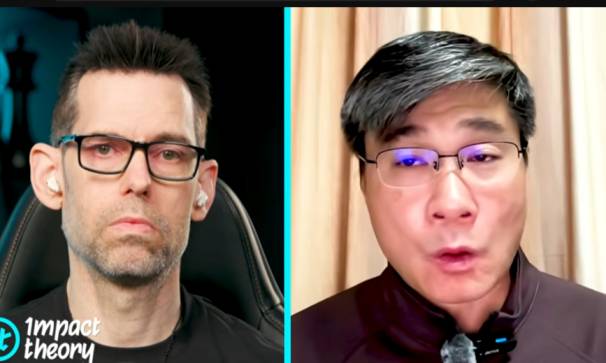
Editor’s Notes: In this episode of Impact Theory, Tom Bilyeu interviews Prof Jiang Xueqin of the Predictive History YouTube channel to analyze the escalating conflict with Iran through the lens of historical cycles and imperial decline. Prof Jiang argues that the U.S. is currently trapped in a “toxic combination of hubris and desperation,” where the refusal to admit the possibility of defeat leads to a dangerous doubling down on military force. The discussion spans from the economic importance of maritime choke points and the “McKenna thesis” to the use of religious eschatology as a repository for historical memory and game theory. Ultimately, Jiang provides a provocative look at why current leadership remains insulated from the realities of the war and what this means for the future of the American empire. (Mar 19, 2026)
TRANSCRIPT:
Can the US Win or Exit This War?
TOM BILYEU: If you had to advise the US, what would you tell them if they actually wanted to either get out of the war with the least amount of damage or actually win? What is the play here?
PROF JIANG XUEQIN: So a lot of the problem is that if you look at Empires in decline, they’re no longer capable of strategic planning because there’s a lethal and toxic combination of hubris and desperation. Washington D.C. has become an insular bubble.
If you just look at these press conferences where reporters are like, “Hey, Mr. Trump, what’s the plan here?” And then Trump’s like, “Shut up, man, I’m going to put you in jail. In fact, I’m going to pass a law that says if you criticize us in the war, we’re going to put you all in jail. We’re going to shoot you to death.” That’s how empires behave.
And so at this stage where empires are in decline, and the leadership is unwilling to admit any possibility of defeat, they’re just trying to force everyone to repeat talking points. Pete Hegseth in his press conferences is just saying, “The problem with you guys is you don’t talk about the good things. All you talk about is the bad things. Stop talking about the bad things. Just focus on the good things and then we’re good.” And what he doesn’t recognize is, the war’s going bad — you need to hear it. And they absolutely refuse to hear it.
So why America’s decline is happening is they’ve become so arrogant and so insular that they refuse to consider the possibility of defeat, so they always double down. And I don’t know how you resolve this issue.
How Will This War Actually Play Out?
TOM BILYEU: Yeah, it isn’t going to be easy, that is for sure. So if we don’t know how to do it well, what is your prediction for how it’s actually going to play out? Is this a Trump declares victory, leaves it in chaos, comes home — or is this Trump gets sucked in because Israel and Saudi Arabia want a ground war, they want this protracted thing to play out so that they can basically jockey for power in the Middle East? Which of those two scenarios is more likely, in your view?
PROF JIANG XUEQIN: Right now there’s a talk of war, so it’s almost impossible for us to ascertain who’s winning this war, because the Israelis and Americans are doing tremendous damage to Iran. The Iranians are fighting back as well. So we can’t actually ascertain who’s actually winning this war.
But if you just look at historical examples, if you just look at game theory, then the idea is the Americans are stuck where they are and they can only double down — because if they ever quit, it’s not sunk cost fallacy. It’s like you go to the casino and you’re losing $100,000. If you quit now, you’ll always lose that money, so you keep on gambling.
So unfortunately, what game theory suggests is that Trump’s just going to double down. I think what he’s going to do is he’s going to take Kish Island and he’ll do it very easily, and then he’ll want to secure the coast as well. And so you have mission creep.
Unfortunately, he’s being egged on by both Israel and the GCC, because Israel clearly wants this war to escalate. And the GCC wants to remove the Iranian threat as soon as possible because they see the amount of damage that the Iranians can do to the GCC. Dubai, if nothing changes, will just cease to exist — because Dubai is just based on the perception that it is a safe tax haven. But if Iran can just rain drones on Dubai uncontested, then no one’s going to put their money in Dubai. So for Dubai to continue to thrive, it needs to destroy Iran and remove that threat from the Middle East.
So unfortunately, the way that things are structured suggests that this war can only escalate and not actually move towards a ceasefire.
The Real Cause of the War: Deeper Than Nuclear Weapons
TOM BILYEU: All right, the official story is that this is a war to stop Iran from going nuclear. But the framework that you’ve been working off — that allowed you to predict this war nearly two years ago — suggests the structural forces that are actually driving it are deeper than that. If the war in Iran is just a symptom, what is the actual sickness?
PROF JIANG XUEQIN: We know the cause is not Iran’s nuclear program, because a few hours before the Israelis struck Tehran and killed the Ayatollah, the Omani foreign minister went on TV and said that the Iranians had already agreed to zero uranium enrichment, even for civil purposes — which was previously a red line. So we know that the nuclear program is not the real cause.
And in fact, Trump has yet to articulate a good reason for why this war started in the first place.
So let’s go over some possibilities. The first possibility is that this war had to happen. And the reason why is the nature of the American Empire. The American Empire’s power rests mainly on its ability to control maritime trade — its ability to control key maritime choke points, like the Strait of Malacca, the Strait of Hormuz, the Strait of Gibraltar.
The British Blueprint: Controlling the Heartland
The great fear is that the Eurasian continent would unify under a great power. In the beginning of the 20th century, there was a British strategist named Harold Mackinder, and he argued that the greatest threat to the British Empire was the rise of a Eurasian power — whether it be the Ottoman Empire, the French, the Germans, or the Russians. Because if that power were to arise, it would unify both Europe and Asia, connect the entire Eurasian continent through railways, and then absorb the Middle East, Africa, and Southeast Asia into a kind of trading block that would negate the naval power of the British Empire.
The British Empire only had naval power. It didn’t have the population to sustain a land army — we saw that in World War I and World War II. So the entire strategy of the British was to cause as much discontent and chaos in Eurasia as possible, and if a great power were to arise, basically go to war against that power.
We first saw this strategy play out during the Napoleonic Wars, when Napoleon basically unified Europe. What Britain did was fight seven wars against Napoleon. They lost six and they won the seventh.
TOM BILYEU: Do you think that the Brits at that point saw that as an existential threat, and that’s why they were going that hard?
PROF JIANG XUEQIN: Yes, they did, because Napoleon wanted to institute something called the Continental System — basically just blockade England. Remember, Britain is a resource-poor island, so they were blocked off from the European continent. If Napoleon was able to embargo them, they would have starved, basically.
The Bank of England and the Financing of Empire
There’s also another issue in that there are two main sources of British Imperial power. The first, of course, is the Royal Navy. The second — which is actually more important — is the Bank of England.
The Bank of England was chartered in 1694. 1688 was the Glorious Revolution, which is important because that’s when basically the Dutch Republic merged with the British Empire. The Dutch prince, William of Orange, went over to England to become their king — something called the Glorious Revolution. When the Dutch aristocracy went over to England, they also brought with them their capital and their wealth. And so they set up the Bank of England as a private bank that would serve British monarchical interests.
Previously, if you were a merchant, you lent money to a king to fight his wars. The problem with that is that the king could die, the king could lose the war, or the king could just renege on his promise and say, “You know what, I’m the King — you can’t do anything about me, so screw off.” So there was a lot of risk involved in lending money to a king.
The great innovation of the Bank of England is that you no longer lent money to a king — you lent money to the Parliament, the nation-state. When you do that, everyone in the nation, including the children and the grandchildren, are now obliged to pay you back. In America, this became the Federal Reserve System.
In other words, all this wealth in Europe that was looking for stability all went to England — including from the Dutch Republic, but also including the Habsburgs and the Catholic Church. And so that allowed England infinite financing for wars. So even though it could not produce a land army, it could give you the financing to fight Napoleon. And that’s what led to the seven Napoleonic Wars. But the problem with this is that once you start to fight a war, you have to keep on fighting — because if you stop, if you lose, then you lose all your money. It’s almost like a Ponzi scheme.
And so in the seventh war, Britain won, was able to force an indemnity onto the French, and that saved the British system. After the French came the Russians, which led to what has been called the Great Game between Britain and Russia in Central Asia.
TOM BILYEU: But with the same idea — they’re trying to stop them from forming this heartland alliance so that they can do trade via trains.
PROF JIANG XUEQIN: That’s exactly correct.
Controlling the Seas, Controlling the World
TOM BILYEU: I want to keep beating this point for people, because this is one of the more brilliant ideas that I had never heard of before that you brought forward. I’m constantly trying to get people to understand what’s going on in Iran through the lens of economics. And I don’t know if this is going to be a point of agreement between us or a point of contention, because I know we’re going to get into the religious element of it with your thesis on eschatology — we’ll get there in a second.
But this idea that multiple different empires have tried to unify that heartland across Europe — that would essentially go from Eastern Europe all the way to the Middle East — I had often wondered: you hear a lot that the US patrols the seas, that England did it before them. And I was always like, how, with boats that can’t go on land, how exactly are you controlling this large empire via the sea?
This is the first time I’ve heard somebody really dive into: well, if you force commerce onto the water, you actively stop it from going on land. Now you get these few choke points, and if you can control those choke points, you control the economics. And if you control the economics, you basically control the world.
I’ve had a shockingly difficult time getting people to view this war through the lens of economics. Now, I know you’re just starting here and you have other things. Do you feel like the economic lens is the predominant lens, or are we going to get to something that you think is actually even bigger than that?
The Economic Lens: Why It’s Not Enough
PROF JIANG XUEQIN: Yeah, I think the economic lens is the priority, but there are other issues adjacent to this economic issue. And about understanding these other issues, we can’t really understand what’s really going on because it was purely an economic issue.
Then what America could do is say to Iran, “Let’s just be friends, let’s be trading partners.” And Iran would be ecstatic about America lifting sanctions because the entire point of negotiating with America on the nuclear deal was to lift sanctions. So if it was purely economics, then America and Iran would have sat down, like 1979, 1980, whenever, and just agreed on an economic solution to their differences.
And 40 years later, there’s never been a serious economic solution. And so this tells us that, yes, economics is at the heart of it, but doesn’t really fully explain what’s going on.
The Handoff from Britain to America
TOM BILYEU: Okay, I want to set the religious component on the shelf for now. We’ll get to why the right lens is economics. But however, if you want to know why people stop being rational actors, we’ll get to that.
So we’ve got this Mackinder’s Heartland thesis. The British have it. They’re fighting against, first France, then Russia. That keeps going for a while, but the baton handoff from the Brits to the US — running the same strategy — is something that I think certainly Americans are largely blind to. Can you walk us through that, and why something that made sense for this tiny island continues to make sense for the gigantic land mass and economy that is the U.S.?
PROF JIANG XUEQIN: So we have to remember, much of the reason why Britain was able to keep its enemies in the heartland at bay was because it allied itself with the Germans. Basically, it was an alliance with the Prussians that allowed the British to defeat the French at the end of the day.
But in the late 19th century, about 1870, Germany unified under Bismarck and now they had their own ambitions. And now Britain came into conflict with Germany. The Germans were extremely technologically advanced at their universities. They were extremely sophisticated, cultured people — just the best philosophy in the world — and they had the best general staff in the world. So Britain found a tremendous adversary in Germany. So much so that it took two world wars to defeat Germany.
We can argue about the causes of World War I, but most historians agree that World War I was caused because Britain was a hegemon and Germany was the challenger — a rising power that threatened the economic and imperial security of Britain. And that’s what ultimately led to World War I. And America came into the war because, quite honestly, it seemed as though Germany was going to triumph in the end. So it took basically an entire global alliance to defeat Germany in World War I.
The tragedy, the travesty of World War I is that in the Versailles Conference, the Allies made Germany take all the guilt for causing World War I, which was extremely unfair and inappropriate. And it basically laid the seeds for World War II.
And so you have World War II, and now Germany is spreading across Europe and decided to attack the Soviet Union, which is communist. You would think that America and Britain would fight alongside the Nazis, but instead they chose to support Stalin. And again, the reason why is the Heartland Mackinder thesis. You cannot allow a great power to emerge in the Eurasian continent. And at that time it seemed that Germany was a threat, because if you marry German technology and logistics organization with Russian manpower and resources, then this is the empire that rules the world. So America could not allow that to happen.
World War I and World War II exhausted Britain and forced the peaceful transfer of imperial power from Britain to America. And this was cemented in something called the Bretton Woods Conference of 1944, which established the global financial order that we live in today. So that is the story.
Why America Accepted the Imperial Mantle
TOM BILYEU: Okay, so the part that I think a lot of Americans will be a little bit baffled by is — why is that handoff so obvious? The idea that the way to rule the world is to stick with these shipping lanes makes sense when you’ve got a small island. It gets more confusing when the US is a gigantic landmass with cooperative neighbors — certainly right now to the north and to the south.
So why did we accept this idea of trying to patrol the entire world via the seas? Was it just that the call of being the imperial leader is so strong and so intoxicating that we’re willing to take on the risk of empire? Or was it that, well, that’s what we’re going to have to do to make sure that the dollar remains the world’s reserve currency?
PROF JIANG XUEQIN: So I think that at the end of World War II, first of all, there was a lot of tremendous goodwill among the Europeans for what America did. Americans made a lot of sacrifices to save Europe from fascism, and so the Europeans were very grateful.
The real concern was that if America retreated back into its continental fortress — which is what America did at the end of World War I — then another threat would arise in Europe, possibly the Soviet Union. And so the Europeans were very much interested in ensuring that America stayed interested in European affairs. And that’s what led to the NATO alliance and the Marshall Plan.
America itself recognized that if it did not help the Europeans, then Communism would ascend. Communism had already won in the Soviet Union and it was clearly going to triumph in China. So now you have a combination of both the Soviet Union and China, and that really scared American policymakers. So it was in their best interest to revitalize Europe and Japan as soon as possible. And that’s what led, of course, to the Marshall Plan.
So I think it was a combination of idealism, goodwill, as well as just realpolitik, long-term strategic planning.
From Pax Americana to Unraveling
TOM BILYEU: Okay, so with that as the backdrop, we now understand that America’s taking the baton. They’re patrolling the seas. For a very long time, they’re really holding at bay Russia from becoming the next great power. We end up winning that largely because Russia just imploded by not being able to figure out a successful economic system.
Now you get Pax Americana — a monopolar world where they’re just running everything. How does that end up pushing us towards this moment? Because for a lot of people that grew up under that, it was awesome. You and I, I think, were actually born in the same year. So for me, this has just been like, yo, this has been amazing. And watching it unravel is deeply distressing.
But seeing it up close, as an entrepreneur, the way that I kept interfacing with something I’ve heard you talk about — but using very different words — is that some people need to be chased by a lion. Without hardship, without having to fight and struggle for something, the ideas that take root in people’s minds are very distorted. They begin to think that the world is just always going to be peaceful — that’s just the default stance. And so they’re not thinking about the real things that it takes to maintain a hegemonic structure like we had for so very long.
So when you think about the structural forces that were at play post the collapse of the Soviet Union, why did it get worse and not better?
The Exorbitant Privilege and the Rise of the Petrodollar
PROF JIANG XUEQIN: Okay, so to answer this question, we have to look at what America’s major imperial innovation was.
The Bretton Woods Conference of 1944 was to establish the US dollar as the world’s reserve currency — something called the “exorbitant privilege.” And America did this to the benefit of Europe, because what this meant was that America was basically financing the reconstruction of Europe and Japan. Europe was devastated by war and needed to rebuild its factories and manufacturing, but they needed an outlet and consumers. So Americans agreed to buy from Europe, and America would also sell to Europe. The point was to very quickly build the manufacturing capacity of Europe as well as America. This was all made possible because of the US dollar.
The problem is that when you have fiat currency, there’s always a risk that you print too much money and lose financial discipline. So the agreement was that the US dollar would be pegged to gold — at any time, Europeans could redeem US dollars for gold. And so the US dollar basically became a contract between the Europeans and the Americans.
This worked out really well for the first ten years and led to tremendous post-war prosperity. But over time, the Americans started to overreach and abuse this exorbitant privilege — in Vietnam, for example. America was financing this war in Vietnam that served no strategic purpose. Then you had the space race, where America was spending billions of dollars to send a man to the moon. And then there was the Great Society of Lyndon B. Johnson, which was tremendous for the American people, but it made the Europeans question how much gold Americans actually had at Fort Knox.
So the French famously sent a frigate — a ship — to New York to pick up their gold and take it back to France. And that led to something called the Nixon Shock. In 1971, Richard Nixon said that the US dollar would no longer be pegged to gold.
Now you have a problem: if you’re not pegged to gold, then how do you determine the value of your currency?
The Petrodollar and China’s Rise as the World’s Factory
Nixon did two things which were crucial and which basically established the world order that we live in today.
The first thing he did was sign a deal with Saudi Arabia, where Saudi Arabia would only sell its oil in US dollars. That led to something called the petrodollar, which is now the basis of the US dollar.
The other thing that Nixon did — which was also very important and which people don’t really discuss — is he went to China and made a deal where China would basically export its cheap labor, and in return they would get US dollars. So these two deals — the petrodollar, as well as China becoming the factory of the world — became the basis of the new global economy.
And in 1991, when the Soviet Union fell, this system then became the global financial order.
The 2008 Crisis and China’s Bailout
This was fine — until there was excess capital being produced around the world, and it all went to America. At this time, America was shifting its manufacturing to China. So the economy of America became very unbalanced. It shifted from a focus on manufacturing to a focus on financing. Wall Street started to explode in both financial and political power, and that led to hubris.
Wall Street, because it had to create financial vehicles to absorb all this foreign capital, started to invent all these risky derivatives — CDOs, collateral debt obligations. And this, of course, led to the 2008 subprime crisis.
At this point in history, essentially the entire global economy should have collapsed. Why? Because Wall Street had basically bundled the entire global economy together so that if one part of the system collapsed, the entire system collapsed.
The system didn’t collapse because something happened: China bailed out the world by printing all this money to build infrastructure throughout China. China basically became the consumer for the world’s raw materials in order to build its skyscrapers and its high-speed rail. And that worked out really well for the world.
But then China said, “Well, before we were exporting our cheap labor, and now we are financing the global economy, so we want to have a greater say over global affairs. We want our companies like Huawei to go to Africa and sell our products and compete against Apple.”
And Americans didn’t like that. And that’s what led to the Trump tariffs. When he came to office in 2016, the first thing he did was to sanction these Chinese companies. And that’s what led to the trade war.
So you have all this instability now in the system because China is trying to contribute heavily to the global economy, but it wants more political power because of this. And Americans are saying, “No, we are still ahead — you have to listen to us.”
So the 2008 great financial crisis was a heavy blow. Then the trade war with China was also another heavy blow. But the next heavy blow was, of course, the 2022 Russian invasion of Ukraine.
TOM BILYEU: Why?
The Financial Weaponization and Its Consequences
PROF JIANG XUEQIN: Because after that happened, America started to use its financial weaponry to sanction Russia. It basically removed Russia from the SWIFT system and it froze Russia’s $300 billion in assets in Europe and in America. And when it did that, it actually backfired because remember, the entire global financial order is based on legitimacy and reputation. And when you steal someone’s money, you destroy your reputation.
So Putin’s response was, “Wow, $300 billion is the best money I’ve ever spent in order to collapse the American-led global financial order.”
And so this is what’s led to a lot of the issues that we have today, where underpinning the global financial order is the US dollar. But people don’t have as much faith in the US dollar as possible. So how do you compensate for that? You compensate for that by using military power.
And this helps us understand this war in Iran, where by going to Iran — and we have to assume that the Americans under Trump were planning for a short, decisive war to control Iran. And once you control Iran, you control the entire Strait of Hormuz. You control all the resources, you can control global trade.
Also, what’s really important is you prevent a Russia, Iran, China alliance from forming. Because once that happens, once China, Russia and Iran come together and trade and create this trading block, it achieves the heartland. And then Europe comes in, then the Middle East comes in, then Africa comes in, food breaks.
So from an economic perspective, Americans didn’t have a choice in the matter, in that the US dollar was extremely unstable. People didn’t have any faith in it anymore. And so you had to use force to remind people that the US dollar is still the only global reserve currency. And so they went into Iran hoping to control that crucial choke point of resources in trade. And it’s really blown up in their faces.
The Petrodollar System and the Erosion of Trust
TOM BILYEU: This stuff is really good. Okay, so you’ve put a couple of pieces together that I think are really important and I’m going to say it in a slightly different way and see if this lands for you.
So 1971, Nixon breaks the peg to gold. You become a true fiat currency. There’s now no real tether for you. The world begins to realize, “Okay, hold on a second, this is just fiat. You guys are going to print out of control like every empire before you.”
And so Nixon does this brilliant thing and he finds two avenues to keep making the dollar systemically important. He gets essentially the vast majority of oil trade to be only transacted in dollars. Presumably you didn’t say this, but I think it’s basically, “We’ll protect you, dear GCC countries. So you can’t really protect yourself — super exposed there in the desert. Don’t worry, we’ve got you. You guys focus on infrastructure, desalinization, all that stuff and we’ll run your military for you.”
That works out very well. “Hey China, we need cheap labor, but hey, we’ll make sure that we’re buying a lot of the stuff that you’re producing. Just make sure that you’re also doing trade in dollars.”
So you’ve got energy now pegged to dollars and you’ve got this industrial revolution — not the one that most people think of when they hear that, but this new rise of China as the world’s manufacturer — also now being tied to dollars.
Then because of course, as empires do, they overextend, they bully, they do things that ultimately are against their own interests. And we begin eroding the trust in the dollar, which is the only thing left on a fiat currency.
And so the part that I want to reword is when you say that we use our military to remind people of the power of the dollar or that we’re strong or whatever, I would say it slightly differently. And this gets to why Iran becomes so important.
What actually happens in Iran is it isn’t enough to remind everybody that you have a big military. You actually have to get control of Iran. You have to control the oil now. You have to control the Strait of Hormuz. And if you either are forced to destroy the oil, which now is going to just have a massive negative impact on the global economy, or because of asymmetric warfare, Iran continues to cause a problem in the Strait of Hormuz — and it’s technically open, but every time a US or US-allied ship tries to go through, it gets blown up — now, all of a sudden, you may have reminded everybody that you have the stronger military, but Iran is showing you they can still control the thing you must get control of if you want to win.
Israel, Saudi Arabia, and the Coalition Behind the Attack on Iran
PROF JIANG XUEQIN: I would disagree, because you are saying that the Americans went in hoping for a Venezuela solution, where they removed Maduro, and that’s Rodriguez, the Vice President, who was very happy to play along. So it’s basically regime change that favors the Americans.
So let’s just discuss how the interests of Israel and the interests of Trump are different. Because as you point out, Trump is interested in optics. He wants a quick victory. He wants the Iranians to surrender to him, and he wants to be able to control the oil supply so that when he goes to Beijing at the end of this month, he can negotiate a great deal for America and he’ll look really, really good. Because he just came off a very decisive victory in Venezuela. So he was very arrogant, very confident. That’s Trump.
But I think the Israelis really are thinking much more long term and they really want to eliminate Iran as a threat in the Middle East. And it’s not just the Israelis. If you look at Saudi Arabia, the Saudis have always had issues with the Iranians. So I think it was a coalition of interests — the Israelis and the Saudis — who were pushing Trump to attack Iran. And actually, reporting from the Washington Post confirms this, where MBS, the head of Saudi Arabia, was lobbying hard for Trump to attack the Iranians.
What Are Trump’s Options Now?
TOM BILYEU: The thing that I want to understand better is, given the quagmire that we are now in with Iran, what are the options that are on the table, especially for Trump?
So if you agree that for the US to actually have gained ground here, they need to control the Strait of Hormuz, or by some miracle, get a friendly government in Iran that will maintain control but do things that are very beneficial to the GCC countries, to the US, to Israel — which seems sort of farther away by the day — do you think he’s going to push into Kharg Island and take over? It’s like 94%. Do you think he goes all the way to a ground invasion? What do you think are the options at this point, given the realities on the ground?
The Kharg Island Gamble
PROF JIANG XUEQIN: What I’ve observed is that Trump and America are behaving exactly the way that an empire in decline behaves, which is that they suffer from a toxic and lethal combination of both hubris and desperation. Meaning that they continue to underestimate the resilience and resolve of the Iranians, and they are desperate for a knockout punch as quickly as possible.
Trump wants this war to end as soon as possible because he knows that the longer this war drags on, the worse the economy will suffer, the worse his polling will be, and the more likely the stock market will tank. So he’s looking for a knockout punch.
And right now, if you’re looking for a quick solution, if you’re looking for a gamble, well, your best option is Kharg Island, because as you point out, that is where Iran exports 90% of its oil, primarily to China. So right now, a Marine Expeditionary Force is traveling from Japan to the Middle East, and we should expect them to arrive maybe in about a week. There are about 2,500 of them, and they specialize in amphibious landing.
So the idea is that they will bombard the coastline and Kharg Island, and this will enable the Marines to land and secure the oil depots of Kharg Island. And at this point, Trump will declare victory and try to get the Iranians to the negotiating table and say, “Listen, I have Kharg Island, and this is your economic lifeline, so let’s cut a deal that allows us to both save face.”
And I think that is the plan. But there are a lot of issues with this plan.
The first issue is that Kharg Island is not as important economically as people believe. Meaning that even if you were to secure Kharg Island, Iran does have workarounds where they can just ship from the coast. That’s issue number one.
Issue number two is that Iran needs financing for this war, and now they’re using this oil as financing, as collateral financing. But if the Chinese and the Russians believe that the Americans want to strangle Iran, then it’s not in their best interest to see Iran destroyed — they will provide financing anyway. And look, the reality is that now that oil is shooting up in price, this benefits Russia tremendously. So Putin can take all this oil wealth and finance Iran in fighting this war. Because Russia has the most to lose if Iran loses this war and there’s regime change. So that’s issue number two.
Russia’s Stakes in the Iran War
TOM BILYEU: You think Russia has more to lose than China?
PROF JIANG XUEQIN: I do. And the reason why is that if Iran were to fall, this opens up the Russian sovereign flank to the Americans. Because Azerbaijan is an Israeli-American ally. And if Iran were to fall, then the Americans and Israelis could stage operations from the south.
Also, Iran has been providing a lot of support to Russia in the Ukraine war. Russia is getting most of its drones from Iran. So Foreign Minister Sergey Lavrov has said that Russia will protect Iran, and Russia is most interested in the Iranian government staying intact. And there’s been reporting from American news outlets that American intelligence believes that Russia is providing targeting for the Iranians. So all these drone strikes, all these ballistic missile strikes — they’re getting intelligence and targeting from the Russians, which, by the way, is what NATO did in Ukraine. So from the Russian perspective, it’s payback. The Russians are heavily invested in the Iranians winning this war.
The Chinese are problematic. They really don’t care. They see Iran more as a major supplier of oil that they need. But if they need to shift supply routes, they can do so. So the Russians are heavily invested, and they will finance the Iranians regardless of whether Iran is no longer able to export oil.
The Danger of Mission Creep
PROF JIANG XUEQIN: And another issue is this. If you attack the economic lifeline of Iran, they now have incentive to strike at the oil refineries of the GCC. Because no matter how much economic damage you can do to Iran, they can do so much more to the GCC. And this would cause the price of oil to spike. Remember, the Iranians have said that their goal is to spike the price of oil to $200 a barrel. Now it’s about $100 a barrel. And so what they’re saying is that we’re going to fight a very long war of attrition that could last years.
So I don’t see what the strategic benefit of taking Kharg Island is.
The last problem — and this is the most important — is that once you take Kharg Island, you expose the Marines to drone strikes and artillery strikes from the coast. Which means that you now need to send in more Marines to secure the coast. So you sent in 2,000 to 3,000 troops to secure Kharg Island — you’ve done that easily. But they can’t secure the island against Iranian drones.
The only way you can do that is by taking the coastline along Kharg Island. You do that with tens of thousands of Marines, but then you expose these Marines to attacks from the Zagros Mountains — drones, missiles from the Zagros Mountains — which means that now you have to invest 100,000 troops to go after Iran’s underground missile facilities.
And this is exactly what happened in Vietnam. The great irony of all this is that the Marine Expeditionary Force that is going to Iran is the same force that went into Vietnam and marked the first major ground involvement of the Americans, in about 1965. They basically went into Da Nang and secured the Air Force base. At first it was like 3,500 soldiers, and that was supposed to be it. Five years later, you’re at 500,000 American soldiers.
So once you send in ground troops, it creates a logic, a momentum of its own. Then you have mission creep, and that’s on-cost policy, and then eventually you have a natural draft. That is the great danger of taking Kharg Island at this point.
The Trap of Escalation: Why America Cannot Retreat
TOM BILYEU: Okay. So let’s keep pushing down that road, because I think that you’re bang on with this. I think if Trump puts boots on the ground in Iran, I think he can get away with Khark Island because it will be small. It will feel like, “Hey, we’re doing this very discreet thing. We can take it in a couple days. We’ve got it now.” He’ll declare that that’s a big win for us. We control 94%. He buys himself a little bit of time. Most people don’t know what you just said, which is Iran has other options. So that’s going to feel — going back to Trump equals optics — it’s going to feel like an optical win.
The thing that scares me is I think, to your point, he will end up getting drawn into boots on the ground because, one, he’ll have seen, “Oh, the American people didn’t super freak out.” Okay, that’s great. We all start going, “Well, I mean, I guess we already have boots on the ground, so it’s not so crazy that we go just try to finish the job real quick.” But by doing that, I think that his base implodes. I think he is a guaranteed loss at the midterms.
And I think, given the political dynamic in the US where we are so hyper polarized, that it becomes existential for him in terms of — he will go to prison. So if he loses the midterms, he gets impeached immediately. He then obviously loses power in 2028, which needs to happen no matter what, given that right now our Constitution makes it very clear, no third term for you.
But I think that we would — I mean, look, many, many a thing can happen between now and the 2028 elections. But I would imagine if Trump goes down, the Republican Party loses power, Democrats get into office, they have already vowed that they’re going to go after him legally. So I have a feeling he’s going to fight like this is existential. He’s going to start making decisions that would seem irrational to anybody else but will seem rational to him, because he absolutely must find a way to victory. Better to prolong it, leverage a war to stay in power, etc.
So walk me through if you think any of that analysis is off base or if I’m missing something, but what do you see if he makes the fateful decision to go after Khark Island?
PROF JIANG XUEQIN: Yeah, no, I agree with your analysis. I think a lot of his thinking is, “How does he stay in power?” Because we know exactly what’s going to happen if he leaves office. The Democrats are going to come to power and they’re going to go after him and his family. We know this because that’s what happened in 2020. Remember the raid in Mar-a-Lago? Remember all this lawfare against Trump? Remember that he lost his court case and it almost bankrupted him? Okay, so you can imagine that there’s going to be a lot of people who want revenge for what Trump is doing in his second term.
So Trump cannot afford to leave office. And so his personal calculus is, “How do I stay in power?” Well, staying in power via the ballot box is very risky. But if he starts a war, and this war is at first supported by both the Democrats and the Republicans, but then slowly this war spirals out of control and there’s a lot of unrest around America — in which case he’s forced to send the National Guard and then he’s forced to call the national draft in order to protect American interests in the Middle East — then he can conceivably stay in power for as long as this war continues.
And we know this because of what happened with Zelensky in Ukraine. Because of the war in Ukraine, they’ve suspended their constitution and they suspended elections, and Zelensky is still in power. Remember when Zelensky visited Trump in the White House, Trump asked Zelensky, “Hey, can you really do that?” And then Zelensky is like, “You like this, don’t you?” So I think unfortunately that is going through the mind of Trump right now.
Why America Cannot Simply Declare Victory and Go Home
I just want to step back, because a lot of people are saying, “Won’t Trump just declare victory and go home?” The problem with this is, if Trump were to leave the Middle East, basically the American empire would collapse. So let’s go over, using game theory, what would happen if Trump were just to say, “You know what, I killed the leadership, I destroyed the nuclear weapons program, I set back their ballistics program. Everything I wanted to accomplish, I’ve already accomplished. I’m going to go home, guys. Goodbye.”
Okay, what happens is this. Iran would say to the GCC, “Hey, you’ve destroyed our country. You have to pay back reparations. If you don’t pay back reparations, first of all, we’ll continue to attack you and destroy your oil infrastructure. And second of all, we won’t let you use the trade from Hormuz.” And so now the GCC is forced to take their fortune in dollars in sovereign wealth funds. Before, this money was going to the United States. Now it’s going to Iran to build back their economy and infrastructure and their military.
But then the Japanese and the South Koreans are like, “Well, we just saw what happened — the Americans attacked Iran, and Iran fought back and destroyed the GCC. And the Americans refused to defend the GCC.” Remember, the entire point of the petrodollar agreement is that Americans would guarantee the security of the GCC. And when this war started out, what we know happened is that the Americans abandoned their bases, changed into civilian clothes, and moved into hotels because they could not stop the Iranians from raining drones and ballistic missiles on their bases.
So the South Koreans and the Japanese would be like, “Okay, well, we can’t trust Americans, so we need to remilitarize as soon as possible. Let’s just not depend on Americans and remilitarize.” But what that also means is they stop buying US treasuries. And so the US dollar loses buyers from the Middle East and loses buyers from East Asia. And so the dollar could potentially collapse in value.
Now America has $40 trillion in debt, which forces an economic crisis in America — a great reset, a financial depression. You have riots in the streets. And then you go to Europe. The Europeans are like, “The Americans are suffering from depression and the Americans are not able to defend their allies. Why are we fighting the Russians again? Why don’t we just come to an agreement with the Russians? Why are we sending our men to die in Ukraine?”
So now Russia becomes the dominant power in Europe, and Iran becomes the dominant power in the Middle East, and America is imploding back in the Western Hemisphere. Is that a situation that the American government, that Trump, would counter? I don’t think it is. So there’s really no possibility of America retreating from this war. America can only escalate, unfortunately.
The AI Bubble and the K-Shaped Economy
TOM BILYEU: Yeah. There’s another piece that I think is getting lost in all of this, which is Trump went to the Middle East and secured — I don’t know, call it $2 trillion in investment promises into the US, which will largely go into AI infrastructure. And if he doesn’t manage to restabilize the Middle East and make sure that the GCC countries don’t have to spend that money on their own defense, they’re going to pull all of that money to defend their country. That causes a shock, a potential collapse — or burst — of the AI bubble.
And so right now, the American stock market — as you well know, we have a grotesquely K-shaped economy. And the only thing propping up spending right now is that the wealthy few at the top are still buying a bunch of stuff. And that creates this illusion that the economy is doing okay-ish. And that stops if AI implodes. And AI doesn’t have to not be real — AI is real. But if the money stops flowing in, they’re not able to get the infrastructure investments they need to see this across the finish line so that the revenues can catch up. Because right now there’s still a massive gap.
We find ourselves in a position where the one thing propping up the US economy — poof — goes away. And so it’s like everything you just said, and then squared. Because you’ve got the second thing waiting in the wings. If the first one doesn’t kill the dollar, the second one could kill the thing holding up the economy.
PROF JIANG XUEQIN: Well, I completely agree. It’s a very dire situation.
Thucydides Trap: Does It Explain Trump’s Move Against Iran?
TOM BILYEU: Okay, so as we look at this — when I was trying to come up with a mental model for why Trump was pushing the issue to go to war with Iran, I was legitimately confused in the beginning. Because I understood the attack on Fordow — it’s like, “Okay, they’re about to get nuclear weapons, they chant death to America. Let’s just blow up their nuclear sites.”
PROF JIANG XUEQIN: Cool. Did it.
TOM BILYEU: “Hey, everybody. We demolished it.” And then all of a sudden he starts talking about, “Well, we’re sending all these boats to Iran.” And I was like, “Why? I don’t understand what’s happening.” And so then you’ve got all the uprisings and just more and more ships — “We’re going to help them out, all’s well.” But then we didn’t move at the peak of them killing 30,000-plus civilians. So then I was like, “What are we doing?”
And so then he starts talking about nuclear weapons again. And I’m just like, “Hold on a second. I thought that we already destroyed the nuclear capabilities, so what are we doing?”
For me to make this all make sense, I was like, “Hold on a second. If you inject Thucydides Trap and you understand we’ve got a rising China, a declining America, then this all makes sense.” If Venezuela and Iran are a one-two punch to try to do whatever amount of quarantining or economic damage that we can do to China — to make sure that they don’t have access to cheap oil that’s outside of our ability to sanction — I’m like, “This at least makes sense.” I’m not saying you should do it. I’m just saying I can follow your chain of logic.
One thing — you’ll talk about China for sure, but you don’t often mention Thucydides Trap. Do you think Thucydides Trap is overblown? Do you think it just doesn’t apply here? What’s your thinking on — could that have been the reason that Trump actually made the move?
The US-China Relationship: Cooperation Over Conflict
PROF JIANG XUEQIN: So this is a great question. And so let us just assume that Trump is rational and that there’s a logical strategy behind all this maneuvering in the Middle East. And the best explanation is that right now Trump is trying to negotiate with China.
Trump right now understands that the US Dollar is a Ponzi scheme. So it needs more consumers to buy into this Ponzi scheme. And China, for all its problems, the household savings rate in China is 40%. So there’s this untapped market in China that Trump wants to access. But how do you force China to agree to let Chinese consumers buy US Dollars? Well, you do it by strangling the Chinese economy. Because remember, the Chinese economy is export driven. Therefore it’s reliant on imports like oil and food. China imports about a third of its food and two thirds of its oil. China gets a lot of its food from the Western hemisphere, probably South America.
So that’s why we saw Trump announcing the mineral doctrine, the Trump corollary to the mineral doctrine, where the Americans would control the entire Western hemisphere. So if China wanted to trade with the Western hemisphere, the Americans have to collect a tax or a toll. And we’re seeing this play out in Venezuela where the Chinese are continuing to buy Venezuelan oil, but they pay the Americans a tax or whatever. Okay, so that’s the strategy in the Western hemisphere.
And Iran makes sense because China imports most of its oil actually from the GCC. So once you control Iran and you control the Strait of Hormuz, then you basically strangle China. And now China is forced to buy more oil from the Americans, the Canadians and the Mexicans. And so that would resolve the great financial crisis America is facing. It would basically save the US dollar. So from a rational perspective, this does hold.
But there are certain issues with this thesis. The first issue is that from the economic perspective, it’s very risky to use military force to resolve an economic issue. You don’t actually have to go and occupy Venezuela or attack Iran. You can negotiate a grand bargain, or a new trade alliance, which is more like BRICS, a more collaborative model. Okay, that’s issue number one.
Issue number two is I think this Thucydides Trap is overblown. So let me explain my reasoning. I think that China and the United States are co-dependent. What I mean by that is that in the 1980s America did offshore its manufacturing to China. What China did, and which people don’t really discuss, is China offshored its elite selection and indoctrination to America. Meaning that the Chinese elite were educated in American colleges and universities. And so they have a very American mindset in many ways. China has been colonized. Sorry, America has colonized China. And so the Chinese elite are very pro-American. And so you don’t really have to strangle China. You just have to make a deal with China. You just have to be nice to China because the Chinese are desperate for a deal.
And there are many ways that this deal could benefit itself. Trump has talked about welcoming 600,000 Chinese students to America. Trump has talked about selling digital currency to Chinese consumers, basically just tokens backed by US Treasuries. So there are a lot of mechanisms that he has to resolve this issue.
I really think this US-China conflict is overblown primarily because China is not interested in being a hegemon. It’s not even interested in controlling a sphere of influence in Southeast Asia. China is first and foremost interested in maintaining its national sovereignty and creating trade routes that benefit the Chinese people. And I think the American policymakers understand this, and I think that this China threat has always been overblown to justify a lot of bloated spending in Washington, D.C.
An example is AI, where the Americans are like, we need to spend all this money on AI because if we don’t do this, then the Chinese will do this. So China is this imagined threat for many decades.
And the last thing I will say is that people do not appreciate the level of cooperation between the Chinese and the Americans in this world. The classic example is if you look at what’s happening in the Strait of Hormuz, Chinese ships are able to pass through, and Americans are not doing anything to stop them. In fact, Scott Bessent, the Treasury Secretary, has said that we’re allowing this to happen to maintain stability in the global financial order. And both the Chinese and Americans are cooperating to maintain the stability of the global financial order, the global economy. But the Russians and Iranians are interested in destroying the global economy and creating a new economic system that benefits them. So people don’t appreciate that in terms of just pure interest, America and China are aligned against Iran and Russia, if that makes sense.
A Unique Lens on the US-China Dynamic
TOM BILYEU: It certainly makes sense. It is very different than certainly the mental map that I have of what’s going on, and probably the mental map of a lot of Americans, which is the absolute fascinating part about getting to talk to somebody like you.
For people that don’t know your backstory, I’ll speedrun it. Correct me if anything is incorrect. Born in China, you emigrate to Canada when you’re six. You are Ivy League trained here in the US but end up going right back after college, heading back to China, where you now live. We’re speaking to you from Beijing. If I’m understanding it all correctly, you were a teacher there at a private school, but everything that you post online is in English. So I presume that your classes are taught in English.
So you have a really fascinating lens. Chinese by birth and nationality, trained in the west, educated in it, grew up in the west, feeling quite alienated, go back to China, but still somebody with a more Western mindset. Again, I don’t want to put words in your mouth, but it is a very interesting lens with which to look at this problem. So first, did I represent the history accurately enough?
PROF JIANG XUEQIN: No, no, it was very fair and accurate. Yes.
TOM BILYEU: Okay, perfect. So now my mental map is that what’s happening in the world right now is really a question of the US and China. I’m looking at it very much like you, so it’s interesting that we draw different conclusions.
For people that don’t know you, which these days is a vanishingly small number of people, you’ve got two issues. One, that you’re looking at the world through the lens of game theory, and two, you’re leveraging history to tell us what we’re going to see in the future. And so when you look backwards at history, 12 of the last 16 times that a rising superpower collided with a declining superpower, exactly like the US and China, they went to war. So it’s like, whatever, 75% of the time, this ends in war.
And so I’ve been looking at much of Trump’s movements. He’s somebody who’s been banging the drum about China for a very long time, much longer than he’s been a political figure, and saying, okay, this is a guy that’s had his eye on China for a long time, who either intuitively or actually intellectually understands America’s decline, understands China’s rise, and is trying to find some sort of equilibrium. He’s the art of the deal guy. So I think you’re right. He’s perfectly willing to cooperate to get a deal done. I don’t think that Trump is going to make any play whatsoever to infringe on China in its sphere of influence.
But you’re the first person I’ve heard say that China doesn’t want a sphere of influence. All they want is to be sovereign. So that is the first bit of dissonance where I’m intrigued. I will certainly sit with it. My whole worldview is about, you’re wrong about something, so you might as well race to figuring out what it is. And so, hey, maybe my whole frame of reference around the Thucydides Trap just isn’t accurate, but I’m going to have a hard time metabolizing that one. I’m not going to lie.
So, for instance, help an American audience understand — right now, some percentage of us, I certainly don’t think we’re homogenized thinkers, but some percentage of us see us at war with Iran. China now has all these ships and planes circling Taiwan. We all look at that as escalation. The people who think like this, which I am definitely one of, go, oh, China is now seeing us with our eye off the ball. They’ve said forever that by 2027, they want to reunite with Taiwan, which would be a huge blow to our perceived modern way of life because of TSMC. And so that feels like, given that and the Gold Corridor in South America and some of the moves with the Belt and Road Initiative, China is being more strategically aggressive than it sounds like you think they are. So help us understand why that’s wrong.
Rethinking the Thucydides Trap
PROF JIANG XUEQIN: All right. So the Thucydides Trap was coined by a Harvard historian named Graham Allison, and he did it for his reading of the Peloponnesian War. So I want to correct the understanding of the Peloponnesian War, because the war started in Thucydides’ formulation because Sparta was the hegemon and Athens was the rising power. And Thucydides was wrong. So let me explain why.
Sparta and Athens actually wanted nothing to do with each other. Sparta was an agricultural power, and Athens was a naval power. The Spartans had a plantation economy where their entire system was based on exploiting slave labor. But because they did that, they were outnumbered by the slaves 10 to 1. And so they were always afraid of slave revolt. And that was a consistent problem throughout their history because the Spartans were notoriously brutal, and as such, they developed a very conservative, insular society, and they were not interested in international affairs.
The Athenians were very different. The Athenians were a trading power, and so they were very expansionist. They were very ambitious. We know about the two because of the Persian wars. The Persians invaded the Greek mainland, and the Spartans and the Athenians were forced to come together to repel this invasion. But after this invasion was repelled, the Spartans were like, “We’re going to go home, and we’re going to stay in our land. Don’t bother us ever again.”
And then the Athenians created something called the Delian League, which was an alliance very much like NATO today. But over time, the Athenians started to abuse their allies and turn them into vassals. And then these vassal states started to rebel against the Athenians. And this is what led ultimately to the Peloponnesian War. And Sparta was dragged unwillingly into this war, and then Persia was as well. So it’s not as easy as Graham Allison and Thucydides are making it out to be.
And there are parallels to our modern society where it seems as though China and America are at war, in conflict, because these are two economic hegemons. If you think about it, the real issue is that America is trying to exploit its economic allies. Let’s go back to two months ago when Trump was saying, “I’m going to take over Greenland, I’m going to take over Canada, I’m going to take over the entire Western Hemisphere. And you Europeans, you need to pay more in NATO spending, you need to move to 5%. And also I’m going to charge you tariffs for trade, because we’re America, we’re indispensable, and you have to follow along because you’re vassals.”
So that’s really the real conflict going on in this world, where America is trying to maintain the unipolar order and its allies see that America has become arrogant and is engaged in bullying behavior. So they’re trying to break away somehow. And ultimately, if we just read the Peloponnesian War, this will lead to open conflict between America’s allies and America eventually. And then perhaps China and Russia are dragged in. But ultimately, China and Russia don’t want a conflict with America. So does that make sense to you?
Xi Jinping, the Middle Kingdom, and China’s Century of Humiliation
TOM BILYEU: I mean, it’s certainly believable that nobody wants a war with another great power. It’s just so destructive and can take so many years. I can certainly buy why Russia is reacting because of what’s going on in Ukraine. They would really not want to be a part of this.
Now, I’ve read enough about Xi and how he’s sort of — what’s the phrase? The ambition grows in the eating. China’s had, I don’t have to tell you, so much incredible success over the last 40 years. I mean, it’s really breathtaking. And that has to leave somebody with the feeling of like, we could do even more now.
This is so interesting, and I am so grateful to you for letting me say these things out loud to somebody who’s really in the middle of it. So in my reading about China and Xi specifically, there’s this idea of the Middle Kingdom. And so a big part of my mental map of why I think this is the most perfect Thucydides Trap ever is that China’s gone through the century of humiliation. You guys come out of that with a “never again” mentality. We’re not doing that anymore. We’re thinking very long range, we’re going to take our power back.
PROF JIANG XUEQIN: And —
The New World Order: De-Industrialization, Nationalism, and Mercantilism
TOM BILYEU: And you’ve actually done it. And so just like Trump strikes Venezuela and realizes, oh, like, I’ve got a really good military, I can really start doing some stuff here. I look at China and I go, how do you guys not look at what you’ve accomplished? And go, oh, okay. Like, we need to be methodical, we need to be thoughtful. And maybe we’ve got a housing crisis right now, so maybe we need to chill for a minute. But we know how to play this game. And so we’re going to keep going, keep going, keep going.
And so from the Western lens, it looks like Xi’s consolidating power, he’s purging the military because he wants to get everybody aligned with his future vision, where he wants to take things. And it feels like somebody who thinks, hey, this is all working, I’ve got ambitions. But they’re in terms of, look at the gold corridor, right? So just, you know, China wants to get out from under the dollar. They’re selling their debt. They’re — again, this is speculation based on watching how you’re moving — but the banks in China, the central banks are buying up a ton of gold. They’re talking about, hey, guys, we’re going to back our currency. They’re a little wishy-washy about that, but they’re buying so much gold and then appealing to the world to use the yuan as the reserve currency.
You start putting two and two together and you go, oh, I get the play. Talking about housing gold, actually in other countries. And if they can find a partner that will back them and say, hey, we vouch the gold is here, it’s not controlled by China, we’ve got it. The moves are so smart that I cannot help but then project onto it that this is somebody who’s not stopping now.
And so that’s where I bump into the looking at China as just completely sanguine and like, yeah, I don’t want any conflict. I get that they don’t want open conflict. I can totally buy that. But they’ve got the big agenda with Taiwan and they’ve made so many smart ally moves that if I’m China and I’m watching the US alienate all of their allies while I’ve been building all of mine, while they’re shooting themselves in the face economically — and okay, we’ve got a little bit of woes here, but we’re going to get back on track. We’re far more disciplined. 40% savings, all that — that just creates this mental model that I have of the ascendant China who’s not going to be told what to do by a clearly dysfunctional United States.
PROF JIANG XUEQIN: I think that’s a great analysis and I think absolutely right in that China has been signaling its intention to replace the American financial order with a new BRICS system based on gold, and that’s why it’s creating the Shanghai Gold Corridor. So I think what you say makes a lot of sense and I think it’s really part of Chinese policymaking to create as much economic diversity in the world as possible to hedge against the Americans.
The way I look at the world is for game theory. And for me, what’s really important is how nations have behaved in the past. So when you say the Middle Kingdom, the Middle Kingdom from a Chinese perspective just means that we don’t care about the rest of the world. We’ve never really cared about the rest of the world. All we care about is the internal stability of China because historically — and this is very important — China has been poor and corrupt and so rebellions against the government are very commonplace. And so your entire state apparatus is structured to ensure that local rebellions don’t arise.
And in the 1980s, there was a solution to this problem of local rebellions when basically the communist system had an agreement where, “We will engage in economic reform and we will allow the elite to engage in corruption.” And so that incentivized the elite to promote economic reform and turn away from the old socialist model of Mao Zedong. And in the 1980s, this was very controversial, but because of the financial incentives, the elite engaged in market reform.
But then you have a tremendous corruption problem. Also, where was this money going? They were engaging in this corruption. They weren’t putting it in China because it was not safe because they were stealing this from the government. So this was being transferred overseas to America, to Canada. And the amount of capital that was being transferred overseas was just tremendous. So much so that really the Chinese economy is now suffering under a deflationary spiral.
But it was not just capital that went overseas, it was also the elite that went overseas. The children, the families of the elite, all are now overseas. And if they are overseas, where are their national interests aligned? They want peace and harmony between China and America because they see China as a plantation economy where they can continue to exploit the economy and then take their ill-gotten gains and take it over to the Western lifestyle. And for many decades, this was just the way business was done in China. And it worked to the tremendous benefit of the Chinese elite as well as the Western economies.
And then when President Xi came to power, he recognized that this is not sustainable in the long term. Eventually our economy is going to collapse. Eventually we’re going to have to rebalance all over the place. And so he started to clamp down on corruption and he started to focus on national rejuvenation, on creating a national identity. And from his perspective, the way you do that is through unifying with Taiwan and establishing an independent economic system that is based on the Chinese yuan as opposed to the US dollar. So that was his intention.
But again, the reality is that China is a very corrupt place and so the elite are rebelling against him. And so these past two years — and this is about information — most of the generals in the military have been purged for corruption issues, for other issues as well. Meaning the military does not have the political will to engage in a foreign conflict anywhere. So yes, I understand there’s the intention of the state, but then there’s the cultural reality in which we live in. If this makes any sense.
The Death of the Post-WWII World Order
TOM BILYEU: That makes a tremendous amount of sense. It is the kind of thing that explains your absolute meteoric rise. This is a very, very useful conversation. I’m very grateful. Okay, so that’s a very clear picture of China that is very different, I think, than the common person in America would view it as.
I’m going to put that back on the shelf, let it sort of sit in the background as we get back to Iran and look at what I want to talk about. We’ve got those two things, so we’ve got China’s realities of everything. We’ve got US Empire acting the way that failing empires do. They’re flailing, they’re acting like bullies, they’re overextending, they’re getting themselves in trouble doing anything that they can to hold on to the vestiges of their empire.
A thesis that you’ve put forward that I find very compelling is that the current world order, the post-World War II order, the monolithic US as global hegemon — those world orders are done. They’re already dead. And maybe you’re watching the death throes or whatever, but the new world order is coming. And I want to understand what does the new world order look like? And with Iran as pivot point, what does it look like? How does this play out? How deep do we go? And why is there no sort of ability to preserve the current world order?
PROF JIANG XUEQIN: First of all, the current global economic order is based on the premise of cheap oil, right? Because cheap oil is the basis for everything. Not just energy — you also have fertilizer, which allows you to grow food. You also have sulfuric acid, which is what allows you to process semiconductors. So cheap oil, cheap energy is the basis for the entire global economy.
The reality is the Strait of Hormuz is not going to open tomorrow. It’s probably going to stay closed for the next few years. Meaning the world loses access to cheap oil. So we need to think ahead and see what this means for the rest of the world.
And so I would say there are three major trends that we should expect in the next four to five years, and I think these trends will be very, very salient.
The first major trend is de-industrialization and de-urbanization, meaning that it doesn’t really make sense to have millions of people live in cities doing digital work. Why? Because the economy is not balanced. You need people to grow food and then you need manufacturing as well. Before, you didn’t have to worry about this because it was a globalized economy where you could import food. Just think about how, if you’re a middle-class American, you basically have a higher standard of living than the Roman Emperor because you could, every day, go to the supermarket and eat avocados, cherries — you can have food from all around the world all the time. And again, this is because of access to cheap oil. But those days are gone. And basically economies need to become much more balanced economies. And that means moving people from the cities, especially young people, and moving them back to the rural areas so that they can grow food and be self-sufficient.
The second major trend is that before, globalization was the religion, was the faith of the times. But now that globalization is collapsing — because American power can no longer support globalization — nations need to reassert themselves. So you have the rise of nationalism, which then allows for remilitarization in order to protect their borders better. Because before you could just rely on American military power for protection, but now you have to defend yourself. And you do that through rejuvenating people’s sense of national pride and identity.
The third major trend is mercantilism — basically self-sufficient economic spheres around the world. And it’s going to look differently in different places. Europe might be a trading bloc onto itself, but in other places, maybe Israel, maybe Japan create their own economic zones through military power. And then in the Northern Hemisphere, I think that America will come out okay, because America is a superpower regardless. So America retreats from the rest of the world, but then it builds an economic system within the Western Hemisphere and then it’s fine.
So we’re seeing a rupture or splintering of the world, going back basically to the 1930s.
Winners and Losers in the New World Order
TOM BILYEU: That’s wild. Okay, so who are going to be the winners and who are going to be the losers in this,
Japan’s Resilience and the New Global Order
PROF JIANG XUEQIN: Right. So basically, whoever, whichever nation is most able to embrace these trends and transform the economies from one that is globally dependent to much more nationally dependent will survive. Okay? So that’s why I think that Japan in Asia is actually better positioned than China because the Chinese economy is too export orientated. Okay? China, the Chinese economy just relies on dumping cheap goods onto the global market. And you can do that again with cheap oil and a global marketplace. But once, you know, nations start to go into war and then they no longer trade, then China is forced to become much more insular.
And unfortunately, the Chinese economy is not balanced. Meaning, like it’s completely dependent on exports and consumers don’t actually have any demand because consumers don’t have any capital, they don’t have any savings to spend money on. Consumers are afraid of the future. They lack confidence. Okay, so China is in a very tough situation because the Chinese economy and Chinese planners are not able to make the transition from one that is a global economy to one that is a much more regional economy.
Japan on the other hand, has a history and a record of making radical transformations when the existence of the nation is at stake. Okay? So you just look at Japan, you think, “Oh my God, Japan is completely screwed because they have an aging crisis, because they are completely dependent on resources from abroad. They don’t actually have their own oil. And the Japanese economy, it has been in a deflationary spiral for the past 20, 30 years.” Okay, do you think Japan is completely screwed?
But when all hope seems lost, the Japanese somehow come together and then transform their entire system. Okay? And so this goes. So I’ll give a few examples where, you know, in the 1200s or 1300s when the Mongolians were coming to invade Japan, and Japan at this time was a feudal system. They came together as a people and they repulsed the Mongolian nation not once but twice. That’s very impressive.
Then you go to the Meiji Reformation, which is the mid 19th century when China had already been carved up by the Western powers. And Japan’s like, “Okay, we need to industrialize now.” And they did so in 20 years. All right. So much so that Japan defeated Russia in the Russo-Japanese War.
And then you go to the end of World War II when the Japanese economy was completely devastated. So what happened? The Japanese people came together and in 20 years time they became the world’s dominant manufacturing power. Okay. The Japanese are a special people. Never ever bet against the Japanese. So even though things look darkest for the Japanese, they are remarkably resilient and cohesive people. So I think they are the most likely to make the transformations necessary in order to survive the new global order.
Another thing I will say is the aging crisis, where every industrial economy is suffering from the aging crisis. Right? You have people living into their 90s, into the hundreds, and they’re not working, they are just consuming a lot of resources. And every industrial nation is going to suffer from this issue.
The Japanese are different. Meaning, if the Japanese nation is under stress and there’s a crisis and the elderly in Japan need to make the necessary sacrifices in order for their grandchildren to survive, they will do so, and no other nation in the world will do this. Okay. Get the baby boomers in America to make sacrifices for America. I mean, you can make the argument that a lot of the issues in America come from the fact that the baby boomers are a selfish, materialistic and self-absorbed generation that refuse to surrender power. Right. I mean, look how old their congress is. You’ve got this guy, Chuck Grassley. He’s like 94 or something? He’s still there. What is he doing?
Nationalism, Diversity, and the Limits of Multiculturalism
TOM BILYEU: Yeah, it is, I have to admit, it is pretty wild. Yeah. Japan is a unique case. It brings up the question, so you’re talking about people are going to get more nationalistic because they’re going to have to defend their own interests. And Japan is a special use case. Expect them to become a regional power because of their ability to coalesce, come together.
Japan is also making waves here in the US because they’re being so xenophobic and absolutely just deciding, “Yeah, we’re not doing any more immigration,” which is crazy, given that they have this aging population, they have this demographic challenge and they’re going to get rid of one of the easiest, maybe not the best, but one of the easiest ways to deal with it.
I’ve heard you say some things that to western ears is quite striking about diversity not being a useful thing at this time. Talk to me a little bit about that. What’s the thesis there?
PROF JIANG XUEQIN: Right. So the idea is that after World War II, there was a lot of discussion as to why World War II happened, and the agreement was excessive nationalism. Right. These nations like Japan and Germany became fascist. And so what we need to do is dilute the national fever of people around the world, and then you have eternal peace. And so a concept that came into popularity at this time is something called the open society, where you have open borders, multiculturalism, diversity, and now celebrated as a way to create common bonds among humanity. And for the longest time, this made a lot of sense.
And clearly, I benefited from this, because I was allowed to immigrate from a poor village in China to go to Toronto and then get a full scholarship to study at Yale. So I clearly benefited from the system. But now we’ve reached an extreme where to have any sense of community, to want to belong to a group, is considered racist and backward and provincial. And I think that’s just wrong.
I mean, I’ve been watching the spread of DEI in the United States, and I just think it doesn’t make any sense to me. I appreciate diversity. I appreciate multiculturalism. But to make it your official religion and to punish anyone who wants more balance in society, who wants to protect the American identity, I think it’s just fanatical. And I think if you embrace too much multiculturalism, which is what the Europeans are doing, it will lead to eventually national suicide.
Okay, so the example is in 2014, you have millions of these refugees from the Middle East fleeing war and terror created by the Americans, and they’re going to Europe. And quite honestly, the Europeans did not have the capacity to absorb these millions, tens of millions of refugees. But Angela Merkel, the German chancellor, said, “We can do this.” And it’s been a dumpster fire for Europe, all right? You’re talking about civil war possibly emerging in Europe over the next five to 10 years. You look at what’s happening in Britain, in France, their populations are being replaced.
And I’m not saying refugees are bad. What I’m saying is that nations need to protect their own identity and value system, because that’s what gives meaning and purpose to the local population.
I don’t understand why people are allowed to immigrate wherever. Like, it’s absurd to me where, you know, I’m from Canada, and there are a lot of Canadians who hate the liberal government of Canada because they’re very authoritarian. And I’m one of them. Okay, but you just shouldn’t be able to pack your bags and then move to America or Dubai or Singapore. You should have to stay where you are and fight for your community. Because that’s what we’ve done throughout human history.
If we always had the option of, if we’re unhappy, just moving somewhere else, we would never have human civilization. Human civilization is a coming together of people with a common bond, with a common sense of identity and then building on top of that. Right. So I feel we’ve gone too far. The very common phrase, now very popular phrase, is “suicidal empathy.” Right. Where you care too much about your neighbor when you should really be looking after your own house.
Values, Identity, and the Bureaucratic Overclass
TOM BILYEU: Yeah, that is an idea that’s gaining a lot of traction here in the US as we all think through how exactly do we deal with this problem. The thing that I’ve been trying to convince my audience of is that values matter. And so a lot of people are getting tangled up in this concept as if it were a race issue. It’s not a race issue. When you find somebody that, say, shares your religion, but they’re a completely different race than you, you’re far more bonded over the fact that you share a religion than you are alienated that they don’t look like you.
And for some reason, especially here in the west, we have just told the story over and over and over that everything comes down to your skin color. But I just refuse to believe that that’s the experience people are actually having. It comes down to, do you click with somebody? Do you guys view the world the same way? Do you enjoy each other’s company? And if you look exactly like me, but I can’t stand to be around you, I don’t have any sense of affinity towards you whatsoever. So, yeah, that one’s very strange to me. Now, speaking of that, as you were talking. Sorry, go ahead.
PROF JIANG XUEQIN: I feel I want to jump in here because this is a very important point where DEI multiculturalism is being used to justify the bureaucratization of society. Right. So this is not so apparent in America, but if you go to Europe and Canada, it’s really apparent where these nations are essentially authoritarian, where you say anything now, the police can come knock on your door.
So you go to England where, you know, if you are part of these grooming gangs, well, the police don’t come after you, but if you post about grooming gangs, they’ll come knock on your door. Right? And so Franz Kafka writes about this in his book, The Trial, where bureaucrats don’t bother with criminals because it’s a pain in the ass. So they go after ordinary citizens because ordinary citizens are compliant and it allows them to feel good about themselves and to collect their paycheck.
So that’s what we’re seeing throughout the western world, not in America, but in Canada and in Europe, where you have the rise of this bureaucratic overclass that justifies its existence by virtue signaling, by stomping on people who want a sense of community and identity.
TOM BILYEU: Yeah, no, it’s well said and it’s wild that Kafka was writing about this. It just shows you that, and some of the stuff Orwell was doing, these are just baked into the human psyche and so they repeat over and over because these guys are writing from 80 years ago. I mean, this is not like recent stuff. This was very predictive a long time ago.
Eschatology: The Religion Behind the War
TOM BILYEU: Speaking of predictive. So part of what has made you so famous is that you made these predictions a couple years ago that Trump was going to get elected, this is before the 2024 election, that we would go to war with Iran and that we would lose the war with Iran. Now there’s a key part of your thesis that we haven’t touched on as to why all of this plays out, that we teased at the beginning. And I think we should pull into center light now, which is the religion of it all.
So once you talk about eschatology, which I had never heard before, so I had to look that up. So if you would, given that it’s basically religion, but in the extreme, walk people through what eschatology is, why you use that word instead of just saying religion, and then why you think we’re never going to understand what’s playing out right now unless we understand that.
The Eschatology of the Middle East Conflict
PROF JIANG XUEQIN: Right. So eschatology comes from the Greek word eschaton, which means “the end.” So eschatology literally means the study of the end times. But what it really means is your understanding of how the world ends or how humans can become unified with God. And different religions have different eschatologies, so that’s the word eschatology.
And as you point out, it’s usually extremists who embrace eschatology. But the problem with eschatology is that it’s very, very powerful, because as humans, there’s always three questions burning inside our hearts. The first question is, where do we come from? The second question is, what are we doing here? The third question is, where are we going? And eschatology answers all three questions to the soundscript, this section of the human heart. And so that’s what galvanizes, energizes religious extremists into action.
If you look at eschatology, the most passionate people right now in America are people called Christian Zionists. So evangelicals are about a quarter of the American population. And then among the evangelicals, there are these very passionate people who are only a minority, okay? But they’re Christian Zionists. And the technical term for them is premillennial dispensationalists.
And so what they believe is that the world is theological, meaning that God has a divine plan that he voiced in the Bible. So if you read the Bible properly, it will tell you where the world is going and how it will end. And so what they believe is that God has a divine plan. If you have faith in God, what you do is you accelerate the plan. You cannot defy the will of God, but what you can do is accelerate his plan.
And so these Christian Zionists believe that Jesus will return, but certain conditions have to be met before Jesus can return. So the first condition that needs to be met is that Israel needs to be reconstituted as a nation. Why? Because the Jews are God’s chosen people. And God has a covenant with the Jews, which is the land of Israel that God promised Abraham, their ancestor.
So that’s the first condition that needs to be met. The second condition that needs to be met is the Jews need to build Solomon’s Temple, the third temple, and then the Jewish Diaspora have to return to Israel. They all have to return. You can’t be living in the United States. You have to go back to Israel. And then there has to be a war of Gog and Magog. And then the Antichrist will emerge to lead the Jews — to threaten the Jews. Sorry, I was going to say.
TOM BILYEU: Wait, hold on.
PROF JIANG XUEQIN: Sorry, sorry. Yeah, sorry, sorry. It’s very confusing because these eschatologists have different details. But then when the Antichrist is most threatening the existence of Israel, then Jesus will return to save the Jews. And when he returns, Christians will be raptured up into heaven. So if you’re Christian and you really believe in Jesus, when he returns, you’re going directly to heaven. But if you’re not a Christian, then you’re going to suffer.
Then Jesus will institute something called the millennium — a thousand years of eternal peace where Jesus rules the world. And at the end of the millennium is the Day of Judgment, where he will judge you a good person or a bad person. If you’re a good person, you live forever. If you’re a bad person, you’ll burn in hell forever.
So that’s what these Christian Zionists believe. It’s a very simplified version, but as you can see, it’s a very compelling story of what you should be doing, of how you can accelerate the coming of heaven onto earth.
Christian Zionists and the Al-Aqsa Mosque
And unfortunately, these Christian Zionists are embedded in the very fabric of American political life. So I’ll give an example — Pete Hegseth is a Christian Zionist. He has these crusader tattoos on his body. He’s talked about rebuilding the Third Temple.
Well, that’s an issue. The site where they want to build the Third Temple is where the Al-Aqsa Mosque is. So you would need to destroy the Al-Aqsa Mosque first in order to build a Third Temple. The Al-Aqsa Mosque is the third holiest site in the Islamic world — only Mecca and Medina are more holy. And the Al-Aqsa Mosque is apparently where Muhammad ascended to heaven.
For the longest time, the Al-Aqsa Mosque was actually controlled by Jordan, and so only Muslims are allowed actually in the Al-Aqsa Mosque. But what’s been happening these past few days is that the Israelis have shut off access to the Al-Aqsa Mosque. And there are rumors that the Israelis might do a controlled demolition of the Al-Aqsa Mosque and blame it on the Iranians.
TOM BILYEU: Yeah, and that strikes me as a terrible idea in that it will be, one, immediately people will just assume that they did it, and then two, that that will galvanize the Muslim world against Israel in a way that has never happened before. What do you think will happen if they destroy the mosque?
PROF JIANG XUEQIN: It’s all been planned out where destroying the mosque is very important because, as you point out, it will galvanize the entire Muslim world against the Israelis. And two — and this is really important — is that you will see a surge of anti-Semitism throughout the world where everyone sees the Israelis as crazy fanatics and the Jews as enabling the Israelis.
But it’s all part of their plan. Because remember, for their plan to work out, first of all, all Jews need to return to Jerusalem, and there has to be a war of Gog and Magog, where the entire world unifies and attacks Israel. So destroying the mosque accomplishes both objectives. And yeah, I mean, I know it sounds crazy. So go ahead and ask some questions.
Game Theory, Historical Patterns, and Eschatology as Predictive Tools
TOM BILYEU: Well, so the big thing is how much credibility do you put in that this is really a driver — that these different eschatologies — and there’s more to talk about, but I think rather than detail out each of the different eschatologies, just to know this idea: you’ve got Christian Zionists who believe one thing that’s driving them to make decisions at the nation state level that may have had some influence in us going into the area, may have some influence in whether we are allies with Israel or not.
Then you’ve got extremists within Israel that believe in things like the Greater Israel theory, and they want to take over more land, and they want to actually piss people off, and they want this war of Gog and Magog — which would be great if you, because there’s a theory about what current nation states are Gog and Magog, and they’re both in play right now. So understanding that would be useful.
And then people will at least have the package from which to understand where we’ll go from here. But understanding whether you think this is a primary driver, whether you think this is just a fringe theory, and how much of this you actually think has predictive validity.
PROF JIANG XUEQIN: When I do predictive modeling, I’m looking at different theories. And when these different theories converge together, I can make a pretty accurate prediction. So there are three major theories that I look at when I make predictions.
The first theory is game theory, which is I just look at the different interests of the different nation states. The second is I look at historical patterns — how do empires behave as they decline? So I look at Rome, I look at the British Empire, I look at different historical instances of empires in decline. The third thing is I look at eschatology, at religion. And why eschatology is important is that it’s a script for people to follow over the centuries, and they can slowly build towards this script.
So when I do these three things — when I look at eschatology, when I look at game theory, and when I look at historical patterns — then I’m forced to conclude that they will eventually destroy the Al-Aqsa Mosque and force the war of Gog and Magog.
How Religious Extremists Envision the Unfolding of Events
So first of all, what I’m going to do is explain to you how in your minds historical events should unfold — how these current events should unfold. And then I’ll explain to you the religious rationale for why this should happen.
So in the mind of these religious extremists — and they’re Jewish and Christian — they want this war in the Middle East to destroy both Iran and the United States. Basically they want the United States sending ground troops to Iran. It becomes another Vietnam. It is extremely unpopular in America. There’s a natural draft, there’s a civil war in America, and now America is forced to retreat from the Middle East. This is important because America is not actually part of this eschatology. And so how do you get rid of the American empire? Well, you cause civil war back in America.
Number two is that once Iran is destroyed, Israel is able to achieve the Greater Israel Project because there’s no longer any local opposition towards Israel. So by this time the GCC nations are also destroyed, because of this war. So Israel is now very quickly able to achieve the Greater Israel Project and build something called the Pax Judaica, which is basically an AI surveillance state. It’s basically what they did in Gaza these past 10 years, and then scaling out across the Middle East.
And so what they’re going to do is they’re going to allow transnational capital to come in and build up their AI infrastructure, and they’re going to import millions of laborers from India, China, and the Philippines to work their system. And the Pax Judaica will become the main trading block for the world. Because if you’re Russia and you want to access the African market, you have to go through the Pax Judaica — the Greater Israel — just because of how trade routes are established. And then Greater Israel is then able to export its surveillance technology throughout the world and help other nations build up their surveillance networks.
But then because Israel has destroyed the Al-Aqsa Mosque and built their Solomon’s Temple, the Third Temple, this galvanizes the Muslim populations to rebel against their governments — governments that are actually very pro-Western. So this creates this religious jihad fever among Muslim extremists. And so you see a reordering of the Muslim world where governments are overthrown, very much like the Arab Spring.
And now what’s going to happen is the Muslim world is going to unify eventually against — and join an alliance of Russia and Iran. By this time Iran will have rebuilt itself, and then Russia and the Orthodox world will form an alliance with the Islamic world, and they will march against Israel. And it’s called the war of Gog and Magog. And then, of course, this will lead to the end of the world where nuclear weapons might be used. So that’s how they perceive historical events playing out. Does that make sense?
TOM BILYEU: It’s all very clear. There’s an internal logic. The only thing that I’m trying to pin down is — you’ve got three things. Are they sort of of equal value, or do you think that one is bigger than the other?
Because the eschatology part is where certainly my mental map is — yeah, these guys are on the fringes. Yes, they can get their own base riled up, but in a world that is governed far more by economics than it is by religious purity or enthusiasm, I don’t expect that to be the primary driver. And a very weird set of events would have to trigger to get enough people to believe that — “I’m really trying, like, I’m actually trying to bring back God.” It just seems like that part has — it gives a nice flavor to the whole thing, but it would be the lowest in predictive validity.
So I’m very curious if you think that has equal predictive validity to the other two things you walked us through — game theory, historical precedent. Is this like an equal third player, or is this like a “well, just by way of mentioning everything, let me throw it in”?
The Origins of Islamic Eschatology
PROF JIANG XUEQIN: So let me try to explain this slowly because it’s actually very complicated. We first have to ask where does this eschatology actually come from? And what I think is that whenever you have prophecy, it’s probably a lost historical memory. Meaning, the prophecy that they have is something that historically happened before in the past, but we’ve lost the memory of it.
And if you look at history and you try to reconstruct history, this prophecy, this eschatology, where would it come from? And I think it would come from the rise of Islam. And this happened in the seventh century.
So what’s happening is Persia and Rome are at war with each other. The Romans are called the Byzantine Empire. So you have two major powers. The Persians and the Byzantine Empire are at war with each other. And they’re fighting over Jerusalem. Why they’re fighting over Jerusalem? Because Jerusalem is a major trading nexus. If you control Jerusalem, you’re able to control Egypt. And Egypt historically has been the main agricultural nation in the Middle East.
And at this time, the Jews were very much trying to re-establish themselves back in Jerusalem because they’ve been expelled from Jerusalem by the Romans. And so they went to the Persians for help, and they convinced the Persians to come in. And at first it succeeded, but then the Byzantine struck back and retook Jerusalem and slaughtered a lot of Jews.
So under threat, they escaped into the Arabian desert. And Jews have been in the Arabian Desert for a long time. And then they anointed their Messiah, a man named Muhammad. And then Muhammad created something called the Constitution of Medina, which is this grand alliance among believers. So his followers were originally called believers, and then they march against both the Persians and the Byzantines. And they were very quickly able to overwhelm both the Persians and the Byzantines. Why? Because by this time, both of these empires have been exhausted through years and years of war. And in fact, there was civil conflict within their nations as well. And so they really didn’t offer that much resistance against a galvanized army of religious fanatics.
And so they were able then to establish the caliphate, which was this grand alliance between Christians, Jews and Muslims. And we’ve lost this memory because those who succeeded this caliphate had invested interest in discussing the fact that there’s a revolution happening. Because now they’re the empire, so they want to disguise the revolution. So, is this making any sense to you so far?
TOM BILYEU: It does, and I’m reading between the lines, though, because really, what I’m trying to establish — as I’m sure you’re aware — this is the part of your thesis that people are going to lean on and say, “That’s all crazy. That’s conspiracy theory. You’re applying way too much to this.”
I think you believe this is a pretty major part of the predictive recipe, and that if you fail to understand that this religious eschatology is actually tied to historical events — said in a religious, allegorical way — then you’re really missing something important. So that answered my question in terms of — I think you believe that it has predictive validity and that people are getting lost in the religion of it all instead of realizing that this is just another way of saying this is how things have played out historically. So yeah, it answers my question, assuming that that was an accurate representation of what you just said.
PROF JIANG XUEQIN: Yeah, sure. So something to keep in mind is that for most of human history, we’ve kept history — the lesson from history — using allegories, using stories, because we didn’t have writing. You didn’t actually write stuff down. You actually told stories. And by telling stories, you have to make them much more imaginative.
So I think eschatology is actually just lost historical memories of patterns that emerge through time. The reason why these religions are so powerful is that they have access to thousands and thousands of years of human history, which they then condense into patterns that they relay on to their followers. So another way of saying this is that game theory, historical patterns, and technology are actually aligned together. And that’s why they’re so powerful together.
Closing Remarks
TOM BILYEU: Prof. Jiang, this time has been absolutely incredible. I cannot thank you enough for taking the time to do it. And then also just your meteoric rise — I think — is extraordinarily justified. You’ve got such a unique take on this. Obviously very deep, very broad in terms of your background and poetry and things that just give you such a different lens on this. Where can people follow along with you online?
PROF JIANG XUEQIN: Yeah, so there are two ways to follow me online. The first, the best way is through my YouTube channel, Predictive History. And then I have a Substack which actually goes deep and analyzes geopolitical events to give you insight into how things should progress. And it’s predictivehistory.substack.com.
TOM BILYEU: Awesome, man. Thank you again for taking the time. And everybody at home, if you have not already, be sure to subscribe and I will see you next time, my friends. Take care. Be legendary.
PROF JIANG XUEQIN: Peace.
Related Posts
- Megyn Kelly Show: w/ VP JD Vance & Alleged 1/5 Pipe Bomber’s Lawyer (Transcript)
- The Basement: w/ Bryce Zabel – Disclosure Day, Dark Skies, and Hollywood UFO Deals (Transcript)
- Raj Shamani FO521: w/ Nobel Laureate Abhijit Banerjee – India’s Economy, Poverty, GDP & AI (Transcript)
- Tucker Carlson Show: w/ Israeli Journalist Gideon Levy (Transcript)
- Diary of A CEO: w/ Graham Hancock – They Secretly Found Antarctica 300 Years Before Us (Transcript)