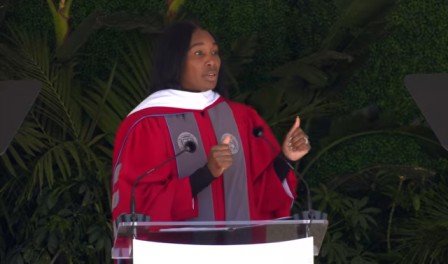
Editor’s Note: In this inspiring commencement address at Loyola Marymount University, tennis legend and entrepreneur Dr. Venus Williams encourages the Class of 2026 to adopt a “winning practice” by setting clear goals, visualizing success, and embracing the inevitable failures that come with growth. Drawing on lessons from her own multifaceted career, she emphasizes the power of self-belief, the importance of maintaining a positive mindset, and the necessity of finding joy throughout one’s personal and professional journey. (May 16, 2026)
TRANSCRIPT:
Welcome and Opening Remarks
DR. VENUS WILLIAMS: Hey everybody. Wow, what a moment. That felt amazing. Thank you guys so much.
Wow, I’ve got to tell my parents. Graduates of the Class of 2026, I am so thrilled to be with you here today. It’s of course an honor to be here at Loyola Marymount University speaking to you all and to be a part of the story that you will tell on this day, because this is a day to remember, and to share with you in what is in fact an amazing celebration and a culmination.
There are a few people I want to thank today. Thank you guys for having me. This is such an honor. Chair Viviano, what a guy. Chair Dean, he’s my main man. EVP and Provost Weaver. What’s up, Weaver? Weaver is out. EVP and COO Kiralla, thank you guys for having me.
I’ve had a blast, I’ve been dancing my way down this avenue. Is that what it’s called? The Avenue. And it’s just great to be in your company.
Honoring the Legacy of Past Speakers
And I’m also really happy to be in some great company of previous speakers. Just to name a few, Viola Davis. I love her. Woman King. Abby Wambach. She is a killer. Her attitude in sports, I learned a lot from her. John Legend, we are not ordinary people today. Hi. Janelle Monae and Quest, just to name a few, goes on and on.
I’m so excited to be in amazing company, but most of all, I just want to say that it is an honor to be in the class and in front of the class in the company of 2026.
Celebrating the Graduates and Their Supporters
You all are the reason that we are here today. I see the folks in the back who have supported you every single way, the moms, the dads, the brothers, the sisters, everyone who has gotten you here. Thank you guys for getting these graduates here today because they are our future tomorrow.
So I applaud you guys, I celebrate you, and I want to send you off with some last pieces of knowledge because you will be shaping tomorrow. And you’ve probably heard this many times before, perhaps to the point of being cliche, you will shape tomorrow, you are our future. But before you can shape the world, you have to shape yourself.
What are your dreams? What are your goals? How in the world do you get there?
Keeping It Real: Lessons from Compton
I’m not here to preach to you. I’m not here to use fancy words that sound good together but don’t mean a lot, because that’s blowing smoke. And where I come from, right down the street in Compton, California, we had to keep it real.
Compton was real in the 80s. A lot better now. And it took real work and real focus to graduate to something higher, which is what you have done. You graduated to something higher. And it’s just the beginning.
I know you all yearn for something more. You want to find your path. You want to succeed and you want to know how to succeed. So today I want to share with you what I’ve learned through the wins and the losses and the ups and downs and the self-discovery. Because life happens and life happens now and life won’t wait.
Winning Big 101: Your Last Class
Because nobody shared this with you. But today is actually your last class. Your last credit you need before you graduate, and it’s called Winning Big 101.
So the good news is that you got the first big win, you graduated, that’s huge. So what’s next? Hopefully a future that steadily builds upwards towards your dreams, but to shape your dreams of your future you have to create a winning practice.
Step One: Set Your Goals and Write Them Down
So for me the first steps in winning has actually been two steps, and both are equally important. First, you gotta have a goal. My dad always said, “If you fail to plan, then you plan to fail,” but all dads say that, right? Dads back there, you said that right.
And I’m sure you’ve heard this before, but like I said, winning big, this is Winning Big 101. But now you get to fast forward and I get to hack you forward today for the same low price of free. To advance to Winning Big 201. And here it is.
Anyone can have a goal, but a goal is just a thought in the mind. And here’s what my dad said next. He said, “A thought in the head is an electrical impulse.” And you know what an impulse is, right? It’s here, one second, in and out, gone. So if your goals are just in your head, it’s just an electrical impulse.
Real goals are written down. And this is how they become tangible. It’s how they become real. It’s how it becomes a starting place. But guess what? Writing them down is not enough. You gotta write the steps.
First is the long-term overarching goal. I know a lot of you folks may not even know what’s next. So maybe your first goal is figuring that part out. The second steps are how you get there.
And after this is done, now it’s not the time to put the notebook down, and for the notebook to gather dust, this is just right when the work begins.
Because your plan might not work, I’m sorry to break this to you. But it doesn’t mean you can’t adjust. Champions adjust.
You need to review your goal daily, weekly, monthly, yearly, pivot when things don’t work, do more of the stuff that does, learn from the failures, celebrate the wins, but most of all, do not stop setting goals.
The Power of the Notebook
So I have a notebook when I’m out playing my tournaments. Yes, I still play, for those of you. Yes! And in those notebooks I write down what I’d like to achieve. I write down everything. I write what I’m feeling. A lot of times what we’re feeling can either help us toward what we want to achieve or hold us back. So getting those feelings out is very important.
If I lose a match, I get rid of that notebook. A lot of notebooks have been left behind. It’s a superstition, unfortunately. But what that notebook does for me is that it helps me to write down my goals for that week and for the rest of the year. But it also helps me to know where I am in that place and what goals I need to achieve at that moment.
I also have a design notebook. Not all the designs make it. Many stay on the cutting room floor. But that notebook is my place to dream and to grow. It makes my dreams a reality. And you’re never too old, too experienced, or too accomplished to need to make a dream a reality.
Step Two: Visualize Yourself There
But still, writing it down is not enough. And most people never take this next step. And that’s visualizing yourself there.
My dad was a big proponent of visualization and when I was a child he would always tell us, “Visualize yourself there.” I didn’t really know what he was talking about. I was like eight. I was trying to watch Saturday morning cartoons.
So as I got older I started to understand. And I don’t know if you guys know this, there’s a street down the street called Wilmington. Do you guys know Wilmington? Well, my dad used to say, “If you don’t bend your knees, the only place you’re going is to Wilmington and not Wimbledon.”
So at some point I finally got to Wimbledon. Thank God. And when you get there, Wimbledon is hallowed sports ground. It’s beautiful. It’s beautiful. It’s sacred. You walk in and you get it.
And when we got there for the first time, my dad told us, “Go into that stadium,” because when you’re a player, you get there before they open the gates. He said, “Go into that stadium. Sit in that stadium. Visualize yourself accomplishing what you want to accomplish. Visualize yourself winning big. Visualize every single thing, every single moment, every single step of that way there.”
And that really took me to my first championship.
Visualization in Action: A Grand Slam Story
Another time I used visualization was when I really was struggling. I was playing another Grand Slam event and as an athlete, something’s always broke. And for whatever reason, something was very broke this time. I could not train before the tournament.
So my team and I, we still booked the court, and we would go on whichever stadium we got booked on, and we’d sit on the side. And then we all took turns, we closed our eyes, and we visualized the point from the very top.
So if I was starting the point, first game in the match, of course I choose to serve. Have you guys seen that thing where Serena says to her opponent, she says, “Are you sure you want to serve?” after she wins the toss? Always serve.
In any case, we would just go through each point and visualize how we wanted to accomplish it and also how you want to feel. I would say something like, “While I walk to the line, I’m feeling amazing. I know I got this. This is exactly where I want to be. I bounce the ball, I bounce it again, I throw the toss up,” and I do exactly whichever technique, I won’t bore you with that. And I’m doing this and I’m doing that, and the ball goes out wide, I pull her out wide, and then I open it up to the court, and we visualize two sets, and then we leave the court without ever hitting a ball.
Now I didn’t win that tournament but I advanced so much further than what I would have ever advanced had I not done those visualization techniques, because at that point that’s all I had was to visualize myself there.
So see yourself there, whatever it is that you want. Visualize it happening. Visualize yourself in that job interview. Visualize that big presentation. And once you’ve done it in your head, once it’s happened and you visualize it over many, many times and again and again and again, you’ve perfected it before it even happens. And once it happens, it’s like riding a bike. You’re like, “I already did this. What’s next?”
Step Three: Go For It
The next key to winning big is, you just gotta go for it. We talked about this earlier today, right? Me and you.
And no one is going to say, “Oh my god, you deserved it, because you’re a nice person.” Or, “Is it time for your lucky break?” Lucky breaks happen to those who set themselves up for lucky breaks. Or, “You went to a good school.” You did definitely go to a good school. But the wins go to those who go for it. And sitting back and watching the next person win goes to those who don’t.
The 1999 US Open: A Lesson in Going For It
And that happened to me, folks. I had to sit back and watch someone else win. Thankfully, that other person was also named Williams. In fact, that happened many, many times, more times than I wanted.
But in this particular case, I’m going to take you back to 1999. I know most of you guys probably weren’t even alive, whatever. But regardless, 1999 did happen.
I was playing this tournament that you may have heard of called the US Open. I was a kid, younger than y’all. I think I had just turned 19, Serena was 17, we were kids, we were playing a tournament, and we were both about to play the semi-finals, and I said, “Are you nervous?” And she said, “No, I’m not nervous. Since I have to show up, why not compete?”
Unfortunately, I did not take the advice. I showed up, but I didn’t compete. I was nervous, I was scared, I was afraid. Oh, my God. It was a major choke-a-thon. And unfortunately, I did not go for it. So I got to watch my opponent go forward into the finals.
Serena got to the final. She won in amazing fashion. It’s on YouTube. I watch it all the time. I’m a big fan. And she went forward and she taught me how to go for it. So go for it.
Plan to Win
Plan your win. Speak up. Ask for that raise. Speak to your boss about your long-term plan, about the company. Don’t just hope you get the raise. Plan for it proactively. Ask that top-level executive to be your mentor. Start your company. The future is for those who reach out and grab it.
So plan to win. And your plan should be extensive. Don’t be afraid of hard work. Welcome it. Enjoy the battle, because there is no way around it. Pay the price because there’s always a price to pay, and there’s a very distinct price for winning and for losing, and both prices are heavy. So you get to decide which price you want to pay.
Embrace Your Mistakes and Do Not Fear Fear
So we talked a lot about winning, but you also have to embrace your mistakes. Don’t be afraid. Let me take that and break it down further. Do not fear fear.
Fear has its proper place, but you cannot let it lead you. And I learned that early on at the US Open. It was tragic, man. I don’t think I left my house two weeks after that.
But I learned early on that fear was going to have moments, moments of fear when it just completely gripped me. But I had to allow myself that feeling because sometimes you cannot control it. But I gave myself a mantra to conquer my emotions, which is what fear is, it’s an emotion. It’s not a real thing, it’s an emotion. It’s emotion bubbling over. But I couldn’t let it take over and interrupt my dreams.
So my mantra was, “I am allowed to be afraid, but I can’t let it affect how I play.”
Most of the time we’re afraid, or at least I was, because I was afraid to lose or embarrass myself or let myself down after putting in so much hard work, but I had to accept this reality, and if you want to win big, you will, too.
Winning Big 301: Embrace Failure
Making mistakes a part of life, ain’t nobody perfect. And understanding this advances us to Winning Big 301. Three classes so fast, you guys should have hired me to teach at this school.
Because you know what? You’re going to fail. And if you haven’t failed, you haven’t tried. And if you haven’t pushed hard enough, you took the safe route. And we know what that’s about, right?
Embracing Failure as Fuel
We’ve got to go for it and not take the safe route. And let me tell you what failure is. Let me tell you what failure is. It’s not failure. It’s input. It’s information. It’s data. It tells you that a particular way doesn’t work and it gives you information on what to try next or what you should do.
So you got to fail fast, fail hard, and fail only once in each way. And never fail the same way twice. So unfortunately that means that you can’t date your ex again. Let that go. Move on.
And in failure you learn so much more about yourself than you ever would winning. It makes you tough. It makes you hungry if you let it. Hungry to get it right, hungry to get to the top of that mountain. Even when you thought, “Oh my God, I did everything right, what did I do wrong?” Let it make you hungry again.
It’s food and fuel for winning big. And it’s unrealistic to think that you won’t be afraid and you’ll never fail or make mistakes, but it is possible to frame this fear and put it in its place. And as long as you don’t allow fear to immobilize you and fear of the unknown to immobilize you, because fear is simply an anxiety of a possible future outcome. That’s it. It’s a fear of something that hasn’t even happened yet, and if we let it take control, that’s when we lose momentum. That’s when we get dragged down into complacency.
And my mom always said growing up, “Fear is the devil.” And we can’t afford to be tempted by it because the devil is a pretty terrible dude. It’s a bad guy, so don’t let that control you.
The Gift of Belief
One of the greatest gifts that I received from my parents was their spirituality. Our family believed in something higher and I thank God every day for that gift. I’m here. You’re here. We’re all here because of that gift.
And I have a conviction that my belief and values have been the greatest direction and the greatest protection. And when you don’t believe in anything, you’ll get swept up into anything, and you’ll do anything, and you’ll get anything. And if you believe in something, whether it’s a higher power, or your loved ones, or yourself, or values, any of it, you give yourself a foundation. And that’s the ground on which you stand.
One of the other greatest gifts my parents gave me was self-belief. So let me be clear, there’s a difference between self-belief as a core value and moments of doubt. Moments of severe doubt are a reality. And I face moments of doubt all the time in business, before trying new ventures, when I step on the court.
And a lot of times you’ll have moments of doubt because the others around you doubt you and that can be really challenging.
Faking Confidence Until You Feel It
I told you believe, believe, believe, you can do this, you got this, but the truth is you are going to have to go about life being confident and when in reality, there are many times you won’t even feel an ounce of courage. And a lot of times you’ll have to fake it.
And I know I mentioned earlier that I come from a place where things are real and you had to keep it real. But now I take some of that back because there’s way too many times I had to be fake. Because I just didn’t believe in myself fully because I was afraid. Because I had a goal and a dream or something that I really wanted to do and achieve and I wasn’t sure if I could do it, if I was good enough or if I was good enough in that moment. And there were times where the whole world said I could not. And a lot of times, I had just let myself down so many times.
So many times, I had to fake it and fake it and fake it and fake it. And a lot of times, winning comes down to confidence. But the truth is, as humans, we spend a lot of time not being confident and doubting ourselves. So what it comes down to, really, is who can act the most confident.
When the feelings and the moments of doubt, or when you’re having a downright crisis of confidence, we have to ask ourselves this question every time and every day if needed. What would I do if I felt confident? Would I stay in this relationship or would I go? Would I stay in this job or leave a workplace that isn’t suited to me or my goals that I set, that you have definitely written down? What is my self-talk like? How would I speak to myself if I felt great about me? Would I tell myself I’m a winner and I can do anything, or am I just going to allow myself to give myself this feedback that I’m going to fail?
The Power of Body Language
What I’ve discovered is one of the precursors of confidence is body language. So I was watching this match of myself early on in my career back in the 90s, taking you guys in the time machine. Scary. But I remember watching this match because as an athlete you have to go back and watch the matches, especially the ones where you lost, and it’s horrible, it feels bad. And throughout the whole match, you’re hoping for a different outcome, even though you know you lost. And you’re like, “Maybe it’ll change in this tape or film.” Back in the day, it was tapes.
But in any case, I was watching this match and I could see the body language, my shoulders were down, and most of all the look in my eyes said defeat. And after I saw that, I said to myself, “Even if I don’t feel good and I probably think I’m going to lose, I’m going to act like I’m going to win. I’m going to hold my shoulders up, I’m going to have fire in my eyes like I’m about to laser burn them like Superman or something.” Whatever it takes for me to at least portray that confidence.
So put your shoulders up, put the smile on your face, and master that twinkle in your eye, because belief in self-confidence, or lack of it, all ends with that body language, and it all starts and ends with self-talk.
Training Your Mind
We have to correct negative thoughts immediately. We all have negative thoughts. But each time we have a negative thought, we have to replace that one with a positive one. And I want to share with you my process.
So first I start with a physical cue. It can be anything. It can be jump up and down. Any physical cue, right? So we’ll start out with that. The next one is to correct that into something positive. So let’s say I’m on the tennis court and I just double faulted, right? And I’m like, “Oh, shoot, I did that again. Wait a minute. I can make my serve. That was just a moment. Now I can go forward.”
So once you get into that process and you start to train yourself, and it works, if you train your mind just like any muscle or studying for a test, you will get good at it. You will succeed. And I’m telling you, within a matter of days, months, weeks, you’ll be surprised at the progress that you make mentally and how your mind starts to change and to think immediately to that positive thing. So your mind will only give you the input that you put in, so make sure that input is positive.
Develop Your Mantra
So let’s take this even a step further. Let’s be proactive. Develop your mantra. You guys heard mine, right? “It’s okay to be nervous or scared, but it’s not okay to let it take over.” And that can change over time, depending on where you are in your life and what support you need, what you’re going through. You can change your mantra to fit what you’re going through to conquer what you’re going through.
Winning comes for those who can be the most confident or pretend to be. So believe. Believe in you. Believe in doing what’s right. Get yourself some values and you’ll be on your way.
The Never Peak Method
So today brings the end of the formal learning process. However, you should make it your life pursuit to continue learning in your life. And I call this the never peak method. And I always joke that when I pass away, my gravestone will say, “She never peaked.” And here’s why.
I learned what happens when you peak too soon. So let’s take us back to Wimbledon again. And I was playing with a partner. And I said to her, because I don’t want you guys to look this up and find out who it might be. But in any case, I said to this partner, “Hey, you want to practice?” And they’re like, “No.” Normally you practice with your doubles partner before the match, you can get in sync and everything. And they said, “I’m peaking.” I’m like, “What?”
It’s hard to handle these situations, but you never want to peak too soon. And I said to myself, “This is peaking. I never want to peak.” And it’s just a funny story. It’s just a joke. We all win or lose matches and don’t play well. But it was a lesson for me to never peak.
Be a lifelong student and never peak because it benefits you. And if you don’t want to learn anymore, it’s time to retire and hang it up and walk into the sunset, and something tells me none of y’all are there yet. Might be actually my turn, but not you guys.
Celebrating You
Finally, and most importantly, we got to celebrate you. That’s what we’re here to do, right? It would be a disservice to you and your hard work if we did not celebrate you today, the sacrifices that you and your loved ones have made, if we don’t finish on anything but pure joy.
And I hope you found joy in the journey that brought you to this moment. And that’s why we embrace the process and that sense of pride that comes with accomplishment and the confidence that accomplishment gives you and instills in you. And this is where the happiness begins. And what’s the point of being great if you’re not happy?
In you, the class of 2026, I see both. I see you guys celebrating. By making it to this day, you already inhabit your greatness. And I challenge you to cultivate that greatness and allow it to grow and evolve with you. And as you try new things and embark on all the adventures and alongside all the new people you’re going to meet, you’re going to continue to get closer to the core of who you are. And it’s absolutely paramount to your joy that you embrace that person unapologetically. Embrace you.
Final Words to the Class of 2026
Class of 2026, you made it. This degree, every medal, every stole, and some of you are dripped out. I see that. It’s a product of hard work, mental strength, and guess what? Belief.
So let me leave you with a few more words, and I wrote these on my phone and I was just thinking of that when I was sitting here. First is be positive and love your life. There’s only one of you, love yourself. Let honesty be your guide in everything that you do. So be honest with yourself, by only being honest with yourself. That’s how you get to your greatest. Seeing yourself for your strengths and your weaknesses. Always be honest with you. Don’t hide from yourself and surround yourself with great people.
A couple more words that I heard from my dad before every match. When the preparation and the process brings you here, after you put in all the hard work, to the brush and the canvas, and you left it all on whichever court you’re playing on, there’s only one thing left to do. And my dad said this. A lot of times he wouldn’t come to the tournaments, he didn’t like flying. Or sometimes he would say some crazy stuff at the event, maybe he was just trying to prevent himself from saying something. But before we walk out on a major final, we call our dad and he says, “Okay, make sure you turn your hips, look at the ball and have fun.” That was it every time.
So have fun and congratulations to you guys all. Thank you guys.
Related Posts