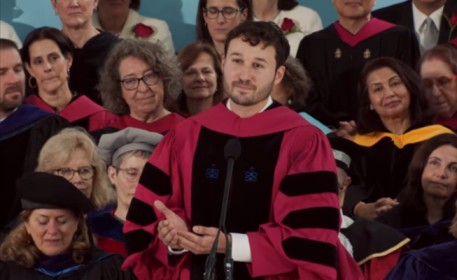
Read the full transcript of Andrew O’Donohue’s Graduate English Address, “Losing Our Education,” at Harvard’s 2026 Commencement Exercises on Thursday, May 28th, 2026.
Editor’s Note: In his 2026 Harvard Graduate English Address, Andrew O’Donohue reflects on his decade at the university, using his personal experience with research funding cuts to highlight the critical link between academic freedom and democratic health. He calls on his fellow graduates to remain committed to asking tough questions and defending the principles of open inquiry and free speech, even when institutions fall short.
A Decade at Harvard
ANDREW O’DONOHUE: Believe it or not, this is my 10th year at Harvard. I’ve been here so long, my parents don’t even brag anymore. In my decade at this university, the most important thing I’ve learned is about the promise of a university — of a place where we have the freedom to ask questions, rethink the status quo, and learn from one another.
A Summer in Turkey
When I was an undergraduate here, I interned for the U.S. State Department in Turkey. One night that summer, I watched as tanks blockaded a nearby bridge. Turkey’s military was staging a coup attempt. When the elected government prevailed over the coup plotters, I saw citizens celebrating the triumph of democracy. At the same time, I saw thousands of people arrested as the president abused emergency powers to purge judges and imprison opponents.
In the aftermath, I couldn’t stop thinking about two questions. Why was democracy in danger? And what could we do to protect democracy?
Returning to Harvard: A Problem to Solve
I came back to Harvard as a graduate student because I had this problem I needed to solve. At the start of my PhD studying political science, I received a grant from the US government.
With support from the National Science Foundation, I had the freedom to spend a full year interviewing judges on high courts in both Turkey and Israel. Those interviews gave me new answers to my questions. They sharpened my focus on understanding why courts defend democracy or undermine it instead.
I discovered that even independent courts sometimes damage democracy. I learned that judges depend on allies — on protesters, public officials, and people like us — to take decisions that protect democracy.
A Day at the Gym
Now, when I’m not agonizing over democracy, I love going to the gym with friends. One day last spring, I was at Hemingway Gym with my friend Brandon, a PhD student in chemistry. On that day, I saw a look of pain on my friend’s face, so I asked how he was. My friend had lost his grant.
As the government pulled back funding, his chemistry lab, which studies the basic science used to make medicines and clean energy, was facing deep cuts. I went home from the gym feeling upset for my friend, only to find out that my grant also had been cut.
We all came to Harvard with our own goals, dreams, and passions. Now I had to ask myself, would we still have the freedom to pursue our education? Would we still be able to research, teach, and learn without the foundational support of our government?
Harvard Rose Up
In that moment of uncertainty, Harvard rose up. Even if the government would not fund my research, Harvard would, at least temporarily. Harvard defended our rights in court. Last fall, a judge in Boston ruled that the government’s efforts to take away research funding violated our rights to free speech and due process.
My friend’s grant and my own were restored. And today, my friend Brandon and I will graduate with our PhDs.
You know, Brandon and I actually have a lot in common. Chemical science, political science — it’s basically the same thing. Right, Brandon?
Gratitude and Reflection
As we all celebrate this milestone, I am grateful to my friends, my teachers, and my family for supporting me through every challenge and triumph. I am grateful to Harvard and to a judge in Boston for protecting our research and our rights. I am grateful to so many of you here for believing in the promise of education.
Today, that belief in higher education is under fire, and universities are facing questions. In my time at Harvard, I have felt conflicting emotions. And I have wondered, are universities truly for all of us? Are universities protecting our rights to speak, learn, and protest? Or are universities teaching students to be silent?
At Harvard, I’ve also been a student worker and a member of our union. And I’ve wondered — are universities treating their workers well?
The Purpose of This Place
We must engage with all these questions. That’s the purpose of this place. At universities, we ask and engage with questions. We view feedback and failure as opportunities for growth.
The past few years have put the ideals of our university to the test, and Harvard did not get an A. Our university must do more to protect academic freedom and free speech rather than restrict them. Our university must improve its efforts to support students from different backgrounds rather than pull back. Above all, we must speak up for the promise of the university, even and especially when we fall short of that ideal.
Look around you, in this yard, at the people gathered from around the country and around the world. Don’t we all feel in awe of the ideal of the university?
Universities and Democracy: Deeply Intertwined
Before I go, I want to connect the dots between my experience at this university and my work on democracy. The vitality of our universities and the health of our democracy are not disconnected. They are deeply intertwined. Both our universities and our democracy depend on our freedom of speech.
In my time at Harvard, too many of my friends have felt afraid. Many of my friends are international students. They feared that taking a leadership position or attending a protest would put them at risk.