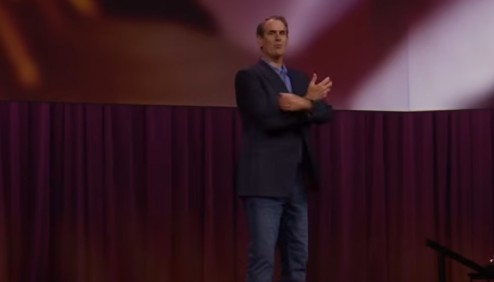
Read the full transcript of venture capitalist and author Bill Gurley’s talk: “Follow Your Fascination” at TED2026 on April 17, 2026.
Editor’s Note: In this inspiring TED talk, Bill Gurley argues that achieving career excellence isn’t just about following your passion, but rather following your “fascination,” which naturally drives the obsessive, continuous learning required to excel in any field. By sharing personal anecdotes and lessons from industry leaders, he highlights how aligning your career with what genuinely fascinates you leads to greater fulfillment, energy, and long-term success.
Follow Your Fascination: How Obsessive Learning Drives Career Excellence
BILL GURLEY: I’m going to start with a story. A good story, a true story. In 1983, my friend Danny was 25 years old. A few years earlier, he had graduated from Trinity College with a poli sci degree. Bounced around for a while, but fell into a really cool job in sales. He sold those doohickeys they attach to clothes in the department store so you can’t steal them. He’s good at it. He’s making a lot of money.
But as a poli sci student, he’d always planned to take the next step, law school. So the night before the LSAT, he’s out for dinner with his Uncle Richard at a place called Elio’s on the Upper East Side. And Uncle Richard can tell something’s not right.
“Danny, what’s eating you?”
“Ah, I have to take the LSAT tomorrow and I don’t really want to.”
Uncle Richard probes. “So why are you?”
I’ll get back to Danny and Uncle Richard in a minute, but let me tell you why I’m here.
Six Years of Research Into Career Excellence
I spent the past six years studying what drives career excellence. A co-writer, a researcher, and I combed through over a hundred biographies. We talked to some of the leading academicians in the field, looked at their research, and we even did our own survey with Wharton. We turned that into a book.
What did we find? There were many common traits, but one thing stood out above everything else: continuous and obsessive learning. They were all lifetime students. They knew the history of their field. They understand the nuance of their field, the thing that separates great from good. They know the edge of their field. That’s where innovation lies. And they studied throughout their entire career — beginning, middle, and end.
I’d like to think they thought about their craft as an artisan, with an artisan mindset. And I’ve come to believe these artisans exist in every field.
The Magnus Carlsen Example
Here’s a fun example. In 2015, at the annual chess competition in Iceland, they did something fun. They held a history trivia contest. Guess who won? Magnus Carlsen, the world champion. See, he’s not just great at chess, he knew the history. But if you study Magnus Carlsen, you’d know this to be true. It’s very low likelihood that he got to a place in his career where he says, “Oh boy, to be even better at chess, I need to study the history, I’m going to go do it.” It was a different mechanism.
Obsessive Learning Is an Output, Not an Input
And this is my key point, the key takeaway right here at the beginning. Obsessive and continuous learning is not an input, it’s an output. It’s not the cause, it’s the effect. What’s the cause? What drives someone to learn for a lifetime?
In 2024, Jerry Seinfeld, the comedian, gave the commencement speech at Duke University. And after making fun — which he’s good at — making fun of the phrase “follow your passion,” he came up with a different word, a better word, a more precise word. He said you should follow your fascination.
I really love this distinction. You see, passion doesn’t invoke work. You can be passionate about the Cincinnati Reds and sit in a chair for three and a half hours drinking beer. But fascination comes with a mechanism. When you’re fascinated, you study automagically. By the way, I know that’s not a real word.
Back to Danny
Back to Danny. Uncle Richard kept pressing, “Danny, all you’ve ever thought about and talked about your whole life is food and restaurants. Why don’t you open a restaurant?”
Danny listened. He took the LSAT the next morning, but he never enrolled in law school. Instead, he enrolled in a $300 restaurant management course that he found in a magazine. He would then take a 90% pay cut to get his foot in the door at a local restaurant where he could rotate through the different jobs. And then he planned a trip through Europe, a learning trip, where he would stodge in many different countries, many different cuisines. Stodge is a fancy French word that means work for free. He then went back to New York. He had to study some more location buildings.
The Magic of Following Your Fascination
Then in 1985, a full year after that momentous dinner, Danny opened Union Square Cafe. Union Square Cafe would be recognized by Zagat magazine as New York’s favorite restaurant eight times. And Danny would go on to launch over a dozen high-end restaurants in New York, including Eleven Madison, Gramercy Tavern, The Modern.
For you younger folks out there, he would then, after that, found and launch Shake Shack, which has 400 locations worldwide and a $4 billion market cap. Every time Danny started a new concept, he’d do a year of learning and study before he’d launch. When I talked to him last fall, he was just back from Europe on another learning tour, over 40 years later, still in his DNA.
Uncle Richard did two things really amazing that night. First, he saved the world from another lawyer. But second, and more importantly, he unleashed Danny’s career around this amazing fascination that he had. One dinner, one comment, and a bit flip from zero to one, and the rest is history.
What Happens When Career Meets Fascination
It feels magical.
I think a lot of magical things happen when you combine fascination with a career. First, obviously, you’re more fulfilled and you’re more happy. Second, the learning comes for free. What do I mean by that? Zero conscious effort.
When you’re learning about something you don’t like, it taps your energy. You get tired. You need a break. When you learn about something you’re fascinated by, you get energy. You want to smile. That contrast is massive, and it’s why Danny knew exactly what to do, and it’s precisely why Magnus Carlsen knew the history.
The third thing that happens when you combine career and fascination is people notice. If you’re enthusiastic and have extra knowledge, you’re going to do better in every dimension of your career. You’re going to crush it in interviews. You’re going to get promoted. You’re going to attract mentors, and maybe most importantly, opportunity comes at you.
“Oh, I hear you’re interested in starting a documentary. You have to talk to Sally. She’s obsessed by them.” Those introductions happen all the time.
The last thing that happens is the fascinated people leave big footprints. Uncle Richard didn’t just help Danny. Think of the thousands and thousands of people that have worked in and learned in Danny’s restaurants. Think about the millions of customers that have felt his hospitality, and think about the restaurant owners and small business owners that have read his book, Setting the Table. It’s really, really a massive impact.
Why So Few People Find Their Dream Career
So how many people make it to this magical place? In 2023, Gallup did a poll where they asked what percentage of people are thriving and engaged in their job. Only 23% said yes. A full 59% they put in this category they called quiet quitters. They said they’re ambivalent about their job, emotionally disconnected.
In our own survey, we asked people, are you in your dream job, and do you want a do-over? And only 20% said yes, I’m in my dream job, and I don’t need a do-over. So maybe it’s as low as one in five, 20%.
Why isn’t it better? I think there are a few issues. First, I think the path to and through college is broken. I think it’s because schools are so damn hard to get into. In sixth grade, we begin with Jonathan Haidt, his term, the resume arms race. We do Mandarin lessons, lacrosse lessons, cello lessons, volunteering, and that’s just by Tuesday. The kids feel pressure and the parents feel pressure, and I think we know something’s wrong there.
Second, we’ve moved the decision goal post. When I was young, they wouldn’t allow you to declare a major until the end of your sophomore year of college. Today at many schools, you have to apply to the major when you fill out the application. We made the life decision from 20 years to 17 years old. Have you ever asked a 17-year-old what they want to do the rest of their life? They really don’t know. They really don’t know.
The Threat to Safe Jobs in the Age of AI
The last thing is several well-intentioned parents and advisors, and I want to repeat well-intentioned, have pushed kids towards the safe jobs, medicine, legal, finance, comp sci. But what if the safe jobs aren’t safe anymore? Along comes AI. You know all those formulas and algorithms you learned in school that helped you take the test? They’re all in the model. If you’re not advancing your learning after you leave college, they’re catching up.
And I don’t think it’s the jobs we love that are under threat. It’s the ones people were ambivalent about already, the 59%, the quiet quitters. But maybe what’s really under threat is the static mindset.
AI as a Jetpack for the Fascinated Artisan
What about the artisans, the fascinated artisans? Mark Cuban said something the other day. He said there’s two types of people in the world, those that use LLMs to learn faster than ever, and those that use LLMs to skip learning altogether. The reality is for these fascinated artisans, AI is a jetpack. They learn faster, they soar higher.
So how do we get more people in this lane? I fear the institutions aren’t set up for it. They’re set up for high-volume mass manufacturing, not bespoke, individualized, customized fascination discovery. But if they can’t, who will?
Matthew McConaughey: Don’t Half-Ass It
I’m going to close with two short stories that might point us in the right direction. My wife and I relocated to Austin four years ago, and we’ve had a chance to meet this very famous actor that lives there. You may know the one. All right, all right, all right. You got it.
When Matthew was young, he was really good at winning arguments, and his whole family told him you should be a lawyer, and he decided that’s a great idea. He headed off to college. During his sophomore year, he fell in with some friends at the film school, really loved it, wanted to switch. But he was fearful of his stern father’s reaction.
He eventually set up a call, walked through the logic, long pause, and his father says, “Don’t half-ass it.” Matthew said it was the last thing he expected him to say and the best thing he could have possibly said. And with those four simple words, he unleashed another artisan, an Oscar-winning one, and also saved us from another lawyer.
Jackson’s Story: From Finance Track to Basketball Analytics
A few months ago, I got an email from a friend I hadn’t heard from in a while. His name is Doug. He had seen me talking about these topics on a podcast, and he wanted to share a family story. His son Jackson is a senior at Wake Forest, Finance track, but in all his spare time, he loves to study basketball analytics. On a recent trip, he would wake up at 7 a.m., go to the coffee shop, and do his basketball studying before the family activities. Last summer, he did an internship in basketball, not finance.
His father told me that he’d been on his own journey, a parental journey, from awareness to acceptance to enthusiasm to full support. And as he went through those stages, he could see Jackson’s confidence grow. I have a hunch Jackson’s going to have a great career.
The World Needs More Uncle Richards
So if it’s not up to the institution, maybe it’s up to us, the individuals, parents, counselors, friends, family. It doesn’t take much, a comment, a nudge, holding up a mirror so they can see maybe what they already knew. Matthew’s dad gave him a green light, Danny had Uncle Richard, and they had incredible careers based around their fascination.
Maybe all the world really needs is many, many more Uncle Richards, and I hope there’s a bunch of you out there in the audience today. Thank you.
Related Posts