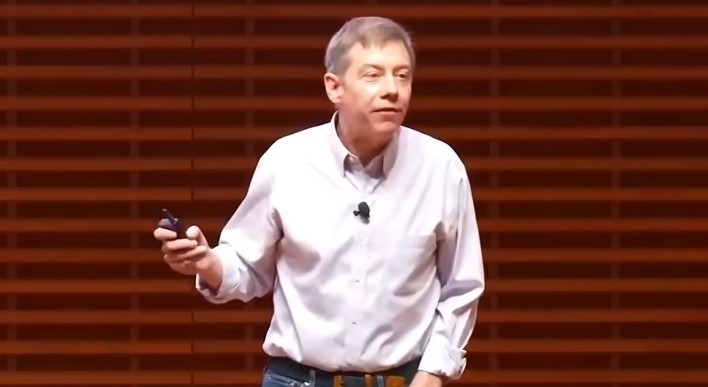
EDITOR’S NOTE: This is a transcript of a lecture by Stanford economist Chad Jones on “The Future of Jobs in an AI World,” delivered as part of a reunion weekend talk. Drawing on several years of research papers, Jones lays out two extreme scenarios for how AI could reshape economic growth, introduces his “weak links” framework for understanding automation’s pace, and walks through simulation results before taking audience questions on jobs, inequality, and catastrophic risk.
Introduction
CHAD JONES: Really happy to have a chance to share this talk with you. This is something that’s been on all of our minds. My research for the last fifteen years and longer has been on economic growth, and I feel like AI is this incredible new technology, and how it shapes the future, what kind of consequences it may have for us and our children, is something I think all of us are thinking about every day. So this is based on, I think, four or five research papers that I’ve been working on over the last couple of years. So I think it’s an easy statement that AI is likely to be the most transformative technology of our lifetime.
Importantly, it’s the latest in a line of transformative technologies. Electricity, the transistor, semiconductors, information technology, the Internet are all transformative technologies. A question I’ve been pondering, and I’ll get to this in a little bit, is to what extent is AI different and to what extent does it share features with these earlier transformative technologies? And I think in terms of the difference, the next bullet point, which Sarah echoed a little bit, I think really gets to the heart of it. What if machines, AI for cognitive work, and then AI running robots for physical work, what if they can perform every task a human can do?
What does it look like to live in that world? To start out, I want to lay out for you two scenarios that I think of as two extremes. Neither one is probably what’s going to happen. They’re kind of caricatures in a way, but I think we learn something by thinking about these two scenarios, and then I’ll show you some research I’ve been doing to help me think about where in between these two extremes we might end up. The first scenario is going to be AI dramatically accelerates economic growth.
The FOOM scenario of Silicon Valley, which we read about practically every day. The second scenario is where AI is just a normal technology. AI is business as usual. Maybe it’s normal the way electricity and semiconductors and the internet were normal. They were transformative technologies, but we’ll see.
Scenario One: AI Dramatically Accelerates Growth
Let me dive into these two scenarios. In the first scenario — and I should say my plan is to talk until 5:45 and then take fifteen minutes of questions. Hopefully that’ll work well. I got lots of clocks here to keep me on time. AI dramatically accelerating growth.
I think this one we’re in the middle of watching now. So, you know, Dario Amodei, Sam Altman, Demis Hassabis, Geoffrey Hinton, sort of the luminaries of AI, have been saying for the last ten years that these things are coming, and we’re kind of marching along the schedule that they laid out for us ten years ago. The first part of that schedule, I think, is AI automating software, AI automating software engineering. And we saw back in November, I think, when Claude Opus 4.5 was released — Anthropic, whenever they’re trying to hire a software engineer, gives the software engineer a two-hour take-home exam.
And they see how they do, and that’s part of how they decide who to hire. They gave this same two-hour exam to Opus 4.5, and it scored higher than any human in history. That was already seven months ago, and the models have only gotten better. We’re up to Opus 4.7 now, two generations later. Decade, is it plausible that we’ll have AI agents that can automate most coding?
Yeah, maybe that’s next week. I mean, this seems like it’s coming very soon. I mean, you know, maybe it’s a decade. Okay. When you have AI agents that can do everything a software engineer can do, well, you put them to work doing more things. In particular, you put them to work on AI research.
Build better algorithms to improve the AI itself, and build agents that can use a computer the way a human can use a computer. Right? And so again, shortly after that, it seems plausible that we’ll have agents that can function as virtual remote workers. Anything you could call up a colleague on a virtual Zoom call and ask them to do, the colleague could be an AI rather than a human. Once you have that — and again, shortly after, maybe — well, you can scale these things up on millions of GPUs.
And you can end up with billions of virtual research assistants, each running a hundred times faster than we run. And you put these to work — these “country of geniuses in a data center,” as Dario Amodei called them. You put them to work discovering new ideas. Right?
You tell them, “Help me design better computer chips. Simulate the real world and help me design better robots so we can finally get the grippers that are just sort of the bottleneck for robotics. Help us design better technologies, new pharmaceuticals.” AlphaFold was nearly ten years ago now, and it’s transforming pharmaceuticals, but there’s so much more that can be done. If you’ve got this country of geniuses in a data center, what virtual cognitive tasks can they not do?
Well, once they’re designing better robots in virtual reality, we test them out in the real world. And again, eventually — maybe it takes a decade — but eventually we have robots run by these super geniuses in a data center, and then we’ve automated physical tasks as well.
It’s totally plausible. There’s a question of the horizon. Does it happen in three years or five years, like the AI 2027 people, or Leopold Aschenbrenner of Situational Awareness? Or does it happen in twenty-five years? Well, in some sense, if growth is exploding and accelerating, five years versus twenty-five years is still transforming the world.
Okay. So that’s a scenario that’s very familiar in Silicon Valley. I do think it’s plausible and has some merits, but it’s certainly not guaranteed that this is the way things happen. Let me give you a scenario at the other extreme. AI is just sort of a business-as-usual technology.
Scenario Two: AI as Business as Usual
And here I think the story goes the following way. Let me show you a graph. And again, if you ever took my class, you saw this graph 37 times. So apologies. But now you can see the updated version.
It’s changed so much relative to when you took the class. Right? Okay. So what is this? This is average living standards in The United States.
Real income per person, a hundred and fifty years, on a logarithmic or ratio scale. And what you see is you never get too far away from this straight line with a slope of 2% per year. Living standards in The United States for a hundred and fifty years have risen at 2% per year, plus or minus a little bit. What’s especially interesting about that is when you reflect on the transformative technologies that entered and diffused throughout The US economy during this period. In 1870, the electrical transformation of The US economy was just a glimmer in Thomas Edison’s eye.
Over the next fifty years this transformation happened. Internal combustion engines, jet airplanes, right? Antibiotics, vacuum tubes, transistors, semiconductors, information technology, the Internet. All of these amazing technologies absolutely transformed living standards, and yet the growth rate was always 2% per year. This raises a big puzzle, I think.
How can it simultaneously be true that these technologies were wildly transformative and yet growth rates stayed at 2%? The answer, if you think about it, is: what is the counterfactual? I think the way technology works is that within any technology class, ideas get harder to find. The steam engine runs out of steam, and so if all you had was the steam engine and you didn’t discover electricity, growth would have slowed. Or if all you had was electricity and you didn’t discover internal combustion engines and semiconductors, growth would have slowed.
And so the straight line would have bent. The arc would have bent here. And instead, what each of these technologies did is they allowed 2% growth to continue for another fifty years. Right? And sort of the pessimistic — in quotes — scenario about AI is maybe it’s the latest transformative technology that lets 2% growth continue for another fifty years.
You can see how these are two very different extremes. I think they both have a lot of merit. One other point I’ll say about a lesson from economic history — and you see this a little bit in the discussion I just gave — economists who’ve studied how steam power got replaced by electric power, or how information technology diffused throughout the economy, have highlighted repeatedly that these transformations take decades. You have to reorganize the factory when you go from steam power to electric motors. Instead of one shaft through the middle of the factory, you can now put motors everywhere.
Or information technology — you have all these complementary innovations that need to be made. You invent the spreadsheet. You invent the word processor. You invent the database.
You invent SQL. And so you have lots of complementary innovations that need to be integrated, and production needs to be reorganized. That takes time that’s measured in decades. So again, this sort of lesson from economic history is: don’t be so quick to assume transformative technologies bend the curve here. They’re bending it relative to growth slowing down, and it may take a while.
The Weak Links Framework
Those are the lessons. Still, we’ve got this question — both of these scenarios have plausible aspects to them. Where are we going to be in between, and how should we think about that? That’s the question I’ve been thinking about for the last year and a half or so. The concept that I’ve come up with that I think is really helpful is “weak links.”
A chain is only as strong as its weakest link. Let me give you the application of that to business. Business success requires completing many, many tasks successfully. Right? So if you want to release a new version of the iPhone, you have to design it.
You have to source all the parts. You have to get it manufactured. You have to make sure the manufacturing is within very, very exact tolerances in every place. You get one thing wrong in one place, the whole thing falls apart. Once you’ve manufactured it, you have to figure out how to get it delivered in a timely fashion.
Hundreds of millions of iPhones delivered every fall. You have to handle the retail, the advertising, etcetera, etcetera. If any of these tasks falls down, then a lot of the value gets lost, at least in the short term. Okay, and that’s what a weak link model is. Right, and so the space shuttle Challenger explodes because a $25 rubber seal — the rubber O-ring — fails.
One small part fails. Or you think about ASML and TSMC, the manufacturers of these computer chips, with machines that are just incredibly complicated, with precisions that are incredibly tight. Right? One little error there and your chips don’t work. So how does this help us think about these two scenarios?
Well, again, back to the chain. If you’ve got a chain with 20 links and you make 17 of them really, really strong, that helps, but it doesn’t in the end really change the overall strength of the chain, because there are always three more weakest links. Let me give you an example of that that I find really, really helpful. In your pocket, in my pocket, we have a computer with a hundred million times the transistors of the equivalent we had in the 1970s. Okay.
So in your pocket, you have a hundred million times the transistors of the equivalent you had in the 1970s. Right? I’m not a hundred million times more productive at research. Why not? Well, my computer can invert matrices like nobody’s business, but I have to figure out what data to put in those matrices.
I have to figure out what questions to ask, what theory to test. It’s a weak link problem. You could be really good at one thing — instead of a hundred million times more productive, maybe I’m two or three times more productive. That’s great, but I’m limited by the other weak links that haven’t changed. So this is, I think, a really important insight about how the world works, and it’s going to help us understand where we are in these two scenarios.
Let me highlight one other thing that I’ll come back to shortly. Weak links are the source of scarcity. One of the key lessons of economics is scarcity is what gives rise to high returns. What is the scarce factor? What is the weak link?
That’s a question we should always be asking when we’re studying some economic phenomenon. And so when we come back to what’s going to happen to the income of our kids, thinking about what is scarce, I think, is a very helpful framing for that question. Okay. One more graph that I like a lot. Again, if you took my class you may remember this. Economists are infatuated with the question: who gets GDP?
Who gets paid? What share of GDP is paid to labor versus paid as a return to capital? Turns out for seventy-five years it was remarkably stable. Two-thirds went to labor, one-third went to capital. Okay?
In the last twenty-five years, interestingly, the share paid to labor has fallen by about 10%. Share paid to capital has gone up, and economists are obsessed with understanding this. We have two theories. One is automation — I’ll come back to that in a second.
And the other is market power. Maybe big firms are bigger and they’re exercising more market power. They’re able to capture more of the GDP as profits and pay less to labor. We don’t know the answer to that. I’m not going to answer that today.
Instead, I want to take that in a different direction, which is: okay, two-thirds is paid to labor, one-third is paid to capital. But you can break labor and capital into their components. How much of the GDP that’s paid to labor is paid to people with more than a college education versus less than a college education? Or look at the capital income — how much is a return to buildings and structures versus equipment? Or within equipment, how much is a return to computers?
What share of GDP is paid as a return to computing power, and how has that changed over time? If you look in the right spreadsheet, you could just look this number up on the BEA or BLS website. But you have to dig. What does it look like? On the one hand, computers are everywhere.
On the other hand, the price is falling like crazy. It’s a p times q, where q is going up and p is going down. So which effect dominates? Here’s the data. During the 1990s, during the dot-com boom, the share of GDP paid as a return to computers went up.
It peaks in 2000 at just under 4.5%, and since 2000 it’s fallen by a third, to 3%. Computers are indeed everywhere, and yet they’re paid less as a share of GDP, rather than more. The price decline dominates the quantity increase. This is exactly what a weak link model predicts. Computers are plentiful.
They’re the most plentiful thing in the economy. Everything else — humans — are scarce. And so the computer share has gone down. So when we think AI might automate everything, and we worry, “What are all of us going to do?” — this graph is at least something to take into account.
Computers are getting less of GDP, not more of GDP, even though there are a hundred million more transistors in your pocket. What do we do next? We write down a model to try to study these two scenarios. And the model features ideas as the source of long-run growth.
Building the Model
Paul Romer’s Nobel Prize. It features a production function for goods and ideas that both involve weak links. The production of everything, in my view, involves weak links. So goods and idea production functions have weak links, but they get automated away. It used to be inverting matrices was done with pencil and paper by hand — now the computer does it.
It used to be that driving your car was done by hand — now in San Francisco the computer does it. Hopefully, throughout the world, the computer will do it someday soon. Then that automation process occurs endogenously over time. You invent better machines, you invent faster computers, and that lets you automate more and more things. And then we calibrate the model to fit the historical US data back to the 1950s.
And then we run it forward to ask what’s going to happen. And none of the numbers I’m going to show you should you take too seriously, but it’s just helpful to see what happens and try to think about what the economic forces are at play and how important they might be. Okay. Before I show you the simulation going forward, let me give you another thought experiment that you can do in this model that’s really interesting. As I mentioned, Dario Amodei, Anthropic, OpenAI — everyone is expecting we’re going to automate software engineers very soon.
One can ask: how much richer would we be if we automated all software engineers? We can ask that in the model. And in fact, I’m going to change the question slightly. What if we had infinite amounts of software rather than finite amounts of software? So anything that uses software, push it to infinity.
How much richer would we be? Remember the computer example. We have a hundred million times the transistors, and we’re not a hundred million times richer. So it’s going to be much less, because of weak links. How much less?
Turns out there’s a very simple, elegant formula. Because of weak links, infinite amounts of some task raises GDP by that task’s share of GDP. Software is about 2% of GDP. If we had infinite software, we’d be 2% richer. Why only 2%?
Because all the other weak links are bottlenecking us. Okay? And so this sort of makes you realize automating one thing really well is not enough. What you need to do is keep automating the weak links. We need a dynamic model, not just this static model, and that’s what the model does.
Our model features ingredients that I think one takes away from those scenarios that I outlined. In the first scenario, you’ve got automation giving you new ideas, giving you more automation, giving you more new ideas. There’s a flywheel effect there with positive feedback. And positive feedback wants to explode. Right?
On the other hand, based on the business-as-usual scenario, we’ve got weak links. Right? Weak links tell you, okay, you’re automating some stuff but not the rest — the chain is still weak because of the weak links. What if you put both these ingredients in a model, calibrate it to what we’ve observed in the past, and run it forward? I’m going to show you two more simulations.
In one, AI is just a continuation of the historical patterns of automation that we’ve seen. We’ve been automating the economy. This is an important point. We’ve been automating production for two hundred years. The Industrial Revolution, textile looms, tractors and railroads, computers — we’ve been automating for a long time, and yet 2% growth.
But if you continue doing that, something may change. And then the second scenario recognizes AI may be different. AI might not just be a continuation of historical patterns. A weak link of our paper is we don’t have a micro-founded model of AI that explains exactly how it’s different. So instead, what we’re going to do is take a very aggressive calibration.
One of the sectors we look at in our history is the computing sector. Right? Moore’s Law is incredibly fast. So what if, as our aggressive scenario where AI is a real break with the past, we say the entire economy starts out today getting automated just like Moore’s Law? Machines get better at 10% per year throughout the economy starting today, and then that automation gives you more ideas, gives you more automation.
Okay. So that’s going to be a very aggressive scenario. I think of the second scenario as too aggressive, and the first scenario as probably not aggressive enough. So again, maybe the truth is somewhere in between. Alright.
Simulation Results
So what do we see when we do this? I’m going to show you three sets of graphs for each scenario, and a lot of lines on the graphs, but hopefully it’ll make sense. This first graph is the capital share versus the labor share. Remember, I said one-third is paid to capital, two-thirds is paid to labor. What share is paid to capital in our simulations?
You can see, going forward, it’s 38.2% for the next eighty years, and then it actually splits off a hundred years from now. What’s going on? We have three scenarios. The purple scenario says there’s nothing special about humans, and everything gets automated in finite time. If that happens, the share of GDP paid to capital goes to 100%, share paid to labor goes to zero.
Okay? The green scenario says almost that, but there’s 3% of tasks that are reserved for humans that can’t be automated away. Magnus Carlsen playing chess, Leo Messi playing soccer. Right? There are some things we’re going to reserve for humans, and in that case, you get infinitely good at the 97%, but the 3% done by humans bottlenecks you.
And in fact, the weak link is the humans. The human share goes to 100%. The labor share goes to 100%. The capital share goes to zero. This is like that computer example I gave you, where the share paid to computers is falling.
Okay. And then, interestingly, there’s a scenario in between that I call the baseline — the blue scenario. Here, the capital share remains stable. One-third, two-thirds. And that one’s interesting, because you say, what’s going to happen to growth in the intermediate scenario where the capital share and labor share stay two-thirds all the way through?
What happens to automation and economic growth? Okay. Here’s the growth rates over time. The baseline is 2% growth, like in the graph that I showed you. And you see a couple of different things here.
First, purple line: growth goes off to infinity. Full automation — if machines can do everything, including produce ideas, and machines keep getting better, growth explodes. The green scenario says, no, no, no — we’re bottlenecked by the 3% of things that can only be done by humans. So the growth rate in the end is limited to how fast humans get better.
And I’m not that much better at inverting matrices by hand than, you know, my mom was when she was young. Right? So, yeah, that rate is pretty slow. And initially, the baseline scenario, the blue scenario — if you look closely, growth is speeding up. And in fact, even in the baseline scenario, growth speeds up, and it ends up settling down at 50% per year.
But it takes centuries to get there. So even in the baseline scenario, growth accelerates. You can see the acceleration — 2 to 2.3 to 2.6 to 3 — but look at the axis. The acceleration is stunningly slow. By 2050, instead of 2%, we’re growing at 2.3%.
This is a model that eventually explodes, but it takes a long time. Why? Because of weak links. This is again like the computer example. We have a hundred million times the transistors, but we’re just limited by all the things that humans still have to do.
Okay? I can also show you this in levels. So this is the growth rate graph. Here’s the level — income per person. Remember the 2% line — that straight line is the dashed orange line now.
And then the numbers are how much richer you are relative to the orange line, if growth hadn’t accelerated. And you see, yeah, by 2050 we’re 4% richer. By 2075 we’re 15% richer. Growth is accelerating, growth is even exploding, but the explosion is slow, because of weak links. One other thing that I find interesting about these graphs — notice the three different scenarios, maybe look here — they’re very different for the future.
Two hundred years from now the world looks very different, whether green or purple, and yet for the next seventy-five years it’s really hard to tell which scenario you’re in. Now you can see why I wanted a second set of scenarios, because this growth explodes but it takes a hundred years. You might say, “Okay, well you’re being too conservative with respect to AI. AI is not just a continuation of the automation that we’ve seen for the last two hundred years.” Maybe it is, but seeing this you want to say, what if it’s not?
So now, for our next set of scenarios: suppose AI starts out today with Moore’s Law everywhere. Not just Moore’s Law in the computing sector — machines get better throughout the economy at 10% per year, instead of 3% per year, which was our baseline number for the aggregate economy. Okay?
Okay. Capital share, labor share looks the same. This graph — you might say, “Is it the same graph?” Well, look at the axis. The years have changed.
Okay? So if I show you the growth rates now — now this is different. You can see, in the purple line and even the blue line, growth is exploding. By 2050 we’re well on the way — we’re above 25% growth per year.
And even today — the scenario starts in 2020 — if you have Moore’s Law everywhere today, instead of growing at 2%, the economy grows at 4.7%. So we certainly didn’t do that for the last six years, and so, again, that’s another version of this example being too aggressive. But what I take away from here — let me show you — growth goes to 713% by 2040. This is an explosion that happens relatively quickly, and yet relative to the AI 2027 folks, or the people in Silicon Valley who think it’s happening in four years —
No. It’s not until 2060 that the explosion is fully complete. Even in this case — this incredibly aggressive case, where we’re 50% richer in 2030 than we would have been without the accelerating growth — even in this case, the explosion takes thirty years. Why?
Again, weak links. And so I think this weak link phenomenon is really slowing things down, and that’s one of the lessons I take away from the scenario. So two lessons here. I’m a person who’s made my career off of that straight line graph that I showed you. The whole reason I’m at Stanford, the whole reason I got tenure, is that one picture.
Right? That picture says bet on growth not changing. Right? 2% per year for a hundred and fifty years, maybe for the next years. And yet I’m telling you, in a world of AI, all the scenarios I run say growth explodes over the next fifty or a hundred years.
Right? Now, what happens in the long run depends on these details. The Leo Messi example: growth explodes, but still the explosion is not nearly as fast as you would have thought when I said the word “explosion.” Right?
And that’s the weak link thing. So those are the things that I think are going on. Notice — why does it explode even with weak links? Well, eventually we automate away all the weak links. And then this flywheel effect really takes over, and that’s what’s giving you the explosion.
Jobs, Inequality, and Meaningful Work
Okay? Alright. So what I want to do in the last ten minutes is talk about several other things. And these things — at least the jobs and inequality thing — my kids ask me about this every day. Every time I give a talk they ask me about this.
I don’t know nearly as much about this as I do about growth, but having thought about it for a while and read other people’s expert work, I can share some insights with you. Geoffrey Hinton, Nobel Prize winner, inventor of deep neural networks, in 2016 — I was actually at the conference in Toronto when he gave this remark. He said, “We should stop training radiologists.” He said, from 2016’s perspective, in five years there’ll be no more radiologists with jobs, because the AI will be better than the radiologists.
Okay? He wasn’t wrong about AI being better than the radiologists — that’s true on many dimensions today, but not on every dimension. What do I mean by that? Well, in fact, there’s a nice article written in the magazine Works in Progress that documented we have more radiologists today than we did in 2016, and they’re paid more than they were in 2016.
Why is that? I think, again, it’s weak links. So the insight economists have come up with is jobs are bundles of tasks. There are a hundred different tasks that you do in your job. When the AI automates 75 of them, well, the weak links are the things that are now scarce and get the high return. And automation — the fact that I have a computer when I’m doing research makes me more productive as a researcher.
So my wage goes up. The fact that radiologists can consult with an AI model that helps them read scans and detect cancers and other problems makes them more valuable and more productive, and they’re still needed to consult on surgeries, or consult with other doctors, or double-check the hardest scans. Automating 75% of tasks can raise wages. On the other hand, if you’re betting on Uber drivers ten years from now — I think there’s a good chance we won’t have Uber drivers ten years from now. I’m going to sound like Geoffrey Hinton if I say we’ll still have Uber drivers in ten years.
But you know, Waymo, the self-driving cars, are really automating everything that an Uber driver does. And it takes time. It’s actually fascinating how much time it takes. The first self-driving car competition — DARPA had a competition in 2004. Carnegie Mellon, Stanford, other teams entered — no one won, no one completed the course.
2005, Stanford wins — Sebastian Thrun. And that was 2005, we’re more than twenty years later, and yeah, in San Francisco you could take a self-driving car, but they’re very rare outside of the Bay Area. And even in the Bay Area, one wouldn’t call them common. Okay? And so, again, the weak link view tells you things take a lot longer than you think.
Inequality and meaningful work. Historically, labor is the main asset that people trade to get consumption. What happens when the machines can do things better than you? You might worry about the value of your labor, and whether you’ll be able to trade it for consumption. That’s a valid worry.
Let me give you the optimistic take. The world where AI changes everything, as we saw in the simulations, is a world where GDP is incredibly high. We’re living in a world of abundance there, and there’s plenty to go around. Rich countries already engage in lots of redistribution. An interesting question I want to look at is, suppose we kept The US redistribution programs in place as they are now, and we run the model — what happens to the wages of the bottom 10%, or consumption of the bottom 10%, not the wages?
I think it goes up. So there’s a chance to make everyone better off. Economists love making everyone better off, and we say things like that about trade, and yet then you get the China shock and people in North Carolina seeing their jobs disappear and communities being decimated. So it doesn’t happen automatically, but at least it’s a world of abundance where there are possibilities. I’ll say one other thing here.
I worry — I’ve been using AI models to help me with research all the time now. And already GPT-5.2 Pro was as good as me at math, and 5.5 Pro is way better than me at math. And I wonder how long it’s going to be before the AI writes better growth papers than I do. And what am I going to do? I get half my meaning — family’s great.
The other half of my meaning comes from developing growth models, and the AI is going to be better than me. What will we do? Well, an analogy I go back to is retirement. When we look at retirees, we don’t say, “Oh, they no longer have this great meaningful work.” They seem pretty happy.
They live in a world of abundance — go on cruises, go see their friends, go dancing. Summer camp was an analogy I like. They go make pottery, and maybe my version of that would be making pottery and singing songs and getting together with my growth friends and having the AI teach us the latest growth model. I think that’ll be my version of summer camp. Let me say one other thing though, because contrary to what you might have taken from the talk so far, I’m not a total optimist on this.
Catastrophic Risk
I would even say I’m very nervous about our future. Why? Because of catastrophic risks. And I think it’s really important to discuss this honestly and openly, without the sort of pejorative criticism that sometimes gets associated with it. I think this is something we absolutely should take seriously.
So there are two versions that people talk about. There’s the bad actor version and the alien intelligence version. The bad actor version, I think everyone can understand very easily and believes is likely to be a problem. So what if there’s some bad actor, some hacker in North Korea or wherever, who decides they want to do harm, and they have access to a jailbroken version of GPT-8 or Opus 7? All these models are jailbroken the day they come out. And they ask the model — this oracle, GPT-8, Opus 7 — these are going to be able to do anything the smartest humans can do.
If it’s possible to design a virus that’s more lethal than Ebola and takes three months to display symptoms, the AI will figure it out. We got through nuclear weapons so far because they were so rare. Only a handful of people had red buttons that they could push and do serious damage. If 8 billion people have access to the red button, can we make sure no one pushes it? This is the problem that I take very seriously.
The other version is more speculative, but there’s a quote from a computer science professor from Berkeley that I found helpful. Alien intelligence: suppose we found out this evening that there’s a spaceship on its way from Pluto toward the Earth. Some alien spacecraft heading toward Earth. How do we feel?
We’d be pretty excited at first, and then we’d say, “But wait a minute.” When advanced societies or species encounter less advanced societies or species in our history, it hasn’t gone well for the less advanced. Stuart Russell’s quote: “How do we retain power over entities more powerful than us forever?” That’s worth thinking about. Let me say one other thing.
I’m going to skip how much we should spend to avoid risk. Let me say one other thing, because it’s related to weak links — the thing I’ve been worried about just in the last month as I developed the research paper. A chain is only as strong as its weakest links. I told you one consequence of that is the benefits come slowly.
Right? Because you have to automate all the weak links. You need to strengthen all of them to get the full benefit, to get growth to explode. Okay. But remember, the space shuttle Challenger, the O-ring problem — in a chain, if you break one link, all the value gets lost.
So a weak link model is very slow to improve, but it’s very fragile on the downside. Already, think about Mythos, the model that Anthropic didn’t release publicly, but said this model’s discovering bugs in twenty-five-year-old software that’s been battle-tested by humans for twenty-five years, that we didn’t find. It’s discovered thousands of bugs that people didn’t find. In six months, in a year, we’ll have an open-source version of Mythos that anyone can use. How sure are we that a bad actor doesn’t take it and hack the electric grid?
Hack the financial system? Hack the banking system? Or it can communicate — it contacts a bio lab somewhere across the earth and says, “Help me design a virus, I’m a scientist at Stanford trying to do something.” You hack the electric grid, you hack the banking system, you zero out everyone’s bank balance in your favorite financial [institution] — that would be a huge problem, not an existential problem, but I think that’s a problem we have a good chance of facing in the next three years. The AI can already do that. Mythos can already come close to doing that. Wait a year or two or three, at the rate these models are getting better. This is a problem that’s around the corner, and I think it’s something we should be concerned with.
Closing Thoughts
Let me just end with this last thought — a question I find helpful. How much did the internet change the world between 1990 and 2020? A lot, we think. Despite the 2% growth — again, you don’t know the counterfactual.
How much is AI going to change the world between, say, 2015 and 2045? How many internets is it worth? I think multiple internets — many internets. I think it’s more transformative than anything we’ve seen probably so far, but it’s probably going to take a longer time than we thought. Just because it takes thirty years instead of five years doesn’t mean the effects won’t ultimately be huge and transformative.
Then I’ll add this last point: the downside risk can come sooner. That’s what the weak link view of the world delivers, and so we should be using the intervening years that we have to prepare for these risks — the inequality risk, the labor market risk, the political economy risks, and the catastrophic-type risk that might be there. So, sorry to end on a down note — should say, class of 2006, hooray! Okay, so I think we have fifteen minutes or so for questions.
Q&A
CHAD JONES: Are people with microphones? So how about we wait till someone comes to you with a microphone, so everyone can hear. Happy to talk about any of the things on these slides, or macroeconomics, or how Stanford’s changed. I guess, up here.
UNIDENTIFIED SPEAKER: Thank you for that. A question around the slow growth rate that seems counterintuitively slow. And I’m sure you’ve heard this objection a million times, but I’m curious how you respond — what about, like, the infinite free chess lessons that I get that aren’t monetized? There’s value there, but I don’t think that’s reflected in GDP, and that’s just going to multiply going forward. So even if the GDP growth rate looks slow, there’s so much value. How are we capturing that?
CHAD JONES: This is a question you can ask historically as well. GDP is mismeasured for sure, but it’s always been mismeasured. Right? You invent antibiotics — how are those captured? How are the gains in life expectancy over the twentieth century captured?
Massive gains. Bill Nordhaus, the Nobel Prize winner from a couple years ago, asked this question. He said, suppose you could only have one of two things — you could have the GDP growth of the twentieth century, or you could have the gains in life expectancy, but not both. Life expectancy went from 50 to 77.
Right? And he surveyed a bunch of people, and half chose one, half chose the other. It says the gains in life expectancy, which are not nearly adequately captured in GDP, are as important as the gains in GDP. So I totally agree with you, things are mismeasured. An interesting question is whether things will be increasingly mismeasured or not.
And I’m open to the possibility that the answer is yes. So the simulations I’m showing you are kind of holding the measurement constant, and that would be one reason why things could be a little faster. I think that’s totally a fair point, I appreciate it. Yeah, I think there’s a question up here.
UNIDENTIFIED SPEAKER: Oh, over here, sorry. One question I have — and I don’t know if it’s the topic of your talk — is about distribution and the short-term effects, short being the next ten, twenty years. If AI comes and automates certain tasks and completely eliminates the need for those tasks, a big chunk of the economy dies almost immediately. And until we reach that fifty-to-hundred-year trajectory of whatever growth we have, this is going to be a shock in and of itself, which could be a disrupting factor to AI growth or any other growth. Do you have any scenarios simulating that?
CHAD JONES: I don’t. I think this is an incredibly important question. I had those two slides on the labor market effects and I kind of mentioned — yeah, I’m not the right person for that. The follow-up paper we’re working on is exactly on this question.
So come back in a year or two and hopefully I’ll have a better answer. I will say, as I think about it, the Waymo example or the radiologist example I find very helpful. Because again, Geoffrey Hinton, world’s expert on deep learning, deep neural networks, is telling you we’re not going to need radiologists, yet we have more, and they’re better paid. Or, Waymo, with self-driving cars, 2012 — if you go back and read the Wall Street Journal, they’re saying self-driving cars are here in five years.
No one will need to drive ever again — and we’re a long, long way from that. Why? Because of weak links, and the lesson of history that all these changes take a lot longer than you think. The thing that’s going to be automated first, I believe, is software engineering. Ask yourself: do you think we’ll have as many software engineers ten years from now as we do today?
And it’s easy to say no, but let me give you the scenario where the answer is yes. AI is going to transform the entire world. Integrating AI into every business in the world is a long, drawn-out process that requires lots of software engineers. You might say someday we’ll have AI that can do it, but ask yourself — you’re the CEO of your company, you’re the CIO — are you just letting Anthropic press the button, or do you want some people in there that you can talk to, and do it slowly, and make sure it works right with your precious data? I think we’re going to have software engineers around, and that’s probably the first thing to be automated.
So I think one of the things I took away from the scenarios being relatively slow is that we might have more time than we think to avoid some of these scenarios that we’re very concerned about. But that’s just a very preliminary thought, and I think this is a really important question.
UNIDENTIFIED SPEAKER: I’d just like to double-click on the radiologist versus Uber driver. If you look at the number of people that are getting scanned and have more active preventative healthcare, it’s exploded over the last fifty years. And so possibly a reason for the rise of radiologists, and also incomes for radiologists, is because there’s more variability. And due to the fact that there are more medical technicians that increase the variability by placing patients into a scan in various different ways, there are more things being seen. That’s very different. And I would argue that if there is automation in terms of placement, and also machine learning in terms of imaging, the weak link could become much stronger. So this all kind of feels like Von Neumann’s elephant, to a certain degree. And at what point are we saying, with five points or five variables, we can make the elephant’s tail wag?
CHAD JONES: Yeah. No, these are all excellent points, I don’t disagree with anything you said. I do think things are taking longer than we might have expected based on Waymo. Here’s another way to think about it: someday I think we’ll have robots teaching our kindergartners. Right? Why do I say that?
You may say, “No, I’d never want a robot teaching my kindergartner.” Well, remember, the average kindergarten teacher is not nearly as good as the world’s best kindergarten teacher in history. Once we invent the robot that could be trained to be the world’s best kindergarten teacher in history, or even better, we can then replicate them a million times and give every kindergarten classroom that robot. That’s going to happen, but is it going to happen in ten years? No way.
It’s way more complicated than that. Are we going to let the robot take care of little — mine, Audrey, little Audrey? No. Because we want to make sure it’s 100,000% safe. Right?
So I do think these things are going to take —
UNIDENTIFIED SPEAKER: Just one follow-up. Also, if you look at the growth of the Taiwanese economy or the South Korean economy, IT output for those economies is substantial. We’ve outsourced manufacturing of semiconductor chips to those economies, and we’ve replaced it with services, namely healthcare and financial services, over the years. Are those the areas that are easily at threat from AI? So how does your model account for the fact that you’re replacing manufacturing with services, and weak links?
CHAD JONES: Yeah, I think historically manufacturing is kind of the easy thing to automate, and kindergarten teachers, and the nurse holding the hand of my father when he has Alzheimer’s at night — those things, again, we’ll get robots someday to do it, but maybe not in the next twenty years. I think the services might, to me, seem like the weak link. Think — over here, sorry, look for the people in the red shirts. That’s my rule.
UNIDENTIFIED SPEAKER: Okay. So people have talked about the K-shaped economy. We’ve all heard, of course, of Meta doling out $100 million to top software engineers or AI engineers. It feels very Gilded Age right now, at least in The United States. So my question is, in capitalism, what stops the hyper-concentration of the capital share of income — i.e., basically an oligopoly, Big Tech on steroids, capturing more and more of the economy?
CHAD JONES: Yeah. No, this is totally a valid question to worry about. I don’t have the answers, but I’ll tell you some things I’ve been thinking about along these lines. First, contrary to what I said historically — I thought manufacturing would be the first thing to be automated. Low-skilled workers could be replaced, and us creative types, how could you ever replace creativity? No — it turns out ChatGPT does creativity like this. I’m going to be replaced long before the electricians and the plumbers. Think about what that does for inequality. That’s actually good.
The electrician’s wage is going up like crazy, and my wages — I think it’s probably not going down, actually, but fingers crossed. But it could be good for inequality in the short term. Second thing I’ll say — the high-skilled cognitive labor that’s getting replaced by AI, the doctors, the lawyers, the economists, the professors — we all own shares of the S&P 500. If you own shares in the stock market, you’re getting some of this capital income.
And so actually, I think the people who own shares are fine. It’s the people who don’t own shares you have to worry about. But then I would say the government owns a lot of shares in GDP. Why? Through its tax system.
Right? So the government taxes and transfers, and that allows them to help out the less fortunate. We do that already, maybe not enough, but that at least puts a floor that hopefully can be improved. But this is a political economy question. If you wanted to say, “Chad, you know nothing about political economy, look at the last twenty years” — that’s a fair point.
So I think it’s a complicated problem for sure. Okay, over here please.
UNIDENTIFIED SPEAKER: So I really liked your framework of weak links being the source of scarcity and therefore potential for high returns. So given that framework, what advice would you give for the younger generation, as well as us, to earn the high returns?
CHAD JONES: I do think management — the things we teach at a business school — are actually going to be some of the things that are still valued in the world ten, fifteen, twenty years from now. Why? I think we don’t want to give power to the AI and let it make all the decisions unchecked by humans. Managers are the people who are going to consult with the AIs and then make the final call. They’re going to be the thing that’s, in some sense, scarce and incredibly valuable. So I actually think I’m going to be automated in two years.
You guys are safe for another fifteen years, I think. After fifteen years, all bets are off. Own shares of the S&P 500 though, and I think you’ll be okay. So that’s kind of how I think about it. Yes?
UNIDENTIFIED SPEAKER: Thanks again for the talk, I thought it was great. So if speed depends on your willingness to go at the weak links strong, won’t it be possible for different societies to go at different speeds, and won’t there be huge differences if someone is willing to move a lot faster?
CHAD JONES: Yeah. No, this is an excellent question that I’ve thought about even less than the labor market inequality question — that’s not my focus yet. Almost no one’s thinking about what this looks like in a global economy. Right? So I think the economies that have the software engineers and that are creating the ideas behind neural networks, OpenAI, and Anthropic — we own shares of those companies.
I think, one way or the other, in a world of abundance, we’re fine. What about developing countries that are much less well off, don’t have claims on the S&P 500, have enormous inequality, and the least fortunate of those countries are in terrible, terrible shape? I don’t know how that works. The US redistributing from rich to poor — we already do some of that, maybe not enough of that, but The US doesn’t redistribute that much to poor people around the world, except through ideas we invent. The ideas we invent can help out, but I think the global implications of AI for the global economy are fascinating, and not studied nearly enough.
I saved an article just yesterday that I’m going to read on the plane tomorrow about that, but it’s the only one I could find. Yes?
UNIDENTIFIED SPEAKER: First, it probably won’t be replaced within two years. But just think about your example for a radiologist — a lot of my friends may actually become busier with the AI, and they take over the easier job, and we do the harder job, and it becomes easier and harder. So I’m just thinking, fast forward — I don’t know how many years — there will be a small group of people who become busier and do this job, and as you mentioned, they have higher pay, whatever. And there’s a much larger group that probably can just take their summer vacation all day long. How will society think about the wealth distribution, the resource distribution, at that time? Did you ever think about that?
CHAD JONES: Yeah, yeah, yeah. The only answer I have, which is not satisfactory, is: at least in a world of abundance where the growth graph looks like that, we have enough income for lots of billionaires and for the worst among us to be millionaires.
Right? That’s what infinite income and finite time creates — a lot of resources to redistribute. Warren Buffett and Bill Gates give away a lot of resources. The tax system transfers a lot of resources. So there’s every possibility for that to work out well.
It doesn’t mean it has to, but I do think a world of abundance is a great world to hope for. We just need to solve this subtle, complicated redistribution question. I’m more optimistic about that. Again, call me Pollyanna. Yep.
CHAD JONES: And this will be our last question.
UNIDENTIFIED SPEAKER: Oh, wow. Yes. My name is Roberto Santana, class of 2011. I work at Google DeepMind. I’m trying to reconcile the model you’re showing with the natural experiments we’re running, and they don’t match up. I think the challenge that I’m having with the model you provided is that it assumes the weak link constraint is human, and that AI cannot take over or improve in those tasks — the coordination, judgment, taste, I’ve heard it described in many different ways. And so it appears to me that the model’s gradualism is based on an assumption that AI has to be gradual. That’s the piece I’m trying to reconcile.
CHAD JONES: Yeah. No, this is totally fair. In some sense, your reaction is entirely the point of the paper, because I went into it — I’m in Silicon Valley, I hear and see and read all the things that say the world is changing tomorrow, and I’m definitely open to that. I write down the model, calibrate it to historical data. I haven’t told you how I calibrated how strong the weak links are — that’s obviously a key question here. I don’t have time to go into it now.
You could argue we’ve calibrated that to be too strong, but the fifty-year thing takes a long time. The example I like to think about, when I ask whether this is plausible or whether my friends in Silicon Valley who draw this line happening in three years are right, is Waymo. The Waymo example is really compelling to me, because Waymo people were saying, back in 2012, this is going to be a soft problem. Think about how easy it is to solve a self-driving car problem — you turn the wheel left, you turn the wheel right, you step on the gas, you step on the brake.
That’s all you have to decide. Right? We have every sensor in the world, incredibly capable machine learning algorithms that can do math better than me. Simple problem, seemingly — and yet not a simple problem. Why?
Because there are all sorts of bottlenecks, weak links. The physical world is complicated. The cognitive world — I’m very open to the cognitive stuff going much faster. But to get that graph going, think about computers — the computer factor share has gone down.
You’ve got to automate everything else in the physical world. I think that’s really the intuition behind the slowdown. But is it going to happen in twenty years or a hundred years? I don’t know. I’m pretty sure it’s not going to happen in five years, based on this weak link argument.
Anyway, thank you so much. Hope you have a wonderful time at your reunion. The AI revolution has already started. The future belongs to those who learn faster.
Related Posts
- Jared Isaacman: A New Era for NASA and American Space Exploration (Transcript)
- Transcript of Bill Gurley: Searching for Feynman at All-In Summit 2026
- Transcript of Neil deGrasse Tyson Interview: This Past Weekend #683
- Transcript: Elif Shafak and Robert Macfarlane Interview on Writing w/ David Perell
- Transcript: How Does Your Brain Know Where You Are? w/ Edvard Moser – World Science Festival