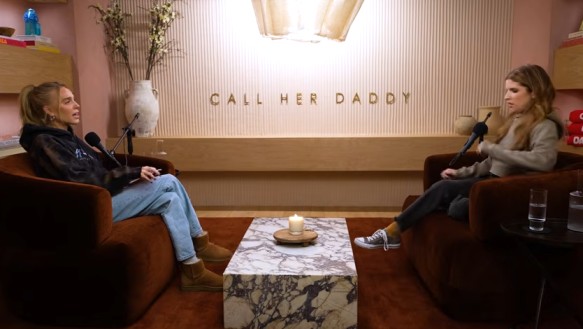
Read the full transcript of American actress and singer Anna Kendrick’s interview on Call Her Daddy Podcast, January 23, 2026. (Originally aired on October 23, 2024)
Brief Notes: In this revealing episode of Call Her Daddy, host Alex Cooper sits down with Oscar-nominated actress Anna Kendrick for a candid conversation about her life and career, from the viral success of “Cups” to her unique perspective on the Twilight franchise. Anna shares the vulnerable journey behind her directorial debut, Woman of the Hour, and discusses the “blind panic” that ultimately pushed her to take the lead behind the camera.
The discussion takes a deeply personal turn as she reflects on surviving a long-term emotionally abusive relationship and the “fawn response” that often complicates a woman’s ability to leave dangerous situations. Blending her signature dry humor with raw honesty, this interview offers a powerful look at the strength and resilience of one of Hollywood’s most beloved stars.
Introduction
ALEX COOPER: Anna Kendrick, welcome to Call Her Daddy.
ANNA KENDRICK: Hi.
ALEX COOPER: I’m so happy we’re doing this.
ANNA KENDRICK: Me too.
ALEX COOPER: We’ve never met.
ANNA KENDRICK: Wait, is it tacky? Should I get rid of my phone?
ALEX COOPER: Only you can put on silent.
ANNA KENDRICK: It’s not tacky. Whatever. But no, I’ll just get it out of the—
ALEX COOPER: Okay, okay, okay.
ANNA KENDRICK: Sorry.
ALEX COOPER: Just in case you get an important call.
ANNA KENDRICK: No.
ALEX COOPER: Who would be calling you?
ANNA KENDRICK: No one.
ALEX COOPER: No one. It’s fine. Are you a big texter?
ANNA KENDRICK: Oh, yeah. I’m always like, if you need to get ahold of me, you’re going to have to text me. If you want an email back, you’re going to have to wait two weeks. You might as well send me a postcard in the mail.
ALEX COOPER: I’m so bad on my email. Are you one of those people, though, that has a thousand plus emails, or are you deleting?
ANNA KENDRICK: I think it was—you know that period between Christmas and New Year’s where you’re like, where are we? And time has—I was like, I’m going to clean out my email inbox because I did have one of those. Because it was like, well, what else are we doing?
ALEX COOPER: Right?
ANNA KENDRICK: And I am one of those people, and I hate that about me, that I’m one of those people that has 2,000.
ALEX COOPER: I have the same thing. And if anyone calls, humiliating, I immediately don’t answer and I wait. Did someone die?
ANNA KENDRICK: This is bad news. This is terrible.
ALEX COOPER: I don’t like confrontation.
ANNA KENDRICK: No, I don’t. I don’t like communication. People I don’t know. No, that’s not true. Mostly.
ALEX COOPER: But—
ANNA KENDRICK: But yeah, no, yeah, you have to text me.
Life Off Camera
ALEX COOPER: Okay. Obviously, being an actress now, obviously director. But what is your day off? What are you up to when you’re not working?
ANNA KENDRICK: I’m trying to get mint to grow in my garden. I’m trying to really be a homemaker. Not a homemaker. That’s not what I mean. I mean, I’m trying to do something physical and tangible that I can go like, wow, I grew this mint, and now I’m putting it in a cocktail because that’s as close as I’m ever going to get to cooking.
And I don’t know, there’s something about devoting your entire life to this very weird thing of pretending to be another person and crying on cue in front of a room full of people you met three days ago and whatever that you’re like, I don’t make anything physical. You know what I mean? So I feel like I’m always trying to find—I should really take up knitting or something. I just want to make something that I can hold and go, I made this.
ALEX COOPER: Okay. To give you a little bit more credit, you are making something that—I mean, it’s not—
ANNA KENDRICK: It’s not real, but there is just something fleeting about it or—I don’t know.
ALEX COOPER: Are you having an existential crisis right now?
ANNA KENDRICK: Constantly.
ALEX COOPER: This whole episode is us just trying to figure out what is the meaning of being an actor in life? No, but I get what you’re saying. You’re like, I want something tangible, AKA mint. It’s a little odd that mint is the one thing in your garden.
ANNA KENDRICK: It goes in a lot of cocktails.
The Art of Cocktail Making
ALEX COOPER: What can—are you making good cocktails?
ANNA KENDRICK: I’m trying. Yeah. Yeah. When I moved, I was like, I want to be able to have people over and be able to offer them a refreshment. But I’m never going to cook, and that’s never going to happen.
ALEX COOPER: Okay, pretend I come over. What are you making me for a drink?
ANNA KENDRICK: Well, do you have a specific—
ALEX COOPER: I like tequila and vodka, so I’m kind of like, I can go either way. I like a Moscow mule. I like a margarita.
ANNA KENDRICK: Well, Moscow mules are super, super easy, so we love that. But there’s a watermelon vodka cocktail that I like. I also feel like people tend to come over and say that they drink anything but gin. But gin makes great cocktails. Drinking gin straight is for crazy people. I don’t know what that’s about, but it makes really great cocktails, especially if you want to serve something up.
And also if you want to commit to doing an egg white foam, it’s really easy. People are absolutely blown away that you’ve created something.
ALEX COOPER: I’m blown away already. Wait, an egg white foam?
ANNA KENDRICK: Yeah. The key is doing a dry shake in your shaker with the egg white before you add ice.
ALEX COOPER: I’m the dumb b that’s like, whoa.
ANNA KENDRICK: Well, then that’s what I would make right now so that you find me impressive.
The Pomegranate Chapstick Connection
ALEX COOPER: Yeah, that’s—okay. That’s good to know. What is one thing you can’t leave the house without?
ANNA KENDRICK: Oh, God, probably chapstick. I’m one of those people that I have a drawer full of chapsticks and—
ALEX COOPER: Yeah, same.
ANNA KENDRICK: Yeah. And I like all the different flavors and the—
ALEX COOPER: Oh, yeah. What’s your go-to?
ANNA KENDRICK: I really like the Burt’s Bees. There’s a pomegranate one.
ALEX COOPER: Are you with me? No. You’re f*ing with me.
ANNA KENDRICK: No. What? People are laughing. What’s happening? No.
ALEX COOPER: You talk to someone. Are you doing a bit?
ANNA KENDRICK: All my life on my dad’s soul? No.
ALEX COOPER: Absolutely.
ANNA KENDRICK: Wait, what is happening?
ALEX COOPER: Anna, you are not about to do that to me right now. You don’t understand.
ANNA KENDRICK: That’s sick.
ALEX COOPER: No, you don’t get it.
ANNA KENDRICK: I might have it in my fanny pack. I’m not joking.
ALEX COOPER: You brought a fanny pack?
ANNA KENDRICK: You know what? We’re—I’m doing a lot right now. Don’t make fun of my fanny pack.
ALEX COOPER: First of all, that’s it.
ANNA KENDRICK: Now I feel like you’re f*ing with me.
ALEX COOPER: No, that’s crazy. Okay.
ANNA KENDRICK: I have a—I feel like you just—I feel like you’re the Mentalist. You’re Criss Angel. And you’re like, you mean this pomegranate?
ALEX COOPER: Whichever one. You said you’re like road lipstick. I’m like, boom.
ANNA KENDRICK: I also like the sweet violet, but I was like, well, that’s not really—I guess that’s a tinted lip balm. I don’t know. That’s something else. So I was like, pomegranate.
ALEX COOPER: I like the pomegranate too, because it gives that a little bit of a tint, the tiniest hint.
ANNA KENDRICK: Yeah, I—what’s happening? We—
ALEX COOPER: I’m not kidding you. I thought you were doing a bit.
ANNA KENDRICK: No.
ALEX COOPER: Or you were with me.
ANNA KENDRICK: Wait, have you talked? Am I an idiot? Have you—
ALEX COOPER: No. Everyone that really, really knows me—you know the Arthur meme where he’s got the fist?
ANNA KENDRICK: Yeah.
ALEX COOPER: I always have this in and anywhere you look. Any interview I’m doing, I have it somewhere in my body. And I have an entire bowl in my house, and every single sweat—I have a bowl in my house of all the pomegranate next to my bathroom sink, and I just pick one up every day, and I open a new one, and I use it until I lose it, and then I go back. I love it.
ANNA KENDRICK: This is weird. I don’t like it. It’s creepy.
ALEX COOPER: It’s really creepy. But I think the reason I love chapstick so much is because I have this feeling. It’s like the ick of myself is if I don’t have my lips somewhat moisturized, I feel like that goes and is almost contingent with having bad breath. When you see someone with chapped lips, you’re like, they must have bad breath.
ANNA KENDRICK: Oh, yeah. I don’t know. No, I think that—yeah, I haven’t thought about it so consciously. Yeah, I’m just going to lean away.
ALEX COOPER: Okay. So you’re a chapstick girl.
ANNA KENDRICK: Yeah.
ALEX COOPER: Good to know. So you probably have good breath. Haven’t gotten close enough to you today, but we’ll see later. What is the most high maintenance thing about you?
The Hair Journey
ANNA KENDRICK: Probably my hair. Because I have—I’m a secret curly. I’m a secret Keri Russell in Felicity level curly.
ALEX COOPER: You have gorgeous hair.
ANNA KENDRICK: Well, you know, not really what my hair looks like. Yeah, and I’ve been—I haven’t—I started—I was on a natural curly hair journey. I let my therapist see me with my real hair, big steps. And two of my best friends in my house have come over and I’m like, I should let you know that I have let my hair dry naturally. And I’m in a very vulnerable place because I just—
It was one of those things that I always felt messy because I think when I really started to be like, oh, I need to start learning how to blow out my hair and whatever was when pin straight hair was—when tiny butts and super straight hair was the height of female attractiveness. So I just felt like, yeah, I don’t know, almost like the chapped lips thing where I was just constantly doing that, you know, just kind of make my hair be flat.
And when it would get frizzy if I would go to a concert or whatever, I would just be freaking out about it, humiliated.
ALEX COOPER: But you’re like, I have to leave. I have to leave the concert.
ANNA KENDRICK: And I was thinking about all the f*ing energy and time that I think we all spend without even thinking about it about, okay, well, okay, if I wash my hair at this time and then how long is it going to take to do my blowout? And if I shave my legs on this day, I’ll have stubble for that. Well, but—and just—it’s always just running in the background. It’s exhausting.
ALEX COOPER: It’s so exhausting. And it’s so dumb because we notice so much more about ourselves. I bet if you had your curly hair here, I’d be like, oh, I love your curly hair. Wait, what did your therapist say to you? When did you do a big reveal of like, I’m going to show you now. Is it on Zoom or in person?
ANNA KENDRICK: It was on Zoom. Oh. And I think it—I think it was—this is so boring. But I was still self-conscious about it. So I pulled back—you know, I did a half up, half down thing. And so she was sort of like, oh, where are you going? It was, you know, that it was—it just looked different because I usually just wear it in a bun and a headband.
ALEX COOPER: Right?
ANNA KENDRICK: So I think she thought that I was going somewhere. So I was like, well, that’s encouraging. She wasn’t like, what happened? But yeah, I’m still on a journey.
ALEX COOPER: Well, you know what, we’re going to support you on that journey. Your hair looks amazing today. But I bet it would also look amazing if it was curly. Okay. Anyways, you’ve been making movies for two decades. What do you think you would be doing if you hadn’t pursued acting?
Early Career and Education
ANNA KENDRICK: Oh, God, I don’t know. What, I really don’t. I mean, I feel like obviously I didn’t get into show business because I hate attention. So there’s that piece.
Like when people ask me that question, I feel like I’ll usually just say, oh, I’d have a bakery or something. But I don’t know, I would be so screwed. Like, I actually remember when I was 17, 18, whatever, whenever I moved to LA, I was really, really jealous of all my friends that were going to college, number one, because I felt really insecure about not going to college. I have a whole complex about it.
But I was also on the phone, hearing about this exciting new chapter that was sort of laid out for them, going to classes and joining a sorority, having this immediate community. And I was in LA, I was like 17 or 18. It’s really hard to make friends in LA because of the way the city is laid out, but especially when you don’t have a fake ID. And even if I did, I looked about 12, so that wasn’t going to work anyway.
And I was just absolutely terrified and really wondering if I was making a huge mistake. And then the weirdest thing was that when everybody entered their sophomore year, I was still just trying to get in the door and all that. But I then noticed that when I would get on the phone with friends of mine who were in college, they were suddenly, all of them, sophomore year, having a total crisis because freshman year was “this is so exciting, and there’s this new chapter, and my whole life is ahead of me, and I’m making these friends.”
And sophomore year, it felt like, “okay, I’m back with the same people, and that’s great, and I’m picking my classes for this year, and that’s great.” But what do I want to do with my life? There’s no longer just the excitement of frat parties and the college experience. It’s like, oh, I have to figure out what I want.
And so even though the thing that I wanted felt like a total pipe dream, and what am I doing? This is a disaster. It’s so hard to carve out space for yourself in this industry, but on the other side of it, holy s*. I did not think, what a blessing to just know what I want. And I was watching all my friends go, “oh, my God, I don’t know what to do.”
ALEX COOPER: It’s so interesting because I went to college and I remember from a young age, I knew I wanted to be in Hollywood. I knew I wanted to create. I knew I wanted to do something in this industry.
ANNA KENDRICK: I—
ALEX COOPER: But my mom kept just being like, “no, you have to do school. You have to do school, and then you can do it later.” And I resented that so much for a while, but hearing the difference, everyone wants what they don’t have. Being in college, wishing by sophomore year I was like, get me the f* out of here. I know exactly what I want to do.
But you being watching all the kids in college and you being like, that was a big insecurity of mine. Why was it an insecurity, though? Because you were like, I don’t have an education technically.
ANNA KENDRICK: Totally, totally. So I think my family really values traditional education for good reasons, bad reasons, whatever. And so I was the first person to not go to college, and my dad was a teacher and everything, so it was very black sheep behavior to not go to college.
ALEX COOPER: Were they okay with you not going to college?
ANNA KENDRICK: Yeah. I mean, I think they knew I was going to do what I wanted to do, but I think there was always that sense of, “well, if things maybe don’t work out that first year, it’s not too late to just…” So I think that was always something that they had in mind, but I don’t think they were thrilled, which is understandable. But yeah, I then just worried about, oh, my God, I didn’t go to college. I don’t know. It’s like, I get it.
ALEX COOPER: I think it’s in a great way. I do think the concept of education now is becoming a little bit more lenient, where people are like, you don’t need to go to college to be XYZ. And it’s interesting because you were right on the right path, but because of societal standards, if you’re smart, you go to college.
It probably felt so disorienting when you’re watching all these people do the natural next step, really, you just skipped a big step and then you got ahead on your career. But it doesn’t mean you can’t still feel insecure about it. In conversation, having to be like, “oh, I didn’t go to college.” I get that. Especially if your family was like, go school, go school. And your dad being a teacher.
ANNA KENDRICK: Totally. And I think now that I’m older, it’s less of a thing. But early 20s, that’s part of the conversation. “Oh, where’d you go to college?” “Yeah, I didn’t.” How? Oh, my God. I have to say I didn’t. And by that point, 21, 22, I didn’t really have much to show for it yet. Then some things happened and it was less of an issue.
But yeah, if you’re like, “oh, I didn’t go to college because I wanted to become an actor.” And it’s like, “how’s that going?” “Well, you know, I think I got to…” Someone’s… I’m hearing my phone ring. So, yeah, right.
ALEX COOPER: They’re like, “what are you in?” You’re like, “be back soon. Got to go.” I get that. Talking about your family, though. You were raised in Maine, right? Born and raised in Maine. What were you like as a kid?
Growing Up in Maine
ANNA KENDRICK: I think I was really hyper vigilant. I was really in everybody’s business a little bit. But I think that I was even thinking a couple weeks ago about how I do, one of my many toxic traits is I do kind of walk around with a little bit of a, “alright, who’s trying to f* me over?”
And I was like, I don’t know, there’s a chance that it’s like, “oh, you’re spelling bedtime. You think I don’t, you think I don’t know what’s happening here?” Just being real aggressive about how I wanted things done and very opinionated.
But I can’t really tell if that comes from childhood or from working in an industry where, I’m sure you’ve experienced, it’s like you agree to certain things and then it’s like, “oh, and can we also do this thing that would be really humiliating for you and not pay you any extra money or check with you in advance and ask you in front of a group of people. So if you say no, you’ll look like a b.” So I’m just always like, “alright, who in this room is trying to f* me over?”
ALEX COOPER: That’s so interesting that you’re like, did that happen when I was young or is it just something I can’t not remember? Because you started in the industry at what, like 10? You started really getting into it.
ANNA KENDRICK: Yeah, I started kind of auditioning for things when I was 10 and I booked my first gig when I was 12. But I mean, I wasn’t auditioning all the time because I lived in Maine. And so either one of my parents had to drive me to New York City for a 15 minute audition. And they were like, “well, sweetie, we love you, but Jesus.”
So eventually my brother and I would take a Greyhound bus from Maine to New York. And that’s one of the situations where I auditioned for this show that I ended up getting and we were in New York and they asked me, “are you cool to stay for a callback tomorrow?” And I was always just told, “we’ll just say, just say yes, you’ll figure it out later.” So I was like, “absolutely, I will see you tomorrow, no problem.”
And my brother and I are just like, “okay, we need to find a hotel in New York City.”
ALEX COOPER: Anna, what are you, 11?
ANNA KENDRICK: I’m 12, he’s 13 or 14. And so we found a hotel and my parents called the hotel and faxed a credit card and told them, “yes, yes, we’ll be along shortly.” And they’re in Maine. And so I wash my underwear in the sink and then just put on this… I mean, luckily there is a thing where if you get a callback, it’s kind of conventional wisdom that you should wear the same thing. So that didn’t seem like I was the gross kid with one pair of clothes, same underwear.
But so then the next day the same thing happened and again it was like, “no problem, I will see you again in the morning.” And had to do it again. And then they did ask me because I was wearing combat boots and they were like, “can you…” because the part was for a little rich girl. So they were like, “could you wear something, we just love to see you in more of a kind of Sunday best outfit?” And specifically someone mentioned my shoes.
So I was wearing this ratty cardigan and ripped jeans and these combat boots. But I was like, “ah, the solution will be to go to the nearest Payless and find white church strappy sandals.” And so with the last $20 that we had, I bought this pair of sandals, dress sandals, and wore those with my ratty cardigan and jeans. And I think they were just like, “oh, for f*’s sake. Yeah, fine, whatever.”
ALEX COOPER: Great.
ANNA KENDRICK: And then we were on a Greyhound bus home and we had this phone for emergencies and that rang and it was like, “hey, you’re going to be on Broadway.”
ALEX COOPER: I’m trying to picture 12 year old me walking around in New York City with my brother who’s two years older than me. I’m like, how the hell were you not even scared?
ANNA KENDRICK: I think that we just thought it was such an adventure. And I think we also wanted to be cool New York City kids so f*ing bad that we were just like, “yeah, this is so normal.” I can’t remember if we were low key freaking out or not, but I mean, even when I went there at 17, I did this show at New York City Opera and I remember riding the subway to work and seeing, oh my God, you see those gorgeous girls who were going to American Ballet and looking at them and being like, “we’re really doing it. Oh my God, I’m in New York and I’m going to work and I’m going to work on the subway and it’s not a big deal at all.”
Which if you’re thinking about it like that it’s a huge f*ing deal to you. I was not… I had no chill. But that was…
ALEX COOPER: But that’s sweet.
ANNA KENDRICK: Yeah.
ALEX COOPER: Okay. All of this is happening. I know that you were nominated for a Tony Award when you were just 12. So it came from that.
ANNA KENDRICK: Yeah, yeah, yeah.
ALEX COOPER: Okay. What did kids in school think?
ANNA KENDRICK: It’s weird again. I don’t know if you would experience something like this, but there were several moments where it felt like if I mentioned anything to the kids at school, they, don’t get me wrong, understandably, sort of thought I was talking about something else.
In the same way that if someone in my school in middle school or high school had been like, “oh, yeah, I’m going to Olympic trials,” I would be like, “so there’s some kind of local…” It’s the Olympics. You know what I mean? I would just be like, “no, you’re not.”
ALEX COOPER: Right.
The Sundance Story
Like, because that just doesn’t make sense because we’re from Maine. Like, what are you talking about? I remember having a really little indie film in the Sundance Film Festival when I was 16, 17, and going to Sundance. And I remember one of my close friends, one of my best friends called me and was like, “That’s so weird. There’s something on the news about…” I think it was, I could be getting this mixed up, but I think it was the year that Britney Spears and Fred Durst went to Sundance together. There’s something. I’m maybe hallucinating. It was some other story. I don’t know.
But she called me and she was like, “Yeah, they’re at the Sundance Film Festival. And isn’t that so weird? Because you were just saying that you’re doing something called Sundance, but it’s happening at the same time.” And I was like, “I’m at Sundance. I’m at the Sundance. I’m at the Sundance film. That’s why I was so f*ing excited about it.”
ALEX COOPER: Right? You’re like, “I’m here with Britney Spears.”
ANNA KENDRICK: Yes. And she was a close friend. So I think there’s an understandable thing that happens where you’re just like, yes. Not you. Not from here.
ALEX COOPER: They didn’t get it.
ANNA KENDRICK: So you…
ALEX COOPER: And you didn’t talk about it over the top where people would even have a concept of it.
ANNA KENDRICK: No, no. I mean, even I think there was a luckily very brief window where it was kind of a teasing situation. So it was like, I knew better than to be running my mouth.
ALEX COOPER: About it too much because people would make fun of you.
ANNA KENDRICK: Yeah.
ALEX COOPER: That’s so weird. Meanwhile, it’s like, everyone wants to be a movie star.
Middle School Survival
ANNA KENDRICK: I don’t know. I think just drawing any attention to yourself in middle, particularly. This was in middle school, right after I did the Broadway show. It’s like, you just want to dissipate. I think people talk about high school as being cutthroat. Middle school was so much scarier to me.
ALEX COOPER: It was so horrible. I completely agree. High school’s actually I started to get my sh*t together. Middle school, I was terrified.
ANNA KENDRICK: Yeah. I remember feeling just trying to be a moving pile of laundry, you know, just wearing the biggest clothes and just trying so f*ing hard not to draw any attention to yourself.
ALEX COOPER: Yes. So you obviously start to become so successful. Was your family like, “Oh, this is normal?”
Making It Real
ANNA KENDRICK: You know, I found some success. And then I think this is pretty typical for entertainment stuff that the money really follows several years later. There’s that period where you’re like, “Okay, I’m low key, a little famous, but I am so broke. It would make you tear up how broke I am.” So you’re kind of trying to fake it till you make it.
But I had brought my family to the Oscars, and you know, there was a really interesting moment a few years later when I bought my first place and I had them at my place, and it was like, you could feel the energy, particularly for my mom and dad, of, “Oh, okay, okay, okay.” And it wasn’t a mansion, but it was just like, “Oh, you’re going to be okay.”
Because they were obviously very proud. But there’s things with awards and reviews where that’s great, but it’s still really abstract. And to just see something solid where it was like, “Okay, our crazy daughter who didn’t go to college has managed to buy a home.” You know, it was like I could feel not so much pride, but that they were actually like, “Oh, you made it okay.”
ALEX COOPER: Yeah, it all worked out. Like, we don’t have to worry about now her going back to college and trying to figure out something else completely.
ANNA KENDRICK: She’s not going to move in with us and drain us dry.
The Cup Song Phenomenon
ALEX COOPER: Love, you’ve been in so many great movies. I want to talk to you about a few of them today. We got to start with Pitch Perfect, obviously. What was that audition process like?
ANNA KENDRICK: Well, you know, I think that the most interesting piece or the piece that has certainly followed me around is when I auditioned, they need you to just prove that you could sing. And I was like, “Well, I know how to do this thing. There’s a cup, and there’s this song, and I could do that.” So it was just because I was like, “Well, where else am I going to do it?” Because I was lame enough and dorky enough to have bothered learning this thing.
And so I did it for my audition, and they were like, “We should put that in the movie.” And originally in the script, Becca, my character’s audition song was “I’m a Little Teacup,” which I keep meaning to ask the writer, Kay Cannon, like, was that meant to be funny? How would that have worked? How was I supposed to play that?
ALEX COOPER: I don’t…
ANNA KENDRICK: I don’t know what I was supposed to do.
ALEX COOPER: Would you have gone?
ANNA KENDRICK: Were they supposed to do a Christina Aguilera version of “I’m a Little…” to be like, “Oh, I resent that I have to do this, and, you know, but I sound fine.”
ALEX COOPER: How do you think you would have done it?
ANNA KENDRICK: I guess like that. I mean, I would have been relying on somebody to tell me what the vibe was supposed to be, right? But luckily, I didn’t have to figure that out.
So they were like, “Well, let’s do that for Becca’s audition.” And I was like, “Great. Making use of a useless skill.” And then people, when they saw the movie, would ask about it and stuff. And so then the studio was like, “We should release this as a single.” And I was like, “What? Are you f*ing stupid? That’s so embarrassing. I’m so embarrassed for us.”
So they had me go into the studio for 20 minutes, a hit that was made in 20 minutes, and just sing the rest of the song. And I was in there with a stool and a cup, doing the cup in this weird studio. And then they were like, “What if we did a music video?” And again, I was like, “Are we… What’s going on? This is so… You guys. I’m so embarrassed for you.” I just was like, “There’s no way anybody would care about this. Whatever.”
And so we make this music video, and then it, which is, by the way, why am I saying this phrase? Why is this phrase coming out of my mouth? It started climbing the charts. I was just like, “What’s f*ing happening? This is so out of the realm of anything that’s supposed to be happening.”
And I always thought, because I was in the middle of making this indie film and I’d be getting texts from people going, “It just got into the top 10 of Billboard’s top 100.” And I was in the basement of some church shooting this tiny little indie film. Meanwhile, I think it was, I think it was, speaking of the times, Miley Cyrus and Macklemore was in also in the top 10.
And so I always just think they must have been like, “What the f is this sht? Literally, who is this girl? What is this? How dare you. I’m out here busting my a on Good Morning America, putting on a live performance and this freak show, whatever this f*ing is, is in the top 10. How dare I? What on earth, Anna? I would hate me. I would hate me.”
ALEX COOPER: Did you ever learn to be like, “Damn, that sh*t’s good.”
ANNA KENDRICK: They did send me a platinum record and that was…
ALEX COOPER: Bye, b*tch. That’s literally perfect. Like, I guess it was kind of…
ANNA KENDRICK: Oh, I guess when I got my platinum record though.
ALEX COOPER: That’s insane that you’re like, “This is so fing embarrassing, you guys.” And meanwhile, it’s like the entire world learned this sht. I remember trying to learn it, Anna.
ANNA KENDRICK: Okay, no, you didn’t.
ALEX COOPER: Oh, I tried.
ANNA KENDRICK: Of course, everyone. Oh, I shot your face.
ALEX COOPER: I couldn’t really do it. You shot your face. You f*ing invented it. It’s so crazy that you brought that to the movie. And they were like, “Yes, okay.” I just realized also while you were talking, which is fun is I have had on you, Brittany Snow, Adam Devine and I have had on Rebel.
ANNA KENDRICK: Oh my God.
ALEX COOPER: I have almost had the entire…
ANNA KENDRICK: Yeah, you’re collecting all the Pokemon.
The Pitch Perfect Family
ALEX COOPER: Yeah, yeah, I’m kind of having a good time. How would you describe your guys’ friendship on that cast?
ANNA KENDRICK: Honestly, I use this word in the truest sense of, we are a family. Truly in the sense of we didn’t choose each other. We didn’t ask to be in each other’s lives in this way. And we’re so bonded and it does feel, there’s something really, not to be lame, there’s something really magic about it because so often you’ll do a big job and there’ll be one or two people maybe that you keep in touch with and they’re the people that are the most similar to you.
And we’re all really, really different. And after three movies, you’re like, “I think this is a not getting rid of each other kind of situation.”
ALEX COOPER: I think the entire world is happy. It’s a not getting rid of each other situation.
ANNA KENDRICK: And also, I think that I’m avoidant. So actually cracking that shell and being in my life, it takes some persistence.
ALEX COOPER: That’s a big deal.
ANNA KENDRICK: Brittany’s always joking that her… She’s like, “Well, your phone is all white or whatever.” The blue text. Yeah, you get it. You get it. Because she’s always texting me and just being like, “I know you’re not going to reply, but, you know…”
I think that I’m kind of certainly the curmudgeon of the group. But it is almost like everybody has a role and, you know, Brittany kind of brings the party and I bring the grumpiness, I guess. I don’t know, but I am… It’s really interesting because even the girls that are not one of the closest girls, when they’re going through something, I get the call.
And it makes me feel so good because I do feel like that’s kind of my role in the group is if you’re in jail, my shoes are on. We’re… I’m going to… We’re getting you out tonight. I don’t know how, but we’re going to figure it out. Whereas if you need help with party invitations, I’m going to freeze up and be like, “I don’t… I don’t know. I don’t know. I don’t know what to do. I don’t know. I have to leave the room right now.”
ALEX COOPER: Call Brittany.
ANNA KENDRICK: Yeah, call Brittany. Please call Brittany.
ALEX COOPER: It’s so fun to know that you and Brittany Snow are so close, because it, I don’t know, it sets something right in the world. I like that you guys are… It also is nice because obviously, as consumers, we know that sometimes on movie sets people don’t get along. And there’s something oddly satisfying about how amazing those movies are. And knowing you guys are so close, it’s just a fun thing for fans.
ANNA KENDRICK: It makes me really happy. I saw some of the girls from the movie, the original, The Craft, having dinner once, and I was like, “You guys are friends in real life.”
ALEX COOPER: It makes you happy.
ANNA KENDRICK: It made me so f*ing happy. So I do… I wouldn’t think anyone would care, but seeing The Craft girls, I was like, “This is so beautiful.”
ALEX COOPER: Thank you so much.
ANNA KENDRICK: To me.
ALEX COOPER: So now when people are crying when they see you guys out together, you get it?
ANNA KENDRICK: Totally.
ALEX COOPER: Are we getting a fourth one?
ANNA KENDRICK: Oh, I have no idea. I’m always like… I’m always like, Rebel is kind of the steam train of the group. She’s always like, “I think we should do it.” And I’m like, “Well, then great, we should. I agree. I’m just here for… I’ll just be back up, I guess.”
ALEX COOPER: We need it.
Twilight Memories and Reunions
ANNA KENDRICK: I would love that because we’re all so busy and I’m so happy that everybody’s so busy and successful and doing so much that actually getting, whatever, the 10 of us in a room is impossible. So it’s usually like maybe six of us at a time, trying to have a little reunion. So it does feel like the thing that would actually get us all in a room again is the movie. So that’s my best reason.
ALEX COOPER: I will watch, so let us know. Twilight.
ANNA KENDRICK: Can you believe? Can you believe? I mean, okay, so someone was just asking me about, a while ago I had done a silly, funny tweet where I just said, “Holy shit, I just remembered I was in Twilight.” And people were like, “But you didn’t forget. You didn’t forget that you were in Twilight.” And the answer is truly, truly yes and no.
Because obviously, obviously I didn’t forget the experience of making the movies. But those movies, especially at the time, took on such a life of their own. And they were such a kind of, for better or for worse, a kind of touchstone, such a reference that everybody would talk about, trying to find the next Twilight or whatever.
And I would find myself in business conversations talking about, “Oh, yeah, I’ve heard that there’s a book series that just got optioned that maybe want to try and make it the next Twilight.” And then I would be like, “Oh, my God, I’m in—”
ALEX COOPER: Oh, my God, I’m in the movie.
ANNA KENDRICK: Oh, my God. Because I was also so on the, just on the outside, had a front row seat, but was just on the outside of the madness of it. And I was really lucky to not be dealing with the Eye of the Storm, really.
I think that a lot of the folks that were in the movie, even in the later movies where they are playing, as long as you were a supernatural character, if you had one line, you couldn’t leave your hotel room. People were crazy. And people were criticizing, like, “Oh, but she has green eyes in the book,” or whatever.
And I just didn’t have to deal with any of that. So it almost feels like I didn’t really have to run the gauntlet that some of the other, I mean, most of the other people did. I just had to show up and say dumb, funny shit. Just be like, “What are you guys talking about?” Because they’re f*ing acting weird. Okay, everybody really serious. Bye. That was the gig. It was awesome.
ALEX COOPER: Jessica. Oh, my f*ing God. Jessica being like, “What’s so great about Bella?”
ANNA KENDRICK: Like, I don’t get it.
ALEX COOPER: Like, what’s going on with Bella?
ANNA KENDRICK: Which is also crazy, because when I auditioned for that, I was like, yeah, I think in the book, she’s the blonde, athletic volleyball captain, popular girl. So I was like, well, great. I’m not getting this job. And the goal then becomes like, well, I hope I just make an impression on the casting director and the director so that maybe they’ll remember me for something else. Right?
And so I was like, well, I’m just going to try to be weird and funny because I don’t know. And then they were like, “Oh, great. Yeah, let’s do that.” So there I am with my headband, because in that humid weather, they didn’t know what to do with my hair full circle. They were like, it just keeps getting bigger. So it was always in a headband or pulled back really tight, and in my ratty little costume, five inches shorter than Kristen, going, I don’t even get what the point is.
Meanwhile, she’s so stunning in real. You’re like, “Oh, my God. I’m staring into the eyes of a Siberian husky.” She’s so gorgeous. I mean, she’s gorgeous on screen, but in person. Have you met her in person?
ALEX COOPER: No.
ANNA KENDRICK: There’s a quality, let me tell you. Really? Oh, my God. It’s breathtaking. And she’s obviously very beautiful. And sometimes you meet certain people and you’re like, “What? How dare you?”
ALEX COOPER: Right?
ANNA KENDRICK: Why are you doing this to me? Oh, my God. So the audacity of me to be like, “I don’t see, I don’t see it. I don’t get it.” Right?
ALEX COOPER: You’re like, right, right, right. Were you ever like, I’m being annoying, or you’re like, it’s fine. It’s my role?
ANNA KENDRICK: Yeah, I guess it was like, I’m being annoying, which means you’re doing your job. I’m doing what I’m supposed to be doing.
ALEX COOPER: You’re doing your job. I’m obsessed with you being like, are they trying to put my hair down? And I’m like, I don’t know what to do. It all comes real circle.
Alice Darling and Personal Trauma
ALEX COOPER: Okay, next movie. Alice Darling. This is obviously a bigger shift and is basically about a woman in an emotionally abusive relationship. When you’re taking on a more intense role, do you hesitate in those moments, or do you enjoy those type of moments that are a little bit darker?
ANNA KENDRICK: It was, oh, gosh, that’s weird. I’m about to use a phrase that I’ve been using in reference to directing, so. But kind of makes sense because it’s a similar thing where it was pushing myself off of a cliff and not giving myself the time to go, “Is this a good choice?” Because it was really scary and personal.
And, God, I’m just remembering, I remember I didn’t tell, I haven’t thought about this in a while. I didn’t tell anybody in my life. Not my, well, this was also kind of COVID-y, so I wasn’t talking to that many people. So again, I’m bringing up my therapist, but I didn’t tell my therapist. I didn’t tell my closest friend that I was making this movie about emotional abuse because I had just gotten out of a relationship that was extremely similar to the movie.
And I didn’t want anybody to tell me to not do it. I didn’t want to get talked out of it. And I knew that there were good reasons for my friends and certainly my therapist to be like, “Is this the best idea for you right now?” So I just kept telling them it’s about three friends in a cabin and it’s about their relationships, which, in a way it is.
ALEX COOPER: Right.
ANNA KENDRICK: But yeah, I didn’t even, when after the movie was wrapped, whatever, they didn’t even know that it was about emotional abuse until the trailer came out. Because I just didn’t, I just didn’t want somebody to tell me, “Well, I don’t know. Maybe this is the childhood thing of, I don’t want you to tell me it’s bedtime.” I need to do this. I’m going to do this.
Surviving Emotional Abuse
ALEX COOPER: Can I ask, how long did that abusive relationship that you endured last?
ANNA KENDRICK: It was, it didn’t follow the traditional pattern, which is kind of yet another reason why I was finding it really difficult to identify it and name it as abusive. Okay. Because I was reading all the articles and going like, “This doesn’t look like, some of it looks like how they’re describing it, but not completely.”
And so the relationship was seven years, but it was like an overnight switch. And that went on for about a year. So it didn’t follow that more traditional, it’s like a frog in boiling water thing, where it started slow, it came out of absolutely nowhere, but was built on this foundation of, I had so much love and trust for that person, so I thought it had to be me.
If one of us is crazy, it must be me. So it was very, very difficult to actually go, “No, this, I think this is, I think this is him. I think this is his stuff.” Because I turned my life completely upside down trying to fix whatever was wrong with me.
And it didn’t help that for a long period of time, our couples therapist, I think, just bought his stuff kind of hook, line and sinker. And I’ve had several sessions with him in the last several years where he’s apologized to me because I think he realized what was going on toward right toward the end. But, yeah, that obviously made everything a lot more complicated.
ALEX COOPER: We always have to remember, therapists are human beings, too, and a lot of times they don’t know the inner dynamics. And if you are with a very manipulative person, though, that is good in crowds, they can mask it pretty easily. And you can be kind of painted to be the person that’s insane, or you’re unreasonable or you’re unwilling to make the relationship work. And when you have a licensed person staring at you next to the person that is abusive, because we project so—
ANNA KENDRICK: Much authority onto them, even though we kind of know intellectually well, they’re just people, right? It’s like, I just want, and it was also, I just want someone to tell me what’s happening. I wasn’t even thinking, we’re going to go into couples therapy and he’s going to ream you out, and it’s going to, I was just like, “Will someone just explain to me what’s going on?”
So, yeah, it was full on. But it was also interesting that I always felt like I was trying to stay so calm in couples therapy. Because I was like, f*, in these sessions, he’s so able to kind of stay calm in a way that he does not do when we’re outside of therapy.
And then there was a day again toward the end where I really kind of lost my shit. And I did think, “Oh my God, what have I done? What have I done? I can’t, it’s going to be so bad now. What did I do?”
ALEX COOPER: I mean, what do you mean it’s going to be so bad?
ANNA KENDRICK: Like, if things when I’m trying so hard to appease this person, they’re so f*ing awful. So how bad is it going to get now that I’ve yelled, you know?
And after that session, I, first of all, weirdly, he was fine, which was very weird, very interesting because I think he felt like maybe a little bit calm because he was like, “See, you’re f*ing crazy.” So it was weirdly fine.
But I sent the therapist an email being like, “I’m so embarrassed. I’m so sorry. I need to control myself or whatever,” because I had yelled in this session and he called me, which he hadn’t done before, and was like, “No, no, I’m so proud of you.” And that’s when I knew, oh, something has shifted, something’s changed. And then, yeah, things ended pretty quickly after that.
Recognizing Red Flags
ALEX COOPER: I mean, I appreciate you sharing this just because I have so many women that listen that are like, “What are the signs?” And I appreciate how you opened the conversation about this topic about like it literally changed overnight. And I was reading all the articles being like, “Is this me? Well, no, that’s not me.” You try to justify things.
Do you mind sharing anything that maybe my listeners could be like, “Oh, this is happening to me too,” that maybe doesn’t present as this is abusive and toxic, but the undertone is so there?
ANNA KENDRICK: God, it’s so hard. It’s so hard. And I, well, I don’t know, maybe I’ll think of something. But it’s, this conversation is even really complicated for me. It’s like, even talking about it, I can feel my body temperature going up.
Because I think that sometimes the conversation around red flags, those are important conversations that we should be talking about it, thinking about it, looking for them, sharing with each other. And I think that even the most well meaning conversation sometimes about red flags can be a little victim blamey.
Which is hard because I’m like, well, also, I want to know and share red flags because it does sort of put the onus on you to be able to identify something that, by the way, someone is working so hard to make sure you can’t identify.
I really started thinking about it like, if someone was raised from birth as a wilderness survivalist and they just dropped you, or, I mean, I don’t know, maybe you have this in your background, but if they dropped you or me in the middle of the woods, I would step into a booby trap within three feet.
ALEX COOPER: Yes.
The Complexity of Recognizing Abuse
ANNA KENDRICK: Because I don’t know what to look for. And it’s like, because I didn’t spend my life learning how to build or identify traps. Like, how is it that we’re meant to be inside the mind of someone who is working very hard to make sure that you feel very unsteady and are questioning yourself? So it’s really complicated.
And it’s hard for me because there are even times when I talk about my situation where, as I’m saying it, I will go, am I making that up? Am I making everything up? Like, I remember having a conversation with my therapist, like, a year after that relationship, where I was constantly asking her to just diagnose me with an ego syntonic disorder so that I could just fix it and make sure that this just won’t happen again, or something.
And there was a point where she was talking about my ex, and she started to say something where she was like, “Well, you know when you’re dealing with a wolf in sheep’s clothing?” And I went, “No, no. What if I’m the wolf? Like, what if it was me?”
Because I think that was the thing that I didn’t expect was how totally convinced he was of his own victimhood. Like, I know him well enough in spite of feeling like, well, I didn’t know him at all, but I know him well enough to know he’s not an actor. He’s not a performer. He’s not a great liar in a lot of ways.
So I was looking at someone who was actually kind of suffering. And I thought, like, well, if he’s being manipulative, I’ll know it, because I’ll smell the bullsh*t. Like, I’ll smell that this is kind of a performance that he’s putting on. But I don’t think he was putting on a performance. I think he genuinely believed that I was torturing him.
He told me one day I was terrorizing him because I was just crying because I couldn’t pretend that things were fine anymore. And I just started crying and he screamed in my face, “You’re terrorizing me.” But it was truly from the place of a person who believed that they were being terrorized.
So I don’t know if that would resonate with people, but it’s like, even when I would watch these fing videos, I would read the articles and watch the videos, and when Dr. Ramani, who I love, she’s doing an impression of a fight where some abusive piece of sht goes, “Alex, you’re crazy.” But that’s not how it actually sounds.
It was like, sometimes it was so emotional. It was like, “Anna, I’m begging you. Like, you’re ruining everything. You’re making…” Like, it was so real for him that it was like, am I really doing something terrible? And I think that, especially with conversations about, like, “Well, you’re always out with your friends” and trying to isolate you, those kind of things. Like, I think they’re really convinced that you’re doing something terrible to them. So the pain place is real. And that can be very, very misleading and convincing.
ALEX COOPER: I just want to say, the way that you… everything you just said.
ANNA KENDRICK: Yeah. Did any of that make sense?
ALEX COOPER: One hundred percent. It made so much sense. If anything, it’s probably one of the best descriptions of it because I really, really appreciate you saying, like, I still am uncovering some of the f*ing red flags because I’m still even in my head being like, what did that even happen? Am I… is it still some of it on me?
Like, I think that is a great message to just give to everyone listening is like, it is not normal. You should not be like, “Oh, that’s bad behavior. And I recognize that you’re being manipulative and gaslighting and blah, blah, blah.” Like, when you’re with someone that you love for so long and it does turn into an abusive situation, it is so hard to see. And that’s why ignorant people that whether they don’t have someone that they know or it never happened to them, are like, “Why didn’t you just leave?” It’s so…
ANNA KENDRICK: It’s so hard.
ALEX COOPER: It’s so much harder than that. Because even you to this day, sitting here, being like, I still in my head, I’m like, was that real?
ANNA KENDRICK: And even sharing that I’m like, f*ck, should I even say that? Like, there’s something that feels, I think, incorrectly, but feels shameful about, how am I not more solid in my healing recovery, whatever. How am I still?
The Journey to Trusting Yourself Again
ALEX COOPER: But it’s not that, Anna. It’s like you are present in your reality today, but when you reflect back on that relationship and that inner dynamic with that person, you are still perplexed by how the person sitting here today was in a situation and how that went. Like, that I think is normal.
Like, I think that’s what people struggle with. And that’s why I’m appreciative of you talking with me about this. Because it is so weird when you’re like, I am happy and healthy now, so how can I still be affected by that? I think it would be weird to not be affected by someone that manipulated you in a way, because it distorts your reality.
And so you sitting here, like, I guess I could ask, like, how have you learned and I’m sure you’re still doing it, like, to trust yourself again.
ANNA KENDRICK: Yeah, it’s hard. I mean, yeah. I mean, even having this conversation, you know, like, in the… I know we haven’t gotten there, but in the movie that I made, like, something small, like, you know, there are all these different women in the film and they all have very different personalities.
And that felt important to me as yet another kind of small reason why it feels like, hey, there’s no… I wish there was, but there is no way to guarantee protection from someone who is determined to harm you. And that sounds grim and I guess it is. But surely the least we can do when someone has harmed us, when we come out of a devastating situation, is take off that top layer of shame where we go, “Well, I should have known. I should have seen. I should have been different. I should have been the tough girl. I should have been the sweet girl. I should have done…”
And it’s like, none of that will save you. None of that will save you. And again, like, I almost hate saying that because it’s so bleak, but I think I have… I did and still sometimes do so much self shaming around, like, how did I find myself in that situation? Like, I’m a real sshole. So how did I not do the thing that I would have told you that I would do, which was immediately be like, throw a scarf over my shoulder and be like, “Have a nice life, dck.”
And it’s… there’s something so vulnerable and kind of humiliating about the fact that I just stayed and I kept thinking, I’ll just try to be, I don’t know, warmer or better or something. I mean, even when this was… our schedule was getting worked out to come and record this, it was like, the next day I went on social media and I saw a video of you talking about an experience you had where you were like, “Why did I not just leave?”
And I was like, girl, you were in a fawn response. And that’s the whole Woman of the Hour. That’s… it’s all fawn response. It’s all just like, what do I have to do to survive? Like, you were doing what you had to do to survive.
Understanding the Fawn Response
ALEX COOPER: Thank you for bringing it up, because I do now want to talk about the movie. That’s kind of what we’ve been building to is these themes of every woman listening. Yes. I feel like we’re both pretty strong, independent women that we’ve got our careers and people could look at us and it’s like, “Wow, you guys have got it all figured out.”
And we’re both sitting here being like, “No, no, no.” Like, to this day, I’ve been in weird work situations that I’m like, wait, like, Alex Cooper, the Call Her Daddy person that just signed her big deal and all this? Like, no, there have been still moments in this industry where I am having uncomfortable interactions with people, and I’m like, wait, why didn’t I just…
ANNA KENDRICK: Why weren’t you just assertive?
ALEX COOPER: It’s not that easy. And I now want to talk about the movie because you’re right. There are so many themes in it that are so brilliantly portraying what we, as women go through every day. And then it also, women will be like, “Yup, I’ve been there. I’ve been there.”
And still to this day, I don’t know if men completely understand what we have to go through and why we fawn instead of scream, kick, and punch in the face. Let’s talk about the movie Woman of the Hour. First of all, you were set to be the lead.
ANNA KENDRICK: Right.
ALEX COOPER: And then you also directed it. How did this come to be?
Taking the Leap: Directing Woman of the Hour
ANNA KENDRICK: Yeah, so I actually got the script for Alice Darling and Woman of the Hour the same month at least. I want to say the same week, but it might have been the same month. And, you know, certain movies just come together quickly, and certain movies take forever. So I was attached as an actor for two years.
And, you know, you’re just sort of like, “Well, I love this script. I love this story. Let me know.” And that happens a lot in the industry. And the other thing that happens is that sometimes something will just be kicking around for a long time, and then out of nowhere, it will be like, “Hey, we raised the money and we have a start date, so let’s try to keep this train on the tracks, because otherwise it’ll probably disappear again.”
And so we were suddenly starting the search for a director. And I basically had 48 hours where it was like, this voice going, “You should pitch yourself.” And me going, “Shut up. Absolutely not. Everyone needs to be quiet. We’re not doing that.” And it was that same feeling of like, oh, my God, I’m going to push myself off a cliff.
So I pitched myself to direct the movie because I felt like I had become slowly kind of obsessed with the script. And there was a little bit of me where I would give ideas, feedback, whatever, but, you know, there were producers, cooks in the kitchen, whatever, and I was always a little bit like, “Well, you know, if it were my movie, I would probably do it like that, but it’s not my movie, so whatever.”
And the idea of taking it and just tweaking it that little bit was really exciting to me. So I pitched myself, and I got the job. And then six weeks later, I was in Canada doing hard prep for the movie. And then we were making the movie.
And it really was like, I’m going to push myself off a cliff. And I guess I will find out on the way down if I packed this parachute correctly. Because if it had been six months later, I would have panicked and backed out. I would have been like, “You guys are right. We should find someone way more experienced. It’ll be great.”
But I had also, in the last five years before that, started to have the experience of looking around a film set and going, “Huh? Oh. Oh, God. I’m the most experienced person here. Oh. Oh, no. I’m the most experienced person here, and I’m an idiot. This is a nightmare.” Like, it wasn’t like, “Ooh, hot sh*t.” It was like, “Oh, no.” But you are like, “Oh, wow. I’ve been doing this a long time.”
So, yeah, it felt like, okay, it’s kind of a now or never thing. And I was absolutely terrified. But I was trying to kind of just fake it, right? I’m a super confident leader. I should be in charge of things. And again, I don’t know about you, but I absolutely overthink things and I can get paralyzed in perfectionism, all that stuff.
And then when my back was against the wall or things were really running behind and you don’t really have a choice but to be running on adrenaline and instinct. There were even things in the edit where you’re looking at the stuff in between takes where I would see myself run into the frame and give the actor a note and adjust a piece of set deck. And I was like, “Well, that lady seems like she knows what she’s doing.”
ALEX COOPER: Damn. Okay.
ANNA KENDRICK: Like when I’m in a blind panic and you don’t really have a choice. I was like, she seems like she’s an authority figure. How about that?
ALEX COOPER: I mean, it’s an incredible movie and you should be so proud of yourself. I know you are, but to know that I didn’t realize it was that where you’re like, “Should I pitch myself? Should I pitch myself?” Thank God you pitched yourself because it’s awesome. Like, it really is amazing. Coming from someone that gets so f*ing scared from movies like this.
ANNA KENDRICK: I know, I know. And I did tell you. I was like, well, if you made it through the first five minutes, it’s all. It’s like, it gets easier from there.
ALEX COOPER: It gets easier. But before, for people who haven’t watched it yet, the movie is based on an insane true story. Can you give just a little bit of a bite for them to understand what’s going on?
ANNA KENDRICK: Yeah. So it’s based on the true story of a serial killer in the 1970s who went on the show the Dating Game. And it moves around through time. So it’s kind of following this more than a decade long period where he was really operating without consequence because nobody was really looking for him. Which is another interesting. And by interesting I mean enraging aspect of the story.
But I play the bachelorette who’s on the Dating Game and some of that footage exists online, but the full episode, all the footage appears to have been kind of lost to time. So the screenwriter kind of used that vacuum as this opportunity to. It’s almost like a fantasy section of the movie, except the fantasy is what if a woman stood up for herself? Can you imagine?
But it’s interesting because speaking of asserting yourself, it’s a really fun section of the movie. It’s a really tense movie. But that section is kind of fun. But as the viewer, it’s complicated because you know that, okay, she’s been shrinking herself and in a fawn response and she’s standing up for herself, which is so fun to watch. But we know she’s getting herself closer and closer to danger. And it’s complicated. There are times where you go, why don’t I just assert myself? And it’s like, sometimes it’s not that simple.
The Fawn Response and Survival Instincts
ALEX COOPER: Women will understand those moments where you stroke the ego or you actually are so f*ing nice in situations that you’re so uncomfortable in. Because in your head you’re like, the only way I’m getting out of the situation is to be so appeasing and so nice and work it. And then all of a sudden I know I’ll be able to get out at some point.
But to a normal person that’s never been in that situation or isn’t a woman is like, wait, why don’t they just scream and run?
ANNA KENDRICK: That’s right.
ALEX COOPER: And you’re like, first of all, if I tried to scream and run, I’m dead. So you okay, clearly we’re not that dumb. I think that was something very interesting in the movie. Obviously. I talked to you earlier before we got out here about that parking lot scene. Just struck me because I think every woman, anytime you were in a dark area and you are walking anywhere, your senses go up where you’re like, what the f is going to happen to me? What the f is going to happen to me? Am I going to die? Am I going to get murdered?
How do you think this movie, what do you think it says about how women are preyed upon in society?
ANNA KENDRICK: Yeah, I mean, well, first of all, I just want to say, it’s so interesting that you use the word your senses go up. Because even the way that scene was kind of the first scene that I could visualize and I imagined it in kind of mediums and close ups. And then when that thing happens where we’ve all been there, where an interaction is perfectly pleasant. And then 10 seconds later you’re like, wait, 10 seconds ago everything felt fine. And now something feels very f*ing dangerous.
It almost is like your entire, your hearing, your peripheral vision is just like, okay, where do I see movement? Where do I hear movement? How unsafe am I? And so that’s when the camera goes jumps wide because it’s like oh, that’s when you would be aware of, oh, this parking lot is empty. There’s not a maintenance man. There’s not a passing couple. All I can hear is the buzz of the street lights.
And it really is in those moments in your own mind, you’re like, oh, I can almost hear the ringing in my own ears because there’s nothing. F*, there’s nothing.
A Woman’s Perspective Behind the Camera
ALEX COOPER: That is so interesting stylistically. You having the decision making around the camera angles and how different. Not that we love men and we love male directors, but I’m just so curious to know how a man would have directed that scene where you’re directing it so in the presence of your own body and how you would feel in that moment.
ANNA KENDRICK: And there were times when people were talking about, when we were on set, people were talking about me as like, oh, see, oh, I’m so glad a woman’s directing this. And there were times where I was like, is it making that much of a difference? I can’t really tell.
And then there were a bunch of examples like this, but there was a moment where the girl in the New York City apartment when she kind of realizes, oh, something’s wrong. I don’t know what’s wrong, but something’s wrong. And she doesn’t even drop her smile and you can just sort of see it in her eyes. And when we were shooting that, one of my producers was like, should we just do another take where it’s just more clear what’s happening?
And I was like, it will be very clear to women what’s happening. I think it will be clear to most men. But I was also like, if there’s 20% of men who are like, I don’t understand what’s happening in this scene.
ALEX COOPER: Fine, right? That’s okay.
ANNA KENDRICK: That would be fine. I would much rather actually be like, no, this is how you would handle this. You wouldn’t let on at all.
ALEX COOPER: No.
ANNA KENDRICK: So, yeah, it was like, oh, I wasn’t really sure how being a woman director would really show up in the movie. But then, yeah, there were a bunch of things like that where I was like, oh, no, that’s not even what the scene’s about.
ALEX COOPER: No, I love it so much. And I think again, the themes are so important for people in society to just grasp onto and understand. And I think this is a very accurate depiction. Obviously heightened. We’re not all dealing with a murderer, serial killer.
ANNA KENDRICK: You know, there are so many stories that I hear where, I mean, even your story where you’re like, why did I, why didn’t I just whatever. It’s like, you did what you had to do. Are you kidding? Are you kidding?
ALEX COOPER: I know.
ANNA KENDRICK: Are you kidding?
ALEX COOPER: It’s just so weird. Daddy Gang, we’re talking about the Paris episode. The Paris story. If you haven’t listened, go listen. But yes, that story. I remember being so even anxious to tell the story online at first because I was like, oh, God, everyone’s just going to say, like, well, girl, what were you thinking?
ANNA KENDRICK: Like, why’d you get on a plane? Why’d you go?
ALEX COOPER: And I’m like, because I thought that he was a normal, nice man. I think that’s what we all go into it. Unless you are burned so deeply from a young age, which is horrific, and you have those guards up from a young age, you go through life for a while until you hit a point where you are over in a way that will stay with you for the rest of your life.
And we wish that wouldn’t happen to us. But when it happens, you can’t unsee it. But before it happens, you’re trusting people. You’re like, I want to trust people.
ANNA KENDRICK: Yeah.
ALEX COOPER: I want to have a good time with someone.
ANNA KENDRICK: Isn’t it interesting that we’re so easily induced to go like, well, what were you thinking? What? Trusting someone. Thinking other people are good. But then, by the way, if you’re like, oh, I’m kind of cagey about dating and stuff right now, it’s like, well, you got to open yourself up. You’re like, all right, May. Oh, oh, oh, oh, this is a setup. This is a trap. Oh, I see, I see. There’s no winning.
ALEX COOPER: Winning.
ANNA KENDRICK: Got it.
ALEX COOPER: There’s no f*ing winning. Wait, speaking of dating, as we’re wrapping up, I promise. No, are you, are you dating? Are you single? What’s going on?
Dating and Non-Negotiables
ANNA KENDRICK: No, no, I’m single. But it is funny, I was thinking the other day, I’ve been single for a while. And I was like, oh, God, I’m. This is very me. I’m very avoidant. And I have all these kind of little traps in my head or escape hatches or whatever.
And I think for a long time now, I’ve been like, ugh, nope, no prospects. Meanwhile, I’m like, every time your phone buzzes, it’s someone being like, oh, I know this guy who writes on this great. He’s on that show that’s so great that every left and he really wants to meet you, so just let me know.
And I just put it back down and go, no prospects for old Anna. Poor Anna. Nobody wants me. It’s such a game that I’m playing with myself where I’m like, oh, I’m not wanting to go there. So I just don’t see what’s happening. People going like, I’d love to take you out for a meal. And me going like, oh, he wants to be buddies. But that’s not even a euphemism. That’s just how people ask you on dates. And it’s just amazing the way that I’m like, no one for poor Hannah. It’s so pathetic.
ALEX COOPER: You’re just not in the mood.
ANNA KENDRICK: Yeah, basically. Well, and also I made this movie about the most dangerous, violent man. So there might be some bleed over there.
ALEX COOPER: No, I think it’s. I love when people are like, no, I’m not dating. I think we can normalize that. When people are like, you’re not seeing anyone. I hate those friends that are like, come on. It’s like, first of all, shut up. I’ll do it when I want to.
But clearly, yes, you went through something with someone and you made this movie and now it’s like, you’re going to get back out there when you want to get back out there. Is there anything that’s a non negotiable for you in a relationship?
ANNA KENDRICK: Oh, well, in spite of my not great experience with couples therapy, I was like, first of all, I’m never getting involved with a man. Meaning, we’re not even kissing. We’re not, I’m not even. We’re not even going to have a real conversation unless you are in or have been in therapy.
And if we’re actually like, okay, maybe this is a relationship. We’re getting a couple therapists from jump. From jump. And by the way, that guarantees nothing even that. But yeah, I love that.
ALEX COOPER: A man that’s in therapy.
ANNA KENDRICK: I know, it warms my. It warms my heart. It’s a good time. It is not a guarantee of anything.
ALEX COOPER: You’re right, it’s not a guarantee. But at least it’s a little bit more like, it’s a little bit more in the right direction completely. Because a man that’s like, I would never fing go to therapy. I’m like, what’s wrong with you? You’re the one that has the most fing trauma. Not a good sign.
ANNA KENDRICK: And can I say, I mean, even kind of going back to the red flag thing that, I’m aware that, you know, I love that there is a bit of a community and women wanting to share, this turned out to be a red flag. And, you know, we should know those things and know that it doesn’t necessarily protect us to look out for those things.
But I was thinking about how, you know, a classic one is any guy that says, oh, all my exes are crazy, that’s a red flag. I was like, you know, all these guys have access to the same Internet and the same culture that we do, so I don’t think that they’re rocking up to first dates and going, oh, all my exes are crazy f*ing bitches. They’re like, it was a messy situation. It was, you know, and I’ve been burned. And look, I probably contributed in some ways too, but I’m like, I think as we’re learning it, they are too not to be like, oh, they’re. And I don’t even think they’re doing it on purpose.
ALEX COOPER: No, you’re right.
ANNA KENDRICK: Just happening subconsciously.
ALEX COOPER: No, those little f*ers are fully learning off of this episode, being like, don’t say this, do this. No, you’re right, you’re right. They’re taking notes, they’re not idiots. You’re right.
Dating Red Flags and Manipulation Tactics
ANNA KENDRICK: I had a guy tell me about an ex where he was doing, it was almost like he was getting me to collude with him by being like, “No, she was a great person.” But then would tell me things about her that would make me go, “That’s not okay. That’s awful.” And he would sort of be like, “Oh, wow, really? Do you think it was?” And then it was all bullshit. It was all full-on fabricated crazy.
But it is like, oh, they’re learning. They’re like velociraptors. My God.
ALEX COOPER: Okay, so on a first date, what do you want to be doing on a first date? Are you going to a dinner? Are you doing a coffee? Are you doing a f*ing Zoom meeting?
ANNA KENDRICK: Oh, my God.
ALEX COOPER: What are we doing? What’s your ideal first date?
ANNA KENDRICK: I know. I’m like, is there a way to just have it at my house in my pajamas? I mean, you have to look nice. And I will be recording it for the authorities, so don’t try anything.
But yeah, I am like, what? Leave the house? Dinner? Alex, that’s disgusting. Why would you say that? Go to a movie? What? Oh, my God.
ALEX COOPER: Your movie. How iconic? Yes, kind of iconic. Okay, last two questions. What is your best quality that you think you bring to a relationship?
Best Qualities in Relationships
ANNA KENDRICK: Oh, God. Sometimes when I feel like I’ve seen memes and stuff online about the girlfriend that will be like, “This isn’t what he ordered.” You know how some men are like, “Oh, that’s, well, this isn’t, but that’s okay, and I’ll just eat it.”
I’m very much like the bodyguard. I think I’m compensating for how short I am. I’m always like, “Wait, wait, now, hang on a second.” Which is weird because I’m the person where if the wrong thing comes, I’ll just eat it. But when it’s somebody else, and it’s the same thing with friends where I’m like, “Where are they? No, no, no, no. Who said that to you? No, no. Where are they? I just want to talk. No, no, I just want to talk.”
I go, I really talk crazy to people. It’s a lot. But I don’t know. I like that about myself.
ALEX COOPER: I kind of—
ANNA KENDRICK: I don’t know. If you find that it’s way easier for me when it’s somebody else, of course.
ALEX COOPER: And then to stick up for yourself, you’re like, “Oh, no, no, no. Never, never.” But to someone else, I’m like, “Oh, I got you, bitch. I’m coming in full swinging.” Let’s go.
ANNA KENDRICK: No, I’m like, they’re already dead. I don’t, we don’t even have to worry about it. I slit their throat last night. It’s fine.
ALEX COOPER: That’s a good friend to have. This is good to know about you. Brittany’s lucky, but you’re also lucky. Last question. What do you think is the biggest misconception about you?
The Biggest Misconception
ANNA KENDRICK: Oh, God, I don’t know. I mean, sometimes, okay, sometimes I don’t know if this counts as a misconception, but sometimes I truly don’t realize how dry I’m being. I have such a nervous kid sister energy around real comics. And so I’ll try to be funny. Even if someone’s just funny, I’ll be like, “Oh, yeah, I have to keep up.”
And I’ll go so dry that I think sometimes I don’t realize it comes off like I’m being dead serious. I saw a video of my, I saw a TikTok of mine once. I was at this party and this guy just got me to do a video with him. And I was joking that he told me that he’d been filming me from across the party. It was fine, it was fine, whatever.
But I was like, “Oh, we’re doing a bit about how, oh, you were secretly filming me, motherf*er.” So, okay, we’re doing, I’m like, “Yeah, we’re doing a bit.” And then I see the TikTok because it went viral and I was—
ALEX COOPER: Oh, my God.
ANNA KENDRICK: It seems like I’m, it seems like I’m ready to kill this man. Which, look, mostly, am I ready to kill men at any given moment? A little. But I was like, “I’m being so funny.” And then I saw it back and I was like, “Oh, my God.”
And all the comments were like, “Wait, is she being serious?” And I was like, “I don’t know. Am I being serious? My God.” And it really, I’d never seen just a video of me doing a bit that wasn’t coming across as a bit, right?
So I was like, “Oh, my God, how many times? How many times?” Because this is the tone that I snap into when there’s a comedy director or something, where I was like, “Oh, wow, there have got to be so many situations where they’re like, I don’t know, I thought we were getting along fine and then she just snapped. She went cold, dead-eyed on me or something.”
Meanwhile, I’m like, “I’m being so funny. It’s going great. Okay? I’m nailing it, Anna. You’re nailing it.”
Closing
ALEX COOPER: And that is the end of the episode. And that concludes today’s session. Ladies and gentlemen, Anna. Thank you so much for coming on Call Her Daddy. This was so fun. You’re amazing.
ANNA KENDRICK: Thank you so much for everything.
ALEX COOPER: Thank you, thank you.
Related Posts
- Transcript of Nara Smith Interview: Call Her Daddy Podcast
- Transcript of Pop Base Interview: w/ Cherien Dabis on All That’s Left Of You
- Transcript of Actor Tim Robbins Interview: Joe Rogan Experience #2532
- Transcript of Paul Wesley Interview: Call Her Daddy Podcast
- Transcript of Madonna Interview: Howard Stern Show