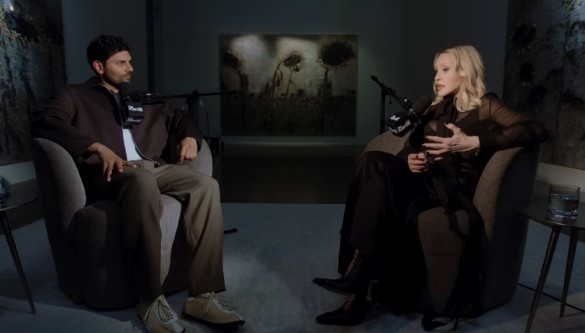
Read the full transcript of global icon Madonna’s interview on On Purpose Podcast with host Jay Shetty, September 29, 2025.
Brief Notes: In this exclusive interview on the Jay Shetty Podcast, global icon Madonna opens up about a deeply personal side of her life: her 28-year spiritual journey. She shares how her spiritual practices and rituals have been the cornerstone of her sanity and resilience, helping her navigate the immense pressures of fame and life’s inevitable ups and downs. Moving beyond her public persona, she discusses her soul’s purpose and the transformative power of seeking consciousness over instant gratification. This profound conversation offers a rare glimpse into the wisdom that has guided one of the world’s most influential artists for nearly three decades.
A Rare Conversation About Spirituality
JAY SHETTY: Madonna, welcome to On Purpose. I am so grateful to be here with you today. Thank you for the honor and the opportunity.
MADONNA: Thank you for having me.
JAY SHETTY: I’m really happy to be with you. After lots of FaceTime calls and discussions about this conversation, we’re finally here.
MADONNA: Good to finally be in person.
JAY SHETTY: Absolutely. And I wanted to start off by asking, you don’t do a lot of interviews. We don’t see you doing interviews, maybe even for the last nine, ten years, give or take. What’s your intention for being here today? Why now? Why today?
MADONNA: Well, in the past, I’ve usually done interviews to promote my work, whether that’s music or a tour or film. But today, I would like to talk about my spiritual life and the spiritual path that I’ve been on for over 28 years.
This wisdom has helped me navigate the ups and downs of life, for lack of a better expression. People ask me a lot through the years, “What is the reason you’re still sane? What is the reason you keep going? Why have you not fallen by the wayside like other people?” Definitely a lot of my peers who are no longer with us. “What would you say is the key?”
And I would say that is my spiritual life. I absolutely would not be where I am or who I am if I did not have that. It’s helped me enormously, as I said, navigate the ups and downs of life. So I feel like I would like to share that with people.
That’s really the point. I’m not here to promote a product. I don’t want anyone to buy anything. I just want to share something with people that has pretty much saved my life. That sounds dramatic, but it’s true.
JAY SHETTY: Yeah. It seems like it’s something that’s extremely meaningful to you and a deep part of your life that often I feel you don’t get to share in other spaces. So even though it’s been a part of your life for nearly three decades, maybe you haven’t shared parts of it before. What would your life look like if you didn’t find it?
MADONNA: I would believe that the physical world is all there is. I would believe all the illusions, and that would be my downfall, and that is most people’s downfall.
Defining Spirituality
JAY SHETTY: What does spirituality mean to you? Because I think that word itself means so many things to so many people.
MADONNA: Yes. I mean, a spiritual life or a spiritual path could mean a lot of things. I know that you have a spiritual path, and for me, it’s not really about whose is the best. It’s whatever works for you. I’ve been studying Kabbalah for 29 years, since 1996. Yeah. It’s a long time.
JAY SHETTY: It’s a long time.
MADONNA: And I’m not a frivolous person. I don’t suffer fools gladly. If something, if I think there’s something false about it or corrupt or not authentic, I wouldn’t have stuck around for so long. I’ve had the same teacher for all this time.
I feel like, almost like it’s my responsibility to share with people because I feel like people need guidance, people need enlightenment. And for me, a spiritual life is having an internal life. Because, you know this, I’m sure you know, if we get stuck, caught up in the belief system that our value in the world is based on people loving us or other people’s approval or how much money you have or how many fabulous outfits you have or how many followers you have on Instagram, those things don’t make us happy. Those things don’t bring us peace.
So having an internal life and being able to look internally and having some kind of practice, whatever that might look like, your prayer, your meditations, the time you take out of every day to stop and take stock, contemplate. We live in a very busy, chaotic world. Lots of noise, lots of distraction.
I mean, how many times have you heard people say, “Oh, you know, social media,” and all the, people can’t walk down the street without listening to music. Everybody has to be visually stimulated all the time. There’s no peace. There’s no quiet. We’re not comfortable being quiet with ourselves and looking inward and asking ourselves, “Why am I here? What am I doing? What is my intention in a specific choice I’m making right now?” Whether it’s about my work or the way I’m raising my children, decisions that I make about everything, really.
JAY SHETTY: Yeah.
MADONNA: I have to ask myself, and if you don’t have a spiritual life, you’re never going to stop and ask any questions. You’re just going to plow through life. And you’re going to see everything that happens to you as just a random event.
And I don’t believe that anything is random. I think everything that happens to us is meant to happen to us, to teach us some kind of a lesson. But, you know, the question is, are you aware enough?
I don’t want to go through life seeing everything that happens to me as random. But I also don’t want to go through life as a victim. And I’ve had a pretty challenging life. And it’s easy to fall into the trap of feeling sorry for yourself or being a victim or, you know, “Why isn’t this happening to other people? Why is it happening to me? Why don’t I have what that person has?”
I’m sure you know the expression, “Comparison is the killer of joy.” So, you know, you’ve got to get out of that game. You have to have a spiritual life. You just have to.
The Third Space Theory
JAY SHETTY: You’re reminding me of something beautiful that I came across called the third space theory. Have you heard of it? It’s this idea that as humans around 50 years ago, we had three spaces. So we had work, we had home, and then you had a temple, a synagogue, a church, a community center, or a third space.
And the point of that third space, it’s kind of what you’re saying, was a place that you could look back at work and home and you could reflect on your life. You could take stock, you could introspect. But as time’s gone on, what’s happened is we lost that third space. We stopped going to temple, church, community, whatever.
MADONNA: It was a place of self-reflection.
JAY SHETTY: A place of self-reflection. And we ended up with work and home. And then after the pandemic, we lost work. And so now we’re in one space, and we don’t have a different vantage point to where we are anymore, which is what I think you’re saying.
MADONNA: Go back even one more step. That to me is like a prison. If you remove the spiritual life, spiritual practice, you remove the workplace, then you’re in the home. And then removed once more from home is looking at your phone, which even takes you out of home.
JAY SHETTY: It’s a great point.
MADONNA: Yeah. So where are you? You’re nowhere.
JAY SHETTY: We’re living in the virtual world. Yeah, we’re living in the virtual world. Not even in the material world.
MADONNA: Yes, but a virtual world is not a bad world, but if you don’t have consciousness, there’s really no point to living.
Spiritual Practices and Rituals
JAY SHETTY: Yeah. So it’s interesting to think about that, because I feel like everyone can relate to the idea that if we all had, we need physical spaces to sometimes make us do internal things.
MADONNA: Yes. I mean, some kind of ritualistic behavior has to happen.
JAY SHETTY: What have been your rituals? I’m intrigued. I’m curious. What are your spiritual practices and rituals that have been so supportive and emblematic of your journey, that have kept you going at the times, as you said, there were so many times you could give up or things could go wrong. You kept pushing and they kept you locked. What were they? What are they?
MADONNA: Well, one really important thing is studying. Making time every week to sit down and study. I mean, you can study the Bible, you can study the poetry of Kahlil Gibran, or you can study the Vedas.
JAY SHETTY: And you did that, right? You actually studied different traditions yourself.
MADONNA: I mean, to be honest, before I discovered Kabbalah, I was looking for answers.
JAY SHETTY: And why do you think that was? Why were you looking for answers?
MADONNA: Because I had everything that people would assume would give you happiness. I had a successful career. I had fame, fortune, monetary things, physical things, but I wasn’t happy.
And I naturally sought out, well, when I was a dancer, I had a roommate. She was a Buddhist, and she would get up and chant every day. And so I was very intrigued by that. Nothing bothered her. You know what I mean? Everything bothers me. Everything bothers me. I’m a Leo, I’m Italian, I’m very dramatic.
I wouldn’t say she was peaceful all the time, but I was just struck by her confidence and her knowingness that everything was happening for a reason. She never got upset about things. And this is in the beginning of my career when I was living in New York and I was broke and a lot of crazy things happened to me. Really scary, traumatic things.
And I would always ask her, her name was Marianne, I would always say, “Why are you never upset?” So I attributed that to her spiritual life, but it didn’t speak to me.
And then later on, I started practicing yoga, Ashtanga yoga. And my teacher, Eddie Stern, he still…
JAY SHETTY: I love, you know Eddie?
MADONNA: Yeah, yeah. He’s amazing. I got quite caught up in and competitive about first series, second series, third series. But one thing I noticed is that a lot of people would come into his practice, his studio where he taught, and they wouldn’t even do the poses. They would just go and sit in front of the statue of Ganesh or light candles or prayer.
And I realized, and Eddie pointed it out to me, because sometimes I would have injuries or I would be traveling and I couldn’t practice yoga. And he’d say, “Look, are you breathing?” And I’d say, “Yes.” And he said, “You’re practicing yoga.”
So I realized that I was still too caught up in the physical poses. He’s like, “No, you don’t understand. You’re missing the whole point. The poses are just something that you do to breathe through, to calm your nervous system down and to bring you back to your center.” And that really spoke to me.
There was a big, no, it was a painting on the wall of the yoga studio. It says, “Desire and detachment.” And I said, “What does that mean?” And he said, “Well, of course we want all the beautiful things in life. We want all the pleasures. We want all the happiness. We want it all. There’s nothing wrong with that. But you can’t be attached to it, because then if you’re attached to it and you don’t have it, what’s going to happen to you?”
So I studied that for a while, and I studied Sanskrit. I had a teacher. And, you know, I learned that the vibrations of the letters had a calming effect on your nervous system and centered you and placed you firmly rooted in the earth. And all of that made sense to me.
The Turning Point: Pregnancy and Purpose
But then again, nothing happens by accident. I was pregnant with my daughter Lola, my oldest daughter. And I suddenly realized I was living in LA. I suddenly realized I’m going to be responsible for another human being. What am I going to teach her?
I’m just, I’m like a meteor making my way through the, you know, on this planet. I have great survival instincts. I have a great work ethic. Yes, I’m very ambitious, all of those things, but I was never looking back. I’m going to be somebody, because that’s, you know, that’s why I came to New York in the first place. I will never go back to the nobody life I had when I was a child growing up.
So I definitely was fueled by an inner drive, but I would not say that I was spiritual or conscious. When I was pregnant, I suddenly realized I knew nothing and I was a slave or a victim of other people’s opinions of me. And I didn’t really, even though it looks like, and looks like I was confident, brave, audacious, whatever, you know, deep down inside, I was not.
So I was at a dinner party.
JAY SHETTY: While you were pregnant?
The Beginning of a Spiritual Journey
MADONNA: Yeah, I was at a dinner party at my friend’s in LA and there was a woman sitting next to me and I knew her vaguely. She was a costume designer. Her husband’s a director. And she said, “Oh, you should come with me to class.” And I said, “What class?” I’m open to classes, by the way. I love being a student.
So what’s the class all about? She said there’s a teacher there. It’s something called Kabbalah. It’s next to a synagogue. And I was like, “Wait, so he’s Jewish?” And she said, “Yeah, but it doesn’t have anything to do with being Jewish. It’s just a belief system. Not a belief system, like a philosophy about life that, you know, you could learn a lot from.” And I said, “Okay, I’ll go.”
So I did. And that’s how I met my teacher. And I literally would sit in the back of class for years. Mostly men were in the class at the time. But everything that he said seemed to make so much sense to me and gave me courage to be who I am and who I’m meant to be and made me actually think about intention and a real sense of purpose.
Because my sense of purpose can’t just be, “I want to be rich and famous,” or “I want to be popular,” or “I want to sell a lot of records” because none of that lasts. But it wasn’t until I went to class that I actually started thinking about those things. So I just kept going and here I am today.
But you know, motherhood or being a parent is really what made me start asking questions that most likely I should have asked them sooner, but I didn’t because I was just caught up in myself.
JAY SHETTY: I love that story for so many reasons. One of them being that my journey to my spirituality had certain similarities in that. Not that I was pregnant, so definitely not that one. But I had a friend and friends who were starting to get interested in spirituality and they invited me to hear a monk speak.
And I’d seen monks while I was growing up, but I’d never really engaged with one or really understood what they did or meant. And I’m so glad I said yes to going along. And I was very young. I was 18, 19 years old. I wasn’t even seeking. I was open and I was curious and to be honest, I was doing what everyone else was doing at that time when you were 18, 19 year old kid, like experimenting and doing everything else under the sun.
But I’m so glad I went because now looking back, I find that after meeting the monks that I met, it gave my life a compass at a very early age that I’m so grateful for because it changed the entire trajectory of my life. I can’t imagine what I would have ended up doing in the same way as you did. And it sounds dramatic, but it’s true that without the group of friends that invited me to go along and meet my teachers who would become my future teachers, I can’t imagine what life could be like.
MADONNA: And are those teachers still your teachers?
JAY SHETTY: Yes, absolutely still, since that time. So it’s been nearly 20 years now.
MADONNA: That’s meaningful.
JAY SHETTY: Yeah, very meaningful.
MADONNA: And are your friends that came with you still also studying or one of those?
JAY SHETTY: One of those, yes, absolutely. One of those friends was my best man at my wedding and he studies under the same teachers to this day.
MADONNA: That’s cool.
JAY SHETTY: Yeah.
MADONNA: What about the woman who took me to class? No, she didn’t stick with it.
Reconciling Spirituality and Success
JAY SHETTY: It’s amazing to hear that you had this ambition and this drive to become successful and at the same time there was this spiritual calling that was almost happening simultaneously. How did you reconcile the two? When to the external eye they could look very opposite? How did you actually see them?
MADONNA: That’s absurd, those are narrow minded people. I mean, you need to be spiritual to be successful. Success is having a spiritual life, period.
It’s interesting because I had this boyfriend some time ago and after we broke up we saw each other years later and I was telling him about Kabbalah. He’s like, “Oh yeah, that makes a lot of sense because you grew up as Catholic and know how religious your mother was.” And I was like, “No, no, that’s not what it is at all. It’s got nothing to do with religion.”
Everybody has to find the path that speaks to them and resonates with them. But I do think it’s important to have one. And I dare say if you didn’t have a spiritual path, you wouldn’t be as successful as you are today. I will make that assumption in your work, in your marriage, in your friendships, all your relationships.
It honestly, it sounds like a cliche, your spiritual life, but it’s just got a bad rap. You know, you can 100% have a spiritual life and be successful. I wouldn’t be here if I didn’t have one. There’s no way we’re going to escape suffering. Even if we grow up with wealth and privilege, our challenges and our suffering is going to come to us in a different way.
Radical acceptance is just accepting that what is happening to you is meant to happen to you and that you’re going to be okay. Whatever’s happening to me that might be uncomfortable is obviously meant to happen to me to teach me a lesson. And if I don’t learn that lesson at that point, it’s going to come up again.
JAY SHETTY: Let’s talk about how your spiritual life has impacted your different roles because you played so many roles in life. And let’s start with artist because that’s what the majority of our viewers and our audience will connect with you on. Your spiritual life has directly impacted your art. When did you feel it was first introduced to your art? How was it introduced? How would you use it to inspire your art?
Channeling Light Through Art
MADONNA: About a year after I started studying, I made my Ray of Light album. And that is 100% influenced by my study. Spiritual practice, like a door opened for me and I suddenly, and maybe I was spiritual without knowing it unconsciously. And some things happened.
I mean, often things would happen where I would have visions or I would get ideas and I would manifest them. And if you’re too busy to sit for a moment and think, “Wow, that’s so amazing what just happened? I channeled that.” Like you don’t actually know that you’re tapping into another dimension until you start paying attention to the idea that there is more to life than you and I sitting in this room on a chair.
Like, if you believe in energy and you believe in universal laws and you believe in quantum physics, the possibilities are endless and miracles, the idea of miracles is not a foreign concept. It’s not a lucky strike. You know what I mean?
It definitely affected my work. I became conscious of the fact that I was and am, I am channeling light. That’s what I’m doing. I don’t own it. It’s not mine. I am a vessel for it. I’m a vessel for this light, which in turn, my goal is to share with other people.
Now, I can do that through my work. I can do that through my music. I can do that through my relationships with people. I can do that as a friend. I can do that as a mother, as a parent. So you realize that it informs every part of your life.
But the one really important thing, well, one of the many important things that my teacher taught me was that I am not the owner of my talent. I am the manager. As long as you keep that consciousness and you’re aware, like people who run to say, “I did that. That was my idea.” I mean, you created an opportunity for yourself by allowing yourself to be a vessel for this. Call it what you like. Magic.
I think it’s magic. I think when you channel artistic ideas and you have creative visions, it’s magic. And when you think it, overthink it, or you start thinking about how much of that you own, you stop it.
That’s why a lot of, I would say, this is my observation, that a lot of people have these great kind of meteoric careers, and they rise up and they take the world by storm, and they influence the masses. And then they just, something happens and they can’t handle the light, and they’re not even aware of it. And in a way, they fly too close to the light and it burns them. Yeah, that’s Icarus.
And I would say that’s really true about many of my peers that I had. I was lucky enough to know them, whether that’s Prince or Michael Jackson or Jean Michel Basquiat, the painter. These are people who were channeling light.
JAY SHETTY: Channeling light.
MADONNA: But I also don’t think they understood the concept of what they were channeling and that, you know, there has to be some kind of restriction. There has to be some kind of filament. There has to be, you know, like, people like to take drugs, right? Why? Because they’re actually channeling light when they’re, you know, tripping on acid. But it’s light with no restriction. And then that’s what kills you or burns you out.
JAY SHETTY: That was never your path to the light.
MADONNA: Oh, no, no, no, no. Thank God.
JAY SHETTY: What kept you away from it when everyone else was doing it?
MADONNA: The universe, God. Honestly, people ask me that all the time because I grew up, when I came to New York when I was broke, and I had no friends, nowhere to live, nothing really. What protected me from, you know, I was held up at gunpoint. I was robbed. I was raped. All these horrendous things happen to me, but I just feel like I’ve always had a guardian angel. It took me a minute to figure out how blessed I was and that the universe was protecting me and looking out for me.
Surviving Trauma and Finding Purpose
JAY SHETTY: Was that a realization that came after? Because, I mean, when you talk about the events of, I mean, getting raped, being held at gunpoint, these are extremely traumatic, stressful. I mean, the most extreme, tragic events people could go through in their life. The realization you’re sharing today, how long, talk to me about the journey of having that experience and then getting to the realization you just mentioned, because I’m assuming it’s not immediate.
MADONNA: No.
JAY SHETTY: So walk us through that.
MADONNA: Well, first, there’s just my determination that I think I was so, I had such an unhappy childhood that whatever happened to me in New York City, I was like, “Whatever happens to me is better than what my life was. So I’m going to, I’m sticking around. I’m not going back.”
But, you see, the worst things that happen to you are the best things that happen to you. Because if my childhood hadn’t been what it had been, if I hadn’t lost my mother, if I hadn’t had all of these challenges as a child, I would have thought of my home as a place of comfort, and I would have gone back, but I didn’t. So that’s what kept me going.
And then, you know, there are challenges in my career. Even though I was very successful, I went through many periods of time where the press was beating up on me. I was demonized. What kept me going? I don’t know. Like I said, guardian angels.
But again, I wasn’t conscious of it until I was pregnant. Then I started to see, like, everything started to come into focus for me, but it’s not, I make it sound like it’s an easy thing, like studying. Like, the more, you know, the harder everything is. And the more enlightened you try to become, the more conscious you try to become, the more tests you have, the more, you know, it’s like, why?
Like, the more, you know, the more you realize you don’t know. And the more you aspire to be conscious, the more you feel like everyone’s trying to drag you down and take you out of it and convince you that it’s not true. Or, you know, the tests.
JAY SHETTY: Yeah.
MADONNA: And you know, life is a test, let’s face it. Yeah.
The Power of Spiritual Practice
JAY SHETTY: I was thinking about, as you were saying that a bit earlier, of managing that balance between recognizing you are a manager of the light and you are not the light itself. I was thinking of this story about Marcus Aurelius where he was followed around the Roman town square by an assistant. And the assistant’s only job was to whisper in his ear, “You’re just a man. You’re just a man.” Because people would praise him and people would shower him with accolades and compliments and the assistant would remind him and it said that that was done so that he could always remain grounded.
I can imagine for you to not fall into the trap of believing you’re the light is extremely difficult when you’re one of the best selling artists of all time. When you, like you said you named the company, there’s only the Beatles, yourself, Michael Jackson, that sit in this esteemed group of individuals who’ve achieved incredible things. How did you hold on to that beautiful belief that you’re not the light and you’re a manager of the light when anyone else could easily believe they were?
MADONNA: By continuing to have a spiritual practice. Spiritual life, by continuing to study, like, always pulls you back to center.
JAY SHETTY: Were you able to keep it up when you were on tour or when you’re building your album?
MADONNA: Absolutely. It drove everyone crazy. My manager’s like, “Why can’t we have shows on this night? Or why are you late?” Because I’m praying. Like what? You know what I mean? I would pray before every show. But people who are focused on making money are definitely not focused on spiritual life. You have to have your feet in both worlds.
JAY SHETTY: You literally wouldn’t do a show on a day because that was your study day?
MADONNA: Yeah. Or I would be late.
JAY SHETTY: Yeah.
MADONNA: I get a lot of s* for being late.
JAY SHETTY: Walk me through.
MADONNA: Honestly, it’s really hard to balance being a parent, having work, having a spiritual life. You’re constantly juggling. There’s not a lot of time to rest. And if people don’t recognize that, then they’re just going to look at you in a very superficial way and go, “You’re late.” But you don’t understand what I was doing before I became late.
Motherhood and Spiritual Awakening
JAY SHETTY: I want to talk about how spirituality affected you, your role as a mother. Obviously, you said that becoming a mother yourself is actually what even began that enlightenment, kind of began that journey. It felt like a responsibility. It felt like a moment of change. How is—
MADONNA: Well, my mother died after giving birth to all my brothers and sisters. So literally, the year after my youngest sister was born, my mother died. So I always equated motherhood with death. And I also equated it with, I could see she was not happy. I could see she wasn’t living the life she wanted to live. I equated it with death, or I equated it with no freedom, or I equated it with no life except taking care of other people.
And so when I came to New York and I started my career, I was like, no, this is not for me. I don’t want to be a mother. I don’t want that. I wasn’t saying it out loud, but I was thinking that, like, why would I give all of this up? I worked so hard for it.
Well, one day I found that I was pregnant, and I had been running away from it for so long. And I wouldn’t say I was in a stable relationship, but I loved her father. So I wasn’t really thinking it through, but I was like, okay, this happened to me, so it’s meant to happen to me.
But honestly, what the hell am I going to teach my daughter? Like, how am I going to guide her? I’ve just been living this completely selfish life, really, that turned out good in many ways. But in reality, I was doing everything for my own self. And I also kind of thought, well, you know, okay, I’m pregnant, so I’m going to be a mother, so I’ll figure it out. I’ll work it out.
But honestly, I was scared shitless, and I wasn’t in a traditional relationship. And once again, this is the story of my life. I keep finding myself in unconventional or untraditional or unusual or unfamiliar places, and I have to keep adjusting. And I say that, I would say that that is also the reason that I am still here and still going and have the strength to fight things or to survive. Because being too comfortable in life, I would say, is the downfall of a lot of people who started off taking chances, taking risks.
The Power of Being an Outsider
JAY SHETTY: Is that something success does to you, do you think? Where in the beginning you take risks and you—
MADONNA: I feel like that happens to other people, not me. I think I’ve always felt like an outsider in life. I felt like an outsider growing up in Michigan. I felt like an outsider when I came to New York. I felt like an outsider when I moved to LA and had my Hollywood life. I always felt like I did when I was in high school. I don’t fit in.
And not fitting in is what saves you. Studying Kabbalah, nobody else was interested in it. Not my friend group. And if I was to speak about it to people, they’d be like, “Oh, that’s really interesting.” Having a spiritual life isn’t necessarily going to make you popular, but if you’re a conscious person searching for truth, then it’s going to be interesting.
Like, I’m interested in your spiritual path, your spiritual life. I want to know what you do, what it does for you. I want to know how you do it. Because I’m curious and curiosity and being an outsider, those are the things that actually save you. Even though it’s not supported in our society. Like to think outside the box, to take the road less traveled by, to not be so concerned with approval, public approval.
And now we live in a world where everyone follows algorithms. And algorithms are the opposite of taking chances. They are the opposite of being unique. They’re the opposite of spiritual life. They’re the opposite of consciousness. That’s why artificial intelligence cannot duplicate consciousness. It can duplicate doing things, following formulas, but it can’t duplicate consciousness. So now have we gotten really off the side?
JAY SHETTY: I love it, though. It’s great to be in your stream of consciousness. And on that point, I’ll get back. But I often get asked the question right now when I’m on panels of do I ever believe that AI will have a soul? And my response is always, I just hope that the people who are building AI have a soul. Because ultimately it’s becoming a reflection of whatever’s inside of us. But I digress. Going back to how, you were going to say something.
MADONNA: No, you’re right. Yep. The people who make it. But are they?
JAY SHETTY: Yeah, that’s the most important part.
MADONNA: That’s the scariest part.
JAY SHETTY: Yeah. The intention and the purity.
MADONNA: Intention and consciousness. Yeah. Yeah. I just repeat that like a mantra. Consciousness is everything. Consciousness is everything. But a lot of people don’t even know what that is.
Passing on Spiritual Teachings
JAY SHETTY: When you became a mom and you’re trying to teach your children about, I guess I’m assuming you wanted to pass some of these teachings on.
MADONNA: Yeah, I mean, they grew up learning it and studying it. Studying or listening to me study with my teachers or listening to other people. And they would bounce back and forth between thinking it was silly or something weird that mom does. But I see that it has impacted all of them.
JAY SHETTY: What makes you see that?
MADONNA: Because they study. Not all of them, but I feel like my children who have a spiritual life are happier than the ones who do not.
JAY SHETTY: But obviously, they could start at any time. It could happen.
MADONNA: I’m not, you know, there’s no coercion in spirituality. It’s like if you, either it speaks to you or it doesn’t.
JAY SHETTY: I remember my dad was trying to get us to do things, to start long, and I rejected it so hard because—
MADONNA: Yes. Well, that’s the other thing. Children always reject their parents, the path they follow, their belief systems. They think it’s stupid, and then they come back around a little bit.
JAY SHETTY: Totally.
MADONNA: Yeah.
JAY SHETTY: Yeah. There’s that famous quote that says, the day you realize your parents were right, your kids are telling you that you’re wrong. And I think it’s an often common experience that people have.
MADONNA: Yeah.
Finding Compassion Through Kabbalah
JAY SHETTY: How did Kabbalah impact your, and your spiritual practice, impact your role as a daughter? Because, like you said, you lost your mother when you were five.
MADONNA: To a certain extent, I resented my father growing up because I felt like he wasn’t present for us emotionally. He did have a lot of responsibilities, and he’s a deeply Catholic person, but I felt like he followed his spiritual path or he followed Catholicism, because that’s how it was. That’s how he was raised. That’s how it was done.
When I was growing up, if I wanted to ask a question about, why do we do this? Why are we genuflecting? Why are we receiving the body and blood of Christ? My father didn’t have an answer. He’d just say, “That’s what is written.”
And what drew me to Kabbalah was that I could ask questions and there were answers and questions were invited, which is the opposite of how it was brought up. So I looked at my father as kind of like a religious robot. You know what I mean? Not that he’s not a good person, but I didn’t want to be a robot.
And especially having a spiritual life, I started to see my father as a human being and see that he was a human that made mistakes and that he did the best with what he was taught he was given. When those cylinders start clicking in your head, you start to have a lot more compassion, not just for your parents, but for all people who don’t see life the way you see it, that you don’t agree with. It brought me to a place where I could have more compassion for him.
JAY SHETTY: I mean, that seems like a really big gift.
MADONNA: Yeah.
JAY SHETTY: To have that understanding. And I could agree. I think spiritual context creates so much compassion when you are able to zoom out and look at someone’s life. Like, I remember the moment I really had compassion for my dad was when I visited the home he grew up in, which was this room. I mean, I can’t even compare it to this. His home was probably just from here till here, his entire home. And they shared a bathroom with 20, 30 neighbors, families.
MADONNA: Yeah.
JAY SHETTY: And we went outside. I was nine years old. We’re in India, and there’s cockroaches around us in Pune. There’s cockroaches around his home. There’s bats in the, you know, and it’s just like, and inside. And I was nine years old, and I couldn’t believe that, you know, that’s where my dad grew up. And it was almost like something clicked where I was like, unless I saw that, I wouldn’t have had that experience because it was always easier to assume that their life—
MADONNA: Yeah, well, that’s the thing. Like I say to my kids all the time, you’re judging me by the chapter you arrived in. This is not how my life has been. And it’s really hard for kids to see that.
JAY SHETTY: Yeah, yeah. Going there was probably one of the best things that ever happened to me, because it’s what you’re saying. I was able to go to a previous chapter in someone’s life. And even though my childhood, we weren’t well to do or we didn’t have anything, but we didn’t have a lot, going to see that, I was like, oh, gosh, my life is a million times better than this. And having that context was huge for me.
The Journey from Victim to Survivor
I want to hear about how you were able to apply these principles in the difficulty of the big things you’re talking about. Because whether it’s reconnecting with our parents, whether it’s recovering from being raped, whether it’s dealing with these challenges you’ve dealt with. As you said, it doesn’t happen overnight. It’s not easy. It is the level of study and work. But talk to me about the emotional journey of shifting from a victim to whatever you would call this on the other side, because it would be very natural for anyone to feel that way. I want to hear about the emotional journey and the spiritual journey you went on. What were some of the steps or stages that you saw that if anyone who’s listening or watching can recognize and potentially—
The Power of Spiritual Practice in Times of Suffering
MADONNA: Well, the first thing is you’re suffering all the time. If you don’t have a spiritual life, you’re just suffering all the time and you really think that whatever’s happening to you is something that’s never going to end and you drew the wrong card.
JAY SHETTY: That’s how you feel?
MADONNA: Yeah, that’s how I used to think. And even now, since I’ve been studying, there’s been times where I’ve been really challenged and really suffered in certain situations. If I didn’t have a spiritual life, I don’t know how I… You know, there were moments in my life where I wanted to cut my arms off. I actually contemplated suicide.
And that probably sounds really weird coming from me because I’m not that, I’m not emo, you know what I mean? But I was like, I can’t take this pain anymore. But as soon as you understand that what’s happening to you is a challenge, that you are karmically meant to experience and learn from and evolve to a higher level of consciousness, then you can look at that event, that experience as a lesson and not punishment.
JAY SHETTY: What pain at the time pushed you to that place of potentially wanting to take your own life?
Facing the Darkest Moments: A Custody Battle
MADONNA: I mean, I don’t, I’m not in the blame game. That’s the thing. I used to be that way. And I used to always want to seek revenge. You know, somebody did me wrong, or I would pronounce loudly, “Oh, well, you know, they’ll get their own karma.” Well, whatever, you know what I mean? And even knowing about karma doesn’t mean you’re a grown up. It doesn’t mean you’re not being a victim.
But I would say probably one of the most painful moments in my life where I honestly couldn’t see the forest for the trees was when I went through a custody battle with my son. And, you know, even though my marriage didn’t work out, I mean, a lot of people, marriages don’t work out. They marry the wrong people. They’re not aligned, they’re not meant for each other.
Someone trying to take my child away from me was like, they might as well just kill me. That’s really how I was thinking. And I was on tour at the time. So I had to go on stage every night. I would just be lying on the floor of my dressing room, sobbing. I really thought it was the end of the world. I couldn’t take it. I just couldn’t take it.
But thank God I don’t feel that way anymore. And I had to keep studying, continuing my studies and continuing on my spiritual path, helped me to understand that the enemy is within.
JAY SHETTY: Talk to me about that.
MADONNA: You know, lots of people do lots of bad things and make a lot of bad choices or make choices that cause other people pain, suffering or chaos or whatever. But at the end of the day, I needed to learn some lessons. And I can see that with the benefit of hindsight, but I couldn’t see it at the time.
And also, I was abandoned as a child by my own mother. And so losing a child, it was like life repeating itself. I couldn’t accept it. And so it caused me a lot of suffering. And not being able to accept things causes all of us a lot of suffering. So, yes. And now, you know, I’m happy to say that I’m really good friends with my son, but I couldn’t see it then. I really thought it was the end of the world. So, you know, thank God I had a spiritual life.
The Practice of Radical Acceptance
JAY SHETTY: Was the lesson radical acceptance?
MADONNA: Yeah, exactly. It took me a long time, actually several years. Radical acceptance is just accepting that what is happening to you is meant to happen to you and that you’re going to be okay. It’s not an instant thing. There’s no such thing as an instant thing. There’s no way we’re going to escape suffering.
Even if we grew up with wealth and privilege and, you know, didn’t grow up in a small room, our challenges and our suffering is going to come to us in a different way. I can give you another example of radical acceptance, and that is, and this is something that my teacher shared with me.
About a year and a half ago, I was rehearsing for a tour, and I got a bacterial infection. And one minute I was alive and dancing around, and the next minute I was in the ICU unit of a hospital. And I woke up from being unconscious for four days. I got out of the hospital. They took me off of the ventilator. I started to breathe on my own, and I had something, it’s called sepsis. And it can kill you.
JAY SHETTY: Yeah, that’s really bad.
MADONNA: And everybody recovers at a different rate. And so, you know, I’ve always seen myself as superwoman. So I was like, “Oh, I’m going to kick this. I’m going to be good. I’m getting back into rehearsals.” And I had no strength. I had no energy. I couldn’t get out of bed. And I didn’t know when it was going to end.
And I used to talk to my teacher all the time, and he’s like, “The sooner you accept what’s happening to you and that you don’t know when it’s going to end, the sooner it’s going to end.” That made so much sense to me, and of course it did. But, I mean, I’ve heard some people never recover from it completely. Never recover and have their full health again.
So, again, it’s the same idea, same concept. If you sit around feeling sorry for yourself, “Oh, woe is me,” or “poor me,” or “this is, I don’t accept it. I will not accept it.” Well, then you’re just going to be swimming in suffering.
JAY SHETTY: You reminded me of something I read in a, it’s not a spiritual book, but it has a similar message. It’s called “Culture Code” by Daniel Coyle. And he talks in this book about how when soldiers were out at war, a lot of them wanted to believe they’d be back by Christmas. And there were the others that accepted that they had no idea when they were going to get home.
And he talks about how those who accepted that they had no idea when they were going to get home were actually happier and were able to endure what they were going through a lot easier than those who hoped they’d get back on Christmas and then didn’t.
MADONNA: Yes. It’s like the Viktor Frankl book.
JAY SHETTY: Yes. Yeah, yeah, exactly. And it’s such, when I hear it from those really extreme scenarios, you’re like, wow, if Viktor Frankl can think that, you know, in the experience that he had, you go, okay, well, and Edith Eger with “The Gift,” and you go, wow. If you can have that experience there, then there must be some truth to that, because how could you accept that when you were going through the worst.
MADONNA: Yeah, yeah.
Understanding Karma and Life’s Lessons
JAY SHETTY: It’s really, really tough going back to your experience of that. What would you say? Because you mentioned karma there and this idea of choices we make and lessons we need to learn and karma almost being this experience of learning the lessons. How do you see karma? How do you define karma from your learnings and studies? Let’s start there and then I’ll ask the second question after that.
MADONNA: My personal understanding is that our souls choose the lives that we are born into, the circumstances we are born into, that our souls are perfect. But then we’re born into a life which is one challenge after the next. And that our journey is to navigate and to see that each challenge that happens to us is our karmic destiny.
It’s energy. It’s the law of, it’s quantum physics. It’s cause and effect. Whatever’s happening to me that might be uncomfortable is obviously meant to happen to me, to teach me a lesson. And if I don’t learn that lesson at that point, it’s going to come up again and again and again until I learn it and accept that it’s a lesson, not a punishment. So that’s how you get out of victim mentality.
JAY SHETTY: Also, what was the lesson that kept repeating for you and took you a bit longer than you would have liked to learn? What was the one that kept showing up?
MADONNA: Betrayal or abandonment. Sometimes they go hand in hand. But it really kept me, I saw a lot of people, or I felt and experienced that I was constantly being either abandoned or betrayed. So that kept me in a state sometimes, often, feeling sorry for myself, stuck in a place of blaming others and not taking responsibilities for, well, how did I bring this upon myself? Or why?
Asking the question, “Well, why is this happening to me over and over again?” Obviously, I need to learn something. I think everybody, if they think about it, what is the thing that always comes back to you? For everybody, it’s something different. Obviously.
I think the abandonment thing was the greatest lesson that it could teach me, that I could stop being destroyed by it or paralyzed by it, was to think of all, how am I not showing up for other people? How am I abandoning other people?
JAY SHETTY: How am I abandoning myself?
MADONNA: How long have I been not listening to myself? My inner truth, my inner voice. Yes. And we all say goodbye to our inner selves at some point or another until something wakes us up. Push has to come to shove for everybody. There’s just no way to escape it.
So that’s something that as a concept that you have to get your head around. There’s no running away from being tested. There’s no running away from experiencing pain, suffering, whether it’s physical or emotional. I mean, and that obviously takes life experience and living and going, “Okay, everything’s going well for me. I’m so happy. Everything’s great. Oh, no, this is a failure. People are writing negative s* about me,” or “this relationship ended,” or “this person cheated on me,” or rejection.
And then you go, and you go, “No, I’m not happy.” If you’re going to go through life being a slave to these ups and downs, you’re just going to be, I don’t know how you can last, obviously. I mean, it’s obvious to me. I don’t know if it’s obvious to you or anybody who’s watching this, but I don’t know how we can maintain our sanity.
And especially now. I mean, when people lived simpler lives and we didn’t see what was going on in the world and we weren’t so connected like we are because of technology and the Internet, whatever. It’s hard not to get anxious or start blaming or taking sides or feeling. You know what I’m saying?
Coming Home to Ourselves
JAY SHETTY: Yeah. I loved what you said. This one line will stay with me for a long time. I really, really thought it was beautiful. You said, “We all say goodbye to our inner selves at some point.” And that really landed because that’s why it feels like we’re coming home to ourselves.
And I think everyone who’s listening or watching can, if they’ve started their spiritual journey, they’ve started their reconnection journey, they know what that feeling is like where it’s like, yeah, wait, I left myself and now I’m coming back to myself.
MADONNA: Yes. I always say, “What was I thinking before I was thinking right? I don’t even know.” So I was just thinking about myself. But ironically and paradoxically, when you’re just thinking about yourself and consumed with yourself, you’re actually not connected to yourself at all. You know what I mean?
JAY SHETTY: Yeah. So how does it change now when you go through betrayal or you go through rejection or any of those things that you talked about? How do you process it differently now with your spiritual practices than you did before? What’s the different experience you have of it?
MADONNA: Well, I spend less time feeling sorry for myself, being a victim, blaming, and more time thinking, “Okay, why? Why did this happen to me? What’s the lesson?” I mean, I go to that sooner.
JAY SHETTY: Wow.
MADONNA: Than I did before.
Accountability Without Self-Blame
JAY SHETTY: What’s the difference between self-blame and accountability? Because I feel a lot of people fall into the trap of now, you don’t go and blame other people, but you blame yourself. And you go, “I messed up. I should have chosen right. I should have done…”
MADONNA: Okay, well, self-reflection and acknowledging and being accountable for your behavior is not the same as feeling guilty. Feeling guilty is just, you’re consumed with your ego shaming yourself. Yeah. So you’re not going to get anywhere with that. It stops any kind of growth from happening.
JAY SHETTY: It’s pretty amazing to say that you can speed up to that point of asking yourself that question of what can I learn from this? I mean, that’s the ultimate question.
MADONNA: Yeah. And believe me, it’s not something that stays with me all the time. Sometimes I forget and I’m like, I’m doing this again. I’m doing it again. I’m falling back into a familiar pattern.
Yeah, but if you don’t know, then you’re not like, it’s important to know again, not beat up on yourself. Well, okay, I made a mistake. What can I learn from it? Swallow your pride. Tell your ego to shut up.
JAY SHETTY: Basically, you mentioned the word manifesting earlier and channeling and being a vessel. And I wanted to ask you because manifesting becomes very popular in the world today as a concept, it’s at least out there, people understand the word now. When people would look at your career, they would assume you’ve manifested incredible amounts of success for yourself, incredible amounts of wins and all the rest of it. Talk to us about your process of manifestation. What does it actually look like?
The True Nature of Manifestation
MADONNA: If you’re manifesting things and you’re not conscious that it’s a gift from the universe, from the light, from the creator, whatever you want to call it. If you’re not aware of that and you’re not conscious, then, okay, you invented something great. You created this thing that now is selling billions. But everything becomes finite when you’re not manifesting with the consciousness that you are channeling something, you don’t own it. So that’s a big thing.
JAY SHETTY: That’s the key part.
MADONNA: Yeah, sure.
JAY SHETTY: So whatever.
MADONNA: So if I have a successful show, if I have successful, if anything happens to me successfully, like it’s perceived as a success in the outside world, I just say, you know, that’s, how blessed am I. I manifested that with the help of God. I didn’t do it on my own. I do nothing on my own.
And if you think you’re manifesting on your own, you’re like an ostrich with your head in the sand. And there will be an end to whatever you’re manifesting.
JAY SHETTY: So if someone desires something, they’ve got to recognize that it’s not their hand, it’s something that they’re willing to become.
MADONNA: Well, I mean it requires work to be conscious. It requires work to see that you’re channeling something and being a vessel for something. So you do have your part in it, but you’re not on your own. That’s the point.
JAY SHETTY: And a lot of us feel like I’m going to do this, when I do this, I’ll get this. And when I get this, then I will be this person.
Manifesting for Sharing, Not Selfishness
MADONNA: That’s desire for selfish reasons. Manifesting success is whenever you want something for the sake of sharing, when you want something just for yourself. I’ll be happy when I have 10 Bugattis and a mansion in every major city and I’m the brand ambassador of Louis Vuitton. No offense to Louis Vuitton, just throwing that out there, but you know what I mean, like those things like really make people happy. But it’s short lived and sooner or later everybody comes to that realization anyways. It’s just whether it’s sooner or later.
And these are the things I talk about this in our studies. Let’s get back to why I’m here. And my intention is to share my spiritual life with people. We talk about in our studies, we talk about manifesting and we talk about being a channel and you know, I share in one of the studies I talk about writing my first song, for example, and how I taught myself how to play the drums.
And my friend, my boyfriend at the time was in a band and he taught me how to play guitar, like just simple chords. And when nobody was around I would start playing with all the instruments and start without thinking, without any. Like I’m going to be this or I’m going to be that. Let me just. I just sat down and wrote a song for the first time and I was very conscious at that moment after it happened.
Where did that come from? How did that happen? I didn’t grow up with musicians, I didn’t grow up with songwriters, no one. I didn’t have a goal to be that. Where did it come from? And so when you start like opening your eyes to that, where did, how did that happen? Where did that come from? Then you see the possibilities, you see the magic of the universe of life and you see that, you know, that was a gift.
Some angel showed up in my room and you know, what am I going to do with that gift? So these moments happen to you throughout life. They happen to everybody. Whether you’re saving someone’s life or you have this incredible idea for some life saving invention, you know what I mean? We are all blessed with those moments. And the important thing is to acknowledge where that came from. That’s really manifesting.
JAY SHETTY: I love that. That’s my favorite explanation of manifestation I’ve ever heard. Truly it really is. Because I think what often happens in substitute of what you said is we have an idea and then we try and manufacture that set of inputs and outputs again to get that again. And then it doesn’t work.
And then we’re confused because like wait a minute, last time I did this and did this and did this, then I got this and now I’m trying to do it again. And then you get stuck because now you think you can’t do it. But the reality is that’s just a very functional way of looking at something that’s far beyond input, output and manufacturing. You can’t manufacture to manifest. It doesn’t make sense.
MADONNA: No.
JAY SHETTY: Yeah, I really, really like that. I really, really appreciate that definition and I think that’s going to help a lot of people because I think the way it’s being talked about right now is just being, be clear about your goals and be really clear about what you want.
MADONNA: And I mean that’s important too. Say out loud what you want out of life. That is important. But it’s, you’re in a partnership. That’s really what’s important to remember.
JAY SHETTY: Yeah.
The Importance of Environment and Community
MADONNA: And we become our environments as well. So we want to surround ourselves with people who, with like minded individuals. And if you are around people who also are attaining to reach a higher level of consciousness or want to know the deeper meanings of life, or want to look inward and figure out why, what their karmic destiny is, or even take into consideration the idea of karma.
I mean you need that also because if you don’t have that support system, then you can also fall back into the trap of recreating formulas that work or trying to capture some magical moment and make it magic again. And that’s just our ego taking over and telling us, you know, I did that.
JAY SHETTY: I did that, I can do it again. Yeah, yeah. And you can’t. No. One of my favorite ways of thinking about it is, especially when you said it’s a partnership, is when we look at the universe, everything’s always serving. So the sun’s providing light and heat. Water is obviously giving us life, oxygen exists, trees are giving us shade and fruits and flowers.
And so in order to really be in partnership with the universe, one has to want to serve because everything is designed to serve and give. And everything’s designed to give and serve and provide. And so when we’re not serving, we’re actually acting against the universe. Yeah, because everything in the universe is designed simply to give.
We’re wired for generosity, but educated for greed. And when that juxtaposition comes up against itself, it just creates friction. It’s like we all feel better when we do something for someone else.
MADONNA: Absolutely.
JAY SHETTY: We all feel more joy when you take care of someone in need more than if you did it for yourself. And the science and the research backs up as well. This isn’t some woo woo spiritual idea.
MADONNA: No, it’s absolutely the truth.
JAY SHETTY: But it’s amazing how our conditioning and education is so the opposite. That we all believe that every man for himself.
MADONNA: Yeah, yeah, yeah.
JAY SHETTY: That’s the statement.
MADONNA: No.
JAY SHETTY: How much unconditioning does it take for us to lose the every man for himself mindset? What does that look like in your spiritual practice and journey especially?
Spiritual Practice and Ritual
MADONNA: And not fall back into that trap? You mean to continue to have a spiritual life? Spiritual practice, to study. I love our simple to stop every, you know, whether every day, once a week, people don’t have some kind of ritualistic moment in their life. Like I said, whether it’s every day or a few times a week that like, what’s going to stop you? You know what I mean?
You have to have that moment where you’re thinking about what you’ve done, thinking about what you’d like to do, thinking about what, you know, have I capitalized on the opportunities that have come my way? Not monetarily, spiritually. Like, what did I do to help someone? What have I done for others? I mean, that’s really the only way you can be successful in life.
JAY SHETTY: What were you trying to channel when you were creating in your music and what were you trying to do to help people? What was.
MADONNA: Well, in the beginning, I just wanted to be somebody. I just wanted to be somebody. Like, I wanted to have a voice. I wanted to make a difference in the world. But I wasn’t clear about what that meant. Now I’m clear about what it means.
JAY SHETTY: What is it? What does it mean today?
MADONNA: That everything I say has weight and gravity and that words are powerful and actions are powerful. And I always ask myself, like, why am I doing this? Why do I want to, why is this song important to me? Why is this performance important to me? Why is this conversation we’re having right now important to me?
That’s really the difference. It’s like having intention and consciousness. We’re really like, I’m repeating myself over and over again. I can’t think of other words that capture that. But self awareness, self awareness doesn’t really do it because self awareness kind of implies like selfishness. You know what I mean? A day at the spa. Not that that’s not something to be enjoyed. I could use the day at the spa.
JAY SHETTY: You could use a day, sure.
MADONNA: My roof has been leaking for a month. Yeah, I want to go to the spa. That’s okay. But that’s not going to bring me lasting happiness.
Living in the Paradox
JAY SHETTY: But I think that’s the reality of it. Right. Like when you look at your experience, there’s this. Everyone’s experience is this paradox where it’s like you have the highest highs, the lowest lows. You have a life that of course you need everyday self care. But there’s also what is lasting happiness? And these bigger questions. We all live in this world, but we’re not of this world. It’s almost like everything that it makes more sense to recognize it’s both and, as opposed to either or.
MADONNA: Well, you have to live in the paradox. Yeah, it’s like the greatest amount of light is where there’s darkness. And you can reveal the most amount of light. When you’re in a dark room, you turn on the light. When you’re in a room that’s already light, there’s no effort made. So should we look for darkness? You know what I mean? Should we? But no.
But when we are in that space where we’re feeling dark, where we’re feeling an absence of light, an absence of hope, an absence of inspiration, of vision, then you have to. Those are the moments, the challenging moments where you have to say to yourself, this is my opportunity to bring light to a dark place.
You know, spiritual wisdom is not helpful when everything’s going your way. It’s helpful when you’re challenged and when you’re happy. It’s helpful to remember that at any given time, in any moment, it could be gone. So don’t take it for granted. Have humility. Be grateful when things are going your way and when you’re being tested, also be grateful. That’s a hard one. That was a hard one for me. It still is. And, but I’m glad that I know what I know.
The Challenge of Forgiveness
JAY SHETTY: One of the key aspects of this beautiful study series that you’ve created is we’ve talked about some of the themes today. We’ve talked about karma. There’s manifestation, there’s desire, there’s all of these themes that exist. And one of the big ones that really stood out to me was forgiveness.
Because, you know, when I listened to you today and I even watched the studies that you created that I’m hoping our audience will go and watch and appreciate and learn from as well. You’ve conquered and continue to try to conquer some really difficult emotions, like really, really difficult things.
And I feel like forgiveness for us in the world today is probably one of the hardest things for us. Whether we’ve been betrayed, whether we’ve been lied to, whether we’ve been exploited, whether we’ve been taken advantage of. And we always hear the age old phrase of forgiveness is for you, it’s not for them. And you hear these things, but it’s.
MADONNA: Wait, wait, who says that?
The Power of Forgiveness
JAY SHETTY: I mean, it’s common verbiage that exists in the world, at least of this idea that, you know, don’t hold on to grudges.
MADONNA: Well, you said it. We shouldn’t. And it is ultimately liberating for us to forgive. But obviously the world benefits from our empathy, our ability to forgive.
JAY SHETTY: Talk to us about that conditioning.
MADONNA: I’m a fighter, you know. If somebody messes with me, they’re going to get it.
JAY SHETTY: You’ve always been like that.
MADONNA: Yes. But you know, when things happen to you and there’s not a tangible enemy that you can put your finger on, what are you going to do? You have to lean into radical acceptance.
But, you know, there are things that have happened to me in my life that I just thought I will never forgive this person. I will never. Now I just don’t want to have those feelings anymore because they’re really a prison and it’s poison to not be able to forgive and to live in a state of holding a grudge or hating someone or wanting them to suffer. It’s like a kind of poison. It’s like a kind of cancer.
That’s why it’s important to find a way to forgive, even people that you perceive as your biggest enemies. For a really long time, it was my brother who died recently, because I think the hardest ones are the people that you feel like they’re the closest to, they’re your greatest ally and they turn on you. The people that hurt you the most are the people that you love the most.
And when life doesn’t go the way that you expected it to go, that you suddenly, that this pain is unbearable and that you think what’s going to save you is to think vengeful thoughts or to never forgive. Like that’s going to give you some kind of power, magical power. It doesn’t. It just weighs you down and eats away at you and is poisonous.
So having to forgive my brother, knowing that I had to forgive my brother was, you know, it’s like your ego dances around it. Yeah, yeah, yeah, I’ll get to it. I’ll get to calling him up or talking to him or being his friend or helping him. But eventually I did.
And I know I’m being mysterious. If someone you love deeply betrays you and does something that shows that they have no consciousness in that moment, that they made that choice to do that, it’s really a bitter pill for me to swallow. I can’t speak for everyone, but I imagine that lots of people feel this way.
JAY SHETTY: I agree.
MADONNA: For my brother, I didn’t speak to him for years and years. And it was him being ill and reaching out to me and saying, “I need your help.” And me having that moment, like, am I going to help my enemy?
JAY SHETTY: That’s how it felt.
MADONNA: Yeah. And I just did. And I ended up, and I felt so relieved, and it was such a load off my back, such a weight that was removed, baggage that I could put down to finally be able to be in a room with him and holding his hand even if he was dying and saying, “I love you and I forgive you.” That was really important.
A Near-Death Experience and the Call to Forgive
And that was another thing that I realized when I woke up in the hospital. Forgiveness. That word came to my mind. Like, I have to forgive people. Because I was there. I was almost there on the other side. And I had a conscious moment, and my mother appeared to me and she said, “Do you want to come with me?” And I said no.
My assistant was in the room with me, but I was still unconscious. But she heard me say no. And then when I did eventually wake up, I realized that the no was about me needing to forgive and make good with people that I still held grudges against.
And interestingly, I wrote a song about him. I’m working on new music, and I wrote a song called “Fragile,” which is about my brother. And then I wrote another song. And this is again, just channeling. It’s called “Forgive Yourself.” But the repeating phrase, the chorus of the song is, “If you can’t forgive me, forgive yourself.”
Which is something we all have to do. We have to forgive others, but we also have to forgive ourselves and stop beating up on ourselves about things. Choices we’ve made in the past that haven’t worked out for ourselves or other people. Taking responsibility. Again, we come back to that concept also, or that idea of being accountable and being responsible, taking responsibility.
That’s a very big lesson that I learned studying Kabbalah, is that I am responsible. I am responsible and I believe in personal accountability, personal karma, and I believe in global karma. A lot of the things that are happening in the world is as a result of our selfishness as people, as humans, as a society. We are responsible.
You can’t just sit in your room or your house or the safety of your home and go, people are, you know, they deserve it, whatever. Like to be aware and conscious that you’ve contributed in some way, shape or form. And at the same time, if we have collectively and consciously evolved to a higher state of consciousness, we can change the world.
That also sounds like a cliche, but make the world a better place, tip the balance, so to speak. But that’s why I’m here, and that’s why I’m talking to you. And that’s why I made these, this is why I documented my studies with my teacher. Because I really believe that this wisdom can help other people in a very practical way, an esoteric way. And that’s why I’m here.
JAY SHETTY: Thank you for sharing that. And that journey you went on of forgiveness because, yeah, for you to be that honest and vulnerable and explain that that was someone that you felt was an enemy at that point, but the relief you felt from helping someone. I mean, that’s like, you know, I can, I’m thinking about the people that are listening and watching right now and the experience that they’re having where they’re really struggling to forgive themselves or forgive someone else.
And looking at it from the point of view of what would that look like if you never got that opportunity? I know so many people who regret the last thing they said to their parents or the last thing they said to a loved one or whoever it may be. And it seems that vengeance and spite doesn’t seem to heal the soul.
MADONNA: Well, harsh words and harsh behavior is energy, and you can never take it back. But you can change your destiny, your karmic destiny. And one of those ways is to forgive others and forgive yourself.
The Value of Repetition in Spiritual Practice
JAY SHETTY: Madonna, you’ve been so gracious with your time, your energy and vulnerability. Today I feel like I’ve learned so much about you. I’m very grateful to get, and you said you repeated yourself, but I’d honestly say that I enjoyed that because it shows to me the good training is good repetition. And so if you have the same, if you have a similar mindset towards something, it’s not in the material world.
MADONNA: Well, you only get good at something if you do it a lot.
JAY SHETTY: Yeah. In the material world, we know that, but we often look at repeating as, I have heard that before. I know that. But actually, the thing we think we know the most is the thing we need to hear more often. And when I think about the Gita or the Vedas, “You’re the soul, not the body” is the most repeated lesson. It’s the first lesson, but the most repeated. You’re the soul, your consciousness, not the body.
MADONNA: Yes.
JAY SHETTY: Is repeated more than any other teaching, even though it’s the most obvious and it’s the first teaching.
MADONNA: Very obvious. But so look how attached we are to physicality.
JAY SHETTY: Exactly. So you need to repeat it. But yeah, I was thinking that this might be a perfect time because you’ve been referencing in this conversation, you’ve referenced your teacher so many times, and we’re fortunate enough today to actually have the opportunity to invite him onto the show. And if you’re open to, I think this may be the first time.
MADONNA: I would love to.
JAY SHETTY: Should we do it?
MADONNA: Yeah, let’s do it.
Meeting Eitan: Madonna’s Kabbalah Teacher
JAY SHETTY: Perfect. Eitan, I’m so grateful that we actually get to speak to you. Madonna’s been talking about you the whole interview, and I want our audience to know, of course, you were sitting in on our conversation, and so you have context of everything we talked about. And of course, you have 29 years of context of everything Madonna shared with us over the last couple of hours. But thank you so much for doing this and thank you for being here. Thank you for having the honor of being here and being part of really sharing these teachings.
Yeah. Well, I was sharing with you earlier that my vision when I started my platform was to make wisdom go viral, especially ancient wisdom. And so this is truly my heart’s work. And so thank you for the opportunity back.
I want to dive in because we’ve heard about Madonna’s journey and her journey to Kabbalah, but I would love to hear how you came to it, because I’m assuming everyone has their own spiritual journey of awakening or connecting. And I’m sure many of our listeners today are either on their spiritual journey, want to start one. But I’d love to hear, how did you come to this practice yourself?
I started at a young age. I grew up in Israel in a non-religious family. And from a young age I was asking questions about life. I think it came from the depth of my soul. It’s beyond because someone taught me or anything. And when I was 17, my brother introduced me to Kabbalah. I went to the Kabbalah center and I met my teacher for many years, the Rav Berg.
And after hearing one hour of a lesson of how the universe began and why are we here, it resonated on such a deep level. Literally I couldn’t sleep for three nights and I felt I’m home. I felt I’m reconnecting to really my purpose, what life is about. And it took a few years and by the age of 21, I knew that’s my mission in life. So basically in the last 40 years, that’s what I’m doing all day long. Student and a teacher in the last 40 years.
That’s beautiful. Like I was saying earlier, I felt like I came to my work when I was 18 and so I’m a couple of decades behind you in my journey. But that idea of discovering something early and it resonating so strongly with your heart and committing your life to it.
What was it like when you first met Madonna? What was that first interaction like from your vantage point, your perspective? Tell us about it.
I don’t think she knows, but when Madonna’s friend which studied with me called me and told me I’m bringing Madonna to a class tonight, 40 people. So I told her, you know, I never saw a picture of Madonna. I heard her name, so cute. So don’t worry, she’ll sit in the back with me. So that’s actually the first time.
So you had no idea?
No, I didn’t have a clue. I didn’t have a clue. In those days I was pretty naive.
You were plugged in.
Yeah, I was totally in mission and I didn’t, I heard the name Madonna, but actually recognize. And then, did you connect that evening? Was that…
Yeah, that evening actually we sat, we did, yeah. We sat in the conference room because we sat at events that we’ll meet and Madonna was very suspicious of me.
I can relate to that.
Yeah. What’s the agenda here? What’s happening? But listen, she had many students, but one of the amazing qualities of Madonna is perseverance, tenacity in the ups and downs. And trust me, I’ve experienced and seen a lot of ups and downs.
Nurturing the Soul
But I always say when you constantly nurture your soul, your soul will guide you. Our soul is the part within us which knows all the answers that connected to the higher force 24/7. It is our body, our logic, our ego, the layers in our hearts that blocking us to see and to feel the truth.
When you just agree with some spiritual concept and once in a while learning, wow, it’s amazing, I love it, it’s not enough. You need to nurture the soul. That light of the soul and that wisdom of the soul and that intuition that come from the soul will channel back its energy to your life. Because the source of all protection and the source of all true joy come from the soul.
MADONNA: So.
JAY SHETTY: She has that, an amazing and amazing attribute of tenacity and perseverance.
MADONNA: Not giving up.
JAY SHETTY: Not giving up, no matter what.
MADONNA: One of the reasons I like going there is because it was the only place where people didn’t bother me about who I was. I literally sat in the back of a room with folding chairs. As I said, there was mostly men. And no one said a word to me. No one bothered me. No one said, “Oh, my God, aren’t you Madonna? Can I have your autograph?” Or whatever. I just felt like I could be anonymous there.
The Anonymity of Learning
JAY SHETTY: Was that the first time you’d experienced that in your career at that time?
MADONNA: Well, for a long time, yeah. So with a large group of people and strangers. So I liked the anonymity of just being a student and going there and learning. And it had nothing to do with my career or work or. Yeah, so that was inviting.
So I wanted to go back and then I would always bring my notebook and take notes. And I have a zillion journals from all of my classes and studies. And I love to be a student and learn. And I was learning so much.
And I also was so. What I loved so much about Kabbalah and studying Kabbalah was how in tune it was with science and quantum physics. And, you know, it wasn’t just because, you know what I mean? Everything made sense to me.
And I could see how, you know, even the idea of, you know, how the world was created or the beginning of life, the idea of, you know, Genesis, for instance, or the idea of Adam and Eve. I learned that nothing in life can be taken literally. You have to study the deeper meanings of everything.
And that is true for a spiritual practice as well as science, as well as everything we do in life. You can’t judge a book by its cover. You can’t take things literally.
And I was like, oh, like when I was growing up, as a Catholic, I would always say to my father, well, why, why do we have to, you know, why do we have to address this to church? Why does, why does it, you know, like, you know, wear a hat, cover your head, what? Like there was no explanation for anything. And that really bugged me.
So if you can’t find a reason, if you can’t explain something to me, I’m not interested. So he did explain things to me and they all. Everything made sense. Nothing was silly.
What we do study, when we study Kabbalah, is the. We study the Zohar. And within the Zohar is everything about life, about medicine, about science, about nature, about relationships. And that was really comforting to me to see. That’s what helped me see life is not a series of random events.
The Ancient Wisdom of Kabbalah
JAY SHETTY: You mentioned, I mean, as I’m listening to Madonna speak about this as well, you mentioned that obviously, you know, this tradition is 4,000 years old. How first book that was written, but it was before. Right, right. So it’s put into writing. It was put into the technology of books 4,000 years ago.
How did it come to be like, tell us a bit about the history of it so that we get some context of the tradition.
Actually, the first book that was ever written in Kabbalah was three pages long. It’s called the Book of Formation. That was written by Abraham the patriarch. And it’s written in such a coded way and will not get any understand the secret of life and the whys of life. It’s three pages.
Three pages. That’s cool. Yes, it’s a lot of commentaries, but yes, three pages.
And then the main book of Kabbalah, after many Kabbalists teaching from one to another, was the Book of the Zohar or the Book of Splendor that was revealed 2,000 years ago. And the Zohar is actually decodified Torah, decodified Bible. And helping us to understand the Bible is not a book of stories or laws or religiosity or dogma. The secrets of life are hidden there.
And the Zohar, the main book of which we have it today, translated to English and to other languages. It’s actually helping us to understand that everything in this world has a purpose and a reason.
And if you’re asking what really Kabbalah is about, Kabbalah is about understanding the whys of life, of the universe and why I’m here and what is my purpose and why are we struggling and what is the journey of our soul and where we came from and if the Creator is such an infinite force of good and love, how come we all struggling either with pain, with doubts, with negativity, with selfishness.
So that is the main book of Kabbalah. And of course was many Kabbalists throughout history since then that were able to bring Kabbalah down to us. And in 1970, that’s when the Kabbalah center started, which is opening the gates and the doors of Kabbalah to all mankind.
Do you remember you’re talking about the whys of life and the questions and the seeking. Do you remember one of the first questions that Madonna inquired about or one of the first things that she was grappling with? What do you remember Madonna?
MADONNA: I don’t even remember.
JAY SHETTY: So I just, I don’t remember in what specific context. It was 29 years old.
MADONNA: Also, I didn’t study with him like this. Like I was just a student in the back of a class. It took a while for us to like have one on one conversations.
JAY SHETTY: It took a year or two until we started to meet regularly. Once a week as well. Yeah. Wow.
Understanding the Opponent Within
So. But I think one of the, one of the things that I remember speaking to Madonna and this is a struggle that everybody have, so we get there’s a higher power, call it God, call it the light, call it ein Sof, endless energy of love, of giving that is beyond time and space. And it’s within us.
Okay, so why does evil forget about outside, even inside? Why do we have constantly destructive forces within each one of us? There’s a constant chatter, you wake up and gravity pulls you down.
MADONNA: Why.
JAY SHETTY: A lot of people study today how to overcome that negative force. But why there is a negative force within us.
So one of the, one of the basic understanding we’re talking about, it’s understanding that the greatest gift, the greatest gift the Creator gave us is the opportunity to overcome the opponent within. Because when you overcome, you become co creator.
The reason why we don’t experience enough peace, enough light, enough fulfillment. It’s very simple. Light attracts like you want to experience the light, be like the light, be a being of sharing. But part of what the light is about is a creator.
So the gift to overcome negativity within is the gift of being the Creator. Imagine you were given everything. You were born with talents, you were born with love. You were born with just helping people all day long. That’s your natural tendency. No negative force tries to pull you down. No selfishness.
Do you think you really will be able to actually experience and appreciate the force of the Creator, the force of love, the force of light, the force of true fulfillment. The answer is no.
So while sometime we are upset, why I have this particular negative voice in my mind? And why do I have to struggle with abandonment issue? And why do I have to struggle with moments of sadness at the moment you realize one second, this is the greatest gift the Creator give you, doesn’t mean you right away know how to overcome it. Maybe we’ll share some tools how to do it.
But the fact that you accept the greatest gift in this world is the gift of overcoming and doesn’t mean it has to be with suffering. Actually it doesn’t mean. But the fact that you accept that opponent within you, it actually was created by the light, by the universe, by the force of good, to help us to grow.
Imagine you bring. Spoke about soccer a little bit before. Imagine you bring your kid to play soccer and you bring them in front of a goal and with the ball and say, now score. Will it be fun? No. He needs an opponent, he needs a goalie, he needs to overcome something.
Without overcoming anything, we’ll never have a sense of true fulfillment. And we’re not talking about overcoming the external challenges which is part of life, but recognizing the unique challenges each one of us needs to overcome. We call it karma, we call it Kabbalistically, tikkun.
Each one of us have our own unique areas of transformation. And everything that life presenting to us is to present these opportunities of overcoming and as a result allow my soul to shine, my gifts to shine, my true purpose to shine.
That’s beautiful. I love hearing that. It’s so interesting to hear how that which we believe to be the obstacle is actually the path. And it reminds me of. And I know Madonna, you studied the Gita as well, Arjun’s dilemma in the first chapter.
So Arjun’s a warrior. He’s an archer, to be specific. And he’s in the middle of a battlefield and on one side is his brothers and on the other side is his cousins. So it’s all family, the opposing side and his side.
And he’s on his chariot in the middle of the battlefield and he’s talking to God and God is serving him as his charioteer. And what he’s expressing to God is his doubt, his anxiety and his insecurity. And that’s how it begins. It begins from a place of doubt, stress, fear, pressure, which is what engages him to ask the question.
And it’s so interesting that we often think that doubt and anxiety are the problem. But often they are the seed of where the question comes from and why we even look up or look around and question what’s happening in our lives.
And it’s almost like doubt is the direction. And anxiety is beautiful. Right. Like there’s. That’s. It’s similar as an.
MADONNA: Something needs to wake you up. Whether you need some kind of pressure, whether you’re standing in front of a goal or you’re, you know, trying to win a war.
JAY SHETTY: Well, your pressure was becoming a mom.
MADONNA: Yes, it’s. Yes, it was. You know, and coming to terms with, you know is also, you know, is my life. Is my life as a. In my career is, you know, as an entertainer. Is it going to change? Is it going to. Is it going to be over?
Like I said, I associate motherhood with death. So it’s like, what’s going to happen to me? Like, I needed to be rooted somewhere and I needed to have certainty. But you can’t have certainty unless you start with doubt.
JAY SHETTY: Exactly. Like she mentioned before. Yeah. Madonna mentioned before that the greatest light hiding beyond the greatest perception of darkness.
So if darkness manifests itself as fear or the unknown or the uncertainty or the doubt or the weakness, so one of the practices is actually ability to pause and allow yourself to feel it for a second because there’s a great light hidden there.
MADONNA: Yeah.
Confronting Fear and Abandonment
JAY SHETTY: What did you help? What do you remember helping, or what advice would you have given to Madonna at that time to help her connect the dots?
I think the phrase that she’s repeated a few times in this conversation of seeing motherhood as death is such a strong statement, but it makes so much sense from your experience when you connect the dots. How did you encourage her to reflect on that association?
We didn’t necessarily speak about that concept, but about other challenges and fears and perceived pain.
MADONNA: Abandonment. We talked about that a lot.
JAY SHETTY: Abandonment, absolutely.
MADONNA: I think also you don’t want to love or be in love or be attached, feel attachment, because then you could get hurt. So that was a big issue for me. Like, I’m good on my own, like, as a warrior, surviving. Like, don’t f* with me.
JAY SHETTY: I don’t need help.
MADONNA: I don’t need any help. Like, I’m good. But then you need help. And then it’s hard, like, to say it and say, I’m doubting myself. I don’t feel like a warrior.
Finding Purpose in Daily Challenges
JAY SHETTY: Yeah, that’s Arjuna’s dilemma. He’s the greatest archer of his time, yet his bow is slipping from his hands because he’s like, I can’t shoot an arrow. And he’s the best. And that feeling of, I think we all have that, like you so beautifully talked about it, Eitan.
This idea that we’ve been given so many gifts with so many talents. And I think a lot of our audience today in the world, people have forgotten the gifts that they have. And then we often get into this feeling of low self esteem. You know, we don’t feel worthy, we don’t feel we have a purpose. And I feel like that’s where the world is today.
A lot of people who are listening and watching today probably feel like they don’t have something to offer or maybe they know kind of what they have to offer, but they don’t feel confident enough. What would your teachings and some of your guidance say to those kind of people who are sitting there thinking, I kind of, you know, I don’t have that confidence in myself. I don’t really know what I’m going to do. And they’re feeling stuck.
I think like Madonna mentioned she felt weak. She didn’t feel her personality of being a warrior. So there’s a big difference between personality and soul strength. Talk to us about the difference. What’s the difference between personality and soul strength?
EITAN: So Madonna always been a warrior. That’s her personality. That’s part of her gifts. But it doesn’t necessarily mean that she’ll channel a warrior’s attributes in a soulful way. But we identify with that. I’m a warrior. When I’m a warrior, I’m strong. When I’m strong, I’m happy. When I’m strong, I’m meaningful. When I’m strong, I matter.
And when suddenly you go through a situation that threatens that ability to be a warrior, to be strong, to be independent, suddenly you feel fear and emptiness. And what I would recommend, what I would share with Madonna, I would recommend to anybody: In order to find your strength, start with the challenges of today. Today it’s not about finding my purpose in the future. And let’s break it down to simple.
JAY SHETTY: Such a great point. It’s such a great point. It’s brilliant. Simple, four steps. How do I handle a challenge today? So step number one, I just wanted before you dive into the steps. That is beautiful. I absolutely love that mindset. I think it’s such great advice.
I hope everyone who’s listening and watching right now, it’s such great advice because we’re so fixated on finding, discovering, looking for the answer in some point in the future. And it just keeps feeling postponed and further away. And I love what you’re saying is that the challenge in front of you right now is the purpose.
EITAN: Exactly. Yeah. It’s beautiful. How do you connect with the light, with the energy, with your soul, with the blessing that’s available in this very moment?
JAY SHETTY: So good. Sorry. Yeah.
EITAN: And that will lead to other blessings, that will open doors, that will attract clarity. We face a challenge, all of us. It can be a challenge at work, it can be a challenge at home. It can be just I start to compare myself to someone else, and it triggers lack.
All of us, doesn’t matter how spiritual we are and doesn’t matter how successful we are, we’ll have at least a hundred times a day lack will be triggered.
MADONNA: Fear.
EITAN: Today. Even today? Yeah, absolutely.
MADONNA: Every day. It’s like the comparison game.
EITAN: At least a hundred times a day.
The Illusion of Social Media
MADONNA: I mean, that’s what social media is for, really, to make you feel bad about yourself. Unless you recognize that that is an illusion, that’s not reality.
EITAN: Oh, this is an opportunity.
MADONNA: Right. An opportunity for me to not engage.
EITAN: Exactly. And to actually find light in the moment.
MADONNA: But just actually to conquer your fear in that moment or to conquer your repetitive behavior of, oh, my God, I wish I had that. Oh, my God, I wish I was that person. Oh, my God, I wish that my life was like that person’s life. Like, if only I had. You know, it’s like to stop yourself in that moment and conquer that moment, which is, I’m good enough. I am everything that I need. I am. I embody it. I just have to reveal it.
But that’s a really hard one, I think, especially for women, you know, because we are conditioned to want to aspire to be this beautiful or this great of a mother or, you know, this great of a homemaker or this great of a, you know, it’s a test every day to not judge yourself and to not feel like you’re lacking in some way, like you say.
And when I say my prayers, part of my prayer is that I rise above my limitations and that I rise above my nature and that I don’t get sucked into the vortex of lack, which can come in so many different forms and tune into. You really have to be consciously, like, going like your head is a radio dial. Like, no, I’m not. That’s not me. You know what I mean? It’s a constant conversation you’re having with yourself.
JAY SHETTY: Yeah, so true. So that’s a really relatable problem.
The Work of Constant Awareness
MADONNA: And it requires work, and it requires paying attention and being aware of. And we also get caught up in, we live in a world that’s just distraction. Right. So easy to get distracted. It doesn’t mean you’re not supposed to have fun. Like right now I really want to have fun, but not that you’re not fun.
JAY SHETTY: Oh, we’re not having fun. I think we’re having fun.
MADONNA: But yeah, we live in a world of distraction. So it’s so easy to get pulled off the track of, you know, what am I doing? What am I doing right now? What am I doing to myself? Like I’m already there. I got caught, you know what I mean, by the seed of doubt and self judgment and comparing and I’m not good enough.
Therefore I’m going to be in a bad mood. I’m going to shout at my child or you know what I mean? It takes so many different forms and the greatest thing in the world is to be able to stop yourself before that happens. But it does require constant vigilance.
JAY SHETTY: Yeah, absolutely. It’s amazing to hear you say that you still feel that way.
MADONNA: Yeah.
JAY SHETTY: That’s helpful and validating for all of us. That’s part of the path of transformation. Sorry. Back to the tool.
MADONNA: Yes.
Four Steps to Overcome Lack
EITAN: So really, because what is lack? It’s the illusion that there’s no force of good. You are not protected, you are not loved. You are alone. You are sad. You’re disconnected. And the practice to overcome that, not just in meditation throughout the day, which is very powerful.
Step number one: As you face the challenge before you get into the reactive process of lack and negative thoughts, tell yourself, say these words. Pause. What an opportunity. I don’t know why it’s an opportunity, but I know every moment of lack, it’s a gift from the universe to help me to reveal greater light and a blessing in my life.
Step number two: Don’t fix it yet. Embrace what is. Embrace the difficult feelings. Because in order to find light in darkness, you need to be there with courage a little bit in darkness. We want to fix right away. We want to get rid of what bothers us. We want to get rid of the fear. We want to get rid of the insecurities. We can’t stand it. We don’t like the discomfort.
And how do we want to get rid of it? By being reactive. By blaming, by judging ourselves. By jumping after opportunity for instant gratifications. By being self destructive. Pause. Embrace. It’s okay. And part of the reason of studies developing trust. It’s okay. Embrace first what is and then go to the next level.
JAY SHETTY: When you say embrace, do you mean to meet it positively?
EITAN: To me, as it is, to allow it.
JAY SHETTY: Yeah, to allow it, sit in it, allow it.
EITAN: Not because I want to stay there, because that’s part of the process of revealing the great light of my soul.
JAY SHETTY: Yeah. It almost feels that often what happens is because we’ve tried to go to the light so much, we don’t know how to sit in the darkness. We want to go to the good so quickly, we don’t know how to sit in the bad.
EITAN: And that’s when you develop strength.
Certainty Beyond Logic
JAY SHETTY: And there’s a concept, Kabbalistic discomfort. There’s a concept Kabbalistically called certainty beyond logic. Explain that.
EITAN: I’m trusting even though I don’t feel it and it doesn’t make sense that actually I’m led towards anything positive, but I’m trusting beyond logic that this experience is for my best. Even if I’m guilty and feeling horrible about mistakes that I’ve done. It’s okay, you’re going to get to the part of learning the lesson, don’t fix it, don’t erase it. Certainty beyond logic.
So the part of embrace, see it, allow, and then you’re ready to the next step, which is telling yourself, because our belief system tells us it’s a moment of darkness. There’s no light here, there’s no good here, there’s no light there. There’s no love here, there’s no light here.
So you need to tell yourself, all the light that I need is within me. Now tell yourself it doesn’t make sense. Logic doesn’t agree, the heart doesn’t agree. But that’s the job of this world. To allow the thoughts, the stream of energy that come from the soul to influence gradually the mind and the heart and the body. And again and again, again. Tell yourself, all the light I need is within me.
And now, I’m certain beyond logic, it’s for my best. And then show me the way. The light, the universe. What’s the way? When you feel less reactive. Because usually when we experience lack, we’re reactive. We want to get rid of the lack, we want to get rid of the, and that’s what’s causing, think what’s caused evil behavior between people, not knowing how to handle moments of lack. That’s where it starts.
So forget about others, let’s start with ourselves. And sometimes we’ll fix the lack because someone would tell us, wow, you’re an amazing person. I love you so much. And now we feel good. And I fixed it. I forgot about my lack. I forgot about my insecurity. Actually, I am amazing.
Are you developing true muscles and skills to find the light within or you want to be attached to the external energy that will fix you? It will never work. And of course, when you’re in that place, actions of giving, even if it doesn’t make sense, calling someone, adding value to someone, being kind to someone, also help you to shift your energy towards the vibration of the soul, towards the vibration of the light.
But we all need to go through these tests. You know, some people would call it mental illness, but we all have that mental struggle. We all have that mental struggle in feelings and in our mind. So it’s actually, it’s a daily practice to transform. It’s a daily practice and when you have the courage and you study enough depth that support the understanding that the light is never gone.
Yeah, it’s my perception, I see the light, I don’t see the light that is causing me to feel the light has disappeared and I’m small and I’m not enough and I’m not capable and I’m not confident.
Reading a New Script
JAY SHETTY: Yeah, that really resonates very strongly because I feel like when you’re first reading this new script, you don’t believe it. And that’s why, as you’re saying, the regular study is almost like reading a script consistently, a new script, because we’re already reading the old script of I’m not good enough, I’m not capable enough, I don’t belong, whatever it may be.
But the one line that I really loved that resonated with me, which I want to ask you about, Madonna, is the trust beyond logic. Because I think that’s the phase that most of us give up because we are living in a logical, functional material world where if a train is not coming, you would leave this station.
But here, the trust beyond logic is, no, I’m still going to wait here or I’m going to act in a certain way or I’m going to change these behaviors. Madonna, when did you have to practice trust beyond logic in your life the most? Where have you?
Working Through Life’s Challenges
MADONNA: I mean, every challenge I’ve ever had, once I became aware that I had the power to do that. And like making art, creation is, there’s nothing to do with being logical, doesn’t have anything to do with the logical part of your brain. You can’t measure it, you can’t predict it, you can’t control it. You have to allow it.
So I would say that challenge is like happening on a daily basis. Like even now. Like I told you, there’s a pipe that burst in the middle of my house and it’s like creating havoc. And I was so excited to come to London, to be in my house in London and everything’s gone wrong and I’m like, okay, so there has to be a reason for it. I can’t just sit here and like be angry or upset.
Like, there’s an illogical wisdom to everything that’s happening. If that’s not being attached to material things, then that could be an option. If that’s because all these things are broken, I need to spend more time doing something else. It’s more important, then that’s, you know what I mean? There’s always a reason for something.
And you can’t logically figure it out. Like, I wish that I could have seen 10 years ahead, that my son was going to be my best friend. I was trying to make logical sense of everything. You know what I mean? So I wish that I knew then what I know now. So there’s always, then there’s big struggles and little struggles. Like you can’t logically explain things.
Like, especially like, I always use art as an example because I can tell you that 99% of the time when I’m writing lyrics or singing a melody, I’m not thinking about it. That’s logic. If I think it’s gone or it doesn’t come to me, I want to.
Trust Beyond Logic
JAY SHETTY: Ask you, Eitan, based on that, as Madonna said, she waited 10 years to see that experience of her son becoming her best friend. I think a lot of people wonder, how is the reason revealed or received? How do we know? Because like you said, it’s trust beyond logic. And logic is like, if I do this, then this will happen.
And this like my pipes are burst. If I call the guy, he’ll come and fix it, right? Like, that’s the kind of way our brain works when we’re trusting beyond logic. It could take 10 years to receive a reason. It could take 20 years. It could take 50 years to really have a revelation on something. How is it often revealed or received when it’s not based on logic?
EITAN: So does that make sense? What you’re asking, number one, is when things don’t go your way, and of course sometimes we need to do practical action to make things better and to fix things, but sometimes it’s out of our control, things don’t go our way. Like the situation with the experience that Madonna shared.
So certainty beyond logic is that the struggle that I’m going through is for my past. But it doesn’t allow me to be self-destructive. Because if I want to speed up the process that I see the light at the end of the tunnel, I need to strengthen and we need friends. You need teachings. You need the right support to actually trust. The universe loves you and it’s for the good difficulties.
But then you need to ask a second question when you’re ready. When you’re not as reactive. What’s my lesson? Why is it in my movie? And sometime the answer is simple. Every time we experience rejection. What is rejection? Things don’t go our way. It purifies us. Because our mind and our heart so attached to happiness is when this will happen. Which is not necessarily the big picture. Happiness. What really good for me.
So when you actually realize that actually that’s a purification process. And you open and you allow it to happen. Because all of us are not aligned with the true desire of the universe. If it would be aligned, we would be joyful every second. And we will be giving unconditionally every second. And we’ll think all day long how can I add value to others?
And because we are not there. And that’s part of the gift of life. Gradual transformation. We need moments of rejection. But when you question yourself where am I too attached? What’s my lesson? What do I need to let go that will support to speed up the process of seeing the light?
Because every fruit in order to become sweet and ripe is first sour. There’s a process. Actually the botanist would say that more sour the fruit in the process sweeter at the end. It’s so easy to throw the sour fruit and to say it’s a bad fruit. But if you’re able to allow this process and you need a lot of spiritual strength.
Because culture, society, our body, our mind is prone to react and to decide its power. Bad. Constant conversation in our mind. It’s good, it’s bad. I’m good, I’m bad. It’s that reactive conversation we have within us that actually prolonging the process.
So actually faster we embracing certain beyond logic fasting we asking question. Because at the beginning you cannot ask because you’re in pain. So you just try to at least trust and embrace and embrace and beg something and asking. But when you’re ready to ask question. What’s my lessons?
Because very often we are so attached. We spoke about forgiveness to what’s wrong with them. And we forget that the true purpose of life is my own transformation and elevation while I’m interacting with other people. So when the conversation is no longer about that good, that bad, how did they do it? And you bring it back to you. How can I elevate? How can I become better? How can I transform between me and my soul, between me and my perfected self?
That’s when you inject the energy then things, the lights will be shown faster. That’s the question. That’s the accelerator. We want the pain to go away quicker. Exactly. That question is. And sitting with that question is the thing that actually speeds it up.
JAY SHETTY: What are you trying to work on right now, Madonna, that you’re working on in your studies? I know you get together regularly. People are going to be able to watch your studies as well that you do together. What’s something that you’re trying to work on right now that seems very fresh as a challenge, something to overcome?
Lessons from Parenting
MADONNA: As you said, the lessons that I learn and study are more applicable to things that are challenging me on a regular basis. Which would be, you know, my children, they’re always challenging me in one way or another. And that’s such a big lesson for me to like let go of expectations and stop trying to control the outcome and over worrying.
And you know, I’m just like, some days I wake up and I’m like, I’m just relieved that they’re all okay. You know what I mean? And I always say to people, when you have that many kids, you’re not really a parent, you’re a manager. You know what I mean?
EITAN: By the way, she has amazing kids and spiritual kids. And because of her tremendous effort to infuse not just with the teachings, with their behavior consciousness. Sometimes you don’t see it right away, but we see kid of the kid that actually they’re coming around in their own unique way.
MADONNA: And also infuriating me.
JAY SHETTY: What kind of things trigger you?
MADONNA: I mean, I have to stop thinking that, you know, my way of doing things or my way of approaching life or my way of being an artist is going to be somebody else’s or my kids way of doing it. Everybody has their own journey and it’s taken me a long time to accept that and to let go of control.
JAY SHETTY: Why is that so hard as a parent? Because I feel like so many parents would be able to relate to that right now where we subconsciously or consciously projecting, living through our children, wanting them to.
MADONNA: Wanting them to be successful in, not like, not even in a, not like, I want them to be rich and famous. I just want them to be happy. I want them to be authentic. I want them to not compare themselves to other people, not worry about what people think of them, because they’re my children.
Like, we’re, you know, fearing judgment, letting that go, helping them to see their own unique gifts. It’s a constant battle. Because also, you don’t want to come off as somebody who’s like trying to control the situation all the time.
Either my weekly studies with Eitan or my daily prayers or whatever are often about, you know, I don’t want my children to do specific things. I want them to realize what they were put on this earth to do. I want them to elevate to their highest level of consciousness. And how can I help that? That’s it. But it’s still hard not to be bothered by things.
JAY SHETTY: I think that’s a very relatable challenge for parents. It’s a real one. And I guess when you ask that question, then, of what is the lesson in this? Applying Eitan’s process, what do you often come up with?
MADONNA: Trying to control all the outcomes in life and not getting the outcome you wanted is what makes you suffer. So if that lesson keeps coming back to me, then I guess I haven’t learned it yet. And children are a perfect teacher for that because they’re never going to do what you want them to do the way that you want them to do it. Just get them from here to there without hurting themselves or anybody else. You know what I mean?
JAY SHETTY: Because they, too, have to overcome.
MADONNA: Exactly. I grew up with very little, and so I have a huge desire. And then, of course, you give your children all the things you wanted to have, and then you realize that’s killing their desire. And so, you know, it’s like, it’s just, you’re just constantly going, oh, shit. Oh, shit. Okay, I’m not. Okay, just be counterintuitive. Just say nothing.
That’s a big one for me. Say nothing. But I’m getting good at it. I’m just really getting good at it now.
Craving Truth in Spiritual Growth
JAY SHETTY: I appreciate you walking us through that thought process, because I think you’ve summed it up. That’s exactly what we want to do. We want to take away someone’s pain or the pain we thought they’re going to have because of the pain we had. And then you provide something only to create a new pain and for them to never have the pain that you had but have a completely different version of it. We do it for everyone we love.
And I was going to ask you a time like what do you do when you don’t like the answer? That question is so important, like what is the lesson I need to learn? But a lot of us subconsciously may not like the answer we get and that’s why we have to keep learning it. Again, what happens when you don’t like the truth that you’re experiencing?
EITAN: So I think part of true spiritual transformation is craving truth. I want to know really what’s my lesson? Because what’s the other option? More pain until I’m going to learn the lesson. So the reason why we’re not listening to the voice that tell me let go of control or for kids, one of the biggest mistakes parents do is over giving to kids, which in kabbalistic terminology we call it “bread of shame.”
When you give to someone something without working for them, without earning, you’re actually hurting them. And the parent might know I’m over giving and it’s not healthy for them. But I feel guilty to say no.
MADONNA: And I’ll be popular if I say yes.
EITAN: Exactly. So here is the test. Guilty of saying no versus long term pain for the kid and for yourself. So actually pause and ask that question that will help you to get closer to the truth and be less in denial and a fork. Short term, long term saying yes just to fix the pain, to give them what they want, to let them play with the phone or say no and it’s difficult and they feel bad and they’re blaming you. But you’re doing it from place of love because what’s driving us true desire to share in a long term.
MADONNA: Yes, because.
The Long-Term Impact of Discipline
If that’s my truth and that’s the truth. Am I really coming from true desire to share for a long-term sharing, not just temporary fix? And when I’m coming from that place, only blessings. You’re planting a seed of light, seed of blessing, a seed of miracles.
When you’re coming from another place, pretending to be good or nice or kind only because you cannot handle the temporary pain, you’re planting a seed of chaos which chaos also has intelligence to teach you lessons but in a longer path.
JAY SHETTY: I mean I can relate to that as a kid because I’m not a parent. But it was almost like during your teens you just think everything your parents say is wrong. And then in my 20s I was like so grateful for the discipline and the rules. I was only allowed to play video games for like X amount of time or whatever it was.
And all of a sudden everything my parents did, I was like, oh, wow, there’s actually a lot of good in it. But during my teenage years, I obviously didn’t agree with anything they said. And there’s such a reality to that feeling of the long-term point that you’re making, that long term you realize, oh yeah, I’m glad you actually didn’t just let me eat rubbish or I’m really glad you didn’t just let me waste hours playing video games. I’m really glad that you didn’t do XYZ or whatever it may be.
And so it’s hard though, because the parent or the person, this could be romance, it could be in any relationship. You’ve got to be unpopular in the moment. You have to put aside your ego. You have to go through that discomfort.
YEHUDA BERG: Yeah, yeah. Which applies at work. It applies everywhere in anything. Especially in the culture today when everything can be so instant, ordering food and getting what you want and watching any program on your phone. So that instant culture preventing a child or an individual to go through a real process of going through discomfort or earning the light, as we coined saying kabbalistically.
And people don’t understand they can be bright. How come I’m depressed? Depression, very often, it’s a consequence of instant gratification. Not willing to go through difficult process. So hard. So hard. We don’t want to go through the difficult process and we don’t want anyone we love to go through a difficult process. Although that is the only process that’s going to benefit us.
MADONNA: But we’re going to anyway. So.
Soul’s Purpose
JAY SHETTY: Absolutely. I have one last question to ask both of you. What is your soul’s purpose? Why do you think you’re here? And what personally was the becoming or the overcoming that you went through to really receive that soul’s purpose that you’re living by? What was it that birthed that idea within you?
MADONNA: My soul’s purpose is to reveal light in the world through whatever I do. Whatever that’s being a parent or being an artist, being a friend, being a leader. We are here to receive for the sake of sharing. So I have a huge desire, I have many desires. This is not a belief system or philosophy that’s about, no offense, being a monk and going up in the mountains and meditating for hours and hours. I want it all, but I want it for the sake of sharing, not to keep it for myself. Yehuda, he wants more followers on Instagram.
YEHUDA BERG: The personal relationship between me and the light, between me and the Creator. I know that I don’t want anything less than connecting while I’m in this physical world to the soul that was given to me. And it means total transformation, total desire to receive for the sake of sharing, certainty beyond logic until it becomes second nature. That’s at a personal level.
But one of the ways to achieve it is to connect with our purpose of sharing. So I know in my gut, in my soul, and it was beyond knowing, it was beyond logic, that that’s what I came to do in this world, which is to spread, to be a teacher for the teachings of Kabbalah. While I’m studying, one of them is about being a perfectionist spiritually. You know, taking spiritual lesson to an imbalanced place, something is wrong with me.
And I know as long as we’re in this world and if we’re truly not settling for less, that’s the message for everybody. I want to say never settle for less wherever you are, this is just the beginning comparing to your next level potential. So those challenges were necessary to help me to evolve to where I’m at today. And of course, this is just the beginning.
JAY SHETTY: Well said, Yehuda. Thank you so much for your time and energy. I’ve again learned so much from both of you today and I really can’t wait for people to watch the studies. I hope that it gives spiritual seekers an opportunity to ask better questions, deeper questions, and begins their quest for overcoming and becoming whatever their soul’s purpose truly is.
And I’m so grateful that you’re both living yours truly and I’m really again thankful for the opportunity to have learned so much from both of you today. Thank you so much.
YEHUDA BERG: Our honor. Thank you.
MADONNA: Thank you.
Related Posts
- Transcript: Druski Interview on Diary Of A CEO Podcast
- Transcript of Alanis Morissette Interview: Anger, Attachment, & Postpartum – Call Her Daddy
- Transcript: Dolly Parton Interview on Dumb Blonde Podcast
- Transcript of Dolly Parton Interview: Khloé In Wonder Land Ep. 23
- Short Videos on Hanimax: A New Way to Enjoy Animated Stories