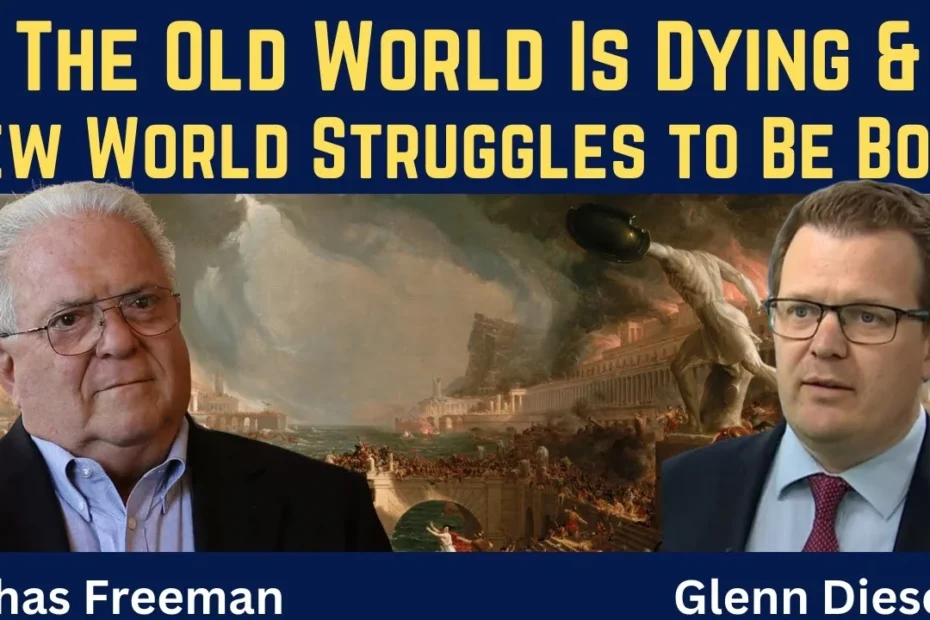
Read the full transcript of Ambassador Chas Freeman in conversation with Norwegian writer and political activist Prof. Glenn Diesen on “The Old World Is Dying, and the New World Struggles to Be Born”, July 11, 2025.
Opening Remarks
PROF. GLENN DIESEN: Hi everyone and welcome. We are joined today by the excellent Chas Freeman, a former Ambassador to Saudi Arabia and also former Assistant Secretary of Defense for International Security Affairs. So welcome back to the program. Always good to see you.
AMBASSADOR CHAS FREEMAN: Yeah, good to be here.
The End of Western Dominance
PROF. GLENN DIESEN: So it’s often said we are reaching the end of the line of the western-centric world. I mean, there’s decline across the political west, measurable economic, technological, social, political, amongst other indicators. Not suggesting it’s a world without the west, but one where the west will no longer necessarily be dominant, at least not in all spheres.
And we also see that other great powers are preparing for less western-centric world as well. So new economic links, political ties, military partnerships, also with new institutions such as BRICS. I’m not sure what to think of the meeting they just had in Brazil. It appears they’ve taken the role of an opposition as opposed to leading us into a new world. But maybe this is one step back before getting too forward. I’m not quite sure.
But I thought a good place to start is to map out where do you see American and European overreach and decline as well, or to what extent?
AMBASSADOR CHAS FREEMAN: Well, let me begin by saying that I agree with you that the BRICS meeting in Rio de Janeiro disappointingly took a complaining stand rather than a creative stand. The world really requires new leadership. American leadership is obviously discredited and ever more so every day given the wild activities of our president, one of which has just affected Brazil.
He slapped 50% tariffs on Brazil in order to protect his doppelganger Bolsonaro. I mean, Trump is the Bolsonaro of the North, I guess, and Bolsonaro is the Trump of the South. So kindred souls. And he demanded that the Brazilians not prosecute him for the criminal activity that he engaged in, which parallels Mr. Trump’s efforts to overturn the elections in 2021.
A World Without Clear Leadership
So we are in a world with no clear leadership. And it’s certainly not coming from Europe, which continues to have a divided and ineffectual foreign policy apparatus and which continues what are essentially peripheral rivalries in almost every field and therefore is never as much as the sum of its parts.
It’s not coming from China, which is reluctant to lead. Russia is not competent to lead, given the state of its relationships with many other countries and blocks. So we’re basically rudderless and we’re adrift.
And in this context, to go to the last part of your question, the west has clearly seen the end of its 500-year-long dominance of world affairs. The European Enlightenment, which created various political systems two centuries ago or more – 250 years ago perhaps – has clearly run its course.
I would say many Western societies, including my own, are in a pre-revolutionary condition. That is to say the level of dissatisfaction on the part of the people with their government and just their disbelief in what their government says and their sense that the government does not heed their voices even during elections and therefore has a certain illegitimacy about it and needs to be altered somehow, if not by elections, then by force.
Loss of Moral Standing
These things are all coming together and we’re entering a very uncertain world. But it’s one in which the west collectively, meaning the transatlantic community if you will – one could include Latin America in the west, but I think the core of it is the transatlantic community – we have no moral standing anymore, given double standards continuously applied to various issues.
Most notably the genocide in West Asia, the aggression against countries that neighbor Israel and some that don’t like Iran. And we have no standing. And yet the institutions we created after World War II to help manage affairs don’t work. The Security Council is polarized and paralyzed. The General Assembly does not cohere.
Other institutions which have been created to complement UN institutions like the BRICS, like the Asian Infrastructure Investment Bank, like the Shanghai Cooperation Organization and so forth, as I said at the outset, are not leading. They’re whining and complaining and pointing fingers and not doing anything. So this is not a happy time for the world.
Trump’s Tariff Policies and Global Response
PROF. GLENN DIESEN: You used the word “wild activities” of President Trump. Well, there’s been a few. So not that long ago they published from the White House this letter with 50% tariffs on Brazil, as you said, accompanied by demands for not going after Bolsonaro.
But again, you see these tariffs being thrown around the rest of the world now. I was wondering how you see the Middle East responding to this because Europe appears to be willing to take the abuse. So far at least some are starting to consider that there needs to be some changes. They still talk about strategic autonomy, but it’s not really going anywhere.
However, in East Asia, where you have alternatives, China and other great powers, you see historical or traditional allies of United States such as South Korea and Japan beginning to move a little bit away and looking for alternatives. But how about in the Middle East? You did mention the genocide and attack on Iran among other countries in the region. But do you see America’s allies – I guess primarily the Gulf states – starting to move a little bit away?
Shifting Middle East Dynamics
AMBASSADOR CHAS FREEMAN: I think the Gulf states generally – let me make several comments.
First, of course the United Arab Emirates, UAE, which is a supreme practitioner of realpolitik, normalized its relations with Israel. I think it’s having buyer’s remorse now because Israel has emerged – it’s very clear to people in the region that Israel demands absolute security and that means absolute insecurity for everyone else in the region.
There is no country, not just in the region, but generally, that Israel is prepared to accept anything but subservience from. And I’m sorry to say that includes my own country, which is essentially controlled by an unregistered Israeli lobby with regard to anything having to do with West Asia.
So the UAE and Bahrain, Morocco, which signed on to the so-called Abraham Accords – an effort by the Zionist lobby in the United States, essentially using the Trump administration in its first incarnation to move beyond the Palestinian issue, to set it aside, to ignore the issue of Palestinian self-determination – this is now I think on life support and I don’t know how long it will survive.
Saudi-Iran Rapprochement
A country like Saudi Arabia, which had a visceral contest both religious and cultural with Iran, an enmity toward Iran that was quite implacable – Iran of course reciprocates with a very contemptuous view of the Saudis and other Arabs – this has all changed. The two countries are making common cause now to balance the threat that Israel poses to the region’s remaining elements of stability.
Mohammed bin Salman has been in touch several times with President Pezeshkian and with Khamenei, the supreme leader in Iran. And they both condemn the Israeli actions. Saudi Arabia is not willing to break with the United States on this for the very simple reason that its military arsenal is almost entirely American. It no longer exports oil to the United States market in any quantity. But its ties to the United States, although they’re greatly diminished from the time that I was ambassador there three decades ago or so, are still very substantial, overshadowed a bit now by commercial ties with China.
China’s Growing Military Influence
And I think one of the interesting developments in that region which bears on the question of how they’re adjusting is the impending arrival of China as a military competitor of the United States in terms of arms sales. We’re already seeing this with the phase-out of Egypt’s F-16 fleet in favor of J-15s I think from China. This is the Chengdu export model the Pakistanis have used to good effect recently in their brief conflict with India.
The Chinese were accused of supplying air defense equipment to Iran during the conflict. I don’t think they did, and they’ve issued a denial. When you read the denial, it looks to me as though what they’ve denied is that they delivered anything like that during the fighting. And I expect that they will now supply various sophisticated air defense equipment to Iran and probably to Iraq, which in September will see, supposedly, the last of the US occupation forces.
Russia’s Changing Role
So this is a change. Russia, of course, has had its ups and downs. It has lost its political foothold in Syria. It is a traditional enemy of Iran. And while it has now built a strategic relationship with Iran, it apparently has been slow to deliver military supplies to Iran.
And I guess that’s the last thing I’ll say: that the United States has basically run out of military stocks. And so it’s hardly surprising that the Pentagon, hearing President Trump’s opposition to aid to Ukraine, would suspend arms sales to Ukraine in order to conserve what remains of American stocks and also conceivably to divert supplies to Israel, which has been very depleted of its defenses.
In fact, if the war had gone on another couple of weeks, some people believe that Israel would have been essentially defenseless, having lost its ability to intercept missiles from Iran.
Trump’s Continued Manipulation
So there’s a lot going on in shifting relationships. What hasn’t changed is the relationship between Mr. Netanyahu as the manipulator of Mr. Trump, and Mr. Trump, who continues to be manipulated. And we see his deference to his donors in the context of the Zionist lobby.
But we also see it in the context of the Epstein files – this philandering pederast who was a good friend of Donald Trump’s, although he now claims he hardly knew him. There are enough film clips to demonstrate that’s false, and he clearly has disappeared the Epstein files, because among the prominent people listed in those files are many of his primary donors.
And so, quite aside from his own relationship with Epstein, which he probably can finesse, those files would hurt a lot of people – people he cares about because they are donors.
Global Consequences
So West Asia, yes, changing. East Asia, changing, too. Tariffs on the Republic of Korea, South Korea and Japan have led to open discussion for the first time in Japan of removing the American military presence from Japan. I don’t think that’s gone very far. The person who’s voiced this is the former Prime Minister Hatoyama, who is a rather isolated figure, politically peripheral to Japanese politics, but not insignificant.
So the United States is making adversaries everywhere and losing friends. I expect Brazil now to retaliate, probably by ceasing to buy Boeing and going for Airbus instead, which is probably what President Trump has just accomplished. I don’t know what else the Brazilians will do, but they’re a proud country and they will not take interference in their judicial process either on behalf of Mr. Bolsonaro or the other request stemming from an earlier Elon Musk objection to their censoring his Internet outlets.
They’re not going to yield on these things. So we’re creating more and more immovable objects and showing that our force is resistible.
The Syria Question
PROF. GLENN DIESEN: Well, you did mention Syria and this is one of the more troubling developments. I remember very well after the September 11th attack, the whole world was focused on fighting Islamic extremism, jihadists. And many people would make the point that a lot of this had origin back to the direct support and financing of jihadists in Afghanistan throughout the 80s. It felt a bit like distant history nonetheless. But now we’re in this strange position where…
AMBASSADOR CHAS FREEMAN: Where…
PROF. GLENN DIESEN: The former Al Qaeda and ISIS leader Jolani has of course taken over Syria. The decision has been made to remove, scale back the sanctions, I guess, which could be positive to the extent that it has a very bad impact on the civilian population. However, I guess the cynic in me would expect that this has some purposes to align perhaps foreign interests, perhaps starting arms sales to Syria and possibly even using Jolani’s Syria as proxy.
I’m not sure against Iran or where this could go. It’s just, it does seem if we buy into the premise that we’re simply pursuing liberal democratic values and seeking to fight terrorism, it looks a bit strange when all the Western leaders are rushing down to Syria to shake hands with or inviting them back to their capitals to shake hands with Jolani.
And I can’t remember what Trump said – he’s a strong man, or something along those lines, which was a weird way of referring to ISIS, but here we are. So how do you see the new role of Syria in the region?
The Syrian Situation and Israeli Influence
AMBASSADOR CHAS FREEMAN: Well, Al-Shara, he’s changed his name back to the original, but he is from the Golan Heights, which is what Jolani means. You can explain all this only by reference to Israel and Israel’s hold on Western politics.
Israel has always had the objective of fragmenting Syria. It probably is involved now in assisting the Kurds to avoid integration into the Syrian National Army. This is the main obstacle to the so-called Syrian Democratic Forces giving up their autonomy in Syria. They insist on retaining a separate identity within the Syrian armed forces.
Quite understandably, the Damascus authorities want them to integrate on an individual basis. They had a strong tie to the Israelis who’ve been messing around with the Kurds in Turkey, in Iran, and in Syria all along. Iraq is particularly egregious in that regard.
So what is going on is an effort to subdue Syria and bring it into the equivalent of the Abraham Accords. That is, accept Israel has the great power in the region and defer to it. Al-Jolani, or Al-Shara if you want, is sufficiently desperate in presiding over a country that has been totally devastated by proxy wars fed by outsiders, as well as fights among Syrians themselves. He’s desperate for assistance and is willing to make any cynical bargain he can.
So he is supposed to meet with Netanyahu in the early fall, maybe in Washington. This tells you what this is really all about. It’s not about democracy. It’s not about political Islam. If Mr. Al-Shara is strong in the sense that he beheaded a lot of people, I suppose that counts for something in Mr. Trump’s mind, but it certainly does not burnish his credentials.
Of course, it is possible that he has repented and been saved, and his inner Democrat has emerged suddenly from the monster that he was. But while all this is going on, there have apparently been 1,600 murders of Alawites in the Latakia area of Syria – reprisals – and nothing’s been done about that at all. The world is basically, as it has in the case of Gaza, looked the other way.
So if you want to find a moral quagmire, the Levant is the leading candidate. This does not speak well of anyone’s foreign policy at present.
Trump’s Contradictory Ukraine Policy
PROF. GLENN DIESEN: Well, Trump wasn’t only going to end the Middle Eastern wars to restore America’s strength. He was also going to end the main war that is against Russia through the Ukrainian proxy. But this is also a source of confusion for many people because he obviously said there wouldn’t be any more weapons to Ukraine. Then he resumed, then he took it off. And then within almost 24 hours, he argued he had no idea who stopped the weapons shipment and will have it sent back again.
Beyond the disorganized approach, has he made his peace with this being Trump’s war as well? Or is this part of some negotiations to manage hawks within Washington, or is this just Trump becoming Biden?
AMBASSADOR CHAS FREEMAN: Effectively, it’s politically convenient because he’s surrounded by neoconservatives. Much of his donor base is neoconservative. His political base does believe in restraint in foreign policy and does not want forever wars and does not want the United States involved in the Ukraine war. So he’s got a contradiction there, and he’s clearly come out in favor of the donors. It is a pretty well-known fact that he likes money, and that seems to call the tune in this case.
But is there a strategy here? Is there a coherent policy? No, there’s not. This is not part of a negotiation. This is petulance. This is hubris and bluster and a kind of childish tantrum. You have children, you probably have seen them at the age of usually two and a half or so do similar things. So if he’s a very stable genius, as he proclaimed in his first era, he’s not behaving that way at the moment.
PROF. GLENN DIESEN: But there are still limits to what can actually be sent. That’s why I was trying to see, well, look for some order in the chaos. When he announced America was going to pull out, the Europeans said we’re going to take this over, right before the collapse begins to intensify. I thought he got the Europeans to agree to the 5%, which would allow him also to walk away. He got the minerals deal from the Ukrainians, which allowed him to declare victory and walk away. I thought that everything was lining up perfectly. And now back to square one.
Putin’s Strategic Response
AMBASSADOR CHAS FREEMAN: So he’s got a problem politically. He’s losing his base. This one big, beautiful bill, which was run through by, in effect, the Trump cult in Congress, it hurts many of his most ardent supporters. We’re about to see a jump in inflation as a result of all these tariffs that he’s imposing. He’s lost the confidence of Wall Street. Nobody abroad takes him seriously anymore because he can’t adhere to any agreement that he makes. He charts no consistent course. So he’s holding onto his donor base. That’s my view. There’s no serious purpose here.
In the meantime, what will happen, of course, is I think that Vladimir Putin has basically written off President Trump and he doesn’t feel any imperative to do a deal with Mr. Trump because he knows Mr. Trump is unreliable. So what he will do is what he’s doing, which is increasing the pressure on Ukraine, advancing as he can not just in the east, but in the south. The Zaporizhzhia region is now the locus of a major offensive, apparently.
I think it’s very likely that Mr. Putin will now take seriously the threat to take Odessa if he can. Not easy, but not impossible. Ukraine has run out of manpower. Weapons supplies to Ukraine are not going to solve any problem that Ukraine has. So not only does the United States not have the weapons in abundance, but Ukraine doesn’t have the people to man the weapons or use them effectively.
So this is an opera. The protagonist is dying slowly on the stage. The fat lady hasn’t sung yet, but she will.
The Irreversibility of Hegemonic Decline
PROF. GLENN DIESEN: Well, okay, I like the picture you paint, but what is it that can be done? Do you see hegemonic decline being irreversible? A different way of framing it is if the idea that hegemony would be forever made sense at some point, it would exhaust itself. This is something people often commented in the 90s that this would be a risk of attempting unipolarity. That is, the US and its European partners might exhaust themselves economically, militarily, their standing in the world of legitimacy, and end up with a very depleted socioeconomic base at home, which would create even further instability.
But do you see any pathway to reverse any of this? If Mr. Trump was calling you for advice, what are the possible pathways for America at this point?
Constitutional Collapse in America
AMBASSADOR CHAS FREEMAN: Well, I think he’s not going to call me for advice, so I’ll dismiss that as a hypothetical that can’t be answered. But in my view, we’re in a period of constitutional collapse in the United States.
The United States was admired because for Americans and for much of the world, it seemed to represent an idea rather than a country based on ethnicity, religious faith, or language. Now we have an official language, apparently English. We never had to be told to speak English before – everybody learned it, because that’s what we spoke.
The Bill of Rights, which created the idea, which embodied the idea, contained guarantees of press freedom. But now we prosecute the press for conducting investigative journalism. It contained guarantees of free speech. But now we persecute students if they speak out against genocide. And we do that on behalf of a foreign country which demands that we do it – Israel.
The First Amendment also contains a guarantee of separation of church and state. And yet more and more of our politics reflects particular religious beliefs. The Supreme Court, remarkably, is dominated by Catholics who have, not surprisingly, imposed the Catholic view of abortion on the country. It’s not just Catholics, it’s evangelical Christians, of course. So there’s a coalition. But what became of separation of church and state? We’re no longer a secular country.
The Fourth Amendment bans unreasonable searches and seizures, and yet we now have a surveillance state. The Sixth Amendment says that if you’re accused, you have a right to know the charges against you and the evidence thereof. But we now have secret evidence in courts which is not presented to the accused.
So the Constitution is in the process of collapsing. Underneath all this, I think, is the abandonment of the time-honored Scandinavian, Anglo-Saxon view of due process. That is that the legitimacy of a result is determined by the fairness of the process that produces it, not by whether you like the result or not.
The purpose of the courts is to quell controversies. If the process by which they proceed is fair, then if you don’t like the decision, too bad, you have to accept it. If elections are held and they are fair and they elect a group that you don’t like or an individual, you have to accept that result, because that is a fair process.
All that is gone. Now we have the legitimacy of outcomes determined by whether we approve of the outcome or not, not by the process that delivered it. This is the end of a central tenet of our culture, and along with the end of the various Enlightenment values that are embodied in the Bill of Rights, it means that we are, in fact, undergoing revolutionary change without really realizing it.
America’s Lost Moral Authority
So it’s not just that the world is changing, and our position, the United States, Europe, transatlantic community, if you will, our role in it is changing. We are becoming isolated by our own failure to stand up for our own values. But our values are in fact being abandoned by us. So not only do we have no moral authority globally, but we have no appeal of the sort that we once did.
Or to put it a different way, we’re in a strange position where we have the Chinese as the prime defenders of the United Nations Charter and its principles and international law, even though they’re not perfect. They violate international law, as all great powers do, but in relatively minor ways. In effect, we have met the enemy. And to paraphrase Pogo, the enemy is us as we used to be.
We used to be the defenders of international law and the UN Charter. Now we’re the enemies of these. Look at what has just been done to Francesca Albanese, the UN reporter on Palestine. The United States is sanctioning her and calling her a criminal. What does she represent? She represents conscience. She represents international law. She represents the international justice system. And we are now opposed to that.
We have Greece and Italy and France and Britain allowing a war criminal, Netanyahu, who has an international warrant out for his arrest, to transit their territory to fly over airspace to meet with his fellow – well, not perhaps war criminal, but at least convicted felon – in Washington.
Where is what is left of what began in the 18th century in Europe to be codified as international law? Where is the respect for process? I think this is a very fundamental shift that is going on, and it’s not one that I, as an antique – anything over 50 years old is certainly an antique by definition – do not enjoy watching this happen.
Europe’s Moral Drift
PROF. GLENN DIESEN: We did mention the Europeans, but do you see the foundation of Europe being weaker as opposed to its American counterpart?
AMBASSADOR CHAS FREEMAN: I think it’s just adrift. I don’t know that it’s weaker or stronger. There are preposterous statements being made by some Europeans about things like Gaza. There are things happening, for example, the criminalization of protests against genocide when I thought one of the great achievements of European culture after having committed genocide was to repudiate it definitively and to declare that genocide was the supreme crime against humanity. Now it’s endorsed.
We listen to people in Israel who sound worse than the Nazis. Worse than the Nazis. You can see them on the videos advocating a complete extermination of the Gazans. Starvation, sniping, bulldozers, artillery, aerial bombing, whatever it takes. And where is the counter to that from Europe?
Europe says, well, I’m just following American orders. That’s the German Wehrmacht or the SS’s excuse. I was following orders. Where’s the conscience of Europe? Who represents it?
The Duration of Western Decline
PROF. GLENN DIESEN: How long can this go on? That would be my last question. Because the whole post-Cold War era was supposed to be organized around liberal hegemony. It’s not hegemonic anymore. And as you know, we now effectively criminalize genocide protesters while supporting genocide.
I mean, the Germans – if you would have told me a few years ago that they would be in this position, calling on arming themselves to the teeth to fight Russia, arguing that they will now be the main force for backing Ukraine as America pulls back against Russia, supporting genocide in the Middle East. One would not have thought this was very credible, but here we are.
But how long do you see this? At some point it has to fracture within the political West because when we identify as one group based on common values and those values are discarded, what is it that unites this part of the world?
The Loss of Civilizational Values
AMBASSADOR CHAS FREEMAN: Well, I don’t know. I mean, I think there were very clear civilizational characteristics of Europe that were admirable and they go back – you can trace them back to the Greeks and Romans. They were reborn in the Renaissance. They were perfected, I would think, in the Enlightenment. I see no deference to these values now.
There is an American political adage, I’m sure you’re familiar with it, attributed to someone’s mother who told her son: if something can’t go on forever, sooner or later it will stop. Well, sooner or later this will stop, but when? And what will replace it?
Echoes of the Past
You know, there are many echoes of fascism in what we are now seeing. I don’t want to say that the Germans – having been in Ukraine before and having done genocide before and having armed themselves to the teeth during the Depression as a way of conducting a German-style counter-cyclical spending program that actually worked pretty well. They built a lot of autobahns and built a lot of weapons and a lot of people got employment who wouldn’t have had it. I don’t want to say that they’re going back to that past, but pretty clearly they’re not going into the sort of future that, as you said, we all imagined we were going into.
Francis Fukuyama and the end of history are now a joke – probably should have been at the time, but anyway, they have no credibility at all, this kind of statement.
The Absence of Leadership
So I don’t know whether – I hate to be… I spent my life as a diplomat. Diplomats have to be optimistic about everything. But I’m trying to find a solution for this and you ask where it is and I don’t see it. I don’t see it because I go back to the point that those who might lead are not leading.
The BRICS is not leading, the Chinese are not leading, the Indians are not leading. Maybe the Japanese will return to leadership in East Asia, I don’t know. But they haven’t taken that role. The United States is not leading. It’s just flailing about in a spastic manner that damages the United States itself as well as everyone else.
Trump’s Unfulfilled Promises
And where are the ends of the wars that Mr. Trump promised? Twenty-four hours – he’s going to end the Ukraine war. He never said anything about reining in the Israelis. He was going to do a better deal with Iran. He was going to reorganize trade to produce a major surge of industrial employment in the United States and create a fair playing field for everybody. Not happening. Everything that’s happening is the opposite.
So you might conclude from this that Mr. Trump was a confidence man who didn’t really know what he was doing and has now managed to equip himself with a staff which is as ignorant and incompetent as he is. And that the incompetence of the American government, which is growing as the number of competent people in it are fired – ever more are fired – that nobody’s out there in the rest of the world ready to step into the vacuum that this creates. Europe isn’t.
Concluding Thoughts on Leadership
PROF. GLENN DIESEN: The lack of leadership, I think, is a good diagnosis of where we are. Thank you so much. I appreciate your insights. I wish there was some more optimistic view in terms of where we’re heading, but it does feel like there’s a lack of a strategic vision. I personally genuinely thought that Trump would, along the lines of trying to bring back or scale down the empire to save the Republic, along those lines. But I haven’t really seen it yet, so there are some problematic times ahead, it seems.
AMBASSADOR CHAS FREEMAN: It’s a Zeitenwende, clearly. But there’s a saying by Seneca: if a man knows not to what port he steers, no wind is fair. We don’t know where we’re going. That’s the problem.
PROF. GLENN DIESEN: Very much agreed. Well, thanks again.
AMBASSADOR CHAS FREEMAN: I’m sorry to be so depressing, but I wish you a happy evening.
Related Posts