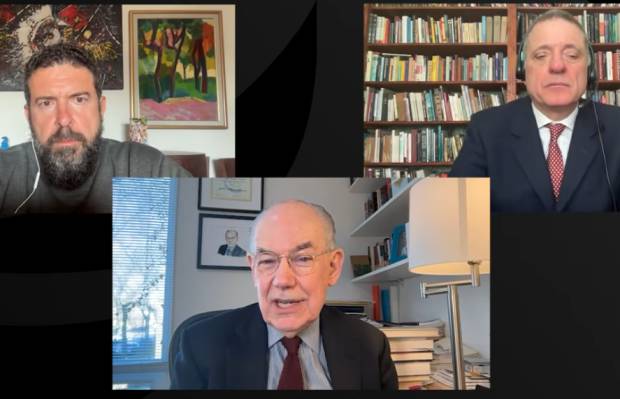
Editor’s Notes: In this episode of The Duran, hosts Alexander Mercouris and Alex Christoforou are joined by renowned international relations scholar Professor John Mearsheimer to analyze the escalating conflict between the United States and Iran. The discussion delves into the strategic “quagmire” facing the Trump administration, drawing parallels to the Vietnam War and examining why initial expectations of a swift victory have failed. Mearsheimer highlights the significant roles of Israeli influence and internal advisors in shaping U.S. policy, while also warning of the catastrophic risks to the global economy and the potential for dangerous further escalation. (April 7, 2026)
TRANSCRIPT:
Introduction
ALEX CHRISTOFOROU: All right, Alexander, we are here with John Mearsheimer and we will be discussing what is happening with Iran, with the war in Iran. And before we get started and I pass it off to you, Alexander, and to Professor Mearsheimer, I just want to direct all our viewers to please follow Professor Mearsheimer at his Substack. I have the link in the description box down below, and I will also have his Substack as a pinned comment as well. So definitely highly recommend Professor John Mearsheimer’s Substack. And let’s get started with all the news because there’s a lot to unpack. So Alexander, Professor Mearsheimer, the floor is yours.
Are We in a Quagmire?
ALEXANDER MERCOURIS: Well, there certainly is. And today our guest absolutely requires no introduction. I could say definitely that pretty much everybody who watches us knows Professor Mearsheimer. And all I will say is I have learned a huge amount from him. There are several books of his there in that large number of books that you see. And I have learned much from him over the years, and there’s nobody better to discuss the situation that we find ourselves in today in this conflict with Iran and in discussing US policy.
So here we are, John, we are in this conflict. We’ve had extraordinary events over the last couple of weeks. We’ve had an attack on the 28th of February. We’ve had systematic attempts to assassinate Iranian leaders, which have been successful in killing large numbers of Iranian leaders. But we see no sign at the moment of an end to the war. Oil prices are currently at around $110 a barrel. I saw a report that in 2 weeks’ time, it’s expected that they will rise further and settle at about $150 a barrel. There’s concerns about the global economy.
I was reading reports about the fact that there are now stresses in the shadow banking system with some banks in the shadow banking system, which is something, an entity I don’t fully understand myself, but apparently they’re restricting withdrawals by their customers, which sounds somewhat disturbing. And well, here we are in a war. And the question, the word which I am sure we both remember for Vietnam, quagmire, is starting to be used. Are we in a quagmire? In this conflict with Iran?
JOHN MEARSHEIMER: Well, I think, Alexander, the situation that President Trump faces is pretty straightforward. Number one, he can’t go up the escalation ladder and win because the Iranians can beat him or stymie him at every turn. He just has no way of escalating and winning this war. And at the same time, he has no exit option. There’s no way that he can get out that’s not going to leave him in a situation where it looks like the United States has been defeated. I mean, there is an exit option if you want to accept defeat, but for him to accept defeat at this point in time is politically impossible.
So if you can’t put an end to the war, you can’t go up the escalation ladder and dominate. Where does that leave you? It leaves you in a quagmire. And like you, it reminds me a lot of the Vietnam War. As I like to tell people, I went into the American military in June of 1965, and combat troops landed in Da Nang on March 8th, 1965. And then Rolling Thunder, the famous or infamous bombing campaign in North Vietnam, started on March 2nd, 1965. And then I got out of the military in the summer of 1975, 10 years later. And it was in April 1965 that the war in Vietnam ended with a decisive defeat for us and for our allies.
And we were in a quagmire from 1965 on. You have a similar situation here. One big difference is that we went into Vietnam fully aware that we were in a terrible spot, that we did not have a winning strategy, and that our allies were militarily and politically incompetent. I mean, the reason that we upped the ante in 1965 was because the South Vietnamese were going down the tubes, and we had to go in to rescue the situation. And it’s not like we went in there thinking that we had the magic formula to fix the problem. And of course, it quickly evolved into a quagmire. We tried to escalate, that didn’t work. And there was no exit option other than to accept defeat, which is ultimately what happened.
This case is a bit different in that we went into the war foolishly thinking that we could win it. It’s very different than Vietnam in that sense. I don’t know why they thought that they could win the war, and lots of people told them they couldn’t, but they thought they could win it. But once it was clear that that was not going to happen, and as I said before, we have no escalation option and we have no exit option at this point in time, we’re in a quagmire. And this is a disastrous situation, not just for President Trump, but for all of us, because this is going to do enormous damage to the world economy.
How Did the US Walk Into This?
ALEXANDER MERCOURIS: Absolutely. You actually anticipated my next question, because your point about us going into this conflict expecting that we would win and win quickly, it was contradicted by all sorts of people.
Now, how did that come about? Who exactly is the president and his officials listening to? Is it, and I’ve seen this suggested, that the United States doesn’t actually have a strong intelligence operation in Iran, that it has relied excessively on the Israelis? The Israelis have a well-known desire to involve the United States in a conflict with Iran. I mean, they’ve never made any real secret about this. And that the Israelis basically gave an indication that Iran was far weaker, far more fragile than it really is. What are your thoughts about that?
JOHN MEARSHEIMER: Well, first of all, it’s very important to understand that we have an extensive scholarly literature that’s easily accessible to anybody with a college education that tells you that a lot of the schemes that the United States has come up with in recent years are guaranteed to fail. But the idea that you can bomb a country and cause regime change with air power alone is not a serious argument. The evidence is overwhelming that this just doesn’t work. And why the Trump administration or President Trump himself thought that he could pull this off is beyond me. And all of this talk about regime change and coups and so forth and so on, the literature again is very clear that it hardly ever works. So I really don’t understand why they just didn’t pay much more attention to the conventional wisdom.
Second point I’d make is, a lot of people like to berate the deep state, and that includes me. And a lot of people have said that General Cain and the intelligence community in the United States are bankrupt and they contributed to this disaster. I actually think that’s not true. I think the deep state, as best we can tell from the evidence that’s available in the public record, understood that this was a foolish decision — declaring war against Iran was a foolish decision for sure. General Cain told them before the war that we had no viable military option. There was all sorts of evidence in the Washington Post about this fact. Furthermore, the National Intelligence Council told the president that this was not going to work. And there’s all sorts of evidence that other people in the intelligence community, unsurprisingly given what the scholarly literature and what the historical record says, understood this was not going to work.
So the question is, what happened here? As best we can tell, it was the Israelis who played the key role in convincing President Trump and apparently Prime Minister Netanyahu that we had the magic formula. And it’s this man named David Barnea who is the head of Mossad who became convinced that if we decapitated the regime early on, we launched some sort of shock and awe campaign against Iran, that there would be a huge revolution inside of Iran, the people would rise up, they would overthrow the government, and we’d get a new government that would in effect dance to our tune.
The New York Times story on this, which was very detailed, said that Barnea’s predecessor, a man named Cohen, had said this was a crazy idea. It wasn’t going to work. Cohen undoubtedly had read the literature, knew the historical record, but for some reason David Barnea came in and took control of Mossad, and he came up with this strategy that was supposed to work. And there are all sorts of reports in the Israeli media, by the way, that Barnea basically lived in the White House, that he was in the United States all the time selling this plan, and he sold it to Trump.
Now, one final set of points. It’s very important to understand that Trump depends very heavily on Jared Kushner and Steve Witkoff to advise him on these things. First of all, these two individuals are babes in the woods. They don’t know much about foreign policy. They’ve not studied these issues like the three of us have. They’ve not thought deeply about them. But more importantly, they’re ardent Zionists. They’re deeply committed to Israel. The evidence is overwhelming in this case. And therefore, if the Israelis want a war, they want us to go to war. They’re pushing hard. Netanyahu’s pushing hard. Barnea is pushing hard. And the two people that Trump is relying on the most for advice are people like Jared Kushner and Steve Witkoff. It’s hardly surprising that Trump took the bait and off we went. And here we are in the quagmire.
Will This Change the US-Israel Relationship?
ALEXANDER MERCOURIS: Is this going to result in a rethinking in the United States of the relationship with Israel? I mean, I don’t mean by that that the United States is going to completely turn its back on Israel, but is there going to be much more scepticism of the Israelis in future? And perhaps actually slightly contradicting what I just said, are we going to see a sea change in attitudes towards Israel and the United States, especially once we get the debacle, which I think we all see is coming?
JOHN MEARSHEIMER: Yeah, I mean, it’s a hard question to answer at this point, in part because the debacle has really not hit yet. It’ll be fascinating to watch what happens over the next year or so as this war plays itself out. If Trump is able to pull off a miracle and put an end to this war very quickly, and various countries around the world can work to minimize the damage, that would mean that the US-Israeli relationship would not be hit that hard. But if that doesn’t happen, which is likely, and this war goes on and enormous damage is done inside the United States and around the world, I think that will do major damage to the US-Israeli relationship.
You want to think about what we’re staring in the face here. We’re staring in the face a disastrous war, a war that looks like it’s going to tank the international economy, that we’re going to have significant stagflation moving forward. And at the same time, it’s clear to most people on the planet, not just in the United States, but most people on the planet, that the Israelis are behind this war. That means the Israelis are going to be blamed in the United States and in other places for producing this disaster. And it’s hard for me to imagine that that’s not going to have a significant negative effect on US-Israeli relations moving forward.
But I would just say to you, Alex, and you, Alexander, you do not want to underestimate the power of the lobby in the United States and the power of the lobby to keep the United States and Israel joined at the hip. The lobby is enormously powerful, and despite all the damage that Israel has caused or will cause, I wouldn’t be surprised if the lobby is able to mitigate a lot of that damage.
Strains on US-European Relations
ALEXANDER MERCOURIS: Let’s just look at the other allies of the United States. We have the Europeans, and there’s some criticism and tension now between the Europeans and the Americans. The Europeans are saying, “This is not our war.” They are making it absolutely clear, as clear as they can, that they see it as a massive diversion from the war that they want the United States to be focused on. Which is the war in Ukraine. For them, Russia remains the main concern.
We’ve discussed this in many programs and the worry that the Europeans have of one day the United States losing interest in Europe and walking away and of the problems that will cause for the Europeans themselves. And we have comments from the United States too. That the Europeans are being very unhelpful. They’re not rushing to help in the Strait of Hormuz. There are statements, not just from Trump, but even from people like Rubio, that where are the Europeans when you need them? Why aren’t they helping with the Strait of Hormuz?
Are we going to see a change, a shift here in US-European relations as well? And is this going to continue beyond the current administration? Some people in London are worrying that they will, that a major line has been crossed.
The Transatlantic Relationship Under Trump
JOHN MEARSHEIMER: Well, I think that if Trump remains in office for another almost 3 years, it’s hard to believe that there will be anything left of the transatlantic relationship by the time he’s done. I mean, first of all, there’s going to be huge economic damage in Europe. There’s already been significant damage that was done in good part as a result of the Ukraine war. And here in the early stages of the Iran war, damage is being done in Europe.
Most of the accounts that I read in places like the Financial Times, the Wall Street Journal, all indicate that the biggest hits are now being felt in Asia. But what’s going to happen with the passage of time is that the troubles, the big troubles, are going to spread to Europe. So the European economies are really going to be badly damaged by the Iran war. And add to that the Ukraine war.
Furthermore, President Trump is going to blame the Europeans for losing this war. I mean, we know how President Trump operates. He’s not going to accept responsibility for this disaster. He’s going to look to blame other people. And he’s going to say, “We could have won this war had the Europeans come to our rescue. We have done all these wonderful things for the Europeans over time. And when the money was on the table, the Europeans did nothing for us. They’re responsible for the fact we couldn’t open the Strait of Hormuz. They’re responsible for the fact that Iran basically won this war.”
So not only is Europe going to be clobbered economically, but Trump is going to do everything he can to blame the Europeans, which is another way of saying he’s going to poison relations even further between the United States and Europe.
The Lesson for American Allies
The final point I’d make is if you’re a European, you’re a Gulf state, you’re an American ally in East Asia, the lesson you should learn from all of this is you don’t want to get too close to the United States. You want to stay as far away as you can. I mean, it’s almost impossible to avoid the United States because the United States is just so powerful. And you also don’t want to anger Trump if you can avoid that. But at the same time, you just do not want to get too close to this rogue elephant because this rogue elephant can do disastrous things to your economy and to your political system.
I think the best example of this is the Indians. When President Trump came back into the White House in January of 2025, one of the first people to visit him was Prime Minister Modi. And as you remember, in Trump’s first term in office, he had really good relations with Modi. And then Modi, of course, comes over in early 2025, and it looks like he and Trump are going to be the best of buddies and India’s going to live happily ever after.
But then Trump turns on India and relations go down the toilet bowl by the summer of 2025. The Indians have significant tariffs on them, terrible relations with the United States, and the Americans are telling them they can’t buy any more Russian oil and so forth and so on. Now, those relations have been repaired somewhat, but if you’re the Indians and you look at what the Trump administration is now doing to the world economy, and you look at what the consequences are for India — and the consequences for India are really profound — it’s not just oil, it’s also fertilizers and assorted other things that the Indians depend on that they’re not getting. The message you should take away from this is you got too close to the United States.
So my view is that the Europeans will eventually figure out that they have to put some distance between themselves and the Americans. It’s in their national interest not to get too close to the Americans.
The Bucharest Summit and European Capitulation
And I just want to make one final point on this. You want to remember, just on NATO expansion into Ukraine, the decision to do that was made in April 2008. And at the famous Bucharest NATO summit, both Angela Merkel, who was the German chancellor at the time, and Sarkozy, who was the French leader at the time, both of them were adamantly opposed to NATO expansion into Ukraine. Because as Angela Merkel later said, “I understood that President Putin would interpret this as a declaration of war.” It’s a remarkable statement.
But nevertheless, Merkel and Sarkozy caved to the Americans. They caved. They should have stood up to the Americans. They should have said, “Under no circumstances are we bringing Ukraine into NATO.” And if they had done that, we would have avoided this catastrophe that’s now taking place in Ukraine. And as you two know better than I do, it is an utter catastrophe.
But the Europeans didn’t stand up. And this has been the problem with lots of countries. You don’t stand up to the United States, you don’t put some distance between yourself and the United States, you’re going to get yourself into a heap a lot of trouble.
Security Guarantees and the Dangers of Alignment with the US
ALEXANDER MERCOURIS: But this actually brings us to something else because Ukraine has been pressing for a security guarantee from the United States. Security guarantees. The Europeans have been advocating for the United States to give security guarantees to Ukraine. Firstly, doing that is only going to provoke the Russians and is going to make any attempt to end the war — in terms of the Ukraine war, in terms of a negotiated solution — more difficult, if not impossible, probably impossible.
But secondly, the lesson I would have thought from what we see with the Gulf Persian Gulf countries who thought that they had some kind of security guarantee, at least protection from the United States, is that getting into a security relationship with the United States can actually land you in a very great deal of trouble.
Now, I happen to know there are people in Europe who are talking about this. This is something that is for the first time that I know of actually being discussed. And that plays directly to the point that you said, that people in Europe are starting to say to themselves, “Is this very close security relationship with the United States such a good idea?” It’s the first time that it’s actually being talked about and talked about by people who just a few weeks ago would never even have considered debating it.
America’s Strategic Overstretch
JOHN MEARSHEIMER: Yeah, let me just say a few words about this whole notion of a security guarantee for Ukraine. I think anybody who’s thinking about a security guarantee for Ukraine or the United States remaining deeply involved in Ukraine is living in cloud cuckoo land.
What’s going on here? The United States has 3 areas of the world that it really cares about. These are strategically vital interests, these areas. One is East Asia because of China. Two is Europe for all the obvious reasons. And three is the Persian Gulf. And the United States only has so much wealth and it can build only so many forces and it can fight only so many wars at one time.
What’s happened here is that the United States has gotten into a quagmire, as we were talking about before, in the Middle East. It is expending tremendous amounts of expensive ammunition. It’s depleting important stocks of ammunition. And very importantly, it’s pivoting away from East Asia, which is the most important area in the world for the United States.
If you go back and look at the November 2025 National Security Statement that came out of the White House, except for the Western Hemisphere, which is obviously the most important area of the world to the United States because it’s our backyard, the area that matters the most outside of the Western Hemisphere today is East Asia. So I always like to say historically, Europe has been the most important area of the world for the United States. Starting in 2017 or so, for the first time in our history, for the first time in American history, East Asia became the most important area of the world because of the rise of China. That’s why we were pivoting to Asia.
But if you look at what’s happening today, it’s really quite remarkable. We are pivoting away from Asia. That Marine Expeditionary Unit, the 31st, that’s coming out of Japan to the Middle East — it’s in the Middle East now. Furthermore, we’re pulling THAADs and Patriots out of Japan and South Korea. So you have this situation where we are, by almost all accounts, in a quagmire in the Gulf. We’re pulling troops and weaponry away from the geopolitically most important area of the world.
Ukraine, Russia, and the Limits of American Power
The question you want to ask yourself then is, what does this mean for the third area of the world, which is Europe? Well, the first point I would make, which I don’t have to tell you guys because you know better than I do, Russia is not a threat to overrun Europe, and we, the United States, don’t have to worry about Russia overrunning Europe. We don’t even have to worry about Russia overrunning all of Ukraine despite all the threat inflation in the West.
Furthermore, do we really want to give precious military assets that we’re burning up in the Gulf to the Ukrainians to fight a war that they’re going to lose anyway? And which also means that we can’t send those precious assets to East Asia to deal with what we think is the number one threat? The answer is almost certainly no. It’s hard to believe how we go on over the long term sustaining Ukraine in its fight against the Russians. The weaponry is just not going to be there. And the idea that we’re going to give Ukraine a security guarantee? I find that hard to believe.
And just one final point on this. I think if the Americans are ever going to get out of this war in the Gulf, they’re probably going to need help from the Russians and the Chinese. They’re probably going to have to go to the Russians and the Chinese and ask for help, to put pressure on Iran to work out some sort of deal. They’re probably going to get the Russians and the Chinese involved in providing some sort of security architecture in the Gulf that leaves the Iranians thinking that they won’t be attacked again in 6 months.
So I think one can make a good case that, if anything, we’re going to have to play nice — we, meaning the Americans, are going to have to play nice with the Russians and the Chinese because of the trouble that we’re in in the Gulf. And if that’s the case, do we really want to be playing hardball with the Russians over Ukraine? The answer is no. So I think the link between the United States and Ukraine has been badly damaged, if not wrecked. I’m curious what you two think about that.
Parallels with Vietnam
ALEXANDER MERCOURIS: Well, actually, it’s a very good point because isn’t this in some ways again a bit like Vietnam? Because I’m just old enough to remember Vietnam, obviously not as well, but I remember people would say, “This is a sideshow. Southeast Asia is not pivotally important to the United States.” The focus at that time was in Europe because that was where the Cold War was being played out. There was concern about the fact that the Soviets were moving forward towards first nuclear parity, and some people were worried that they were moving forward towards nuclear supremacy.
And one of the reasons, or so it has always seemed to me, why in the end the United States swallowed the reality of defeat in Southeast Asia was because Southeast Asia ultimately had to be sacrificed in order to try to focus, to bring the focus back to the place that really mattered, which at that time was the competition with the Soviets and Europe.
And the interesting thing was that in order to get out of Southeast Asia, what did the United States have to do at that time? It actually had to do exactly what you’ve just been talking about. It had to improve relations with the Soviets and with the Chinese because they were the two parties that had some leverage over the Vietnamese at that time and who could edge the Vietnamese towards a negotiation, towards a resolution.
Now, history never repeats itself. It’s never exactly the same. But are there some rhymes, if you like? Does it rhyme in some ways with some of the situations that we’re seeing now?
The Strategic Importance of Northeast Asia vs. Southeast Asia
JOHN MEARSHEIMER: Yeah, absolutely. Just one sort of historical point. During the Cold War, and this of course includes the Vietnam War, we used to distinguish between Northeast Asia and Southeast Asia. And if I talked about American grand strategy, let’s say in 1975 or 1980, I would’ve said to you, there are 3 areas of the world that matter to the United States. One is Europe, two is the Gulf, and three is Northeast Asia.
And you want to remember that during the Cold War, our principal adversary was the Soviet Union, and the Soviet Union is physically located in Northeast Asia. Therefore, people argued at the time the war in Vietnam made absolutely no sense because it was in Southeast Asia. You want to note that nobody argued that the Korean War was a bad war or a foolish war, that we shouldn’t have fought the Korean War. And the reason is that Korea is in Northeast Asia and it involved the Soviet Union.
What’s happened today is that Russia is not a threat in East Asia. China is the threat from the American perspective. And if you think about it, China’s physically located in both Southeast Asia and Northeast Asia. So our rhetoric has changed today, and we don’t talk about Northeast Asia as that area of strategic importance. It is East Asia, which includes South and Northeast Asia.
But anyway, to go back to your point, there’s no question that as the war wore on, this is the Vietnam War, we came to understand that Southeast Asia was not an area of great strategic importance to us. The Soviet threat that we worried so much about was not located in Southeast Asia. And of course, we then had a rapprochement with the Chinese, which really took Southeast Asia off the table.
But we couldn’t get out of that war, as you were saying. And the way we got out of that war, or one way we got out of that war, was getting some help from the Chinese and the Russians. But, Alexander and Alex, in the end, what did it was not so much Chinese or Russian help. We just got beat. The North Vietnamese just beat us. And the Chinese and the Russians really couldn’t help us.
I think in the case of Iran and the war that’s going on there, you can tell a plausible story where the Russians and the Chinese actually help us. We’re going to have to eat a lot of crow. The Americans are. There’s just no question about that. There’ll be limits to which Trump or any president can sell this as a quasi-victory. We’re going to eat crow. But I think we have to get out of it, and I think the Russians and the Chinese may be able to help us a bit.
Russia, China, and the Stakes of an Iranian Victory
ALEXANDER MERCOURIS: Well, one reason why they might want to do that is because I wonder whether they would want to see a clear-cut Iranian victory of the kind that the Vietnamese achieved in Southeast Asia, because the Middle East is an important region. And certainly for the Russians, it is an important region. They have friends there and they don’t just have friends, they got interests there too.
And the Russians, as I happen to know, find the Iranians not exactly easy people to work with, and a victorious Iran dominating the Middle East I think is not something that people in Moscow would particularly want to see. They would probably want to see something a lot more balanced than that.
Can you talk to that? And can you perhaps discuss briefly where, what the effect of a visible Iranian victory and debacle for the United States in the Middle East, what the effect of that might be? Because to me, that looks like an enormous event. And obviously the Americans wouldn’t want it, but I wonder who else would. I mean, apart from the Iranians themselves, perhaps. Certainly I can’t imagine that Israel would be happy with an American defeat in the Middle East. But as I said, I can’t imagine that the Russians would be delighted with that either. The Chinese might feel differently, but I can’t imagine that the Russians would be —
The Nuclear Proliferation Risk and Economic Catastrophe
JOHN MEARSHEIMER: Yeah, I think that’s true. I think one thing that the Russians worry about is Iran acquiring nuclear weapons. I think that if the Iranians were to win this war in any meaningful sense, in other words, the war was shut down and it was clear that the Iranians had prevailed, that they would nevertheless be tempted to get nuclear weapons. I can’t believe that at this point in time, there’s not a powerful impulse inside of Iran to move quickly to get a nuclear deterrent to make sure this never happens again.
And the Russians have been steadfast about preventing nuclear proliferation over the years, as have the Americans. And in fact, as you well know, the Americans and the Russians worked together with other countries as well to fashion the JCPOA. The Russians did not want Iran to have nuclear weapons.
And then you go to the question of Israel, and I think the Russians understand this is a serious scenario that they have to worry about. If Iran goes down the nuclear weapons road, and the Israelis know that’s happening, or they think that’s happening, and they also understand — they meaning the Israelis — also understand they cannot prevent it conventionally. This war has just shown that they can’t prevent it conventionally. The Israelis will be tempted to use nuclear weapons to prevent Iran from acquiring a nuclear deterrent. I would not be surprised at all if the Israelis used a nuclear weapon or a handful of nuclear weapons to prevent Iran from acquiring its own nuclear deterrent. And I think the Russians understand that as well.
So I think the Russians, and to a lesser extent the Chinese, as you say, have a vested interest in shutting this war down and helping the Americans get out of the mess that they’re in.
But you know, Alexander and Alex, I think the key reason that the Chinese and the Russians will help us — and I think you could make an argument, I’m just throwing this out, where they will be willing to help us a lot to shut this war down — is the threat of the international economy going off a cliff. I mean, what’s happening here in terms of the international economy is already severely damaging. If this goes on, it could be catastrophic. We could have a worldwide depression, and that worldwide depression is going to affect everybody. It’s not just going to affect the United States or India and Indonesia and not China or not Russia. Everybody’s going to be affected.
So I think at some point the Chinese and the Russians have a vested interest in moving in here and trying to help the Americans get out of this mess, so that we avoid an even bigger catastrophe. So that would be my argument for why you may be able to get the Chinese and the Russians involved here in ways you couldn’t do in Vietnam, because there was no threat of an economic disaster as a result of the Vietnam War.
In fact, one could argue that during the Vietnam War, the Russians and the Chinese had a vested interest in keeping the war going because of the guns and butter argument inside of the United States. There are many people who argued that fighting the Vietnam War did significant damage to the American economy. We could debate that. But anyway, you could make the argument that then the Russians and the Chinese had an interest in keeping the war going. I don’t think the Russians and the Chinese, as we move forward, will reach that conclusion. I think at some point they’ll say to themselves, if we can shut this down, it’s in our interest and everybody else’s interest.
Russia and China’s Economic Vulnerabilities
ALEXANDER MERCOURIS: Yeah, I think that is indisputably true, by the way. The Chinese are always far less forthcoming in their public comments about what they worry about in terms of the economy. It’s unsurprising, but they talk about it less. If you go to what the Russians are saying, you read everywhere about how the Russians are going to get this enormous bonanza from selling oil at higher prices. That is not the mood in Moscow. Quite the contrary. They say, yes, all right, for a few weeks, a few months, we’re going to see oil prices go higher. And then what? If there is an international crisis, if there’s a global crisis, the oil price will in turn collapse. We will be in a worse position than the one in which we were in before. We would not have low oil prices, we would have collapsed oil prices.
Both China and Russia are integrated in the international global economy in ways that they were simply not back in the 1960s during the Vietnam War. And certainly the Russians worry about this a great deal. Putin himself has spoken about it.
The Fertilizer Crisis and the Global Food Supply
JOHN MEARSHEIMER: And just one other quick point. We talk about oil and gas all the time. I think an argument could be made that the bigger problem is fertilizers. One-third of the world’s fertilizers come out of the Gulf. And according to almost all reports that I’ve seen, hardly any of those fertilizers are getting out. And almost everybody who writes about this says this is eventually going to have catastrophic effects on the production of food around the world, and huge numbers of people are going to starve to death as a result.
And to take it a step further, it’s quite clear when you read about this that increasing oil prices are inextricably bound up with the food problem, and the lack of oil and gas and the high cost of fuel and therefore transportation costs will make the food situation even worse.
So collectively, we have a deep-seated interest. And when I say collectively, I mean the Chinese and the Russians, because that’s who we’re talking about here. But it includes the Indians, the Indonesians, the Europeans. Everybody has a vested interest in shutting this war down as quickly as possible and doing everything that can be done to help President Trump get himself out of this giant mess that he’s in.
Is Washington Ready to Negotiate with Iran?
ALEXANDER MERCOURIS: No, but however, that does require Trump himself being prepared to actually explore some way to end this himself. It requires, in other words, some degree of diplomatic action from the United States. I have to say, at the moment, I’m not really seeing it. I mean, they’re still trying to kill high-ranking Iranian officials, the very people that they need to negotiate with. They’re making all sorts of extraordinary threats against the Iranians. They’re demanding that Iran capitulate in some way.
I mean, that seems to me — that really awful Truth Social post that Trump published on Easter Day, that that was what he pointed to. Is there any, do you get any sense that in Washington there is at this moment in time a serious desire to sit down and negotiate with the Iranians and maybe not concede all of the Iranian demands, which are very, very high, very grave? I mean, I’d say from an American point of view, completely unreasonable, but even so much as to recognize that there will have to be big concessions made by the United States if this is going to be ended. I mean, does that awareness even exist at the present time?
Trump’s Desperation and the Iran Quagmire
JOHN MEARSHEIMER: Well, I would just start off by saying that President Trump is more or less like a king way back when. When kings had almost absolute power, he rules the roost. And so the big question here is what’s going through President Trump’s head? Because he is really the ultimate decider here.
I’d be curious to know what you two think about these Truth Social posts, which make one wonder whether he’s not really losing his mind. You read what he writes, you look at the language he uses, and you think about these Truth Social posts are written on Easter Sunday or the day before Easter, and you just sort of say to yourself, this doesn’t look like the behavior of someone who’s playing with a full deck, as we used to say. So there’s that whole line of argument. And again, he is the ultimate decider.
I think a probably more realistic view is that he’s playing with a full deck, but the level of desperation here is great. We talk about shutting this war down, but I think almost everybody agrees that even if you shut the war down tomorrow, the damage to the world economy and the damage to the United States, and therefore the damage to President Trump, is going to be enormous. He’s in a lose-lose situation. If he shuts it down tomorrow, he loses. And if he lets it go on, he just loses bigger. But either way he loses.
I mean, he made — and you guys know this — he made a catastrophic blunder on February 28th. This is not some small mistake. This is a catastrophic blunder. The blunder here is much more profound than the blunder that LBJ made in March ’65 when he upped the ante. This is on a completely different level. And again, even if he shuts the conflict down tomorrow and begins to repair things, the damage is still going to be enormous. The damage to his reputation.
You could say — I don’t want to be overly dramatic here — but you can say that he destroyed his presidency on February 28th. No matter what he does, he’s not a fool. In fact, he is a brilliant politician. I’ve never seen anybody like him. And I’ve been around longer than both of you, I’m sad to say, but I’ve never seen anything like this guy. I’ve never read about anybody with the political acumen that he has. He’s just amazing. And I’m not a fan of his, but you have to take your hat off to him.
So why am I saying this? I’m saying this because I think he has to understand that he has wrecked his presidency, and therefore the level of desperation has to be remarkably high. And I think that’s what you saw in these Truth Social posts the past two days. This is why you see him flailing around, saying one day, “Who cares about the Strait of Hormuz,” another day saying, “We have to get the Strait of Hormuz back,” and so forth and so on. He’s flailing, and he’s flailing because he has no solution. And at the same time, he understands he’s blown both his feet off. So I think that’s really what’s going on here.
ALEXANDER MERCOURIS: I completely agree. I think we all agree. To me, it looked absolutely desperate, very frustrated, very frightened. When people use that kind of language, my own experience is that it shows that there’s a level of desperation and fear — of course, the two are connected — which is expressing itself in this kind of incredible language.
In Vietnam, it took well 10 years for the war to run its course. Negotiations in Paris started 3 years after the Americans went in. We don’t have that kind of timeframe. The global economy isn’t going to withstand a delay of 3 years to get negotiations going. We need to start something. We need to start something very, very fast.
Is anybody pointing that out to Trump at this time? I mean, he’s got perhaps a month left before the situation becomes not just bad — it already is very, very bad — but bad to the point where we’re going to absolutely look at a major crisis in the global economy. What do you think about this?
The Vietnam Parallel: Trump’s Deteriorating Position
JOHN MEARSHEIMER: Let me just say a word about the Vietnam analogy. In November of 1964, LBJ won one of the greatest landslide victories in American history. And you want to remember, LBJ was a Democrat. In those days, the South was solidly Democratic. The South is now solidly Republican, but then it was solidly Democratic. We had big cities that were filled with labor unions that were filled with Democratic voters. This is the legacy of FDR putting together that Democratic coalition that won big victories. And of course, he ran against Barry Goldwater, and Barry Goldwater was a candidate who was guaranteed to lose big time.
So here’s LBJ winning this stunning victory in ’64, being inaugurated in early ’65. He’s on top of the world. And then, as we talked about, in March of 1965, he starts the bombing campaign, Rolling Thunder, and he puts in the first combat troops at Da Nang. On March 31st, 1968 — I remember it very well — President Johnson gives a speech where he says — this is a downtrodden President Johnson — he says he will not run for the presidency again. He’s a defeated man. And of course, Hubert Humphrey gets the nomination that August — August 1968 — and he loses to Richard Nixon.
But in those 3 years, Johnson’s political situation, Johnson’s demeanor, declined drastically. It was really amazing to watch that happen. And it was the Vietnam War that did it to him. And the truth is, the same thing is going to happen to Trump, and it’s going to happen at a more rapid pace for two reasons.
One, Trump is much older than Johnson was at the time. And as I can tell you, when you’re in your late 70s or you’re 80 years old — as Trump will be; Trump will be 80 years old on June 14th — the ravages of age set in. And number two, the situation that Trump is in is much worse than the situation that Johnson was in. This is not to deny what a mess Johnson found himself in and how it wrecked his life and wrecked his presidency. But Trump is in a much worse position.
So over the next year or two or three, this is going to have a devastating effect on Trump. And I think he’s going to get increasingly desperate. And therefore, I think there is a risk that he will be increasingly dangerous. And this is a situation we should really worry about. So I’m very pessimistic about what happens here moving forward.
It gets back to what I said to you two at the beginning. If you think about this, he has no escalation option really, and he has no exit ramp. And where does that leave him? If he called the three of us up and said, “Come on down to the White House and give me advice on what to do,” what would we tell him to do? How do you get out of this without really admitting defeat? I’m curious — what would you two tell Trump if he called you up and said, “Come to the White House”?
What Advice Would You Give Trump?
ALEXANDER MERCOURIS: I would tell you what I would say. I would say, “For heaven’s sake, send someone to Moscow. Start negotiations there and negotiate on the assumption that you’re going to lose. However bad that is, carrying on with what you’re doing now is going to be even worse. Better find a way out of it now than wait 3 months, because in 3 months’ time, your position is going to be much worse.”
But I can tell you what his reaction is going to be. He’s going to show me the door, because that is Donald Trump. He’s going to try and hold out, waiting, hoping, gambling that something will turn up, which is what people in this kind of situation do. If they hang on long enough, there’ll be a crisis in Tehran, there’ll be problems in the armed forces, the Strait of Hormuz will be magically opened, something like that will happen that will turn the whole situation around and make him a winner.
Trump is a gambler, and he’s been a very successful gambler in terms of his politics over the last 10 years. And the problem with people who are very successful in that kind of thing is that until it’s absolutely clear that their luck has gone, they still cling to the belief in it until almost the last moment. That’s my assessment of Donald Trump.
JOHN MEARSHEIMER: Alex, what do you think?
ALEX CHRISTOFOROU: Get out now.
JOHN MEARSHEIMER: Think about this.
ALEX CHRISTOFOROU: Get out now. I think the minute we get boots on the ground, there’s no turning back. And we’re very close to boots on the ground because of the incident that happened with the F-15. The US military fought with the Iranian military, so we’re almost there. I think once we get boots on the ground, there’s no turning back. He’s stuck.
So I would just say get out, accept whatever defeat you’re going to have to accept. I still think that Trump can spin it in a way that the core MAGA support will go with. A large majority of the US population and of the world will understand what happened. But there will be a 10%, 15% of his core base, of the voter base, that will say we came out of this even, or we may have even won, if Trump spins it the way he’s so good at spinning things. But he has to get out now. The longer he stays in this, it’s going to be a complete disaster.
Negotiating an Exit: Bases, Reparations, and Diplomacy
JOHN MEARSHEIMER: Let me ask you a question though. When you say get out, the Iranians want us to get out of the bases in the region, and they’re even talking about us taking their business or economic interests in the area and moving them out too, getting Amazon, Oracle, and these various corporations out. What do you think we should do with regard to bases and with regard to just our military capability in the region? You think we should just leave?
ALEX CHRISTOFOROU: I would say that that’s something that he could actually negotiate. I think that would be the minimum damage that would happen to the Trump administration — giving up maybe not all of the bases, but a part of the bases. You could then package reparations as perhaps giving back some money to Iran that’s been frozen. If there is any money that’s still frozen, perhaps you let Iran go with the toll at the Strait of Hormuz — the Tehran toll booth. Perhaps you let that pass off as reparations. And I think if you follow that route, there is an exit, but that’s going to be the minimum. And I think he could escape with that.
And the uranium enrichment could be handled by Russia and China. They can come in and they could deal with the uranium component. And I think he could get out of it. I think Iran might let him get out if it’s packaged in that way. That would be my take on it.
But the bases can also be packaged to the American people. If he spins it right, it could be packaged as, “We’re out of the Middle East. Look at all the money we’re saving. There’s never been anything like it ever in the history of the world.” He can come up with these kinds of phrases and perhaps he can package it that way.
JOHN MEARSHEIMER: What do you say on that, Alexander?
ALEXANDER MERCOURIS: Well, I would simply make a point about the bases, which is that they’ve not turned out to be a strategic asset, at least relative to Iran. They’ve been a liability. The United States has had to withdraw from them. Now, I think that the United States going into a negotiation should not simply agree with Iran that we’re giving up bases. I mean, I think that would be an unwise thing to do. You want to negotiate, you want to put things on the table.
And this is going back to what we were saying before — what you were saying about the Russians and the Chinese being in a position to help. They would be prepared to help with that. We could perhaps even agree to something that might be discussed in stages. We have phase 1, which is a ceasefire; phase 2, an agreement on the nuclear issue; phase 3, an American pullout over the Middle East, or at least this part of the Middle East — something done over time. It could be arranged that way. In other words, a broad framework agreement. But it requires negotiations. And for the moment, that isn’t happening.
Having Pakistan send messages that are basically ideas that seem to be drawn by Witkoff and Kushner — which is what it looks like to me at the moment — that isn’t going to take you very far. You need to actually begin proper diplomacy, which for the moment he’s not doing, and he seems to be very unwilling to do.
ALEX CHRISTOFOROU: Well, can I just make one quick comment? Isn’t there also a trust issue — a huge trust issue — in that everyone that is negotiating with the United States, with the Trump administration, is targeted for assassination or decapitation? I think that’s a huge issue.
The Gulf States and the Path to Negotiation
JOHN MEARSHEIMER: There’s no question. And I think, by the way, that is basically the Israelis and the Americans will have to lean on the Israelis enormously hard to get them to stop assassinating people. Yeah, but there’s no question, Alex, that that’s a huge issue. Let me make two other points.
One is that just on a ceasefire, my initial inclination is to say the problem is that the Iranians have a vested interest in keeping the pressure on the Americans, keeping the pressure on the Russians and the Chinese as well, to incentivize the Russians and the Chinese to help settle this one. So I was thinking that the Iranians won’t want to let up, therefore they won’t agree to a ceasefire. But I believe I’m wrong because they can accept the ceasefire and keep the pressure on with the Strait of Hormuz, by regulating the flow of traffic out of the Strait of Hormuz.
So the Iranians, if you think about it, are really in an ideal situation for keeping the pressure on the Americans, the Chinese, the Russians, and everybody else to settle this conflict on favorable terms for Iran, from Iran’s perspective, right? And they can at the same time accept the ceasefire. That’s point one.
Point two is, I don’t know if you’ve noticed, but Oman and Qatar are trying to cut a deal with Iran. It looks like the Saudis and the UAE are trying to encourage the United States to up the ante, at least the last time I looked. But I think that maybe what you want to think about doing is, if you’re the Americans and you want to shut this one down, getting all of the Gulf states to reach some sort of modus vivendi with the Iranians, get all of them to stop shooting at each other. And that would be a step in the right direction as well.
The Need for Washington to Act
ALEXANDER MERCOURIS: Absolutely. And I agree about the divisions amongst the Persian Gulf states. That’s absolutely correct. And again, the US could — there are cards that can be played. There are people you can talk to in the Gulf. The great problem at the moment is that none of this is being done. There has to be something from Washington, some action to try to get a move towards first a real ceasefire.
And you may have to accept that the Strait of Hormuz is indeed going to remain controlled by the Iranians because, as you absolutely rightly say, this is their trump card. They’re not going to give up this ace at this point in the game. And the one thing we have seen with the Iranians is that they are extremely shrewd negotiators, and they are good tacticians. I mean, they’re not just going to give up their key cards prematurely. That simply isn’t going to happen.
But you can, I think, find a route back with them. You can talk to others, you can talk to the Qataris, the Omanis, the Russians, the Chinese, the Pakistanis, the Egyptians, the Turks. But you have to start doing it. And the time to do that is short. And someone has to point this out to him, to Trump, because the decision in the end has to be his.
There’s this enormous deficit of trust, unquestionably. There’s the problem of people being assassinated, and that is terrible, by the way, and that is wrong at many levels. But before you could start to address all of these issues, before you could tell the Israelis you must stop, before you can get the Qataris and the Omanis to move, before you can get the Russians, Lavrov and Wang Yi and people like that calling Tehran, you have to make a decision that you’re going to end the war. And so far, that doesn’t seem to be happening. And that is the big roadblock that I could see in the process at the moment.
It goes back to your point: if escalation isn’t going to work, which it isn’t, and you are facing this enormous crisis that is now coming rapidly towards us, then the only route out, the only escape route, is to try to find a way through by talking, by negotiating. And that does mean trade-offs. It does mean making major concessions. And the sooner that’s accepted, the better. Because otherwise the situation can spiral out of control and the concessions you’re going to have to make in 3 months’ time are going to be very much greater than the concessions you might have to make now.
Israeli Pressure and the Risk of Escalation
JOHN MEARSHEIMER: Yeah. Let me make 2 points. One is we don’t want to lose sight of the fact that Trump is talking seriously about starting a massive bombing campaign tomorrow. And he may go in exactly the opposite direction that we’re talking about. Let’s hope that somebody gets to him or he comes to his senses.
Second point I’d make is the biggest problem here is going to be the Israelis. The Israelis want us to destroy Iran. They understand that we’re not going to get regime change. They want us to basically do to Iran what they did to Gaza, just flatten the place. That’s what they’re talking about. Yoav Gallant, who was the former Minister of Defense in Israel, who the International Criminal Court has indicted along with Netanyahu, or put out an arrest warrant for him, he’s been talking about the fact that the United States should be turned loose to flatten Iran, just destroy the country.
So it’s just important to understand that the Israelis will be pressuring us to do that. And if we do reach a deal along the lines that we were describing, this will leave Israel out in the cold. And, you know, for the Israelis, especially for Netanyahu, Iran is like Moby Dick, right? Netanyahu’s just — and the Israelis more generally are obsessed with the Iranian threat. So the question is, what will they allow us to do?
And, you know, this gets back to people like Steve Witkoff, Jared Kushner. Lindsey Graham is another player in this game, right? He has a lot of influence with Trump. He has Israel lobby written all over him. So, Israel itself and the Zionist influencers in the United States will make it tough for Trump to cut a deal. And at the same time, going back to my first point, they’ll be putting pressure on Trump to flatten Iran. And that’ll make it tough to get out. But I think the threat of the world economy going off the cliff may be enough to overwhelm Israeli and Israel lobby.
How Close Are We to Economic Catastrophe?
ALEXANDER MERCOURIS: I think that is right. The only problem is that we’re not quite at that point where it is clear to people that the world economy is going off the cliff. I think we are probably about 2 weeks away from that point in Europe, but in the United States, it’s going to take longer because the United States is much more insulated from this. And that’s going to be a problem.
I mean, I think that we have to be realistic. This is my sense, and accept that there’s quite likely going to be a lot more escalation over the next few weeks before we do finally get to that point of negotiations. And that is inevitably going to make the damage greater. But I wonder whether there’s any way — I mean, I doubt that there’s any way that this can be stopped. Sometimes things do have to get worse before people really do start to see that there is really no other way out.
JOHN MEARSHEIMER: I hate to agree with you because the consequences are so terrible, but I do agree with everything you said. If we go up the escalation ladder starting tomorrow, and Trump goes into Iran with the Israelis and they begin to tear up infrastructure, the oil-producing facilities, the oil fields, and so forth and so on, the Iranians have made it unequivocally clear that they’re going to retaliate in kind.
And I think the economic consequences of getting into a war involving economic infrastructure in the Gulf and in Iran itself will be devastating. Furthermore, I would imagine the Houthis will then come in and the Houthis will shut down the Red Sea. And I wouldn’t be surprised if the Iranians even completely shut down the Strait of Hormuz for some period of time. And, you know, you marry that to all the damage that’s already taken place, and we’re talking about catastrophe, right?
It’s going to take a while, as you were saying, Alexander, for this to ripple through the system, for Europe to be hit, for the United States to be hit. But there’s a giant tidal wave already out there coming at us, right? All sorts of economists are saying that the stagflation that’s going to result from this crisis will be worse than the stagflation from the ’73 oil crisis. So there’s big trouble coming independent of what Trump does tomorrow. And then if he really goes up the escalation ladder, because he’s talking about a giant step up the escalation ladder, God only knows where that’s going to leave us.
ALEXANDER MERCOURIS: I completely agree. But you see, that goes back to your point that if he escalates, he has consistently underestimated Iran’s ability to escalate in response. He seems to be still making that mistake. And I’m afraid for the moment, I don’t see any sign of him changing his views about this or of anybody successfully advising him to change that approach. So that’s the problem.
So long as he goes on assuming that he can escalate beyond what the Iranians can escalate, beyond the point where the Iranians can escalate in return, I think the temptation that he will have, the very strong one, is to go on escalating until we get this tidal wave. And then, well, we’ll have to pick up the pieces. A massive amount of damage will be done. But I mean, is it realistically avoidable? I mean, I hate to sound pessimistic, but that’s how it looks to me.
The Downed Plane and a Possible Colossal Military Failure
JOHN MEARSHEIMER: Alex, you raised the question, or the issue before, of this plane that was shot down and then the rescue mission. And it appears to me that when you read about what happened in a number of alternative media sites and you listen to people talk about it, it looks like this is not just a case of rescuing a downed pilot, that they were also conducting a major operation to try to capture the enriched uranium near Isfahan, and that it was a colossal failure.
Is it? I’m just asking. I want to ask you, do you have the sense that Trump is saying that we won a great victory by rescuing this one pilot or navigator who was lost, when in fact what’s happening here is we’re covering up a colossal military failure? Do you think that’s what’s happening here?
ALEX CHRISTOFOROU: That’s what much of the analysis, the alternative media analysis, is pointing to.
JOHN MEARSHEIMER: Yeah.
ALEX CHRISTOFOROU: And there’s one thing that’s very interesting about the entire story with the F-15 pilot and perhaps a special operation to extract the uranium in Natanz. All the information, all the images, all the video that has been posted on social media and on the internet has been provided by Iran, and it has been verified by sources such as Sky News. Sky News has verified that these images and this video are indeed authentic.
And so it’s Iran that is putting out all the images of the wreckage of the planes, with bullet holes in them, of the propeller bent in a certain way which indicates a crash rather than a blowing up. And my sense is that Iran is putting it on the internet and putting it on social media, understanding that the alternative media analysts who are very good at this thing and they enjoy going through these images and dissecting them are going to come to the conclusion that you just laid out.
Does the Failed Mission Give Trump Pause?
JOHN MEARSHEIMER: So my question is, what effect do you think this has on Trump? You know, if this was a failed mission, which it looks like it was, really a colossal failure, what does this tell him? Does this tell him that upping the ante really doesn’t work? Is this another case of trying to go up the escalation ladder and it backfiring on him? And he’s just disguising that fact.
You know, it’s very interesting. A lot of people think that he’s going to bomb tomorrow. He’s going to turn the dogs loose tomorrow because he’s just won this great victory in terms of rescuing the pilot. I mean, I find these arguments preposterous, but it is the case that rescuing this pilot is being advertised in the United States as if we had just won the Battle of Midway in the summer of 1942. It’s kind of crazy.
But anyway, what we’re saying here is that maybe that’s completely wrong, that maybe there was this fiasco. And if anything, this should give Trump pause about going another step up the escalation ladder.
The Path Forward: Escalation or Negotiation?
ALEXANDER MERCOURIS: Well, before we started making this program, I was discussing this and I wonder, actually, because I’ve been looking at all of these reports on social, on the alternative media space. I was just wondering whether that terrible Truth Social post that came out yesterday that we were commenting about, the fact that it sounded so desperate and so angry, might partly be because whatever this operation was, it turned out so badly.
And he’s angry, he’s desperate. And his immediate instinct is not to rethink and to draw back, but to escalate even more, to hit the Iranians even harder. And of course, in that post, hinting also that he wants to kill more of them, that he’s coming after them individually as well.
So I wonder whether that wasn’t his immediate reaction, whether as the hours pass, as he starts to cool down, as he starts to get presumably more detailed briefings, he’ll rethink this. I don’t know, but I think his immediate reaction is that if that didn’t work, let’s try something even bigger and even more terrible and see whether that will work instead. So that’s been what I’ve been thinking this morning. We’ll see what he does tomorrow.
ALEX CHRISTOFOROU: Can I ask a question? If the operation really was to extract the uranium, then what was Trump’s purpose in greenlighting this operation? So the F-15 is hit and it crashes. For some reason, the Pentagon still went ahead with this operation to try and extract the uranium. So they successfully extract the uranium, or they say they successfully extract the uranium if this operation went well. What would Trump have used that for? Would he have said, we’ve accomplished this mission? And we got the uranium and now we’re out, or we can negotiate, or what?
I was just thinking this morning, what would be the goal of getting the uranium out if it had succeeded? Then what would have been Trump’s next move if it was a successful operation?
JOHN MEARSHEIMER: Well, I think you’re asking exactly the right question, and the answer is it would not have mattered at all for the course of the war, even if we had gotten all the enriched uranium, because the Iranians are not quitting. Iran is not quitting. And the Iranian threat at this point in time is not enriched uranium. The Iranian threat at this point is their ability to cut off the flow of oil, fertilizers, aluminum, helium, so forth and so on, into global markets. That’s the real threat that we have to deal with.
So even if we had captured it, what could Trump conceivably have gotten from that? He would’ve declared a great victory, right? We would’ve had a press conference. Everybody would be saying, this is wonderful. It would be like winning the Battle of Midway again, and so forth and so on, but it just wouldn’t matter.
And it’s like all this discussion about destroying the Iranian Navy, right, or the Iranian Air Force — who cares? Nobody was saying that destroying the Iranian Air Force or the Iranian Navy mattered before the war started on February 28th. It just didn’t matter. It’s become important now because it’s one of the few things we’ve been able to do, so we trumpet it as a great victory, destroying the Iranian Navy. And I think the same basic logic applies here. But I think that they’re desperate, Alex. They’re just desperate. And they think anything that looks like a victory will help them. But the truth is, it wouldn’t help them.
Summing Up: Desperation and Escalation
ALEXANDER MERCOURIS: A very bleak situation. Maybe we could — because we can speculate further — but maybe this is the point where we can sum up and think whether there’s some other route. As I think, if we have a consensus, it’s going to be more desperation, and at least on my side, it’s desperation and escalation that we’re going to see over the next couple of days or weeks rather than negotiations. Because as to the latter, I see absolutely no sign at the moment, no real attempt to find a way out. And well, I’ll just throw it open to the other two — what do you think on this?
JOHN MEARSHEIMER: I’ll say something quickly, then throw it to Alex. I think the key over the next couple of days is to just make sure that Trump doesn’t go up the escalation ladder. There’s the whole question of starting negotiations, looking for a way to end this. That’s the second big issue. In other words, I’m saying there are two big issues on the table. One is whether we go up the escalation ladder or not. Number two is whether we start to think about how to shut this war down in a serious way.
And at this point in time, I just want to make sure we don’t go up the escalation ladder. I hope that Trump backs off tomorrow and doesn’t decide that he’s going to destroy all the infrastructure in Iran and flatten it, to use Yoav Galant’s rhetoric. And then I think if they don’t go up the escalation ladder, I hope they begin to think about different ways to come to some sort of end to this war before even more damage is done.
ALEX CHRISTOFOROU: The Axios report about some sort of talks or negotiations for a 45-day ceasefire — I don’t have much hope, but a lot of people are talking about it. I don’t know if Vance and Araghchi are engaged in some sort of more detailed talk or passing on of messages. I think we’ll find out if there’s anything to that. I’m not hopeful, but maybe that’s something.
And listening to you, Professor Mearsheimer, and to you, Alexander, I just think that Trump is very similar — he’s waging this war in a very similar way to Zelensky in Ukraine, in that he’s not fighting the war that needs to be fought or not addressing the issues that need to be addressed, for example, Hormuz and figuring out how to open Hormuz or how to solve the economic crisis that’s coming. It seems as if he’s looking for these victories that really don’t mean anything. They’re very much like what Zelensky has been doing in the war in Ukraine.
JOHN MEARSHEIMER: Yeah, I hadn’t thought about that, but Zelensky is someone who has been a terrible strategist. He should have a long time ago understood that he was in a terrible situation and gotten the best deal possible then rather than continued the war, escalated the war. I mean, he’s a big proponent of escalation. But he’s chasing after windmills, as Trump has been doing. And yeah, I hadn’t thought about the Zelensky parallel. Let’s hope that Trump undergoes some sort of epiphany between now and tomorrow and does not escalate.
ALEXANDER MERCOURIS: Indeed. Professor Mearsheimer, depressing end to this program. But I think a very realistic one.
ALEX CHRISTOFOROU: Realistic.
ALEXANDER MERCOURIS: And I think we need to think realistically about where we are. Hopefully — and I do know actually that there are people close to the administration who do watch programs like this — so hopefully somebody there will listen and watch, and something will come. I think you’re right, by the way. If we can avoid going up the escalatory ladder over the next couple of days, then perhaps things will begin to start. Well, we might start to see the first steps towards a solution, but I’m not going to pretend I’m hopeful.
JOHN MEARSHEIMER: Yeah. Let’s hope that you’re right.
ALEXANDER MERCOURIS: Soon.
Closing Remarks
JOHN MEARSHEIMER: But thanks very much for having me on the show. I thoroughly enjoyed it. As Alexander knows, I’ve been a huge fan of his over time, and I watched the two of you on many occasions, have learned a lot, and I view all of us and many others as well as being part of a community — the alternative media community that has, I think, collectively done a great service for people. We’ve not been right on every issue.
ALEXANDER MERCOURIS: No.
JOHN MEARSHEIMER: But we’ve gone to great lengths to give people what we think is straight and honest analysis. And so I’m proud to be part of this community, proud to know both of you guys. And hopefully our efforts won’t be needed at some point in the future because some sanity will come inside of the mainstream media and inside the foreign policy process in Western countries. But I’m not totally hopeful.
ALEXANDER MERCOURIS: No. Well, just to say, thank you also for both of those very generous words and for coming on our program. And I think it’ll be enlightening to very many of our viewers.
ALEX CHRISTOFOROU: It’s been a great show and thank you so much for coming on our program. And once again, I would like to tell everyone that is watching this program to please subscribe to Professor Mearsheimer’s Substack. I have it as a link in the description box down below, and it is also linked as a pinned comment as well. Thank you.
JOHN MEARSHEIMER: Thank you, guys.
Related Posts
- Transcript: President Trump Hosts a Cabinet Meeting, Jul. 31, 2026
- Transcript: President Trump’s Remarks at Sen. Lindsey Graham’s Funeral
- Transcript: Trump’s Michigan Rally Speech Ahead of Midterm Elections
- Transcript of Nick Fuentes Interview ft. Hunter Biden – Channel 5
- Transcript: Trump Remarks at White House Correspondents’ Association Dinner