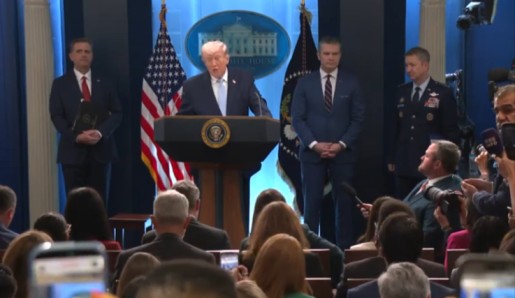
Editor’s Notes: In this press conference, Donald Trump celebrates the successful rescue of two American F-15 crew members who were downed behind enemy lines in Iran during “Operation Epic Fury”. Joined by CIA Director John Ratcliffe and other military leadership, Trump details the harrowing missions that involved hundreds of aircraft and risky daylight operations to ensure no American was left behind. The President also issues a stern 48-hour ultimatum to the Iranian regime, threatening the total destruction of their infrastructure if a deal—including the reopening of the Strait of Hormuz—is not reached. (April 6, 2026)
TRANSCRIPT:
Opening Remarks: A Historic Easter and a Complex Mission
TRUMP: It’s a great honor to be with you, and happy Easter. We had a great Easter. This is one of our better Easters, I think, in a lot of different ways. I can say militarily, it’s been one of the best.
So good afternoon. We have quite a bit to discuss. We’ll go into pretty good detail. And we have the people that are most involved — we’ll give you exactitude.
And we’re here today to celebrate the success of one of the largest, most complex, most harrowing combat searches — I guess you would call it a search-and-rescue mission — ever attempted by the military. Generally, when planes are knocked down in war, especially when you’re fighting a strong group, an evil group, you can’t really do this. Because you send in 200 men to pick up one, and it’s something that’s usually not attempted as much as you want to attempt. And bad things happen to that one or two.
In this case, we did two, and it might not have been attempted before, but we did. And we got — we had great talent, but we got a little luck, too, I would say. And we were helped by a lot of people, a lot of great people. And it was an honor to be involved with it. It’s very historic. This is a rescue that’s very historic. It’ll go down in the books.
The F-15 Goes Down: Operation Epic Fury
Late Thursday night, an American F-15 fighter jet went down deep inside enemy territory in Iran while participating in Operation Epic Fury, where we’re doing unbelievably well — well at a level that nobody has ever seen before. The entire country could be taken out in one night, and that night might be tomorrow night.
Both members of the crew ejected from the aircraft and landed alive on Iranian soil. I immediately was asked to make a decision. I ordered the U.S. Armed Forces to do whatever was necessary to bring our brave warriors back home. A risky decision, because we could have ended up with 100 dead as opposed to one or two. It’s a hard decision to make. But in the United States military, we leave no American behind. We don’t do it.
The Rescue Operation: 21 Aircraft Into Hostile Airspace
Within hours, our armed forces deployed 21 military aircraft into hostile airspace, many flying at very low altitude, being shot by bullets. You bring rifles into play when you’re going that low, but there are also certain advantages. We’ve been in broad daylight over Iran for seven hours at times, facing very, very heavy enemy fire.
We have a helicopter that’s got a lot of bullets in it. It’s amazing. We just realized how good those weapons are, those machines are. Nobody has the equipment that we have, and nobody has the military that we have. Not even close. We’re the most powerful military anywhere in the world, by far.
The flight crews and warfighters aboard those aircraft took extraordinary risks to rescue their fellow servicemembers. This first wave of search-and-rescue forces successfully located the pilot of the F-15, and he was extracted from enemy territory by an HH-60 Jolly Green II helicopter — a fabulous machine — as our warriors faced gunfire at very close range. It’s amazing that, when you look at the machinery, what happened, that nobody was even injured.
The Second Crew Member: Stranded and Surrounded
Meanwhile, the second crew member, a Weapons Systems Officer, a highly respected colonel, had landed a significant distance away from the pilot. When you’re going at those speeds, even if you go out two or three seconds later, it’s miles — it’s miles and miles away, because you’re going fast.
He was injured quite badly and stranded in an area teeming with terrorists from the Islamic Revolutionary Guard Corps — a rough group — as well as besieged militia and local authorities. Many — on top of everything else, they told the communities — actually, within Iran, the people of Iran — they were given a tremendous incentive to find this pilot.
The Rescue Operation Begins
TRUMP: Despite the peril, the officer followed his training and climbed into the treacherous mountain terrain and started climbing toward a higher altitude, something they were trained to do in order to evade capture. They want to always go as far away from the site of the shootdown. You want to go as far away because they all head right to that site. You want to be as far away as you can.
And he was injured, and he was an amazing, amazing thing. He scaled cliff faces, bleeding rather profusely, treated his own wounds, and contacted American forces to transmit his location. They have a very sophisticated beeper-type apparatus that is on them at all times. And when they go out on these missions, they make sure they have lots of battery space and they’re in good shape. And this one worked really well — amazingly, saved his life.
Mobilizing a Massive Rescue Mission
We immediately mobilized a massive operation to retrieve him from the mountain holdout. And he kept going higher and higher. The mountain kept getting rougher and rougher and really very, very hard to find.
The second rescue mission involved 155 aircraft, including four bombers, 64 fighters, 48 refueling tankers, 13 rescue aircraft, and more.
So we wanted them to look in different areas. So we were scattered all over like we were right on top of them. We had seven different locations where they thought. And they were very confused. They said, “Well, wait a minute. They’ve got groups here. They’ve got groups there.”
It’s an amazing thing. I was listening to these great people, these great generals. General Raisin Cane was amazing, and Pete Hegseth was amazing. But I listened to the whole thing. It was pretty amazing.
So they had all these different sites where everybody thought he was located. “We think we have them over there because they have nine planes circling a little area that’s 25 miles down the coast.”
The Rescue: Skill, Precision, and Force
So in a breathtaking show of skill and precision, lethality, and force, America’s military descended on the area — the real area — engaged the enemy, rescued the stranded officer, destroyed all threats, and exited Iranian territory while taking no casualties of any kind.
The heroic F-15 weapons system officer had evaded capture on the ground in Iran for almost 48 hours. That’s a long time when you’re in tough shape and when you’re bleeding. It’s a long time.
The Exit: Sand, Weight, and Contingency Plans
When we left, as you probably know, we had two large planes — old, pretty old planes. They carried a lot. We needed a lot more equipment going in than coming out, obviously, because going in, we needed to be able to scale mountains. And we had a lot of equipment.
But the sand was — it was sandy, wet sand. So we thought there may be a problem taking off because of the weight of the plane. And then we also had all the men jumping back onto the planes, and they got pretty well bogged down.
And we had a contingency plan, which was unbelievable, where lighter, faster aircraft came in, and they took them out. We blew up the old planes — blew them up to smithereens — because we had equipment on the planes that, frankly, we’d like to take, but I don’t think it was worthwhile spending another four hours there taking it off.
So we didn’t want anybody to have — we have the best equipment anywhere in the world. We didn’t want anybody examining our anti-aircraft and other equipment. So these were large planes that were old, pretty old, and we blew them up. And we had faster, lighter planes come in, and they were able to land on the sand.
We needed the bigger planes because we had so much equipment that we needed. We took three helicopters over there, which were very strongly used and couldn’t have lived without them. They performed unbelievably well.
The Helicopter Contingency
**TRUMP:** And if you’d see it, you wouldn’t believe it. They came off the plane, and these guys had them — the rotors were off. They rebuilt these helicopters in less than 10 minutes. And that was one of the more amazing things. These are helicopters — small, unbelievably powerful, but small — very small, so they can get into certain areas. And they got them off the plane and they rebuilt all three of them in a matter of less than — I would say less than 10 minutes.
It’s pretty amazing — the genius of these people. Who would think that? You’d think it would take five days to build them. And in some companies, it would take five days, and they wouldn’t do it well. But they served us well.
As Commander-in-Chief, I never forget the extraordinary risk taken by the warriors that we send into battle. And the genius — I mean, think of it. Having a contingency of three planes waiting because we think the sand is so bad that we probably won’t be able to take off. And the planes really got bogged. The sand was — this was not much of a runway. This was a farm, not a runway. It’s a farm, but it did the trick.
But to have a contingency, as opposed to having to wait two days — can you imagine, right in the middle? This was central. This was right — you would call it central casting if you were doing a movie for location. And probably the toughest area of Iran, where we’d be sitting there.
So these planes came in. Those pilots came in so fast and so quick and got out of there. Everybody got aboard and just got 15-minute intervals. One load, out. One load, out. One load, out. The three — it happened.
And we were watching, and we said, “That’s amazing.” In many ways, I was almost more impressed by the contingency that we had than the fact that, if we would have had a runway or decent soil. But it was an amazing thing. But we thank God for every single one of them. And the talent — the genius — it’s not even talent, it’s genius. It’s the whole ballgame, every one of them.
The Maduro Operation
If you look at what we did with Maduro, we went into a military compound — a massive compound — with thousands and thousands of soldiers, and within a matter of minutes. And he lived behind iron doors. There were steel doors. Broke them down so quickly. And within almost minutes, he was in the back of these planes. It was a similar group. Incredible. We have incredibly talented people. And if the time comes, we move heaven and earth to bring them home safely. We’re going to bring our people home safely.
Historic Operations
I want to thank every member of the U.S. Armed Forces involved in these historic operations. They really were historic. It’s just not something that’s done. And you’d understand it. Not that they don’t want to do it, but when you’re going into areas — when you look at these helicopters, when you look at the amount of bullets and everything else that they took — when you go into these areas, you don’t come out like we came out.
God was watching us. I’ll tell you. Well, it was the Easter — we were in the Easter territory, I guess. But God was watching us. Amazing. Because when you look at the machinery, they took — they took damage. It tells you — the first thing I said is, “These are unbelievable machines,” how they flew back and not even much of a problem.
The Leak
But these two extraordinary rescues — because it was two. And as you probably know, we didn’t talk about the first one for an hour. And then somebody leaked something, which we’ll hopefully find — that leaker. We’re looking very hard to find that leaker. And talked about there’s somebody missing. They basically said that we have one and there’s somebody missing. Well, they didn’t know there was somebody missing until this leaker gave the information.
The Leak That Endangered the Mission
**TRUMP:** So whoever it was, we think we’ll be able to find it out because we’re going to go to the media company that released it, and we’re going to say, “National Security, give it up or go to jail.” And we know who — and you know who we’re talking about — because some things you can’t do.
Because when they did that, all of a sudden, the entire country of Iran knew that there was a pilot that was somewhere on their land that was fighting for his life. And it also made it much more difficult for the pilots and for the people going in to search for him. All of a sudden, they know that there’s somebody out there. They see all these planes coming in. It became a much more difficult operation because a leaker leaked that we have one, we’ve rescued one, but there’s another one out there that we’re trying to get.
So, actually, the country, Iran, put out a major notice — you all saw it — offering a very big award for anybody that captures the pilot. So, in addition to a hostile — very talented, very good, very evil military, we had millions of people trying to get an award. So, when you add that to it — but we have to find that leaker because that’s a sick person. Probably didn’t realize the extent of how bad it was. I can’t imagine that the person did. But we’re going to find out.
It’s national security. And the person that did the story will go to jail if he doesn’t say. And that doesn’t last long. And I think everybody would understand that they put this mission at great risk. They put that man at great risk, and they put the hundreds of people that went in looking for him because everyone now knows that we’re going in.
10,000 Combat Flights — A Record Unparalleled in Military History
Over the past 37 days, America’s armed forces have carried out more than 10,000 combat flights over Iran — unheard of — striking more than 13,000 targets. The F-15 we lost last week was the first manned aircraft downed by the enemy in this entire operation, with thousands and thousands of flights. He got lucky. It was a lucky hit. You know, eventually, you get lucky. But we got lucky, too, because we got both of them back.
But it’s a record that is unparalleled in the history of military air operations. Nobody has ever seen anything like it. It’s such an honor to be involved with it.
Waiting for the Rescue Planes to Land
We were up late at night, and then we were waiting for those contingent planes to come in. And we said, “Come on, let’s go get in,” because they’re waiting out on this farm without a runway with wet, crummy soil, sand — mostly sand, wet sand — and it eats planes alive.
And we’re waiting, and we’re saying, “I hope that one can land and take off.” And they came in like magic. Boom, boom, boom. One after another. It was like genius. I’m so impressed by that. Because we were a little concerned. We said, “Boy, if they don’t get in and get up fast, we’re sitting in the middle.” And that’s called Iran Prime. Right, General? That’s where the whole bet is. And here we are sitting there waiting for a plane.
But they came in so fast and so hard. And these guys knew exactly what to do. “Let’s go. Come on. Get in. Let’s go.” They came one right after another. Not at the same time. They don’t want to come at the same time. They had to come right after each other. They didn’t have any room. There was barely any room to land. Tiny little patch of very wet earth and sand.
So, I just — I’m so proud of the people that I have standing up here with me, and many others that worked. I mean, so many. Steve Witkoff’s over here. He’s doing fantastically. Jared Kushner. But the people that are here, the job they did is amazing.
And I think I’m going to introduce — the head of the CIA — and he is a man who — he’s central casting, okay? If we cast a movie, he’s going to play the head of the CIA. He’s one of the few. John Ratcliffe. He did a phenomenal job that night. He did something that — I don’t know if you want to talk about it. If you want, you can. I’m not sure you’re supposed to. I’m not going to talk about it.
But he really — the CIA was very responsible for finding this little speck. It’s like — they used an expression on one of the shows the general was talking about. It’s like finding a needle in a haystack, finding this pilot. And the CIA was unbelievable. And you may — if you can, you’ll talk. It might be classified, in which case I’d have to put him in jail if he talks about it. And I don’t want to put him in jail. He doesn’t deserve that. So, John, do you want to say a few words? Thank you.
John Ratcliffe Addresses the Press
JOHN RATCLIFFE: Thank you, Mr. President. It’s a privilege to be here with you today to share what we can about this exceptional mission and to recognize the ingenuity and bravery of those who executed it, as well as the leadership and resolve of the President who ordered it.
One thing that has been clear to me in this role is that the flawless military operations that the Department of War is known for are hostage to flawless intelligence. We saw that in the skies over Iran in Operation Midnight Hammer last summer. We witnessed it in Venezuela during Operation Absolute Resolve. We’ve seen it against the cartels in the Western Hemisphere, and we’re seeing it every day in Operation Epic Fury, including this mission to rescue an aviator buried deep behind enemy lines.
A No-Fail Mission
Because it is the unique tradition of the U.S. Armed Forces that we leave no man or woman behind, this was a no-fail mission. That was the spirit in which the President put us to work, and we were determined not to let him down or our airmen down.
As an agency, the CIA possesses unique capabilities that only the President can deploy. Some of these capabilities fall under covert action authorities, and because covert means exactly that, I’m not going to be able to tell you everything that you want to know.
At the President’s direction, we deployed both human assets and exquisite technologies that no other intelligence service in the world possesses to a daunting challenge comparable to hunting for a single grain of sand in the middle of a desert.
A Race Against the Clock
This was also a race against the clock, as it was critical that we locate the downed aviator as quickly as possible, while at the same time keeping our enemies misdirected. For that reason, in addition to the human and technical assets deployed by the President to find our airmen, CIA executed a deception campaign to confuse the Iranians who were desperately hunting for our airmen.
On Saturday morning, we achieved our primary objective by finding and providing confirmation that one of America’s best and bravest was alive and concealed in a mountain crevice, still invisible to the enemy but not to the CIA. That confirmation was relayed by Secretary Hegseth to the President, and the operation quickly moved to the execution phase.
Iran Left Embarrassed and Humiliated
Following the successful exfiltration on Saturday night, our intelligence reflects that the Iranians were embarrassed and ultimately humiliated by the success of this audacious rescue mission.
When the President asked me to lead the CIA, he made it clear: get back to basics, no politics, no agendas, tackle the hardest problems, and execute the toughest missions. This President is about results, and now that’s what his CIA is about, too.
The professionals at the agency and at the Department of War deserve immense credit for their flawless execution during this daring mission.
Their skill, creativity, and courage are unmatched on the battlefield wherever they step, but none of that matters, and all of that is wasted without a President with the political courage to put them into action. Mr. President, I’ve had the privilege of seeing you act with political courage in the best interest of the United States up close on a daily basis, and I’m grateful that this successful mission has given the American people a window into that as well.
The Secretary and Chairman will tell you that our service members’ confidence is boosted by a Commander-in-Chief who has their back the same way they have yours, and I know that the confidence of CIA officers is boosted by the knowledge that their work is informing a President who is not afraid to make the hardest decisions when the stakes are highest.
And to the American people, your confidence should be boosted by knowing that the security of the nation is in the hands of a President who is willing to take on problems that have confounded both sides of the political aisle for nearly half a century. It is an honor to serve under a leader who just proved that you can believe him when he says, no matter what, we will leave no one behind. We will come for you. Thank you.
Ambassador Roos Addresses the Press Conference
SECRETARY PETE HEGSETH: Well, John, thank you for the collaboration of the CIA as well. Incredible and ongoing partnership. Ladies and gentlemen, fellow Americans, and especially the brave warriors in our armed forces, over this Easter weekend, the United States military has once again proved why we possess the greatest fighting force the world has ever known.
In two extraordinary combat search and rescue operations deep inside enemy territory in Iran, our warriors executed missions of breathtaking skill, courage, and precision. When our warriors are unleashed as this President has allowed them to be, they are unstoppable.
Deep Inside Enemy Territory: The Rescue Operations
When American airmen were down behind enemy lines, our forces and our President did not hesitate. Special operators supported by elite air crews and intelligence professionals moved swiftly and decisively into treacherous mountain terrain under the constant threat of Iranian forces closing in. Ultimately, it was an impotent Iranian threat. And today, as the CIA Director mentioned, Iran’s military, and we know this, is embarrassed and humiliated, and they should be.
Now, these are not routine operations. They were high-risk, high-stakes missions conducted in the heart of enemy territory. This was not just barely into Iran. This was deep into Iran, involving coordinated strikes to suppress threats, deception tactics to protect our teams, and full synchronization across air, ground, and special operations. The Iranians are still asking themselves right now, how did the Americans do this?
“God Is Good”: The Story of the Downed Airman
One downed airman evaded capture for more than a day, scaling rugged ridges while hunted by the enemy. When he was finally able to activate his emergency transponder, his first message was simple, and it was powerful. He sent a message: “God is good.”
In that moment of isolation and danger, his faith and fighting spirit shone through. You see, shot down on a Friday — Good Friday — hidden in a cave, a crevice, all of Saturday, and rescued on Sunday. Flown out of Iran as the sun was rising on Easter Sunday. A pilot reborn, all home and accounted for, a nation rejoicing. God is good.
No American Lives Lost: A Testament to Training and Grit
Despite incoming fire and unforgiving conditions, our troops brought every American home. No American lives were lost. We leave no man behind, and that is not luck. It’s the result of unmatched training, superior technology, an unbreakable warrior ethos, and sheer American grit.
Our special operators, pilots, and support crews performed with near perfection under fire, and they were lethal. Just ask any Iranian soldier who dared attempt to get anywhere near that pilot before or during that mission. Death from above. Our troops turned a potential tragedy into a resounding demonstration of American resolve and capability. That’s what excellence in uniform looks like.
But make no mistake about it, none of this would have been possible without the courageous leadership and ironclad determination of President Donald J. Trump.
No One Left Behind
**SECRETARY PETE HEGSETH:** From the moment our airmen went down, President Trump made it clear we will leave no one behind. The first mission, the first of two, was an audacious daylight thunder run, right up the middle. It was authorized in less than two hours from that pilot going down when we knew where he was.
And it was authorized in the middle of the night, because anybody that’s worked for this man knows he’s up in the middle of the night. Authorized immediately, without hesitation, audaciously.
The second mission, as soon as we knew where that pilot was — and John was certainly helpful in that — also executed immediately.
You know, I looked up at my screen when the final mission was complete inside our SCIF, our secure facility. And we have a running VTC, a running coordination cell. And the top of it read 45 hours and 56 minutes. For 45 hours and 56 minutes, we held that call open for coordination.
From the moment our pilots went down, our mission was unblinking. The call never dropped, the meeting never stopped, the planning never ceased.
The President’s Resolve
The President demanded rapid, decisive action. He backed our military with the full weight of his resolve, refusing to let enemy propaganda or tactical setbacks deter us. His leadership ensured that every lethal and non-lethal resource was brought to bear, that our forces had the authorities and the support they needed to succeed.
When the President says he has the backs of our warfighters, he means it. And it means a great deal, and it’s a big difference on the battlefield.
President Trump understands that “peace through strength” is not a slogan. It is a doctrine that saves American lives. His unwavering commitment to rebuilding our military and restoring the warrior spirit has paid dividends in missions just like this one. Under his command, America projects power with confidence and brings our people home with victory.
A Warning to Iran
And that continues today, by the way. Per the President’s direction, today will be the largest volume of strikes since day one of this operation. Tomorrow, even more than today. And then Iran has a choice. Choose wisely, because this President does not play around. You can ask Soleimani, you can ask Maduro, you can ask Khamenei.
A Nation in Awe
To those heroes who planned and executed these rescues, your nation stands in awe. I stand in awe. The Chairman stands in awe. We all stand in awe of your professionalism and bravery. We serve for you. You embody the very best of America.
To the rescued airmen and their families, welcome home. Your courage and endurance, the quiet declaration of faith amid the storm, inspires us all. God is good every day.
And to our adversaries watching from Tehran, let this be a clear message. The United States military will go anywhere, at any time, to protect our own and complete the mission. We execute with precision. We control the sky.
You see, we flew for seven hours in daylight over Iran to get the first pilot. And we flew seven hours in the middle of the night to get the second. And Iran did nothing about it.
We fight with honor. And under President Trump’s leadership, we win. So God bless our troops. God bless President Trump. And God bless the United States of America. Thank you.
Chairman’s Briefing
**UNIDENTIFIED SPEAKER:** Well, good afternoon, everyone. Thank you, Mr. President. Thank you, Mr. Secretary. I know before I start, I know many of you want specific details in these briefings. We will share what we can, but I will retain what I must in the event that we have to go do this again sometime. And I cannot stress the importance, as the President said, around operational security.
The Secretary and I will do a more detailed briefing tomorrow morning, and we look forward to sharing the details that we can.
The Recovery Event: DUDE-44
On Thursday, 2 April, at 10:10 p.m. Eastern Time — 4:40 in the morning local Iran time — the Joint Personnel Recovery Center, which handles the Central Command area of responsibility, declared an isolated personnel recovery event for a U.S. Air Force F-15E Strike Eagle, call sign DUDE-44, which was down in hostile Iranian territory.
The Rescue Operation Begins
SPEAKER: The pilot and weapons system officer had both safely ejected and were isolated behind enemy lines. Following confirmation of active rescue beacons and on the direction of the Secretary and by order of the President, a rescue operation was launched with the stated purpose of bringing both Americans home safely.
As the Secretary said several hours later on the morning after positively locating the front seater, call sign DUDE-44-ALPHA, and aware of an aggressive ongoing search by the enemy, a U.S. Central Command plan was approved by the Secretary and the President.
Shortly thereafter, a U.S. Air Force Combat Search and Rescue Task Force, comprised of A-10 Warthogs in their Sandy role — and I’ll describe what that is in a minute — HC-130 Combat King IIs, HH-60 Jolly Green II helicopters, and Air Force Special Warfare Airmen, a package comprised of combat rescue officers and para-rescue operators, audaciously penetrated enemy territory in broad daylight to find, fix, and recover DUDE-44-ALPHA from behind enemy lines.
This was an incredibly dangerous mission, an incredibly dangerous undertaking, but a fulfilled promise made to every American warfighter that you will not be left behind. We will always come find you, and we will always bring you home.
Into Enemy Territory
Over the next hours, the Search and Rescue Task Force crossed the beach, entered Iranian airspace, protected by a fighter strike package, and moved into the objective area, all under fire. En route, as some of you have seen on social media, the helicopters took gas off the C-130s and pressed onward and forward up into the objective area.
While this was ongoing and out in front of them, the Sandy flight of A-10s and other remotely piloted aircraft, drones, and other tactical aircraft were violently suppressing and engaging the enemy in a close-in gunfight to keep them away from the front seater and allow the pickup force to get into the objective area.
During this engagement, one of the Sandy aircraft — the one primarily responsible for communicating with the downed pilot — was hit by enemy fire. This pilot continued to fight, continued the mission, and then, upon exit, flew his aircraft into another country and determined that the airplane was not landable. This was one of our A-10 Sandy aircraft. The pilot then made the decision to eject over friendly territory and was quickly and safely recovered and is doing fine.
Under Heavy Fire
After picking up DUDE-44-ALPHA, the HH-60 Jolly Green flight was engaged by every single person in Iran who had a small arms weapon. And one of the aircraft, the trailing aircraft, took several hits. The crew sustained minor injuries and they are going to be fine.
What a Sandy Does
A note for those of you that do not know what a Sandy does. Named after the flight call sign that did this very mission in Vietnam flying A-1 Sky Raiders and A-7 Corsairs, a Sandy has one mission: get to the survivor, bring the rescue force forward, and put themselves between that survivor on the ground and the enemy. They are committed to this. This is what they live for and this is what they’ve trained for over many, many years.
The A-10 force and the rescue force did a fantastic job rescuing DUDE-44-ALPHA. He was recovered Friday afternoon. As I said, and the nation needs to know this, this was an incredibly brave and courageous mission and a testament to the courage, skill, and tenacity of the joint force and our leaders. And especially a daylight option — having the guts to try means so much to so many.
The Search for the Backseater
Meanwhile, the backseater, as the President and the Secretary have said, had continued to work and survive. Through the hours of daylight, DUDE-44-BRAVO, the backseater, evaded. Using every means available, the efforts of the United States military, the Central Intelligence Agency, and others were attempting to find and locate with precision DUDE-44-BRAVO, the backseater.
A note on the backseater and the front seater. The single most important contributor to a successful rescue operation is the spirit of attack inside the heart of that downed aviator. Their will to survive, their will to evade, their will to recover is everything.
In this case, the backseater’s absolute commitment to surviving made much of our efforts possible. On Saturday, 4 April, after establishing positive communications with the backseater, we learned, as the President said, that he was injured and actively evading enemy forces. And thanks to our interagency partners, we were able to get eyes on his location and positively ID him.
Throughout this entire time, the enemy force continued to search for 4-4 Bravo, and the joint force continued to strike them over and over and over again. Fighting off marginal weather in Iran and the enemy’s search, for a second time on Saturday, at the recommendation of the CENTCOM commander and at the approval of the Secretary and the President, we launched a rescue task force to recover Dude 4-4 Bravo.
The Second Rescue Mission
Again, this came to the President and the Secretary for approval, this time with a much larger force package based on the time that the enemy had to prepare to find 4-4 Bravo. Again, this force was protected by A-10 Warthogs using the Sandy call sign. And this force had one single mission — do everything they can to bring an American home.
This meant having a plan, being prepared to execute that plan, and more importantly, being prepared for multiple simultaneous contingencies. And because of this force’s professionalism, grit, and determination — fighting off two enemies at the same time, the enemy searching for 4-4 Bravo and contingencies, which anyone who has done these types of missions knows we run into every single time — the force fought off both of those enemies incredibly well.
During the period of darkness on Saturday, and as the Secretary said, into Easter Sunday and into the daylight, the force fought its way in and rescued Dude 4-4 Bravo. They were protected overhead by an air armada, including tactical drones, strike aircraft, and others. The force fought through multiple simultaneous contingencies, something no other nation, no other military can do, and safely returned Dude 4-4 Bravo, the backseater home, and all other Americans home as well.
Mission Accomplished: Easter Sunday
At midnight, 12 local Eastern time, Easter Sunday, more than 50 hours after the start of this operation, the Joint Personnel Recovery Center declared Dude 4-4 Bravo — both the front and backseater — returned to friendly territory.
The courage demonstrated by both the pilot and the weapons system officer while isolated and evading the enemy cannot be overstated. Their grit and warfighting tenacity is a direct result of the absolute trust they have in our rescue forces, their training, and their will to survive and return. They always knew that we would be ordered to go get them, and they always knew that we would be coming to get them.
A Nation’s Sacred Obligation
These two operations reflect our nation’s most sacred obligation to our military service members. We leave no one behind. It also perfectly captures the first truth of our special operations forces — that people are more important than hardware. That is the standard we live by, and the rescue forces that execute these missions operate under a clear motto: “These things we do that others may live.”
Their actions were a direct embodiment of that commitment to others, and I could not be more proud of each and every one of them today. As the Secretary said to our enemies, this operation serves as a clear reminder of the capability and will of America’s Joint Force. The United States of America will recover our warfighters anywhere in the world, under any conditions, when we want to. We will always bring overwhelming skill and firepower.
To every member of the Joint Force, our interagency partners, the leadership at CENTCOM, and our leaders at the Department and above, thank you. I’m proud of each and every one of you, and thankful to our deployed forces and their families. And lastly, and most importantly, to Dude 4-4 — welcome home. Job well done. Thank you.
TRUMP: Pretty amazing. Pretty amazing. And these two gentlemen have been, from day one, they’ve been perfect.
I got to know General Caine in my first term because he was able to take out ISIS in four weeks instead of the four-year projection that was given to me by other much lesser generals. And I said, you know, if I ever do this again, that’s going to be the head of my Joint Chiefs of Staff. And we worked it that way, didn’t we?
And he’s amazing. He took out ISIS. We defeated ISIS in four weeks. I was told it would take four years. I flew to Iraq to find out, with the greatest equipment in the world, why would it take four years. And he told me, “Sir, it won’t. It’ll take four weeks and you’ll have time left over.” And that’s exactly what happened. So he’s great.
## Pete Hegseth and the Pentagon
And Pete, all I can say is that he was treated very unfairly. And now those same people that treated him unfairly, that fought against him, they call me up saying, “What a great choice he was.” They say, “Well, what happened during his nomination? What happened to you?” I’m telling you, people that were not forum senators, friends of mine, said, “Sir, I don’t think you’re doing the right thing.” Now they’re calling me up. “What a choice.” These two guys are fantastic.
And John Ratcliffe was incredible. It was actually their genius that called us from — he was 40 miles away. And he said, “You know, we’re seeing something moving up in the mountain.” It was at night. And they kept the camera on him for 45 minutes. He wasn’t moving. And they said, “You know, probably wrong, but we’re seeing something moving.”
This is a vast mountain, vast, thick, with bushes, trees. He said, “We see something moving 40 miles away.” It was the head of a human being, I’m telling you. It’s moving. And then, all of a sudden, 45 minutes later, he moved a lot, stood up, and they said, “We have him.” And that was really the beginning of something incredible. We had an idea where he was, but not specifically. That’s a big mountain.
So I want to thank the CIA, too. I don’t think they get enough credit for the great job they’ve done.
## Questions From the Press
REPORTER: Thank you very much, Mr. President, for this great opportunity. Your country has a super army. You make a difference, Mr. President. Thank you for your greatest leadership. I have two quick questions, Mr. President. What was your reaction when you learned that the Kurdistan region had resumed exporting oil to the international market with your support as the United States of America?
TRUMP: Well, I expected that. We’ve gotten along with the Kurds for a long time, so I expected that.
REPORTER: Another question — what would be your reaction if the Iranian people rose up against their regime during a ceasefire, Mr. President?
## On the Iranian People and Regime Change
TRUMP: Well, they should do it, but again, the consequences are great. I mean, they were told, “If you protest, you will be shot immediately.” You saw what happened to the young wrestler. He was a great champion, by the way. He was a great wrestler, one of the top in the world. And he and his two friends were hung. And all they did was say a little bit about liberty. They wanted liberty, and they were violently executed.
But the number is up to probably 45,000 people were killed. So, you know, when somebody stays in a house, when they know if they walk out of the house to protest, they’ll be immediately shot and killed — and they issued that. You know, that was publicly issued. It’s not a secret.
That’s why so many people say, “Oh, well, why are you doing this this way?” We can’t let Iran have a nuclear weapon. You know, we got regime change. We do. We’re dealing with a much different regime than before. We’re dealing with different people. They’re smarter. I think they’re sharper and far less radical. We have regime change, but we didn’t do this for regime change. We did it for the fact — and my view is very simple. I saw somebody said, “Oh, he doesn’t have a plan.”
Trump on Military Strategy and Intelligence
**TRUMP:** I have the best plan of all, but I’m not going to tell you what my plan is. You know, they want me to say, “Here’s my plan. We’re going to attack at 9:47 in the morning, and then we’re going to do this.” And if you don’t do that, they say, “I have a plan.” These people know what the plan is. Everybody here knows what the plan is.
But it’s very unfair to say — you know, because I don’t mind being insulted. I’ve been insulted for many years by the fake news. But you can’t — it’s so bad for the people. You just saw two great — and John Ratcliffe — three unbelievable people. They have a plan. Every single thing has been thought out by all of us. But I can’t reveal the plan to the media. But we’re just thrilled by the success of this operation.
Yes, please.
The Iranian People and Their Desire for Freedom
**THE PRESS:** Thank you, Mr. President. You’ve said Iranians would be mad if you stopped these attacks. But why would they want you to blow up their infrastructure, to cut off their power? Wouldn’t that be punishing Iranians for the actions of the regime?
**TRUMP:** They would be willing to suffer that in order to have freedom. The Iranians have — and we’ve had numerous intercepts — “Please keep bombing.” Bombs that are dropping near their homes, and they’re saying, “Please keep bombing. Do it.”
And these are people that are living where the bombs are exploding. And when we leave and we’re not hitting those areas, they’re saying, “Please come back, come back, come back.” These are the people. All I can tell you is they want freedom. They have lived in a world that you know nothing about. It’s a violent, horrible world where, if you protest, you are shot.
The Women’s Protests and the Snipers
**TRUMP:** Remember the great women’s protests where they had 400,000, 500,000 women, and they were all enthused, and they were going to protest, and everybody said, “Oh, the regime is going to come to an end.”
And then, all of a sudden — boom, boom — five, six different areas. A woman would go down right between the eyes. They had snipers. They had five snipers. That’s all it took. And those 400 or 500,000 women said, “Oh, my God, what’s that? Oh, look over there, what’s that?” A woman shot right between the eyes. And after five or six of them go down, then you start hearing the murmur through the vast number of people. And then they said, “Oh, my God, who would do that?”
And they’re incredible people, but they’ve lived so horribly. They’ve lived so horribly.
Trump on the Persian People
**TRUMP:** You know, Iran was a great country, if you go back 25 years ago or so. The Persian people — they’re incredible, smart, brilliant, actually. And I know so many. Coming from New York originally, I know so many people from Iran. They’re incredible people, incredible energy, and very, very brilliant people.
But when you’re standing in a group and protesting, and you have a woman — in the case of the women, remember the Great Women’s March. Everybody was like, “Oh, this is the end of the country.”
And then snipers selectively picked. Every single one was shot right between the eyes, from a long distance. They were on top of buildings. Nobody even knew where they were, where they were coming from. This wasn’t like a machine gun, which is also very bad. They’ve done that too. They did that recently.
This was snipers sitting on the top of buildings, aiming and hitting women. And when they see people go down, all of a sudden there’s a riot in the reverse direction. And they never came out again.
And a lot of the news doesn’t talk about that. They talk about, “Oh, women’s rights.” You want to see women’s rights? You’re not going to see it there.
On Protesters and the Reality in Iran
**TRUMP:** It’s amazing when I see some of the stupid people like, you know, AOC plus three, all that group. They talk about, “Oh, freedom for Iran.” They don’t tell you the real facts. Women, men, gays. How about gays for Iran? They kill the gays. They throw them off buildings.
So I wonder what’s going on. I can only say this — they want us to keep bombing, even if it jeopardized, because their life is in much greater danger. They want freedom for Iran, but it’s very hard for them to protest. I actually tell them, I said, “Don’t go out.” I fully understand. Nobody in this room would go out.
I don’t think there’s anything — because, frankly, it’s not a question of bravery. We’re all brave, right? You’re brave. I’m brave. But we’re also intelligent. If you have people shooting at you, expert shots, with the best rifles you can get, hitting you right between the eyes every single time, and you’re looking here and you’re seeing and you’re looking here — you’re out of there. I don’t care who. We’re going to play it.
Questions on the Weekend Operation
**MARK MEREDITH:** Mark Meredith, Fox News. America’s watching — no joke. Can we go back to the weekend? First off, was everyone on board with the operation? Or were there people that were trying to talk you out of going through with the operation this weekend?
**TRUMP:** Not everybody was on board.
**MARK MEREDITH:** Somebody else within the —
**TRUMP:** No, there were military people, very professional, that preferred not doing it. These two were totally on board, which was very important. They were, and it would have had a little difficulty. But no, there were military people that said, “You just don’t do this. You don’t go into the heart of a very powerful military.”
You know, this is — hey, you have countries and countries. You have some countries where military is not their strong suit. This whole thing is militarized like nobody has ever seen before. Half the people are wearing uniforms.
And we had people within the military — usually it’s not done. That’s one of the reasons. You know, I was surprised. Somebody said it’s the only time it’s ever been done. I said, “That’s not possible.” But it is possible, because you’re going into hundreds of thousands of soldiers along the path. I mean, look at some of the helicopters, how they got hit.
Hundreds Were Sent on This Mission
So yeah, there were people within the military that said it’s not wise. And don’t forget — how many men did you send altogether, approximately, for the operation?
**THE PRESS:** I’d love to keep that a secret, Mr. President.
**TRUMP:** Okay, well — I’ll keep it a secret. But it was hundreds. And hundreds of these people — that’s pretty good. Is he central casting? But hundreds of people went into this journey. Hundreds of people could have been killed. Forget about the equipment — a lot of equipment. Nobody cares. Hundreds of people could have been killed.
So we had people within the military that said, “This is not wise.” And I understood that, but I decided to do it.
Was There Ever a Moment to Abort?
**THE PRESS:** Was there a point that you were thinking there’s too much on the line, and somebody was saying, “Maybe we abort this now and wait”? I mean, given the resources — like the General said, it seemed like there was so much on the line here. You must have been thinking this could have completely changed the next three years.
**TRUMP:** So the first one, which was in many ways as dangerous as the second — I guess it gets, because we’re flying over in daylight. You know, we’re the best in the world at night. We have goggles that nobody — we have goggles. I’ve tried them. They’re unbelievable. I see better with the goggles at night than I see without them during daylight.
I mean, daylight today — we have a beautiful day. You see just as well with goggles. In many ways, it’s enhanced.
So we have the best of the world. So it’s much safer for us to — for us to do it at night, whereas other people — no other country has that capability. They don’t have the — they don’t have that particular piece of equipment like we do.
But when I was told, flying — and in daylight, I think we flew seven hours over Iran — and that’s a long time — over unbelievably hostile territory, where they have nothing but weapons. We took out their anti-aircraft, which is great. We took out their radar, which is great. We took out a lot.
But they still have — you know, what hit this one was a shoulder — handheld shoulder missile, heat-seeking missile. So it’s not like, you know, they’re totally whatever. But — and they had probably a little luck, because you got to get lucky. But they shot it, and it got sucked in right by the engine. But these guys were out of there. They were great. Their timing was great.
A Dangerous But Worthwhile Mission
But, no, I was told that this is a very dangerous mission. I understand. They didn’t say it’s a foolish mission. They said, you know, we’re going to be sacrificing hundreds of people to do this. This is — I mean, you have tankers that are flying over this area so that they — because the flight was so long, they had to refuel. It’s a very dangerous mission. I just felt it was worth it.
If you would have told me that we would have been successful, gotten both, and nobody was even, essentially, injured, I would have said that would be impossible.
TRUMP: Yeah, please.
Questions on Iran’s New Leadership and Human Rights
REPORTER: Mr. President, thank you very much. Thank you, sir. We’ll come back to you. Okay, thank you. Given that you are now dealing, you say, with a more reasonable, less extreme leadership in Iran, what does that mean for the protesters, for the human rights movement in that country after this conflict? What’s your expectation?
TRUMP: Well, I think it’s positive. Yeah, if they assume control, if we do something and they assume control, I think it’s very positive. A big step. I don’t think you’d see the radicalization that you have seen in the last — look what happened. I mean, women are being executed because they’re not properly clothed, they say. They’re not properly clothed. And they execute the women. They absolutely — they shoot them right on the street.
No, you have a much different group of people. Now, I’m not saying — we are dealing with them. Essentially, they have until 8 o’clock tomorrow night, Eastern Time. But we are dealing with them. I think it’s going well. Mr. Witkoff is here, and J.D.’s involved in the dealing. Mr. Witkoff is sitting right here, and I think it’s going fine. But we’ll have to see.
47 Years of Failure — and a Decapitated Iran
You have to understand, we’ve been dealing with these people for 47 years. I’m standing here with a much more powerful Iran as of a month ago. Not anymore. Right now, they are decapitated. But I’m standing here a month ago with a much more powerful Iran than it was at any point during 47 years. This should have been handled by seven Presidents, a lot of Presidents. And those Presidents are saying now, every one of them, to their friends, We should have done this a long time ago.
So it’s not something I like doing. It’s very dangerous. And we’re getting them at the height of their strength.
Obama’s Iran Nuclear Deal and the Cash Payments
If I didn’t terminate the Barack Hussein Obama Iran nuclear deal, they would have had a — don’t forget, that was a path to a nuclear weapon. Remember this. He chose Iran over Israel, pure and simple.
How Israel can vote for a Democrat is — if you’re Jewish, in New York City or any place else in this country, and how you can vote for a Democrat is unbelievable. Because he chose Iran, a very hostile Iran. Remember when he filled up a 757 with cash? Billions of dollars of cash. And he sent it over to them.
TRUMP: Then they gave him tens of billions of dollars. He chose Iran over Israel and, really, the Arab world, if you look. Because, you know, the other — Saudi Arabia, Qatar, UAE. I mean, you take a look. I mean, I can add Kuwait, and I can add Bahrain, and you can add others. He chose such an unlikely candidate. Nobody could believe it.
Frankly, if you’re going to choose between Iraq and Iran, he should have befriended Iraq. He went in the exact opposite direction of all thinking, and he made a terrible mistake. But that was a road to a nuclear weapon. And when I terminated that, everyone said, “Oh, he terminated it.” It was one of the best things we ever did because he had a road to a nuclear weapon.
On the Iran Nuclear Deal
And it was going to — it was a very short-term deal. You know, countries don’t do 10-year deals. Countries do hundreds of years. You don’t do a 10-year deal. For a country, you need — this isn’t — you’re a landlord, you’re renting a store on a certain street, and you give somebody a five-year or 10-year lease. This is a country. It was a short-term deal. It was ready to expire. I terminated it before it expired. Took a lot of heat, and it was one of the best things I ever did because he would have had a nuclear weapon.
The B-2 Bomber Strike and Iran’s Nuclear Threat
Then he would have had another nuclear weapon, had those beautiful B-2 bombers not gone in eight months ago and obliterated that — and, by the way, the word is obliteration. CNN said, “Well, maybe it wasn’t complete.” It was so complete that they still haven’t been able to get it. It was obliteration.
But if we didn’t hit them — that was a courageous decision, too, because we had all those planes flying in at night with very little cover — unbelievable stealth planes. And they were able to do their job. If we didn’t do that, Iran would have had a nuclear weapon at a high level, either one of those two instances.
And if they did, in my opinion — I told this to Bibi Netanyahu yesterday — Israel would have been extinguished. Large portions of the Middle East would have been extinguished, whether it’s Saudi Arabia, Qatar, UAE, or others. And you saw that with thousands of missiles raining down upon them. They didn’t think they were going to be hit. They thought they’d be watching us fight. And all of a sudden, UAE got hit by 1,500 missiles. He would have taken them out also. And they were powerful.
Terminating the Obama Deal and Eliminating Soleimani
If I didn’t come along and terminate the Obama deal, which was terrible — the Iran nuclear deal was a road to a nuclear weapon, a big one, unlimited. Legally, I terminated it without even much thought. It was so easy. I terminated that and then the B-2 bombers.
And I did one other thing. I had killed Qasem Soleimani, who was an evil genius. And the reason I did it, I heard he was going to knock out five of our military bases. And had he lived, I believe we would be fighting, perhaps, a different Iran right now, because he’s never been replaced, you know?
And I also — I did one other, but this one was not picked up. Osama bin Laden. If you read my book, I said you got to take him out one year before the World Trade Center came down. So I wish you’d read the book. But as a President, to be a good President, I believe you have to have good instincts. And a lot of this is instinct.
Press Question: Europe, the Strait of Hormuz, and the Ceasefire
TRUMP: Yeah, please.
THE PRESS: Thank you so much for taking my question today, Mr. President. Last week, you suggested that Europe should take the lead on reopening the Strait of Hormuz. Has circumstances changed now that you’re issuing a direct 48-hour ultimatum? And secondly, would a new ceasefire include Israel, or would it just be between Iran and the U.S.?
Ceasefire Talks and Kurdish Forces
TRUMP: We can’t talk about ceasefire. But I can tell you that we have an active, willing participant on the other side. They would like to be able to make a deal. I can’t say any more than that.
UNIDENTIFIED SPEAKER: Thank you so much. You’ve listed the goals. Excuse me. Please, go ahead.
UNIDENTIFIED SPEAKER: Thank you, Mr. President.
TRUMP: Who are you with?
REPORTER: My name is Diakhod. I’m with the largest Kurdish media outlet, Houda Media Network. It’s based in Iran.
TRUMP: Go ahead.
REPORTER: Mr. President, you said before that you don’t want the Kurdish forces to enter Iran and be harmed. Do you still want them to stay away, or what role do you expect them to play now?
TRUMP: I’d rather have them stay away. I’d rather have them stay away. I’d rather have them stay away. Because I think they bring with them some problems and some difficulties. And I know they bring death — I mean, you know, to themselves. But I’d rather have them stay away.
War Crimes Allegations and the New York Times
REPORTER: Thank you, Mr. President, for the question. Secret attacks on civilian infrastructure violate the Geneva Conventions and international law.
TRUMP: Who are you with?
REPORTER: I’m with the New York Times.
REPORTER: Are you concerned that your threat to bomb power plants and bridges amounts to war crimes?
TRUMP: No, not at all, no. I hope I don’t have to do it. But, again, I just said, 47 years they’ve been negotiating with these people. They’re great negotiators. And because they’re not going to have a nuclear weapon.
And if somebody that takes my place someday is weak and ineffective — which possibly that will happen, because we had numerous Presidents that were weak, ineffective, and afraid of Iran — we’re never going to let Iran have a nuclear weapon.
And if you think it’s okay for people that are sick of mind, that are tough, smart, and sick — really sick — from a policy standpoint, from any standpoint, any which way you want to say, mentally, these are disturbed people. If you think I’m going to allow them, and powerful and rich, to have a nuclear weapon, you can tell your friends at the New York Times: not going to happen.
Quiet, quiet, quiet, quiet. You no longer have credibility at the New York Times. Because the New York Times said, “Oh, Trump won’t win the election,” and I won in a landslide. I won every swing state. New York Times said, “Oh, Trump won’t win the election.” New York Times has no credibility.
The credibility they have is — it used to be “All the news that’s fit to print.” A great — the old gray lady, it was great. But they’re running on past fumes, and you can’t keep doing that. You have to be able to give the correct news. And people like you, who I know, are fake. You’re fake.
Escalation or Wind-Down: The Deadline Explained
REPORTER: Go ahead, please. Your messaging on the war has moved from “the war is coming to an end” to “we’re going to be bombing Iran to the Stone Ages.” And we’ve heard a range of those kinds of messages. So which is it? Are you winding this down? Are you escalating it?
TRUMP: I can’t tell you. I don’t know. I can’t tell you. It depends what they do. This is a critical period. They have a period of — well, till tomorrow at 8 o’clock. I gave them an extension. They asked for an extension of seven days, right? I said, “Steve, give them 10 days.” Ten days is up, actually, today. So I gave them 11, I guess, indirectly.
I thought it was inappropriate the day after Easter. I want to be a nice person. They have till tomorrow. Now, we’ll see what happens. I can tell you they’re negotiating — we think — in good faith. We’re going to find out.
We’re getting the help of some incredible countries that want this to be ended, because it affects them also. A lot of people are affected by this. But we’re giving them — we’re giving them till tomorrow, 8 o’clock, Eastern Time.
And after that, they’re going to have no bridges. They’re going to have no power plants. Stone Ages, yeah. Stone Ages.
## The Strait of Hormuz: A Complex Priority
THE PRESS: Are you willing to make a deal that does not include reopening the Strait of Hormuz, or is that now a top priority?
THE PRESIDENT: I would say it’s a very big priority because — see, that’s one thing that’s a little different than other things. We can bomb the hell out of them. We can knock them out for a loop. But to close the Strait, all you need is one terrorist that somehow has a truck loaded with — because you can carry them in trucks, large trucks — a water mine, drop them in the water, and now you tell people that own ships that cost a billion dollars to, don’t worry about the mine. You can do that even just by saying, “We put mines in the water.”
So it’s not like the rest. We can knock out their military. We already have. We’ve knocked out their Navy. We’ve knocked out their Air Force. Completely. We’ve knocked out 158 ships in three days. We’ve knocked out even their mine droppers. They don’t have any mine droppers anymore, but they put them on other boats. And they could drop them.
I’m not even sure they have any mines there, by the way. I’m not sure. Personally, they say there might be eight. I don’t know. I don’t know. I think there might be none because they’re very good bullshit artists. That’s why, for 47 years, they’ve been bullshitting other Presidents, and they haven’t done the job. And people are living in hell. You live in that country — they’re living in hell.
## Iran at Its Weakest Point
No, I think that 47 years of this stuff is long enough. They’re at the weakest point they’ve ever been. They have no Navy. They have no Air Force. They have no anti-aircraft weaponry. They have no radar. They have no communication.
In fact, the biggest problem we have in our negotiation is that they can’t communicate. I said to Steve, “What are they saying?” He said, “Sir, they can’t communicate. They have no method of communication.” So we’re communicating like they used to communicate 2,000 years ago — with children bringing a note back and forth. They have no communication.
But all I want to see is I want to have a safe world. And you’re not going to have a safe world. Israel will be gone. The Middle East will be gone. And then they’re coming for Europe.
## Disappointment With NATO
And I have to tell you, I’m very disappointed in NATO. Very. I think that NATO — I think it’s a mark on NATO that will never disappear. Never disappear, in my mind.
You know, they’re coming to see me on Wednesday. They’re going to say, “Oh, we’ll do this, we’ll do that.” Now they all of a sudden want to send things, you know. But they said it loud and clear at the beginning when I spoke to the UK, of all countries. I would have said they would have been the first because they’ve been — they’re the oldest.
And I say, “Yeah, I’d love to have a little help.” He said, “No, sir, we’d rather wait till you win.” I said, “I don’t need help after we win.” They have two old, broken aircraft carriers. Barely work. I said, “I guess we can use them. Who the hell knows?” I called the general. He didn’t even want to — he said, “We don’t really need them. We’ve got the USS Abraham Lincoln, sir. We don’t need them.”
## 101 Missiles and American Technology
You know, we have — in terms of technology — we had, one day, 101 missiles going at 2,700 miles an hour, aimed at the Abraham Lincoln. 101 missiles. Out of 101 missiles, 101 missiles were shot down. Unbelievable technology.
Ten years ago, five years ago — I don’t know if that would have been possible. But 10 years ago, that wouldn’t have been possible. 101 missiles heading to a ship that’s not that far off the coast.
And out of the 101 missiles, we shot down all 101. We have weaponry. The Patriots are unbelievable. We have weaponry that’s unbelievable.
Yeah. Go ahead, please. Yes.
THE PRESS: Thank you, Mr. President. You said earlier today, during the egg roll, that you would like to take Iran’s oil. But Americans want U.S. forces home. What’s that trade-off?
On Taking the Spoils of War
THE PRESIDENT: Correct. Have I had my choice? Have I had my choice? Yeah. Because I’m a businessman first.
With Venezuela — as you know, the war was over in about 45 minutes. And we have great people running Venezuela. Very good people. I mean, the relationship is good. And we are a partner with Venezuela. And we’ve taken hundreds of millions of barrels. Hundreds of millions. Over a hundred million barrels already is in Houston, refined, and out. And paid for that war many, many times over. Many times.
Old days. To the victor go the spoils. And I’ve said, “Why don’t we use it?” To the victor go the spoils. And we don’t have that. We haven’t had that in this country probably in a hundred years, because even the Second World War — you look at the Second World War — we didn’t have it with the Second World War. We helped rebuild all those countries. We rebuilt Germany.
How about Germany telling us — Germany telling us that, “Well, it’s not their war. We had nothing to do with it.” They wanted me to go and tell them everything I was doing. We didn’t know anything about it. Well, if I would have told them, they would have leaked it, and we wouldn’t have been nearly as successful, possibly, right? But to the victor belong the spoils. So we haven’t heard that in, I think, maybe hundreds of years.
On Venezuela and Running for President
Now, with Venezuela — and just so you understand, the people of Venezuela — they say if I ran for President of Venezuela, I’m polling higher than anybody has ever polled in Venezuela. So after I’m finished with this, I can go to Venezuela. I will quickly learn Spanish. It won’t take too long. I’m good at language. And I will go to Venezuela. I’m going to run for President.
But we’re very happy with the President-elect that we have right now, the people that are running it. If you remember Bush with Iraq, they fired the generals, they fired the police, they fired the people that worked in their equivalent of the White House — they fired everybody. And you know what they had? They had a mess. And you know what happened? ISIS formed. Those generals and those soldiers got together. The police got together. They all got together. They formed ISIS. Not going to happen with us.
The Military Operation in Venezuela
So Venezuela has been an incredible situation. We went in. We were very successful. Military power like nobody’s ever seen. The Venezuelan general said — I was on that site — he said, “I’ve never seen ferocity like that. I’ve been doing this for 40 years. I’ve never seen it.”
They hit them from 17 different angles. They were all set. They saw that big, beautiful aircraft carrier — the Ford, in that case. And planes were pouring off it at 1 o’clock in the morning. So typically, when you see that late at night, you know you could be in trouble, right? And they were all ready. They had their equipment. It was Russian. And they had Chinese equipment. It was all set. They were going to give us a fight.
He said, “And then they came. And they came at speeds like we’ve never seen. And they came at 17 different angles.” The general and his people — that was a lot of angles. They hit them from every angle. He said, “We knew it was over in three minutes. We were waiting for them. Their equipment didn’t work.” And there’s a reason it didn’t work. Someday we’ll explain that to people. They pressed the button. Nothing happened. They pressed it again and again.
Nothing happened. And he said, “We knew this whole thing was over in three minutes. We’ve never seen any —” he used the word ferocity. “The ferocity of these planes from 17 different angles.” And it was over. We went inside. And remember, that was on a military base with thousands of soldiers. And those soldiers looked, and they said, “Get the hell out of here.” Thousands. We didn’t have thousands. We had, like, 200 people.
So we have a great military. And I’ll tell you what, somehow this rescue captured the world’s attention, more so than — normally, you’re talking about two people. But this rescue captured the world’s attention.
Maduro, the Border, and a Sealed Southern Frontier
We did it in Venezuela. That was amazing. And now we have a very bad man in prison and going to trial. He released, aside from the drugs — which he was terrible — Maduro released hundreds of thousands of people from jails into our country. Drug dealers, murderers — the worst people in the world were released into our country because we had a stupid President, who probably didn’t know.
And we had a border czar who never went to the border and never once called our great Border Patrol agents, right? Not once. Kamala. She never called the Border Patrol. She never said, “How are we doing?” I used to call the Border Patrol guys every day. You can ask them. Paul, ask any one of them. Brandon, ask them all the time. “How are we doing? How are we doing?”
And we now, I’m proud to say, have a totally sealed border. Nine months, nobody is coming through our border. And nobody even tries, because they know they’re not going to get through. So we don’t have caravans anymore. So maybe one or two more, and we’ll be done.
On Charging Tolls Through the Strait
REPORTER: Mr. President, are you willing to end this conflict with Iran charging tolls for passage through the strait?
TRUMP: Us charging tolls?
REPORTER: Iran. What about US charging tolls? Is that something you’re considering?
TRUMP: I’d rather do that than let them run it. Why shouldn’t we? We’re the winner. We won, okay? They are militarily defeated. The only thing they have is the psychology of, “Oh, we’re going to drop a couple of mines in the water.” All right? No, we — I mean, we have a concept where we’ll charge tolls, okay? I thought you meant us. Your question would have been more accurate if you said us. Go ahead.
Iran’s Deadline — Deal or Open the Strait?
REPORTER: Mr. President, thank you very much. Just to clarify, in order for Iran to successfully meet your deadline tomorrow, do they have to make a deal, open the strait, or both?
TRUMP: We have to have a deal that’s acceptable to me. And part of that deal is going to be we want free traffic of oil and everything else.
On God, Glory, and the Weight of War
REPORTER: Mr. President, thank you very much. You’ve said “Glory be to God” in this conflict. Do you believe that God supports the United States’ actions in this conflict?
TRUMP: I do, because God is good —
UNIDENTIFIED SPEAKER: And have you shown his direction?
TRUMP: Because God is good, and God wants to see people taken care of. God doesn’t like what’s happening. I don’t like what’s happening. Everyone says I enjoy — I don’t enjoy this. These two guys don’t enjoy it. You know, people say, “Oh, boy, they’re so tough.” They don’t like — I don’t like seeing people killed.
Eight Wars Ended — and a Nobel Prize Moment
I’ve ended eight wars. Nobody’s ever done it. The person who won the Nobel Prize came to me and said, “You deserve the Nobel Prize.” She announced that. When they announced it, they said it goes to Maria. She’s a great person, really a good person. She said, “No, no, no, this is ridiculous. They gave me the Nobel Prize. President Trump ended eight wars.”
I could go over every one of them, including India and Pakistan, where the Prime Minister of Pakistan said, “President Trump saved from 30 to 50 million lives.” That makes me much happier than what we’re doing right now.
TRUMP: That makes me much happier. We have one more to end, by the way.
## The “Crazy Bastards” Comment
REPORTER: President, you called — yesterday, in your Truth Social, you called the Iranians “crazy bastards.” True. What is your response to critics who say that
TRUMP: I don’t care about critics.
REPORTER: What is your response to critics who say that it is your mental health that should perhaps be examined as this war continues?
TRUMP: Well, I haven’t heard that. But if that’s the case, you’re going to have to have more people like me, because our country was being ripped off on trade, on everything, for many years, until I came along. So if that’s the case, you’re going to have to have more people.
## Targeting in Iran — What’s Off-Limits?
REPORTER: When you said that very little is off-limits in Iran, as far as targeting, including power plants, bridges — you’ve mentioned those. Very little is off-limits. Are there certain kinds of civilian targets, though, I’m thinking —
TRUMP: I don’t want to tell you that.
REPORTER: — hospitals that you —
TRUMP: I don’t want to tell you that. We have a plan, because of the power of our military, where every bridge in Iran will be decimated by 12 o’clock tomorrow night, where every power plant in Iran will be out of business, burning, exploding, and never to be used again. I mean, complete demolition by 12 o’clock. And it’ll happen over a period of four hours, if we wanted to.
We don’t want that to happen. We may even get involved with helping them rebuild their nation. And you know what? If that’s the case, the last thing we want to do is start with power plants, which are among the most expensive things — and bridges.
## The Bridge Order
TRUMP: You saw the bridge. The bridge went. We were very close to a deal. And then I got a call from Mr. Witkoff, Mr. Kushner, and J.D. saying, “I think they’re breaking the deal.” I said, “Tell them that’s okay. Don’t worry about it. Tell them to look out their window and watch.”
And within 45 minutes, I gave the order to knock out the biggest bridge — I gave the order to knock out the biggest bridge in, I believe, the Middle East, but the biggest bridge in Iran. And within 10 minutes after I gave that order, that bridge was over.
So do I want to do that? No. Do I want to destroy their infrastructure? No. It will take them 100 years to rebuild. Right now, if we left today, it would take them 20 years to rebuild their country, and it would never be as good as it was. And the only way they’re going to be able to rebuild their country is to utilize the genius of the United States of America.
## NATO — A Paper Tiger
REPORTER: In the past, is there a danger to the U.S. not being the de facto leader of the alliance, and then other powers within the alliance getting the decision-making when it comes to wars and nuclear weapons?
TRUMP: No, it’s not a danger. NATO — look, we went to NATO. I didn’t ask very strongly. I just said, “Hey, if you want to help, great.” “No, no, no, we will not help.” I said, “That’s all right. You don’t want to help?” Because I’ve always said NATO’s a paper tiger. See, NATO’s a paper tiger. Putin’s not afraid of NATO. Putin’s afraid of us — very afraid of us. And he’s explained it to me a lot of times. I got to know him very well. I know him very well.
NATO’s a paper tiger. NATO is us. And when we needed them — we didn’t need them, by the way. We didn’t need them, obviously, because they haven’t helped at all. Just the opposite. They’ve actually gone out of their way not to help. They didn’t even want to give us landing strips. Think of it.
And it’s not just NATO. You know who else didn’t help us? South Korea didn’t help us. You know who else didn’t help us? Australia didn’t help us. You know who else didn’t help us? Japan. We’ve got 50,000 soldiers in Japan to protect them from North Korea.
TRUMP: We have 45,000 soldiers in South Korea to protect us from Kim Jong-un, who I get along with very well, as you know. Do you notice? He’s said very nice things about me. He used to call Joe Biden a mentally retarded person, okay? So, don’t tell me about your stuff. Joe Biden — he said he’s a mentally retarded person. He was so nasty to Joe Biden. It was terrible. But to me, he likes Trump.
And do you notice how nice things are with North Korea? It’s very nice. But we have 45,000 people — soldiers — in harm’s way, and right next to Kim Jong-un, with a lot of nuclear weapons — 45,000 — which shouldn’t have ever happened. If a certain President — I’m not going to mention this President because I happen to like him, believe it or not — but if a certain President did his job, Kim Jong-un would not have nuclear weapons right now. But they’re all afraid to do their job properly.
On Allies and NATO
But just to conclude and just to finish — Japan didn’t help us, Australia didn’t help us, South Korea didn’t help us, and then you get to NATO — NATO didn’t help us. There were some countries that did. Now, countries that have been good — and you could also say they’ve got to be a little bit more involved because they’re in the territory. But Saudi Arabia has been excellent. Qatar has been excellent. UAE has been excellent. Bahrain, Kuwait.
I mean, Kuwait did shoot down three of our planes. The only planes, really, that we lost — friendly fire, they call it. I call it unfriendly fire. They unfortunately didn’t know how to use our great Patriots. The pilots said, “What kind of a missile is coming at us?” Patriot. Boom. Because they know a Patriot never misses. So they had beautiful Patriots. There were planes heading in their direction. Unfortunately, they decided to shoot those planes. They were our planes.
On NATO and Greenland
So, you know, NATO is a paper tiger. Now, he’s coming to see me on Wednesday, as you know. He’s a wonderful guy. Secretary General is great. And Mark Rutte — he’s a great person. And, you know, it all began with — if you want to know the truth — Greenland. We want Greenland. They don’t want to give it to us. And I said, “Bye-bye.”
Okay, thank you very much, everybody. Thank you.
Related Posts
- Transcript: President Trump Remarks at Wheeler High School in Marietta, GA
- Transcript: What It’s Really Like Inside Trump’s World w/ Maggie Haberman & Jonathan Swan
- Transcript of Rolling Stone Interview: Zohran Mamdani
- Transcript of Tucker Carlson Interview: The Mishal Husain Show
- Transcript: President Trump Speaks at FIFA Reception in New York City