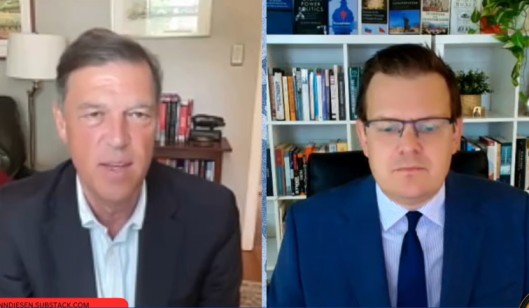
Read the full transcript of former CIA Russia analyst George Beebe’s interview: “Ukraine on the Brink – What Happens Next?” on Greater Eurasia Podcast, August 31, 2026.
EDITOR’S NOTE: In this interview, Professor Glenn Diesen speaks with George Beebe, former CIA Russia analyst and Director of Grand Strategy at the Quincy Institute, about what he calls a grim turning point in the Ukraine war. Beebe argues that Russia’s tightening blockade of Odessa’s ports is landlocking Ukraine, crippling its export economy, and undermining any prospect of a durable postwar recovery. The conversation examines attrition dynamics, Ukraine’s demographic decline, and why Beebe believes a negotiated settlement is now more urgent than ever.
Introduction
GLENN DIESEN (00:00:00 – 00:00:15): Welcome back. Today is the 31st of August, 2026, and we are joined by George Beebe, the former director for Russia analysis at the CIA, now working as the director of grand strategy at the Quincy Institute. Thank you for coming back on the program.
GEORGE BEEBE (00:00:16 – 00:00:17): My pleasure. Thank you.
Russia’s Naval Blockade and Ukraine’s Ports
GLENN DIESEN (00:00:18 – 00:02:01): I read your article about Russia shutting down Ukraine’s ports and de facto landlocking the country. And yeah, I would advise everyone else to read it as well. So I’ve left a link in the description.
But this seems to be part of a wider challenge, it seems. That is, there’s a tendency to go up the escalation ladder against Russia without really, I guess, critically assessing the possible consequences. And what we saw in this 40-day-plus campaign of these deep strikes into Russia, which were aimed to a large extent at targeting civilian infrastructure, including its shipping.
Initially, it was celebrated as a game changer, not just by Ukraine. I saw Marco Rubio also referred to it, and the president of Finland was very open in why this is a good strategy, why we should hit civilian targets inside Russia so the Russian public would put pressure on the Kremlin to end the war. However, we also see that Russia has a lot more air power and Ukraine doesn’t have much air defences. So it seems that some of this should have been predictable, and yet it wasn’t, it seems.
So we now see the Russians attacking pretty much everything and putting this naval blockade on Ukraine. So, I guess I have 2 questions. Why wasn’t this predicted? But also, in your article, you describe Russia landlocking the Odessa ports as potentially a grim turning point. What do you think makes this moment different from the other developments throughout this war?
Why the Warning Signs Were Ignored
GEORGE BEEBE (00:02:03 – 00:10:59): Well, on the predictability of this, yes, it was predictable and it was predicted. The problem is that the mainstream in the West, both here in the United States and in Europe, essentially has turned a blind eye to any development in this war that does not conform to its preferred narrative for what’s going on. And the preferred narrative, of course, is that the Russians are losing, that this is a war that Ukraine will ultimately prevail in.
And so every Ukrainian attack is celebrated and is portrayed as confirmation that this war is going according to that preferred narrative. And Russia’s own activities, its advances on the battlefield, its strategic airstrikes on Ukraine are all either ignored or underplayed. And that means that people that predict what’s going on and warn about where all this could lead are essentially sidelined in the popular discussion.
And that I think will ultimately prove quite tragic because Ukraine is going to be left in really an abysmal condition. And I think people in the West are going to be surprised by how this war ultimately plays out. And that can be dangerous because when you’re confronted with the reality that is so sharply at variance with what you’ve been led to expect, people can react in ways that become quite dangerous. Washington and Europe can kick into what I would call “do-something mode” in order to preclude the situation that has become apparent. And that’s when people make dumb decisions. That’s when things can escalate into direct military confrontations.
So I think this was predictable, it was predicted, but those predictions were largely ignored. And that’s, I think, a big problem.
The “Steel Porcupine” Scenario and Its Collapse
When it comes to this question of the broader implications for Ukraine about what the Russian strategic air campaign is doing to the country, what it really is doing is eliminating the possibility of an outcome that many people in the West believe is both desirable and likely. And that’s what I call the “steel porcupine” scenario.
These are people that say, okay, well maybe Ukraine can’t win the war outright. Maybe it can’t drive all of the Russian military off of all occupied Ukrainian territory, but it can essentially fight Russia to a stalemate. It can arm itself so heavily that Russia will be forever frustrated in its ability to bring this war to a decisive end. It will be sort of the equivalent of Israel in Eastern Europe, a state that is heavily militarized, that punches well above its weight class as a military power, can overcome the size advantages of a large and hostile neighbor, and in turn can be the frontline for Europe in counterbalancing and frustrating Russia’s own geopolitical ambitions, which are allegedly to dominate Europe and perhaps even inflict some sort of military defeat on a NATO ally.
And I think what the Russian strategic air campaign is doing is actually precluding the possibility of that kind of outcome. Russia is making sure that Ukraine is not going to emerge from this war in any condition to become a steel porcupine. It will be a country that has not only lost a fair amount of territory, but also a country that can’t rebuild itself economically, that can’t be reconstructed by outside donors, whose infrastructure is so devastated that it can’t heat itself, it can’t trade, it can’t bring economic goods to market, it can’t meet its own budgetary requirements and is perpetually dependent on European cash flows in order simply to meet its budgetary needs.
That’s not a country that’s going to be a steel porcupine.
That’s going to be a country which is on a track to becoming a failed state. And that will be, I think, a tragedy for the people of Ukraine, but it will also be a tragedy for Europe. Because it will leave Europe in a chronically unstable situation, perpetually prone to new crises and dealing with the repercussions of a Ukraine that can’t effectively govern itself.
Ukraine’s Demographic Crisis
And I think the biggest threat that Ukraine faces over time is a demographic crisis. A country that simply is shrinking at alarming rates, whose birth rate is one of the lowest in the world, a country that is hemorrhaging refugees. And that’s likely to get even worse this winter as Russian attacks on Ukraine’s energy infrastructure intensify. And more and more people simply flee the country just to find warmth during this period.
So if you look at some of the numbers, the last Soviet census in 1989 put the population of the Ukrainian Soviet Republic at just under 52 million people. Well, we’ve had Ukrainian officials in the last few months say in public that they think the population of Ukraine as it now stands is somewhere between 22 and 25 million people. In other words, less than half of what it was when Ukraine gained its independence. And that number is going down at a fairly rapid rate.
That’s a real crisis. You’re not going to sustain a large standing military with a population of that size. And half of the people that are left in the country right now are pensioners, people who are either of retirement age or are crippled by the war and dependent on state outlays. And again, you can’t build a large standing army and become this steel porcupine with that kind of population crisis on your hands.
Odessa and the Strategic Implications
So when you look at Odessa and the closure of those ports and the prospect of Ukraine becoming a landlocked state, that doesn’t just deal a blow to Ukraine’s current accounts in its economy, to its ability to export agricultural goods and other things that its economy depends on doing. I think it’s even more significant as a blow to the future, to what Ukraine can become, to its ability to play the role that the current Ukrainian leadership aspires to and which Europe is essentially counting on.
And that means we’re headed toward a real strategic problem, both for the people of Ukraine but for European security writ large. And that’s something of enormous significance, I think, and is getting far too little attention in the West that is very much focused on the day-to-day conduct of this war and is not sufficiently thinking about what the aftermath of this fighting is going to look like and what the strategic implications of that are going to be.
The Limits of Acceptable Discourse
GLENN DIESEN (00:11:01 – 00:12:52): Yeah. On the miscalculation though, it shouldn’t be that big of a surprise, I think, that we’re getting things wrong because it feels like a lot of the political and media establishment’s been kind of — it’s limited what they can say.
For example, if I notice, at least in Europe, if anyone makes the point that, well, Russia appears to be winning, and you can use subjective indicators, it’s able to bring more pain, it’s also much larger, it has more firing power. Well, this is considered to be a pro-Russian argument, because if you say that Russia’s winning, that’s pro-Russian. But no one explains why this has to be a pro-Russian argument as opposed to, you know, just objective reality.
But indeed, it suggests that everyone has to organise around a consensus that, okay, well, Ukraine is winning, given that this is an official truth, policies have to be built on that. And even it can also be applied to NATO’s growing involvement. That is, if it risks a direct war because we become a direct participant, well, arguing that NATO is becoming a direct participant is also considered a pro-Russian argument. Again, there’s nothing inherently pro-Russian about discussing the involvement, but it kind of limits, I think, the policies.
But where do you think though that all of this is taking the war now? Because if the Russians had just a naval blockade, this could be lifted, we could go back to normal, but you focus a lot on how it’s not going to be possible to rebuild because they’re not just blocking the ports, they’re actually bombing them and destroying them as well. So, I mean, how do you think this is gonna affect the war moving forward? Is it gonna take on a different format? Because again, the front lines are cracking and the economic problems are building up, political problems are developing.
Russia’s Veto Over Ukraine’s Reconstruction
GEORGE BEEBE (00:12:55 – 00:18:28): Well, I think that what this tells me first of all is that Russia is going to be in a position to make sure that Ukraine is never reconstructed unless the Ukrainian government and the West agrees to a diplomatic compromise that addresses key Russian concerns. The Russians essentially have shown they have a veto over Ukrainian economic reconstruction. That’s the bigger significance, I think, of the closure of Ukraine’s Odessa port complex.
We can’t change that situation. The Russians simply have too much ability to inflict damage through strategic airstrikes for it to be otherwise. We can’t provide the Ukrainians with sufficient air defense assets to shut down this air campaign on Russia’s part. We don’t have the capacity. We’re seeing that right now with Patriot air interceptors. It’s not a matter of political will. It’s not a matter of budgetary allocations. We simply lack the capacity to manufacture enough of these Patriot missiles anywhere close to fast enough to meet Ukraine’s needs. We’re talking about many, many, many years down the road before we can manufacture the quantities of Patriots that the Ukrainians require.
The Russians are building missiles and drones and glide bombs at a far faster rate than we can build air defense interceptors. So what that means is not only can the Russians keep the Odessa port complex closed for years and years to come, should they choose to do that, they can threaten any new economic reconstruction activity in Ukraine for as long as they want to, even after major ground operations in Ukraine have ended.
The Path Forward: Deal or Stalemate
And if they do end, it will either be because we’ve reached a compromised diplomatic settlement of the war or because the Russians have decided they don’t want to continue to advance on the ground, that they’ve acquired all the territory they care to acquire. But one of those two things is going to happen.
But if it’s the latter, if the Russians basically say, okay, we’ve got whatever territory we want, they can simply keep the war unsettled for as long as they want to by holding out the possibility of new airstrikes to target any economic reconstruction activities, any production of military material that’s going on inside Ukraine.
This notion that we’re going to build a Patriot factory to manufacture missiles on Ukrainian territory is a fantasy. We can’t do it. The Russians will bomb that facility before the cornerstone is even laid there. So this means there are real limits to what can be achieved in Ukraine absent some sort of deal with the Russians. And I think that’s enormously significant over the longer term.
Ukraine Under Severe Strain
Over the shorter term, the Russians are strangling Ukraine’s ability to manufacture, to export, to generate electricity and heat, to provide fuel for trucks and cars, to operate rail networks. All of this is putting Ukraine under severe strain. And it’s not as if it will cause the Ukrainian economy necessarily to collapse, at least not over the short term. I think the Europeans certainly have the capacity and the will to sustain the Ukrainian budget for quite some time to come. But this will have a big impact on Ukraine’s ability to sustain the war over time. And that pressure is going to get worse, not better. And I don’t think there’s very much that the United States or Europe can do to change that reality.
So all of this I think should lead to some natural conclusions on the part of both Ukraine and the West. And the biggest is it’s very much in our interest to find a way to settle this war at the negotiating table as soon as possible. Unfortunately, for reasons that you’ve discussed, the media narrative is not pushing people in that direction. It’s just the opposite. The media is basically saying, “Stay the course. We can keep this thing going, we can win.” And I think that’s both false and very tragic for all of the players involved.
The Drone Wall Narrative vs. Reality
GLENN DIESEN (00:18:30 – 00:19:30): Yeah, that’s another media narrative that is that the Russians can’t advance anymore because of this huge drone wall, they call it. And indeed it has changed. I don’t think we’re going to see a lot of those massive, you know, big arrow advancements of the Russian army. But that being said, drones still need people operating them. And you already see along this huge frontline that there’s gaps starting to appear all over, which the Russians can take advantage of. It’s a lot of square kilometres, and they simply can’t fill it all. And the Russians are also able to track where the drones are being sent from and returned to, and they can begin to take out these drone teams, which they have been doing. So it does appear that, you know, with all this wishful thinking about catchphrases about, you know, drone wall, steel porcupine, it’s great for headlines, but it doesn’t actually play out as they hoped it would, it seemed.
GEORGE BEEBE (00:19:31 – 00:22:36): Well, it’s great for eliciting budgetary outlays, I guess I would say. And if you look at the correlation between the media narratives and the decision-making process in the West about what are we going to provide to the Ukrainians, how much money, what kind of weapon systems, there’s a very close correlation between those decision points and the media narratives. And once those decision points have come gone, then suddenly you start to see more press articles. Oh, maybe the Ukrainians aren’t winning. Oh, maybe the Russians are advancing on the ground, which was true all along, but not convenient for people that were making the budgetary arguments about what kind of aid we should be providing.
And I think there’s a fundamental misunderstanding about what kind of war the Russians have been waging since the first year of this contest. Early on, the Russians did approach this with sort of a shock and awe blitzkrieg kind of rapid advance attempt to seize the airport outside of Kyiv and force regime change very quickly. But once that failed and the Russians settled into a new kind of war, it was no longer about big arrow movements. It was no longer about fundamental breakthroughs and rapid advances. It was a war of attrition.
And wars of attrition tend to go slowly until they don’t. And you don’t measure progress by looking at how rapidly the front lines are changing. You look at other metrics, manpower metrics, military production, economic sustainability, infrastructure resilience. And in all of those areas, which very few media figures in the West have been tracking, the Russians have enormous advantages and are making big progress.
And that attritional progress is cumulative, and you reach a point where it goes very, very slowly and then suddenly it goes quickly. And unfortunately, I think we’re on the cusp of that curve starting to steepen, and the Russians are going to make some significant progress in that attritional area. We’re already seeing it with the strategic air campaign, the closure of Odessa, the manpower problems that are obvious inside Ukraine as the controversies over so-called Russification, forcible drafting of soldiers are growing in intensity. And that doesn’t bode well for where Ukraine is going to wind up. Yes.
Ukraine’s Economy and the Breaking Point
GLENN DIESEN (00:22:36 – 00:23:47): Well, initially though, for the first years, it looked as if the war of attrition was primarily focused on the military, just destroy all their military equipment, their military personnel, I mean, again, very kind of dark, well, indicators of success, if you will, that is literally bleeding out their whole military. But it shifted to a big extent now though towards the military by now to, sorry, the economy, by going after industries, logistics, ports, yeah, the railroads especially, even down to the petrol stations. I think Ukraine has about 7,000 or so, but you know, there’s a lot of them, but the Russians are just, systematically going after them, but starting in the strategic regions.
But you suggest this also manifests itself in social problems, political problems. When you say that Ukraine might be at the cusp of a, well, at the breaking point, what do you see possibly happening moving forward now? Is it going to be the economy shutting down, just too many people leaving, or how close could we be?
GEORGE BEEBE (00:23:48 – 00:26:50): Well, I think some of that depends on factors that aren’t very predictable. How bad is the winter? And how much additional progress does Russia have in attacking Ukraine’s energy infrastructure? In the figures I’ve seen, Ukraine had prior to last winter about 5 times the generating capacity that they have now a year later. And the Russians are cranking up their attacks on Ukraine’s electrical and power generation infrastructure. So that number is likely to get a lot worse. Now, if the winter is also very cold, that could be absolutely catastrophic for the Ukrainian people.
So where do I think this is going to go? How quickly is Ukraine really going to crumble? Very hard to say, but you’re seeing signs in all of these areas. You’re seeing Ukrainian officials increasingly warning that they’re going to have a very hard winter. You’re seeing signs of growing public dissatisfaction with Russification. You’re seeing more candor on the part of Ukrainian officials acknowledging that they have manpower issues. You’re seeing more and more Ukrainian political figures challenging Zelensky. And that suggests that there’s growing turbulence inside Ukraine socially and politically.
Where this goes, how quickly it goes, whether this leads to a crisis either soon or late in Ukraine, those are— you can’t be at all precise about making predictions on that. But the trends don’t bode well for Ukraine. The trends are all toward a country that is growing much more economically vulnerable, much more socially precarious, and much more politically turbulent than it has been. And that’s generally how wars of attrition end, not in big breakthroughs on the front lines of the fighting, but in a country whose ability to sustain itself to sustain the war effort simply erodes and then ultimately collapses. And when that point will be, I don’t know. I wouldn’t pretend to be able to be precise in making that prediction, but I’m pretty confident it’s not going to be 5 years from now. It’s probably going to be a lot sooner than that.
Kellogg’s Optimism and the Ratcliffe Moscow Visit
GLENN DIESEN (00:26:51 – 00:27:54): I see some people still trying to keep the optimism or alternatively to keep the war going, such as General Keith Kellogg, he said that Ukraine is doing well, they’re on the path to victory. However, they also have to start conscripting women. So it doesn’t seem to be quite consistent with what you would expect to see success being in a war of attrition. If you have to go after the youth and the women, yeah, it’s not a good indicator.
But given we all notice now that things are going from bad to worse, is this— again, I guess we have to speculate, but is this why the CIA director, John Ratcliffe, went to Moscow? Because we keep being told that this was nothing out of the ordinary, but at the same time, I don’t think a CIA director has been to Moscow since November of 2021. So it is out of the ordinary. It’s the first time since Russia invaded Ukraine. What do you make of this? These are your former colleagues, so to say.
GEORGE BEEBE (00:27:56 – 00:30:42): Well, I think the first thing I’d have to say is I don’t know. I can only speculate. That said, President Trump has said this was semi-routine, and my guess is that that’s probably close to the mark. Not that this is an ordinary everyday kind of thing, obviously it’s not. But what I mean when I say that it was probably semi-routine, that suggests to me it was not about Ukraine, at least not primarily. It was probably about business between our respective intelligence agencies. And again, one can only speculate about what that might be.
But my guess is that you don’t use John Ratcliffe to engage in high-level diplomacy over the Ukraine war. His counterparts are not the key decision makers and are not the means of addressing Russian President Putin’s decisions when it comes to this. If we want to make a deal with the Russians, if President Trump wants to have a summit meeting with President Putin and President Zelensky, for example, or send messages about NATO or further Russian aggression, the best way to do that is for the president to communicate that directly to President Putin. And he has the ability to do that, has all along, and has had many conversations directly with the Russian president.
So it doesn’t make sense from my point of view to send John Ratcliffe to send that kind of message. And this notion that, well, maybe you can present intelligence to the SVR or the FSB and that they in turn can persuade President Putin to take a different approach to the war, I think is absurd. It’s a fundamental misunderstanding of what kind of influence they have over President Putin and what kind of role they play in the system.
And if you just stop for a minute and ask yourself, can you imagine the Russian intelligence service director coming to Washington and meeting with Ratcliffe and saying, “We want to present you intelligence that shows President Trump is losing the war in Iran and needs to settle this war right away.” It’s laughable to imagine that. And it’s no less laughable from my point of view to imagine that we would try to do that with the Russians in that way. So my guess is that this visit was probably primarily about issues between the intelligence services and not about the Ukraine war.
Media Narratives, Diplomatic Realities, and Pathways to Peace
GLENN DIESEN (00:30:44 – 00:32:46): Common theme here appears to be the media narratives being very detached from reality, which kind of explains also why the politicians who act upon a lot of these media narratives are making foolish mistakes. Just as my last question, though, was about the possibility of putting an end to this, because you said before you weren’t optimistic about any, or you suggested you weren’t optimistic about any diplomatic settlement.
But given, you know, if you see that the war is not going your way, we are losing this war, and in defeat, the Russians can take a huge amount of strategic territories, we can end up with a broken Ukraine that will sow this instability across Europe for decades to come. I mean, this is a disaster. And if we know we’re losing, we see this coming, you would think that there would be more motivation for having some, you know, honest approach to diplomacy.
But I now see that the foreign minister in Russia, Lavrov, he seemed very disinterested now because he said, well, we’re done with all this deception. That’s how he framed all the diplomatic efforts coming out of the West. So, and I guess after— yeah, Alaska and the Europeans asking all the time for this unconditional ceasefire so they can begin to pump weapons and troops into Ukraine. I can understand why this is considered to be deception, but what are possible pathways here?
I mean, if President Trump would pick up the phone and call you tomorrow, what are the— how can they put this to an end? Because, you know, everyone bets so much in, bets so much here. The Europeans bet all their money, their security, their political credibility. I mean, everything has been bet on the victory. So how can this be put to an end now? Sorry, that’s a big question.
Closing the Window: Diplomacy, Iran, and the Multipolar World
GEORGE BEEBE (00:32:47 – 00:37:36): Yeah, it is a big question. And I think I’ll preface my answer by saying I think the window of opportunity for striking a diplomatic deal, a compromise to end the war is closing.
And I think it’s closing in part because the Russians are beginning to conclude that the Trump administration just does not have the ability to deliver a compromise on our end. There are too many people in the deep state, if you want to call it that, in Washington that don’t want a normalization of relations with Russia. There are too many people that believe that whatever it is that the Ukrainian government wants to do at any given time is exactly what we should be doing and enabling them to do rather than beginning with what are American interests in all of this and where does that lead us? To decide.
So if we were going to salvage this, I think we’d have to do a couple of things. One is, as I’d mentioned, I think in an earlier discussion with you, we need to expand the agenda of discussions and talk to the Russians about this broader issue of European security, which I think is the most important strategic issue that the Russians are facing here, something that we haven’t been willing to talk to them about and will be fundamental to any kind of compromise deal in Ukraine.
The second thing I think we have to do is to wrap up this war with Iran, which has had, I think, a very deleterious impact on our ability to conduct diplomacy with the Russians on Ukraine and lots of other things. It has undermined Trump’s standing in the United States contributed to a perception in Russia that Trump is simply not strong enough to deliver the kinds of things like lifting or easing sanctions, like pushing a treaty ending NATO enlargement through the Senate, things that are important to the Russians but require somebody in the White House with sufficient political clout to deliver. And I think the Russians are having growing doubts that Trump can do that in part because of the impact that the war in Ukraine has had on his political standing here in the United States.
So how do you end that war in Ukraine? That’s a different issue. That’s a long discussion. I would say though, if we’re going to do that, the fastest and best way to do that is actually to work with Russia and China. To bring that war to an end. They both have more influence over the Iranians than we do, and they have reasons of their own to want to see this war with Iran come to an end.
I think the Russians see this as an obstacle to the kinds of strategic relations with the United States that are important to Russia. The Chinese don’t want to see the world economy take a nosedive and the American economy suffer such damage that it brings China down, which is linked to the US economy in so many ways and will not escape damage if things really go poorly for us.
So I think these countries have some incentives to work with us. I think we have an incentive not just to end the war with Iran, but also to move toward a new approach to managing the multipolar world that is emerging. And that multipolar order, if it’s going to be stable, I think is going to have to be built on a foundation of some great power understandings, an equilibrium of power, and some shared perceptions among the great powers about what’s in bounds and what’s out of bounds.
And the sooner we start building those understandings and building that equilibrium of power, a balance in US relations with Russia and China, and not adopt policies that drive them artificially together, then that advances our strategic interests in the world. So I think there are a lot of reasons why we should be working with Russia and China to bring the war with Iran to a close as soon as possible. Unfortunately, there aren’t a lot of people in Washington that are thinking along those lines. So that leads me to be pessimistic about where this is going to go right now.
Lost Optimism: From the Valdai Club to the Present
GLENN DIESEN (00:37:37 – 00:39:21): Yeah, I remember when the election results came in for, well, when Trump won the second time around and this was at the same time as the annual Valdai Discussion Club meeting in Sochi. And yeah, I remember because I was there and a lot of the people from the Kremlin was there— Lavrov, Putin, a lot of the others. And you could feel the optimism though, because many people, they listened and they bought into Trump saying, we want to have different relations with them, we can end the war. And many thought along the lines that this would be the historic opportunity to overcome a century of bad relations with the US, given that there’s no inherent strategic reasons why these 2 countries have to continue to be at loggerheads.
And indeed, also what they didn’t talk much about, but I assume they were thinking, is in this multipolar world, they don’t want to have excessive dependence on China. China will always be stronger than Russia economically. But that’s okay if the Russians can diversify, not put all their eggs in that Chinese basket. And so the Trump administration kind of had that possibility too.
So it came with so much potential, but it seemed to be all gone now. And I accept it’s a huge ask, that is a new security architecture for Europe. You’re saying more or less we need to replace the alliance system with a security architecture in the Middle East as well to adjust to the multipolar world. So there’s a lot that has to be done. I just don’t see it with our current leadership, Europe as well, or especially. But anyways, you have any final thoughts?
Keeping the Window Open
GEORGE BEEBE (00:39:21 – 00:40:09): Well, I agree. What I would say though is that if we are going to go through this the next few years without the kinds of breakthroughs diplomatically that I think we’ll ultimately need, at least we should be working to keep the window open for that eventuality when it becomes politically possible.
In other words, over the next 2 years, don’t do things that provoke crises that make the possibility of a move in the direction that we’re talking about even possible. So can we do that? Can we avoid spoiling the possibility of some sort of breakthrough two, three, four years from now. I think that’s the challenge that we’re facing right now.
GLENN DIESEN (00:40:12 – 00:40:46): Well, so keeping the bar low, but that should of course be a I think possibly the best option at the moment—not making matters worse. I always think as well if we see how the toppling of Yanukovych in 2014 where that took us—the inability to control that escalation ladder. I think it should be also a lesson for not starting anything more dramatic because I don’t think we can control any of this moving forward. So anyways, thank you very much and probably have a busy day ahead of you, so I appreciate taking time. Great, always a pleasure.
GEORGE BEEBE (00:40:46 – 00:40:46): Thank you.
Related Posts