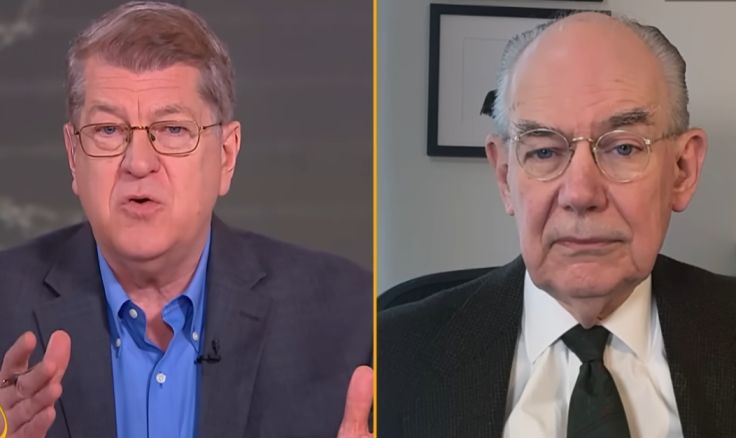
Editor’s Notes: In this episode of The Bottom Line, host Steve Clemons sits down with prominent political scientist John Mearsheimer to analyze the deepening US-Israel war on Iran and its devastating impact on the global world order. Mearsheimer explains how the current administration’s disregard for international law and institutions is undermining America’s ability to project power, potentially leading to a long and costly war of attrition. The discussion further examines the regional instability in Gaza and Lebanon, questioning which actors truly pose the greatest threat to Middle Eastern stability. Ultimately, the episode explores a shifting geopolitical landscape where traditional alliances are fraying and “might makes right” is becoming the new standard for global diplomacy. (April 5, 2026)
TRANSCRIPT:
Introduction
STEVE CLEMONS: Hi, I’m Steve Clemons, and I have a couple of questions. President Trump keeps saying he wants more time, maybe just 2 or 3 more weeks, to finish the job in Iran. But what is the job, and what does finishing it look like? Let’s get to the bottom line.
U.S. President Donald Trump is threatening to bomb Iran back to the Stone Ages if it doesn’t make a deal in the next few weeks. Despite seeing many of its key political, theological, and national security leaders killed, Iran has been able to absorb wave after wave of Israeli and U.S. bombings, which are also killing civilians, as in the case of 168 schoolgirls killed on the very first day of the conflict, and destroying the country’s industrial and energy infrastructure.
Iran has hit back at Israel and U.S. military bases across the Arab world and shaken the global economy by blocking access to the Strait of Hormuz. So are we heading to a quick resolution or are we heading to a long war of attrition? And is the war on Iran triggering something much bigger, a very new and different global world order?
Today we’re talking with U.S. political scientist John Mearsheimer, professor of international relations at the University of Chicago, and he’s author of “How States Think: The Rationality of Foreign Policy.” John, it’s great to be with you again.
This is one of those moments again where the world is watching the tit for tat between the United States and Israel on one side, Iran on the other. That’s one way to cover it. Another way to cover it is ask what this moment means to the global order, to American power, to the superstates in the world. And I’d love to get your take on the temperature of the global order as you see it and what Iran means to that.
The War’s Impact on American Power Projection
JOHN MEARSHEIMER: Well, I think a lot of people talk about how this is going to affect the global balance of power or the distribution among the most powerful states on the planet. And that would include, of course, China, Russia, and the United States. And I don’t think that this war is going to have any effect on the distribution of power in the international system.
Where this war really matters is in terms of how the United States uses the power that it has. And I think that under the Trump administration, what we have seen is that the United States has pursued a set of policies that undermine our ability to project all of that power that we have around the globe.
Now, what exactly am I saying here? I think if you’re a great power like the United States and you’re interested in using all that power you have, it’s very important that you pay attention to international institutions, which you, by the way, have created. You pay attention to international law, which you, by the way, have largely written. And you also go to great lengths to foster good relations with your allies, because institutions, international law, and allies are important for projecting power.
And what the Trump administration has done, and it is doing very clearly in the case of the Iran war, is that it’s undermining international law, it’s undermining international institutions, both of which it needs, and it’s doing great damage to its relations with allies in Europe, in Asia, and certainly in the Persian Gulf.
So this war in Iran is disastrous for the United States. It’s not going to undermine our basic power structure. We have lots of power. But what it’s going to undermine— and of course, this is consistent with what President Trump has been doing since he first returned to the White House in January 2025— is undermine our ability to project power.
The Solvency of International Institutions
STEVE CLEMONS: I think you framed it really in such a fascinating way that when I think about it, listening to you, I think about UN rapporteurs, I think of prosecutors of the International Criminal Court. They’re the ones being punished in this moment. They’re the ones that are being sanctioned and pushed. And it kind of raises this kind of question about the solvency of institutions, the solvency of international law. But I’m interested in the equation that you said after this is over, the distribution of power remains the same. But doesn’t America basically suffer at all in a world where it has tossed out its own systems?
JOHN MEARSHEIMER: Well, the point here that you want to keep in mind, Steve, is that the power that any country has is largely dependent on the material capabilities that it has. The two building blocks of power are wealth and population size. And you use that wealth and you use that population size to build powerful military forces.
And the fact is that the United States is able to behave in a rather cavalier and one could argue reckless way, and that will not have any effect on those material factors. To give you a good example, the United States lost the Vietnam War between 1965 and 1975. We engaged in this war in Vietnam and suffered a devastating defeat, but it had no effect on the balance of power.
The United States was not less powerful. We didn’t have less people, less wealth, and a weaker military as a result of the war.
And that’s the same basic argument that I’m making here. This foolish foreign policy that President Trump is pursuing, as evidenced by what’s going on in Iran, is not weakening American power. What it’s weakening is our ability to project power because it’s undermining institutions.
Just think about NATO. NATO is an international institution. The United States has depended heavily on NATO for many, many years, since 1949, to be specific. Is it in our interest to undermine NATO? Is it in our interest to undermine international law? Is it in our interest to undermine the International Court of Justice? I think the answer is no. We need these institutions. We need allies.
But President Trump, who is a unilateralist at heart, doesn’t think that you need multilateral institutions. He doesn’t think you need international law, and he’s contemptuous of our allies. And in many ways, he treats our allies worse than he treats our adversaries.
Trump on Middle East Independence
STEVE CLEMONS: Well, let’s listen to President Trump, who has something to say about exactly this. Let’s listen.
VIDEO CLIP BEGINS:
UNIDENTIFIED SPEAKER: We’re now totally independent of the Middle East, and yet we are there to help. We don’t have to be there. We don’t need their oil. We don’t need anything they have, but we’re there to help our allies.
VIDEO CLIP ENDS:
STEVE CLEMONS: He’s basically saying, I agree with John Mearsheimer in that we don’t need our allies, we don’t need this, we can walk through the world as a single actor and be arbitrary one way or the other. But your thoughts, John?
JOHN MEARSHEIMER: Well, to argue that we’re totally independent of the Middle East is ridiculous. The fact is there are 3 areas of the world that the United States cares greatly about. This is where vital strategic interests are engaged. One is obviously Europe. The other is East Asia. And then the final one is the Persian Gulf because of the oil. It is a vital strategic area of the world for the United States. And to argue that we’re independent of it, that it doesn’t matter to us, is a foolish argument to make.
President Trump often talks about leaving the war. What is he saying here? That we’re going to leave the Middle East? We’re just going to forget the Persian Gulf? We’re going to forget that oil? Of course we’re not going to do that. We’re going to remain there because it is a vital strategic area of interest to us. So I don’t know what he’s talking about.
And with regard to allies, as I said, we need allies. We need allies in the Gulf. We have allies in the Gulf. We need allies in Europe. The idea that we are an independent actor that doesn’t depend on allies is a foolish argument to make. The United States is a great power that tries to project power all across the globe. How do you project power all across the globe without allies? And the answer is you don’t. And when you start slapping them around the way he does, you’re going to find yourself in a well of a lot of trouble. And as is clear, we are in a well of a lot of trouble in Iran.
Is Iran Really a Threat?
STEVE CLEMONS: So I guess my question is, if you saw Iran as a nefarious actor in the world, why not take this kind of action now and use this as a moment to reorder those relations? So pick that apart.
JOHN MEARSHEIMER: First of all, this argument that Iran is a great threat to stability in the Middle East and a serious threat to the United States is nonsense. The greatest threat to stability in the Middle East is the United States working closely together with Israel. Iran has not started a war in centuries, as best I can tell. It’s not a highly aggressive country. The country in the Middle East that is highly aggressive is Israel. The country that has committed genocide in Gaza is not Iran. It’s Israel. And we were complicit. We, meaning the United States, were complicit in that genocide.
Twice, once last year in June of 2025 and again on February 28th of this year, the United States and Israel launched unprovoked attacks against Iran. So the idea that Iran is this great destabilizer in the Middle East is a myth that the United States and Israel purvey. This is not to say that Iran doesn’t present some problems in the Middle East that the United States has to be concerned about. But the idea that this is a serious threat, much less an existential threat, is not a serious argument. That’s point number one.
Point number two is if you look at what the Israelis and the Americans are now doing to deal with this purported Iranian threat, what you see is we’ve taken measures that have made the situation much worse. In fact, one could argue that we are going to crash the international economy as a result of this war that Israel and the United States started.
I would make the argument that we are on the edge of the precipice in terms of the state of the world economy because of this war. This war shows no signs of ending anytime soon, and already great damage has been done to the international economy, and more damage will be done the longer the war goes on.
So this idea that, number one, Iran is a great threat to the United States is bogus. And number two, the idea that President Trump and his friends in Israel are making a safer and more stable Middle East is a ludicrous argument. In fact, what they’re doing is they’re putting the entire world on the precipice of a disaster.
The Strait of Hormuz and the Failure of Shock and Awe
STEVE CLEMONS: One of the things that I find interesting is when you kind of talk to war planners, strategists across Republican and Democratic circles, it’s hard to find anyone that wouldn’t have expected that Iran would shut down and use the Strait of Hormuz as a choke point, that in fact the Strait of Hormuz was really Iran’s nuclear bomb, that if you wanted to create something that they thought was deterrence. I’m just interested in why you think this White House had none of that input or just disregarded that element.
JOHN MEARSHEIMER: I actually think it’s quite clear. President Trump has said that he was forewarned that the Iranians were likely to shut down the strait, but he said that it didn’t matter. And the reason that it didn’t matter is that the administration thought that they could win a quick and decisive victory.
They thought that they could launch— and when I say they, we’re talking about the United States and Israel, which I like to refer to as the tag team. The tag team thought that they could launch a shock and awe strategy against Iran, which would involve decapitating the regime. And because that regime had so little support in the general population in Iran, the decapitation or the shock and awe strategy would lead to a revolution. The regime would be overthrown, and the new regime would either submit to our demands or the old regime would remain in place and just surrender. Those were the two things that they thought might happen.
But the point is that this shock and awe strategy would produce a quick and decisive victory, and therefore you wouldn’t have to worry about the Iranians closing the straits. But what happened here, obviously, is that the shock and awe strategy failed, and we’re now in a war of attrition. And in this war of attrition that we now find ourselves in, the Iranians hold almost all the cards, not us. And that’s why we are in desperate straits.
China, Russia, and the Shifting Global Order
STEVE CLEMONS: It is interesting that President Trump said the opposite. We have all the cards and Iran has none. So I take your point. But another element here is other big global powers— China, Russia. How are they looking at this moment? Is China fearful of a more muscular United States willing to deploy power like this? Or is it basically applauding this moment as an opportunity for itself?
China’s Strategic Gains From US Middle East Entanglement
JOHN MEARSHEIMER: Well, I think from a Chinese point of view, one could argue that what’s happening is manna from heaven, that this is a case of the United States which says that its principal threat in the world is China and that its principal mission is to pivot to Asia and contain China. Has now enmeshed itself in a war in the Persian Gulf that is causing it to pivot away from East Asia and weaken its containment strategy towards China.
You want to remember that the United States is moving Patriot and THAAD missile batteries out of East Asia. This Marine expeditionary unit that has just been moved to the Middle East came from Japan. So what you see, Steve, is that the United States is actually weakening its military capability in East Asia. Again, we’re pivoting away from East Asia, and this is manna from heaven for the Chinese.
Furthermore, Chinese influence around the world is increasing. You remember I talked before about the ability of a state to project power around the world, to have an effective diplomatic strategy. If you look at the United States and you compare it to China in terms of state behavior, in terms of which state looks like a responsible stakeholder in the international system, it certainly looks like China is the responsible stakeholder. The Chinese look like they are the adults in the room. The United States certainly does not look like a responsible stakeholder.
The Gulf states, the Europeans, our Asian allies are all questioning whether or not the United States is playing with a full deck. All of our allies around the world can’t believe what we’re doing. They fully understand that we are threatening the international economy. We are threatening to take the international economy off a cliff, which is going to have devastating consequences for every state on the planet. So when you think about where China stands versus where the United States stands in the eyes of the world, the Chinese have benefited enormously from this conflict.
The UAE’s Call to Finish the War — And Why Mearsheimer Calls It Foolish
STEVE CLEMONS: UAE Ambassador to the United States Yousef Otaiba just published an op-ed recently in The Wall Street Journal where he said you can’t just— a ceasefire is not enough because you will leave Iran not defeated, not crippled, able to do various things there. I’d just be interested to get your take on this because I think you’ve said America has opened a Pandora’s box of messes. Now many people in the region say, well, you’ve got to continue what you’re doing. Don’t leave it like this. What are your thoughts?
JOHN MEARSHEIMER: I think this is remarkably foolish. Both the Saudis and the UAE have indicated that what they’d like to see the United States do is finish the war, go full bore and defeat Iran once and for all. First of all, we’re not going to defeat Iran once and for all. And if we march up the escalation ladder, as they would like us to do, there is a very good chance that the UAE and Saudi Arabia will be destroyed as functioning societies.
You want to understand that these countries depend heavily on desalinated water, and there are a handful of desalination plants in each of these countries that are big fat targets that the Iranians can go after. And not only can the Iranians go after those desalination plants, they can go after their energy infrastructure, they can go after their oil and gas infrastructure, they can destroy those countries. And if the United States begins to attack a broader set of targets in Iran, the Iranians, who have been playing tit for tat all along, have made it clear that they will destroy or they will attempt to destroy— and I think they will destroy— countries like the UAE and Saudi Arabia.
So if anything, Steve, what the UAE and Saudi Arabia should be doing is telling the Americans to back off and to work overtime to come up with some sort of negotiated settlement to put an end to this war. These countries, the Gulf states that is, have absolutely no interest in seeing this war continue. They had no interest in seeing this war start in the beginning. And I just don’t know what they’re thinking when they’re talking about getting America and Israel to up the ante.
Lebanon, Gaza, and Israel’s Role Across the Region
STEVE CLEMONS: Other parts of the dashboard of this conflict right now are what’s happening in Lebanon, Israel’s commitment to essentially occupy parts of Lebanon, what’s going on in Gaza. And I’m just interested in how you see the other dimensions of the Middle East beneath the Iran conflict that are also parts of the puzzle that are moving right now.
JOHN MEARSHEIMER: Well, let’s start with Lebanon, and there are two dimensions to the war in Lebanon. One is the ground war where the Israelis are attempting to take more territory. And I think many Israelis, especially on the right-hand side of the political spectrum, want to annex the southern part of Lebanon from the northern border of Israel up to the Litani River.
And in fact, if you look carefully at what’s happening in southern Lebanon at this point, the Israelis are suffering a series of tactical defeats. They are having one whale of a lot of trouble fighting against Hezbollah on the ground in southern Lebanon. And the idea that they’re going to conquer all of southern Lebanon, I think, is wrong. And I think they’re going to suffer a lot of casualties trying to do that. And they already are, of course.
The second point I’d make is that by the end of 2025, it looked like Hezbollah had been defanged and that the Israelis had done egregious damage to Hezbollah’s ability to fire rockets and missiles into Israel. As you moved into this year, it looked like Hezbollah had been defanged and couldn’t cause Israel any problems with its rockets and missiles because it had hardly any left. Israel had destroyed all of them. That has clearly not happened.
And not only is Hezbollah firing rockets and missiles into northern Israel and even as far in as into Tel Aviv on a daily basis, but the Iranians are coordinating with Hezbollah. And the Iranians are firing missiles into northern Israel and into Lebanon itself. So the Hezbollah threat is there in spades.
With regard to Gaza and the genocide, there’s no question that the Israelis have slowed down the genocide. But if you look at their behavior, they’re very interested for sure in cleansing all of Gaza of Palestinians. And they’re pursuing a genocide in hopes that that will allow them to get all of the Palestinians out of Gaza. And if they don’t get them out, murder them while they’re in Gaza.
And we don’t want to lose sight of the fact, Steve, that on the West Bank, the Israelis are launching pogroms on an almost daily basis because they’re interested in ethnically cleansing the West Bank as well.
So if you look at what’s going on here with Israel, Israel is deeply involved in a conflict in southern Lebanon and with Hezbollah. Furthermore, it’s involved in a genocide in Gaza. It’s involved in pogroms on the West Bank. And furthermore, it’s constantly attacking Syria. And on top of all that, it dragged the United States into a war against Iran.
Israel is by far the most aggressive state in the Middle East. One could make an argument that it is the most aggressive state on the planet. This gets back to our earlier discussion of whether Iran or Israel is the greatest threat to stability in the Middle East. I don’t know how anybody could make the argument that it’s Iran. The answer is it’s Israel. And most importantly, you want to remember that Israel is committing the greatest of all crimes, which is genocide in Gaza. And no matter what you think of the Iranian regime, the Iranian regime is not committing genocide.
Closing Remarks
STEVE CLEMONS: It’s a messy world, and that’s why we always love talking to you. University of Chicago political science professor John Mearsheimer, thanks so much for joining us today.
JOHN MEARSHEIMER: It was my pleasure, Steve. Thanks a lot for having me.
The Bottom Line
STEVE CLEMONS: So what’s the bottom line? However this war ends and however long it takes, one thing has become really clear: today’s world is governed by the order that prevailed over the past few decades is just crashing down and being replaced with a much more vicious system. The United States is the change agent now, using brute force where it sees oil or assets or territories that it wants. Staying in old alliances like NATO may just not be worth it for a new America.
If anything, we’re heading back to the 19th century, a dog-eats-dog, might-makes-right, no-rules place, where all countries are up for grabs and everyone needs muscle if they want to survive. And that’s the bottom line.
Related Posts