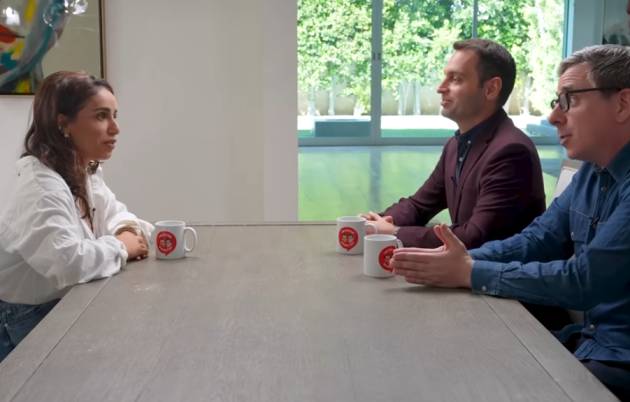
Editor’s Notes: In this compelling episode of Triggernometry, hosts Konstantin Kisin and Francis Foster sit down with Iranian activist and lawyer Elica Le Bon to discuss the urgent necessity of regime change in Iran. Elica provides a stark look at the regime’s systemic brutality and outlines her “three-step” path to liberation, which combines external military pressure with internal uprisings and strategic defections. The conversation also explores the “moral inversion” found in modern Western political discourse and the significant challenges of achieving a stable, democratic future amidst global geopolitical tensions. It is a deep and often challenging dive into the human and political stakes of one of the world’s most volatile conflicts. (April 5, 2026)
TRANSCRIPT:
Introduction
KONSTANTIN KISIN: Elica, welcome back to the show.
ELICA LE BON: Thank you for having me.
KONSTANTIN KISIN: Every time we put out an episode where the guest is somewhat critical of the war in Iran, all the comments are like, you need to speak to an Iranian. So here you are for diversity purposes.
ELICA LE BON: Diversity, oh my gosh. Or maybe authority.
KONSTANTIN KISIN: Authority, okay.
ELICA LE BON: Hit me with the diversity.
KONSTANTIN KISIN: She’s here for authority, guys. This is going to be an interesting one. All right. So welcome back. Obviously the subject is a serious one, even though we’re joking around. Tell us what your take is on everything that’s been going on.
The Massacre in Iran and the Call for Help
ELICA LE BON: I think my take is a very long take because this is something that has really built up into the moment that we are right now. Obviously if you were following what was happening in Iran around January where we had this massacre on January 8th and 9th where it’s estimated — well, these numbers, people want to war over these numbers, but the numbers that came back from the hospitals was about 36,000. And that was just each hospital in every city listing how many casualties they had. And that’s not including the people who were just executed on the streets who never made it to the hospitals. So suffice it to say that we’re talking about tens of thousands.
At that point, from my perspective and from the perspective of people inside Iran, we are always sort of hedging towards what’s going on in there and what do they need from us, right? Because that’s the only role we play. They don’t have internet, they can’t communicate with the outside world. So we want to know, well, what is it that you want? So through that period of time, there were so many messages, there were so many videos, there was so many just of this sort of universal voice that was saying, “We need help, we need help, we cannot fight this alone. These people are killing us with military-grade weapons. How do you defeat military-grade weapons?” And so that was the call for help.
Now, where things get tricky is that you have the US and Israel coming into this picture, and people sort of give this condescending attitude of, “Oh, you think that these people are just here to save you and save your country.” Well, none of us ever said that, right? None of us ever believed that any nation was acting anything but in their own interest. And that is the way that things are. Everybody understands that nations act in their own interests.
But because of this backdrop of since October 7th, this radical anti-Zionism, anti-Israel, anti, anti, anti, anti-Western, which stems back to Soviet infiltration, right? We’ve had that conversation, I think. It came to a point now where this war, which was supposed to be seen through our eyes as a rescue mission, perhaps through the US and Israel’s eyes as decapitation of an enemy, whatever, has now turned into something where people are being almost radicalized in support of the regime. And so it’s getting really dark.
Skepticism About the War’s Objectives
KONSTANTIN KISIN: Well, I think there’s probably some people who are being radicalized in support of the regime, but there’s also — cards on the table, Francis and I recorded a conversation, will go out a couple of days from now, from when this goes out, where we are basically saying, it doesn’t look to us like any of the objectives any of us might have wanted to be achieved — i.e., Iran doesn’t get nuclear weapons, i.e., the protesters who you are talking about get justice or have a regime that replaces the current regime that doesn’t treat them the way that — regime change. I don’t think that’s going to happen. It’s clearly not happening at the moment. And there’s a possibility of a global recession. So you can also be concerned about what’s happening without being radicalized in support of the regime.
ELICA LE BON: Well, yeah, of course, those are two completely different things. There’s obviously a well-meaning sort of skepticism about what are the objectives of this war and when do we know if those objectives have been achieved?
I think one of the main issues, and it’s something that I can’t even get my head around, is that I don’t think that there’s ever been a time where war by itself would effectuate regime change. There are other things that need to sort of unite, like for example, uprisings, defections within the ranks, and the person that has mostly largely been responsible for that is the Crown Prince Reza Pahlavi. So when he called people out into the streets in January, they went out in their millions. When the internet got shut down, his views went down in the millions. So there was strong evidence that there was a strong connection there.
And so I think where this war has sort of been negligent is in not pulling in the other actors that would effectuate regime change, right?
The Case for Reza Pahlavi and Regime Change
KONSTANTIN KISIN: And so what are you basing that on? How do we know that?
ELICA LE BON: His team says that. How do we know? I mean, I can only tell you what his team says, but what I can tell you is that —
KONSTANTIN KISIN: But do you see what I’m getting at, right?
ELICA LE BON: But we have enough evidence of his support, right? We have enough evidence of the people chanting his name in the streets. We have enough evidence of millions of people coming out when he called them to come out. So that’s good enough that we know that there are a ton load of people inside of Iran who support him.
But either way, it’s not about — this isn’t making a case about who supports him, who doesn’t. It’s making a case that why aren’t we taking the necessary steps towards regime change? It’s not going to be just the war in isolation. It’s going to be the war does what the war needs to do. Then Reza Pahlavi calls the people into the streets. The regime is significantly weakened. There’s been defection within the ranks, and then the regime falls. So I think it’s almost like we’re doing step 1, but if we’re not going to do step 2 and 3, then what’s the point?
Lessons from Ukraine and the Risk of Calling People to Rise Up
KONSTANTIN KISIN: I mean, that’s a fair point. And when we interviewed Ted Cruz, he talked about arming the protesters. But I’ll be honest with you, Elica, I feel about the war in Ukraine very much the way you feel about Iran. It’s personal to me. I have family involved in whatever. But I have never called for people in Russia to rise up against Vladimir Putin because I always knew that if they did that, they’d just get slaughtered and nothing good would come of it.
And when this whole conversation about Iran was starting, I think the protests were just happening. And I was kind of saying at the time, I’m really not certain that calling people into the streets is going to create a positive outcome here. And I’m worried that — the way things are going now, I don’t see it. I don’t see this working.
ELICA LE BON: Well, I mean, it really speaks to the brutality of the regime, right? Because when you think about 1979 when there were these uprisings in Iran and the Shah just left because he was like, “I don’t want this type of bloodshed of what it would take to sustain this regime,” right? And so now, this regime is so brutal that there really is no length, no ends that it will go to to not suppress the uprisings.
But at the same time, they’re going to die anyway, right? So that’s the way that they look at it — they look at it like they have nothing left to live for. Everybody in Iran has been affected by this regime now. Somebody’s parents has been hanged, somebody’s children have been shot. This isn’t a life for anybody. So when you tell people at that point to go into the streets to fight for their freedom, it’s like, what? They might as well die fighting. That’s the way that they see it. I think everybody understands and anticipates that they very well might not come home, but what else do you do?
And then the only other option is outside help. And now outside help is like the worst thing that you could possibly do because this is American imperialism and Israel’s plan for greater Israel or greater Iran or whatever the hell it is. So it’s like we’re fighting a battle on so many fronts. And it’s just impossible.
The Risk of Half-Measures
KONSTANTIN KISIN: Well, it’s kind of what I’m saying. I’m not sure that this can get solved the way that people want, and therefore encouraging more people to rise up against the regime — I take a point. Look, if I was living in an authoritarian country and I felt the regime was evil, I’d rise up against it. And look, it’d be up to me, do I get killed or not, whatever. But from outside, I’m worried that the administration and others have called for people to rise up only for them to be killed for nothing.
ELICA LE BON: But I think that they’re killed for nothing if everything isn’t locked in place, right? I think if you have the war, which is decapitating the regime, if you have protesters who are coordinated in rising up, if they are armed, if there are defections — because that point of defection almost always happens where it seems that the instability is at a tipping point, that it could go one way or the other. And then there’s personal stakes. It’s like, “Okay, this is going this way, so I’m going to —” this is how it’s always been with regime change, right?
And we even saw with Syria — it was 11 days. Nobody could have — everybody said, “Oh, this brutal regime, decades-long Assad regime, there’s no way that this is coming down.” But somehow it did.
KONSTANTIN KISIN: After a brutal civil war that lasted God knows how long and killed hundreds of thousands of people. Do we want that for Iran?
ELICA LE BON: No, but when it came down, it was in 11 days.
KONSTANTIN KISIN: But you had to have the civil war first.
ELICA LE BON: Yeah, I mean, we’ve basically had the worst of it as far as I’m concerned. I just think what doesn’t make sense is to half-ass these things. That’s what I think doesn’t make sense. I don’t think it makes sense to have a war and to not be sort of collaborating with people like Reza Pahlavi, or collaborating in ways that can help make the protest successful. Maybe if it involves arming, I don’t know, something that involves defection. I just think that this needs to be covered in a much more broad way for it to work.
Ideology and the Difficulty of Achieving Liberal Democracy
FRANCIS FOSTER: And also, look, nobody’s ever really been honest about what it takes to turn a country that is authoritarian to a country which is a liberal Western-style democracy. For example, take Venezuela. My family have been involved in protests time and time and time again, going out on the streets demonstrating. But what we have in Venezuela is something called the colectivos, and they’re essentially Chavez’s or the regime’s armed thugs, and they suppress. In order for you to gain freedom, you need to get rid of all the colectivos. In the Iranian case, it’s the IRGC.
ELICA LE BON: Yeah. And I think what this really speaks to is how much ideology can really destroy nations, right? So you talk about socialist dictatorships, Islamist dictatorships. In either case, these are people who are convinced to the death of them that their ideology is the right ideology, even in the face of contradictory evidence, right? With socialism, I mean, it’s the worst ideology in human history, basically the deadliest ideology in human history. And you see that these people are so totalized in their worldview that they are willing to live and die to maintain that system. The same with Islamism, right?
FRANCIS FOSTER: I think to push back on what you’re saying, Elica, I think Islamism is actually far worse. I take what happened in Venezuela with Delcy Rodriguez. Now people talk about regime change, but Delcy was an integral part of Maduro’s government. But you talk about socialism and all the rest of it, she’s not that ideological because she was happy to kick him to the curb and become leader herself. Because what she’s really interested in is power and status and the money. Whereas you look at some of the lads in charge of Iran, they really believe — they’re true believers.
The Ideology That Refuses to Leave Iran
ELICA LE BON: They are true believers. And that’s why— and it really to me speaks to how much— and I guess this is why I have such a hard time now in the world that we are in, where radicalization is happening. Because it is like, I know the story of the other end of that so well. Once that radicalization is entrenched, you cannot convince, you cannot push back on them. There is nothing you can do because in their minds they have this story, right?
“This is my fight. This is my fight. And God wants me to fight this and to defeat the bad people, to bring the good things to the world.”
And it is like, you see what you are bringing to the world. You see this is just death and destruction. “Oh, but they are martyrs. They’re martyrs for a great cause.” There’s always some way to spin it in your mind. And so it’s just, that’s really what we’re looking at. We’re looking at an ideology that refuses to leave Iran. And it’s like, how do you kill an ideology?
FRANCIS FOSTER: Well, if you look at history, the only way of doing it, if you look at Japan or Germany, is to essentially decimate the country, bring it to its knees. And then have a process of de-radicalization like we did with Germany.
KONSTANTIN KISIN: And that’s why I’m worried about this conflict, Elica, because we’re not going to do that, right? And no one’s advocating for that. And that means, some of the conversations we’ve had while we’ve been here, it’s likely that you end up in a trap where you are not prepared to do the actual thing that you need to do, ’cause it’s terrible. Like what we did to Germany and Japan was awful. You don’t want to do that to Iran. But that means you don’t have a way of achieving your objectives. You don’t have a way of getting rid of the nuclear material. They’ve taken it, they’ve dispersed it. We don’t know where it is. You’re not going to get it with airstrikes. And now also the other thing is they’ve got control over a hell of a lot of oil, gas, fertilizer, helium, etc. And a lot of people are now saying actually they’ve got all the trump cards.
ELICA LE BON: I mean, I don’t know. I feel like they’ve had all the cards for the past 47 years. I just wonder where this goes. Do you know what I mean? Like, at some point this regime has to fall, but when is it?
KONSTANTIN KISIN: Why?
ELICA LE BON: Well, it can’t last forever.
KONSTANTIN KISIN: Why?
ELICA LE BON: Nothing lasts forever.
KONSTANTIN KISIN: Okay, sure.
ELICA LE BON: Even the British Empire didn’t last forever.
KONSTANTIN KISIN: Oh, I’m very sad now.
ELICA LE BON: And that pretty much owned the whole world. But I—
KONSTANTIN KISIN: You see what I’m saying though? Like, it could last another 50 years.
When Does a Bad Faith Regime Fall?
ELICA LE BON: I think the way that these regimes typically end themselves is because— I mean, we just have to remember that these people aren’t really exactly in their right minds. They’re not reasonable people. And so when you think of Hitler, for example, he was not reasonable. He was drunk on power. Eventually he was killing the Jews and nobody really did anything. Nobody cared. Holocaust, whatever. Finally, when he invades Poland, people are like, “Oh, this is a real threat.” And then so comes the war.
I think the thing about actors like this, like the regime, is that they won’t stop. They won’t stop with the October 7th. And the massacres and the sort of imperialism out into the Middle East that draws these forever wars. They won’t stop. And so my thing is that one of these days they’re going to do something that’s the last straw. They’ve already done something that’s the last straw according to the United States. It’s just that this last straw wasn’t enough to go all the way. I just don’t see— I think the reason that this regime has to fall, like every bad faith regime in history, is because it will eventually do something that invites the world wanting to attack it.
Is There a Real Plan for Regime Change?
FRANCIS FOSTER: Look, that very well may be the case, but the problem is, if you look at it at a purely practical level, what we are doing and what we’re talking about is simply not going to enact regime change. It just isn’t. And that is the unfortunate situation.
ELICA LE BON: A regime change can happen now if the circumstances are right. And so the question is, why aren’t we aligning the circumstances to make it right? We have this window in time where we can get the Iranian people out into the streets, possibly arm them, possibly go for— the precision strikes are so incredible. Why can’t they go for the weaponry that they’re using on the protesters?
KONSTANTIN KISIN: Because it’s just assault rifles, Elica.
ELICA LE BON: Well, can’t they target that?
KONSTANTIN KISIN: No.
ELICA LE BON: They’re targeting the booths. They’re literally targeting the booths where they’re doing the checks.
KONSTANTIN KISIN: I know, but you’re not going to take out every single AK-47 in Iran. It’s not going to happen. And this is the thing, it’s like the IRGC are still going to have guns at the end of the day.
ELICA LE BON: Yeah, well, maybe then it involves arming the protesters. I don’t know, maybe it involves arming the protesters. Maybe it involves more coordinated riots. The funny thing is that this is literally America’s specialty. Every time it’s done these coups and things like that. Even 1953, that was exactly what they did. They coordinated protesters, they armed them. I actually don’t know if they armed them, but they coordinated them. They made it a serious thing, and it was from that tension that regime change— Mossadegh fell, whatever. But they know how to do that. I find it odd that there’s no investment in that end of it, which is where the regime change happens. I think it’s very odd. There’s a part of me that wonders, do you want regime change?
KONSTANTIN KISIN: Well, this is kind of the problem here because, as we talked in that conversation that’s coming out shortly, we’ve talked to a lot of people. Some of them work in the administration, some of them know things— don’t want to go into the details how they know them— but there is no plan here. There’s no grand strategy here from what we understand. I’m not saying we know, we’re not experts on this, but that’s what we’re being told. There’s no great strategy here. This is just like, “Oh, we did Venezuela, now we can do this.” And what you’re pointing out is the same thing that we are concerned about, which is it hasn’t actually been thought through to that level or pre-planned to that level, which is why you’re not seeing the things that were promised or you’d want. You see what I’m saying?
ELICA LE BON: Yeah. I don’t know. I think that this whole thing needs to be revisited, shall we say.
FRANCIS FOSTER: Yeah.
ELICA LE BON: But I do think that those are the 3 steps to regime change. The war is one step, the uprisings, possibly armed uprisings, is another, and defections is the other. And I think that those 2 things, if they’re neglected, we’re not going to have the regime change. And I think ultimately this is the time to do it. If there is a window in time, it’s now. And so I really don’t understand why this isn’t being coordinated in that way.
Iran Is Not Iraq or Afghanistan
FRANCIS FOSTER: It’s also political, Elica, in that the Americans have no stomach for regime change, especially after Iraq, especially what happened with Afghanistan.
ELICA LE BON: But those are not the same.
KONSTANTIN KISIN: They’re not.
FRANCIS FOSTER: They’re not the same.
KONSTANTIN KISIN: This is kind of worse in a way though.
FRANCIS FOSTER: Yeah.
KONSTANTIN KISIN: Because Iraq wasn’t holding the world ransom economically. Iran can and is.
ELICA LE BON: True. But the fear that people have over regime change is that it’s going to be another Iraq, it’s going to be another Afghanistan, it’s going to be another failed state. Well, it’s not a failed state. It’s like a thousand-year-old nation state. What those regime changes did was that they tried to impose an outside government and effectively build a state that didn’t exist because those were new countries at the time as well. And so Iran, you have this really old kind of a nation state that is unified behind language, behind a flag, behind culture, behind all of these things. We don’t want a foreign-imposed government. That’s not what— this is not Iraq. We want—
KONSTANTIN KISIN: Well, you do though. You do want a foreign-imposed government.
ELICA LE BON: No, we don’t want a foreign-imposed government.
KONSTANTIN KISIN: Well, if you cause regime change and then replace it with one of your puppets, which is what you want to happen.
ELICA LE BON: No, that’s not what we want to happen.
KONSTANTIN KISIN: Okay, maybe I’m—
ELICA LE BON: Reza Pahlavi is only a transitional leader. So this has been articulated so many times, I don’t know why people don’t get this. He’s a transitional leader that comes into the country once the regime falls to facilitate moving the country into a democracy where people can vote for their own leader.
KONSTANTIN KISIN: What if they vote for an Islamist regime?
ELICA LE BON: Well, no one’s going to vote for an Islamist regime because we know the statistics of what people favor.
KONSTANTIN KISIN: Oh, okay. I actually don’t. What are the statistics?
ELICA LE BON: 90% of people in Iran are against it.
KONSTANTIN KISIN: Against the regime?
ELICA LE BON: Against the regime.
KONSTANTIN KISIN: Wait, how do we know that?
ELICA LE BON: Because there’s studies like the Gammon study, which is in, I think, the Netherlands, conducted, and it speaks to people inside Iran, obviously anonymously, and they collect data about their public sentiments. And they say that— 90%— or is it 85% or 90%? There’s 10% that support the regime. Still, it’s a country of 90 million, still a lot.
What Do We Really Know About Public Sentiment in Iran?
KONSTANTIN KISIN: And they have the guns. But your point about 90% is very powerful. I mean, we’ve had people on the show, Ayman Dean, who’s a former Al-Qaeda MI6 double agent, for example. He gave a very different assessment of it, which was like 25% people support the regime, 25% hate the regime. To me, I’ll give you a similar example for Russia, which is easy for me to explain. So I am someone who’s a fierce critic of the Russian regime in the way that you are a fierce critic of the Iranian regime. But I would not say that I know what percentage of people in Russia oppose.
ELICA LE BON: Because maybe you don’t know.
KONSTANTIN KISIN: Because nobody does.
The Question of Iranian Public Sentiment
ELICA LE BON: Yeah, but you can, you absolutely can have a fair assessment about the sentiments of a country through extensive polling over time. And for the past 46 decades, repeatedly polls have shown that it’s a very high percentage, almost 90% of Iranians who are against this regime.
I just think it’s like, who would want — who would like this regime? You do have this minority, of course you have a minority of extremists, but this is where it’s like, you do not know Iranians if you think that that’s who the majority of Iranians are. They don’t identify that way. They don’t identify with Islamic extremism. It’s not part of our culture. It’s not part of our cultural personality.
It’s so obvious to us that when people ask these questions, it’s like, we even give you the statistics, right? We even give you the polls, but people just believe what they want to believe. I don’t know what to tell you. It’s not a country that’s 50% Islamist radicalist. It’s just, it’s not who the Iranian people are.
KONSTANTIN KISIN: Oh, sure. No, no, I’m certainly not saying that. But again, an example from my own experience, which sort of makes it easier for me to think about these things. The Soviet Union was deeply unpopular by the time it collapsed. But that doesn’t mean that 90% of people living in the Soviet Union were opposed to the Soviet Union.
If you took a poll in the Soviet Union around the time that it actually collapsed and there was regime change, there was still a ton of people who supported it. It just became weakened economically and morally and in other ways. But to me, when someone says 90% of people in a country agree on something — you may be right, I’m not disputing it — I’m just saying, to me, that’s a bit of an alarm bell because that seems—
ELICA LE BON: It’s not an alarm bell. It’s a terrorist regime that everybody hates and has destroyed the country. It’s brought it to ruin, to economic collapse. Everything about them that they do — they take the money and they give it to proxies. They are so radicalized. They don’t take care of the country. They kill people for protesting. The methods of torture are medieval. They hang people. Nobody likes this regime.
I’m not saying that 90% of Iranians agree on other things. Iranians never agree on anything. It’s actually disturbing how much they disagree. But if you want to include the diaspora, 99% are against the regime statistically.
KONSTANTIN KISIN: Well, the diaspora are the people who left, right? So that would make sense that they’d be against the regime.
ELICA LE BON: So on average, you’re talking about 95% of Iranians in this world at least agree on being against this regime. I’ve never even seen this type of overwhelming evidence of people who support the regime. When I go online, I don’t see anyone except the bots that support the regime. If there are people who support the regime, they’re here in the West — Anna Kasparian and Cenk Uygur. But where are all of these massive spokespersons for the regime?
FRANCIS FOSTER: Well, there may be a lot of people in Iran who actually can’t go online because there’s been an internet blackout.
ELICA LE BON: Oh, they have internet. The ones who support the regime have internet.
FRANCIS FOSTER: Okay. And also, how many people get radicalized at school?
ELICA LE BON: They don’t get radicalized at school. It just doesn’t work. I mean, yes, they do have to go to school and they say death to America, death to Israel. But it just doesn’t work because they go home to their parents and their parents say, “Yeah, just say that. But we’re not like that.” They don’t go home to radicalized parents.
The culture inside of Iran is very different. It’s a culture of tolerating this sort of infrastructure of extremism, but also being outside of it because you have a people who are — what’s the word — familiar. It’s like literate in this type of propaganda. And so you build propaganda literacy the more you live under this regime. It gets to a point where everybody understands it. Everybody understands the manipulation, the dishonesty, the lies, the danger. Everybody understands it.
I’m not saying that there aren’t the extremes. Of course there are the extremes. 10% of 90 million — that’s millions. I’m not good at math, but pretty sure that’s millions. So I’m not denying that those millions of people exist. It’s just there’s a huge disparity. And you even saw when some of these uprisings were happening a couple of years ago, they started to throw the turbans off of the mullahs’ heads when they were walking down the street. And that was a little bit controversial. Some people said, you know, and other Iranians said, “f* you.” But there is quite a strong divide there.
Concerns About a Prolonged Campaign and Trump’s Endgame
FRANCIS FOSTER: They don’t even like seeing them in the streets because the concern is going back to America. On our show, Ted Cruz said that if — I think it was by November, if the war — by the midterms — if the war was still carrying on by the midterms, they would have failed. Trump said at the very beginning, 4 weeks maximum. Now we all know that Trump talks a lot of nonsense.
There simply isn’t the stomach, Elica, to carry out a prolonged campaign in order to get rid of the regime and the regime’s goons and everything that is needed to keep the regime in place. Which is my concern, because what could actually happen is Trump turns around in a week, 2 weeks, 3 weeks, and goes, “You know what, we’ve degraded their military capacity, we’ve bombed—”
ELICA LE BON: He’s already said that. We’ve got new leaders.
FRANCIS FOSTER: Yeah, exactly. So we’ve destroyed the capacity to produce nuclear weapons. Tick, tick, tick. We’ve secured the Strait of Hormuz. It’s now up to the Iranian people.
KONSTANTIN KISIN: Rah, rah, rah.
FRANCIS FOSTER: Cuba next. That could very easily happen.
ELICA LE BON: I mean, I think that’s pretty much happened already.
KONSTANTIN KISIN: Yeah.
ELICA LE BON: He’s already said that there’s a regime change because everyone there is a new leader.
KONSTANTIN KISIN: Right. So this is kind of our concern. And look, I know we’re pushing back on a lot of stuff you’re saying. I’m going to sound like our mutual friend who we all admire, Dave Smith, here. I really hope what we are saying is wrong.
ELICA LE BON: No, I don’t.
KONSTANTIN KISIN: And we are rooting for the Iranian people to be free of the tyranny of the Islamic regime. But we’re just really seriously concerned at this point that there is no great plan. And given some of the ways that we, because of the conversations we’ve had, understand the way this can escalate, we’re just very concerned that basically what is likely to happen is Trump is going to pretend that he got this big victory, but actually what he’s going to do is cut and run.
And I don’t think the Iranian people are going to be better off. I don’t think the nuclear material is going to be eliminated. So the one thing you could say is, well, you flattened the missile program, you’ve destroyed their military industrial complex, you’ve set them back 10 years, let’s say. Maybe some people will take that, I guess. Yeah, you probably wouldn’t.
ELICA LE BON: No. What they’ve said inside Iran repeatedly is that the worst case scenario is that the war ends and the regime remains in power. It would have been better that there was no war at all, because after that, that’s when they do their most brutal crackdowns. That’s when they start killing everybody and saying, “You were a Zionist, you were a Zionist, you were a Zionist.” People who were just filming outside of their windows, whatever. So that’s actually worst-case scenario if they stop this war.
But you can’t deny how much public sentiment has shifted the direction of the war as well, because it’s considered generally a very unpopular war. And I think this is largely because of the backdrop of the conversations that have been had in the Middle East over the past 3 years, especially the very, very anti-Israel view of things, which has sort of driven this conversation towards — okay, yeah, some people are extreme and they’re going to say the regime are the good guys, but some people, the more like Dave Smiths of the world, are going to say, “Well, these people are not really bothering us. These people haven’t done anything wrong. They’re just a regular government, just like my government and your government. And isn’t America a terrorist government too?”
And that sort of really manipulates public perception in a way that people are not willing to get on board with a war that they just fundamentally don’t think has any purpose or benefit to them, maybe not even in the long run. I genuinely do not think that the American public think that the Islamic regime is a threat.
Is Iran Actually a Threat to America?
KONSTANTIN KISIN: But it—
FRANCIS FOSTER: Because it probably isn’t a threat to them, really, if you look at it and you analyze it objectively now. It’s far more of a threat to the UK. It’s obviously a much greater threat to the Middle East and the stability of the Middle East. But to the average American living in Kansas City, why is Iran threatening them?
ELICA LE BON: It’s a threat if the regime succeeds in its ambition. It’s a threat, right?
KONSTANTIN KISIN: So what is its ambition?
ELICA LE BON: Well, its ambition is death to America, death to Israel. And right now its task is to remove Israel.
KONSTANTIN KISIN: But that’s kind of like my toddler saying death to daddy. It’s not—
ELICA LE BON: Right, but there’s action. There’s not just intent, there’s action.
KONSTANTIN KISIN: So what is the threat that they pose to America? Yes, sorry, sorry, sorry, sorry, sorry.
ELICA LE BON: So the first stage is to remove Israel because these are the two oppressors, right? The oppressors of the West and the oppressors of the Middle East. So they’ve put in action all of the stages necessary to remove Israel. They created a second IRGC called Hezbollah in Lebanon, which is the closest border to Israel, have been attacking Israel nonstop ever since. Of course, Hamas, same thing, Houthis, and all of this is part of the campaign to remove Israel.
Now Israel is relying on the United States for aid to defeat these proxy groups — which is another thing that people are like, “Why should we have to pay money to Israel?” Because they don’t understand that Israel is the one that is holding down the fort against these forces.
Because let’s say those forces did win, let’s say the United States pulls out its funding, let’s say that they don’t consider them allies anymore, and Israel falls and the Islamic regime wins. Now the Islamic regime has exported its revolution out into the Middle East. Now you have the Islamic Republic of Lebanon, which already is a state within a state — it’s just ready to go one way or the other. You have the Islamic Republic of Palestine, you have the Islamic Republic of Yemen, the Islamic Republic of Syria, God knows where. And now you have these combined forces, with combined military technology, all of these things.
You don’t think at that point they’re going to go for the second thing that they stated in their charter, which was “next we’re going death to America?” You don’t think that’s going to happen?
But then you could say, “Well, I just don’t think that’s ever going to happen because Israel will always be there and we’re always going to support them.” The public sentiment in this nation is that there should be no support for Israel, that Israel is the biggest terrorist state in the world. All of this stuff is just a complete inversion — it’s just total moral inversion of the situation. If you want to keep funding Israel for the rest of your life, then maybe the regime will never threaten you. Sure.
The Iran Nuclear Threat and Regime Change
FRANCIS FOSTER: But the one thing that I would say is that when we’re talking about Iran, their death to America, Iran would have to be monumentally stupid. They would have to be monumentally stupid in order to do a 9/11-type terrorist attack, for example, because that would mean their entire country gets obliterated.
ELICA LE BON: That’s why they go around the side door. They didn’t do October 7th. They went around the side door.
FRANCIS FOSTER: Yeah, but October 7th was done to Israel, right?
KONSTANTIN KISIN: In the same way that the Taliban didn’t do 9/11, but they let Al-Qaeda, right, you don’t train and do other things, but then it was the Taliban that had the shit kicked out of them for like 20 years.
ELICA LE BON: Yeah, and now the Islamic regime is having the shit kicked out of them. So it’s not going to be so direct.
FRANCIS FOSTER: Yeah.
ELICA LE BON: But you move indirectly, you say, oh, as Dave Smith said, they had no idea about October 7th.
KONSTANTIN KISIN: Yeah, I don’t think that’s true. But I still don’t know that if I were an American, I’d be sitting here quivering in my boots at the threat of Iran. I mean, some of the things that were said about this, you know, Iran is an imminent threat. I mean, come on, really? Imminent? I don’t think it is, right?
ELICA LE BON: If it has a nuclear weapon, it’s imminent.
KONSTANTIN KISIN: To whom?
ELICA LE BON: To anyone.
KONSTANTIN KISIN: Why?
ELICA LE BON: As a nuclear weapon, you don’t think it’s an imminent threat to America? No, I could do whatever it wants with it.
KONSTANTIN KISIN: Okay, but is North Korea an imminent threat to the United States?
ELICA LE BON: No, no.
KONSTANTIN KISIN: North Korea got nuclear weapons so that they could just be left alone to have their dictatorship in peace, effectively, right? That’s what they did. And this is the thing, I remember I was very curious and interested in the arguments you made last time when you were on the show, when you talked about the type of Islam that the Islamic regime practices in Iran, and the fact that there’s the Mahdi coming back and all of this eschatological stuff, which obviously that exists, right? But from Iran’s perspective, the much more rational reason to get nuclear weapons is to be a regional hegemon, or at least to protect itself from what it perceives as the threat.
ELICA LE BON: But that’s exactly the problem, isn’t it? Because then you cannot control their behaviour going forward because they’re a deterrent state. Once you get nuclear weapons, they’re a deterrent state. So yeah, you can march straight into Lebanon. Who’s going to stop you? You can march straight into Gaza. You can go do whatever you want with Israel. Who’s going to stop you? That’s the whole problem.
KONSTANTIN KISIN: Well, Israel has nuclear weapons, so who’s going to stop you is Israel.
ELICA LE BON: So what, are we going to have a nuclear war?
KONSTANTIN KISIN: No, well, historically speaking, nuclear weapons appear to actually create peace.
ELICA LE BON: Stalemate.
KONSTANTIN KISIN: Yeah.
ELICA LE BON: Yeah.
KONSTANTIN KISIN: This is not me advocating for us to let the Iranians get nuclear weapons. My concern is, if I’m being honest, as I understand the situation on the ground, other than negotiations, which I don’t think are going to work long term either, but they might work short term, there’s actually no way of stopping the regime from getting nuclear weapons short of successful regime change and boots on the ground.
Why Regime Change Is the Only Answer
ELICA LE BON: That’s why we need a regime change. And that’s why everything else, no matter how long you go down the rabbit hole, is just kicking the can down the road. It just makes no sense. We want to get into this situation where both the regime and Israel have nuclear weapons, but the regime— this is the difference of what’s in whose charter, right? In their charter, it’s that they must eliminate Israel. So whether that escalates into a nuclear war actually becomes deterrent because they both have nuclear weapons. Or they just keep— I mean, where does this end? And isn’t the US always going to be implicated in that war when it comes to the regime and Israel? So I just— this is just dragging the October 7th nightmare on and on and on and on and on. I just think that none of this is going to make any sense unless there is a regime change.
FRANCIS FOSTER: The problem is, I don’t think there is going to be a regime change simply because the Americans don’t want it. I think the Israelis do want it.
KONSTANTIN KISIN: I don’t know that Americans don’t want it. I just don’t think they’re doing the— as you say, they’re doing the things to achieve it.
FRANCIS FOSTER: Yeah, so therefore you don’t want it. If you’re not prepared to do the things to achieve it, then you don’t want it.
ELICA LE BON: If he wanted to, he would.
FRANCIS FOSTER: Yeah, exactly.
KONSTANTIN KISIN: Exactly.
FRANCIS FOSTER: I don’t get that reference, but it makes sense.
ELICA LE BON: You don’t get that reference?
KONSTANTIN KISIN: No.
ELICA LE BON: Oh, you didn’t get it either?
FRANCIS FOSTER: Yeah, I got it.
KONSTANTIN KISIN: What’s the reference?
ELICA LE BON: It’s like with men, like when they don’t call you or whatever. Yeah, they don’t. If he wanted to, he would.
KONSTANTIN KISIN: I’ve been married for far too long to understand anything.
ELICA LE BON: Yeah.
FRANCIS FOSTER: The Americans effectively don’t want it. You look at the Israelis, the Israelis do want it, but the problem is the Iranian people definitely want it. Absolutely. But the Israelis can’t do it without the Americans because the Americans are the senior partner. And also, the more Israel goes down this path, the more it loses support in the United States.
KONSTANTIN KISIN: Yeah.
FRANCIS FOSTER: You already see that there is a massive chasm between the way people of the ages 40 and over view Israel and the way people—
The Narrative War and Moral Inversion
ELICA LE BON: But that’s because of all of this radicalization, which I genuinely have serious concerns about where this ends. This is such Soviet disinformation, all of it. It’s like this whole idea that the West is the source of all evil and Israel and the US reflect that greatest evil. And this sort of perception hijack over time, right? And I think especially after October 7th, it has been most deeply entrenched, such that you literally look at all of these situations, and the way that they see it is the total opposite to the reality.
The fact is that the more that there are these wars, the more they see the bad guys as the good guys, right? And they’re constantly circling back to the same conclusion, which is that Israel is the source of all evil in the world. And to make that conclusion true, everybody else has to be good. Everything that Israel is fighting has to be good or misunderstood or just reacting to Western imperialism, right? That’s always the story. All of these people are always just reacting to Western imperialism. For 1,400 years, they were reacting to Western imperialism, right? Zero agency.
So what I fear happens over time is that the more they’re able to rewrite and invert these stories through war— because it’s always happening through war, it happened through the Gaza War, it’s happening through the Iran War— the more they’re radicalizing people towards this really staunchly anti-Israel, deranged anti-Israel perspective. And that oddly enough, is starting to really hurt the Iranian people because of how much they need to make the Islamic regime faultless by extension.
So now you’re seeing, for example, they hanged 3 men, a young wrestler, right? And you see these people, leftists, taking to the internet saying he murdered a Basij, he murdered an IRGC officer, “Here’s the video,” and it’s like some black grainy shadow that doesn’t show anything. And they’re literally just regurgitating state propaganda. And it’s like, look at what you’re doing. You are romanticizing a terrorist regime just because of your hatred for Israel. Because if this really was a terrorist regime and you had to accept that, then you would have to also accept that Israel being at war with it might be justified. And you can’t in any circumstance make Israel justified. So to make Israel never justified, the regime can never do any wrong.
And so now this is directly affecting us and our morale because we’re experiencing this where we’re seeing thousands and thousands of people being killed. And you see people going on Piers Morgan saying, “We think the Ayatollah was a very courageous man because at least he didn’t capitulate to the Israelis.” It’s like, what planet are you on? Who says that? It’s like saying Hitler was a very courageous man. So this is such a time of extreme distortion and moral inversion. And I think my fear at the same time, it’s like you have a physical war, you have a narrative war, but where does this narrative war go? Where does that end?
Critiquing Israel Without Antisemitism
KONSTANTIN KISIN: Well, this is part of Francis and I’s concern about all of this, because I think you described it very well, what’s happening. And I think there’s been a huge amount of propaganda and brainwashing and whatever. And also, though, I think we also have to be honest, and we’ve talked to lots of people off camera and on camera on this trip, a lot of people who are not anti-Israel and who are not antisemitic and all the things that people like to say whenever anyone has a critique of Israel’s foreign policy.
KONSTANTIN KISIN: Anyway, the thing that I’m concerned about is I think there’s also a lot of people who are not anti-Israel, who are not antisemitic, but who see that Israel and actually Saudi Arabia and the UAE as well, they have, as all countries do, their own agenda. And the agendas of those countries do not fully align with the agenda as they would perceive it of the United States, for the reason that we tried to talk about earlier, which is there are different levels of threat that are presented to those countries versus America.
ELICA LE BON: Right.
KONSTANTIN KISIN: And because of that, and this is where a lot of people have a brain spasm where I agree with you, the propaganda begins to take effect because they go, “Israel has tricked America.” And it’s like, how? How?
ELICA LE BON: Yeah.
The Micropenis Discourse and Online Radicalization
KONSTANTIN KISIN: What is the mechanism? And they start to make all this shit up about the super powerful Israel lobby, which I just don’t— I don’t think that’s remotely true. I don’t think President Trump can be tricked into stuff like this. What he can be tricked by is like his own ego or his own political ambitions. These things might be very well possible. But I guess what I’m saying is there are more and more people now in America who feel that Israel has its own agenda that’s different from America’s, and they want their government to be pursuing the interests of the American people.
ELICA LE BON: That’s fair.
KONSTANTIN KISIN: Which is totally fair and totally reasonable. And my worry is as well that one of the other things that starts to happen is whenever anyone expresses that point of view, there are far too many people online who instantly start calling them names and start saying the anti-Islam—
ELICA LE BON: I mean, we get all the names. Everyone gets the names.
KONSTANTIN KISIN: Everyone gets the names.
ELICA LE BON: There’s no option where you don’t get the names anymore.
KONSTANTIN KISIN: Sure, that’s true. But if you want to radicalize normies against a particular view, just start calling them names for expressing a view. Do you see what I’m saying?
ELICA LE BON: Yeah, I mean, I haven’t personally seen that. I haven’t personally— because those people, in my opinion, don’t speak up too much. I haven’t seen people— I haven’t seen really— I’ve seen some videos where someone’s like— where I think I saw this video of a woman that she was like, this is not our war, blah blah blah, and it actually got loads of likes. Every time I’ve seen people say stuff like that, it’s very much liked. All the comments are like, you’re so right, this is so amazing. I’ve never seen somebody get backlash for saying that.
KONSTANTIN KISIN: I mean, there are a lot of people now who are in favor of this war calling anyone who disagrees with it— I mean, you’ve seen the micropenis discourse on Twitter.
ELICA LE BON: Actually, I’ve not seen the micropenis discourse.
FRANCIS FOSTER: It’s one of the intellectual discussions of our time.
KONSTANTIN KISIN: The Mark Levins of the world are going after the Megyn Kellys of the world, and it’s all just devolved to literally micropenis. She’s got a micropenis, she’s a massive— I mean, I just— I find it incredibly sad that this is where the level of the discussion’s got to.
FRANCIS FOSTER: And it’s body shaming.
KONSTANTIN KISIN: I think you can shame someone with a micropenis. I’m still on board with that. I’m old school.
ELICA LE BON: You can what?
KONSTANTIN KISIN: You can shame someone for having— Yeah, I think so.
ELICA LE BON: But how would you know?
KONSTANTIN KISIN: I mean, that’s a good question. How does Megyn Kelly know Mark Levin has a micropenis?
ELICA LE BON: Yeah, the shame has to be at least accurate.
KONSTANTIN KISIN: Yeah, yeah, that’s fine.
ELICA LE BON: Otherwise it won’t live in the body, and so what have you really achieved?
FRANCIS FOSTER: That’s a fair point. You might have MPE— micro penis energy.
KONSTANTIN KISIN: All right, well, I’m glad this episode has taken this turn.
The Iranian Regime’s Targeting of Dissidents
ELICA LE BON: Yeah, this is great stuff. No, but I think that— sometimes when I just look at the internet. And I try not to these days because it’s so bad and it’s getting worse, especially there are so many bots on X now. And I don’t know if they’ve just targeted my account. I think the regime is specifically targeting my account because every time I post, it’s just so many comments that are just like, you bitch, or this, that. And it’s always like zero followers, zero posts, zero— oh, and I’m sure you heard about the whole beheading thing.
KONSTANTIN KISIN: The beheading thing?
ELICA LE BON: The beheading thing. You guys didn’t hear about that?
FRANCIS FOSTER: No, no.
ELICA LE BON: So Goldie and I— do you know Goldie?
KONSTANTIN KISIN: Goldie?
ELICA LE BON: Yeah. All right.
KONSTANTIN KISIN: Okay.
ELICA LE BON: We got an email from this hacker group saying that they’d commissioned a Mexican cartel to behead us for $250,000. So I obviously went to the FBI and they opened the investigation. DOJ determined that it came from the Ministry of Intelligence in Iran.
FRANCIS FOSTER: Wow.
ELICA LE BON: Yeah. And just get this because it gets worse— after I had been on an episode of Piers Morgan, right? And Anna Kasparian had taken a clip of me and Goldie laughing at Cenk because he was going, Israel’s to blame for 9/11, Israel’s to blame for Iraq, Israel. Like, it was just funny. Like, we were laughing. And then she manipulates the clips and takes our laughter and says essentially that we were laughing at war, and she calls us laughing hyenas.
So the Ministry of Intelligence, in its email that it was going to behead me, used Anna Kasparian’s thing and said we were laughing like hyenas at war— just quoted her word for word. And it’s like— oh, and then they have her in their Telegram group chats so that Fars News, which is one of the state’s media, they have her, they’re promoting her, doing her like anti-Israel stuff within their group chats. And it’s like— and they’ve also had Cenk Uygur on their IRIB, which is their broadcasting channel.
KONSTANTIN KISIN: And of course Tucker Carlson, the great man himself.
ELICA LE BON: And it’s like, is there not a point where people are going to see like, how on God’s green earth— these are people that are going out there saying like, oh, we’re pro-American. You are literally being used by the enemy of the United States. They agree with your talking points. They follow you and fangirl over you. And the FBI is concerned about me against you. Do you know what I mean? Like, you’re not pro-America. You’ve gone so far the other way.
And this is this moral inversion that terrifies me, because where does that go? Right? And I just— I don’t think that people understand. Like, I don’t know why, but I keep thinking about Nazi Germany because I get it now. Because I get that during that period of time, the buildup, no matter what you said to these people, they would have been like, what are you talking about? This isn’t extreme. This person is just saying their opinion and that opinion is true. Like, there would have been no way to get through to people the more and more people were radicalized until something like that happened. And I just— it kind of just puts me paralyzed in a way because I’m like, what do we do about this growing extremism which isn’t extremism anymore because it is the sentiment of a lot of the country now?
The Rise of Radical Extremism in the West
FRANCIS FOSTER: Well, the worry is you say you’re worried about where it ends, right? I’m going to tell you where it ends, and we’re already seeing it now, which is a growing rise of radical extremism and terrorist attacks. That’s where it’s— that’s what we’re seeing. We’ve been here a matter of weeks. We saw a terrorist attack in Austin. We saw a happily supported terrorist attack on a synagogue in Michigan, which could have been horrific. A truck loaded with explosives. We saw a nail bomb attack happen in New York. And the more this war carries on, the more people get radicalized, the more Iran starts to fund terrorism abroad, which I’m sure it will do at certain points, the more we’re going to see this.
ELICA LE BON: But this is exactly what the regime has been planning all along. The regime is planning all along to subvert the Western left, and now it’s happened— no, I don’t know, I don’t know how it happened to the Western right, who would just— we’re pro-America. Apparently not. I don’t know how you get Tucker Carlson and the Islamic regime. I genuinely don’t.
KONSTANTIN KISIN: I wrote a whole article about it.
ELICA LE BON: Oh, you did? I didn’t want to make you sneeze again. I heard that inhalation. I heard inhalation.
KONSTANTIN KISIN: I wrote a whole article about it a long time ago, Tucker Carlson and the woke right, and I kind of lay out what I think is going on. And I mean, that point that you make, Elica, is actually really important, and I totally agree with it, which is I think there is an honest critique of this war, for example, to be made.
ELICA LE BON: Of course.
KONSTANTIN KISIN: And we’ve made it today.
ELICA LE BON: I mean, it’s war.
KONSTANTIN KISIN: But there’s a difference between that and where people are getting to now, where Tucker Carlson is literally on camera saying, oh, you know, Sharia law has made all these Arab countries brilliant. And you’re going, what the f* are you talking about?
ELICA LE BON: What the f* are you talking about? But you know what’s so funny about even when I saw that was that he starts and he’s like, yeah, our problem here is just self-hate. We hate the West. And it’s like, you’re so close, but you’re the one that’s doing it.
The Radicalization of the Right and the Woke Left
KONSTANTIN KISIN: Which is actually the point that I wrote in my article, which is a lot of people on the— well, not a lot. Some people on the right have become so disillusioned with where the West was going, particularly during the woke period. They started to almost hate the West, but in a different way. So the left hates the West for its ideals, whereas this section of the right hates the West for failing to live up to its ideals. And they kind of became radicalized this way.
But you would think that— and the funny thing is the reason that conversation came up is all the evidence shows that the American right considers radical Islam to be the number one problem.
ELICA LE BON: Not anymore.
KONSTANTIN KISIN: Well, the bulk of it still does, but some of these people who’ve taken trips to various parts of the Middle East, they are now trying to make that not the argument. And by the way, as three people who come from Britain, I mean, we can tell you how this is going to go.
ELICA LE BON: Yeah, absolutely. Absolutely.
KONSTANTIN KISIN: And for someone like Tucker, who keeps slagging off Britain for mistakes that it’s made, to be fair, in terms of immigration policy and other things, to then not see that that is going to also happen in America. I just, I don’t get it.
Soviet Ideological Subversion and René Girard’s Scapegoat Theory
ELICA LE BON: I think, yeah, there are so many moving parts here. I think, you know, we have the part of like, you know, the Soviet ideological subversion where it sort of comes into the US in the ’60s and ’70s and starts to sort of radicalize people towards this Marxist slant. And unfortunately, there was that fusing of the social justice movement at the time, right? The civil rights movement, which was obviously a legitimate movement. But once it becomes fused with Marxism, it’s kind of inextricably intertwined. And so that’s why we have this Marxist foundation in modern social justice, which is inherently anti-Western. It is anti-West, anti-imperialism, because this is the root of all evil.
Well, imagine if they saw what the Soviets did, right? Imagine if they knew what communism did, then they would know that there’s a very different root of evil. And then I think another thing which is really showing up for me right now— that sounded so therapy, like, another thing that’s showing up for me right now— but is I keep thinking about René Girard’s scapegoat theory. I don’t know if you know it.
KONSTANTIN KISIN: Tell everybody.
Girard, Jung, and the Scapegoat Theory
ELICA LE BON: Okay. And mixed in, I sort of have this hybrid model with Carl Jung’s shadow. But essentially, René Girard talked about something called mimetic rivalry, where two people, two sides would rival each other because they want the same thing. And the wanting of that same thing is what assigns value to it. Like two kids wanting the same toy. Oh, if you want it, I want it.
So this kind of mimetic rivalry is something that exists maybe between political sides, like the left and the right, the east and the west, whatever. So when he talks about scapegoat theory, he basically explains that these two sides that are rivaling each other, let’s say the left and the right in the United States, they eventually reach a point where there’s imminent violence. It’s like, there’s nothing that can happen here except one of us has to kill the other.
In that moment, what will happen is that they’ll find a scapegoat and they will project all of their social problems onto this scapegoat, and they will eliminate that scapegoat. And then feel or believe that all of their problems have been resolved. Obviously, this has happened numerous times, and René Girard actually created this theory because of the Jews, like the Jews being the convenient scapegoat throughout history, throughout Nazi Germany, blah, blah, blah.
And then there’s this other side of it — so that’s kind of like a macro kind of look at it. But I think there’s another side of it that it’s the same thing that’s happening on an internal level. So when you think about these people who are so — like these Candace Owens, Ana Kasparian — these people that it’s like, it’s like their life and soul to destroy Israel, it is very clear that there’s something in them, some type of wound, some type of trauma, some type of pain that they are projecting outward to avoid confronting whatever is in that shadow. Right? And by eliminating that thing, you feel like you have eliminated that shadow within you.
So that is also Carl Jung’s theory, and it matches perfectly with René Girard’s theory. And what I feel like we are seeing is people who have some degree of really deep interpersonal problems, and they are now doing this whole scapegoat theory. But the difference is now, instead of saying Jews, they say Israel. And you can really feel, you see it in these people’s eyes, they genuinely believe that they will finally get peace, or that the world will finally have peace once Israel is abolished.
And you know that it’s a fallacy because you know all of the things that are around Israel that they continue to ignore. You know that they continue to ignore this terrorist regime in Iran, ISIS, Hamas, Hezbollah. Oh no, they’re not that bad. You know, they continue to ignore the worst of it, and that in itself is kind of like an admission that what they’re doing with Israel is some form of scapegoatism, which is both political in my opinion and personal.
FRANCIS FOSTER: They also feel that essentially Israel activates all of these different countries, and if you took Israel out of it, everything would calm down. It would be like turning just the hob off, and all of a sudden the Middle East would stop being this boiling pot of resentment and anger.
ELICA LE BON: Yeah, if you killed all the Jews.
FRANCIS FOSTER: Yeah, well — Israel didn’t exist. Well, they wouldn’t even say that. They would just go, oh, we need to change what Israel is. And you actually drill down on what they mean by that, they can’t explain it. But basically what they want is for the state no longer to exist, right? And then once it does, and it’s utopian thinking, we’re going to reach this nirvana, which is obviously nonsense.
ELICA LE BON: Yeah, well, it’s the idea that once the state stops existing, they will be absolved, right? They will be absolved of all of that white guilt of Western imperialism, like the original sin, right? It’s like this — Israel is the original sin of Western imperialism, colonialism, and all of the things that they’ve ascribed to it, which also came from the Soviets, mind you. And it’s this sort of spiritual renewal that they want to experience through it, which is just such a sort of leftist, privileged, luxury belief, you know. It’s like, I’m going to have spiritual renewal by dismantling the state of 9 million people, including Arabs and Muslims.
Israel and the Woke Theory of Everything
KONSTANTIN KISIN: Well, Israel fits very, very well into the woke theory of everything — the narrative about the woke theory of everything. But if you think about it, what is the woke idea? What is the core of the woke ideology? The idea is that everything is best understood through oppressor and oppressed groups. There is a group that is oppressing everybody. There’s a group that’s oppressed. Within original Marxism, that was about class and economics. Obviously, they updated it to race and ethnicity. So you’ve got these white people, the Israelis, the white, oppressing the brown people who are also clearly oppressed because they’re losing. Because that’s how you know who’s oppressed.
ELICA LE BON: Right.
KONSTANTIN KISIN: And I’ve always said this is like the teacher in the playground mentality where she hears some screaming, she turns up, there’s a kid hitting the other kid. That must be the bad kid.
ELICA LE BON: Right.
KONSTANTIN KISIN: Whatever happened before that, nobody pays any attention to. And so Israel —
ELICA LE BON: I don’t think teachers are allowed to hit.
KONSTANTIN KISIN: No, no, the kids are hitting each other.
ELICA LE BON: Yeah, I glitched in the middle.
KONSTANTIN KISIN: I thought I was explaining myself very well. Apparently not. What I mean is, you were —
ELICA LE BON: It was my fault.
KONSTANTIN KISIN: Your fault. Okay, we’ll go with that. So it fits very well with this mentality, and Israel is therefore the perfect vehicle for expressing what is ultimately the anti-Westernism. That’s what this is really about, because they just see Israel as like the colonial outpost.
FRANCIS FOSTER: Yeah.
KONSTANTIN KISIN: And so the people who live here in LA who’ve got that “no one is illegal on stolen land” sign — yeah, they don’t leave their house, but they can say Israel should leave its house, right?
ELICA LE BON: Because the spiritual renewal has to come from afar.
KONSTANTIN KISIN: Yeah, of course, because you don’t want to leave your nice house.
ELICA LE BON: Yeah, yeah, yeah. And I think, you know, how far the moral inversion goes is that, you know, you say “Well, there would be peace in the Middle East if it wasn’t for Israel,” or, you know, activating all of these groups. The responsibility is never on the other end. Like, can these groups stop trying to kill Israel and then everyone will be safe and free?
FRANCIS FOSTER: Because no, but they would say — and I know because I’ve heard it and I’ve had the conversations with them — they would say that this is an uprising because they’re oppressed. October 7th was an uprising. That’s how they would see it.
ELICA LE BON: No, the other country. What are you going to say about Lebanon? What are you going to say about Hezbollah?
FRANCIS FOSTER: They’re fighting. It’s an uprising. That’s what it is.
ELICA LE BON: Well, then why can’t we go to war with Iran then? Because we’re fighting a colonial —
FRANCIS FOSTER: No, because they’re not colonists.
KONSTANTIN KISIN: They’re brown elephants.
ELICA LE BON: Yeah, they can’t be. It’s not possible.
KONSTANTIN KISIN: Well, but that’s — you laugh, but that is how they think.
ELICA LE BON: Yeah, I know. That’s because it’s still funny.
KONSTANTIN KISIN: Because when they look at the Middle East, they don’t know that it wasn’t all Muslim before.
ELICA LE BON: Yeah, no, they don’t understand that.
KONSTANTIN KISIN: So they don’t understand that Muslims colonized all of that.
ELICA LE BON: We were Zoroastrians, so we were colonized by Islamism, right?
FRANCIS FOSTER: Yeah.
ELICA LE BON: So why can’t we say that this war is fighting a colonial empire?
KONSTANTIN KISIN: Because the Ayatollah is brown.
FRANCIS FOSTER: Yeah, and they’ve got —
KONSTANTIN KISIN: That’s literally what it is.
ELICA LE BON: He’s Jewish. He’s actually Jewish.
KONSTANTIN KISIN: Is he?
ELICA LE BON: Well, no, but we should say —
FRANCIS FOSTER: Then they’d say, well, he deserves to get bombed.
KONSTANTIN KISIN: That’s quite a conspiracy.
ELICA LE BON: That’s why I say we should say he’s Jewish.
FRANCIS FOSTER: I think he might have a few issues.
ELICA LE BON: I think we could make an argument for that.
FRANCIS FOSTER: And it’s also that America is the evil empire. As a result of them being the evil empire, everybody else is oppressed.
ELICA LE BON: Nothing about it ever makes sense. You talk about Hezbollah, you talk about the Houthis, you talk about the regime. You’re like, yeah, they’re fighting oppression, but they are committing more oppression than anybody else.
KONSTANTIN KISIN: Yeah, but they’re doing it for good, Elica.
ELICA LE BON: They’re doing oppression in their own lands for good?
KONSTANTIN KISIN: Yes.
ELICA LE BON: Okay. Yeah, because to suppress the Mossad agents.
KONSTANTIN KISIN: Because they’re brown. Yeah. And oppressed by evil Israel.
FRANCIS FOSTER: It’s good we’re agreeing finally.
KONSTANTIN KISIN: Yeah, finally. All of the debates.
ELICA LE BON: I think the logic is airtight. It’s airtight logic. They win. I think we have to go forward as leftists because we clearly see that that is the superior worldview.
KONSTANTIN KISIN: All right, well, fine. I’m gay and trans. We’ve done it.
FRANCIS FOSTER: I don’t think we’d be accepted.
KONSTANTIN KISIN: What do you mean? I self-identify as a woman.
FRANCIS FOSTER: You self-identify?
KONSTANTIN KISIN: Yes.
Ideological Subversion and the Trojan Horse of Humanity
KONSTANTIN KISIN: I think it’s a good note to end the episode on. Elica, what’s the one thing we’re not talking about that we should be?
ELICA LE BON: Oh my gosh. Ideological subversion. Should I say more?
KONSTANTIN KISIN: Yes.
FRANCIS FOSTER: Yes.
ELICA LE BON: Oh, okay. I thought that was the end of the episode.
KONSTANTIN KISIN: So manipulative again, do you notice that?
ELICA LE BON: Should I say more?
KONSTANTIN KISIN: She knows what she’s doing as well.
ELICA LE BON: You said the end of the episode. I thought it was like boom and then no.
FRANCIS FOSTER: You’ve watched our episodes.
KONSTANTIN KISIN: Come on, Elica, tell us more.
ELICA LE BON: Okay, I think that what people aren’t talking about enough, or what people aren’t seeing enough of, is the way that bad faith actors use periods of vulnerability such as war to try and turn the public in their favor using tactics of ideological subversion and propaganda, and how that radicalizes people, even people far, far away, people in the West, people in the United States.
And that radicalization changes the nature, the fabrics of the society that we live in. Ultimately, what happens is that this becomes like a Trojan horse of humanity where you keep saying that, you keep siding with these people who have subverted you. You keep saying these are the good guys or these are the people that we need to have some understanding for. Then you usher in authoritarianism into our societies through this Trojan horse of humanity.
Now authoritarianism, terrorism, all of those things start to become normalized. When we see these terrorist attacks, we’re like, “Well, I mean, this poor guy was probably like really just upset over something that happened, so we really have to have more understanding for it.” And so our tolerant societies are now being lost to intolerance because of that normalization of authoritarianism which is coming from this ideological subversion that these bad faith actors are doing to the Western world.
KONSTANTIN KISIN: Elica, thank you so much.
Related Posts
- Transcript: President Trump Remarks at Wheeler High School in Marietta, GA
- Transcript: What It’s Really Like Inside Trump’s World w/ Maggie Haberman & Jonathan Swan
- Transcript of Rolling Stone Interview: Zohran Mamdani
- Transcript of Tucker Carlson Interview: The Mishal Husain Show
- Transcript: President Trump Speaks at FIFA Reception in New York City