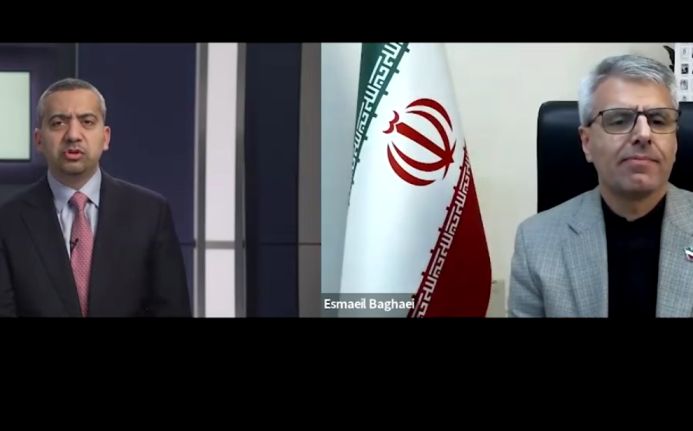
Editor’s Notes: In this exclusive interview, Mehdi Hasan speaks with Dr. Esmaeil Baghaei, the spokesperson for Iran’s Ministry of Foreign Affairs, as the conflict between the U.S., Israel, and Iran enters a critical phase. The discussion delves into the status of nuclear negotiations, the impact of recent military strikes, and the Iranian government’s perspective on human rights and domestic protests. Dr. Baghaei addresses allegations of war crimes and outlines Iran’s stance on regional security and potential future diplomacy. This conversation provides a rare, direct look at the Iranian leadership’s response to the ongoing international crisis. (March 28, 2026)
TRANSCRIPT:
Introduction
MEHDI HASAN: The US-Israeli illegal war on Iran is about to enter its fifth week. Iran is showing no signs of backing down or rolling over, while the Trump administration seems to be prepping for a ground invasion. Joining me now, as you can see here, is Iran’s spokesperson, its Ministry of Foreign Affairs spokesperson, Dr. Esmaeil Baghaei, to talk about the war, nuclear negotiations, human rights abuses and more. Dr. Baghaei, thank you for joining me from Tehran on Zeteo today.
DR. ESMAEIL BAGHAEI: Thank you. Thank you for having me.
Is Iran Winning the War?
MEHDI HASAN: We’ll talk about what actually happened in the nuclear negotiations — I know you were involved in last month between the US and Iran. We’ll talk about whether there’s any prospects for renewed diplomacy between the two countries. But I have to start first with the state of this war right now between the US and Israel on one side, Iran on the other. In your view, is Iran winning this war, losing this war, or in a tie? And if you say you’re winning, how does Iran define winning, define victory against the US?
DR. ESMAEIL BAGHAEI: I think we have already won this brutal war because, literally speaking, we have been in confrontation — to put it otherwise, the United States has been at war with Iran from 1979, when they opposed the Iranian revolution that was aimed at overthrowing the dictatorship. For the past 47 years, they tried everything: assassination, crippling sanctions, as they call it. And as you know, during the last months of the Iran-Iraq war, they also intervened militarily.
So this is another phase in their animosity toward Iranians, and it is mostly based on their miscalculation. And this time, everyone understands this is a war of Israel. They were dragged into this war again because of their miscalculation. I think the Iranians showed that they are determined, they are resolute in defending their homeland, because they understand that this is an unjust war of aggression imposed on Iranians. So the fact that for the past 27, 28 days we have been resilient — we have defended against two nuclear-armed regimes. They are technologically superior, they are very sophisticated. But we have learned how to live, survive and thrive under these critical situations.
Iran’s Conditions for Stopping the War
MEHDI HASAN: We hear a lot of experts saying that even if the US were to stop the war tomorrow, stop the bombing, Iran would not stop and has no interest in stopping this war until it establishes or re-establishes deterrence, until it has a guarantee that it won’t be attacked again in the future. Is that a fair description of the Iranian government’s position?
DR. ESMAEIL BAGHAEI: I think this is based on the past experiences we have had. Just look — for the past nine months we have been attacked twice while we were in the middle of negotiations. They attacked us on 13 June, while we were supposed to meet on 15 June. And for 12 days we had to fight back. And then after a few months, they said, “Let’s talk again.” We engaged in these negotiations, but they replicated the same pattern. On 28 February, they launched their aggression while we were supposed to meet on Monday in Vienna.
MEHDI HASAN: Talk about how do you stop that happening again.
DR. ESMAEIL BAGHAEI: That’s the point. We have to break this cycle — war, negotiation, ceasefire, and then repeating the same things again.
MEHDI HASAN: But what does that look like? What does a security guarantee for Iran look like, if that’s what you want?
DR. ESMAEIL BAGHAEI: I think the experience has shown that there is no security guarantee. We have to guarantee our security. We use all capacities we have in order to make sure that Israel and the United States will not attack Iran again.
Trump’s Claims and Iran’s Military Resilience
MEHDI HASAN: President Trump says he has completely decimated and beaten Iran economically and militarily. He says he has blown Iran off the map, which is obviously not true — it’s his typical hyperbole. But the US and Israel have degraded your military severely. They’ve destroyed huge parts of your infrastructure. Set Iran back years, if not decades. You’re not denying that, are you?
DR. ESMAEIL BAGHAEI: It reminds me of the first days of Saddam’s invasion of Iran. The first minutes they attacked Iran, they claimed that they had broken the bones of Iranians. Eight long years we fought back. And please remember those days — we were in the first days of the revolution, the previous system had collapsed, and we had to fight with minimum capacity and capability.
Today, Iran is a mature state based on the will of its people. For 47 years, we have learned how to subdue our enemies. This is not a new phase that we are fighting with the United States and Israel. We have gone through these experiences and we know how to fight back and how to survive this crisis.
Trump’s Claims About Iran “Begging for a Deal”
MEHDI HASAN: Just hours before we started this interview, Donald Trump posted on his Truth Social media website that Iranian negotiators — he called you “strange” and he said you are begging for a deal with the US.
Is he telling the truth?
DR. ESMAEIL BAGHAEI: Tell me how you can really believe this diplomacy, basically. Is there any diplomacy in this administration? They have betrayed diplomacy two times in the past nine months. So I think it would be insane for anyone to take what they say as believable.
We cannot simply ignore the experiences we had in the past nine months of negotiations with the United States. And again, I should remind your audience that we had a deal with the United States in 2015. But three years later, they withdrew from the deal unilaterally for no reason. And then we tried so many times to reinvigorate that deal. Every time, they move the goalposts, they degrade diplomacy. So that’s their fault. This is not Iran’s fault.
The Nuclear Negotiations at Geneva
MEHDI HASAN: So let me ask you about the nuclear negotiations. You’ve mentioned it a few times. How close was Iran to a nuclear deal — a new nuclear deal with the US — in Geneva, on the eve of this war? The Omani foreign minister said a deal was “within reach,” that there was an agreement on big issues like zero stockpiling and enrichment. But the IAEA chief, Rafael Grossi, has said there was a discussion, yes, but “no agreement at that point.” What’s the Iranian position on what happened at Geneva on the eve of this war?
DR. ESMAEIL BAGHAEI: I refer you to what was said by the Omani mediator. I think he was trusted by both Iran and the United States. Rafael Grossi was not part of that — everyone knows that. Rafael Grossi has always been simply on the side of the spoilers, unfortunately. But what Mr. Musaidi said was correct in saying that the deal was within reach. He characterized the negotiations as significantly progressive. And everyone — others, also the UK authorities that were involved in this process, not only in this process but were aware of the negotiations — also said that the flexibility shown by Iran was unprecedented. So everyone knows that.
Iran’s Flexibility: The Key Concessions
MEHDI HASAN: Just to be clear, Dr. Baghaei, just to be clear for our viewers who are not all nuclear experts — you say Iran was being flexible. Just give me the three top bullet points of what you had been flexible on at Geneva. What did you agree to with the Omanis?
DR. ESMAEIL BAGHAEI: First, they have been telling the world for the past four decades that Iran is at the verge of developing nuclear weapons. That’s a big lie, because our nuclear program has been safeguarded. We had the most sophisticated inspection regime on our nuclear program. You cannot find a single paragraph, a single report from the IAEA indicating that Iran’s nuclear program is deviating to weaponization.
Secondly, their concern was about Iran’s highly enriched uranium. We agreed to dilute it.
Thirdly, they were concerned about the accumulation of highly enriched uranium. We said that we would enrich uranium only in accordance with our needs. It would mean that there would be no accumulation of highly enriched uranium. So if their concern was truly about highly enriched uranium — which could be the necessary part of any nuclear weapon — that concern was simply removed.
MEHDI HASAN: Just to be clear, you had agreed to no stockpiling — I think the Omani phrase was of highly enriched uranium. Had you agreed to no enrichment? Because that was one of the US demands — zero enrichment.
DR. ESMAEIL BAGHAEI: Enrichment is part of every country’s right under the NPT. Iran has been part of the NPT from 1970. Iran initiated the Middle East free from nuclear weapons as of 1974. So if Iran is part of the NPT, if Iran is going to remain in that treaty, it should be able to benefit from the prerogatives. According to Article 4 of the NPT, Iran has the right to have nuclear capacity for peaceful purposes.
MEHDI HASAN: So what I’m hearing is that you hadn’t agreed to the US demand — many would say excessive, non-NPT demand — that Iran should do zero enrichment, but you had agreed to no highly enriched uranium in Iran. That’s what you’re saying. You were flexible on that.
DR. ESMAEIL BAGHAEI: Their main concern, as they said — yes, and we do not think that that’s really legitimate — but their alleged concern was about Iran keeping highly enriched uranium. We can address that by diluting it. And about Iran’s enrichment capacity, we said we would do it in accordance with our needs.
The 400kg Stockpile of 60% Enriched Uranium
MEHDI HASAN: So let’s talk about your needs, Dr. Baghaei. The IAEA estimated last year that you had a 400 kilogram stockpile of 60% enriched uranium, which is just a step away, as you know, from 90% weapons-grade enrichment — and enough for 10 nuclear warheads. Your critics often ask: why have 400kg of 60% enriched uranium if you weren’t planning on building nukes? What other reason would there be to enrich so high to 60%? What do you say to them?
DR. ESMAEIL BAGHAEI: This is another misrepresentation of facts. The fact that we have 400kg of highly enriched uranium doesn’t mean that we have a nuclear weapon.
MEHDI HASAN: I didn’t say that. I didn’t say that.
DR. ESMAEIL BAGHAEI: Why did we do that? Because in 2015 we had a deal, and Iran agreed to have just 3.67% enriched uranium, not above that. But in 2018, the United States withdrew from the deal. For one long year, we just waited for Europeans to compensate for the United States withdrawal. After one year, we decided to scale back our commitments because we couldn’t stay in a deal one-sidedly. So the reason why we enriched uranium to that level was simply to reciprocate the United States withdrawal from it. We never had any intention to make nuclear weapons. We have made that clear.
MEHDI HASAN: It was a negotiating tactic, a bargaining chip.
DR. ESMAEIL BAGHAEI: You can put it that way.
Kushner, Witkoff, and Future Negotiations
MEHDI HASAN: There has been reporting that Iran and Gulf countries even consider Steve Witkoff and Jared Kushner, the lead US negotiators, to be “Israeli assets” — that’s what the Guardian wrote — and that you, Iran, would now prefer to negotiate with Vice President J.D. Vance going forward. Is that the case?
DR. ESMAEIL BAGHAEI: We regard the United States as — so regardless of who —
MEHDI HASAN: Sorry, Dr. Baghaei. The internet is not great right now from Tehran. Could you start that answer again?
DR. ESMAEIL BAGHAEI: The point is that we are negotiating with the United States government as a sovereign nation. So regardless of who is representing the United States, the outcome was catastrophic because the United States could not really comply with their obligations in the first place. And secondly, they didn’t negotiate in good faith. And I think that’s very important, because negotiation in good faith is the basic principle of international law and international diplomacy.
MEHDI HASAN: With respect, you didn’t answer my question. Going forward, would you prefer to negotiate with the Vice President over Kushner and Witkoff?
DR. ESMAEIL BAGHAEI: I can tell you that the Iranians didn’t have a good experience with those envoys. I think it’s a sure thing. The Iranians cannot trust those who agreed to have another round of negotiations on Monday, and then just two days before that, launched an aggressive war against Iran.
Iran’s Nuclear Position and the Future of Deterrence
MEHDI HASAN: The late Ayatollah Khamenei, your former Supreme Leader, had a fatwa, a religious ruling banning nuclear weapons. In the early 2000s, Iran agreed in the 2015 JCPOA, the nuclear deal with President Obama, that it would never get nuclear weapons. The US intelligence community confirmed last year that Iran is not seeking nuclear weapons. I wonder, is all of that out of the window now? Is Iran now still willing to say we will never get nukes, or has this war changed everything? Are nukes now on the table a la North Korea?
DR. ESMAEIL BAGHAEI: I can tell you this shows that we are a nation of principle. We were sanctioned, we were attacked, our scientists were assassinated, our people were assassinated. But you cannot find any statement from our leaders saying that we would go for nuclear weapons. That means that we are a nation of principle. And it also shows that the Americans and Israelis were not really concerned about Iran’s nuclear weapons. That was simply an excuse. That was the past.
MEHDI HASAN: I’m asking about the future. Has that changed now?
DR. ESMAEIL BAGHAEI: Otherwise they would not have assassinated those who denounce nuclear weapons. About the future, I cannot judge about the future. But one thing is sure, is that again, Iran remains a nation of principle.
MEHDI HASAN: If Iran had nuclear weapons, you wouldn’t have been attacked. Many say that.
DR. ESMAEIL BAGHAEI: That’s the judgment of many. But as I said, even during the war with Saddam Hussein, we were gassed. Saddam Hussein used chemical weapons, generously given to him by Germany and other Western countries. But we were never allowed to use the same method of warfare. WMD is prohibited under our Islamic precepts and under our national values.
The US Peace Plan and Diplomatic Negotiations
MEHDI HASAN: Dr. Baghaei, the US reportedly sent a 15-point peace plan to Iran via Pakistan, calling for limits on your ballistic missile program, an end to your support for Hamas, Hezbollah, and the Houthis, and removal of all enrichment material. To be clear, has Iran definitively rejected that 15-point plan?
DR. ESMAEIL BAGHAEI: I’m not going to express any position on that. One thing I can tell you is that yes, we have received through mediators certain suggestions from the United States. Those suggestions are extremely maximalist and unreasonable, and I think I should stop at this. Talking about those things which are part of the inherent right of Iranians is not a sign of good faith or seriousness in any diplomacy. They have already tried that.
MEHDI HASAN: You’re describing American proposals as maximalist and unreasonable. Some would say yours are also maximalist and unreasonable. Iran has talked about American forces withdrawing from the entire Middle East, which, let’s be honest, is not going to happen. There’s reporting that Iran now plans to charge fees on ships that go through the Strait of Hormuz once it’s reopened. None of that is realistic or reasonable, is it?
DR. ESMAEIL BAGHAEI: Have you received any of these points you refer to as the official position of Iran?
MEHDI HASAN: So they’re not the positions of Iran, they’re what’s being reported by people in your government?
DR. ESMAEIL BAGHAEI: There have been many stipulations, many reports about different things. But one thing is clear. We have to make sure that the United States and Israel would not be in a position to attack Iran again.
MEHDI HASAN: How do you do that? I asked you at the start of the interview. I don’t understand how you do that.
DR. ESMAEIL BAGHAEI: We have to do it in practice. We have to make sure that the territory of our Arab brothers and sisters would not be abused to attack another country in the region. You know what happened, Mehdi, on the 10th of Ramadan. The countries, the territories of Muslims and Arab countries in the region were abused by the United States and Israel to attack another Muslim nation. And I think that’s a shame.
Relations with Gulf Neighbors
MEHDI HASAN: Do you worry that your neighbors, the Gulf neighbors who you’ve bombed — and the former ICC chief prosecutor says your attacks on the Gulf are illegal also — they are now, even if the war ends tomorrow, surely you’ve wrecked your relations pretty much forever with your Arab neighbors.
DR. ESMAEIL BAGHAEI: First, we didn’t bomb them. We didn’t attack them. We just defended ourselves against sources of aggression. Unfortunately, they allowed the United States and Israel to use their territories, their military bases, their assets to conduct their military aggression against Iran. This is both illegal and immoral. We attach high importance to our relations with every country in the Persian Gulf region and we are determined to continue relations. What else should we do? Accept their attack?
MEHDI HASAN: Do you worry that the Saudis and the Emiratis are going to join the war against you? The Emiratis have been making very hawkish noises. The New York Times is reporting that MBS, the Crown Prince of Saudi Arabia, is urging Trump to carry on attacking you. Do you worry that they’re going to join the war against you next?
DR. ESMAEIL BAGHAEI: Whatever is said in Western newspapers, we do not regard them as plausible, because we know that we feel no animosity toward any Arab Muslim country in the region.
MEHDI HASAN: I mean, they might feel differently. Iranian bombs are dropping on their countries. They might feel differently.
DR. ESMAEIL BAGHAEI: Please. Iranian missiles are launched against those military bases and assets that are being used by Americans and Israelis against Iran. Can you imagine that Muslim countries, Arab countries are taking the side of Israel — a genocidal regime that has already killed 70,000 innocent Palestinians — against another nation in the region? They have to be very careful. They have to understand that the outcome of this war could be the hegemony of a genocidal regime over the region. Support Iran. Instead of standing against Iran, Iran is fighting against the United States and Israel, and I think that must be recognized, because we are sacrificing not only for Iran, but also for the whole region, for the security of the region.
Iran’s New Supreme Leader and the Question of Governance
MEHDI HASAN: Let’s talk about Iran’s leadership. How do we know the new Supreme Leader of Iran, Mojtaba Khamenei, is even alive or in good health? We’ve not seen him in public since he was appointed. No videos, no audio.
DR. ESMAEIL BAGHAEI: He had a very important message on the eve of Nowruz. Alhamdulillah, he is well, and he is now the commander of the armed forces and our Supreme Leader.
MEHDI HASAN: Why can’t he come on TV like you have come on today?
DR. ESMAEIL BAGHAEI: You can understand the war situation, the threats. So I think we have every reason to be very careful, because —
MEHDI HASAN: Mehdi, he’s not injured or sick, because that’s what is also coming out.
DR. ESMAEIL BAGHAEI: He’s fine. He’s fine. This is not a conventional, classical warfare. This is a combination of terrorism and acts of aggression. And I think you cannot find a similar case in history where the leaders of a country — political leaders, diplomats — are killed or threatened by their enemies. So this is a nasty war imposed on Iranians, and I think every Iranian takes maximum precaution because of this situation.
MEHDI HASAN: That’s undeniable, what you’re saying about the assassinations. I’m not disputing that. You had massive protests in Iran back in January, demanding a change of government and, for many, an end to the Islamic Republic’s theocratic model of government. In particular, why does your government refuse to listen to the demands of the people? Why replace one unelected Supreme Leader who ruled for nearly 40 years with another unelected Supreme Leader who the Iranian people didn’t choose, had no say over? How is your country not a dictatorship?
DR. ESMAEIL BAGHAEI: This is not true. He is not an unelected leader. He was elected by the experts. An Assembly of Experts is elected by the people through polls. And this Assembly of Experts, as the authority, has the mandate to monitor the performance of the Supreme Leader. So he is appointed by the Assembly of Experts.
You refer to the protests. Yes. We had these protests mainly because of economic hardship, because of the sanctions. And then after a few days, after 10 days, it turned violent. I refer you to Western media that are now starting to recognize the facts, or to reveal the facts, that all this violence was propagated, was even orchestrated by the United States and Israel as part of their campaign to defame Iran and to destabilize the system.
The January Protests: Deaths, Crackdowns, and Accountability
MEHDI HASAN: Well, let’s talk about that. You’re saying two things at once, and I think two things can be true at once. It is undeniable that the Israelis were trying to incite protests inside of Iran. The Financial Times has reported on that. The Israelis themselves have said that. So I’m not disputing that outside powers were trying to foment unrest and incite protests.
But you’ve also admitted that these protests were legitimate demands against economic problems. Your president said in December these were legitimate demands. And then you cracked down on these protesters. Some people say 30 to 40,000 people were killed — that’s seen as the higher end. Others say 3 to 4,000. I think your own government has admitted that thousands died. How many people were killed in these protests in January, according to you?
DR. ESMAEIL BAGHAEI: I think 30 to 40,000 — some put it at 70,000 — to match it with the number of Palestinians killed in the genocide.
MEHDI HASAN: Put aside what your critics say. I’m asking what you think. How many do you think were killed?
DR. ESMAEIL BAGHAEI: 3,170 persons were killed. And I should say that every single life matters for us. 2,400 of them were regarded as martyrs because they were either police officers or bystanders. But I should —
MEHDI HASAN: Hold on, hold on. Your government figures suggest — I think it’s 3,117 is what the Iranian government put out, 200 security forces. So who killed all of the other civilians?
DR. ESMAEIL BAGHAEI: As I said, many of them were killed by government infiltrators inside the protesters.
MEHDI HASAN: How many were killed by your government?
DR. ESMAEIL BAGHAEI: I don’t have the figure.
MEHDI HASAN: It’s a pretty big issue for Iran. It’s been the biggest —
DR. ESMAEIL BAGHAEI: Yes, it is.
MEHDI HASAN: So how can you not know how many people your government, your security forces, killed?
DR. ESMAEIL BAGHAEI: I don’t have that information. But for sure, the security authorities are aware of that and it is being investigated. But one thing is sure, that the protest, which was peaceful and driven by economic problems, was turned violent because of the American and Israeli involvement. And this is what they themselves confess to.
MEHDI HASAN: So you say. Let me ask you this. When leading human rights groups like Amnesty International accuse your government of, quote, “massacring protesters,” when they say they have reviewed — and I’m quoting here — “verified videos and eyewitness accounts” of, quote, “security forces positioned on the streets and on the rooftops of buildings, including houses, mosques and police stations, repeatedly firing rifles and shotguns loaded with metal pellets at protesters, frequently targeting their heads and torsos” — when Amnesty, no friend of the US or Israeli governments, when Amnesty says that, Dr. Baghaei, why should we believe your government and not Amnesty?
DR. ESMAEIL BAGHAEI: Why should we believe Amnesty and not —
MEHDI HASAN: They’ve documented the evidence. You’re saying you don’t even have the numbers. They’ve provided evidence, verified videos and eyewitnesses.
DR. ESMAEIL BAGHAEI: You can simply see many of those so-called evidence and videos being provided to them by Israeli and United States sources.
MEHDI HASAN: They haven’t been provided by Israel. Israel in fact criticizes Amnesty the same way you do. I’ve interviewed Israeli officials and they accuse Amnesty of fake evidence. You sound, I’m sorry to say, like an Israeli official denying what happened in Gaza. These are eyewitness accounts, doctors’ accounts, videos.
DR. ESMAEIL BAGHAEI: You compare Iran’s treatment of protesters to Gaza? Come on.
MEHDI HASAN: No, I’m comparing your response — denying a human rights group. I’m not quoting the US or Israeli governments. I agree with you, the US and Israeli governments are not reliable when it comes to Iran. I’m quoting an independent human rights group.
DR. ESMAEIL BAGHAEI: I’m not sure they are independent. Otherwise they would have come and told the stories of many innocent Iranians that have been killed during the past 27 days. They didn’t.
So what I’m saying is that, in all honesty, the government, the president’s office, published the names of those who were killed during these protests. And we were transparent to say that they were killed by whom. We said that 2,400 of them were regarded as martyrs because they were killed either by gunmen — they were either police officers or innocent bystanders. And you can say that yes, 600 of them were either the infiltrators or those gunmen.
MEHDI HASAN: But what about the eyewitness accounts of people being brought into hospitals, heads and faces shot full of pellets by Iranian security forces? Human Rights Watch have documented that. Amnesty International have documented that. Multiple media outfits have documented that. You’re saying all these eyewitnesses are lying? It’s all fake?
Iran’s Use of Cluster Munitions and the Threat of Ground Invasion
DR. ESMAEIL BAGHAEI: I’m not saying all of them are lies. I have to see them. And I’m sure that our authorities are taking care of every report that has been produced implicating our security forces.
MEHDI HASAN: Well, you couldn’t give me the numbers earlier, so I’m not sure. I’m not sure it has been that full an investigation. Before we run out of time, let me ask you about another important issue.
DR. ESMAEIL BAGHAEI: I’m the spokesman of Ministry of Foreign Affairs. That I do not know exactly — what I told you the numbers that I do not know exactly. The number of those people who have been killed by others doesn’t mean that we don’t have. You have to talk to the spokesperson of the Ministry of Interior, the security people.
Cluster Munitions and International Law
MEHDI HASAN: Well, let me ask you about something a Foreign Ministry spokesman should know about — another human rights claim. The US bombing a girls school. Israel bombing residential buildings and power plants in Iran. Those are war crimes. Undeniably. We have said so at Zateo. What the US and Israel is doing in Iran are war crimes. But Iran is also using cluster munitions against Israel, which are indiscriminate, they cause a lot of civilian casualties. And again, Amnesty International human rights group has previously called the use of such munitions a flagrant violation of international humanitarian law. Dr. Baghaei, how can you condemn the US and Israel for breaking international law if you’re doing it too?
DR. ESMAEIL BAGHAEI: How many. How many people have been killed by those so called cluster ammunitions?
MEHDI HASAN: Why are they so called?
DR. ESMAEIL BAGHAEI: Because I cannot confirm that.
MEHDI HASAN: Well, you’re denying the use of cluster munitions, but in any case, evidence of — you see, and you asked me a question, by the way. Three Palestinian women in the occupied West Bank were killed last week by a direct hit from what the Israeli military say was an Iranian cluster munition missile.
DR. ESMAEIL BAGHAEI: They are saying that.
MEHDI HASAN: So who killed the three Palestinian women? I mean, the Palestinian Red Crescent is saying that — that is a Palestinian group, not an Israeli group.
DR. ESMAEIL BAGHAEI: But I can tell you that Israelis are professional liars.
MEHDI HASAN: What about the Palestinian Red Crescent? What about the Palestinian Red Crescent which says these three women were killed by fragmentation from an Iranian missile in the West?
DR. ESMAEIL BAGHAEI: We have to investigate that. Okay, but one thing is for sure, only in one single act of war crime, as you put it correctly, 175 innocent kids and teachers were killed. But this was not a single accident. They have been attacking many residential areas. Even our Red Crescent society was targeted by the United States and Israel. So this is a pattern of their war tactics, their war strategy. So you cannot compare.
MEHDI HASAN: I’m not disputing that. I was asking about your tactics. Why use cluster munitions if you are, as you said earlier in the interview, a country of principles? Those are banned under customary international law and the 2008 Convention on Cluster Munitions. I know you haven’t signed them, but that has the weight of international law.
DR. ESMAEIL BAGHAEI: We are 100% compliant with our obligations under international law.
The Threat of a Ground Invasion
MEHDI HASAN: Last question I have to ask you. There’s chatter here in D.C. that we could see a ground invasion of Iran. Whether it’s Karg Island, whether it’s Iran proper, the mainland, as early as this weekend, maybe. We know Donald Trump likes to do things at weekends. Are you prepared for that? What will the Iranian response be to a ground invasion by the most powerful armed forces in the history of the world?
DR. ESMAEIL BAGHAEI: You see, this is our homeland and we have to stay strong and we have to fight back. I’m sure that our armed forces are prepared for every scenario. Do we have any other choice other than fighting back the invaders? This is our war and I’m sure our people are determined and united to fight against any such scenario.
A Message to the American People
MEHDI HASAN: What is your message to Donald Trump today?
DR. ESMAEIL BAGHAEI: I do not have any message to the American authorities, but to the American people. I think this is a war of whims. This is not the war of American people against Iranian nation. This is a war that the United States is dragged into by Israel. This is a war that is imposed on the region. Iran has nothing to do with the consequences, the calamity that this war has brought upon the region and on world economy. The United States must be held accountable for all the consequences. So this is a war of choice by the United States against a civilizational state, against a civilization that was in diplomatic process with the United States to resolve their differences.
MEHDI HASAN: Dr. Esmaeil Baghaei from the Iranian Foreign Ministry. We appreciate you taking my questions in the middle of a war. Thank you for your time.
DR. ESMAEIL BAGHAEI: Thank you. I appreciate it.
Related Posts