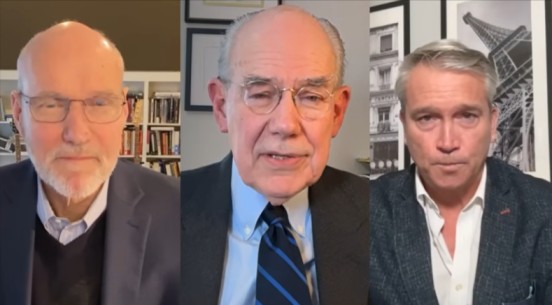
Editor’s Notes: In this discussion, host Tom Switzer joins renowned scholars John Mearsheimer and Stephen Walt to analyze the escalating tensions between the United States and Iran. The conversation explores the strategic challenges facing the Trump administration as it navigates a conflict that threatens global energy markets and economic stability. By examining Iran’s leverage over critical maritime routes like the Strait of Hormuz, the experts highlight the complex geopolitical consequences for U.S. allies and rivals alike. This video offers a critical perspective on the shifting dynamics of power in the Middle East and the difficulties of securing a lasting peace deal. (March 29, 2026)
TRANSCRIPT:
Introduction
TOM SWITZER: Hello and welcome to Switzerland. I’m Tom Switzer. Always great to have your company. Our two guests today, Professors John Mearsheimer from the University of Chicago and Stephen Walt from Harvard University. John, Steve, always great to see you both.
STEPHEN WALT: Nice to see you. Great to be here.
Trump’s Claims of Negotiations with Iran
TOM SWITZER: Now, President Trump has paused his threatened destruction of Iranian power plants until April 6, and he’s claiming that detailed and productive negotiations with Tehran are underway. Of course, the Iranians categorically deny this. John, what’s going on?
JOHN MEARSHEIMER: Well, the fact is that the Iranians have a deep seated interest in continuing this war because it’s going very well for them. And the longer the war goes on, the more leverage they have. President Trump, despite what he says in public, surely understands that things are not going well and he’s looking for an exit ramp. And he believes that he can work out a deal, or he hopes that he can work out a deal with the Iranians, that allow him to put this war to an end on reasonably favorable terms for the United States. But again, I don’t think that’s going to happen because the incentive structure for the Iranians points in the other direction.
TOM SWITZER: John, let’s just get this straight on the issue of negotiations. The President of the United States has asserted his government is doing negotiations behind the scenes with the Iranians, but the Iranians deny this, and there is global uncertainty about whether to accept Washington’s version or the version put out by Tehran’s leaders. That’s a strange state of affairs, isn’t it?
JOHN MEARSHEIMER: I think you misspoke, Tom. I don’t think there’s global uncertainty. I think there’s global certainty that President Trump is lying.
TOM SWITZER: Yeah.
STEPHEN WALT: Can I add something here, Tom?
TOM SWITZER: Sure.
STEPHEN WALT: There are several countries that have been rumored to be involved in some kind of mediation effort, in particular Pakistan. And none of them have been saying that there are serious talks underway. It’s possible that they’ve been exchanging some messages back and forth, but the idea that there’s serious negotiations actually happening, I think, is a fiction.
Is the War Going Well? The Strategic Reality
TOM SWITZER: It’s a fiction, Steve. Max Hastings, the distinguished British historian who has been a guest on this program, he wrote over the weekend that when Trump says the war is almost won, nobody knows whether this is a prelude to a fresh bombardment, a ground invasion, or a ceasefire. What do you make of all that?
STEPHEN WALT: Well, I think that’s consistent with, first of all, the run up before the war, where we were told there were negotiations underway right up until the moment that we started bombing — we and the Israelis started bombing. I think it’s evidence here that the administration is also flailing around a little bit. They didn’t have a plan. They assumed this was all going to go very well from the very beginning and be over with the regime collapsing. That hasn’t happened. So now they’re improvising.
And just to amplify what John said a moment ago, the reason the Iranians have such an incentive to keep this going is they’re essentially trying to restore deterrence. They want the United States to pay a large enough price for this that we’ll learn not to do this sort of thing into the future. And until they’re confident that they’ve re-established deterrence, they’re likely to keep this going.
TOM SWITZER: And we should stress, just so that we’re all on the same page here, that before February 28, before the strikes started, Iran controlled a mere 4 to 5% of the world’s crude oil exports, which is essentially its own output. But by blockading the Strait of Hormuz, Tehran now controls something like 20% of the world’s oil and LNG, the liquefied natural gas, which is your point — both of you have made about Iran’s strategic leverage. John, where does all this leave Trump?
JOHN MEARSHEIMER: Well, Trump is looking for an exit strategy. He’s looking for an alternative to conceding defeat, and he can’t find one. And in the meantime, what’s happening is we’re walking up the escalation ladder slowly but steadily. And the problem that he faces there is that the Iranians hold most of the cards as you go up the escalation ladder, and we don’t have escalation dominance. And in fact, as you go up the escalation ladder, the threat to the global economy increases markedly.
So we’re in a very precarious position as we march up the escalation ladder. And this just creates greater pressure to find an exit strategy, to find some sort of way we can live with the Iranians. But the Iranians, again, as I said at the beginning of the show, have an incentive not to cut a deal now, in good part for the reasons that Steve just laid out. So Trump is between Iraq and a hard place. And I would argue that what might happen — one could argue is even likely to happen — is that the economy threatens to go off a cliff and Trump has no choice but to cut a deal with the Iranians on terms that are favorable to them, not the United States.
Trump’s April 6 Deadline and the Question of Escalation
TOM SWITZER: Well, I was just going to say, Steve, when Trump’s April 6 deadline is up and we assume that Iran won’t surrender, that it won’t accept this — what’s it called, a 15 point framework plan that the Americans have put to the Iranians — if the Iranians won’t relinquish control of the Strait of Hormuz, and just assume that Tehran keeps attacks on Israel and the Gulf states after that deadline passes on April 6, Steve, what does Trump do?
STEPHEN WALT: Well, I think we’ve all learned to not try and predict too much about what he’s going to do, but he will face the decision of: does he move up the ladder, does he try something else?
Maybe inserting ground troops in various places, maybe another round of strikes on more targets, although of course the administration claims they’ve already destroyed almost anything that’s worth destroying. So it’s not clear exactly what more he can do.
He can go after power plants, but of course the Iranians will retaliate in various ways against other Gulf states. And it doesn’t solve the larger problem, which is reopening the straits so that oil can flow out to markets, along with all the other things that are bottled up inside the Strait right now. So none of these things actually solve the larger problem, which is the prospect of severe economic damage around the world.
The Ground Troops Question
TOM SWITZER: More than 3,000 Airborne and U.S. Special Forces troops — they’re preparing for operations on Iranian territory and they’re set to join 5,000 US Marines already closing in. John, many of the defenders of the war — and we’ll get to them in a moment — but they say all this will be a geopolitical game changer that’ll change the tide of the war and diminish Iran’s strategic leverage.
JOHN MEARSHEIMER: This is delusional. We went into Iraq with a couple hundred thousand troops, and most of those troops were in mechanized infantry divisions and in armored divisions. In the first Gulf War, back in 1991, we went in with over 700,000 troops — again, mechanized infantry divisions and armored divisions. Now we’re talking about going into a country that is far bigger than Iraq, has many more people than Iraq, and has daunting terrain, and we’re going to go in there with 10,000 or so light infantry and make a difference. This is a laughable argument. This tells you a great deal about the state of the discourse in the United States and in the West more generally about what’s going on in Iran.
TOM SWITZER: So you don’t think that Washington is capable of stopping Iran from exporting oil from Kharg Island and through the strait?
JOHN MEARSHEIMER: Are they capable of stopping them? They don’t want to stop them. We want them to export oil. You have to understand that we are marching toward the cliff in terms of the state of the international economy. We don’t want to go off the cliff. And to avoid that, we have to get as much oil as possible out into global markets. That’s why we took sanctions off the Russians and we have taken sanctions off the Iranians. And furthermore, we are letting the Iranians ship oil from Kharg Island through the straits out into the global markets. Why in God’s name would we now cut off the flow of that oil when it’s likely to have disastrous economic consequences?
TOM SWITZER: Steve, is that your sense, too?
STEPHEN WALT: Absolutely. I mean, gaining control of Kharg Island, or even worse, destroying Kharg Island, would be shooting ourselves in the head for the reasons John just laid out. It doesn’t solve their problem at all. And the fact that people like Lindsey Graham — the senator who’s very pro-Trump, very pro-war — keeps advocating things like this, just tells you how little he really understands about the situation we’re in.
JOHN MEARSHEIMER: Tom, just very quickly, you want to remember when President Trump bombed Kharg Island, he bombed it once. He went to great lengths to say that we only struck at military targets, not the energy infrastructure, because again, he understands the importance of getting that Iranian oil out into global markets.
Defenders of the War and the “Defeatist” Charge
TOM SWITZER: So both of you are saying that Trump’s range of options vary only between bad and worse. Steve, going back to the defenders of this mission — and I think of the award-winning columnist Bret Stephens at the New York Times, past guest on this program, the Wall Street Journal editorial page, General Jack Keane, who’s on Fox News every few hours defending the war, saying that it’s going well. And I know this from firsthand experience. I had an article in the Australian newspaper just the weekend, more or less making your points, and the online commentary was overwhelmingly critical. They say that people like Stephen Walt, John Mearsheimer, and Tom Switzer are defeatist, that they’re appeasers.
And their main argument, though, is that the war has been going for just one month, yet Iran’s air force, navy, command and control capabilities — they’re already on their knees. As Pete Hegseth, the Defense Secretary, says, the US controls the skies of Iran. Your response, Steve?
STEPHEN WALT: Sure. Well, remember Clausewitz’s famous line that war is the continuation of politics by other means. War is not about who can blow the most things up. War is about which side can impose its will, can dictate the terms, can control the politics. And the fact that we’ve been able to damage Iran’s capabilities in a variety of ways doesn’t mean that we’re winning.
We won every battle in the Vietnam War against the North Vietnamese. We lost the war. The Taliban never defeated the US Military in open combat. Neither did the Iraqi insurgency, and we lost both of those wars. It’s really about politics. And the thing to remember here is this war is not a vital American interest. This was a completely optional war. We didn’t have to fight this. Our security, our independence wasn’t at stake.
For the Iranian regime, this is existential. This is their survival. They have enormous resolution here. They have every reason, every willingness to pay a much larger price than we are, which is why you see Trump, of course, now flailing around trying to find some way to get out of it before the American economy takes a hit — on a war that didn’t have popular support before it started and has even less now. So the idea that we’re winning this in any kind of strategic or political sense, I think, is laughable.
The Houthis and the Red Sea Threat
TOM SWITZER: And that brings us to the role of the Shia ally of the Iranians in Yemen. John, what’s the significance of the Houthi attacks in the Red Sea over the weekend?
JOHN MEARSHEIMER: Well, there are two ways to think about the Houthis. One is that they can launch ballistic missiles and drones at Israel. And that’s what happened. And that’s not of great consequence to us. The second thing they can do, which is of great consequence, is they can stop the flow of oil out of the Red Sea. As Steve pointed out before, 20% of the world’s oil comes out of the Persian Gulf. Another 12% comes out of the Red Sea.
TOM SWITZER: There’s a lot of Saudi oil exports too, correct, John?
JOHN MEARSHEIMER: Exactly. In fact, the Saudis have been increasing the amount of oil they export through the Red Sea, given that they can’t export any more out of the Persian Gulf. But the point here is 20 plus 12 is 32. And the consequences for the international economy of cutting off 32% of the flow of oil from the Middle East would be disastrous, and it’s the last thing we want. But the Houthis — it’s very important to emphasize, Tom — the Houthis have not done that yet. They make it clear that that is a serious option, but they have yet to say we have shut down the strait at the bottom of the Red Sea.
TOM SWITZER: Well, Steve, do you think the Red Sea could become the new Strait of Hormuz?
The Risk of Economic Catastrophe
STEPHEN WALT: Yeah, no, I think that that’s certainly a possibility. The Houthis have made it clear that that’s one option they’re considering. I just want to remind, actually, the listeners that this illustrates another tendency one ought to keep in mind, that is, the longer wars go on, the more they tend to expand, the more they tend to get bigger. The participants keep looking for new ways to try and bring more pressure to bear on the adversary. Third parties start getting involved either to help one side or the other or to exploit it in some other way, take advantage of the fact that we’re distracted.
So the longer this goes on, the more likelihood that you see complications arising in a variety of other places, both within the region, but also possibly in some other parts of the world. It’s very much in everyone’s interest to get this shut down as quickly as possible, but that’s not going to be easy to do.
TOM SWITZER: So just to clarify here, the intervention by the Houthis in the Red Sea, this raises, I mean, this could raise the risk of both routes. So both the Strait of Hormuz and the Red Sea, they could become largely impassable. I mean, that is really something to contemplate. But at the same time, John, as you know, the president has flagged the idea of withdrawing from this operation in coming weeks, shutting it down, if you like. But if that’s the case, what does Iran do in response? John, if Iran has sent off the US, would they keep the Strait of Hormuz closed?
JOHN MEARSHEIMER: Well, first of all, it’s almost impossible for the United States to walk away from the Middle East. I mean, the Middle East is an area of great strategic importance because of the oil and furthermore because of Israel. And the idea that we just would abandon it flat out is almost unthinkable to me.
TOM SWITZER: No, I was talking more about Trump pulling out of the operation in Iran.
JOHN MEARSHEIMER: Well, the Iranians still have a vested interest in keeping pressure on the United States and other countries around the world until they get a deal that they like. I mean, it’s like giving up the straits. I don’t think the Houthis will give up the straits until almost all the sanctions are lifted. You want to understand that we have inflicted an enormous amount of economic pain on the Iranians with our sanctions. Well, we’re not going to lift those sanctions. I don’t.
TOM SWITZER: I was going to say, can you imagine President Trump going to Congress asking for sanctions relief to Iran? No.
JOHN MEARSHEIMER: In fact, if you look at the negotiations that were taking place before February 28, they always inserted the word “international” before the word “sanctions.” They were taking the international sanctions off, and the reason was that they couldn’t take the American sanctions off. So I understand exactly what you’re saying, Tom, but if you’re playing the Iranian hand and the Americans don’t want to do anything to take off the sanctions, at least in any meaningful way, it’s in your interest to keep control of the straits, make money by controlling the straits, and put pressure on the United States and its allies to take off the sanctions.
The Dilemma of Ending the War
TOM SWITZER: Steve, you talked about the Americans wanting to shut this down as soon as possible. But if the Islamic Republic survives, and that seems increasingly likely, if Iran keeps its nuclear program or is able to still enrich uranium and it keeps its ballistic missile capabilities, and it controls the strait, and meanwhile the Houthis control the Red Sea, how on earth could the United States end the operation against Iran?
STEPHEN WALT: Well, that’s exactly the dilemma that the Trump administration is facing, that having started this thing, they’ve created a set of circumstances that now are very hard to walk away from. I can imagine, again, if we really are facing the prospect of an economic disaster, that the Trump administration will find something that they can point to as a victory. Perhaps the fact that they were able to eliminate the ayatollah, say that, get rid of the person they keep calling the most evil leader on the planet and argue, try to convince people that that’s sufficient. I don’t think it will convince very many people.
And at that point, I think they have to hope, and again, with fingers crossed, that the Iranians will not try for much more, that they will ultimately be satisfied at having humiliated the United States, demonstrated our inability to impose our will upon them, and begin to try and restore sort of more normal relations and then rebuild their own capabilities so that they can credibly threaten to do this again if we come after them. I don’t know if they’re going to do that, but that’s, I think, what you have to hope for here.
Energy Markets and the Global Economy
TOM SWITZER: Yeah. Let’s turn to the likely consequences of the US-Israeli actions here. And I just want to start with energy, John. As you know, energy markets are already showing serious signs of strain. You’ve got price increases, local disruptions and all of that. But John, what would a sustained disruption to energy flows coming out of the Gulf mean? Just walk us through that process.
JOHN MEARSHEIMER: Well, first of all, you want to remember it’s not just energy flows, it’s also fertilizer. And one could make an argument that fertilizer not coming through the Gulf is worse than oil not coming through the Gulf because that will have a catastrophic effect on the food supply in the world and have devastating consequences in the developing world.
TOM SWITZER: And one third of fertilizers in the world come through this strait, correct?
JOHN MEARSHEIMER: That’s right. One third. The potential for disaster here is just not to be underestimated. But to go to your question about oil, the fact is that 20% of the world’s oil comes through the Gulf. And if you look at the number of container ships that have come through the Gulf since the war started on February 28, it’s about 5% of the number that was coming through the Persian Gulf on February 27th. Just think about that. This is going to have huge consequences. It’s already having huge consequences all around the world.
TOM SWITZER: Well, this is why the markets are so jittery, correct?
JOHN MEARSHEIMER: Absolutely. And then you get back to our discussion from a few minutes ago about shutting down the Red Sea. Furthermore, this has a cumulative effect. It’s just very important to understand that most people will tell you that no matter when they shut down this crisis, if they do it tomorrow, it’s still going to have significant negative effects on the world economy for a couple of years to come. That’s if you shut it down tomorrow. But there’s no sign that this is going to be shut down soon and the consequences are just going to multiply over time.
And I think you’re staring at a problem that looks worse than the one we faced after the 1973 oil crisis. And there you had stagflation all around the world, including in the United States, for a significant number of years. There are some people who argue we have never fully recovered from that oil crisis. So if this one continues to go on, one can imagine a situation where you have consequences, economic consequences that are —
TOM SWITZER: — worse than ’73, like the Titanic heading towards the iceberg. John?
JOHN MEARSHEIMER: Yeah, I like to use that argument. I mean, one can never be certain as to exactly where this is headed. As Steve and I know as students of international politics, there’s a lot of uncertainty surrounding various policies that states pursue. This gets back to going to war. War is in many ways a crapshoot. This is one of Clausewitz’s main arguments. When you start a war, you really can never be too sure what you’re getting into. Donald Trump, by the way, should have remembered that on February 28th when he rolled the dice.
But the same thing is true with the economy. There are some people out there who are very knowledgeable who tell complete horror stories about where we’re heading. Can you say that they’re right with any high degree of certainty? No, but they may be right. And you just don’t want to take a chance if you’re Donald Trump. That’s why I think the pressure on him, Tom, just to finish here, I think the pressure on him to sort of figure out how to get out of this is going to be enormous over the next couple of weeks.
The Impact on US Allies
TOM SWITZER: Yes, yes. And we should remember that the United States is energy independent, so they might weather a global economic storm. But what about US allies? I mean, already we’ve got a sense from allies and partners that they’re being asked to bear the consequences of what they believe was an avoidable, ill-considered and poorly executed mission. Steve, what does all this mean for America’s European partners? NATO?
STEPHEN WALT: Well, first of all, the United States is not insulated from the economic effects because the price of oil going up goes up in the United States as well. But I think the effect on many of our allies, particularly those who are heavily dependent upon energy imports, including imports from the Gulf, are going to be very adversely affected. And notice, the European economies have not been in great shape. This is a moment where they’re having to spend lots more on defense because they no longer have much confidence in the United States. They’re still concerned about Russia and they’re still concerned about Ukraine. Same thing is happening in Asia in countries like South Korea and Japan, where the United States has been pushing them very, very hard to spend more on defense, etc. Well, this is a huge shock to them. It’s a huge blow to their economies.
And of course, they weren’t consulted about this, they weren’t asked their opinion if they thought this was a smart idea. So in addition, they’re being sent the message that in fact, this administration actually doesn’t care very much about them, went to war in the Middle East, did enormous damage to their economies and didn’t even think about how it might be affecting them. And I think when you think about the long-term political consequences of this, it’s just more evidence that the United States both can’t be trusted to be reliable, but even worse, can’t be trusted to be competent. And you don’t want to have to trust for your protection on an incompetent and unreliable partner. Again, I think the ripple effects of this over time are going to be quite significant.
The Sunni Gulf States and the War’s Endgame
TOM SWITZER: John, Steve mentions that Brussels was not consulted before the strikes, but America’s Sunni Gulf partners were consulted and none of them wanted this war. But now that the war against Iran has been started, we’re now well into a month, the Sunni Gulf states want to make sure they have a say, a controlling say as to how this war ends, because they don’t want a situation where Iran will continue to weaponise these two major routes, the Strait of Hormuz and the Red Sea. That’s a lifeline for their societies and their economies. So how do America’s Sunni Gulf partners — I’m thinking of Saudi Arabia, UAE, Kuwait, and so on and so forth — how do they respond? John?
JOHN MEARSHEIMER: Well, actually, you see something of a division among them at this point. Oman and Qatar have clearly signaled to the Iranians that they want no part of a war against Iran and they want to stay out of it. The UAE has looked quite bellicose and quite enthusiastic about pushing the United States to use ground forces and to up the ante in recent weeks. But actually I just saw some evidence that the UAE is beginning to back off because the Iranians have told the UAE that if you join with the Americans in any meaningful way, we’re going to come in and blast you. And they’re well aware now that that is within the capability of Iran, given all the short-range ballistic missiles and drones that it has. So the UAE is even beginning to back off.
It looks to me like Saudi Arabia is the one country, maybe Kuwait as well, that continues to want the United States to up the ante. But all I would say is, and I think both of you would agree with me, from a strategic point of view, it’s crazy for these Gulf states to push the United States to up the ante and to talk about joining with the United States against Iran. Iran has the capability to do egregious damage to every one of these states. They should be asking the United States to put an end to this war immediately, not asking the United States to escalate.
TOM SWITZER: Yeah, but hang on. Putting an end to the war, John, just to keep you on your toes here, would mean at least trying to come halfway to meeting Tehran’s demands of reparations, sanctions relief that we mentioned earlier and a commitment by Israel and America to never strike Iran again. That seems inconceivable.
The Asia-Pacific Dimension: China and Russia as Beneficiaries
JOHN MEARSHEIMER: Tom, what you want to understand here is that given the genius of President Trump and his advisors, they’ve put him in a situation where that is the only viable choice they have left. You cannot go up the escalation ladder here. You’re not going to win. And the potential for economic disaster is huge.
So what are we going to do? We’re going to end up eating crow, to use a phrase that we used to use when I was a kid. We’re going to end up eating crow. That’s what you’re saying. And you’re saying that’s unacceptable. So I say to you, what’s the alternative?
TOM SWITZER: Yeah, yeah. Bad and worse. Steve, we’ve dealt with the European allies, the Sunni Gulf partners. Let’s turn just quickly to East Asia, the Indo-Pacific, where there’s been that diversion of high-end systems such as THAAD and the Patriot missiles away from Northeast Asia to the Persian Gulf. How do you read the Asian, the Asia-Pacific response to this crisis?
STEPHEN WALT: Well, again, they have the same reaction as our European allies. This was not their idea. They weren’t consulted about it. And it’s a sign that the United States doesn’t consider them nearly as important as it should.
I mean, given that China is ultimately the long-term problem for the United States, the big strategic problem is China, then our allies in Asia are of critical importance because the United States is not an Asian power. We need to have strong partners there in order to be an effective balancer against a rising China.
And what we’ve now signaled, what the Trump administration has now signaled to these countries, is that they’re way down the list. We don’t need to worry about their economic concerns. And when necessary, we’ll pull systems that are deployed in Asia to defend them. We’ll pull them out and send them to the Middle East to defend Israel or to defend other countries as well.
So again, the message we have sent, I think unintentionally but unmistakably, is that these countries can’t rely on this administration to have their strategic interests at heart. Now, it’s possible some future administration can rebuild confidence in the United States. But I think we’ve done enormous damage to our situation in Asia. And that will become clearer and clearer over time.
The Pivot Away from Asia
TOM SWITZER: John, as you well know, President Obama, Trump first, Biden, and even Trump second was supposed to pivot to Asia to help contain China. That’s clearly not happening. Does this mean that China could very well emerge as the Iran war’s biggest beneficiary?
JOHN MEARSHEIMER: Well, it’ll be a competition between Russia and China, because you don’t want to underestimate how this war has worked to Russia’s advantage. First of all, we’ve taken economic sanctions off Russian oil, which is allowing them to sell lots of oil and make lots of money.
And you want to remember when we started the war in Ukraine — and I do believe we are principally responsible for starting it — when we went to war back in 2022, we were going to put wicked economic sanctions on the Russians and bring them to their knees. Now we’re taking those sanctions off.
Furthermore, the flow of weaponry to the Ukrainians is going to diminish over time because that weaponry is now going to the Middle East. And this is to Russia’s advantage for all the obvious reasons.
With regard to China, it’s going to increase its influence in the Gulf. Once this war is over with, countries like Saudi Arabia and others are going to look to China much more so than they have in the past. It’s going to improve China’s diplomatic situation all over the world. But most importantly, as Steve was saying, basically what we are doing here is not pivoting to Asia, but pivoting away from Asia. This is manna from heaven for the Chinese. Couldn’t ask for anything better.
STEPHEN WALT: Yeah. I just want to add an additional point to that, and that is there’s this old line of Napoleon’s: “Never interrupt an opponent when they are making a mistake.” And so Beijing must be looking at this as just a wonderful development, particularly because they have been trying to represent themselves for a long time now as a predictable, stable, reliable force in favor of world order — not starting a lot of wars, not getting involved, not trying to overthrow other governments, someone you can do business with even if you don’t agree with them on everything.
And of course, this just reinforces that image. We look like the rogue elephant that’s causing trouble all over the place, and the Chinese look like they’re responsible stewards of a stable world order. That’s going to be a great boon to their diplomacy going forward.
Closing Remarks
TOM SWITZER: So a war that was meant to destroy the Iranian regime and seriously set back their backers, China and Russia, looks like it could embolden not just Iran, but also China and Russia. Steve, John, to be continued. Thanks so much. We’ll do this very soon. And next time, we’ll address what all this means for Israel. Thanks so much.
Related Posts