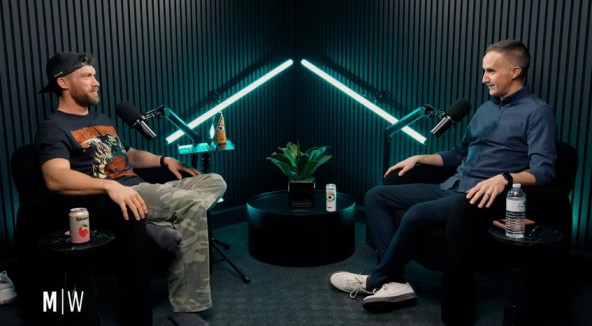
Editor’s Notes: In this episode of the Modern Wisdom podcast, bestselling author Morgan Housel explores the psychological underpinnings of wealth and the “unexpected laws” that govern our financial behavior. He discusses how spending habits often serve as a window into our deepest insecurities and ambitions, rather than just a reflection of net worth. The conversation shifts to redefine true wealth as the ability to control your time and choose meaningful problems to solve, rather than simply accumulating assets. Housel and Williamson also touch on the generational shifts in finance, arguing that the ultimate goal of building wealth is to provide a better, more flexible life for the next generation. (Feb 5, 2026)
TRANSCRIPT:
CHRIS WILLIAMSON: You are my favorite writer.
MORGAN HOUSEL: Thank you.
CHRIS WILLIAMSON: You have the most insights per word of anybody that’s writing stuff at the moment.
MORGAN HOUSEL: Well, thanks. That means a lot to me. Thank you.
Why Write About Spending Money?
CHRIS WILLIAMSON: You could have chosen to write about anything. Why choose to write about spending money?
MORGAN HOUSEL: Well, I’ll take it back to the start of my career, which was like a lot of young men, particularly in the mid-2000s, the ultimate goal before tech really existed, the ultimate goal was be an investment banker on Wall Street. And it’s hard to remember that era because now if you’re a young person at Stanford or whatever, your goal is go work at Google, go work at OpenAI. Back then, it was all, go work at Goldman Sachs.
And so my sole kind of life aspiration when I was 20 was to be an investment banker or a hedge fund manager. And I knew I loved investing even at that age. I used to go to Barnes and Noble and read investing books, and I loved it. To begin with, I was fascinated with money.
And then I haphazardly got a job as a writer. Because I graduated in 2008, the economy was a wreck and nobody was hiring, no banks were hiring. And so the only finance job that I could find was as a writer for the Motley Fool. Didn’t want to be a writer. Hated writing. Was embarrassed that I had dreams to be a powerful investment banker. Now I was a journalist. I hated that.
But I actually pretty quickly fell in love with it. And what I loved about it was I loved being an outsider who was not being influenced by the incentives of that career. And so if you are a hedge fund manager, you have a lot of incentives and biases based around that. If you are a financial advisor, there’s a lot of just, you have to think a certain way to fit into that profession.
And I felt like as a writer, and I’m not a journalist, as a writer, I could just be on the outside looking in. I felt like I was just up in the bleachers looking down and be like, let me try to figure out what’s going on down here.
CHRIS WILLIAMSON: Like you’re watching the players on the pitch.
MORGAN HOUSEL: Yes. And then tell a story behind it. And to me, money, I think I got lucky because money, I think, has more fascinating social stories in it than almost any other field where how you spend money and how you save money and your ambitions are such a window into who you are.
And of course, there’s a lot of other things in life that are more important than money. Family and purpose and whatnot. But money is a very clear window into who you are. And so that I feel like there’s just an endless well of interesting stories to tell about it.
What Spending Reveals About Us
CHRIS WILLIAMSON: What can you tell about someone from the way that they spend money?
MORGAN HOUSEL: So much of it is about your ambitions and who you think about yourself. I’m not anti-materialistic at all. And I really don’t judge other people. But when I see somebody driving a yellow Lamborghini, I’m like, there’s a story there. There’s a story there. And it’s not a judging story, but that’s a story of who you want to be and what you want to show off.
Now, some people have expensive cars because they love the craftsmanship and the engineering and whatnot they’re truly doing it for.
CHRIS WILLIAMSON: Which is still a story.
MORGAN HOUSEL: It’s still a story, but whenever I see someone clearly peacocking and there’s a lot of it, you see it, there’s a story in there. I found this headline from 1929, which was the peak just before the Great Depression. And it was such a good headline. It was in the Washington Post. It was “The more you are snubbed while poor, the more you enjoy displaying being rich.”
And I was like, it’s almost like you don’t even need to read the article. That’s it. That’s so astute and I think so true that for a lot of people, not everybody, but for a lot of people, the more you are showing off or you just desire to show off, a lot of it is a wound that was inflicted upon you. And you’re like, I’m going to get back.
And sometimes too, you’re not even showing off for other people. You’re doing it to prove to yourself, to signal to yourself that I did it. I remember talking to Anthony Scaramucci about this, and he said that he grew up in one social class where the ultimate signal that you made it to yourself, that you overcame where you became, was the Lamborghini. That was it.
And so he said, he was like, I don’t want it for other people. I want to do it to show myself that that kid who grew up down there made it up here.
Retributive Materialism
CHRIS WILLIAMSON: Like retributive materialism is what it’s making me think of that I am going to get back at whatever that thing was from my past.
MORGAN HOUSEL: Yeah.
CHRIS WILLIAMSON: And you see this across everything. You see this across people who spend a lot of time beautifying themselves because they probably at one point in their life felt quite ugly.
MORGAN HOUSEL: Yeah.
CHRIS WILLIAMSON: Somebody who spends a lot of time accumulating power. Well, at one point they probably felt pretty powerless.
MORGAN HOUSEL: Yeah.
CHRIS WILLIAMSON: Somebody who tries to accumulate a lot of wealth while they felt like they maybe didn’t have very much freedom or they didn’t have very much independence or they were very poor. Somebody who makes themselves very powerful and very strong and very big, while at one point they probably felt very weak.
It’s not a wonderful lesson because in the calling out of it, it sort of derogates the thing that most people are chasing. And everyone fing hates that because it devalues the goal that they haven’t yet reached or the one that they have reached. And so look how fing hard I worked to get to this place. And you’re telling me this is part of just some childhood ancestral wound thing?
It’s like, I get that. But if you look around closely, the reliability of being able to pattern match what somebody becomes or is trying to become and what it is that they fear or what they used to be is really high hit rate.
MORGAN HOUSEL: And the saying that a lot of people know, hurt people, hurt people. There’s a lot of cousins of that of just like the way that we behave and act is a reflection of insecurities, things that were done to us that we had in life, or even positive experiences that we’ve had in life.
I think a lot of people who grew up very wealthy, they have a very interesting financial psychology as well. They understand, I think, very acutely what money cannot do for you. So a lot of them, if you talk to them, would be like, yeah, we grew up very rich and we had all these homes and all these cars. But, you know, pick whatever story you want. My parents didn’t get along. My parents got divorced. My dad didn’t have any relationship with me. I was bullied at school.
They’re very acute. They’re acutely aware that money can solve a lot of problems and build an amazing life for you, of course. But I think when you’re poor, it’s easy to tell yourself that’s the solution to all my problems, that if only I had that much money, then this hole I have in my soul would go away and it’d fill up and everything would be done. And people who grew up rich know that that’s not true.
The Big House Trap
CHRIS WILLIAMSON: Will a big house make you happier?
MORGAN HOUSEL: If you use it as a way to have better relationships with people? If you have a big house so you can have 20 of your best buddies over every Friday night and have a great time. Yes. If you have a big house because that’s what you need for you and your spouse to have five kids. And that’s your meaning and purpose in. Yes, absolutely.
But I think if you’re using it as a way of just like a, you know, because that’s what you should want kind of thing, then it can be pretty miserable. Very interesting. Harvey Firestone, who created Firestone Tires, he was alive 120 years ago, or some odds. He wrote a biography in the 1920s, and he pointed this out.
He said every wealthy person that he knows, without exception, buys a gigantic house, and every single one of them, without exception, finds it to just be a tremendous burden. And he was like, why? Why do we do it? And he even said Henry Ford, who at the time was like a cheap miser kind of. He was like, even Henry Ford has a gigantic house that he hates.
But he’s like, there has to be something in the human soul that just associates large property with success, big abodes, because. And I think a lot of people who have a big house know this, a big house is a tremendous amount of upkeep. A lot of people who live in those giant homes will eventually basically seclude themselves to a small little corner of that house that feels homely.
CHRIS WILLIAMSON: I would love to see people who have homes over 10,000 square feet or whatever. I’d love to do one of those GPS tracking maps.
MORGAN HOUSEL: Yes.
CHRIS WILLIAMSON: How they do.
MORGAN HOUSEL: Where do you stay? With walls. Yeah.
CHRIS WILLIAMSON: And I’d want to see. Oh, my God. You know, of the 10,000 square feet that your house is, you use the same 1,500 square feet.
MORGAN HOUSEL: Right.
CHRIS WILLIAMSON: And you would be able to purchase that in this location or however many of these. Or you. This is what you lived in. You use the size of house that you lived in when you were 22.
MORGAN HOUSEL: Yes.
CHRIS WILLIAMSON: And you’re still living in that same house. There’s just slightly bigger surroundings.
MORGAN HOUSEL: But even if you showed that person that information, or for myself, and you said, hey, you could actually only live in a house that’s 1,500 square feet. No. No, thanks. Not interested. So that’s what Harvey Firestone got right. He was like, it’s a burden, but you still do it, and you’re still going to do it.
I have a friend whose parents live in a 20,000 square foot house, and he gave us a tour and the tour was basically, yeah, down that hall there’s four bedrooms that nobody ever uses. Down this hall there’s a room. It was going to be a gym, but we actually put the gym downstairs. Nobody ever uses it. He was giving us a tour of places that are never used. And just like I said, they basically secluded themselves to the kitchen, living room, bedroom, and that was it.
CHRIS WILLIAMSON: Behold my obsolescence look at surplus.
MORGAN HOUSEL: But I think this is why it’s such a fascinating topic, because people have always done that and they will always do it.
The Only True Luxury
CHRIS WILLIAMSON: An interesting point is even rich people, not all rich people buy fancy cars now. Everyone’s into cars. Yeah, not all rich people. Most rich people fly at a slightly nicer class. I think that’s one of the places. But very few people regret choosing to fly business over flying economy. If you’re in the market for that kind of travel quality.
MORGAN HOUSEL: Yeah, this is what Sam Zell, who is a billionaire real estate guy, he told David Senra this. Sam Zell said, “The only true material luxury is flying private.” So Sam’s advice, it’s ambitious advice. He was like, get the private jet money. That’s the only thing that makes it the same.
CHRIS WILLIAMSON: Scott Galloway said, once you were able to own your own home, the only next thing worth buying is being able to have a jet.
MORGAN HOUSEL: And obviously that’s 0.0001%.
CHRIS WILLIAMSON: I’m like, Scott, the difference between, I mean, for a lot of people being able to buy a house is out of f*ing reach at the moment. And then the jet thing, but at least to me, the sort of funny note, and that was like, what about a yacht? And he’s like, yacht’s stupid. No.
MORGAN HOUSEL: Pain in the ass.
CHRIS WILLIAMSON: Yeah, I thought it was so funny. How do you define financial success? Then after all of this time thinking about it, what does financial success come to me?
The True Definition of Wealth
MORGAN HOUSEL: To me, it’s independence to be who you want to be. And who I want to be is not who you want to be. Everyone has their own very individualistic definition of that. It’s waking up and saying, “I can do whatever I want today” and having the independence and the freedom to do that.
And the distinction is there are billionaires who have no control over their time, no control over their schedule, spend their entire day doing things that they don’t want to do. And there are people who make $50,000 a year who are living their absolute best life and totally control their life. Control where they live, where they work, who they spend their time with, doing the hobbies that they want to do. And so to me, that’s really what wealth is.
And I think a lot of people can get this wrong in their ambitions, that if your sole financial ambition is, “I want the highest net worth” and the way in which you’re going to get that is to basically put on a performance with somebody that you’re not and wake up every morning and do things that you don’t enjoy doing. And that’s not to say hard work. I think the vast majority of people get a big thrill and a lot of pleasure out of hard work. They like being productive, doing the thing that they want to do.
It’s working hard on things that you genuinely don’t enjoy solely because you’re attracted to a bigger bank account. But then that’s a very common thing. So I think the definition of wealth is the ability, the pleasure of being who you want to be, being independent. Waking up every morning and saying, “What I’m going to do today is the thing that I want to do.”
CHRIS WILLIAMSON: Wealth without independence is a unique form of poverty.
MORGAN HOUSEL: That’s what it is for a lot of wealthy people. This, to me, is one of the most fascinating things of meeting a lot of wealthy people. If you associate wealth with material and you go, do they have a big house, a big car? Maybe they have a plane? And you associate, “Oh, this person is very wealthy.” And for a lot of, not all of them, but for a lot of them, if you get to know them, they spend the vast majority of their day doing things that they don’t want to do.
And that, to me, that still might be appealing to some people, or if you’re not at that, you might say, “Look, I understand you say that, but let me experience that for myself. Let me try to do that.” That’s always the appeal. So I get that. But of the very wealthy people I’ve met, some of them have truly amazing lives. And I wouldn’t say jealous, but I look at them and be like, “I want to be you.” I think there’s a greater number, though, that when you, if you get to know them, you’re like, “Wow, that’s not what I thought it would be.”
The Trap of Success
CHRIS WILLIAMSON: Well, a lot of people have to do things that they don’t want to do. And many people who worked super hard, two jobs, got the kids, all the rest of the stuff, would say, “Well, you know, good. They should do. I have to work hard, and so should they.” You go, “Yeah, but why do you think they made themselves wealthy now? What would you do if you…” “Well, if I was wealthy, I wouldn’t have to work the second job.” It’s like if you are the sort of person who is driven to make yourself into the kind of wealth that they have, you can’t turn off the switch.
MORGAN HOUSEL: You can’t. You’re never going to meet a billionaire except on the very few people who accidentally got rich. You’re never going to meet a self-made billionaire who has a kind of personality who could say, “That’s enough, let me put it all in muni bonds and go home.” It’s not. The reason they are successful is because they have the kind of personality where they cannot. Twenty-four hours a day all they can think about is their business.
And even if I would say I don’t want that for myself, of course I want to be financially successful and I enjoy the work that I do. I’m so grateful that those people exist. The vast majority of the great technology and great medicine that we all enjoy in the world came from people who were maniacally obsessed about their job, even if it came at the expense of their health, their marriage, their relationship with their kids. They created something amazing and that’s why…
CHRIS WILLIAMSON: They got successful. Human perpetual motion machines.
MORGAN HOUSEL: Yes.
CHRIS WILLIAMSON: Just churning, sucking in problems and spitting out solutions.
MORGAN HOUSEL: Yeah. I think we should be almost the most grateful for people in society who created amazing technology and amazing things at the expense of their own happiness that we all get to benefit from now.
CHRIS WILLIAMSON: Yeah, I mean it should be a cautionary tale, but from the outside, everybody looks at it and thinks some version of that might be true for them, but it won’t be true for me. Watch me dance through the minefield that has been laid by art and literature and movies and songs and stories from my grandparents and the most famous investors from history. Watch me dance through that minefield and not kick the trip wires.
MORGAN HOUSEL: David Senra has profiled 400 of the most successful entrepreneurs. He’s done such a good job doing it. And he says of the 400 entrepreneurs he’s profiled, there’s two whose lives that he thinks that he would actually want to live.
CHRIS WILLIAMSON: Who are they?
MORGAN HOUSEL: One is Ed Thorp, who was a card counter in Vegas and then a hedge fund manager and had just an amazing personal life on the side. Just amazing family, incredible health. I think he’s still around. I think Ed Thorp is 90 years old and genuinely looks 55. Incredible life.
But of the other, you know, 399 people that he’s profiled, it’s that person created something amazing, built an incredible thing, an amazing amount of wealth, technology that we all benefit from. And we should worship that person or at least admire that person. And I would never want to be them.
CHRIS WILLIAMSON: Yeah, yeah. And evade them as much as you can. At least in a role model. You got this great line. “Money serves you best when it stops being the thing you think about.”
When Money Stops Being the Goal
MORGAN HOUSEL: Yeah, I think the vast majority of successful entrepreneurs, with the exception of maybe hedge fund managers, were not chasing the money. They were absolutely fascinated with the problem that they were trying to solve. But they weren’t doing it just to get rich. And the money came. It eventually came. If you solve enough problems in a way that’s helpful for people, it’ll eventually come to you. But I think people, entrepreneurs who set out the goal is to become rich very seldomly do.
CHRIS WILLIAMSON: Oh, I actually took that line to mean something else. “Money serves you best when it stops being the thing you think about.” I took that to mean that your ultimate form of wealth is when you no longer have to think about the cost of a thing. You turn up at dinner and you don’t mind putting your card down. You buy some more…
MORGAN HOUSEL: Yeah, you can stop thinking about it.
CHRIS WILLIAMSON: So I was in Nashville a couple of months ago on tour, and I was there with Luke, who’s my tour manager. And he was telling me this story about how his missus gets mad at him because it’s 1 a.m. and he’s still WhatsApping away. He has the highest phone use of anybody. Gen Z girls, TikTok addicts like degenerate. He has the highest. And it’s all work. It’s just work. And he just loves it. He used to be a club promoter, same industry as me. And the guy’s an animal. He’s so good at what he does and he is unrelenting. And he has a lot of fun doing it, too. So it’s this kind of weird intersection of all the Venn diagrams.
And he made this really f*ing wonderful point. He said, “I have a brain that likes to solve problems. I’m just trying to give it good problems to solve.”
MORGAN HOUSEL: Yeah, great.
Giving Your Brain Good Problems to Solve
CHRIS WILLIAMSON: And I was like, still chills on my arms thinking about it. Because lots of people have the kind of brains that are just looking to obsess over something to try and fix, make this piece fit to that piece. He is fortunate that he has managed to find business and kids and jiu-jitsu and wife and health stuff and a bunch of interesting problems. Allow me to apply to that.
But if you don’t have a sufficiently interesting problem, that’s when people get obsessed with politics or porn or their ex or whatever it might be. And I think a really great solution to this, maybe, should you do enough mindfulness to be able to relinquish your permanent obsession with problems?
MORGAN HOUSEL: Perhaps.
CHRIS WILLIAMSON: But a good interim strategy is just give yourself better problems to solve.
MORGAN HOUSEL: I mean, a cousin of what you just said is, you know, the FIRE movement, financial independence, retire early. You had all these people who would try to live incredibly frugal lives with a high savings rate and then they would retire when they were 28 and had half a million bucks in the bank, whatever it would be.
So many of the people who actually did that, who retired when they were 28, were clinically depressed six months later because they realized what their actual purpose was in life that gave them meaning and whatnot was work. And so many of those people who did retire went back to work. And so the idea that we all need meaningful problems to solve and to go is really important.
And a lot of people get this wrong with retirement. They spend all of their retirement planning on how do I save enough money and none of it on what am I going to do in retirement? I mean, that’s a big problem for people.
CHRIS WILLIAMSON: In other news, you’ve probably heard me talk about Element before and that’s because I am frankly dependent on it. And it’s how I’ve started my day every single morning. This is the best tasting hydration drink on the market. You might think, why do I need to be more hydrated? Because proper hydration is not just about drinking enough water. It’s having sufficient electrolytes to allow your body to use those fluids.
Each grab and go stick pack is a science-backed electrolyte ratio of sodium, potassium and magnesium. It’s got no sugar, coloring, artificial ingredients or any other junk. This plays a critical role in reducing muscle cramps and fatigue while optimizing brain health, regulating your appetite and curbing cravings. This orange flavor in a cold glass of water is a sweet, salty, orangey nectar. And you will genuinely feel a difference when you take it versus when you don’t. Which is why I keep going on about it.
First of all, there’s a no questions asked refund policy with an unlimited duration. Buy it, use it all, and if you don’t like it for any reason, they give you your money back and you don’t even have to return the box. That’s how confident they are that you’ll love it. Plus they offer free shipping in the U.S. right now. You can get a free sample pack of Element’s most popular flavors with your first purchase by going to the link in the description below. Heading to drinklmnt.com/modernwisdom.
The Longevity of Purpose
CHRIS WILLIAMSON: Isn’t there some data around people who retire dying more quickly as well? I’m pretty sure that there was a study done on people who decide that they’re going to retire at 60 or 65. And there are many things that contribute to how long you’re going to live, but one of them seems to be how early you stop working. And if you stop working earlier, you tend to die sooner.
And I mean continuing to serve your corporate overlord as a longevity strategy might be a little bit of a high risk move for me to put forward. But I think something, the lesson is yes, meaning, purpose, reason to get up, structure, collegial sharing with other people, problems to solve, keeping the mind active. It’s a big suite of things that come from work that is more than just the paycheck.
MORGAN HOUSEL: The only formula that I put in the book, this is the simplest that I could do, is a formula for a pretty good life is independence plus purpose. And I think it’s hard to have a good meaningful life without both of those things. The independence to be who you are and do what you want and the purpose, the wisdom to solve interesting problems, hard problems, as you said, I think that’s important. I think you need both of those to have a good life.
CHRIS WILLIAMSON: And I guess you need the independence so that you can choose the problems you want to solve.
MORGAN HOUSEL: Problems solved and purpose will be different for everybody. For me, it’s my kids right now. That’ll change when they’re on their own. For some people it’s work. Some people it’s religion, whatever it might be, that independence to be who you are and to chase something that is bigger than yourself, work on a problem that is bigger than yourself.
CHRIS WILLIAMSON: Talk to me about the relativity of wealth, the comparison and anchors.
The Relativity of Wealth
MORGAN HOUSEL: I think you have to choose your words carefully when you say this because you can really offend a lot of people. But the average ordinary median middle class American today earning $60,000, whatever the median income is, lives a life that would be indistinguishable from magic to somebody 100 years ago. That’s true. Just the access to the simplest things that you and I never think about, Advil, sunscreen, let alone phones and the Internet and whatnot, would have seemed like magic to people.
It is also true. This is the important part. It’s also true that nobody wakes up thinking about how magical Advil is and how grateful we should be to live in a world that has Advil and penicillin and all this. The speed at which a luxury becomes a necessity is two seconds.
And you can easily imagine a world in which our grandkids live in a world that if we could get a glimpse of it, had a time machine and could see how they’re living in the world, we’d be like, I can’t. You guys must wake up so happy. Yeah, we’ve cured cancer. You know, we’ve done all these things. We’re a multi planetary species, whatever it might be, and they won’t appreciate any of it because it’ll just become a normal thing.
And so that’s always the case that luxury becomes necessity very, very quickly. It’s always been the case that there’s no definition of wealth. There’s no objective definition of wealth. The only definition that makes sense to people is relative to other people. And so it doesn’t matter how much money that I have, all that matters is that I have more than you.
That’s always been the case. It is 100 times more potent now because of social media. So what I just said was true 100 years ago. It’s true a thousand years ago. You judge yourself relative to other people. But your comparison group, now that you’re comparing yourself to is a curated algorithmic highlighted reel of the top 1% of moments of the top 1% of people’s lives.
CHRIS WILLIAMSON: Globally.
MORGAN HOUSEL: Yes, globally. And so it’s created this idea. Look, as an iron rule of math, half the population has to be below the median. That’s just how it works. Half the population has to be below average. And when everybody though, is being almost force fed the top 1% of moments of the top 1% of people’s lives, you create the situation where a lot of people are living good lives by any historical standard.
But we’ve created a world where I think most people expect what is effectively a top 1% outcome. And you see this a lot with college students where a lot of people think that, look, the baseline norm of what they want in life is a bachelor’s degree from a flagship university, a corporate job that pays low six figures to begin with, great health insurance, great retirement, a 3,000 square foot house with two SUVs. That’s become their baseline norm of like, that’s just what I expect.
CHRIS WILLIAMSON: Anything short of that.
MORGAN HOUSEL: Anything short of that is a failure. And on one hand, I want to live in a world that has rising expectations, that’s what progress is. I want to live in a world where my grandkids live in a world where cancer is cured and they don’t even think about it. That’s the dream. Rising expectations is progress. That’s what it is. But you also have to expect and understand that in that world, that growth, individually and as a whole society is never going to feel like you think it would be, because it just becomes the norm that you expect.
CHRIS WILLIAMSON: Yeah. The median income is $83,000 for a household.
MORGAN HOUSEL: Individually, it’s lower because there’s more than one worker per household. There’s one and a half or whatever workers per household.
CHRIS WILLIAMSON: That’s interesting. You’re right. The median US household income.
MORGAN HOUSEL: Household income, yeah. So individually it’s probably $60,000 or something. Like whatever. Maybe $50,000. Whatever.
CHRIS WILLIAMSON: How interesting.
MORGAN HOUSEL: Yeah.
Trajectory vs. Position
CHRIS WILLIAMSON: I think the sort of relativity thing is completely true. There is no such thing as objective wealth. There is only subjective wealth compared to the people around you. But there’s another comparison, and it’s you yesterday.
MORGAN HOUSEL: Yeah.
CHRIS WILLIAMSON: So not only do you need to be more than the people around you, but let’s say you even manage to do that, right, which is by design, you’re the outlier in that group. So however big the group is, which is now 8 billion people, but local, friend group, neighborhood, whatever it might be, I’ve done it. I’m in the top 10% or 1% of people that I compare myself to. Okay. How’s your trajectory doing? Up against you?
MORGAN HOUSEL: Yeah.
CHRIS WILLIAMSON: Because you now have to run on a treadmill that’s not only faster than all of the other people running on treadmills next to you, but the treadmill can only get faster on yours, irrespective of what they do at the same time. And that trajectory piece. I know you’re a massive fan of Jimmy Carr. He’s a great friend. And the guy f*ing rules, dude.
MORGAN HOUSEL: The best. So smart.
CHRIS WILLIAMSON: He’s great. And he has this idea. Trajectory is more important than position. If you’re the hundredth best downhill skier in the world, but last year you were 150, you are in a subjectively better position than the second best downhill skier in the world, who last year was number one.
MORGAN HOUSEL: Yeah. Oh, that’s absolutely true. I think for a lot of people, what they really like with money is not even being rich. It’s the process of becoming rich. The change in the trajectory is way more exciting.
CHRIS WILLIAMSON: The philosopher Andrew Tate said, “Having things isn’t fun. Getting things is fun.” Sure, it’s an accurate insight.
MORGAN HOUSEL: And I think it was Nas maybe who said, “People don’t like you when you have something. They like you when you’re pursuing something.” Have you read the book “The Evolution of Desire” by David Buss?
CHRIS WILLIAMSON: Of course.
MORGAN HOUSEL: Fantastic book. One of the things that he pointed out, the example that he gave, I thought was so fascinating, is what tends to be attractive are not people who have a lot of resources. It’s people who have the potential to acquire future resources. So the example that he gave is a med school student might be more attractive to a mate than a doctor.
CHRIS WILLIAMSON: Yeah.
MORGAN HOUSEL: It’s the trajectory that they’re on.
CHRIS WILLIAMSON: Why is it that the starving guitarist living on his friend’s couch can kind of get all of the girls? Why? Like, you know, I’m sure the rock star could too, as long as he’s on the right trajectory. But if the rock star’s facing that, he’s kind of like Bitcoin at $1. You were talking about some of the early episodes that we’d done, and when you get to be at the start of somebody’s journey, you know, we spoke for the first time before 2019.
MORGAN HOUSEL: Does that sound right?
CHRIS WILLIAMSON: Yeah, 2019, maybe. Maybe even 2018.
MORGAN HOUSEL: Yeah.
CHRIS WILLIAMSON: Before you’d written “Psychology of Money,” before I don’t even know if you were blogging on Collaborative Fund.
MORGAN HOUSEL: I was a blogger.
CHRIS WILLIAMSON: Yeah, but were you still at Motley Fool?
MORGAN HOUSEL: No, I was at Collaborative Fund, but I hadn’t written a book yet. Yeah, you were a very nascent podcaster yourself, right?
CHRIS WILLIAMSON: Correct. Yeah, it was a blobby baby toddler thing, but yeah, talk to me about that trajectory piece. What are your, have you got any examples, any stories that speak to that? I must be better not only than the people around me, but also than me yesterday.
The Fleeting Nature of Success
MORGAN HOUSEL: I think it’s, you know, it was weird for me. I had been a full time professional writer for 15 years before I wrote a book, and I was very comfortable in my position of where I was as a blogger, as an online writer. Felt like I had a great life, loved what I did, made enough money for my family to be totally happy and have some sense of independence.
And then I wrote a book 15 years into it that I never expected to do anything and the publisher didn’t expect to do anything, but massively increased the trajectory of my career. And it felt great. It felt amazing for, I want to say, a year. And then it became, this is just where I’m at now.
I think what the reason happiness is a fleeting emotion, which it is, most people are never happy for more than a short period of time. It’s a great emotion, but it’s always fleeting is because what makes you happy is surprise. It’s experiencing something that you genuinely did not expect. And so when I had this bump in my career, there was a period of surprise. I never expected this to happen. And then after a period of time, it was like, okay, now I’m used to this trajectory, and this is where we’re at. So I think even when you’re on a higher trajectory, you can get used to it very quickly.
CHRIS WILLIAMSON: Gradient continues to get steeper. But the problem is, as the gradient gets steeper, there are fewer and fewer degrees that you can make it go more vertically.
MORGAN HOUSEL: But even if you’re on this, like, even if you’re still. So there’s a hedge fund called Renaissance Technologies. It’s the most successful hedge fund that’s ever existed.
CHRIS WILLIAMSON: No way.
MORGAN HOUSEL: I’ve never heard of it. So it’s not open to outside investors. It’s pretty much only employees get to invest in it. And it is in a universe of its own. Its average annual returns going back like 30 years are 66%. Just did a complete. Which if you don’t know anything about finance, that is like Michael Jordan times 50. It’s a different universe.
And but look, when you’ve earned 66% every year for 30 years, and if you earn it next year, like, you got richer. But you’re like, yeah, that’s just what this does. That’s just where I’m at. That’s what I expect. And I imagine, like, when Taylor Swift makes a billion dollars on tour, she’s like, yeah, that’s what I do.
CHRIS WILLIAMSON: And anything short of that is a failure.
MORGAN HOUSEL: Anything short of that is a failure. Right, right. I think that’s always the case with anything that you do.
CHRIS WILLIAMSON: Great line in a John Bellion song. He says, “If the higher I climb is the further I fall, then why love anything at all?” He’s talking about emotional connection and opening up your heart and then potentially being broken. But the same thing is absolutely true when it comes to status and striving and money and success and accolade. Your last album got a Grammy nomination. Well, this year it better get a nomination or win. Or you better get two.
MORGAN HOUSEL: Yeah.
CHRIS WILLIAMSON: Or else you’re going backward. It’s not very good.
MORGAN HOUSEL: The one career profession I think is really interesting in here is President of the United States, because you are the most powerful man in the world with anything at your fingertips. And by the beauty of democracy, it’s a short term job. And after being the most powerful man in the world one day you wake up and you’re just some guy named George Bush.
And there’s very few careers that are like that where you are absolutely tippity top for a moment, but it’s going to end. And yes, you can have book deals and speaking deals and have a good fortune, but you know there’s going to come a specific day where nobody cares about you.
CHRIS WILLIAMSON: I mean, imagine the first book that you write being a global international bestseller at a rate that’s hereto unknown of in the entire industry and then having to write a second one and a third.
MORGAN HOUSEL: And a third one and a fourth one. Yeah, no, it’s an interesting thing for me and yeah, it’s been.
CHRIS WILLIAMSON: But you’re in oddly, oddly good company with regards to that. James Clear did the same thing. If you discount models. Mark Manson did the same thing. There is a, you’re in a sort of contemporary club of people who kind of did the same of peaking in high school with regards to their writing career. And that’s not to say that it can’t be beaten, but the ability to be able to beat it is.
MORGAN HOUSEL: So it’s so difficult because your own and importantly everybody else’s expectations shift.
CHRIS WILLIAMSON: Correct.
MORGAN HOUSEL: Not just higher, they go stratospheric.
CHRIS WILLIAMSON: Which says a lot about the importance of expectations.
The Power of Low Expectations
MORGAN HOUSEL: Yeah, yeah, it’s everything. And I think a lot of the reason that maybe my first book did well is because nobody expected anything from it. Nobody expected, readers didn’t expect anything, the publisher I didn’t expect. It was all, it was all upside right there. And everything that came after that was like if this is anything short of absolute life changing in every sentence, I’m going to consider it a failure.
The Comparison Trap
CHRIS WILLIAMSON: How much of modern dissatisfaction do you think comes from comparing ourselves to people that we don’t actually want to be like? I think that that marries what we were talking about before, which is a lot of the richest, most powerful people on the planet are secretly or even kind of publicly miserable.
MORGAN HOUSEL: Don’t want to be.
CHRIS WILLIAMSON: Yeah.
MORGAN HOUSEL: I think what’s more important, you remember the show MTV Cribs? Of course. Were you of that generation? I know you were young.
CHRIS WILLIAMSON: Yeah, yeah, yeah, yeah, yeah.
MORGAN HOUSEL: That was most people’s view into how the other half lives. This is before social media and whatnot now. But it didn’t really inflate your aspirations because, you know, that’s not a peer. It’s Jay Z, it’s Shaq. Of course he has a bigger house than I do.
What social media did is it showed you people who ostensibly should be peers or at least that’s the idea.
CHRIS WILLIAMSON: An Instagram login as well. They use the same platform that you do.
MORGAN HOUSEL: That’s just a normal, that’s not a celebrity. It’s not Shaq. It’s just a guy who looks like me, but he’s obviously living a much better life than I do. So it created this idea that like, that’s where I should be. And I think that’s the poison of what it is. It gives the impression that people who are showing you a tiny little fraction of their life, it gives you the impression that that’s what you should be doing right now at this moment too.
Money, Status, and What Really Matters
CHRIS WILLIAMSON: What have you come to learn about the relationship between money and status?
MORGAN HOUSEL: You bring up our friend Jimmy Carr, who I admire. I think he’s so brilliant. I have such a fondness for comedians.
CHRIS WILLIAMSON: Have you got to speak to him?
MORGAN HOUSEL: We’ve DMed a couple times, but I love the guy. He’s so great. I think what’s great about comedians is that if you have a favorite comedian, you don’t know and you don’t care how much money they make. I saw Louis CK live weeks ago, and this is part of who he is. He stumbles out on stage. He’s wearing like a shirt that’s way too big for him and his dirty jeans, kind of. And people love him. They love every second of it. Because what you love them for is their comedy. Obviously.
It’s a rare situation where I’m like, what I value you for has nothing to do whatsoever with your financial success. And so, yes, the relationship between money and power. If you’re talking about a businessman or an entrepreneur, you might measure their success based off of their net worth. If you’re talking about if your favorite athlete had a gambling addiction and lost all their money, but they’re still just so much fun to watch on the court, you wouldn’t care that much.
And there’s a lot of athletes who did fit that bill and comedians who might fit that bill. If this is not the case, but if my favorite comedian, if I found out he hasn’t figured out how to monetize it yet, and the guy’s actually broke and lives in a tiny apartment, I don’t care. I’m going to watch every special because I value them for something more than money.
And that’s true for your best friends. I wrote about this in the book. One of my best friends, I’ve known him for 20 years. The best guy. I have so much fun hanging out with this guy and known him forever. And of our peer group, he makes by far the least amount of money. By far the least amount of money. And it really bothers him. And he talks about how inferior he feels and whatnot.
And I told him one day, I was like, if you are a funny joke teller and a good friend, you’re fun to hang out with. I love our conversations. You’re working hard to support your family. You’re a good dad, you’re a good husband, you’re a good citizen. If you do those things, you’ve earned 90% of the points that I’m willing to give anybody. If you also happen to be rich and successful, I might bump you up to like a 9.2. But let’s not pretend that like what I enjoy about you and like about you is that you—
CHRIS WILLIAMSON: His issue, though, is not your warmth and respect to him. His issue is his perspective of himself.
MORGAN HOUSEL: Right.
CHRIS WILLIAMSON: It’s how he feels about him, not how he feels you feel about him.
MORGAN HOUSEL: I think in some ways this is unavoidable. So I’m not saying this is even a bad thing. It’s just a real thing. But we want to think that what people admire us for is our wealth. And 90% of the time, if you run through the people who are most meaningful to you in your life, they don’t value you for your wealth. And the thing that they value for has nothing to do with money.
My kids don’t care in the slightest whether my income went up last year, what our net worth is. They care that I listen to them and I play football with them in the driveway and that I read books to them. And that I’m a good friend.
I have another friend, the same friend who gave me the tour of his very large house that was mostly not used, who said, “Sometimes I have days where I wish my dad was just a normal guy who drove a Subaru,” that the money was actually getting away. It was getting—
CHRIS WILLIAMSON: He inherited the money.
MORGAN HOUSEL: Yes. That the money was getting in the way of his ability to just be a normal, good dad. And when you have that much money, it was the center of everything that they did in life was like, how do we use our money for philanthropy and the lifestyle that we live? And he’s like, “Sometimes I just want my dad to just go out and play baseball with me to be a normal guy.”
The Obsession at Both Ends
CHRIS WILLIAMSON: Isn’t that strange that people who are struggling for money are obsessed with money and people who have lots of money are obsessed with money? Both groups at both ends of the barbell, much of what they’re spending their time thinking about is their wealth.
MORGAN HOUSEL: I think that’s true for a lot of things in life. If you’ve known someone who’s dealt with infertility, they will do anything to have a kid. They would chop off their arms. “I’d do anything to have a baby.” If you know people who have newborns, they will do anything to sleep tonight. They would chop off their arms for this kid to shut up and let me sleep.
So it’s always the case that like the extent to which you value something, if you want something and you can’t have it, you value it more than anything. When you have it, the value diminishes. And if it’s taken away from you, then the perceived value goes up tremendously again.
CHRIS WILLIAMSON: Such playground mentality, this sort of scarcity equals value.
MORGAN HOUSEL: Yeah.
CHRIS WILLIAMSON: For everything.
MORGAN HOUSEL: How could it be any other way, though? Of course that’s always what it is, that scarcity equals value.
CHRIS WILLIAMSON: Because dopamine is a hell of a drug.
MORGAN HOUSEL: That’s it. That’s a lot of it. And in a competitive world where we’re all competing for attention, we’re competing for jobs, we’re competing for spouses, we’re always competing. Again, it doesn’t matter how much I have. It just matters that I have more than you.
Training Contentment
CHRIS WILLIAMSON: The happiest people I know are the most content, not necessarily the richest, healthiest or most successful. Is it possible to train contentment?
MORGAN HOUSEL: Pretty difficult, I think. I think there are a lot of things in behavioral finance that it’s just who you are and that who you are was forged at conception and there’s not a lot you can do about it.
Daniel Kahneman was a psychologist, won the Nobel Prize in economics, is basically the godfather of behavioral finance. Came up with the vast majority of the theories that we all talk about that dictate how we think about money and success. And we asked him one time, like, has all of this research that he had done over the previous 70 years, has it made him better at making decisions? And like, no. Without hesitation? No, no, no.
And so you’re like, if somebody like him, it hasn’t necessarily helped him. So I think for a lot of this, the flaw that people make is seem like I can learn about the psychology of wealth and money and investing and then change myself and change my behavior. And I think a lot of it, a lot of the evidence is, no, you can’t.
I think the best you can do is become more aware of who you are and accept it and build a financial plan and build goals that are around that. I’ll give you an example of this. Jeff Bezos was talking about when he started Amazon in 1994, I think it was, and he used that, this is now famous, the regret minimization framework. And he said, “If I started Amazon and it failed, I would not regret that. But if I didn’t start it, I would regret that for the rest of my life.”
And I remember hearing that be like, that’s awesome. I love that. And that is so not me. If I put everything I had into a startup and raised money for my parents and worked 150 hours a week for five years and it failed, I would be beside myself. And that’s, but I’m so glad that he and—
CHRIS WILLIAMSON: Other people exist, which is exactly why he’s a billionaire and you’re not.
MORGAN HOUSEL: Exactly. And never will be. And it’s not, and so the idea that like you have to figure it out what kind of person you are. And so back to like, I should not train myself to be, like, how can I train myself to have the entrepreneur’s mentality? I don’t. It’s okay. It’s not that big a deal. I should just create a life that maximizes who I am than trying to be someone who I’m not.
CHRIS WILLIAMSON: What are the important things to learn about who you are in this context?
The Art of Internal Benchmarking
MORGAN HOUSEL: I think so much of it is having goals that don’t leave the roof of your own house, kind of just being very selfish in a positive way. I think a lot of bad financial decisions happen when you are chasing a goal or doing something that is very right for another person, but wrong for you.
And it’s the easiest trap to fall into because you’re like, Chris did that, and it worked for him, and he’s really happy with it, so I should do it too. And it’s one thing if you’re chasing ideas that didn’t work out for other people, then the writing was already on the wall. But if I try to do something that not only was successful, but that you love, then it’s like, well, I should love this too, without the acknowledgement that everybody is so incredibly different.
There are a lot of things that I do with my money that other people, maybe you would look at and be like, I don’t. It doesn’t make any sense to me. I don’t understand why you’re doing that. And 90% of the time, my answer would be like, yeah, I understand. It wouldn’t work for you. You probably do things that would drive me crazy, too, and it’s fine.
And people understand that very vividly. If we’re talking about our taste in food or music that, like, everyone’s different. Like, you like Italian food. I like. It doesn’t matter. Nobody’s right. It’s all subjective. But when it comes to how you should manage your money and the lifestyle that you should live, it really bothers people.
I think part of it is because there’s obviously no right answers on how to do this. This is all very uncertain. How to build wealth is uncertain, how to manage it, how to spend it, it’s all uncertain. And so when you see somebody doing it differently than you are, you take it as not like, oh, maybe that’s a different way to do it. You take it as a threat to the decisions that you make.
CHRIS WILLIAMSON: So true. This is everything. This is just.
MORGAN HOUSEL: Well, this is why I think the rent versus buy argument gets so heated. Because if you’ve, like. Because honestly, it’s not. It’s not obviously clear which is better written by you. Like, anybody can make the argument either way. But if you’ve. If you have a giant mortgage and you put your life savings into your house and somebody tells you renting was better, you’re like, that’s a threat. That’s a threat to my identity. And I’m going to respond viciously.
CHRIS WILLIAMSON: Now, what’s that line of yours where you say, most debating on the Internet are just people with differing perspectives being unable to understand the others talking over each other?
MORGAN HOUSEL: Yeah, people. Just most people, whether it’s how you invest your money, when people are like, no bitcoin, no index funds, they’re just. They’re different people talking over.
CHRIS WILLIAMSON: I’m a bitcoin guy trying to tell you, an index fund guy, how to be a bitcoin guy.
MORGAN HOUSEL: And the truth might be, like, bitcoin is the absolute right way that you should invest, and index funds are the exact way that I should invest. And that’s where a lot of people get. Like most debates about people with different time horizons, different risk tolerances, different cultures, different family goals, and not understanding that it’s okay for people to have different views.
The Cost of Impressing Strangers
CHRIS WILLIAMSON: Spending money to show people how much money you have is a fast way to go broke and an expensive way to gain respect.
MORGAN HOUSEL: It’s the fastest way to have less money. Spending money to show people how much money you have is the fastest way to have less money. And so this is why I think one of the most valuable financial assets is not needing to impress strangers. It’s the most valuable financial asset that you can have on your balance sheet, is to say, I want to use money as a tool to give myself and my family a better life. I do not want to use it as a yardstick of social status, by and large, because we massively overestimate almost always how much other people are paying attention to us.
I’ve seen some fascinating studies, I thought they were so well designed. Of a study where some researchers took a woman and they put her in an objectively hideous ugly sweater, like a comically ugly sweater, and sent her into a party. And she mingled about, like, with a sense of humiliation. And she came back out, and they said, how many people in the party noticed your sweater? And she’s like, everybody. Like, everybody’s staring at me and laughing.
And they go into the party and they start asking people, did you notice the woman in the ugly sweater? No, no, no, no, no, no, no. Nobody’s thinking about you as much as you are. And I think so. The idea. It’s so easy to tell yourself, if I had this house, car, clothes, whatever it might be, that other people will notice and elevate my status and pay attention to me and look at me and say, wow, look at. Look at Chris. He’s such a cool guy. And the reality is, most people aren’t thinking about you because they’re too busy thinking about themselves inside their own head.
CHRIS WILLIAMSON: Have you seen the Dartmouth scar experiment?
MORGAN HOUSEL: No.
CHRIS WILLIAMSON: Similar to that. So study participants were brought in, and they were going to sit down and have an interview. As they were putting makeup on them, prosthetic makeup on, they make up the scar across their face. A huge, big smile, as if you’d been sort of gang violence. This massive scar across their face.
And then as they’re about to head in, they said, oh, just one moment before you go in. We’re going to. We’re going to touch it up and just refine the scar a little bit more. And the participants weren’t allowed to see themselves before they went in. They removed the scar. They put them in. They said, have the interview come back. Tell us, do you think the person noticed the scar? Do you think that the interview went well or badly because of their impressions of this? They couldn’t stop staring at it. I’m absolutely certain that they were judging me because of it. This is horrible. This is so bad. Please look in the mirror. The scar wasn’t even.
MORGAN HOUSEL: That wasn’t even there. Right. I think a lot of times it’s really interesting if you meet someone the first time and the conversation goes great, and sometimes a couple hours later, they’ll email you and say, God, I’m so sorry that I said X, Y, and Z after I thought about it. That probably offended you. And really. And 99% of the time, like, I was. No, it didn’t. I didn’t think about it whatsoever.
So the idea that most people, they don’t have the bandwidth to think about you because they’re busy worrying about themselves. And so in that situation, there are probably people in that room who did have scars, did have birthmarks, did have ugly sweaters. They’re worrying about themselves and not thinking about other people.
CHRIS WILLIAMSON: What’s that word for staircase regret? Le spirit d’escalier. Familiar with that?
MORGAN HOUSEL: No.
CHRIS WILLIAMSON: Okay, so le spirit d’escalier. Staircase wit is a French term used in English for the predicament of thinking of the perfect reply too late. Oh, all the time as you’re going down the spirit descalier. And someone said, we’ll know when AI has fully reached human intelligence, when it regrets not saying the thing it meant to say on its way out of the chat.
MORGAN HOUSEL: See, this is why I like blogs more than books.
CHRIS WILLIAMSON: Me too.
MORGAN HOUSEL: I would always do that. I would write a blog post and a week later I’d be like, God, in that second paragraph. You know what sentence I should use? I should use this sentence.
CHRIS WILLIAMSON: Not to the next blog.
MORGAN HOUSEL: No, I’ll just go update it. I just got updated. Whereas the book, when it’s printed, it’s done.
CHRIS WILLIAMSON: That’s the issue with email, right? If you’re pumping this stuff out, you don’t get back to go back into. Yeah, yeah, yeah. Okay, a quick aside. You’ve probably heard experts like Dr. Rhonda Patrick talk about the benefits of omega 3s. They reduce. Hello omega 3s. There they are. They reduce brain function. No, they don’t. They support brain function. Maybe I should take more.
They support brain function, reduce inflammation, improve heart health and are backed by hundreds studies. But here’s the thing. All Omega 3s are not made the same. Most brands cut corners. They use cheap fish oil, skip purity testing, throw in fillers and call it a day. But with Momentous, you know you’re getting the highest quality Omega 3s on the market. They’re NSF certified for sport and they’re tested for heavy metals and purity.
So you can rest easy knowing anything that you take from Momentous is unparalleled. When it comes to rigorous third party testing, what you read on the label is what’s in the product and absolutely nothing else. Best of all, Momentous offers a 30 day money back guarantee so you can buy it and try it for 29 days. If you don’t love it, they’ll just give you your money back. Plus they ship internationally.
Right now you can get 35% off your first subscription and that 30 day money back guarantee by going to the link in the description below or heading to livemomentous.com modernwisdom and using the code modernwisdom at checkout, that’s L I V E M O M E N T O U S.com ModernWisdom and Modern Wisdom A checkout when, when you look at the happiest people that you’ve met, what, what did they have in common that money alone doesn’t explain?
Contentment Over Happiness
MORGAN HOUSEL: I think they, they were very internally benchmark focused. Their benchmark for how well their life was doing was like health, marriage, kids, job. It was a very. It didn’t. It didn’t leave the confines of their roof. And again, you could flip that around and say some of the. The least happy people you met are a purely external benchmark. How beautiful am I? How many followers do I have? How many other people do I think are looking at me? It’s very external benchmark focused. That’s almost always the case.
The internal versus the external benchmark is everything in terms of contentment and money. And contentment is important because the emotion that people want to chase with money is happiness. I want to be happy because I said earlier, happiness is always fleeting. You experience happiness and it’s awesome, but no one’s happy for more than usually a couple minutes at a time.
I use the example of happiness is like humor. If I tell you the best joke in the world or if we listen to Jimmy Carr, let’s say, and it’s the funniest joke, you laugh for 30 seconds. You don’t laugh for 30 years. That’s not how humor works. And if I told you the joke every day over and over again, you’re like, stop. It’s lost all value at this point. And I think so. Happiness is that way. It’s great emotion. It’s fleeting. Contentment, though, is permanent.
CHRIS WILLIAMSON: Isn’t it interesting that music is the. Is different? You can listen to your favorite song a thousand times and still love it on A Thousand and One. But the same is not true with jokes, movies.
MORGAN HOUSEL: Derek Thompson of the Atlanta Used to be at the Atlantic wrote about this, that if you watch a movie 100 times, you want to blow your brains out. It’s just. You hate it. But you listen to a song a thousand times, it can get better over time. It’s a different part of your brain that’s processing it. But I think that it tends to be the case that. But being content, just waking up and being like, I got everything I want and I can live in the moment and just appreciate what I have. And yeah, there’s a lot of people who have a lot more than me, but I don’t focus on that. I got everything that I need right here. It’s a unique mindset.
Uncertainty and Happiness
CHRIS WILLIAMSON: There’s two elements that I thought about a lot last year to do with happiness. One is that happiness can only arise when uncertainty isn’t present. Like if you’re highly uncertain and maybe you’re uncertain about how the football game’s going to go. And that’s kind of exciting. But when we’re talking about life ambiguity, is my job going to be around in three weeks time or is my partner going to stay with me or is my dog going to die or is my kid going to come home? Uncertainty is just cancerous to happiness.
The second one is from Naval, which is happiness can only arise when you don’t want things to be different.
MORGAN HOUSEL: Yeah.
CHRIS WILLIAMSON: Like if things are uncertain or ambiguous or ambivalent and you want the world to be different, that is those two things and they cross over a lot, they’re often intersected, it becomes very difficult to be happy. So inasmuch as money is able to reduce uncertainty and allow you to want things to be different less, I think that creates a nice foundation because that’s kind of like a price that everybody has to pay. If you’ve got high uncertainty and you want lots of things to be different, to whatever extent money is able to reduce those things, I think that’s a good reason to gain more of it.
The Power of Financial Optionality
MORGAN HOUSEL: Just using it as a tool for optionality to say, look, if we were to experience the second Great Depression, I’m going to be okay and my kids are going to be okay. If I want to change careers, I can do that. If I want to move, I can do that. If I want to work less, I can do that. Having the mere option to do it, even if you’re not exercising that option, is tremendous for people of just waking up this morning and being like, my life’s in my control.
CHRIS WILLIAMSON: 35 to 40% of adults in the US say they couldn’t cover a $400 emergency without borrowing or selling something.
MORGAN HOUSEL: Shocking. Right? And look, here’s the thing. If you had said that statistic to someone 100 years ago and it wasn’t $400, just $40 would ever be adjusted for inflation, people would be like, yeah, that’s how life works. Life is fragile and brutal. And the idea that you have unemployment and you need to drastically reduce your lifestyle, that would be the norm for people.
I think we’re fortunate to live in an era where there’s an expectation that ordinary people are going to have some sense of some semblance of protection and safety because other people do in their life. Right?
The Vanderbilt Fortune: A Cautionary Tale
CHRIS WILLIAMSON: What’s your favorite historical example of the difference between being rich and having wealth? Because there is a difference between these two things.
MORGAN HOUSEL: To me, the most interesting family of all the mega rich families that existed, of all the robber baron families, the mega rich, the Carnegies, the Rockefellers and the JP Morgans did pretty good job managing their money. They lived good lives themselves. They left it to beneficial causes. Not perfect, but they did a pretty good job.
The Vanderbilts I think by far did the worst. And it’s such a fascinating example to dig into the Vanderbilt family. You know, when Cornelius Vanderbilt died, adjusted for inflation, depending on metrics you use, he had something like $300 to $500 billion. And within several generations, three generations, not that long of a period, there’s virtually nothing left. And not a tremendous amount went to charity either.
Vanderbilt University was kind of their big project, which didn’t even cost that much money to fund it. But most of it was spent on three generations of Vanderbilts who were just in a generational pissing contest to see who could spend it the fastest.
And if you dig into their biographies, there have been several biographies written about them. It’s telling and it’s kind of sad because true to the David Senra idea of super successful people who you would never want to be, that’s the sense that you get reading the biography of the Vanderbilts.
The money told them who they could be. It told them where they could live, who they could marry, who they could socialize with, how they had to dress. They had no independence over their life at all. And a lot of them, it was almost like they were characters in a movie. Like the movie was called the Vanderbilt Family and they were just reading from a script on who they could be. They had no independence on who they could be. And a lot of them were just miserable for it.
And this is now a well known thing, but one of the first Vanderbilt heirs who didn’t get a trust fund when there was like no money left over was Anderson Cooper. And he’s talked about this, about how he’s kind of the first Vanderbilt heir in 150 years who was allowed to be himself, had to figure out who he was, create his own identity, make his own money, be his own person. And it was almost like he was the first person who was relieved of the burden of the money controlling who they were.
CHRIS WILLIAMSON: Well, he inherited the genetics of somebody that was able to make $350 billion but didn’t have to deal with the gravity of managing it.
MORGAN HOUSEL: Or just dictating who I was. He also had another element, which is that his last name is not Vanderbilt. His mother was Gloria Vanderbilt and his father was a guy named Wyatt Cooper. And so he didn’t have the name recognition of it that would follow him around for the rest of his life and change people’s opinion of him.
CHRIS WILLIAMSON: Where did they spend the money on the Vanderbilts?
MORGAN HOUSEL: Yeah, most of it. A lot of it was mansions and parties and yachts and just the most ostentatious lifestyle that you can imagine. A lot of it was, you know, some of the mansions that they made. This gets back to the point of what people actually want is like a smaller house.
And so some of the mansions that they made were so unbelievably huge that they didn’t want to spend any time in them. They were so big and so unhomely that where they wanted to spend was the smaller apartment that they had in New York that felt much more like home to them versus the other house. The gigantic mansion that they had was a trophy. It was to show other people that you had. But nobody needs a house with 70 master bedrooms kind of thing. It was just to show people what you had.
And I think there’s another element here which is when you don’t make the money yourself, when it was inherited from somebody else, then the symbolism of what you’ve overcome doesn’t exist. It’s not there. If you made it yourself, then the gigantic mansion is a symbol to yourself of what you’ve done and what you’ve built and what you overcame in life. And you take tremendous pride and gratitude in that. If you inherited from someone else, you had none of that.
The Burden of Inherited Success
CHRIS WILLIAMSON: Do you know Eddie Hearn? Boxing promoter.
MORGAN HOUSEL: Sounds familiar.
CHRIS WILLIAMSON: British boxing promoter, big name in that world. And his dad created the organization that he now runs. And he was asked, what do you regret about childhood or what do you wish had changed? And he says, no, it was. I really loved my life. Loved my life, loved my dad. But I never got to do it first. I never got to do it first.
MORGAN HOUSEL: And if your parents are unbelievably successful, you know, there’s no chance statistically that you’ll ever exceed them.
CHRIS WILLIAMSON: Well, I mean, if your son wants to become a writer, what’s the likelihood that you can outstrip the site? The Psychology of Money. You, the guy who wrote it, can’t outstrip The Psychology of Money.
MORGAN HOUSEL: Right. And imagine if one of Elon Musk’s children is an entrepreneur and creates a business that’s worth a billion dollars.
CHRIS WILLIAMSON: That’s cute, right?
MORGAN HOUSEL: Imagine if they become self made billionaires, one billionaire, and your dad is worth 700.
CHRIS WILLIAMSON: Oh, that’s so cool. Yeah, I mean, even if I’ve never even thought of that. But what a horrible bind that you’d be in. I know that he’s got a slightly strange relationship with some of the kids. Even if you were to say, I don’t want any of the inheritance, I don’t want to even take the name, I’m going to change all of the things. And then you go and independently you become a millionaire or a billionaire.
MORGAN HOUSEL: Yeah.
CHRIS WILLIAMSON: How many people are going to go? Yeah, well, I mean, you were Elon Musk’s kid. I don’t even talk to. We haven’t even. Look, I don’t even. I’m not even on the. You were Elon Musk.
MORGAN HOUSEL: Well, look at something where you can’t necessarily use your parents’ status. Someone like Bronny James, LeBron James’ son who now plays for the Lakers. He’s made the NBA, unbelievably good himself. But he’s always going to be LeBron’s son. Right.
CHRIS WILLIAMSON: You know what’s interesting though? Steph Curry’s got a higher percentage shoot than his dad. Is that right?
MORGAN HOUSEL: Yep.
CHRIS WILLIAMSON: So what you see is typically a regression to the mean in the world of basketball. Seth Stevens Davidowitz did a wonderful book on basketball, the mathematics of basketball. Basically, for every inch that you are over 6 foot, your likelihood of getting into the NBA doubles. So it’s twice as much. Twice as much, twice. And it doesn’t stop to 6’7″, 6’8″, 6’9″. It just keeps going.
But the regression to the mean usually happens if you have this outlier freak of an athlete. Typically the son goes a bit closer to whatever the median is, except for with more skill based players. And that is typically free throw shooters.
MORGAN HOUSEL: Yeah.
CHRIS WILLIAMSON: Because not only have you got some of that genetic material that’s percolating through you, but you’ve also got all of the expertise, all of the tactic and all of the training. And Steph Curry is the canonical example of this. That his dad was really, really great at what he did. And Steph Curry’s better.
MORGAN HOUSEL: Yeah.
CHRIS WILLIAMSON: So there’s some cool, you know, it’s okay. Well, what are the kind of inheritances that I can take from my parents? My dad left school with no qualifications at 16. None. Zero qualifications at 16. And I’m the first person in my family to have gone to university, but I was able to learn stuff from him that I didn’t need to use in an academic setting.
MORGAN HOUSEL: Yeah.
CHRIS WILLIAMSON: Get a f*ing masters in International marketing. I can’t remember. None of that really mattered.
MORGAN HOUSEL: Yeah. No, that’s interesting. I think there’s a lot of people who are very talented in their own right but will always be in the shadow of their parents. Colin Hanks is a very talented actor. Unbelievably talented.
CHRIS WILLIAMSON: Tom Hanks.
MORGAN HOUSEL: Exactly. You knew it. I could tell you don’t even know who Colin Hanks is. But you know he’s Tom Hanks’ son and he’s unbelievably talented. If you just put him in his own right he’d be an A list actor. But I think he’ll always be known as Tom Hanks’ son.
The Hidden Pressures of Privilege
CHRIS WILLIAMSON: There’s an interesting explanation about why the children of wealthy families perform so well in school. And it’s not the additional tutoring or the after school clubs or the going to a higher rated local comprehensive. It’s not to do with any of that. Even if you control for all of those things, it seems to be the fact that those are the kinds of kids who are driven to do unreasonable things in a desperate attempt to escape the gravity of their parents.
MORGAN HOUSEL: Yeah, yeah.
CHRIS WILLIAMSON: And that’s why you see more drug use among the kids of wealthy parents. Again, not because, maybe because they can afford it. They’ve got, they’re having these sort of swanky parties at 16 and they’re bringing their friends around and one of them’s got ecstasy or whatever it is. But how much of it is just trying to escape the f*ing expectations of their parents?
And how unpopular of an opinion is this to talk about? Oh, sorry, these poor upper class kids that are out in, you know, f*ing Long Island, off on the tails of the fish, just popping it up in the Hamptons. I mean these kids are driven to do unreasonable things, to get into a varsity league university, to do the things that are needed.
Unless you’re unbelievably, naturally talented to do the things that are required in order to become a billionaire. If you’ve read Walter Isaacson’s book about Musk, it’s evident that he is just on an intergenerational generational run to disprove all of the shit that happened to him as a kid.
MORGAN HOUSEL: Yeah, yeah. I think there’s a different flavor to this. I did some work for a family many years ago that they were multi, multi billionaires and it was the grandfather who made all the money. And I was working with the grandchildren who were mostly like probably 18 to 25 years old, let’s say. And I was there to teach them about some money stuff.
And one of the things they said, because the other element here was all of these kids were very good looking, the guys and the girls are extremely good looking and they all have access to unlimited money and live unbelievable lives. One of them had a helipad in his backyard kind of thing. Just unbelievable. Quintessential billionaire children.
And one of the things they brought up was how hard it is to date. And one of the things they said, two things. One is it’s almost impossible to find someone who can just look past the money and actually like me for being me.
The other thing is that if the relationship progresses long enough, basically the family’s lawyer pulls the boyfriend or girlfriend aside and says if this relationship gets to a proposal, you will be met with the most ironclad prenup that has ever existed in the world. And after that meeting, so many of the boyfriend and girlfriends are like, I don’t know, I don’t know if this is what I want to do.
And so you have these very good looking 19 year olds with unlimited money and they’re almost undateable. It’s like. And so that’s like a tiny violin thing. But the social pressure, I call it social debt. There’s a social debt that can hang over having a lot of money that’s very difficult to contextualize when you don’t have a lot of money.
CHRIS WILLIAMSON: What are the worst ways to spend money then? If someone wanted to guarantee dissatisfaction with their wealth, what would you tell them to adopt?
The Art of Spending Money
MORGAN HOUSEL: I think you would anchor all of your expectations and all of your goals to the chasing the admiration of people who are not important in your life. I desperately want my wife and kids to admire me and love me and pay attention to me. After that it drops off precipitously.
And I think if you are the kind of person and social media has really put a spotlight on a lot of these people who are just desperate for the attention and the engagement of total strangers and their life’s purpose. Like the only thing that matters to them in their life is the engagement of strangers. And it’s a very unhealthy way to go about things. I think it’s always going to leave you empty.
So I think that’s the biggest. I want to be very ambitious financially and career wise to benefit a very small number of people in my life. Fewer than 10 people, family, a couple, friends kind of thing. And after that I couldn’t give two shits about what happens from there. I think that’s the goal of happiness and everything around it, the opposite of that, of trying to impress people who aren’t paying attention is the source of the vast majority of financial misery.
CHRIS WILLIAMSON: Okay. Ultimately, you do end up needing to spend money. And if people get to the place that they want to, which is some kind of wealth escape velocity where they can have more than they need, you’re going to end up spending it on some stuff that isn’t the necessities. So what’s the opposite? What are the best places for people to spend money?
Experiences vs. Things: A False Dichotomy
MORGAN HOUSEL: I think where a lot of people go astray with this, I’ll definitely get to what works. But where they go astray is don’t spend money on things, spend money on experiences. I think a lot of things are awesome and a lot of experiences can leave you pretty empty, particularly in the social media world. I think of a lot of people. I would venture to say most people pick their next vacation based off of what’s going to make the best picture on social media.
CHRIS WILLIAMSON: That’s interesting.
MORGAN HOUSEL: And I’ve talked about this before. You know what my personal example of this is? This is very subjective. People can disagree with this. Bali.
CHRIS WILLIAMSON: Okay.
MORGAN HOUSEL: You ever been to Bali?
CHRIS WILLIAMSON: I have, twice. I came off a moped once.
MORGAN HOUSEL: Do you like it?
CHRIS WILLIAMSON: Yeah, I do, actually.
MORGAN HOUSEL: Okay, so we might differ in this.
CHRIS WILLIAMSON: I think Bali is super overrated.
MORGAN HOUSEL: Completely overrated. We went there. It’s not bad. But I’ve been to so many other tropical places that were 10 times better. But if you go to Bali and you post a picture on Instagram or TikTok of you going to Bali, you think at least people are going to be like, “Wow, you went to Bali. That’s so cool. It’s so exotic.” And so there’s quite a bit of that of like the experience thing is a different.
CHRIS WILLIAMSON: What are the other, other than holidays? And what are some other experiences that you think people get the spend money on experiences, not things staying inverted due to.
The Real Value of Travel
MORGAN HOUSEL: The reason I think travel can be beneficial for a lot of people is sometimes it’s not even the destination of where you’re going or how beautiful the destination is. It’s that you need to travel to kind of give yourself permission to detach from the rest of your life.
And so if flying to Maui is the only chance that you can have totally uninterrupted time with your spouse or your kids, you just can’t do it at home. You’re too distracted at home, your kids are too distracted at home. You have to fly to Maui in order to sit there and spend hours with each other in each other’s presence and company, like, that’s the value of it.
I think that tends to be true and that’s definitely been the case for me, that I have to go somewhere else to totally detach. And if you have some sort of staycation at home or even just a weekend at home, we’re all, everyone in my family is all kind of just lost in their own world, their own priorities, their own email or friends or whatnot. They’re all lost in it. And you have to detach from that in order to spend quality time. To me that’s the biggest value of spending money on travel vacations.
CHRIS WILLIAMSON: You know, it makes me think about how cool it would be to just have a cabin in the woods that’s within 90 minutes of your house. That is all of the benefit of not at home, not in work mode, not even in typical family mode. It’s got all of our stuff there.
And I didn’t, I guess this is why people like caravanning in the UK. I don’t think it quite exists in the same way here in America, but a caravan park where what you’re doing is you’re extricating yourself from the usual day to day monotony and you’re putting yourself into this new thing, this different thing. Yeah, I guess the problem is that it’s if you go there enough, that just becomes.
MORGAN HOUSEL: That’s not new anymore.
CHRIS WILLIAMSON: F it. F the caravan.
Finding Your Thing Through Experimentation
MORGAN HOUSEL: The idea that you just hit on, which is what really gives, what has the potential to make you happy. We said before, a lot of what happiness is. Surprise is trying new things. And a lot of it is everyone has their thing that they might spend money on. Cars, food, clothes. Everyone’s got a different thing. Everybody has a thing, but it’s always different. It’s not always obvious what your thing might be.
And so I think you have to experiment with a lot of different kinds of spending to actually figure out what’s going to be right for you. So little experiments of like, try eating at a fancier restaurant than you normally would. It might not do it for you. Wine is not my thing. I have so many friends who are like, because I’m not a wine guy, and they’re like, “All right, you haven’t tried the right wine.” And they’re like, “Here, this is going to change your life, Morgan.” They hand me a glass and I’m like, it all tastes the same to me. I’m sorry, I just don’t have it.
CHRIS WILLIAMSON: I’m a philistine as well.
MORGAN HOUSEL: But there’s other people that’s like, wine gives themselves so much happiness and purpose. And I love the collection, the tasting of it. Everyone’s got to find one thing.
One of the things for me with reading is that I think a lot of the reason that if people don’t like reading, they have to just haven’t figured out the kind of book that’s going to work for them. And it’s not always obvious what you will enjoy. And so for the longest time, I was like, fiction just doesn’t work for me. But I know, I’ve heard from so many people, like, fiction changed my life. These stories changed my life.
And I always try and I couldn’t figure it out. And I finally found like a genre of fiction that would work for me, but I had to experiment so many different times. It’s like historical fiction is like, it has a potential. Science fiction just makes, I don’t understand why anyone would enjoy it. But historical fiction, this could be true. I’m like, I can sit there and read this all day long. I love that kind of stuff.
The Power of Historical Fiction
CHRIS WILLIAMSON: What are some of your favorite fiction books?
MORGAN HOUSEL: You know, some of the, there’s one that was a historical fiction of the history of New York City starting back before it had been populated, when it was truly just a forest inhabited by beavers and whatnot. And then it tracked a series of families. A Dutch family that originally colonized that. And then through the generations ending up with 9/11.
CHRIS WILLIAMSON: No way.
MORGAN HOUSEL: And tracked it. It’s like a thousand page book.
CHRIS WILLIAMSON: What’s it called?
MORGAN HOUSEL: Can I look at it?
CHRIS WILLIAMSON: Yeah. Get it. Dude, that sounds f*ing awesome.
MORGAN HOUSEL: Amazing.
CHRIS WILLIAMSON: Because when I think historical fiction, what I think is Fall of the Roman Empire or Game of Thrones, but without the dragons. And something that brings.
MORGAN HOUSEL: What’s that?
CHRIS WILLIAMSON: Man in the High Tower. That was kind of similar. Right.
MORGAN HOUSEL: If the Germans won.
CHRIS WILLIAMSON: Alternative history. But it’s moderately modern history.
MORGAN HOUSEL: Because it has a unique name. No, it doesn’t have a unique name. The book’s name is New York.
CHRIS WILLIAMSON: Oh. And who’s it by the way?
MORGAN HOUSEL: Guy’s name is Edward Rutherford.
CHRIS WILLIAMSON: Okay. I imagine there’s lots of books.
MORGAN HOUSEL: He also wrote one on the history of London. And that has a unique name.
CHRIS WILLIAMSON: Same thing.
MORGAN HOUSEL: Yes. All made up.
CHRIS WILLIAMSON: This is such a cool.
MORGAN HOUSEL: And the history of China.
CHRIS WILLIAMSON: This is such a cool way to do it. All that you do is take some interesting place and then make a story about.
MORGAN HOUSEL: And here’s kind of how he does it. Is let’s start with a family and then track generations of that family over 500 years.
CHRIS WILLIAMSON: And the Vanderbilt and.
MORGAN HOUSEL: Right. And so it’s fascinating. And it gets very deep into the culture of what New York was at different periods of time. That rules very different 200 years ago than it would have been today. So that I can wrap my head around. The best fiction for me is when I’m reading it and I forget that it’s fiction.
CHRIS WILLIAMSON: Oh yeah. It’s just a slightly more exciting biography retelling of something that could have.
MORGAN HOUSEL: The other trash fiction that I love is like John Grisham because it easily could be true. And that’s another where I’m reading and I have to remind myself that he made all this up.
CHRIS WILLIAMSON: I got into a spiral last year because I was pretty tired and I was trying to look after my health and do a bunch of other stuff. So I got pinged on whatever the Amazon Kindle algorithm is with Frieda McFadden. She did the Housemaid and then the Housemaid’s Revenge and then the Teacher and the Trapdoor and the Something of Everything. And then I did the Silent Patient by Andrew Michaelides, Alex Michaelides. And I just got sucked into this vortex of chick fiction. And I f*ing loved it. And I thought it was.
MORGAN HOUSEL: There’s a reason it’s so popular. Yeah.
CHRIS WILLIAMSON: It’s so good.
MORGAN HOUSEL: Yeah.
CHRIS WILLIAMSON: It’s so easy to read.
MORGAN HOUSEL: Wasn’t there a thing that I think many years ago they made a version of the Harry Potter books that had adult covers on them.
CHRIS WILLIAMSON: Correct.
MORGAN HOUSEL: Because adult doesn’t want to hold a book that has a cartoon cover on it. They made it just. And I think you could do that with some of those rom com books or like those.
CHRIS WILLIAMSON: I was proudly reading the Housemaid by Frieda McFadden. I was brandishing it to be. I’m reading the. We read it. I wonder what the twist’s going to be.
MORGAN HOUSEL: I mean, so many of those are just, they’re just amazing storytellers and they just. So I’m sure if Frieda McFadden wrote a John Grisham novel about, you know, like a crime novel or a legal thriller, like, it’d be amazing.
The Power of Storytelling in Finance
CHRIS WILLIAMSON: Wouldn’t that be cool? Wouldn’t it be cool to go to some of the biggest authors in different genres of fiction and get them to try and maybe work together? You do one of mine, so you do a kind of domestic thriller thing about a powerful woman and I’ll do one of yours, which is about an unsolved murder. And then we’ll get Jack Carr in and someone can do one of his about a Navy SEAL that’s been trapped behind enemy lines.
And it would be so cool to see what other people’s interpretation would be. But the thing that you learn with going back to dopamine that you learn when you read something like Frieda McFadden book is so much of it is pacing and just keeping the uncertainty and the suspense going and surprise and this. What’s it going to be? What’s it going to be?
And then after I’d read enough of these, it’s almost a little bit like learning to dance. It doesn’t take much learning to read, but you become more excited when you know what’s going to happen, but you don’t know how it’s going to happen, how it’s going to happen. I know that there’s going to be something and it’s going to get me and I’m going to go, ah.
MORGAN HOUSEL: I think if you did that, I don’t know if it would go both ways. I think if you had J.K. Rowling, if you told her to write a nonfiction, like, hey, J.K. Rowling, write a thousand word article about what’s going on in gossip, whatever it might be, it’d be amazing. But I think if you asked Michael Lewis or Malcolm Gladwell to write a fiction, it’d be much harder to make that work.
CHRIS WILLIAMSON: That street goes in one direction because the storytelling is more compelling than the other way around. All of you guys, you, George Mack, who’s knee deep in his current bucket about high agency, all of you especially yours is kind of the canonical example of this. You’re desperately trying to sneak nonfiction ideas under the guise of fiction.
MORGAN HOUSEL: Yeah. You’re just trying to tell stories.
CHRIS WILLIAMSON: Desperately. Stories, stories, stories, stories, stories.
MORGAN HOUSEL: So much of that in finance is important because 99% of financial media is A, a lecture and B, incredibly boring. If it’s formulaic, and that’s the vast majority of personal finance books, it’s a lecture. You’re doing it wrong, you idiot. And here’s a really boring formula that looks like an algebra equation of how you can fix it. And nobody wants to read that. It’s not interesting at all.
Personal Finance Is More Personal Than Finance
CHRIS WILLIAMSON: Your line of personal finance is more personal than it is finance. And okay, how am I going to interject into this very psychological, bias driven, predisposed, patterned response with these statistics that you did? Shapiro’s famous line, which you kind of reworked in the book of facts. Don’t care about your feelings. That could not be more wrong.
Like, feelings really don’t care about your facts. Yeah, they don’t give a single shit. And that means that if you can, they should do. What Ben is sort of putting forward is in the perfectly rational world that we should want to live in, it shouldn’t be the case that the way that you feel about something would impact your opinion of it, et cetera. But the bottom line is it does, it does, and it always will do.
MORGAN HOUSEL: Yes.
CHRIS WILLIAMSON: So, yeah, I think so much about what my bias is when I’m trying to tell somebody something, I think about this. With the live show that I do back on tour, Australia, New Zealand and Bali coming up soon, I’m building out the new live show. And I’ve got my first work in progress show here in Austin on Monday. Like, f*. I’ve got all of these ideas. I’ve got three years since I wrote that first show, self discovery, and I’ve now got the new one, mostly wise.
Okay, what am I going to talk about? What am I interested in? And I’ve just got a quarter of a million words that I’ve written on the newsletter. All of it, all of it is just kind of thinly veiled autobiographical journaling, but it’s personal, so. And then made into the third person.
MORGAN HOUSEL: Yeah.
CHRIS WILLIAMSON: So I’m like, I can’t do this. I’m scouring the Internet going, ooh, Salvador Dali. I think he brings my idea to life. But when it comes to trying to compel somebody to think a thing, peppering them with statistics and rhetoric just straight up doesn’t work. As opposed to you going, well, look, the Vanderbilts managed to go from basically the richest people on the planet to zero in the space of three generations. And they did this story. They did this. Exactly.
MORGAN HOUSEL: It’s true for almost anything in life that the best story wins. Not the best idea, not the right idea. It’s just the person who can tell a good story that gets people nodding along. That’s who wins. That’s true in politics, it’s true in business. It’s true in everything.
I remember I had this friend, it’s probably 10 or 15 years ago, who was like, he hated Apple. And the reason is he was like, Samsung and Microsoft make better. They’re technically better, and they have every feature that Apple does. And it drove him crazy. He was like, I don’t understand why anyone would own an Apple phone. The Samsung is just objectively better. And that was initially, I mean, yeah, but Apple’s just telling better. It’s just a cooler phone. It just tells a better story of who it is.
CHRIS WILLIAMSON: That’s the Ben Shapiro philosophy up against what actually happened.
MORGAN HOUSEL: Feelings don’t care about your facts.
CHRIS WILLIAMSON: Yeah. Feelings don’t care about your processor speed.
The Power of Pop Historians and Communicators
MORGAN HOUSEL: Yeah. People, it was just a better story. But you see that everywhere of just the person who can tell the best story. This is why a lot of the example I like to use is Bill Bryson. Fantastic author, one of the greatest authors of our time. He’s written some amazing books.
And my understanding is that if you are an academic historian, if you’re a Harvard historian, by and large, you don’t like Bill Bryson because you consider him a pop historian is what they would call him. And to me, pop historian just means you’re a good writer. It just means that you can communicate things better than the academics who are writing in the most dense verbose language that nobody wants to read.
And so if you can, I think there’s a lot of room in the world for people to take really good ideas from academics who have no communication ability and just explain them a little bit better. You can move mountains doing that.
CHRIS WILLIAMSON: Both of us. What do you think?
MORGAN HOUSEL: Both of us.
CHRIS WILLIAMSON: My career is me poorly reinterpreting the ideas of smarter people who are smaller in platform and need somewhere to come and speak it. That’s exactly what it is. It’s like, hey, I had a conversation with a guy who is an evolutionary pediatrician so he looks at child rearing through an evolutionary lens. And this is both from a developmental standpoint and a medical standpoint. This work’s fascinating.
He’s done lots of work that’s been tangential to reducing anaphylaxis from peanut allergies by realizing the amount, the sort of dose that these kids would be exposed to. And then you do this titrated exposure over time and you can get rid of it and you can do the same thing with dairy. Then he’s talking about how 1 in 6 American adults have occipital flattening the occipital lobe at the back of the head. Because kids are laid on a mat for so long while their skulls are still forming. Like an ice cube in a tray, freezing in the freezer. You’ve ice cubed your kid’s head.
But that a kid on the ground is a meal. And that you look at what happens with hunter gatherer tribes and their whole. Anyway, 50 things like that that I had to explain. It was so cute. He had to get maybe his daughter in law. He’s like in his 70s to get his daughter in law to come and explain to him how the webcam works. I’m getting him to sort of reject. And then I got him sit down and this guy is a f*ing legend. He’s so good. He’s a great communicator. He’s full of vim and vigor.
MORGAN HOUSEL: It’s great.
CHRIS WILLIAMSON: I was like, you rule and you’re significantly more talented than me, but nobody knows who you are. And mercifully, from a thousand and a bit repetitions of doing this thing sitting down with people like you, I’m like, I now have this weird kind of slingshot that I can strap you into and go boom.
MORGAN HOUSEL: Yeah.
CHRIS WILLIAMSON: And just send your. Yeah. Shamelessly repurposing the ideas of people who are way smarter but just need a platform.
MORGAN HOUSEL: Yeah.
CHRIS WILLIAMSON: And then allowing them to come on and shine and go, dude, it’s a.
MORGAN HOUSEL: Great thing to do. I mean, this is what the Internet and social media has done so well is it’s just turned a lot of things into a pure meritocracy. So f*ing nobody gives a shit where you went to school. When I was just like, if you can tell a good story, you go straight to the top.
The Meritocracy of Social Media
CHRIS WILLIAMSON: And it’s getting more like that now as well.
MORGAN HOUSEL: Well, yeah, right now that can be gamified, of course on social media in a way that can be kind of nasty. You can people learn that the right way to get attention on X is to do this and say that and rage bait and whatnot. You can gamify that. But still, it is a hundred thousand times more meritocratic than it was 20 years ago.
CHRIS WILLIAMSON: Yeah. And the Internet, I think social media is more egalitarian and meritocratic now than it was even three or five years ago.
MORGAN HOUSEL: How so?
CHRIS WILLIAMSON: The biggest YouTube channels don’t have the most plays. The biggest TikTok accounts don’t have the highest shares. The biggest Instagram accounts don’t get the most reach. It’s if you do. My friend Zach, who I lived with and I toured with around North America this year, last year, he realized that ChatGPT shits itself if you try and get it to spell the word strawberry out loud in terms of counting the number of Rs.
MORGAN HOUSEL: Yes. Yeah. People. Yeah.
CHRIS WILLIAMSON: And he did half a million likes. I think it had 15 million plays in a week from him just having a conversation with ChatGPT, trying to get his spells dropped.
MORGAN HOUSEL: Desperately trying.
CHRIS WILLIAMSON: He’s arguing with it and getting infuriated with it. My point is he’s got a couple of hundred thousand followers on Instagram, which is lots, but it’s not an absurd amount. The video was just good. The platforms are getting more and more egalitarian, which means that you don’t, you can compete with anybody that you want. If you put the right sort of thing out with a base rate of launch velocity, you can absolutely crush it on the point of we kind of don’t necessarily know what it is that we want.
You heard the story about Jenny Jerome, Winston Churchill’s mother?
MORGAN HOUSEL: Yeah, Churchill’s mom, yeah.
Making Others Feel Interesting
CHRIS WILLIAMSON: Yeah. So she dined with Prime Minister Benjamin Disraeli and his rival, William Gladstone, on consecutive nights. She was a bit of a sort of Hollywood socialite, and when asked about her impressions of the two men, she said, “When I left the dining room after sitting next to Gladstone, I thought he was the cleverest man in England. But when I sat next to Disraeli, I left feeling like I was the cleverest woman.”
MORGAN HOUSEL: That’s good.
CHRIS WILLIAMSON: Yeah. And I think a lot of the time people believe that they want to be charismatic, but you want to make.
MORGAN HOUSEL: The other person feel good about themselves.
CHRIS WILLIAMSON: Bingo.
MORGAN HOUSEL: Yes.
CHRIS WILLIAMSON: Some people are interesting and some people make us feel interesting.
MORGAN HOUSEL: I was telling someone earlier today about someone who we both know, a mutual friend who, when I met this person, I came away and I was like, I think he really likes me. Like, he really seems interested in me. And then I had this moment. I’m like, I think actually he does that to everybody. I think he has that effect on every single person that he meets.
CHRIS WILLIAMSON: That’s a great point from Matthew Hussey around dating, that people go on a first date with someone and feel this incredible spark and think that it’s something special between them and the person without realizing that that person is just sparky. They just have this effect on everybody.
But the reason that I love that story about Jenny Jerome is a lot of people believe that they want to be more charismatic because they want to walk into a room and for that aura to be electric and everyone to sort of turn and gasp and be so impressed. But when I reflected on the sort of friends that I liked spending the most time around, they weren’t the ones that had this magnetic aura that was super impressive and dominant or formidable or whatever.
MORGAN HOUSEL: Made you feel good about yourself.
CHRIS WILLIAMSON: People that I wanted to hang around with because they made me feel good about them.
MORGAN HOUSEL: They make you feel good about you.
CHRIS WILLIAMSON: They made me feel interesting.
MORGAN HOUSEL: And it’s a great thing. What we’re talking about earlier of like, no one’s thinking about you as much as you are. And so no one’s paying that much attention to your aura or your charisma or if anything, they might find it gross and egotistical. But if that person makes you feel good about yourself and makes you feel good about the person who you are inside of your own head, people love that. Politicians figured that out a long time ago.
CHRIS WILLIAMSON: How so?
MORGAN HOUSEL: Of making other people feel good about themselves. When you meet someone, it’s less about, look how powerful I am. And more about, like, liking themselves and making you feel good about yourself. That’s always been the trick.
CHRIS WILLIAMSON: Wasn’t that descriptor of the people that had met Clinton? He made me feel like I was the only person in the room.
MORGAN HOUSEL: That’s exactly it. Yeah. Yeah. I was trying to think of who the other one right there, I think it was Howard Dean. Someone said, who the f* is that? Or John Edwards.
CHRIS WILLIAMSON: Who the f* is that?
MORGAN HOUSEL: They both ran for presidency in the early 2000s. John Edwards had a huge flame out, but they were very talented. Of everyone they met, the guy, he really likes me.
CHRIS WILLIAMSON: Magnetic.
MORGAN HOUSEL: He remembered me kind of thing. That’s always been a skill.
CHRIS WILLIAMSON: That’s also a really good way if you want to hurt someone. If you really, really want to hurt someone. When you shake the hand, just look right through them. Yeah, I’ll tell you.
MORGAN HOUSEL: I won’t tell you who they are because they’re still writing, but I had a writing role model 10 or 15 years ago, person I looked up to more than anybody. And I wanted to emulate this person. And not only the writing, but career wise. I was like, I want to be this person. And I saw them at a conference and never met him, never exchanged a word with them. And I came up and I said, oh, I’m Morgan Housel, it’s nice to meet you. And he went, who?
I’m Morgan, I’m a writer for the Motley Fool. And he basically swatted me away and kept walking. Looked through you and I will never forget that. It made me feel so small and the fact that I looked up to him so much at that time. And honestly, it was a know nothing event. Like, I’m not going to pretend it was that big a deal, but I’ll never forget it. People will never forget how they made you feel, good or bad in that moment.
CHRIS WILLIAMSON: Well, you’re right to say that. The expectation as well. Talking about expectations, talking about wealth, your expectation of meeting this person who you’ve idolized for a very long time, you had. Because if you’d just been some bloke who didn’t know who that other bloke was, and you said, oh, I’m Morgan. Oh, seemed a little bit rude. Whereas you had the huge expectation clouds are going to part and the angelic music, in his mind, I was just.
MORGAN HOUSEL: A little rat getting in his way that he needed to brush aside. In my mind, he’s a hero.
CHRIS WILLIAMSON: He’s a goat. The key to understanding most online debates is that a lot of people take joy in being angry. It’s their preferred mindset because it makes them feel morally superior to the other side.
MORGAN HOUSEL: It’s intoxicating.
CHRIS WILLIAMSON: That is such money. That is so good.
The Intoxication of Moral Superiority
MORGAN HOUSEL: And I think it’s the idea that, like every judgment is a confession. When you judge other people, when you judge other people, you’re actually confessing something about yourself. And a lot of people enjoy being angry because it gives them an intoxicating sense of moral superiority. Because what you’re saying is, if I say, Chris, you are immoral, you’re doing things wrong, you’re a terrible person. What I’m actually saying is I’m doing it better. Implicitly, I’m doing it better and I feel good about myself. I’ve elevated myself by pushing you down.
And that’s why a lot of this happens. It’s not that people, like, people enjoy being angry. They want to be angry because it makes them feel good about themselves. And if you see it through that lens. Why is everyone so pissed off? Social media is so negative because it feels great. It can feel great to hate other people, especially on social media, where you don’t need to do it to their face. You don’t need to physically attack the person. You just write this, and I feel great about myself.
CHRIS WILLIAMSON: You’re implicit in that my morality stands on the shoulders of your morality that I’ve just pushed down a peg.
MORGAN HOUSEL: The only way that I can really measure how what my morality is is if I identify people who are below me. And that’s why it feels great to identify people below me and constantly be looking for them and reminding them that they’re below me.
The Bless Her Heart Effect
CHRIS WILLIAMSON: There’s an idea from evolutionary psychology about female intrasexual competition. It’s called the bless her heart effect. And what it explains is a type of gossip that is more prevalent among women than it is among men. And it’s venting. Venting is couching the critique of a potential rival under the guise of concern. So, Morgan, I just, I need to tell you about Elizabeth. I’m just so worried about her because she’s sleeping with all of these guys, and I’m just so worried that she’s going to get hurt.
MORGAN HOUSEL: I’m just here to look out for you.
CHRIS WILLIAMSON: What have you taught? You’ve said that Elizabeth sleeping with all of these guys that you would never. Me. I would never. So implicit in the derogation of her. You’ve disrupted her trajectory and implicitly raised up your own. You’ve managed to get. If Elizabeth comes and says, Christina, why did you. Why did you tell Morgan this thing? I go see how Morgan’s good. Cause it’s a girl’s name as well. Christina, why did you. He’s like, Elizabeth, I’m so sorry. I’m just, I’m really worried about you. Ask her, was I gossiping or was I worried about her?
MORGAN HOUSEL: Yeah.
CHRIS WILLIAMSON: And. Yeah, the bless her heart effect.
MORGAN HOUSEL: There’s another version of this joke that goes around that girls like telling other girls that they should cut their hair short.
CHRIS WILLIAMSON: I had the.
MORGAN HOUSEL: Because they know guys, by and large don’t like that. But if you tell your girlfriend to do it, you’ve just demoted her and promoted yourself.
CHRIS WILLIAMSON: Dr. Danielle Siolikowski.
MORGAN HOUSEL: I don’t know if it’s a real or a joke.
CHRIS WILLIAMSON: Dr. Danielle Siolikowski is the woman who did the study on this. And women who are higher in what’s called intrasexual competition, which was the dynamic I was literally just talking about. Yeah. Women who rate higher on that advised women that they saw as potential sexual rivals to cut off more hair.
MORGAN HOUSEL: Yeah. That’s so fast, bro.
Sex Differences in Financial Behavior
CHRIS WILLIAMSON: There is an entire world. Everything’s a competition, but there is an entire world. This is why when it comes to finance, it must be really interesting. And I know that there is a huge world of this, like financial advice for women.
MORGAN HOUSEL: Yeah.
CHRIS WILLIAMSON: And I don’t know what the split is of people who read your books, but it’s the same fuel source and a similar outcome that both men and women are looking for when it comes to finance. But their motivations for getting there have to be very different. And the way that they think about money, I would imagine that there is a big sex difference. Steve Stewart Williams, who wrote the Fantastic, the Ape who Understood the Universe. His new book is A Billion Years of Sex Differences. I can’t wait.
MORGAN HOUSEL: Yes.
CHRIS WILLIAMSON: He’s going to be so canceled and it’s going to be so f*ing brilliant. And there have to be some really interesting sex differences. Like what is it that driving women to accumulate wealth and what are their fears? And what about men? Because we certainly know that women spend more money on beautification and men spend more on cars and watches. Men spend more on formidability. Women spend more on making themselves look younger. Okay, so what does that say about the, the, the motivations and the dynamics? And if you start to lose being number 100 in the world and then dropping down to 150, how does that feel to a man and how does that feel to a woman?
MORGAN HOUSEL: Right.
CHRIS WILLIAMSON: So you know when you’re talking about there is no one size fits all, even from the same culture, same family, same background, same industry. Well, those two individual people, if you just pick man versus woman.
MORGAN HOUSEL: Yes. You get a totally different outcome.
CHRIS WILLIAMSON: Universe is a part.
MORGAN HOUSEL: I’m willing to bet too. I don’t have this data. I’m willing to bet if you were to sort through the most reckless Robin Hood accounts of people who just blew themselves up, you know, they had a six figure account balance and bet it all on this thing and lost everything. I’m willing to bet good money, 98% of them would be men. Of course, that’s just the mindset of it.
But I also think to that point, on the getting rich versus staying rich spectrum, I think it tends to be the case that men are better at getting rich because they are willing to take unbelievable risks and women are better at staying rich because they have a more developed prefrontal cortex. I wonder we can better size up the risk.
CHRIS WILLIAMSON: I wonder if this is a really wonderful pro marriage argument. You need both. Yes, yes, yes. You need the man to have got you off the launch pad and then you need the woman to keep you out in orbit.
MORGAN HOUSEL: There’s. Yeah, I think that’s cool. There’s a lot of things I forget where I read this recently or heard this recently. That young men in particular like really need guardrails. Scott Galloway, who wrote this. Young men really need guardrails, by and large, from women who can put the guardrails around them. Left to their own devices, they’re going to make terrible decisions.
CHRIS WILLIAMSON: Very bad. Yeah, I won’t be surprised.
MORGAN HOUSEL: And I’m, I’ve been, my wife and I have been together for 20 years and I’m sure a lot of my financial philosophies in my own house are based on the idea that like this is just me, I have a family to take care of. So I’m not going to take risks that I otherwise might if I was on my own and otherwise would make perfect sense to me if I was on my own. But now I have the family guardrails around me to temper that down and be like, no, this ain’t for me.
CHRIS WILLIAMSON: Don’t use leverage. Don’t use leverage. Not today.
MORGAN HOUSEL: Right, right.
CHRIS WILLIAMSON: Let’s not use my.
MORGAN HOUSEL: And certainly I did a lot of crazier things when I was much younger and not married. Not partner because they seem like good ideas. I think the vast majority of young men in particular when they are first exposed to investing, have a pure gambling mindset. And the idea of like buy a diversified portfolio and hold it for 50 years, you’re like, that’s nobody’s knee jerk reaction of what you should do. Everybody’s knee jerk reaction is like, what’s the fastest way that I can get rich?
The Dangers of Sports Betting
CHRIS WILLIAMSON: I wonder if that is going to become more prevalent with Polymarket and Kalshi.
MORGAN HOUSEL: Oh, it’s the worst. There is so much financial history across cultures, across countries, across generations that if you give people the tools to light themselves on fire financially, they will douse themselves in kerosene and light the match. They will take it full and ruin their lives doing it. And they’ll do it. And so look, I’m a free markets guy, I’m a free, I’m an individual responsibility guy. But giving 17 year old boys the power to bet their meager life savings that they need for tuition or whatever it might be to bet on the spread of tonight’s game, I don’t think we’re going to look at that fondly.
And every statistic hasn’t been around for that long. And every statistic, if you talk to like therapists of just like the explosion of young men coming to them and being like, I’m broke. I lost everything.
CHRIS WILLIAMSON: I spent all of my time, what, on sports betting?
The Hidden Costs of Easy Trading
MORGAN HOUSEL: Sports betting, trading or stock market, Robinhood kind of things. And so it used to be, whether it was legally or the barriers to entry to stock trading 20 years ago were pretty high. You know, you were paying per trade. There was a per trade fee that was like a speed bump that I actually think was a good thing.
Like there’s not a lot of times in life where lower cost gives worse consumer outcomes. I think stock trading was one of them. It was just enough speed bump for you to be like, do I want to be doing this? Is this the right trade to make?
Now you can sit there on Robinhood all day and just buy, sell, buy, sell, buy, sell, buy, sell. Everything we know about investing is like, that’s the behavior that’s going to lead to regret.
The Paradox of Wealthy Parenting
CHRIS WILLIAMSON: What are some of the biggest well meaning mistakes that parents make when money enters the picture and it’s related to their kids?
MORGAN HOUSEL: I think a lot of wealthier parents, not super wealthy, but just parents of some low level of means, have an idea, very understandable idea of like, I want to use my money to give my kids a better life, but I don’t want them to be spoiled.
And the way that they go about that with very well meaning intentions is being like, look, we have money to help this child, but they need to go do it themselves. They need to go earn themselves and suffer on their own and whatnot. And inadvertently, what often happens is the parent thinks that they are teaching the kid hard work and dedication and integrity. And the message that the kid actually hears is humiliation that the parents could be helping them, but they’re not because I’m not worthy of their help.
CHRIS WILLIAMSON: Oh, okay.
MORGAN HOUSEL: And in the mind of the adult, in the mind of the parent, that doesn’t make a lot of sense. In the mind of a 14 year old, that’s all you can hear, is I’m not worthy of their help. And it goes astray.
I’ve told this story before about a good friend of mine whose grandfather was very wealthy and didn’t want his kids and grandkids to be spoiled. And so when they went skiing, his grandfather would say, if you want me to buy you a lift ticket, you first have to hike up the hill. And if you do that and ski down, then I’ll buy you a lift ticket, show me that you are capable of hard work.
And so my friend tells a story. He says, the lesson that the grandfather wanted to teach us was hard work, but the lessons that we actually learned was, grandpa’s an ahole. That was the lesson that they actually heard from it. It was humiliation.
And I think there’s a lot of versions of that. Another version of it is it’s extremely difficult for anyone to demote their lifestyle, to be at one level and then have to tick down even a small amount. People can absolutely lose their minds.
And so if you are a parent of any kind of means or wealth, you have to be very careful picking your lifestyle, knowing that that will become the baseline, barest of expectations for your child when they are adults.
CHRIS WILLIAMSON: If you’re in the 20,000 square foot house.
MORGAN HOUSEL: That’s the baseline. That’s not a mansion to you, the parent. It’s a mansion because you grew up in something smaller. To your kid, that is normal now.
And you think about this, what if that child wants to be a kindergarten teacher but they can’t? They know that they can’t live that lifestyle because they got accustomed to something else. So now they have to try to become a lawyer or a doctor or an entrepreneur, even if they don’t want to do it.
The Financial Toll of Divorce
CHRIS WILLIAMSON: I wonder if this explains another element, on top of the psychological and relational and all the rest of it, why divorce is so painful. Because if you’re splitting the finances or even not everything’s half, right? It’s half as much to go around, which means you don’t get the same house and put it in half. You get two houses that are less than half as good.
MORGAN HOUSEL: Yeah.
CHRIS WILLIAMSON: Like, because you’ve got all of these additional costs that you need to pay now and you’ve got to go between the two. And maybe you shared a car, but now you’ve got to have two cars, and that means that both cars are less than half as good.
MORGAN HOUSEL: Right. I think a very core human feeling that feels incredible when you have it and is devastating when you don’t, is generational improvement. To say that I’m living a better life than my parents. And as parents, it feels so good when you look at your children and say they lived a better life than we did. That is a core thing.
And if you don’t have it, it’s difficult to have a good life. If you say, my parents raised me up here and now as an adult, I’m down here. Even if down here is still a great life, it’s very difficult to wrap your head around.
CHRIS WILLIAMSON: Have you looked at intergenerational competition theory? IGCT, the entire body of work around exactly what you’re talking about. Really, really interesting. You’d love it.
MORGAN HOUSEL: Makes a lot of sense. And that’s the curse of being a very successful wealthy parent. You feel so good as a parent. I worked my a off, made a lot of money, now I can give my kids a great life. Every cell in your body tells you to do that and it’s a wonderful thing.
And if in the process of doing that you inflated your kids’ expectations to a level that they will never be able to exceed themselves through their own hard work and dedication, it’s actually a curse.
The Modern Wealth Crisis
CHRIS WILLIAMSON: Yeah. I think the other interesting thing is this comes into conflict with two or three other dynamics in the modern world. So you have intergenerational competition theory and it’s not where were my parents at the age that I’m at? It’s where do I think my parents were at the age that I’m at?
So if you’re unable to see the difficulty of them taking the bus to work or whatever it might be, there’s just this assumption that a lot of the costs and a lot of the price, they didn’t pay it all that much but they were able to buy a house for what like two years wages or something like that.
So it’s not only where were my parents but where do I think my parents were when they were at my age and also where do I think that all of my peers are now? Given that everybody is putting the best of themselves online and that your entire competition network is globalized and available 24/7 and has the highest status wealthiest people on the planet rising to the top by design because they’re the ones that have got the outlier effect.
It is no f*ing surprise to me that people feel like they can’t afford to have family, that they can’t afford to buy a house. What’s your, give me, you must have looked at this sort of the financial state of Gen Z and of sort of modernity. What are some lesser known or unpopular insights into the wealth of Gen Z and previous generations?
The Housing Crisis as a Social Problem
MORGAN HOUSEL: Well look, by and large there has been wage growth, real wage growth adjusted for inflation over the last several generations on average. That’s true. On the whole that’s true.
The areas in which it is absolutely not true, that is just dramatically more expensive today than it was in any previous generation is housing. And that’s the most important thing to people in terms of box checking into adulthood. Buying a house is near the top to where if you can feel that you can do it, you feel like you’re really making progress. I’m an adult. I own my own house. I’m doing it.
And if you can’t do it, you feel like you’re just kind of stuck down in some lower level that you’ll never get out. And so when people talk about the price of housing, they talk about it like it’s a spreadsheet problem. Like it’s just, oh, we got to get down to mortgage rates. It’s a social problem.
And I think almost every social problem today that we have in any country in America or any other country that has expensive housing is downstream of housing affordability. If you can’t afford your house, you’re less likely to get married, you’re less likely to have kids, you’re more likely to abuse drugs, you’re more likely to have poor mental health. It all stems down from lack of housing.
And even something like drug addiction that you wouldn’t think would be that attached to housing. When housing is very expensive, almost by definition, the bottom sliver of society becomes homeless because there’s not enough of it. Almost definitionally, people are becoming homeless. What do so many people do when they become homeless to gain a little bit of hope in their life? Drugs. Heroin.
And so I think it seems crazy, but there’s so many of those where you think housing affordability is a housing problem and it is just a social problem all the way down. We had a family friend, and she was in her late 20s, happily married. Both of them have good jobs, want to be parents, but can’t afford a house where we live and are delaying, delaying, delaying, trying to have kids until they can afford a house, which in many cities, including the city I live in, seems like good luck waiting kind of thing.
And so it’s a huge, it’s the biggest social problem I think that we have in America.
CHRIS WILLIAMSON: What is the relative, do you know the data on how actual wages, median wages, median house price at what is it? Because house prices have gone up an awful lot and wages haven’t gone up in line with it. Is it because of interest rates? Is it, what is it?
The Simple Solution to Housing
MORGAN HOUSEL: The thing that I think should make you angry about the housing issue is that it’s the easiest issue to identify why it’s a problem, and it’s the easiest thing to fix. We don’t build enough houses. That’s it. It’s the easiest supply and demand thing.
We’re probably 5 million houses short in America that we should have built that we didn’t. Why didn’t we build them? We have plenty of construction workers. We have plenty of capital. There’s plenty of demand almost all the way down. It’s a zoning issue.
Whereas in most cities in America where people want homes to be, it’s illegal to build them. You can’t get it properly zoned or it takes too long for most developers to put up with it.
CHRIS WILLIAMSON: Okay.
MORGAN HOUSEL: And so it’s purely, it’s a choice. It’s a choice to be in the situation that could end tomorrow if people understood the problem enough.
CHRIS WILLIAMSON: Hang on. So we have the money to build the houses?
MORGAN HOUSEL: Of course.
CHRIS WILLIAMSON: And the people to be able to do it, the demand to do it, the people to be able to build them and the materials to be able to make them, and the people to live in them.
MORGAN HOUSEL: Yes.
CHRIS WILLIAMSON: And the demand for them. But because, talk to a real estate developer.
MORGAN HOUSEL: In Los Angeles who owns a plot of land that wants to build 100 homes on it, and they’ll tell you it’ll take you, if you’re lucky and good and spend a fortune, it’ll take you three to five years to get it permitted. And by that time you’ll probably just give up and move somewhere else.
CHRIS WILLIAMSON: This is f*ing insane.
MORGAN HOUSEL: It should be the biggest problem. There’s several books have been written about it recently. “Abundance” by Ezra Klein and Darrett Thompson is a good one. There’s another book called “Stuck” that is about the history of zoning rules and why.
CHRIS WILLIAMSON: Why is zoning getting in the way? What is it that they want? Do people not want houses built?
The Myth of Rising Home Prices
MORGAN HOUSEL: People who already have houses don’t want other homes built around them. The other thing, I think the most dangerous thing that we’ve done in America in the last 50 years is convince people that rising home prices are a good thing.
And now if you own your house, you think, oh, I bought this house for $200,000 and now it’s worth $600,000. I just made $400,000. I’ve never seen so much money in my life. No, you didn’t. Because if you sold that house for $600,000, you have to buy another house that is also inflated in value. So you didn’t make anything. You didn’t make any money whatsoever.
Who you did push out is the first time home buyer who didn’t ride that wave of rising home prices that is now priced out of the house.
CHRIS WILLIAMSON: That’s such a f*ing good point. How have I never thought about this? That if you buy a house low and sell it high, you still need a house.
MORGAN HOUSEL: You need another house that is inflated by the same amount. The only exception to this is if you downsize, but that’s a very rare thing to do if you migrate or downsize. I did it, but most people do neither.
The Housing Crisis and Generational Wealth
CHRIS WILLIAMSON: I don’t own my house in America, but I did very fortunately manage to buy a house in the UK, and I did it the other way. So I went from the northeast of the UK, very working class town, where, you know, gosh, at a not particularly fancy wage, I think less than one year of annual salary for me was my deposit.
So in the space of not too long, by being frugal, I was able to save up enough money to be able to put a deposit down on the house. Then I moved to America and the world is very different over here.
MORGAN HOUSEL: Different thing.
CHRIS WILLIAMSON: It is a different f*ing beast.
MORGAN HOUSEL: You know, Trump had a very honest comment about this two weeks ago. And this is one of the great things about Trump. He’ll tell you exactly what’s on his mind, won’t sugarcoat anything. And he said, look, I’m paraphrasing him, but he said, if we build more houses, that’s going to come at the expense of people who already own houses. If you build more houses, the price goes down.
That’s phenomenal for the people who don’t own a house yet, and it’s devastating for the people who do. And so that’s where we’re at.
CHRIS WILLIAMSON: This huge stalemate between the two, right? And I’m going to guess that local house owners lobby the zoning people so that we don’t want more because we don’t want to lose our right.
MORGAN HOUSEL: I read this book recently on the history of Levittown. Do you know what Levittown is?
CHRIS WILLIAMSON: I know a funny joke about it. It’s near Long Island.
MORGAN HOUSEL: There’s several of them. And it was at the end of World War II. We stopped building houses in World War II because we needed the material for other things. We didn’t build a single house, basically. And then you had 16 million GIs come home, all of whom what they wanted more than anything else was a house.
And so they came home in the late 1940s and there was a massive housing shortage and prices surged and it was a huge problem. But back then in most areas of the country there was very little zoning and so the Levitt brothers started buying up old abandoned farms and they built tens of thousands of houses, just threw them up. And this became like the quintessential white picket fence, small, that housed all the GIs.
And one of the parts of the book that’s really interesting is like I said, there’s virtually no zoning back then. If you bought a farm, do whatever the hell you want with it. Now we’re sitting here in Austin, Texas. Texas is one of the few states that still more or less has that. And what is true about Texas housing, it’s cheap relative to other areas of the country.
And if you go to San Francisco, Los Angeles, Seattle, extremely difficult zoning and an entry level shithouse costs two and a half million dollars. And it’s absolutely devastating to the young generation who rightly feels that the opportunities that were afforded to their parents and their grandparents.
CHRIS WILLIAMSON: I should do more about this on the pod. If you were to bring somebody on the podcast, who would I speak to? Who do you think is good on this topic?
MORGAN HOUSEL: Probably Derek Thompson probably understands it more than anyone and can articulate it very well.
CHRIS WILLIAMSON: Okay, I should do more about this.
MORGAN HOUSEL: The book “Stuck” is very good. And the history of zoning, zoning started really with as a way to keep Chinese immigrants out of white people’s neighborhoods, out of native neighborhoods, and started with that and just expanded, expanded, expanded and blew up. So it has like very strict racial beginnings. That came into as something that almost every city in America now practices.
CHRIS WILLIAMSON: And it’s now being inherited by domestic people, Americans everywhere.
MORGAN HOUSEL: And when you frame it again as the first part of the equation, like if the value of your house doubles, you didn’t gain anything because the house that you have to buy. So frame it as this: we are stifling young people’s ability to buy a house so that old people can raise the value of their house when they’re not actually gaining anything at all to begin with. They don’t actually gain any wealth.
CHRIS WILLIAMSON: The entire water line, it’s the entire…
MORGAN HOUSEL: Town, it’s all of it.
CHRIS WILLIAMSON: Everybody’s going up and down together, I suppose.
MORGAN HOUSEL: And so here’s the other thing that’s so crazy about this. To Trump’s comment, if we build more houses, the value of homes would fall and that would hurt people. It wouldn’t actually hurt them. If your house is currently worth a million dollars and then we build tons of houses and now it’s worth $500,000, you didn’t lose anything because you can sell that and buy another house that’s $500,000.
CHRIS WILLIAMSON: I suppose the problem here is you need a God’s eye view to coordinate all of the houses to go up and down together.
MORGAN HOUSEL: And so much of this is the vast majority of it is local rules and laws. And if you think national politics is dysfunctional, local is much more so.
The Problem of Not Spending Money
CHRIS WILLIAMSON: Again, okay, “Art of Spending Money” talked about a million different ways that you can get spending money wrong. What about not spending money? Because there are the misers, there’s Ebenezer Scrooge on the other side. Bill Perkins’ book “Die with Zero” is f*ing fantastic.
MORGAN HOUSEL: Fantastic, wonderful.
CHRIS WILLIAMSON: What is your perspective? What is there to know about people who can’t put their hand in their pocket as opposed to keep putting it in too frequently?
MORGAN HOUSEL: I have two views on this. One is it’s just as broken and detrimental to have a mentality of “I can’t spend this money” to the person who can’t spend it fast enough and runs themselves over a cliff. It’s just as much of a mental illness in that situation.
And if you talk to a lot of financial advisors, they will tell you the number one psychological ailment of their clients are baby boomers who have saved several million dollars, can easily afford to safely have a wonderful retirement and can’t bring themselves to spend a penny of it because their financial identity is number goes up every year.
CHRIS WILLIAMSON: I’m a saver.
MORGAN HOUSEL: I’m a saver and my net worth goes up every year. And the idea of starting to entrench that down is so painful to them.
The other side of this, of why I think it’s actually half rational, is we’re fortunate to live in a world where if you retire at 60, there’s a meaningful chance you’re going to live into your 90s. And so you’re talking about, it was not that long ago, I mean, 60 or 70 years ago, the idea of retirement by and large didn’t exist for most people.
CHRIS WILLIAMSON: People just worked until they couldn’t work anymore.
MORGAN HOUSEL: Your retirement party was also your funeral. That was how it worked. And retirement was something that rich people could afford to do, but ordinary people didn’t work at all. And even if you go back to the 1980s, you retired at 60, you’re probably going to die at 68. So you’re talking you might need to fund a retirement for three, five, maybe 10 years.
Now you’re legitimately looking at people who might need to fund a retirement for 40 years and the amount of money that you… So the idea that they are worried about spending too quickly, they’re like, yeah, good worry. You should think about that.
CHRIS WILLIAMSON: Yeah. Between some people getting to wealth escape velocity and longevity, increasing lifespan, you could end up with, well, I mean, even for your adult life, you’re talking about only maybe about 50% of your time being spent working. If you live until you’re 90 and…
MORGAN HOUSEL: You retire at 65, you got, I mean that’s, it’s a period of time that you need to fund that would have been just such a magical thing to my grandparents’ generation, to our grandparents’ generation. So the idea that people think about that longevity and don’t want to overspend makes a lot of sense.
And you can match that with people who still have a mental affliction of “I can’t bear seeing the numbers go down.” I don’t know if I’ll do a good job with this. Honestly, I’m in wealth accumulation growth mode right now. When I’m 80, I don’t know if I’ll do a good job of it because I do feel like in a way that’s probably not good, number go up is important to my identity.
Giving Inheritance Early
CHRIS WILLIAMSON: I think a good line from Bill Perkins’ book about give your kids their inheritance when they’re 30.
MORGAN HOUSEL: That’s my favorite takeaway from his book and changed profoundly how I think about inheritance for my children. Profoundly.
CHRIS WILLIAMSON: Yeah. The simple fact that if you wait until you die, your kids don’t need your money.
MORGAN HOUSEL: Right. But they desperately need it when they’re 30 and trying to buy a house.
CHRIS WILLIAMSON: Get the first house, do it and get it.
MORGAN HOUSEL: And having kids.
CHRIS WILLIAMSON: You know what else? This might actually be a wonderful intervention to get people, parents to feel the pain or to dampen the pain and maybe even completely negate the pain of the downsizing and of the number go down thing of, well, yeah, sure, we had a big house, but we had a big house because there’s three kids in it.
MORGAN HOUSEL: Yeah.
CHRIS WILLIAMSON: And now it’s just, I know you’ve talked about this as well, that you and your wife have discussed that, okay, what are we going to do when kind of a golden era is over of the kids? And now we’ve got the next thing and we’re going to, maybe it’d be a lake or maybe it’d be whatever.
And okay, well, if you, at 60, 65, we’re going to downsize. We don’t need the big house. All of the kids are grown and it looks like none of them are coming back, which, hooray, we did a good job. Let’s sell the house. How much money we’re going to get out of the house? Well, that’s a few hundred grand or maybe more.
Wouldn’t that be wonderful? And I’d listen to that Morgan guy, and I listen to that Bill guy, and I think, I think we should give it to the kids in their late 20s, early 30s, and then they can do it. You go, well, the number’s going to go down and the house is going to go down, and we’ll have to downsize a few things.
MORGAN HOUSEL: Things.
CHRIS WILLIAMSON: But look at what we got out of it, you know. What a wonderful way to trade money for a better…
MORGAN HOUSEL: Life for my family.
CHRIS WILLIAMSON: But the people that you were doing it for all along.
MORGAN HOUSEL: Now, I think in a very broken way, it’s well intentioned, but I think a very wrong way, is that what’s holding a lot of parents back from doing that is, well, I had to work when I was 30. I worked my a off for my own house. This kid has to do it, too.
CHRIS WILLIAMSON: Reverse intergenerational.
MORGAN HOUSEL: And here’s why I think that’s wrong. You baby boomer parent who thinks that you built all this, you live a life that makes you look like a spoiled little b in the eyes of your grandparents. You have antibiotics, you have air conditioning, you have jet travel. If your grandparents could see how you lived, you say you’re spoiled. You don’t have to, you think, you know, hard work. I used to work in a coal mine. You think you worked hard?
I think the goal of every generation should be to create kids and grandkids who appear, by the standards of a previous generation, to be spoiled. That’s the goal. And so the idea of using your money to give your kids a benefit so that they appear spoiled by your generation’s terms, I’m kind of like, that’s the goal, right? Isn’t that the way to do it?
I remember having this conversation recently of a guy who, his parents were immigrants, worked their absolute aes off to support him and his siblings, and now he himself is pretty successful. And he’s like, I feel guilty that, like, I didn’t have to work as hard as my parents. And I said, look, I bet if we could talk to your parents right now, they would say that was the goal. The reason they worked their aes off is so that you would not have to. That’s the goal. And so don’t feel guilty. Like, this is what it was supposed to happen, dude.
CHRIS WILLIAMSON: I feel the exact same about living in the US. I’m an only child. My mom and dad only have me. I’m their sole progeny. And I decided to f* off to the other side of the Atlantic. And anytime that I think about it, I think, well, why do you think that they encouraged you to work hard and get a university degree?
MORGAN HOUSEL: They wanted you to be who you are today.
CHRIS WILLIAMSON: Because it means that I get to go and do the thing that I want.
The Only Person Who Wants You to Succeed
MORGAN HOUSEL: I think it was Steve Harvey. I think it was, he said this. I don’t know if it was his quote or if I just heard him say, as someone else, he said that. I think it was at his father’s funeral. Someone told him, your dad was the only person, the only man in the world who wants you to exceed him. The only man in the world who wants you to do better than him.
And I think that’s, that’s by and large true. When most particularly men look at each other, I—
CHRIS WILLIAMSON: Even your brother.
MORGAN HOUSEL: Yes, I want you to. Especially your brother.
CHRIS WILLIAMSON: I want you to be successful, but not more successful.
MORGAN HOUSEL: Not more than I am. The only person who doesn’t believe that’s your dad. I want you to be more successful than I am.
And so tying this all together, if you can use your money and supercharge that at age thirty, that was the shift that I had from Bill’s book.
Where to Find Morgan’s Work
CHRIS WILLIAMSON: Morgan, you’re the goat dude. Episode eight or nine or whatever this is. You’re so fantastic.
MORGAN HOUSEL: Let’s do it again. Can’t wait.
CHRIS WILLIAMSON: I can’t wait. What have you got out? Where should people go to get all of the things that you do?
MORGAN HOUSEL: You know the three books I’ve written: Psychology of Money, Same as Ever, The Art of Spending Money. Every half decent thought that’s ever entered my head about money is in those three books.
CHRIS WILLIAMSON: Unreal. I appreciate you, man. Until next time.
MORGAN HOUSEL: Thank you.
CHRIS WILLIAMSON: Thank you very much for tuning in. Congratulations to making it to the end of an entire episode. Another one that I think you’ll enjoy is right here.
Related Posts
- Transcript of Mohandas Pai Interview: Raj Shamani FO539 – Truth About India’s Tax System
- Transcript of Alex Hormozi Interview: The Diary Of A CEO – Jul 20, 2026
- Transcript of Scott Bessent Interview: The Way I Heard It with Mike Rowe
- How To Buy A Used Luxury Car Safely
- Only In America Interview: w/ Indra Nooyi (Transcript)