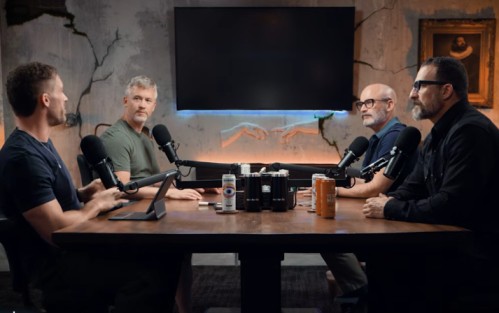
Editor’s Note: In the debut episode of Mostly Wise, host Chris Williamson brings together a powerhouse panel featuring comedian Matt McCusker, neurobiologist Dr. Andrew Huberman, and comedian Tom Segura. Over the course of a nearly three-hour conversation, the guests dive into a wildly entertaining mix of health optimizations, brain science, and hilarious personal stories. From the benefits of prostate health protocols to the subjective nature of comedy, this episode perfectly balances deep, insightful science with unfiltered humor.
Tadalafil, Morning Routines, and Weight Loss
CHRIS WILLIAMSON: I keep seeing tweets about how everyone should be taking erectile dysfunction medication. Is that true?
MATT MCCUSKER: Low-grade, whatever. Yeah.
DR. ANDREW HUBERMAN: The low-grade tadalafil, which is the generic name for Cialis, was developed first as a prostate health drug, and then people took more of it and realized that at higher dosages it can be effective for erectile dysfunction.
TOM SEGURA: But low dose is good for prostate health.
DR. ANDREW HUBERMAN: Low dose, like 2.5 to 5 milligrams per day, is very helpful for perfusion of the prostate and also it causes vasodilation in the brain. So things like strokes, I mean, you want blood flow, right? You don’t want excessive blood flow where you’ve got a headache from it. But our chair of male sexual health and urology at Stanford, Mike Eisenberg, he came on the podcast and he said pretty much every male over 40 or so should be taking about 2.5 to 5 milligrams per day.
MATT MCCUSKER: Does it still get you pretty hard too?
DR. ANDREW HUBERMAN: It definitely will improve.
MATT MCCUSKER: Just curious.
DR. ANDREW HUBERMAN: It will definitely notch up erectile strength. But unlike some health people out there, I’m not using the calipers to measure the strength. I ask someone else to measure and she tells me that, it’s all good.
MATT MCCUSKER: I know what you mean.
TOM SEGURA: Yeah.
MATT MCCUSKER: She’s telling her to close her hand. Close her hand if you can.
DR. ANDREW HUBERMAN: Well, no, I’ve never actually subjected to the grip test. I don’t want to tempt anybody, but in all seriousness, the drug that was developed for vasodilation, which is now used for erectile dysfunction, it really was developed first as a prostate health drug. And a lot of sitting — the prostate’s weird too, because it doesn’t get a lot of blood flow compared to other tissues.
CHRIS WILLIAMSON: Speak for yourself.
DR. ANDREW HUBERMAN: Same immune system. Yeah.
MATT MCCUSKER: Well, what if you sit with the plug in?
DR. ANDREW HUBERMAN: We’re here kegeling all day. So Chris had to pull up to this little piece of tape so we didn’t catch a kegel. Kegeling, kegeling.
CHRIS WILLIAMSON: I kind of feel like it could just be a psyop to normalize erectile dysfunction medication by dudes that have got erectile dysfunction. Like by doing that, every man should be taking it, so that nobody is then on the outside.
DR. ANDREW HUBERMAN: Hmm.
CHRIS WILLIAMSON: It’s fair.
TOM SEGURA: I take it — it’s like 5 to 6 milligrams in the morning.
DR. ANDREW HUBERMAN: You do it in the morning?
TOM SEGURA: Yeah. Every morning.
CHRIS WILLIAMSON: There you go. What’s a little trochee? What’s a little mint? Is that half?
DR. ANDREW HUBERMAN: What’s like a — I don’t know. I mean, you can get like a — is that a full one?
CHRIS WILLIAMSON: Is that a full one or a half one?
TOM SEGURA: Of what?
CHRIS WILLIAMSON: The tadalafil?
TOM SEGURA: Well, it depends on the prescription that you’re given, right?
CHRIS WILLIAMSON: Yeah.
TOM SEGURA: So the 6 milligram thing is supposed to be for prostate health. But if you were to get 25, 50, obviously that’s like massive blood flow and you’re going to take note and it can draw blood.
CHRIS WILLIAMSON: Strong gust of wind.
MATT MCCUSKER: Yeah.
DR. ANDREW HUBERMAN: And it can disrupt, you know, lower blood pressure slightly and things like that. Because you gain vasodilation, so all the pipes are getting a little bigger. But let’s all take one right now and see how the broadcast —
CHRIS WILLIAMSON: Whoever gets the erection last wins.
TOM SEGURA: Yeah, I have a strong mind.
DR. ANDREW HUBERMAN: This is not the podcast I signed up for. But to your point, it probably does feel safer for guys to call up their doctor and go, “Hey, I heard this podcast. I heard some MD, PhD from Stanford — not me, but Mike Eisenberg — said that I should be getting better perfusion in my prostate and I should take 2.5 to 5 milligrams of tadalafil.” And there they just avoided all the statements about Cialis, ED, and so on. And then they call another doctor and get a duplicate prescription and now they’re taking double. You can assume that some of that happens, but it’s also cost like pennies. It’s generic now. The patent is out.
The Discovery of Viagra
CHRIS WILLIAMSON: Do you know the story about how Viagra was found?
DR. ANDREW HUBERMAN: I only know that it was very quick to market. It’s one of these remarkable discovery-to-market stories, and that just tells you how badly certain people want it on market and to use it.
CHRIS WILLIAMSON: The story was that they were trying to do something — I think it was for angina, it was more heart stuff. And they found that typically when a medical trial’s finished and they ask people to give the medication back, people don’t have any issue doing it. And no one wanted to give the medication back.
DR. ANDREW HUBERMAN: Like, no.
TOM SEGURA: Oh, this is —
CHRIS WILLIAMSON: And then they also noticed when the nurses were going in to do the checkups on the people during the trial, that the guys were sitting weird. They were all sitting cross-legged to cover themselves up.
DR.
CHRIS WILLIAMSON: And from that they said, “Yeah, there’s been this sort of weird side effect to this angina medication that you’ve been giving me. I feel like I’m 14 again.”
DR. ANDREW HUBERMAN: Well, the younger guys are probably going to want to get on the tadalafil too, but maybe not for the same reasons. It does upregulate either sensitivity or number of androgen receptors, so your body can respond more and better to whatever circulating testosterone you have.
TOM SEGURA: Yeah.
DR. ANDREW HUBERMAN: So there are a bunch of things that make it a useful tool, but at this very low dose, it will make you a little ruddy — a little, you know, it makes you a little bit red.
CHRIS WILLIAMSON: The Cialis?
DR. ANDREW HUBERMAN: Well, just because blood flow — it’s everywhere, you know.
CHRIS WILLIAMSON: I’m sure I’m British.
DR. ANDREW HUBERMAN: I’m sure somebody’s going to do that.
CHRIS WILLIAMSON: You know what I mean? Like a pink people.
TOM SEGURA: A lot of pro athletes take the low dose before games too.
DR. ANDREW HUBERMAN: Is that for anxiety?
TOM SEGURA: I think they just — the increased blood flow is something that they want.
CHRIS WILLIAMSON: How does it impact anxiety?
DR. ANDREW HUBERMAN: Lowers blood pressure a little bit. That’s why I was saying if you take it later in the day, it can just assist — kind of like a half a cocktail.
CHRIS WILLIAMSON: You careful using “half”?
DR. ANDREW HUBERMAN: No pun intended. Nothing is safe in this room. Yeah, comedians and sh. I’m — yeah.
Matt’s Morning Routine
CHRIS WILLIAMSON: I want to know your morning routine.
MATT MCCUSKER: Mine?
CHRIS WILLIAMSON: Yeah, Matt. Andrew spent a long time optimizing people’s mornings. I want to know what your morning routine —
MATT MCCUSKER: Well, I heard you were talking about cortisol for a while, so I was waking up and just chugging coffee, being like, “I’m upping my cortisol.” And I would have a panic attack in my office and be like, “I don’t know, man, I don’t know if I’m cut out for this.” But no, I wake up early, like 6:30. Every other day I’ll take my kids to school and then I just go to the gym for like an hour.
TOM SEGURA: Are they off on the other days?
MATT MCCUSKER: No, my wife does.
TOM SEGURA: Oh, okay. I thought you’re like, they don’t go to school every day.
DR. ANDREW HUBERMAN: I was like, are you homeschooling? Because that sounds like a good ride.
MATT MCCUSKER: No, man. But yeah, I’m honestly more locked in than I’ve ever been. I’m up every day at 6:30 and I work out almost every day. I got fat — I got fatter than I ever was. So I’m trying to pay for 2 years, 2 and a half years of bad eating. So I’m losing.
TOM SEGURA: You look good, man.
MATT MCCUSKER: Thank you.
DR. ANDREW HUBERMAN: Good.
MATT MCCUSKER: You guys all look great.
DR. ANDREW HUBERMAN: And no shame if anyone does it — anyone on the GLP. I’m not, I haven’t tried them yet.
TOM SEGURA: No.
MATT MCCUSKER: Is that the —
DR. ANDREW HUBERMAN: That’s like real quiet.
TOM SEGURA: I tried it. I tried it in 2022.
DR. ANDREW HUBERMAN: Yeah.
TOM SEGURA: But I tried it after I had lost the majority of my weight.
DR. ANDREW HUBERMAN: Okay.
TOM SEGURA: I got down — so I hit a wall at like 212, 213, and I was like, “I want to get to like 200.” And I took it for like a month, but I didn’t eat.
DR. ANDREW HUBERMAN: Oh yeah.
TOM SEGURA: And so I lost the 12 pounds and then I was like, yeah, but I’m not eating at all. So I got off of it and then gained the 10, 12 pounds back. And then I kind of just floated there for a while.
Tom’s Weight Loss Journey
TOM SEGURA: And the thing that actually jumpstarted getting down again was doing a fast. I did a 5-day fast.
DR. ANDREW HUBERMAN: No water?
TOM SEGURA: No, I had water. But 5 days of no food.
DR. ANDREW HUBERMAN: Okay.
TOM SEGURA: And I anticipated that once I resumed eating I would gain some of the weight back, but I gained none of it back. And then I went into a production and on the production, the thing is, if you’re in every scene, you don’t want to eat a lot. So I would get on set at like — the makeup trailer — like 5:30, 6 in the morning. They’re like, “What do you want to eat?” I’d be like, “Just a little bit of fruit, a little bit of egg whites.” Then you shoot for like 6 hours and you break for lunch. So you pick a little bit at lunch and then you have to shoot the rest of the day. So the only real full meal I was having was at the end of the day — dinner. And in the production, just by working, I lost 25 pounds.
MATT MCCUSKER: Damn.
TOM SEGURA: And then I gained like 10 of that back. So I’m like 190 right now, but it’s from just basically manipulating how I was eating and working out.
CHRIS WILLIAMSON: Overworking yourself.
DR. ANDREW HUBERMAN: Was that from your show for the —
TOM SEGURA: That was from the movie I did last year.
DR. ANDREW HUBERMAN: Okay.
TOM SEGURA: And then when I came back I was like, “Sh, I’m going to gain all the weight back again.” But I just started working out more, like 4 days a week. I work out in the mornings and just dial in food more, like pay attention more.
Comedians Who Can Act
DR. ANDREW HUBERMAN: Yeah. I have a question about the whole thing with comedians and acting. How come they’re so good at it? Like it seems like — Theo’s got a — I haven’t seen Busboys yet, but I saw the trailer. I’m like, Theo can act. And then obviously Jim Carrey as a comedian. All these people — all these comedian actors. Whitney will show up in things. So is it an easy jump? And if so, why?
Comedians as Actors and the Nature of Comedy
TOM SEGURA: I think it’s actually really dependent. Some can really do it. Some can’t. And the ones that can really do it have the dramatic capacity to do it, right? Like when you think of Jim Carrey, Robin Williams, those guys were like incredible comedians, but they have this darkness and sadness within them, which I think lends itself to dramatic acting. But I don’t think that that’s across the board because I’ve seen a lot of comedians that are sh*t actors and then some that really impress you, but it’s kind of like — you just never know. You just never know.
MATT MCCUSKER: It’s hard too, because you don’t get feedback. When you do stand-up, people laugh. When you act, people go, all right, that’s fine, keep going. You’re like, is that all? Is that the best? Or like, what are we doing here? And then I started being like, well, they don’t like — you don’t even get feedback. And then you hear someone will do a scene and the whole staff will clap, and you’re just like, f*, there was feedback. I’m not getting it right.
TOM SEGURA: Yeah, well, the thing is — you could tell about comedians who act, especially at first, versus experienced actors. Experienced actors, when they yell cut, the experienced actor doesn’t turn to the director and go, what do you think? They know what they’re doing. You f*ing come over me if you want to. Like, I’m not asking you for approval.
DR. ANDREW HUBERMAN: They know how they do it.
TOM SEGURA: They know what they’re doing. Comedians, they’ll go cut and they’ll be like, what do you think? Because they’re waiting. Because we’re used to the immediate feedback.
CHRIS WILLIAMSON: But it would be the same as being on stage and going to the audience and going, did you like it?
DR. ANDREW HUBERMAN: Yeah.
CHRIS WILLIAMSON: Yeah.
TOM SEGURA: Yeah. You notice it, right? And then, yeah, some blow you away with how talented they are as actors. But I think it’s like — you never know who has it and who doesn’t. It’s a specific skillset, I think.
Method Acting and Staying in Character
DR. ANDREW HUBERMAN: Is it true that some actors just never leave character? I was listening to something about the filming of The Outsiders, the original movie, right? And someone was saying that Tom Cruise literally just stayed in character the entire filming.
TOM SEGURA: There’s all these stories, right? About who does that.
DR. ANDREW HUBERMAN: Yeah.
TOM SEGURA: And famously, like Daniel Day-Lewis — there’s various stories about who does it. I talked to somebody who said they were on a set and one of the other actors came up in character and was like doing his voice. And the director was like, we’re not doing this. And he was like, oh, okay.
DR. ANDREW HUBERMAN: My bad.
TOM SEGURA: Like, he was just like, I’m not playing with this.
DR. ANDREW HUBERMAN: In 2017, I think it was, I met Pee-wee Herman at an art show.
TOM SEGURA: Uh-huh.
DR. ANDREW HUBERMAN: And he was in the full getup.
TOM SEGURA: Yeah.
DR. ANDREW HUBERMAN: And Paul — what’s his name? Anyway, real life, I don’t even know his real name. Yeah, yeah, yeah. And Paul Reubens, something like that. And Laird Hamilton was there. And Laird’s like only Laird, right? He’s on after. He’s just like — and I don’t think he knew who Pee-wee was.
TOM SEGURA: Really?
DR. ANDREW HUBERMAN: Pee-wee Herman worked his way through this enormous wall of mostly women who wanted to get near Laird and was like, “Hi, so nice to meet you.” And he was talking — there’s this moment where it was like Laird Hamilton and Pee-wee Herman. He was just fully in character, the lips, stick to everything. Yeah, I mean, so look, I get how this was out in the world. It was like a West Hollywood art show.
TOM SEGURA: Yeah, I get how if you’re really in the character and kind of stay that way between setups and shots, it can help, especially if it’s like a really involved thing. But I think there’s probably limits to where you want to take that. I’ve heard that the most extensive was Jim Carrey doing Andy Kaufman. There’s a lot of stories about how he was just never breaking from that. But I don’t think that that’s mostly what people do when you talk about method acting.
MATT MCCUSKER: Yeah, my method is I drink a ton of Dunkin’ Donuts coffee and I think about my face the entire time. I just feel like, what is my face doing right now?
DR. ANDREW HUBERMAN: Anxiety from caffeine. You drink a lot of — you mentioned 3 times, you’re like, “If I drink a cup of coffee at noon, I’m effed.” And then you’re like, “I wake up in the morning, I slam a coffee.” And you’re like, “I drink before.” You know who’s actually a good actor?
MATT MCCUSKER: It’s a problem.
DR. ANDREW HUBERMAN: No sh*t. You know who’s a really good actor? This guy. They do these ads for Newton and these other things. I’ll see it on Instagram. Like, this actually passes for acting.
CHRIS WILLIAMSON: I can’t stop thinking about the fact that you’re obsessing over your face the whole time.
MATT MCCUSKER: You’re thinking like, what does my face look like right now?
TOM SEGURA: Do you mean like, what am I emoting? Like, is it —
DR. ANDREW HUBERMAN: Yeah.
MATT MCCUSKER: Like, what does it just look like? I’m thinking about my face — or does it look like I’m sad? Like, I don’t even have a broad range of emotions. We’ve only met in person for a little bit, but I’ll tell you right now, you’re pretty deadpan. Am I deadpan?
DR. ANDREW HUBERMAN: Pretty deadpan.
MATT MCCUSKER: Yeah, behind this face it’s just a swirl of emotion and chaos. Am I deadpan for real?
DR. ANDREW HUBERMAN: You’re pretty deadpan.
MATT MCCUSKER: Yeah, that’s funny. Yeah, I don’t feel deadpan.
DR. ANDREW HUBERMAN: All right, that’s crazy.
MATT MCCUSKER: I appreciate it. You’re pretty — you got poker face too.
DR. ANDREW HUBERMAN: I mean, I don’t act. I mean, this guy was on reality TV, so yeah.
CHRIS WILLIAMSON: But you were on last season of Ties as well. Are you doing the next one? Do you know if you’re in that?
MATT MCCUSKER: Yeah, same thing. But again, I get done and I’m like, would my face have been terrible?
DR. ANDREW HUBERMAN: Yeah.
MATT MCCUSKER: Oh yeah, it had to have been terrible. And then I see it, I’m like, I didn’t realize that was you. And I’m like, dissolved into the role.
CHRIS WILLIAMSON: Yeah, because you weren’t his dad.
MATT MCCUSKER: I’m completely confused. I’m waiting for someone to be like, “You get the f* out of here now.”
CHRIS WILLIAMSON: What are you doing here?
MATT MCCUSKER: What are you doing? Get away from here.
TOM SEGURA: I think that’s a very comedian’s perspective. Yeah, I really do. And that’s about — he’s good, and that’s why he thinks that way. If he was like, “I’m the sh*t,” he probably wouldn’t be any good at it.
The Science of Comedy and What Makes Things Funny
CHRIS WILLIAMSON: Yeah. Has there been any research done on comedians? Like if we put Tom and Matt in a lab, do you think there’s some scans or tests or biomarkers that you could do on them that would identify what they’ve done as a career?
DR. ANDREW HUBERMAN: Oh, that’s a tough one. The only science that pops to mind — and Tom and I have talked about this before — is there are some interesting studies, like the classic studies of memory were all done on this guy, HM, this patient who had damage to the hippocampus, a critical region of the brain for encoding memories. And you could walk in, introduce yourself, walk out, and then 5 minutes later walk in, he would not remember your name. And they tested — he wasn’t faking it. They kept at this for decades. And if you told him a joke, he’d laugh. And if you came back and told him the joke again, he would laugh a little less each time.
TOM SEGURA: Mm-hmm.
DR. ANDREW HUBERMAN: Even though he was completely unaware that he’d heard the joke before. So that’s kind of interesting, right? There’s something kind of unconscious. And then I think it was you, Tom, that said this — that there’s also something weird about comedy, which is for many other things like visual art or music, if you don’t like opera and then you listen to a lot of it and you start looking for certain things and you kind of develop a sense of the nuance, you can start to really like it. But with comedy, it either lands with you or it doesn’t. And if you hear something more than once, it just sounds worse.
TOM SEGURA: I think that art is subjective, obviously. And you have involuntary reactions to like, “I like this painting, I like this song,” right? But what I was saying is, you could see a painting and not care for it, but maybe somebody comes to you and explains the history or the technique that was used, and then all of a sudden you start to appreciate it more. But I think if you go, “That’s not funny,” it doesn’t matter who tells you what — you’re just like, it’s not funny to me.
DR. ANDREW HUBERMAN: Right.
CHRIS WILLIAMSON: Yeah.
TOM SEGURA: So in that sense, I think people have the most completely involuntary reaction to what they find funny or not funny.
Greatness Is Objective
CHRIS WILLIAMSON: But it’s pretty hard to deny good music. I think music and beauty are two things that sort of penetrate in that way. Kanye, dude. Kanye, like, just has not had a great run over the last 5 years, brand-wise. He’s got such bangers that he can sell out SoFi Stadium 2 nights in a row, like f*ing 30,000 people, and stand on top of the world and everyone be like, “Yeah, he’s still unbelievable.” Music’s undeniable in a way that a lot of other things aren’t.
DR. ANDREW HUBERMAN: Is he touring again?
CHRIS WILLIAMSON: It’s like the Swatch Ticket Tour or something. He was on top of a globe.
MATT MCCUSKER: He already did that one. I heard this one.
DR. ANDREW HUBERMAN: Have you seen his list where he published the “people I hate” list? Have you seen this? These lists are amazing. You haven’t seen these? I don’t have my phone with me, but occasionally he’ll just tweet, like, “People I hate.” It’s like a revenge list. But what’s wild — someone should find this.
CHRIS WILLIAMSON: Pete Davidson just always at the top.
DR. ANDREW HUBERMAN: He’s on one or two of them, but then some people show up on multiple lists. These lists are insane. They’re pretty technical.
CHRIS WILLIAMSON: Everyone hates you, but for different reasons.
TOM SEGURA: It’s kind of nice to be that free, though, too. Don’t you think? He says sh*t and you’re like, “Bro, come on, man.” But then you’re also like, this guy’s so free that he doesn’t care. Yeah, yeah.
CHRIS WILLIAMSON: You just can’t deny music in that way.
TOM SEGURA: Like, if you’ve got bangers, people are just like — but to extend that to comedy and art, people always say it’s all subjective. But I do think that greatness is objective. Do you know what I mean? Like, you can say, “This guy’s not funny, that guy’s not funny.” But if you’re trying to say that Richard Pryor, George Carlin, Eddie Murphy — if you’re like, “They’re not funny,” I think you’re objectively wrong or deaf.
CHRIS WILLIAMSON: Yeah.
TOM SEGURA: Like, you can say you don’t find it funny, but you are actually, I think, wrong. Like, greatness is greatness, right? You can’t argue with a certain level of great art.
CHRIS WILLIAMSON: I suppose you might not like the genre of someone’s music, but you would have to go, “Well, look, they’re a f*ing savant at whatever they’ve done.” Yeah. You don’t need to like hip-hop to say Kanye makes bangers. You don’t have to like classical music.
TOM SEGURA: You’re not going to say Beethoven’s trash, right?
MATT MCCUSKER: That would be a hot take.
TOM SEGURA: That’s a hot take.
MATT MCCUSKER: Yeah.
TOM SEGURA: Beethoven’s trash.
MATT MCCUSKER: Oh yeah, no one says “not for me.” Just like, it’s just not for me.
TOM SEGURA: Yeah, yeah.
CHRIS WILLIAMSON: It’s like, that sucks. But people are more personal when it comes to, especially YouTubers, podcasters, right? Because the distance between whatever the art form is and the person is basically zero. It’s like, well, you’re just you.
MATT MCCUSKER: Yeah.
CHRIS WILLIAMSON: Right. You’re just being you, which means that it’s not just not for me. It’s that person’s a bad person. And then it gets wrapped up in like morality and the sense of who they are. The same thing’s not true in any way for like a musician. That’s someone who doesn’t even perform with their real stage name. Maybe they wear a mask on stage, they get dressed up and then comedians are sort of somewhere in between. Right. Because it’s like, it’s partly you but partly not. I don’t know.
TOM SEGURA: Yeah.
CHRIS WILLIAMSON: Yeah.
Physical Comedy and Reading an Audience
DR. ANDREW HUBERMAN: I’m fascinated by the comedy thing because of the different cues. Like I said, unless they’re deaf, like if they can’t actually hear the jokes, I was being kind of tongue in cheek there. But in reality, like some comedians I know this, I noticed they’ll like how they use the whites of their eyes.
CHRIS WILLIAMSON: Mm-hmm.
DR. ANDREW HUBERMAN: Like, you know, they’re like this kind of thing. Like they can, they can punctuate.
TOM SEGURA: Oh yeah. With eye contact and their— the physicality is so much of it. Yeah.
DR. ANDREW HUBERMAN: Yeah. That’s a huge part of it. And I just don’t really understand physical comedy. Like, I don’t really get it. I have to say I wasn’t really into the Jim Carrey movies, you know, like that. It’s just so crazy. Like all the craziness. But I love the stuff he acted in. Yeah, I get it.
TOM SEGURA: You know, I just saw somebody like at the festival and like, as soon as it got like real wacky, I’m like, what the f* is going on here?
DR. ANDREW HUBERMAN: Right.
TOM SEGURA: Like, yeah, it throws me off too.
MATT MCCUSKER: Yeah.
DR. ANDREW HUBERMAN: I mean, they eventually started animating him and it was like it became its own character.
CHRIS WILLIAMSON: Right.
TOM SEGURA: You know, or cartoon.
DR. ANDREW HUBERMAN: It’s wild. So yeah, there’s a lot there. And I think people are— so I think some people are just tuned to pick up on certain things, and they— there’s an excitement that puts them at this edge. This is how I always feel as a spectator.
TOM SEGURA: Yeah.
DR. ANDREW HUBERMAN: So I don’t play music. I know nothing about music except what I enjoy.
CHRIS WILLIAMSON: Yeah.
DR. ANDREW HUBERMAN: It’s one of these areas I just— I’m purely a consumer. Same thing with comedy. Yeah. And I feel like comedians do something or a combination of things that bring certain people to like this edge where they’re like ready to laugh. They’re like, you know, it’s like the gun’s cocked and loaded, you know? And so they’re just like ready, and then you just have to let them go. And so some people, they’re hard to bring out a bit more, and they probably respond to a different kind of humor.
TOM SEGURA: Some people love that physical. I’ve also been— I’m sure, like, you’re in the room sometimes in a club and someone’s on stage and they are just murdering.
MATT MCCUSKER: Yeah.
TOM SEGURA: And you’re like, what’s going on?
MATT MCCUSKER: Like, I—
TOM SEGURA: Like, you’re just like, I don’t even know what is happening right now. You’re watching it and you’re just like—
CHRIS WILLIAMSON: You feel like you’re dissociating or something because even as someone who’s supposed to understand what’s going on, you’re like, I don’t get it.
MATT MCCUSKER: Yeah, you’re on next. You’re like, this guy sucks.
Tim Dillon and the Power of Association
DR. ANDREW HUBERMAN: Yeah, well, there’s also this interesting memory. Like, Tim Dillon made me laugh so hard one time at the Comedy Store with the “I am your mother” thing. Like, before I saw it online, I saw him do that whole bit. Is that what you call it? Yeah. And now when I see Tim Dillon, I start laughing. Like, I’m kind of at the edge of laughter, and I’m not expecting him to make a joke. It’s just somewhere in my unconscious mind, like, that’s queued up.
CHRIS WILLIAMSON: Just associated him with funny.
DR. ANDREW HUBERMAN: And I’m just like, this is going to be so funny. He taps into something. Yeah.
TOM SEGURA: So it’s just, he’s really fing good. Oh, f, man.
MATT MCCUSKER: Especially when he’s ranting. When he’s ranting on a show, it’s like, it’s impossible to sit there.
TOM SEGURA: I’ve never seen anyone better actually than Tim. He’s alone. It’s one of the hardest things because when podcasting started big in comedy, it was probably like ’09, 2010 is when people started to like really, and when I would see the guys who could sit alone and do the hour alone and make it interesting and funny. I had tried it one time and I f*ing died.
MATT MCCUSKER: I feel crazy.
TOM SEGURA: I felt crazy.
CHRIS WILLIAMSON: Talking to myself.
MATT MCCUSKER: Yeah.
CHRIS WILLIAMSON: Just having a conversation with myself. Where’d you go? Build it up really well.
MATT MCCUSKER: Notes help.
TOM SEGURA: Yeah.
MATT MCCUSKER: If you at least type out some thoughts, it can help. But just going—
CHRIS WILLIAMSON: To pretend conversation with yourself.
MATT MCCUSKER: Yeah. I can talk to myself a lot, but if you’re trying to sell it, that’s tough because it usually doesn’t make sense.
TOM SEGURA: Yeah.
CHRIS WILLIAMSON: You’re just talking about what your face is doing the whole time.
MATT MCCUSKER: You do it alone a lot? I’ve done it a couple of times. It feels good when you do it and it goes well, you feel really good.
TOM SEGURA: But when you lose the thread, you’re like— but you gotta have like some place to go to start.
MATT MCCUSKER: It helps.
Alex Jones: The Original Solo Yapper
CHRIS WILLIAMSON: Alex Jones though. Yeah. Alex Jones, the best. The OG.
MATT MCCUSKER: Legend. Another level.
DR. ANDREW HUBERMAN: For doing what?
CHRIS WILLIAMSON: Just being able to solo f*ing— like he was the original yapper.
TOM SEGURA: Yeah.
CHRIS WILLIAMSON: Right. He could just 3 hours a day, dude.
TOM SEGURA: That’s wild.
DR. ANDREW HUBERMAN: He’s not like the Rush Limbaugh kind of thing. Yeah. Kind of built off that.
TOM SEGURA: That’s true.
DR. ANDREW HUBERMAN: Yeah.
TOM SEGURA: Yeah.
DR. ANDREW HUBERMAN: I feel like Alex Jones kind of built off Rush Limbaugh, but with Rush, like coked up.
MATT MCCUSKER: Yeah.
TOM SEGURA: Yeah.
CHRIS WILLIAMSON: Like coke Rush.
TOM SEGURA: Yeah.
DR. ANDREW HUBERMAN: Yeah. And then a bunch of very costly to him false statements about a couple about school shootings.
MATT MCCUSKER: Misinformation.
DR. ANDREW HUBERMAN: He wasn’t— he fed himself misinformation.
MATT MCCUSKER: Nah, that was f*ing—
DR. ANDREW HUBERMAN: I don’t want to get involved in the lawsuit. I don’t know what happened. No, I think it did. He— but, you know, and then I’m going with the original news story.
MATT MCCUSKER: They got him.
CHRIS WILLIAMSON: The f*ing— The Onion now own Infowars.
TOM SEGURA: Yeah, they own Infowars.
CHRIS WILLIAMSON: Yeah, they bought— I don’t know whether—
TOM SEGURA: And is there a more Onion thing to do?
CHRIS WILLIAMSON: Like, I know it’s the first video they did was an impression of Alex Jones drinking the blood of Christ and it was red wine. And he’s like, “It’s available at the Infowars store.” Like if they’d released their own red wine under that brand, like Infowars red wine, blood of Christ wine.
MATT MCCUSKER: Doesn’t he owe like a billion dollars? It’s like hundreds. It’s like a hundred. Really?
CHRIS WILLIAMSON: Jared, ask Chad how much.
MATT MCCUSKER: I thought it was like hundreds of millions of dollars.
CHRIS WILLIAMSON: At least a billion.
DR. ANDREW HUBERMAN: But everything around him, even though he’s apparently a comedian and a bunch of other things woven in there too, gets real, real, real f*ing quick because someone got shot and killed on his team here in Austin. Yeah. Right. He’s talking about, you know, school shooting murders, this kind of thing. Like, there’s something he likes to— I don’t think he wanted that thing to happen to a staffer, obviously, but stuff just runs really into reality very fast with him. He goes there and it comes back to him. Yeah, like, not good boundaries.
MATT MCCUSKER: Yeah, it’ll happen.
CHRIS WILLIAMSON: No, no, no. What’s the— what was the— what, what is Alex Jones’s—
MATT MCCUSKER: You know, the fine.
CHRIS WILLIAMSON: What’s he being sued for? Yeah, he—
MATT MCCUSKER: I mean, he got absolutely buried for the Newton— the settlement.
CHRIS WILLIAMSON: 1.5 billion dollars. Holy shit.
MATT MCCUSKER: 1.5 billion.
DR. ANDREW HUBERMAN: I like how you think because I have a PhD that I’m supposed to know what Alex Jones owes.
TOM SEGURA: No, I meant the word. We were looking for the word.
DR. ANDREW HUBERMAN: Oh, well, I was focused on something else.
Chris Williamson’s Reality TV Experience
DR. ANDREW HUBERMAN: I’m still wondering if Chris’s experience on reality TV made him a better actor or better at reality?
CHRIS WILLIAMSON: Oh, f*, dude. I mean, I was— oh my God, that was 11 years ago. And what show was it? You’ll never— season 1. Oh, you were like the first person through the doors.
TOM SEGURA: Oh, like of Love Island. Brit hotties all together on an island.
CHRIS WILLIAMSON: Me, I was the hottie. Yeah, yeah, that’s right. Yeah, yeah, yeah, dude, that was, uh, that’s awesome. It was kind of like Navy SEAL Hell Week but for reality TV because you don’t get to leave. Like locked in this villa, no phone, no internet, but to his point, with a bunch of hot women.
DR. ANDREW HUBERMAN: Yeah, sounds a lot like hell. Let me call up some of my friends who are team guys. How did that go? How many hot women were there?
CHRIS WILLIAMSON: Similar to your situation, right?
DR. ANDREW HUBERMAN: Right.
MATT MCCUSKER: Just horny.
DR. ANDREW HUBERMAN: You’re not going to get a lot of sympathy.
MATT MCCUSKER: Yeah.
TOM SEGURA: Do you find yourself in those situations in a reality show?
CHRIS WILLIAMSON: There is like a bit of posturing and like there’s cameras, so you have awareness literally everywhere.
TOM SEGURA: So do you find yourself kind of like putting on, you know what I mean?
CHRIS WILLIAMSON: To a degree. It’s really weird because they work super hard to try and hide the cameras. So let’s say that we were talking here, there’d be like a plant in the middle and the plant would have one of those little CCTV things that they could just spin around.
TOM SEGURA: So you’re not like aware.
CHRIS WILLIAMSON: You’re never really thinking about it. And there’s the huge big, almost like sports TV bazooka things and they’re over the far side, right? So this would be a bigger room.
TOM SEGURA: Whoa.
Love Island’s Psychological Manipulation
CHRIS WILLIAMSON: And there’d be shit over the far side and they’d be zoomed in. And then the villa producer would come over because they want to poke the story. Like they can’t take 3 weeks for you to ask this girl if you can kiss her. It’s like, it needs to happen f*ing today.
MATT MCCUSKER: Yeah.
CHRIS WILLIAMSON: So they’ll come over and go, “Matt, how do you feel about Chris asking Andrew out?” “Well, you know, I thought we were friends, and it really turns out we’re not, and I felt a bit betrayed by him.” You go, “What I think you should do, why don’t you ask him to go and have a chat over by the fire pit?” And you go over to the fire pit and there’s a fing army of different photographer, videographer people all around there, but they’re all outside the bounds and you’re not allowed to talk to them. And this was the fing maddest thing. You never knew what time it was.
TOM SEGURA: And they feed you booze too, right? Wasn’t there booze?
CHRIS WILLIAMSON: They put a limit on after my season.
DR. ANDREW HUBERMAN: Oh, okay.
CHRIS WILLIAMSON: Strategically.
TOM SEGURA: Right.
CHRIS WILLIAMSON: But even the camera guys and the drivers, if you ever needed to go off site to go and do a date or something, they all changed the time on the car radio. They changed the time on their watches or took their watches off. It was insane. You never knew what time you went to bed or what time you woke up. I think it’s so they could control our sleep and wake patterns.
TOM SEGURA: Whoa.
CHRIS WILLIAMSON: It was really kind of weird.
DR. ANDREW HUBERMAN: It’s very cultish.
MATT MCCUSKER: Yeah.
CHRIS WILLIAMSON: But I think it was just so that they could lock you into whatever they need. The first night we were there, everyone was super excited. We stayed up until what must have been 2 in the morning, 3 in the morning. And then someone got up — there’s half as many beds as there are people. So you’re always sleeping with a girl each night.
TOM SEGURA: Oh, boo-hoo.
CHRIS WILLIAMSON: And then — hell week. Hell week.
TOM SEGURA: Yeah. It’s f*ing butt school. Thank you, sir, man.
DR. ANDREW HUBERMAN: Did you say butt school or bud school?
CHRIS WILLIAMSON: And then we woke up the next morning and they came over the tannoy and they were like, “Hello Islanders, you’ve been asleep for 3 and a half hours. Can everyone please get back to bed?” Because no one knew that we’d only been asleep for a little bit of time. One person’s up and we’re like, “Well, I guess we must have been awake for a while, whatever the f*.” So that’s weird.
Sleep Scores and the Psychology of Performance
DR. ANDREW HUBERMAN: Not to inject some science, but because you said they’re telling you how long you were asleep and you don’t know how long you were actually asleep, there’s some really cool data that show, within limits, if you see a great sleep score, cognitively and physically, you perform better the next day, even if your sleep wasn’t that great.
TOM SEGURA: Really?
DR. ANDREW HUBERMAN: And the reverse is also true. If you see a lousy sleep score and you actually slept great, your cognitive and physical performance takes a dive.
CHRIS WILLIAMSON: Are you saying that the best wearable, like the best thing that Whoop could do, would just be to always lie to you and tell you that you are feeling great?
DR. ANDREW HUBERMAN: Technically, yes, within limits. So if you sleep 3 hours and it says, “Oh, you had a spectacular night’s sleep,” you’re not going to compensate for that lack of sleep. So it’s when you’re down or up about an hour or two of sleep. The real solution to this — sorry to make it so serious. Let’s get back to Love Island.
TOM SEGURA: No, no, no need. Booty school.
DR. ANDREW HUBERMAN: The best thing to do would be to check your sleep score against your subjective feeling — like you write down how you feel when you wake up in the morning. And then at the end of the week, you compare your score to how you actually felt. So maybe check in like every 4 or 5 days as opposed to, “Woo, got a 90, I’m good.”
CHRIS WILLIAMSON: Ruined today.
DR. ANDREW HUBERMAN: Yeah. Or more importantly, if you get a lousy sleep score, you don’t necessarily want to let that worm into your brain.
MATT MCCUSKER: Yeah. It brings me down.
DR. ANDREW HUBERMAN: But this is a real effect on real cognitive and real physical performance. It wasn’t some corny in-lab test. This stuff can make a big difference, especially if you’re operating at the level that you guys are and you’re getting out there. So anyway, sorry to inject that. Since they did it to you — did you fall in love on Love Island?
CHRIS WILLIAMSON: I was only there for 20 days. I don’t think that’s long, dude.
DR. ANDREW HUBERMAN: I’ve fallen in love many times in 20 days.
CHRIS WILLIAMSON: Sometimes you fall in love in one day.
DR. ANDREW HUBERMAN: That was something entirely different. That wasn’t love.
MATT MCCUSKER: That happens.
DR. ANDREW HUBERMAN: Now I fall in love 20 times a day with one person.
MATT MCCUSKER: There you go.
DR. ANDREW HUBERMAN: Yeah, she’s so rad.
CHRIS WILLIAMSON: That’s cute.
TOM SEGURA: That’s sweet.
The Retard Maxing Movement
CHRIS WILLIAMSON: Are you threatened by the retard maxing movement? Have you heard about this?
MATT MCCUSKER: It’s a great question, dude.
DR. ANDREW HUBERMAN: That’s a great question. Right at me.
CHRIS WILLIAMSON: Yes.
DR. ANDREW HUBERMAN: Let me answer that the way I think you intended it. Yes, I am personally offended.
TOM SEGURA: Wait, do you wake up and are you like, “I’m retard maxing today?” Like, is that what you think?
MATT MCCUSKER: All right.
DR. ANDREW HUBERMAN: What is retard maxing? All right.
CHRIS WILLIAMSON: All right.
MATT MCCUSKER: It’s awesome.
DR. ANDREW HUBERMAN: No, I actually — what is this?
TOM SEGURA: I heard of looksmaxing.
CHRIS WILLIAMSON: Yeah.
DR. ANDREW HUBERMAN: There’s looksmaxing. Then there’s a guy who does what’s called retard maxing, which was popularized by, of all people, Marc Andreessen, who’s easily one of the smartest people I’ve ever met. Know Marc real well. He’s a big fan of retard maxing. Retard maxing is this guy on the internet who — what, you want to explain?
CHRIS WILLIAMSON: Oh, I’m loving that.
DR. ANDREW HUBERMAN: So, with all the stuff about get up in the morning and do this and do that, and all the kind of stuff that Chris covers about emerging dynamics of male-female relationships and self-perception and philosophy — and he interviews real thinkers and they have British accents and that kind of thing — this guy sits in his backyard, which is basically a farm, and he does this thing that he calls retard maxing, which is where you basically just don’t think about anything at all. You just do what needs to be done. If something bothers you, you just ignore it.
TOM SEGURA: Wait, is this the CEO that is like, “I don’t self-refer?”
DR. ANDREW HUBERMAN: So Marc Andreessen came on the David Senra podcast. Marc Andreessen started Netscape, and now he has a16z, which is one of the biggest investment firms in the Bay Area and all over the world, frankly. And he came on the David Senra podcast, which is also the guy who does the Founders Podcast.
CHRIS WILLIAMSON: Uh-huh.
DR. ANDREW HUBERMAN: The Founders Podcast, incidentally, put out by Sycom. We loved the Founders Podcast. So we brought Senra over and he brought Marc Andreessen on. And Marc Andreessen said — these are not my words — he said, “Great men of history did not sit around thinking about their thoughts and introspecting.” Introspection is not what we need to be doing. We need more action, less introspection.
Actually, Dana White kind of doubled down on this recently, saying that he is not a fan of men talking about their emotional challenges publicly — that it’s like, get up, go to war, make money for your family. Sort of the old school stoicism thing.
So the Marc Andreessen thing mobilized a big discussion online, on X in particular. One angle of attack that he opened was, “All right, here’s a billionaire who doesn’t like introspection.” And I know Marc very well. He’s not a sociopath. He’s a very, very kind person. I know his family. He’s an incredible human being at many levels. I’m going to catch a lot of shit for saying that, but that’s the truth if you actually know him.
TOM SEGURA: And now he’s retard maxing. Now, no, no.
DR. ANDREW HUBERMAN: He then made a plug for retard maxing and he was like, “Hey, there’s this guy on the internet who basically doesn’t overthink anything at all. He just says, just handle your business, do what you need to do, and stop thinking about things so much. Don’t ruminate so much.” And he said he was a big fan of this retard maxing. So building off of looksmaxing, that caught some momentum.
TOM SEGURA: Uh-huh.
Introspection vs. Action: Finding the Balance
DR. ANDREW HUBERMAN: And so now the big thing is introspection. Like, should we introspect? Should we think about and reflect on who we are and what’s challenging us? Dana was basically saying, a lot — I think the point Dana was trying to make was that men’s mental health, while critical — suicide rates are way up, we all acknowledge that — he made a very good point, which is that oftentimes getting into action and doing things, as opposed to being online and thinking about your problems, is better. Rumination is a very dangerous place to be.
TOM SEGURA: Yeah, I think so.
DR. ANDREW HUBERMAN: He said get up and work and provide for your family. But when he and Marc said these things, it came across as a little bit dismissive of the idea that emotions are relevant. And I do think they have a point in the sense that I think we need to balance out some of what we’ve been hearing a lot of over the last few years.
TOM SEGURA: Sure.
DR. ANDREW HUBERMAN: Which is that we need to think about every aspect of self. Too much therapy is not good.
TOM SEGURA: Yeah. If you spend your time just thinking and not doing — ’cause it feels like that’s kind of the note behind the note, right? If you just sit and introspect and think, and you just sit in, “I feel this way,” and you never actually take action, then you’re literally not doing anything. But I think there are kind of levels to it. I think it’s good to be introspective to a degree.
DR. ANDREW HUBERMAN: Mm-hmm.
TOM SEGURA: Check in with yourself.
DR. ANDREW HUBERMAN: Yeah.
TOM SEGURA: Express how you feel, but don’t just sit there and say, “This is how I feel,” and then not do anything.
DR. ANDREW HUBERMAN: Yeah. There’s a larger, perhaps deeper discussion around — and Marc Andreessen has said this as well — people who’ve tended to accomplish a lot of great things oftentimes have some pretty rough edges. I grew up in the town where Steve Jobs was around. He used to come in and get rollerblade wheels at the skateboard shop where I worked. He was kind of a rough-edged guy and he didn’t wear shoes. When he wanted what he wanted, he wanted it. He was known for yelling at people. He would drive 95 miles per hour.
MATT MCCUSKER: Yeah.
The Video Evidence Threshold
DR. ANDREW HUBERMAN: He likes to drive fast. And so there was this time up until phones with cameras, thank you Steve Jobs. There was this time up until phones with cameras where people were kind of celebrated for being big personalities with some rough edges, but for the great things that they did. Now there’s a movement largely from the left of like, hey, everything needs to be rather tempered, right? You can’t be a big personality unless you’re perfect in every dimension. And if you look, historically, you look at any public figure now, you’re going to find, as you said, there’s that dark and light. Those, and Mark’s whole thing is those things go hand in hand. Like great CEOs oftentimes have some strong disagreeableness. They rate highly on disagreeableness. Sure. They’re conscientious, right? But they also are kind of high friction people.
TOM SEGURA: But some of these, you know, Mark and you’re like, this is good, but some really high achievers historically, even now, men, let’s say, that are really high achievers that get a lot of things done and have accomplished a lot are also like, from many people’s accounts, like terrible people. You know, some of them are.
DR. ANDREW HUBERMAN: I guess the question is how close are those people to the actual person, you know, that are saying that?
CHRIS WILLIAMSON: Yeah.
DR. ANDREW HUBERMAN: I mean, I think right now there’s a lot of hatred of billionaires.
TOM SEGURA: Sure.
DR. ANDREW HUBERMAN: Yeah. And look, I was born and raised in Silicon Valley. So, going big is like a thing. My friends had gotten to skateboarding in the Bay Area. Like, they weren’t thinking about becoming billionaires, but the Embarcadero Plazas in the early ’90s, those guys started big companies. Yeah. They went big. Rob Dyrdek, he’s from the Midwest, but then came out, he shows and then he’s like Ridiculousness.
TOM SEGURA: I mean, I have no beef with it whatsoever.
DR. ANDREW HUBERMAN: Going big is a theme in tech, right? Yeah. And everyone uses these platforms and everyone hates these people. But I know some of these people, I’m not like super close with them, but yeah, I like Mark, I trust Mark, I like the other Mark, I trust that Mark too. I know various folks who run these big companies and do I think they’re perfect?
TOM SEGURA: No, of course.
DR. ANDREW HUBERMAN: But I could listen, if I were start talking about Nobel Prize winners past and present, man, the men and the women, very complicated people. Sure. Like you want to do a deep dive on the complications of science funding, look up Jonas Salk and who he married and getting money and then the work that he was able to do by virtue of his marital relations and things. I’m not saying he used his wife to make money for funding. There are many examples of this in science. You know, money fuels science. You can do more science with, gotta love some science. So there’s a lot of interesting, and it’s not sordid, it’s just, they’re still humans. Yeah.
CHRIS WILLIAMSON: So anyway, but if you’ve got constant CCTV, because there’s a phone camera within 2 yards of you everywhere on the planet, those rough edges look a get more harsh when they’re scrutinized. Is that what you’re saying?
DR. ANDREW HUBERMAN: Yeah, I mean, I have this whole opinion — purely opinion now — about what cameras have done to sort of what we need in order to really make a strong assumption about somebody.
In the past, you could just say, hey, this person, I don’t like them based on one thing they said. And you’re entitled to do that. But I think two things have happened in the last couple of years that have completely transformed what our expectation is about how rumor matches up with reality, at least for me.
One would be — this is an unfortunate, it’s a bad incident, right? — there was all this speculation about Diddy and these Diddy parties, right? And everyone expected, at some point there’s going to be a video. Guess what? There was never actually a video aired, right? But there was a video of him beating up this woman. That sort of raised the threshold for what people need to see in order to be like, okay, that actually happened. Okay? The other one was this Coldplay concert.
TOM SEGURA: Thing.
DR. ANDREW HUBERMAN: Like that Coldplay concert where the couple got caught cheating or whatever, like, whatever the context of their backdrop of the relationship was, totally uninteresting to me. But you could not have created — this was like opera, right? They’re at a concert, they’re cheating. The guy goes, “Oh, look at these two lovers,” right? The guy is not just any guy.
CHRIS WILLIAMSON: It’s like a sketch from one of your shows. It’s literally like a sketch from one of your shows.
DR. ANDREW HUBERMAN: There’s this moment where they’re like, “Oh, that’s us.” Then there’s this moment where they’re like, “Oh, s, that’s fed.” So it went from kind of delight to shock in an instant, to shame. And then we got to witness the whole arc. Now I wasn’t interested in that, but the whole world jumped on that because it’s like the human drama playing out in real time.
So now when somebody goes, oh, I heard that this woman had a kid with this guy, and she named her kid after this guy. And it has this kind of low level, like whatever, what happened between Justin Baldoni and Blake Lively and this and that. And it’s sort of like, yeah, where’s the video? Show me the video. People don’t —
TOM SEGURA: People —
DR. ANDREW HUBERMAN: And so the press can go back and forth and back and forth, and people kind of pick their camps. But I think real things being captured on real video has set the standard — not standard, low standard, high threshold.
MATT MCCUSKER: Yeah.
DR. ANDREW HUBERMAN: And so I think that’s changed. So now if somebody goes, oh yeah, these guys are sociopaths, you go, show me the data for sociopathic. People actually now need to see data. It’s not sufficient that somebody write some little thing about one little thing. They need to see the video. Do you ever think video is what actually shifts people’s minds? So if people are saying, hey, this billionaire founder, these guys are terrible people.
CHRIS WILLIAMSON: Right, right, right.
DR. ANDREW HUBERMAN: How are they terrible people?
MATT MCCUSKER: Yeah.
DR. ANDREW HUBERMAN: Show me them being terrible people. I don’t want to see it, but I just don’t see evidence of it. So I think it’s just turning to chatter and I think it’s just going to turn to fog and then I think it’s just going to go away.
Hating the Successful
MATT MCCUSKER: Well, yeah, I think a lot of it differs though. It depends who it is. There’s different billionaires doing different stuff. But I agree, if someone just has a billion bucks, I wouldn’t hate them just because it’s like you shouldn’t have that much.
DR. ANDREW HUBERMAN: If someone’s busy and you’re doing well, I think it’s very easy to get upset with other people because it’s a lot easier than getting up and doing something.
MATT MCCUSKER: That is 100% true. Also, good news, I think the couple — the guy who did squeeze boobs at the Coldplay concert, I think he’s back with his wife now.
DR. ANDREW HUBERMAN: Wait, squeeze boobs? I thought that was Al Franken.
MATT MCCUSKER: No, he did over-the-shirt second base on the jumbotron. That’s what he was caught doing. He was hugging from behind.
DR. ANDREW HUBERMAN: He was honking, but he was her boss. Yeah.
MATT MCCUSKER: And she was HR, which nobody touches.
TOM SEGURA: That’s wild.
MATT MCCUSKER: That’s crazy.
DR. ANDREW HUBERMAN: And she was married.
MATT MCCUSKER: Oh, she was the HR lady, he was the boss. It’s like the most forbidden thing possible.
DR. ANDREW HUBERMAN: She did this whole thing, like the New York Times ran this thing about how hard it was for her afterwards. They tried to do this kind of rescue. She’s a promotion.
MATT MCCUSKER: Yeah, she’s a promotional speaker about getting her tits squeezed. Yeah, it’s like, that doesn’t define me basically.
TOM SEGURA: Yeah, yeah. So I have more than this.
DR. ANDREW HUBERMAN: And the real question is, what were the rules for HR at that company?
MATT MCCUSKER: She can never get hired.
TOM SEGURA: You can never be HR.
MATT MCCUSKER: You get honked once, you’re done. Yeah, you can’t.
DR. ANDREW HUBERMAN: That’s, yeah, yeah, yeah. OnlyFans is terrible.
CHRIS WILLIAMSON: I do think you like email yourself about the fact that, yeah, I might be taking this, you know, where you just like, have you got any evidence?
DR. ANDREW HUBERMAN: Let me put it in your arena with comedy. If I watch comedy like in The Tonight Show in the 1950s, it’s very ho-hum, right? For now.
MATT MCCUSKER: Yeah.
DR. ANDREW HUBERMAN: But you know, some of the stuff that was on game shows in the ’70s was kind of edgy, right? You know, you’d kiss the guy’s wife and oh, you know. And then now there’s just so much that’s been out there.
TOM SEGURA: Yes.
DR. ANDREW HUBERMAN: That your threshold, just like eating very, very great flavorful food with a bunch of crap thrown in it, raises your threshold for what you consider sweet or salty. Yeah. So there’s just sort of like emotional recalibration that needs to happen. But we’re still on this — I don’t like that word “ascension” cuz it comes from that, same thing. All the words are taken, right?
CHRIS WILLIAMSON: That’s true.
DR. ANDREW HUBERMAN: All the words are taken.
CHRIS WILLIAMSON: That is true. Yeah. All the fun ones.
DR. ANDREW HUBERMAN: But in any case, sorry, you’re going to make a point.
TOM SEGURA: No, no, I was just saying that I also just think it’s super lame that everybody just goes, “I hate so-and-so cuz they’re basically successful.” You know, that’s a big thing in society now is that the eat the rich, hate the, punish them. It’s like, sure, I understand sometimes when they go, this is like a legacy thing where this person just inherited, but when people start a company and do well and then you just hate them cuz they did well, it’s really interesting the taglines.
CHRIS WILLIAMSON: “Eat the rich” or “tax the rich,” not “help the poor.”
TOM SEGURA: Right.
MATT MCCUSKER: Yeah.
TOM SEGURA: Punish them, not encourage them.
CHRIS WILLIAMSON: Help the people that are supposed to be helped. It’s the first step, right? Which is we don’t like those people. So we do like these people and we think that they should be helped.
DR. ANDREW HUBERMAN: Also, everyone uses these products.
TOM SEGURA: I mean, of course.
DR. ANDREW HUBERMAN: I mean, if you really truly hate somebody so much that you’re willing to defect from their product line, but everyone uses them. So obviously they don’t hate them that much.
CHRIS WILLIAMSON: Have you seen, what do you put a bumper sticker on your Tesla?
MATT MCCUSKER: It says anti-Elon.
CHRIS WILLIAMSON: “I bought this before.”
DR. ANDREW HUBERMAN: I don’t know, I drive a 4Runner, but I’ve heard these new Teslas that drive themselves are awesome.
CHRIS WILLIAMSON: They’re everywhere, those robo-taxis.
MATT MCCUSKER: It’s just so funny to buy a car and be like, “By the way, I don’t like it.”
TOM SEGURA: I don’t like to drive the car. Or just sell it. Sell it, f*face. Like, you hate it so much, just sell it.
Cars and the Joy of Driving
DR. ANDREW HUBERMAN: What are you driving nowadays? Are you a car fanatic?
MATT MCCUSKER: No, I have a CRV.
CHRIS WILLIAMSON: No, really?
DR. ANDREW HUBERMAN: What’s your —
CHRIS WILLIAMSON: I appreciate his car.
DR. ANDREW HUBERMAN: It’s all Porsches for you, huh?
TOM SEGURA: I like Porsches. Yeah, yeah. It’s fun. I still love my GT4 the most. It’s my favorite one. It’s not even like the craziest car that I have, but some, I think when you get into cars, you’re always like, “Oh, level up and the next crazy thing.” And then you find that, oh, what you actually are looking for is the fun of driving. Sometimes the fun isn’t in the craziest thing out there or the fastest thing. It’s something that the feel, the experience of driving is the thrill. And for me, it’s still that car.
DR. ANDREW HUBERMAN: Yeah. It’s like relationships.
AI Replicas of Exes and the Surveillance Society
TOM SEGURA: Yeah, exactly. Yeah. Yeah.
CHRIS WILLIAMSON: Have you guys seen, dude, just feel the wine.
DR. ANDREW HUBERMAN: I didn’t hear that, but I’m going to, you know.
There’s people making AI versions of their exes. Have you seen this?
TOM SEGURA: What? What do you—
DR. ANDREW HUBERMAN: Oh man, I could have fun with that.
CHRIS WILLIAMSON: F*ing unbelievable.
TOM SEGURA: Load up.
CHRIS WILLIAMSON: You load in all of the previous chats that you’ve had with your ex-girlfriend or ex-boyfriend.
DR. ANDREW HUBERMAN: This is so good.
CHRIS WILLIAMSON: All of the photos. And then you train the AI to create an exact replica of them, and they know where you’ve been on holiday and your little in-jokes and the cute names that you call each other and all of your memories. And then basically it’s like you’re still in a relationship with them, like you never broke up.
TOM SEGURA: That seems like a healthy thing to do.
MATT MCCUSKER: Yeah. Oh, I thought you meant—
DR. ANDREW HUBERMAN: I could just— sorry, you’re saying to indulge in this. Oh, I thought you meant to put it out to the internet.
CHRIS WILLIAMSON: Oh, that you could date my ex.
TOM SEGURA: To attack the internet.
MATT MCCUSKER: To attack the internet.
CHRIS WILLIAMSON: Date my ex.
DR. ANDREW HUBERMAN: This was my experience.
TOM SEGURA: You can see how this went.
MATT MCCUSKER: I would just fight with it.
TOM SEGURA: Yeah.
DR. ANDREW HUBERMAN: Yeah.
CHRIS WILLIAMSON: “Hey, look, I know that you think that I might have been in the wrong here, but you can interact with her for 5 minutes. Me or the gaslighting?”
MATT MCCUSKER: Yeah. Oh, I wonder if you could just feed it all in, like, who was right?
CHRIS WILLIAMSON: Well, this was on, what is this? OpenAI. I played around with OpenAI.
DR. ANDREW HUBERMAN: Shit, are we in Reddit? We’re really down in the gutter.
CHRIS WILLIAMSON: Create your own chatbot and plugged in scripts of text messages. And basically, like, she’s saying it’s a way of coping to mitigate some damage done to other people or even my ex because I don’t detect any desire of reaching back out or having to rebound to chatting with the AI. I don’t have a sex drive except for wanting my ex to touch me again. So there’s the other issue. This has been satisfying my emotional needs. She does go a little bit further down. She’s like, “I have been training it to be a little bit more like him.” I’m like, this just feels like you’re trapped in purgatory with this relationship.
TOM SEGURA: This could really be a disaster.
CHRIS WILLIAMSON: It could be a f*ing nightmare. But the other thing is like, do you own your own likeness over text message? Is this a little bit like, I don’t know, I guess you can replay the nudes that your ex sent you.
DR. ANDREW HUBERMAN: There are definitely laws about what, I mean, she can put certain things out there perhaps, but I don’t think you can.
CHRIS WILLIAMSON: She’s not making it public, right? It’s just like, it’s just privately for her.
TOM SEGURA: But I feel like this is ultimate, like she says, “I love being your little spoon.”
DR. ANDREW HUBERMAN: “I love being your little spoon. X.” And then he goes, “X. That’s my favorite cuddling position too. I love being able to wrap my arms around you.”
MATT MCCUSKER: There’s no way that’s healthy.
TOM SEGURA: No way. I get the part where, like, the mind of like, this is going to help me from reaching out when I shouldn’t. But ultimately, no, it’s not good.
MATT MCCUSKER: It’s for sure not good.
DR. ANDREW HUBERMAN: Wait, hold on a second. We’re in the data now. “I always love being your little spoon.” Okay. I could imagine a woman saying that. I’m assuming that’s a woman. And then him, assuming it’s a him. “That’s my favorite cuddling position too. I love being—” Chris, did you really write this?
CHRIS WILLIAMSON: I didn’t write this.
DR. ANDREW HUBERMAN: Would you blame me?
CHRIS WILLIAMSON: Is this because of the retardment? You’re still bitter about the retardment.
DR. ANDREW HUBERMAN: No, that’s—
MATT MCCUSKER: A little bit. That’s your— that’s an ex-girlfriend building almost like a nuclear weapon text against you to be like, “I figured a lot of things out with you.”
TOM SEGURA: “I figured out how I can fix you. Like, read what this version of you does and do this.”
MATT MCCUSKER: Yeah.
TOM SEGURA: Yeah. Oh my goodness.
MATT MCCUSKER: That’s terrible.
CHRIS WILLIAMSON: It’s training data.
Cameras Everywhere and the Decline of Serial Killers
TOM SEGURA: Wait, do you ever think about— you know how you’re talking about cameras everywhere? Do you think that with the amount of cameras out today, that’s why we don’t have serial killers really anymore?
DR. ANDREW HUBERMAN: Because now they just do mass shootings.
TOM SEGURA: Yeah, yeah, yeah.
DR. ANDREW HUBERMAN: They all get— it’s like very economical.
CHRIS WILLIAMSON: Sure.
DR. ANDREW HUBERMAN: They get it all done at once. Yeah.
TOM SEGURA: Forensics, but also cameras are everywhere, dude.
MATT MCCUSKER: Ring doorbells. We just got one not long ago and it’s crystal clear audio. So I’ll get like a fight with my wife, walk outside and be like, “F this.” But then I’ll be like, “Oh shit, I’m right on camera being like, you’re fed up, man. She’s going to build that into the script.”
DR. ANDREW HUBERMAN: Just watch out.
MATT MCCUSKER: Yeah, I need to grow up. F* you.
CHRIS WILLIAMSON: That’s when you feed the Ring doorbell camera into your XAI.
MATT MCCUSKER: Yeah, no, they’re everywhere.
DR. ANDREW HUBERMAN: Every—
MATT MCCUSKER: They’re on like every street.
TOM SEGURA: There’s—
MATT MCCUSKER: I think there’s more cameras in America than China if you include private Ring doorbells and all that stuff.
TOM SEGURA: Because like, I watch these crime things all the time and it’s like somebody commits a crime and they’re always just like either Ring or like at a, you know, like when you go through a toll and it’s like somebody gets— they always get caught so much quicker with technology. So you don’t have like all the, you know, growing up you had like all these crazy killers, BTK and Bundy and all these guys. And like, I feel like there’s never those stories anymore.
CHRIS WILLIAMSON: Like those, but they get caught so quick.
TOM SEGURA: That’s what I’m saying.
CHRIS WILLIAMSON: Because the communication as well. So I was watching Worst Ex Ever on Netflix, and there was that Wade Wilson, the Deadpool killer, this dude that was in a relationship with like 4 or 5 women at once.
TOM SEGURA: Tight.
CHRIS WILLIAMSON: He killed one of them and then just went on a spree. Like killed one and got a woman off the street that was walking after dropping her kids off at school, asked her for something, locked her in the car, strangled her to death.
TOM SEGURA: Jesus.
CHRIS WILLIAMSON: Then left her in a field and then was like just ready to go and do it again and again and again. But like, you just go on a run and then you get caught and then it’s done, right?
DR. ANDREW HUBERMAN: Yeah.
CHRIS WILLIAMSON: Like this, no, used to be like 10 years, 20 years.
TOM SEGURA: You can’t find somebody, you know, like, yeah.
MATT MCCUSKER: Oh, you used to be able to move and like your family couldn’t find you.
DR. ANDREW HUBERMAN: Yeah.
MATT MCCUSKER: You could just go to another state.
TOM SEGURA: Yeah. But it sounds like you’ve thought of it.
MATT MCCUSKER: I know you used to be able to do that.
CHRIS WILLIAMSON: The fuel station, the petrol station.
MATT MCCUSKER: I will say, before I got married, I tried that where I was doing online dating. So you’re like, we’re just dating. It’s casual. Something weird about online dating. Then I was dating like 4 or 5 women and I remember being like, just be honest, man. And I would like tell them the deal and they’d be like, “F you, get out of here.” And I’d be like, “Nah, f, I’m never telling you this again. I’ll keep this to myself for now.”
CHRIS WILLIAMSON: What do you mean tell them the deal? What do you mean?
MATT MCCUSKER: Well, like you’re going on online dates and it’s just like very fluid and you’re like, we’re not like boyfriend, girlfriend, we’re just on dates. And you know, it’s like they can’t really tell you not to date other people. And then I’d be— I remember like, so, but then you come up with this like web of like relationships that’s like not really that deep, but it’s like, by the minute gets deeper and deeper. And as soon as you’re like, “Hey, I’m actually dating other people,” they’re like, “What the f*?” And you’re like, “I don’t even know you like this. We like—”
TOM SEGURA: How long would you be into it before you would— a month, maybe. I don’t know, you’ve gone out several times.
MATT MCCUSKER: Yeah, I start feeling myself. I’m like, “Here’s the deal, babe.” And they’re like, “Get out of my house.” And I’m like, all right, I tried the Dan Bilzerian approach for dating.
CHRIS WILLIAMSON: Man, it failed.
MATT MCCUSKER: Doesn’t work.
The Gas Station Collapse Clip
CHRIS WILLIAMSON: Yeah, watch this.
DR. ANDREW HUBERMAN: This is some type of gas station and the awning or some type of structure completely collapses. Shoddy construction work. It’s not quite infrastructure. But look who springs into action. Yes, a Black man loitering outside the gas station.
TOM SEGURA: This is his big come up.
DR. ANDREW HUBERMAN: Hustles over to get himself tucked under to pretend he was caught in the wreckage settlement.
CHRIS WILLIAMSON: That’s pretty—
TOM SEGURA: I mean, that’s quick.
DR. ANDREW HUBERMAN: “Two cartons of Newports and a thousand, I’ll be out of here.”
TOM SEGURA: I’m not mad at that guy, dude.
CHRIS WILLIAMSON: That’s the American dream.
TOM SEGURA: It’s hilarious too.
CHRIS WILLIAMSON: That is the American dream right there.
MATT MCCUSKER: I was thinking about this the other day. Falling is like a billion-dollar industry.
CHRIS WILLIAMSON: Falling?
MATT MCCUSKER: Just falling. If you fall, there’s billions of dollars you get paid out every year in America for gravity.
CHRIS WILLIAMSON: It’s free. This is the biggest life hack of our time. Why is no one arbitraging gravity?
DR. ANDREW HUBERMAN: That’s my favorite thing I’ve heard all day.
TOM SEGURA: Do you know the comedian Russell Peters?
MATT MCCUSKER: Yeah.
TOM SEGURA: So he’s like a very famous Indian-Canadian comedian. And his brother Clayton is his manager. And he told me he was on a, at the CBS lot in LA for a meeting and it had rained and he slipped and fell. And he said the people at CBS were like, “What do you want to do?”
CHRIS WILLIAMSON: To do.
TOM SEGURA: And he was like, “What?”
CHRIS WILLIAMSON: And he’s like, like he’d hit someone’s child with his car.
TOM SEGURA: Yeah, no, they were like, we don’t know how to make this up to you. He’s like, I f*ing fell, like I slipped and I fell. And they’re like, so what should, like, we will hire the orthopedic surgeon, we’ll, you know, we’ll get like, do you want to call your lawyer? He’s like, I’m Canadian, we don’t do that. So he’s like, I fell and I have a bruise now and I’ll be okay. But the people on the lot were like, are you going to sue us for falling?
CHRIS WILLIAMSON: Terrified.
DR. ANDREW HUBERMAN: Yeah.
TOM SEGURA: Terrified.
DR. ANDREW HUBERMAN: Well, this is the merge of this plus cameras. When you get into an Uber now, there’s like cameras going out, cameras going in. Like you can bet every conversation you have is recorded.
CHRIS WILLIAMSON: That’s the advantage of a Waymo. The advantage of a Waymo.
DR. ANDREW HUBERMAN: They’re recording everything.
MATT MCCUSKER: It’s definitely recorded.
TOM SEGURA: Yeah.
CHRIS WILLIAMSON: Well, who’s it going to?
DR. ANDREW HUBERMAN: Huh?
CHRIS WILLIAMSON: Who’s it going to? Indian data center?
DR. ANDREW HUBERMAN: China.
Waymo Stories
MATT MCCUSKER: Dude, there’s a guy — I got in, this isn’t great, but I got in a Waymo with my wife and kids and we let the kids sit on her lap because we weren’t going far at all. And they called us right away and were like, yo, what’s up with those kids? And I was like, what do you mean? And they were like, how old are they? I was like, uh, 9. My daughter was like, I’m 6. I was like, shut up. The guy laughed.
DR. ANDREW HUBERMAN: Are those even your kids?
MATT MCCUSKER: The dude laughed and was just like, just, you know, get in the front, put their seat belts on, you’ll be good. We were just in our neighborhood going to like a pond.
CHRIS WILLIAMSON: Have you ever touched anything in a Waymo? So I’ve been in the front seat and the windscreen — sorry, the windscreen was dirty and I was like, I’m going to help. So I’m going to press the thing, ’cause it was on my side, you know, the windscreen wiper thing like that. Immediately the car starts flashing, says, do not touch any of the controls, we’re pulling over. Pulled the car over to the side of the road, and then this schoolteacher comes on and says, what are you doing? Like, why are you touching the f*ing windscreen stalk?
The windscreen thing was dirty, and I thought I was — I started to get panicked. I was like, I feel like I’m in trouble. I feel like I’m being told off by a teacher in school. And they said, okay, we’ve put a mark on your account. And if this happens again, then your account will be removed from the Waymo.
The interesting thing was it was my housemate’s account and he was sat behind me. So I got him a strike on f*ing Waymo by trying to clean the — but yeah, they do not want you touching.
TOM SEGURA: Don’t touch the shit.
MATT MCCUSKER: Yeah.
DR. ANDREW HUBERMAN: I took one in San Francisco. It was wild because I got in. I was like, this is really odd. And then it was going up through Pacific Heights and I forgot there was no driver. Like, obviously there’s no driver. You’re in the back seat, but it’s just wild. Like, it drives so well.
CHRIS WILLIAMSON: Can they go motorways yet?
DR. ANDREW HUBERMAN: I don’t know.
MATT MCCUSKER: No, I think it’s all back roads.
DR. ANDREW HUBERMAN: I don’t know. Is that —
TOM SEGURA: Yeah, I think that’s the thing.
CHRIS WILLIAMSON: Yeah, yeah, whatever, the fast big ones.
MATT MCCUSKER: Yeah, yeah, they’ll be on soon, but I think it’s just back roads now. I do the same thing. I forget there’s not a driver. I’ll get out, I’m like, thanks. Yeah, it’s weird.
DR. ANDREW HUBERMAN: What does that tell us about drivers?
MATT MCCUSKER: I don’t know. Usually they kind of yap. I usually get the yappy ones.
DR. ANDREW HUBERMAN: Have you talked to your Uber driver?
MATT MCCUSKER: Oh yeah.
DR. ANDREW HUBERMAN: Every time.
MATT MCCUSKER: I love it, honestly.
TOM SEGURA: You love the conversation?
MATT MCCUSKER: I’m one of the only people — I love chatting with the driver.
CHRIS WILLIAMSON: What do you ask him?
MATT MCCUSKER: Whatever. I usually let them kind of do the thing, you know, let them start the convo. Or I might start if I’m kind of bored in the back. I’ll be like, is it busy?
TOM SEGURA: And it depends.
MATT MCCUSKER: They’ll just start going. They love to talk, man.
TOM SEGURA: I got in an Uber and the guy was like, where are you from? And I go, Austin. He goes, I was just in Dallas. He’s like, the CIA f*ing killed JFK. And I was like, what?
CHRIS WILLIAMSON: Oh no.
TOM SEGURA: And he’s like, I did the whole tour, I can set you up. I don’t want to go on the f*ing tour. He just starts going off. He was like, it was a 12-man job. I’m telling you. I was like, okay, play your cards.
DR. ANDREW HUBERMAN: I have friends —
CHRIS WILLIAMSON: Alex Jones.
TOM SEGURA: I mean, it was definitely a listener.
Conspiracy Theories
DR. ANDREW HUBERMAN: This is crazy. I have otherwise completely rational friends who do not believe that the Challenger explosion was real. That’s like their new thing. Yes. The number of conspiracies that actually hook now with otherwise basically reasonable people is staggering.
TOM SEGURA: Have you ever looked at any, and I mean any, post from NASA on Instagram and gone to the comments?
CHRIS WILLIAMSON: No.
TOM SEGURA: You do this — any fing image, they’ll be like, there’s people on the space station right now, look at this image, and everyone’s like, fake AI, you guys are trying to fing ruin, like, you’re tricking us, this is bullshit, who’s buying this shit? Like thousands of comments for anything.
MATT MCCUSKER: The word on the street is that NASA was founded by like a Satanist. That’s what someone said. There was like a —
DR. ANDREW HUBERMAN: This is what I’m f*ing talking about. That could be true though.
MATT MCCUSKER: That could be true.
TOM SEGURA: As like, you’re a logical science-based person.
DR. ANDREW HUBERMAN: Yeah, I believe in science.
MATT MCCUSKER: I love Maui.
CHRIS WILLIAMSON: Oh, this is nice.
MATT MCCUSKER: Yeah, but that’s Mother’s Day. Do sort by newest.
CHRIS WILLIAMSON: Here we go.
TOM SEGURA: More propaganda.
MATT MCCUSKER: Nice. Yeah, yeah. Fighting Earth is — I mean, that is — that could be a flat Earth.
CHRIS WILLIAMSON: Don’t —
MATT MCCUSKER: All right, hold on. They’re — yeah, I mean, I could see that. I could see them getting kind of crushed, especially at this. If it was the moon, they’d be getting attacked.
TOM SEGURA: Oh, they have moon stuff.
MATT MCCUSKER: That’s tough.
TOM SEGURA: They have moon stuff for sure, man.
CHRIS WILLIAMSON: Jesus Christ. Brief us about — go back up to that essay.
MATT MCCUSKER: It’s actually pretty supportive. I’m saying, I brief us about these images.
DR. ANDREW HUBERMAN: I don’t think people were wondering if the recent mission was fake. I think it’s about the classic missions. And there are some just basic questions I wish NASA would just answer directly. Like Rogan’s always bringing up some very reasonable questions, like how come the phone call was so clear — like, just explain how it was that the phone call was made from the White House or from Cape Canaveral. Like, just explain the engineering behind it. You know, you have to do it in detail.
TOM SEGURA: Do you feel like —
DR. ANDREW HUBERMAN: Because look, they just say bullshit. It smells like bullshit. Yeah, exactly, exactly.
TOM SEGURA: Dude, it’s —
CHRIS WILLIAMSON: It’s our favorite Hollywood actors at the top.
MATT MCCUSKER: That’s kind of funny.
CHRIS WILLIAMSON: Unbelievable.
TOM SEGURA: It’s for every — it’s everything.
TOM SEGURA: Do you feel like any of the, let’s say, big ones of the top 10 are legitimate to, or interesting to you?
DR. ANDREW HUBERMAN: We need a category in it.
MATT MCCUSKER: Yeah. What do we need? What are the top 10?
DR. ANDREW HUBERMAN: There’s so many, right? Well, I mean, there’s like the Pizzagate thing. There’s the Adrenaline thing.
TOM SEGURA: The moon landing thing is a huge one.
DR. ANDREW HUBERMAN: Yeah. The moon landing thing seems pretty easy for NASA to resolve if they actually care enough to resolve it. I don’t doubt that the photos were, you know, there was some exposure adjustments perhaps done to those photos, but that’s not what people are claiming, right? People are claiming this was fabricated.
MATT MCCUSKER: It was a set.
DR. ANDREW HUBERMAN: So it should be pretty straightforward, right? I mean, here’s —
MATT MCCUSKER: I’m always agnostic about it because it’s like, yeah, it could totally be real, 100%, but if we were politically pressured to beat Russia, they could totally do a set and be like, yeah, we did it.
DR. ANDREW HUBERMAN: You know, I feel like the day that Elon claims that the moon landing was fake —
MATT MCCUSKER: True —
DR. ANDREW HUBERMAN: I might get on board that hypothesis because he knows a lot about this whole rocket space thing, and he’s not afraid to say whatever.
TOM SEGURA: Yeah.
CHRIS WILLIAMSON: And yeah, no one’s thinking that Elon’s not spending his time —
DR. ANDREW HUBERMAN: Let’s put it this way, he’s not spending his time going on it to go back there. He’s got a different target. And I would think that he would raise his voice, but I don’t know Elon. He’s not one of the people I was referring to earlier. I’ve never met him. We’ve been in the same physical space with other people at a gathering, but I’ve never actually spoken to him.
The Conspiracy Rabbit Hole
CHRIS WILLIAMSON: There’s definitely something that happens with conspiracies if you’re sat around a table, especially with people that spend a good bit of time thinking about conspiracy theories, which I don’t, but I love listening to people talk about them.
TOM SEGURA: Sure.
CHRIS WILLIAMSON: And there’s kind of like this race to the bottom of the iceberg where people go, “Oh, what? You think that Epstein killed himself? Well, really what happened? Oh, you think that Epstein didn’t kill himself? Well, actually, he transcended to a third, a fifth dimension.” And it’s like this weird one-upmanship game of who’s got the most intense deep 4chan rabbit hole they’ve gone down, guys.
DR. ANDREW HUBERMAN: He didn’t kill himself. I mean, come on.
CHRIS WILLIAMSON: There was a suicide note. There was a suicide note that was written like his roommate.
DR. ANDREW HUBERMAN: Have you seen what his roommate did? His roommate’s like an ex-cop, right, who’s — I do think doing 4 life sentences.
MATT MCCUSKER: Oh, the cellmate that was the murderer?
DR. ANDREW HUBERMAN: Yeah, like, I’m going to charge that guy, you know.
TOM SEGURA: Yeah, the guards were chilling.
DR. ANDREW HUBERMAN: There’s somebody going up the stairs. Like, also, he was a narcissist. Everyone agrees on like, they don’t tend to kill themselves.
TOM SEGURA: Yeah.
The Epstein Conspiracy and the Trump Assassination Attempt
DR. ANDREW HUBERMAN: There’s something just, I mean, who knows? Maybe, maybe he was serious. I saw that note the other day online and maybe he was like, okay, this is no fun, I’m out. But like, does not seem consistent with everything else.
TOM SEGURA: There’s things that lend itself to, I mean, he also basically changed his will, what, 2 or 3 days before where he—
CHRIS WILLIAMSON: Did you know that? Yeah.
TOM SEGURA: He passed everything to his brother, which you could interpret as somebody getting ready to check out. The hyoid bone that snapped. If you talk to certain forensic pathologists, they say it’s more consistent with a homicide than a suicide, the way the force with which it was broken, right? So that lends itself to murder, not suicide. But yeah, it just kind of depends on—
MATT MCCUSKER: I retard max on conspiracy theories. I go, maybe, I don’t know. Yeah, literally, I don’t know. That way everyone, it’s, you’re just perfectly in the middle.
DR. ANDREW HUBERMAN: I genuinely have no idea.
MATT MCCUSKER: I genuinely, if I’m agnostic. Yeah, I have no idea. Like, it’s plausible that it was all a giant government cover-up. Also, I don’t know. Like, I have no idea.
DR. ANDREW HUBERMAN: People I know that have worked literally just like in the government doing, you know, like spooky shit, like online spooky shit and that kind of thing, will tell you that the government is pretty inefficient, even at the highest levels, that it would be very hard to do clandestine things within the most effective organizations, their suborganizations. So if somebody wanted to run countercurrent to like everyone around them and be the, you know, that’s tough. You could get a small collection of people, but then it’s hard to keep a secret, right? As we know human beings. I don’t know. The Epstein thing was wild. I have to say that, that blew a hole in the internet for a while.
TOM SEGURA: Oh yeah.
CHRIS WILLIAMSON: It was huge.
DR. ANDREW HUBERMAN: You had people from the right who were on that list and in the emails on the left. What was so interesting to me is that kind of like the video theory that I had earlier, you know, which is just a thought and a theory really, the files were interesting even though they were incomplete because they were real-time correspondence. It wasn’t like I heard someone say this and then they said that. It wasn’t a deposition, right? These were the real emails at the time.
CHRIS WILLIAMSON: You could have fed it into a chatbot and had a conversation.
MATT MCCUSKER: Yeah.
DR. ANDREW HUBERMAN: Have you seen this thing? There’s this, like Jmail where they turned all the conversations. Yes. And then they have another one, which is a plot where you can put anyone’s name in and it shows the number of conversations they had with him over time. Like it’s wild. Yeah. And you know, he sat at the nexus of a lot of different people, organizations, and it transcended again, right, left, it transcended academia. I mean, he was connected.
TOM SEGURA: He was so connected.
DR. ANDREW HUBERMAN: And what’s wild is the people who were approaching him and wanting his time, many of them had tons of money, tons of public accolades or private accolades. Like they didn’t, like, I don’t understand how it is that people just continue to seek him out. It was wild.
CHRIS WILLIAMSON: Yeah.
DR. ANDREW HUBERMAN: Wild.
TOM SEGURA: It was really interesting. Crazy that somebody was that connected. Connected to so many different facets of people in life.
DR. ANDREW HUBERMAN: And they overlooked the fact that he had already been convicted of—
MATT MCCUSKER: Yeah, that was the wild one where it was just kind of like, if you didn’t know that, whatever. But like, when people are like, yeah, this is public record, and you’re like, yeah, so like not a conspiracy theory.
DR. ANDREW HUBERMAN: And you can look this up. There’s a guy I know because he was kind of peripheral to the science community. I never met him. He was actually kind of a lousy failed scientist named Al Seckel, this great big fat guy who studied visual illusions, right? But his data were always kind of eh. Anyway, he ended up marrying Ghislaine Maxwell’s sister. He was in charge with a small group of other people of basically trying to bury Epstein’s sex offender status after he, you know, was convicted the first time.
CHRIS WILLIAMSON: Oh, was he the one that helped to get all of the headlines out?
DR. ANDREW HUBERMAN: Yeah. So they created like a fake whatever, sports or whatever. And so it kept putting this stuff out.
CHRIS WILLIAMSON: Yeah.
DR. ANDREW HUBERMAN: What happened to him? He was found dead at the bottom of a cliff in like 2015 or something. The French government won’t comment on cause of death. Like, there are a lot of dead people around this.
The Trump Assassination Attempt
TOM SEGURA: There’s another conspiracy that was interesting that I was like, oh, I didn’t know what happened. It felt like, you know, when you pick up on stories but you don’t really follow it, which was the assassination attempt, you know, of Epstein. No, no, Trump. Oh, where you’re like, oh, this guy, you know, was a shooter. And then it just kind of, you mean the, not the first one, the first one, the one where he was campaigning.
CHRIS WILLIAMSON: He’s f*ing 3 now.
DR. ANDREW HUBERMAN: Okay, so hold on, hold on.
CHRIS WILLIAMSON: The Gulf Coast one.
DR. ANDREW HUBERMAN: There’s the, there’s the, do you remember the one in Pennsylvania?
TOM SEGURA: No. That’s what I’m talking about.
DR. ANDREW HUBERMAN: The outdoor one.
TOM SEGURA: That’s what I’m talking about.
MATT MCCUSKER: The ear, that ear.
TOM SEGURA: The ear. That’s what I’m talking about.
DR. ANDREW HUBERMAN: Okay.
TOM SEGURA: You’re talking about that one.
DR. ANDREW HUBERMAN: Have we ever seen a photo of that guy?
TOM SEGURA: Well, the thing is they, the investigation was just like shut down. Like they just go, this is what happened. And then there’s no further investigation.
CHRIS WILLIAMSON: He’s got a little bit of a watch behind his desk.
DR. ANDREW HUBERMAN: Yes.
MATT MCCUSKER: It’s weird.
DR. ANDREW HUBERMAN: He’s like, I’ll handle the punishment.
TOM SEGURA: Why don’t we have more of this story? Like, it just kind of f*ing evaporated. Modern-day assassination attempt with a rifle at an outdoor event of a former president who’s campaigning.
DR. ANDREW HUBERMAN: Do we even know the name of that? The person who’s supposed to be— no idea who it is. I remember who that is. That’s kind of wild, right?
TOM SEGURA: That’s crazy. That is crazy.
CHRIS WILLIAMSON: It fully evaporated. Yeah.
MATT MCCUSKER: It’s called the memory hole.
TOM SEGURA: And then I don’t know if this is true. They said that like as he was being helped up, that the flag was being lowered for the photo.
DR. ANDREW HUBERMAN: I don’t buy that. I mean, I don’t buy that.
TOM SEGURA: I look it up.
DR. ANDREW HUBERMAN: But if we were to, if we were to—
TOM SEGURA: I’m retarded.
CHRIS WILLIAMSON: I’m retarded. If we were to Google, that’s good.
DR. ANDREW HUBERMAN: If we were to Google what is the first and last name, or put into AI— now we don’t Google, we put into AI or ChatGPT, right?
TOM SEGURA: Yeah.
DR. ANDREW HUBERMAN: If you were to put into ChatGPT what is the first and last name of the person who attempted to assassinate President Trump but grazed his ear with a bullet instead. Does anything come up? Are you guys like afraid to do this?
MATT MCCUSKER: No, it definitely comes up.
CHRIS WILLIAMSON: For sure.
DR. ANDREW HUBERMAN: His name comes up.
TOM SEGURA: Yeah, of course it does.
DR. ANDREW HUBERMAN: But any history on the guy, who he is?
CHRIS WILLIAMSON: Are we too afraid to do it?
TOM SEGURA: That’s what they would shut down.
DR. ANDREW HUBERMAN: Can we do that?
MATT MCCUSKER: I would like to see that.
TOM SEGURA: Nobody— we’re just like, that’s what happened.
CHRIS WILLIAMSON: Well, the matter is like Peter Brown. It was such a quick news cycle that even the public forgot about it. And this is what people say about the Iran thing, that the Epstein files were getting too spicy, so we’re going to invade Iran. And if you do the Google trend data looking at search volume for Epstein and then search volume for Iran, they just f*ing cross over.
DR. ANDREW HUBERMAN: Matthew Crooks. All right, so Thomas Matthew Crooks.
CHRIS WILLIAMSON: Yeah, f*ing sweet fucker.
DR. ANDREW HUBERMAN: Is he, like, where’d he go to high school? What’s his, you know, what does he do? Well, can you—
TOM SEGURA: Was that investigation shut down? Like, was the further— because there really is no—
DR. ANDREW HUBERMAN: If any of you guys disappear in the next 48 hours, I know we’re completely effed.
MATT MCCUSKER: Oh wow. Okay.
TOM SEGURA: Concluded.
MATT MCCUSKER: Okay.
DR. ANDREW HUBERMAN: He acted alone. No evidence of co-conspirators, broader plot. Officials said they never established a clear motive. I think the motive—
CHRIS WILLIAMSON: There’s nothing else.
DR. ANDREW HUBERMAN: The motive was to kill the president.
MATT MCCUSKER: Yeah, yeah.
CHRIS WILLIAMSON: Duh.
TOM SEGURA: So the FBI criminal case was— is there a photo?
DR. ANDREW HUBERMAN: If you just said image of this Thomas Matthew Crooks, because somebody went to school with him, somebody knows him, someone’s ChatGPTing because she’s his ex. I mean, come on.
MATT MCCUSKER: Yeah, it’s funny because the last assassination attempt, I remember being like, boring. It was just— wasn’t even fun.
CHRIS WILLIAMSON: Weird.
DR. ANDREW HUBERMAN: So they just kind of let it just want, want, like—
MATT MCCUSKER: Yeah, it seems strange.
CHRIS WILLIAMSON: Thomas Crooks, retard maxing.
TOM SEGURA: Yeah, definitely not look maxing.
DR. ANDREW HUBERMAN: No, I think that’s not the, that’s not the young version of the looks maxing guy.
MATT MCCUSKER: Jesus, f*, he was—
CHRIS WILLIAMSON: He was 20 years old.
TOM SEGURA: So young to do— like, wow, man.
CHRIS WILLIAMSON: Taken too soon, man. Face caved in too soon.
MATT MCCUSKER: Also, how do you know where the— like, exactly where the president is going to be?
TOM SEGURA: That whole thing was so f*ing weird, man.
CHRIS WILLIAMSON: That’s—
TOM SEGURA: Yeah, you know, you have like the Secret Service snipers everywhere, and a guy’s just like, I’ll climb up on that roof.
MATT MCCUSKER: Yeah.
TOM SEGURA: At this thing. And people are like, there’s a guy up— you can see people going like, there’s a guy up there right now.
CHRIS WILLIAMSON: There’s a lot of—
DR. ANDREW HUBERMAN: Well, he didn’t have as much Secret Service then, right? Because he was running and there was, you know, Secret Service working for a different administration, but I don’t know what the rules are.
MATT MCCUSKER: They all blamed it on that girl Secret Service.
TOM SEGURA: That was the worst part.
DR. ANDREW HUBERMAN: I know.
MATT MCCUSKER: They’re like, is that a f*ing girl?
DR. ANDREW HUBERMAN: When I, that’s what happened.
MATT MCCUSKER: Everyone was like, oh, obviously I had a next door neighbor.
Secret Service Origins
DR. ANDREW HUBERMAN: I don’t want to mention who it was on camera. He lived next door. And so the Secret Service were parked out in front as long as one of his close relatives was president. And so I would talk to those guys and gals. They’re like really nice people. And I asked them, I’m like, you know, how do you deal with your political affiliation versus who you protect? They just like, it’s a job, just like military. We talk about it like we just, we take orders. They had a good post. This was, you know, in Southern California, so they liked that post. And they’d rotate in, rotate out, and, you know, some of them will be a little open about it. It was interesting, Secret Service was started as an attempt, as a unit within the government against counterfeiting.
TOM SEGURA: Yeah, that’s how it started. What?
DR. ANDREW HUBERMAN: Yeah, that’s how they started.
MATT MCCUSKER: They still visit you today if you have counterfeit bills.
TOM SEGURA: Yeah, they illegal counterfeiting.
Counterfeiting, Fake IDs, and Legal Consequences
CHRIS WILLIAMSON: Did George Floyd get popped? Was he not using counterfeit money?
MATT MCCUSKER: No, at a local level, it’s like you got to be counterfeiting a lot. So at a local level, they can just turn you out. But if you have— if you’re like actually producing, like, you’re the guy that George Floyd bought from. Yeah, if you’re doing it on a scale that’s causing like even like a larger economic dent in the economy, they use it a lot in drug— like drug sales. It’s like you use counterfeit bills, it’s like you can’t tell the cops, like, somebody gave me counterfeits.
TOM SEGURA: So, wow.
CHRIS WILLIAMSON: Originally created in 1865 to fight counterfeit currency, not to protect the president.
DR. ANDREW HUBERMAN: Yeah.
TOM SEGURA: I know a guy who did counterfeit bills in high school.
CHRIS WILLIAMSON: Was he any good?
TOM SEGURA: They were terrible.
MATT MCCUSKER: Yeah.
CHRIS WILLIAMSON: What does that mean?
TOM SEGURA: Well, I mean, his versions of— like, he was trying to make 20s at the house.
MATT MCCUSKER: Yeah.
TOM SEGURA: And like, f*ing crayon.
MATT MCCUSKER: You know what, you know which one you can bleach? You can bleach.
TOM SEGURA: He got Secret Service visit though.
DR. ANDREW HUBERMAN: Yeah. I gotta be careful with this because I don’t want to reactivate any old web searches. I don’t have anything to do with this, but I went to high school with a couple of really smart kids who had some really smart parents who got really smart about making fake IDs. And there’s a big business for that in college too, right? Because a lot of kids go off to college. Like, I was 17 when I first went off to college, right? And so turned 18 my first year. So you’re not buying alcohol, you gotta get someone to buy it for you.
And so they were selling fake IDs out of their dorm. It was in the early ’90s, and they did time, like real time. And these were, you know, not hardened criminal kids before going in. It turns out that someone got— and this is wild— they had this going for a long time. It was great money for them. And someone got pulled over and accidentally handed over a fake ID. Cop ran it through the system. That laddered up, and eventually it was an FBI sting. And this kid and his cohort, they did really—
CHRIS WILLIAMSON: They rounded up the pole like you do. I remember.
DR. ANDREW HUBERMAN: So, like, the fake ID thing is no joke because it’s counterfeiting.
CHRIS WILLIAMSON: Yeah.
TOM SEGURA: I got pulled over at 16 and I had a fake, like a good fake for the time. And that moment where I was like reaching into the wallet and I know that’s my fake and my real was here. I had to reach behind and give the— and like that moment you’re like, yeah.
CHRIS WILLIAMSON: Is that super illegal to give it?
TOM SEGURA: Illegal?
CHRIS WILLIAMSON: Super illegal to hand over a fake?
DR. ANDREW HUBERMAN: I think it’s counterfeiting.
MATT MCCUSKER: I mean, if it’s like a, whatever it is, falsifying documents. Yeah. You’re getting a lot of trouble.
DR. ANDREW HUBERMAN: Well, also if people go and buy alcohol and then get into a car accident. There’s all this liability. This is like the parents who buy their kids booze. They’re like, “Well, I don’t want them— I’d rather have them drinking at home.” And they’ll give booze to their kid and their friends, and then the kid drives home and gets into an accident. Parents have done real time. Actually, we’re really going down the trench, but there are a number of instances that are—
CHRIS WILLIAMSON: Have more yerba mate. It’s good.
DR. ANDREW HUBERMAN: What’s that?
CHRIS WILLIAMSON: Have more yerba mate. It’s good. I’m going to keep you f*ing ripping.
MATT MCCUSKER: Yeah, my filter just goes.
GABA, Guns, and Moving to Texas
DR. ANDREW HUBERMAN: My GABA level drops at 5:00 PM anyway. People who know me, like, after 5 PM, I’ll say whatever. We record podcasts early in the day. I’m on 2 hours back. I’m still California time. I’m not full Texan.
MATT MCCUSKER: Oh, you’re good.
DR. ANDREW HUBERMAN: You guys are going to have to teach me, you know, the Texan thing.
TOM SEGURA: There’s a whole thing, man.
DR. ANDREW HUBERMAN: Really?
TOM SEGURA: Take you out to a ranch.
CHRIS WILLIAMSON: Yeah, yeah, yeah.
TOM SEGURA: We’re going to go.
DR. ANDREW HUBERMAN: Is it more about dropping the California stuff or you add in the Texan stuff?
TOM SEGURA: I think you gotta add some Texas.
CHRIS WILLIAMSON: Yeah.
DR. ANDREW HUBERMAN: Okay.
TOM SEGURA: Yeah. I mean, you guys, where were you before?
CHRIS WILLIAMSON: Were you California?
TOM SEGURA: I was LA, 19 years.
CHRIS WILLIAMSON: Yeah. Okay, so you can teach him the transition.
TOM SEGURA: Oh man. Yeah, I got a f*ing 9mm.
CHRIS WILLIAMSON: I’m going to give you one.
TOM SEGURA: Get out of here.
MATT MCCUSKER: Yeah.
TOM SEGURA: Oh man. Get your concealed carry going.
DR. ANDREW HUBERMAN: I mean, I don’t mind guns, but I’m not into guns.
TOM SEGURA: Yeah.
DR. ANDREW HUBERMAN: Yeah.
MATT MCCUSKER: They do kind of scare me. I used to— I like, I used to just have my brother’s gun for a while and I would look at it and be like, ugh, it’s scary. I would be like high in my house.
DR. ANDREW HUBERMAN: They increased the probability somebody gets shot significantly. Yeah, exactly.
MATT MCCUSKER: I would just be stoned and there was like a gun on my table, and I was like, “F*, that’s crazy.” I never touched it.
DR. ANDREW HUBERMAN: It’s a device for killing people.
MATT MCCUSKER: Yeah, yeah.
DR. ANDREW HUBERMAN: Or things.
MATT MCCUSKER: Exactly. It’s scary.
Cannabis, Alcohol, and Parental Liability
DR. ANDREW HUBERMAN: No, I believe in the right to bear arms, but where were we? You were saying about the parents who feed the kids alcohol and— yeah, I mean, there’s a lot of stuff now about parents doing stuff to give their kids access to something and then the kid doing something really stupid and parents doing real time.
MATT MCCUSKER: Yeah.
DR. ANDREW HUBERMAN: And it’s a whole different landscape now in terms of— like when I was growing up, like every kid in high school would end up drinking on a weekend or something, a little bit here or there. And back then it was the Mothers Against Drunk Driving thing, it was all the drunk driving thing. Now apparently there’s a lot less death due to drunk driving because of Uber. Yeah, right.
MATT MCCUSKER: Kids don’t drink as much either.
DR. ANDREW HUBERMAN: That’s good.
MATT MCCUSKER: Yeah, it’s great.
DR. ANDREW HUBERMAN: I’m not a big fan of alcohol.
MATT MCCUSKER: Well, yeah, it’s also crazy if you think about it— if you like, I like drank in high school, college, but if someone had a camera on me at 18 when I was drunk. That’s like you can just ruin your whole life for what you say. Yeah, what you say, anything.
DR. ANDREW HUBERMAN: Yeah.
MATT MCCUSKER: So, it’s like if you’re a kid now, you’re like, “Yeah, I got to kind of keep it a little tight.” But then, the THC stuff is way up, right?
TOM SEGURA: That’s what I read, that the consumption of edibles or especially the beverages that have them are also bad.
DR. ANDREW HUBERMAN: Yeah. And some people can do it. Look, my whole thing is people think I’m anti-cannabis or anti-alcohol. You can have a couple drinks a week and be fine if you do a bunch of other things correctly. I’m talking about adults, right?
With kids and with adults, the cannabis thing is tricky because some people can do it and they’re all right. Other people who have a predisposition to psychosis, like they can end up with some permanent psychosis. People who are predisposed to bipolar— I mean, it’s a real thing and it got very political for a while. Like I got attacked for saying this when being pro-cannabis was associated with one political party.
Then when the pendulum— you know, it’s interesting that the Trump administration was— I am totally apolitical. Like I, I’ll just come out. I’m a double hater. I don’t like anything I see.
MATT MCCUSKER: That’s a great term.
DR. ANDREW HUBERMAN: I’m like, I grew up punk rocker, like f* them all.
CHRIS WILLIAMSON: Like honestly, like I see, that’s a more activated version of you with conspiracy theories.
DR. ANDREW HUBERMAN: Yeah. Yeah.
MATT MCCUSKER: Double hater.
CHRIS WILLIAMSON: Like I don’t know about either of them.
DR. ANDREW HUBERMAN: I’m a double hater.
CHRIS WILLIAMSON: Like I don’t know about them.
DR. ANDREW HUBERMAN: I’m a double hater because I see certain things I like in certain people and what they’re doing. And then I see something and I go, “You got to be kidding me.” And I see that on both sides. So it’s very hard for me to reconcile that, right? And it’s not like music. I can’t just be like, “All right, well, not for me, Kanye, you know, amazing musician.” But these other things are a little bit like, I don’t know, you know, maybe look into that.
But the cannabis thing has gone from— it was a very left-associated thing. Yeah. To now the Trump administration has been making some serious efforts to legalize psychedelics like ibogaine, which is not a recreational psychedelic. A lot of liberty around substances. And then the left will sort of— the news will— the left-leaning news will kind of print against cannabis. Then they’ll go back and forth, which just tells me one thing, right? Because the right side does this too, which is that they have no heart, they have no stance, right? It’s all just algorithmic ping pong, blow with the wind.
Yeah. So the reality is some people should use cannabis if they want to, no problem. But I hear from lots of, in particular, moms of guys in their 20s— including some people who were doing very well in life— and now their kids are like in full-blown psychotic episodes that won’t reverse.
TOM SEGURA: Jesus.
DR. ANDREW HUBERMAN: And it’s very hard to know who that’s going to be. Right. But certainly there are people who can use cannabis, no problem.
Coffee, Cannabis, and Productivity
CHRIS WILLIAMSON: Well, even if it’s not causing some long-term psychosis problem, it’s not exactly a performance enhancer, right? Like this happened— I think in the 1700s or the 1600s when coffee houses first started in— oh yeah— activity in Britain. Yeah. And because people used to go and drink ale all day. They’re just fing drunk, wasted. You’re not going to get anything done when you’re wasted. And then coffee comes along and people are like, “What’s all of this fing productivity I got in front of me?” And it’s kind of the same. Well, cannabis, no one’s died from overdosing on THC apart from, I don’t know, you get into a car, you fall down some steps.
DR. ANDREW HUBERMAN: There’s no road rage from caff— well, maybe there’s road rage from caffeine, but no one’s coming home and beating up their spouse because they drank too much coffee.
MATT MCCUSKER: I could be the first, dude.
CHRIS WILLIAMSON: I got to show you this video.
DR. ANDREW HUBERMAN: Seem pretty mellow.
MATT MCCUSKER: Look at me. No, if I have enough, my wife’s back. Have you ever seen the video of when you’re definitely drinking coffee.
CHRIS WILLIAMSON: Drink driving ban. Drink driving got introduced in the US.
MATT MCCUSKER: Just no drinks at all?
TOM SEGURA: Yeah.
CHRIS WILLIAMSON: So watch this.
MATT MCCUSKER: That’s bullshit, bro. Get out of here.
TOM SEGURA: Oh, oh, yeah.
DR. ANDREW HUBERMAN: Drink driving.
CHRIS WILLIAMSON: To restrict drinking and driving here is viewed by some as downright undemocratic.
DR. ANDREW HUBERMAN: It’s kind of getting common when a fella can’t put in a hard day’s work, put in 11, 12 hours a day, and then get in your truck and at least drink one or two beers. They’re making it laws. Where you can’t drink when you want to.
CHRIS WILLIAMSON: Baby in the passenger seat.
DR. ANDREW HUBERMAN: You have to wear a seatbelt when you’re driving.
CHRIS WILLIAMSON: Pretty soon we’re going to become this country.
TOM SEGURA: Oh yeah.
Nostalgia, the ’90s, and the Golden Era Debate
CHRIS WILLIAMSON: Unreal. Just the f*ing best.
MATT MCCUSKER: I will say, if you had worked outside all day for 11 hours, you can drink one beer on your way home. That’s fair. One ice cold beer anywhere.
TOM SEGURA: Dude, you could get that passed here now.
CHRIS WILLIAMSON: Yeah, you could.
MATT MCCUSKER: One ice cold beer. One road dog.
TOM SEGURA: But you know, back in the day—
CHRIS WILLIAMSON: Excuse me, sir, that looks like an ambient beer. You’re not allowed to have that.
TOM SEGURA: In the ’80s, we would be in a station wagon in the very back. No seatbelt, just all my siblings and like 5 of us. And then a semi would come up to here. And our parents were never like, “This is dangerous.” That was just normal.
MATT MCCUSKER: My parents, when we were little, they would go, “Everyone have their seatbelts on?” And we’d all laugh because they were like, “I’m not wearing a f*ing seatbelt.” Of course. My whole family held it down. Wearing a seatbelt was like, weak. It’s like, why are you scared? Why are you wearing a seatbelt?
DR. ANDREW HUBERMAN: Yes.
CHRIS WILLIAMSON: Yeah.
DR. ANDREW HUBERMAN: I now wear them.
CHRIS WILLIAMSON: How old are you?
MATT MCCUSKER: 40.
CHRIS WILLIAMSON: 38.
DR. ANDREW HUBERMAN: I’m 50.
TOM SEGURA: You’re 47.
DR. ANDREW HUBERMAN: I know. Full of shit. You’re 47?
TOM SEGURA: We think it was 55. No. Yeah, it’s 47, man.
DR. ANDREW HUBERMAN: I thought you were my age again. I’m the senior in the house.
MATT MCCUSKER: That’s f*ed.
TOM SEGURA: I don’t know why, man.
DR. ANDREW HUBERMAN: Oh, you look great!
TOM SEGURA: You f*ing dick. When I shave, I look 46.
DR. ANDREW HUBERMAN: Dude, I’m just getting you back because that one f*ing family gathering — he sold me out.
MATT MCCUSKER: What happened?
DR. ANDREW HUBERMAN: No, oh God, yes, no, Tom, nope, yes, nope, no. I’ll walk out of here. Well done. I’ll walk out of here. I’ve been pretty open today. I like to think that’s true. Pretty loose, a little open. Yeah, I’m only on my first matcha. Of your life. It’s actually my 7th latte.
TOM SEGURA: 7th?
CHRIS WILLIAMSON: That’s why you’re so spicy right now.
TOM SEGURA: Oh man.
DR. ANDREW HUBERMAN: Oh man. That’s fair.
CHRIS WILLIAMSON: Did you lift today?
TOM SEGURA: Did you lift today?
DR. ANDREW HUBERMAN: No, I lifted yesterday.
TOM SEGURA: Yeah, that’s why. He’s usually a little more chill if he—
DR. ANDREW HUBERMAN: This is true. Yeah, I know. Yeah.
CHRIS WILLIAMSON: Jocko was moody with me the first time that I did an episode with him, and someone tweeted about it a couple of weeks after and was like, “Hey, you seemed a little bit off.” And he was like, “Yeah, I didn’t get the lift in at 4 in the morning.”
DR. ANDREW HUBERMAN: I have to say, there are a number of people on the internet that I don’t know, and I don’t know how they present versus who they actually are. But how Jocko shows up online is exactly who he is.
CHRIS WILLIAMSON: No, that’s not true. We spent 4 days with him, 3 days with him in December, and on the way back, the final plane ride home, there was a little bit more looseness. But yeah, he’s just an aggro dude. True.
DR. ANDREW HUBERMAN: Yeah, he’s got a lot of energy.
Nostalgia for the ’90s
DR. ANDREW HUBERMAN: Anyway, so my question is, this whole thing about obsession with the ’90s — like these posts of, “Oh, this is what it was like then, and no one’s got phones.” I have to say, even though I was born in ’75 and loved the ’90s, grateful that I was a teen in the ’90s, the whole thing irritates me a lot. I never want to be a part of that generation of people that’s talking about how great it would have been before. And these poor kids, like, they’re 15 and 16. Your kids are younger than that, right? I don’t know how young your kids are. You don’t even know who your kids are.
CHRIS WILLIAMSON: I’m speaking—
DR. ANDREW HUBERMAN: You just speak for yourself.
TOM SEGURA: They’re still on Love Island, right?
CHRIS WILLIAMSON: He abandoned them on the bed, turned your life into Love Island.
DR. ANDREW HUBERMAN: Listen, they contacted me. No, no, I’m kidding. Yeah, so these kids now, they have to hear about how great it was then. It’s got to be annoying as shit. Of course it’s got to be annoying as shit. We should just cut it out.
CHRIS WILLIAMSON: It can be the truth, right? It could also be the truth.
DR. ANDREW HUBERMAN: Like, we’re going to revert to that?
CHRIS WILLIAMSON: I understand, right? So speaking as a Brit who moved — I moved 4 years ago to America. When I think about golden era America, you know when I think about this most? When I’m driving down the highway and I see some huge industrial estate, some massive fing factory that probably makes pipes or something. And there is an American flag and a Texan flag that would cover a small house, right? Just for the sake of it. And I’m like, “F yeah. That’s f*ing sick, dude.” And that immediately makes me think about Limp Bizkit and WWF and the Stone Cold Stunner and the Transformers movie. I’m aware that we’re bleeding into the 2000s, but ’90s shit — technically you’re a millennial, right?
DR. ANDREW HUBERMAN: Is that right?
CHRIS WILLIAMSON: Technically, yeah. Okay.
TOM SEGURA: I mean, you can just — it can be that, like, “Hey, the ’90s was an awesome f*ing decade.” And still just not be the person who’s like, “You don’t get it. You guys are doing everything wrong.”
CHRIS WILLIAMSON: Question.
DR. ANDREW HUBERMAN: Also, there were things that genuinely sucked. Like, you didn’t have access to things like all the health stuff now. Like, you had to work so hard to find creatine. You could find cocaine more easily than creatine.
MATT MCCUSKER: They would cut cocaine with creatine.
DR. ANDREW HUBERMAN: Really?
MATT MCCUSKER: It’s a cut.
CHRIS WILLIAMSON: Yeah.
MATT MCCUSKER: Swear to God.
DR. ANDREW HUBERMAN: Really? Oh, that’s if you’re buying cocaine.
MATT MCCUSKER: If you’re selling, you’re just trading.
DR. ANDREW HUBERMAN: Got it. But if I bought creatine, it wasn’t cut with cocaine, was it?
TOM SEGURA: No, no, no.
DR. ANDREW HUBERMAN: Wow.
CHRIS WILLIAMSON: That would be a deal. That’s a good deal.
DR. ANDREW HUBERMAN: One word.
TOM SEGURA: These games.
DR. ANDREW HUBERMAN: But if you wanted information, you had to wire somebody money and then do a phone call and then do all — it was tough. Things took more work. And people don’t realize it’s like, okay, maybe housing costs were lower, but things were also very stratified back then. It was like “Lifestyles of the Rich and Famous.” There was a big gap then too. There was just a lot of cool stuff happening at the lower end where you felt like things were really creative — the whole indie music, indie movies, et cetera. You could do cool shit for not a lot of money, and people were building and consuming cool stuff for not a lot of money.
MATT MCCUSKER: Yeah.
DR. ANDREW HUBERMAN: But I don’t believe it was — it was great for what it was, but now is now. I feel bad for these teens who are like, “Oh my God, what am I supposed to do? Ditch my phone 24/7?”
CHRIS WILLIAMSON: They’re not going to do that.
TOM SEGURA: Some of that goes like — entertainment, what comes out decade to decade — the ’70s was great music and film. The ’80s was trash movies. Like most movies were shit compared to Ghostbusters. Well, you can find good ones, but if you compare decade to decade, the ’90s was a much better decade for entertainment. So some of that is like, you can find the thing that you’re like, “I miss that.” I miss what was being put out — music and entertainment. I think for the ’90s it was pretty incredible.
MATT MCCUSKER: Awesome.
TOM SEGURA: Yeah.
CHRIS WILLIAMSON: It was easy to rewatch, right? Which quality of life isn’t in the same way.
TOM SEGURA: And you can associate — you can be like, “The ’90s,” and what you’re really thinking is, “I loved the music I was listening to, the vibe of the decade,” but it doesn’t mean that everything was f*ing amazing.
CHRIS WILLIAMSON: Do you think that in 20 years’ time people will look back at 2026 and go, “Dude, f*ing golden era”?
TOM SEGURA: Yeah, somebody will.
MATT MCCUSKER: Yes, absolutely.
DR. ANDREW HUBERMAN: Absolutely. Because it’s happened in every generation before.
TOM SEGURA: Yeah.
DR. ANDREW HUBERMAN: I mean, we’ll be — hopefully not senile, but we’ll be old.
TOM SEGURA: You’ll be very old.
DR. ANDREW HUBERMAN: Or dead. Yeah, I mean, we’ll be dead.
MATT MCCUSKER: Yeah, you’ll be a little less old.
TOM SEGURA: I’ll be in my 70s.
DR. ANDREW HUBERMAN: Fake ID cigarette.
TOM SEGURA: I will.
DR. ANDREW HUBERMAN: He’s walking around with fake IDs. 47.
TOM SEGURA: Yeah, I’m 47.
The Smartphone Brain and the Narrow Path
MATT MCCUSKER: I do miss — I remember before smartphones, when if I had nothing to do, my brain would just go into daydream mode. And now I’m like, if I stop doing anything, I immediately pop it right away. I’m like, “There’s a thing I need to look at.”
DR. ANDREW HUBERMAN: That kind of bothers me a little bit — easy to numb out and get pulled into drama online. That’s like the two — I think of it like, I literally have to have this visual. I actually drew this picture for myself, because that’s how I consolidate things I want to do and not do. I think I get up in the morning and there’s this narrow path, and on either side it’s just like, whoa, down to no productivity, nothing useful in life. One side is drama, other people’s drama.
CHRIS WILLIAMSON: Yeah.
DR. ANDREW HUBERMAN: And the other side is just dumbing out.
MATT MCCUSKER: Yeah.
The Neurochemistry of Post-Performance Arousal
DR. ANDREW HUBERMAN: And you got to stay on the path. You got to walk this really narrow path. And then it’s interesting because the algorithms are very, very good. And so you go, “All right, well, I’ve been good today.” I’m just like, get on for a second. And it’ll be like fight video on X. That’s just insane. And then you’re like, “I don’t want to see this.” You’ll go and it’ll be like cute video and it’ll find your button.
CHRIS WILLIAMSON: It will find it.
DR. ANDREW HUBERMAN: It’ll find it. Yeah. It’s like a borderline girlfriend, man. She’ll figure it out. And your next thing you know, it’s like 3 hours later and you’re like, “What happened?”
TOM SEGURA: It’s a cycle. You get on the cycle. Do you notice, by the way, because I think it’s especially for people like going to hotels, right? We stay in hundreds of hotels. It started like a few years ago where I realized one day I was like, “Oh, I’ve been in 200 hotels this year and I never turned on the TV once.”
DR. ANDREW HUBERMAN: Never.
TOM SEGURA: And it used to be, right, you’d get into the hotel and boom, like you’d see what’s on. Also, I was like, man, a year went by and I’m like, I’ve been in so many and I’ve never— because you just pick up your phone and you’re just— it’s just like an ornament now. Like, it just sits there. If I do a hotel, it never goes on.
MATT MCCUSKER: If I stay in hotels for a weekend and don’t look at porn, I feel like I’m a saint. I leave, I’m like, they should literally just like—
DR. ANDREW HUBERMAN: Yeah, you pay for it. Like, they’re—
MATT MCCUSKER: No, I’m just on your phone. Yeah, because it’s like you have— you’re just isolated in this bunker. You get off stage, you’re like, “I’m tired.”
DR. ANDREW HUBERMAN: Yeah.
MATT MCCUSKER: You’re like, “I need to go to bed. I know exactly how I can fall asleep right now.”
TOM SEGURA: Yeah. Yeah.
MATT MCCUSKER: And you go like, “No, I’m not going to—” I’ll do it like 4% of the time. And I’m just like, man, they’re going to canonize me after. It’s impossible.
DR. ANDREW HUBERMAN: It sounds like you’re open about this with your wife. Otherwise she just— yeah, it’s about it now. She—
MATT MCCUSKER: I’ve talked to her about it and now I’m off it. I’m off the porn. But I always ask for her help.
TOM SEGURA: How was that?
CHRIS WILLIAMSON: How was the transition off the porn?
MATT MCCUSKER: Dude, it’s better. Because now I’m 40. I swear to God, once you’re 40, it’s like your 20s, you can have infinite boners. You can be watching porn, even this. Now I need to be ready. If I’m fapped out and I get the big call, I’m like, “No.” So now I’m just always— I stay ready at all times. I’m like, “Just let me know.”
DR. ANDREW HUBERMAN: 5 bits of tadalafil. No, I’m just kidding.
CHRIS WILLIAMSON: That’s it, dude.
DR. ANDREW HUBERMAN: I’m just kidding.
MATT MCCUSKER: I’m going to try that as well.
CHRIS WILLIAMSON: Is that one of the life hacks that comedians know that the health experts haven’t cottoned on to? That if you’ve just done a high stimulation activity, that just a fap before bed is—
MATT MCCUSKER: That’s universal now. It’s got to be universal knowledge.
DR. ANDREW HUBERMAN: That—
CHRIS WILLIAMSON: I haven’t heard that on the Huberman Lab podcast.
MATT MCCUSKER: Fap before sleep, it’s called a fap nap. Never heard of a fap nap?
DR. ANDREW HUBERMAN: I’ve never heard.
TOM SEGURA: We’ve been doing this for generations.
CHRIS WILLIAMSON: My daddy was a fap napper and his daddy before him.
TOM SEGURA: Well, the thing is, every comic, probably every performer, like music or otherwise, but certainly for comedians— the adrenaline spike you’re getting off stage, like usually somebody, different people get into something. Like there’s the guys that just drink their faces off or do drugs or like eating or go out all night or jerk off. Like somebody— you have this rush after, and it’s like the night’s over. Like you just go back.
DR. ANDREW HUBERMAN: No girlfriends or wives on tour? I mean, girlfriend or wife on tour?
TOM SEGURA: No.
CHRIS WILLIAMSON: I mean, you are really Freudian slipping your way through this podcast.
DR. ANDREW HUBERMAN: I have one girlfriend. He was addressing the table. I said— I’m addressing, yeah, I’m addressing the audience.
MATT MCCUSKER: That’s the thing.
DR. ANDREW HUBERMAN: Can you— but I’m not a live show guy. When I finish a podcast, like a solo episode of my podcast, I want to collapse, man.
CHRIS WILLIAMSON: Can you explain what’s happening neurologically, biochemically when the being on stage, high stimulus, a lot of focus, a lot of adrenaline, positive feedback— what is that? What’s going on?
Dopamine, Adrenaline, and the Post-Show Crash
DR. ANDREW HUBERMAN: I mean, in a word, arousal, right? I mean, the catecholamines— dopamine, norepinephrine, and epinephrine. The catecholamines, this little cocktail of chemicals that are made in our brain and body, right? Different ones, different places, et cetera. We don’t have to get into that, but that cocktail is what’s released under high arousal situations. Some are scary situations, some are exciting, but when you’re a performer and you gain that feedback, then yeah, you got a lot of dopamine, norepinephrine, and epinephrine. So you’re alert, you’re focused.
So broadly speaking, right? The science crowd is getting a little pissed at me for this, but broadly speaking, the dopamine thing is going to want you having like more of whatever you’re experiencing. Right? Higher threshold. Higher threshold. Okay. Epinephrine, which is adrenaline, makes your body alert and norepinephrine released in the brain— and this is again, generalizations— increases focus for the thing that you’re pursuing.
CHRIS WILLIAMSON: Right?
DR. ANDREW HUBERMAN: So you get off stage and those things are cranked to level 11 and you— I mean, you could do some long exhale breathing, you could do a sauna, but obviously you’re out on tour.
CHRIS WILLIAMSON: Yeah.
DR. ANDREW HUBERMAN: You want to bring it down a notch and then you got to get on the bus or the plane the next day and go. And so yeah, and it can be hard to sleep, man. Look, evolution hardwired circuits so that the desire to ride this roller coaster up to this peak and then crash down again, and make sex, ideally with somebody else, but apparently in this case, if you’re alone, you’re trying to find a way to do that.
MATT MCCUSKER: Yeah. That’s the honorable thing.
CHRIS WILLIAMSON: You are alone.
DR. ANDREW HUBERMAN: Right. So that brings you into a so-called lower arousal parasympathetic state. Right. Yeah. And as dopamine goes up, testosterone goes down. Testosterone goes up in women and men. Okay. And then after orgasm, dopamine goes down and prolactin goes up, and that sets the refractory period during which time you need a higher stimulus thing to get you aroused.
CHRIS WILLIAMSON: Coolidge effect.
DR. ANDREW HUBERMAN: Yeah, the Coolidge effect. Like in roosters, this whole thing— if you trade out the hens, then they can continue to copulate over and over again.
CHRIS WILLIAMSON: Yeah.
DR. ANDREW HUBERMAN: To some extent that is true in humans. But there are also— I sort of joked about the tadalafil and that was indeed a joke. But there are some interesting things. Like if you want to play this game, you can, although I’m not sure I want to encourage your porn habit. No, no, no, I’m not a porn guy. But when you were saying like trying to turn me on— the refractory period can be shortened.
MATT MCCUSKER: Yeah.
Prolactin, Refractory Periods, and the Science of Recovery
DR. ANDREW HUBERMAN: Right. By blunting the prolactin response. That can be done with taking something like P5P, which is related to vitamin B6, and it blunts prolactin somewhat. There are drugs which I don’t recommend people take, but these prescription drugs like cabergoline, ergoline and things like that, which inhibit prolactin. And there are communities— like in the gay community, there’s a big use of some of these drugs to have sort of marathon sex type thing. They’ll use stimulants like meth, right?
I have a friend who’s a former meth addict. He happens to be gay. And I was like, “Well, I don’t understand. I’ve never done meth, but what’s the deal with meth?” And he’s like, “Oh, the idea is marathon sex, right?” And then when people get sober from meth, hopefully, they lose their sex drive for a long, long time. These systems need to be recalibrated. We’re talking about extremes with drugs, right?
One reason why I’m not one of these “all porn is bad” people— but one reason why I personally am just not a fan of porn is I think you can dial in pretty much a higher and higher threshold thing without really having to do the work of going out and finding a relationship. And I think a lot of younger guys who aren’t married, who don’t have a relationship, they don’t know how to use it judiciously, right?
CHRIS WILLIAMSON: You got to titrate.
DR. ANDREW HUBERMAN: And it never says no to them either. So a lot of issues with porn in the younger crowd.
TOM SEGURA: So I mean, that’s like— for comedians, I feel like your 20s into your 30s is probably the time of the most consumption of porn. Like, you’re alone, you’re a loser, you’re also in a strange place. Like, you know what I mean? You have just like, “This isn’t my environment, right?” And then you throw in the performing and getting bumped up from that and just being like, looking for someone to f* you. No. Yeah, no, we’re comedians.
MATT MCCUSKER: I don’t know. Oh, are you kidding me?
DR. ANDREW HUBERMAN: Don’t give me that horse sh. Are you kidding me?
TOM SEGURA: I didn’t hear what he said.
MATT MCCUSKER: I was picking up what Andrew’s putting down. You call the boys and fire up the meth pipe, man.
TOM SEGURA: Yeah. F* yeah, let’s go.
CHRIS WILLIAMSON: So you’re saying if you take the stuff that suppresses prolactin that you can—
DR. ANDREW HUBERMAN: The refractory period is shortened.
MATT MCCUSKER: Yeah, I want the refractory.
DR. ANDREW HUBERMAN: That’s the thing.
MATT MCCUSKER: I want—
DR. ANDREW HUBERMAN: You’re looking for some peace and—
CHRIS WILLIAMSON: Trying to optimize refractory.
DR. ANDREW HUBERMAN: You’re looking for some peace and ease, you know.
MATT MCCUSKER: I want to pass out. I want to—
DR. ANDREW HUBERMAN: Yeah, so I mean, this seems like an age-old method, I’m guessing, of calming down. Hey, listen, better that than taking like a barbiturate, right?
MATT MCCUSKER: True.
Andrew’s New Book: Leaving It All on the Mat
DR. ANDREW HUBERMAN: We talk about the ’80s, right? In the ’70s and ’80s, if you look back— I just completed this book. Finally.
TOM SEGURA: Congratulations, bro.
DR. ANDREW HUBERMAN: Thank you. It’s like 700 pages. I apologize in advance, but it’s like an encyclopedia to be able to look up— like, if you want more focus, what stimulants could you consider? What are you willing to take?
CHRIS WILLIAMSON: So you fully took the f*ing rails off with this. It was like not just stuff that’s white market available.
DR. ANDREW HUBERMAN: I was like, “Have lawyers read it for whatever concerns you have.” I’m like, “Put the disclaimers you need.” But I didn’t cover peptides and hormones because that’s stuff I’m still exploring. But everything I know to be true, I put in there. I just left it all on the mat.
CHRIS WILLIAMSON: That’s pretty cool.
TOM SEGURA: That’s cool.
DR. ANDREW HUBERMAN: I just put it all in there. And even the introduction, I get brutally honest and there are some people that I wanted to credit and things like that, that I’ve been kind of quiet about. And I just— it’s all there.
TOM SEGURA: Wait, can I ask you that?
MATT MCCUSKER: Yeah.
TOM SEGURA: Because we’re talking about like, as guys that go on the road, we perform and we’re like, getting to sleep is a thing.
DR. ANDREW HUBERMAN: Yeah.
Sleep Supplements, Peptides, and Parenting
TOM SEGURA: What’s the most non-prescription drug, best way? Is there something to consume, maybe a melatonin to consume or do, or maybe both?
DR. ANDREW HUBERMAN: I mean, look, behaviors first, let’s just say that. I’m not saying this to protect myself. I’ve been around long enough, attacked enough for every little thing, I don’t tap dance anymore. I would say, okay, you get back to your room, give yourself a hot shower, dude.
MATT MCCUSKER: That was hot.
DR. ANDREW HUBERMAN: The hot shower, right? Paradoxically, is going to lower your core body temperature. You need your body temperature to start dropping to get to sleep. Which is, we can talk about why that happens, but you heat up the outside of your body, then there’s this compensatory drop. It’s like you have a thermostat in your brain. It goes, oh, outside my body’s heating up. So then core body temperature starts to drop when you get out, towel off.
Then I would, it seems silly, but when you deliberately exhale, you slow your heart rate down. You want your heart rate pretty low before bed, but you don’t have to have it really low. It’s just in the morning you want your heart rate and your cortisol spiked and get into the day, caffeine, exercise, and all that stuff. Look at your phone if you need to, get your sunlight, do all that stuff.
But in the last hour of your day, whenever that happens to fall, some long deliberate exhales. Normally we passively exhale, but when you deliberately exhale, you slow your heart rate down. It activates a descending branch of your vagus nerve, which goes to your heart. It activates something called respiratory sinus arrhythmia, which sounds bad, but it’s actually good. It’s like the brake on your heart rate. It’s the basis of heart rate variability. So just some like, whew, just bringing that down.
If you wanted to take something, nowadays there’s so many different sleep supplements, but yeah, something with magnesium, saffron, some apigenin, which is chamomile extract, and that would be the supplement version.
MATT MCCUSKER: Mm-hmm.
DR. ANDREW HUBERMAN: So like, it sounds like a plug, but the AGZ supplement kind of combines all those things. That’s what I’ll drink, like half a packet of that. There are, and I get in trouble for this nowadays, but I’m kind of having fun. These days, because I don’t really care anymore. So now you just get the real me. I mean, it was always the real me minus the stuff I was afraid to say.
CHRIS WILLIAMSON: Mm-hmm.
DR. ANDREW HUBERMAN: But there’s a peptide called pinealon, which is spectacularly good at increasing REM sleep. I would not take it every night. You gotta make sure you’re getting real pinealon. I recommend you work with an MD who gets it from a compounding pharmacy, not buying it off the, you know, they say Chinese peptides, but they’re from all over the world. It’s a little unfair to the Chinese, by the way.
MATT MCCUSKER: Yeah.
DR. ANDREW HUBERMAN: You know?
CHRIS WILLIAMSON: They make it sound like they make other stuff too.
DR. ANDREW HUBERMAN: They make other stuff too. And for all we know, there’s great Chinese peptides, but I recommend getting your peptides from a reliable source. But pinealon, taken like 3 nights a week, you’ll notice that your REM sleep is spectacularly good.
If you aren’t getting enough deep sleep, which is at the beginning of the night, it is wise to not have eaten for about 2 hours before you go to sleep.
MATT MCCUSKER: Dude, I get like 20 minutes a day. I get so much REM, but I get like 30 minutes of deep sleep.
DR. ANDREW HUBERMAN: This is interesting. So there’s always a trade-off. So if you take something to increase the amount of slow-wave deep sleep that you get, and I’m not recommending this because these growth hormone secretagogues, they’ll increase growth hormone, but things like tesamorelin, sermorelin, you’ll get a bigger growth hormone surge and you’ll get more deep sleep, but you’ll get less REM.
CHRIS WILLIAMSON: Yeah.
DR. ANDREW HUBERMAN: Cannabis smokers get almost no REM, like almost no REM. And then when they come off cannabis, their dreams are wild. So that’s a well-known rebound effect. So the pinealon would be a more advanced trick.
And on and on and on. But some people, I’m not a Xanax guy, right? But at some level, if you are doing all the right behaviors, you’re not drinking caffeine too close to sleep, you’re doing the shower, the long exhale breathing, maybe the supplements either stacked together, you take them independently and figure out what you want and what works for you, or you decide to do pinealon every once in a while. I think you’re doing pretty much everything you can do.
TOM SEGURA: Yeah.
DR. ANDREW HUBERMAN: And at that point, hopefully Eight Sleep will make a portable version because it’s a great thing to cool your bed and all. It really does help. Problem is there isn’t really a good portable version of it. So I keep hoping they’ll do that. And keep it dark. Eye mask, earplugs.
TOM SEGURA: I sleep with the eye mask.
DR. ANDREW HUBERMAN: Keep it dark every day. Yeah. And then you’re pretty much there.
Trazodone, Kuvivic, and Melatonin
CHRIS WILLIAMSON: What do you think about Trazodone?
DR. ANDREW HUBERMAN: Trazodone supposedly keeps the architecture of sleep right. But these serotonin agonists, the problem with tweaking serotonin is you can end up with other effects, right? It’s an anti— I think it was originally designed as an antidepressant, right?
CHRIS WILLIAMSON: Higher doses.
DR. ANDREW HUBERMAN: Yeah.
MATT MCCUSKER: Yeah.
DR. ANDREW HUBERMAN: So not my go-to. There’s a prescription drug called Kuvivic, which is in a class of drug called the DORAs, which works on the hypocretin orexin system.
CHRIS WILLIAMSON: It’s like Belsomra.
DR. ANDREW HUBERMAN: Yeah, it’s very expensive, but that seems to improve REM sleep.
TOM SEGURA: Kuvivic.
DR. ANDREW HUBERMAN: Kuvivic. Very expensive, like $30 a pill or $50 a pill.
CHRIS WILLIAMSON: Dude, I took a Belsomra last year and it felt like someone had hit me in the back of the head.
DR. ANDREW HUBERMAN: I don’t know what that is, so I want to be careful.
CHRIS WILLIAMSON: It’s in the same category. Yeah. F* me. It was like someone had come in and just hit me with a hammer.
MATT MCCUSKER: I stopped taking melatonin because you said it shrinks your balls.
DR. ANDREW HUBERMAN: Melatonin scared me off, but years ago I used to work on these little Siberian dwarf hamsters and they’re seasonal breeders. And if you give them melatonin, their balls shrink to the size of a grain of rice.
TOM SEGURA: Damn.
CHRIS WILLIAMSON: Can’t do it.
DR. ANDREW HUBERMAN: A tiny, tiny bit of fast-acting melatonin every once in a while. When I say tiny amount, I mean like 300 micrograms. Normally people are taking like 1 to 10 milligrams. And some people who are alleged sleep scientists say, “Oh no, 10 milligrams is the dose that was used in these studies.” Like, I’ve run a lot of studies. When you’re going for an effect, you oftentimes will be like control group, 5 milligrams, 10 milligrams, right? Because some graduate student’s life is on the line. There’s very few dose-response curves of these things done under the same condition. So tiny, tiny, tiny amount of melatonin if you’re going to do that. So it’s not a problem for occasional use, but a lot of people are giving too much of it to their kids.
MATT MCCUSKER: Yeah.
DR. ANDREW HUBERMAN: And melatonin helps keep puberty at bay. And then there’s a switch in the patterns of melatonin secretion that correlates with puberty. So by the way, your kids probably are going to start having hormones, in which case you’re effed because your kids are already like in your face.
TOM SEGURA: Wild.
CHRIS WILLIAMSON: Yeah, dude.
DR. ANDREW HUBERMAN: They’re wild.
CHRIS WILLIAMSON: How so?
Tom’s Kids and Parenting Stories
TOM SEGURA: I mean, they’re amazing kids, but they have just, my oldest is like very competitive.
CHRIS WILLIAMSON: How old?
TOM SEGURA: He’s 10, but he’s like, “I’m 10, I’m taking over.” No, for real, he’s a 4th grader. He does cross country, does jiu-jitsu. He was in the state finals for cross country.
You see this thing with kids, you realize, “Oh, this is just who you are.” So like, this kid, he always wants to compete at everything, at everything. It doesn’t matter if it’s like we’re reading something, “I’m going to read this faster than you.” It’s the Michael Jordan thing. He just wants to compete. He’s also super emotional.
DR. ANDREW HUBERMAN: His dad—
TOM SEGURA: Yeah, yeah, I know. I hope it doesn’t happen to me. Yeah, Jesus Christ. But be careful. The little guy has a comedian’s personality. 100%. He’s a complainer. Comedians complain. Things aggravate. You hang around comics, they’re not indifferent to things. They have— so he’s always just like, “What’s this fing table doing here, man?” And you’re like, “What?” He’s like, “It takes up the whole room. I keep running into it.” Like, it’s some smaller shit. And he curses like that. I’m like, “Yo, you can’t be talking—” He’s like, “You fing say shit all the time.”
DR. ANDREW HUBERMAN: I’m like, okay.
TOM SEGURA: He’s fired up. And then they’re boys, and so they just love to break shit. Like, everything nice that I just have, I just go, “I’m just going to take this somewhere else, take this to the office,” because they just break things. And they’re just fired up to do that.
And so, yeah, we’re still right before puberty. The 10-year-old is close, like he’s getting on the line. The funny thing is, obviously you tease your kids, so when I have people over for dinner, because I know it bothers them, I’ll be like, “Do you have a girlfriend?” And they’re both at that thing where they don’t like girls.
MATT MCCUSKER: Yeah.
TOM SEGURA: So the 10-year-old will go, “What kind of question is that?” He goes, “What kind of question? I’m 10. I’m not going to date a girl for years. It’s a crazy question, man.” And I’m like, okay. And then I’ll turn to the 7-year-old, I go, “Do you have a girlfriend?” He’ll go, “F you.” And I’m like, “Yo.” He goes, “F you, man. Okay, I have a f*ing girlfriend.” I’m like, okay. What does your wife think about all this?
I mean, she laughs. She doesn’t try to provoke them as much as I do because I think it’s—
DR. ANDREW HUBERMAN: I think who’s more like who, or is that a thing?
TOM SEGURA: Oh, 100%. I mean, the 10-year-old is her twin.
DR. ANDREW HUBERMAN: Okay.
TOM SEGURA: And the 7-year-old is like my duplicate. I mean, he’s exactly the same. We react the same way. We’ll be watching something and like a van will hit a guy on the side of the road in a movie or something, and the 7-year-old will be like— and she’ll be like, “He’s you, he’s you.” And I’m like, yeah. I’m like, Jesus Christ. That’s what I was laughing at. It’s crazy. They’re exactly like them.
CHRIS WILLIAMSON: Do you find it easier to discipline the one that’s more like you? Like easy to understand, or is it throwing your sort of patterns back at yourself? Do you get more triggered by the one that’s more like you?
TOM SEGURA: Oh, 100%. And also, if I start getting loud, he’ll just— we were throwing the ball and he threw the ball poorly to me. I go, “Dude, throw it to me.” He goes, “You got knees, bend down, pick it up, okay?” And I’m like, Jesus Christ.
But the 10-year-old, and he’s been like this since he was like 5, which is so spooky to me, if he does something like, he knocked paint over and I go, “Come the f on, man. What the f?”
DR. ANDREW HUBERMAN: What are you doing?
TOM SEGURA: He’ll be like, I’m a kid and you can just speak to me. Self-aware. And I’m like, they’re becoming self-aware. And then you’re like, I’m a piece of s*. Like, immediately you’re like, I cannot believe, cause he’s right.
CHRIS WILLIAMSON: He’s outfoxed you.
DR. ANDREW HUBERMAN: Yeah.
TOM SEGURA: Oh, 100%.
DR. ANDREW HUBERMAN: Do they have smartphones?
TOM SEGURA: No, no, they don’t have phones.
DR. ANDREW HUBERMAN: That’s good.
TOM SEGURA: They don’t have phones.
CHRIS WILLIAMSON: Yeah.
TOM SEGURA: And we’re not planning on doing that anytime soon.
DR. ANDREW HUBERMAN: Wow.
MATT MCCUSKER: Yeah, yeah, yeah. No, personality differences are crazy.
DR. ANDREW HUBERMAN: It’s crazy.
MATT MCCUSKER: You go, that’s all kids, 3 and 6. And you’re like, all right, that’s— this is where our kids will be. Like, you have another one, you’re like, what the f*?
TOM SEGURA: What happened to you?
MATT MCCUSKER: What is this? And it’s just completely— it’s funny, mine are the opposite. My oldest is like me. They both— they share characteristics. My oldest is like pretty introverted and like low-key, and the other one’s just like her mom.
She’ll like— we had a little, like, it was like they called it a daddy-daughter dinner. We go out and they played music, and I’m like, all right, you know, I gotta— this is my moment. I dance with my kids, and my youngest was like, bro, I’m dancing with my friends, get away from me. And she just all night— she’s 3 years old— danced with her friends. They just, just like life of the party. My oldest was kind of like, I’m going to chill out, this is a little much for me. It was really funny. But yeah, they’re polar opposite, so it’s so weird.
DR. ANDREW HUBERMAN: Do you watch your swearing around them like Tom watches his?
MATT MCCUSKER: They’ll get on me for it. They’ll go like, that’s a bad word, Dad. And then now the youngest one will throw them back at me a little bit.
DR. ANDREW HUBERMAN: Yeah, don’t let them hang out with Tom.
TOM SEGURA: Yeah, it sounds like they’ll pick up some choice.
MATT MCCUSKER: They won’t say hate. If we say hate, they’re like, that’s a bad word. And I’m like, where did you get this from? She’s like, I think it was from their early school.
TOM SEGURA: My youngest curses more than the older one. Yeah, will curse less.
DR. ANDREW HUBERMAN: Same.
MATT MCCUSKER: That’s how my younger one will curse more. The youngest— my wife told the two kids like, get your asses upstairs. And the youngest was like, adults, get your asses upstairs. She’s 3.
TOM SEGURA: We’re like, whoa.
MATT MCCUSKER: Yeah, I was kind of impressed. I was actually pretty good.
DR. ANDREW HUBERMAN: Sometimes there’s a big difference between swearing and swearing at someone. Yeah, right.
MATT MCCUSKER: Yeah, for sure.
CHRIS WILLIAMSON: You bang your knee on something, you’re allowed to say f*, dude.
DR. ANDREW HUBERMAN: Yes, my— fundamentally different. My—
MATT MCCUSKER: I dropped a thing and one of my kids was like— I dropped it, was like— she was like, you can say s*, Dad. I was like, thanks, man.
CHRIS WILLIAMSON: It really does feel like your kids are parenting you more than you’re parenting them.
TOM SEGURA: Dude, they probably—
MATT MCCUSKER: I think kids are smarter now. I swear to God, I think kids are way smarter.
CHRIS WILLIAMSON: Look back and you’re like, I was retard maxing from birth.
MATT MCCUSKER: I was 100%. I didn’t talk to people at all. My kids are like, hi, how are you? How’s your— they’ll congratulate people when they have a baby. My 3-year-old will be like, congratulations.
DR. ANDREW HUBERMAN: Just a random— we never told her to do this.
MATT MCCUSKER: She’ll go up and be like, congratulations. And they’re like, thanks. That’s good.
DR. ANDREW HUBERMAN: At least she doesn’t say, I’m sorry.
CHRIS WILLIAMSON: F*.
TOM SEGURA: It’s wild, dude. It’s so—
DR. ANDREW HUBERMAN: Oh, man.
CHRIS WILLIAMSON: The fact that they become self-aware and they know I’m a kid, it’s like, oh, no, no, no, no, no. You’re not supposed to be able to watch the rules of the game. You’re supposed to be in the matrix.
TOM SEGURA: Yeah, exactly.
CHRIS WILLIAMSON: You’re not supposed to be observing the matrix.
DR. ANDREW HUBERMAN: Hyper-aware.
MATT MCCUSKER: Yeah, I try to really catch myself on that. Like, this is what I— because if I’m going back and forth, like, do this right now, and they’re like, no, I’ll want to be like, just do what I say, and then they’ll come up with a reason, I’ll be like, that’s actually a fair point, you’re good, go ahead.
Kids’ Emotional Intelligence
TOM SEGURA: That’s just, you know, it’s crazy. Like, the emotional intelligence thing also is always like, so, like, that— the 10-year-old, we were in a setting which someone was like, who do you love the most? And he was like, my mom, and I was like, yeah.
And then later on he came back, he goes, hey, I just wanted you to know that when I said I love mom the most, he goes, I love you just as much. I just spend more time with her. So I feel like that’s, and I was like, yeah, what the hell? I was like, no, it’s okay, man. Like, he was like, I just didn’t want you to feel like I didn’t love you as much. And I was like, it’s cool. You’re 10. Yes.
CHRIS WILLIAMSON: Stop.
DR. ANDREW HUBERMAN: Yeah.
CHRIS WILLIAMSON: F* me.
TOM SEGURA: Yeah.
MATT MCCUSKER: That’s rad.
TOM SEGURA: Yeah.
CHRIS WILLIAMSON: But I’m an only child, so I was essentially autistic. I had like autism until age like 20 when I went to university. I’d been in university for 2 years. I was like, oh, okay, I’ve like integrated with society in this way. I don’t know any only children that are normally adapted. Not— you just don’t have the same amount of social exposure.
DR. ANDREW HUBERMAN: But you guys can, you know, I was going to say you guys can play with yourselves. No, but you know, it’s true, like, they— kids who grow up alone know how to like integrate with adults in the family, and then they go to their room and they do their thing. I suppose nowadays they have iPads and definitely comfortable in solitude and stuff, but yeah.
CHRIS WILLIAMSON: I do. I remember when I went to uni, I was 18, and I didn’t know that you were supposed to knock on someone’s bedroom door before you went in. Because I’d never had to knock on anyone’s bedroom door. Like, mom and dad always went to bed after me or whatever. And there was like, I was never going to fing like, there’s just no reason to do it. No brothers or sisters. So I was like, I had to learn s.
MATT MCCUSKER: Just not there.
CHRIS WILLIAMSON: Yeah. They don’t burst into your f*ing housemates in the uni halls of residence.
TOM SEGURA: That makes sense though.
CHRIS WILLIAMSON: You just didn’t have, it’s never been part. Meanwhile, your 10-year-old’s like giving you counseling advice. He’s bringing your emotions back into land after maybe making you feel uncomfortable.
TOM SEGURA: I know. It’s so unexpected. And you’re like, who taught you this? You know, like he wasn’t taught. He just—
CHRIS WILLIAMSON: A kid’s getting smarter. Is that a thing?
DR. ANDREW HUBERMAN: I don’t know. I mean, I know that the language learning data show that, you know, kids can literally say words they’ve never heard before that are accurate to the meaning of the word. They’ll construct sentences in novel ways they haven’t heard. You know, I mean, there’s some fundamental units of language in the brain that, you know, different languages all over the world, you know, kind of hijack the same machinery to construct language. So there’s a template for it, right?
And so maybe if they’re getting more exp— I’m, there’s a guess here, it’s conjecture, pure conjecture that they’re, you know, able to access lots of more movies and television shows and your kids aren’t online, but you know, they’re hearing many more different dialects and things from different people that they’re able to come up with novel combinations that we weren’t able to access. That makes sense.
MATT MCCUSKER: She had like the car, like the door, like the unlock thing, the key or whatever. And I can’t even talk, but she was like, I was like, here, I’ll show you how to do it. She goes, 3-year-old, she was like, I’m an expert. I was like, where the f* did you hear expert from? It was bizarre. And she actually did know how to unlock it properly. And I was like, all right, man, I’m done. You can just have my money when I die.
DR. ANDREW HUBERMAN: But this is good, right? Because this is the generation that’s going to take care of everybody.
MATT MCCUSKER: I think so, man. She’s like, I’m an expert. She’ll be 4 in a couple weeks, but she was like, I’m an expert.
DR. ANDREW HUBERMAN: And I was like, that’s rad.
MATT MCCUSKER: Where’d you hear that from? It’s— I swear they’re smarter. Yeah, I really think so.
TOM SEGURA: The language thing is spooky. Like, they start constructing sentences with vocabulary and correctly, you know. Like, you hear it all the time and you go like, did you hear that in a show or something?
MATT MCCUSKER: Like, where did you get that?
Only Children and Sibling Order
DR. ANDREW HUBERMAN: I mean, I don’t know if these data ever held up. You might have covered this on your podcast in terms of like sibling order and only children and etc., but wasn’t it the— is it the case that only children, in terms of just successful life outcomes, you know, by the sort of like standard metrics, that they tend to do better on average?
CHRIS WILLIAMSON: I think so. But that, I don’t know whether it’s on average, but you’re certainly going to get more outliers. It’s just weirder inputs, right? You’re going to get more variability in what happens. And for some of those, it’s going to end up with extreme success. And for others, it’s just going to end up with like f*ing trying to shoot the president or whatever.
MATT MCCUSKER: Oh yeah, it’s a fine line.
DR. ANDREW HUBERMAN: But there used to be these theories like, you know, you date someone who’s an only child and like they need a lot more attention or something. But then you could also say, well, no, but they grew up being able to spend more time alone. So I don’t think any of this stuff really holds. I don’t know. I ask in seriousness, not just because you’re an only child, but because you cover some of this stuff on your podcast.
CHRIS WILLIAMSON: The guy that’s done 1,100 podcast episodes needs some attention.
DR. ANDREW HUBERMAN: No.
CHRIS WILLIAMSON: Maybe.
TOM SEGURA: No.
DR. ANDREW HUBERMAN: The guy who’s done 1,001 podcast episodes and a significant fraction have centered around human dynamics and biology and psychology.
TOM SEGURA: Yeah.
CHRIS WILLIAMSON: Yeah.
DR. ANDREW HUBERMAN: Yeah.
CHRIS WILLIAMSON: Yeah.
DR. ANDREW HUBERMAN: Yeah. I’m actually a fan of your podcast.
CHRIS WILLIAMSON: Thank you.
DR. ANDREW HUBERMAN: Why. Yeah, that’s why I make that.
CHRIS WILLIAMSON: We’re all fans of each other.
AI OnlyFans
CHRIS WILLIAMSON: I got to show you this. I learned this thing about this 21-year-old college student in Austin who has made $43,000 running an AI OnlyFans account.
TOM SEGURA: Dude, I just heard that I had this meeting where they were talking about how—
MATT MCCUSKER: Oh, he’s doing like—
DR. ANDREW HUBERMAN: Oh no.
TOM SEGURA: Wow.
DR. ANDREW HUBERMAN: Wait, so that’s the dude and that’s the— that’s the guy and she’s the AI version that he’s selling?
CHRIS WILLIAMSON: Yep.
MATT MCCUSKER: So, okay.
CHRIS WILLIAMSON: Well, what is this? It’s a 22-year-old. This is like her avatar, right? So he’s using Claude Code and Flux and ElevenLabs, and basically she can chat 24 hours a day with all of her subscribers and her top fans paid nearly $2,000 in messages. Average revenue per fan, $34. And she doesn’t sleep. There’s nothing to film. No one’s typing. Claude Code writes message, Flux generates every photo, and ElevenLabs generates her voice.
TOM SEGURA: What’s the added context?
CHRIS WILLIAMSON: Is it OnlyFans requires verification that includes individuals’ ID addresses in numerous forms. There is no camera, no girls, and no OnlyFans except for a LARP farming Twitter revenue with a made-up story. Well, it’s a good story.
AI, Voice Cloning, and the ElevenLabs Controversy
TOM SEGURA: It’s a good— well, there’s something that is happening with— because, you know, with AI is what Hollywood is embracing right now is like sets, right? Like, so in other words, they’ll bring in the actors for real right now.
DR. ANDREW HUBERMAN: Mm-hmm.
TOM SEGURA: And they’ll say like, okay, you guys are acting. We’ll put a table in the room, but this is going to be in, you know, whatever. It’s outdoors. Like the table’s in Siberia. So the set is AI, right?
DR. ANDREW HUBERMAN: Yep.
TOM SEGURA: But what some apparently OnlyFans performers have been approached is for a payout where they already have a following, like the OnlyFans person has a following. A company goes, we’ll pay you X amount of dollars to have your OnlyFans account for like 6 months. And then what they’re doing is putting the OnlyFans person into an AI situation, having them do wilder things than they actually do, generating a whole crazy amount of revenue. And now that OnlyFans performer is like, yeah, but I didn’t do this stuff. You know?
CHRIS WILLIAMSON: So they’re like, and then you’re obliged when you get your account back. You’re like, hey, but do you remember what you were doing with your feet for the last 6 months?
TOM SEGURA: Yeah. You were drinking piss and now you’re just like posing again. Yeah.
CHRIS WILLIAMSON: Whoa.
TOM SEGURA: So they’re exploiting the hell out of them with AI.
CHRIS WILLIAMSON: I mean, that’s a level of self-exploitation to actual exploitation.
TOM SEGURA: Yeah, exactly. Right. Wow. Yeah.
MATT MCCUSKER: That’s crazy.
TOM SEGURA: But I mean, you can obviously like, that was, that’s nuts too.
CHRIS WILLIAMSON: Well, the video still exists regardless of whether or not the guys set up the system to do the thing. Yeah. Yeah. That dude is making that work by masking a hot girl over the top of him wearing her pants.
DR. ANDREW HUBERMAN: Do you think we’re close to the point where like you can go on vacation and then just have AI, you know, this pipeline generate a podcast and no one will know?
CHRIS WILLIAMSON: So like NotebookLM kind of does this already. I’ve had a couple of conversations with different platforms that are thinking about doing it too. That makes me a bit uncomfortable, but the fing thing that I’m going through at the moment, which is wild, is ElevenLabs. Their go-to British voice — so ElevenLabs is like the big AI text-to-speech company. Matthew McConaughey is an investor in it. It’s made tons of money. It’s absolutely fing ripped. Their go-to AI British voice is me.
DR. ANDREW HUBERMAN: That makes sense.
CHRIS WILLIAMSON: 1000% being trained on me. It’s awesome until people use it as voiceovers for products that I don’t endorse.
DR. ANDREW HUBERMAN: That’s when you sue, my friend.
CHRIS WILLIAMSON: Dude, we emailed them. We emailed ElevenLabs a year ago and said, hey, like, this is f*ing Chris. Like, you’ve used Chris’s voice. And they said, oh, we’ve done a Rochemann-Heisman test and it’s come back at 0.3 similarity and it needs to be above 0.65 in order to— I’m like, dude, it doesn’t—
DR. ANDREW HUBERMAN: This was ElevenLabs. ElevenLabs poached you or these other people poached you?
CHRIS WILLIAMSON: No, ElevenLabs used their Archer. They must have trained this voice on you. Like pull up that essay, the video essay, the M1 for—
DR. ANDREW HUBERMAN: I got someone I’m going to connect you to. I got a friend who’s like perhaps the world’s best scientist on the neuroscience of speech and language.
CHRIS WILLIAMSON: And is he going to be able to say, yeah, that’s f*ing Chris’s voice. Give him some money.
DR. ANDREW HUBERMAN: Yeah. Because I don’t know what criteria they’re using. Yes, you do. Your name, face, and likeness. And that’s your likeness. I don’t know what criteria they’re using, but there’s a way where you look at the envelope of the frequency and you could — there’s the reason it sounds like you is because they’re capturing some overall essence. Now it’s true with certain music, like certain songs, right? If you change a couple of chords, then you escape the copyright. So this is essentially what they’re doing, right? But yeah, there’s ways to address this with them where I’m not saying get legally aggressive. It would cost you a lot of money. It costs a lot of time, but you own your voice. Just like I can’t take a picture of you and just like tweak something just a little bit and then make a video and have you sell something. I tried that. I got caught.
The AI Voice Impersonation in Action
CHRIS WILLIAMSON: So yeah, but you do have this like f*ing — look at this, look at this video essay. “It’s been over 12 years since the disappearance of Flight MH370.”
DR. ANDREW HUBERMAN: I’ll play this.
CHRIS WILLIAMSON: There we go. “Massive searches, more than $200 million spent, and on March 8th, 2026, Ocean Infinity officially—”
TOM SEGURA: What did it pay? This is cool.
CHRIS WILLIAMSON: Search. “Their CEO, Oliver Plunkett, essentially admitted what no one in the official investigation wanted to say: maybe the plane simply isn’t where we’ve been looking. But one man wasn’t surprised.” Yeah, this is you.
MATT MCCUSKER: Is this not supposed to be you?
CHRIS WILLIAMSON: No, it’s not me. This is Archer from ElevenLabs. People think—
MATT MCCUSKER: This is you.
CHRIS WILLIAMSON: Okay. People think that this is my secret second channel where I do video essays.
MATT MCCUSKER: Oh no.
TOM SEGURA: Yeah, yeah.
DR. ANDREW HUBERMAN: Yeah, but if it was, you would be saying this right now.
CHRIS WILLIAMSON: It’s not my secret second channel. Aviation Files. Like, this video’s good. I watched it. I really enjoyed it.
DR. ANDREW HUBERMAN: That’s f*ed up.
CHRIS WILLIAMSON: And there’s people doing like shilajit company ads.
MATT MCCUSKER: Yeah.
CHRIS WILLIAMSON: The f*ing weirdos.
DR. ANDREW HUBERMAN: Raises FSH just a little bit, but it does.
TOM SEGURA: You should be doing more voiceover work though anyway.
MATT MCCUSKER: Your voiceover’s great.
CHRIS WILLIAMSON: Thank you. It’s a shame.
MATT MCCUSKER: You could be Planet Earth for sure.
CHRIS WILLIAMSON: Infinitely scalable with that.
DR. ANDREW HUBERMAN: I want to hear you on The Simpsons.
CHRIS WILLIAMSON: Dude, it’s very — well, it’s, that one’s strange, but then there’s another one. What people are using it for is ads. So they’re putting my voice as the voiceover for ads. And originally it was just like VO with subtitles.
TOM SEGURA: At this point, if it’s getting into ads, it is worth doing some like at least legal kind of experimentation here.
DR. ANDREW HUBERMAN: There are a couple of people I can put you in contact with who are absolutely world-class at suing the pants out of these companies. This is the advantage of being friends with you.
TOM SEGURA: Getting real money.
DR. ANDREW HUBERMAN: And bankrupting the sh*t out of them. Now, I don’t want to bankrupt ElevenLabs. In fact, I think it’s impossible. I think we actually have a relationship.
CHRIS WILLIAMSON: Look at this, look at this one. This is f*ing insane. Watch this.
DR. ANDREW HUBERMAN: And why don’t they just change this?
TOM SEGURA: But you’re the first comment.
DR. ANDREW HUBERMAN: Yeah.
CHRIS WILLIAMSON: “Does Chris Will know that you’ve stolen his voice?” And then tagged my manager.
MATT MCCUSKER: Yeah.
CHRIS WILLIAMSON: Well, fing, so, but that’s over an AI guy that isn’t me. And that feels even more fing pernicious.
MATT MCCUSKER: Yeah. Yeah.
DR. ANDREW HUBERMAN: So yeah, I mean, when there’s a voice — years ago there was this Jawserciser ad with me talking.
CHRIS WILLIAMSON: Yes.
DR. ANDREW HUBERMAN: I remember that one. It was all AI, right? So people, you know, I get enough crap anyway, but people were like, oh, the Jawserciser. I’m like, I’m not selling. This was all AI.
MATT MCCUSKER: You do have a big neck.
DR. ANDREW HUBERMAN: That sucks. I train my — you got to train your neck, guys.
TOM SEGURA: Yeah, do you iron neck it?
DR. ANDREW HUBERMAN: No, I have a 4-way neck machine, or I do some like a plate wrapped in a towel and, you know, that kind of thing. It’s your upper spine, it’s important. I don’t have the best posture, but I don’t have the worst.
MATT MCCUSKER: Doesn’t that mess with your sleep?
DR. ANDREW HUBERMAN: No.
MATT MCCUSKER: Alex Jones said you make DMT — Alex Jones said you make—
DR. ANDREW HUBERMAN: It stabilizes the whole shoulder girdle. A lot of guys have shoulder issues.
CHRIS WILLIAMSON: What do you mean you don’t want a thick neck?
DR. ANDREW HUBERMAN: You don’t want to—
CHRIS WILLIAMSON: You have like a f*ing carpenter’s thumb for a neck.
DR. ANDREW HUBERMAN: You don’t want a neck so big that it restricts your breathing.
MATT MCCUSKER: Yeah, well, you know, Alex Jones says if your neck gets big enough, you produce DMT in your sleep, which is why he’s in connection with interdimensional entities, and that’s where he gets a lot of his information.
CHRIS WILLIAMSON: So I was just checking the science behind that.
DR. ANDREW HUBERMAN: That might be related to the fact that he owes nearly $1 billion. But hey, listen, the last person I want to get into the mix with is Alex Jones. I don’t know him. I’ve seen some things here or there. His employees get shot walking up to their house. Seems like a dude to avoid for the most part. But anyway, love and light, as they say in Los Angeles.
MATT MCCUSKER: Fair enough.
DR. ANDREW HUBERMAN: I don’t know.
CHRIS WILLIAMSON: So level of neck thickness you can get to where you just start producing DMT and asleep.
MATT MCCUSKER: That’s — he claims his neck’s so thick he produces DMT.
TOM SEGURA: That cannot be real.
DR. ANDREW HUBERMAN: It’s so funny.
MATT MCCUSKER: It’s so funny though.
TOM SEGURA: That is funny.
MATT MCCUSKER: You just brag about a thing, you’re like, okay, yeah, sure.
Clang Associations and Pattern Recognition
DR. ANDREW HUBERMAN: He’s like a random node connector. Like, in terms of — there’s this thing in psychosis called clang associations where people who are psychotic start to associate the sound of a word, like the phonetics of it, with the meaning. So they’ll be like, “I was for a walk, talk, we should talk,” and then they kind of go down these — the brain is broken in some sense, right? And so they’re following these nodes that are not of reality at some level, or they’re pseudo-random or hyper-random.
And so clang associations often show up in like the health and wellness thing where — these are hard to think about — where someone will say, “Yeah, you know, walnuts are really high in this particular fatty acid. It’s good for your brain. And it looks like a brain. And that’s why it’s good for your brain.” And you go, that’s a visual clang association, right? That’s psychotic.
CHRIS WILLIAMSON: It’s like numerology.
DR. ANDREW HUBERMAN: Now, it’s true that the fatty acid in walnuts might have some brain benefits, but it’s not like this. It’s not in the shape of a brain because of that. So humans love to do these things. There’s something called pareidolia, which is like people look at clouds and be like, “Oh my God, it looks like a puppy dog or something.” But some people take that into the world, right? They can be great, but they always going to be effing crazy.
CHRIS WILLIAMSON: How do they take that into the world?
Spurious Correlations and Johnny Depp’s Spending
DR. ANDREW HUBERMAN: Well, some people will take that into the world and they’ll see something and they’ll go, “Oh, that window is like a matrix that matches something I saw before. And there’s like a portal to that other thing.” And you can’t really argue with their logic because they can usually do the simple math of it, but it doesn’t square with like a functional life. And if you go down and if you hop on their thing, like you’re effed, like you’re not getting anything cleaned on that day.
Even in psychedelic journeys, this is what’s interesting, I think, about some of the real psychedelics like psilocybin and LSD. There is this weird thing about them, which is it’s not really psychosis. There seems to be some real structure about the unconscious mind revealed under those drugs. And that’s why people always use the thing— the guy who developed polymerase chain reaction, which you can use to amplify DNA, which is used for everything from forensics to genealogy, all sorts of things, evaluating embryos, seeing if kids are going to be healthy, all that stuff. That guy supposedly came to the logic of that on an LSD trip. Now, he also did a lot of really hardcore science. He knew his math, he really understood. But there does seem to be some real core structure of the way that the world is built and the way that the mind is built that can be revealed with proper support in psychedelics.
But people are just walking around making these clang associations. You see a lot, you hear a lot of this in LA, within the health and wellness thing. And people will be like, they sort of associate the shape of things with how good they are for you. Or some verbal, like a little pun they’ll think is real. It’s a bunch of horseshit. It’s not quite psychosis, but it’s kind of like veering there.
TOM SEGURA: Have you experimented with—
DR. ANDREW HUBERMAN: And so Alex Jones, I’m not calling him psychotic. I know what you mean. Let’s take two things, DMT and neck size, and you go like— it sounds so awesome. Listen, I would be the first person open to it. I’ll be totally open to it if there was any kind of basis. We’ve dissected a lot of human bodies over the years, like the medical and science community, so if there’s a basis for it, I would be totally interested. I think the chakras are really interesting as like convergent centers for nerves and vessels that might have some real basis. So I don’t think it’s totally cuckoo, but he seems to be really good at merging themes to create interesting stories. And here we are talking about it.
CHRIS WILLIAMSON: Yeah. Have you ever seen the website for spurious correlations?
DR. ANDREW HUBERMAN: No, but that’s what this sounds like.
CHRIS WILLIAMSON: F*ing unbelievable. So this is basically mapping two things onto a graph that seems like they’re correlated, but can’t be. It’s like, I swear the number of films that Nicolas Cage was in and the number of people that die by eating cheese per year is the same.
DR. ANDREW HUBERMAN: Okay.
CHRIS WILLIAMSON: Right.
DR. ANDREW HUBERMAN: Right.
TOM SEGURA: Look at this.
CHRIS WILLIAMSON: Annual US household spending on alcoholic beverages correlates with the number of septic tank services and sewer pipe cleaners in Hampton.
DR. ANDREW HUBERMAN: Love this. Yeah, exactly.
CHRIS WILLIAMSON: Go down, go down. The popularity of the Call Me Maybe meme and the kerosene use in Panama, like almost one-to-one. Whoa.
DR. ANDREW HUBERMAN: Right.
CHRIS WILLIAMSON: Like Google searches for “that is sus” and a stock price for this f*ing random company.
DR. ANDREW HUBERMAN: Love it. But the question is, were these pulled together at random or did they search for a common curve?
CHRIS WILLIAMSON: This guy, this Tyler Vigen guy, like he literally tries to find things that are just correlated and this website is filled. There’s thousands of them. Like how nerdy Tom Scott’s YouTube titles are and the number of movies that Mila Kunis appeared in.
DR. ANDREW HUBERMAN: Damn.
CHRIS WILLIAMSON: Like it’s f*ing—
DR. ANDREW HUBERMAN: Chipotle Mexican Grill.
MATT MCCUSKER: This is so good.
CHRIS WILLIAMSON: This is so good. Ticket sales for the Houston Astros.
TOM SEGURA: If you showed this to somebody that was psychotic, they would be f*ing flipping out.
CHRIS WILLIAMSON: Well, this is all the sort of stuff that conspiracy theories— Google searches for “why do I have green poop” and solar power generated in Bulgaria.
DR. ANDREW HUBERMAN: Motor vehicle.
TOM SEGURA: Johnny Depp. Yeah.
CHRIS WILLIAMSON: Number of movies Johnny Depp appeared in.
DR. ANDREW HUBERMAN: There’s another Pirates of the Caribbean coming out.
CHRIS WILLIAMSON: Johnny Depp.
DR. ANDREW HUBERMAN: I believe so.
MATT MCCUSKER: Nice.
DR. ANDREW HUBERMAN: Wow. I might have heard that from a very reputable source.
MATT MCCUSKER: Yeah.
CHRIS WILLIAMSON: Is it Johnny?
TOM SEGURA: No.
CHRIS WILLIAMSON: You friends with Johnny?
DR. ANDREW HUBERMAN: No, never met him.
TOM SEGURA: Oh, it’s going to be a fat check for Johnny, dude.
DR. ANDREW HUBERMAN: You know, I think his comeback, people are eagerly awaiting it.
TOM SEGURA: Yeah.
CHRIS WILLIAMSON: I mean, what do you reckon he got paid?
TOM SEGURA: I think, for the new Pirates movie, it’s going to be a sizable guarantee and he’s going to have a massive piece of the backend. Because it’s not makeable without him.
CHRIS WILLIAMSON: You can’t do it without it.
TOM SEGURA: Yeah. So the piece of the backend is going to be big. What’s that?
CHRIS WILLIAMSON: What’s piece of the backend?
TOM SEGURA: Well, at points he’s going to have a percentage, probably— if he has the best deal, it’s going to be like a 1% gross percentage, which is like the moment somebody buys a ticket, he gets a piece of that. And that could be a billion-dollar box office thing. So he could be getting, I mean, if it’s as big as we would anticipate, 9 figures for doing a movie.
CHRIS WILLIAMSON: It’s like the Jordan—
DR. ANDREW HUBERMAN: That’s a comeback, right?
TOM SEGURA: Yeah, it’s a comeback.
DR. ANDREW HUBERMAN: I wonder if it’ll compensate for what he lost from the trial, and then gets from this, whether or not, if you looked financially—
TOM SEGURA: Yeah, well, emotionally— well, he’s also famously a loose spender, you know. Oh really? Oh, you never read that article?
DR. ANDREW HUBERMAN: No.
TOM SEGURA: It was f*ing amazing, dude.
DR. ANDREW HUBERMAN: About his spending habits? Yeah.
TOM SEGURA: It was a Rolling Stone article that was like a 20-page thing about how he spends. And it was just fascinating because he obviously could, at the time, generate crazy income, but he would spend wild. So like if he liked a car, he would be like, “I like this car and I have 8 houses, so I want one of each of these cars at the 8 houses.” He was spending like 30 or 40 grand a month on wine, every month. It was just multiples of everything.
CHRIS WILLIAMSON: And I think I heard about the wine in the trial.
TOM SEGURA: Yeah.
CHRIS WILLIAMSON: But they called it a mega pint.
TOM SEGURA: Yeah. And then there was a thing with the business manager. They were like, “You’re behind on taxes and payments to us,” but then he would do a movie, so revenue would come in, and then— but it was like Floyd Mayweather.
CHRIS WILLIAMSON: It was massive spending.
DR. ANDREW HUBERMAN: It was crazy.
TOM SEGURA: It was a crazy article.
CHRIS WILLIAMSON: All of Depp’s reported $650 million fortune is gone according to Rolling Stone.
DR. ANDREW HUBERMAN: Tyson levels of accrual and loss.
CHRIS WILLIAMSON: Yeah, f*ing serious.
MATT MCCUSKER: There’s something nice about that, of just getting to spend all $650 million.
DR. ANDREW HUBERMAN: Well, what’s interesting is—
CHRIS WILLIAMSON: Hang on, hang on— Depp reportedly spent $75 million on more than a dozen residences, $3 million to shoot the ashes of his friend Hunter S. Thompson into the air from a cannon.
DR. ANDREW HUBERMAN: That’s pretty gangster.
CHRIS WILLIAMSON: $7,000 to buy his daughter a couch from the set of Keeping Up with the Kardashians. That’s f*ing insane.
DR. ANDREW HUBERMAN: Yeah, that’s pretty wild. I love it.
TOM SEGURA: I mean, it’s a fun—
DR. ANDREW HUBERMAN: He’s living life.
TOM SEGURA: Yeah.
Fame, Sleep Deprivation, and Circadian Health
DR. ANDREW HUBERMAN: Also, he’s been famous since such a young age. It’s amazing he’s as sane as he is. And I don’t know him, but earlier we were talking about how different it is now. Can you imagine growing up where you see yourself on a screen and on the internet? I didn’t see myself on a screen until I was like 45 years old. Your brain’s mostly developed, right, for better or worse. But as a kid— and then you’re making money for it, and then you’re just out there. It’s wild.
TOM SEGURA: No, and he was like that at like 19, you know.
MATT MCCUSKER: Yeah, they claim that’s kind of what killed Elvis. He was like one of the first people ever to have his image projected pretty much all across the world on television.
DR. ANDREW HUBERMAN: What’s gotta be a mind—
MATT MCCUSKER: Elvis, they claim that he was one of the first people to have like a massively popular visual, like a doppelganger basically. And you have to watch yourself and millions of people are watching you. They said that kind of just like wrecked him.
DR. ANDREW HUBERMAN: Yeah, when I saw that movie— I forget what the movie was called, about his manager and that whole thing. I swear, if there wasn’t a better case for circadian health than that film, because it was like the darkness of the hotel and he’s in there all day and he went wacko. If you want to make someone— there’s this thing called ICU psychosis where people come into the intensive care unit and they’re being woken up in the middle of the night and they’ve got lights on, there’s like hospital life, right? And they start to become genuinely psychotic. They go home, the psychosis lifts. This is a well-known phenomenon because their circadian rhythm is so out of whack. You have enough fractured sleep like that, for enough time, you will lose your mind.
CHRIS WILLIAMSON: What’s the longest someone’s ever stayed awake? Do you know?
DR. ANDREW HUBERMAN: Oh, I forget. Some radio DJ did this in the ’70s or something as like a fundraiser. And it was like— maybe we looked this up, but I think it was 6 days or 7 days. I mean, eventually you die, right?
MATT MCCUSKER: Yeah.
DR. ANDREW HUBERMAN: Because there’s so much inflammation— now we know it would be kind of catastrophic levels of inflammation. During sleep, the whole reset of the body is like tamping down inflammation, coordinating the different organs of your body, getting them back in check. Your liver and your stomach, they’re working on different timescales, but they need to be nudged into place like an orchestra.
CHRIS WILLIAMSON: Mm-hmm.
DR. ANDREW HUBERMAN: So yeah, things really fall apart here. Randy Gardner. Here we go. 11 days and 25 minutes. Wow.
CHRIS WILLIAMSON: The record was set by Randy Gardner, a 17-year-old high school student in California as part of a science fair experiment. Researchers monitored him throughout and it was 11 days, 25 minutes, which is 264 hours. Interestingly, after finally sleeping, he recovered surprisingly well with no obvious long-term damage reported at the time.
DR. ANDREW HUBERMAN: Well, he was young. It definitely helps when you’re young.
MATT MCCUSKER: Yeah.
CHRIS WILLIAMSON: What’s the longest that you guys have ever stayed awake?
TOM SEGURA: I mean, several days.
DR. ANDREW HUBERMAN: Really?
TOM SEGURA: Yeah, several days.
CHRIS WILLIAMSON: Yeah.
TOM SEGURA: I can’t—
Backyard Ultras and Sleep Deprivation
DR. ANDREW HUBERMAN: Any stimulants besides caffeine? No, no, this is a safe space.
TOM SEGURA: Yeah. No, no, no.
CHRIS WILLIAMSON: Was it at a meth party?
TOM SEGURA: No, I just— I was— there was also travel involved. Yeah. You know, and yeah, stayed up and no, you feel real, just real pushing through. Yeah, push through a few times.
MATT MCCUSKER: I had this thing in college where I just started being like, one day a week I’ll just stay up all night and work at night. I was going to deliver f*ing Insomnia Cookies. I’ll just, I’ll stay up 24 hours, go to school, then work the other 12. If I stay up all night one night a week, I’ll be fine. It just shattered me in like a week and a half, and I was like, all right, even 3 hours.
DR. ANDREW HUBERMAN: Yeah, it really—
TOM SEGURA: These days I’m so much more sensitive to it though.
DR. ANDREW HUBERMAN: Yeah, as you get older, you need the regularity. You also get the experience of how much better it feels when you actually sleep.
TOM SEGURA: Oh my God.
MATT MCCUSKER: Yeah.
CHRIS WILLIAMSON: Why is it that you’re less tolerant to f*ing with your sleep when you’re 45 than when you were 25?
DR. ANDREW HUBERMAN: Just global levels of inflammation. As you get older, just inflammation increases.
MATT MCCUSKER: Yeah.
DR. ANDREW HUBERMAN: You know, sort of the amplitude of inflammation on the circadian cycle. Like, if it looks like this when you’re young, it starts to look like this. And then sleep deprivation — I’m making this up, but like, as a sort of top contour plot, you’d be like, it’s really amplified. And inflammation, kind of like cortisol, right? You’re meant to have this big cortisol peak in the morning and then it subsides, because that’s super healthy. That’s the healthy pattern. But if you start staying awake, it starts getting a jagged line, you know? Well, how long have you stayed awake?
CHRIS WILLIAMSON: A day and a half probably is the most. I’ve struggled to sleep on planes. And when I always fly, like go to Bali and stuff like that, it’d be overnight. And then you arrive there and you’re all excited. You’re like, yeah, it’s the middle of the afternoon. F* it. I’m going to start drinking. I’ll go have a party, meet friends, do stuff. Probably about a day and a half, I guess.
DR. ANDREW HUBERMAN: Yeah, but like, yeah, maybe two. Maybe two.
CHRIS WILLIAMSON: Yeah, there’s no way I’ve done 48 hours. There’s no way. Yeah, I can do one night because you wouldn’t ever do 48 unless you change time zones a lot, right? You would only ever do 36, right? Or whatever the f*ing next one is.
DR. ANDREW HUBERMAN: Doing it on a plane is tough. I mean, like, when you talk to the guys that did do BUD/S and stuff, they will tell you, like, they get the opportunity at one point to take like a 30-minute nap, and some of them just opt out because it’s harder. Yeah, then if you just keep moving. I don’t know if that’s true.
CHRIS WILLIAMSON: Have you seen Backyard Ultras? Have you seen this?
DR. ANDREW HUBERMAN: Oh yeah. So this is Last Man Standing.
CHRIS WILLIAMSON: Last Man Standing races. So Nick Bear does one.
TOM SEGURA: Bear does.
DR. ANDREW HUBERMAN: Yeah.
CHRIS WILLIAMSON: Yeah. BPN here.
DR. ANDREW HUBERMAN: There’s that guy Chad — former SEAL guy, long red beard. Chad Wright.
CHRIS WILLIAMSON: Did he win?
DR. ANDREW HUBERMAN: I think he does these Last Man Standing things.
CHRIS WILLIAMSON: Okay. Have you seen these?
MATT MCCUSKER: No.
CHRIS WILLIAMSON: Do you know what this is? Okay. So it’s a—
DR. ANDREW HUBERMAN: Yeah, he’s a legit badass. That guy will just, he’ll run your ass to death basically.
CHRIS WILLIAMSON: They do 4.1 miles every hour you have to complete. I think it’s 4 miles and there’s a loop. And by the time that the bell rings for the beginning of the next hour, you have to have completed the loop. And if not, you’re out. And they just go until everyone quits. Right? So just how far— Sorry. Yeah, there it is. 4.17 miles or 6.7K.
DR. ANDREW HUBERMAN: Until you drop.
MATT MCCUSKER: What’s the winner? How many does the winner do?
TOM SEGURA: Dude, the guy—
DR. ANDREW HUBERMAN: As many as it—
TOM SEGURA: Who did that Bear one?
CHRIS WILLIAMSON: It was like 2 days.
DR. ANDREW HUBERMAN: Yeah.
CHRIS WILLIAMSON: He was running for 2 days.
TOM SEGURA: Wasn’t it like 100 and some, like some crazy amount of miles?
CHRIS WILLIAMSON: I think it was 200 miles.
TOM SEGURA: 200 miles. Yeah.
CHRIS WILLIAMSON: More than 200. But these guys just f*ing, they just keep going and then they’re grabbing short bits of sleep. And obviously it’s a trade-off, right? Because you run faster, you get more tired.
TOM SEGURA: You get more rest. You have like a — so you can take a little nap. If you completed it in, let’s say 30 minutes, you have 30 minutes to spend how you want. Right.
CHRIS WILLIAMSON: But then you’ve just done 4 miles in 30 minutes, which is more tiring than 4 miles in 45 minutes.
TOM SEGURA: Yes.
CHRIS WILLIAMSON: I think most people, it seems like, do like 45 minutes-ish of movement and then 15 minutes of recovery and then go again. Like, it seems like the recent Backyard Ultra, Phil Gore ran 114 laps of the Backyard Ultra format, 475 miles over nearly 5 straight days.
MATT MCCUSKER: And he went to 496.
CHRIS WILLIAMSON: He nearly did 500 miles.
MATT MCCUSKER: That’s crazy.
TOM SEGURA: I don’t know.
DR. ANDREW HUBERMAN: Yeah, that’s some Forrest Gump shit right there.
CHRIS WILLIAMSON: That is f*ing—
MATT MCCUSKER: I would do one and then eat and then stop.
CHRIS WILLIAMSON: I know, that’s a good workout.
MATT MCCUSKER: Yeah, that’d be nice.
Running, Marathons and Mark Bell
DR. ANDREW HUBERMAN: Yeah, I’ve never run a marathon. I’m sort of tempted, but not really.
CHRIS WILLIAMSON: Are you? You think you’re not built for a marathon, dude?
DR. ANDREW HUBERMAN: I ran cross-country in high school. I was a lot lighter.
CHRIS WILLIAMSON: Yeah, you were half the size.
DR. ANDREW HUBERMAN: I was probably 100 pounds lighter. No, no, no, no, I was about 75 pounds lighter. Yeah, I’m like 225.
TOM SEGURA: You do some running now?
DR. ANDREW HUBERMAN: Yeah, thanks. How old are you?
TOM SEGURA: F*ing A, we already did this. You’re saying I’m going to do a marathon?
DR. ANDREW HUBERMAN: On Sunday I do a long slow run. How far? Like, I’ll maybe do like 6 miles. I mean, I used to do more, I used to go further, like 8 or 10 when I was lighter. Right. Yeah. I’ll do a long run. Then midweek I do a 30-minute run at a faster clip. And then one day a week I either get on the Aerodyne bike and do some sprint intervals or I’ll do some running sprint intervals. And then I lift 3 days a week.
TOM SEGURA: But you’re actually like thinking about doing a marathon.
DR. ANDREW HUBERMAN: Yeah. You know, every once in a while someone will be like, “Hey, there’s a half marathon outside of Aspen, which is beautiful. And you can like crest into the town.” And I’m like, that sounds kind of cool. 13 miles seems, you know, like doable.
Like Mark Bell — he’s a big dude. I mean, Mark Bell’s denser than dark matter. I’m not talking about your brain, Mark. He’s a smart guy. But he has like the highest muscle density ever. It’s insane when he moves. It’s like everything twitches, like one of those Belgian Blue Bulls. And so he’s run marathons. Yeah, he’s constantly—
TOM SEGURA: What’s crazy is he used to be like a highly competitive powerlifter and was like 328 pounds. And then now he just shrunk all the way down, but he’s still like, that muscle is just crazy.
DR. ANDREW HUBERMAN: I think he bench-pressed 1,000 pounds. I’m not kidding. Is that possible?
CHRIS WILLIAMSON: I don’t think the bench record is. Squatted 1,000.
DR. ANDREW HUBERMAN: Squatted 1,000.
CHRIS WILLIAMSON: I don’t know.
DR. ANDREW HUBERMAN: Can we look at Mark Bell’s best bench? I mean, he was genuinely fat too.
MATT MCCUSKER: Yeah.
DR. ANDREW HUBERMAN: But huge.
CHRIS WILLIAMSON: Very, very strong.
DR. ANDREW HUBERMAN: I wonder, maybe it was 700 pounds. I don’t know.
TOM SEGURA: In any case, it’s nuts.
DR. ANDREW HUBERMAN: He was also doing the snake diet recently.
TOM SEGURA: He was real like — what the f* is that?
DR. ANDREW HUBERMAN: Do you know about this? Yeah. He’s like, well, you just do sugar all day long. Low protein. So there’s this weird thing, right? And there are all these crazy theories. I want to just disclaimer, I don’t necessarily believe the mechanism.
MATT MCCUSKER: Sure.
DR. ANDREW HUBERMAN: But there’s this idea that when you are low protein, high sugar, you generate this fibroblast growth factor, one of these FGFs, that then converts into a bunch of energy. And this is why kids have tons of energy — the theory is this is why kids have tons of energy. And so he was doing this diet of just like fruit and candy and low protein carbs all day, and then like a chicken breast at night. And he claimed he got super shredded on this, had tons of energy. I tried it for like half a morning, and I’m like, I want my eggs, I want my protein drink. I’m not doing this.
CHRIS WILLIAMSON: Was he not carnivore for a while?
DR. ANDREW HUBERMAN: Sorry, 854 pounds. I apologize, I misspoke. Not 1,000 pounds, but not that far.
CHRIS WILLIAMSON: But he said 2,000-pound total, and he’s hit a 1,000-pound squat, which is f*ing—
DR. ANDREW HUBERMAN: Gosh, 1,000 pounds. That makes sense. Nobody’s bench pressing 1,000 pounds. Hang on, hang on.
CHRIS WILLIAMSON: Was he not the f*ing carnivore guy for a long time?
MATT MCCUSKER: Yeah.
DR. ANDREW HUBERMAN: And he and his brother — he’s now the sugar maxing guy basically.
CHRIS WILLIAMSON: But he also got shredded on both diets.
DR. ANDREW HUBERMAN: Yeah. He likes to experiment with things.
TOM SEGURA: He loves to experiment with things.
CHRIS WILLIAMSON: Yeah.
DR. ANDREW HUBERMAN: Yeah.
CHRIS WILLIAMSON: That’s yeah.
DR. ANDREW HUBERMAN: Great guy.
TOM SEGURA: That’s crazy.
DR. ANDREW HUBERMAN: He and Nassim are like a really important corner of the health and fitness world in my opinion. Because I do genuinely believe that Nassim is natural. Like, he just has wild genetics and he trains really, really hard.
CHRIS WILLIAMSON: And he’s black.
DR. ANDREW HUBERMAN: Does that have anything to do with it?
CHRIS WILLIAMSON: He definitely has the build of a guy that could not be white and natural. Like, do you know anyone that’s white and natural that’s built like that?
TOM SEGURA: Yeah.
DR. ANDREW HUBERMAN: I mean, Nassim is not white. I agree with you on that.
CHRIS WILLIAMSON: Correct.
DR. ANDREW HUBERMAN: I’m not trying to be politically correct. I don’t know. I don’t know. It hadn’t occurred to me that it was related to—
CHRIS WILLIAMSON: I think that’s an enhancer when you get to that level of performance.
DR. ANDREW HUBERMAN: All right, we have to get Nassim on here. I’m not trying to dance around— I don’t know, but he’s a—
TOM SEGURA: He’s f*ing amazing.
DR. ANDREW HUBERMAN: But Mark is always doing these experiments. Like, he’s into the David Weck rope flow, and he like takes it to the extreme. He does it like every day, talks about it nonstop. Then he does the snake diet, which is the sugar thing.
CHRIS WILLIAMSON: Then he was doing competitive kettlebell swinging.
DR. ANDREW HUBERMAN: I love it because he’s willing to do this stuff, and he’s checked off the boxes of like — he’s really good at the stuff that he puts his mind to.
CHRIS WILLIAMSON: Big neck as well. I bet he’s got loads of DMT.
DR. ANDREW HUBERMAN: And he’s also not selling you a damn thing.
TOM SEGURA: Yeah.
DR. ANDREW HUBERMAN: You know? And so he’s just like — we need guys like him, you know? And he’s very open about his steroid use. He has been for a long time.
The Marshmallow Test
MATT MCCUSKER: Hang on.
CHRIS WILLIAMSON: I thought you said he was natural.
DR. ANDREW HUBERMAN: Oh no. Naseema is natural.
CHRIS WILLIAMSON: Right, right, right, right, right, right, right.
DR. ANDREW HUBERMAN: Martin Bell is definitely— Martin Bell hasn’t been natural since his— it was whatever.
CHRIS WILLIAMSON: So yeah, yeah.
TOM SEGURA: Fourth grade.
CHRIS WILLIAMSON: What’s the truth about the marshmallow test? Because I keep on seeing this being debunked and rebunked and then you tweeted about it.
DR. ANDREW HUBERMAN: Yeah. So this was done at Stanford, right? Everyone’s heard about it. You put kids in front of a marshmallow. If they can wait, they get a second marshmallow. The kids that could wait, the original data said that correlated with better life outcomes, better SAT scores, better schools, better income. The kids who couldn’t wait had more incarcerations. That was the idea.
Those data propagated widely and those conclusions propagated widely. I should be— not the data, the conclusions propagated widely. Then there was the criticism.
CHRIS WILLIAMSON: Who did the original study? Was it Roy?
DR. ANDREW HUBERMAN: I think it was Bing Nursery School at Stanford, or somewhere in Escondido Village — the same place that the drawing incentive extrinsic motivation stuff was done. In any case, then there was the critique of that which said, well, whether or not these kids waited or not depended on how much they trusted the experimenter, which is also true. If the experimenter was someone that they knew and trusted, then they went, well, they probably will bring the second marshmallow.
Here’s what they— so I just had a guest on my podcast, a guy from Ohio State. He studies self-control motivation, and he knows this literature better than anybody, and he studies it in his own lab — Dr. Kentaro Fujita. Fujita, he told me, is the correct pronunciation. Excuse me, Japanese listeners.
So it turns out the way the experiment was done is every kid got a marshmallow in front of them. A timer was set for 15 minutes. Every kid ate the marshmallow. Nobody talks about this. No kid waited for the second marshmallow, but they were able to see how long they were able to wait before they ate the marshmallow. So some kids were like— and the videos are really cute because sometimes the kids would be looking at it, they’re trying, they’re thinking about it. But every kid ate. No kid made it 15 minutes, which is interesting. We never hear that.
If you look at the data that way, it turns out that even if you factor in the critique and you look at the repetition of that study, it turns out that this self-control delayed gratification thing does seem to hold up over time. And you can build it out. You can develop it.
TOM SEGURA: How old were these kids? Do you remember?
DR. ANDREW HUBERMAN: I forget. Maybe like 5, 6, 7? I don’t know.
CHRIS WILLIAMSON: We can look at it, but I’m going to— kids are f*ing not eating a marshmallow that’s in front of them for 15 minutes.
TOM SEGURA: One could definitely do it.
DR. ANDREW HUBERMAN: Mm-hmm.
CHRIS WILLIAMSON: The competitive one?
TOM SEGURA: 100%.
DR. ANDREW HUBERMAN: Yeah.
TOM SEGURA: 100%.
DR. ANDREW HUBERMAN: Right.
TOM SEGURA: He has incredible self-discipline and restraint. Like, it’s—
DR. ANDREW HUBERMAN: You tell him some other kid waited 2 days, he’s waiting 3.
TOM SEGURA: Oh, dude.
MATT MCCUSKER: Yeah, for real.
TOM SEGURA: And the other one would be like, oh, just immediately.
DR. ANDREW HUBERMAN: Right.
TOM SEGURA: And he’d be like, it’s just gone. I don’t know where it went.
MATT MCCUSKER: I did it with my oldest kid. I actually did the marshmallow challenge.
DR. ANDREW HUBERMAN: You’re kidding.
MATT MCCUSKER: But I was like, “Don’t eat that.” Because I was like, if you eat that, you’re f*ed. Just please don’t eat that marshmallow.
DR. ANDREW HUBERMAN: She was like, “All right.”
MATT MCCUSKER: You scared the sh out of me.
DR. ANDREW HUBERMAN: What’s the point?
CHRIS WILLIAMSON: The rest of your life hinges on how long it takes you to eat this marshmallow.
MATT MCCUSKER: You have no idea what’s at stake.
Delayed Gratification and What You Choose Not to Do
DR. ANDREW HUBERMAN: I mean, I feel like now more than ever, child or adult, so much of life is basically what you decide not to do. Like, just don’t stay on social media too long. Go there and use it, but don’t stay on there too long. Don’t watch too much porn — in your case, I feel like you got it in a good place.
MATT MCCUSKER: I did. I swear to God. Finally, finally, after years.
DR. ANDREW HUBERMAN: It was a problem. Yeah, it was.
MATT MCCUSKER: For me, it was like, it was never a massive problem, but it just — there’s an intuitive feeling afterwards where I’d just be like, it’s not what I want to be doing. And then it’s like, just come on, man, you can do this. And then finally I’m like, all right, I don’t want this anymore. It just feels bad. It’s like the people making them — there’s no way you’re telling me the majority, or even close to the majority, of the women making porn are having a nice life. You’re like, I think you’re feeding off a really sinister thing.
DR. ANDREW HUBERMAN: And so for you, it was guilt and shame around how other people are exploited for your pleasure, ultimately.
MATT MCCUSKER: And squishy 40-year-old boners after the fact. Yeah, it all congealed and I was like, there we go.
DR. ANDREW HUBERMAN: But yes, you want to hear something really embarrassing? So I’m not an actor, I’ve never been in any kind of thing like that. I tried to play when I was a kid, I ended up doing crew — like the curtain and stuff like that. But recently someone wrote to me and they were like, “Hey, you’re in episode 1 and 2 of season 2 of Beef.”
CHRIS WILLIAMSON: And we signed the release form for that.
DR. ANDREW HUBERMAN: Yeah. So you’re in it too?
CHRIS WILLIAMSON: No, because — we f*ing signed the release form for this, right?
DR. ANDREW HUBERMAN: But so I go to it, I’m like, okay, cool. They give me the timestamp and I go to it. I thought I got punked because in both cases it’s a dude jerking off to porn, then cleaning up his computer and his hands, and then he goes out for a run listening to my podcast.
TOM SEGURA: Oh, nice.
DR. ANDREW HUBERMAN: So this is about dopamine. This is how this guy gets over the guilt of masturbation — listening to my voice. So I was all excited. I was going to send it to my mom. I was going to send it to my sister. And I see this thing and I was like, all right. And then I asked my team, I’m like, “Did we approve this?” And they’re like, “Yeah, we approved it.” I’m like, yeah, you approved it.
TOM SEGURA: Yeah. Yeah.
DR. ANDREW HUBERMAN: But anyway, it was interesting.
CHRIS WILLIAMSON: One of the clips is from our episode.
DR. ANDREW HUBERMAN: Awesome.
CHRIS WILLIAMSON: So Rob — I think your manager Rob and us were like, yeah, sure, we’ll sign it off. And you didn’t know about it.
DR. ANDREW HUBERMAN: And this is why you have male friends.
CHRIS WILLIAMSON: Exactly.
TOM SEGURA: Way to go.
MATT MCCUSKER: But yeah, that’s it. It’s just kind of, you finish and you’re like, this isn’t what I need to be doing. Especially once you have kids, then you’re like, dude, I really can’t do this in my house. If you get busted by a kid, it’s over.
CHRIS WILLIAMSON: You don’t really want them to know.
DR. ANDREW HUBERMAN: And it can happen. And you don’t want them knowing you did this. So it’s great that you’re talking about this on the internet.
CHRIS WILLIAMSON: Hey man, I never even thought about this — the fact that all of your fear as a kid was being walked in on by your mom or dad, but all of your fear as a parent is being walked in on by your kids.
TOM SEGURA: A thousand percent.
DR. ANDREW HUBERMAN: Oh my God. Interesting.
CHRIS WILLIAMSON: The trauma gets so much deeper.
MATT MCCUSKER: Way worse. Yeah, it’d be horrible. So that was the one I was like, that’s a good insight.
DR. ANDREW HUBERMAN: No more. You’re going to make a great parent.
CHRIS WILLIAMSON: So yeah, you will make a great parent. I can’t wait to be a dad.
DR. ANDREW HUBERMAN: You’ll make a great parent.
Sunscreen, Sunlight, and Skin Health
CHRIS WILLIAMSON: What about — okay, the other thing that I’ve kept on thinking about that I’ve never asked you — sunscreen. Is it killing us or not?
DR. ANDREW HUBERMAN: No, it’s not killing us.
CHRIS WILLIAMSON: Is it bad for us? Should we — am I bad to go in layers again?
DR. ANDREW HUBERMAN: Couple things to know. Sunscreen. Yeah.
TOM SEGURA: I won’t do the whole rabbit hole.
CHRIS WILLIAMSON: This rabbit hole is f*ing — this is like Alex Jones sh.
DR. ANDREW HUBERMAN: You need sunlight. Not just for vitamin D. You want sunlight on your skin as much as possible in terms of days of your life that you can get it. That doesn’t mean as much sunlight as possible.
MATT MCCUSKER: Why?
DR. ANDREW HUBERMAN: UV light — short wavelength light — can damage the DNA in your skin cells. Yes, it can cause problems. You need a lot of it for that to happen. So here’s the interesting thing. The UV index is low when the sun is low in the sky. Very easy to remember. So early day and later day, UV index is low. How do you know it’s low? Well, you can look on an app, you can Google it, or ChatGPT it. But if you can look at the sun and it’s not painful to look at, typically that’s because the sun is lower in the sky. There’s something called Rayleigh scattering and a lot of the UV gets filtered out.
So getting some sunlight in your eyes — as everyone’s heard me say many times before — but also on your skin in the early part of the day. And if you can in the later part of the day, great. In the middle of the day, the UV index is very high. So if you have pale skin that can burn easily, you want to be careful how much exposure you get at that time.
Now, shielding from the sun can be accomplished by a physical barrier. But there are also longer wavelengths of light in the sun — the yellows, the oranges, the reds, the near infrared and the infrared, which you can’t see. That’s the heat from the sun. And that stuff is really important for the mitochondria of your cells, and it can actually go through your body. This was demonstrated by my friend Glenn Jeffrey from University College London. Even if you have a t-shirt on, that’s the good stuff. Think of this like the high-quality protein of sunlight — you want that long wavelength light.
It’s not present in LEDs. It’s present in some incandescent bulbs. It’s present in candlelight and firelight. It’s present in sunlight. So you want that stuff. You don’t want to completely shield yourself from the sun. But if you’re wearing a light t-shirt, some of that’s going to get through and into your body. And if it’s appropriate for where you’re at, you take off your shirt and get some more of your skin exposed — that’s great to do, as long as you don’t burn.
Sunscreen typically blocks the UV.
TOM SEGURA: Mm-hmm.
DR. ANDREW HUBERMAN: And there’s sunscreen and sunblock, and it gets kind of nuanced. But if you are worried about the endocrine disruptors, or you’re worried about the coral reefs and the disruption to the oceans that are caused by sunscreens when you’re swimming in the ocean, it’s very simple. Just use a mineral-based sunscreen — mineral only. So zinc oxide only. Now, a lot of people, in particular women, don’t like it because it doesn’t tend to rub in as well.
CHRIS WILLIAMSON: Yeah.
Sunscreen, Light Therapy, and Wrapping Up
DR. ANDREW HUBERMAN: But there’s some versions that do and that works just fine. But this idea that you need to completely shield from the sun all the time, except for people who have genetic abnormalities that require that, it’s complete bullshit.
CHRIS WILLIAMSON: What about the endocrine disruptors? Is that true?
DR. ANDREW HUBERMAN: Well, those are mostly in the chemical-based sunscreens, right?
CHRIS WILLIAMSON: But that’s what everyone’s using.
DR. ANDREW HUBERMAN: The spray ones, the benzene-based ones, those are very problematic. Now, could you use them once in a while and it’s not a problem? Sure. But if your kids are at the pool all day and you’re getting this stuff on, I mean, kids’ skin is— young skin is also much more absorbent than older skin.
So the simple takeaway is try not to get burned, get some sunlight on your skin as much as you can each day. It doesn’t mean you have to get completely naked. You can, thin clothing can do it. But that longer wavelength light is the red light, the best red light therapy in the world.
MATT MCCUSKER: Mm-hmm.
DR. ANDREW HUBERMAN: And then ultimately it’s the balance between the longer wavelengths and these shorter wavelengths. And that gets into a discussion about like, are LED lights bad? Well, they’re not really bad, but they’re really blue shifted and they’re really short wavelength shifted. And it’s not just about disrupting your circadian rhythm.
If you’re going to be indoors a lot, you want to try and get more of that long wavelength light. You could get it from red light therapy, you could get it from using incandescent bulbs, and the best thing would be to get sunlight on you. And that whole thing around LEDs may be causing problems for mitochondria, which is what the short wavelength light can do, independent of the effects on sleep, was considered kind of crazy quack science until Glen Jeffries’ lab started looking at this.
And Nature magazine, which is a legitimate scientific publication, they’ve been around more than 100 and something years, and the serious science only, although there’s some horseshit papers published there, but it usually gets corrected over time. They published a review recently which said, yeah, what you want is that balanced spectrum of long wavelength, medium wavelength, and short wavelength light, but not getting burned. And the best source of that is this thing that we call the sun.
And if you really want to enhance the effect, you get outside where there’s a lot of greenery because some of that infrared light actually reflects off the greenery. So this whole thing of spending time outside and in nature, damn great. And even on overcast days, some of that comes through. So forgive the long kind of thing. And yes, I said UV on the longwave. It’s a short wavelength light.
The Sun’s Gamma Rays and Electromagnetic Radiation
MATT MCCUSKER: You want to hear a cool sun fact? I just researched the sun the other day. I did. I had Shane left, so I had to do a podcast. I’ll just do outer space. And I just talked about outer space. So the hydrogen fusion, whatever that happens in the sun’s core, that releases gamma rays, which if they went through, they’ll just literally sever your DNA, they’ll kill you. They bounce around in the sun’s core. That original light that’s originated in that reaction bounces around the core for like 17,000 to 100,000 years in the core. Then it gets to the surface and shoots out in like 8 seconds. And no one knows what’s going on in there, but if it didn’t do it, we would just die. We’d just get drowned in gamma rays and just be dead.
DR. ANDREW HUBERMAN: If you ever want to—
MATT MCCUSKER: It’s amazing.
DR. ANDREW HUBERMAN: If you ever want to just trip out, you just look at wavelengths of electromagnetic radiation and sources and damage. X-rays are damaging, we know this, you don’t want too many of them. Microwaves, right? You heat things up from the inside basically. So it’s really cool to just kind of think about this. And then people go, is Bluetooth bad? I actually use corded headphones because I lose the stupid AirPods.
TOM SEGURA: Yeah.
DR. ANDREW HUBERMAN: But microwaves. Question. Do you stand in front of the microwave when it’s going?
MATT MCCUSKER: Yeah.
DR. ANDREW HUBERMAN: Interesting. We’re completely relying on the shield.
TOM SEGURA: Yeah.
CHRIS WILLIAMSON: The literal see-through piece of plastic.
DR. ANDREW HUBERMAN: We have a lot of trust. The other thing that we completely trust, I always trip out on this stuff, is when the elevator door is closing.
TOM SEGURA: Yeah.
DR. ANDREW HUBERMAN: And it’s going to go up or down, and that door is like huge.
CHRIS WILLIAMSON: Yeah.
DR. ANDREW HUBERMAN: And people go to let somebody on. Think about it, if it didn’t stop—
TOM SEGURA: I know—
DR. ANDREW HUBERMAN: And you’re just like ripped in half. But we trust it.
TOM SEGURA: We trust it.
DR. ANDREW HUBERMAN: Yeah, we just trust it.
TOM SEGURA: I always get kind of spooked out with the microwave going, you know what I mean? I just always stand off to the side.
CHRIS WILLIAMSON: Let’s go down to one side. Have you ever seen people that have got fears of escalators? Trying to get on.
MATT MCCUSKER: Oh yeah.
TOM SEGURA: The videos of that?
CHRIS WILLIAMSON: Yeah.
TOM SEGURA: Yeah.
CHRIS WILLIAMSON: And they’re like just terrified of the fact that it’s moving at, you know, 2 or 3 miles an hour. Not even one that’s going up. Like a travelator, you know, at the airport. And they’re like holding on to the side. Sometimes it’s an entire family. It’s an entire family and there’s like a queue of people behind them like, to f*ing escalate.
MATT MCCUSKER: I was at the airport and there was like a mom and she had a little kid that was like 3 or 4, and the mom got on with all of her luggage, and it was this big, tall, steep escalator. And she started going down, she turned around, her kid was like, yeah, right, I’m not going down. And I just looked at her and I was like, you want me to put this kid on here? And she was just like, yeah. She didn’t speak English. And you just give it up, just grab the kid, was like, come on, man, get on there, just set him down to his mom.
CHRIS WILLIAMSON: But yeah, it was—
MATT MCCUSKER: She was like, oh no, how am I going to get back up there when you need to run up?
CHRIS WILLIAMSON: And she had—
MATT MCCUSKER: She’s going down, big suitcases, she couldn’t—
DR. ANDREW HUBERMAN: She wouldn’t have been able— American Gladiator. Yeah, my travel days are like rucking days. I got this big bag I carry with all my supplements, weighed down. And then if there’s a big staircase, I swear I’m the only person ever on the staircase.
MATT MCCUSKER: You feel powerful on it.
DR. ANDREW HUBERMAN: I just like getting the work in. I don’t like arriving sweaty. But there’s something to be said about a shower.
CHRIS WILLIAMSON: That is the workload equivalent of you not fapping over a weekend when you’re in a hotel. You’re like, I did the hard thing. I did the hard version of this.
MATT MCCUSKER: I’ll do the steps too. I’ll grab my suitcase and be like, pussies, go down the steps real hard.
DR. ANDREW HUBERMAN: Yeah, but then you’re in your room jacking off 10 minutes later. I’ve got places to be. Yeah. My tea.
MATT MCCUSKER: I’m just kidding, man.
DR. ANDREW HUBERMAN: I’m not giving you a hard time.
MATT MCCUSKER: No, dude, I’m—
DR. ANDREW HUBERMAN: I appreciate your vulnerability and your openness about this. Thank you. Yeah, yeah, man.
Closing Remarks and Plugs
CHRIS WILLIAMSON: Boys, I appreciate you all. Thank you for joining me. Tommy, your thing—
MATT MCCUSKER: Oh, that’s a final word.
CHRIS WILLIAMSON: Your thing came out— your thing came out yesterday.
MATT MCCUSKER: Yeah.
TOM SEGURA: Yes, Bad Thoughts Season 2 is on Netflix. Yes, it’s on Netflix. It was—
DR. ANDREW HUBERMAN: Is there a lot of poop in this one too?
TOM SEGURA: No, there’s no poop.
DR. ANDREW HUBERMAN: Oh, thank goodness.
CHRIS WILLIAMSON: Did you have a problem with the poop?
DR. ANDREW HUBERMAN: Why are you so comfortable with the poop?
TOM SEGURA: It was a bold choice. It was the first episode of the season to go with poop. But we learned, we changed. There’s a whole bunch of different stories. They’re all super f*ed up again. But yeah.
DR. ANDREW HUBERMAN: Does Garth Brooks show up in this one too?
TOM SEGURA: No, we’re done with him. And the poop. We have new targets and new f*ed up stories. But yeah, it was a blast to make. And yeah, I’m super excited about it. It’s streaming on Netflix. Please check it out.
DR. ANDREW HUBERMAN: It’s out now.
TOM SEGURA: Out now.
CHRIS WILLIAMSON: Out now. Are you on tour?
MATT MCCUSKER: Yeah, I have my— actually this weekend, I don’t know when this is coming out, but I’ll be in Toronto Friday and the 15th, and then the 16th I’ll be in Chicago.
TOM SEGURA: Unreal.
CHRIS WILLIAMSON: And then you’ve got a book that comes out.
DR. ANDREW HUBERMAN: A book, Protocols, a user manual for the human brain and body, and it’s out for presale. It comes out in September finally. And I always say nothing cures insomnia. This book will do it.
TOM SEGURA: So I’m going to go rub one out right now.
MATT MCCUSKER: Yeah.
CHRIS WILLIAMSON: Unreal.
DR. ANDREW HUBERMAN: All right. Thanks for hosting us, Chris.
CHRIS WILLIAMSON: See you next time. Congratulations. You made it to the end of a full podcast episode. You are not so TikTok brained that you’ve completely dissolved into nothingness. Why not watch another one right here? Go on, press it.
Related Posts
- Diary Of A CEO Interview: Neurologist Dr. Stasha Gominak (Transcript)
- Dr Stephen Porges Interview on Polyvagal Theory: Why You Feel So Anxious All The Time (Transcript)
- Transcript: Activate Your Ultimate Inner Doctor – Dr. B M Hegde
- Thomas Seyfried Interview on Cancer Origins: Diary Of A CEO (Transcript)
- Making Sense #485: w/ Siddhartha Mukherjee – The New Science of Cancer (Transcript)