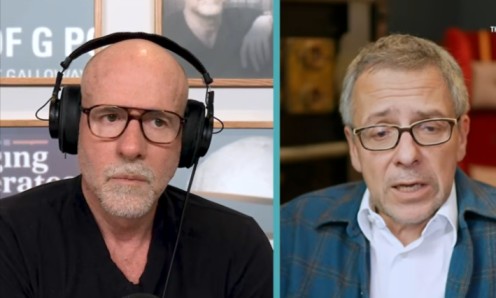
Editor’s Notes: In this episode of The Prof G Pod, host Scott Galloway sits down with Ian Bremmer, President and Founder of Eurasia Group, to dissect the complex “no exit” reality of the ongoing war in Iran. The discussion delves into seismic shifts in global alliances, including the UAE’s sudden departure from OPEC and the growing friction between the U.S. and its European partners. Beyond the Middle East, Bremmer offers expert insights on the stalemate in Ukraine, the strategic posturing of China regarding Taiwan, and the broader implications for the upcoming U.S. midterms. This conversation provides a compelling “world tour” that maps out the current state of geopolitical risk and the significant economic challenges ahead. (May 1, 2026)
TRANSCRIPT:
The State of Geopolitics: Iran and Beyond
SCOTT GALLOWAY: Ian, where does this podcast find you?
IAN BREMMER: Hey, Scott, I am back in my office in New York City. Sunny, spring-like New York City. Thank God. We need something.
SCOTT GALLOWAY: Oh, that’s nice. So let’s bust right into it. Abroad, the war in Iran drags on with no end in sight. Blockades were exchanged. The Strait of Hormuz is still effectively closed, and talks keep collapsing. At home, we had another incident of political violence earlier this week. The attempted assassination of the president at the White House Correspondents’ Dinner. Ian, in your view, what’s the state of play in geopolitics right now, particularly in Iran?
IAN BREMMER: Well, the biggest thing that happened today is the Emiratis, ally of the United States, unilaterally withdrew from OPEC, an organization the Americans don’t like, and is now going to be weaker, more fragmented, more led by Saudi Arabia. That is part of what is a growing divide between an Emirati bloc and a Saudi bloc on security, on economics and technology in the Gulf. And definitely the Iran war has accelerated that pretty dramatically.
But take a quick step back. The other big news this week out of Iran is that the German chancellor publicly said the United States is being humiliated. The French president publicly said that the US president, the Russian president, the Chinese president are all directly against Europe, acting together against Europe. Those are things that at best you usually hear with inside voices. You don’t hear them saying publicly.
So this unwinding of US alliances, this anger and fragmentation geopolitically, both in the region and more broadly, is clearly becoming more front and center. And there are questions over how much this is in America’s advantage over the short, the medium, and the long term. But the anger, the feelings are raw. And the view that these institutions, these alliances are not serving the purpose of the US or the allies, those things are growing and becoming much, much more direct.
And the pain that comes from an Iran war that we’re now in the third month of, no end in sight, as you said, the economic consequences are massive as well as the geopolitical, is really leading to a lot of anger and hostility and mistrust on the global stage. So maybe that’s the way I would frame it just to start.
The UAE’s Decision to Leave OPEC
SCOTT GALLOWAY: So I want to bifurcate it into what I think is a really interesting story, and I’m interested to get your take, and that is the UAE deciding to divest or leave OPEC, and then obviously US allies getting more strident in terms of their criticism of the US. Why would the UAE see it to their advantage to alienate other Gulf partners in OPEC, weaken OPEC. What is the mechanization and the sort of the industrial logic behind the UAE coming to the decision that they’re going to leave OPEC?
IAN BREMMER: So Scott, there are lots of reasons. It’s hard for me to tell you which ones are the most important, but they all move in this direction. One is that Dubai, which has been like so much of the model of future growth, like “we’re the Switzerland of the Middle East and we’re attracting all these expats and everything is safe and stable.” And you’ve been there, I’ve been there many times, right? That looks a lot more vulnerable when suddenly the Iranians are able to shut down the strait and use their missiles to strike directly your 5-star hotels, your airport, and the rest. And so suddenly you see Abu Dhabi, the capital of the UAE, willing to focus much more on what they see as in their national interests right now. And that is, we’re aligned with Israel, we’re aligned with the United States. Those are the countries that are coming to our aid, not the Saudis.
We are going to sell as much oil as humanly possible in the near term, as soon as the strait is opened, at higher rates. We’re not going to align with voluntary restrictions on oil export because we can make money on that now. But long term, we’ve got to diversify away from oil. We’ve got to focus on tech investments. We’ve got to focus on post-carbon energy. That’s the win for us.
Then you have the fact that their view on Iran and this war is completely different from Saudi Arabia. The Emiratis really want the war to continue. They certainly don’t want to see this Islamic Republic stay in place, and they don’t want this regime to have the military, the ballistic missile capabilities, the proxy support, or potentially the nuclear capabilities. In that regard, if the war were over today, in 6 months, in 12 months, I could see the UAE joining with Israel in so-called “mowing the grass,” which you and I and Dan Senior talked about a few weeks ago when we last had a public conversation.
The Saudis, on the other hand, their principal alliance outside of the US is with Pakistan, a nuclear power. And they are increasingly aligned with Egypt, with Turkey, but also are thinking long-term about how to make a deal with a post-war Iran to ensure their own security.
And so this war — again, there’ve been fights between MBS and MBZ that predate this war. We saw that play out in Yemen. We saw that play out in Sudan. We’ve seen that play out in financial decision-making. But it has been accelerated and intensified by the war and the very divergent responses to the war geopolitically, militarily, and economically by these two very successful countries with very different models.
And I think that’s what has led to the UAE to make this announcement, an announcement that’s made when the strait is closed. So it doesn’t have any proximate economic impact tomorrow, but it will. It would not surprise me if the Emiratis leave the Organization of Islamic Countries, the OIC. I have heard from both the Emiratis and the Saudis and others in the Gulf that they think the Gulf Cooperation Council, the GCC, which is the overarching regional framework, however loose, is not fit for purpose anymore. So that could also fall apart. It’s becoming a GZERO Middle East in that regard.
Iran’s Military Reach and the UAE’s Exposure
SCOTT GALLOWAY: Yeah. And one of the stats that just blew me away is that more projectiles have been shot at the UAE from Iran than Israel. I mean, it appears that Iran has decided that the UAE is, absolutely not their ally.
IAN BREMMER: And it’s a lot closer. It’s a lot easier to hit if you’re Iran, right? You need longer range missiles to hit Israel, which they don’t have many of. And Israel, much harder, much more hardened targets.
SCOTT GALLOWAY: Do you think this brings one or the other, the UAE or Saudi, closer to Israel and the US and alienates the other? I mean, I see this as a pretty big deal. One, I hate cartels, so I’d like to think over time this lowers the price of oil for everybody. But this does feel geopolitically like a pretty big shift in the chessboard.
Shifting Alliances: UAE, Saudi Arabia, and the US
IAN BREMMER: I don’t like cartels. I don’t like monopolies, whether they’re US platforms or they’re global commodity unions. And in that regard, the breakup of OPEC will lead to more competition and lower prices over time. I believe that is true, and that certainly redounds to America’s overall interests.
Now, the UAE and Saudi Arabia are both allies of the United States militarily. They both rely on the US for intelligence to a very great degree. Now, Saudi Arabia, their missile program is provided by China, and that is important. It’s also because the Americans weren’t about to sell Tomahawks to the Saudis. Longer term, I see Saudi Arabia becoming more aligned with China in terms of who’s going to buy their oil export. And Saudi sees themselves as the big producer of the last inexpensive barrels over decades that will still be needed in a global economy that’s transitioning, but still very much reliant in part on oil and gas.
I also think that the Saudis will be more enticed to buy Chinese technology, including AI, because it will be less expensive for their own population than the Emiratis, who will want to be more aligned with the US military-industrial-technological complex. So for now, both of these countries are still aligned pretty strongly with the United States overall militarily. Over time, I expect that that will become more true for the Emiratis, and it will become less true for the Saudis.
There’s also the kleptocracy piece, the fact that so many billions of dollars are trading hands from the Gulf to the Trump family and the Trump inner circle. There’s also massive investments made into the United States. I think that the Saudis, even though they’ve promised $1 trillion and Trump went there at the beginning of the term and he made that huge announcement of how much the Saudis were going to give him, I think the Saudis are much more likely to downgrade how much money they’ll put in the US, and they will reprioritize domestic investments for their own sovereign wealth funds.
While the Emiratis, I think, are going to be doing much more globally. And in that regard, they will be seen as deeper pockets and more attractive partners for a lot of Western multinationals. So these things are, again, I think geopolitically there are lots of consequences that will be playing out for a very long time on the back of this war, but the most immediate and consequential is probably this dynamic, which we are seeing play out with the headline of the Emiratis leaving OPEC.
Who Has More Leverage: Washington or Tehran?
SCOTT GALLOWAY: So Iran has offered to reopen Hormuz, the Strait of Hormuz, if the US lifts its naval blockade and ends the war, setting aside or kicking the can down the road for nuclear talks. Secretary Rubio called it unacceptable. Trump canceled the Islamabad follow-up talks. A ceasefire — technically, “technically” is doing a lot of work here — holds, but both sides keep probing. Qatar is warning of a frozen conflict. Who do you think has more leverage right now, Washington or Tehran?
IAN BREMMER: The Americans say they have more leverage. The fact that the Germans spoke the way they did implies they think the Iranians have more leverage, which is not helpful. I will say the Iranians have an information advantage. They have an asymmetry here, right? Trump for a very long time has talked about the fact that “you never know what Trump is going to do” is an advantage, right? Like he could do crazy. And so people have to be careful with him.
Well, we actually know less about the Iranian leadership, who is willing and capable of ultimately implementing a decision, how decentralized the decision-making process is. And we don’t have good information on who’s saying what to whom. Where in the United States, we’ve got polls, we’ve got impact in the markets, we’ve got all sorts of people inside the Trump administration that are talking to the media. So it is easier for the Iranians to assess that Trump wants a ceasefire, that he’s looking for an off-ramp, that he’s promising the American people that this war will be over soon. All these things. It’s very hard for the Americans to make that assessment of the Iranians today.
Now, America, of course, is vastly more powerful than Iran. And so in principle, that should give the Americans a lot more leverage. And yet the Iranians are showing that they are willing and capable of taking a lot more pain. 150 of their leaders have been assassinated. No American leaders have been assassinated. No Israeli leaders have been assassinated. So the Iranians are taking a lot more damage. They’ve got over a million people displaced. They’ve got well over 1,000 dead. Americans, 13. So the Iranians are clearly showing that they are capable of tolerating a lot more pain than the Americans had expected.
They’re also showing that their military capacity at this point is much greater than the military planners in the US believed. And here, Scott, I’m not talking about what Trump thought, having ignored what a lot of his military planners were telling him. I’m actually talking about the military planners. They are very surprised. CENTCOM is very surprised that in the third month of this war the Iranians still have over 50% of their ballistic missile capacity intact. They’re very surprised that after strikes on launch pads, in some cases the Iranians were able to dig them out and relaunch within 24 hours. They’re surprised by the hypersonics that were able to get through American defenses in the Sultan Air Base in Riyadh and destroy American advanced aircraft. They’re surprised by the range that the Iranian missiles were able to show to launch a small attack on the base of Diego Garcia.
So there has been more capability shown militarily on the part of the Iranians despite all this damage. The long and the short of it, Scott, is that it’s hard to say who has more leverage here, but it is clear that President Trump is looking for an off-ramp. It is clear that President Trump is not in any way interested in a short-term return to warfighting. And it’s not as clear what the Iranian incentives are in this environment.
The U.S. Painted Into a Corner
SCOTT GALLOWAY: So I’ll put forward a thesis and I want you to respond to it. It feels like the president has really backed himself into a corner that they can’t just leave. They could be accused— I love, I think it was you used this term of having a glass jaw. It doesn’t matter how big and scary you are, if you get punched once and you’re down and you’re out.
I don’t think they can politically leave if the Strait of Hormuz is not open. I don’t think it can be, “We broke it, it’s up to the rest of the world to fix it.” At the same time, it feels like every day that the war goes on, Iran can claim credit for surviving, and that whether it’s the Taliban, the Viet Cong, or now the IRGC, they win by just surviving.
It feels as if, one, do you agree with that? And two, what is the likelihood that the U.S. is able to enforce free passage of the Strait of Hormuz and then leave, kind of declare victory and leave with what is arguably a weakened Iran in terms of its military capacity? But then do they just leave the Gulf states more vulnerable? It definitely feels as if he’s painted himself into a corner here. Your thoughts?
IAN BREMMER: Yeah, I think you’ve framed it extremely appropriately, right on the money. Scott, this is the question I’m exercising myself with and my analysts at our firm every day.
I think you’re right that Trump feels like he cannot just cut and run here, even though that is clearly the right thing for America’s national interests. The longer this war goes on, the more damage, the more costly. But Trump is unprepared to declare victory, even though he has tried to. I mean, how many times has he said, “Ah, the Strait is the European problem, it’s the Asian problem, they have to deal with it?” He has said this. He has set himself up to declare victory and leave, but he’s not willing to do it because he knows it just looks horrible. He knows it feels like too much of a loss.
Even for Trump, who is one of the most incredibly shameless at saying things that just aren’t so and willing them to be the truth for himself and his supporters, even he does not believe that this is plausible and credible. And yet we’re in an environment where the baseline outcome, even if he were to declare victory and leave today, the baseline outcome is worse than the deal that was on offer to Jared and Whitcoff by the Iranians before the war started. It is a worse outcome than if Trump had not left the Iranian nuclear deal, the JCPOA, at the beginning of his administration. And it becomes a worse outcome for every day that he chooses to continue with this blockade.
The costs are so much greater than the benefits of continuing with this fight. And he’s chasing the dragon, right? I mean, he needs a bigger hit and a bigger hit every moment. And he’s becoming too pot committed. And you and I both know, we’ve seen people with gambling addiction problems, they end up getting themselves in bigger and bigger holes.
So I think that he should declare victory and leave. What he seems to believe right now, and what I’ve been hearing from the White House, is— and this reflects him saying to the public, “You need to be more patient,” after he told the public that we’re going to be done in 2 to 3 weeks max, the war will be over. That has proven not to be the case. He told the G7 allies, “Just a couple more days,” at the beginning of the war, and the Iranians are going to surrender unconditionally. That turned out obviously to be very, very far from the case.
He’s now saying, if we just give it another month or two privately, then the Iranians will be under such economic pressure because of the blockade, which isn’t biting yet, and isn’t biting in part because he suspended the sanctions on Iran at the beginning of the war so he could keep the oil prices low— turned out not to be such a foresightful move— that then they will be forced to come to the table and negotiate more seriously with the Americans and give him the nuclear win that he is seeking.
And that is a theory of the case that is plausible. It will cause far, far greater economic damage to the U.S. and globally, to the American consumers, American voters. But that also relies on the idea that the Iranians are negotiating in part in good faith and on the basis of a clear-eyed view of their national interest and not out of revenge or vindictiveness or ideology and theocracy, and that they’re a suitably unitary actor to implement what the negotiators agree with. And all of those things are open to question.
So for all of those reasons, I think that Trump is only getting himself in deeper and deeper trouble here. So you’re right, he painted himself into a corner, but that doesn’t mean digging yourself into a hole after you’re painted in the corner, right? At some point logic tells you, okay, you’re going to get some paint on your shoes, walk out of there.
Can America Leave Without Securing the Strait?
SCOTT GALLOWAY: Do you think America can feasibly leave without ensuring free flow or free navigation through the Strait of Hormuz?
IAN BREMMER: Of course, of course they can. The question is, what are the implications of that?
I think that were the Americans to do that, the Iranians, if they were to charge prohibitive tolls and no one signs up to it, or only very small numbers of countries, then oil prices are still high. The Americans could easily turn back to a blockade at any moment. So that option remains there for the United States.
Number one, turn the money off for the Iranians. Number two, you’ve got the option of what Trump intimated by saying it’s the problem of the other countries, is they end up doing deals with the Iranians. And you can call it a toll or you can call it reconstruction money. You can have sanctions suspended again off of Iran and then a whole bunch of the oil’s actually getting out. And then the Europeans may send some destroyers and other ships to help ensure the navigation and the insurance comes back online and the ships become crewed and then prices come down again. And the U.S. economy has taken comparatively less of a hit than most of the other economies in the world.
Now, is this embarrassing for Trump because you still have the same Iranian regime in place? Well, yes, but I don’t see any strategy to remove the Iranian regime at this point. It’s not like Trump is still talking about rescuing the Iranian people. The Iranians would still have their nuclear capabilities, but Trump has said now on a few occasions that if they try to get those nuclear capabilities, “We’ve got satellites on them, we can blow them up at that point.”
You and I looking at this, Scott, it should be plainly obvious to everyone, irrespective of what Trump admits to, that there’s no win here for the Americans. So the question is, how are you going to reduce your losses in ways that allow everyone to move forward? And I do think the best, the least worst scenario at this point is to conclude the war and open the strait as soon as humanly possible. And I would’ve argued that 6 weeks ago easily, it would’ve been much better than now. I mean, I don’t see what’s been gained in the last 6 weeks other than far, far more economic damage.
The State of Play in Ukraine
SCOTT GALLOWAY: So let’s keep moving around the globe. I get mixed reporting, mixed messages about the war in Ukraine. I see that the oil infrastructure in Russia is being damaged and that Ukrainian drone technology is increasing or ramping up their attacks on Russian oil infrastructure and registering a lot of success. At the same time, I see other reports that Russia’s industrial machine is just overwhelming Ukraine with more and more drones. Give me what you think the state of play is in that conflict.
IAN BREMMER: For the last 3 months, Ukraine has taken back a small amount of territory. And that is because the drone capabilities and the unmanned ground vehicle capabilities are increasingly changing the advantage on the front line, if not in favor of Ukraine, at least no longer in favor of the more highly manned Russia.
Russia benefits from the war. They’re selling a lot more oil, gas, fertilizer, commodities at higher prices. Some sanctions have been suspended by the U.S. Furthermore, the Ukrainians are having a harder time getting access to some of the weapons that the Europeans want to buy for them because they are in short supply and necessary now for the Iran war. American weapons. So there is a tactical advantage to the Russians that comes from the Iran War, but the war itself between Russia and Ukraine has at best for Russia shifted to a stalemate.
Where the Russians are showing more advantage is that they now are manufacturing more ballistic missiles. Their drone capabilities are not what the Ukrainians are, but they’re high. And they’re now launching a lot more of those, record-level rates, and some days more than we’ve seen at any point in the 4 years of the war against Ukrainian cities. And the Ukrainians are running low on interceptors. Not on the lower-tech drone responses, but interceptors for ballistic missiles, having a harder time defending their cities.
So you could imagine a situation where the Ukrainians end up taking more land back, but the Ukrainians also take more casualties, civilian casualties in cities, and their own critical infrastructure becomes more damaged. Their economy gets more hurt.
Still, I guess your big takeaways here, and this shouldn’t surprise you: number one, zero incentive of Putin to negotiate a ceasefire in the near future. And number two, zero slowdown at this point of the Ukrainians to continue to defend themselves because they no longer need quite as many troops on the front line. And that’s been the biggest vulnerability, is that they’ve had a harder time raising reserves in a Ukrainian democracy than the Russians are, that can send North Koreans, they can send mercenaries, they can send convicts, all this kind of thing. The Ukrainians have a disadvantage there with a smaller population. That’s becoming more balanced.
Is There a Resolution in Sight for Ukraine?
SCOTT GALLOWAY: What do you see— do you see any resolution here? What do you think looking 12 months in? I mean, we’re now several years into this war. Does either side have an incentive to figure this out right now or to come to some sort of resolution?
European Frustration and the Iran War
IAN BREMMER: Doesn’t look that way. You know that Trump, his top priority foreign policy when he became president was to end the war. His repeated quote of, “24 hours, it’ll be over.” He’s failed at that and he’s admitted that he’s failed at that. He’s frustrated about it. He blames the Ukrainians at least as much as the Russians, which is not analytically sound, but it does express his frustration that he doesn’t have the leverage to muscle around Putin in the way that he does with Zelensky. So that irritates him.
The Europeans are all in supporting Ukraine, and they’re spending a lot more money on their own defense. Certainly the Germans are, the Poles are, the frontline states are. They’re also now spending all the money for Ukrainian defense. American taxpayers are no longer spending anything on Ukraine. So this is 100% the Europeans. And that’s what really, I think, has so antagonized — when the Europeans are doing all of the burden for Ukraine in defending a democracy that the Americans wanted to invite to join NATO. It was Condi Rice and Bush that pushed that. It wasn’t the Europeans first and foremost. So the Europeans are now the ones doing all of the lifting for Ukraine to help the Ukrainians.
And then the Americans decide to engage in a war in Iran that is going very badly. They didn’t tell the Europeans about it in advance. And then the Europeans take more economic damage from the war, and then Trump calls them cowards when they don’t stand up and join him. The level of anger among European leaders right now towards the United States is unprecedented in my lifetime. I have never seen anything like it. And that’s even before we talk about the trade hostilities. It’s before we talk about Greenland. It’s before we talk about Trump’s recent flirtation with Argentina and the Falklands. I mean, all of that stuff. I can give you so many more data points on this.
But the Russia and the Iran wars and the American response to that — as the Europeans do feel like they’re absolutely stepping up, they’re spending money like they never have before on defense, and they should have for decades. But they’re also doing all of the lifting on Ukraine. And Trump’s like, okay, but what are you doing for me on Iran? It’s extraordinary.
Viktor Orbán’s Defeat
SCOTT GALLOWAY: So trying to find a brief moment of sunlight here. Thoughts on Viktor Orbán’s defeat?
IAN BREMMER: Great one. Absolutely. And here’s one that Trump should have been in favor of. I mean, here’s, you’ve got a new leader who wants to drain the swamp. He’s from the populist right. He believes in strong borders. He really opposes all the migration coming in. He wants a strong transatlantic alliance that’s capable of defending itself against Russia and against the Chinese, principal adversaries of the United States.
He defeats Orbán, who has wildly redistricted their political system and controls the media and has enormous amounts of informational advantage. And despite all of that, he was able to secure a constitutional majority. This should have been a win for a conservative, nationalist, America First president. And yet Trump wanted Orbán. Orbán supporting the Chinese, supporting the Russians, wildly kleptocratic, deeply anti-democratic, the swamp incarnate, but liked Trump and came to CPAC and said all the right things and flattered him.
And ultimately what matters, what MAGA is, unfortunately, is what Trump says it is and what appeals to him. Before it helps the country. And that’s the part that’s going to lead him to lose the midterms in such a spectacular way. And it really plays out most clearly in Hungary. And it’s why Giorgia Meloni, who was the only European leader that came to be there with Trump for his second inauguration, has now broken decisively from Trump — on the Iran war and on other issues. It’s why he’s losing support from the far right in France, Le Pen, Bardella and others.
It’s kind of extraordinary that the populist right in Europe would not be pro-Trump and pro-MAGA. And it’s because Trump and MAGA are no longer reflecting the populist right. They’re starting wars, they’re expanding the swamp. They’re not doing precisely what the people that voted for them really wanted them to do.
The Trump-Xi Summit and US-China Relations
SCOTT GALLOWAY: So let’s keep heading east. Thoughts on the Trump-Xi summit? What’s your read on China-US relations right now, especially given the war?
IAN BREMMER: Xi Jinping, in the near term, he’s taking it pretty hard from this war. His economy — I mean, they say it’s 5% growth. In reality, economic experts believe it’s more like 2 to 3%. There’s high unemployment, particularly among the youth. There’s enormous amounts of bad corporate debt. And the Chinese response has been very cautious and incremental. So this is not a time when the Chinese want to see reduced demand for their manufactured exports, the one part of their economy that has been outperforming.
But now you’ve got people around the world that won’t be able to buy as much, can’t afford as much from the Chinese. China has big stockpiles of oil and of commodities, but still all of this disruption from the strait is costing them. They need the plastics, they need the polymers, and they’re not getting them. And when they are, it’s at very expensive prices. So they really want this war to be over.
But Scott, the Chinese are also the one country in the world that has made the long-term strategic investments at scale in moving past oil and gas and in electrifying their economy, and in having the solar and nuclear and wind at scale getting cheaper, and the batteries and the rare earths and the critical minerals that are powering them. So long-term, the more this war goes on and tells everybody the future is not oil and gas — which the Emiratis clearly understand today — but the big beneficiaries are not the Emiratis. The big long-term beneficiaries are the Chinese. So they are extremely well positioned despite all their domestic challenges on the back of this Iran war. And the worse the war gets, the longer the war goes on, the more the long-term Chinese bet looks like the most intelligent bet they could make.
Now, in the context of all of that, China has said, we want peace, we want this over. They’ve engaged with Pakistan, but they’re not taking the lead in negotiations. They don’t want responsibility for that. They don’t expect it will go well, and they don’t want to be responsible for it not going well or perceived to be attached to a failure.
Having said that, they are proceeding all in with this now delayed summit in just a few weeks in Beijing, which Trump appears to be willing to continue with despite the ongoing blockade. And I do think that even if the blockade is in place, as long as the ceasefire holds, I think Trump still wants to go.
Now, I think what Xi Jinping is going to do — he’s going to welcome Trump like no American president has ever been welcomed. There’ll be extraordinary military parade and robotic display and drone display and a huge group of American CEOs and all the corporates and all the top leadership from China will show up and they’ll say what an amazing president that Trump is. And then when Xi Jinping meets Trump directly, he’s like, “I know you want to be the best dealmaker and you’ve ended all these wars. And the biggest deal you could possibly do is we can create peace in Taiwan. And if you were just to say that you do not support Taiwanese independence, here are all the things that we can do for you. Here’s the money that we can spend. And this time it won’t just be Ivanka’s handbags that we’re giving you licenses for. It’s going to be big, big purchases of American goods and a whole bunch of stuff for the family too.”
I think that Xi Jinping would be derelict in his duty as head of the Communist Party, as chairman, if he did not try that with Trump. Because we know that Trump does not care much about Taiwan. He does not care about a territory thousands of miles away from America. He wants to be seen as a dealmaker. And his own advisors, who are much, much more hawkish on China, will readily admit that they have no idea what Trump would do in a room alone with Xi if he’s given an offer like that.
Now, will Trump accept it? What will he say? How? I don’t know. But I do know that Trump understands that China has leverage. They’re willing to use it. He shows a lot of respect, even deference, to Xi Jinping. He talks about a G2 between the Americans and the Chinese. He would never afford any American ally that kind of positioning and brand power. And he really wants this summit to happen. So I certainly don’t think there’s going to be a fight. I think the question is whether or not Trump is inclined to give away the store for things that he considers personally important.
Cuba: Carrot or Stick?
SCOTT GALLOWAY: So let’s keep going on our world tour right now. Another topic that has fallen somewhat behind the news cycle is Cuba. What do you think is going on there? What do you think is the likelihood that we try and pull a Venezuela on — you know, that’s the best case scenario — pull a Venezuela or worse in Iran on Cuba? What do you think is going on there? And what do you think is the likelihood we take military action against Cuba?
IAN BREMMER: It’s not an Iranian type scenario. I mean, the Cubans don’t have that capacity. They don’t have the resources. And Marco Rubio, I think, who is really running point on this decision-making process — as opposed to Iran, where Trump has been the decider — readily admits that there is no military solution here.
So the question is really not whether or not Cuba’s going to be Venezuela, but rather how small of a deal is acceptable that can be announced as a breakthrough. Because the Cubans are getting hit hard economically. The blockade really matters. They’re not getting the energy from Venezuela or from Mexico, rolling blackouts. Sanitation’s not getting picked up, the buses aren’t running, people don’t know when they’re going to have electricity. This is incredibly hard for the Cuban population. And they’re getting angry, and they’re getting angry in part with the Cuban government.
So I think that the Cuban government is highly incented to see if they can do something with and for Trump. And so the question is, if it’s basically the same government, if it’s still the Castros, because there really ain’t nobody else right now, at least no one in the country, and they’re willing to open the Cuban economy to American investment big time in terms of tourism and real estate development and the rest — because they don’t have much in terms of commodities, some ag, but nothing that really moves the needle — if they were willing to do that with a similar government, does Trump announce that as a huge win? Because it’s kind of — you can call that Venezuela light, or you can call it Obama plus. Because Obama essentially was trying that. He just didn’t get much from the Cuban government. Ultimately, they were slow rolling it. They weren’t sure it was real, and they thought they had time, and they thought the opportunity would always be there, and they failed. They botched it.
Here it’s very clear that the urgency is there for the Cubans. I don’t think there’s that much at stake other than for Cubans living in Cuba, Cubans living in Miami. Marco Rubio — this is not going to have the same national impact that Venezuela has or than Iran has, but it is set up to be at least a significant foreign policy win at some point for Trump. I just don’t think it’s going to be massive.
SCOTT GALLOWAY: Yeah, there’s no minerals, no economic prize. 13 presidents have tried to thaw relations or do something and have failed. I, this is an unusual analogy, but about 20 years ago, I raised a bunch of money to go become the largest shareholder in Gateway Computer, which I realize is a really weak —
IAN BREMMER: I remember Gateway.
SCOTT GALLOWAY: Yeah. And I just want to acknowledge that’s a pretty weak flex. And I met with the board and said, “I want this, I want this, I want this many board seats or I’m going hostile.” And I can’t remember if it was Ted Wade or one of the guys on the board said, “Scott, why don’t you just start buying stock and we’d love to have you on the board.” It was like, what, you don’t need to come in guns blazing. Wouldn’t the right strategy with Cuba be to show up with energy and humanitarian aid and do a deal to open McDonald’s and Chipotles and just sort of, in other words, go the other way to use the carrot, not the stick here?
Cuba, the Midterms, and the Taiwan Question
IAN BREMMER: Well, I think that the stick is presently being used to get to the carrot. Because the Cuban government has historically shown that they are very reluctant to allow the Americans to make those investments because they worry that’s a slippery slope to eventually the end of the Communist Party, the end of their control.
So I do think that there is a utility in having some coercive diplomacy if the intention is to open an economy that otherwise they refuse to open. There has to be more of a stick than what the Obama administration was itself trying to accomplish. Because the Obama administration had sticks too. They had the continued sanctions on the Cubans, but that by itself was inadequate because Cuba could deal with that hardship over many decades. The hardship is so much worse now.
Now, has Trump overdone it in terms of the damage that the Cuban population is living with and under? You could make that argument. You could also argue if ultimately this leads to allowing lots of investment in, and sure, that’s going to include a whole bunch of stuff that will touch the average Cuban people.
What you don’t want it to be is a small number of deals that Americans that are connected to Trump make money in their investments, and it’s all picked up by the Cuban military, and the Cuban people don’t get any of it. Because then Cuba’s not opening, right? That’s not what you want.
What you want is the opportunity for the Cuban people to develop a real economy, to have small and medium enterprises that they can be a part of, to have employment opportunities that they can be proud of, to actually themselves be able to participate in a global economy that their own country has cut them off from for 60 years now.
The Midterms and Trump’s Endgame
SCOTT GALLOWAY: Any thoughts on the state of the parties right now, headed into what will at some point be election season for the midterms?
IAN BREMMER: Well, I’m interested in your views on this too, Scott. At this point, I believe that Trump understands that the midterms are lost. I think he knows that he can’t turn the economy around. That’s why he’s suddenly pivoting towards patience on Iran. That’s why he said, “I’m surprised oil prices are so low. I thought they could be $250, $300. They’re under $100.”
I think he knows that he’s in too deep, and so the midterms are lost. And so then the question is, does that make him more risk-acceptant? Does it make him more willing to allow this war to go on and roll the dice and maybe even use ground troops? Because one of the things so far, one of the limitations of how badly this war is perceived as going by the Americans is 13 Americans have been killed. But no ground troops have been inserted. That could change very easily, and there are plans for that, and there are troops that are in the region for that. But Trump recognizes that they’re extremely risky, and they’re not being recommended by his advisors.
So if he knows he’s going to lose no matter what, and he knows that in the following 2 years he’s going to become more of a lame duck, does that make him more risk-acceptant in trying to end checks and balances against him and just throw everything at the wall? Or does he give up on that and start focusing more on monetization? He’s worth $5 billion that he’s made through the presidency in the last year. How about $50? How can he potentially use the remainder of his period in time to make as much money for himself and his family as humanly possible.
And I’m not saying he can’t do both, but I do suspect that there will be a prioritization of one or the other. And it is not clear to me that the closer he gets to the end of the administration, whether he really is trying to go all out like Bolsonaro in Brazil — “I must find a way to ensure that my political opponents are defeated and they’re investigated and they’re arrested and I control the elections and I select the next person” — or he just gives up on that because it ain’t happening and he focuses on the stuff that he can do, which is make a shit ton of money as president. And I don’t know the answer to that.
The Taiwan Trade
SCOTT GALLOWAY: Yeah, I always learn from you. And the thing that I’m taking away from this conversation that’s literally sent chills down my spine, it just makes so much sense. And I think the media, or most of the media, has missed it. And it just, if you just look at the fact patterns here, it’s such an obvious insight. But I had missed it.
I think you’re right. I think there’s a non-zero probability he trades Taiwan for billions of dollars of personal enrichment. You’re absolutely right. Xi can say to the guy, “Figure out a way, we’ll work with you to kind of slow step a creeping takeover of Taiwan. You start making noises about we need peace in China and Taiwan. You withdraw the military umbrella coverage of Taiwan.” And wink wink, once you’re out of the presidency, I’ll figure out ways, whether it’s buying billions of Trump coin or doing hotel deals in China that are guaranteed to work, so to speak.
Yeah, it seems to me that’s the most obvious path here. And I love what you said, that Xi would be derelict in his duty not to offer that. That’s the cheapest way to invade China right now, is to bribe a corrupt president.
IAN BREMMER: I mean, how far you could actually go in implementing something like that, because Congress exists and there would be strong resistance from inside Trump’s administration himself. But that’s very different from an announcement by Trump that “I do not want an independent Taiwan,” which creates facts on the ground.
A withdrawal of American military engagement, that seems really hard to actually implement. Willingness to talk with the Chinese about what defense the U.S. sells to Taiwan — Trump is already willing to at least engage with Xi Jinping on that. Trump has already shown, after the Japanese prime minister got herself in trouble in responding in a slightly intemperate way to a journalist’s question on whether you defend Taiwan or not. And the Chinese cut off their tourism to Japan, cut off their seafood imports from Japan. And Trump’s response was not to defend her position, which is aligned with the historic American position. Rather, he called her and said, “Why don’t you calm it down on Taiwan?”
So Trump has already shown his bona fides to the Chinese as someone that wants peace and security and stability in Taiwan, even over the historic position of some of his predecessors, Democrat and Republican. The question is, how much farther can Xi Jinping push that? And I’m suggesting that that proposition is going to be tested when they meet one-on-one. And the best time to do that is not when it’s a big formal meeting, with both sides arrayed, but rather when it is the smallest possible venue between Xi, Trump, and a couple of translators.
SCOTT GALLOWAY: But at the end of the day, can’t he just say to him in a private meeting, “Yeah, we have Ohio-class submarines that have the nuclear launch capability of France, each of them”? And that’s — I would imagine that’s one of the biggest deterrents to taking any sort of military action or a blockade against Taiwan by the Chinese. Can he just say, wink wink, “I’ll tell them to stand down”?
IAN BREMMER: No, I don’t think he can do that because that implies that what the Chinese are into here is a surprise military attack against Taiwan, which would be incredibly risky for them to do and actually cuts against everything that China’s been showing us.
The biggest move China’s made on Taiwan, since the war in Iran started, was they invited the head of the Kuomintang, the opposition party, which is more in favor of peaceful cross-strait relations, softer towards Beijing, invited her to Beijing to meet with Xi Jinping. And on the back of that, they made a bunch of unilateral offers to improve cultural and diplomatic engagement as well as economic engagement with Taiwan, much of which was rejected by the more nationalist president of Taiwan.
But this was Xi Jinping showing that the future is not about the military. The future is about, “We’re so much bigger and we’re not trying to engage in hostilities. It’s this rebel troublemaker president that you have who you should not be voting for in the next elections, by the way.” And he’s trying to show that Trump is part of the solution. So it’s not a wink wink, “We’re going to attack and you’re not going to do anything.” It’s more about how can you nudge, shift the table in our favor in a long-term trajectory so that there is a peaceful unification of Taiwan with China, which is what Xi Jinping sees as an ultimate legacy issue of his leadership.
SCOTT GALLOWAY: So you don’t even think the Chinese would consider a naval blockade? Do you think it’s going to be a quote-unquote — they’re going to attempt a softer unification or a soft take?
The Taiwan Question and Trump’s Transactional Politics
IAN BREMMER: I don’t think they believe it’s remotely necessary in the near term. I think if things went badly in the upcoming elections and it proved to be a landslide for the DPP, I could imagine the Chinese starting to do things like boarding some suspicious vessels with the Coast Guard as opposed to the military, so it didn’t require an American military response. I could see that.
So again, even in the worst-case scenario, it’s longer-term and it’s more incremental. I don’t think there’s anything this year that the Chinese are going to try on the military front. I think it’s much more, we’ve got a shot to really improve our lie by engaging with this guy that doesn’t care about Taiwan and that he can be bought off individually.
And so many leaders, the Pakistanis, Honduras, others around the world, leaders, former leaders, they’re showing us that they can buy indulgences, they can buy pardons, they can buy policies. You know, this is the one thing we really want. By the way, we already gave him TikTok, which was the thing he most wanted to have control over algorithmically with his friends. So that they could have more control over the media environment.
Hey, we in China, we respect that. We’ve got complete control of our media environment, so we understand why Trump wants that. So they gave it to him, they let him buy it, right? So I mean, they have built credibility with Trump already that shows that we are willing to give on the things that matter to you, so you need to give on the things that matter to us. And Taiwan may matter to America. But does Taiwan really matter to Trump? I mean, it’s hard to make that call.
Is a Blue Wave Sweeping the West?
SCOTT GALLOWAY: So last question here, Ian. I’m trying to be — and I don’t know if I’m talking my own book here or trying to manifest something — but it feels with Orbán’s defeat, with what looks like to be a pretty significant pickup for Democrats in the House and possibly in the Senate, you look at Trump’s popularity when you look at the fact that the world feels more insecure and full of wars and conflict right now, might there not just be a blue wave in America, but a blue wave that absolutely sweeps the West?
IAN BREMMER: I mean, there are countries where you don’t see that happening. Right now in the UK, you certainly don’t see that happening. You see Reform UK is doing far better and Labour’s imploding. You don’t see it in Germany where the AfD is picking up and the center left, the Social Democrats, are in complete disarray. So I can give you counterexamples.
But what we are seeing, I think, that reflects the broader point you’re making is that in democracies where leaders are showing themselves to be wildly corrupt and/or wildly incompetent, there is a real reaction function from the publics that thought that they represented them. To knock them out of power. And I do think that that is a throughput line of Hungary and the United States right now.
I think that Trump had a whole bunch of things that he stood for when he ran for office. Ending the wars that you’re fighting on the backs of a lot of people that don’t have money and connections. And those wars, securing the borders when you’re taking care — you’re inviting all these illegals in and you’re providing them with benefits. And you’re not taking care of me and my family. No mas, don’t want any of that. And drain the swamp because you got all these powerful people and you’ve got a two-tier system of justice and I’m done with that. And that’s why we want the Epstein files out.
And now he has gone against his populist impulses and instincts on all of these things. I mean, the border’s still secure. That’s gone well. But the affordability crisis is real and it’s on him because of the Iran war. He’s fighting an unnecessary war that Israel certainly cares about, but the Americans don’t. And he’s doing it at the price of the pump and of groceries and these things that, this is why people voted for him. He said, we’re going to stop doing this crazy international stuff because you’re going to take care of Americans.
He was the guy that cut a horrible deal with the Taliban. Allowing them to basically take over the country, right? But he got to end a trillion-dollar unnecessary bleeding war on the back of not well-connected, not wealthy Americans. And people supported that.
And now, whether it’s Epstein or whether it’s Iran or whether it’s the economy or whether it’s extraordinary corruption, Trump has gone against all of the things that got him elected. And I certainly think, okay, there are some MAGA supporters that act like it’s a cult and they’ll support him literally no matter what he does. But that’s not even all MAGA supporters. Not at all. These people are not brainwashed automatons. They’re not idiots. They ultimately see when their leader is screwing them, and it matters to them. And some of those people, they may not vote for Dems, but they’ll stay home, and that matters. And the independents? Absolutely not. And the Bernie swing voters? Absolutely not.
So I think that happened in Hungary. It was a lot harder in Hungary. Hungary, this guy had power for 16 years. Hungary, this guy made it so hard for any opposition candidate to actually come in and take out a seat. So much harder to actually win. And he didn’t just win a little, he won a constitutional majority. And now Orbán is giving up his seat and he’s going to spend the summer in the United States. Good riddance to bad rubbish.
And I think it’s fantastic that the people of Hungary were capable of voting this bastard out. In favor of someone that actually represented their national interests. And I feel quite confident that’s going to happen in November here in the United States.
Closing Remarks
SCOTT GALLOWAY: Ian Bremmer is the president and founder of Eurasia Group, the world’s leading political risk and research and consulting firm, and GZERO Media, a company dedicated to providing intelligent and engaging coverage of international affairs. He joins us from his office in New York. Ian, I always appreciate your time and always learn from you. Thanks very much.
IAN BREMMER: Thanks, Dave. Great to see you, Scott. Thanks a lot.
Related Posts
- Tucker Carlson Interviews Gregory K. Bovino (Transcript)
- Transcript: Vice President JD Vance Remarks in Brewer, ME – Aug 24, 2026
- Transcript: President Trump Remarks at Rose Garden Event, Aug. 24, 2026
- Transcript: Secretary Bessent Remarks on Economic D-Day on Iran & Allies
- Transcript: Canadian PM Carney Remarks After US Tariff Talks Collapse