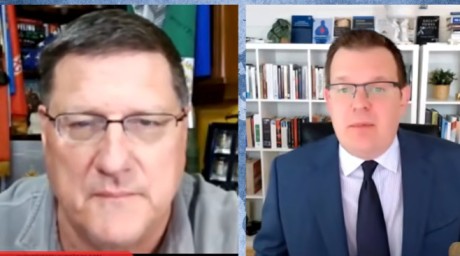
Editor’s Notes: In this episode, Glenn Diesen is joined by former UN weapons inspector Scott Ritter to analyze the sudden and dangerous reignition of conflict between the U.S. and Iran following a surprise move to forcefully reopen the Strait of Hormuz. Ritter provides a scathing assessment of American strategic failures, arguing that the administration’s “fantasy” policies have led to military humiliation and shattered any hope for regional stability. The discussion explores the existential risks facing Gulf Arab states and the potential for a global economic collapse as the U.S. doubles down on its failed objectives. Together, they examine the profound disconnect between Washington’s rhetoric and the harsh realities of a war that Ritter believes the U.S. is destined to lose. (May 4, 2026)
TRANSCRIPT:
Introduction
GLENN DIESEN: Welcome back. Today is Monday, May 4th, 2026, and we are joined by Scott Ritter, a former UN weapons inspector and a former US Marine Corps intelligence officer. Thank you for coming back on. It’s been a crazy day. We see that the US announced it would open up the Strait of Hormuz. It would be done today by force in something of a surprise announcement, and we received some reports then of American warships being hit. They appear to have been mistaken. But at least now it seems that the US is attacking Iranian gunboats and Iran is, well, launching a lot of drones and missiles. Beyond this, it’s still unclear what’s happening. Are we heading towards returning at least to all-out war? How are you reading the situation?
The Current State of Conflict
SCOTT RITTER: Well, clearly the United States is not opening the Strait of Hormuz. I mean, I’ve read the various press releases, two American warships are operating in the Arabian Gulf and two US-flagged container ships have transited. I don’t know if this is true. The United States has a proclivity for lying or shading the truth. What we do know is that ships that have tried to transit have been struck by the Iranians. We know that the Iranians are likewise striking targets in the United Arab Emirates and that the United States has claimed to sink, who have sunk at least 6 small Iranian boats.
It’s war. I mean, I don’t know how else to describe this, a skirmish, opening battle. But the ceasefire is over. And whether it escalates beyond this, we will wait and see. Bahrain has declared a state of emergency. I think Kuwait is on the cusp of declaring a state of emergency. I think the Gulf Arab states understand that the consequences of America’s precipitous action could be fatal to them. Not harmful, fatal to them.
Iran has warned the United States using indirect communication methodologies, or actually going to Moscow and Vladimir Putin making a 1.5-hour phone call to Donald Trump in which, according to the readout from Ushakov, made it clear that the consequences of continued American military action against Iran would be devastating for the United States, for the region, for everybody.
Right now, I do think this is a containable event, but it’s going to require the United States to back down. And if the United States backs down at this junction, then the United Arab Emirates, which has undertaken extreme strategic reposturing in the past week — it’s now come out that Israel sent air defense missiles to the United Arab Emirates, including troops, Israeli troops operating on Arab soil. Mind-boggling. Which means that the United Arab Emirates has made a strategic decision to step away from the Gulf Arab community and permanently link itself to the Abraham Accords, to the greater Israeli project.
This is a heck of a gamble that they’re making because it’s one that they can’t recover from. Either they win, the United States defeats — because this Israeli-UAE dream partnership can only succeed if Iran is strategically defeated. So the United Arab Emirates now is in an existential struggle. They can’t accept half measures. A lot of decisions have been made for which there is no going back. And now the question is, will the United States make a similar decision? Hopefully the answer is no. Hopefully we find a way to de-escalate, but I don’t think that’s in Donald Trump’s DNA at this point in time.
What Are the U.S. Objectives?
GLENN DIESEN: Well, it begs the question what the objectives are, because again, I agree it can still be contained if they walk this one back and the US can even use it as a, you know, for PR, trying to present it as Iran being the aggressive part. But what do you think are the objectives here for the United States? Is it to — because I can see that they might want to try to push through and, you know, probe, see if Iran would allow ships to go through if they’re being threatened. But it should be obvious, as you would know as well as an intelligence officer, you know the people who are there in the US, these are smart people. They would know that the Iranians would not permit this. Indeed, if they let some ships go through, it might even embolden the Europeans to join in with the Americans. Why do you think the US went forward with this? I mean, what are the objectives?
Israeli Influence and Policy Failures
SCOTT RITTER: Well, you say that Trump has surrounded himself with smart people. I say the opposite. Trump has surrounded himself with some of the stupidest people on the planet. There might be smart people on the periphery, but their voices are being drowned out by the stupidity whispered in his ears.
Just take a look at the intellectual foundation of the American policy vis-à-vis Iran in the Persian Gulf region today — it is being run by the Foundation for the Defense of Democracy, which is literally an adjunct of the Israeli Foreign Ministry. In fact, when it was originally founded, it used a Hebrew name because it was an Israeli organization.
But these are the people who are writing the policy that advises Scott Bessent. The CIA is not writing policy. The DIA is not writing policy. This Israeli think tank is writing policy, which means this is an operation being run by Israel. Now we get back to originally what we talked about, the United Arab Emirates and the Abraham Accords and the greater Israeli project. That’s what this is all about.
Scott Bessent has been implementing economic strategies against Iran, which are 100% derived from FDD papers and prognoses. He’s 100% wrong, by the way. I mean, everything he says about Iran is factually incorrect. There is no pressure on the Iranians. Their oil wells aren’t in danger of collapsing because of bad maintenance, and they haven’t run out of storage. And the idea that they’re not making money — go to the Pakistani border, Mr. Bessent, and take a look at what’s going on right now. The flood of vehicles going back and forth in expanded black market and gray market operations where Iran is exporting a tremendous amount of oil to Pakistan and earning hard currency in the process.
So the stupidity of Scott Bessent is only matched by the stupidity of Pete Hegseth, this testosterone alcoholic who is running around pretending that the United States military has somehow won this war against Iran. I want to remind people there were 3 objectives stated by the United States going into this. Regime change was one of them. Termination of Iran’s ballistic missile capabilities was a second one. And the elimination of Iran’s nuclear program was the third. None of these objectives have been met.
What we see is that the regime is stronger today than ever before. The missiles are there firing right now, sinking ships, damaging ships, destroying infrastructure, and the nuclear program isn’t on the table. Iran won’t put it on the table. So the United States has achieved nothing but embarrassment, humiliation. Even American reporters who’ve been cheerleaders for this war have to acknowledge that Iran has destroyed almost the totality of American military infrastructure in the region.
So for Hegseth now to tell the president that “we’ve got this, boss” — he doesn’t have anything. This is a humiliation. Where is Bradley Cooper, the admiral who commands CENTCOM? I don’t know, on an Apache helicopter apparently doing some sort of photo op that he’s flying through the Strait of Hormuz. I dare you to fly through the Strait of Hormuz, Admiral. You’ll be shot down.
This is stupidity that’s taking place right now. We have people who are literally inventing their own fantasy world and filling it with their rhetoric. And now they’re running into the harsh truth that nothing they say is true. Nothing they do gets accomplished. Iran has said that if the United States resumes military operations against Iran, that they will destroy the totality of the oil production infrastructure of Kuwait, Bahrain, Qatar, and the United Arab Emirates. That means the physical elimination of these modern nation states as viable entities. That’s what’s at risk here.
The Russians tried to warn Trump — actually went to Moscow, spoke to Putin. Putin made the phone call. But smart people aren’t anywhere near to be found around this president. There are no smart people around this president. If there were, this wouldn’t be happening.
Escalation or De-escalation: What Comes Next?
GLENN DIESEN: Yeah, that’s fair. But let’s say if they’re not working to contain this conflict, that is to walk it back — all the things that have happened today — well, what do you expect the return to war to look like? Will they essentially catch up, pick up where they left it, or do you think this will be a gradual race up the escalation ladder, or do you think it will go much further up and intensify the attacks much more than last time?
Dealing With an Unpredictable President
SCOTT RITTER: It depends again on how much of a wake-up call, how much awareness the president has. Some people might accuse this to be trivial. I know there are the mouth-breathing MAGA guys out there that’ll say this is Trump Derangement Syndrome, but we have to stop viewing this problem from the standpoint of traditional geopolitics, because you’ll never get it right. This is about a mentally ill president. When I say mentally ill, it is a mental illness. When you speak of narcissistic personality disorder, it is literally a mental illness. This man has an extreme, malignant version of it. He is literally psychotic.
You saw the tweets, 11 posts in a period of a handful of hours — stuff that, if the average American who was employed by a high profile agent, any military person who did this would be relieved of command. Their clearances would be revoked. If you were a flight attendant with a major airline and you went on a social media spree of this nature, you would be yanked. A pilot would be yanked. You’re not allowed to do this because it’s a sickness. It’s a sickness that’s humiliating for whom you represent, and it represents a total lack of mental stability.
Now you understand why it’s almost impossible to answer your question, because we’re dealing with a literal insane person who has surrounded himself with people whose job is to sustain the insanity. They’re there not to correct the president, to do anything. They’re there to stroke the president’s ego, which is the worst thing you can do for a narcissist. But that’s what’s happening. We have a cult of personality in Washington, D.C.
So how do you end this? Well, I think the Iranians hopefully are on the right track. You end this by punching him straight in the face. Straight up punch, break his nose, make it hurt, make the blood flow. And what I mean by that here is hit the United Arab Emirates hard. I don’t know how hard they’re going to hit them, but if you saw, they skipped echelon. The Iranians didn’t go tit for tat for escalation. The United States hit some ships and boom, United Arab Emirates. If they keep hitting the United Arab Emirates, hitting them with near fatal intensity, it sends a signal to the rest of the Gulf Arab states that Iran will follow through on its promises.
And at that juncture, people have to tell the president — certainly somebody could tell the president — that if we get up to $200 a barrel, the American economy is going to just shred itself. The global economy is finished. And he is finished as a president. Somebody needs to go back and tell him that Bill Clinton’s warning to himself during his first run for president, “It’s the economy, stupid,” is as relevant today as it was back then.
If you want to lose an election, keep doing what you’re doing, Mr. President, because not a single American understands the Middle East, therefore is in a position to contradict you on your lies. What they do know is whatever you’re doing in the Middle East has resulted in higher gas prices at the pump. Diesel is going to become unavailable. Airlines are going to shut down. We are getting into the summer season when Americans think they’re getting on airplanes. They’re not going to be getting on airplanes because no airplanes are going to be taking off because there will be no aviation fuel.
Europe is already through this crisis. 20,000 cancelled flights. Other airlines in Europe have stopped training staff. You don’t stop training staff. You never stop training staff unless it’s over. And that’s where we’re at right now.
So I pray that the Iranians terminate the existence of the United Arab Emirates right now, or at least move in that direction, to send the signal to Trump that it’s over. You lost. You can’t win. Withdraw. We’re past the point of trying to create a face-saving mechanism for the United States. Now we’re in a life-saving mechanism. And somebody has to tell Trump — don’t kill the nation as you kill your political future, because his political future is shot. It’s shot. It’s finished. He has committed suicide. He can’t recover from this. There is no recovery from this.
And if he keeps doing this, understand there are ramifications. How do you think the Chinese summit’s going to go? It’s not. It may get canceled because of the stupidity of this president, this insane, narcissistic, psychotic lunatic who’s calling the shots. I wish I could be more optimistic, but I can’t. This is — if you have an international relations degree, it will do you no good because we’re dealing with trying to predict the actions of an insane individual, and you can’t do that.
The Reality Behind U.S. Desperation
GLENN DIESEN: Yeah, I was a bit surprised that the US decided to go back into this war because it looked as if there was some desperation, which is why they exited this war to begin with, or at least they pushed for this ceasefire. Do you see the time now being decisively on Iran’s side, or could this have been— well, given that if Iran— time is on Iran’s side, is this possibly a reason why the US went back in, that the essentially the blockade is too costly in terms of resources, it can’t be done, or is this— I’m just wondering, is this desperation, or should we expect to see something else from the US here?
Pure Desperation: The Blockade That Never Worked
SCOTT RITTER: Well, I think it’s pure desperation. First of all, I think it just reemphasized that if you remember, I’ve been running around busy. My daughter had a baby, and so I’ve been, the last 10 days have been this insanity of watching this wonderful little girl survive some very serious heart surgery. And so I forget what the calendar is. Today is Monday, I guess, right? Monday? All right.
So what was it last week that the— I mean, everything, social media, everybody was talking about the genius of the American blockade. It was genius. I mean, it’s of course, because only Donald Trump can produce absolute genius. In a blockade of 16 ships, which can never work. Everybody knows that, but no, it’s Donald Trump. It’s a brilliant blockade, is causing the collapse of Iran because Kharg Island was full, 98% full, and they keep pouring oil and they have nowhere to put it. And when they run out of places to put the oil, then their wells are going to have to shut down and they can’t shut them down. They won’t be maintained right. The water will seep in. That’ll be the end of the Iranian economy. So the Iranians have to quit. They have to quit. Donald Trump is a genius. You heard that, you saw it, you read it.
None of it was true. Not a single word of it was true. It was FDD/Israeli-produced propaganda sold to Scott Bessent, who sold it to the president. But I think the intelligence reports came in and said, Mr. President, the Iranians are thriving. They actually— they’re selling a lot of oil. They’re making a lot of money. They’re not running out of storage at all. And meanwhile, the global economy is about ready to go into a tailspin. You can’t outlast the Iranians because we will collapse before they collapse. So that was one thing.
And then the other thing is the president’s looking at his polls here at home. I mean, he’s just dying, politically dead, the worst performing president in history. And when you combine that, it was an act of desperation rather than doing what was right for the world, what was right for the nation, and saying, yeah, nope, we’re going to pull back and, you know, we’ll get a deal. The Russians are offering a way out. You know, he could have done a grand bargain, gotten peace in Ukraine and all this stuff. But no, he needed to have a win because he’s a narcissist. And so this was the gamble.
Nothing Was Accomplished: Lessons from Desert Storm
And again, he was told by people that the Iranians have nothing. When this president keeps talking about 159 ships at the bottom of the sea, it means he’s focused on the wrong thing. And when he lies about the state of the Iranian Air Force, because we know that a 50-year-old fighter penetrated the vaunted American air defense and bombed Kuwait, an F-5 Freedom Fighter. You know, how’d that happen if you destroyed the— we know that Su-30s and MiG-29s and F-4s and F-14s are in the air over Iran today. They weren’t destroyed. And we know Iran has all of their missile capability intact. It wasn’t destroyed. We didn’t accomplish anything.
I remember at the end of the Gulf War back in way back in the day. I met with General Al-Ubaidi. He used to be the head of Military Industrial Commission and then he became the oil minister. But he had commissioned a battle damage assessment from the Iranian or the Iraqi perspective. And he showed me the book, he showed me the work. And what it proved is that the United States accomplished nothing in the strategic air campaign in Desert Storm, nothing. We blew up empty buildings that the Iraqi industry largely survived intact by evacuating stuff.
I’m here to tell you right now that I have a high degree of confidence that the Iranians can produce a similar result. We accomplished nothing, literally nothing in 40 days of bombing. Nothing. That’s the reality. Nothing. And Donald Trump can’t admit it.
A Nation That Has Lost the Ability to Tell the Truth
He has people who won’t tell him the truth. He has people who are lying to them, lying to him, and lying to themselves. And that’s the problem. The United States has become agreement incapable because we have no integrity. We have no honor. We have nothing. There’s no ability to tell the truth. We lie to ourselves as much as we lie to others. And this is throughout the system. And so how do you even begin to deal with the United States? Because we don’t know what reality is. We don’t live in a world where facts are a thing. We live in a world where it’s all about perception management, about lies. It’s insane. Literally, this country has gone insane.
Our media has lost the ability to tell the truth about anything. And even when they try to tell the truth, it’s always done in a minor manner. Nobody wants to call it out as it is. This president is mentally ill. I’m going to— this is, of course I don’t have the ability to medically make this diagnosis. And I guess legally you’re not allowed to make a diagnosis unless they sit down in front of you. But hey, 2 plus 2 equals 4. This president is insane.
And it makes it impossible for standard political military geopolitical analysts like yourself and myself to have to do standard connect-the-dot analysis because there are no dots. Whatever dots we think we see, he doesn’t see. He has populated his world with different dots, lies, fabrications. He’s operating in a completely different dimension. So how do we predict what he’s going to do and how he’s going to do and why is he going to do it? We don’t know. We don’t see his map. We don’t see the dots he’s trying to connect.
Closing Remarks
GLENN DIESEN: Yeah, the lying is kind of extraordinary. I mean, the whole point that Iran was defeated and they asked for the ceasefire, then it would make sense if it was the US that accepted the 10-point plan of Iran. Same as if the blockade was working as brilliantly as the media repeats that Washington says, then why would the US return to a high-risk war? So no, nothing really makes sense, but yes, here we are. Anyways, I know you’re short for time today, so thank you very much for coming on, and I hope to speak to you soon.
SCOTT RITTER: Okay, Glenn, thanks a lot. Have a good day.
Related Posts