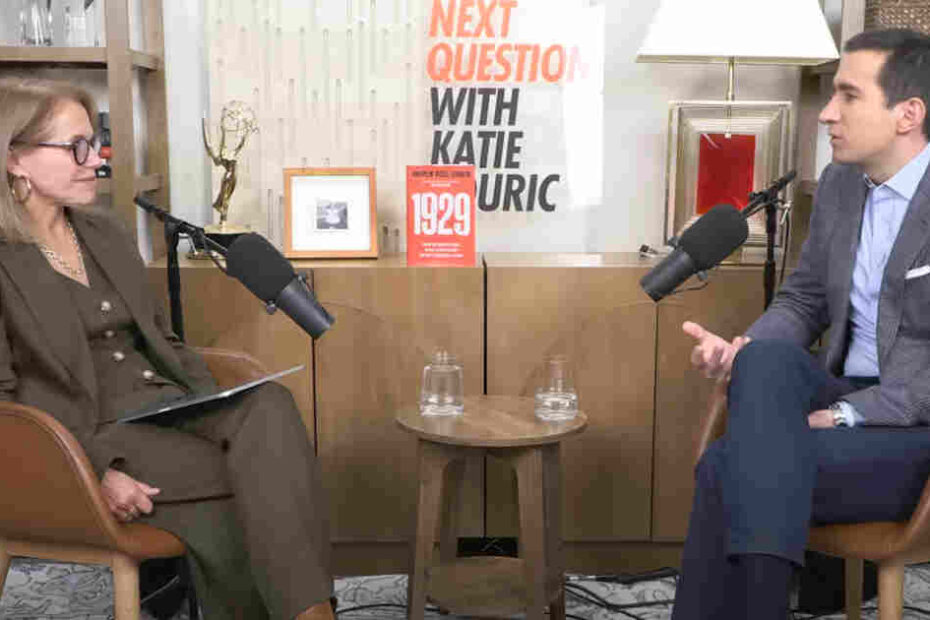
Read the full transcript of New York Times financial columnist Andrew Ross Sorkin’s interview on Next Question with Katie Couric on “1929 – Lessons from the Greatest Crash in History”, October 15, 2025.
The Human Story Behind America’s Most Devastating Financial Collapse
KATIE COURIC: What really happened in 1929? And why does it still matter? Nearly a century after the most devastating crash in American history, Dealbook founder, New York Times reporter and CNBC host Andrew Ross Sorkin has unearthed the human story behind it. The ambition, the greed, the blind faith that the boom would never end.
In his new book, “1929,” Sorkin shows how that era’s delusion still echoes today in our markets, our tech obsessions, even our politics. We’re going to be talking about what history can teach us about capitalism, risk, and our endless belief that this time it will be different. Andrew, I’m so happy to see you.
ANDREW ROSS SORKIN: Thank you for having me. I’m so excited to do this with you.
KATIE COURIC: First of all, you know, when I saw this book, I heard about this book, and then I actually put the book on my scale. I thought, how the hell did you find time to write this? You are the busiest human being on the planet. You do Squawk Box on CNBC every morning. You write fantastic articles for the New York Times. You do Dealbook, a newsletter. You do the Dealbook live event. What the hell?
ANDREW ROSS SORKIN: It took me eight years. That’s the answer. I don’t play golf. I don’t do other things. I do have three children.
KATIE COURIC: I know you do.
ANDREW ROSS SORKIN: Who are so happy that this book is over, by the way. But I would do this on airplanes, on weekends, at nights. I would be sneaking little time in at any moment I possibly could.
Why 1929?
KATIE COURIC: So what was it about 1929, Andrew? I mean, you have a choice to write about so many different interesting moments in history and what’s happening today, too, because the world is just exploding. So how did you decide? Gosh, I really want to write about this one specific year.
ANDREW ROSS SORKIN: So I’m always chasing interesting, which oftentimes means chasing failure. Because I oftentimes think that’s where the most drama is. It’s where the most interesting characters are. It’s where we can try to understand things that we do well and things where we may need to do better.
And I had written this book, “Too Big to Fail,” in 2008, about the financial crisis then. And people used to ask me about 1929 and say, how does 2008 compare to 1929? And I’d always be like, I don’t know.
I think like most Americans, we knew something very terrible happened in 1929. We all sort of have a vague notion that the Great Depression happened. Then the stock market fell. But I didn’t know who the people were, what they were saying to each other, what their motivations were, what their incentives were, who’s sleeping with who, what’s going on here? I mean, I really wanted to know these things.
And so I went on a vacation, actually, with my wife, like a real nerd. And I brought all these books with me about different characters in 1929. And they were all written sort of the 1930s, 40s. One of the most famous books was written in the 50s, mostly by economists, sort of talking about them in sort of economic terms and structures and charts and all of these things. And I sort of walked away saying, there’s got to be more to this.
KATIE COURIC: More human drama, right?
ANDREW ROSS SORKIN: More human drama. Look, the books that I always loved were things like, you know, “Den of Thieves” or “Barbarians at the Gate.” These were sort of these great dramas about business where you felt like you were watching a movie. And I thought, I wonder if I could do that?
The Discovery at Harvard
And I happened to be at Harvard University giving a speech, and I got there early, which, you know me well enough to know I’m never anywhere early. And I get to the library, so I have this extra time. I walk into the library there at Baker Library, and I say to the archivist, look at these boxes you have from the late 20s, early 30s.
And there was a guy named Thomas Lamont who was running JP Morgan then, and his family had donated all of his papers, his letters, his diaries, and all the things. And I open up this box, and there are these transcripts in the box of his conversations. His secretary would keep these transcripts of him conversing with Roosevelt and Hoover.
And it would literally be, you know, it was a transcript, so it would say what he said and what the President said. And I thought, wow, I hadn’t read this in any of the books, and they’re talking about all the things that are actually happening. And by the way, not to bring this to today, these conversations are like the conversations that all these CEOs are now having with Trump all the time.
KATIE COURIC: And we’re going to talk about the parallels.
ANDREW ROSS SORKIN: But I’m thinking to myself, oh, my goodness, okay, could I take that kind of material and do this writ large? Now, the truth is, the archivist said to me that she’d read “Too Big to Fail.” She said, you’re not going to do this book. This doesn’t exist because the material is not there. It’s there for this guy, but the other people, you’re going to struggle.
KATIE COURIC: And you took that as a challenge.
ANDREW ROSS SORKIN: I took that as a challenge. I didn’t want to believe her. Now, by the way, she was partially right.
The challenge in this case was there really wasn’t like one or two or three places you could go. It was, you had to be like needle in a haystack situation with, you know, 15, 20, 30 different places. And you’d almost have to guess, you’d almost have to say, okay, well my character doesn’t, I don’t have an archive for this character. But he might have called somebody or talked to someone after. Well, who are the 12 people he might have talked to? Okay, I’m now going to go to their archives and then pray to God that I’m going to find some letter there. And sometimes you would, and sometimes you wouldn’t.
The Research Process
KATIE COURIC: Tracking all this stuff down sounds like it was more than a full time job. And I know that you enlisted these grad students during COVID, right? So talk about, I mean, honestly just thinking about how overwhelming this task was, how you were able to track all this stuff down.
ANDREW ROSS SORKIN: Well, so one of the things I did, and this was sort of maybe the mother of invention. During COVID, I had been going to a lot of these libraries. I had had a researcher who I’d worked with early on and was planning to spend the time in the stacks. And I ultimately did, by the way, spend extraordinary amount of time, maybe too much time in the stacks.
But during COVID-19, you weren’t allowed in. So I would call, we would call the librarians and say, is there any student who’s allowed in the library? Sometimes they had a dissertation or a thesis that was due and so they were allowed. Those very select students were allowed in. And so I would then pay the students.
KATIE COURIC: How did you find them, by the way?
ANDREW ROSS SORKIN: The librarian would usually say, well, I’ll give you some emails of some people. And then you’d pay them. And then you’d say, I want you to take a picture. I want you to find Box 152 or whatever it is, and I need you to take a picture of every page in 152 and we’ll set up these Dropbox, these sort of elaborate Dropbox folders. And then you’d read it. It was a very tedious process, but it was actually quite helpful, I have to say.
KATIE COURIC: I mean, how many grad students did you work with? And I hope you acknowledge them in the book.
ANDREW ROSS SORKIN: Yes, a bunch of them. I do. A handful. Only a handful. And then the truth is that after the pandemic was over, I oftentimes found myself back at a lot of the same libraries. Because one of the things I really did learn was you almost felt like you needed to see everything because you were worried that something was missed. Maybe there was a box that you didn’t know to look in.
Certain boxes are, I didn’t know about all this history stuff. Some boxes are indexed so people know what’s in them. Some boxes have, nobody knows what’s in them. And sometimes people, as a result, don’t even look. And that’s where the great sort of needle in a haystack situation comes into play. Because sometimes you’ll land on something and go, ah, that’s amazing.
KATIE COURIC: Now I understand the eight year process.
The Compelling Story Emerges
So you amass all this original research, Andrew, and you read it, you learn about all these specific characters and you write this tome about the year. And I’m curious, as you read and sifted through all these stories, what was the theme? What surfaced that made you think this would make such a compelling story? And what was that story?
ANDREW ROSS SORKIN: I think the animating idea for me was the people themselves, sort of the human condition. And what was happening in the 1920s was just so fascinating to me in that this was like a boom, like nothing we’ve ever seen. Maybe it’s a boom like today we’re having with AI or something, but it was like a generational shift in the whole country.
So prior to 1919, nobody ever took credit, nobody borrowed money. It was considered a moral sin in America to borrow money. You just wouldn’t do that. General Motors started doing that, actually helped them sell more cars. And then Sears Roebuck clocked what was happening and said, okay, we should do that for appliances.
And then a guy named Charlie Mitchell, who ran a bank called National City, which later on becomes Citigroup, which, you know, now said, okay, well we can do this too. We’re going to lend people money so that they can buy stocks. And there was this explosion. All these people became celebrities, business people, CEOs. This was the celebrity. All the things that are happening now, you know, Elon Musk, Sam Altman, Jamie Dimon. That really started in the 1920s.
KATIE COURIC: And it was all because of credit.
The Credit Explosion
ANDREW ROSS SORKIN: And it was all because of credit, because all of a sudden everybody could gamble and brokerage houses start emerging on the corners of streets. Like the way there’s Starbucks today. I mean, they’re just everywhere. And you could go in and you could literally give them a dollar. If you put down a dollar, they would give you, they would lend you ten dollars.
So as the market’s going up, and by the way, when I say the market’s going up, it’s not like going up 10% a year. In 1928, so the year before 1929, the market went up 48%. By September of 1929, the market was up 90%. So this was like free money.
And people, you know, they feel wealthy, they’re running around, they’re doing all of these crazy things. And it was just so fascinating to see. I don’t want to say greed, but I think that the human condition is to want more. Everybody wants more. And people knew that this was getting out of hand. It wasn’t that nobody was saying, you know, this isn’t crazy. There were Cassandras in the room, but nobody really wanted to stop it. The party was going, the drinks were flowing. You know what I mean?
KATIE COURIC: The wealth was growing.
ANDREW ROSS SORKIN: There’s a great line. It actually happened right before the financial crisis in 2008. A guy named Chuck Prince, who was actually the CEO of Citigroup, said, you know, “when the music’s playing, you have to dance.” And these folks in the 1920s, they were dancing.
And I thought that was so interesting, to see all of those component parts and then to see the mistakes that they were making along the way. And the story also goes in many ways, actually, beyond 1929. 1929 is sort of the pivotal domino, but the story really goes through the end of 1933, the summer of 1933.
Beyond the Crash
And I think that will also maybe change your impression of 1929. People think there was some kind of great crash. The Great Depression happens. That’s not really what happens. It’s like there’s a series of crashes, actually, and then a series of terrible decisions that get made in Washington, oftentimes in conjunction with the CEOs and bankers who are trying to influence the president and tell him crazy things that really lead to what ultimately turns into the Great Depression.
KATIE COURIC: Before we talk about this moment, actually two moments in 1929 and what happened in those bad decisions. I’m fascinated by the Roaring Twenties, you know, and was this kind of environment or atmosphere where everybody was going crazy and living large. Was that impacting everyone or only a certain segment of society?
The Democratization of Finance and Inequality
ANDREW ROSS SORKIN: It’s a great question. So the inequality was real in 1929, very similar to now. But I do think all of this was sort of under the guise of democratizing finance. So you did have the ordinary American going into these effectively gambling salons, otherwise known as brokerages, to try to participate in this dream. There was this almost lottery-like idea.
It was also, by the way, a real shift in what I even describe as the American dream. Prior to this period, people really did talk about the sort of Horatio Alger story being the American dream, this sort of get-rich-quick fantasy of capitalism, or whatever, however you want to describe it. That was a phenomenon of the 1920s.
And there was also a technological shift happening. So here we are on a podcast with video. The hottest stock in the 1920s was ticker symbol Radio.
KATIE COURIC: I knew you were going to say that.
ANDREW ROSS SORKIN: I was going to say RCA. And that was like the Nvidia of its time or something. And everybody was going crazy because they thought this is going to change the world, just the way we thought the Internet was going to change the world, just the way we think AI is going to change the world.
Key Characters in the Crash
KATIE COURIC: It’s amazing how many similarities. And I do want to talk about that in a moment, but first I want to hear about some of the characters that you really learn about and that you profiled and whose diaries you read, et cetera, and letters. So I think a lot of people think, oh, Hoover, Roosevelt, and maybe Carter Glass when they think of this whole episode in American history. But let’s talk about some of the others that are less known but will be now because of your book. Thomas Lamont, managing partner at J.P. Morgan. Just tell us quickly about him.
ANDREW ROSS SORKIN: Okay, so J.P. Morgan was considered like the most important bank in the country. Still is now, was then. He really was the guy running the bank. So a guy named Jack Morgan, the son of J.P. Morgan—J.P. Morgan had died at this point—was ostensibly the CEO, but Thomas Lamont was really the man who ran the bank.
And he was the ultimate sort of client guy. He believed that if you could just get a bunch of people in a room, like the right people, you could control the world. And he would have dinner with Hitler and with Mussolini and with Roosevelt and with Hoover. This guy was just everywhere and everything. He was befriending all the journalists. So he was schmoozer in chief, whispering in everybody’s ears. This was that guy.
And the truth is he tried to control this thing, but it sort of got away from him. So he did believe that somehow he could keep all this from bubbling over. And then October of 1929 comes around. He gets the people in the room and it doesn’t work.
Sunshine Charlie Mitchell
KATIE COURIC: I want to know what happened on that day, but first let me go through a couple more characters. Charles “Sunshine Charlie” Mitchell, CEO of National City Bank. You mentioned him earlier.
ANDREW ROSS SORKIN: Charlie is my favorite character in the book.
KATIE COURIC: Did you feel like you know him, right?
ANDREW ROSS SORKIN: I feel like I know Charlie. Charlie ran, as I said, the bank that becomes Citigroup. He was the Jamie Dimon of his time. And he was as famous as Jamie Dimon, who runs JPMorgan today. But he’s probably the most famous banker in America, in the world.
He invented the idea. He was the one who said, “Okay, we should lend money to folks to buy stock.” He was called Sunshine Charlie because he would tell anybody who would listen to him that everything was always going to be better. He always had a smile on his face at all times. That was sort of his job and his way.
And he gets—I don’t want to give away what happens—but he does something. He does a little side deal at one point with his wife who gets involved in this whole thing. And let’s just say that the police show up at his house at one point and he gets handcuffed. We won’t say what happens after that for now.
KATIE COURIC: It wasn’t so sunshiny at that point.
ANDREW ROSS SORKIN: At that point, that happened in 1933. So it took a while for things to catch up to him.
Jesse Livermore: The Tortured Short Seller
KATIE COURIC: The other one is Jesse Livermore. Poor Jesse Livermore.
ANDREW ROSS SORKIN: Right, poor Jesse Livermore. So one of the other things that—I mean, look, I know this probably sounds like a book about the economy. It’s kind of like a crazy drama. So Jesse Livermore is an emotionally tortured short seller. This is somebody who bets against stock. And he was famous in the ’20s for betting against stock and winning.
He almost is basically out of business by 1928 and ’29 because the stock market keeps going up and up and up. He’s losing his shirt because you can’t bet stocks are going down during this period. And he magically comes back and makes a crazy trade in the fall of 1929, walks away with a hundred plus million dollars, which, by the way, within a year or two he had summarily lost again. He was sort of an addicted, you might describe as like degenerate gambler of sorts.
And I will give away the ending. He ultimately, in 1941, walks into what was then the cloak room at the Sherry Netherland up on Fifth Avenue near the Apple store—you know, the Apple store wasn’t there back then—and he shoots himself in the head and kills himself. So there’s actually a number of suicides that take place during this whole period. A bunch of people who jump out of windows.
KATIE COURIC: And I mean, I think that people who don’t know that much about the crash, I think that’s what they always think of: people jumping out of windows, people losing their wealth in a matter of minutes, right?
Personal Stories and Generational Trauma
ANDREW ROSS SORKIN: So my grandfather, Sydney Sorkin, who’s no longer alive, he was 91 years old. He was down there in October of 1929. His brother was a messenger boy and he was—I think he was 11. He went with his older brother down there and he used to tell us a story about how he saw somebody jump out of a window in October of 1929.
KATIE COURIC: Wow.
ANDREW ROSS SORKIN: And he never, in his whole 91 years, bought a share of stock in the stock market.
KATIE COURIC: Interesting.
ANDREW ROSS SORKIN: It was a generationally scarring event for him. I think he bought bonds, maybe he had some mutual funds, I don’t know, but stock—like individual stocks—he always thought the stock market was like this place for gamblers because of this sort of formidable experience he had. But I think a lot of Americans had that.
KATIE COURIC: Interestingly, my dad, too, by the way. You know, when I was starting to make some money in TV news, my dad was always like, “Muni bonds.” He really wanted something super safe and secure. And thinking about that, my dad was born in 1920, so I think probably like your grandfather, he had the same scarring experience, even if it was from afar, right?
The Reality Behind the Suicides
ANDREW ROSS SORKIN: Now, weirdly, I should note, just to be factual, as a journalist, one of the more interesting things that I did learn is that actually from a data perspective, there were actually not more suicides in 1929 than there were the year before.
KATIE COURIC: Oh, wow.
ANDREW ROSS SORKIN: So there’s sort of this impression that everybody’s jumping out the window.
KATIE COURIC: No, but I guess because it was so dramatic that it has been overblown in retrospect, right? Yeah, that is interesting.
ANDREW ROSS SORKIN: And I think also in the moment, to the extent there were suicides, they were more dramatic. There were people shooting themselves in the head, they were jumping out of windows, and they were being covered in the newspapers constantly, because oftentimes if you read the article about somebody committing suicide, it was also about how they had lost their fortune or lost all their money or had to mortgage their home.
KATIE COURIC: And maybe it was in a sort of truncated period of time, Andrew, you know, so maybe there weren’t more, but maybe it was in a limited time span. I don’t know. Get on that, will you?
ANDREW ROSS SORKIN: I will, I will.
October 28, 1929: The Day Everything Changed
KATIE COURIC: All right. The book opens with Charles “Sunshine Charlie” Mitchell, the CEO of National City Bank, returning to his office at 55 Wall Street on October 28, 1929, hours after the market had closed with a 13% drop. What happens next?
ANDREW ROSS SORKIN: Well, Charlie finds out that while he was out of the office all day—he had joined the board of the New York Fed while he was out at these emergency meetings—that his trader had bought a whole ton of stock in the bank itself and they didn’t have the money to buy the stock. So you know how companies buy their own stock? Back then, companies did the same thing.
The problem was that during these, especially these sort of crazy periods in October of ’29, the stock market—if you looked at the board of the stock prices on the exchange back then—they were oftentimes like two or three or four or five hours behind what was actually happening in reality. And so people were buying stocks, not understanding what the prices were, and so they effectively bought 30 plus million dollars worth of their stock and they couldn’t afford it.
Which put him in this position, trying to figure out, “What am I going to do to try to save the bank without anybody knowing that they had done this?” He all of a sudden has this sort of existential crisis.
KATIE COURIC: Well, just give a little. People will still buy the book.
ANDREW ROSS SORKIN: No, no, no, no. One of the things that he does is effectively—he goes and gets a—he decides he’s going to put this whole thing on his back. He’s going to go to J.P. Morgan to try to get them to give him a loan and for him to buy the stock off of the bank because he didn’t want anyone to know that the bank would have otherwise been in trouble.
And that decision, which, that sort of secret decision turns into a sort of bigger problem for him later because he then tries to do some sort of tax shenanigans with his wife. Let’s just say that leads to his arrest.
A Relentless Unraveling
KATIE COURIC: So I know you say that—I think when we imagine this crash, right, we think of a crash.
ANDREW ROSS SORKIN: You think one day. This is not really one day.
KATIE COURIC: Multiple days. And you say it wasn’t a moment, it was a relentless unraveling. Talk about that.
ANDREW ROSS SORKIN: Well, so the very strange thing is that despite the market going down 40, 50% between September or end of September and November, by the end of the year—and this is the part that most people probably would never even imagine—by the end of the year, the stock market was only down 17%. And so there was this sort of relief thing happening, except that all of these people had lost their money in the process.
And I think the one thing to think about with the stock market, which is just so different than it is today: when the stock market goes down today, people say, “Oh, well, I bought the stock at $50, and now the stock’s at $30. So I lost $20 a share.” Not good. But what was happening is most people had borrowed all the money to buy the stock. So it wasn’t just that you lost the $20. It was that you owed the bank, oftentimes, like $100. And so people are going into hock.
I mean, there’s a great little scene that I sort of landed on with Groucho Marx, who at that point was not actually famous or really that famous yet. And he was out in Long Island. He was pretty conservative, according to his son, with his money. But he was spending all day long at this brokerage house in Long Island just following the tape constantly. That’s what he did.
KATIE COURIC: And smoking his cigar, right?
ANDREW ROSS SORKIN: Smoking cigars and following the tape. And he actually was a very smart guy. He was questioning his broker about whether he should buy RCA. “Why is RCA not giving out dividends?” Well, they weren’t giving out dividends because they don’t have any cash. But the brokers were like, “This time is different. If you don’t do this, you’re going to lose out. Trust me. I do it, too. We’re all doing this.”
Well, he gets a call in October of 1929, says, “You got to get down here and you’re going to have to pay off the loan.” He ends up having to mortgage his own home to deal with it all. And I think that that was sort of just a little microcosm of a story of what was happening everywhere.
KATIE COURIC: Talk a little bit more about sort of the relentless unraveling, if you will, Andrew. So you have—I mean, just give us a little time stamp of all these events.
The Aftermath and Government Response
ANDREW ROSS SORKIN: Well, I don’t know how far we want to go. I mean, most of the real action happens in October in terms of the market crash. However, as I said, there’s sort of a series of dominoes. So the country is sort of losing its shirt in late 1929, market starts actually coming back a little bit, but the economy is not really coming back.
And so there’s a big question. What is President Hoover going to do? What is the government going to do? Talk about bad decisions. So President Hoover’s treasury secretary then was a guy named Andrew Mellon, who you may have heard of. And Andrew Mellon was a true capitalist. His view was, if you trade and you lose, you lose. We’re not helping you, we’re not bailing you out. You know, screw you.
Hoover had this sort of view that somehow the economy and the stock market were separated, that they weren’t really connected to each other. And this was almost like a psychological problem. And that if you could just get the country over the sort of psychological problem, that somehow you’d be in a better place. But he also wanted to raise taxes at that time. Probably not the best decision.
He then decides to implement tariffs again. What’s happening in America today? Tariffs. So he implements in 1930, something called the Smoot Hawley tariffs. A year later, global trade is down 60%. Back then, and by the way, same thing as now. A thousand economists wrote an open letter to Hoover begging him not to do this. But he had run on this because he wanted to get the farmers in the middle of the country to vote for him, and he wanted to make good on his promise.
So there were sort of a series of these things. But of course, by 1933, even before that, I mean, you started to have what’s called Hoovervilles were emerging. These were tented camps even, including in D.C. Also in Central Park. There were tented camps in Central Park, literally blocks away from Charles Mitchell’s house.
Charles Mitchell lived, if you know New York very well, up on Fifth Avenue and 75th street is the French Consulate. That was his house. That’s where he lived. They lived in these mansions. They were castles. And so Hoovervilles were emerging. And so you had this sort of series of dominoes of things that really, I think, put the country in a very, very tough place.
Parallels to Today’s Economic Climate
KATIE COURIC: It’s amazing when you think about the culture of the 20s, obviously, and this, I’m sure, struck you time and time again as you’re writing this book, Andrew. And what we’re seeing today in terms of the economic climate, sort of income inequality, a laissez faire regulatory policy mood, investors and innovators becoming celebrities, and as I mentioned, widening inequality. I mean, were you thinking, “Holy shit, we are ripe for something like this to happen”? Or how did you square the similarities between those two periods?
ANDREW ROSS SORKIN: I should just say straight up, when I started the project, I didn’t think that I was writing about today. That was not really the goal. And by the way, there’s nowhere in the book, as you know, where I say, “Hey, this is like this,” right?
But as I’m writing the book, I would say, especially in the last couple of years, I’d be thinking, “Oh, okay, the tariff thing is happening. The tariff thing is happening. This idea of democratizing finance is happening. It’s happening. We’re going to take some of the guardrails and rules away.”
And you realize, by the way, in the 1920s, there were no rules. I mean, literally no rules. There was no SEC insider trading. All these stocks are being manipulated back then, and here we are right now trying to take these rules away, trying to take transparency away.
KATIE COURIC: The tech titans are meeting at the White House.
ANDREW ROSS SORKIN: All of the, so many of the same component parts of this. And also, I would argue even now with, I don’t know if you call it a bubble, but sort of here we are in this AI revolution. Feels a little bit like the radio revolution. People are betting massive quantities of money using leverage, using debt, and it’s happening all over again.
And there’s also this idea of the lottery ticket. So right now, Trump just implemented a new law that effectively is going to allow the venture capital guys and the private equity guys and the private credit guys to literally sell product to the ordinary investor for the first time. This stuff’s going to end up in people’s retirement accounts for the first time. Your 401k account is now going to have access to these things, which we never allowed before because we thought it was too risky, but now we’re saying it’s not too risky.
The Democratization of Risk
KATIE COURIC: And why is that happening? I don’t quite understand that. Does that also have to do with the government and intel and sort of, or is that a different thing?
ANDREW ROSS SORKIN: I think it’s a different thing. I think it’s the idea, and this was a very 1920s-ish idea, that the elites were making all of this money and that the ordinary, the little guy, had no access. So it is true that folks who’ve had access to buy shares of Uber or Facebook before they ever went public, they’re the ones who made a fortune.
And we created laws, by the way, after 1933, where we said, unless you have a million dollars, you cannot invest in these type of private investments because they were too risky. We didn’t want people who didn’t have enough money to be able to risk all of it. That was the concept.
But in a way, there’s a view today that somehow we have not just protected them from losing money, we’ve protected them from making money. And at the same time, we’re sort of protecting the man. Right. So there’s this sort of subculture that’s an elite that’s been able to make all this money and others haven’t had access.
And so what I think this president is trying to do is say, we want everybody to have the lottery ticket. The thing that worries me is when everybody has the lottery ticket, most people have the lottery ticket lose. That is the great conundrum of the lottery.
KATIE COURIC: And the people who lose are often the people who can’t afford to lose.
ANDREW ROSS SORKIN: Yes, that’s exactly right.
Forces Behind the Cultural Shift
KATIE COURIC: When you look at the big picture, what do you think is responsible for all these big cultural and economic shifts that we’re witnessing right now? If you had to put the pieces together, are they all the things that I mentioned in terms of the environment we’re living in, or, I mean, what forces are colliding right now?
ANDREW ROSS SORKIN: So I think there’s a couple of things happening. Start with the underlying issue of the human condition, which is we all want more. That’s not capitalism, that’s just human nature. And you also have a group of people, financiers, who have a lot of money who’ve been lobbying in Washington to allow for a lot of this to happen.
So crypto, which is, again, another seemingly speculative kind of thing to do. Those guys basically helped bankroll President Trump’s election. And so that money, they effectively paid for that access. And there are people, I do believe that the people who are behind all this genuinely do believe that this is good for America. They do believe that letting the ordinary American invest in these opportunities, they call them opportunities and they think they’re a good thing.
And by the way, they may turn out to be a good thing in the long run if you can keep all the guardrails around them. I think one of the great lessons of 1929 was you need guardrails. People left to their own devices will always want more. And we are not the greatest self regulators of ourselves. We’re just not.
KATIE COURIC: There are no guardrails.
ANDREW ROSS SORKIN: And that’s the conundrum. I think right now, increasingly, the guardrails are coming off. The administration recently announced a plan where corporations, public companies who used to have to report their earnings every quarter, four times a year, the president came out and said, “You know what? You don’t need to do that anymore. We want you to only do that twice a year.”
So again, less transparency. And the SEC looks like they’re probably going to back that plan. So I think there’s just a whole bunch of these types of things that are happening in this moment that are concerning.
The Regulatory Response to 1929
KATIE COURIC: Let’s go back to 1929 and the aftermath following those few years. There was regulation.
ANDREW ROSS SORKIN: Yes.
KATIE COURIC: Talk about what happened. And do you view some of the measures as perhaps an overcorrection?
ANDREW ROSS SORKIN: That’s a great question. So one of the big things that happened, and one of the main characters in this book is a guy named Carter Glass.
KATIE COURIC: Glass Steagall.
ANDREW ROSS SORKIN: People know from Glass Steagall. Carter Glass, though, was really like the Elizabeth Warren of his time. Maybe AOC, but more like Elizabeth Warren. And for many years in the 1920s, he used to rail about this thing called Mitchellism in Charlie Mitchell. He thought people like Charlie Mitchell were going to ruin America because Charlie Mitchell was loaning people all this money, was going to lead to all the speculation and upend the economy.
And so there were a lot of laws that were put in place by people like Carter Glass, though, again, without giving away too much, how Glass Steagall was actually put together, even for me, and I think even some scholars who’ve read the book, is just a shock. It’s completely at odds with what you’d think really happened. Sort of a wild story.
And so you had that happen. You had the creation of the SEC in 1934, by the way. Roosevelt, of course, comes into power in 1933. He goes after some of the banks, shuts down a lot of the banks. So there was a whole bunch of things. Is it an overcorrection? Probably to some degree. But was it too much?
I mean, the good news is we know we’ve had other financial crises, 2008 being one of them, dot com bust being another, but we haven’t gone totally off the cliff for a decade or more at a time. And the one thing I will say that was a bit of a weird lesson for me, we all think speculation is a dirty word, right? You don’t want too much speculation, but we all need a little bit of speculation because speculation is like the twin of innovation.
If you think about it, Elon Musk and Tesla. Somebody at some point had to speculate on Elon Musk early on when it seemed like an insane thing to do. It was a complete speculation. And you need that in the economy for there to be innovation, otherwise we’re never going to get any. But the question is, so where’s the line? And when does it become too much and when does it become too much of a group think? I do think, by the way, we might be having a little bit of that.
The AI Bubble
KATIE COURIC: Well, I was going to ask you, of course, when you said that. I’m thinking, okay, the AI bubble, right? And what’s happening now, how do you think that’s playing out? And how does it relate to some of the other disasters, honestly?
ANDREW ROSS SORKIN: So I think the AI bubble is a bubble and it will pop. But I think of it more like the dot com bubble, which is to say the Internet came of age in the late 90s and there was a pop. But the Internet is still here and is more powerful and a bigger force than ever.
So I think something like that will probably happen with AI, meaning there’s definitely overinvestment and probably investment in the wrong areas. And so there will be some kind of comeuppance. I don’t think that means that AI is not a thing. I think AI is probably a generational shift for everybody.
KATIE COURIC: But there will be a correction.
The Hidden Dangers of AI Investment
ANDREW ROSS SORKIN: There will be a correction. The question that we don’t know this time around is if you believe that every financial crisis is a function of too much leverage in the system, too much borrowing money. Right. In 1929, there’s too many people borrowing for stocks. In 2008, there’s too many people borrowing for subprime loans and the like.
It could be that there’s too much borrowing going on around these AI data centers. People don’t appreciate. Yes, you know, Google and Facebook, they’re all spending hundreds of billions of dollars. But to build these data centers, there’s energy companies that are taking on extraordinary amount of debt, construction companies, real estate companies, and that debt we can’t see anymore.
That’s actually another big thing. It used to be that you’d get a loan from a bank and so the system could see the debt in the system, the leverage in the system today. It’s all moved into what they call the shadows, into this private credit business. And so we don’t really know what’s going on. And that’s a little scary.
And I’ll give you one more little, not to scare everybody, but you know, you’re starting to see what they call round trip deals, these like circular deals where. So Nvidia and OpenAI did this very unusual deal a couple weeks ago where OpenAI is buying chips like crazy from Nvidia. But OpenAI can’t afford to buy all the chips that it’s committing to buy. It doesn’t make money. It’s losing money right now.
KATIE COURIC: Right.
ANDREW ROSS SORKIN: So what’s happened? Nvidia invests money into OpenAI. So they have now committed to give them $100 billion, which then they’re going to take the hundred billion dollars and buy the Nvidia chips. So it’s a completely circular transaction. It’s like magic.
And then just I think two weeks ago now a similar deal, OpenAI is going to buy chips from AMD, can’t afford to buy the chips in AMD says to itself, well, if we announce that we’re going to buy chips from AMD, AMD stock is likely to go up. So we’re going to get a stake in AMD and when the shares magically go up, we’ll now have money from those and then we’ll go buy the chips.
KATIE COURIC: What’s wrong with that?
ANDREW ROSS SORKIN: Well, it just reflects that there’s not a sort of underlying stability in that market. You know, when you get into what’s called vendor financing, when the vendor basically has to finance you, it can come back to bite you.
Now, yes, if OpenAI turns out to be a massive success and super profitable, maybe no harm, no foul. But if it doesn’t, you know, the whole sort of ecosystem can break. And I don’t, right now we’re in this very weird moment in the stock market where, you know, every time that a company announces they’re going to invest and spend more money, the stock goes up, doesn’t go down.
Used to be, you know, if you fire people stock, we go up because they can spend less money, they’re going to invest less, stock goes up. This is like the opposite.
Where to Invest in AI
KATIE COURIC: You say people aren’t investing in the right thing with AI. So I’ll buy. What should I be investing in when it comes to?
ANDREW ROSS SORKIN: So it’s not that you shouldn’t be investing in AI. I think the way people are investing in AI right now is just to buy the biggest, you know, shares in the big tech companies. Nvidia and there are a lot of…
KATIE COURIC: Other smaller companies that are going to be important to the whole AI requirement.
ANDREW ROSS SORKIN: Maybe. And that’s another question. There’s so many small startups that have been coming up around this whole ecosystem, do they last? Do they not last? I don’t know if we know the answer.
The Employment Crisis Ahead
The other piece of this that we haven’t gotten to is, and maybe go back to 1933 and think about this. So we had unemployment in the country in 1933 of about 25%. It’s kind of insane. 25%. A quarter of people were unemployed.
If AI is successful, so all of these AI companies, for them to be successful, they have to create more productivity. Companies are only going to pay for these services if they create more productivity for their company. Productivity is a euphemism, dare I say, for taking out cost, other cost. What is the other cost?
KATIE COURIC: People.
ANDREW ROSS SORKIN: Human cost. It’s people. So if this is truly a success, you know, if they shoot the moon and this is really successful, at the same time that the companies may seemingly be successful, there’s going to be a lot of people who are going to lose their job, who won’t be able to afford to use the services that these companies are going to provide.
KATIE COURIC: Do you think anyone is thinking about that?
ANDREW ROSS SORKIN: I think that there’s a lot of people wearing blinders saying, let’s hope for the best. I think there’s a lot of hope. I don’t think there’s a lot of actually like modeled out spreadsheets that say, if you do this and this and this, it will do this. I think there’s a lot, there’s like a lot of hope and prayer taking place right now.
And by the way, if you talk, if you talk to a lot of the leaders in Silicon Valley today, they say we are more scared of being behind.
KATIE COURIC: Exactly.
ANDREW ROSS SORKIN: And so therefore we’re just going to, you know, we’re putting all our chips down.
KATIE COURIC: It’s China, China, China. Right. As the president would say. That’s what they’re, I feel like they are saying, we cannot lose our competitiveness and unintended or obvious consequences be damned.
ANDREW ROSS SORKIN: Honestly, I think there’s a truth to that. You look at some of these companies, they’re spending basically half to maybe in some cases more than all of their revenues. Literally. They’re taking all the money and investing in AI, and maybe they’ll be right.
And by the way, as I said, I am sure that AI will be a powerful force, huge, powerful force on the other side of this. I just think along the way there will be a hiccup. And the question is, how big is the hiccup?
KATIE COURIC: Kind of like globalization, like nobody really thought about the long term impact of a flatter world, as Tom Friedman would say. And this is kind of that on steroids, right?
ANDREW ROSS SORKIN: It could turn out to be, yeah.
The Role of Government
KATIE COURIC: Isn’t that when the government is supposed to come in and say, whoa, everybody, let’s kind of talk about the impact of this technology and let’s kind of plan for it?
ANDREW ROSS SORKIN: Yes, that’s what the government is supposed to do. Having said that, we have both a broken government and we’re in a rush. It’s a combination of two things. It’s that the government clearly, at least in this moment, I don’t think you’re going to have both sides talking on these issues.
And the other piece is, and they’re not wrong in this respect, if life is relative, you do need to care what the competitors doing and that is China. And if China is going full steam ahead and they’re throwing all their chips down, maybe, at least the argument goes, we have to, otherwise we lose.
KATIE COURIC: And what do you think?
ANDREW ROSS SORKIN: And that there’s like a permanence to the loss.
KATIE COURIC: Right, right.
ANDREW ROSS SORKIN: That’s the issue.
KATIE COURIC: Where do you fall?
ANDREW ROSS SORKIN: I think you could do a lot of what we’re doing marginally slower without ultimately losing the game. I think we are still ahead of the game relative to China. And I think what that you said what you could say, what does that mean in practice?
I think from a regulatory standpoint, instead of sort of opening up, you know, all these new avenues for everybody to just, you know, throw money at the problem, I think you’d probably do that part in a slower and more methodical way than we’re doing it. And I don’t think that would slow an OpenAI or a Microsoft or a Google down that much.
KATIE COURIC: And that would give a chance for some of these other considerations to be…
ANDREW ROSS SORKIN: Well, the bigger considerations about employment.
KATIE COURIC: Right, that’s what I’m talking about.
ANDREW ROSS SORKIN: Yeah. No, if you really get to, if you really get into like what’s going to happen with employment, I don’t know what you’re supposed to do because what’s…
KATIE COURIC: Going to happen to our way of life? And should there be universal basic income? And how will…
ANDREW ROSS SORKIN: I think we need to be having those conversations. People are probably not, I mean you’ve been having some of those conversations, others have had those conversations, but it’s not like an active conversation in part because we don’t know. So that’s the other piece of this. We don’t really know.
And is it going to be a transitional period where we’re going to have to sort of transition from one thing to another, and that’s going to be painful. But on the other side of the transition, we all figure it out and everybody learns how to use AI and…
KATIE COURIC: Or there will be a robot apocalypse, right?
ANDREW ROSS SORKIN: Or there’ll be a robot apocalypse and people will be listening to this podcast and we will be holograms.
KATIE COURIC: Exactly.
ANDREW ROSS SORKIN: Like that might happen.
KATIE COURIC: We should put this conversation in a time capsule.
AI’s Impact on Education and Work
ANDREW ROSS SORKIN: I mean, the craziest thing, I don’t know if you’ve played with like Notebook LM or any of these models.
KATIE COURIC: I actually just learned how to do that.
ANDREW ROSS SORKIN: So, you know, you can create a podcast. I have a son who now takes material from the Internet that he has to learn, puts it into these models, puts his headphones on and goes for a walk and listens to an effectively AI generated podcast to teach him about, you know, some of the classes that he’s trying to learn. There’s part of me that thinks that’s super exciting.
KATIE COURIC: I was going to say, I think it’s cool.
ANDREW ROSS SORKIN: It’s like a great, it’s like a very cool thing, but it often, or I don’t know if it’s often. Ultimately probably means we won’t have as many teachers. And what are those people? I mean, I don’t know. I don’t know what we’re, I don’t know where this all heads.
KATIE COURIC: I just think we should be thinking about it some more and hypothesizing about it some more so that we’re in a better position to at least have thought about the debate when it actually hits us.
ANDREW ROSS SORKIN: Yes, yes, I’m with you.
KATIE COURIC: Do you know, I mean, if you had to name a person who’s really talking about this, is there anybody?
ANDREW ROSS SORKIN: Do you know Tristan Harris? I think he’s…
KATIE COURIC: Oh, yeah, I know him. I love him.
ANDREW ROSS SORKIN: I mean, I think he’s thought about this deeply in relation to social media and the impact social media on society and democracy. I think he’s increasingly spending time thinking about the impact of AI on society and humanity as well.
KATIE COURIC: I interviewed him a couple of times, I think, in 2018 when I was doing an hour for National Geographic on tech addiction. And I think he and I need to have another conversation now.
ANDREW ROSS SORKIN: He’s ahead of the, he’s been ahead of the game on all of this.
KATIE COURIC: He has. And he has been screaming from the mountaintops. The problem is there are not many voices like his out there.
The Cassandra Problem
ANDREW ROSS SORKIN: And that’s the thing about Cassandras. There’s always a Cassandra in the room, by the way, in the late ’20s there were lots of Cassandras, people screaming from the rooftops and nobody wanted to listen to them. And it’s a very interesting thing, just about humanity, you know, when things are going gangbusters, nobody wants the party to end.
KATIE COURIC: They’re like…
ANDREW ROSS SORKIN: Exactly always. But that’s, you know, by the way, think about financial crisis in 2008. I remember people 2003 and four people say, I think there’s a real estate bubble going on. Remember, you know, I’m not going to buy a house this year. I’m going to wait. It’s going to fall next year. So I’m just going to wait.
And the next year you’d read a big article about, a cover article about how there’s a real estate bubble. You said, no, I’m actually, I’ll wait another year. But you wait and then it keeps going up. And then you say to yourself, okay, the train is leaving the station, I…
KATIE COURIC: Better get on the train.
ANDREW ROSS SORKIN: I got either get on the train or I’m never going to be able to get on this train. Of course, everyone jumps on the train right before it’s about to curl off the track.
FDR’s Economic Legacy
KATIE COURIC: Before we talk about today, because I want to ask you some things about President Trump, I do want to go back for a moment to talk about FDR and his role in all of this. Because, you know, I admire—I stan FDR in modern day parlance. And I thought it was really interesting what you wrote about him.
You said that even though handling the economy wasn’t actually Roosevelt’s strength, it was not his thing, somehow Americans grew to trust him anyway. And as the whole world fell apart, the United States fed off his abundant confidence. People were desperate to believe in something. And then you add, “They certainly didn’t believe in money anymore.” That’s true. So just tell me what I don’t know about FDR.
ANDREW ROSS SORKIN: Well, so FDR—I don’t want to say FDR was Trumpian, but FDR was kind of Trumpian. I mean, I think that people, there were people who just were believers. They really believed. I don’t think that anybody would have told you that somehow FDR was some kind of financial genius or guru who understood how to deal with the economy.
I think he saw a mess. It was a mess. I think he got a little bit lucky in terms of the timing of when he came in and the fact, frankly, that Hoover didn’t make certain decisions he probably should have or could have in the year or two before Roosevelt arrived. And the country was so psychologically damaged that they just wanted—they almost willed certain things to happen.
And then, of course, the New Deal comes around, but that was not considered—that was not like an economic plan, really, initially. There were so many other social aspects to what he was trying to do, but it all happened to work. And so, and then of course, World War II comes along and that helps economically too.
So there’s a whole bunch of things that I think we give Roosevelt a lot of credit. I’m not saying he doesn’t deserve it—it happened on his watch. But I’m not sure it happened because he was, you know, the Messiah when it comes to economic activity.
Trump’s Economic Approval
KATIE COURIC: Speaking of messiahs, or lack thereof, let’s talk about Donald Trump and his economic plans. Just 37% of U.S. adults approve of his handling of the economy, according to a recent AP-NORC Center for Public Affairs poll. What do you make of that number, given that so many people look to him as a businessman, an all-knowing businessman, to set the economy straight?
ANDREW ROSS SORKIN: So this, to me, is a complicated question and more complicated maybe than you think. I don’t know. The economy seems to be doing shockingly well, at least on the surface. Now, I would argue one of the reasons for that is this AI bubble.
I think if you would actually take the AI investment piece out of it and look at the rest of the economy, you’d say, “Actually, kind of lousy or not so great.” And then you throw on the tariff piece that he’s put in place and you say to yourself, “Okay, that is creating more of a slowdown than we give it credit for,” because AI is powering so much of it. I think it’s masking a lot of the other things that are happening.
KATIE COURIC: Are you talking about the stock market or the—
ANDREW ROSS SORKIN: I’m not talking about the stock market. I’m talking about the overall economy. So when I say AI bubble, people think, “Oh, AI bubble’s like the Nvidia stock.” That’s not what’s happening here. The AI bubble is impacting the entire economy.
So what’s happening is companies are spending hundreds of billions of dollars. Those hundreds of billions of dollars are being used to build a data center, or data centers all over. What does that mean? Someone has to buy new real estate. They have to go construct the data center. They have to create new forms of energy. So the energy companies, the electricians, the construction guys—I mean, this is huge amounts. And obviously the chip makers, all of the—there’s so many pieces of the economy where people are getting jobs now.
KATIE COURIC: And what about companies, too, that have to hire people to help understand how AI is going to impact their business? Is that contributing to it as well?
ANDREW ROSS SORKIN: I think less. Less on that front. I mean, I think there’s a little bit of that happening. I think the truth is more people will lose their job in the short term from AI than the new people that are actually coming on to transform the stuff.
And the truth is, a lot of this is a sugar high. So I would say, are we in a gold rush or a sugar rush? Because, you know, you’re going to build a data center, which could—each data center is going to take hundreds of people to build. But once the data center is built, it could take five or ten people to manage the data center. It’s not like it requires thousands of people.
KATIE COURIC: So even if this is a bubble, though, Andrew, why do just 37% of people approve of his handling of the economy?
ANDREW ROSS SORKIN: I think costs are going up. It feels like things are still more expensive. I think that’s true to some extent, though. By the way, to his credit, there are certain things that are cheaper than they used to be and other things that are more expensive than they used to be.
I think people are just anxious and worried about where we really are. And I think that in the areas where he said that he was going to make big changes—this is in the industrial, you know, sort of rust belt of America—I don’t think you’ve actually seen the real changes.
But we also haven’t talked about immigration. Immigration is a big issue. If you don’t have immigrants, that’s a problem. There’s a lot of economic forces at play here between tariffs and immigration and everything else that I think we have to be thinking about.
Having said that, one of the biggest shifts in this whole conversation—and this president has made it such—is they’re now tying tariffs to national security. And that’s a very interesting concept, by the way. That’s the concept we were not talking about in 1929.
KATIE COURIC: Interesting or scary?
Tariffs and National Security
ANDREW ROSS SORKIN: I don’t know. I’m not sure. You know, so I’ll tell you what I mean by that when I say I’m not sure. If we didn’t have tariffs on cars in America, there’s a company called BYD in China that can make the cars better and cheaper than any car that’s made here. We would have no automobile industry at all. You wouldn’t make a car here. It just wouldn’t happen.
Is that okay? Is that acceptable that there would be no automobile industry? If there was ever a problem where you couldn’t get access to cars in China, would that be a problem? I think we did learn during the pandemic that you do need some form of resilience around drugs, around masks, around potentially cars and parts and all sorts of things.
So I think there’s this very interesting question that we all have to resolve, which is: Yes, we can get the cheaper product from other places and we can become a complete services economy, sort of like what the UK did. Or we could decide that we actually need to be making these products here. And if we’re going to make these products here, then we’ve got to figure out how we’re going to do that and how we’re going to compete.
And how we’d compete—I think we’re not going to compete, by the way. That’s the other thing. So all these tariffs are going to mean we’re not going to compete. It is likely that ten years from now—I was talking to the CEO of a big auto company—ten years from now, we will pay more for lousier cars in America than most people will be able to get in other places.
You’ll go on vacation to Europe or to Asia or somewhere like that, and you will sit in the back of a car and think, “Wow, this is pretty great. We don’t have things like this,” or “We have things like this, but they cost so much that nobody has them.”
KATIE COURIC: And do you think Americans can tolerate paying more for crummy products?
ANDREW ROSS SORKIN: That’s the fundamental question.
KATIE COURIC: Or less good.
ANDREW ROSS SORKIN: I think Americans don’t—here’s the thing. We don’t really like to pay more for things that say “Made in America.” Most people don’t. Most people don’t seem to care. I just see the little sticker in the back. It says “Made in China,” “Made in America.” Nobody seems to really—
KATIE COURIC: Just give me the shirt I want and give me the best product. I don’t want to pay too much.
ANDREW ROSS SORKIN: And I don’t want to pay too much. And I think we as a country sort of have to come to grips with what that means.
KATIE COURIC: And we could talk about why are cars so much more expensive and lower quality in this country versus China?
ANDREW ROSS SORKIN: Right.
KATIE COURIC: Because we pay people to make them.
ANDREW ROSS SORKIN: Because we pay people to make them. That’s a huge part of it. We pay people to make them. And so we have to decide, do we want to pay people to make them? I mean, these are all of the things.
KATIE COURIC: But are we going to even need people making them in the era of AI?
ANDREW ROSS SORKIN: We may not, because the robots may ultimately make them.
KATIE COURIC: My head is exploding.
ANDREW ROSS SORKIN: Yeah, it’s tough stuff.
Trump’s Economic Philosophy
KATIE COURIC: How would you characterize Trump’s economic philosophy? I wanted to ask Condi Rice—Andrew and I were at a conference recently and Condi Rice was there. I wanted to have her characterize Trump’s foreign policy philosophy. Unfortunately, I didn’t get to ask her the question. So let me ask you, how would you describe his economic philosophy? It seems all over the place.
ANDREW ROSS SORKIN: So I think there’s actually one through line to everything the man does, which is he wants leverage over everyone—everyone, over people, over countries. Where can he find the leverage? Where is the leverage point that he will have over somebody else? That is the entirety of the strategy.
So when you think about, you know, he went after the universities, for example, and said, “I’m going to take your money away for science and other things.” That was a lever. He looked and said, “I don’t like the DEI policies at universities. Do I have any leverage with these people? Well, I do, actually. If I take their science money away—”
KATIE COURIC: Right. Their federal funding or their—
ANDREW ROSS SORKIN: Their federal funding away. You know, do I have leverage over China? Do I have leverage over Europe? Do I have leverage? You know, I don’t like the way Europe’s treating American companies. Well, maybe—
KATIE COURIC: What do I have that they need?
ANDREW ROSS SORKIN: What do I have that they need? And can I put the screws to them? And if I put the screws to them, will they then do what I want? I think that’s the entire—that is the strategy across the board.
KATIE COURIC: As someone who knows the economy like the back of his hand, what are the pitfalls of running a country that way?
ANDREW ROSS SORKIN: Well, it depends. This is a very interesting question. It depends how mercenary you think the world really is. So I think for the last fifty years, we’ve actually thought that we could be a role model for the world and that we wanted people to like us. And we did lots of things to make people like us.
We let most of our economy be open. We tried to share our prosperity with others. We oftentimes were donating money to other countries and bailing them out and doing all sorts of things. And the question is, did that help us or not? He believes it did not help us. He believes we had no leverage over these people. He believes—
KATIE COURIC: I was going to say that we got screwed.
ANDREW ROSS SORKIN: That we got screwed. I think it’s hard to say we got screwed, because I think the truth is we are still this great, shining—
KATIE COURIC: You know, city on a hill.
ANDREW ROSS SORKIN: City on a hill. Thank you. We could also be a hill. And I think we probably did get screwed in certain things, but I think on the whole, we’ve done pretty well doing it this way.
KATIE COURIC: And this desire to have leverage on everyone—I mean, let’s face it, it can also be very alienating to countries when we need them.
ANDREW ROSS SORKIN: Well, that’s going to be the big question. When we actually need them, what’s going to happen? And I don’t think we know the answer. That’s—look, there’s so many things where this president is just, you know, shifting and changing the way we’ve done things, taking stakes in companies.
Government Stakes in Private Companies
KATIE COURIC: Well, I wanted to ask you about that. Can you talk about the government taking a 10% interest in Intel? Because it is so unprecedented. And explain it to me, somebody who doesn’t really understand the economy that well, how this is so, needless to say, unconventional.
The Free Market and Government Intervention
ANDREW ROSS SORKIN: Okay, so historically, we claimed we had a free market, and the free market was such that companies could succeed, they could fail, and the government was not an investor or playing a real role in this. Maybe they were.
KATIE COURIC: We did bail out companies.
ANDREW ROSS SORKIN: We have bailed out companies. But typically there was a serious crisis. It was a crisis. And the reason for bailing them out in 2008 was we believed that if we didn’t bail them out, it was going to have a wider effect on the economy.
So here we are. Intel is struggling. We’ve decided as a country, or at least this president has decided that chips, and making chips in America is a super important thing to do for national security reasons. Most of our chips are not made in America. We need to start making chips in America.
The Biden administration had given money to Intel as a grant, said, “Here’s the money. We’re not going to, we’re not asking for anything in return. We just, what we’re getting in return is we’re going to have national, we’ll have national security, and we’ll have more resilience because chips will be made here. But we’re not asking for anything else. We’re just handing you the money.”
Intel, to be honest, became a mess. It was probably a bad investment in Intel to start with, and became an even bigger problem. Intel needed more money. Not more money, but needed the next tranche of the money that they were going to get. And this president said, “You know what? This whole thing is so screwball. I want more. If I’m going to give you all this money instead of granting you the money just so you could have it.”
KATIE COURIC: I want what’s in it for me.
ANDREW ROSS SORKIN: What’s in it for me? I want a piece of the action and I want the taxpayer to have a piece of the action. So if Intel is going to do better over time, I want them to be able to have shares in the company. And if they do worse, by the way, we’ll also lose our shares too. That’s the conceit of what happens.
The problem with doing something like this in my mind is it changes the dynamic once the government becomes an investor in companies, plural. So let’s say Intel in the future wants to merge with another company and normally whatever that merger is, a regulator might say, “You know what, this seems like really bad for customers. We don’t want two of these big guys getting together like this.”
Well, how does that dynamic in that conversation change when you say to yourself, “We actually own 10% of this company and if we do this, we will do a lot better, taxpayer will do a lot better, customers may get screwed, but the taxpayers that the US Government that owns this will do better.” So all of a sudden it’s sort of—
KATIE COURIC: Well, we’re seeing it with these mergers of media companies that play out in a different way.
ANDREW ROSS SORKIN: It just changes the whole dynamic with which how everything gets played out and it becomes political.
KATIE COURIC: So do you see this happening more and more or is this kind of a one-off situation?
Government Stakes in Innovation
ANDREW ROSS SORKIN: No, you’re having it happen right now with rare earths, these rare earth companies, which again, we may need rare earths in this country to have great success. Should those be independent businesses? Should the government effectively subsidize them? If they do subsidize them, should they get, should they get money?
I have one for you. And actually, because I think about this, and I actually do think it’s a very interesting one. So one of the things that the Trump administration wants to do is right now the US Government gives grants to universities all the time and scientists use that grant money and they go off and they make amazing discoveries and inventions.
And the profits of those inventions and the patents for those inventions typically go to the scientist and the university that’s behind them. Now the money that was used to pay the scientists and the university came from you, Katie Couric, and me and everybody in this room and who’s listening and watching because we’re the taxpayers.
Historically, we have never gotten anything. We have no stake in it. What we’ve gotten is the invention. We’ve decided that the invention unto itself is the benefit for our society.
KATIE COURIC: Right.
ANDREW ROSS SORKIN: Should we, like an investor would get a stake in the patent? Because that’s what the President is. That’s the next place this is all going. They’re going to go to the universities and say, “Look, you want this grant money? Great. If you have a great success creating CRISPR or the next great drug, the US Taxpayer should get a little bit of that money.”
And you would look at it also in the context and say, okay, this government, I mean we as a government or as a country are overspending and not taking enough revenue. You have to figure out new ways to get revenue. That would be one way to do it. Is that good? Is that bad? The science community will tell you it’s horrible. I don’t know.
KATIE COURIC: Why would the science community be so against that?
ANDREW ROSS SORKIN: Because they would say that they deserve the fruits of their labor and that these are not inventions of the taxpayer and that the American public is getting a great benefit.
KATIE COURIC: Because it’s life-saving work.
ANDREW ROSS SORKIN: Because it’s life-saving work.
KATIE COURIC: What do you think?
ANDREW ROSS SORKIN: I have totally mixed views of it. I don’t know. I don’t know if we said we want 10% of the action, whether that would change the dynamic with which the universities would do this work, whether the professors, the scientists would not do this work.
KATIE COURIC: Or do it differently to a different country.
ANDREW ROSS SORKIN: I don’t know.
KATIE COURIC: Right now they’re not getting the funding, so it’s kind of a moot point.
ANDREW ROSS SORKIN: But it’s an interesting, but I’m just saying, philosophically, it’s a very interesting concept. And irrespective of whether you think President Trump is a good president or a bad president, these are some of the ideas that he’s throwing around, some of which I think at least merit a conversation about saying, okay, maybe this is good, maybe this is bad.
The Federal Reserve and Political Independence
KATIE COURIC: What about his sort of view of the Federal Reserve? I mean, it’s very different. It’s been a core guardrail for decades and now he’s pressuring, as you know. I mean, you probably talk about this every morning, Andrew. Jerome Powell trying to oust Governor Lisa Cook. Talk about the threats to the Fed’s independence. This is a different way of looking at the Federal Reserve. Should it be an arm of the executive branch or should it be this?
ANDREW ROSS SORKIN: I have a much stronger view about, I think politics has to stay very, very far away from the Federal Reserve. And by the way, to bring it back, oddly, to 1929, one of the reasons that the Federal Reserve didn’t do what it probably should have done in 1929, which is raise interest rates in a material way, was because they were worried about the politics of it. They were worried about the optics of it.
The Federal Reserve was a new entity started in 1913. And these guys thought, you know, what if we do something that damages the economy, meaning we try to clamp down on all of this, we’re going to get hauled up in front of Congress, we may lose our jobs. But not just that, the Federal Reserve may disappear. It’s not now. It’s been around for a while, so people think it’s supposed to be here. That was not the case back then.
You do not want political pressure on the folks operating the Federal Reserve. You want them to be making a decision based on the math, frankly. And the second you think politics gets involved, at some point, I would imagine that investors around the world who invest and buy Treasuries in America would say to themselves, “You know what, right now, I pay X percent for the bond. And you only have to, you have to give me this kind of premium because I trust you. But if you’re going to politicize all this and I don’t know what you’re doing, I’m going to charge you more.” And if they charge you more, it’s going to cost all of us.
KATIE COURIC: So the impact would be, the impact?
ANDREW ROSS SORKIN: Would be that it would, that our debt, the US Debt, would ultimately cost more, and that would be a problem because we don’t have enough money to pay our debt as it is.
Concerns About the Presidency
KATIE COURIC: Donald Trump has, I think, kind of reimagined the presidency to say the least. And I’m just curious with everyone you talk to every day about very complicated topics, and I know your focus is on the economy and finances, but when you look at what has gone on, Andrew, just I’m asking for a friend, asking a friend from the time he went into office to now and plans. And you hear things like plenary authority and things like that uttered by Stephen Miller and this unprecedented power of the executive branch. As somebody who’s covered so many administrations, on a scale of one to ten.
ANDREW ROSS SORKIN: Yeah.
KATIE COURIC: How concerned are you for the country?
ANDREW ROSS SORKIN: Seven. Seven. And let me tell you why I think you might be 10.
KATIE COURIC: I don’t know, maybe I’m a little higher than seven. I don’t know if I’m 10 now, but maybe.
ANDREW ROSS SORKIN: But I’m going to tell you the thing that I can’t, that I grapple with, okay. So there are things that this president does that I think are completely unusual and problematic. And I worry about democracy. And I see the indictment of Comey, for example, Tish James. Tish James and I. And that is, to me, at least from the outside, feels like a weaponization of the system in a very bad way. Okay.
And then I see this deal that was just made between Israel and Hamas, which seemed almost unthinkable, by the way, during the Biden administration. Unthinkable and potentially, if lasting, could have a huge impact on peace in the Middle East. If that is true, and trying to balance and weigh these things against each other are hard, are harder for me than you’d think.
And so I’m not ready to wave my hand and say it’s all awful. And I’m definitely not ready to say it’s all fabulous.
KATIE COURIC: You’re ready to say you have mixed feelings?
ANDREW ROSS SORKIN: I’m at a seven.
KATIE COURIC: Well, the book is called “1929: Inside the Greatest Crash in Wall Street History and How It Shattered a Nation.” It is going to make a great dramatic series for someone somewhere because the characters are so fascinating. And I think part, part of it, I mean, a big part of it, Andrew, is because you write it like a thriller, and it is so dramatic and the characters are so interesting that they jump off the page. And I hope everyone buys it from your lips.
ANDREW ROSS SORKIN: Thank you, Katie.
KATIE COURIC: And I love talking to you. Thank you so much for coming in.
ANDREW ROSS SORKIN: I appreciate it. This is so much fun.
Related Posts
- Transcript of Elizabeth Lane Interview on Propaganda Network: Tucker Carlson Show
- Transcript of Justice Ketanji Brown Jackson Interview: IMO Podcast
- Transcript: Mary Talley Bowden Interview on Tony Fauci’s Diary @ Tucker Carlson Show
- Transcript of CIA Whistleblower Jim Erdman Interview: Tucker Carlson Show
- Transcript of Shawn Ryan Interview: Trump’s Betrayal – Tucker Carlson Show