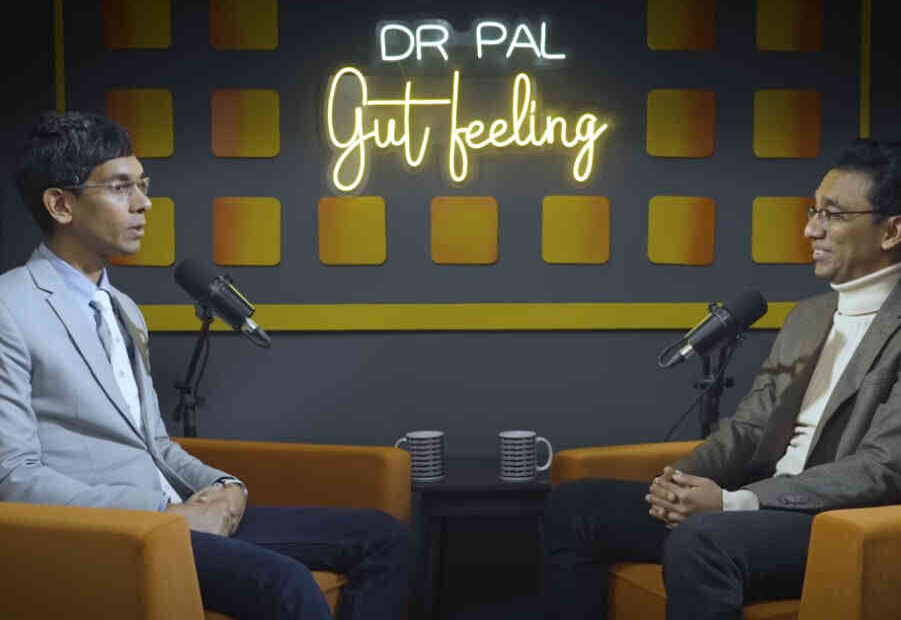
Read the full transcript of celebrity nutritionist Ryan Fernando’s interview on Dr Pal Gut Feeling Podcast on “Anti-Aging, Sugar Craving & Restaurant Food Concerns”, March 15, 2024.
DR PAL: Welcome to my podcast Gut Feeling with Dr. Pal. Today we have a very special guest. He’s my very good friend Ryan Fernando. He’s a celebrity nutritionist and he has trained people like Virat Kohli. And he looks like he’s 30 years old. And I really want to know how he looks like 30 years old while I am looking like 50 years old.
Okay, so we’re going to dive deep into it to see what are the tips and tricks that he can share with us so that we can be like Virat Kohli as well. All right, let’s dive deep into it. Hi, Ryan.
RYAN FERNANDO: Hey, Dr. Pal. Nice to see you in the shores of India.
DR PAL: Yes, yes, yes. Nice meeting you as well. Thank you for coming. I’m so excited for two reasons.
RYAN FERNANDO: Okay.
DR PAL: One is I’m so jealous of your fitness. Okay. And number two is I like your fashion sense.
RYAN FERNANDO: Thank you so much. Thank you so much. You know when you reached out to me and said you’re coming into India and he’s like, let’s do this together, I was like, anyway, people confuse us as two brothers sometimes. So you’re not looking old. Okay. You’re looking young, and you’re my younger brother.
DR PAL: So to the audience, is it okay if I reveal your age?
RYAN FERNANDO: Yes, you can.
DR PAL: You don’t have a choice now.
RYAN FERNANDO: I don’t have a choice.
DR PAL: So you are 50, correct?
RYAN FERNANDO: Yes.
DR PAL: You’re 50 years old. You look like you’re 30. Okay, so I want to start right there. How did this keeping yourself fit and, you know, loving your body, where did this start in your life?
The Journey to Body Awareness
RYAN FERNANDO: So I wrote a book called Wheat Less, which about 10 years ago, I discovered I was gluten intolerant, so I had adult acne. And, you know, you get all the protein powders and you’re training all of these sports stars, so they’re like, “Wait, you eat some food first.” So, you know, as a medical expert, you’re kind of feeling little bad. Like, you know, I can’t walk the walk and talk the talk.
So you take all of these protein powders, but then you realize your gut, gut feeling is not really good, right? So some of us are born with delicate, darling stomachs and good brains. So I was thankful for the very good brains. I was thankful for the good brains part. So I said, look, let me become the scientist in food. Let me be the nutritionist. Let me take the science behind it.
But along the way, I realized that being the scientist behind the food, the nutritionist behind the food, I got to help my body. And I realized one thing is that the celebrities, the film stars and all, then they come to you. What’s the one thing that they’re looking for? They are looking at their body being the most expensive real estate that they own.
So I coined this tagline: your body is the most expensive real estate you own. Now, I behave like a real estate agent. Now when I’m going out and selling to people saying that your body is the most expensive real estate. Now, I can’t, I couldn’t get the muscles. So I said, at least let me keep my age in check.
So there are few factors that we look at: the visceral fat, which you well know about, the subcutaneous fat. We look at the microbiome, which we’ll talk about today. So about 15 years ago, I said, even before all of this biohacking and longevity started, I was like, there are people out there who look younger than they actually are, right?
So birth certificate age will say 1975, but when you look at them, they look like 20 years younger. So I started asking people questions, and as a nutritionist, they’re like looking at me with confused, “Oh, it’s in the food you eat, right? It’s in the care you take.”
So your real estate, your body. I then came to this conclusion: such people live in their body as landlords, they don’t live as tenants. 99% of the people think they’re the most expensive real estate. They think they’re a Bugatti Veyron. But the fueling that they do is of a cheap car, vehicle.
They put oil, all of this bad stuff that you will talk about in your videos and all. And so I ask, are you a tenant in your body? So to become young I think it’s not diet, it’s not genes, it’s an attitude which I found for my celebrities. And the celebrities believe that their body is the most expensive real estate. Then they change the attitude that first my body I see, not my taste buds.
DR PAL: If all patients feel the same way, I will not have any business at all.
RYAN FERNANDO: And if everyone did it correctly, I wouldn’t also be in a job. We’d be doing this on Goa over two pina coladas, maybe virgin pina coladas, no alcohol.
DR PAL: So when you say about real estate though I could come up with this analogy that this is the only real estate market which will never go down.
RYAN FERNANDO: It will never go down in terms of value. Yes, it’ll never go down in value. In fact Dr. Pal, there’s one incident where I had a 72 year old come to me and we made him lose about 11 kgs of body fat in a year. Visceral fat went down by five points. And anyone out there could buy these weighing scales which do body fat percentage and visceral fat.
Understanding Visceral Fat
DR PAL: You know, visceral fat, just to clarify for the audience, right, so there’s two kinds of fat, right? One, the fat that you see outside, like your belly fat and you know your big and everything. The other fat is the fat deposited around the organs inside the body.
RYAN FERNANDO: And as a doctor, you know that when you go into surgery sometimes you have to really dig around to find the organs, right? So I think that when as a nutritionist, I’m not invading a person, I’m not giving medicine. So my medicine is nutrition.
So I tell people, get that weighing scale, know your visceral fat. And then once you know your visceral fat, how do you bring it down? Control your tongue, control the thought process of food. Don’t let food be the master in your body. You take the knowledge and awareness.
So I think when we work with the celebrities, why do they pay us nutritionist money is because they look, “Dude, I need to look young. I need to look timeless, right?” And in that timelessness, I have a job. So ultimately, when I came back to my profession, I was like, you got to walk the talk, at least in some way.
So hence started the journey in walking, weight training, martial arts. And I definitely eat organic. And I would advise your fans and my fans, organic, I think is a better aspect to lower the chemical, insecticide, pesticide load in our body.
DR PAL: One question I won’t talk about organic as well, but how do people measure visceral fat sitting on the weighing scale? The people, they say that, I mean, the complaint that I get is that, oh, it is not accurate. It doesn’t have to be accurate. Isn’t it?
RYAN FERNANDO: You know, it’s very good when somebody wants to find an excuse, you know, so if I say, “Hey, Dr. Pal, you don’t look very well today,” now your reply is like, “Oh, you think I’m sick?” So it’s like the question that you need to ask is this: a medical expert is telling you, a digital weighing scale is telling you, fine if it’s not accurate.
My return response to my clients is, you step on it for six times in six months. Trend line, sir, I lost weight. Correct. Now, I do not want people to lose muscle weight because, Doc, as you know, muscle is the only age reversible organ. We hold our skeletal muscle for about 14 years. Fat resides in our body for eight years.
So the cell turnover, you’re better off at having muscle mass that is dropping decade on decade as we grow older. But research now is showing people who weight train, resistance train have a chance to improve their muscle. Thereby the muscle being an endocrine organ releasing hormones, makes you feel fitter and younger.
So now when they say that, “Oh, the visceral fat is not accurate,” you’re not a Virat Kohli. Right? You’re not going for the Olympics. So let them say it’s accurate or not accurate. And then you can do the DEXA scan, which is the most accurate gold standard. But because you’re exposed to mild radiation…
DR PAL: And expensive as well.
RYAN FERNANDO: And expensive, yes. You’re not a person all the time. DEXA, DEXA, DEXA scan because of the accuracy. “Oh, Dr. Pal, what’s your visceral fat? Mine’s three. Oh, mine’s five.” There’s no competition here in the world of those not competing in sports.
Like for example, I have film stars who have a higher visceral fat but still are able to get a six pack because the subcutaneous which is on top of the muscle goes down drastically. Correct. But I still tell them as your nutritionist, if your visceral fat is high, you may have go muscle, you may have show muscle, but in your case you have the show muscle and I need you to have the go muscle.
DR PAL: What is go muscle?
Show Muscle vs. Go Muscle
RYAN FERNANDO: So go muscle is bending, cleaning, cooking, lifting a tire out of your car, going shopping, picking up the groceries. Of course, none of us do that today with all of the apps and all. That’s why visceral fat is going up.
DR PAL: Because Swiggy is in the delivery shop. Yeah, the friend don’t.
RYAN FERNANDO: It’s the temptation and the ease of life. I think it’s harder now for people to not gain visceral fat. And in fact I’m more worried about the 18 to 30 year olds today because, you know, Dr. Pal, when you and I grew up, we went out once in 15, 20 days because we didn’t have that much money in our pocket.
At least I remember daddy would give me some five rupees and like, save it, save it, save it. And then once a month went out and there were no fast food joints and all, we went to our local idli dosa or vada pao or whatever it is and we would eat it.
But today the youngsters are going out and they are pressing these buttons or eating out on a convenient point all the time. And I am seeing from the Economic Times, which is the economics newspaper, that the amount of palm oil that we’re importing into India, government first of all dropped this, the duty on import of palm oil.
And if you’re a chef, you love palm oil in your cooking. Because a South Indian will not know the taste or North Indian will not know a taste. Like in South India if you cook in coconut oil, North Indian will not eat it in the restaurant. And in North Indian, if you cook in, let’s say mustard oil, the South Indian will not eat.
So palm oil is a very neutral oil and unfortunately the palmitic acid is what is creating the arachidonic inflammation effect. Which now visceral fat says, “Please come and do your fixed deposit.”
DR PAL: So you were saying that is the amount of palm oil is more important than the actual palm oil, is that right?
The Restaurant Food Problem
RYAN FERNANDO: No. So the thought process over here is this: we are all eating outside. When we are eating outside, we have no control on the food molecules. We have no control. I mean, yesterday at the hotel, I asked for an oil free biryani and they did it and it was amazing.
And I was telling my colleague, “See, look, I’m using the fork and pushing my biryani. There’s no oil on the underline of the plate.” But when he pushed his biryani plate, we could see the streaks of oil.
DR PAL: Can you ask them?
RYAN FERNANDO: You can ask them.
DR PAL: Oil free biryani.
RYAN FERNANDO: Yes, oil free biryani or it’ll be…
DR PAL: It’ll be just white rice. I’m just asking.
RYAN FERNANDO: It’s a gut feeling that you and I are going to have lunch today. But coming back to that story, that was not the problem. The chef gave me 500 grams of biryani. So when you eat out, you have no portion control.
So frequency of eating out, no control over the contents, no control over the portion. Erratic eating times, eating in fast mode or stress mode, all contribute to visceral fat storage.
DR PAL: But in this era, everybody is going out.
RYAN FERNANDO: Correct.
DR PAL: And you know, I promote sunrise to sunset method of eating in my channel. What are the practical tips that you tell your patients? You know, you can say, don’t go out.
RYAN FERNANDO: I was just offered samosa and batata vada. I said no. So the first point is, is your body the most expensive real estate you know? Anyone watching, and this is the first thing: what is your identity? If you are going to mistreat your own body, which you can never replace, then you will be like, “Moment on my taste buds, forever on my hips or in my tummy.”
The Landlord vs. Tenant Analogy
DR PAL: A moment on your lips, ever on your hips.
RYAN FERNANDO: Ever on your hips. You’ve heard that, I’ve heard it. So fortunately for me, people are not in disaster zone, but when they come to you, they’re already on one crutch. So my thought process to people is you can control a lot of how you become based on the food you put into your body.
I also have this philosophy today that as a human race we’re eating more than we require.
DR PAL: There’s no question.
RYAN FERNANDO: There’s no question. But I have not found the solution how to tell a person not to eat more. See, we call that a diet plan. But then when we look at a diet plan and I give a diet plan to person, it’s like “I’ll follow Ryan’s diet plan. I signed up for three months, I’ll follow for three months.”
So Dr. Pal, what we started doing is we started doing blood test, genetic test, omega-3 testing, microbiome testing. So now the client is a little bit like “this is my genetics, this is my blood test, this is my omega test, this is my microbiome.” So when the diet chart comes, it is my diet plan. So we get more patient or client compliance.
And I tell people to follow a nutrition plan for at least 254 days.
DR PAL: 254 days.
RYAN FERNANDO: Because the research paper that came out at the lowest level was 21 days. That everyone talks about 21 days to make a good habit. But if you read the scientific study a little further, the lazy ones in the scientific study took 252 days to make a habit.
DR PAL: Average.
RYAN FERNANDO: And food, food Dr. Pal, to you and me is governed by the motherly love of how we have been taught to eat. So when a doctor or a nutritionist comes into the play of changing love and culture of eating to science, it’s a head-on battle and invariably love and culture always wins. Or “I’m a tenant in my body. So let me eat it today, I’ll visit Dr. Pal after 10 years.”
DR PAL: So I say that, you know, if you’re a tenant you need to pay your rent. If you don’t pay the rent, the landlord might evict you.
RYAN FERNANDO: I never thought of it that way. That’s brilliant, Doc. Because the landlord is your body and he’s kicking you out of your own body. So I guess you see that in your patients all the time.
DR PAL: All the time.
RYAN FERNANDO: I don’t see that because they’re like…
DR PAL: So people are coming to you when they are landlord. People are coming to me when they are tenant.
RYAN FERNANDO: Yeah. And I think the problem with the human race is a lot of people for a long period in their own body behave as tenants.
DR PAL: Correct.
Celebrity Clients and Body Ownership
RYAN FERNANDO: So this is very interesting. Who are the landlords? It’s the celebrities and film stars. So you’re not like “ah yeah, celebrity film star, companies, money.” But you know Doc, when I sit down and write the schedule, like I’m working with Anupam Kher right now, I look at his schedule, I looked at Manoj Bajpayee’s schedule. They work 15 times more than a doctor or politician.
DR PAL: At multiple times, multiple…
RYAN FERNANDO: Time zones, multiple people, multiple meetings, high stress levels. So they understand they need to get up at 3, 4, 5 a.m. in the morning, work out for 40 minutes, cold plunge shower, do this, do the nutrition. That’s like whenever talking to them about the diet, there is an assistant who’s producing that food and giving it to them.
Now people will say “but he has an assistant to give.” It is a simple assistant, your brain. So just like I said, I do not want a batata vada or samosa right now. I’m happy. I will go till 4 o’clock. It’s good.
The human race is eating too much today and we use food as a therapeutic balm for stress. Right? You know, so from that perspective, I think your Gut Feeling podcast brings about greater awareness. We need to tell the gut boss there’s a landlord in the body. Can we take control back again so that you pay…
DR PAL: Rent a little bit less?
RYAN FERNANDO: Yeah, nobody wants to pay rent at the end of the day. It’s better to own something at the end of the day.
Understanding Body Composition Through Technology
DR PAL: Absolutely. Just for the audience, I want to ask you, the weighing scale I keep coming…
RYAN FERNANDO: So there is a weighing scale…
DR PAL: In India available where you step on it and then it just takes the body fat percentage.
RYAN FERNANDO: Absolutely. So you have various brands. You have Withings, you have Omron, you have InBody, you have Karada, and you have a host of at least about 15, 20 Japanese brands. What people should be looking for is the weighing scale should say weight, fat, mass, area-wise distribution. So trunk, arms, leg, overall subcutaneous as well as visceral fat.
Now people ask, how is a machine able to calculate all that? Dude, my watch is able to track my heart rate and BP. Research has gone to that level where the sensors have been developed using bioimpedance. Layman knowledge: a small current goes through your body. Fat resists electricity. Muscle, which contains water, conducts electricity. They’re able to check the resistance factor between two sensors and approximate the weight of muscle, water, bone and fat.
So a good weighing scale will also give you water percentage and fat percentage, but they go into the above hundred dollar range or 10,000 rupee range. It’s a great investment. Buy a weighing scale that gives visceral fat.
I remember the first time my cameraman joined the company. I told him, “Please stand on the weighing scale.” So he stood on the weighing scale and his weight was in the late 50s. That day he couldn’t work. And we’re talking about a mid-20s…
DR PAL: I mean, percentage was 50.
RYAN FERNANDO: His age was 50.
DR PAL: Age of 50.
RYAN FERNANDO: Okay, so the best way to get anyone to comply to become a landlord in their body is to tell them that they’re not really young. That’s so sad, because what other tool do I have as a nutritionist? Look, as a doctor, you have a scalpel, you have a stethoscope, you have blood test.
The guy comes in and pays me money and he leaves the cabin with nothing. “Please wait for five days. I’ll send you a nutrition plan.” So nutrition is the most intangible advice, consultancy advice. You know, even if you go to an astrologer, he’ll give you some sort of mantra or something to chant. When you leave my cabin, I’m like “Dude, I need to plan your diet chart. Give me two to three days to build the whole thing for seven days.”
So I have got to scare people with a simple thing. Don’t check weight, check your body age, check your visceral fat.
Body Fat Percentage Guidelines
DR PAL: Visceral fat percentage. So you know that brings the discussion of skinny fat, right? Many people, even though I look skinny, I’m not healthy because my body fat percentage is like 25. So I wanted to bring it down to like 20 or even 17. But people think that if you are skinny, you are normal. So for Indian population, what is the body fat percentage when you step on the weighing scale that they should be concerned about for males?
RYAN FERNANDO: Ideally you should be 15 to 20% of body fat. Then you’re like, you know, you can enjoy your body a little bit more and have that weekend extra biryani. 15 to 20% fat, 20 to 30% body fat in males, I’m like you need to start your homework. You need to start holding your tongue, you need to start stepping on the scale, you need to start walking. You need to start eliminating grain from your diet because grain is obviously high calorie energy delivery.
So once you start cutting back on that and you have the weighing scale, you can see the downward trend. People above 30% body fat, start walking 15,000 steps a day because you need diet and you need exercise. So it’s like I tell people, you’re like a bank balance. Eating is like cash deposit. Exercise is like cash withdrawal. You want the perfect bank balance, you need to do more withdrawal if your FDs, fat deposits or fixed deposits, are really high.
DR PAL: So this is what we call balanced diet.
RYAN FERNANDO: Balanced diet, bank balance. I like to give the bank balance because everyone’s so concerned about their bank balance. You know, like “Do I have money in my bank? I need to save money. I need to do systematic investment plan, SIP.” Everybody in India is doing SIP. You know, I’m looking around and everyone’s laughing right now because everyone’s doing a SIP, saving some money.
But they’re doing a lot of systematic investment plans with double-digit returns when they’re eating too much of food. So then the fat percentage goes up. You know, you’re getting double-digit return.
DR PAL: So for men, more than 20 to 30 is…
RYAN FERNANDO: Is in the danger zone because that solid fat starts spilling over into the liquid fat in your bloodstream. Now with women, if you’re not of childbearing age, 15 to 20% is athletic. But fertility drops. If you’re of childbearing age, maintaining 20 to 25% is perfection. And above 25% body fat is where the woman needs to start taking care of her health.
In fact, we have a lot of women who come to us that before they’re pregnant, they’re at 30, 35% body fat. So the first thing I say is you don’t need to lose weight, you need to lose body fat percentage. Because when the baby is born, then they have a runaway 25, 30% weight gain. And the muscle mass in them is not significant enough to hold the baby in terms of posture, in terms of back load and stuff like that. And most women are not athletic or have gone to the gym or work out or do yoga, Pilates. Strength training is not a part of…
DR PAL: Yes, and especially in India.
RYAN FERNANDO: Correct. I always tell people, like when I did Anushka Sharma’s pregnancy diet plan and post-pregnancy weight loss, people are like “Oh, she’s got so many nannies and so many servants.” No, she got up at 5:30 in the morning before the baby got up and worked out. So there is an investment of your desire to be a better person.
Post-Pregnancy Weight Management
DR PAL: I’ll play devil’s advocate here. I’m being that pregnant woman.
RYAN FERNANDO: Okay.
DR PAL: So after delivery and especially Indian culture, we pour love to the baby so much and then we feed the women a lot more so that they feed the baby a lot more as well.
RYAN FERNANDO: Yes.
DR PAL: So the common thing is that, you know, we are very busy and yes, you know, we are not prioritizing, but the pregnancy has caused us to put on more weight. And I have a feeling here that people are missing that critical period where they don’t go back to their pre-pregnancy weight. And that is just a start of the vicious cycle.
And in the first three years, four years where the baby is so young, at least here in India there is some kind of support, family support. In the U.S., there is nothing.
RYAN FERNANDO: Right.
DR PAL: So we are the caretakers of baby, husband, wife, everybody. So the common complaint we get over there is, you know, yes, we are not able to prioritize, but we don’t have the time to prioritize. Waking up at 5:30 is not an easy thing for me to do. I do this initially for willpower, but eventually it dies down.
So do you think that if a person is torn between these two, they should focus on workout or they should focus on the diet if they want to choose one?
RYAN FERNANDO: Very good question, very astute question. Number one, everyone has a paucity of time in today’s world. But when it comes to a woman who’s just given birth, the first thing that she needs to do is she needs to walk with her baby, she needs to bond with the baby. So walk with the baby in your kangaroo pouch, in your pram. You will be able to get 7-8,000 steps if you have that time.
I do see mothers who are not working in those first six months. There is time in the day to bond with your baby and walk and talk and exercise, number one. But to answer your question, I feel diet is more important. And there’s this age-old wisdom that you need to feed double to a pregnant woman and a breastfeeding mother.
DR PAL: Correct.
Calculating Caloric Needs During Pregnancy
RYAN FERNANDO: Now most women require anywhere between 1,200-1,900 calories depending on their body weight or body frame size in a pre-pregnancy, in a pre-pregnancy carrying of pregnancy. Now when you say double, 1,200 is 2,400, but when you are in pregnancy you need only 400 calories extra per day and it ranges again from 300 to 500 depending on where the woman is.
When you come to breastfeeding, it’s anywhere from 200 to 600 calories extra. So this notion of double eating is where we have this runaway weight gain.
So diet perspective should be that every pregnant—look, none of us eat out of science, we eat out of love and culture. Even I, till I became a nutritionist did not know how much I needed to eat. You need to do that calculation. What is your resting metabolic rate? What is your energy expenditure you’re normally eating between resting energy expenditure, which I call as engine idling speed.
Sitting here doing nothing, I need 1,200 or 1,400 or 1,500 calories. What does 1,500 calories a day look like in three meals or two meals a day? Then I do this much of running or I don’t do running. I do this much of gym or I don’t do gym. I do this much of jadu pocha, jadupocha meaning cooking, cleaning and everything.
All of these activities are anywhere from 200 to 2,000 calories. So then we construct that as a nutritionist and say this is what you need to eat. You know the surprise doc, 90% of the people say “oh, only this much I have to eat.”
So then I ask, but who taught you how to eat? Mummy taught me how to eat. Now, how do mommies teach? Feeders, right? One extra serving, one extra serving.
DR PAL: They love.
RYAN FERNANDO: That’s love. So that’s what I said. Love and culture. So in pregnancy we have the love and culture. Very powerful.
Nutrition Planning for Pregnancy and Postpartum
But I can tell you that if a woman does the nutrition planning correctly, diet will help her not have a runaway weight gain. Also diet in pregnancy, women postpartum depression is actually reduced.
For example, we send a blotting paper to the mothers from a lab and we ask them to expunge breast milk onto that and send it back to us to send to the lab. What are we measuring for? DHA, the omega-3 fatty acid in the mother’s milk which the baby will feed and that will help the baby develop intelligence. Higher IQ at 4 years of age is responsible.
So everyone’s talking about breastfeeding. Now we’re taking it to the next level. Is your diet so accurate that you are aware first, does your body produce enough of DHA?
So one is I need to lose weight, other is I’m putting on weight. Other is like I can’t exercise. Forget all of that. Are you giving your child the right nutrition in your breast milk that is dependent on the mother eating scientifically?
So slowly people have started walking into our nutrition clinic because they’ve understood that the food chain doesn’t have the right nutrition. My discipline doesn’t allow me to eat the right thing. I’m worried about my child, can I eat correctly?
So what we do is we look at good breast milk nutrition and parallel, we’re looking at no postpartum depression. And parallelly we’re looking at can we help you lose weight.
Understanding Your Metabolic Rate
DR PAL: So you made a point about the resting metabolic rate and probably you must have discussed about total daily energy expenditure and everything. Is that something that women can say, “okay, you know what, this is how much calories that I need per day?” In your practice, what do you do?
RYAN FERNANDO: So very simple, okay? When you stand on these modern weighing scales, it actually tells you your BMR, your basal metabolic rate. So now if you know that you require 1,400 calories, you can actually go on to many apps. You don’t need to come to a nutritionist, but you can go on to many apps if you want self help.
But if you’re lazy like me, it’s like just find the expert. You know, when I work out, you get so many apps to teach you how to work out. I like a trainer.
DR PAL: So what I do is I tell my patients to calculate the TDEE. You go on website, it’s a free app, free calculator.
RYAN FERNANDO: Correct.
DR PAL: Where you plug in the number. So let’s say they come up with like 1,800 calories. How do you teach them how to measure the calories and how much they are taking per day?
Learning to Measure Portions
RYAN FERNANDO: That’s the key. That’s the key. So normally I don’t teach them everything. So they come to me for three to six months. So like first month rice. Rice or roti, you eat? I eat. Okay. This is the information for one roti. This is the information from 100 grams of rice.
I want you to go home and I want you to weigh your roti after it is made, cooked weight. I want you to weigh the rice that you serve yourself. Now don’t weigh and put, do one game in your house. Everybody line up. Everyone put rice in the plate.
So everyone puts rice in the plate and measure it. “Oh, I took 200 grams of rice. Oh, I took 140 grams of rice.” So that’s the first part, the standardization of portion.
Like if you give me a plate of rice now, within 5 grams I will take out exactly 100 grams. You can’t beat me. Why? I need to translate that experience to my client. And mom and granny have not taught us that.
So if you can just measure your bread or Indian bread or rice or jowar or bajra in a small weighing scale, then you start saying “oh, 100 grams of rice is so many calories.” Now calories also differ from rice to rice because of different glycemic index. So I just tell people that it doesn’t have to be accurate.
DR PAL: It doesn’t have to be accurate.
RYAN FERNANDO: There’s a vast universe, right? It’s like you don’t need to become a Formula One car driver to learn to drive. You need to know the basics. Steering wheel, gear or automatic, accelerator, brake.
Similarly in the food you need to know the carbohydrate foods and you need to know the protein foods. See fat and all. I tell people, first you become basic, sir, don’t try and go Virat Kohli level. Protein, carbs, fats, vitamins. Then if you want that level, you come to a coach, you come to a nutrition course.
Why Carbohydrates Come First
So you start off with the carbs first. Now why doctor not protein first? Because carbs is the culprit in the human race. Because we’re eating too much and you and I and everybody here in this set and everybody out there watching, we are all watching this as desk jockeys, DJs. We’re all DJs.
This movement, this movement and this movement, the calorie expenditure of this is only one meal a day, just one meal a day.
DR PAL: So for everybody, it doesn’t matter whether you work out or just a normal person. A daily protein requirement is 0.8 gram per kilogram per day. And if you shoot for one, maybe you’ll get 0.8. So that’s why I tell my patients, shoot for one gram per kilo. From your experience for Indian patients, when you see their protein content is low, what do you do?
Meeting Protein Requirements
RYAN FERNANDO: So normally what we do is as dietitians and nutritionists, we build a small chart. I tell my dietitian who eats 100 grams of any item, don’t go as per government labeling law, take the serving size.
So if I’m going to eat kidney beans or lima beans or pinto beans, chana, rajma, lobia, those sort of beans, right? How much will I eat? 2 tablespoon, 3 tablespoon, 45 grams. Give me the protein requirement in that and then I draw a chart out and maybe I’ll send this across to you so you can flash it on our podcast above our heads, right?
Which is like, what does 8 to 10 grams of protein look like in vegetarian and non-vegetarian food? So now that you give that information, the client, they’re like, “okay, I kind of follow this much.”
The second thing I do is if any of my clients work out, they go for a walk, they go for yoga, jogging, weight training, anything. I say you take 15 to 20 grams of protein post workout. If they do not have any gut issues, if there are gut issues, I never give a protein supplement because it is too concentrated and it is artificial.
From the perspective of nature, nature never made something to have only protein and no fiber and no carbohydrate and no plant compounds or other molecules in it. So this 10 to 20 grams is something that I give to all people who work out because the moment I give 20 grams of protein, the average Indian race is between 50 to 90 kgs. And if you give 20 grams of protein, it’s equivalent of almost one and a half meal.
And the final point I tell a person is if you’re eating three meals a day, your breakfast, lunch and dinner should aim to hit at 20, 20, 20. So yeah, then you know that you’re going to get that 200 run score if you’re a Virat Kohli. Like, “okay, this is my run rate, breakfast run rate, lunch run rate, dinner run rate.”
DR PAL: Let’s wait to hit the six on the last ball.
Protein Solutions for Vegetarians
RYAN FERNANDO: So the problem is the vegetarians are like the bowlers going into bat, trying to save the game. Not much of skill, but it’s like, “okay, I have to beat the target.”
So then we work with—my favorite is glutamine. My all time favorite is glutamine. Glutamine is an amino acid that really, really makes up 60% of skeletal muscle. And so what I do is I have my client make a vegetable juice or a fruit juice. Yeah, you just blend it.
And why the juice is because in today’s world, nobody has the patience to eat the vegetable plain. Like today at breakfast I was eating plain broccoli, plain tomato, and the chef is looking at me like, “we can saute it for you. We can add this dressing.” I’m like, plain means zero calorie. You do anything to it, it adds more calories. I don’t need that.
So what I do is when I juice it up, I get the fiber and then I add—
DR PAL: Not that much. You do lose a little bit. You do, but still, it’s okay.
RYAN FERNANDO: You do still lose a little bit. And you know, the thought process is people can assassinate you for juicing, people can assassinate you for eating vegetable and then combination of vegetable. I just tell people that people are eating so processed and so wrong today. At least that’s nature’s way of getting some of those plant compounds.
So a teaspoon of 5 grams or 10 grams of glutamine to that, or I look at a plant based protein powder and add it to that. You know, but personally, my story to you is I worked for 15 years for supplement companies. I took all the supplements in the world. It did affect my gut because I have a delicate, darling gut.
So today I do work out, but I don’t touch a protein supplement. I am disciplined to hunt down my protein. So I’ve got—you will have patients who will get disciplined because they are hurting. But the normal person is not going to be disciplined.
So you and I have got to cajole them, convince them to do that. And I always use this line: “Nutritional supplements are a convenience for your nutritional indiscipline.” If I can get them more nutritionally disciplined, evolution did not go wrong for us to design supplements. It is man that has gone wrong in terms of eating habit.
The Role of Protein Supplements
DR PAL: No, absolutely true. Absolutely. In fact, for my protein requirement, if I don’t meet my one gram per kilo, I use supplement. But I nowadays I have designed in such a way that I’m able to take this one gram just with my natural sources of protein. But do you think that this—I personally feel that whey protein powder and all those supplements with the protein requirement does have a role in few people where they will not be able to meet their protein requirement if their gut is okay with the supplements. What do you think about it?
Choosing the Right Protein Sources
RYAN FERNANDO: It’s like putting a cricket team together, right? Do you want all rounders? Do you want batsman, do you want bowlers? So protein is also like that. So you have the animal source of protein, plant source of protein.
Then in the animal kingdom of protein, you have more robust creatine and carnosine coming in, which gives more athletic performance. Whereas a plant based protein or dairy protein has more amino acid profile. And then comes last is soya protein, which many of us nutritionists do not want to recommend because of the genetically modified soya. But soya is still good.
So it’s like saying food is also like human beings. You can’t call a certain human being bad, right? There’s always good in somebody, but you got to find the good in that. So even with the protein supplements, for example, I was asked yesterday, what’s your opinion of whey protein? I am a judge. I am neither prosecutor nor defender. I see the facts of this case.
Who is the person in front of me? Allergic to milk, not allergic to milk. If allergic to milk, it’s prosecuted, go behind bars. You can’t take whey. Whey is a source of milk protein or casein is a source of milk protein.
So I think, Dr. Pal, our followers, our fans, can do one simple thing. When I eat the food, does it agree with me, yes or no? If it’s no, don’t listen to Dr. Pal, don’t listen to Ryan Fernando. Because they said that protein supplement is good. See how your gut feel. What is your gut feeling?
DR PAL: Feeling.
RYAN FERNANDO: And from there go to the protein supplement and say, oh, this protein in natural form agrees with me. Like if somebody launches a broccoli protein, I’ll buy it because broccoli agrees with me. My gut is good, I don’t get gas. I have amazing potty the next day. We should talk about potty also. You know, nobody talks about it a lot. Everyone just talks about input, nobody talks about the output.
DR PAL: That’s my job.
RYAN FERNANDO: It’s a pretty crappy job.
DR PAL: So I tell my patients all the time. I’m afraid, do I do a colonoscopy?
RYAN FERNANDO: I feel like shit.
DR PAL: No, now I know you inside out.
RYAN FERNANDO: The most intimate relationship.
Breaking the Ice with Humor
DR PAL: You know, the reason that I think humor comes into my channel is because that, you know, I’m in a very delicate position. We’ll talk about hemorrhoids, anal disorders, anal rectal. You need to break the ice.
RYAN FERNANDO: Yeah.
DR PAL: And that’s why I come up with all this small, small one liners.
RYAN FERNANDO: What’s your best joke?
DR PAL: The best joke is after I do a colonoscopy, I tell them that. So I go and see the patient. I say that I always have an icebreaker, right. I said, oh, you know, you don’t look like you are 60 years old at all. You look like you, you know, you look much younger. And then the same way I walked into a patient’s room and I said that, oh, you don’t look like you are 45 years old at all. The patient says, yes, I’m not 45 because I’m 35.
RYAN FERNANDO: I thought you caught your hand in the door and you’re like, oh, God, I should have put. I shouldn’t put my mouth. Put where my mouth is.
DR PAL: So, you know, being a gastroenterologist has opened up my lines of communication with the patient in a different way.
RYAN FERNANDO: Opened up, opened up the gut is a nice big long line. That’s right.
Protein and Constipation
DR PAL: So always this protein discussion always comes through. And one of the thing that most common side effect when they take more protein is constipation because as you rightly said, you know, there’s no fiber. So I absolutely agree with you that everybody has to analyze what is in it for them and then what is the gut feeling about their food for their body.
So I always tell them so exactly what you said. Try it out. Even for fasting, that I recommend right Sunrise. It might not be for everybody, but it is the most sustainable method that worked out for me. So I have been like promoting to everybody as well.
So coming back to this organic discussion that you said, so this is very dear to my heart because organic, my understanding is that, yes, you know, there’s a lot of pesticides and everything. And you know, they are growing organically, which might be. No, logically speaking, it looks good on your paper. It looks supposed to be good on.
RYAN FERNANDO: The gut as well.
DR PAL: But two things. One is expensive and then two is should we have to buy everything or only that is listed on the dirty dozen list where these are all the things that is in the top ingredient where you need to buy organic, what do you say?
The Organic Food Priority List
RYAN FERNANDO: Number one, I always say your staples, the grain pulses, legumes. If you can get that to be organic, that is nearly 45 to 50, 60% of your food consumption pattern, then we move into dairy and eggs. If you are an egg-itarian from that perspective, if those can be going into free range and hens that are not antibiotic and hormonally fed, then you know you’re another step closer to being organic. And then comes your fruits and vegetables. And as you mentioned, the dirty dozen.
DR PAL: Let me explain to the audience what.
RYAN FERNANDO: So dirty dozen. The World Health Organization came out and said that they analyzed all the foods on the planet and the dirty dozen was a term coined to say which are the foods with the highest sprayed pesticide and insecticide content on it. And at the top of my head I remember that most berries, spinach are there on the tomatoes. Tomatoes are on the highly sprayed versions of pesticides.
So two things I do is if I do not have control of knowing that it is organic when I purchase it, I make sure I wash it well. And that’s one reason, Dr. Pal, I try and encourage people not to eat outside because if you go behind the scenes in a lot of places in India, the rice, the staples, the vegetables or maybe the fruits are not washed before cooked. So you’re dirty, you expect them to. Your dirty doesn’t raise to X squared, right?
So like I was talking to my hotel, I was like, are your eggs organic? And so they looked at me with a blank look. And we’re talking about a star property, right? And you’re paying in the dollar rate to live in in this current city in India we are in which is Mumbai. And I was like, dude, but if I’m going to be paying so much for a room and you give me all of these lovely soaps and all of these exotic stuff, but my food is not organic.
So these are the perspectives I think we need to have dialogue and discussion about. And I’m hoping I can poke that one or two followers out there saying that when you travel, don’t eat outside. If you have to eat outside, limit your portion. And your concept, fasting from morning to evening, brilliant.
So if I’m one day in Bombay, I do a fruit fast. So I carry my fruit. I know it’s organic, I drink my own water. The body should survive after all. Dr. Pal, we are not walking 22 km right now. Desk jockeys. The world is desk jockeys. We’re eating too much, eat less.
DR PAL: So when you say fruits and sugars.
RYAN FERNANDO: Yeah.
DR PAL: I mean fruits and vegetables. Then that comes this whole. So, okay, let me just bring the bottom line of the organic. So you’re saying that go organic as much as possible, correct?
RYAN FERNANDO: Absolutely. Go organic. Your liver and kidney will thank you 25 years later. And even the gut will be like, you know, I really love you because we don’t need to see Dr. Pal right now for some invasive in and out procedure because you’ve dumped a lot of chemicals inside of me.
DR PAL: So you don’t want my prescription, you want my subscription.
RYAN FERNANDO: I want your subscription because I’m so happy that a doctor is talking about organic. A doctor is talking about nutrition. A doctor is telling people fast. Right? Because the other part is take medicine, do medical procedure. So you have broken the norm. And so, like all of us nutritionists and dietitians love you. You know, it’s like you’re on our part of the world. Like you have a medical problem. No, you have no medical problems. Even the medical doctor saying, eat correctly.
Nutritionists and Doctors Working Together
DR PAL: I feel like, you know, nutritionists should be above doctors because I feel like doctors has to be put to work only with diseases that is not being controlled by nutrition.
RYAN FERNANDO: If I can return the compliment, when the nutritionist has failed in his or her job, then they need to go to the doctor.
DR PAL: If you are a bad nutritionist, then, yeah, you should come to us.
RYAN FERNANDO: Or, you know, at the end of the day, it’s all about influencing people. And I think the doctors of today actually need to become the nutritionists of tomorrow.
DR PAL: That’s true, actually. Yeah. Doctor should be combined with nutritionist on the same day as well.
RYAN FERNANDO: True, true, true.
DR PAL: But the problem is during. I have repeatedly said this in multiple podcasts in my medical training, not only in my everybody’s medical training. We always say weight loss as the final line of a big disease, but we don’t have any big paragraph after that weight loss statement to how to do that. This is pretty standard on every disease.
You take fatty liver, you take IBS, you take obesity, sleep apnea, everything. The treatment is weight loss. And then what we do, we go to the next disease. We don’t talk about how to control the weight. So as I, as you know, I was pretty big before, and then I all learned.
RYAN FERNANDO: You’re about 100 plus kgs, right? Yeah, yeah.
DR PAL: And then I all learn all this by myself. And then that is how I got inspired to teach everybody else. Because what I learned is gold and this golden discussion has not been taught in medical college, at least when I was trained. Things are changing now.
So coming back to the topic of this organic thing. So baseline is, you know, go organic as much as possible and then if you can afford, do the Dirty Dozen for sure. And we’ll put that in the link, description link and what dirty dozen is. And the third thing is try to include fruits and vegetables as much as possible. That brings to the next discussion that what’s your take on fruits?
RYAN FERNANDO: Yeah.
DR PAL: And the sugar inside the fruits, is it good for your body or not?
The Truth About Fruit Sugars
RYAN FERNANDO: From a nutrition standpoint, fruit sugars were created by evolution. I think the sugars that are put into our foods today are created by manufacturing man made processes. That is bad. The sugar that is added to an aerated beverage, to a fruit juice, to all the package foods that we have, that’s the problem.
Like for example, I was on a flight yesterday and the so called aam panna which is mango juice had six teaspoons of sugar in it, right? But if I make a mango juice, it has its natural sugar. I’m not putting another six teaspoons of sugar in that. So the wrong is man made packaged foods of fruit juices. The right is homemade fruit juices or eating fruits. The sugar in that is not good.
Now we have this disconnect a lot. If I eat one orange, that’s all I need. But sometimes I want to have orange juice. And doctor, whenever I squeeze orange juice, I go through eight oranges to get one glass. So now I have eight oranges of sugar minus the fiber going into my system.
So it depends who we are giving this to. We’re giving it to a sports athlete who needs extra calories, extra vitamin C and can do with the extra sugar because they’re burning it off. Or like you and me who are desk jockey sitting and working, we don’t need eight oranges, we need one orange.
So the perspective is that fruits are not bad. When you juice fruit, check out who is receiving it. And because the fiber is removed, I think people who are on the heavier side or not into athletic performance at whatever the age should not consume a fruit juice.
DR PAL: So I got a fruit juice yesterday in the store. They said, I said they were putting sugar, I said no, no, no sugar. And they were like, okay, what? Anything wrong with you? So here I have seen.
RYAN FERNANDO: So in India there’s a very quick thing that you can do if you don’t want sugar in anything.
DR PAL: Bye.
RYAN FERNANDO: No sugar. Diabetic. Then the guy’s like okay, okay, no no, no.
DR PAL: The diabetic.
RYAN FERNANDO: I can’t put sugar. But if you say I’m a health person, no sugar, we’ll put one sugar. It’s a little sweetness in this person’s life.
DR PAL: We should say no, no sugar. I’m going to be diabetic.
Navigating Food Choices and Health
RYAN FERNANDO: Yeah, I tell a lot of people, you know, with our domestic help or our friendly help around us and all, giving yourself a fictitious disease is the best food control I had. Ramprasad Bhaiya used to use too much of oil in my food. So by less oil, less oil, less oil, cholesterol. He continued using like beer glasses of oil in my house and doing so.
One day I came back, I took a forged report saying that I underwent an angioplasty and I had heart attack. Ramprasad heart attack. Dr. Borai, if I don’t stop eating oil tomorrow I will die. He started getting tears in his eyes. Next day, no oil, full cold turkey.
So sometimes you know the food is the PR, right? So we got to remove the love from the food from when it’s being prepared for us and kind of say that you know, this is the fictitious situation where I need nutritional discipline.
DR PAL: That’s what’s happening with my subscribers. They are actually blaming, oh Dr. Pal has asked me not to eat late at night. So all the host and everything is like who’s this Doctor Pal? What is happening with this guy?
RYAN FERNANDO: Good for your business.
DR PAL: So super. Sounds good. It’s a wonderful podcast. So we are going to wrap this up with the rapid fire questions. Are you ready?
RYAN FERNANDO: I have a gut feeling I’m not going to like these questions.
Rapid Fire Questions
DR PAL: I’m going to take my phone. Okay. We have prepared fresh set of questions for you.
RYAN FERNANDO: This is, this is, I can take one run, two runs. I have to hit four or six only.
DR PAL: Even if you put a stroke, it’s okay.
# Top Two Indian Superfoods
DR PAL: Number one. Okay. So you are a top nutritionist here in India. So I have written top two Indian superfoods.
RYAN FERNANDO: Oh this I can hit a six off. Amla and Moringa.
DR PAL: Moringa.
RYAN FERNANDO: Yes. Which is Drumstick. Drumstick. Most powerful. These two guys, it’s like having two Virat Kohlis on your team. Wow.
DR PAL: There’s a famous director called K. Bhagiraj. He’s all my Tamil speaking audience will know. He has a very close relationship with Moringa and his career with this Moringa, his career got like really sky escalated to the next level.
RYAN FERNANDO: You want to know a secret?
DR PAL: Not because of the nutrition value.
RYAN FERNANDO: I live on the third floor on a penthouse. I have a pot that is the size of this podcast studio and in it grows three moringa trees on my terrace in Bangalore. In Bangalore. I believe in it. So the research says the vibrational element of the moringa is the most powerful.
So if you can have moringa, a background, if you can have a backyard, and if you don’t have a backyard, get a big size pot and put a light potting mix for your terrace and grow moringa. Okay.
DR PAL: Super. Super. All right. So second, what will I find in Ryan’s pocket? Whenever you are hungry, to your go-to food.
# Ryan’s Go-To Snacks
RYAN FERNANDO: My go-to food is the date, apple, pistachio, or sometimes figs. What I do is I carry it in a ziploc bag so I don’t keep eating too much of it. And my apple is invariably I hunt down an organic apple that is not waxy coated, so I can just wash it and eat the apple directly. And sometimes I go the whole day with just an apple and two dates.
DR PAL: Apples are also in the dirty dozen.
RYAN FERNANDO: That’s why organic.
DR PAL: Organic apples. Correct. Okay. And then two tips for healthy eating.
# Two Tips for Healthy Eating
RYAN FERNANDO: Eat to your heart’s content. Dr. Pal, what’s the size of the medical heart?
DR PAL: Yeah, yeah.
RYAN FERNANDO: It’s a fist. Eat to your heart’s content. That is my first tip to the human race. This is all that we need to eat. We’ve somehow lost the plot and eat too much. Carbon footprint is too high.
Second is try and eat as close to sundown as possible.
DR PAL: Welcome to my channel.
RYAN FERNANDO: It’s a no brainer and I think we are seeing what the ancient sages said. The ancient sages were more successful because they didn’t have electricity. You and I have electricity, which is our enemy. It’s keeping everyone on Netflix and awake and therefore eating late into the hours of the day. And then they either come to me or they come to you after that.
# Managing Diabetes Through Diet
DR PAL: So two tips for a patient coming in your clinic with the history of newly diagnosed diabetes.
RYAN FERNANDO: Diabetes is in terms of diet. Diabetes is reversible. I’ve had even HbA1c on insulin reverse. The secret is, it is in your diet. What people mistake, including my father, is that the medicine, once I take it, I can continue to eat the way I was always eating. You now have a disease. Change the way you eat.
DR PAL: Okay, so what do you say? Change the way you eat.
RYAN FERNANDO: You need to first align what is your body type in terms of how much of calories, how much of protein, how much of carb, how much of fat? Number one.
Number two, isocaloric. Balance your diet, meaning all the breakfast on Monday, Tuesday, Wednesday, Thursday, Friday. Every breakfast should have 60 grams of carbohydrate. On all days the same. What we do, today I will eat dosa, tomorrow I’ll eat paratha, day after I’ll eat fried rice. The carbohydrate content keeps going up and down. Insulin has to keep pace with this seesaw.
So isocaloric means I plan the diet to have a carbohydrate flatline through the entire meal of the week of that meal, lunches, dinners and breakfast all in the same. So now blood glucose and insulin response is getting more predicted. Weight training opens up the cells to have better insulin sensitivity. So these are standard stuff that I recommend. Okay.
# Fiber-Rich Foods
DR PAL: And being gastroenterologist, I’m very big on fiber. Okay. Fiber is the food for gut bacteria. Two fiber rich foods that you use, right?
RYAN FERNANDO: I love the foods which are with cucumber or high water content. Coconut is one of my favorite because I’m from south India. And if you do not have a gut problem, the beans, the kidney beans, the French beans, all of these, chana, rajma, all have sufficient fiber in it.
And for the clients that complain a little bit about too much of gassiness, bloating and all, I love our Indian jeera, ajwain and saunf made in the form of a post meal tea. So eat your fiber and have a jeera ajwain tea post, or you know, doctor, when we go to the restaurants we get that mouth freshener, not the sugarized version. The traditional version is good enough to help in the digestion process.
DR PAL: Okay.
# Restaurant Eating Tips
DR PAL: Two tips for a person to go to a restaurant. I know you advise not to go to restaurant, but if you go to restaurant, two tips. Yeah, I learned one, oil free biryani. I didn’t know that. I’m going to ask that moving forward. What else? Two more.
RYAN FERNANDO: When you ask that chef, oil free biryani, make sure your camera is out and see the look on his face. Like oil could be.
DR PAL: I’ve never heard that.
RYAN FERNANDO: Is this guy gone? Is this guy gone crazy? Because that’s the look the executive chef gave me. But tips when you go to a restaurant, number one is ask the restaurant to wash your salad items well because of the dirty dozen. And they cut it directly and put it in.
If you’re ordering a salad, share your food with two people. I call it being kanjusi. When my wife and me go to a restaurant, the restaurant waiter thinks we have no money. We have one dal and one rice and we will share it. And if we order a fish, we will share it. So we portion control. So our bill is actually of one person.
So anytime we go to a restaurant, we don’t get very good treatment. But now I’ve realized what’s the right thing to do. Leave a nice big tip for the guy. So now he opens the door nicely for me. He’s like, sir, I can make special children’s portion for you.
So that’s another thing. We’re eating too much. When you go out, share your dessert. Because I think dessert is constructed for three people into one. So when your group of friends go in, everyone takes one, one teaspoon of a dessert. Get taste bud pleasure. Don’t get stomach explosions.
DR PAL: So I used to split everything in my reels, okay. And then so people think that I have a split personality.
RYAN FERNANDO: Okay?
DR PAL: So one of my subscribers told me that, you know, when I went to the restaurant, they ordered, kept on, kept splitting everything. And then the waiter asked, are you a fan of Dr. Pal Channel? So I think, I think that’s what we should do. Splitting everything is the way to go if you are in a restaurant. I completely agree with you.
Choose Your Poison: Regular Coke vs Diet Coke
DR PAL: Okay, so we have one other exercise for you. So we’re going to give you two dishes and I want you to choose one. Okay? And then see the pros and cons. And what will you do? It might not be healthy. Okay.
RYAN FERNANDO: All right, I’ll do my best.
DR PAL: Okay. The full blown Coke. And we have diet Coke. Okay. The answer is going to be, you know, don’t eat, drink both as well. That’s the normal, logical question. But practically speaking, everybody is faced with this. Okay? So if you have to choose between these two, okay?
RYAN FERNANDO: So the standard answer is try and limit your aerated beverages to once or twice a month. Between these two, I would choose the proper Coke. Now, this is about 200ml, if I’m not mistaken. 250ml. This is a glass. I’d share this with my buddy, Dr. Pal. So now I’m halfing the sugar content.
Now Dr. Pal returns back to me and says, no, no, no, we should do the diet Coke. It’s zero calories, zero sugar. Research is showing that the chemical sweeteners in this affect the gut microbiome to insulin resistance and further triggering of the brain for sugar imbalances, creating more craving.
So at the end of the day, if I’m disciplined and I want a cheat meal and I want a sugar spike, I will still go with the full sugar but lesser content. And I actually did that. So yesterday with my biryani, I had a Sprite and I halved it, right? And the guy kept asking me because he knew I was a nutritionist. Sir, diet or zero do you want?
And this contains a chemical item which is one more over all the other chemicals on this. So the lesser evil I feel is this one. The problem, Dr. Pal, lies when people can’t control the quantity and the number of times they do it in a month. Like I said, tea, coffee, milk and sugar was 5.5 kgs. One of this every day is about a 9 kg weight gain every year. So choose wisely.
DR PAL: Choose wisely.
RYAN FERNANDO: Yeah.
DR PAL: So my answer to that is people think that Diet Coke is better in terms of no calories again along piggybacking on your thought processes. You know, drinking every day is not going to help you for that. It is better that you indulge on this regular coke so that you are not fighting with this willpower.
And then that is a very important thing during weight loss journey where you need to be okay and you need to enjoy the process rather than forcing yourself too much to a point that is not sustainable. Okay, super. We have one more.
Sugar vs Salt: The Blood Pressure Dilemma
RYAN FERNANDO: Okay, this is sugar, the sweetness of life.
DR PAL: Life, and this is salt and the saltiness or the elixir of life.
RYAN FERNANDO: Saltiness or the elixir of life.
DR PAL: So the question is, you’re given a one, you are the chef, okay. And you are going to create a dish, okay. And this is for a blood pressure patient, okay. And everybody was saying that, okay, everybody knows that too much of salt might raise your blood pressure.
But now the shift is towards too much of sugar causing metabolic syndrome, causing, you know, metabolic dysregulation that can worsen your blood pressure as well. So if you want to create an ingredient for a blood pressure patient, which one will you choose more?
Understanding Taste Bud Thresholds in Medical Nutrition
RYAN FERNANDO: This is what we call a googly in cricket. So when we construct in hospitals the menu plan, obviously we look at the patient—hypertensive, might also become diabetic, diabetic also becoming hypertensive. The first thing I do as a reverse orientation in personalized nutrition is seeing the taste bud threshold of a person.
People can do a simple experiment. Take a pinch of sugar, dissolve it in 100ml, pinch and take a pinch of salt and dissolve it. Ask the patient which one they can guess—there’s a threshold. They have arrived at BP or sugar problems because their thresholds to detect salt or sugar is lowered. And therefore they spend their whole life enhancing salt and enhancing sugar to feel satisfied.
So when I construct any food, I’m actually not putting either because now the patient is doomed because the taste buds have already fatigued. So we need to retrain the taste buds. And how do we do that is by educating the patient.
One option as an alternative to table salt is celery as celery salts, which are natural salts available, which have an ability to fire the taste buds on higher salt content. And another option for sugar is to go in the direction of using stevia or monk fruit. They say agave, but agave also has a high. Honey also has a higher level to sugar. At the end of the day, when you have a medical condition, you got to listen to your doctor and lower everything out of your life.
DR PAL: You handle the googly very well.
RYAN FERNANDO: We got no runs.
Recommended Probiotic Foods for Indian Patients
DR PAL: All right, sounds good. One last question. Favorite probiotic food that you recommend to your patient? Indian patient.
RYAN FERNANDO: Because I’m from—I live in the south of India—I have seen that making dosa maavu or dosa batter, or in abroad you call it as pancake. Could you make it the previous night and allow it to ferment? Kanji, in Orissa, I married an Odia girl. They have this lovely thing where they take rice and buttermilk and onions and let it ferment and everything. So that fermentation process is good.
And from the Orient, I love kimchi. So nowadays I try and take any vegetable or fruit and try and automatically make it fermented. Sometimes I lose the battle. It gets spoiled. You get the fungus, right? I tend to pickle things like amla, which I hate, but it’s a superfood. So I pickle it in apple cider vinegar and salt and then let it ferment. And so we go in that way. I also ferment garlic—my mouth is actually watering as I’m saying this to you. You know, these fermented foods. So I think these are something that we can actually promote to help in the probiotic content.
DR PAL: Super, super. Sounds good. I’m big on probiotics and the kanji that you said—that’s very popular in every part of the country. Apparently I put a reel on. We call it as palaaya sorrel in Tamil Nadu. Then I got to know that the same dish is available in multiple parts of the country—Odisha, Assam, Manipur. And they have their own regional way to spin it.
The Lost Art of Fermentation
RYAN FERNANDO: I think before the advent of the fridge, people had no choice because food was getting spoiled. So they kind of fermented it. And then we had—because there was no electricity—we had a lot of fermented foods. Now in today’s day and age, because we have electricity and we demand this freshness of food, we have lost the art of fermenting foods.
DR PAL: Correct. No, absolutely, absolutely. So beyond doubt, I always do deal with two Fs: fiber and fermentation. For every GI patient, this is what I say. And whenever I reach a talk to a nutritionist, I always try to get some knowledge from them by what do they eat for rich in fiber, what do they do for fermentation? So because even in us, you know, if you talk to a Chinese patient, I learn from my patients all the time. I say, what is the fermented food in your part of the world?
RYAN FERNANDO: And I think I can add one more F for you as a gastro specialist in the gut feeling. Don’t say farting. I was about to say farting because if your fiber or ferment is not good, you’re definitely going to have the side effect of farting.
DR PAL: I should say fun. Fiber, ferment and fun.
RYAN FERNANDO: I had a lot of fun with you today, Doctor.
DR PAL: Thank you so much. Thank you so much. It was so, so pleasure to have you here. Thank you.
Related Posts
- Diary Of A CEO Interview: Neurologist Dr. Stasha Gominak (Transcript)
- Dr Stephen Porges Interview on Polyvagal Theory: Why You Feel So Anxious All The Time (Transcript)
- Transcript: Activate Your Ultimate Inner Doctor – Dr. B M Hegde
- Thomas Seyfried Interview on Cancer Origins: Diary Of A CEO (Transcript)
- Making Sense #485: w/ Siddhartha Mukherjee – The New Science of Cancer (Transcript)