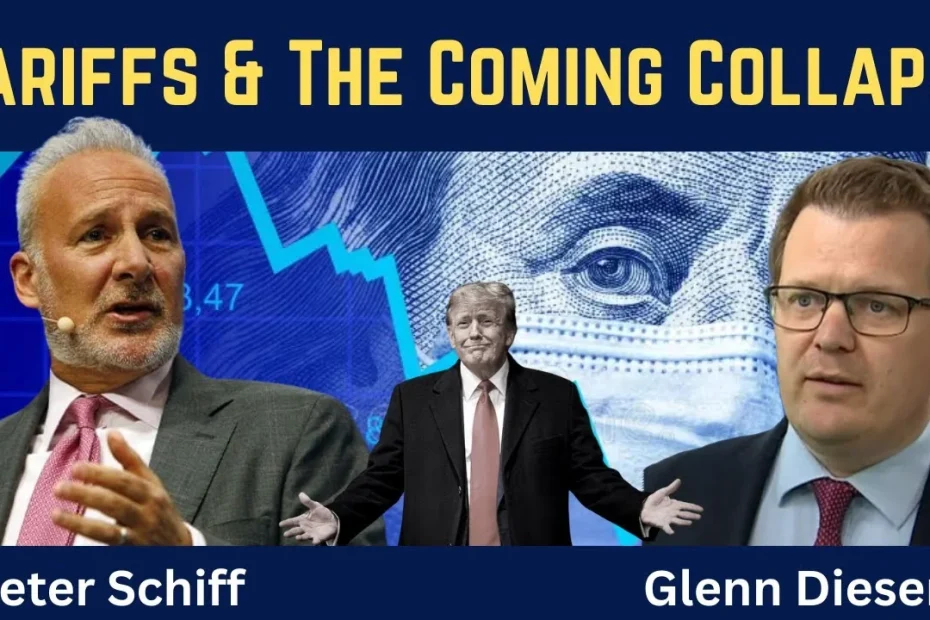
Read the full transcript of a conversation between Norwegian political scientist Prof. Glenn Diesen and financial commentator Peter Schiff on “Tariffs & the Coming Economic Collapse”, Apr 5, 202.
The interview starts here:
Introduction
PROF. GLENN DIESEN: Hi, everyone, and welcome. Peter Schiff joins us today. The founder and CEO of Euro Pacific Capital, the former economic advisor of presidential candidate Ron Paul, and the author of great books such as “Crash: How to Profit from the Coming Economic Collapse,” which I read back in 2008 when you predicted the housing collapse since at least 2006. This is really when I started to follow your work as well. So I’m a big fan.
I guess the big story is Trump’s favorite economic instrument, the tariffs, which have now been unleashed upon the world. It’s argued that this will reduce the deficit and re-industrialize America. Do you share the optimism of the Trump administration?
The Impact of Tariffs on America
PETER SCHIFF: No. I do think the tariffs will reduce our trade deficits because it’s going to make imports prohibitively expensive for a lot of Americans. So Americans will consume less, but we’re not going to produce much more. We just don’t have the capacity right now to do that.
We don’t have the regulatory environment, we don’t have the labor environment, we don’t have the supply chains, we don’t have the infrastructure or the factories. So we’re just going to have to do without a lot of the products that are being tariffed.
It’s going to be a major problem for the US. It’s not as big a problem for the world. The world will still sell goods to America, just not as many. They will then consume those goods themselves. There are billions of people outside the United States that can consume the goods that Americans won’t be able to afford. So it’s not a big problem for the rest of the world, but it’s a huge problem for America.
Trump has the nature of the relationship backwards. The world hasn’t been screwing us, we’ve been screwing them. We’ve been getting away with a much higher standard of living than our productive capacity would ordinarily entitle us. We’re able to consume what we don’t produce, and we pay for it by printing money. So the world gets our inflation and we get their stuff. We’ve got the better end of the bargain.
They use our paper to buy our financial assets, our stocks, our bonds, our real estate. So they are accumulating assets and they’re getting the income from those assets. What we’re doing is we’re indulging our present and we’re sacrificing our future. Trump is right about that, and he’s right to point out that this is a bad trend that is making America poor.
But he doesn’t understand that in the short run, everything looks better on the surface because we get to consume more than we produce. Also, foreigners recycle their trade surpluses into our financial markets and that gives us a higher stock market, it gives us lower interest rates.
Trump is trying to take all that away, which is going to produce a massive recession. We’re going to be redirecting all that inflation away from Wall Street back to Main Street, because now all the money that we used to print and send abroad is going to stay in America. To buy what? Well, not much because the goods aren’t coming in anymore. So it’s massive inflation, it’s recession, it’s a complete disaster.
This was going to happen eventually anyway, but Trump is accelerating the process, which is a good thing, except in this case it’s going to be very problematic because Trump did not prepare the nation for the extreme sacrifice that is going to be required, nor the big cuts in government spending.
In order to free up resources to build factories, we can’t spend all this money and run these huge deficits to crowd out all of our capital. So we need to cut Medicare, Social Security, national defense, and Americans have to stop spending. We need to save our money to build those factories. They’re not going to just grow out of thin air.
There’s a lot of hard work that needs to be done. But of course, nobody has a stomach for that. Our whole economy is a house of cards built on the overvalued dollar and our trade deficits and our excess consumption and artificially low rates and all that’s about to come toppling down.
The Challenge of Re-Industrialization
PROF. GLENN DIESEN: Well, often, I guess the argument for tariffs for economic nationalists would be that it’s a good way of defending national industries so they can gain international competitiveness. But this would assume that there would be domestic industries to be built, but this would be a long-term project, wouldn’t it, to re-industrialize?
PETER SCHIFF: Very long term. Like for example, people are talking about Nike. Nike’s stock is at a 52-week low today, it’s down 12%. I hear people talking about how the sneakers coming in from Vietnam or China are subject to like a 40% tariff. So Nike is going to have to jack up prices a lot.
They’re saying, “Well, to avoid the tariffs, they could just build and make the sneakers here.” Well, how are they going to do that? The factories don’t exist. In order for Nike to build a shoe factory, who knows how long it’s going to take. Plus you’ve got to put together all the supply chains domestically because you can’t import the leather and whatever else. And then you have to have the workers that know how to do it. They’re not here because we’re not making shoes here. 98% of our shoes are imported. It’s not just Nike, it’s everybody. We don’t make anything anymore. The whole industry is gone.
It would take years and years to bring it back, but Nike’s not going to do it. Why is Nike going to invest money in building a factory here in America?
For what reason? They have factories in Vietnam. They can still sell Nikes in America. They just won’t sell as many because the price will be a lot higher.
America will be a smaller part of their market. But now they can take those sneakers that they’re not selling in America and sell them in China, sell them someplace else. Maybe they’ll get a little less money than they were getting selling here, but that’s better than building a factory here and being completely uncompetitive.
Plus, Nike still has to sell shoes all around the world. Why would they build a factory here where the only place in the world anyone would buy the sneakers is in America because it’s going to be an uncompetitive factory? So it’s not going to happen. This is just all a pipe dream. The President is being ill-advised by a bunch of economic ignoramuses.
The Threat of Stagflation
PROF. GLENN DIESEN: It looks like this could be mass stagflation, where the economy would stagnate in combination with inflation. But where’s this leading then? A lot of doors are being closed at the moment. Are we heading towards a collapse?
PETER SCHIFF: Well, we already have stagflation. Now we’re just going to have higher inflation and a weaker economy. We’re going to be in a recession and there’s going to be a lot of inflation. Mainly because the tariffs redirect the inflation out of the financial markets back into the real economy.
We benefited from diverting our inflation to the stock market and the bond market. That’s all going to reverse. And that’s why, if you look at what’s happening today, the foreign stocks are going way up. I own a lot of stocks today that are up 3, 4, 5, 6%, that are in Europe, they’re in Asia, they’re in South America. Money is being sucked out of the US right now. The opposite of what Trump wants. Capital is not coming to America, it’s fleeing America.
Global Reactions to US Tariffs
PROF. GLENN DIESEN: How do you expect the rest of the world to react to this? You mentioned that now they can, instead of producing for the United States, consume their own goods. But what would this mean practically? Would they have to shift to find entirely new markets?
PETER SCHIFF: Well, governments don’t have to do anything. Individual businesses will make the necessary adjustments to their production to fit different markets. Especially if the US dollar continues to fall like it is today because the weaker the dollar gets, the wealthier foreign consumers become and the easier it is to sell into those markets.
The markets are going to self-correct. Governments don’t have to do anything. To the extent that any governments in Europe or South America or Asia retaliate with tariffs of their own, that just harms their own economies.
The harm that is being done by the tariffs in America are to America. We’re not harming Europe, we’re not harming China, we’re harming America. We’re harming Americans. So because we decide to harm ourselves, that doesn’t mean that European governments should harm Europeans. It’s like, if we jump off a bridge, are they supposed to jump off the same bridge? No, just let us jump and stay on, don’t do it yourself.
PROF. GLENN DIESEN: But in Europe now there are some voices who are concerned that a lot of the Chinese goods which were going to the United States would be redirected to Europe and undercut European industries. How would you respond to those?
PETER SCHIFF: Not really, because it’s not the same goods. A lot of the stuff that they buy from China is not the same stuff that they’re making in Europe. But look, it will benefit Europeans to the extent that they have access to more goods at lower prices. That’s good. And let the European economy adjust to that.
The whole goal of an economy is to create consumer goods for your people. And the more goods you have at lower prices, the better.
Investment Advice in the Current Climate
PROF. GLENN DIESEN: So where do American investors go at this point in time? If the industries aren’t performing, there’s mass inflation eating away at savings, what’s a good place to invest?
PETER SCHIFF: They should invest abroad right now. They should get out of overpriced US stocks. They still have a long way to fall. And they should get into the stocks that I own, the value stocks trading outside the United States that are going to benefit from these new trade relationships and capital flows.
They should invest in emerging markets that are really going to be liberated from having to prop up the US economy. They should own mining stocks, precious metals mining stocks that will benefit from the rising gold price. I mean, gold’s over $3,000. It’s going higher as the world de-dollarizes. And central banks are going to be buying more gold and less Treasuries. That’s great for gold mining stocks.
That’s not good for the US Government because who’s going to buy those Treasuries? The deficits are going to be much bigger in this recession. I think the Fed is going to buy them and that’s going to be even more inflation. So not only are the tariffs going to be pushing up prices, but so will inflation that the Fed is going to create.
The weak dollar is going to add to the pain of the tariffs. They were originally trying to tell us that a strong dollar would offset the tariffs. And I said that’s not going to happen. The dollar is going to weaken and it is weakening. It’s at the lowest today it’s been since October last year, but it’s down over 2% today. And it’s one of the worst days in the history of the dollar trading.
I think we’re going to get more days like this. I think the dollar is going a lot lower and that’s just going to put more upward pressure on import prices. That will add to the upward pressure from the tariffs.
PROF. GLENN DIESEN: The whole world economy has been organized around the United States for so long. So many countries organized their exports to the US. So many have been almost investing continuously in the US bond markets and using the US dollar. Do you see alternatives existing in which they’re not decoupling but diversifying at least?
# Economic Restructuring
PETER SCHIFF: Of course, it’s very easy to do. If you think about the US economy in 1944-1945, we had a wartime economy. All of our factories were making ammunition, tanks, fighter planes, and supplies to support the war effort. There were actually economists back then who worried about the US economy because they thought when the war ends, it would cause a big recession since factories wouldn’t need to make bombs anymore.
They forgot that before making bombs, these factories were making sewing machines and washer dryers. Before making tanks, they were making automobiles. The American economy had retooled to provide for the military, but when the war ended, the factories didn’t shut down. The workers didn’t get laid off. In fact, 20 million men were discharged from the army, navy, and marines, and they got jobs back stateside.
It didn’t take long to redirect our capacity from military to civilian production, which benefited people. It didn’t help me that we made another tank I couldn’t drive, but another car? That helps the consumer.
All the world has to do is turn its productive capacity that already exists and use those factories, workers, resources, supply chains, and infrastructure to make stuff for themselves instead of making stuff for Americans. In many cases, it’s the same stuff. The Chinese can wear Nikes too – they have feet, right? So they could buy the same products.
If they have a factory making American flags, they can make Chinese flags, German flags, or whatever. Just put a different mold or dye on the pattern. The world has an easy and pleasant task because they get to consume.
# America’s Difficult Path Forward
The hard work is here in America because we have to figure out how to consume without factories, which we can’t do. We have to build non-existing factories. That takes a lot of resources and effort. We have the difficult road ahead, not the world.
Where is the money going to come from to build these factories and recreate the supply chains? We have to start saving, but then we can’t spend. The government also has to cut spending because the deficits are so large. If we have to finance those deficits ourselves without relying on the rest of the world because they’re no longer subsidizing us, and we need to loan the US government two or three trillion dollars a year, how can we do that and save to build factories? We can’t. It’s all crowded out.
This is the day of reckoning. This is when all the chickens come home to roost. It was going to happen eventually, but Donald Trump has just accelerated the process.
PROF. GLENN DIESEN: Are there any paths now out of this mess? If President Trump called you tomorrow and asked where we go from here, what is the best path forward? What are the possibilities? Because a lot of what’s being done now can’t really be reversed anymore.
# Possible Solutions
PETER SCHIFF: The only way out of it is to keep doing the wrong thing and keep kicking the can down the road. If he calls me and I tell him what we need to do, things are going to get bad for many years, but that’s better than them getting even worse years in the future. The longer we keep digging ourselves into this hole, the more difficult it is to get out. I want to just bite the bullet and do what needs to be done.
But if Trump wants to just try to keep the bubble from deflating so he could pretend that everything is great, just like he pretends that it was great during his first term, he needs to cancel these tariffs. He needs to figure out some face-saving way to do it so it doesn’t look like he was wrong and made a mistake.
Who knows? Maybe you can’t put the eggs back together again once you crack them. He may have set something in motion here that he can’t stop, but we’ll see. I don’t know that he’s going to try. I think he’s surrounded by people that actually believe this nonsense, and I think he’s going to stick to his guns until things get really bad, then they’re going to cave. The Fed is going to cut rates, they’re going to do QE, and that’s just going to throw gasoline on the fire.
PROF. GLENN DIESEN: I remember you said that 20 years ago. It’s better to accept corrections now and take the pain as opposed to delaying it.
PETER SCHIFF: Yeah, we should have done it 20 years ago. We would have been in much better shape now.
# Europe’s Economic Outlook
PROF. GLENN DIESEN: It’s been 20 years and the situation has gone from bad to much worse. But are you that much more optimistic about Europe? On this continent, the British aren’t looking too good. The French neither. Italians, of course. The Germans are now de-industrializing. They lost their access to cheap energy. They can’t make competitive cars anymore, which was their big thing. So now the Germans are arguing they have to borrow a lot of money and start building tanks instead. Do you believe in this German militaristic approach?
PETER SCHIFF: I think in the short run this is attracting capital into Germany to finance this. It has lifted their markets, but long-term I think the real winners are going to be the emerging markets, the BRICS economies. They’re in the best shape and they’re going to be the primary beneficiaries of what’s going on.
In the short run over the next several years, I think European markets will benefit from an exodus of capital from the US. That’s kind of like one of the first places the capital is going to go, and that will benefit them, buying them some time with money coming into Europe. So in the short run I’m very optimistic on the performance of the financial markets there and of the euro.
But long term, you’re right. Ramping up government spending and running big deficits is not a recipe for prosperity. European stocks are cheap, American stocks are expensive. So there’s a lot of money to leave the US market and go over there, and that’s going to help.
The BRICS Alternative
PROF. GLENN DIESEN: You mentioned the BRICS countries. To what extent do you think they present a viable alternative? Do you see it being their ability to create alternative payment systems and currencies? Or is it their control over key supply chains? Is it technology centers? What do you see as their main strength or weaknesses?
I remember back in 2008-2009 when we had the global financial crisis, this is when the Chinese and the Russians began to think about what they refer to as the post-American world in terms of international economy and finance. Do you see that they have things prepared now, or do you see the BRICS as more of a talking club? I spoke to Jim Rogers about this. He didn’t have much faith and thought it was more of a marketing stunt. But they have developed quite a lot, especially over the past three years.
PETER SCHIFF: Look, I think they’re already de-dollarizing. They have a long way to go. That’s one of the main reasons gold’s above $3,000 and headed higher because they’re buying it. They have the factories, they have the demographics. They have savings, they have resources. They don’t need America.
Maybe they needed America for defense. But now Trump is saying we don’t want to defend you if you don’t pay us. So if we’re not going to defend them, then why should they buy our bonds and prop up our markets? I think they’re just going to move away from the US.
The key to economic prosperity is limited government and free markets. The freer the markets, the smaller the government, the bigger the economy, the wealthier the people. You have more government in the West now, more regulations, a bigger welfare state, more people dependent on government checks, and bigger bureaucracies. So they’re not going to do as well.
But the emerging markets, I think, are really going to be liberated. They’re the ones that are going to see a big boom. There are only 300 million Americans. We’re so unique because we buy everything? So what – there are billions of them. They could buy just as much. Buying is easy. Anybody can buy. The hard part is to make the stuff. They can make the stuff, we can’t. The only reason we could buy it is because they make it and they lend us the money to buy it, which they’re going to stop doing.
There’s the economic law – Say’s Law: Supply creates its own demand. Demand doesn’t necessarily create supply. If that was the case, there’d be no poverty. Look at all the poor people in Africa. There’s plenty of demand there. Why don’t they have stuff? You need supply first. Otherwise, all you have is desire, and desire doesn’t mean anything. Everybody wants stuff. You have to be able to produce it to have real demand. That’s what the world is doing – they’re producing, and that’s what America is not doing.
# US-China Technology Competition
PROF. GLENN DIESEN: What does this mean for the US-China economic war over leading technologies and markets? Is this more or less coming to an end, do you think? Or have the Chinese won? Or will the technologies be separate?
PETER SCHIFF: We still have a lot of tech here. Even if we don’t make the chips, we still have a lot of technology in this country. That’s one industry where we may have lost the hardware, but a lot of the software, a lot of the brain power – there’s a lot that happens here in tech that’s still a viable American industry.
The world is still going to want our tech. They’re not going to stop trading with the United States. They’re going to export to us and import our tech. But as far as whether we’ll lose an advantage we have to China or other countries, that depends on regulation and government.
It’s not that we have nothing in the United States. We still have industries that we lead in, and hopefully that will continue unless they end up getting taxed too much or regulated too much.
# Russia’s Economic Position
PROF. GLENN DIESEN: I think you’re correct. The US has gotten itself in some deep trouble, but one shouldn’t underestimate this giant. It’s not going away either. I think you’re right, especially on the tech front. I think the US and China will continue to lead very clearly.
My final question is about Russia. In Europe, they bought into John McCain’s argument that Russia was simply a gas station masquerading as a country. But now they’re actually growing much faster than other European countries despite all the sanctions. They seem to have successfully diversified or decoupled. I’m not sure how much of this is the war economy, but what is key?
PETER SCHIFF: I’m bullish there. It’s unfortunate Americans can’t really invest there because of sanctions, because a lot of those stocks are probably going to do a hell of a lot better than the US market and we’re shut out of it.
The demographics in Russia are much better. The fiscal situation, they’ve got resources. They have gotten closer to China as we are distancing ourselves from China. I think they’re also getting closer to the Saudis and other nations in the Middle East and the Muslim world.
I think Russia is going to do really well. The war with Ukraine is eventually going to come to an end. The sooner it does, the better. The biggest winners there will be Russia and Ukraine, because they’ll clearly benefit from the end of that war more than anybody else. So they have that to look forward to.
PROF. GLENN DIESEN: Great. Well, thank you so much for your time. I appreciate it.
Investment Strategies for Economic Shifts
PETER SCHIFF: In the meantime though, people should look at what’s going on. This is the beginning of a major decoupling, a major shift. The US Stock market’s been the only game in town for more than a decade and that’s all going to reverse. So how do you hold on to U.S. stocks? You’re going to lose a lot of money just like people did in the 1970s if they still believed it was the nifty 50 of the 1960s.
The Fangs, these stocks are going to get clobbered and the dollar is going to get clobbered. You need to own foreign stocks, you need to own foreign currencies, you need to own commodities. Everything that worked in the 70s is going to work even better now.
So you’ve got to recognize this. And that’s what we’re doing at Euro Pacific Asset Management and people want to contact my company, talk to the advisors about having us manage portfolios for you. Getting out of these overpriced US stocks and getting into undervalued international stocks that will benefit from these emerging trends.
I also have a mutual fund family. People can buy my funds. No load. You can get the information on the website europac.com and if you don’t own gold and silver, you should buy some to shift gold. But also the mining stocks in my opinion are probably the best speculative investment I’ve ever seen. And you know, you could buy them. It’s amazing that you can still buy them this cheap with gold over $3,000. But you can do it. But I don’t think you’ll be able to do it for long. So again, we’ve got strategies that focus on mining as well and you can learn about those at Euro Pacific Asset Management at europac.com.
Agriculture and Energy Markets
PROF. GLENN DIESEN: Does Euro Pacific also deal with agriculture focus on this?
PETER SCHIFF: Well, we own companies that are in that space. We have some companies that benefit from rising farm prices. So those are in our portfolios. But yeah, real things, raw materials, energy.
And I think today’s sell off in energy is a head fake because people are pricing in a global recession and they think there’ll be less demand for oil. It’s not going to be a global recession, it’s going to be a US recession. The rest of the world is going to do better when it no longer has to support the American consumer.
And so you’re going to see more consumption of oil abroad and higher oil prices, not lower prices.
PROF. GLENN DIESEN: Great. Now I’ll leave a link to the Euro Pacific Capital in the description. So, Peter Schiff, thanks again.
PETER SCHIFF: Take care.
Related Posts