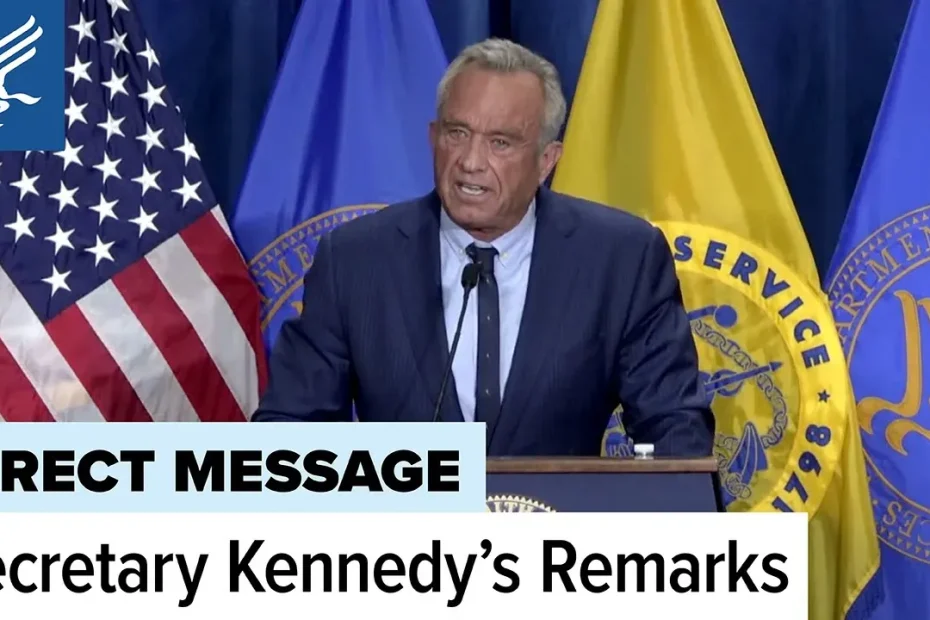
Read the full transcript of Secretary of Health and Human Services Robert Kennedy, Jr. ‘s welcome remarks to staff at the Department of Health and Human Services on February 18, 2025.
Listen to the audio version here:
TRANSCRIPT:
Introduction and Mission
ROBERT KENNEDY, JR.: Hello, everybody. Thank you for that introduction and thank you for minding the agency during my confirmation process. I’m very, very happy to be here today. I’m proud that President Trump has appointed me to the position of trust to carry out his agenda to make America healthy again. This is a mission that President Trump and I hold in common and that has inspired a tectonic outpouring of enthusiasm and support from the American people.
It’s not difficult to understand why. In the U.S., six out of every ten adults have at least one chronic disease and four in ten have two or more. The U.S. has the highest age-standardized cancer incident rate among 204 countries in the world, nearly double the next highest rate. Asthma and autoimmune diseases are far more common in the U.S. than in any other part of the world.
Prior to COVID, American life expectancy averaged 7.8 years. That’s about four years shorter than comparable countries. Autism now affects one in every 36 kids, a more than four-fold increase over past decades. 18% of teens suffer from fatty liver disease. Nearly 38% are diabetic or pre-diabetic and more than 40% are overweight or obese.
These conditions were virtually unheard of when my uncle was president, 1960 to 1963, when I was a ten-year-old boy. The sperm counts and testosterone are down about 50% in American boys and our girls are reaching puberty six years earlier than historical generations. Our only solution to these issues seems to be more and more pharmaceutical interventions that don’t seem to be alleviating the problem and in many cases appear to be worsening it.
Over-medication, particularly in children, is a growing issue. More than 3.4 million American children are currently taking medication for ADD and ADHD and yet the numbers continue to rise. President Trump has asked me to reverse the epidemic of chronic disease. The way to do that is to bring HHS to its full potential as the steward of the American healthcare system. That is the mission that I want to share with you.
Personal Reflections on NIH
I have a vivid memory of visiting NIH when I was a boy. A woman who worked for my mother had a husband who was an NIH scientist and when I was that age I wanted to be a scientist and he would bring me to NIH to the labs to look at the rats and the guinea pigs and to look through the microscopes and for me that was an extraordinary thrill to see scientists who were engaged in this existential search for existential truths and who were working to make our country stronger and to make our people stronger.
Those were different times. America was at the apex of its power and prestige and all the world looked to us for leadership. This was particularly true of NIH and CDC and FDA. They provided the gold standard of science and research trusted the world over. They produced scientific heroes like Bernice Addy, Sarah Elizabeth Stewart, and Frances Kelsey. Frances Kelsey was of course the young FDA scientist who through her own stubbornness and integrity saved our country from the scourge of thalidomide and left the wake of grim birth defects and grotesque mutations and deformities across Europe.
In 1962, my uncle John F. Kennedy honored Stewart with the President’s Award for Distinguished Federal Civilian Service, the government’s highest civilian honor. The greatness of NIH was rooted in its unimpeachable integrity. It truly deserved the reputation for conducting science in the public interest. Countries that didn’t have their own research institution, for example, the new countries of post-colonial Africa, trusted American science so much and many of them wrote into their own laws if the FDA approved it, then it’s approved in our country as well.
Transparency and Trust
I want the agencies under HHS to earn at that level of global trust and what is the path to public trust? The path to trust is always through transparency. Transparency is the foundation of science and it is the foundation of democracy. I think it’s significant that an overwhelming majority of the men who signed the Declaration of Independence with this nation’s founding fathers were also citizen scientists.
These included Thomas Jefferson, George Washington, John Adams, James Madison, Benjamin Franklin, Benjamin Rush, a physician, Julian Bartlett, a physician, Matthew Thornton, a physician, and Oliver Walcott, a physician. Science and democracy were born together during the Enlightenment and they share the same ideals for openness, for public access, and for transparency. Both science and democracy flourish from the free and unimpeded flow of information.
No one trusts science that isn’t transparent about its research hypothesis, its raw data, or its conflicts of interest. No one trusts a government built on lies, on secrets, on cover-ups, and propaganda. That’s why my uncle famously observed that “the word secrecy is repugnant to a free and open society.” Healthcare policy has been the subject of intense controversy for 20 years.
The Chronic Disease Epidemic
But have you noticed that the controversy is almost entirely about who pays for it? Republicans and Democrats fight these ferocious battles on Capitol Hill and it’s always about who to shift the burden of paying for it.
And for me, I’ve said before, this is like moving deck chairs around on the Titanic. Our health is getting worse and worse. And when the total costs are over $4 trillion as they are now, there is no good solution, only less bad ones. We need to start asking a very different question.
Regardless of who pays, why are we paying so much? Well, which is, by the way, two to three times what European nations pay for worse health outcomes.
Well, corruption and efficiency may be part of it, but the main reason is quite simply that Americans are very, very sick. We are, in fact, the sickest nation on earth with the highest chronic disease burden in the world or in the history of the world.
During COVID, we had in this country 16 percent of the global COVID deaths. We only have 4.2 percent of the world’s population.
So something we were doing was utterly wrong. And the CDC says that’s because we’re the sickest people in the world. They say that the average American who died from COVID had 3.8 chronic diseases.
So were they dying from COVID or were they dying from chronic disease? According to some estimates, 90 percent of healthcare spending today goes toward managing chronic disease. When my uncle was president, it was zero. We didn’t even have drugs for chronic disease then.
And now it’s become a burden. It’s threatening to sink our country.
A New Era of Radical Transparency
So my main mission at HHS, in which I hope that you will all join me, is to reverse the chronic disease epidemic in America. How are we going to do that? It isn’t by replacing one paradigm with another one by force. I’m not going to come in here and impose my belief over any of yours. Instead, we’re going to work together to launch a new era of radical transparency. Only through radical transparency can we provide Americans with genuine, informed consent, which is the bedrock and the foundation stone of democracy.
Transparency allows diverse parties to establish common ground of mutually trusted information. That’s the basic precept of science. Results have to be reproducible. A whole experiment has to be open to scrutiny and replication.
It’s no secret that many of our institutions of democracy, of course, our democracy, of course, but even of science and medicine, are no longer transparent. As a consequence, they have become inefficient, dysfunctional, or corrupt. They have fallen captive to the profit-making industries. They have stagnated in bureaucratic secrecy and in siloing. They have lost touch with ordinary citizens.
Here’s the paradox that a lot of crusaders need to understand. Most of the people who work in these institutions and agencies and organizations are competent, ethical, and caring, and idealistic. I think that’s especially true at HHS.
When I was a boy, I particularly admired the scientists that I saw there because I thought these are the smartest people in the world, and yet they’re not receiving much money. They’re very low paid compared to people who are using high IQs to acquire things and to acquire status and money. That means they must have been motivated by something higher, something more idealistic. I still believe that today.
I believe that most of you here are not here for the money. You don’t enter government service to get rich. That’s for sure. On a basic level, I trust the idealism of most of the people who work at HHS. I also understand the corrosive power of money as it infiltrates and captures institutions like ours. My goal as a secretary here at HHS will be to create a culture of competency, of ethics, of openness, of transparency, of caring, of pride, so that individuals who share these ideals can flourish and thrive.
Sure, those who are unwilling to embrace those kind of ideals can retire. I understand that it is a system and not the people in it that is the main problem. This is how the agencies under the HHS umbrella will recover their reputations as unimpeachable sources of scientific information to guide policymaking, medical professionals, the public, and the whole world. We will remove conflicts of interest on the committees and research partners whenever possible or balance them with other stakeholders.
We will shut the revolving door to re-establish public trust. We will make our data and our policy process so transparent that people won’t even have to file a FOIA request. Another reason why our agencies have lost public trust is that they’ve become too politicized. Well, our health should not be a political issue.
As I said to President Trump the other day, there’s no such thing as Democratic children or Republican children. These are all of our children and all of us want to keep them healthy. It should be an issue of science and an issue of basic human compassion. Science gets politicized when power and profit are involved, and power and profit are blind to compassion.
Reducing the influence of money, therefore, goes hand in hand with depoliticizing HHS. I’ve spoken of science and now let me speak about compassion. HHS is the home to programs like Medicare and Medicaid, and between them serve over 160 million Americans. The same Doge technology that has uncovered vast amounts of waste and fraud can be used to better serve our fellow citizens who depend on these programs to make sure that no one is left behind and no one is left out.
We will aim to set a standard of courtesy, efficiency, professionalism, and integrity that will make HHS again the envy of the world. Let me say one more thing about politicization. This is personal. As you know, I’ve come through a very highly polarized confirmation process.
A Fresh Start
The fog of narrative warfare has made it hard to get a sense of who I am and what I believe and what I represent. A lot of times when I read these articles characterizing me, I think to myself, I wouldn’t want to work for that guy either.
So, since we all are here together, I have a request to make from you, my new colleagues. Let’s start a relationship by letting go of any preconceptions that you may have about me, and let’s start from square one. Let’s establish a mutual intention to work toward what we all care about, the health of the American people. In return, I want to make a promise to all of you.
It’s also about preconceptions. I’ll start by acknowledging that throughout my career, I’ve asked a lot of difficult questions, and I’ve come to a lot of unpopular conclusions. I’m going to keep asking those kind of questions. What I promise to you now is to hold my preconceived answers lightly. I promise to be willing to be wrong. I promise to listen to all the stakeholders, all the parties to the conversation, including the ones, especially the ones with whom I’ve disagreed in the past.
I promise to keep an open mind toward every possibility and every contingency. I hope you will all join me in this commitment, because the health of our people is a lot more important than being right or being vindicated. We can start right now.
Last Thursday, President Trump signed an executive order to establish the MAHA Commission to study what has caused the precipitous decline in American health over the past two generations.
So, we will convene representatives of all viewpoints to study the causes for the drastic rise in chronic disease. Some of the possible factors we will investigate were formerly taboo or insufficiently scrutinized. The childhood vaccine schedule, electromagnetic radiation, glyphosate, other pesticides, ultra-processed foods, artificial food allergists, SSRI and other psychiatric drugs, BFAs, PFOAs, microplastics, nothing is going to be off limits.
Whatever belief or suspicion I have expressed in the past, I’m willing to subject them all to the scrutiny of unbiased science. That is going to be our template, unbiased science. That’s something that will make us all proud of this agency and of our role in restoring American health. Let’s commission research that will satisfy all the stakeholders once and for all. Let’s use protocols that we all agree on in advance and not alter the outcomes of studies when they’re halfway through and that they look inconvenient.
Let’s all depoliticize these issues and re-establish a common ground for action and renew the search for existential truth with no political impediments and no preconceptions.
The Spiritual Dimension of Health
Finally, I want to ask you to think about an even larger challenge to this agency. If we’re really going to end the chronic disease epidemic, we need to recognize the connection between the physical decrepitude that now beleaguers our citizenry and the pervasive spiritual malaise that has left so many young people feeling alienated, dispossessed, disconnected, purposeless, and hopeless. Spiritual and physical maladies thrive on one another.
They feed on one another. Our overall wellness must begin with a spiritual question.
How do we relate to ourselves, to each other, to our communities, and to the planet? Vested interests and malignant political actors profit and flourish when we are atomized and fragmented and uncertain when we can be easily propagandized, when we live in fear and helplessness and victimization. These forces prefer to have us in terror and anxiety, which disable our capacity for critical thinking and make us more compliant and more credulous.
They want us hiding from ourselves to avoid our own shadows and dulling our pain and loneliness through sedation and distraction. Yet inside of us, we know that love and self-knowledge are the only true paths to good health. Here at HHS, we need to take on the task of guiding our country and the world to question, towards skepticism, towards engagement, to discover our own paths to living our fullest lives, unleashing the potential in every one of us to make good personal choices that allow us to nourish, to heal, and to develop ourselves.
Only this path will make us effective citizens in a democracy. This is decidedly the American identity that we want for our children and their children. Through our own example of dedication and integrity, we can inspire our country on the mission toward well-being and toward achieving our historic mission as an exemplary nation. The goals that I have for HHS, the goals of transparency, of informed choice, of integrity, of efficiency, are possible only with your help.
This task before us is historic to reverse a trend of worsening health that goes back 60 years. And I know that we can do it. I know a higher standard of health is possible. I know that because I remember a time that our country was the healthiest and most robust country on earth. With your help and commitment, we can go back to that time. We can have that again.