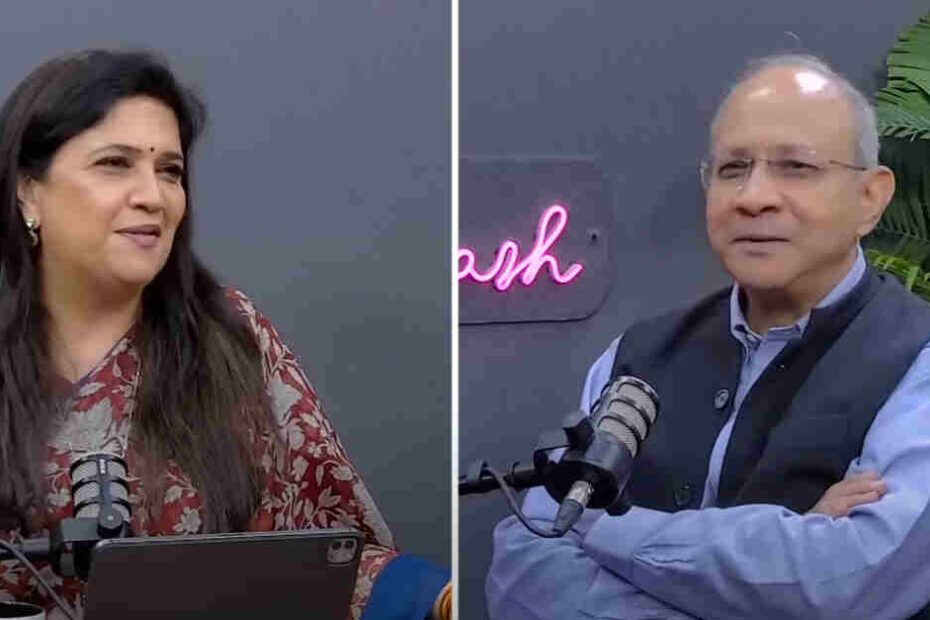
Read the full transcript of retired Indian diplomat Pankaj Saran’s interview on ANI Podcast with Smita Prakash on “Trump’s Tariff, Russian Oil, Munir’s Nuke Threat, Bangladesh & Nat’l Security”, premiered on August 14, 2025.
Trump-Putin Alaska Meeting and Its Global Implications
SMITA PRAKASH: Namaste. Jai Hind. You’re watching or listening to another edition of ANI podcast with Smita Prakash. My guest today is Pankaj Saran, former Indian Ambassador to the Russian Federation. He’s also served as Deputy National Security Advisor of India from May 2018 to December 2021. Ambassador Saran has been India’s High Commissioner to Bangladesh March 2012 to 2015, and served at the Indian Mission in Washington, D.C.
Ambassador Saran, thank you so much for being part of the podcast. Looking forward to my conversation with you. I want to begin because we’re going to be airing this before the famed Alaska meet, and hopefully it happens. I don’t even know. You never know with the Trump administration. Suddenly, things change. But how do you see this happening, this Trump Putin meeting which was to take place? Do you think they can hammer out a peace deal at all?
PANKAJ SARAN: Look, I think it’s firstly, intensely significant moment in contemporary history and it’s extraordinary. I think Trump has staked his presidency on it, on the success of arriving at a ceasefire and finding peace with Russia. So when he began, even before he began in his election campaign, he actually accused Biden of starting the war or not preventing the war. So he has been very consistent.
And not only him, his entire Republican Party, people like Vivek Ramaswamy and everyone else, they have basically said, “This is not our war.” And this was anathema to the orthodoxy of New York, of D.C. under the Democrats, who were the bleeding hearts, fully supporting Ukraine, lambasting Russia. So suddenly it was like a complete convulsion.
And so this is where we are today. Alaska, therefore, is critical for Trump’s presidency and his success. And the last eight months have been a roller coaster between him and Russia. I mean, to the point that he has actually not allowed his foreign office or the State Department to handle the relationship. He has picked handpicked envoy Steve Witkoff, his golfing partner, to do the negotiation directly with Putin.
So it’s a very unorthodox, unseen. The first people who were shocked were the Europeans. They could not understand what is going on. They were very, very fearful of a Trump presidency because they thought they’re going to be sold down the train. So coming to the question, I think Alaska is intensely significant. I have always betted on the fact that by the end of this year, you will have a deal between the Americans and the Russians, regardless of the ups and downs or the highs and lows, because this is the nature of the negotiation.
Trump’s Tariff Strategy Against India
SMITA PRAKASH: Overnight, the press conference that the US President had, he says this, “I’m going to meet him there,” which is, “Russian economy is not doing well right now because it’s being very disturbed by this.” Then he says very significantly, “It doesn’t help when President of the United States tells there which is Russia’s largest or second largest oil buyer, that we are putting a 50% tariff on you if you buy oil from Russia.” That was a big blow. Obviously, it’s not the largest buyer because he’s not slapped tariffs on China to the tune of 50%.
PANKAJ SARAN: Not yet.
SMITA PRAKASH: Not yet. At the time of filing this report, I need to keep saying this. It’s clearly he’s signalling about India. So what is this that we got to hit? Your friend so you got to comply again.
PANKAJ SARAN: So he’s using all the instruments in his armor. Right. So we know the instruments that were used in the past. This is an unorthodox instrument. So the tariffs on India, a part of his Russia strategy. A part of it. Not the full. I mean, we can discuss the whole basis of the tariffs, but a part of the tariff imposition can be ascribed to his Russia strategy.
Now, it’s debatable whether it will succeed or not or whether it will actually have an impact. He’s calculating that India will be forced to stop oil purchases from Russia. Now, supposing India does not, then what happens to the strategy? But, yes, it is a signal to Russia that “I’m going after you, but I’m also going after your friends.” But remember, so far, he actually has not gone after Russia like the Biden people did. The people who actually imposed these crippling sanctions on Russia was not Trump, it was Biden.
SMITA PRAKASH: But nobody expected him to go after Putin. He was supposedly friends with Russia. That was the entire Democrat campaign, that he is pro Russia and everything, and now here he is going hammer and tongs. But then that’s also part of what he is. He went after Elon Musk. After Elon Musk funded his campaign. So there is no consistency in his attitude, behavior, policies, nothing. But what here, what we are seeing, going after India. Do you think Putin blinked? Because this is one of the reasons.
PANKAJ SARAN: Not at all, not at all. I mean, the stakes are much higher. This didn’t materialize in the last one week. I mean, this has been going on since January. I mean, remember, if you catalog all these statements and meetings held just in February, which is less than a month after Trump took over, they were extraordinary. I mean, there was a rush of meetings between American and Russian officials. So the ground was laid at that time. Since then, in the last seven months, the dialogue has continued.
I would keep my eyes on Steve Witkoff on this side and Kirill Dmitriev, the Russian RDIF.
SMITA PRAKASH: It’s the reality.
PANKAJ SARAN: No, what it shows is he’s serious, okay? He’s not bound to institutional niceties that, “Oh, it’s foreign. So that it has to be State Department, it has to be Foreign Ministry.” He’s saying, “I want my job done.” Witkoff was sent to Gaza. Witkoff was sent to Moscow. He meets Putin one on one directly. It’s unheard of. And he’s not a diplomat who is Witkoff. Witkoff is nothing but a very successful businessman who plays golf with Trump and commands 100% confidence of Trump.
So this kind of empowerment and selection of the envoy is critical to the success of the mission. You can have on paper the foreign minister saying, “It’s my job, I will do it.” He’s out of the way, he’s there, but he’s not in the mainstream. So therefore this impact of this tariff on Putin’s mind could be there. But I will definitely not try to exaggerate its impact on Putin because Putin’s calculations are very, very different.
Diplomatic Negotiations: Career Diplomats vs. Businessmen
SMITA PRAKASH: Ambassador Saran, when career diplomats negotiate deals, they have a future. They have a long term goal in mind for the country. Right. You being a career diplomat and you have negotiated so much, you know this, right? Like you think 20 years ahead, even if you’re retiring in five years or the administration changes in 10 years, you know, and you’re planning for the country. But when dealmakers, when businessmen come in, they are looking at immediate transactional benefits. So how is this good for America and for the world?
PANKAJ SARAN: You know, the American system does not actually have a kind of a professional foreign service like many other countries have.
SMITA PRAKASH: Partly they do.
PANKAJ SARAN: Yeah, partly they do. But most of their ambassadors are political appointees. They don’t have one in India for the last many, many months. So it’s a different structure. It’s more presidential and therefore top down. And this is the way America works. It’s a four year cycle and every four years the stables are cleaned and another set comes.
So if you look at DC, it’s just a revolving door policy. Today there is all the Biden people are now professors in think tanks and this will happen to them also after four years. So this is the way America functions, that they are geared and wired to achieve objectives which they put for four years. And so it’s very normal to accept that the last four years were a mistake. “I will do something totally different.” So predictability and if you’re looking at a bureaucratic approach that “what was the precedent, I’ll do the same thing.” That really doesn’t apply to the United States.
Impact on Indo-US Relations
SMITA PRAKASH: You’ve dealt with America, you’ve been posted there. Even when you were in the PMO, you were part of several visits that Dr. Manmohan Singh had. And later, as in the national security apparatus too. You’ve seen how after George Bush W. There’s been a consistently upward trajectory of Indo US relationships. Is this a massive speed breaker to that now?
PANKAJ SARAN: I think so. I mean, I think so. But we are not the only ones. I mean, you look at what’s happened to the transatlantic alliance. It was the holy cow, it was the untouchable. It was the bedrock of the Western led order, global order. Now, the first blow that was inflicted by Trump was not on India or China or Russia. It was on his own allies, the Munich Security Conference. And he started saying this also before January. And he had said this in his first term, but this time he went after them. Basically he said, “You’ve got it all wrong. You’re free riders.” And he dismissed the Russia threat…
SMITA PRAKASH: And J.D. Vance’s speech.
PANKAJ SARAN: That’s what I’m saying. So, you know, that was the sledgehammer to Europe. And I have been visiting Europe and talking to a lot of European scholars. You know, before January, they were all extremely worried about what would be the consequence of a Trumpian foreign policy on the European alliance. They were even talking about the existence of the NATO alliance, the transatlantic alliance. They were even talking about that.
It is the time has come to maybe delink ourselves from the United States. And instead of having a US led NATO to have a European led NATO. They even talked about issues about a coalition of the willing, that since Europe is large and diverse, a few of them should get together and handle their own security. So the French, the Germans, the Italians, you know, they started asserting themselves.
SMITA PRAKASH: Recalibrating now.
PANKAJ SARAN: Recalibrating. So all of this was happening. I mean, you know, so when we look at ourselves, it’s better to look at what we are going through in a larger context to understand why it is happening. The question is, are we the only ones or is it part and parcel of a bigger disruption globally that we are going through? And I think we are going through a disruption.
India’s Strategic Realignments
SMITA PRAKASH: But we can’t. You see what happens when these kind of disruptions is you’re looking for allies. Okay. NATO is suffering, EU is suffering. The others are also in the same boat as us, but we can’t ally with them. That can’t happen like that. Right.
PANKAJ SARAN: Well, some of it has actually happened.
SMITA PRAKASH: Because of the FTA that you’re talking about.
PANKAJ SARAN: Yeah. And if you notice, our outreach to Europe suddenly got stepped up.
SMITA PRAKASH: Yeah. It was very awkward to see that happening. But it’s happening. Yes.
PANKAJ SARAN: No, you had this famous visit of Ursula von der Leyen with the entire commissioners of the European Union. Never in the history of Europe have all the commissioners traveled to any country. So Europe was suddenly feeling orphaned. So they started looking at India with a new, fresh perspective, which they never had done before. Earlier, it was, you know, human rights, this, that, and the other, violent, prescriptive. But now you suddenly found that that umbrella under which you had lived for decades wasn’t quite. Actually was leaking.
So, yes, I’m not saying we can draw satisfaction from the fact that others are getting hit. That’s not the point. But the point is to make a policy response. You have to understand who you’re dealing with and what is the overall situation. Because if you are making a policy response on the analysis that you’re the only one getting hit and everyone else is fine, then there’ll be a certain kind of policy response. But if you have figured that you’re part and parcel of a bigger global disruption, then you will tweak and modify how you respond.
So, yes, I think we are, to be sure, at a difficult moment in the relationship, something which we actually never expected.
India’s Response Strategy
SMITA PRAKASH: I mean, but in your prescriptions, which you give us in your articles, you said not to get upset with what he says and not to react, not to be reactive to every statement, every press conference that he conducts. Donald Trump. Right.
PANKAJ SARAN: Well, it’s a. One is a style issue and the other is a substance. You know, the Prime Minister, I know him. He’s not a person who tweets every day, not at least on foreign policy. It’s very measured, and that’s the way it is. I mean, that’s the way he is and that’s the way Donald Trump is. You can neither. You can’t change either of them.
SMITA PRAKASH: So forget the Prime Minister. All we’re getting from Indian side reaction is a Joint Secretary drafting a statement. Very anodyne, and putting that out. So every time Trump says “dead economy,” all we get is one statement which.
Trump’s Strategic Approach to Global Powers
PANKAJ SARAN: I think everyone here is still wanting to play this carefully because the stakes are so high in the India-US relationship. I think what you’re seeing is a recognition of the fact that there is an asymmetry out here. You’re dealing with a global power. You can’t. You’re not an equal. And you have to be realistic.
Bravado and being rash and being kind of thumping your chest or the table is not actually going to help. So that is why I think so far, and also, I think it’s all work in progress. I don’t know where is the full stop in the Trumpian approach to India. Let us say keep squeezing or he could relieve the pressure.
SMITA PRAKASH: Okay.
PANKAJ SARAN: So we can see both happening. Basically, he’s testing again. If I look at what he’s done with China or with Russia or with Europe, so you can see all speeds of the car working, the brake, the accelerator, entire gamut, everything. So I think now, it is now after eight months or seven months that he’s turned his attention to us. And we lived through a fairly nice honeymoon phase for the first few months, but now we’re getting into his crosshairs.
SMITA PRAKASH: “May you live in interesting times,” the Chinese curse.
PANKAJ SARAN: Well, that’s true. I mean, I think what we are dealing with is the only person, there’s only one man in the world who knows what’s going to happen next and that is President Trump. Not even his cabinet officials. They’re also the last to know as we are.
And he, if we give him the benefit of doubt, he’s got it figured in his mind what he actually wants at a very broad macro level. He’s looking at the world as a chessboard, as a deal making platform. He’s looking at each country, how it fits into his bigger design. And so it’s quite amazing that the only person who knows the next step is him and not even his officials.
America’s Endless Wars and India’s Role
SMITA PRAKASH: You made an interesting point that when he came in, he had this single goal in his mind, of course, many goals, but one thing is to end these endless wars. America’s involvement in these endless wars, that was one of his earliest things. Then of course comes in that Nobel, all that is there, of course, but ending these America’s endless wars. Where does India fit into this?
PANKAJ SARAN: That’s a very interesting question. I think you’re getting closer and closer to explaining why what is happening is happening. But just to step back a little bit, he was the president who came in amidst a lot of adversity in 2016-17 and the first thing he did was “I want to withdraw from Afghanistan.”
And imagine at that time the US Administration dealt with the Taliban and signed an agreement with the Taliban in Doha. And people were aghast that here is a superpower which is actually saying “I’m leaving.” And they had no problems in dealing with a non-state actor like the Taliban, which is just a ragtag outfit and they handed over the power. The execution was done by Biden, but the agreement was signed by Trump.
So this thing about America getting enmeshed in these kind of endless wars is very much, if you’re trying to understand Trump to the extent that is possible. One of the strands, I think, of his psychology is this, that or some element of consistency that he actually wants to get out of these endless wars.
So we saw that happen, as I said, in Afghanistan, he did it. No other president could do it, nor did any other president want to do it. And it was extremely unorthodox. And he used Qatar, he used Pakistan, he spoke to Russia, he spoke to China. It didn’t matter to him. His objective was to get out.
Now, in this presidency, he has been saying, even in this election campaign, that America is getting overstretched. He doesn’t put it in the diplomatic language, but you can see because he’s basically a businessman, he’s a real estate developer and so on. But you can make out what he’s saying is, “Look, I think we’ve been had, we’ve been getting stuck in all these wars. I want to get out of them,” number one, but “I also want to try and put a stop to them.”
And Russia was a classic example, I just told you. Completely divergent from the Democrat position. Completely. I mean, there was. It’s not a marginal change, it’s a tectonic shift in the approach. And so when you talk to the American elites and papers like New York Times and Post and the liberals, they couldn’t figure out what the hell is going on, because when the invasion took place in ’22, they were the ones who really went after Russia and demonized.
And suddenly you have your own president who is actually saying that it wasn’t Russia’s fault, it was Ukraine’s fault and it was Biden’s fault. So this was nothing short of a political changing.
SMITA PRAKASH: Suddenly, Zelensky becomes enemy. Within a week, he’s back to talking with them, he’s back to arming Ukraine.
PANKAJ SARAN: Yeah, but I think these are tactical day to day shifts. But let’s not forget the strategic goal. And I think that he seems to be very consistent of getting this war ended, finding a ceasefire. And by the way, the justification, whatever he’s giving, is giving. But within his quarters and inner circles, you have two strands of people who are giving the ideological justification for this approach.
One are the ideologues, the strategists who believe that if you can succeed in ending the war and winning Russia over, or giving Russia some space, you have at least half a chance of extricating them from the Chinese embrace. So they have said it in as many words and also by imputation, that the previous administrations simply drove the Russians into Chinese arms, which is what the Indians have been saying from the rooftops. That’s the first. That’s a strategic, ideological. That’s the big picture.
The second view which is coming out is that “I need Russia for my economic needs.” If Ukraine has minerals and this and that, Russia has 100 times more. So if I can get those deals there, if I can work with Russia on the oil and the minerals and the energy and the Arctic and all of that, then that’s also a great advantage to me. So these are two competing strands.
The Russia Oil Question
SMITA PRAKASH: So why is he so angry with India buying oil from Russia? Not so much with China.
PANKAJ SARAN: Look, the China. He hasn’t yet come to China. He’s made a few steps. He’s taken a few steps. The initial, the flurry of tariffs, backtracking.
SMITA PRAKASH: He’s losing out to China in the trade war if he does it right.
PANKAJ SARAN: But he hasn’t yet opened the China file. In the seriousness with which I think he has plans. He has shown his hand a little bit in the first six, seven months, backed off. But I think he will come to China. China knows it. It’s a matter of time.
SMITA PRAKASH: Okay?
PANKAJ SARAN: And so it could go either way. It could go either in the way of a much more fierce degeneration of the US-China relationship, or it could go into a big, huge deal between the Americans and the Chinese.
SMITA PRAKASH: What works for us if those two giants fight among each other and he takes his eyes off us? Isn’t that an ideal thing?
PANKAJ SARAN: I don’t think it works that way because as we are now discovering, India is going to get hooked up and caught in any kind of crossfire between any of the big powers, whether it’s Russia, China, America. We cannot put our head under the sand and say we’re not going to be hit or we’re not going to be affected. I think we have. It’s a moving system. We have to just be prepared for these dynamic shifts.
But so on China, that’s what I would say is something that we have yet to come to, that relationship. Right now, I think he’s focused on Russia. Earlier he was focused on the West Asia, the Iran, Israel issue. But China, he will come to, I think. Let’s wait and watch. And on the other question that you asked about why tariffs on India, we can discuss that. That’s a bigger question. Deserving of something.
SMITA PRAKASH: Please go ahead. Yes.
PANKAJ SARAN: So I think there’s more to it than meets the eye. It’s not just a Russia oil issue because logically it doesn’t really make much sense considering that India has been importing this oil for the last three years. Three plus years. So for someone to just wake up one day and say, “Oh, my God.”
SMITA PRAKASH: “You’re importing oil fueling the…”
PANKAJ SARAN: “Fueling the war machine.” And I’ve written about it and look, if you want to be objective and truthful and honest, India is not fueling any war machine. The war, the monetization of Russia’s oil and gas wealth was not done by India. For the last 75 years, we have not imported any oil from Russia. Can you imagine? Our imports have been basically from the Gulf. When the going was good, it was from Iran, from the Saudis, from the UAE, Kuwait, etc. But never from Russia. Despite the best of relations we had with Russia.
Now, everyone used to ask, “Why are we not importing from Russia?” There were other reasons for that. Our imports have begun only in the last three years. So who has actually built up the Russian energy empire? Who has built up Rosneft, Gazprom, all these huge state within a state, it’s the Europeans. So today, to be told that, “No, you are fueling the machine” is not true. I mean, to be polite.
SMITA PRAKASH: The gas and oil went to Europe.
PANKAJ SARAN: They went to Europe and it was hundreds of billions of dollars which was being exported, and they built up that whole Russian. So that’s why I’m saying there’s more to it than meets the eye. It’s not exactly as if, firstly, I contest the proposition that we are fueling the machine.
Secondly, even the fact that if I bring it down to zero tomorrow, the machine will collapse or that it’ll have some debilitating impact on Russia, I don’t think it’s going to happen. In any case, the imports have varied, have fluctuated, have gone down sometimes, gone up sometimes.
And so that’s the second part of the thing. The third part is, I think we discussed a little bit. Is it part of his Russia strategy to put some mental pressure on Putin? Is it part of other unhappiness which he seems to have developed with India over some actions? We can discuss those. So it is being used as a stick, a convenient stick, to kind of rap India on the knuckles, which may not have anything much to do with the oil and Russia and so on, but just as a pressure.
SMITA PRAKASH: We didn’t give him the joy of saying that he negotiated the ceasefire, that. Is it that personal?
PANKAJ SARAN: It could be. It could be. It could be. Also, I would say he was probably worried that the Pakistani whole episode which we had with them in May, kind of disrupted his plans and didn’t fit into his agenda for the world. And it was like a distraction, unnecessary distraction for him. So it could be that, it could be the personal angle, because the difference between what he said personally, not his administration, and what the Indian government, the Joint Secretary said from the Indian side.
SMITA PRAKASH: And Randhir sir, please watch.
PANKAJ SARAN: And of late, of course, the Prime Minister himself told President Putin directly in June from Canada was actually quite evident, the difference of approaches. So I think all of that has contributed.
The Return of India-Pakistan Hyphenation
SMITA PRAKASH: And he’s bringing that hyphenation back. India-Pakistan hyphenation, dragging it 15 years back, which had been dumped. He’s dragging that back and doing it.
PANKAJ SARAN: So I think the people who are very uncomfortable what all of this is happening are the American strategic experts and the American strategic community itself. People who watch the relationship grow in the last two decades are really upset that here is the situation where you’re unraveling what was built with a lot of difficulty.
And I don’t see actually how it’s going to help America meet its interests in the region, meet its interests globally. I mean, we have this playbook in the past of major powers, all three, America, Russia, China, using Pakistan as a stick to beat India. And in different periods of time, each of them has used this state, the state of Pakistan and the military. Whenever India has either fallen off the line or is misbehaving or is being too big for its boots or is not fitting in, then they use Pakistan.
SMITA PRAKASH: So there’s a charter they put forward to us that you got to walk this line. If you don’t, then we use Pakistan. That’s it.
PANKAJ SARAN: Something like that.
SMITA PRAKASH: Something to that.
Pakistan’s Strategic Positioning
PANKAJ SARAN: Something like that. It’s very convenient. So each of them, if you study the American Pakistan, Russia, Pakistan and China, Pakistan, they all have their different methodologies, but the fact is that it’s a very convenient and a ready entity to use against India.
America’s Multi-Pronged Pressure on India
SMITA PRAKASH: So the most uncomfortable thing is to see literally America – I use the word, I don’t want to use the word, but I’m using it – literally “cluster bombing” India right now.
One is via tariffs. Two is the daily press briefing where he says something or the other. Donald Trump then comes in, Asim Munir threatening a nuclear holocaust and that too from American soil. Not an easy thing for India to ignore because last time he did that, within a couple of weeks we had Pulwama happening. So that is number three.
Number four is what we thought was quad working. And now we have Japan inviting Shahbaz Sharif to come after 21 or 25 years asking Pakistan to come in. Fine, I mean that is what Japan wants to do. But what is Japan’s interest in Pakistan where it doesn’t fit in at all, in any sphere? These kind of things which are happening and forget about China that I set aside, but it looks like America.
And then the fifth element which I want to bring in is media. You’re seeing increasingly Western media writing about India being obdurate and random things. You know, just the other day I saw an article which says that Elon Musk is in court with India regarding social media and things like that. You read the fine print. It’s a 2023 situation, but just bringing it up again with no new information. The new information is “we tried to contact Ministry of Information Broadcasting, Ministry of External Affairs, Ministry of Department of Telecom. Nobody wanted to talk to us.” That is the only new information in that.
But Western media subtly impacting because if you want to read the whole article, you have to be a subscriber, otherwise there’s a firewall. So most people can only read the headline and the first paragraph. I’m just trying to say how subtly this thing is working. The Western media pressure. So five things which I’ve told you.
Western Concerns About Losing India
PANKAJ SARAN: That’s a hell of a lot. Let me start with the last on the media. I can tell you from my personal experience, you know, the amount of interest I have seen among the Western media and Western strategic analysts on what is going on between India and the United States I have not seen in the past.
I mean, and the lesson for me there is that they are interested not to derive pleasure from what is happening, but they seem to be really worried about what’s going on in the India US Relationship. And I’m talking about mainstream Western media and strategic analysts. The amount of queries or people coming to us asking us what’s going on, can you explain how bad is it going to get? What is India going to do? Is India going to pivot to Russia? You know, they are really worried. So somewhat contrary to what you’re saying. So yes, what you’re saying is true. There may be elements in the media.
SMITA PRAKASH: Some well meaning, I grant you that.
PANKAJ SARAN: But there is a concern that “are we losing India?” So let’s look at it from that point of view also, not just our point of view, because there was a lot of investment in India and people are actually worried that is the United States losing India. And that’s a big deal for the US. For America, especially at a time when you yourself are in competition for global influence and authority with other competing powers. So it would stand to logic that you want to accumulate friends, not divest friends.
So that is one thing which we should keep in mind, that there is a worry that is India going to – are we going to lose India? So we should understand that we have a – we are not a nobody. And it’s not as if we have no cards to play, to use the famous phrase of Donald Trump. That’s the first.
On the second, yes. On the Pakistan factor, I think what he has done is he has succeeded in bringing Pakistan back into the India US Equation, something which we had parked aside and we had discarded and we were moving quite fast ahead on the bilateral. And in fact, if there was any country which had come into the equation, it was China, not Pakistan.
So in a sense, we have gone back to the past, but that’s a good thing because we have a lot of experience from the past that if we have to open our dusty files and see how India handled US India, Pakistan triangle, then we have a lot to take away. We have a lot of lessons, we have a lot of experience and we have a lot of lessons learned from how to do it. And I think we will be able to do it better this time. So we’ve been through it. We’ve been through a US Pakistan nexus, an alliance, a relationship. We’ve lived through all that. We’ve lived through the nuclear, the aircrafts, the military, the Afghanistan period and everything else.
SMITA PRAKASH: Why slide down back again to that period?
PANKAJ SARAN: That’s a question which we have to ask him now. Why? You know, either he’s pulling us.
SMITA PRAKASH: Back and both the countries pulling us back to that quagmire again.
PANKAJ SARAN: Well, yeah, but let us see how much this sustains over. I mean, we are looking at it the last two months, right? Last two, three months. Let us see how much this sustains in the coming months. I mean, how is it a structural shift? Is there a tactical shift? I mean, if tomorrow we do something which brings us back into his good books, will he dump Pakistan? I mean, that’s the real issue.
But yes, I mean, the Munir Trump and the Munir US Relationship today is a real thing. And it is something which we have to be very quick in understanding, not pretend it is not happening, not be in denial and find our responses to it.
US Designations and Balochistan Strategy
SMITA PRAKASH: He’s found – I want to also talk about Japan, but before I talk about quad, I want to concentrate still on the Pakistan angle. So you’ve been in the national security apparatus too. How do you see this latest thing about designating the Majid Brigade as a – designating them the BLA and its ally, which is this Majid Brigade as an FTO, foreign terrorist organization? Because just a couple of weeks back, we saw the Resistant Front being given that designation, and now this happens. So it’s a continuation of that hyphenation or is there a larger interest that the Americans have in Balochistan now?
PANKAJ SARAN: Well, I think it’s difficult to say. I mean, the Baluch issue, the BLA has been a terrorist organization of some sort for many, many years. So obviously this is part and parcel of the – it’s a further cementing of the US Pakistan strategic relationship and strategic understanding. So from that point of view, it is significant.
And you know, we have to see it from that point of view. I mean, the TRF is something which we have spoken about in the Security Council. Last year, the Americans designated it, but it doesn’t matter. That is not the real issue because.
SMITA PRAKASH: BLA had been proscribed earlier. It is the Majid Brigade now. But they want – there’s that TAPI line which they have.
PANKAJ SARAN: TAPI is dead.
SMITA PRAKASH: Do you think they want to revive that?
PANKAJ SARAN: No. I mean, you can only have TAP. You can’t have – I mean, you can’t have a TAPI without “I”.
SMITA PRAKASH: Yeah.
PANKAJ SARAN: And as far as Baluchistan is concerned, whether you designate A, B or C, it doesn’t matter. The reality of Baluchistan is – and you’ve spoken to a lot of our own experts I know, on Baluchistan – is known to everyone. Baluchistan is out of control. And it’s not because of their Islamic identity. It’s because of their tribal identity. For centuries and decades, it’s been out of control.
The Balochistan Challenge
SMITA PRAKASH: So it’s been out of control. Pakistan cannot control that area now. They thought this, the CPEC and stuff like that, that will work out. CPEC is almost dead. Dead on arrival or it’s not functioning to the capacity that either China envisaged or Pakistan wanted. So now is Pakistan wanting to get America involved in Balochistan so that they can bring Balochistan under control and Americans can then pilfer out there the resources?
PANKAJ SARAN: You know, this sounds too good to be true.
SMITA PRAKASH: Too good, I know, yeah, it sounds like a – it’s ambitious, right?
PANKAJ SARAN: No, it sounds like a fairy tale. Best luck all. Good luck to the Pakistanis and to the Americans if this succeeds. I mean, that’s great. I mean, if you can have a joint US China, CPEC corridor passing through Balochistan and brings peace and harmony and prosperity to Balochistan, I don’t think it’ll happen in my lifetime, but let them try.
I mean, they’ve tried so much in the past. They bet so much on Pakistan and every time it’s led to a dump truck, to use another common phrase. So these things are not happening. I mean, everyone invests and believes that they have kind of found the secret key to Pakistan or to Pakistan’s prosperity. It doesn’t happen.
Pakistan also believes that it is God’s gift. And it has pursued this strategy of terror against us for three or four decades, believing that it’s a matter of time before India falls, collapses, disintegrates, etc. But you know, facts speak for themselves. I mean, Indian strategists are very fond of flaying their chest that “our narrative was wrong.” I say, what’s wrong with our narrative? The narrative speaks for itself. The narrative is the reality.
What is the Pakistani reality and what is the Indian reality? We have absorbed those thousand cuts and we are where we are today. Pakistan is in the midst of several crises. Now, if it believes that countries like America or China can bail it out, it’s a repetition of the past. So we are actually just repeating the past playbook and they have tried every trick in the book.
But until and unless Pakistan is honest and introspects about its own internal problems, its own internal governance, quality of governance, institutions and everything else you cannot buy or you cannot import stability and prosperity. And India has done it the harder way. We were under US sanctions, Western sanctions. We had a certain kind of self belief. We invested in institutions. We are not perfect, but we are still better off than what Pakistan managed to do.
Pakistan’s Washington Strategy
SMITA PRAKASH: I’m going to ask you this question, which I’ve asked others in the podcast too. Does Pakistan read Washington D.C. better than India reads Washington D.C.?
PANKAJ SARAN: Well, in this case it’s possible. It’s possible that Pakistan got lucky. I mean, they just simply got geographical location.
SMITA PRAKASH: Is that their luck?
PANKAJ SARAN: That is a structural – that is a long term structural. But whether in the last six, seven months, they managed to weave their way into the inner circle of Trump which we could not.
SMITA PRAKASH: And they were apprehensive of a second Trump. They were extremely apprehensive of a second Trump term and Indians were jubilant about second Trump.
PANKAJ SARAN: Again, they actually had not forgotten the kind of relationship they had with the Trump administration in the first term. They were the ones who delivered the Taliban to Trump.
SMITA PRAKASH: Yeah, Imran Khan.
PANKAJ SARAN: Yeah, but Imran Khan was the face. But it was the ISI and the military who handed it over to the Trump people. So neither has the ISI forgotten it, nor have the Trump people obviously forgotten it. They gave him that victory. They allowed him to exit.
SMITA PRAKASH: Okay.
PANKAJ SARAN: The actual exit was a mess. That was Biden. But the decision to say “I’ll hand them over to you” and Trump is not forgotten. And the ISI, and at that time the military in the ISI obviously earned a huge IOU from the Pakistani intelligence agencies and the American intelligence agencies and the American military because you actually helped that to happen.
So if you build upon all of that in this term, so there is a good history, there is a sweet spot they had in the first term. They built upon it and they were obviously – they’ve been very quick to move on.
China’s Reaction to Pakistan’s US Outreach
SMITA PRAKASH: How does China react in the sense that watching Asim Munir going to DC twice in the past couple of weeks, I mean – they’ve just had Operation Sindur, they’ve had their aircraft being used, they’ve had their radars being used by Pakistan and you’re my pup and you’re going there. How does that happen?
China’s Dilemma with Pakistan’s US Outreach
PANKAJ SARAN: Yeah, that’s a great question. I mean I ask myself all the time, what would Beijing be thinking? I mean frankly, President Xi didn’t host Munir for a lunch. Right. He should have hosted him for a lunch. So that’s a great question and I think it’ll play out in the next few months.
And part of it we will see in how they approach the India relationship. Because if they feel that they are being taken for a ride or that Pakistan is double timing or that the moment Pakistan got an opening in America, you ditch your old trusted all weather friends and hunt in greener pastures, then the Chinese will also. There will be a section in China which will might want to teach Pakistan a lesson saying that “you can’t have it both ways. This is not the 70s anymore. I don’t need you to mediate between India, between me and the Americans, because those days are gone. You know, I needed you in 72. I don’t need you today. So your utility to me on the US China relationship is basically zero. I don’t need you. Yes, I need you for my India policy.”
So there will be conflicting views within Beijing on how to respond to Pakistan’s open courting of the Americans and vice versa. And they’re like, saying, “what’s going on? I mean, you know, my poodle is running around. I mean, yeah, you know, I had this leash around him and, you know, he’s hunting all over the place.” So that’s one view that Beijing.
There will be a view in Beijing, but there’ll be another view in Beijing which is more the traditional orthodox hotline saying, “look, let them do it. But, you know, it’s a critical part of my containment policy for India, so I have to keep Pakistan in check, engaged in play, and let me give a little freedom to them to move around and, you know, dance around in Washington.” So I would say there are these different views. As you know, in every capital, major world capital, you don’t have monochromatic views. There are multiple.
SMITA PRAKASH: But in Beijing, there is.
PANKAJ SARAN: No, I don’t think so. Not at all. Not at all. I mean, it’s a very sophisticated. At the end of the day, of course, there will be uniformity, but there will be. Even in India, there are different views. I mean, there are people who think that, you know, there was a time till, let’s say a couple of years.
SMITA PRAKASH: Ago, when they were fixated on Dalai Lama and fixated on these issues.
PANKAJ SARAN: Yeah, fixated on that, yes. But there was also a view in Beijing that the big question in Beijing which had to ask itself was, have we lost India? Has it shifted, you know, irrevocably towards the United States? Or is India still in play? Can we still bring it back?
These two strands were always struggling with each other. At one point, the former prevailed that India is a lost cause and you can forget about it. It’s a US Ally. It’s not even an ally. It’s a US Lucky. So we have to deal with it through the US Lens because India has lost its independent agency.
But there was another view of a certain section which said, “no, you’re misreading India. They still have.” And so when we took the position we did in Ukraine in 2022, the latter view suddenly got revived and said, “see, look, the Indians have actually taken a view or a position which is not what the Americans wanted. So India did show independent agency.” So I think there is even within Beijing. So that’s the beauty of Indian foreign policy that you know, you keep everyone guessing.
Impact of Alaska Summit on India’s Diplomatic Relations
SMITA PRAKASH: Yeah, me too. But let me come to this point which in case Alaska doesn’t fructify because we’re going to be airing this on 14 so we really don’t know in case Alaska summit doesn’t rectify or if the summit happens, but it’s not end of the war in such a situation. Putin coming to India and PM going for Shanghai. Will that invite more tariffs?
PANKAJ SARAN: Look, they’re two totally different things. Our relationship with Russia and relationship with China. The Putin coming to India. I don’t think so. Actually I really don’t think so because I’m pretty sure that we will have a Trump summit before the end of the year and on the so unless there is a complete failure of Alaska, which frankly I would be very surprised if I my bet would be continue to be on a success. Of course I could be wrong, but that’s whatever little I can understand.
SMITA PRAKASH: He just said last yesterday he said “I’m going to Russia” three times he said when he actually meant Alaska. Yeah, I how do we decipher what he’s saying?
PANKAJ SARAN: Okay, so if so, yes, let us look at a scenario where Alaska doesn’t succeed. Right now even there I would like to disaggregate because then the reactions are different. Now if it ends in a failure, I mean, you know, if it or it ends in decision to meet again or if it ends in an interim kind of a, you know, two stage kind of process, there are so many possibilities, it’s difficult to put a finger on it.
But what I can see is that they are actually moving fairly fast despite all the confusion that we are seeing towards something. You know, remember the Americans are speaking as we speak to the Europeans. Zelensky obviously sees that something’s going to happen. He’s nervous, very nervous.
But regardless of what happens in Alaska, the Prime Minister’s visit to China will happen. And I think regardless of what happens in Alaska, an India Russia summit will happen. Now if tariffs are going to be imposed on India, tariffs will not be. You know, the whole, the whole irony of the whole thing is the tariffs are not going to be imposed on us because we’re talking to China, which is our number one strategic threat and challenge. The tariffs are going to be imposed on us because we talk to Russia, which is a friend, but it’s their enemy. And so it’s a so and Also.
SMITA PRAKASH: On agri products and all that which he wants. Or is that a sideshow?
PANKAJ SARAN: No. You know, then nothing can prevent him from imposing further tariffs. But if he, if he feels that we are poking him in the eye or we are holding a summit with Russia deliberately with an eye on him or America or the West, I can understand that he may get further enraged.
But, you know, everything which we are telling him is that this is not, this is not the case. This is an annual event which has not happened since 21. He’ll be coming, if he does, since after the first time, after 21, to India. And if you’re talking to him, I mean, in the last seven months, your people have had more meetings with Putin than we’ve had. We’ve had maybe, I don’t know, two, three meetings. You had like a 10 meetings with him. So why can’t I. And I have also.
SMITA PRAKASH: America’s never negotiated and never dealt with, with the other country as an equal. So for us to say that.
PANKAJ SARAN: No.
SMITA PRAKASH: But we work with them.
PANKAJ SARAN: Right. But we are also telling him that we are not dealing with Russia to be a spoiler in your scheme or in your approach to draw down the war. We are not here inflaming the war. That’s what we’ve been saying to the whole world in the last three years, that we are not in that business. In fact, the people who are inflaming the war are, one could argue, is the Europeans and maybe the Chinese. But India has never been a part of this, of this whole view that the war should continue.
The Future of Quad Under Trump
SMITA PRAKASH: So one question on quad and then I’ll move to the neighborhood. Now that you’re here, I’m going to ask you everything.
PANKAJ SARAN: It’s a tough question. It’s a tough examination.
SMITA PRAKASH: Tough examination. Syllabus. So on the quad, do you think the summit will happen? And why is that under threat?
PANKAJ SARAN: Now suppose my answer to that is, what is squad? Never heard of it.
SMITA PRAKASH: I mean, so was it an, what should I say, unnatural unit that formed.
PANKAJ SARAN: Well, it waxed and wind. I mean, it began with great fanfare in 2004 and then it died. And then it arrived somewhat in 2007 again it died and it revived under Trump in 2021, I think, or some in this first term. And then Biden picked it up and ran with it.
So it’s had a history and like any organization, it’s kind of, you know, it’s, it’s been a function of the overall geopolitical situation. It’s also been a function of personalities, Shinzo Abe was wedded to it. His predecessors were not the Australians. Prime ministers were wedded to it, but it was also the Australians who first were the first ones to withdraw from it.
So, so I, so I think, of course, you know, look, we shouldn’t over dramatize these groupings. They have a purpose and they have a function and they have a utility.
SMITA PRAKASH: Like bricks. Yeah, I mean, utility for some extent. Jab suit. Kia karo Naito put it aside.
PANKAJ SARAN: But brics’s record is much better than quad. I mean, you had a summit every year since 2009. We are in 25. You had 16 summits in 16 years. Unmatched record. Despite everything people say about how the dysfunctionality of bricks, quad is supposed to be homogeneous democracies, same region, this, that and the other.
So if now quad clearly, I mean, let’s not pretend is basically will survive and flourish till as long as the Americans have a stake and support and believe in the Quad. A quad minus America was basically Japan, Australia, India. We are in any case doing what we have to with Japan and with Australia. We have excellent bilateral defense security ties with them.
Now, there was a time when we needed the quad because we had our border clashes with China. There was a understanding among all quad members that if you had to face the China challenge of the next coming decades, none of us can do it alone. You need to work together. Now. If in the wisdom of President Trump, he thinks there are different instruments, he has to deal with the China challenge and quad is not one of them or is a very subsidiary element, then naturally the momentum or the ballast for quad will reduce.
India’s Strategic Balancing Act
SMITA PRAKASH: So now we put quad in the back burner, we bring in Shanghai Corporation in front and we bring NAMM in front, which had been put in the back burner earlier. Is that it? Is that our dynamics now?
PANKAJ SARAN: No, you’re talking about India. I was talking about America.
SMITA PRAKASH: I’m talking about India.
PANKAJ SARAN: So India will, I mean, I’m sure.
SMITA PRAKASH: The Global south, not nam, we should use the new terminology, no?
PANKAJ SARAN: So I think India will continue to go through the processes of inviting people for the Quad summit. It’s a different matter who comes, but it is India’s turn.
SMITA PRAKASH: But if AJT goes first to Pakistan, first to Islamabad and then comes for quad in India, no, thank you. Look, I think we can’t stop him.
PANKAJ SARAN: Let us be adults and be prepared for anything and everything, because there are some things which are in your control, some things which are not in your control. And if we have to live in this kind of a topsy Turvy world. Just get your act together and don’t outsource your. And seek validation or outsource your security to Washington or London or to Moscow or anyone. Just keep your eye on the ball and focus on it.
If it is your turn to hold squad, be a good host. Invite everyone. If they don’t come, that’s their problem.
SMITA PRAKASH: Yeah.
PANKAJ SARAN: So then you decide whether you want to go ahead with the summit or defer it to next year. That’s, that’s, we’ll come to that when we come. But as of today, I know that India is supposed to host. It is India’s turn. After all, we’ve had two three minute meetings with the foreign ministers under the Trump administration. I mean, if he wants to go via Pakistan, obviously he knows what he’s doing and obviously his people, he may not know. His people will know what impact it’s going to have on the India U.S.
SMITA PRAKASH: Who was the last presidential U.S. president? I think Clinton.
PANKAJ SARAN: Right, Bill Clinton.
SMITA PRAKASH: And that also was not an official visit. He just stopped over in the airport and few hours, addressed the people of the country from.
PANKAJ SARAN: Few hours.
SMITA PRAKASH: Yeah. After that there’s been no US presidential visit. So if the American, that itself is for him. Oh, really? I’ll be the first one. Just like he did North Korea. He’d probably do that.
PANKAJ SARAN: But you know, he can go, I mean, he can go once, twice, thrice.
SMITA PRAKASH: Yeah.
PANKAJ SARAN: It’s not going to change the destiny of Pakistan.
SMITA PRAKASH: Right?
PANKAJ SARAN: I mean, if.
SMITA PRAKASH: Will it? I don’t know. You think it won’t?
Bangladesh’s Political Landscape and Security Challenges
PANKAJ SARAN: Look, there’s something called having strong fundamentals and there is something called having a dysfunctionality which is structural and which cannot be fixed by any, even the most magnanimous American president. After all, they had the hand of Richard Nixon and subsequent U.S. presidents. What happened to that country? You know, and I know what happened to it. If the benevolence of the Americans was the key, good luck or the generosity. You don’t like them?
SMITA PRAKASH: No, no benevolence of the Americans.
PANKAJ SARAN: Good luck to them for the generosity of the Chinese, BRI and so on. If these were the secrets to success, Pakistan today should have been a much better and a much bigger economy than India’s. We are the guys who are pushing along, chugging along, making our way through adversity, focusing on what we have to do. And we are there where we are through hard work, not through the goodwill of anyone else. We’ve earned where we are today.
The Bangladesh Crisis: A Diplomatic Perspective
SMITA PRAKASH: Okay, let me just now move to the neighborhood. Sir, you were posted in Bangladesh, so I’m going to ask you about Bangladesh. When you see what’s happening out there, does it really shock you to see how it spiraled out of control once Sheikh Hasina left? Or were there signs you were seeing that this was going to happen?
PANKAJ SARAN: See, Bangladesh is a very sensitive issue and it’s not as amenable to discussion as the American situation because they are a very sensitive set of people. Your question can be answered at many levels. Of course it is. What is happening in the last one year is something which is, I wouldn’t say unforeseen, but it is very serious.
Now, I know that if there are Bangladeshis who are watching this, they will completely disagree. And it depends which Bangladeshis because Bangladesh is not a uniform, homogeneous society. It’s splintered across political lines and so many fault lines in that society. So it just depends who you talk to.
But if you talk to those people who today control power or are close to power, they will completely refute what I’m saying. And they’re saying this is the golden period of Bangladesh because we have now attained freedom from the Hasina rule. We are now inventing ourselves. We are now finding our true calling and the society is now coming into its own. So it depends who you talk to.
As far as I am concerned, I have lived there. I have lived there for many years. I have lots of friends still in touch with them. My son was born in Dhaka, by the way. And I’ve lived at times which were very bad during the period of General Ershad, another dictator, bad time for India. We were not considered friends, so I know what it feels like.
And so we have seen the swings in Bangladesh, again, depending on who is the ruling dispensation. So we’ve seen the swings from Zia Rahman to Ershad to Khaleda Zia to Hasina. And every dispensation, the commonality of all of them is the axiom that the winner takes all. That if you are in control, there is no concept of an opposition, there is no concept of inclusivity, that if you’re there, this is yours to grab. And that includes foreign policy.
And so what is happening today, in addition to this kind of tendency is the fact that I don’t think anyone is really in control of what is going on. So you have disparate groups who have mushroomed and now as time goes by, their different interests are coming into play.
So the students have a certain set of interests. The Islamists have a certain set. The established political parties, the BNP and Awami have a certain set of interests. The army has a certain set of interests, and of course, finally the bureaucracy. And then of course you have the intelligence and the media and so on. So it is not as if you are seeing some kind of a national consensus.
Frankly, I would wish them well because I have always believed that it’s important for us as India to have a Bangladesh which is at peace with itself. But what I’m finding today is that there is a lot of tension between these groups. There is a very high degree of lawlessness. They won’t agree, but it is true by objective observers there is a. You are getting very close to mob rule. And I only hope that they can actually have an election in February.
SMITA PRAKASH: February, huh?
PANKAJ SARAN: In February. And it is inclusive, free and fair. Not because I’m saying it, but because they themselves say it.
The Role of the Army and Islamist Forces
SMITA PRAKASH: The army wants an election, right? Does Mohammad Yunus actually. Will he deliver on an election? He can’t without the army being on board.
PANKAJ SARAN: Either way, the only functioning institution today is the Bangladesh army, is the army. There’s no one else. The police, the administration, the judiciary, they’re all very badly compromised. So I think this vacuum which is there has been sensed very early on by the Islamists because they are the only organized force, much more than the students or the BNP. And they are untested, relatively speaking.
So they regard themselves as those men on white horses who can come untested, pure, who can actually come and set things right. So the Islamists, four or five of them, feel that this is a moment for them to actually emerge and to challenge even the BNP. Because the BNP also is steeped in all kinds of controversies and their record is far from good in terms of governance. You talk of corruption, talk of nepotism, you talk of all the ills of governance. In fact, there is very little to choose, I would say, between the BNP and the Awami. Because the BNP is also family led.
SMITA PRAKASH: Awami minus Sheikh Hasina, you mean?
PANKAJ SARAN: Well, Awami minus Sheikh Hasina is a very new phenomenon. We have yet to understand what it will be and what it is too.
SMITA PRAKASH: Fragmented now to figure out. Right.
PANKAJ SARAN: Because the BNP, so the established parties were led by the two ladies. So it’s very interesting. She was the widow of Zia Rahman. The party was born in the Cantonment.
SMITA PRAKASH: Yeah.
PANKAJ SARAN: Her son had to run away and was rather forced to leave in 2007 or eight or something. The other side, father was Sheikh Mujib. The whole family was assassinated. One daughter or two daughters luckily escaped. One took over the mantle, but there is no ready succession.
So we have two powerful families and their personal animosity is very sharp and has played out and has actually in many ways held the country to ransom. True, in the middle of all this, the Jamaat has emerged and now of course, the students have come, but the Jamaat has emerged and has survived despite everything in the last 50 years. But today it sees its moment of being able to participate in the election and also occupy many more seats than probably it has ever done in its entire history.
So we are, I think, at a new stage in Bangladesh of which we know very little. Which way this will turn, which way this will go is something we yet have to see. It’s very difficult to predict what will actually happen.
Pakistan’s Renewed Influence and India’s Response
SMITA PRAKASH: You know, whether the BNP or Zia Rahman or Ershad, none of them had this. Well, they did lean pro Pakistan as compared to Awami League, but they didn’t do this free visa. And to have army chief from Pakistan coming.
PANKAJ SARAN: Some of it is this. No, some of it is a reaction to the Hasina period when she had cut off the Pakistanis completely. She had started getting them back in the last few years, but in her initial period she had cut them off completely. So this is a reaction to doing or the instinct to overturn whatever she did.
SMITA PRAKASH: But like you have Asim Munir saying, “we’ll attack you from the east,” clearly from Bangladesh is what he’s trying to.
PANKAJ SARAN: Yeah. So again, the past is a good lesson. If we go back to the Khaleda Zia years of 2001-2006, where Bangladesh effectively was handed over to the ISI, the Northeast was in big trouble. We were in trouble.
Now, if they want to go back to those days, this time around, we’ve learned our lessons also and we’re not going to sit back and watch. Just because we’re not talking or making loud statements doesn’t mean that we don’t know or not or that we are not preparing ourselves. We’ve learned our lessons. We’ve learned a lot of lessons.
So this time around, if someone wants to replay that book, I can assure you that we’re not going to take it lying down. The only thing is that we are not going to kind of talk about it or make noise about it, but anyone will know that if you want to play that again, you will have consequences.
Diplomatic Career: Ambassador vs. National Security Advisor
SMITA PRAKASH: Okay, so as I conclude, I have to ask you one question. Which job did you prefer? Being ambassador or Deputy National Security Advisor of India?
PANKAJ SARAN: It’s a very difficult question. What if I say both?
SMITA PRAKASH: Okay, what are the challenges in both of them?
PANKAJ SARAN: I would say, well, they’re very different jobs, right? As the Deputy National Security Advisor, it was, the remit was very vast. You felt you could contribute sitting in Delhi to whatever you felt as ambassador was not being done in Delhi. You said, okay, now you can’t blame anyone. It’s you who is responsible.
So I found it extremely challenging, fascinating every day, just to be a part of a system in which you are contributing to increasing India’s muscle power or national power or capabilities, trying to help everyone get better and better. So it was a satisfying job every single day. Because sometimes you succeeded, sometimes you did not. You knew the scale of the problems, gigantic problems India faces. So whatever you could do. So 24 hours was not enough in that sense. Maybe you’re not in office, but you were thinking all the time and trying to see if I can. As much as I can do in the limited time that I have. So whatever little you could do, you take away with satisfaction.
The Art of Internal Diplomacy
SMITA PRAKASH: So how does a diplomat function? For example, if you’re in the State Department to be put into the Pentagon or something like that. And then here a diplomat’s job is to find solutions and build bridges. Whereas one would think that in your job as National Security Advisor, you’re looking at everything from a security perspective, which means cracking down on those very bridges, right?
PANKAJ SARAN: No, it’s actually the opposite. What happens is that in a system like ours, which is despite Prime Minister’s best efforts, there are silos, there are ministries. They don’t necessarily talk to each other as much as they should be talking. So much of my job, believe it or not, was actually diplomacy within India to get people to sit, to talk, to find. Even if you’re discussing the kind of stuff we did today, what is the Indian view? What is the party view of a certain crisis or a situation? How do you arrive at that? What is your response to a security challenge or a threat? There are multiple players involved in decision making.
Even if you look at, let’s say, the question of the United States or Bangladesh, in the US you have the Commerce Ministry, you have MEA. You have Finance Ministry, you have the agencies, you have so many people so the job of the Deputy NSA, and that is why I would say the National Security Council was beefed up, was reformed because of the understanding that in today’s day and age, national security is an integrative whole.
You cannot have silos, you cannot. A Ministry of Home affairs or Defense or MEA is not the equivalent of national security. National security is more than the sum of its parts. And therefore you need that integrative approach to all these threats and challenges which cannot be addressed by one single ministry.
SMITA PRAKASH: So the National Security advisor, kind of. See, if we look at Brajesh Mishra, the first National Security advisor that we had, he was also Principal Secretary to the Prime Minister. Now you’ve worked with Mr. Doval and he’s done 11 years, I think, as NSA. Right. So how do you see the two styles of Mr. Brajesh Mishra and of Mr. Doval?
The Role of National Security Advisors
PANKAJ SARAN: Look, I’ve worked with all principal secretaries since 1995. What I can tell you is that we are very lucky as a nation, as a country to have the best people on the job as Principal Secretary or NSA. And I have seen it. I’ve seen successive Prime Ministers. All of them have been absolutely fantastic in terms of ability and track record. But all of them have been very different from each other. The skill sets they bring.
I haven’t spoken about this at all in public to anyone, but since you raised it, you know, before Mr. Doval, you had Shiv Shankar Menon. Before that you had M.K. Narayanan. Before that you had a few months. And then before that, Brijesh Mishra was the first National Security Advisor after the nuclear test in 98.
Each of them has been a personality and a huge strong sense of what India is. The ability to give whatever you have to the job and the trust you have of the Prime Minister. So when you look them, watch them at work, it’s a real opportunity to learn and to also then. And you get swept away by the kind of fervor and the passion and the zeal they have. Because when you’re in that position, all you think of is the country.
I mean, it’s a platitude, it’s a. I don’t want to make it sound like a slogan, but it is actually true because somewhere in the entire system, the buck has to stop.
SMITA PRAKASH: Yeah.
PANKAJ SARAN: And you are a chosen person, not because completely for political reasons, but also because of your credentials. So it’s a combination of your professional capabilities and the trust you have of the political leadership.
NSAs and Prime Ministers: The Dynamic
SMITA PRAKASH: Do NSAs differ with the Prime Minister? Have you. I mean, I’m not talking about just one NSA. You’ve interacted with so many of them, you’ve worked with so many of them. So are there times when the Prime Minister may say something but the NSA says no?
PANKAJ SARAN: Yeah, sure, sure, sure. Of course. I mean, that’s the job. An NSA can never be a yes.
SMITA PRAKASH: Man, should not be a yes man.
PANKAJ SARAN: And is never, and is never. Because you will not be made NSA if the Prime Minister thinks that all you’re going to do is to agree with everything he says. At the end of the day, the Prime Minister is weighing 10 options. He’s hearing his cabinet colleagues, he’s hearing the secretaries of the ministry. He comes back to the room, then who does he call? I mean, he’ll call the NSA and say, “You were present, you heard all of them. Let’s tell us, tell me, what should we do?” You work as a team.
So there are occasions and on policies such as Pakistan and this and that, where there is record of NSA’s differing with the Prime Minister. So the Prime Minister may want something to do, something for political purposes which may suit his political ends or his political wishes. The NSA functions as the reality check or someone who. So you have multiple functions.
I mean, you first implement what the Prime Minister wants. That’s your job. But you also feed back up to him and say, “Listen, this is not going well. That is not going well. You know, you want this. I don’t think you should do this.” So when you talk of India’s institutions, you have to give credit to the fact that we have actually developed these very solid institutions which. And every NSA has worked for the country and they’ve gone away, they’ve gone into the shadows after the job is done.
The Impact of 26/11 on Dr. Manmohan Singh
SMITA PRAKASH: So when the 26/11 attacks happened, what was the impact of that on Dr. Manmohan Singh?
PANKAJ SARAN: I think it was quite bad. You know, if you remember, 26/11, in 2008. Now, in the early part of 2008 till then, two things were happening. One was the economy was doing actually quite well and you were really in a bright spot. Everyone was talking about the Indian economy and everything was looking quite good. He hadn’t got into the controversies which he had gotten to closer to the Commonwealth Games and in his second term, this is before 2009, we are still talking of the first term.
So that was internally, externally, two things were happening. Number one, he was on the top with the conclusion of the U.S. deal, the nuclear deal, 2005, of course, and then 2008 was the NSG waiver. He had just won a very difficult vote in Parliament, defeated the left and completely endorsed the. And the Parliament endorsed his U.S. policy. So he became the first prime minister to actually have the sanctions removed and to have that leap of faith in the US relationship. So he was riding high on that.
SMITA PRAKASH: And staked personal capital on that.
PANKAJ SARAN: Completely. Completely. I mean, from 2005 to 2008, I would say that was his principal preoccupation. So in a sense, he was actually the architect of the turnaround of the India US. And the second thing which was going on was the India Pakistan dialogue through the back channel under. Even when President Musharraf was there and that was going reasonably well, very few people knew the details.
SMITA PRAKASH: Satiramba and the others.
PANKAJ SARAN: Yeah, you know, you seem to know everything. But so that was going on and that was good and it was with his blessings and he was very keen to find some solution on Kashmir. And you know, in 2007 you started the Cross LoC Trade and things were happening on that India Pakistan which were never happened in the past. There was some very bold moves were taking place.
But then in late 2007, after Musharraf was removed, the whole thing collapsed, this dialogue. And in September 2008, this is before November, the global financial crisis happened. So all of a sudden you found that things are going really well. First, the Pakistan back channel and the efforts seemed to be crumbling. Second, for no fault of yours, you were faced with this classic global financial meltdown. And then two months later, 26/11 happens, November 26, 2008.
And for him, that was a very devastating blow because he saw the world just collapsing because he had everything under control and he couldn’t quite understand why 26/11 happened. There was really nothing that he had done. Of all the prime ministers, he was the one who believed in relationship with Pakistan and he dealt with the dictator Musharraf. And so he couldn’t understand why this had happened. What was the provocation? There was no provocation. In fact, it’s difficult to think, maybe today you can say there’s provocation, but nothing at that time.
And it was a very, very diabolical attack in Mumbai, in Churchgate and, you know, Marine Drive, I mean, Colaba. I mean, these are things which no one imagined. So he was definitely completely, I mean, crestfallen. It had an impact on him.
The International Response to 26/11
SMITA PRAKASH: It did not result in the PMO taking a muscular security approach or a muscular foreign policy approach.
PANKAJ SARAN: See, a lot of this has been written about, so you.
SMITA PRAKASH: Would have seen it too.
PANKAJ SARAN: I saw it. So I remember that in the first one month or two months after 26/11, we were inundated with foreign delegations who were traveling all the way to India. Basically tell us and say, “Please don’t do anything.” That was the basic objective. “We are totally with you, we sympathize, our tears are with you, but don’t do anything.” And literally begging us.
So this is exactly the kind of attitude and the response which the world had when 9/11 happened, when you had an enraged superpower which had been hit in its heart, when the entire world went and condoled with America to hold its hand, same thing happened to us. So that happened.
But what we. So that was one thing. The second thing, of course was a lot of other things were done internally. You know, Mr. Chidambaram became Home Minister, a lot of other structural reforms took place. Beefing up of intelligence, this, that and the other lot of it is still surviving those steps. But yes, I mean, this idea that you go and it was considered, but finally it was chosen not to do.
But you had a very unfortunate situation. And it’s a lesson for everyone today that with the best of intention, you were kicked by the Pakistani establishment. And you know, there the complicity is so ironclad of the Pakistani state with what happened. So I think it was a defining moment. It was a double whammy for Manmohan Singh. Both the economy part and the Pakistan part. And, and by the way, at that time our relations with China were okay. I mean, they were not so bad.
The Unfulfilled Pakistan Visit
SMITA PRAKASH: So yes, he could never make a visit to Pakistan, though he was born there. I mean, undivided India, but born there. Gah.
PANKAJ SARAN: He was born in Gah.
SMITA PRAKASH: And everybody was like, okay, he is going to visit. He’s going to be that Prime Minister who visits. But it wasn’t him to do that. It wasn’t in his tenure that it happened.
PANKAJ SARAN: So I think every Prime Minister, but.
SMITA PRAKASH: He was never emotional about that part about, I mean, maybe he wasn’t given to emotions anyway or display of it, but one didn’t see that he wanted to do it. Like, at least it wasn’t visible. It was people who thought that, huh, he’s a person who is born there, so he may want.
PANKAJ SARAN: Yeah. So again, when we talk of different personalities, we were talking. Again, here, this is a case study of someone who actually believed that India must have a certain relationship with Pakistan. It was possible and we should do it for the sake of India. But if a person like Manmohan Singh cannot succeed, I don’t see who can succeed. Yeah, I mean, Gujral failed, right? I mean, Manmohan Singh, all these peaceniks, they failed.
The Media and NSAs
SMITA PRAKASH: So it’s also the job of the Prime Minister to protect the NSA to some extent. Because the NSA never defends himself when there’s stuff written about him in the media. At least in the years that I have seen all the NSAs. So when there were headlines saying M.K. Narayanan should be why, I remember the banner headline, “Why is he still NSA?” When 26/11 happened, people wanted his scalp, but he stayed on.
Then there was the time when people said that Shivshankar Menon got the job of the NSA only because he became the fall guy for Sharm El Sheikh and shielded the Prime Minister from the flak that came his way during Sharm El Sheikh. So the reward was that he became the NSA. So the NSAs come under a lot of flak. Do the Prime Ministers then take it upon themselves to shield the NSA?
PANKAJ SARAN: Not really. I mean, firstly, I don’t agree with half the things you’ve said on these episodes, but the NSA, I’m just saying.
SMITA PRAKASH: The media reported it like that.
PANKAJ SARAN: Yeah, but if you look at the NSA, if you look at the track record, you really don’t have any of them going to the media and justifying their actions. Yeah, you know, you don’t have them. I mean, it’s quite remarkable that all of them, they’re such different people, some different personalities, also different backgrounds. One is a diplomat, the others were intelligence. I mean, they were DIBs. I mean they were hardcore intelligence officials, diplomats. So they belong to different cultures, work cultures. But no one actually went out to sit in front of a camera to defend himself.
SMITA PRAKASH: Yeah.
PANKAJ SARAN: And so this, you know, this idea that you work in the shadows is actually quite a.
The Chemistry Between Prime Ministers and NSAs
SMITA PRAKASH: How much does a Prime Minister’s personality impact on the NSA and vice versa?
PANKAJ SARAN: Quite a lot, I would say. You know, a good team would be where they have established a good chemistry between themselves. It’s not automatic. I mean, sometimes it has to be done. But where it happens, like Brijesh Mishra, Vajpayee Narayanan, Manmohan Singh, Shiv Shankar Menon and Manmohan Singh. Now Doval Modi. So you could write a book on it.
SMITA PRAKASH: Did chemistry works. And you’ve seen all of them yeah.
PANKAJ SARAN: So, so therefore my lips are sealed.
SMITA PRAKASH: But if there’s that you have to have 100% trust in your NSA, otherwise things won’t.
PANKAJ SARAN: Absolutely, I mean, absolutely. You cannot have a situation where you, where the NSA, you don’t trust the NSA or the NSA feels that his position is being undermined by someone else. And because, you know, look, in a day as the Prime Minister of India, I mean this is not a small country, you have thousands of challenges in a day. You’re making decisions every moment.
Now it is quite possible that some decisions are wrong and some are right. You cannot have a hundred percent record. But so therefore, and a lot of decisions are taken in conversations. Lot of decisions are taken even by maybe a silent conversation. I mean, I don’t have to, you know, listen to you. I just look at you and I know what you want or what has to be done. So at that very high pressure, so.
SMITA PRAKASH: That firewall is maintained then, is maintained.
The Role and Evolution of the National Security Advisor
PANKAJ SARAN: So the prime ministers normally do not also tend to get into this business of going around defending NSA. They just keep quiet. I mean the biggest defense of an NSA is that he continues. That’s the defense that the NSA enjoys that we haven’t so far had any NSA being removed. I mean, of course during the election there was a kind of a shift from Mr. Narayanan to Mr. Menon. But so that’s the biggest defense.
SMITA PRAKASH: With Brijesh, it was like he was literally alter ego of the Prime Minister. They were there all the time together and many times the Prime Minister was unwell. He went in for surgeries and all. And everybody knew that it was Brijeshji who was taking all the decisions at that time.
And with Mr. Doval, he’s obviously very close to the Prime Minister which is why in 11 years one hasn’t seen a change in that happening. Even though he’s past 80, in spite of that Prime Minister hasn’t replaced him with anybody else. So PM’s PMO is extremely close knit, isn’t it?
The Creation and Evolution of the NSA Position
PANKAJ SARAN: I think so, yeah. I think you see the NSA’s post when it was initially created and Brijesh Mishra was the first. Those are difficult times because as Principal Secretary he was doing what NSA is doing today. But then when the job was bifurcated because we went nuclear and then the nuclear structures were created, you needed someone, you needed to create a post which would service India’s nuclear weapons program. And that is how the post of NSA was born.
So the first few years were difficult because how do you segregate something which was integrated for decades? And that process took some time to stabilize. Today, the functions of the Principal Secretary and the NSA are much better defined.
And then in 2018, because of the more complex challenges that India faces, there was a very fundamental reform of the National Securities Council system. And that’s when I also joined. And so today you actually have a serious National Security Council apparatus which you never had before. You had one for 20 years from 2000 till 2018. But it fell by the wayside again because of personalities, because of many other factors.
But today you have empowered it in many ways. So it is in fact a reflection of all the complex issues we have discussed that you need. So in the PMO, the NSA and the Principal Secretary both, I would say, occupy a very unique position in terms of access, in terms of proximity, in terms of trust, and also in terms of being empowered because they command lots of layers below them.
So what typically happens is that they have a fairly good sense of what the Prime Minister wants. So they are the communicators of those decisions, but they also feed up to the Prime Minister.
SMITA PRAKASH: And the smooth functioning of all of them working as a team is extremely important for the Prime Minister to succeed. Right?
PANKAJ SARAN: It’s all important. So therefore every PMO is also very different. A PMO is not a ministry. It’s a direct function of the personality of the Prime Minister and interestingly of the Principal Secretary and the NSA, because they’re all human beings, they’re all individuals, they’re not robots. So every PMO is very different from the other, but the objective is the same.
Personal Encounters and the Power of the Position
SMITA PRAKASH: I must tell you, sir, the first time I met Brijesh Mishra was like we were – there was this long table and I was a young reporter. I don’t know how it happened, but I was sitting opposite him at this table and he was saying – so I looked and I said, “Who’s this man?”
So somebody said, “Oh, if Mr. Vajpayee becomes Prime Minister, he’s going to be Principal Secretary.” So I just looked at him, I said, “Pokhran too? Sanctions?” I was in my 20s, so sanctions. And he said, “So sanctions.” And I said, “Oh my God, are we going to have a Pokhran too? Really? It’s going to happen if he becomes NSA?” – not NSA, I said Principal Secretary because there was no NSA then.
So I said, “Is he going to become Principal Secretary to Vajpayee? Will we have Pokhran too?” So then everybody at the table was saying it’s not going to happen. And then of course, Brijesh Mishra got up and went to have a smoke, which was something that he did all the time after dinner. So he didn’t have dessert, he got up to have a smoke. And this was all this conversation.
So I looked at him with renewed respect that okay, so if this is the man who’s going to advise the Prime Minister to have a Pokhran too. And lo and behold, it did happen. And it was like, “Oh my God,” I’ll never forget that Ashoka Hotel dinner that we had. So a principal secretary or a national security advisor wields a lot of power.
The Indispensable Nature of the Role
PANKAJ SARAN: Of course. And someone has to wield that power. You can’t run a country of 1.4 billion people and expect to secure national security for this vast sea of humanity if you do not have someone with the right brains and the right – it’s a very critical job and it’s in a sense, I don’t know how we managed without one in the past.
And it’s just as well that this was created. It’s just as well that you empowered it and it’s indispensable. I mean, I don’t see any prime minister in the future being able to govern without a national security advisor.
SMITA PRAKASH: I’m looking forward to reading your memoirs when you do write. And how much you reveal in that will be interesting. Anyway, thank you so much sir for spending this time and explaining everything to us. Thank you so much.
PANKAJ SARAN: Thank you Smita. Wonderful being with you.
SMITA PRAKASH: Thank you. And all the best for your podcast.
PANKAJ SARAN: Thank you. We should have you on also sometime.
SMITA PRAKASH: Thank you so much. Thanks. Thank you for watching or listening to this edition of the ANI podcast with Smita Prakash. Do like or subscribe on whichever channel you have seen this or heard this. Namaste.
Related Posts
- Transcript: President Trump Hosts a Cabinet Meeting, Jul. 31, 2026
- Transcript: President Trump’s Remarks at Sen. Lindsey Graham’s Funeral
- Transcript: Trump’s Michigan Rally Speech Ahead of Midterm Elections
- Transcript of Nick Fuentes Interview ft. Hunter Biden – Channel 5
- Transcript: Trump Remarks at White House Correspondents’ Association Dinner