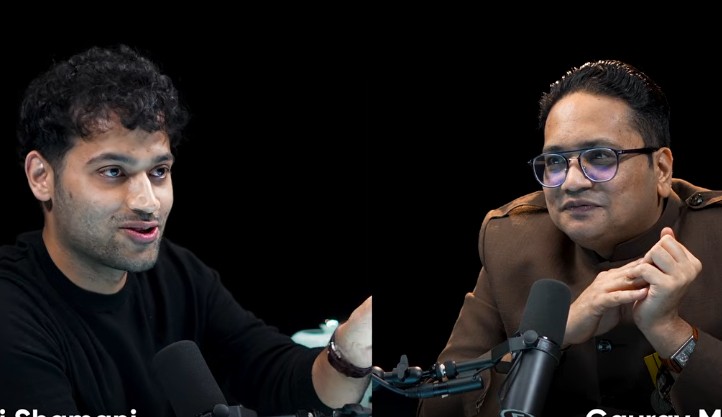
EDITOR’S NOTE: In this episode of the Raj Shamani Podcast, Gaurav Mehta, founder of Jaipur Watch Company, traces the nine-year journey of building an Indian luxury watch brand from scratch — starting with a coin glued onto a cheap watch, and surviving years of rejection, near-bankruptcy, and public humiliation before a Shark Tank appearance and a viral moment involving PM Modi turned everything around. Along the way, he breaks down what actually goes into making a watch, the real story behind Swiss watchmaking’s dominance, and why he believes Indian craftsmanship can compete on the global stage.
Introduction
RAJ SHAMANI: (00:02:18 – 00:04:07): One of the biggest business opportunities in the world today is in the luxury sector. The global luxury watch market is worth nearly $60 billion. A handful of Swiss brands dominate it, and their secret has been marketing, storytelling, and scarcity.
Our today’s guest, Gaurav Mehta, founder of Jaipur Watch Company, has built in this industry from scratch. He sold his BMW to start this business in 2013, and today his company runs multiple stores with its first international store opening soon.
In this episode, we’ll discuss What goes into building a luxury brand from scratch? How did Swiss watches conquer the world, and where are the biggest untapped opportunities in luxury today? Watch this episode till the end, and to know more about Jaipur Watch Company, check the link in the description.
The $17.8 Million Watch
Let’s say someone bought a watch for a couple of hundreds of dollars. Yeah, today is worth 17, 20, 30 million. How do people make money on watches? This one was bought at 200 and now today is $17.8 million. What’s the story around this? This is the money again you’ve got.
GAURAV MEHTA: (00:04:07 – 00:04:34): I’ll tell you the story around this. This was one of the worst performing models for Rolex. It hardly sold. Okay, so when it is hardly sold, it was shelved. We are not talking about the times when Rolex is in waitlist and everything will sell. No, this was the time when it hardly sold and it was shelved. This particular model was given to Paul Newman with his signature or his name on it with some personalization on the back of the watch.
RAJ SHAMANI: (00:04:34 – 00:04:34): Okay.
GAURAV MEHTA: (00:04:35 – 00:05:00): And when it came out, there was no other model available like this. And to top it up, it had his signature, so it made it more valuable and extremely rare because this is the only piece in the world right now. But why? That’s how the Daytonas became more popular right after this, because Daytona used to be one of the worst-performing models for Rolex prior to this auction.
RAJ SHAMANI: (00:05:01 – 00:05:03): But then Paul Newman’s watch became the thing.
GAURAV MEHTA: (00:05:04 – 00:05:08): No, then the regular Daytonas which they have, they became the thing.
RAJ SHAMANI: (00:05:09 – 00:05:10): Because of one guy?
GAURAV MEHTA: (00:05:10 – 00:05:12): Because of one guy and because of one watch which was sold.
RAJ SHAMANI: (00:05:12 – 00:05:18): But why specifically this one, like Paul Newman’s Daytona? It could have been any other watch.
GAURAV MEHTA: (00:05:18 – 00:05:23): It could have been any other watch, but the point is this is one of the few models which are not available.
RAJ SHAMANI: (00:05:23 – 00:05:26): And why can’t they make it again, replace it?
GAURAV MEHTA: (00:05:26 – 00:05:27): The age, you know.
RAJ SHAMANI: (00:05:27 – 00:05:28): This is another watch.
GAURAV MEHTA: (00:05:28 – 00:05:28): Yeah.
RAJ SHAMANI: (00:05:29 – 00:05:35): This one, somebody bought it for like $2,000-$3,000, and now today, $17.6 million.
GAURAV MEHTA: (00:05:35 – 00:05:57): Stainless steel. Hardly any models came out in stainless steel with this version. They were majorly in precious metal. And what happens with precious metal is, even though they’re good, but generation after generation, metal costs become so much that it exceeds the value of the watch and people eventually melt it.
RAJ SHAMANI: (00:05:59 – 00:06:02): But stainless steel watches, the same brand would have 20.
GAURAV MEHTA: (00:06:02 – 00:06:07): No, that is why these are one of the few remaining models which were left.
RAJ SHAMANI: (00:06:07 – 00:06:08): So they don’t have any stainless steel models now?
GAURAV MEHTA: (00:06:09 – 00:06:10): Of this particular—
RAJ SHAMANI: (00:06:11 – 00:06:12): But they can’t even—
GAURAV MEHTA: (00:06:12 – 00:06:14): They can make it again, of course they can.
RAJ SHAMANI: (00:06:14 – 00:06:14): But they won’t?
GAURAV MEHTA: (00:06:14 – 00:06:15): They won’t make it now.
RAJ SHAMANI: (00:06:15 – 00:06:18): But the first story is because this was the first stainless steel watch?
GAURAV MEHTA: (00:06:18 – 00:06:18): Yeah.
RAJ SHAMANI: (00:06:20 – 00:06:22): And people bought it for $17.6 million.
GAURAV MEHTA: (00:06:22 – 00:06:47): Yeah, this is not because it was the first stainless steel watch, because this was one of the stainless steel watches which survived. Okay. Normally gold watches, people would melt because gold value would exceed. Oh, since it was stainless steel, it survived. Got it. Yeah, this is a Gerald Genta’s. What is it? You don’t know? Okay, we need to know about Gerald Genta. Okay, and I’ll tell you my connection also with Gerald Genta.
Gerald Genta: The Godfather of Watch Design
RAJ SHAMANI: (00:06:47 – 00:06:48): Okay.
GAURAV MEHTA: (00:06:49 – 00:07:07): So Gerald Genta is the legendary designer in the watch industry. So the AP Royal Oak, what you see, the Patek Philippe Nautilus, what you see, all these shapes, all these iconic designs, all these iconic models were designed by one man.
RAJ SHAMANI: (00:07:09 – 00:07:09): Gerald Genta.
GAURAV MEHTA: (00:07:09 – 00:07:25): Gerald Genta. And he was probably, you know, way ahead of his time. And, you know, because of him, these brands survived. Because of his designs, these brands survived.
RAJ SHAMANI: (00:07:25 – 00:07:29): But if all of them were designed by him, what makes this one so special?
GAURAV MEHTA: (00:07:30 – 00:07:33): Because I think this was Gerald Genta’s own watch.
RAJ SHAMANI: (00:07:34 – 00:07:34): Okay.
GAURAV MEHTA: (00:07:34 – 00:07:35): What you’re seeing here.
RAJ SHAMANI: (00:07:36 – 00:07:37): That’s why it’s for—
GAURAV MEHTA: (00:07:38 – 00:07:49): one man can decide destiny of so many watch brands just by his designs, which still live and which still are the most popular.
RAJ SHAMANI: (00:07:49 – 00:07:49): Yeah.
GAURAV MEHTA: (00:07:50 – 00:07:52): AP Royal Oak.
RAJ SHAMANI: (00:07:52 – 00:07:52): Yeah.
GAURAV MEHTA: (00:07:52 – 00:07:56): So these are the designs done by one man, and there are many more.
RAJ SHAMANI: (00:08:00 – 00:08:01): So it’s like the—
GAURAV MEHTA: (00:08:01 – 00:08:02): he’s like the godfather.
RAJ SHAMANI: (00:08:02 – 00:08:05): Godfather for the watch industry. Okay.
GAURAV MEHTA: (00:08:05 – 00:08:12): He was the one who introduced complications like jumping hour. This is very funny. Very funny.
RAJ SHAMANI: (00:08:12 – 00:08:14): Why funny? Like, this is 2021. I know, I know.
The FOMO Market and Investing in Watches
GAURAV MEHTA: (00:08:14 – 00:09:14): In 2021, if I would have invested 5 million rupees on this watch, I would have been sitting on 6.5 million dollars. Yes, but if you buy it now and if you sell it now, this price has drastically gone down. So it’s not like every time you will make money in watches. If you try to sell it now, probably you will get you know 100,000. This was a collab between Tiffany and Patek Philippe, and this color, which is known to be the Tiffany color. So that’s how it became so popular. As soon as it was launched, it was flipped in the market. But now it’s easily available. Not easily, of course, Patek Philippe is never easily available, but it’s still available and you can find it in the market for a cheaper price now. So not every watch which was sold for a high price remains at a high price. So this market is dynamic.
RAJ SHAMANI: (00:09:15 – 00:09:19): But how do you decide? What are the— how can I make money in watches?
GAURAV MEHTA: (00:09:20 – 00:09:29): So if you see that, you know, if you think that you’re going to make money in watches and you are investing in watches for the sake of making money in watches, probably you’ll never end up making money.
RAJ SHAMANI: (00:09:30 – 00:09:35): Why can’t I not— like, can I not spot— I understand, how can you—
GAURAV MEHTA: (00:09:35 – 00:09:43): how can you expect— how can you expect that the model you own will become rare or will become in demand probably 30, 40, 50 years from now?
RAJ SHAMANI: (00:09:44 – 00:09:47): But a lot of people do that, at least they give excuses.
GAURAV MEHTA: (00:09:47 – 00:09:51): A lot of people flip watches and they give excuse that, hey, you know what, it’s not available.
RAJ SHAMANI: (00:09:52 – 00:10:11): And no, no, no, the excuse is I am buying watches because one day it will make me so much money and it’s, it’s store of value, it will become high price. See, I mean, looking at these watches, looks like my grandfather, instead of buying plots, he should have bought this. He didn’t. He neither bought plots, he didn’t buy watches.
GAURAV MEHTA: (00:10:12 – 00:10:53): I’ll tell you, see, not every year, you know, the return. So there were 2 or 3 years continuous back to back where watches gave more return than any other asset class in the world. Okay, that has changed completely. You go to a website called Chrono24, you go there, you’ll see they show you the trend of prices year by year or month by month also, that specific. You’ll see that graph has fallen down for some of the iconic models. Like, you see, Daytona used to go at a very high premium. Now you’ll see it’s gone down. A lot of people have lost money because they came in late.
RAJ SHAMANI: (00:10:54 – 00:10:55): Because why?
GAURAV MEHTA: (00:10:55 – 00:11:30): Because, see, it’s very similar, you know, the FOMO market. It’s a FOMO market at the end of the day. Luxury is about FOMO. Luxury is about creating FOMO. Luxury selling is also about FOMO, that this watch is not available anywhere. I have this, I’ll charge you 3x of MRP and you pay it and you can have it now and you can boast it in your friend circle. That is FOMO. You know, so that FOMO, I think, is going down. This new thing which has come up, which is the no-label luxury, you know, I think that is shaping up nicely.
RAJ SHAMANI: (00:11:31 – 00:11:31): Quiet luxury.
GAURAV MEHTA: (00:11:31 – 00:11:50): Quiet luxury. That is shaping up nicely. And like I said in the beginning also, this generation is amazing. And I think they are not just changing for themselves, they’re changing for other people also. So you’ll see a decline in lot of items which were in high demand long back because this generation is not chasing that.
From Coin Collecting to Watchmaking
RAJ SHAMANI: (00:11:50 – 00:11:57): First, tell me how did you start? What’s your story? Where did you come from? Why this? Yeah. Who are you?
GAURAV MEHTA: (00:11:59 – 00:13:54): This is a very you know odd industry to enter into and you know from my journey in UK, jab main job kar raha tha, tab mere ko jo pehli salary mili, to first thing I bought myself was a watch. Not a very famous watch but a fashion brand. I just it was a I think Guess or Armani ya kuch is tarika tha. I bought a fashion brand that time because koi itni knowledge nahi thi but I used to like watches and andaaz unme.
I would buy watches when I came back to India I realized ki yaar HMT company hai and because main Bombay mein job kar raha tha yahan pe us samay HMT bikti thi Nepenthes Road ke paas mein, wahan pe they used to sell HMTs so they had a office over there so main wahan jaata tha, saadhe teen sau chaar sau rupaye mein watches aati thi us samay HMT ki MRP yahi hoti thi saadhe teen sau chaar sau saadhe chhah sau rupaye. So I would buy a lot of them khareedta raha khareedta raha khareedta raha, started building a passion for watches slowly and dheere-dheere watches leta raha, phir watches ko khol ke dekhne lag gaya ki how they function so I would open up my own watches and see how they function okay put them back together, watches kharab bhi kari but maine ye practice apni continue kari.
But hamare age group mein na hum log ek coins ka hamare sabke paas mein ek dabba hota tha, jiske andar koi bhi foreigner aata tha to wo coins rakh ke jaata tha, koi NRI rishtedaar aata tha to usse coins le lete the, and stamps collect karte the, because those were the ways to kill time that time, matlab samay beet. It was not a theme-based collection. It was just a hoarding kind of a thing. Phir meri sister ki marriage hui, meri badi sister ki, to unke jo father-in-law the, he is one of the renowned coin collectors of India.
RAJ SHAMANI: (00:13:55 – 00:13:55): Okay.
GAURAV MEHTA: (00:13:55 – 00:15:48): So main bada khushi-khushi unke paas leke gaya apna dabba, maine kaha sir main bhi coin collector hoon. Sister’s father-in-law? Yeah. Maine kaha ki main bhi coin collector hoon. To unhone bola ki ye coin collection nahi hota, this is hoarding and you need to define a theme to your collection. Ek theme decide karo aur phir usi pe focus karo. Okay. To maine kaha theek hai, so I’ll pick British India as a theme because they are easily available coins at least kyunki sau saal se purani ka mez ke coins hain easily available hai abhi bhi. To maine British India theme choose kari and I started building on that collection dheere-dheere.
To now while I’m running purple, main watches khareed raha hoon, main coins khareed raha hoon aur purple bhi chala raha hoon. Khareed raha hoon matlab coins aur coins like eBay se khareed raha hoon us samay eBay to ek-ek rupaye wale coin, aap mehnge mein khareed rahe ho? Haan matlab British India coins na antique coins so kitne mein milte the ye? Us samay to dekho it was more like, so any collector, you know, for any collector there are two motives, one is ki I leave a legacy for my children, okay theek hai, ye inka aage jaake khazana ban jayega, or kuch which is 90 percent of the mindset of the collectors, 10 percent jo collector hote hain wo isliye collect karte hain jo bad—
And you’ll be surprised, bahut bade-bade naam hain India mein, jo next level ke collectors hain, jinko aap as businessman jaante ho, but aapko pata nahi ki unka ek side passion is coins and stamp collecting.
RAJ SHAMANI: (00:15:48 – 00:15:48): Okay.
GAURAV MEHTA: (00:15:48 – 00:15:51): Yeah. So lot of big big guys.
RAJ SHAMANI: (00:15:51 – 00:15:52): Okay.
Making the First Coin Watch
GAURAV MEHTA: (00:15:52 – 00:19:28): Yeah. So they do it because either intention is to leave a legacy of their own name, aur the intention is to leave a legacy for their children. Okay, theek hai, to you would do that then side mein chalta rahega. Side mein chalta rahega.
So I was just collecting coins dheere-dheere ikattha karte ja raha tha main, and ek din main ek kada watch open kar raha tha. Ek nayi watch khareedi thi maine, sasti watch thi, Maxima ki ghadi thi, main usko open kar raha tha aur maine realize kiya ki is ghadi ke andar na hands mein bahut jagah height hai. Usi samay ek bada interesting coin hai. I’ll show you the coin also. So us coin mein chhed isliye kiya jaata tha, because wo World War Two ke time ka coin tha. Okay. And they wanted to save metal. So they started punching holes in the coin. Okay. Bada interesting coin hai. So wo coin meri table pe pada hua tha aur maine ghadi khol rakhi thi. Hmm. Tabhi mere ko idea strike kiya yaar iske andar na maine fabristic leke haath hataake usme ek sikka chipka ke I placed the hands back and I started wearing it. Hmm, and I can show you that watch. Show me. Watch. Ye bada acche se humne rakha hua hai isko frame karake. So this is someone else’s watch. Yes, this was the first watch, 2012 mein jo maine, and this was Maxima. Yeah, okay so you made it. Aur ye jo coin laga hua coin hai. Haan ye maine iske andar laga diya. Yes, okay, and you did it yourself. I did it myself.
So I started wearing it bada proudly and jo next das din mein log mile mujhe unhone sabne almost 80 percent logon ne notice kara aur poocha ye kya hai, okay so I told them this is a watch I’ve made, so they said yaar hamare liye bhi bana de, same watch I’ll pay you, to hamare liye bana dega, to That was like yaar ye to accha idea lag raha hai, I mean I I can probably make something out of it, you know, I can make it into a living because I enjoy both the things, I enjoy watches also, I enjoy coins also, so maine kaha yaar ye to combination hai cheezon ka and kuch bana sakte hain, matlab us samay main itna bewakoof tha maine na koi market research kari na koi study kari ki India mein kya watch market chal raha hai, kya potential hai, microbrand word kya hota hai ye bhi nahi pata tha mujhe ki koi aisa concept bhi hota hai where, you know, smaller brands are called microbrands in watch industry. Even I don’t know, ya, so I was not aware that, you know, aisa kuch category bhi exist karti hai global level pe.
India mein to T Watch brand ki dealership le leta. Hmm, kyunki India mein koi brand banata nahi hai watches mein. So theek hai, fair for that time, that advice was fair, he was not wrong. Okay, ya. So he was not wrong, I am not saying he was wrong. And then I went to one of my ch— He was the first person, he said ki kar le. Okay. And I think life mein wahi ek validation chahiye hota hai ki ek jana bol de ki haan kar le. Aur mujhe wo mil gaya. Hmm. Maine kaha ab to yahi karunga. Then I thought ki chalo ab karte, then banayenge kaise?
RAJ SHAMANI: (00:19:28 – 00:19:31): Yeah. What was the first step you took after you decided that okay now?
GAURAV MEHTA: (00:19:32 – 00:19:40): The first step was ki India mein watch kaun banata hai? Okay. Kyunki machine to khareed nahi sakta tha humein watches banane ki. So you would go to that person and watch is made.
RAJ SHAMANI: (00:19:40 – 00:19:41): So maine kaha India mein watches kaun banata hai?
GAURAV MEHTA: (00:19:42 – 00:20:17): Found out some manufacturers in Gujarat and so I spoke to them. Maine kaha mera ye vision hai ki stainless steel mein banani hai, ye sapphire crystal hona chahiye, ye hona chahiye. Unhe bola ki ye sab to nahi hota India mein. I was like accha. Manufacturer where where was he? Rajkot. Okay. So he was like ye sab to nahi hota India mein. India mein to brass mein banti hai aur quartz watch banti hai aur mineral crystal lagta hai. Aur hum aapko de denge 500-700 hazaar rupaye mein bas ye kar sakte hain. Maine kaha main to ye nahi kar sakta kyunki I know watches.
Building From Scratch: Stainless Steel and Sapphire Crystal
RAJ SHAMANI: (00:20:17 – 00:20:21): Tell me a difference between the kind of watch you wanted to make versus what was available in India.
GAURAV MEHTA: (00:20:21 – 00:20:33): So I had this vision ki mere ko banani hai, the watch should be in stainless steel. Okay. Because stainless steel is something which will last for generations. Okay.
RAJ SHAMANI: (00:20:33 – 00:20:34): Kabhi stainless steel, that’s one.
GAURAV MEHTA: (00:20:34 – 00:21:01): That’s one. Then I wanted a sapphire crystal on the watch. Okay. Normal kaanch nahi chahiye tha mujhe jo scratch lag jaaye, jo toot jaaye. So I wanted a sapphire crystal on the watch. And ye basic requirement thi meri do. Matlab us samay to automatic aur mechanical movements ke baare mein socha bhi nahi tha. Maine kaha theek hai quartz bana lenge koi baat nahi. But at least the watch should last for a very long period of time and people who wear it they will enjoy it.
RAJ SHAMANI: (00:21:01 – 00:21:02): Okay.
GAURAV MEHTA: (00:21:02 – 00:21:37): So is vision ke saath mein maine socha ki banate hain par India mein koi nahi mila mujhe, and then I was like ki yaar watches banti to phir Switzerland mein hai, Switzerland chalte hain. To Switzerland ka ticket book kara liya and watch factories koi mail likhni chalu kari, kisi ne jawaab nahi diya. Haan and then I found out ki ek watch tour hota hai, okay, jiske andar they take you to factories and wah— So which watch company did you enter? So I went to the Patek Philippe Museum, which was in Geneva.
RAJ SHAMANI: (00:21:37 – 00:21:38): Nice.
GAURAV MEHTA: (00:21:38 – 00:22:00): So that’s a museum, you know, for for you to book a guided tour and you can go and hafte mein do din they take a guided tour and you can go there and then they take you to the famous watch factories and wahan pe they show you how the watch is made and everything. Okay. So hum gaye dekha tour as a tourist dekha wapas aa gaye and then I realized ki yahan to apni daal galne wali nahi hai. But what did you find?
RAJ SHAMANI: (00:22:01 – 00:22:05): So I found in in those watch stores or watch manufacturing facilities.
GAURAV MEHTA: (00:22:05 – 00:22:07): So they were next level, you know.
RAJ SHAMANI: (00:22:07 – 00:22:08): Matlab what was next level?
GAURAV MEHTA: (00:22:09 – 00:22:16): Pehli baar dekha clean clean rooms kya cheez hoti hai. Matlab jahan pe watches assemble hoti hain. You know that was for the first time in my life I saw that.
RAJ SHAMANI: (00:22:16 – 00:22:17): What is a clean room?
GAURAV MEHTA: (00:22:17 – 00:24:03): Clean room is basically a room jahan pe dust nahi aa sakti andar. Log proper aprons pehen ke andar jaate hain. There are like three doors jisko pass karke aap andar jaa sakte ho. So maine pehli baar dekha tha life mein apni us time pe and I was like ki yaar ye sab itna logon ko expertise chahiye watch banane ke liye kyunki maine jo India mein dekha tha that was totally reverse, wahan aadmi baahar dukaan pe gale pe baithke assemble kar raha hai watch. So maine dekha maine kaha us country ke paas kuch bhi nahi hai, but phir bhi us country mein jo log hain, wahan ki population hai, wo poori population united hai ek cheez kehne mein ki we are the best in chocolates, we are the best in watches, we are the best in precision machine. Hmm, aur wo poori country us cheez ki marketing karti hai. True, people claim we are the best in watches.
So ek aadmi mila mujhe, he was very senior. Now to he doesn’t do it anymore, he was I think around seventy uske aas paas hi joganee unke us time pe. I met him and I told him I want to make watches using coins. And he was like, “I have made a watch using coin in the past. I don’t have it right now, but I can make it for you.” Okay. And he sounded very sound technically. He was like, “Coin bahut mota hoga. We’ll have to you know slice the coins. Will you slice it for me? Or I need to slice it? And how will you send the coin?” Because you know you cannot send coins from India because yahan pe kuch antiquity act hai to you cannot export old coins and antiques from India.
RAJ SHAMANI: (00:24:03 – 00:24:04): Interesting.
GAURAV MEHTA: (00:24:04 – 00:26:34): Okay, I didn’t know this. So and then came the big problem which is the typical China problem, MOQ. This is like my MOQ is 500 pieces, isse kam main banaunga nahi. Maine kaha mere paas 500 coin bhi nahi hai bhai main kahan se tere ko doonga 500 coin? And so wahan se problem start hui and then I already solved that, then I realized ki 500 piece mein mere kam se kam bhi 30 lakh rupaye jaane wale hain, just to give it to the manufacturer, coin ki cost alag aur packaging ki cost alag, and you know I was like mere paas to itne paise hi nahi hai. Then I sold my car. Maine kaha kahin se paise nahi mil rahe to I’ll sell my car, us samay main theek-thaak gaadi chala deta hai BMW 3 Series thi mere paas mein, to maine wo bech di. Wahan se mere ko kuch paise mile, and then I realized abhi bhi shortfall hai paison ka, so then I again went to that same friend jisne mere ko pehla baar validation diya tha, maine kaha Vishal bhai mar gaya hoon, I need some money otherwise main isko launch hi nahi kar paunga aur ab to main sab bech chuka hoon, mere paas kuch option nahi hai, so he was like kitne chahiye? Start kar, and he was like a pillar in my life. He’s still like a pillar in my life. And usne pandrah lakh das pandrah lakh rupaye jo bhi shortfall tha he filled that.
Phir humne product banwana start kiya, pehla product was outsourced. Humne banwana start kiya, cases banke aaye and then MOQ ko problem, you asked me how did you solve it? So I spoke to him I said yaar 500 I cannot do. To it’s a large quantity for me. So then we worked out, a way, he said ki yaar coin mein do sides hoti hai, to kuch watches mein ek side laga dete, kuch watches mein doosri side laga dete, kuch ko gold plated kar lete, kuch ko steel rakhte, kuch mein leather bracelet laga lete, kuch mein metal chain laga lete. This was the first watch. You’ll see my logo is also different, and which was seen later and made better. Not a very fancy watch, basic quartz watch, but with the coin and a sapphire crystal and stainless steel body. This is a 2013 watch, and still you can see it’s, you know, looking like brand new.
RAJ SHAMANI: (00:26:34 – 00:26:35): And this is a British coin?
GAURAV MEHTA: (00:26:36 – 00:26:44): This is a British India half silver coin. This is a ₹1 silver coin which used to be half silver. So the composition was half silver, half copper nickel.
Cutting Coins and Finding Watchmakers
RAJ SHAMANI: (00:26:44 – 00:26:48): Interesting. So how did you get like 500 coins?
GAURAV MEHTA: (00:26:48 – 00:26:58): What did you do? My sister’s father-in-law came to rescue. So he’s my guru, he’s my mentor.
RAJ SHAMANI: (00:26:58 – 00:27:00): Collector should have a theme. This is it.
GAURAV MEHTA: (00:27:00 – 00:27:34): So I went to him again. I said, “This is what I’ve decided.” He said, “Aapne naam kya socha hai?” Maine kaha, “Maine naam socha hai Jaipur Watch Company.” And he was very happy because you know why? India ka, world ka sabse bada Jaipur coins ka theme collection unke paas mein. Ah, so you bought it from him or you gave him some equity? No no no, I didn’t give him equity. So he procured it for me and we got the coins. 250 coin mile humein, humne unko 500 banaya. How did you cut a coin? So ye wo coin hai jo aapne us ghadi mein dekha tha. Okay, so this is the coin that you got.
RAJ SHAMANI: (00:27:34 – 00:27:36): So this is thick enough so you can cut it.
GAURAV MEHTA: (00:27:36 – 00:29:05): So it’s thick enough, you can cut it. But how do you cut it? How? That’s the question. So I went to engineering workshop near the bus stand in Jaipur. Coin leke gaya. Maine kaha isko kaat doge kya? To main kam se kam aath-das aise logon ke paas gaya. Ek aadmi ne bola bhaiya main kaat doonga. Maine kaha kaat de yaar. Maine kaha but mujhe barabar chahiye. Maine kaha ki do ho jaane chahiye ek ke. Head alag, tail ho jaayega. Bolo bhaiya main kaat doonga, mere ko kuch tool banana padega iske liye aur phir main isko wire se kaat doonga. Theek hai. He actually did it. Nice. Usne koi tool banaya jisme wo coin ko pakadta tha, hold karta tha basically aur ek wire chalata tha oopar machine se. To wire uske andar se metal ka wire usko coin ko k— Till date, and I am his of course now the biggest client. Because us ek aadmi ne haan bola tha, baaki sabne bola tha ye kya faltu kaam hai, hum nahi karenge. You know everyone was like kaun nayi cheez mein dhyan lagaya? You know that is a big problem ki kaun nayi cheez mein dimaag lagaya? True jo chal raha hai business chal raha hai. He was the one wo khaali baitha hua tha, uske paas koi kaam nahi tha, to he was like ki main kar paanch lakh rupaye mein wo mere yahan se leke jaata hai, just for cutting coins.
RAJ SHAMANI: (00:29:05 – 00:29:06): Brilliant.
GAURAV MEHTA: (00:29:06 – 00:29:10): Yeah. Nice. Imagine ek chhoti si workshop bus stand ke saamne. Sweet.
RAJ SHAMANI: (00:29:10 – 00:29:11): He’s very happy right now.
GAURAV MEHTA: (00:29:11 – 00:29:12): He’s very happy.
RAJ SHAMANI: (00:29:13 – 00:29:15): Okay, so you cut the coins, but then how did you send it to China?
GAURAV MEHTA: (00:29:15 – 00:29:16): We didn’t send it.
RAJ SHAMANI: (00:29:16 – 00:29:17): Then?
GAURAV MEHTA: (00:29:17 – 00:29:25): We didn’t send it because it’s not allowed to send. So we said you send the watches to us, the cases, components, and we’ll put it here together.
RAJ SHAMANI: (00:29:25 – 00:29:27): Okay, so what all you will get from there?
GAURAV MEHTA: (00:29:28 – 00:29:31): Everything other than the coin, everything came from there in the first batch.
RAJ SHAMANI: (00:29:31 – 00:29:31): Okay.
GAURAV MEHTA: (00:29:31 – 00:29:57): So we started looking for watchmakers in the city, and I went to the old city of Jaipur. There are some, you know, small, small watchmakers sitting there for repairing watches and all. There was one uncle, wahan pe he was sitting, and I went to him. I said, uncle, this is the work, and you’ll have to assemble some, you know, 300 watches for me in the beginning. Okay. And he said, I’ll do it. And today he’s my head watchmaker.
RAJ SHAMANI: (00:29:58 – 00:29:58): Nice!
GAURAV MEHTA: (00:29:59 – 00:30:01): The same guy. Today he’s my head watchmaker. He’s making—
RAJ SHAMANI: (00:30:01 – 00:30:02): the uncle who did?
GAURAV MEHTA: (00:30:02 – 00:30:04): Yes, the uncle who did that.
RAJ SHAMANI: (00:30:04 – 00:30:06): The first watch assembly?
GAURAV MEHTA: (00:30:06 – 00:30:07): Yes, that same uncle.
RAJ SHAMANI: (00:30:07 – 00:30:09): First coin sticking, not even assembling?
GAURAV MEHTA: (00:30:09 – 00:30:37): No, it’s full assembling only because, you know, the watch comes in an open phase like this watch you see. So this is open, all components are separate. You have to put the dial, you have to put the coin on the dial. You know, this is the case, which is the body of the watch. This is the back. These are the movements. There are hands. There are straps, bracelets. Everything comes open, you know, and that’s how—
RAJ SHAMANI: (00:30:37 – 00:30:38): every different piece.
GAURAV MEHTA: (00:30:38 – 00:30:38): Exactly.
RAJ SHAMANI: (00:30:38 – 00:30:43): So this is what he would send from there. This is the main mechanics.
GAURAV MEHTA: (00:30:43 – 00:30:46): No, he— so these mechanics we imported from Japan.
RAJ SHAMANI: (00:30:48 – 00:30:49): Because what would this guy from Hong Kong do?
GAURAV MEHTA: (00:30:50 – 00:30:51): He’ll make this body that time.
RAJ SHAMANI: (00:30:52 – 00:30:56): Okay, now we don’t get it made there, but this can get done in India also, right?
GAURAV MEHTA: (00:30:56 – 00:31:21): This is stainless steel, and that’s what I told you in the beginning, that no one works on stainless steel. No one works on stainless steel in India. Now people are working in India, and we are working with them also, but at that time there was no one willing to work on stainless steel. Everyone said we’ll work on brass, and I was very much against the usage of brass because brass tarnishes, brass breaks over a period of time.
RAJ SHAMANI: (00:31:22 – 00:31:25): And how did you get this done? Like, this is a coin, on coin there are numbers.
GAURAV MEHTA: (00:31:26 – 00:31:32): No, this is actually a dial, plain dial. Imagine this as a blank space and the coin has been stuck on it.
RAJ SHAMANI: (00:31:33 – 00:31:36): Okay, so the outside is a dial, outside is a dial, this one is a coin.
GAURAV MEHTA: (00:31:36 – 00:31:36): Yes.
RAJ SHAMANI: (00:31:37 – 00:31:41): And so this outside and everything you would get it made. Yeah, just the centerpiece you would put it in.
GAURAV MEHTA: (00:31:41 – 00:31:42): Yeah.
RAJ SHAMANI: (00:31:42 – 00:31:43): Interesting. Okay.
Finding the First Retailers — and Facing Rejection
GAURAV MEHTA: (00:31:43 – 00:31:46): So this is how the first lot came that uncle had.
RAJ SHAMANI: (00:31:46 – 00:31:47): That was the first watch.
GAURAV MEHTA: (00:31:47 – 00:32:11): Yeah, that was the first watch. And the first watch came, we got it made also. And after making the watch, after doing all the legwork, I realized where to sell this watch. That was a time when Instagram was not there. That was a time when, you know, D2C websites concept never used to exist, where people would come on your website and they’ll buy, especially a category like watch.
RAJ SHAMANI: (00:32:11 – 00:32:12): In 2013.
GAURAV MEHTA: (00:32:12 – 00:32:31): Yeah, so first approach for any businessman, I’ll go to multi-watch brand retailers in India, like these Ethos, Helios of the world. Yeah, now Ethos, Helios now, but there are smaller watch retailers also, you know. Every city has one big name, like, like, you know, Indore will have someone.
RAJ SHAMANI: (00:32:32 – 00:32:33): Who’s— who is it in Jaipur?
GAURAV MEHTA: (00:32:33 – 00:33:22): Jaipur now it’s Watch Factory. Okay, okay. So every few years, you know, someone becomes big and, okay, you know, it keeps on changing, it’s dynamic. So I went to almost every retailer in North India, every single retailer in North India. Everyone said no to me. Everyone said no to me. I have phone numbers of every retailer in my phone of North India. I think I must have gone to at least 24-25 retailers. One by one, I used to carry my briefcase, carry the watches, set a time with them, or just walk inside the store with the briefcase and show them, okay, sir, we have made this watch, and will you please sell it for us? And the kind of feedback I got, if anyone else would have got, they would have, you know, stopped the business that day.
RAJ SHAMANI: (00:33:22 – 00:33:24): What did you get? What feedback? Why did they say no too?
GAURAV MEHTA: (00:33:25 – 00:33:39): So they told me, how can an Indian brand be expensive? Because that time the largest Indian watch brand was selling their product, highest price for their product was ₹15,000. My product, I had priced at ₹23,000.
RAJ SHAMANI: (00:33:39 – 00:33:39): Okay.
GAURAV MEHTA: (00:33:41 – 00:34:17): So how can an Indian brand be expensive? What is there in this? The case costs this much, the hands cost this much, the coin costs this much. This is like, you know, they gave, they gave me a breakup of my own watch. Why are you pricing at ₹23,000? What is the kind of celebrity endorsement you’ll give us? What is the marketing budget you have kept for your brand? So these are all the words I heard from everyone I met. And everyone said, no, we cannot sell an Indian watch brand at our store. How can an Indian watch brand be sitting next to a Swiss brand?
RAJ SHAMANI: (00:34:18 – 00:34:30): So distributors also had this. Like, I know that there is, in usually post-colonial areas, especially, especially country like India, and a lot of other countries, there’s a thing called cultural cringe.
GAURAV MEHTA: (00:34:30 – 00:34:30): Yes.
RAJ SHAMANI: (00:34:31 – 00:34:42): That anything that comes from domestic market or local made, it’s usually seen as less valuable, inferior. It’s cringy to wear that because of the colonial hangover.
GAURAV MEHTA: (00:34:42 – 00:34:44): I’ll tell you, there is whatever from outside, it’s, it’s more valuable.
RAJ SHAMANI: (00:34:45 – 00:34:46): Indian is not more, not valuable.
GAURAV MEHTA: (00:34:46 – 00:34:48): Exactly the same mindset I faced.
RAJ SHAMANI: (00:34:48 – 00:34:51): And but that’s of people, not of distributors or business owners.
GAURAV MEHTA: (00:34:52 – 00:35:19): It is for everyone. I think there’s one full generation which has this mindset, you know, and I’m so proud of the upcoming generation. I’m so proud of your generation, you know, people like you who have changed and who have broken this myth. And that’s why you see this booming Indian watch market right now, because of— it’s because of the generation of people like you who have not themselves changed the perception, but they have convinced other people also.
RAJ SHAMANI: (00:35:21 – 00:35:24): Fair. But this was not there when you started selling? No, no.
GAURAV MEHTA: (00:35:25 – 00:35:27): Nowhere close. It was nowhere close to that.
RAJ SHAMANI: (00:35:27 – 00:35:28): Today it has changed, do you feel?
GAURAV MEHTA: (00:35:28 – 00:35:31): It has completely changed. It has completely changed.
RAJ SHAMANI: (00:35:31 – 00:35:42): Yeah, like I don’t see in our generation especially, you know, when I look at my father’s generation, they still have this little hangover that whatever is coming from the white world, imported products are better.
GAURAV MEHTA: (00:35:42 – 00:35:43): Imported products are better.
RAJ SHAMANI: (00:35:43 – 00:35:47): In fact, we give more value to heritage Indian brands.
GAURAV MEHTA: (00:35:47 – 00:36:22): And the irony is, irony is, the first product was actually imported. But it was being sold under an Indian brand name. People came up with suggestions like, why don’t you rename it to JWC? Thoda videshi sound karega. It will sound more, you know, foreign. Like JLC. Yeah. Like IWC or JLC or you know that. Why don’t you name it as JWC instead of calling it Jaipur Watch Company? Who will buy a Jaipur Watch Company? You know, so this is the kind of feedback I got. I was shattered. I was beaten.
The Most Humiliating Moment
RAJ SHAMANI: (00:36:22 – 00:36:25): What was the most humiliating moment of your life?
GAURAV MEHTA: (00:36:25 – 00:36:51): My humiliating moment was when he said, “Ki iska, you know, this is the breakup of this watch and it will cost you more, not more than ₹1,000. Why are you selling it for ₹23,000?” I could not even explain him the you know the materials we have used in the watch and everything. The way he ridiculed the product. And you know, the best part is life comes full circle. Most of them are the same guys who are now calling me to buy my watch.
RAJ SHAMANI: (00:36:52 – 00:37:04): So you were here, you were getting ridiculed in the market, people were humiliating you. Did you go through a phase where you were insulted? Did anyone insult you, made you feel small?
GAURAV MEHTA: (00:37:05 – 00:37:32): Yes, it happened in my personal life, not by the retailers, but it happened a lot in my personal life. What? You say I sold my car, which was a BMW. From BMW, I came to i20. You know, the lifestyle change in India is a big thing that you know kuch to galat chal raha hai inke saath mein, something is wrong in his life that you know probably from a BMW overnight he has come to i20. So that was how you know people started looking at me and I could see it in their eyes.
RAJ SHAMANI: (00:37:32 – 00:37:34): Yeah, from a fifty lakh car you’ve come to five lakh rupees car.
GAURAV MEHTA: (00:37:34 – 00:37:52): Yeah. So I could see it in their eyes that you know something is wrong. People would ask me, what are you doing nowadays? No, that’s a very humiliating question that what are you doing nowadays? Because you have done so many businesses. So what are you doing nowadays? That’s their way to ask.
RAJ SHAMANI: (00:37:54 – 00:38:04): So what used to hurt a lot? Like that people used to taunt you or make fun of you, or you were only getting embarrassed because you could see?
GAURAV MEHTA: (00:38:05 – 00:39:40): I was getting embarrassed and I could, you know, you can make out that people are talking bad behind your back. You can make out, you can sense it when you meet the person that he’s going to talk shit about you behind your back. So I could sense that it was happening, not just friends, even relatives, everywhere it was happening. And, you know, to make things worse, the business was not picking up. Even after putting in one full year, we had the products ready, no one was willing to buy. I was traveling here and there trying to meet, convince people, but no one was ready to take my products at all.
So that time, you know, Facebook was beautiful. Facebook used to exist, and Facebook mein neeche ek boost button abhi bhi aata hai, but ab kaam nahi karta. Pehle kaam karta tha. So I thought let’s try this. Yeah, this is new. So let’s try this Facebook boost. So I tried, and us samay wo actual mein kaam karta tha. You didn’t need a business manager and just press the boost button. Just press the boost, set the audience, set the city. And wo chale jaata tha. So we did that, and first city I chose was Delhi. I said, okay, let’s try Delhi being the capital. Let’s try that. And I did a boost, kuch 900 rupees something I put in it and boosted it in Delhi. Next day I get a call from someone because the only phone number there was my mobile number. So if you someone will browse down all my old posts, they’ll actually find my mobile number. Okay. So or they can ask AI.
RAJ SHAMANI: (00:39:42 – 00:39:45): To just write down right now and AI to do the job.
GAURAV MEHTA: (00:39:45 – 00:40:02): Yeah. So he called me, someone called me from Delhi. He said, my name is Manish and I just saw your ad on Facebook and I really like your watches. So how much is it priced at? I said ₹23,000. He said, okay, send me 2, I’m depositing money in your bank account.
RAJ SHAMANI: (00:40:03 – 00:40:05): Just in one day with ₹900?
GAURAV MEHTA: (00:40:05 – 00:40:09): ₹900. And I got a sale of ₹46,000 that day.
RAJ SHAMANI: (00:40:09 – 00:40:09): Wow.
GAURAV MEHTA: (00:40:10 – 00:40:14): And I was like, boss, this is magic. I found my way.
RAJ SHAMANI: (00:40:14 – 00:40:16): Yeah, absolutely.
GAURAV MEHTA: (00:40:16 – 00:40:17): Yeah.
RAJ SHAMANI: (00:40:17 – 00:40:18): This was which year? 2013.
GAURAV MEHTA: (00:40:18 – 00:40:33): 2013. I was like, I found my way and this is it. We are going to do this now. Because then next day I thought, today we’ll boost in Mumbai. I was the king of the world. Yeah, yeah.
The Big Door: A Chance Encounter That Changed Everything
RAJ SHAMANI: (00:40:33 – 00:40:36): I decide where I get my watches sold. Yeah, fair.
GAURAV MEHTA: (00:40:37 – 00:41:15): Then I boosted in Bombay. And then one gentleman saw there, his name was Vivek Gupta, very dear friend of mine. And he saw it and he called me. He said, I’ve seen your products, they are beautiful. And I have a big retail store in Bombay. We sell fantastic Indian art, Indian jewelry, and, you know, luxury of India in its own beautiful way. He was also way ahead of its time. He had opened a big store in Pali Hill by the name of The Big Door. Almost a 15,000-18,000 square feet store. So he said, I want you to sell here. You know, I think you can make good sale here.
RAJ SHAMANI: (00:41:15 – 00:41:17): This was a luxury art store?
GAURAV MEHTA: (00:41:17 – 00:41:19): Yes, luxury art store.
RAJ SHAMANI: (00:41:19 – 00:41:20): Not like a watch retailer?
GAURAV MEHTA: (00:41:20 – 00:42:33): Not like a— he had jewelry also, he had silver beds, he had paintings, he had, you know, crazy kind of Indian stuff. Very beautiful store. He said, why don’t you come and sell here? I said, okay, Vivekji, whenever I’ll come to Bombay, I’ll meet you and we’ll discuss. He said, no, no, you don’t know how to do business. It’s not done like this. I’m coming to Jaipur tomorrow. And he actually came next day to Jaipur with his wife. And he saw the product and everything. He said, okay, I’ll keep it in my store. We’ll sell it. And I’ll take 40% commission from you and whatever is sold and I’ll keep this. So I said, Vivekji, you can keep it in the store, but how will it sell automatically? Because I don’t have any support for marketing. He said, “You don’t worry. You leave it on me.” I said, “Okay.” Few days later, he tells me that you know 19th April we are doing a launch of Jaipur Watch Company in Big Door. You come to Bombay. I said, “Okay. What is the launch?” Mere ko kuch nahi pata. I didn’t know anything. It was him deciding everything. Okay. He said, “You come. You don’t worry. I’ll manage everything. You just come and be there. We’re doing a launch.” I see an ad in Bombay Times introducing Jaipur Watch Company.
RAJ SHAMANI: (00:42:33 – 00:42:33): Nice.
GAURAV MEHTA: (00:42:34 – 00:42:38): The ad given by Vivek Gupta at his cost.
RAJ SHAMANI: (00:42:38 – 00:42:38): Nice.
GAURAV MEHTA: (00:42:39 – 00:43:03): For the first time in my life, I saw celebrities inside a watch store, like real Bollywood celebrities walking inside a store. My first sale happened that day. Dr. Jamuna Pai, you know Dr. Jamuna Pai, the most iconic, like you know skin doctor, the country’s cosmetologist the country has. My first sale happened there. Dr. Jamuna Pai was my first client.
RAJ SHAMANI: (00:43:03 – 00:43:03): Nice.
GAURAV MEHTA: (00:43:04 – 00:43:28): I was like, boss, something is happening for real in my life for the first time. I saw cameras for the first time. He made me a star for that two-day period. I was facing cameras. I was giving interviews. I was doing everything, and Vivek was standing peeche jaake, just watching me. And I don’t know. I think he was sent by God to help me.
RAJ SHAMANI: (00:43:28 – 00:43:29): Wow! And no connection.
GAURAV MEHTA: (00:43:29 – 00:43:33): This is just a random guy on Facebook.
RAJ SHAMANI: (00:43:33 – 00:43:45): How sweet! Yeah, man. We need people like Vivek in the world. Thanks, Vivek. Thank you so much for doing this for people. This is so good. Yeah, this is incredible. Okay, and then what happened next? How many watches did you sell?
GAURAV MEHTA: (00:43:45 – 00:44:05): So then we started selling like eight ten watches a month from his store, and things started happening. But obviously, it’s very slow. It’s very low number. You know, our just watches are mahine ki bech rahe ho. It’s very low as a number. Number. When you see, in those 2 days, how many watches did you sell? In those 2 days alone, we sold more than 10-12 watches.
RAJ SHAMANI: (00:44:05 – 00:44:05): Okay.
GAURAV MEHTA: (00:44:05 – 00:44:10): So that was a good, happy start for me. Yeah. You know, okay, we made the biggest sale of our life.
RAJ SHAMANI: (00:44:10 – 00:44:12): Yeah, from 0 to like 6 a day.
GAURAV MEHTA: (00:44:12 – 00:44:28): Yeah. So we were very happy. And Vivek was doing his job. He was promoting. He kept us on the ground floor of his store in the front counter. As soon as you enter, you will see my watch. So that kind of thing he gave. I had no staff also. Vivek’s staff was there. Sab, everything was Vivek.
Down to Zero: The Struggle Years
RAJ SHAMANI: (00:44:29 – 00:44:29): Okay, okay.
GAURAV MEHTA: (00:44:30 – 00:45:45): And, I went back to Jaipur, left the watches there, and he was slowly selling and paying me on time, and everything was happening. And then I realized this— things won’t work this way, and I really need to do something because I cannot live like this. I was married by that time. I hardly had any money in my, you know, personal bank accounts. Everything was in Jaipur Watch Company. I was left with zero, literally zero. There was a time, you know, when I was running the company, I had a team of 3 people. And Vivek was my only sales point and Facebook was my other sales point. And I had to pay salaries to people next day. I was left with ₹33 in my current account. I was like, what will happen? And luckily, you know, a sale happened that night. Someone bought 2 watches again and he paid me and I could pay salaries the next day. I was going, you know, ekdum dot to dot I was moving. I had no money. Like I would earn something, I’ll have to pay salaries, I’ll have to pay courier fees, whatever. So I had nothing, my only asset I had was those 500 watches, which were not selling. It was a dead asset actually, which was not selling. So all my money was there.
RAJ SHAMANI: (00:45:45 – 00:45:50): So at that point it was probably a dead asset, not even like it was liability more than an asset.
GAURAV MEHTA: (00:45:50 – 00:46:59): And then everything was going very slow. And then I met someone at the launch event of Vivek. He was a PR consultant. So his name is Warren. So I met Warren. Warren told me, you know, I think you should try selling at more points. And I said, I’ve tried everything in India and everyone has said no to me. So he said, no, no, why don’t you approach the 5-star hotels? So why don’t you go to Taj? They have a shop called Khazana. Why don’t you go to Oberoi? Oberoi has a shop called Tijori. So they will appreciate because they sell fantastic Indian products from their store, and luxurious Indian products from their stores. So I said, okay, help me set up a meeting. He found the contact person in Taj. We went there, did a meeting. He loved the watches and he was like, these are fantastic. Yeah, they should be in all the Taj. He gave me 11 Taj hotels. You name the Taj and I was there, be it Falaknuma Palace, you know, any top-notch Taj you can even imagine. Main khud jahan gaya bhi nahi tha life mein shaayad. Yeah. Wahan pe meri watches were selling through those hotel stores.
RAJ SHAMANI: (00:46:59 – 00:47:00): And how many orders did they get?
GAURAV MEHTA: (00:47:00 – 00:47:12): So it was not an order. It was like you keep the watches, they’ll sell, we’ll pay you consignment. So but that was good enough for me. You know, a watch lying in my almirah better lie in a Taj almirah.
RAJ SHAMANI: (00:47:14 – 00:47:15): A visible almirah.
GAURAV MEHTA: (00:47:15 – 00:47:22): Exactly. So then I gained confidence. I was like, okay, now let’s approach Oberoi also. So I went to Oberoi and I met.
RAJ SHAMANI: (00:47:22 – 00:47:23): That Taj keeps her watches.
GAURAV MEHTA: (00:47:23 – 00:48:26): He should also keep the watches. And they said yes. Surprise! So I got all the Amar Vilas, Udai Vilas, and every property of Oberoi also top-notch properties. And I was like, do watch ek Taj se bikri hai, ek watch Oberoi se bikri mahine ki, aur paanch-chhah saat watch, das watch bhi vagairah bech rahe hain, and I was like ye to kabhi khatam hi nahi hoga ye to, and I had actually come to a point where I decided yaar I cannot continue, this will not work for me, koi accept nahi kar raha is product ko, I think I’m a failure and you know I should just pack my bags, pack my bags. I called up a friend in Dubai, he was still in insurance, I said boss get me back, I cannot do it in India, I think I failed and I put my family’s life on risk, family’s future on risk, and I don’t think I should be doing it. He told me, he said, “Yeah, try for one more year. If it doesn’t work, then you come. I’ll help you. But try. Don’t give up so early.”
RAJ SHAMANI: (00:48:26 – 00:48:34): It’s just three years. And you know, three years you were doing this. How were you sustaining actually? Where were you getting money from? Only mom and dad.
GAURAV MEHTA: (00:48:34 – 00:48:50): Only thing no, I was not taking money from them. But mere ko khaane ko mil jaata tha, sone ko mil jaata tha, and dad knew my condition. Wo petrol chupchaap bhara dete the gaadi mein and that was it. Baaki kabhi kisi se Vishal se udhaar liya, thoda kabhi kisi se udhaar liya and that’s how I was managing, honestly.
RAJ SHAMANI: (00:48:51 – 00:48:53): What was the difficult most difficult part of that time?
GAURAV MEHTA: (00:48:54 – 00:49:06): Everything every day was difficult for me. You know for years together you know I would just go to office and do nothing and come back because I had no money to even make new collections.
RAJ SHAMANI: (00:49:07 – 00:49:10): What do you feel when you’re going through certain phase like that?
GAURAV MEHTA: (00:49:11 – 00:49:46): I feel, you know, if something keeps you alive, matlab for me it was like the love for watches that you know India should have a nice watch brand. India should have a brand which talks about stories of India, and I think that kept me ticking that someday something magical will happen. Every day I used to pray that you know probably aaj Taj hotel mein koi bada aadmi aayega meri ghadi dekhega aur ek saath bolega sau piece de. That was one hope I used to keep and you know try myself to not think very negative.
RAJ SHAMANI: (00:49:47 – 00:49:50): But at any point did you feel like a loser?
GAURAV MEHTA: (00:49:51 – 00:49:54): Every day, every day.
RAJ SHAMANI: (00:49:55 – 00:49:57): In your own eyes or in your wife’s eyes or in your family’s eyes?
GAURAV MEHTA: (00:49:57 – 00:50:11): In my own eyes. My family didn’t make me feel uncomfortable. They would. My wife never asked for money and I don’t know how she also managed. I have to ask her how she managed all these years.
RAJ SHAMANI: (00:50:11 – 00:50:12): What was the breaking point for you?
GAURAV MEHTA: (00:50:13 – 00:50:28): The breaking point for me was that I couldn’t recharge her mobile phone that day. Then I had to ask my mom, “Please isका recharge karwa dena phone,” and that was like I’m done. And then I called my friend. I said, “Yeah, get me a job.” So Facebook was not working.
The Second Collection and First ₹50 Lakh
RAJ SHAMANI: (00:50:28 – 00:50:39): Retail was not working. Taj Hotel, Oberoi Hotel was not working. Friends, whoever bought it, whoever told you you should do this is not working. Yeah. Okay, so now the next collection started.
GAURAV MEHTA: (00:50:39 – 00:51:11): Next collection started, and this was the time when for the first time all the feedback which I gathered for years from people— because I was the salesman, I used to interact with all the clients myself— and all the feedback which I gathered, I put in one design. And then we launched the King’s Resto, the second watch, and that watch did better than this watch. Okay, we started getting some money, and for the first time I think we touched a turnover of ₹50 lakh in 2017 mein jaake. Not bad. Yeah.
RAJ SHAMANI: (00:51:11 – 00:51:13): Not bad. This is good.
GAURAV MEHTA: (00:51:13 – 00:51:13): Yeah.
RAJ SHAMANI: (00:51:13 – 00:51:17): From not being able to recharge your wife’s phone.
GAURAV MEHTA: (00:51:17 – 00:51:17): Yeah.
RAJ SHAMANI: (00:51:17 – 00:51:18): To fifty lakh.
GAURAV MEHTA: (00:51:18 – 00:51:19): Fifty lakh rupees ka total.
RAJ SHAMANI: (00:51:19 – 00:51:20): And this is all online?
GAURAV MEHTA: (00:51:20 – 00:51:23): All online and these whatever stores we had.
RAJ SHAMANI: (00:51:23 – 00:51:26): Okay. So where were you selling the most?
GAURAV MEHTA: (00:51:26 – 00:51:33): I think Vivek’s store still was doing the best for us as compared to any offline stores we had, all the hotels.
RAJ SHAMANI: (00:51:33 – 00:51:36): Then not even digital was working as.
GAURAV MEHTA: (00:51:36 – 00:51:52): Not even digital because people not used to. People were not knowing me only, you know that there is a watch brand, how can you go and buy? You’ll be scammed most likely. This is the thought process in India. This is an unknown watch brand selling for ₹35,000. Why will I go and buy? I’ll probably get scammed and get nothing.
RAJ SHAMANI: (00:51:53 – 00:51:54): Yeah.
GAURAV MEHTA: (00:51:54 – 00:52:43): Okay. So because there was no marketing, you know. Thoda bahut beech-beech mein there used to be media coverages about Jaipur Watch Company when some journalists were nice enough they would write stories about Jaipur Watch Company and probably that was my only marketing. So it used to be like ek media coverage aayi, and next day kya koi sale hui? You know, it was like aaj paper mein coverage aayi hai probably aaj ek sale honi chahiye. It was that D2C aise hi chal raha tha mera. Okay. So then you know things continued like this honestly for the longest period of time aur koi bhi jana hota wo break down ho jaata but I kept going on. And something just kept me, you know, kicking. I don’t know what.
The Shark Tank Turning Point
RAJ SHAMANI: (00:52:43 – 00:52:48): What was the changing point? What was the pivoting moment for you? Like, from here things just changed.
GAURAV MEHTA: (00:52:48 – 00:52:54): Pivoting moment came very late in my life, you know. Pivoting moment came when I went on Shark Tank.
RAJ SHAMANI: (00:52:56 – 00:52:58): And, which year was that?
GAURAV MEHTA: (00:52:58 – 00:52:58): 2022.
RAJ SHAMANI: (00:52:59 – 00:52:59): Okay.
GAURAV MEHTA: (00:52:59 – 00:53:16): I went on Shark Tank. So I get a call. I was sitting in Delhi with the same guy, Manish. I was sitting with him, and I get a call, have you applied for Shark Tank Season Two? I said no, I’ve not applied because we don’t have numbers and I don’t think we.
RAJ SHAMANI: (00:53:16 – 00:53:17): What were you doing in 2022?
GAURAV MEHTA: (00:53:18 – 00:53:20): Same. I was just doing watches only. That’s no, no.
RAJ SHAMANI: (00:53:20 – 00:53:21): But what numbers?
GAURAV MEHTA: (00:53:22 – 00:53:25): We’d done 1 crore rupees in 2022.
RAJ SHAMANI: (00:53:25 – 00:53:27): One crore a year. Okay.
GAURAV MEHTA: (00:53:27 – 00:53:33): One crore paar jaata hai saal ka. So that’s not a very large number, but we had achieved our first 1 crore rupees.
RAJ SHAMANI: (00:53:33 – 00:53:34): Nice. Nice.
GAURAV MEHTA: (00:53:35 – 00:54:09): So I get a call from Shark Tank India that why don’t you apply, and tomorrow is the last day, and we would like you to apply. So I said, okay, let’s try. I applied, cleared the first round, which is an online form, cleared the second round, which is like an audition which happens in Delhi or Bombay or wherever you are, and then finally you are on the TV. So I went on the sets of Shark Tank India. And first time in my life, I was aired on TV. People noticed me. But at the same time, it was a national rejection for me.
RAJ SHAMANI: (00:54:10 – 00:54:10): Okay.
GAURAV MEHTA: (00:54:11 – 00:54:15): I was rejected by the sharks that, you know, this business is not worthy of investment.
RAJ SHAMANI: (00:54:15 – 00:54:15): Why?
GAURAV MEHTA: (00:54:16 – 00:55:29): Because you don’t have stores, you don’t have sales. After 9 years of business also, you have done only ₹1 crore. So it’s, you know, unbelievable that, you know, how can one do only ₹1 crore in so many years of working? And watches is not a category in India. But one good thing came out of Shark Tank was every single shark appreciated my products. They were like, it’s a very good quality product. It’s fantastic. It’s very nice. But no one invested. Okay, it happened. People noticed me for the first time. Sales started increasing. We started getting, you know, 50,000 visitors came on the website overnight, jiske oopar sau visitors bhi nahi aate the. All of a sudden there we had 50,000 visitors overnight. We had orders coming D2C. I was like, okay, this is going good. Then we got an opportunity to open our first store in 2022 at Select City Walk, so which is the best mall of India as per me. And we got a ground floor at Select City Walk. So we opened our first store there. Year, because we were getting all these sales due to Shark Tank India, we had the money to open a store finally.
RAJ SHAMANI: (00:55:29 – 00:55:33): Okay, how much, say, how much in sales value you got from?
GAURAV MEHTA: (00:55:33 – 00:55:38): So I think, uh, that from ₹1 crore we jumped to ₹4 crore post Shark Tank.
RAJ SHAMANI: (00:55:39 – 00:55:40): That’s amazing.
GAURAV MEHTA: (00:55:40 – 00:55:42): Yeah, so that was a 4x jump for me.
RAJ SHAMANI: (00:55:43 – 00:55:44): That’s incredible then.
GAURAV MEHTA: (00:55:44 – 00:55:44): Yes.
RAJ SHAMANI: (00:55:44 – 00:55:48): Yeah, so you’re one of the lucky ones who got great results, by the way. Not everybody gets—
GAURAV MEHTA: (00:55:48 – 00:56:05): I’ll tell you, I’ll tell you what I think we played smart here. That time Shark Tank India was kind enough; they would allow people to use their clips for promotion. Now I don’t think they allow. Oh, so we picked those parts where we were praised and ran ads on them.
RAJ SHAMANI: (00:56:05 – 00:56:09): We ran nice, good stuff.
GAURAV MEHTA: (00:56:11 – 00:56:11): That changed today.
RAJ SHAMANI: (00:56:11 – 00:56:13): That would be illegal to do today.
GAURAV MEHTA: (00:56:13 – 00:56:15): That is illegal, and they ban your page.
RAJ SHAMANI: (00:56:15 – 00:56:19): Yeah, yeah, yeah. Your account would get banned now.
GAURAV MEHTA: (00:56:19 – 00:56:32): Now, Shark Tank— see, that time Shark Tank was new and they wanted people to know more about Shark Tank. So probably that’s why they allowed, and it worked in our favor. And we ran the same ad for 1 year.
RAJ SHAMANI: (00:56:34 – 00:56:41): No, I’m talking— so this was not a— so that 4 crores was not a Shark Tank effect, it was an advertisement.
GAURAV MEHTA: (00:56:41 – 00:56:42): It was an advertisement.
RAJ SHAMANI: (00:56:42 – 00:56:45): Clever advertisement. I’m talking about right after episode airing, how much sales.
GAURAV MEHTA: (00:56:45 – 00:56:51): Exactly, right after episode airing, I think we made sale of good 4-5 lakh rupees that day.
RAJ SHAMANI: (00:56:51 – 00:56:52): Accha, that’s it. That’s not like a lot.
GAURAV MEHTA: (00:56:52 – 00:56:53): Not like a lot.
RAJ SHAMANI: (00:56:53 – 00:56:55): You were smart enough to actually capitalize that.
GAURAV MEHTA: (00:56:55 – 00:57:01): We capitalized that failure and we made it into look like a success.
RAJ SHAMANI: (00:57:01 – 00:57:10): Haan, fair. See that’s the smart part, right? So Shark Tank gave you 5 lakh rupee sales. That was your actual value for advertisement.
GAURAV MEHTA: (00:57:11 – 00:57:15): That was your actual, that was a budget for advertisement.
RAJ SHAMANI: (00:57:15 – 00:57:17): And those 5 lakh you used it on their ads only.
GAURAV MEHTA: (00:57:17 – 00:57:18): Exactly.
RAJ SHAMANI: (00:57:18 – 00:57:25): Which is illegal to do today, but great, worked out in your favor. 4 crores that gave you money to open a store in Select City Walk.
GAURAV MEHTA: (00:57:25 – 00:57:40): Yeah. Then then I realized offline stores is the way to go because Select City Walk did wonders for us. All of a sudden overnight first month we did a sale of ₹20 lakh at Select City Walk, which was unheard of for me in my lifetime.
RAJ SHAMANI: (00:57:41 – 00:57:41): Yeah.
GAURAV MEHTA: (00:57:41 – 00:57:44): Yeah. And then I realized this is the way to go.
RAJ SHAMANI: (00:57:44 – 00:57:44): Offline.
Expanding Offline and the Ground Floor Problem
GAURAV MEHTA: (00:57:44 – 00:58:00): Offline. Then I opened more stores. We opened a store in Ahmedabad, we opened a store in Pune. So we opened like 4 stores back to back, and things started doing well for us. From ₹4 crore, we reached a point of ₹10 crore.
RAJ SHAMANI: (00:58:00 – 00:58:01): Nice.
GAURAV MEHTA: (00:58:01 – 00:58:10): Because of the stores. And then I realized one thing, that opening a store is a very expensive thing. You have to invest upfront.
RAJ SHAMANI: (00:58:10 – 00:58:11): Yeah, CapEx is very heavy.
GAURAV MEHTA: (00:58:11 – 00:58:16): CapEx is very high. Security deposits are insane. They charge you 6 months of rent for security deposit.
RAJ SHAMANI: (00:58:17 – 00:58:18): Lock-ins are big.
GAURAV MEHTA: (00:58:18 – 00:58:36): Lock-ins are big. And they don’t give you space also on ground floors. The same mindset what we were talking about in the beginning, this also exists in India in retail. Indian brands can’t be on the ground floor. We’ll give you first floor or second floor.
RAJ SHAMANI: (00:58:36 – 00:58:38): Why Indian brands can’t be on ground floor?
GAURAV MEHTA: (00:58:41 – 00:58:45): The same mindset we are talking about, and it’s the same generation of people who were running malls that time.
RAJ SHAMANI: (00:58:47 – 00:58:52): So they, they feel like it’ll decrease the value of their mall if they keep it.
GAURAV MEHTA: (00:58:52 – 00:59:03): And it still exists in some of the malls. I’ve experienced it personally, even today. Even today. Right now I have 19 stores across India, and still some malls say that you have not proved yourself and you’re an Indian brand.
RAJ SHAMANI: (00:59:04 – 00:59:09): Yeah, but why do you want a ground floor versus first floor? What’s the difference?
GAURAV MEHTA: (00:59:10 – 00:59:16): There’s a lot of difference, you know. Dynamics are completely different on when you’re on ground floor, when you’re on first floor.
RAJ SHAMANI: (00:59:16 – 00:59:16): Give me rent comparison.
GAURAV MEHTA: (00:59:17 – 00:59:21): Rent comparison, I think 4x. Okay, from first floor to ground floor.
RAJ SHAMANI: (00:59:21 – 00:59:27): Okay, so if you get it on ground floor, let’s say it’ll be ₹4 lakh, on top it’ll be ₹1 lakh. It’s a random example.
GAURAV MEHTA: (00:59:27 – 00:59:45): Yeah, 70% of the footfall never goes beyond the ground floor. So what you’re left with is 30% for the other floors, unless there is a very strong brand pull and people come looking for you. But when you’re targeting the walk-ins inside the mall, then the only place you need to be there is the ground floor.
RAJ SHAMANI: (00:59:45 – 00:59:47): Ground floor. Yeah. Okay, so it makes sense.
GAURAV MEHTA: (00:59:48 – 00:59:49): Yeah, it makes complete sense.
RAJ SHAMANI: (00:59:49 – 00:59:52): But then if every brand wants ground floor, they are not ready to give you—
GAURAV MEHTA: (00:59:52 – 00:59:58): no, see, the categories are there, you know. So watches is something which is premium, which is expensive, so they need to be on the ground floor.
RAJ SHAMANI: (00:59:59 – 00:59:59): Okay.
GAURAV MEHTA: (00:59:59 – 01:00:09): Whereas if my ticket size probably would have been ₹1,000 or ₹2,000, you’d be— then I don’t need to be on the ground floor. I can be on the first or second floor to survive. Yeah.
Why Jaipur Watch Company Uses Coins and Stamps
RAJ SHAMANI: (01:00:09 – 01:00:24): Okay. So then this happened, and then all of these things are actually making your brand better. Tell me, what’s the brand story? Why do all of this? Like, what’s— what makes your watch expensive? Why this coin? Why stamp?
GAURAV MEHTA: (01:00:24 – 01:00:26): Okay, now when you talk about watches—
RAJ SHAMANI: (01:00:26 – 01:00:27): why should I wear it?
GAURAV MEHTA: (01:00:27 – 01:01:17): Yeah, so first I’ll tell you why we made Jaipur Watch Company as a brand and why we follow a particular design DNA. You’ll see very similar watches, you know, very Indianized watches here. Why we did that? I felt there is a gap that Indian stories are so strong that they should be narrated it through watches. India is probably one of the only few countries in the world who have documented history through our Vedas, through our Puranas, through our Panchatantra, whatever you say, you know, we have documented histories. Raja Ravi Varma paintings were there. You know, that history is carried forward from one generation to another generation, and probably the medium might have changed, but that has carried forward.
RAJ SHAMANI: (01:01:17 – 01:01:19): You’re big on Raja Ravi Varma, right?
GAURAV MEHTA: (01:01:19 – 01:01:21): I’m huge on Raja Ravi Varma. You know why?
RAJ SHAMANI: (01:01:23 – 01:01:26): Why? Explain if someone’s watching this for the first time and they don’t know who Raja Ravi Varma is.
GAURAV MEHTA: (01:01:26 – 01:02:16): I’ll tell you. The same thing happened with me. Same thing happened with me. I was sitting with some of my rich friends and someone brought the topic of famous artists and famous paintings. And then me being me, I asked, do you know Raja Ravi Varma? He said, I’ve heard, but who’s he, Raja Ravi Varma? I said, there is a painting in your house or there is a photo of God in your temple in your house. Wo photo aapko pata hai who has made that photograph? That was Raja Ravi Varma. Every god, every god. The humanized version of the god what we see, that there is a particular image when you imagine Lakshmi Mata that she’s sitting on a lotus and Ganesh Bhagwan and Saraswati Mata, that you know, she’s in a white sari, and who gave that? Someone must have done that. That was one person.
RAJ SHAMANI: (01:02:16 – 01:02:22): Raja Ravi Varma. The person who gave God an image.
GAURAV MEHTA: (01:02:22 – 01:03:26): Yes, because earlier almost all gods, all gods, because the earlier before Raja Ravi Varma phase, gods were only in temples in stone murti. They had no human touch, no human face. Who brought the stories of you know Mahabharata onto paintings? Raja Ravi Varma. He was the first, I’ll say, the most dynamic startup entrepreneur of India. He started Raja Ravi Varma printing press so that because his paintings were expensive, not everyone can buy painting because one painting still take a lot of time to be made. He started Raja Ravi Varma printing press where he would use the technique of lithograph and he would put you know the paintings into printed versions, jo aaj bhi people use on Diwali, they stick it on the walls and you know. So that practice started because of Raja Ravi Varma’s printing press.
RAJ SHAMANI: (01:03:27 – 01:03:32): Nice. Yeah. So you and what do you do with him?
GAURAV MEHTA: (01:03:32 – 01:03:38): Like you have we did a collection of Raja Ravi Varma paintings and.
RAJ SHAMANI: (01:03:38 – 01:03:43): And some of all gods, all the paintings which he made.
GAURAV MEHTA: (01:03:44 – 01:03:50): Yeah, we picked like 15 of his paintings and we made, I think, 50 watches each.
RAJ SHAMANI: (01:03:53 – 01:03:53): Nice.
GAURAV MEHTA: (01:03:53 – 01:04:12): Yeah. And these were licensed. We did a collaboration where we had permission from Rama Varma ji, who’s living descendant of Raja Ravi Varma ji, still lives in Kilimanoor Palace where Raja Ravi Varma used to stay. And all watches were signed by him personally. Nice.
RAJ SHAMANI: (01:04:13 – 01:04:18): Yeah, but why? So what’s the story? What do you— why do you want this history, these stamps?
GAURAV MEHTA: (01:04:19 – 01:04:29): How would people know? You know, my point is, what— when was the last time you used a postage stamp to post something? When did you go to letterbox? Probably not in your lifetime.
RAJ SHAMANI: (01:04:29 – 01:04:31): Yeah, I don’t know.
The Penny Black and India’s Coin Legacy
GAURAV MEHTA: (01:04:31 – 01:05:28): Yeah, yeah, you don’t know the process also, probably. And this entire generation probably doesn’t know that. And this is the greatest system developed by mankind to communicate. So I have a watch here which is made using Penny Black. This Penny Black stamp you see is the first postage stamp issued by mankind. It was issued in the year 1840. And that’s how commercial postage started happening. Prior to that, it was a to-pay thing. I’ll send you a letter or whatever. And if you receive it, if you are at home that time, you have to pay for it. So they came up with the idea of using postage stamp where it’s prepaid through a denomination, which is put on a stamp. You stick it, the cost is decided, and you stick as many number of stamps, whatever is the cost. The letter goes.
RAJ SHAMANI: (01:05:29 – 01:05:30): Interesting.
GAURAV MEHTA: (01:05:31 – 01:05:52): Coinage, we had beautiful coinage. You know, I being a coin collector, you know how I made my first watch. I realized we used to have beautiful coinage. You know, have you seen a coin like this which has a hole? No. Have you seen a coin like this which has like 12 sides? 12, okay, 12 facets.
RAJ SHAMANI: (01:05:53 – 01:05:57): This 1947. Yeah, so this is at the time of independence.
GAURAV MEHTA: (01:05:57 – 01:06:07): This was the last coin of British India. And this logo, if you’ll see very closely, this walking tiger is also the inspiration behind the Make in India logo.
The Watch PM Modi Wore
RAJ SHAMANI: (01:06:08 – 01:06:20): Hmm, yeah, yeah, yeah. How did, how did you get PM Modi to wear your watch? You got the biggest influencer in the country to wear your watch.
GAURAV MEHTA: (01:06:20 – 01:07:18): That was the biggest influencer marketing. If someone asks me what are the two moments of your life? One is 2017 when my children were born. And I have twins by the way, boy and girl. So that was a very significant moment of my life. And second was this— I met him, and I met him in person, and we met at Parliament. I showed him my watches. I showed him that, you know, we are doing something in Make in India initiative, which you have started. It was just the beginning of his, I think, second tenure at that time. So he really appreciated the products, and a lot of people misjudge the fact that I gifted him the watch.
RAJ SHAMANI: (01:07:18 – 01:07:18): Okay.
GAURAV MEHTA: (01:07:18 – 01:09:00): A lot of people, because I met him, there is a photograph of me and him together. So a lot of people misjudge the fact that I gifted him the watch and he’s wearing that watch. It’s not the case. I met him in 2019. The watch which he’s wearing today is this watch, which is called the Baag watch. This was launched in the year 2022. Is the same watch that you’re wearing today? Yeah. This is, we named it the Baag because it’s got the walking tiger on the face of the watch, and this became our best seller till date. From 2022 to till date, it is our best seller watch. Okay, now, 2025 November, how much is this for? This is ₹60,000. Okay, so 2025 November onward— One day, he says, “I have a feeling that you know this reel I just sent you, which has PM Modi in it. He’s wearing your watch.” I said, “No way.” He said, “I think it is your watch. You please check.” I immediately opened my laptop. I went to the PM India website where they upload his gallery, official gallery. So I went there. I started browsing all the way back till November. Like they upload almost daily. So I went day by day, day by day. I went back till November. One image came where I saw my logo. So Modi ji wears the watch like this, so you can’t see the face of the watch easily.
RAJ SHAMANI: (01:09:00 – 01:09:01): Okay, okay.
GAURAV MEHTA: (01:09:02 – 01:09:42): So one image came where this logo which is here on the clasp, that was visible. And my watch has very distinctive lugs, you know, this pattern is very distinctive on the side of the watch. I could see that, I could see this. I’m like, this is my watch, I know that, this is for sure. And this is the Baag watch, but which version, which variant of Baag, I cannot make out. Until next few months, I kept following his image every day, every day, you know. That is like my— if you see my browser, that’s like my second tab after Shopify. One day an image came where he was in a rally and his hand was like— whoa!
RAJ SHAMANI: (01:09:42 – 01:09:43): You could see the watch clearly.
GAURAV MEHTA: (01:09:43 – 01:09:51): I could see the watch clearly, and then things changed for us overnight. Very thankful to him to choose an Indian product.
RAJ SHAMANI: (01:09:51 – 01:09:52): But he bought it?
GAURAV MEHTA: (01:09:52 – 01:09:53): No idea.
RAJ SHAMANI: (01:09:53 – 01:09:55): Actually, you don’t even know how.
GAURAV MEHTA: (01:09:55 – 01:09:57): I don’t even know how it reached to him.
RAJ SHAMANI: (01:09:58 – 01:10:04): He never bought it from you, and you never gifted it. Yeah. You don’t know who gifted it to him. You don’t know who bought it from their team.
GAURAV MEHTA: (01:10:04 – 01:10:06): Yeah. I have no idea how it reached.
RAJ SHAMANI: (01:10:08 – 01:10:08): Nice.
GAURAV MEHTA: (01:10:08 – 01:10:09): I wrote letters.
RAJ SHAMANI: (01:10:09 – 01:10:10): I’m sure that’s power of brand.
GAURAV MEHTA: (01:10:11 – 01:10:26): I still don’t know how it happened, where it happened, which store it happened, online, offline, no idea. I spoke to a friend who does celebrity watch spotting pages on Instagram, and I shared it with him. I said, boss, this is what has happened.
RAJ SHAMANI: (01:10:26 – 01:10:26): Yeah.
GAURAV MEHTA: (01:10:27 – 01:10:29): He said, don’t tell anyone, I’ll post it first.
RAJ SHAMANI: (01:10:32 – 01:10:34): Yeah, I said, okay.
GAURAV MEHTA: (01:10:34 – 01:10:45): He posted. Within, I think, few hours, it reached a million views. And next day onwards, every Instagram page was posting the same thing.
RAJ SHAMANI: (01:10:46 – 01:10:47): The watch that PM Modi wears.
GAURAV MEHTA: (01:10:47 – 01:11:07): The watch that PM Modi wears. The watch that PM Modi wears. Third day, I had TV media guys standing in my office in queue. Like my office conference room, we had like 15 people with cameras and media guys sitting waiting for me to get over with one interview so that the second can come.
RAJ SHAMANI: (01:11:07 – 01:11:10): That how did you actually send the watch to him? Yeah.
GAURAV MEHTA: (01:11:10 – 01:11:17): And how do you feel? And, you know, media questions. And back to back, I was full day giving camera interviews.
RAJ SHAMANI: (01:11:18 – 01:11:21): How much, like, what were the numbers in sales?
GAURAV MEHTA: (01:11:21 – 01:11:24): Sales went out of the roof. You can’t even imagine.
RAJ SHAMANI: (01:11:24 – 01:11:26): But did you have enough watches or it went out of stock?
GAURAV MEHTA: (01:11:26 – 01:11:38): That time, luckily, we had a fresh stock of 1,000 watches which had just come in. I mean, the God is— when God is kind, he’s really kind. Within one week, we sold 1,000 watches.
RAJ SHAMANI: (01:11:38 – 01:11:40): All same, ₹60,000 watch.
GAURAV MEHTA: (01:11:40 – 01:11:51): 1,000 watches. Nice. Within one week. And right now, till this date as we speak, we have 1,500+ people in waitlist for this one watch.
RAJ SHAMANI: (01:11:51 – 01:11:52): It’s still sold out.
GAURAV MEHTA: (01:11:52 – 01:12:15): It’s still sold out. We’ve never been able to, you know, fulfill the demand after that. So the trajectory for business completely changed after that. So we did 4 crores, we did 10 crores, we did 25 crores because of this. We were on track of doing 18 crores or something, then all of a sudden this extra 7 crore pumped in because of this one watch.
RAJ SHAMANI: (01:12:16 – 01:12:20): Because December to March, all organic, so no marketing cost.
GAURAV MEHTA: (01:12:21 – 01:12:22): Huge PAT.
RAJ SHAMANI: (01:12:23 – 01:12:30): Wow, huge PAT because this was all organic and it’s a ₹60,000 watch, so you’re making good money. Yeah.
GAURAV MEHTA: (01:12:30 – 01:12:36): So then things changed drastically for us and now we are on track of doing like ₹75 to ₹80 crore this financial year.
How a Watch Is Made
RAJ SHAMANI: (01:12:37 – 01:12:38): How do you make a watch?
GAURAV MEHTA: (01:12:40 – 01:13:38): So there’s a process. First is the thought process behind the watch. That what is the idea you want to work upon? What is the theme you want to work upon? Not necessarily coins. Sometimes it’s beyond coins. Like I showed you the Rajasthan Polo watch. I showed you the Raja Ravi Varma watch. So they are beyond coins, some watches. Yes, and the first thing is the idea, what comes to your mind. 70% of the time, probably I’m blessed, I can see the watch in my mind before it’s made. I know how it’s going to look like. I get that image in my mind. Okay. I then go to my designers. I sit with them. I try to explain them that, you know, this is the thought now. We have to make a watch like this. It should look like this. It should have these features. Then it is converted into a hand-drawn sketch.
RAJ SHAMANI: (01:13:38 – 01:13:40): But why hand-drawn in today’s technology?
GAURAV MEHTA: (01:13:40 – 01:13:41): No, they do on tablets also.
RAJ SHAMANI: (01:13:42 – 01:13:42): Okay.
GAURAV MEHTA: (01:13:42 – 01:13:47): They do sketching on tablets also, but it’s again hand-sketched.
RAJ SHAMANI: (01:13:47 – 01:13:47): Okay.
GAURAV MEHTA: (01:13:48 – 01:13:50): Be it a digital sketch, but it’s hand-sketched.
RAJ SHAMANI: (01:13:50 – 01:13:50): Why?
GAURAV MEHTA: (01:13:52 – 01:14:14): I think these guys are, you know, more comfortable doing it that way rather than, you know, because they need a canvas to start with on the screen. So they start from the hand. Theek hai. Then they draw it. They come up with basic designs. Like something like this. This is the Baag watch. This was the first iteration of Baag watch. Like the case should have ridges on the side.
RAJ SHAMANI: (01:14:15 – 01:14:16): The watch that PM wore.
GAURAV MEHTA: (01:14:16 – 01:14:27): Yeah. So the case should have ridges on the side. And it doesn’t look like this. You know, if you’ll see the body from here. Yeah, it’s not actually like this. It’s similar to this.
RAJ SHAMANI: (01:14:27 – 01:14:27): Okay.
GAURAV MEHTA: (01:14:28 – 01:14:40): That’s how it started at the first iteration. Then the second iteration was the detailing inside the dials, like how the coin will come, what will be the numerals around it, how the numerals will look like.
RAJ SHAMANI: (01:14:40 – 01:14:40): Okay.
GAURAV MEHTA: (01:14:41 – 01:15:03): Okay. Because this coin is a very interesting coin. This has a ₹1 coin, this has a ₹0.50 coin, and there is a ₹0.25 coin. I’ll show you. All 3 coins are same but are different sizes. This is a ₹1, and this is a ₹0.50, and I think we have a small one here. This is a ₹0.25.
RAJ SHAMANI: (01:15:03 – 01:15:04): Thickness.
GAURAV MEHTA: (01:15:04 – 01:15:13): This is a family of coins. Okay. All 3 same designs and 3 different denominations and 3 different sizes.
RAJ SHAMANI: (01:15:13 – 01:15:15): Is it difficult to cut this one? Because it’s like much—
GAURAV MEHTA: (01:15:15 – 01:15:18): You don’t cut small coins. You put them as it is.
RAJ SHAMANI: (01:15:18 – 01:15:19): So only this one you can?
GAURAV MEHTA: (01:15:19 – 01:15:20): Only this one. This one also be cut.
RAJ SHAMANI: (01:15:20 – 01:15:21): Okay.
GAURAV MEHTA: (01:15:21 – 01:15:21): Yeah.
RAJ SHAMANI: (01:15:23 – 01:15:26): So then this made— this got made, and then this goes to what?
GAURAV MEHTA: (01:15:26 – 01:15:27): Then this goes to this.
RAJ SHAMANI: (01:15:29 – 01:15:29): What’s this?
GAURAV MEHTA: (01:15:30 – 01:15:34): This is a 3D printing, like a normal home 3D printer you guys have.
RAJ SHAMANI: (01:15:34 – 01:15:35): Okay.
GAURAV MEHTA: (01:15:35 – 01:15:42): So we have slightly better home printer, so we do 3D printing of the case first. Okay.
RAJ SHAMANI: (01:15:42 – 01:15:43): Then this comes—
GAURAV MEHTA: (01:15:43 – 01:16:03): then, then this comes out. Then we know what is the, you know, look and feel of the product. Then goes the technical detailing of the watch, where we know what is the thickness, because we have to consider elements like the watch movement. Here, what you see is a Japanese Citizen movement.
RAJ SHAMANI: (01:16:03 – 01:16:03): Okay.
GAURAV MEHTA: (01:16:04 – 01:16:15): This comes from Japan. Okay. You have to consider elements like a dial. Which is this brass plate from the back, you see.
RAJ SHAMANI: (01:16:16 – 01:16:16): Okay.
GAURAV MEHTA: (01:16:17 – 01:16:25): Then you have to consider the thickness of the coin because the coin has to sit down inside the dial or it has to come up from the dial depending on the thickness.
RAJ SHAMANI: (01:16:26 – 01:16:30): Then all the positions have to match because it will go like something like this.
GAURAV MEHTA: (01:16:30 – 01:16:45): Yeah, it will go something like this and this crown position has to match the movement crown position. So you have to give hole at that place. If you’ll see, there’s a crown on the side where you set the time.
RAJ SHAMANI: (01:16:47 – 01:16:51): So it’ll be like this.
GAURAV MEHTA: (01:16:51 – 01:16:58): Yeah, it gets— so there are 2 legs on the dial and there are 2 spaces to keep those legs on the movement.
RAJ SHAMANI: (01:17:02 – 01:17:07): Where can I see? Put this. Yeah.
GAURAV MEHTA: (01:17:08 – 01:17:08): You see this hole here?
RAJ SHAMANI: (01:17:10 – 01:17:10): Hmm.
GAURAV MEHTA: (01:17:10 – 01:17:11): One leg will go here.
RAJ SHAMANI: (01:17:12 – 01:17:12): Yeah.
GAURAV MEHTA: (01:17:12 – 01:17:19): One leg will go here. Okay. And so, put it. This will go inside. So this goes inside this. Then this sits inside the case.
RAJ SHAMANI: (01:17:20 – 01:17:20): Okay.
GAURAV MEHTA: (01:17:21 – 01:17:26): This and then this stem is removed before it goes inside the case.
RAJ SHAMANI: (01:17:27 – 01:17:27): Accha.
GAURAV MEHTA: (01:17:27 – 01:17:41): So this stem is removed first. The stem is pulled out, then this goes inside the case, and this stem is reattached from the outside. From the outside. Got it.
RAJ SHAMANI: (01:17:42 – 01:17:47): So then this, and, and then you put this, then you put the case back, then you put the hands.
GAURAV MEHTA: (01:17:48 – 01:17:51): Yeah, then you put the hands, and in the end you put the case back and the strap.
Why Watchmaking Is Complicated
RAJ SHAMANI: (01:17:53 – 01:17:59): That’s why the— what’s the most difficult part in this? Why people call that watchmaking is complicated?
GAURAV MEHTA: (01:18:00 – 01:18:01): I got something for you.
RAJ SHAMANI: (01:18:02 – 01:18:03): This will just go here.
GAURAV MEHTA: (01:18:03 – 01:18:09): Yeah, that’s all. So this looks very easy. The main thing is this.
RAJ SHAMANI: (01:18:10 – 01:18:10): What’s this?
GAURAV MEHTA: (01:18:11 – 01:18:20): So what goes inside this movement, this small little movement, is this.
RAJ SHAMANI: (01:18:22 – 01:18:27): This, all these things. One, yeah, 7, 185.
GAURAV MEHTA: (01:18:27 – 01:18:32): Depending on the complication, but roughly 170 to 200 components go inside this.
RAJ SHAMANI: (01:18:33 – 01:18:34): In just this? Yes.
GAURAV MEHTA: (01:18:34 – 01:18:51): And this is why people say Swiss precision, Swiss engineering, Swiss movements. This is why the complexity of a watch is known for. This is why watches are expensive. This is why mechanical watches are more expensive, than 170 to 200.
RAJ SHAMANI: (01:18:51 – 01:18:54): Parts go inside this exactly in the right manner.
GAURAV MEHTA: (01:18:54 – 01:18:56): Yeah.
RAJ SHAMANI: (01:18:56 – 01:18:58): There’s not an easy way to make a watch.
GAURAV MEHTA: (01:18:58 – 01:19:01): You can make a quartz watch. There’s very few components.
RAJ SHAMANI: (01:19:01 – 01:19:02): Okay.
GAURAV MEHTA: (01:19:02 – 01:19:08): There’s a quartz stone which oscillates with the power of battery. That’s it.
RAJ SHAMANI: (01:19:09 – 01:19:11): That’s easy. How many components go in there?
GAURAV MEHTA: (01:19:11 – 01:19:12): Probably less than 20.
RAJ SHAMANI: (01:19:13 – 01:19:20): Oh, this one’s a mechanical watch. And what’s the difference between a mechanical and quartz? Like in—
GAURAV MEHTA: (01:19:21 – 01:19:48): so quartz is powered by battery, where a battery oscillates the stone, which gives enough power for the hands to move. Okay. Whereas mechanical is self-powered. This is automatic watch. So there are 2 ways in mechanical. One is called hand winding mechanical watch, where you tune it, it saves the power, and it releases the power slowly and power drains out and you have to wind it again.
RAJ SHAMANI: (01:19:49 – 01:19:50): Like I have to keep winding this again?
GAURAV MEHTA: (01:19:50 – 01:19:52): Exactly! So because it’s a hand winding watch.
RAJ SHAMANI: (01:19:52 – 01:19:52): Okay!
GAURAV MEHTA: (01:19:53 – 01:20:11): Then when you add a small part like this which is called the rotor, this was an innovation. So this rotor, what it does is it does the winding for you. So when you move your hand, it will move and it will do the winding for you.
RAJ SHAMANI: (01:20:12 – 01:20:16): So that’s why most of the watches, when they’re just kept idle in a box, they just stop.
GAURAV MEHTA: (01:20:17 – 01:20:34): They stop, but that also depends on the complication. So we have recently launched a watch which is a 60-hour power reserve watch. So it will last for 60 hours. This watch, Bhagwat, has a 42-hour power reserve. So it will last for 42 hours even after you stop wearing the watch.
RAJ SHAMANI: (01:20:35 – 01:20:39): Okay, and if you’re wearing it, then it will continue to work.
GAURAV MEHTA: (01:20:40 – 01:20:46): Because a mechanical watch has so many parts, there are issues also with mechanical watches which require servicing.
RAJ SHAMANI: (01:20:48 – 01:20:48): What is that?
GAURAV MEHTA: (01:20:49 – 01:21:05): So, you know, with age, you know, there is wear and tear. There are so many gears, there are so many components, so there is wear and tear in the parts with age. Or if there is an accident, impact, fall, then balances shift and then you have to rearrange everything.
RAJ SHAMANI: (01:21:07 – 01:21:08): And then how long does that take?
GAURAV MEHTA: (01:21:09 – 01:21:31): So depending on again the complexity of the movement what you have, it’s a— if it’s a basic movement and if it’s a skilled watchmaker, probably in a day plus 1 day of testing you can get the watch back. And if it’s a high-end complicated movement with a tourbillon or some other complications, then you might take a lot of time on, or you might have to end up paying a lot of money.
RAJ SHAMANI: (01:21:32 – 01:21:38): But are there watches where, like, the watch never stops?
GAURAV MEHTA: (01:21:39 – 01:21:40): No, the maximum—
RAJ SHAMANI: (01:21:40 – 01:21:42): automatically, just, it just keeps working?
GAURAV MEHTA: (01:21:42 – 01:21:47): That’s the only way is quartz, where till the time the battery lasts, the watch will last.
RAJ SHAMANI: (01:21:47 – 01:21:49): No, forget quartz. I’m talking about mechanical.
GAURAV MEHTA: (01:21:49 – 01:21:58): Mechanical, the maximum they have done so far, which is a huge accomplishment, is a 60-day kind of a power reserve. But not more than that.
RAJ SHAMANI: (01:21:58 – 01:22:04): But automatically forever because of some magnetic vibration frequency?
GAURAV MEHTA: (01:22:04 – 01:22:23): See, they are not very friendly. Watches are not very friendly towards magnets. So that is a point of concern for any watchmaker, that keeping magnets is not a good thing. And the only way to increase the power is the coils, the hairspring, what you see here.
RAJ SHAMANI: (01:22:23 – 01:22:23): Okay.
GAURAV MEHTA: (01:22:23 – 01:22:35): Okay. So the more you can wind it, the more power it can store inside it. The more it will release. And you cannot have bigger hairsprings beyond a particular size. You see the watch movement size.
Swiss vs. Japanese vs. Indian Watches
RAJ SHAMANI: (01:22:37 – 01:22:47): Interesting. And what’s the difference between Swiss watches versus rest of the world? Why Swiss watches are the best, the most expensive?
GAURAV MEHTA: (01:22:48 – 01:22:54): Okay, so there are 2 things. One is the truth and one is the lie.
RAJ SHAMANI: (01:22:54 – 01:22:54): Okay.
GAURAV MEHTA: (01:22:55 – 01:22:55): Okay.
RAJ SHAMANI: (01:22:55 – 01:22:58): Tell me both. Start with the truth and then tell me lie.
GAURAV MEHTA: (01:22:59 – 01:23:30): Okay. The truth is that they pioneered watchmaking. They started watchmaking and they’re the masters of watchmaking because they invented mechanical movements. They, you know, this small movement, what you see, that was invented by them. They invented all these components and made a watch work. So that is the truth. They invented a lot of complications. That is the truth. The false part is the marketing, the storytelling around it.
RAJ SHAMANI: (01:23:32 – 01:23:32): What do they do?
GAURAV MEHTA: (01:23:33 – 01:23:59): So they’re very good marketers, no doubt about it. Like I mentioned in the beginning, that the whole country supports the, you know, ambition of claiming that we are the best watchmakers in the world, which no doubt they are the oldest watchmakers in the world, but probably they have some of the best watches also in the world. But cannot say that Swiss watches are superior than Japanese watches or Swiss watches are superior than German watches. I cannot say that.
RAJ SHAMANI: (01:23:59 – 01:24:00): And Indian watches?
GAURAV MEHTA: (01:24:01 – 01:24:57): Indian watches still don’t have their own watch movements. We are still using a heart of Japan or heart of Switzerland. Till the time we are not able to make our own movements, I don’t think we should claim that Indian, Indian watches. We’ll be able to make our own movements very soon. I can tell you that thing. Because, you know, as an industry, you’ll see Titan is probably 30 years old. We are 13 years old. Okay. When you see age-wise, human age-wise, we are young. You know, 13 years is nothing. 30 years is beginning of a career. So Titan just launched a movement in-house, first time. We are very proud of that. And we are just 13. Give us a couple of years, you’ll probably meet me again where I’ll be introducing my own movement.
RAJ SHAMANI: (01:24:58 – 01:25:08): Interesting. So the reason why Swiss watches are superior against German, Japan, is storytelling only?
GAURAV MEHTA: (01:25:09 – 01:25:13): No, somewhere they’re good also with the movements, like I said. They have some innovations.
RAJ SHAMANI: (01:25:13 – 01:25:15): But are they better than Japan? Are they better than Germany?
GAURAV MEHTA: (01:25:15 – 01:26:01): When you talk about basic movements like a normal 3-hand movement, if I have to compare it with a, say, a Miyota 9015, which is a basic 3-hand movement, and I have to compare it with an ETA 2824, which is a Swiss 3-hand movement, or a Swiss SW200, which is a Swiss 3-hand movement. Now let’s start comparing these 3 movements. They cost almost 6 times more than a Japanese movement. Okay. Their availability is a big issue. They don’t supply to outside brands. It’s very difficult to get Swiss movements. Now, talk about the reliability. Talk about the repairability. Jo hum Indians ki aadat hai that you know we need something which can be repaired.
RAJ SHAMANI: (01:26:01 – 01:26:02): Yeah.
GAURAV MEHTA: (01:26:02 – 01:26:23): Yeah. Because we need things for life. I feel Japanese movements have done better in that when you talk about a country like India, because Japan was the only country— Citizen especially— they collaborated with HMT back in the ’60s, you know. And when they collaborated with HMT, HMT could make their own movement based on the drawings supplied by Citizen.
RAJ SHAMANI: (01:26:23 – 01:26:24): Okay, okay.
GAURAV MEHTA: (01:26:25 – 01:26:44): They know Indian conditions, they know our weather, they know our usage. And that’s why I prefer Japanese movements more than this, even though I recently launched the Swiss movement watch. But if you ask me what is the composition of Jaipur Watch Company’s collection, 80% is Japanese automatic movements.
RAJ SHAMANI: (01:26:45 – 01:26:48): And the reason is because they can repair faster.
GAURAV MEHTA: (01:26:48 – 01:26:52): They can repair faster, they’re reliable, and they are workhorses.
RAJ SHAMANI: (01:26:52 – 01:27:05): So you’re telling me all of these components, so let’s say in your one watch like this one watch, which is truly Indian watch, which you say, right? It has more than 170 to 200 components. No component are Indians.
GAURAV MEHTA: (01:27:05 – 01:27:07): No, of course. Now things have changed.
RAJ SHAMANI: (01:27:07 – 01:27:07): Okay.
GAURAV MEHTA: (01:27:07 – 01:27:12): Like the case, what you see is Indian. The dial, what you see is Indian. The coin, what you see is Indian.
RAJ SHAMANI: (01:27:13 – 01:27:21): No, no, this— it has 170 things. No, 170 components in this little thing, which is the actual heart of watch.
GAURAV MEHTA: (01:27:22 – 01:27:40): No, they are— we take it from the exports from Japan, because in India, no one is making the movements. It’s altogether a different industry, and it requires a lot of quantity. You know, if you don’t have quantities, you’ll not be able to support the costing of the movement.
RAJ SHAMANI: (01:27:40 – 01:27:42): Is it a dying industry because of digital?
GAURAV MEHTA: (01:27:42 – 01:27:48): No, it’s not at all. Not at all. If you would have asked me 3 years back, I would have said yes.
RAJ SHAMANI: (01:27:48 – 01:27:49): It’s back, right? Like the—
GAURAV MEHTA: (01:27:50 – 01:28:10): it’s bounced back like anything, you know. And fitness devices caused a, you know, slump in the mechanical watches. But now it is the fitness devices again which are bringing this back because the non-screen fitness devices have come. People wear non-screen fitness device in one hand and a regular watch in the other hand.
RAJ SHAMANI: (01:28:10 – 01:28:13): Like I wear Garmin and then this at the same time.
GAURAV MEHTA: (01:28:13 – 01:28:18): Yeah, so the non-screen devices have actually brought the watch industry back.
The Marketing Gimmicks of the Watch Industry
RAJ SHAMANI: (01:28:18 – 01:28:25): Tell me 2-3 wild ways which watches, like, just— they say weird things just to promote themselves. Exactly.
GAURAV MEHTA: (01:28:26 – 01:28:38): So the first is this water resistance, you know, they go crazy on that, like 100 ATM, 200 ATM, 300 ATM. You don’t need that because no one is going that deep diving into the sea wearing a watch.
RAJ SHAMANI: (01:28:38 – 01:28:39): Which one has the highest?
GAURAV MEHTA: (01:28:39 – 01:29:12): A lot of brands do that. I think a lot of diver watches, specialists like Omega has also made a diver watch with a helium valve release where if there is too much pressure, the valve will release automatically. And professional diver watches have come. Panerai does diver watches also. You know, we were talking about the gimmicks, so the storytelling, you know, they are very strong and they are the best storytellers in the world, the Swiss guys. And that is something which I’ve learned from them that, you know, you cannot sell a watch if there is no story in it.
RAJ SHAMANI: (01:29:13 – 01:29:15): So tell me, one was water, what other things?
GAURAV MEHTA: (01:29:15 – 01:29:45): One was water, another one was that one person’s grandfather was sitting in Neuchâtel in Switzerland, and he was sitting on a lathe machine and making a watch. And now that has become a legacy. And, you know, it’s a 100-year-old, 150-year-old company, which is now run by the 4th generation. Then complications like which company is this? Many companies. All the companies start with the same line. Okay. That’s the village of watchmaking in Switzerland.
RAJ SHAMANI: (01:29:45 – 01:29:46): What is the?
GAURAV MEHTA: (01:29:46 – 01:29:48): Neuchâtel.
RAJ SHAMANI: (01:29:48 – 01:29:48): Okay.
GAURAV MEHTA: (01:29:48 – 01:29:56): So where all the big Swiss brands are there. Like all the brands Patek Philippe, Cartier, Omega. All of them have headquarters.
RAJ SHAMANI: (01:29:56 – 01:29:57): Patek is French. No.
GAURAV MEHTA: (01:29:57 – 01:30:03): No. But they have all Swiss units. No. They call Swiss watchmaking.
RAJ SHAMANI: (01:30:03 – 01:30:03): Cartier?
GAURAV MEHTA: (01:30:04 – 01:30:07): Rolex was never Swiss, by the way, if you don’t know.
RAJ SHAMANI: (01:30:07 – 01:30:07): I don’t know.
GAURAV MEHTA: (01:30:08 – 01:30:09): Rolex was not started in Switzerland.
RAJ SHAMANI: (01:30:10 – 01:30:10): Where was it?
GAURAV MEHTA: (01:30:10 – 01:30:13): Rolex, I think, was started in Germany and then it became Swiss.
The Real Craftsmanship Behind a Watch
RAJ SHAMANI: (01:30:14 – 01:30:19): Which one’s the best watch story that you’ve heard? I think watch company manufacturer.
GAURAV MEHTA: (01:30:19 – 01:30:47): So there are multiple stories, but for me, I think the one of the finest stories has always been the artistry work which goes behind the watch, which is real, which cannot be manufactured as a story. You know, you’ll see people doing enamel artwork, like probably the watch you are wearing, that deserves an enamel artwork on the back with the customization. And if you put your name on it for a waitlist, you’ll take probably a year from now when someone will do a customization for you.
RAJ SHAMANI: (01:30:48 – 01:30:48): Yeah, yeah.
GAURAV MEHTA: (01:30:49 – 01:31:23): So these are real craftsmanship which goes inside the watch, and I have always believed that India can also manufacture these things. Indian crafts are no less, you know, Indian hand painting, Indian miniature art, Indian craft forms, if miniaturized for watches, they are no less. And I feel that we’ll be able to fill that gap where you see that Indian craftsmanship, handcraftedness has been missing from the Indian watches. So we are trying to fill that gap now, which your—
RAJ SHAMANI: (01:31:23 – 01:31:29): what do you— which one do you think will become the rarest watch or the most valuable watch at some point?
GAURAV MEHTA: (01:31:29 – 01:31:41): I feel the same watch what we are talking about, the Baag watch. Eventually, you know, probably 20, 30 years from now, it will become a very celebrated collection and it will be sold in secondary market at a very high premium.
RAJ SHAMANI: (01:31:41 – 01:31:44): 50,000 of these watches, they’ll still sell at high premium?
GAURAV MEHTA: (01:31:44 – 01:32:14): Why not? When you talk about these big watches, what you saw initially, they were made at a point when they were launched, they were made 20,000, 30,000 watches. They dried down from the market and they were left with few pieces, and then eventually it became an auctionable product. So there will be a day when people will say this was the watch which was worn by Prime Minister Modi when he was there in India, and that is why this watch is so expensive, and that is why people are queuing up to buy this watch.
RAJ SHAMANI: (01:32:15 – 01:32:20): And this also has a story, that 1947 coin. So it’s like an India independence moment.
GAURAV MEHTA: (01:32:20 – 01:32:22): It’s a special year for all of us.
RAJ SHAMANI: (01:32:22 – 01:32:32): Yeah, then the government movement and his leadership point. So all the lovers who love him would want to do it and who sees it as a remarkable point.
GAURAV MEHTA: (01:32:32 – 01:32:43): I feel you know this will eventually become. See, as a watch brand again, the same thing. We are only 13 years old. We are only 13 years old. How can you expect my products to come in the secondary market so soon?
RAJ SHAMANI: (01:32:43 – 01:32:47): Hmm. Ah, fair. Secondary. I was asking like, do you have a strategy in your mind?
GAURAV MEHTA: (01:32:47 – 01:33:14): The strategy is very normal and very natural that coins will eventually dry down, and we’ll not have these models again. But the best part is in India, you know, government demonetizes coins every year, like every five years government demonetizes. So far, 25-paisa coins are demonetized. So we are okay to use demonetized coins. So as more and more currency will get demonetized, we’ll always have coins with us.
RAJ SHAMANI: (01:33:15 – 01:33:15): Fair.
GAURAV MEHTA: (01:33:15 – 01:33:15): Yeah.
RAJ SHAMANI: (01:33:16 – 01:33:20): And then you, by the nature of your business, it’ll keep getting rarer.
GAURAV MEHTA: (01:33:20 – 01:33:20): Exactly.
Building the Perfect Watch Collection
RAJ SHAMANI: (01:33:21 – 01:33:39): Okay, and tell me, if someone’s watching it for the first time and thinking that I want to make my or build my own watch collection, what should be the first 3 watches to start building your own collection across the world, across the planet?
GAURAV MEHTA: (01:33:40 – 01:33:51): See, it depends on the budget first and foremost. I mean, if you’re talking about amateur or if you’re talking about a professional, like someone who knows watches. No, first person ever doesn’t know watches.
RAJ SHAMANI: (01:33:51 – 01:33:57): It’s like thinking, okay, I’m the first one, I’m getting in the world of watches, I should have 3 watches which should build my collection.
GAURAV MEHTA: (01:33:57 – 01:34:04): And so the first watch will always and should always be a quartz watch for you.
RAJ SHAMANI: (01:34:05 – 01:34:17): If a young man who started making money in his 20s now want to build a watch collection for the first time, yeah, how difficult would it be? What are the 3 watches that you feel like, like good, he has taste.
GAURAV MEHTA: (01:34:17 – 01:34:23): Okay, so if you’re asking me that question, then I’ll say start with a Cartier first.
RAJ SHAMANI: (01:34:23 – 01:34:24): Okay, which one?
GAURAV MEHTA: (01:34:24 – 01:34:45): If you have the money, pick a Cartier quartz watch, pick a Santos, pick a Baignoire, pick anything what you find a good nice rectangular watch. If you’re asking me someone who has a taste, as for me. Okay, okay, that’s first, that’s the first watch you should start. Buy a basic Cartier quartz watch, you’ll get it for ₹3 lakh, ₹4 lakh.
RAJ SHAMANI: (01:34:45 – 01:34:47): Okay, and Tank or Santos.
GAURAV MEHTA: (01:34:47 – 01:35:44): Yeah, and you start with that. That should be your first piece of a quality timepiece. Okay. Second, I’ll say when you are a little up in the ladder and when you have more money in your pocket, probably go for an experimental brand. When I say experimental brand, these watches are not easy to get. Like, if you are lucky enough, try to get an FP Journe or something like that. But since these are not accessible right now, don’t fall for the trap of marketing. Don’t fall for a Rolex or AP, or, you know, don’t fall for that trap. Rather, buy something classier and probably go for something like an Omega Speedmaster. Okay, because that’s number one, that’s number two, and number three, for me, the best watchmaker in the world, Vacheron Constantin.
RAJ SHAMANI: (01:35:45 – 01:35:49): Antim. Hmm, okay. VC. So which watch by VC? Because they have.
GAURAV MEHTA: (01:35:50 – 01:36:05): They have multiple watches. I mean, the one watch which I fell in love had like some 72 complications and a six-seven year waiting period. But at least they are available. They don’t say don’t come. We don’t have a watch. You can book and you can wait and you’ll actually get the watch.
RAJ SHAMANI: (01:36:05 – 01:36:07): So. Not like these guys.
GAURAV MEHTA: (01:36:07 – 01:36:07): Not.
RAJ SHAMANI: (01:36:07 – 01:36:08): So.
GAURAV MEHTA: (01:36:10 – 01:36:17): You know, these are the three watches. If you buy and if you wear it, I think you are a very classy person and you have a very good taste in watches.
RAJ SHAMANI: (01:36:18 – 01:36:28): Okay. So three actually, not— these are all expensive watches. None of them people can buy. Tell me a— okay. Tell me.
GAURAV MEHTA: (01:36:28 – 01:36:30): Okay. If you have to buy a cheap watch.
RAJ SHAMANI: (01:36:30 – 01:36:32): Cheap watch. Like, not— I wouldn’t say cheap. Let’s say the beginner.
GAURAV MEHTA: (01:36:32 – 01:36:35): Like a value for money kind of VFM.
RAJ SHAMANI: (01:36:35 – 01:36:35): Okay.
GAURAV MEHTA: (01:36:35 – 01:36:39): That it’s easy to find an original HMT.
RAJ SHAMANI: (01:36:41 – 01:36:42): Original HMT, okay.
GAURAV MEHTA: (01:36:43 – 01:36:48): Find a nice hand-winding original HMT watch. Good. Don’t fall for the replicas or repainted watches.
RAJ SHAMANI: (01:36:49 – 01:36:49): Okay.
GAURAV MEHTA: (01:36:49 – 01:36:50): Find an original HMT watch.
RAJ SHAMANI: (01:36:51 – 01:36:51): That’s one.
GAURAV MEHTA: (01:36:51 – 01:36:55): Start with it. You’ll probably pay ₹3,000 or ₹4,000.
RAJ SHAMANI: (01:36:55 – 01:36:55): Oh, brilliant.
GAURAV MEHTA: (01:36:55 – 01:37:01): And you’ll have a nice mechanical watch. You’ll enjoy the charm of winding it every single day.
RAJ SHAMANI: (01:37:01 – 01:37:03): Okay, okay, nice. Okay, that’s first.
GAURAV MEHTA: (01:37:03 – 01:37:06): Then second in the league, go for a Titan Edge.
RAJ SHAMANI: (01:37:08 – 01:37:10): Oh, okay.
GAURAV MEHTA: (01:37:10 – 01:37:17): Enjoy the slim quartz watch which India has innovated. And third in the league, buy a Jaipur Watch Company Baag watch.
Watches and Personality
RAJ SHAMANI: (01:37:20 – 01:37:25): Fair. This might become rare. That’s what you think?
GAURAV MEHTA: (01:37:25 – 01:37:29): This will become rare because of the nature. So let’s attach watches to personalities.
RAJ SHAMANI: (01:37:30 – 01:37:38): Okay. And let’s do that. So if someone wants to look powerful, what watch should they wear?
GAURAV MEHTA: (01:37:38 – 01:37:43): This watch in this category, the powerful watch, which— where this is called the Premium Baag.
RAJ SHAMANI: (01:37:44 – 01:37:44): Okay.
GAURAV MEHTA: (01:37:44 – 01:38:04): Where you will see a walking tiger, and there are different settings. This is just one model I have here, but there are different settings. The tiger is walking in daylight where we have put a tiger’s-eye diamond. The tiger is walking in the night where stars are there, we put aventurine. The tiger is walking against a water body, we have put a seashell abalone behind that.
RAJ SHAMANI: (01:38:04 – 01:38:05): Got it. Okay.
GAURAV MEHTA: (01:38:05 – 01:38:12): So it’s a powerful watch, statement watch. You’ll see a muscular tiger walking and with a very Indian aesthetics around it.
RAJ SHAMANI: (01:38:12 – 01:38:13): Got it. Yeah.
GAURAV MEHTA: (01:38:13 – 01:38:29): So from other brands, if you have to pick a powerful watch, I mean, this is very personal, you know, how you define power. Some people show power by money. Some people show power by rarity. Some people show power by, you know, statement pieces.
RAJ SHAMANI: (01:38:29 – 01:38:29): If you had to choose?
GAURAV MEHTA: (01:38:30 – 01:38:37): You know, something which I don’t like, I’ll put that here, you know.
RAJ SHAMANI: (01:38:38 – 01:38:38): Okay.
GAURAV MEHTA: (01:38:39 – 01:38:48): Probably, you know, a lot of powerful people show power by money. So that’s where Jacob & Co. Billionaire kind of a watch will sit in.
RAJ SHAMANI: (01:38:48 – 01:38:49): Okay.
GAURAV MEHTA: (01:38:49 – 01:38:57): It’s too blingy, it’s too loud for my taste, but that’s how someone who’s ultra-rich will show his power.
RAJ SHAMANI: (01:38:58 – 01:39:01): Okay. Someone who wants to show confidence?
GAURAV MEHTA: (01:39:03 – 01:39:31): I think any subtle Patek Philippe Calatrava, which is like a normal 3-hand watch, or Patek Philippe Nautilus, which— anything is fine from a Patek. Okay, then, and you, rare taste probably will be from those 3 watches which we discussed, like an FP Journe or something that is very classy and rare.
RAJ SHAMANI: (01:39:32 – 01:39:34): Okay, the Chronomètre?
GAURAV MEHTA: (01:39:35 – 01:39:38): Yeah, yeah, okay. So I don’t know what’s the name. Yeah, it’s—
RAJ SHAMANI: (01:39:38 – 01:39:39): we—
GAURAV MEHTA: (01:39:39 – 01:39:43): I think we can Google quickly and see the full name, but it’s FP Journe you put here in rare taste.
RAJ SHAMANI: (01:39:47 – 01:39:48): Take it on then.
GAURAV MEHTA: (01:39:50 – 01:40:08): Young, quirky, trendy, something like a, you know, Swatch collab watches which have come recently, a lot of them. Swatch has launched that Swatch Pop, Swatch has launched that Moon Swatch. Okay, so I’ll put young and Swatch into AP.
RAJ SHAMANI: (01:40:08 – 01:40:08): The—
GAURAV MEHTA: (01:40:09 – 01:40:24): yeah. Yeah, so a lot of these Swatch collaboration watches which have come, they are young and trendy, they are in focus for 6 months and then they disappear. So, okay, timeless, I think Vacheron, any watch from Vacheron.
The Cost of Building an Industry From Scratch
RAJ SHAMANI: (01:40:25 – 01:40:43): Nice. Okay, here’s a last question which I ask all my guests, okay, which is what cost did you pay to become an entrepreneur in an industry which didn’t even exist?
GAURAV MEHTA: (01:40:45 – 01:40:47): I think I paid 9 years of my life.
RAJ SHAMANI: (01:40:47 – 01:40:48): What do you mean by that?
GAURAV MEHTA: (01:40:50 – 01:41:19): I gave 9 years of life without knowing I’ll be successful. I spent 9 years, which is almost a decade, without making a single rupee. I spent 9 years with lack of sleep, because I knew I had to make payments for probably the next day. I spent 9 years asking people for money to survive.
RAJ SHAMANI: (01:41:22 – 01:41:30): That’s a big cost, because you don’t know what’s going to be and you don’t know what the next day is going to be like. And you don’t know when these 9 years will end.
GAURAV MEHTA: (01:41:30 – 01:41:31): Yeah.
RAJ SHAMANI: (01:41:31 – 01:41:35): Is it year 1? Is it year 5? Is it year 20? You have no idea.
GAURAV MEHTA: (01:41:35 – 01:41:39): 99% of people probably would give up by 6, 7 years.
RAJ SHAMANI: (01:41:40 – 01:41:41): What kept you going?
GAURAV MEHTA: (01:41:42 – 01:42:05): I think the love for watches. You told me one thing, you know, when we were discussing that, what about the newer entrepreneurs or first-generation entrepreneurs? If they are rich, will they spend on watches? I think I’m one of the biggest lovers for watches because I could not afford expensive watches and I loved watches. I started my own watch brand.
RAJ SHAMANI: (01:42:07 – 01:42:11): That’s a very good thing to say. An investor would hate it.
GAURAV MEHTA: (01:42:11 – 01:42:13): I know, but like we are not.
RAJ SHAMANI: (01:42:13 – 01:42:16): It worked out for you and it’s a beautiful thing to say.
GAURAV MEHTA: (01:42:16 – 01:42:16): Yeah.
RAJ SHAMANI: (01:42:17 – 01:42:21): Well, I’m happy that it worked out for you.
GAURAV MEHTA: (01:42:21 – 01:42:42): You know, now we are opening international stores. Hamare 20 stores abhi hain and people are loving us globally. I think that’s one of the best feelings in the world. You know, when I’ll turn on my phone after this podcast, I’ll get like 15 notifications that you know so many watches have been sold till now. Da da da da da da da da. And that is the best feeling when I wake up in the morning. I see that.
RAJ SHAMANI: (01:42:42 – 01:42:43): Tak tak tak tak tak tak.
GAURAV MEHTA: (01:42:43 – 01:42:46): The Shopify notifications.
RAJ SHAMANI: (01:42:46 – 01:42:47): Ka-ching ka-ching.
GAURAV MEHTA: (01:42:47 – 01:43:00): Ka-ching ka-ching. And the store messages which come that you know so many watches have been sold today. So many watches have been sold today. Yeah. So that gives me my morning, you know, kick. Yeah.
Closing
RAJ SHAMANI: (01:43:00 – 01:43:08): When I used to run my own Shopify store, at that time I used to be like this. Like, I never keep my phone on general. It’s always on silent.
GAURAV MEHTA: (01:43:08 – 01:43:09): Yeah.
RAJ SHAMANI: (01:43:09 – 01:43:13): When I made my Shopify account, then I kept it on general. Like, ka-ching!
GAURAV MEHTA: (01:43:13 – 01:43:41): Like that. You know, my children know that it is a sale. So they’re young, they’re 9 years old now. So whenever that ka-ching comes on my phone, both of them yell together, watchy! Watch has been sold, watchy! And they keep a track, okay, that this order number is happening right now. So I’ll ask them, okay, what is the number? So they’ll make a guess. It’s 9,151.
RAJ SHAMANI: (01:43:44 – 01:43:49): How sweet. Nice, nice. Well, I’m happy. Thank you so much for doing this.
GAURAV MEHTA: (01:43:49 – 01:43:56): Thank you so much for having me. Real, you know, pleasure to speak with you, and you’re a great human being in person. I really enjoyed my time with you.
RAJ SHAMANI: (01:43:56 – 01:44:02): Thank you, thank you. It was my pleasure. I really love your, uh, love your journey, love everything that you do.
GAURAV MEHTA: (01:44:02 – 01:44:03): Thank you.
RAJ SHAMANI: (01:44:03 – 01:44:07): I am a big cheerleader for what you’re doing.
GAURAV MEHTA: (01:44:07 – 01:44:08): Thank you so much.
RAJ SHAMANI: (01:44:09 – 01:44:14): I want to see this, like, someone from our country to go out and build an international brand.
GAURAV MEHTA: (01:44:15 – 01:44:16): It will happen, I promise you it will happen.
RAJ SHAMANI: (01:44:17 – 01:44:41): Absolutely, I’m waiting for it. Thank you so much for watching this episode till the end. We would love to know what you liked or disliked about this episode and which guest you would like to see again on this show, or which are the new guests that you want to see. Let us know in the comments. Your feedback helps us improve and make every episode a little better. I’ll see you the next time. Until then, keep figuring out.
Related Posts
- Transcript: Howard Lutnick Interviews Nvidia CEO Jensen Huang at G20 Innovation Summit
- Transcript: Ciena Corp (CIEN) Q3 2026 Earnings Call
- Transcript: lululemon athletica (LULU) inc. Q2 FY26 Earnings Call
- TRANSCRIPT: Broadcom Inc (AVGO) Q3 FY26 Earnings Call
- TRANSCRIPT: Hewlett Packard (HPE) Q3 FY26 Earnings Call