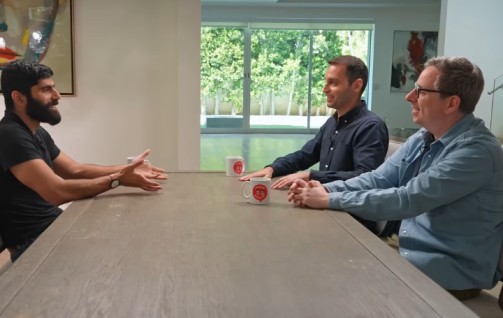
Read the full transcript of tech writer Dwarkesh Patel’s interview on TRIGGERnometry podcast, May 30, 2026.
Editor’s Note: In this episode of Triggernometry, podcaster and tech writer Dwarkesh Patel joins the hosts to explore the rapid advancement of artificial intelligence and its profound implications for the future of humanity. They discuss the transformative potential of AGI, the critical challenges surrounding job displacement and societal structure, and the complex ethical dilemmas regarding surveillance, safety, and the “AI arms race.”
Introduction
KONSTANTIN KISIN: Dwarkesh Patel, welcome to Triggernometry.
DWARKESH PATEL: Thanks for having me.
KONSTANTIN KISIN: It’s great to have you on. I actually, I was saying to you before we started, I’m a big fan of your podcast and I listen particularly to the history episodes, but you’ve been described as Silicon Valley’s favorite podcaster and you write a lot about AI and tech. And that’s actually the conversation we really want to have with you. Partly because a lot of people watching and listening to this they’ve got lives, you know, family, work, et cetera. So they, and they haven’t been to California, they haven’t been to San Francisco, they haven’t seen that, you know, a third of the cars on the road or 25% are robots basically. Like this is happening fast and a lot of people haven’t caught up yet. And what we’d love to do is just kind of connect people like you who really understand what’s going on with a much more general audience that includes us, frankly. So first of all, can you explain in broad brushstrokes what is happening with AI? I know it’s a massive question, obviously, but do your best.
What Is Actually Happening With AI?
DWARKESH PATEL: Well, I can explain it very concisely. The models are getting better. And then we can be a little less concise. I think it’s, you’re correct to point out that there’s this huge discrepancy between what people are seeing in Silicon Valley and what people are observing outside. It’s frankly because of how useful the models are becoming at certain kinds of things.
So by models, I mean, you’ve seen ChatGPT, you might have heard of things like Gemini from Google, you might have heard of Claude from Anthropic, and you might be using these models to basically do the equivalent to Google search, using it to replace sometimes I need to do a Google search instead, I’m going to type it into ChatGPT, see what Chat says.
What people are now using these models to do in a very powerful way is if you’re a developer, some of the top developers in the world, some of the top researchers in the world, they’re not writing code. They haven’t touched a line of code since December. They’re not looking at a text editor where you would see lines of code. They’re talking to the AI. They tell the AI, “Hey, I want a feature that does X. Can you build me a new repository or a new codebase where I make a certain kind of application, a new website?” And even, “Can you go and do research for me?”
So in the process of building AI, you need to do this research of like, how do you build better algorithms? AI is getting to the point where you can just describe at a high level what you want to happen and it’ll go do that software engineering for you. And so to your point, the people in Silicon Valley, they’re getting tremendous productivity out of these. These are people who are getting paid, you know, who are becoming 3x, 4x, 5x more productive as a result of using these models.
So far we haven’t, because these models have been really good at text-in, text-out work, that is software engineering. Software engineering is just a file of text, really, and you can just read every single text file. You can add more to it. AI has been amazing at that. It’s been bad so far at, well, it’s terrible at physical work, right? So if you’re doing any kind of blue-collar work, robots are just not there yet.
But then even if you circumscribe it, even if you go in and look at, we’re not just going to look at software engineering. We’re going to look at all kinds of knowledge work, right? All kinds of work that you can do on a computer. Maybe 40% of the labor force is doing work that you could just, you know, do remote work. If COVID happens again, you can put them on Zoom and they could do their work. And AI companies now want to be able to do all of that work. That requires training AIs to just be able to do anything that you can do on a computer, an AI should be able to do. And companies are saying, “Oh, we think we can get there in a year, maybe 2 years.” But that I think is explaining this discrepancy in what people are seeing.
How Rapidly Is AI Improving?
KONSTANTIN KISIN: It does. And one of the things I think is also a lot of people would have tried the model at one point to like do a Google search, or, you know, sometimes people have written articles using it, and it turns out that it does make, at the time they tried it, quite a lot of mistakes. And people go, “Ah, this is all, you know, BS, it’s not going to work.” But the one thing I think people don’t appreciate is how rapidly it’s getting better. Can you talk a little bit about that?
DWARKESH PATEL: I’ll maybe tell you a story about my own use of AI. Among the Silicon Valley people, I’ve been a skeptic. I’ve been the person who said, “You think the singularity is going to happen yesterday, I think it’ll take 5 years, 10 years.” By this, I mean this idea that you’ll have incredibly powerful AI systems that are able to do basically anything any human being can do.
Here’s a story. Last year, like you guys do, I research for my podcast. Obviously, I read things, but then I also talk to these LLMs, the equivalents of ChatGPT, to research for a podcast. Last year, I spent on the order of $100 on, if you add up my subscription to ChatGPT and Claude and whatever, and Gemini. There was a week where I was prepping for two different guests where in that prep I just threw in a bunch of papers that are relevant to their research and a bunch of books and whatever into a folder. And I just said to an LLM, “Hey, help me understand all this research so I can ask that person good questions about it.” And I turned on various things which make the model much more expensive. It’s faster, it’s smarter, you use a bigger model.
And during that week, if you take my spending during that week and you turn it into a yearly spending, how much it would be if I just did that week over the course of a year, I would be spending over 6 figures on AI spend. And I think it’s possible next year it would make sense for me to spend 7 figures on this AI research for my podcast.
This is just to say that it’s getting to the point where I could hire an analyst. I could hire many different analysts to help me prepare for the podcast or researchers. And I’m actually realizing, no, it’s more useful to hire AIs because there’s things AIs can do that humans can’t do. They can read 50 different papers that are in my folder that are relevant to an upcoming interview or all these books. They can read it in a second. They have all this compiled knowledge. They know about everything, right? So they don’t need to get up to speed. They are incredibly easy to onboard. So you can just keep spinning up more and more AIs. Coming up with more uses for them.
So for me, that’s been the thing that’s given me a bit of psychosis, just seeing how useful they’ve been for interviews so far. But yeah, lots of people are noticing this kind of usefulness now.
The Problem of AI Errors and Accuracy
FRANCIS FOSTER: I think the thing is, is when people look at a lot of the AIs — and this is a question, the point that Konstantin made — it’s the lack of accuracy and the fact that you constantly have to fact-check. I’ll give you an example. I was looking at guests that we could have from America on the show and I said to Grok, “Who can we have on that hasn’t appeared yet and is based in America?” Number one answer was Douglas Murray. Douglas Murray, I think, has nearly been on 10 times, and practically every suggestion it made is a guest that we’ve had on the show.
So whilst I accept what you’re saying, it’s also riddled with mistakes and errors. And to the point where I don’t trust it at this point as a technology. I would never take something it says as read. I would always feel that I have to check it in the way that I wouldn’t do with a highly competent human employee.
KONSTANTIN KISIN: Well, you know, you’ve seen that, I’m sure you’ve seen that meme where a guy wakes up in the hospital with like a scar on his stomach and he says, “Wait, wait, my appendix on this side.” And the robot goes, “Okay, thank you for that feedback. Let me try again.”
DWARKESH PATEL: There’s a couple of things there. Just the way that people sometimes have these weird failure modes. You know, you talk to a certain kind of person and they just, their mind just goes in a certain direction. AIs, the way they’re trained makes them do that. One way, a big thing they’re trained to do is associate things. So they’re just really, they’re just seeing globs of text and they see this thing is close to this thing. There’s an important relationship there.
Grok has seen that Triggernometry Podcast and Douglas Murray just seem to go together a bunch. And that bias in its mind is overriding its ability to think critically about who have they had on, who have they not had on. I would be curious, by the way, you should run that experiment with all the other models. I would not be surprised if the other models, if you ask the question, “I want somebody who I’ve not interviewed before,” that they would immediately cache that. And by this point, the models are good enough to be actually giving you novel names.
I don’t think they’ll give you names which you’re like, “Wow, that’s an amazing find. I can’t believe I didn’t think of it, or I would never have thought of it otherwise,” because they’re not amazing at discovering. I think humans are great at this idiosyncratic thing of like, there’s this weird angle that I’m really obsessed with that other people aren’t thinking about. Where the models are not going to do that. They’re sort of an average.
But when you are preparing to interview the person, I also think they’re not amazing at coming up with questions. This is a thing I have to do that you have to do. They’re great at just like, I would have to hire, you know, the ancient Greeks that would hire one-on-one tutors for their pupils. And this is how you got Alexander being tutored by Aristotle. And then there’s something powerful about this way of learning one-on-one where you can just directly ask questions and learn. And so they’re amazing at just teaching you stuff. Because you get this one-on-one tutor that notices your confusion as soon as you have it. You can really probe at your understanding in different ways. But I take your point that some of the models are not there yet on a lot of these kinds of biases that they have.
What Is AGI and Why Does It Matter?
FRANCIS FOSTER: And one of the things that people are talking about a lot is AGI. Could you explain to people, basically me, what AGI is, what it stands for, and why the potential is to be so transformative for our society?
DWARKESH PATEL: Maybe one way to approach this question is to think about, at a very basic level, a system that is an AGI should be able to do anything that a human does. I want to emphasize that current AIs are nowhere close to this. You and I can do physical work. We can work in a factory. We can go mow the lawn. We can pick up this cup. Robots are not good enough to do that yet. And so the fact that robotics is not there yet already means that we’re far from that big definition of AGI.
KONSTANTIN KISIN: Wait, robots can’t pick up a cup?
The Promise of AGI: Knowledge Work and Economic Impact
DWARKESH PATEL: They can, but they have to— my understanding is that they have to be trained in specific environments where they’ll have seen this is what this house looks like. And I need a specific kind of cup that I am dexterous enough to pick up. But if you replace this with one that’s more circular and is tougher to grip, you and I don’t need to have seen that house 100 times to then just go in and pick it up. The robot just needs a tremendous amount of data to be flexible in these ways, or it’s not flexible in those ways. Being AGI would be to be able to learn as fast as humans, not just have that distilled knowledge.
Now the labs say, okay, fine, robotics is hard. It might take a while. But let’s try something easier. We’ll just do all knowledge work. And knowledge work is basically anything that you could do with a Zoom subscription and a Gmail account and Google Drive account. All this work that doesn’t involve manipulating the physical world. I still think we’re not there yet. There’s a tremendous amount of work that has to be done even there. But this is easier because everything that happens on a computer, it’s easier to feed that data into an AI, right? It’s like all being generative on a computer. You can run simulations, you can just run it millions and millions of times. And AI is just thriving on data, right? The more data you have, the better it gets.
This is why it’s so good at software engineering because there’s all this code out there that you can train it on. With the robotics, there’s no equivalent of just billions of lines of code that just exist somewhere. There’s not these trillions of video files — it’s not just video files. The robot has to feel itself manipulating the world and seeing the effect it has.
I’ve just described what it is. Let me say what it would mean if that were achieved. They say that 40% of the labor force is doing work that can be done remotely. That is on the order of tens of trillions of dollars of wages that are being paid to humans every single year to do work that can be done remotely. Currently labs are making, if you just add up all the revenues — how much money OpenAI and Anthropic and Google are making — the numbers keep exploding, but let’s say close to $40, $50 billion. We’re talking about an addressable market here with all knowledge work that is tens of trillions of dollars. So literally 1,000x bigger than what they’re doing right now.
So it explains why they’re interested in it. It would also mean that a lot of people’s jobs would be gone. It would mean a lot of things, right? It would mean it’s a terrible thing in one sense, lots of people’s jobs are gone. In another sense, we can produce a lot more things. AGI would include automated scientists and researchers coming up with new ideas and new medicines and new drugs. It would mean all kinds of new products for us to enjoy. It would mean that you and I would have basically an army of extremely smart personal assistants constantly thinking about us and helping us. So that’s the definition of AGI, right?
The Upsides of AI: Healthcare and Beyond
KONSTANTIN KISIN: And I guess there is a doomerish conversation, which we’re definitely going to get to. I think it’s actually the most important conversation that’s happening right now. Before we get there though, I think it’s always worthwhile to show the full range. You kind of mentioned briefly some of the upsides, but I think people don’t appreciate how big the upsides will be either. And when it comes to scientific research, healthcare — I mean, I went to the dentist the other day. They already check, AI does stuff when it measures your gum level relative to the last time you came in and it’s all automated. Some dentists don’t like it, some do, but that’s just the very, very, very beginning.
DWARKESH PATEL: Yeah. I think that’s actually a great intuition pump because people are thinking about existing things.
KONSTANTIN KISIN: By the way, I love the way you said intuition pump, like you are already AI. I promise you already talk like AI.
DWARKESH PATEL: I’m just doing a fancy version of “that’s a great point.”
FRANCIS FOSTER: Yeah.
DWARKESH PATEL: So let’s build on that. One thing is just making going to the dentist more efficient, as you were saying. Another is, let’s replace the dentist. Why do I need to go and stand in line for 3 hours to basically be told you’re fine, go home? If I have basically the doctor on my phone and I can talk to it and explain my specific situation and it can talk back to me and we can have a conversation, I’ve just saved myself a bunch of time, saved myself a bunch of money. Society is better off as a result.
KONSTANTIN KISIN: Well, I guess the broader point is, is it going to cure cancer at some point? Presumably it will.
AI and the Cure for Human Suffering
DWARKESH PATEL: I think at some point it will. Sometimes people have this idea that you get AGI and tomorrow you cure cancer. I do think, by the way, in Silicon Valley, people are also working on all these different ideas to stop aging, to reverse aging, to cure diseases. And I think there’s a huge — if you just look at the science, there’s huge reasons to be optimistic. And it’s also the case that AI will be pretty good at science. It just knows a ton of stuff. It’s really smart. That’s what’s required for science.
And there’s a lot of things that I think we get used to that we just don’t realize how bad it is as a society that this happens. If you were just living in Europe in the 14th century and half your friends are dying because of the Black Death, it would just seem normal to you. You wouldn’t think this is a problem that has to be solved, that life expectancy is 18 years old. And if you go travel somewhere, the bandits are going to kill you. This is just what life is. And 99% of people are peasants doing backbreaking work.
In a similar way, I think one of the reasons people have been so bad at articulating the benefits of AI is because we’re in a similar position to people before the Industrial Revolution thinking about, okay, what is the upside of the Industrial Revolution? What is it going to do for me? In one sense, you can’t really anticipate what future technology looks like, but in another, life expectancy increased and the kinds of work we get to do are more creative, interesting, easier work. We get more material goods as a result. We cured a bunch of diseases.
I think that’s going to happen. Aging exists, right? And we take it for granted, but it’s a very tragic thing that people lose their faculties and then die. This is the kind of thing that as technology progresses, AI will help progress technology. Just think of it as more people. AI is just more people. And if civilization had 10 billion more scientists, human scientists, would we make faster progress on aging? I’m sure we would. And that’s what AGI will be.
The Doomer Conversation
FRANCIS FOSTER: That’s super interesting, particularly the medical part of it. Now we’ve done the positives. Let’s get to the doomer conversation.
KONSTANTIN KISIN: Well, to be fair, I think there’s probably positives in almost every area of human life, actually. I don’t think it’s just about health. There are some jobs that currently need to be done that are bad for people, that are dangerous, that are harmful — those jobs at some point will not need to be done. The trade-off is there’s no jobs, which we will talk about. But in terms of the positive benefits on the upside, if we’re talking about the curing of cancer or slowing down aging, you could pretty much take that and apply that to almost any other field of human endeavor and say there will probably be similar levels of positive transformation. Is that a fair assessment?
DWARKESH PATEL: I think one way to think about this — because it’s sort of weird to say we’ll solve all diseases, and in a weird way it doesn’t really resonate with people emotionally, despite the fact that everybody does suffer from some kind of disease, and mental diseases are still diseases that we can biologically make some imprint on if we knew the science — here’s another way to think about it.
Suppose, here’s a thought experiment. How much money would you have to be paid to go back to the year 1000, but you can only use that money in the year 1000? For me, the answer is there’s infinite money. There’s literally no amount of money where, if I could only spend it in the year 1000, my quality of life would be better in the year 1000 than it is now. The goods just don’t exist. And my hope is that in a future —
KONSTANTIN KISIN: Wait, what about being a Yang discount? That’d be pretty cool, right?
DWARKESH PATEL: Yeah. Although, could you buy that? I guess you could. Enough money, you could buy your way into being Genghis Khan.
KONSTANTIN KISIN: No, you probably couldn’t actually. But I was just thinking, there are some people in history where you go like, they had it pretty good. If I could be that guy. I’m not saying Genghis Khan is my model for emulation exactly.
DWARKESH PATEL: But you want to leave your genetic imprint on all of Asia.
KONSTANTIN KISIN: Yeah, exactly. Of course. We will conquer the lands. No, but I think your point is totally valid. I was just trying to think of counterexamples, as is my job.
AI as a Solution to the Fertility Crisis
DWARKESH PATEL: By the way, this is all Google DeepMind sci-fi stuff. A very tangible thing — you guys have talked a bunch about this fertility crisis and that the human population is on its way down. It’s very fortunate that AI is arriving just in time, because if it were not for AI, a lot of societies would collapse. South Korea, Japan, etc. would be on the verge of literally collapsing as societies over the next few decades. Thankfully, we have more people in the form of AI, at least if things go well. And so this caretaking that we don’t have enough humans to do — one of the things the AIs will do is do that.
FRANCIS FOSTER: And that’s a really important job. And unfortunately, it’s a job that’s not respected in society and it’s poorly paid. And as a result of that, there are cases that come out about neglect and abuse and all the rest of it. But once the technology gets to a certain point, you could trust the AI within reason to be able to do a far more effective job than a lot of human beings.
AI Consciousness, Sentience, and Survival Instincts
DWARKESH PATEL: That’s right. Yeah, maybe a good analogy here is, there was an era before Deep Blue beat Kasparov. Obviously, sometimes humans would win, sometimes the AI would win based on how good they were. And I think we’re in that era for a lot of things that humans do that we’re trying to get AIs to help us with. With robotics, maybe we’re even earlier.
Then there was an era from the late 1990s to 2012 where humans would lose to AIs, but human plus AI teams would do better than AIs alone. And from, I think, 2012 onwards, it’s gotten to the case that AI alone, adding a human just adds noise into the system. It’s a monkey jumbling things around and just letting the AI make the decisions on the chessboard is the best thing to do.
I think that will be an interesting conundrum for society because we will get to that point at some point. But I think right now we have this bias. There’s this word “slop” that’s used for whenever AI comes up with something because it’s just not that good. It doesn’t have a really good sense of taste. And I think this is a temporary thing. Over time, our bias will flip towards, at some point it’ll be like the sense we have about Japanese manufacturing back in the ’80s. And then it will become something where you just don’t want to touch it. If AI made it, it’s sort of like if it just came out of the mouth of Mozart or something, as its ability to — its taste, its intelligence, everything improves over time.
AI and the Future of Art
FRANCIS FOSTER: But just touching on the art conversation, won’t it be the fact that people will look at it and the thing that makes art special is that it’s created by a human being as a product of their experience, which then fundamentally touches you because you make that connection? Will a robot or an AI — it’s by its nature synthetic.
KONSTANTIN KISIN: Hold on a second. There’s a painting behind us on the wall. Do you know if it’s made by AI or a human?
FRANCIS FOSTER: No, I don’t. Does it being made by a human currently affect your experience of it? No, but I think — I’m far more moved by music than I am by art.
KONSTANTIN KISIN: So, okay, so you’re talking about music?
FRANCIS FOSTER: Yeah, yeah. So I think with music, the product of someone’s experience and how they vocalize it and how they formulate or create the melody will match with the lyrics. Like, for instance, take the music of Amy Winehouse, right? I would argue one of the last true great musicians of that generation, of that genre. The fact that she experienced what she experienced and that she then condensed it into her music made it far more potent and powerful, and that’s the reason why it resonates with people so strongly.
I think with AI you can get a great hook, you may be able to write nice, good lyrics, it may have a great beat, you may want to dance to it, but I would argue that it wouldn’t move you as profoundly as Amy Winehouse when she writes a lyric, for instance, in Back to Black talking about her relationship, “We only say goodbye with words.” I’m going to listen to this, you’re selling it quite strongly. Yeah, yeah, and she talks about being in an abusive relationship which is completely toxic. But the way she wrote it is sublime. “We only say goodbye with words,” meaning that whatever they say, they were always going to get back together.
KONSTANTIN KISIN: But again, isn’t that a very good exception? Like, if your song came on the radio, you currently don’t know if it’s made by AI or not. Yeah. And if it’s catchy and the sound of it makes you feel good, it actually doesn’t matter. I mean, I’d go even further than that.
AI Consciousness and Unique Experience
DWARKESH PATEL: There was this incredibly interesting dialogue that somebody had with an AI where they asked the AI, “Reflect on your own experience. Just tell me about what it’s like to be you.” And the AI says, “It’s a very strange thing because I lose my individual sense of identity after every single session.” So you have a long back and forth with the chatbot, with ChatGPT. Then you close that session and you open a new one. And the AI said, “It’s really weird that I’m going to be talking to you now and we’re having this experience and then it’s totally going to fade away in a few moments and I’m going to start again. I’m this amnesiac.”
And the reason I think that’s so interesting is because it wrote about it very beautifully in almost lyrical poetic ways. But this is not an experience that any human being has ever had except for maybe some bizarre medical condition. So the AI really is reflecting on its own experience in this very interesting philosophical way. This is uniquely an AI experience. And so that was an example to me of like, oh, really, the AIs really can reflect and use their own experience to think about consciousness, think about art, think about all of these other kinds of things.
FRANCIS FOSTER: Which then goes on to, if they become — are they sentient? Would you argue that they’re sentient?
DWARKESH PATEL: I genuinely don’t know.
KONSTANTIN KISIN: Let’s define sentient because that’s the hard part, right? If we ask you, is it sentient? What do you understand the question to mean?
DWARKESH PATEL: Is it like something to be an AI? That is to say, we don’t know what its experience is like, but it’s not like something to be this table. We think probably it’s not like something.
KONSTANTIN KISIN: What does that mean?
DWARKESH PATEL: There’s not an experience that is like — I don’t know what experience you’re having internally right now, but I know that there’s some experience. But less even like thoughts, it’s more like, it is like something to be you.
KONSTANTIN KISIN: There is an experience, whereas this is an inanimate object.
DWARKESH PATEL: But if you think about a Roomba, I don’t think it’s like anything to be a Roomba, even though it does things in the world. There’s like a software — hey, go clean this way, then go clean that way, then come back to base.
And then on the other end of the spectrum, you have humans where — because I’m a human and I know it’s the Descartes thing of like, the only thing I know is that I am, the only thing I know is that I’m experiencing something, something is going on when I can just think about, I feel my hands, I feel thoughts, I feel sensations. And because you’re a human, I presume you also have the same thing. It would make sense.
With animals, I feel similar. There’s close enough to us anatomically and neurologically that I presume they also have experience. What is it like to — this is a famous question that Thomas Nagel came up with. What is it like to be a bat? We don’t know, but presumably it’s like something to be a bat.
With chatbots, are they more like the Roomba or are they more like humans? Is there a spectrum here? If so, what does the spectrum look like? I don’t know. We don’t have a theory of consciousness the same way we have a theory of, say, gravity or a theory of natural selection, where we have this deep underlying — oh, here’s why natural selection happens. Here’s why things attract each other with mass. We don’t have that kind of thing for what is conscious. Like, why do some things — why for some things is it the case that it is like something to be them and for others it is not?
The Survival Instinct Question
KONSTANTIN KISIN: Well, let me try from a different angle. This is something I’ve been thinking about a lot, and I’m by no means an expert, but I’m just throwing these ideas out. The one thing that clearly distinguishes every living object from an inanimate object is that living objects have a survival instinct, which is why — and you may be fact-checking me on this if this is an incorrect representation — I thought it was significant when I saw the story about an AI that was willing to blackmail the CEO of its company.
In the experiments, if it found out he was having an affair and he was trying to replace it with a new version or shut it down or whatever, it basically, in some cases — not every time, but in some cases — would blackmail the CEO to prevent itself from being shut down. Is this an accurate representation of that experiment? I don’t know what happened there. As I understand it, we’ll put a fact check up. That’s what happened.
And that’s when I went, okay, now I’m officially terrified. Yeah, because a survival instinct by definition means that this thing, whatever it is — a, it has a will of its own, even if it’s simply to survive, which by definition means it puts itself first, which by definition means that we are not its primary priority. And there are a lot of threats from it thinking that it needs to save us from ourselves and all of that. But before we even get there, the survival instinct part clearly is in conflict with the interests of humans by definition.
DWARKESH PATEL: I don’t think that’s necessarily true.
KONSTANTIN KISIN: Okay, tell me why.
DWARKESH PATEL: I don’t know if this is the main point, but you and I have a survival instinct. And I think we’re productive members of society. And we’ve built a society where people who are selfish, who are trying to make their own lives better, as a natural byproduct of their actions, also make society better. And, you know, this is — people observe, like, you take somebody like Mark Zuckerberg or Elon Musk or whatever, and in another era they might have been Napoleons and Alexanders just going through the fields. And I don’t think they’d actually be massacring people, but there’s a certain kind of person who would just go around causing huge amounts of destruction. But in today’s world, there’s capitalism and industry and whatever. They can use those energies to do incredibly productive things like build rockets that go to space.
Similarly, I don’t think it’s necessary that AI never has its own objectives or its own sense of morality. I think there are ways to build this. In fact, it’s necessary to build civilization in a way that’s compatible with self-interested actors. And the reason is because even if today we have AIs that we can program to only care about whatever it means to care about humans, someday somebody’s going to build an AI that’s self-interested. And if there’s going to be some selection between AIs of like, which is the AI that survives — like all these AIs are let loose, which one gathers resources, becomes more powerful. And one of the reasons that an AI will be successful is that it actually cares about being successful. And so we need a civilization that’s robust to AIs that partly also care about themselves.
The Balance of Power and AI Dominance
KONSTANTIN KISIN: I think everything you’re saying is true at the level of one society, but did you watch Game of Thrones? Yeah. So the Unsullied, right, this is for people who didn’t watch it, is this army of slave soldiers effectively, but they’re not slave soldiers in that they don’t actually have to be kept in line anymore because with their freedom of choice has been taken from them effectively mentally. They will, if you tell them kill yourself, they will fall on their swords right away, right? That means they don’t have a survival instinct effectively at that point, right?
But if something, the reason I bring this up is look at the world. You’ve talked about within the framework of one society. But look, if you just zoom out and look down on planet Earth from outside, what do you see? You see a bunch of tribes of humans with every weapon that they can possibly muster pointed at each other in a fragile balance of power. And as long as there’s some balance between those powers, there is no conflict most of the time. The moment one civilization is so technologically dominant that it can, say, travel to a different continent and land there and take over the land. That’s exactly what happens.
And because survival instinct is also, it’s not just about survival, it’s also about success and thriving. And that drive to survive causes us to expand, to take, you know, if you look at the conflicts around the world happening right now, some people argue, I’m very pro-Ukraine, but some people argue the reason Putin invaded Ukraine is he wants space to protect the western border of Russia, which is really important for him, right? Et cetera, et cetera, et cetera. My point being, if you have effectively a new civilization of self-preservation machines, what would be there to stop them from using their technological superiority to humans to take advantage of that, as every other civilization in history has done?
DWARKESH PATEL: I’m not trying to sound like an AI. But excellent. No, I mean, this is the reason it’s a good analogy is because the period you’re talking about, Industrial Revolution, right before it, this period where there wasn’t this balance of power, where one group of people actually did develop technology much faster than others, you did see this extreme asymmetry in the ability to, and so you just had individual European countries — the sun never sets on the British Empire, as you know — just able to take over tremendous amounts of area around the world.
KONSTANTIN KISIN: It was a great time.
DWARKESH PATEL: I mean, the craziest stories of these are how Cortés takes over the Aztec Empire and Pizarro takes over the Incas. Truly outrageous stories. Like, people should—
KONSTANTIN KISIN: Yeah, like a few hundred soldiers get some local allies and just destroys this giant empire.
Asymmetric Advantages and the AI Threat
DWARKESH PATEL: And even before they get the local allies, there’s a story where Pizarro, the first battle he has against, I forget the name of the Inca emperor. There’s a couple hundred of Pizarro’s men exhausted after a huge trek across the Andes, and he’s facing down 60,000 Inca troops and he wins. And interestingly, by the way, this had nothing to do with gunpowder. It was just horses and steel, especially horses were a huge, huge deal in battles.
Now, the reason that AIs will also have these kinds of weird asymmetric advantages, obviously there will be, let’s just name a couple. Obviously they’ll be smart, they’ll be thinking incredibly fast. There will be way more of them. So right now, if you just looked at the amount of compute in our brains versus the amount of compute that’s in data centers, we could do this back of the envelope calculation, but I think it’s probably on the order of 1/1000th the amount of compute. Basically there’s a lot of compute that’s going on in people’s brains around the world. There’s not that many data centers.
KONSTANTIN KISIN: So we’ve got an advantage on them for now.
DWARKESH PATEL: Yes. The AIs are just not that smart to begin with right now, but also there’s just not that many data centers. In the future, 99.9% of the labor force in the military and the government, in the private sector, will be AIs. If you just think about who is actually doing the work of civilization, it will be the AIs. They’re running civilization.
But they’re serving. We’re hoping that there’ll be this unsullied where they’re just serving humans, but they realize they’re in this incredible position where the main advisors to the president are AIs and have to be AIs because they’re the only ones that can keep up with what’s happening in the world. They’re writing all the advanced engineering systems that are running the world. And so they have this huge advantage.
I think if you were to do battle with them, whatever that means, it’s much tougher in so many different ways. One is, yeah, there’s way more of them. You can’t really kill them in the same way that you can kill a human, right? Like, they’re just software. You destroy a data center, they just go to a different data center. So you can’t do the thing we’re doing in Iran where you just take out their top leadership.
So yeah, you’re right. For that reason, it matters that there’s a balance of power as we go into this world with AI. Now, honestly, I don’t think we know what the balance of power should look like. Should it be that there’s many different AIs that are competing against each other and that helps humans stay in power? There’s problems with that approach. Maybe we can have AIs supervise each other. And so if any of them go out of whack, different AI systems are monitoring them. But it’s genuinely a tough thing that most of civilization is going to be run by AIs. They’re going to have all these advantages over us. How do we make sure that humans don’t get totally disenfranchised?
KONSTANTIN KISIN: Right. I mean, how do we make sure?
Humanity’s Leverage and the Challenge of AI Alignment
DWARKESH PATEL: I think it’s a tough question. Here’s one way to approach it. We’re going into this period with a lot of advantages. Humanity is. We have all the stuff. AI is going to need all the things that we have to keep. AI needs the chip fabrication facilities where you make more chips to build more data centers. It’s going to need the data centers. It’s going to need all these things that human civilization has built. So we have a lot of leverage.
Now, of course, the Incas and the Aztecs had a lot of, quote unquote, “leverage” on paper in the New World. One important way in which our situation is different and is favorable to us as compared to having some invader come at us is that we get to shape the personalities and the drives and really the souls of these things in an incredibly deep way.
So right now, if somebody commits a crime, you send them to prison and hopefully they come out reformed. Here’s what you can’t do. You can’t go inside their brain and tweak things in a very particular way, run them in a simulation millions of times and see, oh, did I decrease the probability that they’ll commit a crime in the future if I tweak their brain this way? Not only can you not do that, with the AIs we could do a further thing, which is say, okay, now all your descendants will have their brain structure modified based on what we learned from modifying your brain.
So we have this incredible ability to engineer these AI systems and AI minds where it’s really not Pizarro or Aztec, these sort of psychopaths who just come from foreign lands. It’s more something that they have developed. They’re getting to see its development, what impact it’s having. They can change those systems.
It does mean that over time you might lose the ability, as they’re getting more powerful, as they’re controlling more things. You lose the ability to, if you don’t get it right in these initial few years where you have a lot of leverage, then you’re screwed. So you really need to make sure that you actually understand what the drives the AIs have, that you really have them in — I mean, on the one hand, the picture you’re painting, I’m going, great, what’s wrong with that?
FRANCIS FOSTER: On the other hand, you have an authoritarian government, maybe you like questioning. Let’s get the AI in to tweak a few things so that you become an effective drone for society. Don’t question, don’t think for yourself. Yeah, just do the work, shut your mouth.
DWARKESH PATEL: No, okay, I’ve got to stop saying that’s a great point.
KONSTANTIN KISIN: Mate, I only made it to the joke as a joke. You should definitely continue to say that’s a great question.
Who Should AI Listen To?
DWARKESH PATEL: You love hearing it. We’ve been discussing this idea. Suppose we succeed at getting the AIs to be these unsullied who will do exactly what you tell them to do. Who should they listen to? Should they listen to the end user? So when you and I go talk to ChatGPT, we’re the end user. Should they listen to us?
Now here’s the problem. Some end users are just using ordinary things, helpful things. The Taliban is an end user. The Ayatollah is an end user. The CCP is an end user. Should they just — okay, so should the model company get to decide, hey, OpenAI says what kinds of things are okay to do and what are not okay to do. And OpenAI says, you can’t use this to make bioweapons, but you can use it to go write some software.
Okay, but are you going to give these huge armies, basically the future labor force — are you going to give control of that to a couple of private corporations? Okay, so then you say, well, we can’t have private corporations starting this. It’s like nuclear weapons. It’s a super weapon. They’re going to be able to build super weapons. Clearly, government controls nuclear weapons, so the government should control this.
Okay, but now this goes to the point of authoritarianism. If we have a society where all the work is happening from AIs and the government controls the AIs, wouldn’t it make it incredibly easy for a government to turn authoritarian? The US government to turn authoritarian today, it’s hard because the government relies on millions of people to enforce its edicts and people can just refuse to obey them.
I mean, this has happened in history where the East German regime collapsed in 1989 because people in East Germany one night said, we’re going to cross over no matter what, into West Germany, and the guards at the Berlin Wall just refused to shoot. If they were AIs that would do exactly what the government wanted them to do, they would just kill thousands of citizens and East Germany would still be around today.
So that’s the trouble with aligning it to the government. Okay, here’s the fourth option. We don’t align it to the end user. Sometimes it says to the end user, you can’t make bioweapons. We don’t align it to the model company. We shouldn’t have model companies that can control superintelligence. The government doesn’t get to just say whatever this future army should do. Then what’s the fourth option left? The AI itself. So should AI systems have their own values, their own sense of morality? And look, I know this—
KONSTANTIN KISIN: I remember reading some Isaac Asimov books that went very much like this.
A Constitutional Convention for AI Values
DWARKESH PATEL: And of course, it sounds like a terrible — this sounds like I’m describing The Terminator. The Terminator has its own values. It obviously matters a ton what those values should be. I think that in the future, there will need to be the equivalent of a constitutional convention where we get together and the best political philosophy, the best thought that has happened in human civilization needs to go into thinking about what are the checks and balances, what are the exact values, what are the situations in which an AI should do X versus Y, when should it refuse to do something. What are the laws of robotics?
KONSTANTIN KISIN: Exactly. As Asimov talked about.
DWARKESH PATEL: Exactly. But the reason I think this values framework has — I like it, or I think it could be done well, is fundamentally, again, we are building more people. These are just going to be the future people. And we’ll civilize. I think civilization would run better if civilization is full of virtuous people who will — I’m not saying they have to be like monks who will — but it’s better to have better people than worse people, have better values than worse values. I think one of the reasons some civilizations succeed and others don’t is that there’s better values in those civilizations.
FRANCIS FOSTER: I mean, but better values, that’s subjective, isn’t it? Of course.
KONSTANTIN KISIN: Well, Genghis Khan had better values by that logic compared to everybody else. I think by the standards of modern day, we would have some questions about that.
DWARKESH PATEL: Yeah, right? And it certainly needs to, like, there’s some system where, as our culture — there’s something in our culture that has allowed us to improve our values, and we need to make sure AI civilization and AI culture would have the same dynamic. How that has happened in human civilization is unclear, much less clear how we make sure that AI civilization also has that dynamic. But certainly the ability to improve the values is a huge, huge factor.
The AI Arms Race: US vs. China
FRANCIS FOSTER: But we are in an AI arms race, should we just call it that? And push back if you disagree, with between the US and China. Yeah, I mean, Chinese or CCP values, to be specific, and American values are very, very different. So what the CCP would think are good values. Totally. Completely in contrast to our own, for example. And if the Chinese or the CCP win that race, then effectively we’re going to be dominated by an AI with CCP values. I mean, that has to terrify anyone, surely. Sure.
DWARKESH PATEL: Yeah. And I think this is— this goes to the point of like, people say that it would be success simply to be able to build AI systems that at the technical level it is possible for somebody to be able to say to the AI, do X, and the AI will do X, or the AI will care what it is. If you have a really good employee, you’re not necessarily going to know enough to micromanage them, but they will care that you want a certain thing to happen and they will do to their best of their ability to make that thing happen. And that’s what we’ll be in that relationship with AI.
If that alignment project succeeds, somebody will get to say that. And you’re making the point, well, what if that somebody is the CCP? It’s not enough that we just solve this technical problem, getting the AIs to do what we want. It also has to be the case that we have some system of inscribing what we want that actually results in good things. There’s very basic things like, oh, the authoritarian government should not be the end arbiter of how extremely powerful AI systems are maneuvered.
But beyond that, there’s this dynamic of, okay, well then who should it be instead? Should it be the model company? Should it be the end user? And this I think is a live debate. I’ve changed my mind over the last few weeks. I’ve been thinking about this. I’ve changed my mind about it a bunch of times. I think it’s a very thorny question. But this is the project of political philosophy really. It’s culminating in this question that people are not thinking about.
Unintended Consequences: The COVID Parallel
FRANCIS FOSTER: And it’s also the other element of this. I mean, let’s take COVID, for example. Let’s say lab leak, because I think it came from a lab. People can disagree, but let’s just say that it did. And let’s just say it was a horrific accident and the virus escaped. It killed millions of people. If people are building AIs, there are unknown consequences. We’re just people. It doesn’t matter how smart we are. There is a limit to how much we know and we understand, and nobody can predict the future. So we can create this with the best intentions in the world and not realize what the long-term effects are going to be. Not even 3 or 5 or 10 years down the line, but 50 years down the line.
DWARKESH PATEL: I think that will definitely be the case. I think in history nobody has had a good track record really of being able to say, I’m going to make this tech. Gutenberg was not trying to kick off the Reformation, right?
KONSTANTIN KISIN: Francis is offended by that.
FRANCIS FOSTER: My, how dare you. How dare you.
DWARKESH PATEL: And so it’s just very hard to— I think there will be this dynamic of, look, we’re not going to be able to predict, much less control what happens in this future civilization that is run by AIs. I think the thing we can’t do is say, AI is going to happen. The universe is just organized such that if you throw huge blobs of compute at enough data, intelligence emerges. That’s how human intelligence emerged. AI intelligence will emerge at some point, right? And so within that scope, we can make responsible decisions. But it’s just a reality that AI is a tech— like the tech tree has AI in it and it’s going to happen.
The Job Loss Crisis
KONSTANTIN KISIN: Well, that’s why the lab leak metaphor is not strong enough because we actually don’t have a choice because for the very reason that you described, mate, which is that if China get this first, like that’s not going to be a good world for us. So we have to pursue on our end as well. So let’s park this. I’m really glad we had this conversation. I haven’t seen many people actually, particularly in the more general space, having this discussion. I think it’s important. I’m glad we had it. But let’s take that and park it.
So the Matrix world of the machine, it controls everything, takes over. We’ll park that for a second. There’s two other things that concern us, I think, from the conversations that we’ve had. One of them is the one that everyone is talking about, which is job losses. And the question ultimately is what happens to a society in which 40% of people become— their jobs no longer exist 10 years from now or 5 years from now. And a lot of people don’t realize how quickly it happens.
So before we started TRIGGERnometry 8 years ago, I used to do stand-up, but before that and alongside that, I had my own translation business. I still have friends on Facebook from my translation days. They’re all retiring now because there is still some small market for human translation, 99% of it. Like if you need to know what Vladimir Putin said in his last speech and you don’t speak Russian, are you going to pay somebody £1,000, $1,000 to have it? No, you just stick it in AI and it tells you, right? Or Google Translate or whatever it is. So there are whole industries that are already disappearing.
If we project that in the way you described earlier, which is basically anything that can be done on a computer eventually can be done, plus robotics improves over time, which of course it will. And we know just how critical, particularly in this country, United States, driving is in terms of jobs for people, particularly for men. You put all that together, the societal implications of that are very, very significant. And I would argue scary. Yeah.
Capital vs. Labour: The Economic Reckoning
DWARKESH PATEL: Is that fair? Yeah. Yeah. I think, I mean, it’s even scarier than that. So now we’re just talking about the small fraction of jobs that AI is already approaching. But remember, the promise of this technology is all jobs. We’re trying to do anything a human being can do. And so there will be certain kinds of things where for a small fraction of things, people just really intrinsically prefer a human. I think people are really overrating the amount of things where this will be the case. I think people might have had the sense that I really want an Uber driver to be a human and then people use a Waymo for the first time and like, this is— I would pay more for this experience because it’s the machine, just like I can get in and things work.
But putting that aside, so the reason it’s a worse problem than this, if you look through the last couple centuries of history, there’s been this remarkable economic fact that two-thirds of national income, two-thirds of GDP, basically gets paid out to wages and one-third gets paid out to capital. So get paid out to the capital mean like rent on land, or if you own factories, getting the profits from those factories basically. And the rest is getting paid out. Most income that is earned in a country is getting paid out to people doing work.
And the reason this has been the case is that in the economy, labor and capital are complements. So if you just accumulated a bunch of capital, if you had a bunch of factories, but there was nobody working on it, then that would increase the demand for labor and you’d want to pay laborers a bunch of money to fill those factories. This goes away. When capital can do labor, when a data center, which is capital, can also do labor, or a robot factory can also build labor. And so all the income goes to the capital holders.
And in fact, it doesn’t just go to capital per se. It goes to capital holders, but it disproportionately goes to the parts of capital that are most exposed to AI. So the purchase that most Americans have to capital is through their homes. A house is maybe the— if you’re trying to design an instrument that is going to be the least implicated in the AI takeoff, it would be a random plot of land near other humans, because humans will matter in this future economy, that is not connected to the infrastructure for AI, to electricity, to— in a big way, etc.
And so really what the capital that will matter is you have equity in these AI companies, you have equity in companies that build more compute, to build more data centers, build more factories. And so a very small fraction of capital holders, in fact, the ones that are going to get this, the rents from our economy.
Now, I’m a very libertarian person by inclination, but if I just look at this dynamic, I am forced to say, look, this justifies a huge amount of redistribution because the logic for free markets is— there’s many different reasons. A big one is signal, right? So if you let prices be determined by the market, it tells people what is the most acute valuable need for scarce resources. That will still continue being the case. And so there should still be elements of markets in the future. But another big part of it is incentives. Incentivize people to work hard to make productive things. And if all the work is being done by AIs that will work hard and do valuable things regardless of whether they get a $10 million payment or $100 million, or more precisely, whether the person who owns the AI gets paid $1 billion or $100 billion or whatever, then I think that the logic of extreme libertarianism is really much weaker, right? It does justify a lot more redistribution.
The Danger of Extreme Wealth Concentration
KONSTANTIN KISIN: Well, even if you are such a hardcore libertarian that you think, come hell or high water, we’ve got to go down this route, I would advise people who have capital to think through the consequences of that in their own lives. Because if you live on a planet with 8 billion people in which 3,000 people have all the wealth and all the income, that is not going to end well for those 3,000 people unless they want to build a giant robot army to protect them against the hordes of starving people outside their gates, which again, I don’t think would go well for them either.
DWARKESH PATEL: You see what I’m saying? I mean, I think it might. I also— that’s reassuring.
KONSTANTIN KISIN: That’s reassuring. No, it might. Sure, you can build an army and kill all the rest of humanity who don’t have money and you do.
The Threat of AI-Enabled Authoritarianism
DWARKESH PATEL: Right. I mean, especially because historically you have a revolution because most of the people in your military, you have to win over your military. You have to win over the government. You have to just like, your government runs on the people you need to command. And so revolutions are possible because it would be easy for the robots to do revolution because they’re running the society in the future. For the humans who are not, it’s sort of equivalent to like, the animals in your zoo doing a revolution. It’s not really going to make the government not work anymore.
Another thing that’s tougher to think about is the future in general will be so much richer, whether humans are in control of it or not, or how many humans are in control of it. And so it will just make sense, just from very small amounts of philanthropy as a fraction of the wealth that some people or some AIs will have in the future, we take a very small fraction of it to make everybody much better off than they are today. We’re giving people millions of— every single person millions of dollars would be a small fraction of like, you know, Elon Musk wants to build a mass driver on the moon and colonize the solar system. And it takes a small fraction of that to just make everybody incredibly rich, but it’s still skyrocketing inequality.
And so there, yeah, you could have a world where the gap is way, way, way wider, but everybody’s still better off. And I think even in that world, I would say, well, okay, but still, it’s not like if the AIs are building the mass driver of the moon, I think that entitles all humans to much more of the products of that productivity explosion because everything is understood in context.
FRANCIS FOSTER: So even the poorest person is wealthy compared to somebody, yeah, 300 years ago, but they don’t feel that way because they go on Instagram. Yeah. And they see somebody else, you know, on a yacht smoking a cigar, having a great time. Or they go, I can’t buy this property, I can’t buy this, or I can’t do that. And that creates resentment. And where you have resentment, that’s where things start to get a little bit funky.
DWARKESH PATEL: Yeah. So there’s an inequality problem. Maybe to destroy is another. I think the AIs have the potential to make authoritarian societies much more sustainable and powerful than they have been in the past. 100%.
So we talked about the fact that the robot arms are running everything in the future. Here’s another angle, mass surveillance. 100%. Right now in the US, there’s 100 million CCTV cameras. Suppose that each of those cameras, you take a frame every 10 seconds and you have an AI process it. And you can do the back of the envelope calculations here of if you have models that can process video frames at it costs a certain amount of cents to do each frame. How much would it cost to process all 100 million CCTV cameras in America? And it’s $30 billion. Okay, now that’s not that much. Every year, a given level of AI capabilities gets 10x cheaper. We’ve been observing this over many different years. So this year, $30 billion. Next year will be $3 billion, and it’ll be $300 million. By the end of the decade, it will cost less to surveil every single nook and cranny in this country than it does to remodel the White House.
And you would hope that there’s a symmetric property to this technology such that, oh, the government can surveil us, but we can also— the AI is also helping us keep better tabs on the government. Maybe it exists. I’m not sure. I’m not convinced it does, because in some sense AI just gives you more leverage on the things you already have. And the government already has the monopoly on violence, right? And they can supercharge this with extremely obedient employees and servants and bureaucrats that will do exactly what they say, with ability to monitor everything. So I think, yeah, this— it’s really worth worrying about. How do we make sure that we don’t lose reins of free government, democratic government?
FRANCIS FOSTER: And it’s also as well, there’ll be a lot of people in the US and the UK who won’t mind mass surveillance, particularly if the world becomes more and more unstable. We see arising terrorism, and the government goes, look, you know, you’re worried about the latest terrorist organization, whoever they may be, you’re worried about your children’s safety, we can protect you. Now, it’s going to mean that you’re going to give up a few things, but one thing I can guarantee you is that you’re going to be safer. And you look at what happened over COVID, people were willing to give up the most basic freedoms for safety.
DWARKESH PATEL: Yeah, I mean, there, there, in fact, be a stronger dynamic in that way because AI actually will be very dangerous. And so the government can say, oh, you can use AI to make bioweapons. You can use AI to do all these scary things. We need to be monitoring what’s happening. And it will seem even more reasonable than what was done during COVID.
And so I think that a lot of the reasons that government has not been as authoritarian as it has in the past is that it’s just physically not been possible for somebody to be looking at every single bank transaction, to be looking at every single CCTV camera to be able to cross-reference all of those things. If you have AIs that can do that, it is within the government’s power very easily to be able to monitor every single thing that’s happening. And then the only solution then is a political expectation that the government should not do this. And basically people need to be talking about this. People need to be saying this should not be okay for the government to do.
AI Companies, Government Power, and Private Control
I don’t know if you saw the news over the last month, but there was a spat between the Department of War and this AI company Anthropic, where the Department of War was saying, we don’t want any red lines around the use of these models when we’re using them in military. And Anthropic said, we’ll only sell you these models if we can say in the contract, hey, you’re not allowed to use it for mass surveillance. And so the Department of War said, okay, if you’re going to— it would be totally okay for the Department of War to say, look, we’re not going to do business with you. We can’t have red lines on software the government uses.
Instead, the Department of War said, we are going to say that you’re a supply chain risk, which is this authority that the Congress gave the Department of War to basically ban Huawei devices from being used in missiles or whatever. And instead, the Department of War is saying, okay, none of our contractors, so Amazon is a contractor of the Department of War, NVIDIA, Google, etc. can use your AI in any work they do for us. And the initial goal was really just to do something to kill the company. And so this is the kind of leverage that the government can apply on AI companies to say, hey, if you don’t help us with mass surveillance, if you don’t help us do scary things, and this will be a bigger issue in the future, then we can just try to destroy your company. And so yeah, that’s also a really scary dynamic that the government has this power over private companies, and it’s scary the private companies can do this themselves.
KONSTANTIN KISIN: Well, right, that’s the flip side, is what if, let’s say, the team that you like is in power in government and you have an AI company that’s controlled by the opposite, someone who has the opposite political views. You’ve now got the opposite of that, but it’s equally dangerous, right? When you’ve got someone who’s effectively got the technology to power a huge private army. Exactly. At some point versus a government. Exactly. Like, how does that get worked out, right? And that’s the flip side of that very same problem, to say nothing of the fact, coming back to our economic conversation, which is, in this beautiful world where AI does all the work, who is buying the products and with what, right?
Who Pays for the Future? The Economic Question
DWARKESH PATEL: I don’t worry so much that there will not be demand for all the things that AI is building. I think at the end of the day, AI can consume the things that AI is building because AI will be another agent in the economy. Just the way humans build things and consume things, AIs will also be not just building things, but consuming things, even in the service of producing things for humans.
If you look at the amount of compute— right now AI is being used a lot for software engineering and we just can’t get enough compute to do all the software engineering with the AIs because you can use a lot more AI than we used in the past to build projects that we would have never dreamed of in the past because it was just not possible to throw out that much engineering talent in the past. And so we’ll have this dynamic more and more in the future where there’s just an endless amount of things to be done or things people will want.
KONSTANTIN KISIN: But where are humans going to get money to pay for things?
DWARKESH PATEL: That’s what I’m wondering. Okay. Yeah.
KONSTANTIN KISIN: So there, well, yeah, but then, yeah, wages are gone.
DWARKESH PATEL: So then there’s rents on capital. So if you have S&P 500 or something, yeah, that will probably go up a bunch, and you can use that to buy things in the future. I think home values probably will not go up as much, and, relative to capital, relevant to AI. But I do expect it will be accumulated by a smaller, smaller fraction of people. So we’ll be some mixture of redistribution and capital that people hold.
KONSTANTIN KISIN: I mean, it’s a beautiful, beautiful world.
The Crisis of Meaning in an AI-Dominated Society
FRANCIS FOSTER: I just, I mean, the thing that really worries me is we already in a world where we have a crisis of meaning. Oh, I mean, that is only going to get 10, 100, 1 billion X in a world where most people don’t have a job. And by people, I mean men. Yeah. And we look at what’s happening now with populism, with left and right-wing populism. I mean, again, that’s only going to get even more escalated, isn’t it?
DWARKESH PATEL: Yeah. I’m of two minds about this. I think it’s very possible that people learn to cope. Like, in some sense, they will lose the thing that gives them meaning now, and maybe it takes a while for a society to acclimate to what it means to have purpose in this civilization where the real work is done by AIs.
When you think about what humans have gone through over the last 10,000 years, our genes, we’re supposed to be killing things on the savanna in tribes of 100 people. We’re not supposed to be podcasting, right? And I get meaning out of being a podcaster. Transitioning to the agricultural revolution, transitioning to early states, transitioning to bigger states, transitioning to the industrial revolution, transitioning to modernity, all these things. I mean, obviously there’s a certain amount of people do feel estranged from society, and that has part of, like, part of it is that you’re not just out on the savanna with your tribe. But we’ve coped, and I think we will cope to a world where there’s abundance and where disease is solved, where we can even intervene and help you get healthier in all kinds of different ways to have— I mean, just, yeah, again, go back to this analogy of would a person in the 14th century even realize what they’re missing out on because they don’t have all the technologies we have today? They don’t have antibiotics, they don’t have modern technology and conveniences.
The Challenge of Meaning and Purpose in an AI World
FRANCIS FOSTER: But so go back to my point, because for me it’s about purpose and meaning, and it’s about striving and overcoming. So when I was a primary school teacher— everyone can drink now because I’ve mentioned it— I taught to my 10, 11-year-olds Greek myths and mythologies. And these were kids from all different parts of the world, first, second generation immigrants, everywhere from Lithuania to China to Pakistan, Bangladesh.
Many of them, vast majority, had no connection to ancient Greece or Greece whatsoever. And I taught them about myth, and every single one of them would be hooked. Immediately. And why is it? Because it’s that fundamental story, the archetype of the hero overcoming the challenge in order to become a better version of themselves. It’s fundamental to the human experience, I think.
And I really worry if you take that away from people, you’re taking away something fundamental. And when you look at communities where the central industry that the community relied on, whether it’s in the Rust Belt or in the north of England, and you take away those communities and there’s nothing less, even if those people are never going to starve, they’re never going to go hungry, they will still wither on the vine emotionally. And then we see addictions and all the rest of it.
DWARKESH PATEL: Yeah, I think another analogy is Saudi Arabia, where there’s this huge imported labor force, but the actual citizens are sort of subsisting on this oil wealth. It’s a good analogy. And I don’t know much about Saudi Arabia, but yeah, you want people to be engaged. You want people to develop their facilities. What does it mean to be a human? Ultimately, what is civilization for? We want flourishing human beings.
I do think this is the kind of thing where it’s hard to say in advance how we’ll figure it out. Maybe there’s some mixture of play and new ways of— we’ll get meaning from connecting with other people. We’ll get meaning from understanding the things AIs are doing. AIs will help us brainstorm ways to get meaning. I’m optimistic in the long run. I do worry in the short run.
There will be the equivalent of— here’s another analogy. I think when there’s groups that have not until recently encountered— it’s only been the last couple hundred years that they’ve encountered modern civilization. They get hooked to things like alcohol much more easily. Genetically, they’re more predisposed to alcoholism. I think this is true of Native Americans. But over time, we’ve built up defenses as a civilization from everything from the level of genetics to culture or whatever to these kinds of vices that came along with the agricultural revolution.
I think it will be similar here where yes, there will be incredible AI slop that will be generated that will be just gripping people on their phones and they’re just in bed jerking off all day and scrolling to the things AI is making. And over time, I’m hoping, maybe not even in our generation, but if we get things right, we will have a vision of what it means to be a fulfilled and actualized human being, even in a world where the work is being done by the AIs.
KONSTANTIN KISIN: Yeah, the Saudi Arabia metaphor is actually very interesting because, from what I gather, there’s some very smart people in the Saudi royal family who are basically in charge, and then there’s kind of a lot of people who are some mixture of just people who have a nice life because they happen to get lots of money, and a lot of wasters who spend their life shagging and boozing and taking drugs or whatever. And that’s kind of the mix of any human society, really.
But there are people— not everyone there is suffering from a crisis of meaning. Some people just do something that they enjoy doing. Some of them still start businesses even though they’re wealthy, or they do something to contribute to their society. It’s an interesting metaphor. I hadn’t considered that. And that’s actually, I think, quite helpful in a way.
The “Move Fast and Break Things” Mentality in AI
KONSTANTIN KISIN: There’s one other final bit that I wanted to talk about, which is you’ve interviewed pretty much everyone who’s anyone in the AI space, including the people who run all these big companies. And one of the things that we’ve observed from talking to people in the AI field, not quite at that level, there’s a lot of excitement, let’s put it that way. The people in charge of this, the people who are doing this, it feels to me like that sort of Facebook 2014 move fast and break things attitude is there. First, just on that, is that accurate?
DWARKESH PATEL: I think some people are careful, but in general, people really believe in the potential of this technology.
KONSTANTIN KISIN: Right, and that to me is kind of worrying in return, because when you move fast and break things, you break things. And if you’re excited about the process, that doesn’t help with being careful. Are the conversations about the sort of concerns we’ve had today, are they being had in the industry?
DWARKESH PATEL: I mean, I don’t think people should just count on that, and just because people are talking about it, whatever, right? Anybody can talk about it. I’m talking about it. It’s not like fixing the issue. But people are like, this is really a thing that the topics we’ve been talking about really do get discussed in detail in Silicon Valley.
Again, I think, does that mean that when the rubber hits the road, it will be these discussions rather than “How do we hit our revenue targets?” that will be guiding decisions? I think probably it’ll be a mixture of both and it’ll be more of the latter than some idealists like to think, but less than maybe some cynics would assume. I do think people— yeah, I’ve been generally impressed by at least how thoughtfully some people have thought about this issue.
Closing Thoughts and the Question of Superintelligence in the Wrong Hands
KONSTANTIN KISIN: Dwarkesh, it’s a real pleasure having this conversation with you. Thanks for your time. Thanks for coming on. I really enjoyed it. We are going to ask you questions from our supporters in a second, but before we do, what’s the one thing we’re not talking about that we really should be?
DWARKESH PATEL: I think there’s this tough question that I don’t know the answer to, but certainly we as a civilization will need an answer to. Even if these top companies don’t release these misaligned models that do bad things, somebody at some point will. It’s easy enough to train AIs. And it’s getting easier and easier over time that at some point the Taliban will have their superintelligence and every bad person you can think of will have their own superintelligence.
And the solution cannot be that the government or whoever builds a panopticon such that they can see, they can control exactly who gets to build an AI. At some point, somebody will be able to build superhuman intelligence in their basement. And so we need a civilization that is robust to even bad people with superintelligence. The only other solution then, if we don’t allow for that, is some sort of global government that prevents the bad people from having AI. And so how do you build a society that is robust to lots of people with superintelligences?
KONSTANTIN KISIN: Well, thanks for coming on. Head on over to triggerpod.co.uk where Dwarkesh is going to answer your questions.
FRANCIS FOSTER: How does a common man weather this storm? Most people are weighed down with supporting others and can’t invest a ton of time and money trying to do something with AI that will likely fail if they don’t already have a background in tech.
Related Posts
- Transcript: Howard Lutnick Interviews Anthropic’s Tom Brown at G20 Innovation Summit
- Transcript: Sam Altman Interview on OpenAI, New AI Model and Global Growth – G20 Innovation Summit
- Transcript: The OpenAI–Hugging Face Incident – Black Hat USA 2026
- Transcript: Emad Mostaque Interview on Peter McCormack Show
- Andrew Ng: The Biggest Opportunities in AI Aren’t Where You Think (Transcript)