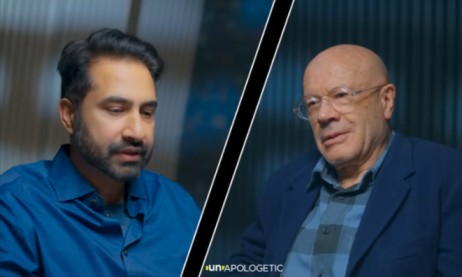
Editor’s Note: In this episode of Unapologetic, host Ashfaaq Carim sits down with scholar and political commentator Martin Jacques to discuss China’s emergence as a global leader and why the Western world struggles to understand its rise. Jacques argues that we must move beyond a Western prism to truly grasp China’s role as a civilization and its growing influence on the global stage.
TRANSCRIPT:
A note from the host: This interview with Martin Jacques on how China is rising was filmed before the US and Israel struck Iran on February 28th. As a result, no references to the war are made in the interview, but retrospectively, what I can say, as you will see, is that Martin’s argument that the West and the USA are quickly falling very far behind China probably just makes more sense right now and is even stronger. Enjoy the interview.
Welcome and Introduction
ASHFAAQ CARIM: Hi, good day. Welcome to another episode of Unapologetic. I’m your host, Ashfaaq Carim, and I’m very pleased to welcome to the studio Martin Jacques. Martin, welcome to the show.
Martin, if you’re not familiar with his work, he’s a scholar of many things. He’s a political commentator, a journalist, analyst, but for the last few decades he’s been studying and understanding and learning and communicating to the rest of the world who and what China is. About 17 years ago he wrote a book, When China Rules the World, which has sold over a million copies. You’re currently deep in the weeds with a second book on China. I don’t know if it’s the second, but your second sort of big book on China. You’ve probably written many things on China, which will come out in 2027.
Martin, you’re on the show today mainly, I think, to do what you normally do, which is to explain to people outside of China how they misunderstand China and how they need to rethink what China is and how China is and how China is emerging. Or emerged, quite frankly, already as a global leader.
I’m going to start the interview in a different way, in the sense that before we actually go through China’s history and what we don’t understand about it — normally I’ll ask a takeaway at the end of the interview — but if there’s someone listening to this, what are the takeaways you would like them to get from this interview?
China as a Global Leader
MARTIN JACQUES: Well, China is already a great power. You can’t understand it through a Western prism, and you should not expect to be able to understand it in those terms. I would argue that China is now probably the global leader, more important than the United States, and that process is going to continue. We’ll see a process of — I suppose this — this “Sinicization” of the world, as opposed to what we’ve experienced for a long time, which has been the Westernization of the world. By which I don’t mean that the rise of China will be any kind of replica of the Western era. I think it’ll be different in all sorts of ways, and that’s what’s going to be so interesting.
ASHFAAQ CARIM: Okay, so I mean, just — I was going to ask more questions, but you say it’s already the world leader. When you say that, in what way do you mean? Do you mean economically? Do you mean in terms of the impact it’s having in the direction the world’s taking? What specifically do you mean?
MARTIN JACQUES: Well, ever since 2014, China’s had the largest economy in the world, overtook the United States, measured by GDP according to primary purchasing power. Now it’s probably about 25% bigger than the United States. It is the number one manufacturing country in the world with a big lead. It is represented in all the new innovations in the economy. In fact, it’s really now the engine of innovation, much more important than the United States.
In terms of AI, it’s probably already the leader in AI, or it’s on a par with the United States. And in areas like robotics, even drugs now, China is becoming a big innovator. Electric vehicles — you only have to look on the streets to see the rise of China. China is the leader in this area.
In terms of its trading relationships, it’s a very, very big trading country. It’s much larger than the United States, and that’s very important because that means that China exists in the context of many different trading relationships all over the world, particularly with the Global South.
What the Interview Will Cover
ASHFAAQ CARIM: We are going to discuss throughout the interview — when we start the longer discussion, we’re just kind of now trying to get an understanding of what the main issues will be. We’ll start with the history. We’ll talk about how China has changed, the Cultural Revolution, the impact of colonialism on China. And I think that impacts how both the colonized world and the colonizers in the world think about China, and how the colonized world associates with China, and how the Chinese themselves think back about how they think about the world.
We’ll also talk about the sticky issues around China — human rights records, authoritarianism, all those kinds of things. But just before we go there, when I hear what you just said, that China is leading economically, it’s the biggest manufacturer — I mean, I think most people now who see the economy and see the stats, the AI debate is something that’s probably not settled, but everything else is kind of settled. Definitely the biggest manufacturer, most trading partners, those kinds of things.
But the first pushback that comes to my mind is culturally, China seems a lot more insular than — or maybe it’s just because I’m part of the English-speaking Westernized world that I think this way.
Culture, Language, and the Chinese Worldview
MARTIN JACQUES: Oh, I agree with that. We’ve always got to remember — we’ve got to pinch ourselves and remember — that China was more or less unknown to the world, and certainly the Western world, until very, very recently. This is a very recent phenomenon, probably basically a phenomenon of this century. Because in the 20th century, China was pretty invisible to most people, certainly in the way the West views things.
The leading edge of its transformation, as is true of all countries and rising countries, is economic. But the impact of other areas and development of those areas usually lags behind somewhat. And the problem with China is that it is in many ways very unknown. People don’t know very much about Chinese history. And I think if people knew more about it, they’d be both fascinated and shocked by some of the problems that China has had historically.
Because the language is so different and so unfamiliar — it’s a very different language, a difficult language to learn — in a world where the lingua franca has for some time now been English, that makes China that little bit more inaccessible, I think.
In terms of movies and so on, yes, Hollywood has dominated this area for a long time. But Chinese movies are becoming increasingly big sellers in China and that area of the world. We’ve always got to remember that the Sino-Pacific area, if you like, which includes Japan and ASEAN and so on, has quite a large population in its own right. The ASEAN countries’ population is about 700 million people.
I’ll give you another example where we’re very unfamiliar with Chinese ways — and that is the philosophy of China and where it comes from, and the great thinkers, the great sages like Confucius and so on. A lot of people have heard of Confucius, but I don’t think their understanding of Confucius is very great, and it’s not talked about in the same way as, you know, the Greeks and so on.
You can’t — and this is very important — you can’t understand the notion of the individual, the concept of the individual, the relationship of the individual towards society in China without having some knowledge of the historical tradition. Because the roots of the Chinese attitude towards the individual and his or her relationship to society are very deep and long-running.
Now, people, for example, when they’re talking about Chinese politics, say, “Oh, the reason why the Chinese don’t have enough freedom is because of the communist regime.” In fact, you could see this during the COVID era — the Chinese expect and believe in society and believe in the state in a different kind of way to what happens in the West. There’s an expectation that the state will lead, in a way that’s opposite to the United States, where people don’t look to the state and are rather inimical to the state. This is not so true in Europe, but it’s partially true in Europe as well.
So there are lots of ways in which, if we want to understand China in a deeper way — socially, culturally, and so on — we’ve got to know something about Chinese history and Chinese thinking.
Martin Jacques: How the Interest in China Began
ASHFAAQ CARIM: Okay, I want to ask you — you’ve kind of touched on what we fundamentally don’t understand about China, and that’s the main question I want to ask you now. But before that — why? I mean, you’ve clearly been studying China for a long time. Where does the interest come from? Were you just a child that was interested in China? Did it develop in your career? What made you decide, “I’m going to become this person who just goes to China a lot, studies it, understands it, tries to figure it out?”
MARTIN JACQUES: Well, I’d say it’s one of those kinds of accidents in life where, at some point, you change direction and only later do you realize how fundamental it’s been. I used to be a kind of writer and protagonist in the British political scene on the left, and I edited what for its time was a very influential and famous magazine called Marxism Today. But to be honest with you, our international coverage was poor. It was not so significant. It was a very Western-centric, above all British-centric magazine. I think while I was there, I only published one major article over 14 years on China. So that’s a good illustration.
ASHFAAQ CARIM: And you were there from, I think it was ’77 to ’91, right?
A Life-Changing Journey to East Asia
MARTIN JACQUES: So yeah, exactly right. And then when I closed the magazine, because I thought we’d just done it, all we could. And I didn’t want it to just peter out, I wanted it to go out all guns blazing, as it were. And then someone’s— this is a very personal story. You know, I’d never had any time because Marxism Today was a killer time-wise, and I never had any money because it was— we didn’t have any money. So it was one hell of a slog, you know.
And when I stopped, I was a bit better towards the end because I had acquired a certain amount of celebrity because of the success of the magazine, the influence of the magazine. So I got asked to write columns and television things and so on. So the last 3 or 4 years of it was financially easier. But anyway, when I finished, I wasn’t sure what I was going to do, actually, to be honest. And I was trying this, that, the other.
And then it so happened that I was thinking, where shall I go on holiday? And I was talking to a friend, and they said, “Well, we’ve just come back from Southeast Asia.” I’d never— I’d been to Japan in 1979 for a conference, and I was very fascinated by it, but basically I was in a hotel room all the time at this conference. So I’d never been to this part of the world, so I went.
And it wasn’t— by today’s standards, it wasn’t very imaginative, but then I went to Hong Kong, southern China, Malaysia, and Singapore. I wouldn’t recommend that choice now, but then it was incredible for me, because I knew the figures, but seeing is believing, and I was really taken aback by the modernity of obviously Hong Kong particularly, and Singapore.
And the question that was in my mind was, it’s so modern, is it Western? In other words, is this just a sort of imitation, or an adaptation — better way of putting it — of Western modernity? Or is this something rather different? And at that time, this was an argument in intellectual circles, with the assumption that globalization was westernization. That was the dominant mantra of westernization in the 1990s.
I’d read one or two things before I left. Ezra Vogel’s book — The Four Nations Miracle, I can’t remember what it’s called now, but it was a very good book for a beginner. It’s a really good book. And so that was very important.
And I remember this extraordinary sight when we were on a coach in Guangdong Province, which is north of Hong Kong. On either side of the road — it was an extraordinary kind of snapshot of various historical eras existing alongside each other. The water buffalo farmers using very little in the way of aids at all. People walking, people on all kinds of contraptions. It was a road in the middle of the countryside, but it was absolutely packed. And then occasionally you’d get this flashy Mercedes-Benz — because this was already the reform period — go by. And as far as the eye could see, they’d cleared the land. So it was an extraordinary moment. I used to be an historian, an economic historian.
ASHFAAQ CARIM: This was in Hong Kong?
MARTIN JACQUES: This was in southern China. In Guangdong Province, which became the leading province for the initial economic transformation of China. And I thought to myself, you know, this is what the Industrial Revolution must have been like in Britain in the 1830s or 1840s or earlier. But this was on a scale which was completely different because it’s so much later and China is so much bigger. But I was absolutely fascinated by that.
A Love Story and a Tragedy
And then on the last day of this holiday, I met — well, I saw — I used to run every day if I could, and when I was running, I saw this woman to the left, and she smiled at me, but everyone smiled at you in Malaysia. And I saw her later on at a jungle trek, as it happened. And she said, from behind — there were quite a few of us getting together — “Haven’t I seen you somewhere before?” I turned around and she said, “Yes, I saw you. You were running. Only a white man would do something as stupid as that.” So I thought, wow, who is this?
And then she said, “Why did you come to Tirmen?” She said, “There’s much better, much nicer islands than that.” And I said, “Always fat Ronnie used to tell me that.” Anyway, we fell into conversation, and within a quarter of an hour, 20 minutes, I’d completely fallen in love with her. And we went on a drunk chat, and I always knew where she was. And from that moment to even now, she has always been on my mind.
Anyway, to cut a long story short, of course, here we have a double whammy. I’ve got falling in love with her — she was Indian, Indian-Malaysian, Punjabi background — and on the other hand, this extraordinary intellectual political experience of East Asia. And from that moment, my life was different. I got back to England. I didn’t want to think again about the West. I thought, I’ll park that. That is my history. I’m going to take a different direction, which is exactly what happened.
ASHFAAQ CARIM: And so you just— have you seen this woman again, by the way, or not? Well, I know we’re completely digressing from what we’re supposed to speak about, but hey.
MARTIN JACQUES: This is a wonderful and terrible story. What happened was, it was very complicated having this relationship, but I was so entranced by her that I was determined to try and make it work. And she’d not travelled really at all. Anyway, I went to see her. I was actually doing an interview with Chris Patton in Hong Kong then for BBC programs, and I decided to go to KL and see her. She lived in KL, well, Petaling Jaya actually. And nothing happened. But after that, I went back on the phone, and she said to me — I said, “How are you feeling?” I just thanked her for her hospitality, and she told me, “I’m missing you.” And I knew at that moment that my feelings were her feelings.
And she came to live in England in 1994, in September. And this is a hard story to tell you.
ASHFAAQ CARIM: You don’t have to.
MARTIN JACQUES: What happened was that this was a phenomenal relationship, a brilliant relationship. Never had anything like its like before and since. And she managed to get a job at a City Law Firm. She was a lawyer. And then they asked her if she’d like to go on secondment to Hong Kong. So we lived in Hong Kong, and she suffered a lot of racism in Hong Kong from the local Chinese. She spoke fairly good conversational Cantonese because she was brought up in a Chinese area of Bataan Jail. And she was mildly epileptic.
On New Year’s Eve, at 1 o’clock in the morning — do you remember Ira Cobbsbourne, the historian? Yeah, well, they were staying with us — and she had an epileptic fit. It was only the second serious one she ever had. She was taken to the hospital, and she died in the hospital as a result of terrible negligence, in my view. Because of racial prejudice, she was neglected, and she died on the 2nd of January 2000.
ASHFAAQ CARIM: I’m very sorry for your loss.
Writing the Book on China
MARTIN JACQUES: So you can see how East Asia opened up and developed my life in a completely different way. We’ve got a son, by the way. He’s now 27. Ravi. So from that moment onwards, from that visit, my mind was absolutely consumed by this and by East Asia. And I tried to find any excuse I could to go, to write or to do a program or a holiday sometimes.
And then actually I think it was Neil Ferguson, who I’m quite good friends with, although we’re politically very different. Neil said, “Why don’t you write a book? You know so much about it, you’re always so interested in it, why don’t you write a book?” And that was the sort of — I think, I’m not certain about this — I think that was probably the first time I remember thinking, yeah, that’s an interesting idea. And that’s what I did.
ASHFAAQ CARIM: So this was, I guess, he planted this idea in your mind about 2004 or ’05, because the book came out in 2000.
MARTIN JACQUES: No, earlier, earlier. Yeah, because I’d already started working on the book — when did I get the contract? In the late ’90s, I got a contract with Penguin. And then going to Hong Kong made sense when Harry got the job, because I was obviously much more able to access the region than I had been previously.
What the West Misunderstands About China
ASHFAAQ CARIM: Okay, so coming back to my initial— thanks for sharing that, by the way. I know that’s very difficult and personal. So when it comes to understanding China, what do you think we — the people in the West who consume Western media, who may even want to empathize with the Global South, as opposed to people on the far right, etc. — what do we fundamentally misunderstand about China?
MARTIN JACQUES: Well, I think we expect China to be like us. We expect China to be Western, so we measure China by Western standards and Western values. And I understand that because the West has been dominant in the world for so long, and the ideas we’re presented with, in all sorts of ways, are Western ideas.
But we came to assume this enormous conflation — that the West was really the world and everything else was tagged on behind it, and that what was happening as these countries took off was they would become like us. Well, that’s completely not obviously true. These countries have totally different histories and technologies and cultures and so on. So they’re very, very different.
So instead of moving more and more into Western modernization, what we’re actually seeing — and this is what I was puzzled with when I went to Hong Kong originally — what we’re seeing is multiple modernities. This is not just true of China, it’s true of India, it’s true everywhere. In the Islamic world, it’s going to be different, and it’s going to remain different, and it’s not going to be a copy of the West.
China’s History Before the Modern Era
ASHFAAQ CARIM: Okay, I mean, China is a very old civilization. It’s been going on for many years, 5,000 years, if not longer. During large parts of that, they were a very prosperous nation, a key trading center of the world. If you had to explain to someone who’s new to this, to someone who doesn’t understand who China is, just up until the modern era, up until about 1500, before colonialism and industrialization takes place, just what are the key components of China’s history that make it what it is until that moment, until about the year 1500?
China as a Civilization-State
MARTIN JACQUES: I think the most important thing to understand about China is that it’s a very old civilization. I mean, the Chinese talk about 5,000 years of civilization, and for several phases in its history it has been the most advanced or one of the most advanced countries in the world.
So if you go back, just take the last 2,000 years, China was sort of unified in a fashion in 211 BC. And since then, during the Han Dynasty, part of the Tang Dynasty, part of the Song Dynasty, part of the Ming Dynasty, China was certainly extraordinary, one of the most advanced, often the most advanced culture in the world.
There is no other civilization that has had that kind of history, that when they rise and decline, as China did rise and decline, they don’t rise again to become so influential and extraordinary by global measures. And so I think what that speaks to is a kind of inner strength of the culture. Why? How? Well, it had various threads to it. A very deep belief in education and the importance of education. A very rich culture, a very rich literary culture over a very long historical period.
Confucius was around about the same time as the Greek philosophers, 2,500 years ago and so on. That was before the unification of China, and others like Mencius and so on were very advanced philosophers for their time, different from the Western traditions, but very important.
So I think what you have here is the picture of not a country, but a civilization. It’s very important that we understand that China doesn’t in the first instance think of itself as a nation. It thinks of itself as a civilization.
After 211 BC, before that for that matter, when there were lots of Chinese states before unification, they didn’t have boundaries and borders. I mean, China didn’t start developing borders really until the 19th century, the late 19th century, because it was so badly harmed by the European powers in particular. China hadn’t drawn borders, it didn’t have embassies and so on. So the whole way in which China existed was very different from what happened in the West, particularly from the Treaty of Versailles and then of course in the 19th century and so on, the rise of the nation-state. That didn’t happen. China was very different. China was a civilization.
To this day, I argue that China is first and foremost a civilization-state and only secondarily a nation-state.
Now, another feature of China is how has it held together over such a long historical period? Because it’s a huge country. It’s not as big as it was actually during the Qing period, which was the sort of last dynasty, but it’s still a very big country. Population size is about 17% of the world’s population. And somehow or other, China’s held together as a whole for a very long historical period. Most of the population concentrated in the eastern part of China and less in the central and very little in the western part of China, where the conditions didn’t lend themselves to economically rich agriculture, etc. So only about 6% of China live in the western parts of the country.
So I would say to people who don’t know much about China: you’ve got to understand all this because you’ve got to think about it in a different way to the experience in the West and the growth of a Western nation.
My view is one of the great strengths of China against a country like the United States is that it is a civilization-state in the first instance and only secondarily a nation-state, and that gives the country a great sense of affinity, a great sense of some great traditions. The state tradition in China is undoubtedly one of the most outstanding features of China. And the people believe in the state in a way that they don’t by and large in Western societies, because we’ve got a very different tradition.
The Century of Humiliation: China and the West
ASHFAAQ CARIM: Okay, I mean, I think a big part of both our understanding of China and how China views the West — and this is again just my assumption — obviously it’s the story of industrialization, colonialism, the Opium Wars, which we can go into, and then the post-World War II period, which is almost now two periods: the period of full-blown communism, Marxism under Mao, and then the Cultural Revolution, right?
All of these things are, in a way, a lot of it’s organic, but a lot of it’s reactions to the West, right? So you can go through this one by one as you like. You can maybe just talk about colonialism and then just talk about — or you can answer generally as you prefer. And if I require, I’ll ask more follow-ups because it’s a big question.
But just how is that period, the period of 500 years of confronting the West, different? Because relations between China and Europe are old, it’s because of trade routes and stuff like that. But in terms of — there’s now this emerging power that is colonizing parts of the world and has colonial designs on China and then meddles with it. And the Opium Wars is very destructive, and its first real, really massively destructive part on Chinese society. And then there’s the condescension which follows, which still exists, which fundamentally changes a proud civilization. Or maybe it doesn’t change it, but it definitely creates stimuli which makes it react differently. So how has that experience sort of impacted China, and how do you see them coming through that?
MARTIN JACQUES: Well, it’s had an enormous impact on China, and I think it was even more difficult for China to take because it’s a proud country, a proud culture, a great civilization. So to be reduced as it was by Europe — by Britain and France and lots of other countries that joined in — was a terrible experience.
But I think the crucial point here is that the reason why China was vulnerable to what happened with the Opium Wars — and it really starts big time from the 1840s — was that China had failed to industrialize. The strength of countries like Britain and France, both economically and therefore also militarily, was that they were industrial countries. And China was primarily still not an industrial country. It had bits and bobs, but it was well behind and it didn’t realize how far it was behind.
And so from that moment of the 1840s, the great challenge for China was, how do we recover from what’s happened? And how do we modernize? The great question of the 19th century — Japan had the same kind of problem. How do we modernize? First of all, there’s a need for recognition that Europe had modernized and that was the source of its strength. And then there was the question of how do we transform ourselves? And this was a long struggle in China to find the conditions for modernization.
The great achievement, in my view, of the Chinese Communist Party — well, one is to unify the country, but the second thing after 1949 was to falteringly begin the process of modernization in China. It doesn’t start with Deng Xiaoping, it starts already with the Mao era. But there are a lot of mistakes made in that period, not surprisingly. And then from Deng onwards, of course, we all know this extraordinary story of dramatic economic growth from 1978, growing for 35 years at 10% a year. Fantastic, incredible.
But I think that for China, they call the 19th century the century of humiliation. And it was — bits of China were colonized, mainly the advanced bits which became treaty ports — Beijing, Shanghai. And the nature of the colonization would be there’d be a French concession, there’d be a British concession, and so on in these places. And the colonial powers won the rights to use the rivers and basically take whatever they wanted to take. So it wasn’t like an African colonization, but it had a hugely damaging effect. And the indemnities charged and the wars that were fought and so on — China was really on its knees.
And so you got the fall of the imperial regime in 1911. And then after that, you got a very difficult period of division in China. And you got the Japanese invasion from 1930 to ’36 in northeast China, and then across most of China from 1939 to ’45.
So China — this was a very proud country, very aware — every Chinese person in their different ways knows about this history. And what they saw was China on its knees, basically. Hence Mao’s 1949 speech on October 1st was, “We’ve got to stand up, China must stand up.”
And I think there are a number of interesting threads from this. China, especially from the reform period, and Deng, understood that it had to learn from the West. So there’s a great learning phase which was learning from the West. It starts in the first period with Mao. They were linked to the Soviet Union after the end of the Second World War and so on. And then the relationship broke down in the late ’50s, and then China was very much on its own. It had very little contact with the West, relatively speaking.
And then that began to change really with the 1972 visit of Nixon and Kissinger to see Mao and the Chinese leadership. And that was the beginning, of course, of the end of the isolation of China and its incorporation progressively into the global economy.
So I think what China — China was never — well, it did have a negativity towards the West, obviously, because of how the West had treated it. But it also understood that it had to learn. China had to learn from elsewhere. They’re great learners, the Chinese are. That’s one of the reasons why they’ve been so successful over a long period of history.
And one of the advantages I think China’s had, having had a colonial experience, is that it never — it still remained independent in a fashion. It was a semi-colony, not completely colonized. So that long history of traditions of the state and so on remained there. It wasn’t ripped out. The civilizational tradition of China remained very much intact.
Whereas I think one of the terrible things that happened for a lot of countries of the Global South is that the colonial experience and the post-colonial experience deprived them of a lot of their traditions. They’ve had to rediscover them. I don’t think the Chinese had that problem in anything like the same way. The depth of those traditions, the depth of the culture, the continuity of the culture, allowed China to be able to recuperate and then achieve extraordinary things later on.
China’s Economic Transformation
ASHFAAQ CARIM: Okay, so yeah, I mean, you mentioned from 1978, 10% growth for 35 years. People sort of attribute it that those all sort of started with the Cultural Revolution, which I think is about ’91 or ’92. I mean, it has been a great story.
We will talk about what people in the West say is the bad side — and I’m not giving a value judgment — we will deal with authoritarianism, possibly the kind of monoculture movement under the Han Chinese, which we’ll get to later. But before that, what do you think? I mean, outside of the fact that there’s this very rich nation traditionally, historically, that also has great ability, great skill, great belief in itself — how did it turn itself around that much?
How did it go from, you know, lifting 250 million people out of poverty, highways and roads that are much better than anything in Europe, trains that go at speeds that are almost as fast as aeroplanes, huge factories the size of towns? I mean, this is just something that’s a bit mind-boggling. How did that happen?
China’s Governance and the Nature of Its Power
MARTIN JACQUES: I know it’s the most extraordinary story. It really is. You can’t— I think you captured it very well. If you go to China now, I’ve said this for a long time to people. I said, when you go to China, you’ll never ever see the world in the same way again. Never. Because the Western mind always has the West at the center of it, and you go to China and you realize that actually we’re not the center of the world anymore. The center of the world is somewhere around here.
China’s modernity now is well in advance, in my view, of anything in the West. Anything. This extraordinary innovation across such a wide— it’s throwing up new companies all the time. Where there were none, there are now larger and larger, more and more companies with extraordinary capacities for innovation.
So, how did this happen? I think one of the important things to understand about China is that, first of all, it’s got an extraordinarily competent leadership. Chinese governance is hugely more advanced than what you get in America or what you get in Europe. They know how to run things. They’re not a bunch of lawyers who are running the show, which is the kind of leaders we get here.
ASHFAAQ CARIM: We used to get lawyers. Now we get people who are just trying to get votes and do funny stuff.
MARTIN JACQUES: And yeah, but in China, if you look at the standing committee, quite a proportion of them were educated at Tsinghua University as engineers, as scientists. So they know how things work.
The way the Communist Party works— the Communist Party is a very organized, interesting organization which you must take seriously, and not just wallow in a sea of prejudice against it because of what happened before which we don’t like or didn’t like. If you look at Xi Jinping’s career, he started off being a leading figure in a small town and then eventually in a province. So he’s got 40 years of experience of knowing how to run things. I mean, what does Keir Starmer know about running anything?
We’ve got this kind of system of governance here where we have allowed people to become the leaders who are supposed to run the country, and they don’t have any experience of running anything particularly. So I think that professionalization of leadership and governance is very important to what’s happened in China.
I’m not going to argue for a moment that we should have the Chinese government system here, because it’s impossible. It’s a totally different history. But we need to learn from them. That is very important. Learn the best things. But if you keep pushing it away and being negative about it, well, you don’t learn anything.
The Transformation of Chinese Society
MARTIN JACQUES: Another aspect of this process that you’re talking about is that the innovative capacity of China over this historical period, especially since 1978 and Deng, has been that the innovative impulse is not just the people who invent things, or the people who run companies, or the people who run the state. It’s much deeper than that.
If your economy is growing at 10% a year from 1978 until 2012, it means the economy is doubling in size every 7 years. It means living standards have basically kept pace with it. The living standards have been transformed— doubling every 7 years. And if you think of a family, think of the generational gaps between the grandparents, the parents, and the kids. Their experiences are of very different societies. Education, schools, hospitals, all of these institutions are being transformed in the same kind of way.
There’s a comprehensive modernization taking place. Who’s doing it? The people are doing it. The people are transformed by this process. They’re not external to it, they’re absolutely bound up in it. And so what you’ve got is a really basically very educated and sophisticated population as a result of all these changes. It’s not all happening over there outside the people. The people have been transformed by it.
If you look at the people who are running the companies or even the state, they don’t come from posh backgrounds. There is an element of that, but most of them have been transformed by this process, and they become leaders and so on.
The One-Party System and Human Rights
ASHFAAQ CARIM: Okay. When you hear China being spoken about on Western channels, on Western media, the big thing is this is a one-party state, lack of freedom of expression, no human rights, or less human rights. What is true about that, and what becomes untrue because it’s not explained properly?
MARTIN JACQUES: It’s very different from here. We’ve been brought up in such a different tradition. In a way, China’s always been a one-party system ever since 2,000 years ago, because the Imperial Age was essentially one— the imperial regime was the party, if you like. That’s the tradition over 2,000 years.
Francis Fukuyama makes a good point in one of his books. He said, “I can’t think of another country in the world where the tradition of governance displays such a powerful continuity as it does in China.” So it’s what China is. China is never going to be westernized in the same way as we are, because 2,000 years is a hell of a long time to be acquiring, trying tradition and practicing those traditions.
The Chinese don’t expect other countries to be like them. It’s not like the old Soviet Union. The Communist Party in Britain in 1935 produced a program called “For a Soviet Britain,” and that was the mentality of the Soviet Union. But the Chinese aren’t like that at all.
ASHFAAQ CARIM: But they weren’t like that 2,000 years ago as well. They were not trying to impose their way and their values.
MARTIN JACQUES: Correct.
ASHFAAQ CARIM: Maybe they were trying to win victories and maybe they had imperial policies, but they weren’t looking at outsiders saying, “Become like us.” It’s like, you will become a subordinate to our partners, but become yourself.
MARTIN JACQUES: Yeah. If you go back to the tributary system, which was China’s world system within its region— world equals a region then— it did not interfere with the governance of the tribute states. The only requirement it really had was to accept that the Chinese emperor was the Son of Heaven, and that Chinese culture, Chinese thinking, Confucius and so on, were the great thinkers. It had no political requirements.
ASHFAAQ CARIM: I mean, that is political though.
MARTIN JACQUES: It is political, of course.
ASHFAAQ CARIM: It’s almost like that now, because when I spoke to a few Chinese people on the podcast, and even when I hear their response in the media, it’s also like they treat One China almost like that kind of thing. When you push back on Tibet, it’s like, “We’re fine with Tibet as long as—” and then they must believe in One China. It’s the same with— so it’s almost like you can do what you like except this major big political thing, and when you do that, then you’re fine.
MARTIN JACQUES: Yeah, when you’re part of China. Yes, they definitely have their red lines. The point I’m trying to make is that China is not interested in regime change. It has no— it doesn’t believe in it. Why? Because I think China thinks of itself as the Middle Kingdom. That historically is how it saw itself. So nowhere could be like China, because only China could be like China. There was a sense of achievement and in some senses superiority, I think, in the attitude.
To this day, they don’t want to interfere. It won’t be like the British and American tradition— the colonial tradition and then the American tradition, especially post-1945. They’re not interested in that. Very important to the Chinese is the economy and trading. What they’re brilliant at historically over a very long period of time— and there’s a very powerful work tradition in China. They’re very hard workers, the Chinese are.
The Belt and Road Initiative
ASHFAAQ CARIM: Okay. I want to start getting to the Belt and Road Initiative and how China is sort of building a business-friendly empire that helps them center themselves in a way, but also possibly has— we want to talk about whether those spin-offs for other nations are positive or negative and in which way.
But before that, just to reflect over what you said, it sounds a lot like— I think Western identity of greatness or of being efficient comes from a colonial idea of expansionism and comes from subjugating other people and comes from an idea that we are better and superior, which aided the colonial project. America obviously took on that mantle. I think MAGA in some way now— the new MAGA movement, which is becoming less interested in instigating foreign wars or anything else— still sees its supremacy but is maybe becoming inward.
But I think China is older than that and never had that expansion. It had an imperial sense, but it was always about, “We want to be China.” Whereas if you’re in Western Empire, the more power you can project on the rest of the world, the greater you are. But with China, it’s the more you can be true to who you are and be efficient and great as your Chinese kingdom, the better. And in that process, what happens to the rest of the world is none of their business. But it’s like, we will work with the rest of the world in that. Maybe that’s how I’m trying to understand it. But now let’s talk about the Belt and Road Initiative.
MARTIN JACQUES: By the way, I agree with the way—
ASHFAAQ CARIM: Okay.
MARTIN JACQUES: Good.
ASHFAAQ CARIM: So China are basically building a lot of infrastructure on land and in ports in various parts of Africa and in mainland Asia, or at least the southern part of Asia, connecting trade routes with its neighbors and other countries, putting a lot of investment. When I first heard of the Belt and Road Initiative, it seemed like it was this infrastructure project. But now I’ve come to know that it’s a much bigger project. It’s about opening up highways and ports in the world, almost providing the seed money for infrastructure with obviously leverage.
What’s at the heart of the Belt and Road Initiative? Its critics say that it’s a form of soft imperialism, almost— I don’t think it’s colonization in the Western sense. People were enslaved and languages were erased. I don’t think it’s that, but they say it’s a form of neocolonialism. What’s your response to that? What do you think it is? Tell us what it is, and then tell us also what you think are the problems with the critiques of it, or maybe the criticisms are correct.
Belt and Road Initiative: China’s Global Vision
MARTIN JACQUES: Yeah, well, I think that Belt and Road, when it was first announced in 2012-13, no one could work out what the hell it was. There were two major speeches that Xi gave, one in Kazakhstan and one in Indonesia. And I think the idea as presented initially was that, look, China’s grown. It was directed at the developing world. It was not directed in any serious way, except at the edges, towards the Western world. And the idea was that, look, we’ve managed to grow and transform our economy and raise living standards and the role of the state’s been important and so on. So it was really a development program for the developing world based on Chinese experience.
I think actually only China could have thought of something like this, because it’s extraordinary. There are 146 to 150 countries part of Belt and Road. I mean, it’s an extraordinary global enterprise. It embraces the majority of humanity now because there are only 190 countries in the world. And I think that it speaks to the historic achievement of China, being able to take on extraordinarily big projects, whether it was the Great Wall or whether it was the tribute system or what have you. China has this sort of global view. I think it comes from the fact that it was a civilization.
And this is a very important point and we haven’t discussed it, but China grew up from — this is way before the Qin Dynasty and the unification of China — China grew up with a philosophy of tianxia, everyone under heaven. And I did mention earlier that China is a civilization. It doesn’t have boundaries, natural boundaries. So there was a very interesting Chinese philosopher, Zhao Tingyong, who argued in an article in 2005 that China has essentially a worldview in a way that the West does not have a worldview. China believes in the concept of the world. The West doesn’t really. The West believes in a concept of nation-states, as you can see in the United Nations. I mean, the nearest we get to a world thing is the United Nations, but it’s based on nation-states.
So the Chinese philosophical view was that China’s relationship with the world should be genuinely global. And this is reinforced greatly by the experience of colonization and China’s identification with the colonial countries, which is very, very clear after 1949, you know, 1955 and the Bandung Conference and so on. This was central to China’s thinking. And Mao was very committed to China’s relationship with Africa. He identified with Africa. Of course, at that stage, China was poorer than quite a number of African states after the end of the Second World War.
So I think that we have to see Belt and Road in these other traditions — there are various traditions and historical experiences and philosophical conceptions which flow into this notion of Belt and Road and lie behind it, because it’s not a natural thing. There’s no model for it other than perhaps bits of Chinese history, but elsewhere there aren’t any things like it. I think this was the thinking behind it.
And that notion has developed a lot with the Global South now, as we tend to call it, the developing world. China’s foreign relations are first and foremost based on its relationship with the Global South. Beyond that point, it doesn’t trust the West.
The Debt Trap Criticism
ASHFAAQ CARIM: I can see why. The West doesn’t trust China. But what do you think about specifically that criticism? For example, they’ll build a bunch of ports in Sri Lanka, or they’ll build a bunch of ports in various African countries on the east coast or even the western coast. And then there’s a criticism that obviously they put down the investment, they usually bring in Chinese workers to an extent to help with that. But then the criticism is now that country is indebted to it. And so China has leverage over them and can impact their policies, whatever it may be. What do you think?
MARTIN JACQUES: Is there some truth in that? Yeah, I think there is some truth in that. But I think that part of it was inevitable in the sense that, you know, you want to establish this or that infrastructure project, railway, whatever it is, in a country, and obviously a Chinese company does it because how else are you going to do it? And then you haven’t got a labor force that has the necessary skills, and so on. So the Chinese company feels more comfortable with Chinese workers because they’ll follow the disciplines and so on. I think one can understand the reasons for it without saying, well, this is a neo-colonial project.
And I think that if you look at what’s happened, so many countries have signed up to Belt and Road, so many countries, with big projects. The Belt and Road is actually a microcosm of the way the world is moving in terms of a global order. Because the new global order, in my view, that will replace the present global order — the axis of that is going to be China and the Global South. That’s going to be — this is also, in my view, a great possibility because historically, in the British Empire and the American Empire sort of thing, these were tiny minorities running the world. But if there is a genuine possibility, which I think there is, of a global order based in the first instance on China and the Global South, that’s 85% of the world’s population. So one can imagine a majority — the first majoritarian global order. I’m not going to say that it’d be perfect. I’m not going to say there’s nothing wrong with it. But historically speaking, it will be a great advance on what’s happened in the past.
Human Rights, Xinjiang, and China’s Contradictions
ASHFAAQ CARIM: Okay, I want to discuss the future more. I want to discuss Donald Trump, and I’ll discuss potentially India, which has a fractious relationship with China at best. But before that, I mean, when I agree with a lot of what you’ve said, and I think a lot of people listening would agree with a lot of what you’ve said — I think increasingly China gets soft love from people in the sense that they may still decry China or worry about it, but they kind of admire it. They admire its advancement. They admire the fact that it has all these interesting EVs which cost a third of what Western cars cost and are just as good, at least in terms of their features. We don’t yet know about how their engines will perform in 10 years because they’ve only been on our streets for 3 or 4 years.
But when it comes to the issue of human rights right now, the West has lost a lot of credibility, honestly, over 400 years on human rights. But specifically, I think it’s been very visible in the last 2 or 3 years. And it’s not a new thing. If you go back to the war in Iraq, if you go back to Vietnam, if you go back to the war in Korea — I mean, people were struggling in the ’60s and ’70s and ’80s for racial equality, and there’s still lots of racism in the West. So there are lots of issues. But besides those issues, it seems like there are valid concerns about scapegoating China for a lot of other things. Locking up these dissenters. There are lots of reports from very credible organizations that I’ve relied on as a journalist — Human Rights Watch, Amnesty — about the awful internment of Uyghurs in Xinjiang.
In my reporting career, I’ve met people who are Uyghur who have told me horrifying stories about their relatives going missing. The fact that they are overseas themselves means their family is already in jeopardy — people they can’t contact anymore. So it’s a weird thing because even I’m sitting here listening to you and I want to be like, I want to be a fan of China. But then I’m like, but there are all these horrible things going on. How do I put the two together?
MARTIN JACQUES: Well, really, the question you’ve raised, particularly Xinjiang.
ASHFAAQ CARIM: I mean, it’s that.
MARTIN JACQUES: Yeah. I think that generally, China is a pretty — well, very law-abiding but also lawful society. It’s not that people are locked up on the basis of nothing. It’s a very sophisticated society in China. And when people are talking about it, it feels like they’re talking about the Cultural Revolution or some period like that, when there were a lot of arbitrary arrests and so on. I think it’s a much more lawful society now as it’s developed and as it’s become more and more educated, and as it’s become more aware of the importance of its own reputation internationally. I think that’s another factor that’s been shaping the way China reacts and deals with things.
The question of human rights is used in a very wide way. I’ll come to Xinjiang because it’s important, but what are the rights of people in China compared with the rights of people in the West? Education — they’ve got an excellent education system, in many ways probably better than here for everyone, or the vast majority. Attitude towards poverty — they’ve actually taken 800 million people out of poverty since 1978. Including — and they must be the only country in the world to get rid of extreme poverty in that campaign a few years ago, which required extraordinary amounts of investment. So in the rural areas, they’re still poor, of course, but they’re not as poor as they were. Can you imagine that happening in the United States or here? I don’t think so.
Actually, what’s happened is that in the last 34 years, inequalities have worsened, and there have been no really major positive steps to try and intervene in that process and help those who are the least fortunate. Geographical areas have fallen behind. The life expectancy in Glasgow compared with London — 10 years difference. So I think that’s a very important aspect of human rights which the Chinese have been very proactive about.
Now, when it comes to politics — look, the lines of what’s acceptable are drawn much more narrowly than here, in a way that we British people would not, I think, tolerate or would not like. And under Xi it’s probably got worse. Although I personally have come to the opinion, actually — I didn’t have this so strongly before — but he’s been a remarkable leader for China. But early on, it definitely became more restrictive in terms of what people could say and write and get published and so on. Having said that, of course, the internet has opened up. Something like Weibo, which is their version of Twitter, is very, very argumentative.
Free Speech and Weibo
ASHFAAQ CARIM: What can I say on Weibo and what couldn’t I say? I’ve never been on Weibo. Most of our listeners or people watching this would never have been on Weibo. So to give us a sense of just how restrictive or non-restrictive it is — I’m guessing I can’t say anything about Xi, and I can’t say anything probably in defense of Xinjiang or Tibet. But what can I say and what can’t I say?
The Question of Free Speech and Censorship in China
MARTIN JACQUES: I think there’s a lot of controversies in China, a lot of arguments about the internet, about social media, about the big social issues. It’s a sophisticated society with a lot of educated, sophisticated people who’ve got ideas and thoughts. And so the idea that they can’t say anything about anything particularly — that is complete nonsense. That’s just wrong.
But if you wanted to argue — you see, it’s a society where, can you argue for the creation of another political party or something like that? I doubt it, but I don’t really know the answer to that, to be honest with you — where the limits would be drawn.
My own experience was — because I contribute to Weibo, or used to, I don’t think at the moment particularly. The only time I had one piece taken down — I can’t remember what it was about. But I remember another piece where it got changed because you’re not allowed to mention Xi Jinping’s name. You can say “the leader” or various other ways, but you’re not allowed to say it, even if it’s praise. Because it was the way I referred to it — it was not negative, but yeah, it was just sensibilities, you know. China’s got its own notions of honor and codes about what you can say, just like we have.
The universities have definitely become more restricted during this last period.
ASHFAAQ CARIM: In what way? Like, how?
MARTIN JACQUES: Give me an example. Well, I think the range of lecturers at universities who you’re invited to speak — it’s become more controlled. I don’t agree with that. I think that’s a negative, definitely.
Corruption and the Xi Jinping Era
One of the problems that happened was that in the last years of the Hu Jintao era, which was 2002 to 2012, there was a lot of corruption, and the corruption was growing. It was particularly within the public sector, with some civil servants and the Communist Party. And people were losing some faith — they resented the fact that people were getting on because they were getting rich or getting promoted, enjoying the benefits of corruption and so on.
So when Xi came in, one of his first big things — maybe the first big thing — was an attack on corruption. And it was very, very strict. People in public office faced very strict limits on how much they could earn, what else they could do, whether they could accept gifts, all those kinds of things. So it became very puritanical, if you like, compared with what it had been.
But the problem was that this was a very important political struggle over the standards and the values that governance had to embrace. There was a strong view that corruption was corroding society. I think there was no question that this was true, this was happening. So there was a big new wave of controls instituted to stop this. And in the process, I think it went into areas where it shouldn’t have gone.
But I mean, I think this is a much more complicated question than the way we normally discuss it. China’s incredibly innovative, incredibly inventive. People now remember the old Western line used to be, “Well, China will never become a leading modernized economy because it was a communist state and didn’t allow discussion and didn’t allow debate.” And what’s happened is that it has become that. There is clearly a lot of discussion and debate in China, but it’s just different.
I think if you were British and you were living in China and you spoke Chinese, you’d find it difficult to adapt to that, but not impossible — because you’d start to see the logic of it and ultimately, I suppose, respect it. But anyway, I’m blathering along there.
The Xinjiang Question
ASHFAAQ CARIM: So yeah, okay, but I mean, coming back to Xinjiang, which you said you’d get to—
MARTIN JACQUES: Sorry. Well, I find it very hard to get to the bottom of Xinjiang. I’ve been to Xinjiang once, just once, to Urumqi. I think the trouble with the situation is — well, I think the Chinese made some serious mistakes. One was to allow far too much Han emigration into Xinjiang, with the result — it’s much higher than, for example, what happened in Tibet. Tibet still has a low Han population as a proportion.
ASHFAAQ CARIM: But was that intentional?
MARTIN JACQUES: I think what happens is — well, I think some of it’s intentional. Chinese firms recruit Han, and some of it is unintentional — yes, you know, Han seeking opportunity. Like any migration, you know, even internal migration in Britain where you think, “I’m going to leave the Northeast because I want opportunities, I’ll go down there.” And the Chinese are very entrepreneurial. I said earlier, they’re very hard-working, very entrepreneurial. They’re really absolutely natural at it. It’s obviously centuries of—
ASHFAAQ CARIM: No, no, I mean, just in—
MARTIN JACQUES: So they go. And then they become wealthy, because the Uyghur were basically in the poorer areas near the oasis and so on. Until a generation or two ago, they were partly nomadic. They came from a much different background, and they didn’t have the networks with the rest of China that the Han would have in Xinjiang. So there was a growing sense of resentment amongst the Uyghur towards the Han.
ASHFAAQ CARIM: Okay, but how does that then result in internment camps and suppression of their identity and people being—
Tensions, Violence, and Repression in Xinjiang
MARTIN JACQUES: Well, I think the situation led to friction. We have to go back a bit here. We have to go back to — was it 2009 — when there was a pogrom by Uyghur in Urumqi, resulting in quite a few Han deaths. And immediately afterwards, there was a big Han demonstration. So you have a bit of a powder keg here between the two.
And you had the development of more hostility towards the Han and towards Chinese things amongst the Uyghur population. And so this was suppressed, repressed. When I went to Urumqi — it was 2015, I think — on the face of it, everything was quite calm. In the hotel where I was staying, they had scanners, but no one was operating the scanners, so it felt quite laid back. But if you went to another area, you’d suddenly see a police van — a kind of militarized police van — and a whole load of police, obviously there to deal with something. There’s obviously a problem of terrorism. It reminded me a bit of the Troubles in Northern Ireland.
ASHFAAQ CARIM: But I mean, I think terrorism is a bit of a scapegoat. I’m not trying to say that there are never acts of violence by the Uyghurs, but — I mean, I haven’t been to Xinjiang, but I have been to Kashmir, and what you’re saying sounds a lot like Kashmir, where there are acts of violence because Kashmiris are upset that they are being marginalized, that they are being suppressed. But the solution to that isn’t stricter checkpoints and more militarization. The police presence there incites a reaction, it incites violence, and is a form of uprooting. In Kashmir it’s seen by the locals as occupation. In Xinjiang, probably it’s not occupation, but it’s seen as a sense of control of who they are. And it’s definitely not the way you manage the problem.
MARTIN JACQUES: I agree with that. I agree. I think you’re right. At the end of the day, you can’t solve a problem like that by repression. You have to listen to what the grievances are.
ASHFAAQ CARIM: And the thing is, I don’t think there’s a lot of that happening. There isn’t a lot of dialogue. There’s a lot more suppression or control occurring.
MARTIN JACQUES: Well, I think the situation has gone through different phases. There was a phase after the pogroms where they tried to — I can’t remember the historical phase now — but there was a phase of repression. And then from about 2010 to 2014, something like that, a more liberal regime was introduced, and the violence got worse. So then around 2015-16, they put another guy in running the show. The key job is a party job, not the state job, and the party job is always Han, never Uyghur. The head of the government might be Uyghur, but the real power lies with the party in that situation.
The guy that came in had a very repressive view, and I think that’s when you got this new wave of repression. But obviously the guy who came in was backed by Beijing — he’s appointed by Beijing. The Chinese are nervous about this. I remember I was at a conference with lots of international people, and I was one of the ones who could ask a question. The person speaking was the then vice president, and my question was about Xinjiang. I asked a succinct question, and the only question that was never replied to was mine. They just didn’t want to talk about it. I think it’s a very big problem for them.
ASHFAAQ CARIM: Do you think they see it as a big problem? I mean, when I’m having—
MARTIN JACQUES: Yes, I do. Because one of the things that really strikes me over the last several years is the huge amounts of money they’ve been putting into Xinjiang. It’s the fastest growing province and has been for some time now.
Why Is China Pursuing This Policy?
ASHFAAQ CARIM: But I mean, how are they planning to deal with the situation? Are they hoping it goes away? I mean, what I don’t understand from the state is — it seems like this is a very efficient state. Fair enough, they have a very different culture in terms of freedom of speech, very different culture in terms of leadership. I can get all of that, but the Xinjiang thing — and I mean, it’s other things too — but I think Xinjiang, let’s just focus on that because it’s sort of the key case study that exemplifies all of these issues.
As a very smart, efficient nation and government, you surely see a more intelligent way to deal with this problem than repression. And you don’t seem to be letting up. This is a publicity problem, it’s an efficiency problem, it’s an immoral thing. So I don’t understand it. Why are they pursuing this policy?
Ethnic Diversity and the Uyghur Question in China
MARTIN JACQUES: I think that’s a very good question, a fair question. I think we need to stand back and ask a question about ethnic diversity in China. China is obviously the product of many, many different races over time. And yet today, something like 93, 94% of the population would describe themselves as Han. Han is not actually a racial category, but that’s how it evolved from the 19th century.
You can see, if you go to China, there’s a lot of ethnic diversity. They recognize ethnic diversity because that was part of what they did after 1949. There were 54 ethnic groups, whereas previously under Chiang Kai-shek and before that, there was no ethnic diversity, no recognition of it. So that was an advance.
I think that what’s happened historically with the development of China is that ethnic diversity has weakened with the process of Han-ization, if you like.
ASHFAAQ CARIM: So a state process, a state project.
MARTIN JACQUES: Well, there’s an element of this, the state’s involved in it, but also it’s at a popular level. Take the Manchu — the Qing Dynasty. Two of the last three dynasties in China were non-Han. One was the Manchurians from the northeast, and that dynasty lasted from the mid-17th century till 1911. Then there was the Ming Dynasty, which was before that, which was a Han dynasty and lasted about 200 or 300 years. And then before that, for 100 years, you got the Yuan dynasty, which was Mongolian and which was very different in lots of ways, drawn from the steppes and so on.
So one has to try and understand China’s attitude towards ethnicity and how it operates and how it works in the context of this kind of historical tradition. It’s not just a Muslim problem particularly, because the Uyghur are the second biggest Muslim group in China. The biggest are the Hui, and they are very integrated. But they come from historically different geographical regions from where the Uyghur came from. So they’re very integrated and very successful, by and large. But the Uyghur have not been successful.
The Chinese mentality is very much an urban mentality — they live in cities, they go to cities. So I think there’s an element of prejudice involved in that. There are obviously multi-layered sources of prejudice amongst the Han in Xinjiang, for example. They look down on the Uyghur, and the Uyghur resent that, quite rightly, quite understandably. I think that was a colossal wrong move, whatever they were doing in those — I mean, they’ve been described as kind of semi-prisons. I don’t buy that.
ASHFAAQ CARIM: I don’t not buy that some of the conditions in some of those camps at times are really, really bad. And then there’s not just the camps, there’s the infrastructure around the camps. The fact that people are taken, no one knows where they are. There’s the atmosphere of you can’t speak. There’s the atmosphere of if you have —
MARTIN JACQUES: We haven’t had that kind of coverage recently, have we?
ASHFAAQ CARIM: No, but I don’t think it just disappears. I don’t think systems of power that oppress you just go away overnight.
MARTIN JACQUES: No, no, no. That was an extreme form.
ASHFAAQ CARIM: Yes. But there are still many, many Uyghurs who are living in London or in other parts of the West who still aren’t in contact with their family, don’t know where they are. So yeah, it’s ongoing.
MARTIN JACQUES: It’s not that there’s an ongoing problem — it’s been going on since the 1930s. It goes back a long time. The particular problem, I think, for the Chinese is — and you alluded to this earlier — this notion of unity of the country. And the problem with the Uyghurs is that a section of them think they should be independent from China. And I think that is the problem.
ASHFAAQ CARIM: There’s this Han monoculture. There’s a move to kind of have a monocultural sort of China, which I think feeds into it — which I think is both a state project, and I could be wrong here, so please correct me — but also I think it’s aspirational for the people. So many people who are possibly more ethnically diverse than Han now want to be associated with Han because it’s being associated with the China that’s on the rise, this new rising dynasty, sort of.
MARTIN JACQUES: If you take Manchuria, the decline of people who are speaking Manchu — it’s obviously partly because they want to be associated with this new urban society.
ASHFAAQ CARIM: Yes, exactly. It’s something that’s happening in India now, where people are excited about the state’s prosperity, and so they’re adopting Hindu nationalism as part of their identity, not because they necessarily love Hindu nationalism, but because they see it as a conduit of India’s new success.
The Future: US Decline and the Rise of China
ASHFAAQ CARIM: Okay, so now probably the crux of — the main part of why we’re having this conversation — which is the future. A U.S. decline seems to be occurring. Some would say no, the USA is still really amazing — it’s got the 7 biggest companies in the world, the strongest military in the world. Donald Trump is, you know, a manifestation of that greatness because he just goes and kidnaps presidents. And others will see the complete opposite. They’ll say the economy is in decline, its relative strength to the world is in decline, its relative military strength to the world is in decline.
I’m assuming you take the view that the US is massively in decline and China has already eclipsed it or is about to eclipse it in many ways. How is the world going to change in the next 20, 30 years based on the rise of China and the decline of the US? And where do you see US-China power working itself out in the future?
MARTIN JACQUES: Looking at the statistics, there’s no question that relatively speaking China’s been on the rise and the United States has been in decline. The significance of Trump and the rise of Trump was that he gave voice to that unease in American society. The conditions of many working-class Americans had been declining over quite a long time, or stagnating, and people were increasingly frustrated by and let down by the American presidencies.
Trump articulated the anger towards and fear of China, which had not really been articulated except in traditional ways in the US at that point. And in so doing, he’s, I think, recreated or redefined the American political stage in a very profound way.
A number of points we might draw from that. First of all, American democracy is under significant challenge. Trump himself is a sort of neo-autocrat, the way he operates. He’s ruled essentially by edict and completely bypassed Congress. The way in which the government sends in ICE people to essentially attack migrant communities, weaken them, or banish them from the country — America is changing in a very significant way.
Meanwhile, America has, with the whole tariff regime, recognized the weakness of the American economy as a competitive unit in the world and introduced tariffs as a means to try and readjust that situation.
I think Trump marks globally a retreat. He talks about the Western Hemisphere. Greater America is Greater America within the context of the Western Hemisphere — Greenland, for example, is talked about in that context. That’s a significant retreat from the United States as the global hegemon. Previously the question was international order, the United States as the leader of the international order. Now Trump is talking in hemispheric terms rather than global terms.
The other element is his attitude towards China. For Trump, the real enemy is China. But in the clashes he’s had with China, at each stage he’s been forced to retreat — in April, and then more recently. The reason is the rare metals threat and so on. China’s too strong now for America. Trump would like to roll back China in some way. That’s how it all started — when he came in in 2016, that’s what he thought he could do. And they can’t do it and they won’t be able to do it, because the situation is getting worse all the time.
ASHFAAQ CARIM: Worse for the Americans.
MARTIN JACQUES: Yes, sorry — worse for the Americans. And China’s getting stronger.
China’s Strategic Preparation and Technological Rise
MARTIN JACQUES: China thinks strategically. After the first term, I think the Chinese learned a lot. The first term, they weren’t really prepared for it. They’d never seen anyone like Trump before. They’d had American leaders they’d been dealing with ever since Nixon in 1972 — relatively, you know, they’d been part of a certain liberal America which we’re familiar with. And then along comes Trump, who’s a totally different kettle of fish, someone we haven’t seen in modern times as an American leader.
The Chinese, because they’d cooperated with America ever since 1972, had a relatively benign view. They knew it was competition and all that, but they didn’t think of America as the enemy, and they were grateful — they learned from America, all the technology and so on. What happened is they learned that America could not be trusted.
In the Communist Party leadership, ever since Jiang Zemin, there’d been a view that China just had a certain period of development before America tries to put a stop to it. And that’s of course what happened. But when it actually happened, I don’t think they were really prepared for it. They realized that America couldn’t be trusted, and they prepared meticulously for the return of someone like Trump — Trump 2.0.
One of the most interesting and graphic examples is that the Chinese greatly reduced their dependence on the American market. Between 2016 and 2024, the Chinese reduced the significance of China’s exports to the American market from, I think it was 19, 20% down to 13%. That’s a big reduction in a very short space of time. There was a self-emphasis on self-dependence.
If you look at the difficulties in the Biden period over chips — China was significantly behind America at that point, behind America, the Netherlands, and Taiwan. The Chinese knew which industries they had to develop, knew which components they needed to be able to compete in, and now they’re still behind in chips but not very far behind. Jensen Huang from Nvidia is absolutely right that if you do what you’re doing, you’re just going to create a very competitive and large Chinese computer industry which will outcompete you. And that’s in the process of what’s happening.
On AI — China was significantly behind, but I don’t think it is anymore. Reading the commentators at the moment in the Financial Times and other places, there’s a general view that probably China is more or less on a par, in some ways ahead. Remember last January, a year ago, when DeepSeek — open source. The way Americans do it, many can’t afford to buy AI, but open source enables all sorts of people to use it.
The West in Trouble: Trump, Alliances, and the Future
ASHFAAQ CARIM: I want to just have a comment and then I’ll have a final question. I think the comment is that — and I want your reflection, your response to the comments, and then the final question. I think you see Trump, in my view — I think the key here is that he’s not strategic. And I think America, if they were really interested in ensuring that China doesn’t become a rival to them, they should have been much more smart about identifying that about 25 years ago.
But they were caught up in a bunch of silly wars, silly wars which are very identitarian in the Middle East, in other parts. And their foreign policy — I just think they underestimated China. They were like — which is a racist view as well — these guys will never—
MARTIN JACQUES: It is a racist—
ASHFAAQ CARIM: Yes, these guys will never actually compete with us, until they suddenly had better goods and everything else. But I think the other thing is that Trump’s going about trying to have this war on China, but instead of isolating China, he’s isolating the US.
He’s not trying to build strong alliances with Europe and other partners to say, “Hey, we’re in a problem here, there’s this massive Chinese state civilization that’s going to come and destroy us all.” Not that that’s true at any stretch of the imagination. Or even that it’s a threat to our economic dominance, a threat to our cultural dominance. He’s isolating the Europeans — because he’s fighting everyone. Which is just a mixture of stupidity and bravado, and it is bound to fail.
But the thing is, I’m guessing that that instinct will self-correct at some point, if not in Trump then in the US administration. And if Europe has some — and they will have — they do have skin in the game. So do you see some sort of future — before we get to the final question of how this is going to change the whole world — maybe 4 years or 6 years or 10 years, where the Europeans and Americans and others who feel the threat from China’s dominance, either economically or culturally or militarily, do you see them working together in a more constructive strategic way?
MARTIN JACQUES: Yes, the West. I think the West is in big trouble. I think probably, with Trump — I mean, a lot of what you said about Trump, I agree. I think that with Trump, America’s definitely — it’s not just Trump. Trump’s reflecting a groundswell of opinion in the United States which is a return to the past, really. America on its own. Prior to the First World War, America wouldn’t have been bound up with all these international organizations and all that kind of thing.
ASHFAAQ CARIM: But it also just wasn’t the same country that it was. I mean, it was a rising power, but it just wasn’t — the rest of the world had colonies and America had itself.
MARTIN JACQUES: Yeah, but America was — it was America alone. And this is what Trump believes. He believes everyone else is inferior. If the Europeans won’t do our bidding, then we’ll kick them into touch. So I think that we don’t know the answer to these questions because they lie in the future, but I think that basically the West as we’ve known it is over. That idea of the Atlantic Alliance and so on — that is going to weaken, I think.
ASHFAAQ CARIM: So you don’t think it’ll strengthen after an initial weakening because they’ll realize—
MARTIN JACQUES: Oh well, it could do. That is a possibility. We’re in the land of the unknown here. Because obviously there’s going to be a lot of changes in Europe as well. I mean, we haven’t really seen — Europe has just been doing two things: moving to the right, or the rise of the far right, on the one hand, and on the other hand, trying to appease America. And with Trump, that’s been its preoccupation.
And then there are now strong voices saying, “Well, we’ve got to stand up to America, we can’t allow Greenland,” etc. Europe made a mistake in not responding to the tariff threat the way that it should have done, from April 2025 onwards. So my feeling is that it will be very difficult to put that back together again.
South Korea, Japan, and Taiwan
Now there’s another aspect to this. When you talk about alliances, it’s not just America and Europe — it’s America and, for example, South Korea, Japan bases, Taiwan. I think in this situation Japan is a problem of its own and its own making. But South Korea, I think, isn’t going to go with America.
ASHFAAQ CARIM: I mean, it’s true, it can pivot.
MARTIN JACQUES: Yes. It’s going to play it both ways, but it’s probably going to lean more and more towards China.
ASHFAAQ CARIM: Yeah, even if unintentionally, but it will.
MARTIN JACQUES: Yeah, definitely. And Taiwan is going to become part of China. I think that is absolutely inevitable.
ASHFAAQ CARIM: Do you mean in a more soft way, or do you mean in a hard way?
MARTIN JACQUES: I think China has shown enormous patience. There’s a quote in Kissinger’s book on China where he quotes Mao. I think Mao said something like, “Taiwan, it’s just an island, we can wait 100 years,” or something like that. A very long time scale. And I think the Chinese can be very patient because there are signs of a new political movement in Taiwan which is more sympathetic towards China.
ASHFAAQ CARIM: The new leader of the KMT — which is part of waiting for 100 years — that will happen.
MARTIN JACQUES: Yeah. But they’ll keep the pressure up, as we can see. And I’ve never really gone with the idea that Xi will in 2027 — or whatever the year is — invade Taiwan.
ASHFAAQ CARIM: I don’t think it makes strategic sense for them. The most strategic position is to wait.
China’s Quiet Self-Assurance and the Broken Global Order
MARTIN JACQUES: Yeah, definitely. And China’s really got it right now. It doesn’t react to all this stuff going on. It’s just quiet self-assurance — that Xi and the leadership are saying, “We’re getting on with the job, we’re modernizing China, we’re supplying you with electric vehicles. We’re the global leader in green technology. We’re about to reduce our CO2 emissions massively over the next 20 years.” I think that’s what China’s doing — positioning itself as the responsible global leader. So I don’t think they’d want to invade Taiwan at all. And when I’m in China — I’m quite well connected there — I don’t hear them talking about Taiwan as a threat.
So I think America is losing its position. The global order as we’ve known it, that we’ve grown up with since 1945, is broken and it won’t be possible to put it together again. And that’s a problem because the Chinese are actually supportive of the present global order with reforms — that’s their position — whereas Trump seems to be basically against it.
So the question will be, can Europe come to terms with a different relationship with China? The big problem the Europeans have got is basically arrogance towards China. They thought they were superior, they didn’t believe in the rise of China, they didn’t believe China would be able to compete with the top European firms. And look what happened.
The biggest, most important industry in Europe is the car industry, and the Chinese have taken them to the cleaners because they were smug and complacent, thought it could never happen. Mercedes-Benz, Volkswagen, all these firms are in big trouble. Who would have thought that?
Europe’s Reckoning with China
If you go back to 1978, 1980, the Germans were very farsighted. Volkswagen was very farsighted. The Chinese wanted Western investment, European investment. Volkswagen built its first plant in China in 1982 — that’s a hell of a long time ago. They dominated the roads. I was always frustrated that there were no Chinese models — they just didn’t sell compared with the Western models.
But now, why did the Chinese want European firms in the first place? Because they wanted the investment, they needed to learn, they needed the technology. Now what’s happened, it’s the European firms that need the technology, that need the know-how of the Chinese firms. It’s a complete inversion of the relationship. From being inferior, they’re on top. How is Europe going to come to terms with all that?
And by the way, in the longer run, about America — at some point there’ll be a calculation in America that getting on with China is better and more profitable than falling out with them and having these big arguments. At some point America will have to accept a fundamentally different relationship with China, just like Europe has got to do.
The Global South and the Rise of China
ASHFAAQ CARIM: I mean, I think if that happens and when it happens, it’s almost — by then they will settle for being the not-hegemon. They’ll just realize — because usually that’s when you settle, when you have to settle because you don’t have the power anymore. When you have the power, you feel you can do anything. Punch and shout and scream and kidnap presidents.
Final question — and you can answer it in stages, so it may not be the final question. I do agree with you that in the 20 or 30-year trajectory, or even shorter, China’s relative strength will increase. The US — I mean, they do have a problem with the remnants of the one-child policy, where China’s population is going to start declining for a long period, and that’s definitely going to impact their ability to grow. But I think they will still grow on the whole. I’m not sure what the longer trajectory is because of that particular policy, but just maybe respond to that.
But it’s clear that China is making an infrastructure alliance, a trading alliance with the Global South. Who needs it? Because the Global South is also mistrustful of the West. The only actors that are still dealing with the West in the Global South are countries either run by people who want a profitable relationship with the West, or countries that have a genuine profitable relationship with the West. But a lot of them do it because there’s a form of coercion that has its history with corporations that were set up by colonial entities.
And I think they look at China with a bit of suspicion maybe, but increasingly also with a bit of relief — there’s someone else we can go to, there’s someone else we can trade with. With South Africa, for example, as the US puts on tariffs and restrictions that may or may not be related to South Africa’s genocide case against Israel, South African members of government and others say, “Oh, it’s okay, we can go to China now.” So there’s this element of relief. How do you see the Global South changing due to the rise of China and the decline of the West?
China, the Global South, and the End of American Dominance
MARTIN JACQUES: I think this is the embryo of the future. The future is, at the core of the future is the relationship between China and the Global South. And it’s actually, it’s not a new phenomenon, but it’s been a growing phenomenon. Its roots go back to the Second World War and the post-Second World War period and the anti-colonial movement.
And China has always had a very positive, empathetic attitude towards the developing world. It identifies with the developing world. It doesn’t identify with the West. That doesn’t mean it doesn’t see anything positive or the importance of getting on with the West, but it doesn’t identify with the West. It identifies with the developing world.
So I think that the next period, however long it is, will be a process by which a new global order begins to take shape. And the global order will be structured around China and the Global South. I don’t mean by that that the West won’t be a part of it. Everyone will be a part of a global order. It’s got to be inclusive. But the big players, the architects of it, will be China and the Global South.
And a country like India, for example, is very important to this. And the relationship between India and China, which hasn’t been great — that’s a very important relationship which I hope can become more friendly in the future.
And I think that if I stand back from this period now of what’s happening and think of it historically — what is all the unpredictability, the uncertainty, the volatility, the breakdown of relationships, the breakdown of trading relationships — what is all that about? Because it is quite extraordinary what’s happening, and it’s been happening very, very quickly. What is that about? I think what we’re witnessing is the end of the era of American dominance.
ASHFAAQ CARIM: I mean, maybe even Western dominance.
MARTIN JACQUES: Well, American dominance in the first instance, and with the end of American dominance is the end of Western dominance. Because there ain’t no Western dominance without the United States, because Europe is that much weaker than the United States now.
So I think this period started, I think, in 2008, looking back on it, with the financial crisis. That was the moment when the citadels of American financial power were shaken, and also the realization in America and the American elite — and of course the forces like Trump — they realized that China was really a very powerful country already. And ever since then, you’ve got the rise of Trump. You’ve got a huge shift in American attitudes. Breakdown of the Western alliances, we’ve seen it and so on. So there’s a fragmentation and sort of disintegration taking place in the Western world.
Meanwhile, the developing world is growing much faster than the developed world, and there’s a self-confidence, I think, growing in the Global South about what the possibilities are. And I agree absolutely with what you said, that China providing them with the possibility, with an alternative, with a way of developing which they didn’t have with the West, because the West had either a colonialist attitude or post-colonialist attitude, which was drawn from the colonial attitude.
So I think that now the only historical period we’ve ever had in the modern period like this — the equivalent — was that between 1931 and 1945, which was the end of British hegemony and the rise of America. But there was a very unstable period, as we all know. Maybe you could make it a bit earlier, maybe 1929, when there was great instability, when everything was breaking down and so on. Of course, it led to fascism and then the Second World War. And then in 1945, you had the resolution of that by the emergence of the United States as the new hegemon.
So I see that as a parallel period to the one we’re living in now. The only thing we don’t know is how long this period is going to last, but it’s certainly not near any kind of resolution at the moment. I think at least 20 years is my guess.
The Threat of Military Turmoil
ASHFAAQ CARIM: Do you think that the previous period you spoke about resulted in a massive war, the biggest war we’ve ever known. I mean, never mind the biggest war we’ve ever known. I don’t think we’ll have something of that sort necessarily. But do you see a lot of political and military turmoil in this period?
MARTIN JACQUES: Well, the political turmoil — look, we’ve already — political turmoil is happening now and the economic turmoil is happening now. The only thing we don’t have is military turmoil, although we do have a war going. We’ve got the Ukraine situation, we’ve got Gaza, which was, you know, appalling, by the Israelis. And then you’ve got the Venezuela situation and the threat on Greenland. So that military side is accelerating.
I mean, Trump posed as a man of peace. I always thought that was baloney. That’s just a marketing job, an opportunistic marketing job, because he obviously fancies using the military. He likes to use it on anyone — except anyone who can give him a bloody nose, sorry.
So I think we’ve not seen the worst of it. I think it’s going to get worse. I think the situation is going to get worse. It’s going to get more dangerous from a military aspect. I don’t rule out something awful happening. I think the main deterrent for something awful happening is that China can do to the United States much worse than the United States can do to China. That’s a deterrent.
ASHFAAQ CARIM: Okay, Martin Jacques, thank you so much for your time.
MARTIN JACQUES: Thank you.
Related Posts
- Transcript: China Is Dumping AI to Crash Silicon Valley w/ Josh Tyrangiel – The Prof G Pod
- Transcript of Kathy Sanders Interview: The 1995 Oklahoma City Bombing – Tucker Carlson Show
- Transcript: Tucker and Saagar Enjeti on America’s Fastest-Growing Addictions – Tucker Carlson Show
- Transcript: NVIDIA’s .2B Quarter, China’s 200,000 Fake Accounts, & OpenAI’s New Chip – Moonshots EP #284
- Transcript: The Historians Who’ve Had Enough of Woke History – Nigel Biggar and Robert Tombs