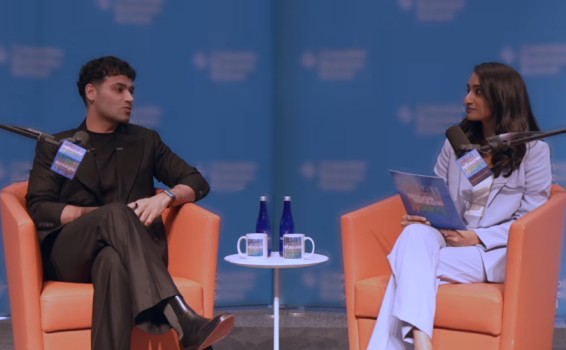
Editor’s Note: In this special live edition of South Asian Trailblazers, host Simi Shah sits down with Raj Shamani, India’s leading podcaster, for a rare conversation where he takes the seat as the interviewee. They explore his remarkable journey from humble beginnings to global success, diving into his philosophy of “values over views” and his strategic approach to building a top-tier media career. (April 10, 2026)
Introduction
SIMI SHAH: Hi everyone, I’m Simi Shah, the founder of South Asian Trailblazers. Today I am in New York City to record a very special live edition of my podcast with Raj Shamani. Raj is the number one podcaster in India and number 25 in the world. He has sat down with the likes of Bill Gates, MS Dhoni, Aamir Khan, MrBeast. The list goes on. And with over 500 episodes and 400 million annual views, he is one of the greatest podcasters on this planet.
But what makes today so different is Raj is almost never on this side of the mic. He’s usually the one asking the questions, and so when India’s number one podcaster decides to sit down with you, you know it’s going to be the crossover episode of the century.
Welcome and Setting the Stage
SIMI SHAH: Welcome everyone, thank you so much for being here. This is like my Super Bowl, getting to sit down with the Raj Shamani. Can we give him a round of applause? Genuinely. Hi Raj, as a podcaster, this is such an honor to get to share a stage with you, and I’m so excited to dig into your story.
And I really want to start at the beginning. Today you are India’s number one podcaster, you’re number 25 in the world, you’re an entrepreneur, you’re an investor. But way before that, there was an incredible point of inflection in your childhood that I feel like set the stage for who you are today. At age 16, your father’s health suddenly failed. You had to step into your family’s business to support them. Can you talk about how your childhood and this point of adversity set the stage for the person you are today?
The Turning Point at 16
RAJ SHAMANI: First, I want to set one fact straight. A lot of people think that at 16 I had no other choice because my father was so ill and I had to actually earn money to support and buy medicines and vegetables at home and all that bullshit. No. I don’t know which media house actually wrote that and how they have celebrated it into this.
The simple fact was, we were— there was no point in my life where actually I had to go and support my family for money. The thing is, we were from a humble background. My father used to make around ₹40,000-50,000 profit per month, and that was a good life we were living. I just saw that my father got really, really ill. He got a diabetic attack. For 30-40 minutes, we thought it’s a heart attack because he was not responding for a very long time. So that moment made me realize that I need to do something, because if he’s not there, who’s going to take care of my family? Because he was the sole breadwinner in our family. So that was the story. It was not that I had to be on the road and actually do that. So the point of inflection was I got serious in my life to go to support him. That’s where it started.
The first thing which I did was I applied to almost every FMCG company I knew which was operating in India, because my father was running a soap manufacturing business. So I thought, let me apply, let me learn, get a job, learn how they’ve scaled, how they’ve become big, and then I’ll come back to my family and start making this business big. So I applied in like 70-80 companies— the HUL, ITC, Mami, I don’t know what all, every company. Nobody replied.
Because nobody replied, I had no other choice but to join my father. And then I joined my father. He gave me about ₹10,000 or ₹15,000 and he told me that this is the only money that I can give you. Now you can either build your own product, join me, go sell, use this for marketing, hire somebody like a salesperson who will do it for you. I don’t care. This is the only money that I have. And that’s where things started for me, and that was the inflection point. Those ₹15,000 taught me everything that I know today.
Speaking at the United Nations
SIMI SHAH: And you started Jadugar Drop selling this dish detergent, but there also comes a point where you turn 17, you go speak at the United Nations, and you start to explore this career as a speaker. Can you talk about when you started to feel like, huh, maybe I could be a content creator, a media personality, while you were also working with your father?
RAJ SHAMANI: See, the idea was promotion. It was not to go out and become a speaker to be celebrated all around the world. First, till I turned 19 or 20, the first 3-4 years, the only idea was let me go out on stages because if I go out on stage, people will hear me. And once they listen to my story, my stuff, they’ll start buying from me. So it was a promotion and a marketing tool. And that’s why I wanted to become a really good speaker and get opportunities at stages because I thought it’s a free way of speaking all around the world.
So I applied at almost every platform, every forum all around the world that I knew of. UN happened to be one of them. Until that point, it’s very sad that I had no clue what UN was.
Then I went to UN and started speaking. The most fascinating story about UN was my first ever speech there. When I was there, you are in a small room where a bunch of different people from different countries are there, and everybody is almost like a polyglot. They know like 20 languages, I don’t know how. So everybody’s coming, they’re speaking in their language, and then they’re speaking in English, and a bunch of things they’re doing. So I went up on stage because I was so nervous and I was feeling so inferior, I forgot what I had to speak. So my speech just started with “Jai Hind.” There were two Indians. I think one guy’s name was Gaurav, who was working in atomic research or something. He started clapping and laughing. Everybody in the room started laughing and clapping. And then I picked up my thoughts and started talking. So that was the best story I had. Ki kuch idea nahi tha mai kya karo. But Jai Hind saved me. It just saved me. And after my speech, everyone who I met, everyone, they were like, “Jai Hind was so emotional.” I was like, wow, thanks.
SIMI SHAH: I’m shocked you don’t start every podcast saying that.
RAJ SHAMANI: No, now I know what to say.
The Birth of a Content Career
SIMI SHAH: So at what point do you start to feel like this could really be a career of yours while you’re still working with your family?
RAJ SHAMANI: This also happened not out of choice but out of force. Me and my dad, we fought, and because we were fighting over business, because business became really big. And I used to handle all marketing, sales, hiring, finance, HR, a bunch of things. Dad used to handle purchase and operations. And me and Dad, we started getting our factory fights to home, and my mom used to be like, “Kya karte hain?” So I thought it’s better to stop this right here because I’m young, I can do something. There was an ego fight between me and my dad, which resolved in about 3 months. So that’s what happened. Me and my dad, we fought, we discussed certain things. Dad said, do something of your own. I was like, why not?
I started then watching Gary Vee at that point a lot, and because Gary was an influential figure who taught the world how to make your product viral or how to build a large company just by using the power of a phone. I was fascinated by it. So I started telling everybody— I started calling all my friends and networks and their parents, jinkabi bada business tha, that I’m going to help you build your brand online because that brand will help you become so big and there’s this dude GaryVee, he’s done it, I’ll help you do that. Nobody bought that. Everybody thought, “Kya, babe, ko bina rahe paga lo gaye. Bitta jo papa sorry woh lo kaam karloonge sa.” But I was adamant.
And because nobody was ready to become my client, I thought, let me become my own client. Let me actually build social media distribution, and then I’m going to show them that, see, here’s the proof. Do it. And that’s where I started building Instagram. And then once I started building Instagram, for the first 6 months I was in my home, I would record like 3, 4, 5 reels a day, I would upload it online. And then I think 6 months later I got a brand deal, first time. They paid me ₹70,000 for a reel. I was like, f*, this is life-changing. Like ₹70,000 was a lot.
SIMI SHAH: It was just UpGrad.
RAJ SHAMANI: This is UpGrad, yeah. So UpGrad paid me ₹70,000 and I was like, this is serious money. I can go to Bombay. ₹30,000 rent ho ka, baki ₹40,000 bajenge, agle maine tak kuchh aur figure out kar lunga. So I thought this is going to be a thing. I’m going to make a lot of money. Agar ek brand aaga, yeh mein Rose Bake brand kar lunga toh mami ro jao ma. I didn’t know that Rose Brand nahi milte. So I was naive.
I moved to Bombay. I started, and the first 10 days I started calling people left, right, center to get a brand. Because the same principles why UpGrad gave me a brand deal, I started reaching out to people. I found out that B2B brands give you more money than B2C brands. I started reaching out to B2B brands, so made some money. And then it became clear that, okay, this is a serious career, I can make money out of it, and let me just expand into something.
The Podcast Begins
RAJ SHAMANI: Until the podcast started. I used to do podcasts here and there because I was recording reels every day. I was like, this is going to get me some money, but where is it heading? I can’t build something really big. So I thought, let me ask people who have built something really big. And that’s where the idea of the podcast started. So I started reaching out to everyone who understood the world better, who had better relationships than me, who had better networks than me, who were richer than me, who understood about wealth. I started reaching out to them to start teaching me something, and we started recording that, and that became the podcast.
So that was the point I thought, maybe this is serious, let me pursue it full-time. I mean, I was already pursuing it full-time, but I thought, ki ab isse kuch ho sakta hai. I think my dad still believes ki soap business was a better idea. He still doesn’t believe that this is a career which is going to last for long, but that’s how it happened.
Lessons from the World’s Greatest Leaders
SIMI SHAH: Wow. I mean, today with Figuring Out, your podcast, you’ve interviewed Bill Gates, MS Dhoni, Aamir Khan, the President of France. You’ve sat down with some of the biggest and brightest leaders in the world. What are some of the key things that you’ve learned in watching them over the years?
RAJ SHAMANI: Wow. So many. I’ll tell you one which is absolutely every leader has in common. They eat incredibly boring lunches. They eat the same food every day. I don’t know why and how. Almost everyone I’ve met— the athletes, the world number one champions, the president, the billionaires— they eat boring food. So I think there must be something in that. So that’s one thing that they do right.
Number two, all of them are almost really fast decision makers. They just want to do. Like, if they want to do it, they do it. They don’t actually think about it a lot. A lot of us, we think about a lot of things so many times before doing. These guys, I don’t know what they’re made of, but they just keep taking decisions left, right, center. And even if they’re taking wrong decisions, they back it up as if this is the best decision in the world. And they’re almost backing it to the point that they’re assholes about it, which is a great quality, don’t get me wrong. So that’s the second thing.
Third, which I feel most of the people who I have had an opportunity to meet, they don’t do complex things. In fact, they only do simple things. They would be asking themselves the question, what is the most obvious thing that we’re missing? And then they go do that obvious thing. So I think that’s a very fascinating thing which I have learned, and I’ve started inculcating that in my life. What’s the most obvious next move that I have to do? And that’s another thing that I’ve noticed in them.
What’s Next?
SIMI SHAH: Yeah. Okay, so now I have to ask you, what is the most obvious next move that you’re going to do?
The Strategy to Become Number One
RAJ SHAMANI: I’m pretty vocal about it. Everybody must be knowing it already. I’m a loudmouth. I talk about my dreams, my next move, my everything very often, very out loud in public. Almost to the point where sometimes it’s embarrassing because if it doesn’t happen, people are going to call me out very bad. So next obvious thing is the world domination, going out in the world, being number one in the world, being the most followed, most ranked, most viewed, whatever there is, whatever framework you want to put it. I want to be that podcaster in the world, so I’ll be number one. That’s the most obvious move.
SIMI SHAH: I want to highlight this for a second so people understand. You ended 2025 as number 1 in India and number 76 in the world, and as of February of this year, you were number 25 in the world. So he’s well on his way.
RAJ SHAMANI: 16, 17 months, I guess we’ll be number 1. That max 16, 17 months in the world.
SIMI SHAH: Raj, what’s the strategy to get to number 1?
RAJ SHAMANI: The number 1 strategy to become number 1 is saying no. Say no to almost everything in life. And here’s what I mean by that.
If you look at our content, India mein top 5 things— everybody understand Hindi? Yeah, perfect. Anyone who doesn’t understand Hindi? So I’ll try to keep it in English, but because English is not my first language, I tend to switch it in Hindi.
In India, if you look at my content, our podcast, our content, everything that works which gets the maximum views, we don’t do that. The top 5 categories in our country which will get you the maximum views— you’ll open any platform, you talk to any platform, CEO, chief, you look at the rankings, apart from us you won’t find anyone who’s in our field.
The top 5 categories that work: number 1, horror. It really works in the podcast category. You will see in top 10, I think there are 6 or 7 podcasts which are horror. Number 2, religion. We don’t do religion. Number 3, astrology. We don’t do that as well. Number 4, sex and erotic conversations. We don’t do that as well. Number 5, entertainment. All 5 categories we don’t do. So there is no way that we would have won. So everything that works, we don’t do.
I think that’s the only formula that will actually help you become number 1. So if you’re very clear about what you’re not going to do, that will set you apart. So we say no to everything that works because we are very clear what to do.
Number 2 is we are very clear about any podcast that doesn’t help you think better, we discard it. People don’t know that we put about 150 episodes a year, but we record about 220-230 episodes a year, and the rest of them, they never make it. We reject them after recording them because we’re like, oh, maybe this guest was great, but they were not able to give insights which people can take. Or maybe I was not good enough, I was not able to articulate better, or I was not able to ask good questions. But in the end, if it’s not helping you think better, we discard it.
So the strategy is keep saying no, no, no, no, no until you reach a point where you’re going to accumulate a lot of people who also said a lot of nos in your life.
Values Over Views
SIMI SHAH: I think this speaks to the theme of the panel, which is “values over views,” which is one of your guiding philosophies. I’ve heard you speak about how you’ve literally turned down guests if you didn’t feel like it was values aligned. Can you speak to a specific example of where you’ve drawn the line?
RAJ SHAMANI: It would feel very unfair if I take the name of somebody, but I’ll tell you. In our office, there’s a big sign which says, “Values over views, sense over sensationalism, teachings over trends.” And we live by that. Any podcast which lies on the other spectrum, we don’t actually upload that. There are guests who have offered us insane money to feature them, but we have said no because they don’t align with the philosophy of actually teaching something. They just want to promote themselves.
Now I’ll give you a more juicier example. There was a politician, and this politician, we did a podcast, very celebrated and decorated, probably, and at least used to be. He has been on multiple podcasts after ours because we didn’t upload his. So we recorded one podcast, I went there. He started bashing left, right, center. He started giving me content which was so sensational. If I would have put it, I knew that it’s minimum 15 million views. He would tell me about affairs of politicians. He started speaking about what goes on inside when they actually choose. He told me about people who have bought tickets and now they are becoming holier than the— I was like, what the f* is going on, right?
So there was really controversial, great episode, but the entire podcast just had this. Anything which I asked him about teaching, learning, some insight— zero. He would just give me gossip, gossip, gossip. So we didn’t upload that podcast. Today I think probably he hates us. His team texted my team, tried to threaten it as well, do a bunch of things. But we didn’t upload it because it didn’t align with our values.
There was another time where there was one rock star in the country, a very big superstar. We recorded a great episode, great guy, we loved it. And then because of some reason, his podcast got delayed by 1 month. So his team member started talking shit and started insulting and abusing one of my team members. And we said, no, we’re never putting it out. We’re sorry. Bye. Thank you.
So if it doesn’t align with our values, it doesn’t matter who you are, where you come from, how big you’ve become. We just say no. Values over views, that’s the specific example.
The Vijay Mallya Episode and Dealing with Public Pressure
SIMI SHAH: It’s clear that you’re very rigorous in your approach to values over views, but there are times that audiences have criticized you, and I want to speak about your episode with Vijay Mallya last year. 4-hour podcast, 20 million views in 4 days. It was his first time speaking in 9 years, but you were subject to a lot of criticism. What do you say to the people that questioned your “values over views” ethos in that instance, and how do you generally deal with public pressure having such a public platform?
RAJ SHAMANI: I genuinely don’t think that I did anything wrong. I stand by it. There are podcasts which teach you what to do. There has to be podcasts which teach you what not to do. Now it’s up to you, how do you see that episode? Do you want to choose it as an inspiration to do something or not to do? It’s up to you. I didn’t do anything wrong.
Along with my team, we tried to gather every information, every research which was possible. We looked at one type of political parties, their reviews. We looked at another type of political parties, their reviews. We consulted so many lawyers, so many people all around the world, and then we prepared a questionnaire, and then we asked them. And Vijay Mallya had no idea about the questions we were going to ask him. He was open. We didn’t cut or edit anything that he asked us to because he didn’t ask us to do anything. Editorial content was on me.
There was an episode that I wanted to make because I was genuinely curious to understand what went wrong with him. Because in India, there’s a perception that if you’re really rich, really powerful, really famous, you can get away with anything. And that’s the larger sentiment. I also thought that was true, but in this case, it was not true. What went wrong? I was genuinely curious.
He was not on my dream list to actually do. I happened to be in London, I bumped into him, I thought golden opportunity. I tried to convince him, it took us 6 months to convince him. He got convinced, we did it. So I don’t think I’ve done anything wrong.
How many of you have watched that episode? How many of you liked that episode just for the podcasting? How many of you, maybe you don’t like Vijay Mallya, but you liked that entire thing? You felt like you’ve not wasted your 4 hours? I think majority.
SIMI SHAH: This is a representative sample, clearly. How do you deal with the public pressure though when you face that type of criticism?
RAJ SHAMANI: I don’t look at that. I don’t know what people are talking about me, honestly. I don’t have time. I have no clue if they’re abusing me. I don’t get high by compliments, and I don’t let all the negative things affect me. I just have blinders.
SIMI SHAH: So you’re tunnel vision on number one.
RAJ SHAMANI: Yes. I have no interest in what the world is saying. I have one moral compass. If tomorrow my mom and dad ask me, “Was this something that you’re proud of?” if I have the answer to that is yes, I’m doing it. I don’t care if the whole world is against me.
What the Diaspora Gets Wrong About India
SIMI SHAH: You said something interesting just now about the perception of India in the world, and what I love about your podcast is you always open by saying that you’re trying to bring India’s voice to the global stage. India has more than arrived in business and media and culture, but I’m curious, there’s still things that we’re getting wrong. What do you think the diaspora gets wrong about India today?
RAJ SHAMANI: One thing they get wrong is they still believe their parents’ stories, which is about an India which was like 20 years ago, not the India of today. India of today has changed. So many people I meet, they’re like, “Oh, but there’s still this problem and that problem and this problem.” I’m like, yeah, these problems are every f*ing where in the world. India is really changing, and you can’t actually experience that change unless you’re building in India, from India. There’s no way on earth you can understand that. So no matter what I tell you, if you’re not doing business in India, job in India, you won’t understand what I’m talking about. So that’s one thing which diaspora gets wrong.
Another thing which they get wrong is a lot of people still believe that if you’re going to be in India or build in India, you’ll still be limited. I think that’s wrong. India is the most difficult market in the world. So if you crack that, the rest of the world becomes really easy for you. So I think there’s merit in actually going out and exploring that.
Imagine the first few years, no matter where you are, is going to be the hardest for you. If you crack that in India, you will actually crack how to deal with so many different people, so many different languages, so many different beliefs, so many different income status, so many different levels of whether they’re going to get hurt or not going to get hurt. There are so many things which only India has to offer. There’s no other part in the world which is this diverse. If they’re diverse, they don’t have the money, which India is changing now. India has the largest middle class in the world, which I think is about to become the largest middle class in the world. Then in India you’ll find the richest of the richest, poorest of the poor. So there are so many things in India which offer you an insane amount of leverage in the world. So if you understand that market, it’s going to be great.
Second thing, scale. No one actually understands scale unless they have built something in India or China. The rest of the world, they don’t understand scale because the kind of scale which these two countries have, it’s insane. I’m not talking about companies which have been there for 10, 20 years. I’m talking about today, the startups and the companies which have been there forever. They have actually gone around the world, so they understand. But people who are building today, if you’re building out of any part of the world and India is not part of your strategy, you’re getting it wrong. So that’s the second thing which they get wrong.
The thing which diaspora gets right is you have actually navigated how to win in the world and set an example for a lot of us to go out in the world and follow the template that you have built. You were the advanced brains, we are now the army which is going to come and show the world what India is. That’s what I believe is being right.
Diversifying as a Creator Entrepreneur
SIMI SHAH: You are no stranger to building in India, obviously, but what I think is so interesting about your journey is that you went from being talent to also building for talent. You’re an entrepreneur, you’re an investor, you’ve built House of X, helping creators build consumer brands. How have you thought about diversifying your career as a creator entrepreneur?
RAJ SHAMANI: Wow. So I’ll tell you a story, right? I think everyone in the room, including me, and everyone who I’ve met, somebody would be incredibly successful, richest people in the world, most powerful people in the world. We all are trying not to actually win. We all are trying to actually prove something to someone we don’t even know. Maybe we are trying to prove ourselves, maybe we are trying to prove our parents, maybe we are trying to prove our buddies, maybe we are trying to prove some version of ourselves who was 5-year-old and saw some dream. But we are trying to prove something to someone and we operate out of that.
So when I started House of X, it was not coming from a place of, “Hey, let me go build a really successful business.” It came from a place where it was about, “Let me prove that I can do this as well now that I have distribution and this and that.” And that was, I think, the biggest mistake that I made, that I didn’t operate from a position of leverage. I operated from a position of “I can do this as well.” So I think that was a wrong move on my part.
That company — I’m a very small part of that company now. That company has been handed over. My co-founders, they are leading it, they are running it, they’re doing an incredibly great job. I’m just a very small equity owner in that company. So that entrepreneurial journey didn’t work out very well for me because it came from a different position, and a wrong position to begin with.
Now coming to the investor part — I’ll come back to the entrepreneur part again — but the investor part: I’m a very bad investor, like a horrible investor, not in terms of returns, but in terms of deciding where to put my money. Every startup that I’ve invested in is either by my friend or some problem that my family was going through, so I had to invest.
I’ll give you an example, right? Do you know Varun Maya and Vaibhav Sisinti? These are two of my friends. We all met, they were starting a company, we all were together. They were like, “We are starting companies.” I put in money in their companies. What was the company? I still don’t know what they do.
SIMI SHAH: That’s a good friend.
RAJ SHAMANI: So that’s how I invest. That was one way. Then I invested recently in Neko. Do you know Neko Health? Do you know Daniel Ek, Spotify’s founder? So he backed another company called Neko. I invested in that. Why I invested? Because they are into blood diagnostics, skin imaging, a bunch of things. They are just making — getting to know your blood work and your body in such a cool way that you get in, in 15 minutes you get out. And it’s designed as if it’s a 5-star hotel, and they charge you 10x less than the normal companies. So I thought it was cool because my mom hates going to the blood sample stores where they come and take your samples, and my mom hates waiting at the clinic and doing all of that. I was like, “This is cool, I want to invest in that.” So I invested.
Then there’s another company I invested in recently called Tempil, which is Deepinder Goyal’s. Deepinder is trying — that company is trying to measure brain flow. And what I understood by that was if you’re able to actually measure your brain flow and understand that metric, you will be better off dealing with problems which are neurodivergent. So I thought, in my family I’ve seen cases which are related to mental health, psychotic issues, so many different problems, which was really problematic for me to see. If this startup works, probably it will solve my family’s problem. So I put in money there.
Then I invested in a company, Gabit, because my mom was getting really, really overweight and she hated that. She lost all her confidence. I gave her this ring. It had that social circle kind of feature where I can track how much my mom has walked and she can track how much I’ve walked. So she and I, now we start competing with each other — ki kaun kitna walk kare, kaun kitna sore, kaun kitna chal rahi hai. And because of that, she lost 13 kgs. So I invested in the company.
So the startup for me is either my family problems or my friends. I’m a terrible investor. Nobody should follow my way. It has been good for me till now, but that’s a bad way of investing.
And coming back to the entrepreneur thing — I run a media business across India, Dubai, London, and LA, and that business helps brands, businesses, and entrepreneurs build their distribution. We help governments build their distribution on social media, and we help them understand how to reach out to Gen Z and how they can actually be influential and make their message and create organic content. That business is doing really well because that’s just an extension of what I do.
So my learnings in business have been: if it’s an extension of what you do, I think it’s going to be a really good business, or else it fails.
Advice for Aspiring Creators
SIMI SHAH: I want to ask you one last question, and then we’ll turn it over to the audience to ask you some questions. You were a creator when being a creator wasn’t even really in our vocabulary, and it certainly wasn’t cool. As someone who’s seen the creator economy and the industry evolve, what do you think people misunderstand? What advice would you give to the people who want to embark on this career today the way that you have?
RAJ SHAMANI: First, I think when I wanted to become a creator, us time pe cool ho chuka tha — creator ban na. I don’t think I started way, way, way before. I think Masoom started when it was not cool to become a creator. I used to look at her and so many more people. In fact, very early on, before when I started the podcast, Masoom was one of the guests I reached out to. She didn’t say yes to me, but she came on my live later — I used to do live.
I think Gary Vee made it cool. He made it cool around the world. In India, Masoom was doing it, Ashna was doing it. You guys were like the fashion blogger era. A lot of people were doing it, so I was pretty late. In the podcasting world, I think only Ranveer was there when I entered. Us time pe India mein zada log — I don’t think people were doing it at scale.
The advice in terms of whoever wants to become a creator — I’ll tell you about India specifically, which now is helping me in the world as well. Right now we get about 1.4 billion views a month. We have about 26-27 million followers across platforms, and about 14% of our audience is not India — it’s the rest of the world.
So what we’ve understood is: the Western world and becoming a creator here was all about picking up a niche and becoming an expert and going deep in that. I think that’s an outdated version of how you will build distribution in today’s world.
The modern way of building distribution is you need to win trust. If you have earned the trust, people will listen to you no matter what you will be speaking, especially in countries like India. Even if you look at companies in India, there are large conglomerates who would be making cars and phones at the same time, doing 20 different things, and people will still fall in love. Imagine there’s a company in India which is the most trusted — it’s called Tata. They make salt and they make technology. They make steel and 20 different things which we don’t even know of. But if it’s Tata, we trust it.
So in countries where there’s a gap of trust, in low trust societies, if you start thinking, “How do I build trust in this economy?” I think you’ll win. As a creator, you should not look at this as distribution or reaching out to more people or going more viral. You should start looking at everything that you do as a micro deposit of trust that you’re making in a public bank. Every right thing that you do, it’s a deposit. Every wrong thing that you do, it’s a withdrawal.
If you start thinking like that, I think you’ll win and go far — way farther, way further than most of the creators who are only trying to be viral in the current moment.
Audience Q&A
SIMI SHAH: Such a powerful insight. I’m going to turn it over to our audience now. Raise your hands, and I believe we’ll have some mic runners come to you.
UNIDENTIFIED SPEAKER: Hello, my name is Kalyani.
SIMI SHAH: I’m an alumni of Columbia Engineering.
Friendship, Conviction, and the 10-Year Framework
RAJ SHAMANI: My friends don’t think I’m successful. My friends are still those terrible bunch of losers who think I’m also a loser. But I’m a terrible friend, let me put it that way. And I’ll be very honest about it. I think that’s one thing I’ve not been able to nail in my life. I’m a horrible friend because I’m not there for people. I’m always so busy doing stuff, chasing my dreams, building every little thing that I’m doing.
I think in my head there’s a bigger responsibility doing this and that, and because of that, I’ve not been able to build good relationships and good friendships with a lot of people. The good part is that I’m a really good friend when you need me at the time of emergency, but I’m a terrible friend for the good times. So if you’ll call me for a poker night and have fun and let’s go out and drink and party, I will never show up. I will never be there. I’ll never go out. I don’t understand the concept of chill. All of these are not there for me.
And because of that, I’ve lost a lot of friends. And that’s why I don’t even make new friends now, because I know ki nahiya koi banda hai se milunga friendship karunga, toh bahut mein atlagi kiya hai, bahut maintain karna padega. So I stay away from friends and people. The only good thing in this which has happened is my 4-5 friends who have been with me since the beginning — they’re still with me today.
SIMI SHAH: Hey Raj, thanks for the talk, it’s really good. Thank you. For the South Asian diaspora, our parents are not compass, and I know when you had a disagreement with your father, not to pry, but you decided to go separate ways. How did you get conviction to be able to do that and stay the course? Because for a lot of us, our parents, our intuition, our conscious are not stars. So how do you stay the course knowing that you’re going against something that’s very true to you? How do you convince parents, or how do you convince yourself?
RAJ SHAMANI: Everything that I do, I play with this framework. I call it the 10-year framework. If whatever I’m going to do — can I be in this field, in this industry for the next 10 years, and I’m okay to be underestimated with? Am I okay to look like a loser? Am I okay to look stupid? Am I okay that other people, other friends, my parents, all the experts in the world are going to call me that? “You’re useless, you’re stupid, you don’t understand the world.” They’re going to underestimate me, they’re going to belittle me. Am I okay with that? If the answer to that is yes, I jump into that industry and then go with it, because that’s the only framework which has helped me stay the path.
I genuinely don’t care about winning in the first year or second year or winning today. I think it’s a 10-year journey, because at the end of the 10 years I know that I’m going to win. I don’t care if I don’t have billions of dollars. I don’t care if I don’t come from a fancy school like this. I don’t care if my parents have money or connections or anything at all. I’m okay if you underestimate me for 10 years because I know after 10 years, even though I don’t come from all of this, I’m going to win.
At the end of 10 years — let’s take the podcast for example. You look at the podcasting scenario. There were people who had way bigger distribution than me. There were people who had way bigger networks than me. There were people who are way richer than me. There are people who are way more intelligent than me, way more good-looking, way more fit than me. I come from nothing. I come from Indore. That’s the highest level of network, right? There’s no network in the world. So against all odds, I don’t even speak English properly, my grammar sucks, and then I come there and I started doing things and I’m delusional about it. And I know that in 10 years, whatever you see me as, however you consider me, I’m going to win. And I know that I’m going to win. So by the end of the tenure — I think this is our 5th year — we’ll talk 5 years later.
The Stamina Problem of Our Generation
I think that’s a larger problem with our generation, actually — the internet generation. Gen Z. And even I would consider that a generation above us, almost internet use. All of us — we don’t have clarity problems. We are very clear about our strengths and weaknesses. We know what to do. We know what we’re good at, what we’re bad at. We know exactly which are the areas where we’re going to win, which are the areas we’re not going to win. We don’t have a clarity problem. We have a stamina problem.
Not in literal words — we have a stamina problem in terms of the moment something looks boring and repetitive, we leave. In a month we are like, “Oh, now it’s not serving me,” and we leave. “It’s not actually giving me that kick. I don’t know where am I going with this.” That is our problem.
Our parents had enough stamina. They were ready to endure one thing over the years. They didn’t have courage and clarity. Whatever they were told, they were doing that, and they didn’t have enough courage to question that. We have courage to question authorities. We have courage to question systems and institutions, and we are clear about what we want to do. We have a stamina problem.
So the stamina problem gets solved by asking: is this the thing I’m ready to do for 10 years? And am I okay to be underestimated for the next 10 years? If the answer to that is yes, go ahead and do it. That’s how you convince yourself.
SIMI SHAH: Hello, good evening. My name is Akansha Sena. First off, thank you so much for the talk today.
AI, Content Creation, and the Future of the Industry
RAJ SHAMANI: And before my question, I’ll take a second to compliment you. One of the reasons I really enjoy your content is the authenticity that you bring with it. Like, even now, the vulnerability that you’re showing — that is the biggest thing that I identify with. So thank you for being the first Indian creator, at least for me, who actually talks about the things that Indians don’t typically — maybe our parents’ generation. So my question for you is, I follow a lot of your content and I enjoy yours and Vaibhav’s content on AI a lot because I think it’s really bringing the knowledge to the masses. But as a content creator, as somebody who’s been in the marketing industry, clearly your friend’s showing you all the magic that AI can do today. What is your current usage of AI, if at all, as a creator?
SIMI SHAH: And then seeing all of the younger generation coming out to be creators or going into the marketing and advertisement world — it’s a 400,000 crore industry in India, right? So how do you see it affect the market and industry today?
RAJ SHAMANI: And is it affecting your workflow, or are you using it? Are you not? Are you planning on using it, and why? I’ll break down this question into two parts. One is how much of AI am I using, and second is what are my thoughts on the industry and what’s it going to do. I think the second part Nikhil da dat chis anse karega. He would understand that way better on economy, market, kaise, what are the disruptions coming, etc. I’ll talk about how much AI am I using.
A lot. Like, to a point where it scares me now — a lot. Everything that we do is AI. If not completely dependent on AI, at least we are using it like 50%. AI has become my life. In fact, every day I talk to AI to just learn new things, as if he’s my buddy and my coach. There’s a project I’ve made — “My billion-dollar coach” — and he helps me become better. There’s a project I’ve made — “Help me become the world’s number one. What are the things I do?” It helps me do that.
I choose my thumbnails through AI. I choose my research through AI. I choose my video editing, video tools, everything through AI. I record all my interview calls before hiring somebody and ask my AI to do analysis on that person. Anything and everything that you can think of — if it includes decision-making, AI has been used. If it includes creativity, AI is used. Pitch decks, AI. Sub. There’s nothing which is left, I think. I don’t even think originally now. I think half of what I’m saying is probably my Claude and GPT saying.
So yeah, a lot of AI. I’m sure it’s true for a lot of other people as well. If you want tools, I can give you tools as well that I’m using, but I think we can save it for another time. I use it a lot, shit tons.
SIMI SHAH: I think we have time for one last question.
On Pressure, Opinions, and Building Trust
RAJ SHAMANI: Hi Raj, my name is Apar. You built a massive platform for yourself, really compatible, and we talk about building trust. In a world which is ever so polarized, do you feel pressurized to share your opinions? Have you made a conscious decision to align or not align? And how crucial do you think it is to start building trust with your community?
I don’t feel pressured. I don’t know, kaun pressure kare hai? Politically, I mean. Maine mujhe kisi nahi kyaashta. And this is very specific to India — logoko lakta hai ke as if madlab tum thoda se influential ban gaye ho toh tumhe roj phone ata ho karta hoon, tumhe bolte hoon ki iss ke bare mein bolo nahi toh tumhe bahar nahi kal dienge. All that bullshit. Nahi hota hai sa kuch. Like, do you get calls? Ever? No. Nobody calls you. There’s no pressure. There’s nothing.
My audience — they have never asked me to comment on something. Nobody does that. So I feel zero pressure. I definitely have my areas of interest, and there are areas which I have no idea about. So whatever interests me — like India’s position in the world interests me, how are we representing India in the world, how are we taking India to the world, getting the world to India — all of these things, I really am excited about. Are we doing the right thing by being neutral or no? Are we doing the wrong thing? All of these interest me, so I talk about all of that. I ask questions and people answer me.
So anything which maybe looks like there’s a pressure — trust me, mushthak toh nahi poch rahi hoon. Kahi aur poch tau kisi aur ko hotu pataani. So I feel zero pressure. That’s one. And whatever I want to speak, I speak about. Whatever I don’t know, I don’t. I don’t understand internal politics, language, war. I don’t talk about all of this. Samajiniyaata kya woh lunga?
Rapid Fire
SIMI SHAH: Okay, we’re going to end on a fun, quick rapid fire. Are you ready, Raj?
RAJ SHAMANI: Okay.
SIMI SHAH: Mumbai or Indore?
RAJ SHAMANI: Mumbai. Hello? Ye clip ko bahut zada karam karenge? Indore for food and my childhood. For opportunities, Mumbai. Easy.
SIMI SHAH: If your life were a Bollywood movie, what would the title be?
RAJ SHAMANI: Tamasha.
SIMI SHAH: In this movie, what would the audience be screaming at you to do right now?
RAJ SHAMANI: Nothing. They’re enjoying.
SIMI SHAH: Dream podcast guest?
RAJ SHAMANI: Hmm, who would be dream guest? I don’t have a dream guest.
SIMI SHAH: You just have guests.
RAJ SHAMANI: Yeah, I know everyone’s going to come one day.
SIMI SHAH: A hot take?
RAJ SHAMANI: Taylor Swift. I think she’s going to be a dream guest because she doesn’t go very often. So that’s why everyone else — I mean, I can talk about the president or I can talk about stars and entrepreneurs, but they all go and do podcasts. Taylor doesn’t do it. So I think that’s why.
SIMI SHAH: Okay. A hot take.
RAJ SHAMANI: On what? Anything. On what? Give me, be specific.
SIMI SHAH: India, media, the world.
RAJ SHAMANI: Hot take.
SIMI SHAH: Other podcasters — you asked for a topic.
RAJ SHAMANI: Hot take. Wow, rapid fire. Where do I not land myself in trouble? Hot take is stay in your lane, because if you change your lane, then a lot of things can go wrong.
SIMI SHAH: Something you’re learning?
RAJ SHAMANI: I’m learning how to answer rapid fire.
SIMI SHAH: Something you’re unlearning?
RAJ SHAMANI: How to not think in Hindi first.
SIMI SHAH: First thing you’re going to do when Figuring Out hits number 1?
RAJ SHAMANI: I’m going to think what’s next.
SIMI SHAH: And what does trailblazing mean to you?
RAJ SHAMANI: Be a diva.
SIMI SHAH: Oh, I love it.
Be a Diva, Be a Trailblazer
RAJ SHAMANI: And I’ll tell you why. This is a longer one, okay? So trailblazing means be a diva. That’s how you’ll become a trailblazer. You’re not going to become a trailblazer if you’re not a diva. Be an absolute diva about what you do. Have really high standards. Get bothered by small things. Get angry at things which are not going as per you. Be really unrealistic about small details. Do everything possible. Just maintain really, really high, high standards everywhere you walk in, whether it’s front of your team, whether it’s in yourself, whether it’s just when you are standing in front of a mirror. Because if you’re not a diva, other people are going to treat you as an average person. So be a diva.
Closing Reflections
SIMI SHAH: I love it. Raj, it’s been such an honor to have you. I know you’re rarely on this side of the mic, so as the expert, the last, last question I want to ask you today is what would you have asked that I haven’t asked you today?
RAJ SHAMANI: What am I going to eat right now? No, do you want an insightful deep answer?
SIMI SHAH: Yes, any parting wisdom.
RAJ SHAMANI: There’s a question everybody should ask themselves. I ask myself every year, and I spend a lot of time on this question: “What would I do this year if I was not afraid to be embarrassed in front of the people who I care about?”
And it’s a really powerful question because once you ask this question, 90% of the things that you want to do is only because you don’t want to be embarrassed in front of the people you really give importance to. So that’s the question I ask myself. So that’s the question I would have asked myself right now.
SIMI SHAH: I love it. Can we give Raj a round of applause?
RAJ SHAMANI: Thank you, thank you so much. Thank you for hosting this. Yeah, thank you for listening, guys.
SIMI SHAH: Thank you.
RAJ SHAMANI: Thank you.
SIMI SHAH: Thank you so much for tuning into this special live recorded edition of our podcast, South Asian Trailblazers, where we’re dedicated to elevating leading South Asians. I hope you’ll join our community at southasiantrailblazers.com. And follow us at South Asian Trailblazers across all socials and streaming platforms. Until next time.
Related Posts
- Transcript of Arnab Ray Interview: ANI Podcast with Smita Prakash #EP-433
- Transcript of Pink Floyd’s Roger Waters Interview: Tucker Carlson Show
- Tony Robbins Interview: Secretary Kennedy Podcast (Transcript)
- Transcript: Tucker Carlson Interviews Benn Jordan on the Coming Slave State
- Transcript of JD Vance Interview: Joe Rogan Experience #2526