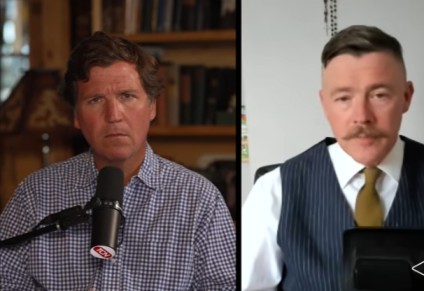
Editor’s Note: In this episode, Tucker Carlson sits down with writer and traditional Catholic Frank Wright to examine how a “godless” modern system is quietly replacing Christianity in the West. Using a brutal murder as a starting point, they trace how today’s economic and political order was built to replace faith, family, and community with itself—and why simply pointing that out has become a forbidden act.
INTRODUCTION
A Killing in Southampton
TUCKER CARLSON: On December 3rd of last year in Southampton, England, there was a murder that has come to trial. There was a conviction just the other day, and it’s in the headlines in the UK. Typically, it wouldn’t be worth spending a ton of time on a single killing in a foreign country, but this one tells you so much, not just about modern-day Britain, but about the West and the attitudes that have brought us to where we are now in the 80 years since the end of the Second World War, that it’s worth recounting in some detail.
So on the night of December 3rd, 2025, a man called Henry Nowak — he’s an 18-year-old university student — was walking back from a bar. He was totally sober. Blood tests later showed that his blood alcohol content was lower than drunk driving. So he was sober.
Walking in the other direction was a man called Vikram Digwa. He’s a 23-year-old Brit, a Sikh, his family’s from India, walking with his brother. Now, there was no apparent confrontation between the two. Nowak filmed him on his iPhone for a second. We’ve seen that tape. And then almost out of nowhere, Digwa pulls out an 8-inch long knife and begins stabbing Henry Nowak, the 18-year-old college student, and ultimately kills him. Stabbed him 5 times, including in the chest, in the heart.
Knife Crime and the Sikh Religious Exemption
TUCKER CARLSON: Now, it’s worth noting that knife crime in England is famously on the rise. In fact, to such an extent that knives are difficult for ordinary people to buy in London. Try to buy a set of kitchen knives next time you’re over there — not so easy. You can do it, but it’s heavily regulated. British citizens are not allowed to carry 8-inch long knives.
White British citizens are not allowed to, but Sikhs are, because under British law, carrying a knife is allowed because of the Sikh religious exemption. Sikhs have argued in court and their lobby groups have argued that they should be allowed to carry knives, and so they can. So again, in modern Britain, whites are not allowed to carry weapons, Sikhs are. And in this case, a Sikh used his legal weapon to murder a young white man.
The Cover-Up: Claiming Racism
TUCKER CARLSON: What happened next is really the most interesting. So Vikram and his brother realize that Henry Nowak is badly injured, and so his brother suggests, “Why don’t we call the police and claim racism?” And so that’s exactly what his brother did. We have the call, the actual call. Here’s what his brother told police dispatch the night of December 3rd.
VIDEO CLIP BEGINS:
UNIDENTIFIED SPEAKER: “We just got attacked racially by some white person.”
DISPATCHER: Right. Okay. Whereabouts are you?
UNIDENTIFIED SPEAKER: We’re on Belmont Road.
DISPATCHER: Just out in the street, are you?
UNIDENTIFIED SPEAKER: Sorry?
DISPATCHER: You’re just in the street?
UNIDENTIFIED SPEAKER: Yeah, literally. I just parked on my car to come home and he attacked my brother.
VIDEO CLIP ENDS:
TUCKER CARLSON:
Now, it’s not clear how long this man has been in the UK. He may have been born there. From his accent, it sounds like he was. But he’s from a family of immigrants. But he’s been there long enough to know that in the West in 2026, racism is the ultimate crime. In fact, it’s literally worse than murder.
And so he tells police dispatch this man, this white man, this random white man as he describes him, just walked up, started hurling racial abuse at him, knocked his turban off his head, and punched him. And the police take that very, very seriously, so they sped to the scene.
Meanwhile, the murderer’s mother also came to the scene. She arrived before the police did, and she took the murder weapon and hid it. She brought it home with her and didn’t tell anybody that she had it. In other words, she participated in the cover-up.
“I’ve Been Stabbed. I’m Dying.”
TUCKER CARLSON: Now, the police arrived fairly quickly to find Henry Nowak bleeding and unable to stand on his own. He said to them a total of 8 times, “I have been stabbed! I’m dying! I can’t breathe!” He yelled it so loud that neighbors heard it. In fact, some of them called the police to say there’s a man who’s been stabbed and is dying.
Nevertheless, police treated Henry Nowak, the dying man who was bleeding out in their presence, like the criminal, because he had been accused of racism. So they handcuffed him. They dragged him through the gravel. They ignored his plea for help.
“I’m dying.”
“Doesn’t look like that, like you’re dying.”
“I’ve been stabbed.”
“Don’t think so, mate,” says the cop.
Now we’re not guessing about any of this because we have the body cam footage. Here it is.
VIDEO CLIP BEGINS:
OFFICER: Got a man full of blood. I don’t want him — he was on the bin on the other side of this gate. He’s jumped over these fences and stuff like that. And he’s obviously — he’s obviously — he’s fallen from there and he slipped from there. His other shoe is left over there, mate. What’s your name, mate? Huh? Has anyone been hurt other than him?
UNIDENTIFIED SPEAKER: Yeah, me. Grab my brother. He took my turban off, started grabbing my head.
OFFICER: Are you injured?
UNIDENTIFIED SPEAKER: Yeah, yeah, I’ve got swollen eye, little bruise.
OFFICER: All right, just step back a little bit for me.
VIDEO CLIP ENDS:
Racism as a Greater Crime Than Murder
TUCKER CARLSON: So there’s Henry Nowak bleeding out. Those were his final moments, drowning in his own blood, being arrested for racism.
Now keep in mind, the police did no investigation whatsoever. They arrived on the scene. There was a non-white man claiming racism. There was a white man claiming he’d been stabbed. But they took only one claim seriously, and they arrested the man who’d been accused of racism.
If that looks familiar, it should, because that is a standard not simply in the UK but in Australia, in Canada, and much of Europe, and in the United States. Racism is regarded as a more grave crime than murder. Now, no one will say that, and statutes don’t reflect that, but in effect, that is true.
Being called a racist entitles you to being treated well — like Henry Nowak was — like an animal, dragged in your final moments on earth in handcuffs through the gravel until you die. The police don’t even consider checking to see if he’s actually been stabbed. And again, he had been, 5 times.
So if that enrages you, to see that video, because of course it’s a refutation of the core claim of the West, which is equal justice — each person is as valuable as every other person — that’s the basis upon which our societies were founded. Actually, that was the justification for importing a brand new population. “We’re all the same.” But in effect, it’s turned out just the opposite.
White lives in the UK are worth less than the lives of so-called minorities. And this is visible throughout the society, theirs and ours. And anyone who says it out loud is in fact the criminal.
The Media’s Response: “Far Right”
TUCKER CARLSON: And if you look at the coverage of Henry Nowak’s murder, you will find much of it very recognizable. CBS denounced anyone who complained about his killing as “far right.” “They’re trying to make far right points. They’re Nazis. Only Nazis would care about the death of Henry Nowak.”
But of course, he’s not the only one. He’s not the only white Briton who’s been stabbed to death by an immigrant. Of course, there are many.
The Transformation of Britain
TUCKER CARLSON: But big picture, it’s not simply the stabbings. There has been for 80 years a policy in Britain to make it very clear to people who were born there that they’re not welcome in their own country.
At the end of the Second World War, Britain was 99.9% white. As of this year, half of all births in Britain are non-white. And so in that short period, a couple of generations since the end of the Second World War, the population is completely turned over. Brand new people.
And on what justification, you ask? Well, that’s not clear. It’s a little strange to be on the hunt for Nazis in a country that fought the Nazis. The Brits famously gave up a lot, including their empire, in their effort to beat Nazi Germany. So did the United States. And yet in both countries that sent millions of men to fight the Nazis, there is an ongoing hunt for Nazis — which is to say, the unearned blood guilt of the Nazi crimes is being imputed to people who fought the Nazis. That’s very, very odd.
White Americans: Dying While Being Called Privileged
TUCKER CARLSON: And it shows in every metric, every measurement — in employment, in life expectancy, in nutrition. In the last couple of years, white Americans are the leading group to die of malnutrition-related illnesses. White Americans.
And at the same time, that very group is lectured as privileged, as having unearned advantage because of their skin color. There’s an entire academic discipline devoted to attacking white people on the basis of the fact — the supposed fact — that they have unearned privilege. And yet, of course, the opposite is true. They are dying.
The leading cause for young white Britons is suicide. The unemployment rate among white Britons is astronomical. In the last 5 years of new jobs created in Britain for young people, British firms hired 1 white Briton for every 27 foreigners. And those statistics aren’t so different in the United States.
90% — between 2020 and 2025 — of all new jobs created in the United States went to foreigners. 90%. Is that an accident? Could it be that recent arrivals from Punjab and Lagos are just that much more impressive than the products of the fabled American education system? Probably not. It’s almost like it’s intentional.
The Message Being Sent to the Indigenous Population
TUCKER CARLSON: And of course it is intentional. Because it sends a message: don’t get too comfortable in your own country. Don’t assume that you have rights because you were born here. Don’t take pride in anything your ancestors built. Stay on edge.
Now, what would be the motive of people sending that message to the indigenous population of a country? “This isn’t yours. It belongs to people you’ve never met.” That is the message. We can only guess at the motive. But we can say that throughout Europe and throughout the Anglosphere, that is the message from our superiors.
And so you have to ask yourself, why are we putting up with this? Because it’s not enough just to look at the stats and say, “Oh, the people whose ancestors built this country are failing, are held to a different standard of justice, aren’t allowed to arm themselves while new arrivals are.” They are disadvantaged in job seeking, in admissions to college, in federal grants. All true.
But you also have to remember that that group of people is not only put at a grave disadvantage because of their ethnicity — the greatest systemic racism ever practiced in the West is being practiced against the people who built the West. All true. They’re also being browbeaten and lectured and finger-wagged into silence. Which is to say, it’s not enough to hurt people. You have to humiliate them as well.
The only crime, the only real crime in any of these countries — and the United States would be among them — is complaining about what they seem to be doing to you and noting the obvious.
London in Decline
TUCKER CARLSON: So London, second biggest city in Europe after Moscow, a beautiful city, and in many ways — have to be honest — still probably a little nicer than the biggest city in our country, New York, but still much reduced in quality of life from 40 years ago and dramatically in decline as compared to 100 years ago. Anyone who notes that London is not as nice as it once was is the crime, is the criminal.
Here’s Sadiq Khan, the longtime mayor of London, often referred to in the United States as a radical Muslim, who’s nothing of the sort. He’s just a conventional white liberal with an Islamic-sounding name. But here’s Sadiq Khan explaining why people would criticize London on social media.
VIDEO CLIP BEGINS:
SADIQ KHAN: Most people’s experience of London is very different to the version you see on social media, and there’s a reason for that. We’ve done some research and looked into what’s going on here. Basically, you got a combination of people using the algorithms on social media that monetize negativity and hatred, but also a combination of state actors, whether it’s China, Russia, or MAGA influences, being unhappy that a city that is progressive, liberal, diverse is incredibly successful.
I mean, we are the antidote — the antithesis — of nativist populist movements. So don’t be surprised if you’ve got people on social media spreading misinformation, disinformation, and lies.
VIDEO CLIP ENDS:
The Failure of Liberal Democracy
TUCKER CARLSON: It’s the Russians, they’re the ones telling you London’s not as nice as it used to be. Because honestly, the one thing we know about London is diversity is its greatest strength. Now, you’re not invited to assess that for yourself. You’re not invited to ask for evidence that that’s true, because in fact it’s not a political slogan, it’s a religious precept. It’s the one thing we know, that diversity is our strength.
Now, if it turns out that diversity is not our strength, we can’t admit it because that would be apostasy. So we have to keep chanting it again and again and again. And you almost, as you listen to Sadiq Khan, wave away any criticism of the city that he’s so gravely mismanaged for so long as state actors spreading disinformation and lies, which are not the same thing, by the way. Disinformation is information that we don’t want to hear. Lies are things that are untrue. It’s disinformation that he’s concerned about.
But as you hear him lay all that at the feet of Putin or China or MAGA influencers, you suspect that maybe he’s starting to believe it, that he won’t allow into his own head what is obvious to everybody else, which is this experiment has failed. This is not working on any level for anybody except the people in charge.
The Broken Social Contract
TUCKER CARLSON: Another way to put it is, if the relationship between the citizen and the state is a contract, a social contract, only the citizen is keeping up his side. So the citizen gives up some rights and quite a bit of money in exchange for what? Security and services. He wants to live in a decent place. He wants his children to get a decent education. He wants non-embarrassing infrastructure. He doesn’t want to get stabbed to death on the way back from the bar.
That’s what the citizen wants. He doesn’t want the neighborhood that he lives in to change in 20 years with new people who he doesn’t know and didn’t ask in. He wants some control over his life, and he wants the state to provide some measure, some basic measure of security and services. And the state no longer does that.
There are so-called developing countries, many of them around the world, that have superior infrastructure to Britain and the United States. Many of them. They’re not richer countries. They’re just countries in which the leadership class takes its own vows a little bit more seriously than ours. “Oh well, in exchange for getting a private plane and the long title and the medals on my chest, I have to provide basic services. And by the way, we can’t have stabbings in the middle of our capital city.” And so they do that, as leaders have always done.
But this leadership class in the West has stopped even trying to do that. And has instead replaced its duty with hatred toward the people it has failed. And that’s very obvious.
Lessons from Britain for America
TUCKER CARLSON: And it’s hard to see that, really, if you live in the United States. And that’s one of the reasons we wanted to show you what’s happening in Britain, because the distance makes it easier to understand. But if you look at our country, you have to ask yourself, is it really so different?
We spent a year talking about George Floyd, pretending that he was murdered by a cop in Minneapolis when it was very obvious from the second day that he OD’d on opioids. Poor man, not making fun of him, but that’s just a fact. He was not strangled to death by a white cop. The whole thing was fake. And we spent a year talking about that and nodding solemnly and excusing the riots that followed and the murder of innocents that followed. Holding the rioters to a different and lower standard of public behavior. They were exempt from COVID laws. Do you remember that?
Meanwhile, is the problem in the United States — and we do have numbers on this — really that white cops are killing people of color? No, that’s not the problem that we have. In fact, it’s almost exactly the opposite of the problem we have, and everybody knows it, and you can look it up. If it’s still on the DOJ website, because they do keep stats on this. So why lie to us? Well, in order to humiliate and degrade and dispirit us, that’s why.
The Totalitarian Present
TUCKER CARLSON: And it’s hard even to know that that’s going on because it’s so omnipresent. If you heard about a country, let’s just say Poland, under the Soviet occupation of 1971, and you were told that in Soviet-occupied Poland there was no privacy whatsoever. There was not one place you could go where you were not surveilled by your government. Even in your own bedroom, people were listening to you. Even when you got in your car, your sanctuary, a machine began to lecture you, hector you like a neurotic girlfriend about wearing your seatbelt. Slow down. And if you didn’t, the vehicle would take control away from you, exert autonomy and strip you of yours, and just act in the way it decided best.
You would have no privacy and you would have no autonomy. If you heard about a place like that, you would say, well, that’s the definition of totalitarian, but you would be describing America right now. Before AI.
So it takes a little bit of mental effort to get perspective on the world you live in and how far from the promise it is and how much it has changed, how totally unacceptable it is, how totally contrary to human thriving it is. It’s no surprise, given those facts and many more like them, that SSRI usage is beyond belief. The suicide rate is unacceptable. People are miserable under our current system.
Liberal Democracy in Name Only
TUCKER CARLSON: That system is called liberal democracy. There are very few Americans who don’t support liberal democracy, including me. I support liberal democracy. It’s our birthright. Liberal democracy — it’s the greatest thing we have. Liberal meaning respecting of human rights, the rights with which we were born. And democracy meaning we own the system and we put our representatives in office by voting for them. We’re in control. We’re the shareholders here. Liberal democracy.
But the truth is, our democracy is neither liberal nor democratic. It doesn’t represent people and it doesn’t acknowledge fundamental human rights. It bulldozes them. And everybody on some level knows this, which is to say it can’t continue because nobody believes in it anymore.
Some of us are hoping for a peaceful resolution to this crisis, but it is a crisis. When the government begins to actively harm the people it supposedly serves, it’s reached the end. I mean, it may take a while to end, but it will end because that doesn’t make any sense. It’s intolerable. It would take a lot of technology to force people to obey a system like that, and even then it couldn’t go on forever. And this one won’t.
The Search for a Way Forward
TUCKER CARLSON: So as you think about this, it gets pretty dark pretty fast. The system you grew up with, the one you were taught to love, the one about which there was at one point a lot to love, is going away because it just doesn’t work. And historians will debate why it didn’t work in the end. Were the flaws inherent to it? Was it bad leadership? Was it the baby boomers? Who knows? Wiser heads will determine the answer. But in the meantime, it’s enough to know that it can’t continue.
And that’s one of the reasons that you’re hearing an awful lot of dark muttering about revolution, violent and otherwise, on the internet. And everyone talking about that should remember what that actually looks like. Civil wars are the ugliest of wars, and they tend to go on for a very long time, and innocents die in huge numbers. So that is not an outcome that you want if you can help it.
But what are the options? Well, out of nowhere the other day, we saw a clip of a man in Britain offering some measure of hope, not because the current system can continue — it can’t and it won’t — but because there are options that are not based on hate and division and violence, that are instead based on decency and kindness. And in fact, we haven’t always lived this way. Our current system is a fairly new invention. People didn’t live this way 200 years ago. In fact, they couldn’t imagine it.
That man is a man called Frank Wright. Now, he was caught on camera by a reporter walking down the street in the UK, and the reporter asked him a question — how do you think Britain’s going? How are things going? And he gave a pretty remarkable answer for a man-on-the-street interview. Here’s part of it.
Frank Wright on the Politics of National Suicide
VIDEO CLIP BEGINS:
INTERVIEWER: So what does finished look like?
FRANK WRIGHT: What does finished look like? Finished looks like an economic collapse. Finished looks like spending all money on foreign wars when nothing works in the country. Finished looks like you can’t get a job for being competent. There’s no sanity even in recruitment. We have a competency crisis because for increasingly ideological and insane reasons, employment opportunities, even training opportunities, are restricted.
There’s one news story after another about why for political reasons we’re doing mad things that bankrupt the country, that basically park people’s careers, that exclude talented people of genuine principle from any area of influence whatsoever. And taken collectively, this is the politics and economics of national suicide. So it has to stop.
VIDEO CLIP ENDS
The System That No Longer Explains the World
TUCKER CARLSON: So who is that guy, we thought. But we shouldn’t have been that surprised, because if you’re on social media, you’ve had similar experiences probably many times. You’ll be reading something like Twitter or Instagram, and there’s a lot of garbage and porn and lunacy and bots, and there’s a lot of ugliness and pointlessness and time-wasting material.
But in the middle of all of that, occasionally you’ll run across somebody writing something beautiful and true and perfectly expressed, and you’ll think to yourself, why haven’t I heard of this person? And what is he doing posting on X at 2:30 on a Wednesday afternoon? Doesn’t this guy have a job?
And the answer is, he may not. Our system is so inimicable, so hostile to inherent superiority, to honesty, to truth itself, but also to cleverness and creativity, that it has systematically excluded some of the brightest people in our country and in Britain from gainful employment.
The man you just saw, Frank Wright, who you never have heard of— how do we know that? Because he doesn’t have a job, that’s why. That man should be in a leading position within the intellectual realm in Great Britain. He should be a noted public philosopher, obviously. And you will definitely think that after you hear the hour-long interview we just did with him, which we’re going to play in just a moment.
But he’s not doing any of those things. Again, he’s not really employed. Why? Because like a lot of people like him, he can’t get a job. Not just because he’s the wrong color and gender, which he is. Not just because he’s not gay, which he’s not, but because he’s honest and smart. And honest and smart people have a kind of irrepressible habit of questioning, why are we doing this? Of asking inconvenient questions. And people like that are not welcome in the oligarchy. Why would they be? They’re troublemakers. They’re disobedient.
The problem is that when you take people like that out of a system, the system loses all creativity. The system loses the ability to continue itself, to make anything interesting. To have enlightened ideas, and in the end, even to be decent. It becomes a machine, and that’s what ours has become.
But Frank Wright, despite being excluded from the system— and he would be here in the United States too, let’s not lie to ourselves— has managed not to become bitter or hateful or angry or a racist. He’s a thoroughly decent, cheerful, hopeful, kind man whose prescriptions are all about loving your neighbor no matter where he’s from, because Frank Wright is a Christian.
And as you hear him speak, remember that he speaks for the old Europe, the old England, the Christian Europe that gave birth to our civilization, that produced the most interesting and enlightened ideas in the history of mankind, also produced the most revolutionary technology in the history of mankind. It was a truly successful, well-flawed society, and it was a Christian society.
So here’s Frank Wright reminding us that the way we live now is not the way our great-grandparents lived. It’s not the way our great-grandchildren will live. And that’s okay. Here’s Frank Wright.
Mr. Wright, thank you very much for joining us. I became aware of you, like most people, fairly recently when you were interviewed as a man on the street, as we say here in the United States, and gave this kind of beautiful explanation of your concerns. And so we pressed a little deeper, and I want to read back to you a couple of quotes from a series that you have started that I’ll be watching, but I want you to explain, if you would, what you mean by this.
And I’m quoting, “We live in a belief system that no one believes in anymore, and it has created a terminal crisis that it can’t escape alive. We have been trained in a way not to see the elephant at all and to call the mess it makes of everything progress.” And then finally, you write, “What is ending now is not the world, but the world as we knew it.”
What system are you describing?
The God That Failed Twice
FRANK WRIGHT: Well, I’m describing the system that was marketed to us as liberal democracy, which we’ve all taken— we’ve been led to believe deliberately because the system rules us by media— is the acme of human organization. It’s like the verdict of history. And we’ve all kind of accepted that this is the only way we can live.
But in fact, that system was intentionally put together over 100 years ago. And as I’ve explained elsewhere, it is the god that failed twice. And it was there to replace the civilization that we had before. And the tremendously destructive opportunity of the Great War and then the Second World War provided, if you like, the opportunity to install this system in place of the European civilization that we’d inherited from the monastic system of the church over 1,000 years ago.
So what we’re doing now is we’re realizing that the beliefs that we’ve been supplied by this system no longer explain the world. And the crisis that this system has created isn’t just national or local, and it is local to you and I, and it is in both of our nations, but it’s worldwide. And there’s a collapse of belief in the system.
And I would like to remind people that it is the foundational technique— rather, it’s central to the political technique of the 20th century— to manufacture belief in your own system. The system manufactures belief in itself through every form of cultural production. I mean, the things that you buy, the disposable items that you have, the terms and conditions that are increasingly offline as well as online.
When you notice that this is everywhere and it’s infused into practically every transaction, and life is a series of transactions now in the main in this system because it’s nihilist and it’s consumerist, then you notice the remarkable fact that you’ve never noticed that you are policed by a total ideology until it starts to fail.
And it’s failing now. It’s not working for all of us. In one of the most divisive times in human history, socially and culturally, everyone can agree that everything’s getting worse and there seems to be no answers from within that system. And that’s because the system is the problem.
A System Designed to Standardize the World
TUCKER CARLSON: I think everyone listening to this, regardless of ideology, senses the truth in what you’re saying. One line stuck out to me. The system is no longer capable of explaining the world around us. What do you mean by that?
FRANK WRIGHT: Well, what I would say is that the crisis that has been created by the way that we are ruled has become so impossible to manage that it’s completely out of control.
If you look at the idea— the reason why I go on about the idea of technique is because technique is one word for saying the refinement of the process of producing a standard result. If you look at what our politics has done over a century, then you can see that it’s been refining itself, if you like, at the speed of the development of communication technology to produce a system that manufactures belief in itself.
And we might be caught up in a lot of the effects. So we’ll complain about something that’s woke, for example, or we’ll complain about some mad war that’s been launched. But really, all these things make sense from the point of view of one big idea, which is if you understand that from its beginning, the liberal system was about creating a global standard in everything, in economics, in politics, in culture, and in belief.
And when you see that as just an object, a standard object— we’re going to standardize the whole world, that’s the object, that’s the objective— then you understand everything that’s been done. And then all the madness makes sense.
Because for example, one remarkable thing I discovered was some of the people that put together the Federal Reserve and then the International Liberal System Management and the Council on Foreign Relations, they described themselves as internationalists. That’s the right early marketing term for what we call globalists today.
And so you can hear a lot of people complain about that. But really, if you understand that the general idea is to standardize the whole world under the standards of this new system, under its political economy, its politics, its economics, and the belief it supplies— and the only beliefs it really supplies are the beliefs in itself, and it excludes all the other ones— you can see why there’s a terminal crisis now. Because the only beliefs that we can find that can explain the world aren’t supplied by the liberal system.
And that’s why they’re policing speech, and that’s why they call anyone, anyone, who makes a sane, decent, and indeed Christian objection to the politics and economics of mass destruction— that’s why they describe you as being evil for demanding a decent life and a future for your children. That’s why they describe you as an extremist if you dare to notice the obvious out loud. And these are some of the effects of this system that’s disintegrating.
Regime Change Changed Our Regime
FRANK WRIGHT: And part of that technique, if you like, is the creation of crises which they then go on to monetize. Obviously, the war industry is a huge crisis management model that saturates our political class and effectively sponsors them, and then permissions further misadventures that result in mass destruction, misery, and of course, magnifying the scale of mass migration.
If you look into mass migration, it has been mis-sold to us as a human rights affair. It’s not, it’s a business. It’s become an industry at scale where governments and NGOs permission the arrival of millions of people, which are often transported into the West by criminal gangs that charge them considerable amounts of money to do so. And this in turn was created by these pointless wars that we fought time and again over the last decades.
And to point that out— basically one of the most remarkable things that occurred to me one day whilst doing extensive reading as a result of my extended leisure time, because I’m rather routinely unemployable given my disputatious and principled character— I thought, I came up with this idea that regime change changed our regime more than any other. And that is a remarkable fact.
And it did, because I’m sure you remember the ’90s. And sadly, it’s not the ’90s anymore, but the ’90s was a very different world to what we’re in now. And that was before the regime change regime really kicked in. And look what it’s done to us. Look what it’s done to the world. These are the causes.
Why Conservatism Never Conserved Anything
FRANK WRIGHT: You see, one of the problems I found with conservatism, the doomed ideology of conservatism— why did it never conserve anything? Conservatism has largely become a kind of political and media phenomenon in which you monetize outrage by whinging about terrible effects and never investigate causes.
If you want to solve the problem, have a look at where they come from. That might be a good start. But if you do solve the problem, then poof, your audience disappears and you can’t make whinge books anymore. So it is kind of fatal to the grifter, but we should try and move beyond that model of simply spectating, of being kind of voyeurs of the obscenity of our own existence, and try and say, can’t we do better? And you can’t do better if you don’t know how bad has been done.
Asking the Right Questions
TUCKER CARLSON: Yeah, well, I think you’ve answered the question in the back of my mind since you began speaking, which is, why aren’t you the most famous living philosopher in Britain? As you should be. And you aren’t because you are committing the sin you just described by asking questions, pointing a finger to the cause of the problems, and not just hyperventilating about the problems themselves, as I did, for example, on Fox News for so long.
So congratulations to you. Shame on me. But notice who had a higher paying job. So I guess that kind of— you’re making your point, or I’m admitting that your point is true. It is true.
The Machinery of Control: Technology, AI, and the Liberal Political Economy
FRANK WRIGHT: To my shame, I’m toxic to money and it doesn’t like me. And there are videos. I don’t care, I’m used to that. I’m not going to blame you personally.
The thing is, when we think about blaming people, really, even in some of the worst, most offensive, and in fact almost unforgivable cases, you have to look at people and really genuinely ask, can you honestly just blame them? People are responsible for what they do, but we have all been raised — I’ve been raised, you’ve been raised — in this total political technique which has formed our consciousness about the world, which has distorted our moral sensibilities, which has given us false aspirations and the worship of false idols. And so can you blame people when they’re misled? Can you blame people when they become subject to mass delusions that send them into frenzies? Because the system has been designed to do that.
And if you think that this is speculative, the giant of postwar American diplomacy, George F. Kennan, who was a genius at preventing the outbreak of nuclear war and so should be commended for that, but in 1948, and you can read this in the Congressional Record, he published a paper called “On the Inauguration of Organized Political Warfare.” And in that paper, he said that he should use the CIA, which had been created a year before in 1947, to basically create cultural propaganda through the direct sponsorship and creation, in some cases, of things like modern art, sponsoring speakers such as Sir Isaiah Berlin, the international and greatest champion of the liberal idea in the 20th century, the art critic Clement Greenberg, touring musical operations and orchestras and so on.
And this became, if you like, the seminal point of the development of cultural production in the mid to late 20th century, where you find now, if you look at it through this prism, you can see that practically everything that’s produced in our mass culture is in some way a form of propaganda for the liberal political economy that rules us all. So basically everything that you see, everything that you consume, all the avenues that you have to navigate to earn a living and to communicate with people, and even to get access to your own money — these are all contingent on some kind of tacit acceptance or submission to a series of ideological rules that you were never asked about. And you don’t really have any chance to object to, or you risk your meager livelihood for your increasingly worthless money.
And so when you notice that, this is another reason why people are losing belief in this system. And it’s not because of radicals and online extremists like me and bigots like you, Mr. Carlson. It’s because of reality. The awful reality we live in is unignorably bad, and no amount of sophisticated cultural production and propaganda can persuade you otherwise. So it’s finished.
AI, Coercion, and the Control Grid
TUCKER CARLSON: It does seem like the final bet, though, of the organizers of the system, the maintainers of the system, the stewards of our system, is technology, is supercomputing, AI. And the point of that I’m starting to sense, is coercion. Like, it doesn’t matter whether you agree with the system or like it. When the control grid is in place, you have to obey.
FRANK WRIGHT: Well, here’s another problem about the political technique of the 20th century. Every time something has been made possible by technology, we’ve seen our political economy adopt it wholeheartedly without any real attempt to mitigate any serious threats to the dignity of human life, to whether or not it’s going to improve, maximize human flourishing, or indeed immiserate us. And so you see that every time something’s invented, the liberals invent a new series of kind of moral values, what they call ethics, to permission its use. You’ve seen this in the development of technology to sterilize and mutilate children, for example, which has perniciously been presented as a human rights issue. That was made possible by technology.
Now, just to use that example and to use the example of artificial intelligence, as it’s so-called, just because we can do something, it doesn’t mean to say we should do. And that’s a very important question for political power. And I think that’s one of the duties of the state to look into how can we best use this for the purpose of the human flourishing of mankind, which should be the duties of the state. And if it is good, great, but let’s be careful with it and let’s see what good we can do with it rather than have it just used, misused, or indeed unleashed and ravaged through our lives.
And one of the reasons why this may very well get permissioned by the ruling elite that’s currently installed is because they’ve reduced the value of human life to price. Our economy sees human life as disposable. It can be simply eliminated as a matter of convenience, and that’s celebrated as the pinnacle of women’s liberation, to basically kill your own children because they disadvantage you by being alive. And the same thing with the elderly. We’re effectively disposable.
These arguments, I believe, are now moving outside of the traditional Catholic Christian base. And even atheists and liberals are beginning to realize, hang on a minute, we live in a vast evil machine that sees us all as not only replaceable, but disposable. It’s a disposable political economy. And I think we should dispose of it before it disposes of us.
And this is the reason why I’ve been on about surrogacy for so long, because that was permissioned in 1993 in a law in the United States, which astonishingly established the right to buy a human life. And that’s what surrogacy is. It’s the hire of women to produce a human life for sale. And if this is not one of the lowest points of human degradation in history, I don’t know what is.
But I will finish by saying this. In his “Notes Towards a Definition of Culture,” around the middle of the 20th century, T.S. Eliot said there is no limit to the depths to which man can fall. So we shouldn’t expect that just because something is shockingly morally degrading like surrogacy, that people will wake up and go, oh no, that’s enough. No, if we don’t actually stop it, we will continue to fall into the abyss. And I think we’ve all got that sense of falling now. You know, when you have a nightmare and you’re falling and then suddenly you snap and wake up — I think we’re all waking up at the moment.
The Motive Behind Global Uniformity
TUCKER CARLSON: If I can just ask you a question about motive. So you said at the outset that the design of the system was to create sameness, uniformity globally, as a standard, universal standard in belief, in economy, in culture. And that’s obviously worked. But what was the motive behind that? Why would anyone or any group of people want that, do you think?
FRANK WRIGHT: Well, by the way, this is not speculative, and it takes place in the record of the Federal Reserve and the United States Congress and so on. This isn’t speculative fiction. It isn’t some kind of grievance narrative. There are several major interests involved in this that I can call to mind immediately.
Obviously, one of them — financial people like J.P. Morgan and later on the Rockefellers — who could see the enormous potential of having, if you like, a debt issuance system that was globally exportable, a standard model where whatever you wish to permission in these new liberal democracies that you were going to create, you could finance it by simply printing money. And that’s what they did. And that’s partly the reason why liberal democracy failed in the first 15 years of its life. It failed along the 1920s through the ’30s. And all the liberal democracies that were installed shortly after the Great War, they just dissolved because they couldn’t answer the financial crisis that their new economic model had created. And they had no political answer to Bolshevism.
But apart from that, you had the international financiers who wanted a global standard economic system for their own interests. You had people like Bertrand Russell and John Dewey, these atheist, pragmatist, rationalist philosophers who actually sold you the idea that if we had a one-world government, we could end war, and that they would sell that to you with these humanitarian principles in mind. And I think Bertrand Russell was quite convinced of that. I mean, I don’t find that a convincing argument because there’s a profound reason why that’s wrong, and that’s because liberals believe that man is perfectible and that according to the myth of progress, that man just gets better every day because the calendar flips over.
But the inexorable moral progress of mankind is a myth, and the British philosopher John Gray has expanded that very cleverly in his “Seven Types of Atheism,” showing that this is just a fantasy. It’s a utopian delusion. But those people sincerely believed it. And these people are dangerous, they’re fanatics. And this is where utopian thought leads you. Like the British thinker and journalist Peter Hitchens said, the trouble with utopia is you have to row across an ocean of blood and you never arrive. And that has meaning in reality.
So you did have well-meaning liberal fanatics — Bertrand Russell and John Dewey actually wrote a series of essays in the 1930s called “Towards a Common Faith.” And he said that we, the liberal elite, should supply a kind of global Christless religion, a common faith, so these plebeians could believe in it and we could somehow unite this new global system of interdigitated liberal democracies, which are all identical in having bicameral systems and incidentally all identical in the fact that you can only vote for left liberals, right liberals, extreme liberals or Bolsheviks, which is what you could actually vote for in the first instance.
TUCKER CARLSON: Yes.
Walter Lippmann and the Creation of Pseudo-Reality
FRANK WRIGHT: So whilst you’re in this new happy utopia, we’re going to give you this belief system. And bear in mind, that comes from a thinker called Matthew Arnold, who wrote a book in 1863 called “Culture and Anarchy.” And I’ll finish with this — he said that because we’re going to liberalize the world and democratize it, but obviously we’re going to subtract religion because we liberals don’t believe in Christ. “We’re going to retain the outward structure of the church and the armature, if you like, of our civilization, but we’re going to remove the supernatural and Christ and God himself from the center of that.” And he said we should replace it with culture or we’ll have anarchy.
So from the 1860s, the liberals had this idea of standardizing the world beneath their own godless standards. But they recognized that without the foundational Christianity of our civilization, there would be anarchy. And so Matthew Arnold imagined that he would promote things like poetry and classical art and classical music. But instead you got like Taylor Swift and televised sports. And then of course, nowadays you get like the current thing craze where you all put on some crazy hat or kneel for an obvious criminal or something.
But these are all elements of the mass production of culture which generates mass belief and literally does drive people insane because it is fundamentally counter-reality. This is a revolutionary ideology, and all revolutions are basically revolts against the natural order, the changeless order of being in reality created by God, of course. And so what they do instead is they create this kind of make-belief reality for you to live in.
And so the final thing I’ll say about this is — a foundational figure in the creation of the liberal system was a man called Walter Lippmann. And Walter Lippmann said that in order to rule these new democracies where all these awful ordinary people will have the vote, what we must do is create a pseudo-reality, his words. And he said we should use mass communications to do this. And when we can get people to believe that the advertisements and mass communication picture of the world is the real world, then we can change that picture at will, and that’s how we’ll rule them. And that is the foundational moment, the political technique of the 20th century.
TUCKER CARLSON: Do you think that technology, new forms of mass media, will allow this to continue?
The Jaded Appetites of an Unrestrained System
FRANK WRIGHT: Oh yes. And it is because you can see how the refinement of that has taken place from the paper and cinema age through the radio and then the television and the internet age. But you can see that the technique has become refined and that it’s become ever more subtle. And now you have a form of addiction towards a constant stream of mind rot that just burns out your brain.
And I’d like to remind everybody that melting down due to information overload isn’t just for your political enemies. Practice some informational hygiene every now and then, because otherwise the kind of laser beam of slop will just burn a hole directly through your cerebral cortex and you won’t notice it because you’ll just be numb. You’ll be just synaptically inactive. So that’s what happens.
Similarly, I’ve got to say this, you live in this system where you’re supposed to live without complete moral restraint and they say it’s fantastic to just indulge all your sensations because that’s how you can sell more things. And that’s how you can sell everything to anyone, just say, look, liberate all your desires, have no restraint. But if you have no informational restraint or any moral restraint, you end up with the jaded appetites of the Marquis de Sade. And I’ve unfortunately read the Marquis de Sade’s work.
TUCKER CARLSON: I have too.
FRANK WRIGHT: Well, they’re not some fascinating account of adventure. You can just see a man degraded by the fact that he saturated himself with ever more extreme pursuance of his unrestrained and repugnant desires until eventually he feels nothing and he is dead to the world. That’s what you end up like when you are saturated with information and desires and pornification and the constant stimulation of wants in place of needs. And it impoverishes you, it doesn’t liberate you. It liberates you into a void, actually annihilates you.
And so why is that technique not going to work now despite it being so sophisticated? It’s because we can all see that this has not produced the paradise on earth that the adverts are telling us that it is. In fact, it’s produced the opposite. And again, it’s that reality that is making people not just disaffected, or, “Oh, I think I’ll make a different political choice this time.” It’s like, “What have we done? What has happened to our lives? What does my life mean anymore? Who am I?” This is a profound existential crisis for the West. And it’s necessary because it permissions the replacement of this distorted, indeed diabolical system with a return to reality.
What Came Before Liberal Democracy?
TUCKER CARLSON: Before I ask you what comes next, what’s the next reality? Can you describe what this system replaced? What came before liberal democracy, and in what sense was it better?
FRANK WRIGHT: Well, quite a lot of people reference the wonderful writing of the long-neglected historian A.J.P. Taylor, and he’s lovely, and he’s written lots of volumes about the origins of the First and Second World War, which are remarkable history, by the way. Far better than the slop that passes for history nowadays.
But A.J.P. Taylor wrote this piece about what Britain was like before the Great War. And he said the average Englishman would have absolutely no contact with the state whatsoever except when he went to the post office. And of course, when your team phoned me up earlier on, I was trying to go to the post office to have some tangential contact with the state, which I try to avoid as well. It’s very difficult nowadays because it penetrates every area of your life.
But we didn’t have things like income tax, passports, universal suffrage, and so on. And that might sound like a terrible thing. But at the height of the British Empire, most of our political arguments at the elite level were about how to interpret Christianity in the form of the management of the state and the world. And they really were. And even a liberal like Robert Toomes in his History of the English admits that. And his chapter on that is absolutely fascinating.
So what basically the liberal system replaced after the great industrial revolution of the First World War was the Christian civilization that we’d inherited from the monastic tradition of the church 1,000 years ago. You had a Catholic hierarchy in Belgium, you had Catholic monarchies in Europe, you had Christian nations. And we had a very different way of living, which didn’t have this administrative bureaucracy infused with this mad ideology that taxes us to death to police us with this kind of awful commissariat lanyard class, for example.
So it became bureaucratized, managerialized, and formalized, and gradually normalized. Because what that system has done is it’s subtracted practically every historical memory that we had that there was ever anything before it, and also that there could be ever anything else after it. And so it gives itself this idea of a false eternity or permanence, and that’s basically evil.
And it reminds me of the title of a book about the end of the Soviet Union written by a bloke called Yurchak. It’s a terrible book, don’t buy it, but the title’s brilliant. And it says, “Everything was forever until it was no more.” And that’s the moment that we live in now.
The End of the Liberal System
TUCKER CARLSON: So you think this is the end of that system?
FRANK WRIGHT: Oh yes. There’s another and far more distinguished tweedy northerner called John Gray. I’ve mentioned him before, and for years he’s been talking about the end of the liberal idea generally, like liberalism finished, not just the political ideology but its economics, its system, the lot. He could see the writing on the wall a number of years ago, maybe 10 years ago. I went to see him personally and listen to him. He’s a brilliant man, and I think one of the most remarkable things about his work is that he said it so long ago. But why would he know? He was a student of Sir Isaiah Berlin, who was the greatest champion of the liberal idea in the 20th century. So he’s been saying that for a long time. It’s not just me.
And it’s very difficult to persuade people because they see this total system and they think, well, how can you ever get rid of it? But one of the major ideas that I can supply to you that will have practical value to you in your life and probably give you a lot of realistic hope, not false hope, but real hope, is that practically no one ever talks about the central role of belief in the political technique of the 20th century. That means belief is foundational to the way that we are ruled.
And as you can see, millions and millions of people worldwide every day are losing belief in the way they are ruled, despite the fact that the machinery of manufacturing that belief is more omnipresent and refined than ever. They have lost control of the foundational political technique that secures their power. “This Is How They Make Belief” is the title of one of my pieces on it, and I show you how they made that mass belief, and I also show you why it’s not working anymore. And again, because it’s effectively a contradiction to the awful reality that that same political system has created around us all practically everywhere we go in what’s increasingly an international nowhere land.
What Comes Next?
TUCKER CARLSON: What do you think replaces it?
FRANK WRIGHT: Well, I think what replaces it is a politics and an economics that’s actually for us and not for itself. I mean, the economy, what’s it for? Is a good question. It’s a wise question because we appear to be for the economy now. We’re disposed for the economy. We’re replaced in our own nations because the economy demands it. Rather than be disposed of by the economy, I think we should dispose of it before it disposes of us.
But what comes next? One of the fascinating things that I think is interesting is that it’s absolutely terrifying to elites if ordinary people, such as suspicious men with mustaches who turn up on streets by accident, if they get involved in politics, they get interested in it, it’s terrifying to them. For very good reason, you’re painfully aware of this. Most people should sensibly spend their lives never having a single political thought because it’s a terrible business full of awful people. And why would you think about that? People have to think about politics now because it won’t leave them alone and it’s ruining their lives.
Now, in Britain, there was a study done after the 2024 general election that returned what was effectively a supermajority to the stricken and panic-stricken looking Dalek-voiced man, Keir Starmer. Impossibly, he got hundreds of MPs. How could you vote for this? He looks like an animatronic parody of himself that’s in this perpetual state of terror. Look at him when he’s on these broadcasts. Watch his eyes. Turn the sound down because he’s awful. But turn the sound down. Look at his eyes. He looks like this. He’s looking for the exits, like he looks like a man in a hostage video and he knows he’s not getting out of the room. Anyway, why does he look like that? But there are obvious reasons why. He knows the game’s up.
But the real danger for people like him and the Conservatives and the Liberals and all the other people that have ruled us into this mess is that in the last election when he won, half the people who could vote didn’t. There’s a survey by an institution called the Institute for Public Policy Research. And they produced a paper called “Half of Us.” And it showed that around 50% of the people who were registered eligible to vote didn’t. And there are even more people who didn’t vote who haven’t even bothered to register.
If you can mobilize some of those people, maybe even a majority of those people, you are going to win. Because the political system is only triangulated on the people that currently vote. But if you give them something that that system doesn’t give them, then those people who don’t vote probably will vote for you. And that’s terrifying. And that, I think, is very interesting to anyone who has an interest in being politically successful.
Because I’ve said before, anyone who comes along and says, “Right, look, we’re going to stop the madness and do some common sense politics for a change,” you’ll clean up. That’s practically all you have to do. But of course, common sense is toxic to this system, and they’ll probably call you terrible names if you come out with it. But if you can suffer a few voodoo curses for being sane in public, then yes, you probably have a very promising political career.
Can the System Be Reformed From Within?
TUCKER CARLSON: But what if the system refuses to allow that? What if you were to say common sense things in public and you got arrested, which is happening throughout the West? What if the system wouldn’t allow your political party or you as a candidate to run because you were too extreme? I mean, at a certain point, is the system capable of being reformed using the system?
FRANK WRIGHT: Yes, I think it is. I think if we allow things to carry on for another good number of years, then nobody will be able to control the collapse that will result. So it’s time to act responsibly to mitigate the ongoing destruction of our civilization whilst we have the chance.
Why do I think that can happen? Well, I think it can happen for an obvious reason. If you look at the desperate measures that the liberal regime, if you like to call it, in places like France and Germany and Britain are resorting to, these measures are authoritarian. They are locking people up for saying things which are true and legal. But every act that they take in self-preservation is also an act of self-harm now. Every time they do this, ordinary people notice and say, “What on earth are you doing?”
You’re releasing all these terrible people. And the courts admitted about Sam Melia, who went to prison and they refused to let him see his children. They said that what he put on his stickers was legal and true, but nonetheless they imprisoned him. And is it Dries van Langerhove? He had a very similar situation. He’s under a similar situation now. What he said was true, but they said that because it was true, it was liable to cause public unrest and cause some kind of invidious behavior because of the awful reality that’s happened.
Now, they have created this awful reality, and they are now criminalizing the mention of that awful reality. That is not a successful technique that can endure. That is a deeply unstable political strategy. You’re effectively saying, “We have made your life miserable. But if you name it, not even if you complain about it, if you just state the facts, if you just state the obvious and point to reality, we may lock you up for doing that.”
So what they’re saying to you is basically, “Suffer and die in silence, or else.” And as things get worse for everyone, as people are increasingly radicalized by their grocery bills, how are you going to lock everyone up for being incensed at being unable to afford to even live when they’re desperately trying to work to stay alive? You can’t do this. It’s unstable.
And furthermore, every act that they’re taking to do this — censorship, speech crimes, locking people up — it’s ultimately an act of self-harm that further delegitimizes their power. And I would add that the state is no longer legitimate, which is becoming obvious to people because it doesn’t discharge its duties.
TUCKER CARLSON: Yes, it’s not doing its part. It’s violated its own terms in the contract.
FRANK WRIGHT: Well, it does have— what we hear all this talk of hysterical rights, and we never hear any talk at all of duties. And why is that? That’s because the states, the rulers, do not discharge their duties. The state has duties. Simply, the state’s duties— this is very oversimplified version, but nonetheless— is to provide security, prosperity, and meaning. To your life in the way that it organizes the political economy. It doesn’t provide any of those things.
And in fact, it now threatens to lock you up if you complain about the mess it’s made out of your life and how it’s robbed your children of any meaningful future and so on. All the many disasters and indeed crimes that it’s committed. And so this means that the state is not legitimate, which is a tremendously grave question. And I’m not the only person to say this. Again, John Gray says this as well, the leading British political philosopher.
So if you look at these things, if you have the time in your desperate life, when you’re trying to meet the payments on your endless debts, if you have the time to look at these things, you can see that these arguments have been made in very closed intellectual circles for a number of years. And indeed, from people like me, you’ve never heard of them, because again, the way you are ruled, subtracts practically any useful information from your life and gives you slop instead.
So it pushes you into a despondent despair where you simply think about, well, I’ll just satisfy myself for the meantime. Just get drunk. I’ll go and gamble my life away. I’ll take some drugs. I’ll go to eat, overeat, something, anything to try and stop the pain for now. Indeed, antidepressants, drugs, legal and otherwise. This is immiserating our people.
And your people, because the system basically tells you, “We’re going to make your life worse. If you complain about it, we’ll lock you up. And there’s no way out. There’s no alternative to us. This is paradise. This is utopia. This is the best of all possible worlds.” You’re being ruled by this. It’s as if Dr. Pangloss, it’s kind of post-op transane Dr. Pangloss now, is coming to you and telling you this. That’s the character in Voltaire’s Candide that said everything is for the best in the best of all possible worlds when people’s teeth are falling out and the roads are full of holes and so on. It sounds remarkably similar to our world today. And by the way, I refuse to apologize for my English teeth because I think it’s an act of treason if we ever get American teeth.
Frank Wright’s Origin Story
TUCKER CARLSON: I kind of find them charming too. I agree. So I guess this is a perfect moment to ask you who you are. You’re not, unfortunately, Britain’s most famous public philosopher. What is your origin story? How did you come to these views? What have you done for a living? Why do you think this?
FRANK WRIGHT: Well, I grew up in a working-class household where we didn’t have any money. Everybody was on the dole, which is on kind of Social Security, just because there weren’t any jobs. So that was normal. Nobody really minded. Everybody had nothing, relatively speaking. And so that’s why I’m not afraid of being financially ruined — it may well happen, I don’t really care.
I went into— I was quite good at school, and so I kind of ended up worshiping the kind of liberals that taught me. I became a liberal, and that’s what I did, and I believed in that belief system. I abandoned my cradle Catholic faith for the false idols of liberalism. And since then, my life has been a series of corrections, if you like. I’ve realized the profound mistakes I’ve made intellectually in my life, thinking I’ve been wrong, oh dear. And to recognize that and to do that is to learn. I learned that as well, and it comes at considerable personal cost.
But I did eventually develop a sense of principle and also kind of objection to being ruled by these kind of increasingly ruthless workplace directives that are totally pointless, needless, and destroy all morale. So I kind of became a bit unemployable as a result, surprisingly. I tried for many, many years to get published, and I never got anywhere. I even met a major publisher once accidentally, who is a friend of a friend, and they said they’d help me, and they never did because I found out that’s because, well, basically because I’m white and I’m not a homosexualist.
And because you have to— there are friends that I met in the Army Reserve who said, “I couldn’t get a job in the fire service unless I tick the gay box.” And I saw them, I’ve seen his application and what she did and said, “I tried before, but once I tick the box, they’ll interview me.” These things are real. You really are. When I say that people are shut out of life, they are. You’re shut out of any chance of not even advancement or riches, but really any real opportunity. It might come as some surprise to you, Mr. Carlson, but we don’t live in a meritocracy.
TUCKER CARLSON: No, I’ve noticed.
FRANK WRIGHT: I’ve noticed.
TUCKER CARLSON: I don’t know if you’ve met our ruling class, but Rishi Sunak and Keir Starmer are not anomalies. We recognize them.
From Transmummy to LifeSite News
FRANK WRIGHT: Well, I actually gave up my, what I laughingly call my career, when God blessed us with children rather late in life. And so I decided to bring them up, and I became what I like to call a transmummy. And when I’d had quite enough of dupla and nappies and so on one day, and I realized I had to do something else for my life. So I volunteered for the Army Reserve, and when I did, they said, what’s your occupation? And I insisted on putting the word transmummy in there, and the platoon sergeant actually threw the pencil back over the table. “I’m not writing that.” And I said, well, I will then, because I thought it was very funny. And it is.
And then as he kind of fulminated at me, I said, “You do realize that if I do identify as this, it’s basically a criminal offense for you to disagree with me?” I looked at him very seriously and he realized I was taking it as a joke. But I did that. And then by God’s good grace, I ended up writing. And I said to my wife, I’m going to try and join the Army full-time and get a commission. But I did, and I went, I passed, and they judged me actually of having average intelligence, which is a very good indication of the Army. Thank you, the Army.
But I found that the Army at that time had become captured by the ideology that is ruining our nation. And I’d signed up to serve the Crown, and I was going to serve as best I could to do that. But the flag that they now salute is more commonly the rainbow flag, which has that kind of transgender triangle on the side of it, and also that circle, which I think stands for the pitiless eye of Sauron himself. So I realized that wasn’t for me.
So I came home with my cap in my hand and I said, well, I had a go at getting a real job, love, and guess what? And so I said, look, you know, once again, and I said, I’ll try my hand at writing. And so I started writing on a Substack. And eventually, quite by accident, a fellow came around to my house who I was teaching a bit of boxing because I do martial arts. And he said, “Oh, why don’t you come and write for us?” And that was LifeSite News. And so there I started writing little freelance articles for them, and graciously they’ve put up with me for a couple of years now. And now I appear on Faith and Reason, and I’ve made this little series with them. And I have tried to get sacked because it’s me. But so far they have suffered me admirably, I would say.
TUCKER CARLSON: That’s an amazing story. But you left out the key pivot, maybe the point of the story, which is how did your views change back? You embraced liberalism, but now you’ve rejected it.
Working with Violent Youth Offenders
FRANK WRIGHT: Why? Oh, one thing that I did was I tried to do good. And so I started working with violent youth offenders in inner cities, and I worked for a charity, and I worked for a Christian charity in the north of England. And I had a bit of a talent for that because I genuinely believe you should try and again look into the causes and not just bewail the effects.
Now, some of these people are young men, very violent. They’re violent offenders. They would attack you and so on. And I was determined to try and keep them out of the criminal justice system. And in doing this, I encountered — pardon me — I encountered how basically they don’t want you to solve the problem. You get 4 times the amount of money for the less — the less British, the less native, the less English they speak, the more crime they commit, the more disturbed they are, the more funding you get for these people.
And if you’re actually talented in academic subjects, and your only hope of escaping your sink estate, like I did, was through some kind of academic achievement, you get nothing. You get rewarded and incentivized for being the worst possible member of society, and a tremendous amount of money goes on iPads and holidays and so on.
And I found a lot of pushback from actually producing good results because I told a lot of the cohort — these young men, 17 to 20 years old, violent criminals, some of them attempted rapists and murderers and things like that, and drug dealers — I used to say to them, honestly, “I’m not your friend and I shan’t respect you because you’re scum. And when you begin to act decently, I will respect you.”
And I used to go to work in a kind of tweed suit and things like that and brogues, looking like this. That’s what I look like. And then they used to look at me and laugh at me and stuff like that. And then they’d say to me, “F off.” And I said, “No, F off, sir.” And then people would laugh at me for that. But then after a few weeks, they would actually say, “F off, sir.” And then after a month, they wouldn’t say “F off” anymore, just “sir.” And then they’d stop saying unspeakable and beastly things to people in the street.
And then when they did try and stab me and kill me and things, which they did, they never succeeded because I was obviously quite capable. I didn’t harm any of them in disarming them, by the way. I don’t believe in that. Just do enough, and they develop a respect for you because you’re not weak.
A Parallel Culture of Crime
And this is something that I suggested to someone that I knew who’s in the legal establishment. I said to him, “Look, it’s a culture of crime.” And he’s a criminal prosecutor, and he’s a very senior one. And I just met him in the pub one day, and I said to him, that’s what I think. I said, “I think it’s a parallel culture.”
And when you look at it, they’ve got their own lingo, they’ve got their own kind of thieves’ cant, they’ve got their own way of describing the world. But they’ve got their own para-familial structure where the gang leader or so on is the dad, because they’re often fatherless as well due to social breakdown. And then you’ve also got a moral inversion where if they think that you’re a good person — what you and I would recognize as a good person — they think that that makes you weak. They think that that makes you prey. And they see a lot of people as prey as well.
And so there’s really no attempt to recognize that that is a parallel culture. And the reason for that is that our culture has been dissolved into these antagonistic parallel cultures. And I think that’s partly a result, intentionally and unintentionally, of the way that we’re ruled by this political technique. It’s deeply antagonistic.
And why is it useful for elite power to do this? Because what it does is it dissolves social cohesion. Exactly. Which makes it easier to dissolve nations into this global standard system, which is why this word nihilism matters. Because if you have no essential value and dignity to human life, then you don’t care about this. All you care about is standardizing things. And so anything that’s destructive actually helps that. And you find that anything that’s destructive has also become a business, even this.
And so I ended up doing a bit of that as well. And that really cured me of a lot of liberal delusion. Because I had to work at the hard end of it, and I went in there with very charitable intentions. Well, it was quite challenging, but it was impossible to maintain beliefs in those liberal ideas after you’d done it. And so I began to profoundly revise my worldview.
A Prayer at a Petrol Station
And perhaps the most profound revision that came in my life was that my wife was — and this is a terrible thing to say, but it’s true — my wife was nearly killed, without any reason, by simple negligence of bumbling migrant nurses in the London hospital where she was going to give birth to my son. And I thought of actually suing the NHS, but I don’t like to do that because we pay for that collectively, and I think that’s a rather terrible thing to do.
But I actually went outside and got out in front of a petrol station and got on my knees and did a terrible thing for a once true-believing liberal. And I got on my knees and I prayed to God and I begged him to help my wife and my son and to deliver them alive. And if he did, I would serve him for the rest of my life. And he did. And since then I have, and I try to be a less bad person.
When people — when you talk about God to people who don’t believe in God, they tend to think you’re a bit bonkers. But sincerely, what I believe is that the way that I try and live my life — my profound conviction as a traditional Catholic now — is I honestly try every day to be less bad. And I think that’s very realistic for me, and I think that’s a very practical way to look at life. And furthermore, if you think believing in God is bonkers, have a look at what not believing in God has produced around us.
TUCKER CARLSON: I began life, many years ago, knowing an awful lot of people who didn’t believe in God, and I’m not sure I know any anymore. I think the world has changed a lot.
The Face of Evil
FRANK WRIGHT: Oh, I agree. I mean, there was a friend of mine who came around. I don’t go for full-on proselytization for people. I rather prefer to show them the face of evil and let them make their own mind up.
TUCKER CARLSON: Yes, that’s exactly right.
FRANK WRIGHT: One of my friends — and he is a dear friend now, I’ll tell you how I met him in a minute, and it’s a great surprise. He probably didn’t try to strangle me, to be honest. But because it is funny — he said to me one day, “I’ve looked at the world and it’s basically evil.” And I said, “Yes, it is.” And he said, “Well, if there’s evil, then there’s —” And I said, “Oh yes, there it is.”
Now I just want to tell you that we lived next to a park in London before I emigrated to England from London. I’m not from London, I’m from the north. My wife was from London, so I had to live there on that kind of vast roundabout full of kebab shops and so on. So we actually lived next to a park. It was quite nice. And I wasn’t working. I just said to my wife, “Look, these are the precious years. We’ll just put it on the credit card and I’ll stay with this beautiful little boy that God’s given us.” And she nearly died delivering him, so thank God for that.
A Meeting in the Park
And so I was over in the park with him when he was a toddler, and you never see men with their own children at that age on their own habitually. Sometimes it’s nice, but I saw this bloke and he was doing what I did. And he had the usual expression of kind of wearisome duty on his face as he’s pushing this scooter around, like going, “Baa, baa,” to the sheep. You know, you kind of look at each other with a kind of silent acknowledgement. But I wasn’t silent. I just marched up to him. I said, “Oh, so you’re a trans mummy, are you? Just like me.”
And honestly, I thought he was going to provide the form of customer feedback that I’ve become habituated to now, which is why my dentist is so well off. But he didn’t. He was seething. And after that, I realized why he was seething, and I helped him actually. He’d been run over by a drunken driver because he used to be a really good cyclist, and it nearly crushed a bit of him. He was in a lot of chronic pain.
And I said, “Well, I’ve had a bad injury, and I got into weightlifting because one of my Catholic friends is excellent at it, and he taught me how to do it, coached me for years for nothing. Come around to my house, I’ve got the gear in the shed, I’ll show you what to do.” And so I did. And so now it helps you with pain management, it makes you a lot stronger, and you just get used to it really, because weightlifting is painful and you’re used to suffering. It changes your relationship to it. You just feel a lot better. He’s not miserable anymore, and he’s lovely. And thankfully he didn’t punch me in the face, but he came around instead for a cup of tea. Amazing, amazing.
Closing Thoughts
TUCKER CARLSON: Your story is amazing. Your views are true and so beautifully expressed, also hilarious. And I am thrilled to know with dead certainty that they will be reaching a lot of people, not just here but a lot of places. I hope you’ll come back, Frank Wright, and talk again because that was wonderful.
FRANK WRIGHT: Oh, lovely job. Yeah, thank you for having me on.
TUCKER CARLSON: Thank you.
FRANK WRIGHT: The best. Oh, may I just say one thing before we go?
TUCKER CARLSON: Of course, of course.
FRANK WRIGHT: In a time of deepening spiritual and political and economic crisis, I would like to remind everybody that again, you can’t blame people alone, even your bitter political enemies.
TUCKER CARLSON: That’s right.
FRANK WRIGHT: For being the way they are. If we are going to do better — and we must do better or we’re all finished. That’s the state we’re in. We must do better. Try and develop the idea of being a social missionary. Look at the idea of the 20th century as a vast revolution that tried to replace everything with itself and it’s degraded our lives completely. And look at these people, your bitter political enemies — see them as casualties on the battlefield. That’s right. Because it’s a war on our civilization. Where you can, when you can, wherever possible, try and heal the sick and help the wounded. Because we must do better than universal vengeance and moral degradation. So thank you for having me on once again. I’ll shut up now.
TUCKER CARLSON: That’s the Christianity I believe in. Amen. Thank you. That was wonderful.
FRANK WRIGHT: Oh, well, again, thank you for having me on.
Related Posts
- Transcript of Arnab Ray Interview: ANI Podcast with Smita Prakash #EP-433
- Transcript of Pink Floyd’s Roger Waters Interview: Tucker Carlson Show
- Tony Robbins Interview: Secretary Kennedy Podcast (Transcript)
- Transcript: Tucker Carlson Interviews Benn Jordan on the Coming Slave State
- Transcript of JD Vance Interview: Joe Rogan Experience #2526