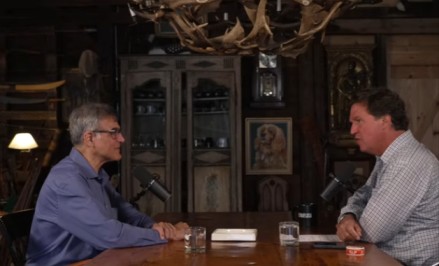
Editor’s Notes: In this episode, Tucker Carlson sits down with former CIA officer John Kiriakou to examine the escalating tensions with Iran and the hidden forces driving U.S. foreign policy. Kiriakou provides a rare insider’s perspective on the influence of foreign intelligence agencies and shares startling allegations about the government’s historical role in the global narcotics trade. Together, they explore the deep-seated politicization of the American intelligence community and the urgent need for transparency and reform in Washington. This conversation offers a provocative look at the “deep state” and the complex realities of modern national security. (April 27, 2026)
TRANSCRIPT:
Introduction
TUCKER CARLSON: John, thanks for doing this.
JOHN KIRIAKOU: Thanks for the invitation.
TUCKER CARLSON: So a lot of us have been trying to figure out how we got into this war with Iran. I think the reporting is clear at this point that there was really nobody at the White House or in the American intelligence community who was telling the president, “Yeah, this is going to be really easy,” right? But he came to that conclusion anyway. There’s a lot of speculation as to why. But tell us about the process. You’re the president. You’re trying to figure out what’s going to happen if you declare war on this country. How do you find that information? Where does that come from?
The Intelligence Process Before War
JOHN KIRIAKOU: Well, I can tell you how President George H.W. Bush did it and how President George W. Bush did it. It’s a process, right? You have to — a formal, formal process. You have to commission estimates from the intelligence community. You commission intelligence, finished intelligence reports from the CIA’s Directorate of Intelligence. You get an idea of what the State Department is thinking about it. You’re talking to your Secretaries of State and Defense, the National Security Advisor.
But then, and I think this is even as important, you need to talk to your friends and allies. You need to know what the European countries are saying or seeing. And then our Gulf allies, the Arab allies — we really needed to engage with all of them, and then there’s going to be a consensus at some point, at least among most of those countries, and then you come up with a policy.
I think that that’s not what took place in this case. As you know, you’ve heard the same criticisms that I’ve heard in the Gulf. The complaints are that they were not consulted as allies. They were just sort of brought along. And I was in Europe a couple of weeks ago and a couple of weeks before that, and I heard the same complaints that they weren’t consulted. The only apparent consultation that was taking place was with the Israelis, and the Israelis really, really wanted this to get done.
Why Consulting Allies Matters
TUCKER CARLSON: So why would you, as a practical matter, need to consult other countries? Because there is this sense, like, as an exceptional nation, we don’t need anyone’s permission to act. But again, not as an ideological matter or a matter of politeness or good form, but as a practical matter, before launching a war, why do you need to talk to the Europeans and the Gulf states?
JOHN KIRIAKOU: At the very least, you’re going to want political cover. You’re also going to want to give them an opportunity to come up with plan B for their — let’s say — oil or gas needs or transportation issues. You don’t want them to be taken by surprise because they’re going to resent you in the end. And we didn’t do that, and they resent us.
I’ll give you an example. I was in Ireland two weeks ago, and at the hotel, they told me I was probably going to have to leave extra early for the airport because they were expecting the largest demonstration in Irish history, which took place the next morning. And it was all because of home heating oil prices and gasoline prices. We didn’t consult with the Irish or the British or anybody else before launching this thing. They were already having problems because of the cutoff of home heating oil coming from Russia because of the Ukraine war. And then this was just doubly difficult for them.
And so gas was — we figured it out — gasoline was $12.50 a gallon. And home heating oil was astronomical to the point where people were just freezing, and they’re blaming us for it. So you want to be able to consult our friends and allies so that they have a chance to come up with a plan to make the hurt on their own people a little bit less severe.
Israel’s Influence on U.S. Foreign Policy
TUCKER CARLSON: Ireland is an enemy of Israel’s. The prime minister and many cabinet ministers in Israel have said that they hate Ireland, they hate Europe, they hate Europeans. So do you think that the president’s reluctance or failure to bring them into this conversation reflects Israel’s priorities?
JOHN KIRIAKOU: I hate to say it, but I do actually. I think that the Israelis — look, I understand what a close friend and ally Israel is and always has been. I get it. But I feel like sometimes we act in Israel’s best interests rather than in our own best interests. I think this is one of those cases. The Israelis, of course, are going to jump up and down and yell about the Irish and the Spanish and the Italians.
TUCKER CARLSON: Right.
JOHN KIRIAKOU: But we should let them vent and then do what’s in the best interest of the United States. And I feel like we’re not really doing that. We’re doing Israel’s bidding for it.
Historical Precedents: U.S. Interests vs. Israeli Interests
TUCKER CARLSON: Have you seen this before? You said it’s been a close relationship — that’s true, since the formation of the country, really, 1948 — and there’s always been pressure to help Israel and go along with its priorities.
JOHN KIRIAKOU: No. In fact, to the contrary, in the Gulf War — the 1990-91 Gulf War — and again in the Iraq War from 2003 onward, we specifically made decisions that were in the best interests of the United States, to the point where the Israelis complained vociferously to us that they wanted us to do A, and instead we did B, because B was better for the United States.
And we would say, “Well, that’s foreign policy. You have your interests. We have our interests. There’s no such thing as permanent friends. There is such a thing as permanent interests. This is our interest, and this is what we’re going to do.” And that just doesn’t seem to be the case today.
I don’t understand how attacking Iran was in U.S. national interests. I fully understand how this was in Israel’s interest, and the Israelis have long wanted us to attack Iran and to overthrow the regime in Tehran. I get that it’s in their interests, but I’ve never believed — I don’t think any CIA officer past or present believes or has believed — that the Iranians were anywhere near a nuclear weapon. They don’t have a delivery system that could deliver a nuclear weapon to the United States.
And when you’ve got two National Intelligence Estimates — a National Intelligence Estimate is a sense of the entire intelligence community, all 18 organizations within the U.S. intelligence community — unanimously concluding that there is no Iranian nuclear weapons program, twice, as well as the late —
TUCKER CARLSON: There’s no program.
JOHN KIRIAKOU: No program. No. Ayatollah Khamenei issued a fatwa in 2003 declaring it a sin to develop a nuclear weapon. And then the CIA twice said they don’t have a nuclear weapons program.
The Fatwa Question: Theocracy or Military Dictatorship?
TUCKER CARLSON: So it’s interesting on that question. The fatwa has been in place all these years — more than 20 years. We’re told simultaneously that Iran is a fanatical, suicidal, homicidal theocracy, totally beyond reason, so besotted are they by their crazy religious views. So there’s that. But we also can’t take the fatwas seriously because it’s Iran and they lie all the time.
JOHN KIRIAKOU: Right. But sometimes you can take things seriously.
TUCKER CARLSON: But I mean, it’s one or the other.
JOHN KIRIAKOU: Either, right?
TUCKER CARLSON: Either it’s a country that issues fatwas and takes them seriously — and therefore we should be afraid of them because they’re a theocracy — or it’s a country that issues fake fatwas because they don’t really believe in the idea of a fatwa. Like, what is it?
JOHN KIRIAKOU: God forgive me for quoting Hillary Clinton, but I’m going to quote Hillary Clinton. She said when she was Secretary of State that she had come to the realization that Iran was not a theocracy. It was a military dictatorship. There was this theocratic group that sort of sat on the top of the heap. But the day-to-day operation of the country was run by the IRGC.
TUCKER CARLSON: Yep.
JOHN KIRIAKOU: And the IRGC, being a military organization, was going to run the country as a military dictatorship, right? I think we should have addressed it that way. We shouldn’t have gotten wrapped around the axle on theocratic issues. We shouldn’t have been afraid to engage the Iranians — or maybe not even afraid, just refusing to engage the Iranians. We should have been constantly engaged, whether it was through the Qataris or the Omanis or even the Algerians, right? There were different ways in which we could speak with the Iranians, and we just never bothered.
Iran’s Threat Record and U.S. National Interest
JOHN KIRIAKOU: I will add, I do not have rose-colored glasses when thinking about the Iranians. I know what the Iranians have done. The Iranians made an attempt to kill me several decades ago. I haven’t forgotten that. I know that they’re bad guys. I know that they’ve carried out terrorist attacks and that they’ve killed Americans in many of those terrorist attacks. But we’re talking single digits over the last several decades.
Now, support for Hezbollah in the ’80s, the ’90s — yes, very bad, very big problem. The Houthis are a little bit of a thorn in our side. The Hamas thing — the CIA was late to the game on the Hamas thing because the analytic judgment for a long time was, incorrectly I might add, that the Iranians are not supporting Hamas because the Iranians are Shia Muslim and Hamas is Sunni Muslim. That was wrong. They were supporting Hamas. I get all that.
But again, Hamas has never carried out an anti-American terrorist attack. So was it in U.S. national interest to attack Iran for supporting Hamas? I think not.
TUCKER CARLSON: Hamas is designated a terror group in the U.S.?
JOHN KIRIAKOU: I think just recently it was — maybe Trump 1, maybe early Trump 2, I don’t recall. But I think, yeah, recently it was designated a terrorist group.
TUCKER CARLSON: But Hamas has never carried out a terror attack against Americans?
JOHN KIRIAKOU: No.
TUCKER CARLSON: We spend a lot of time talking about Hamas.
JOHN KIRIAKOU: Yeah. And the Muslim Brotherhood, which also has never carried out a terrorist attack on Americans.
TUCKER CARLSON: I’m not for either one, just for the record.
JOHN KIRIAKOU: No, nor am I.
TUCKER CARLSON: I don’t have strong feelings about either one, for the record. But why do we talk about both so much?
America’s Need for a Boogeyman
JOHN KIRIAKOU: It’s been my experience — I first came to this realization when I first joined the CIA — we always have this need to have a boogeyman. Whether it was Bolshevism in the 1910s, whether it was socialism in the ’20s and the early ’30s, Nazism — legitimately so. But then in the ’70s and the ’80s, it became Islamism. It’s like we always have to have an enemy to rally around.
The Real Enemy: Drug Cartels
TUCKER CARLSON: Everywhere I go, I meet people who are addicted to drugs, who’ve lost loved ones. I know a bunch of people have died of drug overdoses, and I see a country that’s really been gravely damaged, if not destroyed, by narcotics, which are being imported by drug cartels — Latin American drug cartels. If you’re looking for an enemy —
JOHN KIRIAKOU: There it is right there.
TUCKER CARLSON: — with a death count, that seems like the one.
The Heroin Strategy: Weakening Enemies Through Addiction
JOHN KIRIAKOU: Oh, may I tell you a story? When I was the senior investigator on the Senate Foreign Relations Committee, 2009 to 2011, end of 2011, I told the then chairman, John Kerry, I wanted to go to Afghanistan to do a formal Senate study on the heroin poppy crop. Afghanistan at the time was producing 93% of the world’s heroin.
So I flew to Afghanistan, went to Bagram Air Base. I told them I needed to fly to Kandahar and then to Lashkar Gah, which is the capital of Helmand Province. And I was doing this study now as a senior congressional staff member. I had the rank of Brigadier General. This is the only time in my life I ever pulled rank on somebody.
They wouldn’t take me down there. And I said, “I’m not asking you, I’m telling you, you are going to fly me to Kandahar, and then we will fly to Lashkar Gah, and then we’ll fly back to Bagram.” So they relented. We went to Kandahar, did some meetings.
When we got to Lashkar Gah, as you’re landing, for as far as the eye could see, all you see is heroin poppy. And so I said, I want to go into the poppy fields and I want to find a farmer and I want to talk to him. So I had security, I had a Pashto translator. We just drive out into the fields and sure enough, we stumble on a poppy farmer.
And I asked him a very naive question. I said, instead of poppy, why don’t you grow things that have two growing seasons like tomatoes or onions or pomegranates? And he goes like this, “The Americans told me in 2001 that if I told them where the Arabs were, I could grow all the poppy I wanted.”
I said, “What Americans told you you could grow poppy?” And just as I said the question, my military handler pulls me by the arm and he says, “We’re under threat. We have to go back to the base.” I never got an answer. We got back into the Jeep and they took me back to the helicopter. I flew back to Bagram.
TUCKER CARLSON: Actually, actually. Like out of a movie.
JOHN KIRIAKOU: So I come back to Washington and I said to the chief investigator, I said, I’m on to something here. This is not good. So I wrote it all up just as I collected it. Well, I had a friend at DEA, the Drug Enforcement Administration, and I called him. I said, listen, I’m going to send you a paper, eyes only. I just want your thoughts on it before I send it to John Kerry.
So he calls me back a couple of days later and he says, “Buddy, you know you’re not going to get this paper published, right?” I said, “Why not?” He said, “Afghanistan produces 93% of the world’s heroin. Almost all of that heroin goes to Iran and Russia, and we want them to be addicted to heroin. It weakens their societies.” And I never got it published.
Well, fast forward years later.
TUCKER CARLSON: That’s disgusting.
JOHN KIRIAKOU: We’ve got a fentanyl epidemic in this country. That fentanyl is coming from China and Mexico. They want us to be addicted to fentanyl because it weakens our society, and that’s why we’re in the predicament that we’re in.
Afghanistan’s Poppy Fields and the Taliban’s Zero-Tolerance Policy
TUCKER CARLSON: So you believe that the US government allowed poppy production in Afghanistan in order to weaken Iran?
JOHN KIRIAKOU: Russia. I do. And the reason I have come to that conclusion is not because I’m any smarter than anybody else, but do you know how much of the world’s heroin was produced in Afghanistan in the last year of Taliban rule, 2000? Zero. None. They didn’t grow any.
Not only did they not grow any heroin poppy in 2000, they were a net food exporter to Iran and to Pakistan. And as soon as we took over, it was all about the heroin.
TUCKER CARLSON: That is a quite amazing statistic. Terrible. Does anyone in a meeting where these plans are formulated say, you know, we’re the United States, we can’t flood other people’s countries with heroin, that’s just so immoral?
JOHN KIRIAKOU: I never sat in a meeting like that. The meetings were all about, how do we win? How do we get a leg up? How do we implement the policy that we want whatever country to follow?
TUCKER CARLSON: But if you intentionally flood other people’s countries with heroin, it’s kind of hard to tell yourself you’re the good guy. Like, that’s—
JOHN KIRIAKOU: Oh, Tucker, that was something that I struggled with for at least half of my career at the CIA. We’re supposed to be the good guys. So why are we doing so much of this? I just never understood it.
TUCKER CARLSON: And what do you think the answer is?
JOHN KIRIAKOU: The answer was that I had stars in my eyes, that I was not fully understanding of realpolitik.
TUCKER CARLSON: That you’re a liberal. Well, I’m not a liberal at all, and I find that disgusting. I find it disgusting. I don’t want my government to be involved in any way in heroin trafficking. Nor do I. And I also don’t know why Russia’s our enemy, but big picture. But even if there was a good reason to have Russia as an enemy, I still wouldn’t be for flooding their cities with heroin.
Diplomacy, Russia, and the Limits of Cooperation
JOHN KIRIAKOU: Right after the Russians invaded Ukraine, I was one of 7 journalists, independent journalists, who were invited to lunch with the Russian ambassador in Washington. And what he wanted was our ideas on how the U.S. and Russia could continue to cooperate diplomatically even during a time of war.
And I said— I was actually proud of what I said. I went prepared and I said, the US and Russia have identical interests in counterterrorism, counterproliferation, and counternarcotics. We should never stop cooperating on those three issues.
And I said, and you know what, there’s a fourth thing. I said, “Your Excellency, when you arrest an American, a female American basketball player, and give her a draconian 10-year sentence for having a little bit of weed oil, it’s a bad look.”
That was the only time he got angry. And he said, “Do you have any idea how many Russians are in American prisons? 1,500. I know that it’s 1,500 because I have to send my staff out to visit them. So if you want to talk about not arresting people, talk to your own government about it.”
TUCKER CARLSON: Well, frankly, I would see that as an opportunity.
JOHN KIRIAKOU: That’s yet another thing on which we should be engaged with the Russian government, and we’re not. And it doesn’t matter who’s in the White House, whether it’s a Democrat or a Republican. We just have this idea that the Russians are bad, bad, bad, and we shouldn’t be cooperating with them.
I’ll tell you another thing. My former wife was also a senior CIA officer, and as recently as 2017, she said to me, “The Russians are the gravest threat that the United States has ever faced.” And I’m like, what newspapers are you reading? Because I know these people, and they want to work with us. They’re not going to roll over for us, but they want to be engaged diplomatically.
TUCKER CARLSON: And the gravest threat in what way?
China, Mexico, and the Real Threats to America
JOHN KIRIAKOU: I would be far more worried about the Chinese than about the Russians. I’m far more worried about the Mexicans.
I’ll tell you another thing. I actually left the Democratic Party years ago because I thought that it moved too far to the right. The truth is that the ideological spectrum is not a straight line from left to right. It’s a circle. And there are a lot of issues on which the right and the left can meet and agree. That’s where I am. I’m at the point where the circle meets.
So some of my former friends won’t speak to me because they say I’m far too conservative, that I’ve gone over to MAGA, and they just don’t want to be friends anymore. And that’s fine. I don’t care because then they weren’t real friends anyway.
But the issue is I agreed with Donald Trump’s policy about building the wall. I lost a lot of friends because of that. And I said, you know, you have to look at it this way. I read the Greek press every single day. I’m a relatively recently dual US-Greek citizen now.
Turkey takes something like €1.5 billion every year to hold economic refugees in camps in Turkey until they can be processed and resettled in places like Germany and Sweden and France, etc. But what the Turks really do is they put them on little boats and they send them to Greece in the middle of the night. The purpose being to crash the Greek economy. To destroy Greece.
So what the Greeks did is they built a wall. And all of a sudden, nobody can cross the border where the wall is. So the Greeks now focus on the islands and have the Coast Guard intercept these boats that are coming in almost every night. The wall worked. Our border with Mexico is long. Much of the land is just desolate. It’s desert, it’s wasteland. But the wall works.
TUCKER CARLSON: Of course, that’s why Israel has them.
The CIA’s Indifference to the Drug War
TUCKER CARLSON: So just back to the focus of counterterrorism — really the focus of the entire US government has been on Islamic extremism, has been on Israel’s enemies for over 20 years now. You don’t see a mobilization of men and money to fight the drug cartels who are responsible objectively for so many more deaths in our country. So does anyone ever bring that up and say, wait a second, we have 100,000 people dying a year because of these groups?
JOHN KIRIAKOU: On the contrary. The CIA has something called the— it used to be called the Counter-Narcotics Center. Now it’s called the Crime and Narcotics Center. And that is the graveyard where people’s careers go to die. The CIA doesn’t care about stopping the flow of drugs. They just don’t care.
You know this wonderful show on Netflix, Narcos? So in seasons 1 and 2, just as the DEA’s going to go in and grab Pablo Escobar or grab the Gentlemen of Cali, the CIA station chief comes in and just screws the whole thing up. That’s in that show because that’s what happens in real life.
The CIA at the time cared only about communism and stopping communism. And if the drug cartels were going to tell the CIA where the communists were hiding, then the CIA was okay with the drug cartels. And that attitude has really never changed.
TUCKER CARLSON: Why do you think that is? It doesn’t make any sense.
JOHN KIRIAKOU: It’s old think, Tucker. It’s old think where instead of saying our job is to disrupt any threat to the United States — that’s what I thought the job was — their view is our job is to disrupt any Islamist, communist, fascist, whatever foreign official challenge to the United States, whether it’s governmental or it’s an organized terrorist group. They’re just not thinking about the cartels.
TUCKER CARLSON: So it sounds like they’re doing what all organizations do ultimately, which is to protect themselves.
Reclassifying Cartels as Terrorist Organizations
JOHN KIRIAKOU: Yes, it’s all about kingdom building. I will say, I wrote a piece — I don’t even remember for whom — when President Trump first declared that the drug cartels would be reclassified as foreign terrorist groups, and everybody was laughing and making fun and how silly this was.
I said, no, no, no, you’re underestimating him. He knows exactly what he’s doing. He’s not doing this for the PR of naming the cartels as terrorist groups. He’s doing it because legally it frees up some agencies’ abilities to act unilaterally against the cartels. And it frees up a great deal of money to be used by CIA, NSA, DOD against the cartels. I said, this is a big deal. This is not window dressing.
TUCKER CARLSON: Did it have any effect?
JOHN KIRIAKOU: I think not yet. Frankly, the army of people that we put against terrorism after 9/11 is what we need to do against drugs.
The Iran War: Intelligence, Strategy, and Blowback
TUCKER CARLSON: It’s hard to think that that could happen now, considering that all resources of government, certainly all attention in government, is focused on this Iran war.
JOHN KIRIAKOU: I think that’s the most important point. Yes, I agree.
TUCKER CARLSON: There’s just no bandwidth for anything. And the demands of a war, especially one that you’re losing, which we are by any real measurement, they’re so overwhelming. There’s no time to think about anything else, correct?
JOHN KIRIAKOU: In the ’91 Gulf War and in ’03, the State Department initiated this policy called burden sharing. Really what it was was a nice way of saying, “We want all of our allies to pay for this.” But it worked. The Kuwaitis in 1990, the year that they were invaded by Iraq, for the very first time in their history, they made more from their investments than they made from oil. So they had this bottomless pit of money. They paid for most of the liberation of their own country, but the Europeans also paid. And so it ended up not costing us anything.
We went down the burden-sharing road again in 2003, and a lot of it came out of our own pockets, but our European and Gulf allies also paid for it. This time nobody was consulted, and so this is all coming from our own pockets, and I think that’s unsustainable over the long term.
Iran’s Nuclear Program: Fact vs. Fiction
TUCKER CARLSON: To the beginning of it, the president said two things. One, that we destroyed Iran’s nuclear program in June. But you’re saying that they obliterated it, that there was no nuclear program.
JOHN KIRIAKOU: There was no nuclear program. They had partially enriched uranium, certainly, which under the NPT they’re allowed to do. It’s subject to United Nations inspection. Yeah, they were not—
TUCKER CARLSON: There was no nuclear program in June. No nuclear weapons program. So we destroyed the nuclear weapons program, which doesn’t exist. But then in February, we were told again that the nuclear weapons program is absolutely real, that the threat is imminent. People go on television on Fox News and say Iran can lob an ICBM into Miami and obliterate the United States.
JOHN KIRIAKOU: I’m glad that you brought that up too, because that is also not true. And a lot of people are saying it. The Iranians did something recently that was interesting in that they took two of their medium-range missiles. They stripped them down to the point where it was just the missile and the engine, and that was it. There was nothing inside of them, just to see how much distance they could get. And they made it almost to Diego Garcia, which is far.
So if you instead point them toward Europe, yes, without anything inside these missiles, they could reach Western Europe. That’s not a delivery system. That’s just smoke and mirrors. They can only go that far if they’re completely empty. If you weigh them down with explosives, or God forbid, with nuclear material, even if it’s just to make a dirty bomb, they can’t get that far. They could get to Cyprus, they could get certainly to Israel, and easily to the Arab Gulf countries. But there was no threat to the United States.
What the Intelligence Community Actually Said
TUCKER CARLSON: So the IC, the American intel community, those 18 agencies you referred to, did anybody in those agencies say to the president, “This is a major threat, the nuclear program in Iran?”
JOHN KIRIAKOU: The people that I still talk to at the agency say specifically, no.
TUCKER CARLSON: No. So that information, that lie, came from Israel. Yes. Why would a president believe a foreign intel agency before his own?
JOHN KIRIAKOU: I don’t know. That’s really the $64,000 question. You recall in the first term when President Trump met with Vladimir Putin, he did not take his intelligence people into the meeting with him. Putin took his intelligence people into the meeting with him because the president said he trusted the other side’s intelligence people more than he trusted his own.
And I get it. I get that he believes that he was under direct threat from the deep state and the John Brennans of the world. I understand that. But I’m surprised that that feeling, that belief has held over all this way into the second term — where you would believe the Israeli information before you would believe your own people’s information, especially when you know that the Israelis have a vested interest in you doing their dirty work for them.
General Dan Cain and the Joint Chiefs
TUCKER CARLSON: What about General Dan Cain, Chairman of the Joint Chiefs of Staff? This is someone who I think the president — I know the president likes, certainly speaks well of. He would be informed on this, right? The chairman has a pretty clear readout on what the intelligence is, right?
JOHN KIRIAKOU: Yes. I’m glad you brought him up. I wanted to bring him up too. We have some mutual friends, and not only have I never heard a single negative thing ever about General Cain, I hear only the most superlative things.
TUCKER CARLSON: Yeah, me too.
JOHN KIRIAKOU: That he is the best Chairman of the Joint Chiefs of Staff that the country could hope for right now. But we also hear these leaks into the political press in Washington that he has argued against this war from the very beginning.
It was my own experience — I don’t believe that’s true. I hope that I’m right. It was my experience at the CIA that the Joint Chiefs were the last ones to go to war. They were the ones that always argued until the bitter end not to attack Iraq in 2003 because there was no exit strategy. I think that’s the problem today. There’s no exit strategy. It’s easy to invade a country. It’s easy to overthrow a government. It’s very, very difficult to leave and to leave something that can actually function as a government.
Flight 93 and a Remarkable Coincidence
TUCKER CARLSON: You want to hear an interesting coincidence? I’m sure it’s just a coincidence, but on 9/11, on the actual day, September 11th, there are 4 planes. 2 hit the World Trade Centers, one hits the Pentagon. The fourth, which was late, Flight 93, wound up crashing in Shanksville, Pennsylvania. We know that the vice president gave an order to shoot that plane down because, understandably, he believed it was headed into Washington, which I think it was.
4 American fighter jets were scrambled from DC, chased that plane, and the official story, their explanation was, “We didn’t get there in time and the plane was brought down instead by Todd Beamer and the other passengers,” famously. Of those 4 fighter jets, of the pilots of those 4 fighter jets, they were National Guard pilots. 2 became generals. And one of them is Dan Cain.
JOHN KIRIAKOU: I did not know that.
TUCKER CARLSON: Yeah, it’s not widely known, but it’s a fact. What are the odds of that?
JOHN KIRIAKOU: Not good.
TUCKER CARLSON: I don’t know anything beyond what I just said, but I just think that’s such an interesting fact. So, okay, let’s say — and I’ve never heard a bad word about General Cain other than he did not take a strong position on the Iran war before it started.
JOHN KIRIAKOU: I’d be very disappointed in that.
TUCKER CARLSON: That’s — I believe that’s a fact. I think there’s a lot of backfilling going on through leaking, but when it came down to it, General Cain did not say this is a bad idea. He did not say that. In fact, he said it’s not my job to say things like that.
My question to you is, is it his job to say things like that? If you’re him, if you’re a senior briefer, if you’re John Ratcliffe at CIA or any of the people who advise the president on foreign policy questions, wars — what’s your view of what they should say to him? If you think this is a terrible idea, should you say that?
The CIA’s Role: Policy Support, Not Policy Making
JOHN KIRIAKOU: At the CIA, that’s an easy one to answer. The CIA is not supposed to be a policy organization. It’s supposed to be a policy support organization. So the CIA director should never take a position on things like that. They do, obviously, but they’re not supposed to.
When George W. Bush was president in his second term, he changed the structure of the PDB, the President’s Daily Brief. It used to be, for most of the articles, a paragraph of fact and a paragraph of analysis. He ordered a third paragraph to be added: policy recommendation. And it was like setting the building on fire. Nobody wanted to be responsible for telling the president of the United States what he should do about a policy. That’s just not what the CIA was created for.
Behind closed doors, of course, they’re going to offer advice. When I was there, the Joint Chiefs almost always deferred to the Secretary of Defense, but they were also almost always of one mind. When we attacked Iraq in 2003, there was a very significant split where it was the Office of the Vice President, the Office of the Secretary of Defense, and the NSC that were the pro-war faction — the political people, crazy as it sounds. Well, maybe not crazy. And the CIA, State Department, and Joint Chiefs that were opposed to the war.
TUCKER CARLSON: I’m not surprised at all. I will never defend the CIA. However, like Mossad, they’re a stakeholder in the country. They probably shouldn’t be, but they are. And so sometimes the voices of restraint come from the people with the long-term interest in the state. I think that’s right. Yeah. And I’m not complimenting CIA.
JOHN KIRIAKOU: No, no, no. I know in the chat I’m going to be accused of being a shill for the CIA, which I’m not.
Mossad, Restraint, and the Bombing of Doha
TUCKER CARLSON: When the Israelis bombed Doha on September 9th, the day before Charlie Kirk was murdered, that was a lunatic thing to do — to bomb one of our closest allies in the world. It was insane. And Mossad did not participate in that because they thought it was reckless, which it was. It was bonkers. But Mossad was a voice of restraint in Israel, which is hard to get your head around. Does that surprise you?
JOHN KIRIAKOU: No, because you always have to consider the potential for blowback, unintended consequences, responses that you haven’t fully thought through.
The Risk of Blowback and Shiite Terrorism
TUCKER CARLSON: Yeah, blowback is a problem. So what kind of blowback is the United States looking at now that we’ve killed the religious leader of this country and his family? We haven’t had a problem with Shiite terrorism in the United States during my lifetime or ever. Are we going to have one now?
JOHN KIRIAKOU: Only because it’s always been so hard for Iranians or Iranian proxies to get visas to come to the United States. So these rumors — I think they came from the FBI right after the conflict began — that there’s a cell in Honolulu, there’s a cell in Detroit. No, there aren’t. If there were, you’d just grab them instead of—
TUCKER CARLSON: I was about to say, why are you telling me about cells? Shouldn’t you be arresting the cells if they’re planning terror?
JOHN KIRIAKOU: Exactly. I remember when I was still with the CIA, driving down First Avenue in New York with two FBI agents. One of them said, “You see that storefront? That’s the headquarters of Hezbollah’s cell in New York.” And I said, “Well, why don’t you do something about it? They’re a terrorist group.” What did he say? Just go kick the door down and grab them if it’s the headquarters of Hezbollah’s terrorist cell. They just kept driving like I didn’t understand.
But I think the attack on Iran has galvanized the Iranian public. The government was not a house of cards. We are not going to be seen as liberators. We’re going to be seen as attackers and possibly occupiers. And I think that’s the most immediate challenge we’re going to face.
TUCKER CARLSON: That seems obvious now, 7 weeks in, but at the time, my impression is the president really believed that if you kill the Ayatollah, the whole country collapses.
The MEK, Reza Pahlavi, and the Manufactured Opposition
JOHN KIRIAKOU: But coming back to Hillary Clinton, the reason why it didn’t is that it’s not actually a theocracy. It’s a military dictatorship.
TUCKER CARLSON: Oh, it’s actually one of the most liberal countries in the entire region. You know what?
JOHN KIRIAKOU: It is. I think you and I are the only ones who haven’t been— Really? People would know that. Yes. And we haven’t been to Iran. So many of my friends have been to Iran relatively recently before the hostilities began. And they posted videos on YouTube of just walking down the street in Tehran and the restaurants are open and the cafes and there’s music and people laughing and having late dinners and it’s just normal life. Yeah.
TUCKER CARLSON: No, I remember my father working in Iran, going back and forth to Iran and telling me, no, it’s like Tehran specifically. I mean, I think it’s a huge country, but Tehran, yeah, has tons of liberals. Yeah.
One of the most amazing pictures— I think that’s one of the reasons Trump was convinced that the regime would fall, right? Because there were lots of secular liberals in Tehran. Yes. But one of the most amazing pictures I think I’ve ever seen was a picture of a very butch-looking lesbian-type woman with a nose ring standing in Tehran, standing at an intersection, waving a photograph of the Ayatollah after he was killed. And the point is, this is exactly the person who opposed him while he was still alive. But now that we’ve killed him, you got all the lesbians of Tehran all of a sudden for the Ayatollah.
JOHN KIRIAKOU: I think that’s exactly right. We’ve forced them together. We really have. So look at it this way. If I don’t like whoever happens to be in the White House and I go to demonstrations and my fist is in the air and I don’t like this person’s policy and then the Russians attack, I’m going to pick up a gun and I’m going to fight the Russians.
TUCKER CARLSON: Oh, for sure. No matter who attacks.
JOHN KIRIAKOU: No matter who attacks. Right.
TUCKER CARLSON: But human nature gets suspended for our adversaries because they’re not human beings. So they’re not going to behave in ways that we would recognize. They’re totally irrational. It’s a suicide cult or whatever they’re telling you on Fox News. But the point is that you will suspend all rational analysis. And because you can’t predict people like that other than they want to kill.
JOHN KIRIAKOU: You’re right. And when the only analysis that you’re getting or paying attention to is from either the Israelis or the MEK, the Mujahideen-e-Khalq, which is really no more than a quasi-communist cult, then you can’t rely on the information.
What Is the MEK?
TUCKER CARLSON: So can you explain the MEK? They are big allies in Iran, right?
JOHN KIRIAKOU: Yeah. Which just sends chills up my spine. So who are they? They were founded by a husband and wife team back in the ’60s, and in the ’70s they were based in Iraq, northeastern Iraq, and they would launch these cross-border attacks into Iran, deep into Iran, like in Tehran— terrorist attacks. They attempted to murder the American ambassador. They attempted to murder a 3-star general who was the senior-most American military official in Iran. They’ve carried out anti-American terrorist attacks over the course of decades.
TUCKER CARLSON: Anti-American.
JOHN KIRIAKOU: Anti-American. And then they switched sides when Saddam Hussein pushed them out of Iraq. They relocated mostly to Paris. Now, the husband disappeared. It’s always Paris.
TUCKER CARLSON: Always Paris. That’s where the Ayatollah Khomeini lived until 1979.
JOHN KIRIAKOU: And that’s where what became the Greek terrorist groups 17 November and Popular Revolutionary Struggle started— in Paris. That’s where Pol Pot started. Pol Pot studied in Paris. Yep. Karl Marx’s daughter married Paul Lafargue, the father of French communism. So yeah, Paris is kind of a screwed up place.
Anyway, Maryam Rajavi’s husband vanished, never to be seen again. The conventional wisdom is that she killed him or had him killed, and she took over the MEK. So in 2009, when Barack Obama is elected president and Hillary Clinton becomes— God forbid— becomes Secretary of State, the MEK hires some of the most high-powered lobbyists in Washington to get them off the terrorism list. And they engaged with both Democrats and Republicans. I mean, everybody from Howard Dean to Rudy Giuliani.
TUCKER CARLSON: Howard Dean was lobbying for MEK?
JOHN KIRIAKOU: Oh yeah. And Rudy Giuliani. That’s pathetic. You should see the pictures of them together. It’s sickening. At these big banquets in Washington to raise money for MEK.
TUCKER CARLSON: These are the people who tried to kill the US ambassador?
JOHN KIRIAKOU: Mm-hmm. But they’re the good guys now.
The MEK as Assassins for Hire
TUCKER CARLSON: So the MEK is taking money from Israel. Yes. And I think most people who pay attention think the MEK is like a reasonable pro-America group.
JOHN KIRIAKOU: Right. From the very beginning when they were rehabilitated in 2009, I just started shaking my head like, what are we doing? What are these Obama people thinking? But it turned out it wasn’t just the Obama people. The MEK, first of all, had the money to hire all these multimillion-dollar lobbyists. And they were smart in that they did it across the political spectrum.
TUCKER CARLSON: Democrats and Republicans. Where did they get their money from?
JOHN KIRIAKOU: From rich Iranian exiles who are willing to hold their nose over the personal ideology of the organization and just say, well, if you’re going to kill ayatollahs and hojatollahs, then okay, I’ll write you a check.
TUCKER CARLSON: And the Israelis, of course, see them as useful. Yes. That’s quite amazing.
JOHN KIRIAKOU: They pay millions of dollars to DC lobbyists, senior political figures, former political figures, and now can accept American weapons. Well, the MEK doesn’t have the wherewithal to fight the Iranian government. It’s just all about arming themselves. What do they believe? They’re ardently communist.
TUCKER CARLSON: What? And we’re supporting—
JOHN KIRIAKOU: And Howard Dean and Rudy Giuliani were lobbying for them because, remember, the Iranian regime is this theocratic terrorist cabal and we have to overthrow them to make the Middle East safe. It’s insane.
TUCKER CARLSON: I know very little about MEK other than what you’ve said, but I do know that they are feared. Yes. And they’re murderous. Yes. And it’s suspected— because I’ve heard this from intel people— that they are used basically as assassins for hire.
JOHN KIRIAKOU: Well, the conventional wisdom is that the Israelis use the MEK regularly to carry out these assassinations we’ve seen over the years in Tehran. Yeah.
TUCKER CARLSON: And I have heard— I don’t know if it’s true— in the United States. I heard that from someone who’s pretty informed. Doesn’t mean it’s true. Of course, it’s hard to know what is true now.
Reza Pahlavi: A Manufactured Alternative
TUCKER CARLSON: What about the Shah’s son, who we’ve also been trained to think of as a good guy? Yeah. Reza Pahlavi.
JOHN KIRIAKOU: He is most definitely not a good guy. So who is he?
TUCKER CARLSON: He’s the son of the Shah who was deposed famously in 1979.
JOHN KIRIAKOU: Correct. And when his father was deposed, he was only about 18 or 19 years old. So he came to the United States with his family. The Shah got sick almost as soon as he came to the United States. He developed cancer. He was treated in— I think it was in Houston. The Iranian government under the ayatollahs objected so vociferously that they raided the American embassy and took our diplomats hostage, held them for 444 days.
TUCKER CARLSON: And we told the Shah to go get cancer treatment somewhere else.
JOHN KIRIAKOU: That’s right. He went to the Bahamas for a while, then to Panama, and then ended up finally settling in Cairo, and he died in Cairo. Well, his family stayed here in the United States— Reza Pahlavi, the crown prince, in Northern Virginia, the mother in North Carolina, and Reza’s younger brother in Boston.
Reza Pahlavi is not equipped to lead anything. He is a playboy. He had an affair with his brother’s wife. His brother actually turned to drugs and committed suicide. His own wife, Reza Pahlavi’s wife, is having a very public affair right now with her personal trainer. The Parisian press is just crazy over it, and they publish pictures of the two of them together all the time. It’s humiliating in anybody’s culture, let alone in Iranian culture, which is supposed to be very pious and very Muslim.
So on top of that, he has said repeatedly, most recently on the Patrick Bet-David podcast, that no, he doesn’t think he wants to go back to Iran. He’s made a life here. He’s very wealthy. His kids are Americans. There’s really no reason to go back to Iran. Okay, so why are we talking about him in the first place?
TUCKER CARLSON: Well, he was all over Mar-a-Lago and the White House.
JOHN KIRIAKOU: I’m the guy. I’m the guy. And then, well, maybe I’m not the guy.
TUCKER CARLSON: So what has he done for the last 47 years? Nothing.
JOHN KIRIAKOU: You see him every once in a while at cultural events. Once, twice a year, Iranian singers will come to Washington, or there will be a Farsi language play, a performance or something. And he’ll go to those things. But he’s just not a player in Washington, even in Iranian exile circles. He’s just not a player.
TUCKER CARLSON: So why were we talking about him nonstop all summer?
JOHN KIRIAKOU: Because the Israelis like him very much. Remember, his father opened diplomatic relations with Israel. There was an Israeli embassy in Tehran. Oh yeah. And there was an Iranian embassy in Jerusalem. And so I think there are a lot of people who pine for those days and think that, well, in a perfect world, if Reza Pahlavi were Reza Shah, then Israel and Iran would be friends and all the Iranian people would fall into line and we could all live happily ever after.
TUCKER CARLSON: But is there any indication that the people of Iran— to the extent their view matters, obviously it doesn’t, but let’s just say it did— that they want to exchange a theocracy for a monarchy?
JOHN KIRIAKOU: Not a chance. The only place where he has solid support is in the Iranian-American community in Southern California.
TUCKER CARLSON: Yeah, in Beverly Hills. Yeah, the only zip code in LA to go for Trump.
JOHN KIRIAKOU: That’s right. Yeah. In fact, I think the mayor of Beverly Hills is Iranian.
TUCKER CARLSON: Yeah. And by the way, some of the most entertaining people in the world, some of the warmest people in the world are the Persian Jews of Southern California. Very intense, extremely intense and very successful. Super successful. But I’ve never had a bad experience with them. I’ve always really liked them.
But this is yet another example of an exile community leveraging the power of the US economy and military for its own parochial ends. Like, just be grateful you’re here. Like, stop trying to get my neighbors killed in another dumb war.
JOHN KIRIAKOU: But no one can say that. No, you can’t say that. There’s political fallout.
TUCKER CARLSON: So the Shah’s son thing was like totally fake from the very beginning.
JOHN KIRIAKOU: Totally manufactured. Yeah.
TUCKER CARLSON: Didn’t we do this in Afghanistan? Boy, did we. Some guy ran a restaurant in Baltimore was going to be like the king of Afghanistan.
JOHN KIRIAKOU: Do you remember this? I mean, Karzai’s brother. Yeah, he still has the restaurant in Baltimore. What?
TUCKER CARLSON: It’s quite good. But where does the— I mean, in the face of like 100 years of failing to pull off these schemes, why does no one pause and say, we can’t just install someone to run a foreign country? We don’t even speak the language. We know nothing about it.
The Night Before Iraq: “Have These People Lost Their Minds?”
JOHN KIRIAKOU: It’s because we don’t understand history. You think that— well, again, one of my experiences at the CIA is— and not just at the CIA, John Kerry made the same mistakes— we always think we’re the smartest people in the room, that we know better than everybody else. On what basis? On what basis? Arrogance. It’s just arrogance.
And we’re not the smartest people in the room, and we don’t know history. I’ve told this story a million times. The night before we attacked Iraq, we had the final principals committee meeting. Principals committee is normally chaired by the president. It includes the vice president, the secretaries of state and defense, the national security advisor, the chairman of the Joint Chiefs, the vice chairman, and in this case, the head of CENTCOM, and then a bunch of senior-level NSC people. And everybody brings a note-taker. I was George Tenet’s note-taker. He was the director of the CIA at the time. And for whatever reason, the president didn’t attend this meeting. There was something else going on, so the vice president chaired the meeting.
TUCKER CARLSON: And the president didn’t attend the final principals meeting before the Iraq War, right? But Dick Cheney did.
JOHN KIRIAKOU: But Dick Cheney did. Boy, did he. Okay, sorry. And to make a long story short, General Tommy Franks, who was the commander of Central Command at the time, gave his briefing. “Our men are here and there and elements of this group and that group and the Third Corps and the First Corps.” And I’m like, okay. And I’m writing it all down. And then he says, “If all goes as well, we’re going to invade Iraq the next morning. If all goes as well, we can be in Tehran by August.”
And George discreetly turns off his microphone, and then he turns to me. I’m sitting behind his right shoulder, and he says, “Did he say Tehran, or did he say Baghdad?” And I said, “He said Tehran.” And George says, “Have these people lost their minds?”
I got back to the office at the end of the meeting, and the deputy director said to me, “How’d the principals committee meeting go?” And I said, “Did you know we were going to attack Iran?” And he said, “Are they still talking about that? We’re not going to attack Iran. That’s just a pipe dream that these people at the White House have.” And I said, “Do they know nothing about history?” And he said, “No, they know nothing about history.”
As we were walking out of that meeting, one of the NSC people, a guy who I disrespected, I think, the most of my colleagues at the NSC, he said giddily as we were standing up to walk out of the meeting, “When we cross that border tomorrow, they’re going to throw flowers at us.” And I thought, buddy, have you never read a history book? They’re not going to see us as liberators. They’re going to see us as invaders and occupiers.
And so many of my contemporaries thought, “Well, we’re going to move into southern Iraq, and that’s the Shia part. And they’ve been just so brutalized by Saddam Hussein. They’re going to greet us as liberators. We’re going to arm them and we’re going to go together to Baghdad and liberate Baghdad.” It’s like, no. First of all, we scared the hell out of them when we crossed the border.
There was this very tense standoff where we moved into Najaf, which is one of the holiest sites in all of Shia Islam. And there was a huge group of people and several ran inside one of the mosques to take refuge. And we’re like, “No, no, no, we don’t mean you any harm. We came to liberate you.” And they were like, “Get out of our city.”
And so finally, what the military guys did is they set down their weapons and they asked to see the tribal leaders. And so they met with the tribal leaders inside the mosque and said, “We came here to liberate you.” And the tribal leaders said, “We don’t want your liberation. If you’re here to fight Saddam, go fight Saddam. Leave us out of it.” And so that’s why we didn’t have support in the South. Why should we expect anything different in Iran?
An Invading Army Always Engenders Hatred
TUCKER CARLSON: No, no. And an invading army inevitably mistreats civilians. I saw it in Iraq. I don’t think any— they don’t mean it. Most American soldiers are nice guys. But there’s just no way around it because they’re under threat or the perception of threat. And so they have to get rough. They have to stick rifles in people’s faces all the time.
JOHN KIRIAKOU: And then it’s just a slippery slope from there.
TUCKER CARLSON: Yeah, even if they don’t shoot anybody, it just engenders hatred and resentment. Why wouldn’t it? If someone did that to you. That’s right. I remember seeing this at a gas station in Nazariah where they, whatever, humiliate a man in front of his son. And I don’t think there was an option. Everyone’s afraid of getting killed, so they have to act that way. But downstream from that, where’s that son now? 23 years later. And how anti-American is he now? Yeah. So yeah, by definition it’s counterproductive.
So, just to your point about the president believing that Iran was a house of cards that just needed one swift push to collapse. Where did he get that idea?
JOHN KIRIAKOU: He could only have gotten that idea from Benjamin Netanyahu. That’s it. Because the CIA analysis has been consistent over the course of decades. We can’t just fire a couple of rockets and take down a government in a country of 93 million people. That’s just not the way real life works. They’re going to rally around their leadership because we’re outsiders.
Iran: A Real Country With a History Stretching Back Millennia
TUCKER CARLSON: And just— you make the point about history, but I mean, I think you could— Saudi is probably in competition, but I mean, of all the countries in that part of the world, Iran is the most durable. I mean, it’s a real country.
JOHN KIRIAKOU: It’s a real country with a proud history stretching back millennia. Yes. I have a lot of Iranian-American friends, some quite close, and they never stop talking about the history to the point where I have to say, “Please, can we please talk about something other than Cyrus the Great? Please. And Xerxes. I just can’t anymore. I need a break.” But that’s how proud they are of their—
TUCKER CARLSON: You don’t see that with, say, Kuwaitis. No, no.
JOHN KIRIAKOU: Who, God bless them. I love Kuwait.
TUCKER CARLSON: Oh, me too. I’m not against— They don’t have a history. No. Right. No. So Iran, of all the countries maybe in the world, that would be high on the list of ones. It’s pretty hard to beat.
JOHN KIRIAKOU: I couldn’t agree more. Okay, so even I know that. And the country’s the same size as Western Europe. Yeah, it’s not like you can just launch a couple pinprick strikes and the whole thing falls apart. It’s the size of Western Europe, 93 million people with a forbidding topography on top of it all. Oh, for sure. So yeah, not easy.
How Do We Restore Stability? Only Through Diplomacy
TUCKER CARLSON: We go in on February 28th and Iran does not, strictly speaking, control the strait at the outlet of the Persian Gulf. There’s unimpeded shipping. The 6 Gulf states are thriving. Iraq, also in the Persian Gulf, is pretty peaceful for Iraq, or whatever. It’s fine. We’re not reading about it every day. Things are fine. Now they’re not fine at all. How are they restored to fine?
JOHN KIRIAKOU: Only through diplomacy. That’s it. Whether we like it or not, especially whether the Israelis like it or not, we are going to have to sit across the table from these people and come up with an agreement. It’s going to be an agreement that we are not going to be 100% happy with.
TUCKER CARLSON: But that’s what diplomacy is all about. Not happy with— you mean Iran will be more powerful at the end of this than they were at the outset.
JOHN KIRIAKOU: I think that’s an inevitability. We have forced the Iranians into the embrace of the Chinese and the Russians. And the Indians. And we’re going to get to the point where we’re just not going to be able to stand up against that kind of an alliance and make meaningful gains.
Just think about this. Iran is a BRICS country, right? Brazil, Russia, India, China, plus South Africa and Argentina and Iran and a couple of others, South Korea. Eventually, using the European Union as their model, they’re going to come up with a unified currency. It’s probably 20 or 30 years down the road, but it’s going to happen one of these days. That will be the end of American hegemony in the region, because as things stand now, all oil transactions in the world, almost all, are done in dollars, right? The famous petrodollar.
Well, a year ago, Kuwait sold a shipment of oil to China for yuan. And the Indians, a week ago, paid for a shipment of oil in yuan. So we’re already seeing the cracks in the dam. And then just blasting the place is only going to make this inevitability come sooner. I think it weakens us.
TUCKER CARLSON: I think it’s definitely the end of something profound. So, but what are our military options at this point?
No Viable Military Options Remain
JOHN KIRIAKOU: I’m not sure that there are any viable military options. I mean, God forbid we should target the civilian infrastructure. That’s a war crime. It’s actually very clear in international law. You can’t bomb the civilian infrastructure. You can’t bomb the electrical grid or the water treatment plants. You can’t. We do, but it’s a war crime. You can’t do it.
And so what are we going to do? Just keep blasting the IRGC? Okay, well, where’s that gotten us? There are survivors. It hasn’t led to the collapse of the government. So when are we going to finally come to the conclusion that what we’re doing is just simply not working? Maybe we can wrest some concessions from the Iranians across the negotiating table. Maybe we can figure out how to use their closeness with the Chinese and the Russians to our benefit. I’m not really sure how, but maybe we can get there. But we’re going to have to let the diplomats do what diplomats are paid to do.
TUCKER CARLSON: I don’t think we have any left. No. I mean, all of these negotiations have been run by non-diplomats. Realistically, I’m glad that you brought that up.
JOHN KIRIAKOU: I had made a mental note to raise that, and I forgot. We have almost no US ambassadors in the 6 GCC countries: Saudi Arabia, Kuwait, Bahrain, Qatar, Oman, and the United Arab Emirates. Most of them were relieved of their duties a year ago and have never been replaced. And so there is no Philip Habib to go from country to country right now, as there was in the 1980s. Why?
TUCKER CARLSON: Why do we have no ambassadors in our most important allies?
JOHN KIRIAKOU: I think the president concluded that these ambassadors were not fully bought into his foreign policy, and he withdrew them short of tour. They were all professional diplomats, career diplomats, not political appointees. And the department just never named new ambassadors.
TUCKER CARLSON: It almost seems like this is an intentional effort to destroy the United States by our own government.
JOHN KIRIAKOU: It feels that way, doesn’t it?
Did Assassination Attempts on Trump Push Him Toward War?
TUCKER CARLSON: Yes. Okay, so back, I just want to ask one last question about how we got here. So 2 or 3 weeks after this war began, head of the National Counterterrorism Center, Joe Kent, resigned. In his resignation letter, he said— he didn’t say this in his letter, he said it in an interview with me shortly after, the next day— he said, “I believe the Butler assassination attempt, the other assassination attempt in Florida, a couple of breaches of Donald Trump’s personal security Secret Service detail, and Charlie Kirk’s murder may all have played a role in convincing the president to go to war with Iran.” What do you think that means?
JOHN KIRIAKOU: I would not be at all surprised. Let me preface this by saying I don’t have any inside information. I don’t either. But I would not be surprised if a person or multiple people got into the president’s ear and said, “This isn’t a coincidence that there were these three events. There were these three events because the Iranians are behind it. They’ve got these cells. They’re around the United States. We can’t identify them. We can’t catch them, but they’re gunning for you. And Charlie Kirk was a practice hit, or Charlie Kirk was a message, or whatever.”
And I wouldn’t be surprised if the president would believe something like that. If people he trusts are telling him there’s a problem and the problem originates in Iran, whether it’s true or not, that he would respond to that.
TUCKER CARLSON: A lot of people did tell him that. That’s a fact. I can confirm it. People told him Iran is out to kill you. The Butler assassination attempt— Iran was behind it. People were saying that. Fact. But where that theory falls down is with the Charlie Kirk assassination. So if you were trying to claim that the Iranians were behind it and there were leads from the National Counterterrorism Center or the ODNI that suggested foreign involvement, who knows if they go anywhere, you would follow up on those leads.
JOHN KIRIAKOU: You would have to follow up on those leads.
The Butler Assassination Attempt: Unanswered Questions
TUCKER CARLSON: But they shut them down. Yes. And that’s a fact. And it doesn’t make you a reckless conspiracy theorist or evil to ask, what is that? Why wouldn’t you follow up on those leads?
JOHN KIRIAKOU: I’m one of these people that believes that in almost all cases, the simplest explanation is probably the correct one. But when word came out, thanks to Joe Kent and his brave actions and revelations, that he was not permitted to follow up on these leads— well, call me a conspiracy theorist, but that’s the only place I can go. Well, what’s the answer? There had to be some sort of a—
TUCKER CARLSON: What’s the other answer? I mean, I want to find another answer. I don’t want to have any thoughts like this. Charlie, of course, was a good friend of mine. He’s a good friend of yours. But even if he wasn’t, I just— I live in this country. I don’t— but what? Yeah. Are there any good answers to that question?
JOHN KIRIAKOU: No. There’s literally no reason why you wouldn’t follow up on a lead.
TUCKER CARLSON: Why would the president shut down the investigation into Butler, into his own attempted assassination?
JOHN KIRIAKOU: I can’t even fathom a reason, especially because this president has taken such a strong stand against the deep state, right? If there— I mean, we all agree that there’s a deep state. You don’t have to call it that. You can call it the federal bureaucracy or whatever you want to call it. Permanent Washington.
TUCKER CARLSON: Permanent Washington. People who are going to be here when you leave.
JOHN KIRIAKOU: Exactly right. So somebody like the president who has taken such a strong stance against that deep state, you would think would be the first person to want to run these allegations to ground?
TUCKER CARLSON: Of course, but also just out of self-preservation. Why would the president keep the leadership of the Secret Service in place after his own personal security was breached repeatedly? That’s a fact. These are— I mean, I’m not— none of this is speculation. That’s all true. Why? What explains that?
Secret Service Failures and the Question of Accountability
JOHN KIRIAKOU: I worked with a guy in Athens. He was a contractor. He had been a longtime Secret Service agent and was the creator, the founder of the Secret Service’s Intelligence Division. He started under Eisenhower. He was in Dallas with Kennedy, and finally he was successful in creating this Intelligence Division to work with the CIA and the FBI to head off threats to the president.
He starts getting these letters at the White House from Sarah Jane Moore of San Francisco, California. And she’s saying things like, “Ask not for whom the bell tolls, it tolls for thee.” Well, he flies out to San Francisco and he knocks on her apartment door and she answers. He’s got his badge. “I’m with the Secret Service.” He said, “Sarah Jane, you keep threatening the president in these letters. What’s going on with this?”
And he told me she said, “Oh no, I didn’t mean it. My Social Security check was late and I got mad. And so I wrote to the president and I threatened him, but I didn’t really mean to threaten him.” And he said, “You’re not going to try to kill the president, are you?” And she said, “No, I’m not going to kill the president.”
And 2 weeks later, the president goes to San Francisco and she’s there, bang, bang, bang, bang, bang, trying to kill the president. Heads rolled, his being the first. He was fired from the Secret Service, and then they cleaned out the entire leadership of the Secret Service. That’s what normal people do.
So here we’ve got two legitimate attempts to murder the president of the United States, or the president-elect, or the former president, whatever he happened to be when these attacks took place. And it’s the same people, the same people who let the bad guys get close enough to him to take a shot and hit him in the ear.
TUCKER CARLSON: So given that we both have conceded we don’t know the answer to this question— tell me, as someone who spent a lot of his life abroad working for the US government as a CIA officer, assessing the workings of other governments and drawing rational conclusions. So let’s say the facts, as we just have agreed, are real, which they are, applied to pick a country, Bahrain, where you lived for years. What would you conclude? The head of state of Bahrain has had a couple documented assassination attempts against him and possibly others that have never been written about. That’s right. And I think that is true. Yes. And doesn’t investigate them.
JOHN KIRIAKOU: They come down with an iron fist.
TUCKER CARLSON: Well, of course they don’t play in Bahrain or most other countries. No. But if you found out that the head of state, the Emir of Country X, was not investigating an assassination attempt against himself, what would you conclude?
JOHN KIRIAKOU: That he’s weak. That he’s weak. And either he’s afraid of what he’s going to stir up, or he’s just such a weak leader that it hasn’t occurred to him to follow through on this.
TUCKER CARLSON: Yeah, but it’s an attempt on his life.
JOHN KIRIAKOU: It’s an attempt on his life.
TUCKER CARLSON: He gets shot in the ear.
JOHN KIRIAKOU: Like I say, I don’t think a single American would have been surprised or unsupportive if he had come down with an iron fist. First of all, everybody in Butler that day in the Secret Service and everybody in the Secret Service leadership should have had their badges confiscated and walked to the door. You’re fired and you’re not working in government again.
You allow an assassin, a child, to get onto the roof of a building and say, “Oh, on my walkie-talkie, there’s a guy on the roof over there with a high-powered rifle and he’s pointing it at the president. What should I do? Do I have authorization to shoot?” What is that? I can’t even imagine somebody behaving in that way. Everybody should have lost his or her job, and instead, literally nobody lost their job.
TUCKER CARLSON: So that’s so weird because normally there’s like a one-to-one between someone’s obvious interest and his actions. It’s like, that’s a threat to me. I’m not putting up with it. But here you have a case where it’s a clear threat to him, but he’s absolutely putting up with it. You’re ascribing that to weakness, like he’s just weak, just like he’s got too much else to deal with.
JOHN KIRIAKOU: I just can’t imagine. And I don’t think he’s a weak man. I think he’s proven time and time again that he’s not.
TUCKER CARLSON: So then what are we looking at?
JOHN KIRIAKOU: We’re missing something here. Yeah. There’s something deeper in the system that’s not permitting him to go forward or that’s not permitting the rest of the government to conduct an appropriate investigation. What are historians going to say about this 20, 30, 50 years from now?
TUCKER CARLSON: What are PhDs— they’re going to say at very least there’s a mystery at the center of it, at the center of global events. And now that we’ve embarked on this war against the counsel of the entire U.S. government, like you just said, there’s no one in the U.S. government who was for this that we know of anyway. And he does it anyway in the wake of those acts of violence. Joe Kent says there’s a connection.
U.S. Foreign Policy and the Israeli Influence
JOHN KIRIAKOU: I have a— he’s not really a friend so much. He’s a friendly acquaintance who spent 30-plus years at MI6, the British Foreign Intelligence Service. I spoke with him recently and he said, “You know, you Americans, you’re a mystery to us now. We thought we knew you. Until 9/11, and then you went out and just started killing everybody. And we thought, well, the Americans were traumatized, this is going to run its course. And then it seemed to run its course. And then you invade Iran and you don’t consult with us, you don’t ask for our help, and then you blame us when things start turning against you. Like, why aren’t the British helping us? Well, you haven’t asked for any help and you didn’t tell us what you were going to do in advance.” And he said, “What are we supposed to think? The only conclusion that we can draw is that you’re not really the great friends that we thought you were.”
TUCKER CARLSON: Mm-hmm. So my read on it, having watched this all pretty carefully over a long time, is that we have just taken Israeli priorities and made them our own. And Israeli priorities would include destabilizing Iran. Yes. Turning it into a chaotic mess, civil war. And destroying Europe. The Israelis hate Europe. Yeah.
JOHN KIRIAKOU: And the Israelis thrive on chaos. Chaos in Iraq was good for Israel. Chaos in Iran is good for Israel. Chaos in Libya, in Syria is good for Israel. Yeah. It’s not good for us, but it’s good for them.
TUCKER CARLSON: When you were serving in government, who were the allies we were closest to?
JOHN KIRIAKOU: Well, we were joined at the hip with the Brits. Yep. I mean, we were very close to the Israelis, but we tried to keep the Israelis at arm’s length. They would constantly make demands that we would deny, but we were still close. But we were really closest to the Brits, to the Australians, to a very slightly lesser extent, the New Zealanders and the Canadians. Right. The English-speaking countries. Oh yeah. Yeah. Without a doubt.
And that’s not true anymore. No, not really. The Canadians— we and the Canadians have an actively hostile relationship. I mean, we still sit together and share information on stuff, but we genuinely don’t like each other.
TUCKER CARLSON: Okay. So if you were running the United States for its own benefit, of course you would be closest to the countries that share the language, the culture, the religion, and certainly the border. The longest border is Canada. That’s exactly right. But all of those countries are hated by Israel for reasons that are ancient and hard to understand. And now we hate all those countries. So it does seem like we’ve assumed Israel’s priorities.
The AIPAC Question and the Erosion of U.S. Sovereignty
JOHN KIRIAKOU: It really does. Tucker, when I was serving in Bahrain from 1994 to ’96, I was the economic officer, and I would have to go over to the Ministry of Foreign Affairs to see the director of economic affairs every 3 or 4 weeks. I would save up a bunch of démarches, or what are called white papers, and just go over and say, “Your Excellency, the United States of America officially requests your government’s vote in the elections for the International Telecommunications Organization next month.” And he’d say, “Done.” And I’d say, “Okay.” And I’d go back and write cables back to State.
One of them was, “Your Excellency,” I said, “we’re involved in a dispute with the government of Canada. We believe that clams are fish.” And the Canadians classify clams as shellfish. But the definition of a shellfish is that it can’t move more than, I think it was 10 feet a day, and clams move like 12 feet a day. And so we’re in this dispute. It’s going to the United Nations. We would like Bahrain’s support. And then I’d go out with a Canadian diplomat and I’d say, “What are we going to do about this shellfish situation?” And we would laugh and have lunch and have a beer and go back to our embassies.
Now, we disagree on basic fundamentals of foreign policy. We’re all still in agreement on terrorism and proliferation. That’s all great. But we have, in some cases, an actively hostile relationship with the Canadians, mostly with the Canadians, sometimes with the Brits, to the point where it’s impacting the relationship now. This MI6 officer I mentioned a moment ago, he said, “We still love you, we just don’t like you very much.” And I think that’s really what it comes down to.
TUCKER CARLSON: What does it mean for U.S. national security and economic interests going forward if Canada becomes a South Asian country run by the Chinese, which is what it’s becoming?
JOHN KIRIAKOU: That’s a real thing, and I think it’s going to pose a challenge that we are woefully unprepared for.
TUCKER CARLSON: So if you think that— by the way, I just want to be clear, I’m not blaming the Israelis for any of this.
JOHN KIRIAKOU: No, no, no, no. This is US foreign policy.
TUCKER CARLSON: US officials who decided to sell out their country. That’s right. Because I don’t know, who knows why exactly? But anyway, they did. How do you disengage? How do you get American sovereignty back? How do you break the stranglehold of the Israeli lobby on the U.S. government?
JOHN KIRIAKOU: You know, just like I do, that it wasn’t always like this. AIPAC, the American Israel Public Affairs Committee, only became a major player in American politics beginning around 1970, when President Nixon formally changed U.S. policy toward Israel to guarantee the safety and security of Israel. That changed things. What he should have done at the same time was to force AIPAC to register as a foreign agent, right? I mean, it clearly represents the foreign policy of Israel. John F. Kennedy tried to do that.
TUCKER CARLSON: John F. Kennedy did try to do that.
JOHN KIRIAKOU: Yeah, it didn’t work well for him. No, it did not. And I think President Johnson was afraid to take them on, and he never did anything.
The USS Liberty and Israel’s Influence on U.S. Policy
TUCKER CARLSON: Well, he was working with them very closely.
JOHN KIRIAKOU: He covered up USS Liberty.
TUCKER CARLSON: Look at the USS Liberty. The Israelis take the blame for that. They’re the ones who committed the murders. But I don’t think Lyndon Johnson gets the credit he deserves. Absolutely not.
JOHN KIRIAKOU: I agree with you.
TUCKER CARLSON: For punishing the surviving crew of that ship for talking about it.
JOHN KIRIAKOU: Yes. I went back to the original press reporting. I wanted to do an episode of my own podcast on the Liberty just because so many people still talk about it. We’re talking about 1967. So I went back to the original reporting and the press releases coming out of the State Department and the Defense Department were blistering. And then the president said, “What are you doing? Stop criticizing Israel.”
TUCKER CARLSON: What do you think that was?
JOHN KIRIAKOU: Yeah, that was the Israel lobby.
TUCKER CARLSON: But why would Lyndon Johnson have been such a slave?
JOHN KIRIAKOU: I think he was afraid.
TUCKER CARLSON: What do you think the root of his fear was? What was he afraid of?
JOHN KIRIAKOU: There has been credible reporting over the years that the Israelis may have had something to do with the Kennedy assassination, may have had advanced warning about the Kennedy assassination, and that they either participated in it or allowed it to happen or didn’t warn the United States that it was going to happen because Kennedy not just refused to give them nuclear technology, he actively stood in the way of them acquiring nuclear technology to create a bomb. Ben-Gurion resigned over it.
TUCKER CARLSON: Right. He was demanding inspections of the Dimona facility, the nuclear facility in Israel. That’s right. I don’t know the answer. I can promise you everyone around the world thinks that’s true. You don’t go to a country where people don’t think that’s true. But I don’t know if it is true. But it’s just interesting that Lyndon Johnson was such a slave that he attacked Americans for talking about the murder of Americans by a foreign power. That’s like—
JOHN KIRIAKOU: And there was— the Israelis clearly knew that it was an American ship. It was flying the American flag and it said USS Liberty on the side of it. Of course. And then they waited something like 45 minutes after attacking it, and then they came back and attacked it again.
TUCKER CARLSON: Oh, there’s no question. They tried to sink it.
JOHN KIRIAKOU: Yeah, exactly. And they said, “Oh no, we thought it was from the Egyptian Navy.” Come on. You can come up with something better than that.
Israel’s Influence Embedded Within the U.S. Government
TUCKER CARLSON: So how do you disentangle at this point? My impression is, just as an observer of government, that the Israeli government is like embedded within the U.S. government at this point.
JOHN KIRIAKOU: It seems that way to me. Yes.
TUCKER CARLSON: So it’s probably not a simple thing to undo that.
JOHN KIRIAKOU: Very, very difficult. I think that AIPAC really does have to register as a foreign agent. It really does. Listen, if I had to register as a foreign agent because the Abu Dhabi Chamber of Commerce hired me to write 4 op-eds and I had to go to fara.gov and register, then AIPAC should be registered.
TUCKER CARLSON: So, if the United States were ever to take a more arm’s length posture toward Israel, what do you think the consequences would be?
JOHN KIRIAKOU: I honestly don’t think there would be any consequences. Israel is an important and valuable ally. So are a lot of other countries. And I just don’t think the Israelis should be treated any differently than the Brits or the French or the Greeks or anybody else. Why do they get special treatment? I just don’t understand.
TUCKER CARLSON: Well, it’s more than that. We’ve sacrificed all of our other relationships on their behalf. Their priorities become our priorities and all of a sudden they’re our only friend. And you can’t tell me that’s accidental. They are literally our only friend, and they’re not a friend.
JOHN KIRIAKOU: They have a much longer-term view of these things than we do. They began to try to implement this policy in the ’60s, and it finally came to fruition. It’s prime minister after prime minister after prime minister cultivates not just American political figures, but wealthy American Jews, and says, “Look, we’ve got a lot of lobbying to do. We’ve got a lot of PR to do. We’re going to need money to do this.” And money’s never been a problem.
The War with Iran and the Question of a Draft
TUCKER CARLSON: So back to the war, if there’s a diplomatic resolution, which I think there would be — common sense would suggest because the global economy hangs on this question, there’s going to be a lot of pressure at some point, even from China, to just get this fixed. Getting it fixed leaves Iran in a stronger position than at the outset of the war. A much stronger position.
JOHN KIRIAKOU: Without any question.
TUCKER CARLSON: Can Israel live with that?
JOHN KIRIAKOU: I think that Israel is going to have to live with it.
TUCKER CARLSON: You do?
JOHN KIRIAKOU: I do. They’re going to have to live with it because the American people do not support a long-term conflict in Iran. The American people do not support boots on the ground. This is one of those areas we were talking about an hour ago where the left and the right come together. They can agree on this and they will not support boots on the ground.
TUCKER CARLSON: Does that matter? I mean, I’m hearing calls for a draft.
JOHN KIRIAKOU: Oh yeah, I’ve heard the same thing.
TUCKER CARLSON: A draft is the most totalitarian thing you can do, forcing people to go die for something they don’t agree with. I don’t hear any calls for like a nationwide referendum every time we want to send troops abroad. If you coupled the two, if you said, yeah, we’re going to draft your son, but you also get to decide whether to send him or not, that would seem like a democratic way to handle it. But this is a totalitarian way to handle it.
JOHN KIRIAKOU: Can you imagine the electoral bloodbath that would take place if Congress voted in favor of a draft?
TUCKER CARLSON: I’m just saying this behavior suggests like they don’t care about what an election produces. I think if Trump doesn’t seem to care about the midterms, why is that?
JOHN KIRIAKOU: He took the words right out of my mouth. I was just going to say exactly the same thing. He doesn’t appear to really care about the midterms.
TUCKER CARLSON: Okay. I’m trying to stay calm and everything, but if you’re calling for a land invasion of Iran, a draft to back it up — the public hates this. There’s no polling that suggests otherwise. Elections are this fall. They’re clearly going to be punished. The party doing this is going to be punished, and they don’t seem to care. What does this all add up to?
JOHN KIRIAKOU: I don’t think he has the votes to pull off a draft, at least not in the Senate where he would need 60 votes to break cloture. I think that’s a non-starter.
TUCKER CARLSON: You do?
JOHN KIRIAKOU: I do. I think that there are enough—
TUCKER CARLSON: He started a war with Iran without Congress.
JOHN KIRIAKOU: Yeah, but a draft is something different. That would require very definitive congressional action. There are so many congressional weaklings when it comes to issues of war and peace. Look at Lindsey Graham. I get so frustrated even just listening to the man speak. Lindsey Graham has been all over the map ideologically. I think he’s concluded that neoconservatism is ascendant. And so he’s jumped back in. He apparently has the president’s ear. And so he’s the Trump whisperer telling the president, “Attack, attack, attack.”
But extending that to a draft just does not have the same kind of support. It’s one thing for Lindsey Graham to say the president should be free to bomb our enemies and to send troops and to send naval strike forces. I strongly disagree. I think what you’re saying is illegal, but I get that this is a matter for debate. Reinstating the draft clearly and obviously can only be done by congressional action, and the votes are not there.
Reforming the CIA
TUCKER CARLSON: I know that the president has real concerns about the IC, and I think, as you said, that one of the reasons he was willing to take Mossad’s view in is because he doesn’t trust his own intel agencies. How do you reform them? How do you reform CIA?
JOHN KIRIAKOU: You’re going to have to tear the place down to the studs, and you’re going to have to enact real controls. I’ll give you an example. This may sound silly, but I think it’s important. When I first joined the CIA, I had literally no idea the political views of the people that I was working with. No idea.
In 1996, a woman that I sat next to got in trouble for discreetly taping up a Bob Dole for President bumper sticker in her own cubicle. She was called to HR. She was reprimanded, had a memo put in her file. She wasn’t eligible for promotion for a year because she had violated the cardinal rule that we do not take political positions. And I remember thinking, wow.
And then we got to the point in the not too distant future where the CIA is so politicized that you end up with 51 senior intelligence service officers lying in writing that the Hunter Biden laptop bore all the hallmarks of a Russian intelligence information operation. How did we get there?
I’ll give you another example. The 1992 election, we had a morning meeting like we did every morning. Every group in the entire CIA has its morning meeting at 9:00 to just discuss whatever happened in the region that you cover the night before. And my boss said at the end of that morning meeting, “I know we’re not supposed to do this, but I’m just really curious, who you guys voted for this morning?” And I thought, oh yeah, we never talk about stuff like that.
I still remember it was 3 for Bush, 3 for Clinton, and 2 for Perot. And I remember thinking, wow, that’s interesting. But I would never have known. Well, now it’s like everybody was in bed with Obama. Everybody was in bed with Biden. How did that happen? How did we get there so quickly? When you know what the rules are. The rules are very clear. No politics. It’s all about keeping the country safe until it’s not, until it’s about politics.
And so I think that to reform the place, you have to tear it down and then rebuild. And you have to have real rules that are really followed — that you just cannot be political. You can’t. And then maybe even — this probably would be unconstitutional, but maybe you put the brakes on political involvement for 12 months or 18 months after you leave, just like there are brakes on lobbying. You can’t just go from Friday afternoon, you leave your job, and Monday morning you begin as a lobbyist lobbying your former colleagues. You can’t do that.
TUCKER CARLSON: Well, one way would be to make it more political. CIA has the fewest political appointees of any agency. I think there are 3 or 4, something like that. There’s like no civilian control at this point. It’s supposed to be the intel committees in the House and Senate. But they’re just cheerleaders. The weakest, drunkest, most compromised people sit on those committees.
JOHN KIRIAKOU: The conferences do not vote on the membership or the chairman or vice chairman of the intelligence committees. The intelligence committees are select committees. They’re not standing committees. And so it’s leadership that appoints all of the members. The fix is in from the beginning.
TUCKER CARLSON: No, the whole thing is absurd. And I have to say, as I go down the roster of the members of those committees, I’m like, oh, they’re the most screwed up people in the entire Congress. Oh, I’m aware. I know them. So why wouldn’t you return some measure of public control to CIA?
JOHN KIRIAKOU: I hadn’t thought of it that way, but that’s actually a good idea. If you have a senior intelligence service that’s embedded, it’s not going anywhere. They’re there for 30, 35 years, and they’re going to be anti-president or anti-Republican. Then maybe you do need political appointees to keep the honest people.
TUCKER CARLSON: Well, the public ought to have some control over what its government is doing, right?
Congressional Oversight and the CIA’s Unchecked Power
JOHN KIRIAKOU: Yeah, you can say that again. I spoke with a senator a couple of days ago. I don’t want to betray a confidence, so I’m going to be careful with my language. He has entered into something of a dispute with the Intelligence Committee. And they just won’t budge. And what he’s asking for is legitimately under his purview as the chairman of another committee having to do with security, foreign policy, intelligence, whatever. And the CIA won’t budge. The Intelligence Committee won’t budge. And he said, I don’t know what to do. And I said, well, you’ve got to approach leadership. He said, that was the first place I went. And leadership said they don’t want to get involved in a dispute between two chairmen. So what do you do when everybody on the Intelligence Committee is there just to serve the CIA, not to oversee it, not to ensure that it follows the law, just to cheerlead for it?
TUCKER CARLSON: They spied on members of Congress and were never punished for it.
JOHN KIRIAKOU: Never. I remember Eric Holder saying, “Now, now, I got these referrals, these criminal referrals. Everybody needs to calm down. Nobody’s going to be investigated.” What do you mean nobody’s going to be investigated? The CIA broke into the computer system of the Senate Intelligence Committee to steal the information that was being developed there about the torture program. You’re spying on members of Congress. What do you mean, there’s nothing to see here, move along? It was a crime, but never prosecuted.
Is There Any Hope for Government Reform?
TUCKER CARLSON: Do you have any hope that the government will return to its original purpose, which is serving the population of the country?
JOHN KIRIAKOU: I’ve consistently been criticized as being too optimistic in life about everything. I’m always a glass-half-full guy. It’s a great way to be. I’m happy with the way I lead my life. On this, I can’t see any reason at all to be optimistic.
TUCKER CARLSON: Really?
JOHN KIRIAKOU: Yeah. There are no more Frank Churches or Barry Goldwaters or real leaders. I mean, even Tip O’Neill recognized that Congress was a co-equal participant in government, which drove Jimmy Carter nuts, but allowed him to negotiate successfully with Ronald Reagan. Why can’t we have that? That worked. Why can’t we go back to that?
TUCKER CARLSON: I don’t know. Maybe because as governments degrade, all of the power vests in the executive. I think that’s what the framers understood.
JOHN KIRIAKOU: And then I’m going to come back to Lindsey Graham just because I have so little respect for him. Then you have Lindsey Graham saying, “We need a weaker Congress.” I mean, that’s essentially what he’s saying about the War Powers Act.
On Lindsey Graham, Ted Cruz, and Political Vulnerability
TUCKER CARLSON: Well, he’s a totalitarian, so of course he wants that. How does Lindsey— like, what is that exactly? Why do the intel agencies and the government of Israel seem to have so much control over Lindsey Graham?
JOHN KIRIAKOU: I don’t know. Ted Cruz is the same way.
TUCKER CARLSON: What is that? And it’s both people with weird personal lives. Is that connected? Oh, you’re going to get me started now. I think I just notice it. Everybody I know who’s a cheerleader for the worst things, is vulnerable in some way.
JOHN KIRIAKOU: I think there’s probably something to that. Alan Dershowitz once said that the most intelligent student he ever had was Ted Cruz. I don’t get that. I mean, I want my elected officials to be smarter than I am. I want them to think outside the box. I want to believe in them.
TUCKER CARLSON: He thought Ted Cruz was a genius. That’s what he said. I can say, as someone who knows Ted really, really well, that’s not a word that’s ever come to mind. Glib. But glibness is not IQ. He’s not a wise man at all. Not a well-informed man at all.
JOHN KIRIAKOU: That’s what I mean. There are no Birch Bays, or, on both sides — Birch Bay, Frank Church, Bob Dole, Barry Goldwater, Ted Kennedy — these thinkers that gave us the government that we had in the ’60s, the ’70s, the ’80s, they’re just gone.
TUCKER CARLSON: Right. All victims of affluence and just flaccid thinking, which is a result of flaccid living. It’s nice to worry about nuclear annihilation every day because it makes you sharper. We were talking off camera about the governments around the world that we respect, have dealt with, think are impressive and smart. And they’re all countries that can’t take anything for granted. That are constantly fighting for their own survival, having to calculate everything from 8 different angles. Those are the most impressive people. And the people who think they’re just like hegemon from birth and the affluence will never end—
JOHN KIRIAKOU: Doesn’t work out.
TUCKER CARLSON: No.
John Kiriakou’s Pardon and the Fight for Justice
TUCKER CARLSON: Last question. Are you getting a pardon? We’ve addressed this at length in previous interviews, so anyone wanting to know what pardon for what can look it up. But you were targeted by the US government on insane grounds because you told the truth. And the only people who were ever punished in the US government are those who tell the truth. No one’s ever penalized for lying. You were forced to plead and you’re a convicted felon and not someone who should be. So you’re trying to get a pardon.
JOHN KIRIAKOU: I’m trying to get a pardon. I think that I have reached the president. I have absolutely wonderful support, thanks to you. You’ve supported me from the very, very beginning.
TUCKER CARLSON: Well, it’s not even about you. It’s who I think of as a friend. It’s ridiculous. You shouldn’t send people to prison for telling the truth.
JOHN KIRIAKOU: And if you do, you’re not the good guy. I agree with you. Thank you for that. I have far more support among Republicans than I have among Democrats. Far more support among MAGA Republicans. On the surface of things, it’s because the Obama administration went after me. But it’s more than that under the surface, deeper down. I think that MAGA Republicans really do believe in the rule of law and in the Constitution. And really, at the end of the day, this comes down to the Constitution.
When I put my hand in the air on my very first day at the CIA and I promised to protect and defend the Constitution against all enemies, domestic and foreign, I meant it. And I hate to think that I was the only person in the room that day that did. I think for the most part, it’s Republicans who respect that.
So I’ve spoken with very high-level, well-placed people close to the president, both in and out of government. I know that the president knows that I’ve applied for the pardon. I will admit to you that I disagree with the president’s policy on Iran. But I don’t think that’s a big deal. I mean, people disagree. To me, that’s a normal part of life. Maybe you and I don’t agree on everything. We’re still friends. And so I’m hoping that he does the right thing.
TUCKER CARLSON: I would hate to say that your mild and measured criticism of the state of Israel would in any way affect your eligibility for a pardon, because it’s one thing to go to war because you’re pushed by a foreign country, but to decide how you treat your own citizens based on their views of a foreign country, that is treason. So I just hope that that plays no role. Either way, I’m optimistic. John Kiriakou, thank you so much.
JOHN KIRIAKOU: Thanks so much. Good to see you.
TUCKER CARLSON: Good to see you.
Related Posts
- Rebecca Bextel Interview: Tucker Carlson Show (Transcript)
- Full Transcript of Barack Obama’s Ohio Rally Speech – Oct 24, 2026
- Transcript: Secretary Marco Rubio Speaks At Freedom 250 Reception In Mumbai, India
- Transcript: President Trump Remarks at Wichita, Kansas Rally – 10/19/26
- Transcript: President Trump & First Lady Melania Trump Sign an Executive Order – Oct 19, 2026