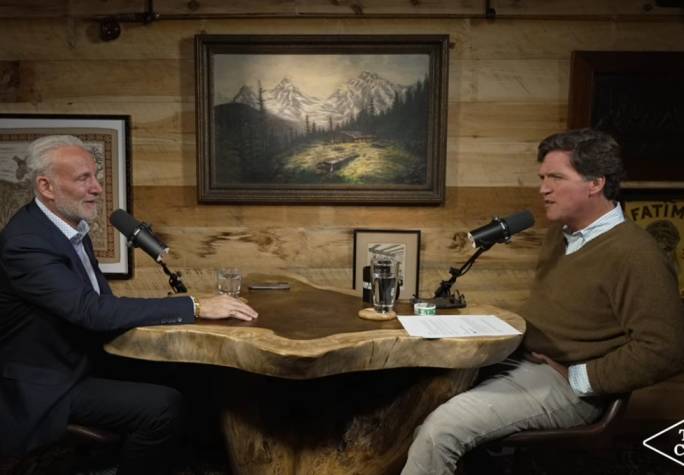
Editor’s Notes: In this deep-dive interview, Tucker Carlson sits down with economist Peter Schiff to discuss why gold is outperforming the S&P 500 and how the government is working to keep you from noticing. Schiff provides a provocative analysis of inflation, the Federal Reserve’s debt monetization, and the potential for a global shift away from the dollar standard. He also offers a sharp critique of Bitcoin while explaining the benefits of tokenized gold as a modern medium of exchange. Together, they explore the systemic risks facing the U.S. economy and offer practical advice on how to navigate the pitfalls of the precious metals market. (January 26, 2026)
TRANSCRIPT:
Peter Schiff’s First Gold Purchase
TUCKER CARLSON: Peter Schiff, thank you for doing this. So when did you personally first start buying gold? Physical gold?
PETER SCHIFF: Well, you know, ironically, the first time I bought gold was when I got bar mitzvahed. That was when I was 13 years old. This was in the 70s when the original gold bull market was happening. So I got my bar mitzvah money because of my father. I bought gold and I ended up selling it coincidentally near the highs in 1980.
That’s because gold went from $35 an ounce in 1970 to $850 in 1980. So in the middle of that run, I probably got bar mitzvahed in 1975 or 1976. I took my bar mitzvah money and I bought gold. Then I sold it to buy my first car when I was a senior in high school. It was an MGB convertible.
TUCKER CARLSON: Nice.
PETER SCHIFF: Yeah. Although it broke down all the time and I bought it as a stick shift. I didn’t even know how to drive a stick. But I wanted that car. So I had to figure it out as I was going along.
So I happened to get out of gold near the highs. Because then gold went into a 20-year bear market. From 1980 when gold hit $800, it bottomed out at $250 in 1999, 2000. But that’s about when I started recommending it.
Recommending Gold as a Stockbroker
So I got into the brokerage business in the 1990s and I was a stockbroker, but I also wanted my clients to own gold. I wasn’t in the gold business at the time, but I believed that everybody should have some of their portfolio in gold. And so that’s when I started recommending it.
And it’s outperformed by a pretty big margin the S&P 500, Dow Jones, going back to the beginning of this century, 2000, 2001. If you were to price the Dow in terms of gold, it’s down about 70%. I mean, so there’s an illusion that we have all this prosperity because in the year 2000 the Dow was about 10,000 and now it’s almost 50,000. So that’s a big gain when you price it in dollars that have lost a lot of their purchasing power.
But when you price it in gold and realize that gold was $300 back then and now it’s $2,800, the gold it took—I think 45 ounces of gold to buy the Dow—and I forget what it is now, maybe 16 or 13. You can buy a lot more of the Dow now than you could back then.
The Illusion of Stock Market Gains
So what that shows you is that the gain in the stock market is inflation. It’s not real value that’s been created in the market. We’ve just destroyed the value of the currency that we use to price things in. And so you need more dollars to buy stocks, but you don’t need more gold. You could buy stocks with a lot less gold because gold is real money. Government can’t just create gold. They can’t create inflation and create gold out of thin air like they do Federal Reserve notes, paper dollars.
Originally, the dollar in 1792 was defined as a weight of gold. I mean, that’s really what the dollar was. It was a specific quantity of gold or silver. And for a long time until 1913, when we got the Federal Reserve, we were pretty much just using gold and silver as money.
The History of the Gold Standard
And even when the Federal Reserve was created, all the Federal Reserve notes were redeemable in lawful money and gold. And gold was money up until 1971. And even though Americans couldn’t redeem their Federal Reserve notes, which we call dollars, they couldn’t redeem them for gold, foreign governments could.
And foreign governments held a lot of gold as dollars, as a reserve. But they did that because they knew that those dollars were not only backed by gold, but convertible on demand into gold. And so we were on a gold standard even through the dollar, up until 1971.
But once we defaulted and the US government reneged on its commitments to pay gold for its notes, that’s when the real inflation started. That’s when we really started printing a lot of money. And that’s why you had the big price increases of the 1970s.
The Oil Crisis and Inflation of the 1970s
And it wasn’t the Arabs that were just jacking up their oil prices, because oil went from $3 a barrel to $40 a barrel. But it wasn’t that oil was getting more expensive. It’s just that we used to pay for our oil with gold, and we started paying for it with paper.
But all that money, we printed it in the 60s for the War on Poverty, the Great Society, the Vietnam War. We ran these big deficits, which were small by today’s standards, but they were big back then, and they were financed with inflation. And we saw the consequences in the 1970s.
And we may have had a real dollar crisis because the dollar lost about two-thirds of its value during that decade against other currencies like the Swiss franc, the euro, the Japanese yen.
The Coming Dollar Crisis
But now I think we’re on the verge of a much bigger crisis, because I think that this time around, it’s not going to be the US going off the gold standard, it’s going to be the world going off the dollar standard.
And you really have to understand the degree to which the US has used the dollar and its reserve status as a crutch. And our entire way of life as Americans has been supported by the idea that we could just create dollars out of thin air and then use those dollars to buy what the rest of the world produces.
We have these huge trade deficits now. In fact, Donald Trump used to talk about the trade deficits a lot as being the problem. They’re a consequence of the problem. They’re not the problem per se.
How the Dollar Reserve System Works
But what enables these huge trade deficits—we have over a trillion dollar a year trade deficit—is the world is willing to accept the money that we print for the goods that they produce. And when you produce goods, you need a lot of resources. You need land, labor, capital, you need factories, you need supply chains, you need raw materials, you need workers, energy. And you don’t need anything just to create money out of thin air. The Fed just adds zeros on a computer.
And so we’re able to create dollars that the world wants and we get all their stuff. We didn’t have to produce it. Then the world takes the dollars that they earn from us and they buy stocks, they buy real estate, they buy our bonds. And so as a result, our asset prices have gone up and goods prices have stayed down and interest rates have been relatively low because we’re able to borrow what the rest of the world saves, even though we don’t save very much ourselves and we don’t produce very much.
You know, we get the benefit of all these goods that are coming in, and we get all the foreign savings that are financing our spending. And I think all of that is about to change.
Trump’s “Liberation Day” and Global Economic Shifts
I think that when Donald Trump talked about Liberation Day, ironically, it was the rest of the world that is going to be liberated from the burden of having to support the US economy. When Trump says that the world has been screwing us over and ripping us off, he’s got it backwards. We’ve been screwing them over because we’ve been getting their stuff and all we do is export our inflation. They get our paper, we get things that make our lives better, and they get our IOUs and then they use our IOUs to buy up our financial assets.
But I think this is all changing. And I think what we’re seeing now in the price of gold, where it’s finally broken out of its consolidation—because after gold went from $250, $300 to $1,900, that was a 10-year move. It went sideways from 2011 to 2024, and it really broke out at the beginning of last year and it’s more than doubled since then.
Silver has finally broken out. Silver had a double top at around $50 from 1980 to 2011, and it just broke out this year. Gold broke out last year, but now you’re seeing this movement out of dollars. Foreign central banks have been huge buyers of gold because they’ve been moving away from the dollar. They’ve been divesting themselves of dollars and buying gold instead.
TUCKER CARLSON: What do we know about who’s buying it? Which central banks?
Central Banks Buying Gold
PETER SCHIFF: Well, the major central banks other than the West—you’re talking about Russia and India and China and even smaller ones, Poland or various countries—are buying gold. And they’re buying gold because they want to get out of dollars.
And in fact, one of the things that happened to really cause this to happen in a bigger way was when Biden was president and he sanctioned Russia. And in sanctioning them, they basically took away a lot of their dollar reserves that they had entrusted in dollars. And we basically pulled the rug out from under them. We sent a message to the rest of the world that you could be next, that if you hold your reserves in dollars, you’re vulnerable.
TUCKER CARLSON: Unreliable store of value.
PETER SCHIFF: Yeah, I mean, it wasn’t even a store of value, but as a reserve asset. And so that was a political impetus. But the real reason for getting out of the dollar is that we’re going to destroy its value.
Understanding Inflation
We have these runaway deficit spending that is the source of all the inflation that we have. It’s the Fed monetizing the debt that the government is creating. A lot of people don’t know what inflation is. They just think it’s prices going up because that’s what the governments tell them or some economists tell them. But prices going up are a consequence of inflation. They’re not inflation.
Inflation is an expansion of the supply of money and credit. And when you expand money, you expand credit. That bids up prices. And so as a result of inflation, prices go up. The root of the word “inflate” means to expand. Prices don’t expand, they go up, they go down.
And if you get an old dictionary, get an old Webster’s dictionary, even as late as the 80s, and you look up inflation, that’s exactly what it says: an expansion of the money supply. But the government kind of redefined inflation because if you define it properly, well, it’s pretty obvious who causes it.
TUCKER CARLSON: But anyone increasing money supply, right?
PETER SCHIFF: But if you change the definition to rising prices now, the public blames whoever it is that’s raising the prices. That’s where it’s coming from. And so the government is able to blame the private sector, whether it’s corporations or workers, for prices going up when they’re simply raising prices in response to inflation.
The Natural Tendency of Prices in a Free Market
And of course, sometimes inflation just doesn’t just cause prices to go up, it prevents them from going down. See, in a free market economy, in a capitalist economy, the natural tendency for prices is to go down.
TUCKER CARLSON: Because of efficiencies, yes.
PETER SCHIFF: If you look at the CPI in 1900 and you look at it in 1800, it was down by 50%. So for 100 years in America, prices went down. And during that time we had the Industrial Revolution. We had the most rapid period of economic growth in the history of America, which was after the Civil War and into the early 1900s. All the time prices were coming down.
Today the Federal Reserve says that we need to have 2% inflation. Prices have to go up 2% a year. Why? I mean, why does the cost of living have to go up? Why can’t it go down or at least remain the same?
TUCKER CARLSON: And what is the answer to that? What’s their rationale for that?
The Federal Reserve’s Justification for Inflation
PETER SCHIFF: Well, they have a bunch of BS explanations and it’s all to justify the fact that the government wants inflation. It’s not that it’s good for us, the government needs it. It’s the way the government raises revenue and repudiates its debts.
But they have a couple of things that they say. One of the things they say is, well, if prices were going down, nobody would buy anything. Right? People would just be constantly waiting for lower prices. And so nobody would buy. And that’s the number one reason they say that prices have to go up.
TUCKER CARLSON: If prices were going down.
PETER SCHIFF: Yeah, that’s how ridiculous it is.
TUCKER CARLSON: Everyone would be waiting for the bottom to buy a new dishwasher.
PETER SCHIFF: Supposedly. But of course, we all have cell phones. If that were the case, nobody would ever buy a cell phone or a television set or a computer. Prices go down. But also, if I’m hungry, am I going to wait a year to eat? Because I think the food is going to be 2% cheaper?
TUCKER CARLSON: If you don’t have a dryer, are you going to wait a year? No.
PETER SCHIFF: You buy things. They forget that there is a value to having something today versus having to wait.
TUCKER CARLSON: The only reason Amazon is based on that idea.
PETER SCHIFF: Yes. The only reason that you don’t buy something now because you want a lower price is because you can’t afford it. And so you’re hoping that the price will go down and then you’ll be able to buy it, which is why what the free market does.
So it’s nonsense to say that we’re not going to buy. I mean, would it be a disaster if food got cheaper, if healthcare got cheaper, if energy got cheaper, if clothing got cheaper, if everything you needed was less expensive? Why does the Fed have to prevent that from happening? Why is that such a horrible thing?
TUCKER CARLSON: I’m not questioning your knowledge, which is obvious. It’s on display. But is that actually their rationale?
PETER SCHIFF: Oh, yeah, it is.
TUCKER CARLSON: So deranged that I have trouble believing it.
PETER SCHIFF: No, I know. That’s how stupid they think we are. And then the other thing—
TUCKER CARLSON: We need inflation because we can’t let prices of services and consumer goods get too low because people won’t buy them.
PETER SCHIFF: Yeah, people will stop buying. We’ll sit on our hands indefinitely waiting for a better deal.
TUCKER CARLSON: The Federal Reserve says that.
PETER SCHIFF: Oh, yeah, they believe that. Then the other thing they think is that businesses can’t make money if prices aren’t rising, which is also not true. They actually make more money when prices are falling. Because what’s important for a business is not the price that they charge.
TUCKER CARLSON: No. It’s the spread between what they paid and what they sell it for.
PETER SCHIFF: Exactly. It’s the margin.
TUCKER CARLSON: The margin.
PETER SCHIFF: And if prices are falling, that’s because you didn’t go and get a degree in economics at a US university. Then you wouldn’t know anything. You would have been brainwashed. This is what they teach.
TUCKER CARLSON: But they actually say that. Businesses don’t make money unless the prices keep rising.
PETER SCHIFF: They don’t really. But the reality is you actually make more money when prices are going down because you sell more, you have more volume.
TUCKER CARLSON: Restaurant owner. Right now a steak is 80 bucks. It cost 80 bucks. The restaurant ate it last night. It’s not even a high tone restaurant because meat is so expensive right now. And they’re making less money because who can pay 80 bucks for a steak?
PETER SCHIFF: Yes. If you have any common sense, you can’t be an economist at the Federal Reserve or for the US Government. So they don’t understand.
But the government wants to create inflation. They create inflation. And so quantitative easing, which was the term they introduced after the 2008 financial crisis, that’s just a euphemism for inflation. What is quantitative easing? The Federal Reserve prints money and buys government debt. Monetizing debt. That’s pure inflation.
They don’t like to call inflation inflation because the public doesn’t like inflation. So they called it quantitative easing. But we created a lot of inflation following the 2008 financial crisis, and a lot of that inflation ended up going into financial assets. But if it wasn’t for all the inflation the government created, prices would have come down following the 2008—
TUCKER CARLSON: Can you be more specific when you said that inflation went into assets, what does that mean?
Where Inflation Goes: Asset Price Distortion
PETER SCHIFF: Well, stocks. So the money, so we create money, we create credit. But where does it go? And if it goes into the stock market, if it goes into the real estate market, it’s bidding up those asset prices.
TUCKER CARLSON: Like you want to put it into something, right?
PETER SCHIFF: But people don’t look at asset prices rising, and they don’t think that’s a bad thing, because people think that they’re getting richer because prices are going up, but it’s really distorting the economy.
You don’t want prices to go up because we print a lot of money. You want stock price to go up because the companies are inherently more valuable because they’re generating more earnings, and their stock price is higher because they’re worth more because they’re earning more. You don’t want just the price to go up because there’s so much cash that’s bidding it up. But that’s really what’s been happening.
And that’s why when you look at prices from the terms of gold, you can see that real prices are falling. But I wanted to get to why we had this big spike in inflation under Biden.
So when we got Covid in 2020, the government basically implemented the most inflationary combination of monetary and fiscal policy I’d ever seen. And I called it out on my podcast at the time when everybody was swearing, oh, deflation. And I was like, look, this is massive inflation that’s coming.
So when Covid hit, we shut down the economy. We told people, don’t go to work, stay at home, don’t produce anything. But then we said, but don’t stop shopping, so everyone’s going to get a bunch of money. We had the paycheck protection, we had these enhanced unemployment benefits. We ran massive deficits. The Fed printed money like crazy. We doubled the Fed’s balance sheet from like 4 trillion to 8 trillion. Everybody stayed home and got money to spend.
So we had all this money to spend, but we weren’t making anything. And so I knew that the consequence of that was going to be soaring prices.
Now, inflation, the expansion of money supply always acts with a lag. If I create a bunch of money today, you’re not going to see it tomorrow at the supermarket or at Walmart. There’s a little bit of time, it could take six months, it could take a year before you really start to see the effect of all that inflation in retail prices.
So what happened was if you look at the CPI in the final year of the Trump presidency, the last three or four months, it really started to shoot up. And it continued for the first few months of the Biden presidency, before Biden’s policies had ever come into effect, before the first stimulus check was put in the mail and that inflation continued.
So all the CPI was up 9.1% during Biden’s first year, his first term. That was all Trump and the Congress under Trump because all the money that was created that resulted in those price increases was created before Biden got into office.
Had Trump been reelected, it would have been the same thing. We would have had just as high a move in CPI had Trump won. So it’s not because we elected Biden that the—it was already baked in the cake.
And the main reason that Trump didn’t get reelected, whether or not you want to think it was rigged or not, the main reason was that Trump got elected promising to make things better. And at the end of his first term, they were worse. Because all Trump really did was continue the failed policies of Obama. And so he promised—
TUCKER CARLSON: What area?
PETER SCHIFF: In all areas. Government continued to get bigger under Trump. Deficits continued to get bigger. We continued to print more money. We didn’t have the real structural reforms that we needed to make America great again. We just kept blowing more air into the bubble.
And so the inflation rates as measured by CPI—and remember, the CPI is a very flawed way to measure prices.
TUCKER CARLSON: Yeah.
PETER SCHIFF: In the 1990s they had some price index—
TUCKER CARLSON: Tell me why it’s flawed.
The CPI Deception
PETER SCHIFF: Well, so in the 1990s, the government decided that the CPI was overstating how much prices were going up. Now that was probably a lie, but the government said we need to recalculate it. We need to figure out a better way to measure prices.
So they made drastic changes to the methodology for calculating the CPI. And they’ve done the same thing for unemployment too. The government constantly changes how they measure—
TUCKER CARLSON: Oh, I’ve noticed.
PETER SCHIFF: Right.
TUCKER CARLSON: So unemployment doesn’t measure how many people are unemployed.
PETER SCHIFF: No, not even close. So in order to see what prices are doing, you pretty much have to double whatever the government says. I mean, I did a—
TUCKER CARLSON: But tell us what the changes are that they made.
PETER SCHIFF: Well, they introduced all kinds of substitution hedonics. Just, they make changes to the basket. I don’t even know. In 2013, I did a YouTube video. It’s a long time ago because I remember looking at the CPI and according to the government, over a 10 year period, newspaper and magazine prices were up by 30%.
And I remember thinking, I don’t know, I think they’re up more than that. So I went on the Internet and I took the 20 most popular newspapers and magazines in 2013. I looked at what the prices were because it’s written right there on the cover, it’s not hard to see. And then I went and I got photographs on the Internet of the exact same newspapers and magazines from 10 years earlier. And I looked at the prices and I just compared them and the actual increase was 130%.
So who knows how you put 130% in and only 30% comes out. That is the magic of the CPI.
TUCKER CARLSON: Well, that’s just, that’s lying.
The Government’s Role in Manipulating Economic Data
PETER SCHIFF: Well, yeah, that’s what they do. I mean, unemployment, the way they measure unemployment now, they used to when they measured unemployment, the official rate. So when they go back and they say, hey, unemployment’s not as bad as it was in the 70s, of course. It’s actually worse if we measured it the way we measured it then, because back then, if you were part time, had a part time job, but you were looking for a full time job, you were still unemployed. And now you don’t count.
If you could be working one hour a week and you’re not unemployed anymore. Even if you spend the rest of the week looking for work, you’re still not unemployed. You used to be unemployed. If you stop looking for work because you can’t find a job and you’re just tired of looking, you really want one, but you’re just not looking because you’re convinced there is no job for you, you used to be counted as unemployed.
Today they say, well, you’re discouraged, we’re not going to count you. So if you give up looking for work but you don’t have a job, you’re no longer unemployed. But back in the 70s and 80s, you were still unemployed. So we’ve basically taken so many unemployed people and we’ve decided that we’re not going to count them as being unemployed. That’s the reason that unemployment is so low, because we’re not counting all these people.
If we still measured unemployment now the way we did in the 70s and 80s, the official unemployment rate would be well over 10% and the inflation rate would be at least double what they claim.
And Donald Trump, ironically enough, when Donald Trump ran for office the first time he said this, if you remember, he kept saying, “Don’t believe these government numbers, they’re fake. Unemployment is a lot higher.” But once he became president, then he told everybody the numbers were real because he wanted people to believe he was doing a great job. And so he pointed to the same government numbers that he said were fake when he was trying to get elected, all of a sudden they were real. When he wanted to use those same fake numbers to pretend that the economy was doing well when it wasn’t doing well.
The “Big Beautiful Bill” and Deficit Monetization
So the big beautiful bill was the worst thing that we’ve done under Trump because the big beautiful bill not only preserved all the deficit spending under Biden, but it expanded it, it made it worse. We made the deficits even worse by increasing government spending and tax cuts. And so now we’re going to have even bigger deficits and the Fed is going to be monetizing those deficits.
TUCKER CARLSON: What does it mean to monetize a deficit?
PETER SCHIFF: It just prints money and buys the bonds. And in fact, just last week the Fed basically said, we’re going back to quantitative easing without saying it because they don’t want to admit it. But they announced, you know, they were doing quantitative tightening. They were shrinking their balance sheet because the balance sheet blew up after the financial crisis and then after Covid.
And so the Fed was reducing, shrinking the balance sheet and they stopped in December, just this month, but now they restarted expanding it again. They’re now printing money to buy up Treasuries in order to suppress interest rates.
But the underlying problem with the U.S. economy has been for decades now, interest rates are too low. Everybody says, oh, we need lower interest rates, we need lower interest rates. We actually need higher interest rates. The reason our economy is so screwed up is because interest rates have been too low. That’s why nobody saves, because you don’t have a return on savings and everybody is going into debt.
We have record debt in the government, record debt in the corporate sector, record debt in households, all because the Fed has kept interest rates too low. And they’ve done that to keep this bubble economy going.
The Banking Crisis and Interest Rate Risks
In fact, that’s the real reason when the Fed started hiking rates, the reason it stopped hiking rates wasn’t because they finished the job and they beat inflation. It was because the banks started to fail. You had several banks that went under because of higher rates, which was another thing that I predicted. Just like I predicted the 2008 financial crisis.
I predicted that the Fed was setting the stage for another crisis by keeping interest rates so low because the banks were loading up on low yielding long term mortgages and government debt. And everybody thought this was great. You know, people can go out and borrow, buy a house and they can borrow money at 3 and 4%.
But I was pointing out, well, what happens to the lenders who own all that paper when interest rates eventually go up and they’re stuck with this long term debt where they’re collecting 3 or 4% but now their cost of funds are 5% and they’re getting killed.
And I said, exactly what’s happening with the housing market now? You have a situation where the Fed has inflated a housing bubble bigger than the one that popped in 2007 because they kept interest rates so low and people were able to borrow money to bid up home prices.
But now that mortgage rates are not rock bottom anymore, they’re still not high, they’re still low. By historic standards, they’re just not as low as they were. 7% mortgage is still pretty cheap. But you can’t afford to buy a home at a 7% mortgage that was priced for a 3% mortgage. And so now you have a situation where real estate prices have to fall.
TUCKER CARLSON: Why haven’t those prices adjusted more quickly than they have?
PETER SCHIFF: Well, I mean, it takes some time. I think that’s a mystery. It’s a mystery.
TUCKER CARLSON: All of a sudden no one can buy a house, but house prices are still high.
PETER SCHIFF: Yeah, well, you know, what’s happening is a lot of the people who own their homes and have these low mortgages, they don’t feel any pressure to put them on the market. I mean, if they can get a high price, they’ll sell. If not, they’re just staying in their homes.
TUCKER CARLSON: Yeah, it would be crazy not to.
The Housing Market Freeze
PETER SCHIFF: Meanwhile, we’re not building a lot of new homes because it’s very expensive to build them. And in fact, Trump has made them even more expensive with tariffs. So we have tariffs on lumber, we have tariffs on copper and steel and all things that need to build houses. Plus, you know, we’re chasing out all the workers. I think something like 20% of the people who work in construction are illegal. So if they’re not here, you know, so you’re driving up—
TUCKER CARLSON: Well, that’s just bullshit. What you said is bullshit. We’ve got 50 million illegals in the United States and they’re all being paid. Not all, but a lot of them are on the government subsidies.
PETER SCHIFF: Yeah.
TUCKER CARLSON: So maybe if you took those away, they would go to the construction trades. You’ve got a lot of unemployed people who could build houses.
PETER SCHIFF: Yes, but they’re not going to take those jobs unless you pay them higher wages. So you’re driving up the cost of building homes. So fewer homes are being built. Regardless of what you think of the immigration policy.
TUCKER CARLSON: No, but I’m just saying it’s not a potential. We have all kinds of labor problems. No one can find labor. But it’s not because there aren’t enough people without work. There are a lot of people.
PETER SCHIFF: No, there are a lot of people that should be working, but the government has given them an alternative, and that is a huge problem. That is a whole different topic. But the point is that there aren’t a lot of homes being constructed, and there’s not a lot of homes for sale, because the people that own the homes, you know, they have such a good deal on their mortgage that they don’t. And rather than even sell it, you’ll rent it out. Because now you can rent it out and pay the mortgage and collect the rent, and you have a good spread there.
TUCKER CARLSON: Put it on Airbnb.
PETER SCHIFF: But eventually, people have to sell their houses for whatever reason. People die, people get divorced, people move. Houses are going to come on the market, and of course, eventually people are going to lose their jobs. I mean, we’re headed for a very severe recession. I think we’ve been in recession for years. It’s just going to get a lot worse.
And a lot of the houses are going to come on the market, and real estate prices are going to go down substantially nationwide. And that creates a whole new problem, because now, if people lose their home equity now, they may just default on their mortgage. And now, in addition to sitting on all these underwater mortgages, banks are going to start to lose money on defaulted mortgages.
Who Bears the Cost?
TUCKER CARLSON: Who eats the shit sandwich? Is it the people who have real estate assets or the people seeking to buy real estate assets?
PETER SCHIFF: Yeah, I mean, you—
TUCKER CARLSON: Someone’s going to get screwed here.
PETER SCHIFF: Exactly. Buyer, seller. Well, houses are unaffordable. People cannot afford to buy them. So the solution is lower prices. But obviously, if you already own a house and that’s your main asset, the last thing you want is lower home price. And so that is the problem. But the Fed created that problem by blowing up this bubble in the first place.
If we never had the artificially low interest rates. And of course, the other problem was the government guaranteeing the mortgages, which enabled people to pay more for homes than they otherwise could have paid.
TUCKER CARLSON: Right.
PETER SCHIFF: So all of these—
TUCKER CARLSON: Can I ask you a foundational question? You’ve referred a couple times to quantitative easing, the post financial crisis, interest rates at zero, but that went on for like what, 15 years or something. Why did that go on for so long?
PETER SCHIFF: Because they were afraid to let rates go up because of all the debt that we had. They knew that if they let rates go up, it was going to be a problem. So they kicked the can down the road and they kept them low.
Government Intervention Makes Everything More Expensive
But the point is that all of the money in housing, it doesn’t make housing more affordable. It actually makes housing more expensive. Whenever the government comes in to try to help you pay for something, they actually make it more expensive. If you look at all the areas where the government is involved in a big way, which would be housing, health care, education, that’s where prices have gone up the most. It’s because the government gets involved and subsidizes it.
You know, before the government got involved in education, college was not expensive. If you were upper middle class in the 1940s, 1950s, you could afford to send your kids to Ivy League schools. It wasn’t that big a deal. If you were poor, like my father grew up poor. He wasn’t dirt poor, but he was upper lower, lower middle.
But my father, you know, they had eight kids and his mother didn’t have a job.
TUCKER CARLSON: Right.
PETER SCHIFF: So even though my grandfather worked as a carpenter, he had a wife who didn’t have a job and he was able to support eight kids. And they had a house, they had like a beach house, they had a car. I mean, they lived okay for what would be, he would consider upper lower class.
TUCKER CARLSON: Well, say a house and a beach house, by modern standards, they’d be rich.
PETER SCHIFF: But they weren’t back then.
TUCKER CARLSON: Even having eight kids, either you’re Amish or you’re rich.
The Cost of Education and Healthcare: How Government Intervention Destroyed Affordability
PETER SCHIFF: Yeah, nobody could afford eight. I mean, you got to be rich to afford eight kids today. And of course you could because your wife would have a job. My grandmother didn’t work and my grandfather came to this country without a penny. He didn’t even speak English. He came here at about 12 or 13. No welfare, no food stamps, no government housing. Just nothing. Just show up and get a job.
Where did I live? In New Haven, in Connecticut. He started, he worked on building the Yale Bowl. It’s like the first thing he did. But anyway, so my father didn’t have any money for college, so he got a job in the summer and that paid for all his college. He didn’t graduate with any debt. He worked his way through college like a lot of his friends. That was common to do back then.
There was no government loans. Nobody could get a loan to go to college. But because nobody can get a loan to go to college, the universities had to keep the cost down or they wouldn’t have any customers. So there was a lot of free market pressure to keep tuition down.
But what happened during the 1960s is the 18 year olds got to vote, right? And once 18 year olds could vote, politicians figured, well, how can we get these kids to vote for us? Oh, let’s promise that they don’t have to work their way through college anymore. You could just bum around Europe all summer, go to Woodstock and we’ll arrange loans for you. You can loan money, you can borrow money and just pay it back later when you get your job.
And so they started all these government guaranteed loans. And then what happened? The colleges reacted to that by raising prices. Hey, the kids have all this money, right? Let’s raise prices. And so they kept increasing how much the kids could borrow and the colleges kept raising prices. And then they said, oh, well, let’s have fancy gymnasiums, let’s have nicer dorms.
Nobody cared how much anything cost because all the loans were coming in. And so the government got involved. And now college cost a fortune. Everybody has a degree, so it doesn’t even mean anything anymore. And you graduate with a mortgage, right? The government caused tuition prices to skyrocket. The same thing with health care.
TUCKER CARLSON: Can I ask a question about college loans? How did the lenders do in that arrangement?
PETER SCHIFF: Well, the lenders did great because the government guaranteed all the loans. So the lenders didn’t care if the kids could pay back the loans. Didn’t matter what your major was, right? You could major in basket weaving, you could go to a college where you don’t get no reading or math. I mean, they didn’t care because the government guaranteed every loan.
And so in a free market, you couldn’t borrow all this money because the banks would be worried about getting the money back. Why am I going to loan all this money to somebody who has no assets? But once the government comes in, then nobody cares. Right. That’s what happens.
TUCKER CARLSON: So the lenders get pretty rich on this.
PETER SCHIFF: Of course they. Oh yeah, the lenders made a fortune and the universities made a fortune because they got to charge more for their product.
TUCKER CARLSON: Exactly right.
PETER SCHIFF: It’s the kids that get stuck with the bill. You get all these liberal or like to say liberal, but Democrat radical left politicians that are now complaining about all the student loan debt. They’re the reason it exists. Without the government, there would be no student loan debt. Colleges would be a lot less expensive. Yeah. And people would work their way through like my dad did, if they didn’t come from an affluent family.
But they did the same thing with health care. I mean, health insurance and health care is expensive because the government is so involved in it. And even if you look at where the government is not involved, like Lasik surgery, prices have come down for those procedures because the government doesn’t pay for it.
And the reason that we all have insurance, right, people have insurance for everything now. And in fact, what really made it bad and Trump doesn’t, the Republicans want no role in repealing it, is under Obamacare, they said that insurance companies cannot discriminate against people who are already sick. Right. If you have a pre-existing condition, the insurance companies have to charge you the same as if you were completely healthy, which destroys the whole concept of insurance and makes it extremely expensive.
TUCKER CARLSON: Well, it’s not insurance at that point.
PETER SCHIFF: It’s not, it’s free health care. It’s like, you can’t buy fire insurance after your house burns down. Right. And if you could, nobody would buy fire insurance before it burns down.
TUCKER CARLSON: Well, no one would have a fire extinguisher either.
PETER SCHIFF: Why? Yeah, well, it’s like, what if you could buy car insurance that covered all your gas? Right. I mean, nobody expects their auto insurance to cover their gas or their oil changes or their tires. Right. You buy auto insurance in case you get a wreck and now you have your car’s totaled. Right.
Health insurance is supposed to be, I got cancer, I got a brain tumor. You’re not supposed to have health insurance because you sprained your ankle, because you had a baby or your annual. Yeah. All of that stuff is supposed to be paid for out of pocket. But the reason it’s not is because the government created a perverse incentive for people to get their insurance from their employer.
Because if your employer gives you health insurance, there’s no tax. If they give you money to buy health insurance, then you have to pay taxes. So now everybody gets their health insurance from their employer, and now they have health insurance that pays for everything.
And so you go to a doctor sometimes, and if they tell you you need to do something, ask what it costs, they’re like, who the hell knows? Nobody knows what anything costs. Yeah, because nobody cares because nobody’s paying for it. Right. The person that’s paying for it isn’t even in the room. Right. You have the patient and the doctor, and neither one of them knows what anything costs because you got some third party that’s paying the bill.
So the entire system doesn’t work. But it’s all because government got involved. Right. When government tries to make things more affordable, it makes them more expensive. The only way to make things cheaper is to let the free market do it. The free market is great at lowering costs and increasing quality.
The Myth of the Free Market
TUCKER CARLSON: But the free market is blamed. Of course, we don’t have anything approaching a free market. Nothing resembles a free market. It’s a monopoly economy. It’s cartel. But all of this is described as a free market, thereby totally discrediting the concept of free market economics and ensuring that we’re going to get a socialist system.
PETER SCHIFF: No, we don’t have it anymore. And it’s very unfortunate because a lot of people look at Trump and they say, well, he’s a pro-business president. And he is pro-business, but he’s not pro-capitalism, pro-free markets.
Donald Trump wants to micromanage the economy from the White House. Like he’s the CEO. He wants to decide where he thinks capital should go and direct it into industries that he likes or companies that he likes. And that’s wrong. I mean, one of the big industries that he’s promoting is crypto. And for me, I think this is a complete waste of capital now.
TUCKER CARLSON: Yeah.
PETER SCHIFF: I mean, if Americans want to throw their money away in a lot of these crypto companies, all right. I mean, it’s unfortunate. But if the government is now promoting it and pushing money into this industry, that might have gone someplace else if it was a free market, this is doing a lot of harm.
Bitcoin vs. Gold: The Great Debate
TUCKER CARLSON: It was growing. I mean, you meet all these people who’ve made hundreds of millions. You meet kids who’ve made real money from crypto. Why is it throwing it away?
PETER SCHIFF: Well, because where did they make it? They didn’t make money in crypto because they produced products that we consume or provide services that improve our lives. The people who have made money in crypto, and I know a lot of them, they’ve made money in crypto because the crypto that they bought a long time ago went way up.
TUCKER CARLSON: Well, how’s that different from buying gold?
PETER SCHIFF: Well, I don’t know a lot of people who got rich buying gold, right?
TUCKER CARLSON: I’ve done really well just being honest and so have you.
PETER SCHIFF: No. Well, okay, we’ve tripled our money. I’m talking about people who bought bitcoin for a dollar and now it’s $90,000. Right. You’re talking about people who put…
TUCKER CARLSON: Okay, so it’s a big run up, but it’s the same. But when you buy gold, which I’m told I own a gold company, I’m totally for buying gold. But you’re not, it’s not a creative act. You’re not making anything, making anyone’s life better. You’re not really adding to the sum total of the economy. You’re not doing anything other than buying something low and holding until it gets high.
PETER SCHIFF: Right, but there is a big difference. And I’ll get to that in a minute. But the people who have made money in crypto, right, they bought it at a very low price and now other people are buying it at a much higher price, believing that they’re going to be able to do the same thing.
There are people who are buying bitcoin now at $90,000, whatever it’s at, they’re buying it because they think it’s going to a million. They think they’ll be able to sell it at a million. And of course the only reason someone’s going to buy it at a million is because they think it’s going to 10 million. Right? So it’s all this greater fool theory.
TUCKER CARLSON: And so why is it different from Nvidia or any stock?
PETER SCHIFF: So Nvidia, right. And I think Nvidia is overpriced. But Nvidia is a business that is generating income, right? Selling its GPUs and has earnings. So it’s an actual viable business. The question is, what is that business worth? I think it’s worth less than the market currently leads, but it’s worth something. There’s no doubt that Nvidia is a valuable company that is producing things that people…
TUCKER CARLSON: But the rationale for the trade, like for the average person buying any stock is that I will buy it lower than I will sell it.
PETER SCHIFF: Well, and the people at the very end of…
TUCKER CARLSON: That chain as it starts to decline, get screwed.
PETER SCHIFF: Well, if that’s the reason. Look, if we buy stocks, right, for our customers at Euro Pacific Asset Management, which is my company, the most important criteria is the current earnings and the dividends. So I’m buying companies because they generate income to me as the owner. Just like if I were to buy real estate, I would look at the rental income, right?
TUCKER CARLSON: I’m sure.
PETER SCHIFF: What am I getting in rent? Yes, right. If you just buy real estate because you think the price is going to go up, well, you’re a real estate speculator. Maybe you’ll speculate, right? Maybe you’ll be wrong. But it’s different from an investor who is looking at the cash flow.
So when I buy a stock, if I’m getting a 7, 8, 9% dividend, right, because I own that company, it’s paying me a dividend. I don’t need the stock to go up. I just get my share of the income. I’m buying into a business that is generating income.
Now if the business grows and generates more income in addition to my dividend yield when I go to sell the stock in the future, if it’s a more valuable company that’s generating more income and paying more dividends, then I can sell it at a higher price than what I paid, right? Because the business itself is more valuable.
But if you’re simply buying a company that doesn’t even make any money, then maybe it’s losing money and you just want to bet that in the future it might make money. You’re speculating on a stock. You could speculate, but it’s very different from being an investor, right? You’re a stock speculator.
But when you buy Bitcoin, you’re not even speculating in the sense that bitcoin is going to earn money in the future. It’s never going to earn money in the future. It is a non-income producing digital asset. It’s marketed as if it were digital gold, but it’s not digital gold at all. It’s got nothing in common with gold.
Gold is a valuable commodity. Now when you own gold, when you decide to buy some gold, right, what you’re doing is you’re storing that gold so that somebody in the future can use it, right? Gold is unique among commodities in that it doesn’t decay, it doesn’t spoil, right? For thousands of years, gold will stay the same, right?
And if a ship sunk 500 years ago in the ocean and you can salvage that ship today, if there was gold in it, it looks exactly the way it looked when the ship sank. Everything else is…
The Physical Properties and Industrial Value of Gold
PETER SCHIFF: They’re not just enduring. They are important and valuable because they’re needed in all sorts of industries. And so when you are storing gold, the gold that you’re storing can be used in the future, not just by a jeweler who would want it to make jewelry, but to use in aerospace, in consumer electronics, in medicine. There are all sorts of things where you actually need gold.
TUCKER CARLSON: There are industrial applications for gold.
PETER SCHIFF: Right. And there are more uses for gold now than there’s ever been. And in fact, we’re developing new uses all the time. So as we advance as a civilization, we come up with more ways that we can utilize. And so when you’re storing that gold and you are holding it for somebody to use in the future, that’s why it’s a store of value.
TUCKER CARLSON: But can I also add to that? I mean, that’s obviously true what you’re saying. It’s even more true for platinum, which is not as prized as gold. And I think the difference is that gold does have a mystical quality to it. It’s been a medium exchange for all recorded human history. All recorded, I mean, from the earliest writings we have refer to gold. So there’s something about gold that people associate with value.
PETER SCHIFF: Well, it has value. It’s not that they associate it. It has industrial value.
TUCKER CARLSON: Okay, it has.
PETER SCHIFF: But even just look, just even here I have a gold bracelet that I’m wearing. I mean, just having jewelry, I have a gold watch. Right. Like I wear gold when I know I’m going to talk about gold. But the reason people could see that, that people like it for a reason as to where it is.
TUCKER CARLSON: But the reason is not so easily explained. It’s not just that it’s useful in medical devices or in consumer electronics. There’s something about it that resonates that hums at a certain frequency within people.
PETER SCHIFF: Right. And you’re talking, God knows what that is. Societies that never had any interaction with each other were using gold.
TUCKER CARLSON: That’s kind of what I’m saying.
PETER SCHIFF: Right.
TUCKER CARLSON: But we don’t know why. Let’s be honest, we don’t actually know what that is.
The Universal Appeal of Gold and the Evolution of Money
PETER SCHIFF: No, but when you look at gold and you look at the things you can do with it and the properties that it has, we as humans value the properties that gold has. It’s just inherent. It’s like we always have. I would imagine that if there’s life on other planets, they value gold there too. I think it’s kind of a universal thing as far as the properties that gold has.
Now, what Bitcoin did, right? Gold wasn’t the first money. It was the best money, because before we had money, there was barter. We invented money. But when there was no money and if two people wanted to trade with each other, they would barter. So if I was a butcher and you were a baker, and you wanted some meat, you would offer me some of your bread. And then I would give you some meat, and we could trade.
But what if you’re a vegetarian? What if you don’t want meat? How am I going to buy your bread if all I have is meat? So it was difficult because you needed a confluence of needs. But man invented money, which was a commodity that everybody would accept as payment. And so if I had money, then I could buy your bread and give you the money, and then you could take that money and buy something else.
But the money also had to be something of value, but not bread, which would go stale or meat that would go bad. The money had to be a commodity that would hold onto its value. And so that’s where gold came in. So instead of giving you meat that you’d have to eat right away or freeze it or something, I just give you gold. And you knew that that was valuable. And somebody else, the candlestick maker would take gold for his candlesticks. You don’t need to give him meat or you don’t need to give him bread.
And a lot of things were used as money throughout societies. But what ended up being the best money was gold. And they made coins out of it. And you could easily tell how much gold was in each coin. And so what kind of weight of gold you were getting in exchange for whatever it was you were selling.
And the reason gold became better money than seashells or cattle or salt, different things that were used—the Romans used salt as money. That’s where the word salary comes.
TUCKER CARLSON: Yes, right, because it was salt.
PETER SCHIFF: But gold had a lot of properties. It was very divisible, it was very portable, it was very durable, it was fungible. It had these properties that really made it ideal to use as money. And so what the creator of Bitcoin did is he came up with a digital token that mimicked those properties. Bitcoin, it’s portable, it’s divisible, it’s fungible. It can do all that stuff, which is fine.
But what it doesn’t have is the most important characteristic that you need to be money, and that you have to be a valuable commodity. You have to have value, intrinsic value on your own.
TUCKER CARLSON: Right.
Bitcoin’s Fatal Flaw: The Absence of Intrinsic Value
PETER SCHIFF: There has to be a use beyond just a medium of exchange, because money needs to be a store of value. It can’t just be a medium of exchange or unit account. It has to be a store of value. And so in order to store value, you got to have value. You can’t store something that you don’t have.
So when you have gold, you’re storing the value of a metal that can be used in jewelry and consumer electronics and aerospace and all this stuff. But when you’re holding on to Bitcoin, you have nothing. I can’t do anything with Bitcoin. It can’t be used for anything because it’s just a string of numbers. So it has no actual use.
Sure, I can give you my Bitcoin, I can sell you my Bitcoin, but what can you do with it? Well, you could give it to somebody else or sell it to somebody else, but the only reason anybody wants to buy it is because they think the price is going to go up. That is the sole source of demand: I’m going to get rich. If I buy this Bitcoin and hold it and never sell it and ride out the volatility, I’m going to get rich.
TUCKER CARLSON: Well, there was another use that was intended or at least advertised at the very beginning. I remember it vividly, which was as a medium exchange that couldn’t be controlled by governments and that was going to usher in true human freedom where they couldn’t control commerce.
PETER SCHIFF: Yeah, part of the promise of Bitcoin when I first learned about it was it was anonymous and private and it allowed you to circumvent the AML laws and the KYC laws and you can transact without the government knowing what you were doing. And that was a positive aspect of it.
TUCKER CARLSON: Yeah, that was the whole appeal to me.
PETER SCHIFF: Which is completely lost now that it’s all in ETFs and Bitcoin treasury companies and all that. But even though that was appealing because it didn’t have any real underlying value, you couldn’t really keep a lot of money in it. It was only really useful, I think, for people who were doing something illegal because if you have to launder money because you’re doing something illegal, even if I end up losing 20 or 30% of my money in Bitcoin because I accept Bitcoin and by the time I use it, it’s lost 30% of its value, that’s fine because criminals are used to paying to launder money. They don’t mind it.
But if you’re a law-abiding, honest person and I’m buying stuff, I really don’t care if the government knows I bought it. You’re not going to take that kind of a risk to be anonymous, to transact in private. And I think it’s unfortunate that we’ve lost all of this privacy that we once had. I mean, it was a constitutional right. You had a right to privacy. The whole Constitution is written, supposedly—
TUCKER CARLSON: Yeah, but not anymore.
PETER SCHIFF: We have, there’s no privacy whatsoever anymore. But ultimately the fact that it didn’t have any real value is what lessened that appeal to most people.
Bitcoin’s Embrace of Government Regulation
But in order to make Bitcoin palatable to Wall Street, they actually got all this government regulation. I mean, can you imagine an industry that is just asking to be regulated, wants regulation? I mean, normally a business industry would want as little regulation as possible. They don’t want the government getting involved.
TUCKER CARLSON: Well, they call it clarity.
PETER SCHIFF: Well, what they’re looking for in crypto is validation. They want the regulation to validate the product and the industry so they can get people to buy it by saying the government has blessed it. See, the government now endorses it. The government is supporting it.
And the reason that so many politicians, including Trump, the reason that they support Bitcoin is because Bitcoin supported them. People that got into Bitcoin early made so much money because so many other people got in late that they were able to pay off a bunch of politicians and get them to support Bitcoin. They supported this whole idea of a Bitcoin strategic reserve, which is really just a Bitcoin bailout fund, trying to use taxpayer money to buy out Bitcoin. But the Bitcoin industry was able to pay off a lot of politicians.
The Case for a New Global Reserve Currency
TUCKER CARLSON: Can I ask though, I mean, a lot of what you’re saying is obviously true, but I also think you’ve described the decline of the US dollar, its diminishing purchasing power. So clearly there needs to be a new global reserve currency. You don’t want it to be one owned by a geopolitical rival. So why wouldn’t tether, why wouldn’t Bitcoin be the new global reserve currency?
PETER SCHIFF: Well, first of all, gold is money. It’s not currency. And so there’s a difference between money and currency. Currency is backed by money. So when we were on a gold standard and we had paper that was redeemable in gold, the paper was currency, the gold was money. So currency is like a money substitute.
But you can have two kinds of currency. You can have legitimate currency which is backed by real money, or you can have fiat currency which is backed by nothing. And so what we have now is fiat currency. And the question is, well, could we replace that with Bitcoin? And I don’t think that that’s possible because I don’t think that Bitcoin has any value beyond its appeal, that a greater fool is going to come and buy it.
Central banks can’t hold Bitcoin as a reserve against their own currency. If they had to sell it, the price would drop sharply. You have to have real money. That’s why all these central banks—
TUCKER CARLSON: But under our current system, you don’t have real money. You have the US dollar, which is real because people have decided it’s real. It’s an act of faith. And their faith in that is declining because it’s been used as a political weapon, as you so crisply explained. And so you need to replace it with something. Why would Bitcoin be any different from the US dollar except you start anew?
Money Versus Currency: The Critical Distinction
PETER SCHIFF: Well, the main difference there is they’re both in a way fiat in that both Bitcoin and the dollar derive their value from faith and confidence. But Bitcoin, most people who are buying Bitcoin are buying Bitcoin to get more dollars. They’re thinking the price is going to go way up and they’ll be able to sell out and have more dollars than they started with.
Most people are not getting into Bitcoin because they just want a safe store value. If that was the case, they would buy gold. They’re speculating in it. But the central banks, these big central banks are not going to be able to put large quantities of their dollar reserves into Bitcoin. It’s not a reliable long-term store of value for them. That’s what they’re looking for. They’re looking for something to replace the dollar, to back up their currency.
TUCKER CARLSON: And are they buying Bitcoin?
PETER SCHIFF: No, they’re not buying. I mean, you have El Salvador bought some Bitcoin. I mean, you have some foreign governments that have sovereign wealth funds.
TUCKER CARLSON: Yes.
The Sovereign Wealth Fund Bitcoin Allocation
PETER SCHIFF: Where those sovereign wealth funds have kind of bought some Bitcoin ETFs or maybe they bought strategy, which was a big mistake. But because these investment managers are under a lot of pressure, just like any other manager to perform. And so a lot of these crypto related assets went up. And so there was a pressure, hey, I need to put these in the portfolio. And so you have allocations.
And then the crypto community tries to pretend, oh, these governments are buying up Bitcoin. They’re not really buying Bitcoin. The managers of these sovereign wealth funds have taken a small allocation. I think that’s all going to stop because this is going to blow up. The people who are putting money into crypto now, into Bitcoin are going to lose a lot of money. They’re the exit strategy.
I mean, that’s why Bitcoin hasn’t gone up. You know, Bitcoin’s real high watermark was four years ago. It’s down about 40% priced in gold over the last four years. So we’ve been distributing Bitcoin from the strong hands that bought it early, the OGs, the whales, to the retail public has been buying it at these inflated prices for years and eventually the bottom’s going to drop out of this thing.
TUCKER CARLSON: You’re making a very, I would say I’m biased, of course, but you’re making a pretty compelling case for gold on a bunch of levels. But one most obviously is a hedge against whatever the hell’s going to happen next. So if you were giving advice to someone you love, like I’ve got a hundred dollars, what do I do with it? I think the wise, the loving advice would be put some of it in gold.
PETER SCHIFF: Well, everybody should have some money in gold.
TUCKER CARLSON: But so why isn’t that advice ever uttered on any of the financial advice channels?
Wall Street’s Silence on Gold
PETER SCHIFF: I think that’s weird. Yeah. You know, because Wall Street has never been a big promoter of gold.
TUCKER CARLSON: I don’t mean why doesn’t, you know, JP Morgan tell you to buy gold? Why doesn’t CNBC tell you to buy gold?
PETER SCHIFF: Well, I don’t think they have enough gold companies that advertise on CNBC. I think most of their advertisers are from the crypto industry and I think that really corrupts the whole process.
TUCKER CARLSON: Really?
PETER SCHIFF: Yeah. I think the advertisers advertise because they know they’re going to have a lot of pro crypto content. I mean they spend the entire day on CNBC. I haven’t been on that show in over a decade. They’re the ones that initially started calling me Dr. Doom when I was predicting the 2008 financial crisis. So they kind of used to have me on.
It’s not just me. They don’t really have any Bitcoin critics on their air. They have one Bitcoin promoter after another and all of the on air talent, all the anchors are pretty much pro Bitcoin.
TUCKER CARLSON: Where are they on gold?
PETER SCHIFF: They don’t even really talk about it. I mean, you know, you started this conversation by describing the rise in the S&P relative to gold.
TUCKER CARLSON: I mean the fall in the S&P relative to gold.
PETER SCHIFF: Well, the S&P has risen, but once you root it in gold, because all measures are comparative, you see that it’s actually fallen compared to gold. So gold is the better buy.
TUCKER CARLSON: Yeah, but again, you know, so like that’s just indisputable, right?
PETER SCHIFF: Yes, but that is not what they’re selling on these financial channels.
TUCKER CARLSON: But they’re lying then.
PETER SCHIFF: Well, yeah, I mean, you know, or they don’t understand it. I mean there’s a lot of people who don’t understand.
TUCKER CARLSON: But that says even I understand. I mean, I don’t know anything.
PETER SCHIFF: You didn’t get a degree in economics.
TUCKER CARLSON: But that’s really simple. I buy two things 25 years ago, which is worth more now. That’s just simple, right?
The Return of Quantitative Easing
PETER SCHIFF: And you know it’s going to accelerate because we’re going to be printing a lot of money. You know, now that the Fed has really gone back to QE, they haven’t admitted it, but it’s only a matter of time.
TUCKER CARLSON: Why do you say they’re going back to quantitative easing?
PETER SCHIFF: Because they’re printing money and buying Treasuries.
TUCKER CARLSON: But what are interest rates? Like over the past six months, what if for those who are not paying attention, tell us where interest rates are?
PETER SCHIFF: Well, short term interest rates have come down, right? The Fed has cut rates three times and so now they have the fed funds at 3.5 to 3.3 quarters. But the 10 year treasury has stayed around 4%. It’s around 4.15%. The 30 year treasury is around 4.8%. So they haven’t been able to move long term rates down.
And I think long term rates are going to soar in this country and I think in order to prevent long term rates from really rising, the Fed is going to be monetizing more debt, printing more money, creating more inflation. Remember, we’re spending now over a trillion dollars a year just on interest on the national debt, like 1.2, 1.3 trillion. That’s going to hit 2 trillion probably sometime next year, because almost all of the national debt is financed with treasury bills.
Right back when interest rates got to 20% in 1980, most of the national debt was long term. So it was unaffected by the big move. It only affected the new borrowing. But now, if a third of the national debt comes due in the next year, the government has to refinance that at whatever the current rate of interest is.
So I think we’re headed for this fiscal time bomb where the cost of servicing the debt is skyrocketing. I mean, in not too many years, it could cost us more than we collect in taxes just to pay the interest on what we’ve borrowed. Because the debt service costs are exploding. And the only reason they’re not much higher now is because rates are still low. You know, 4% is low.
Donald Trump wants them lower. You know, he wants 0 or 1%. But the reason he wants that, he wants just more inflation. He wants to try to blow air into the bubble to hide the fact that the economy is actually getting weaker. So he just wants to make the bubbles bigger by creating more inflation, while at the same time claiming that he’s vanquished inflation.
All because energy prices have come down and energy prices have come down. In fact, energy prices are as cheap as they’ve ever been. If you look at how many barrels of oil you can buy with an ounce of gold, oil is dirt cheap. The question is, how long is it going to stay this cheap? I don’t think it’s going to stay cheap. I’ve been buying a lot of oil stocks now. We’ve been increasing our allocation energy because I think we’re going to see a big move up in oil price.
Technology and Gold Supply
TUCKER CARLSON: The one factor you haven’t mentioned is technological change. So with gold, too, I mean, if gold prices, I don’t know what the threshold for gold is, but if it gets to, you know, six grand an ounce or something crazy, somebody’s going to figure out a better extraction technique and there’s going to be a lot more gold and prices will fall.
PETER SCHIFF: Well, there won’t be a lot more gold because, you know, the supply of gold grows pretty slowly, 1 or 2% a year.
TUCKER CARLSON: It has, but that’s a technology question.
PETER SCHIFF: Yeah, but you know, we haven’t come up with better ways or, you know, because the gold gets harder to get out of the ground. You know, the real easy gold has already been extracted, right? Because they’ve been mining gold for hundreds of years. So, you know, the gold that’s still there is more difficult to get out of the ground.
But there hasn’t been a major gold discovery in decades. There hasn’t been a lot of investment in exploration and development. So by the time the industry is able to attract enough capital into the sector, because nobody’s been interested in gold mining, right, it’s been dead. In fact, crypto, I think, really harmed the industry. It created a big distraction, of course, where people were like, well, why should I buy gold? I got Bitcoin. It’s better than gold. It’s gold 2.0. So the industry was really starved for capital.
TUCKER CARLSON: But I’m just saying, because markets do respond to reality. Over time, if the price gets high enough, it’s in seawater. Okay?
PETER SCHIFF: So, like, yeah, they will. Yes, over time. And people will start melting down their jewelry because they need money and the prices are higher. And yes, all this will happen, but it’s not going to stop the price of gold.
Look, the price of gold was $20 an ounce from 1789 to 1933. For, like, 150 years, it was $20 an ounce. And then Roosevelt devalued and got $35. But if gold can go from $20 an ounce to 4,000, right, where can it go from 4,000? I mean, it can go to 100,000. Obviously, we can keep debasing the value of currency.
Tokenized Gold: The Future of Money
Ironically, one of the ways that you’re going to actually bring gold into the modern economy is through the blockchain, through the Internet. Everybody wants to talk about stable coins, which are basically tokenized dollars, right? Just taking the dollar and turning it into a token. Well, there’s no real stability in tokenizing dollars because you’ve got the same inherent problem. If you own a dollar token, inflation is going to destroy its value. It’s going to, you know, you’re going to lose value the same way.
TUCKER CARLSON: You’re not in control of the Congress and the Fed.
PETER SCHIFF: So, like, and you don’t even really earn interest on it. At least if I have dollars, I can put them in a money market and get some interest to offset some of what I’m losing to inflation. But the ideal thing to tokenize is gold, right? Because when you turn gold into a token, now you actually have digital gold. So instead of having paper money that’s backed by gold, I can have a digital token that’s backed by gold.
TUCKER CARLSON: As long as the tokens continue to match one for one, the physical supply of gold, that’s a real system. Yeah, well that second you’ve got more paper than you’ve got assets, then it’s not real.
PETER SCHIFF: But you know what, but it’s so easily auditable on a blockchain. I mean, I’m doing that. And you should look into this too. I have a on shift gold, I have a T Gold which is ultimately going to be tokenized gold. I haven’t launched the token yet, but right now I’m helping people buy gold and silver that we’re going to tokenize. So once you have the gold, you’ll have the ability to withdraw it either in a physical form or in the form of a token.
But the idea of a gold backed token, the idea of T Gold is so that you can use your gold easily as a medium of exchange and you can transact instantly over the Internet. You know, somebody in the United States can make a purchase from somebody in Australia and pay them instantly with gold. You don’t have to send the actual gold to Australia. You just send the token which represents ownership of that gold.
If you have the token, then the gold belongs to you. And so if I want to give you my gold, I don’t have to drive down to the vault, grab some of it and bring it to you. I just send you the token and now you own the gold. Just like paper money, when paper used to circulate, whoever had the paper had ownership of the gold. The paper currency was titled to gold. And so now you could do that with a token through a blockchain.
TUCKER CARLSON: As long as you can redeem it.
PETER SCHIFF: Yeah, and it’s enforceable and it’s auditable. Look when you know…
TUCKER CARLSON: But is it enforceable?
Tokenized Gold as Legal Contract
PETER SCHIFF: Of course, it’s a legal contract. So if I sell you a gold token and that’s like an IOU, it’s an IOU for gold and I legally, contractually am obligated to pay you or whoever is the bearer of that token. So while you own the token, the gold belongs to you.
But if you spend that token and now somebody else earns it because they provided goods or services or you just gave them a gift, now they own the gold. Now they don’t have to come and get it. They can just leave it there and just transact the token.
I mean, that’s what people did. If you go back to the days of a blacksmith with your gold, you would have gold, and you left it with a blacksmith and he gave you an IOU. And if the people in the town knew the local blacksmith and they recognized his IOU could spend it, people would take it because they didn’t have to go get the gold. They knew the gold was there. The problem would be, of course, if the blacksmith absconded with the gold.
But in capitalism, and I have this argument all the time with these bitcoiners because they think that what I’m doing with tokenized gold, they think, well, you have to trust the third party. So I want to own bitcoin because I don’t have to trust a third party. Well, of course, if you put your bitcoin on an exchange, if you own it through an ETF, of course you’re trusting a third party.
But I have no problem with trusting third parties in capitalism because a business that has a reputation and has a brand wants to maintain the value of that brand. The insurance industry is a perfect example of trust. When you buy an insurance policy, you’re relying on a third party, the insurance company, to pay your claim. If you have fire insurance, you’re trusting that if your house burns down, the insurance company is going to pay you.
TUCKER CARLSON: Every transaction requires—I mean, I trust there’s no poison in my ice cream.
PETER SCHIFF: Now, people in bitcoin say, well, when I have bitcoin, I don’t have to trust anybody. Well, no, you have to trust everybody. You have to trust that people still want your bitcoin despite the fact that it has no value.
TUCKER CARLSON: We also have to trust the electrical grid. That doesn’t exist without it.
PETER SCHIFF: Right, that too. But the bigger thing is you’re just trusting that the people who believe in bitcoin, who believe that nothing is something, continue to believe that and continue to.
TUCKER CARLSON: Have gold coins in your backyard, you have to trust fewer people. All you have to trust is human nature, which is attracted to gold, period.
PETER SCHIFF: Well, but when you own gold, you’re not trusting anything because the gold itself has value.
TUCKER CARLSON: Well, that’s what I’m saying.
PETER SCHIFF: Right.
TUCKER CARLSON: But if you have possession of physical gold, you’re not relying on fragile systems.
Physical Gold vs. Tokenized Gold
PETER SCHIFF: I mean, the only risk there is somebody could steal it from you. If they find it, you could lose it. If you have gold. But the thing about tokenized gold, and I recommend that people have both—they have physical gold and they have some tokenized gold—because the tokenized gold is the gold that you can use in commerce, that you could easily spend.
It’s much more difficult if I have bars of gold or even gold coins. Even a one ounce gold coin is $4,000. A tenth of an ounce coin is $400. I mean, so if you want to buy something for five bucks, you can’t really do it. But if you have the tokenized gold, then you can easily transact. You can buy a cup of coffee, and the barista can accept payment in gold.
The big problem, though, and I want to congratulate you, too, on Battalion Gold that you set up. Because when I started, as I mentioned, when I started in this industry, in the gold industry in 2010, for over 10 years before that, I was just telling all my customers, buy gold. Just go out and buy gold. Even though I didn’t sell it, I thought everybody should own it. And I just said, go out and get it.
And little did I know that people were just getting ripped off. Because I found out years later, people would call me up and they would say, I just sold some gold. I bought it. It was $400, and now I sold it at $700, and I lost money. Well, how’d you lose money? And then I started looking into it, and I found out that when they bought gold, when it was $400, they didn’t pay $400. They paid—because they didn’t get $400 worth of gold. They just paid $400 to get $200 worth of gold because they bought—
TUCKER CARLSON: It in the form of a commemorative coin that was supposed to have value.
The Gold Industry Scam
PETER SCHIFF: Yeah, they got—and so I set up Schiff Gold simply because I didn’t want people to get ripped off anymore, because it was so pervasive, and it was almost because so few people that the only way that the gold industry could make money was to overcharge.
And what really made me furious, and I don’t even want to name names, but I had—is that they would go to some of the most popular conservative talk show hosts and they would pay these guys to recommend their gold company. And the reason they would do that is because the loyal listeners trusted the talk show host.
TUCKER CARLSON: Well, they came to me with an offer. Yeah, that’s how I know this. I didn’t understand how it worked. I never thought—I’ve been pro gold, but I didn’t realize people were paying twice the value, twice the spot price.
PETER SCHIFF: The only reason it worked, Tucker, the reason it worked is because the people who listen to their favorite talk show host and the guy would say, “Here’s the firm I trust. This is where I buy my gold. Because they don’t rip you off, but here’s where I get my gold. Go buy your gold there.”
And the listener who is very loyal to the talk show hosts and trusts them, goes to that gold broker and just assumes they’re getting a great deal. Hey, so and so would recommend this company unless they were going to treat me right. And so they didn’t shop around.
And in fact, they make it impossible to shop around because they sell coins that nobody else has because they’re so obscure and they try to pretend that they’re not going to be confiscated or they have some kind of collectible value, and it’s all BS. They have no value. All the money goes into the pocket of the salesman.
Because these gold salesmen work on commission. And if they sell you Maple Leafs at a 1% markup and maybe they make $200 in gross commission and they make $30 for themselves, or they can get you to put the $10,000 into these deal coins and they make $2,000, $3,000. That’s what they sell. That’s what they—
TUCKER CARLSON: I didn’t know any of this. And the problem with selling gold in an honest way is that it’s a very low margin. It’s very low margin. You’re not getting rich selling gold, and we’re not getting rich from it. And our prices are transparent. You know exactly. Whatever. Two points above spot or something. We’re not in this to get rich.
PETER SCHIFF: Well, where you’re going to make money eventually is on volume. Eventually a lot more people are going to start buying gold. I mean, people just don’t know enough about it. But everything can’t be a scam because—
TUCKER CARLSON: Then people lose confidence in their fellow human beings and their country, and it’s just bad.
PETER SCHIFF: The problem is the only companies that can afford to advertise on television are the ones that are ripping you off.
TUCKER CARLSON: That’s how I figured out it was a scam. I was like, how can they afford—
PETER SCHIFF: It’s a commodity. How can they afford to pay me—
TUCKER CARLSON: Just as a pitchman? I’m sure they have other people, though. They do have other people pitching as well.
PETER SCHIFF: How can—
TUCKER CARLSON: Where does this money come from? And that’s how I figured out. And that’s—
PETER SCHIFF: And I talked to a lot of people that I knew in industry and I was pointing out, your audience is getting ripped off. You are helping these guys steal money by promoting these companies.
Exploiting the Most Honest People
TUCKER CARLSON: And they’re the nicest people. And they’re directionally correct in their concerns. They love America. They’re worried about the softening of the dollar. They know that their politicians basically are looting the country through devaluing the dollar. That’s all true.
PETER SCHIFF: So they’re the best people.
TUCKER CARLSON: They’re the most honest people. And screw them over. Just enraged me.
PETER SCHIFF: Yes, they’re screwing them over. They’re trying to do the right thing. They’re trying to buy gold and then they’re getting ripped off. Now the thing is, gold has gone up so much that a lot of those people don’t even realize because now they can actually still sell their gold at a gain, but they would have a much bigger gain—
TUCKER CARLSON: Yeah.
PETER SCHIFF: If they hadn’t been ripped off. In fact, I have a special report. I remember I wrote this report. People can get it on my website on SchiffGold.com but it’s “Classic Gold Scams.” And I go over all of the tricks, all the things that gold salesmen tell you to steal your money to convince you why you shouldn’t buy a Maple Leaf or a Krugerrand and why you should buy this certain—and they have all these tricks.
And a lot of times too, they’ll even advertise for these—they’ll have a low price on a Maple Leaf that might even be lower than what I would charge. But then when someone calls up to buy it, they don’t sell you that. No, they sell you—they upsell you into something else.
And they also try to con you into it by a lot of these companies have something called “price protection.” They say, “Hey, we’ll guarantee you if the price goes down over the next 30 days, we’ll mark it to the lower price. We’ll give you some more.” Or sometimes they even offer to give you free gold or free silver if you buy a certain amount.
And the only reason they could do that is because they’re overcharging you by so much money. They have enough left over. Or if they’re charging you 50% more than the price of gold and the price of gold goes down and they have to give you back 10% of what they overcharge you, they still made a fortune.
Related Posts
- Transcript of Mohandas Pai Interview: Raj Shamani FO539 – Truth About India’s Tax System
- Transcript of Alex Hormozi Interview: The Diary Of A CEO – Jul 20, 2026
- Transcript of Scott Bessent Interview: The Way I Heard It with Mike Rowe
- How To Buy A Used Luxury Car Safely
- Only In America Interview: w/ Indra Nooyi (Transcript)