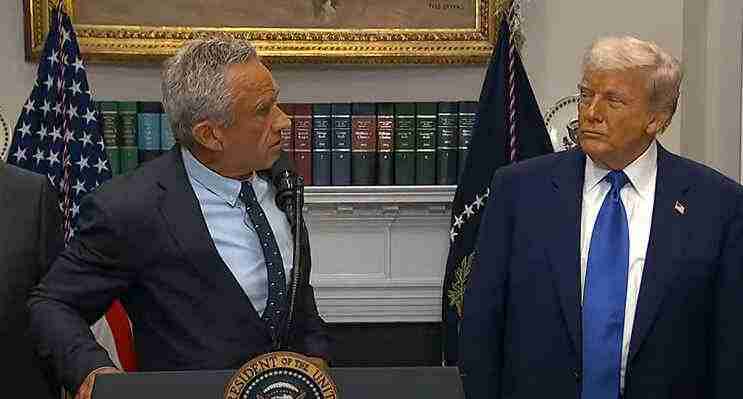
Read the full transcript of President Trump’s press conference with HHS Secretary Robert F. Kennedy Jr. to promote a new Executive Order to lower pharmaceutical costs in the Roosevelt Room on Monday, May 12, 2025.
Listen to the audio version here:
Opening Remarks on International Developments
President Trump: Thank you very much. Thank you, everybody. It’s a big day. It should be fun. I don’t know. You’ll maybe find reasons why it’s not, but I can’t imagine because we have a lot of great things happening. It’s been a very strong week and a very strong weekend.
Before we begin, let me say a few words about the historic events that took place over the last few days. On Saturday, my administration helped broker a full and immediate ceasefire, I think a permanent one, between India and Pakistan, ending a dangerous conflict of two nations with lots of nuclear weapons. And they were going at it hot and heavy, and it was seemingly not going to stop.
And I’m very proud to let you know that the leadership of India and Pakistan was unwavering. Unwavering powerful, but unwavering in both cases, and having these — they really were, from the standpoint of having the strength and the wisdom and fortitude to fully know and to understand the gravity of the situation.
Using Trade as Leverage in International Diplomacy
And we helped a lot. And we helped also with trade. I said, Come on, we’re going to do a lot of trade with you guys. Let’s stop it. Let’s stop it. If you stop it, we’ll do a trade. If you don’t stop it, we’re not going to do any trade. People have never really used trade the way I used it, that I can tell you.
And all of a sudden, they said, I think we’re going to stop. And they have. And they did it for a lot of reasons. But trade is a big one. We’re going to do a lot of trade with Pakistan. We’re going to do a lot of trade with India. We’re negotiating with India right now. We’re going to be soon negotiating with Pakistan. And we stopped the nuclear conflict. I think it would have — it could have been a bad nuclear war. Millions of people could have been killed, so I’m very proud of that.
I also want to thank Vice President Vance and Secretary of State Rubio for their work and efforts. They worked very hard on that.
Progress with the Houthis
We also, as you know, created a situation where the Houthis, for the first time ever, have ceased firing, and they’ve let it be known that they’re not going to be firing at American ships anymore, not going to be firing at Americans anymore. This was a heavy barrage that lasted for approximately 50 days.
And as you know, they’ve been in war, essentially, for forever. But over the last 10 years, they’ve been very difficult for other countries. Nobody was able to do what we did. But they stopped, and we take their word for it. Their surrogates and them, directly, said, We don’t want to do this anymore. And so we were satisfied with that.
Reset with China on Trade Relations
In addition, yesterday, we achieved a total reset with China. After productive talks in Geneva, both sides now agreed to reduce the tariffs imposed after April 2nd to 10 percent for 90 days, as negotiators continue on the larger structural issues.
And I want to tell you that a couple of things — first of all, that doesn’t include the tariffs that are already on — that are our tariffs. And it doesn’t include tariffs on cars, steel, aluminum, things such as that, or tariffs that may be imposed on pharmaceuticals, because we want to bring the pharmaceutical businesses back to the United States, and they’re already starting to come back now, based on tariffs, because they don’t want to pay 25, 50, or 100 percent tariffs. So they’re moving them back to the United States.
I spoke to Tim Cook this morning, and he’s going to, I think, even up his numbers — $500 billion. He’s going to be building a lot of plants in the United States for Apple. And we look forward to that. I really do look forward to that.
But the talks in Geneva were very friendly. The relationship is very good. We’re not looking to hurt China. China was being hurt very badly. They were closing up factories. They were having a lot of unrest. And they were very happy to be able to do something with us. And the relationship is very, very good.
I’ll speak to President Xi maybe at the end of the week. We have some other things we’re doing. But one of the biggest things that we’re doing — and I don’t know if people realize this, but we made a great deal with China, a great trade deal. But it was a much bigger deal originally, and then they canceled it right in the last day. Some of you faces, I remember, were there when that happened. I remember you.
The Original China Trade Deal and Its Collapse
And we had a deal where they opened up their country to trade with the United States, and they took that away at the last moment. And then I canceled the whole thing. And then, six months later, we ended up doing a smaller deal. But it was a big deal. It was $50 billion worth of product that they were going to purchase from our farmers, etc. And we agreed to that. People thought it was 15 because they were doing 15. We made it 50 because I misunderstood the 15.
I thought they said — I said, You got to get 50. Because when I asked — if you remember the story — when I asked, What are we doing with them?
And they were honoring the deal. We would call them up a lot for the corn and for the wheat and for everything. They were honoring the deal. And then when Biden got in, they no longer honored the deal. There was nobody to call. I would call on an average of once every two weeks to say, Come on, you have to speed it up a little bit. And our farmers were doing great. I said to them, Buy more land and bigger tractors, if you remember. That’s what happened.
But the deal was a very good deal. But the best part of the deal was that we opened up China. China agreed to open itself up to American business to go in. And it would have been a great thing, I think, for China. They would be able to see things that they haven’t seen. They would be able to buy products that they have never been able to buy. It would have been great for American business. I think it would have brought unity between China — better unity between China and the United States.
And the bottom line is that they canceled it the last day. We were all set to sign it. And I went a little bit angry. I get a little angry. I said, They canceled the deal. The deal was done. It was all ready to be signed. And people went over there, came back to me, Sir, they don’t want to sign the opening up China. Well, the biggest thing that we’re discussing is the opening up China. And they’ve agreed to do that. But it’s going to take a while to paper it. You know, that’s not the easiest thing to paper. But that’s the single — I think, to me, some people would disagree. Some people would say we’re getting a lot of money with tariffs or whatever. But you know, especially when you add what we already have, because remember, we’re already getting the 50 percent on steel and different things. That’s not included in these numbers. So you can add that.
But the biggest thing to me is the opening up. I think it would be fantastic for our businesses if we could go in and compete and compete with China. It would be a lot of jobs for China. It would be, I think, at a time when they can, frankly, use the jobs. And that’s what we’re talking about.
So when Scott — I watched him speak the other day, and I think he didn’t want to say it, but I said, it’s okay to say it. Look, if we don’t get it, we don’t get it. But if we don’t get it, it won’t be a positive thing. But if we do get it, I think it’s maybe the most important thing to happen. Because if you think about it, we opened up our country to China. They come — we don’t — I mean, they have very few restrictions. And they didn’t open their country to us. Never made sense to me. It’s not fair. And they’ve agreed to open China — fully open China. And I think it’s going to be fantastic for China. I think it’s going to be fantastic for us. And I think it’s going to be great for unification and peace. China will also suspend and remove all of its non-monetary barriers. They’ve agreed to do that. Well, they’re very numerous. But again, to me, the biggest thing that came out of that meeting is they’ve agreed — now we have to get it papered, but they’ve agreed to open up China. It’s going to be great for everybody.
And third, I’m very happy to announce that Edan Alexander, an American citizen who, until recently, most thought was no longer living, thought was dead, is going to be released in about two hours, actually. And he’s going to be released before the eyes of Steve Whitkoff, who has done a fantastic job. I just — you know, I know a lot of people that have a lot of talent. I know Steve had a lot of talent. But I know a lot of people with a lot of talent. But I had — there’s one that I thought had a special way about him, special personality, aside from being a good dealmaker, had a special way about him. And it was Steve — knew very little about the subject matter. Who does? But he learned it in about two hours. And he’s been fantastic.
So I want to just thank Steve, but they’re going to be releasing Edan in about two hours from now, or sometime today let’s say. And again, they thought he was dead just a short while ago. His parents are so happy, they’re so happy. So it’s, as you know, Edan’s the only American citizen that’s captured and held hostage by Hamas since October 7th, 2023. And he’s coming home to his parents to meet his big news. They thought he was dead. So that’s that.
So we’ll be heading there and we’ll be seeing three primary countries. You know all about that. Saudi Arabia, UAE, Qatar. On Thursday’s meeting with Russia and Ukraine is very important. I was very insisted that that meeting take place. I think good things can come out of that meeting. Stop the bloodshed of the horrible — it’s a bloodbath. But that 5,000 more — it’s really much more — I’m trying to be conservative — more than 5,000 soldiers. Russian. They’re not American soldiers. They’re from Russia. They’re from Ukraine. But they’re people. They’re human souls. And they’re being killed at levels that we haven’t seen since the Second World War. And it’s every week, a lot of drone fighting. It’s a whole new form of warfare, and it’s violent and vicious. And so that’s it.
China and Fentanyl
I’d like to go back to China just for a second. They’re very heavy on the fentanyl. We’re charging them, as you know, 20 percent for the fact that they send fentanyl into our country. And they’ve agreed that they’re going to stop that. And, you know, they’ll be rewarded by not having to pay, you know, hundreds of billions of dollars in tariffs. So the fentanyl should stop. It comes from China. It’s amazing. And it comes through our southern border. It comes through our northern border, too. It comes through Canada and comes through our southern border. Far through — much more through the southern border.
But — so that’s a very important subject to me, because I’ve — everybody in this room has lost friends or people that have family members that have died of fentanyl. So there’s a big incentive for China to stop. And I take them at their word. They’re going to work on that, I think, very hard. And one thing, when they work on something, they get it done.
Historic Visit and Healthcare Executive Order
So now I’m about to depart on a historic visit. Some of you are going with us to, as I said, Saudi Arabia, Qatar, and United Arab Emirates. Before I do, I’ll sign one of the most consequential executive orders in our country’s history. I don’t think there’s ever been anything signed like this, certainly not with respect to healthcare. Nothing even close.
I’m delighted to be joined on this occasion by Secretary of Health and Human Services, Robert F. Kennedy, Jr., who is doing a really good job, I have to tell you that. CMS administrator and a friend of mine, Dr. Mehmet Oz, who is an amazing guy. You know, I was telling Bobby before, Oz had a very successful show, but it hurt his reputation. Because when you’re in show business, it hurts your reputation a little bit. It’s good for you. It’s good for you. But in terms of professionalism and being a doctor, it sort of hurts your reputation. This guy went to the best schools, was the best, I mean, top, top, top of the line. Then he did a television show, became a success, made a lot of money, all that stuff. But it sort of hurt him.
And you know who I compare that to? I hate to say this, but a special woman, Jeanine Pirro. She was the toughest, smartest DA maybe in our countries, in our cities and states, history, New York. She was really tough, really sharp. And she did a show that people didn’t think of it quite the same way. She became more of an entertainment person, like Oz. Oz is not an entertainer. He’s not really an entertainer. You know the real story. And she isn’t either. She is unbelievable. She was one of the strongest district attorneys in the history of New York, highly respected, very tough, went after the drug dealers at a level that you don’t see today anymore. And hopefully she’s going to be, she’s given up a tremendous, she’s leaving the number one show on cable television, one of the number one shows on television, period, to five. But they’ve got great people left behind. But she was a big part of it. And so I equate it to that. Jeanine Pirro is unbelievable.
FDA Commissioner Dr. Marty Makary with a reputation that’s second to none and the job he’s doing already has been fantastic. Thank you, Marty. Director of National Institute of Health, Jay Bhattacharya, who has been, as you know, from Stanford, so highly regarded and have all been working with us very hard on this.
And the question they would ask, being a little bit new to the government aspect of it, is why hasn’t, why didn’t somebody fight the drug price situation, meaning equalization? There’s a term. It’s called equalization. Nobody wants to mention that term. And I’m not knocking the drug companies. I’m really more knocking the countries than the drug companies, because they’re forced to do things. But the drug lobby is the strongest lobby in this country. They say the drug lobby, it’s between that and lawyers. And they have a lot of power.
But starting today, the United States will no longer subsidize the health care of foreign countries, which is what we were doing. We’re subsidizing others’ health care. Countries where they paid a small fraction of what, for the same drug, that what we pay many, many times more for, and will no longer tolerate profiteering and price gouging from big pharma. But again, it was really the countries that forced big pharma to do things that, frankly, I’m not sure they really felt comfortable doing. But they’ve gotten away with it, these countries.
The European Union has been brutal, brutal. And the drug companies actually told me stories. It was just brutal how they forced them. And European Union suing all our companies, Apple, Google, Meta. They’re suing all our companies. They end up — they have judges that are European Union-centric. And they get rewarded $15 billion, $17 billion, $20 billion. And they use that to run their operation. It’s not going to happen any longer, that I can tell you.
So what’s been happening is we’ve been subsidizing other countries throughout the world, not just in Europe, throughout the world. European Union was the most difficult, from what I understand. I mean, I’ll tell you a story. A friend of mine who’s a businessman — very, very, very top guy. Most of you would have heard of him. A highly neurotic, brilliant businessman, seriously overweight. And he takes the fat — the fat shot drug. And he called me up, and he said, President — he calls me — he used to call me Donald. Now he calls me President. So that’s nice respect. But he’s a rough guy, smart guy. Very successful. Very rich. I wouldn’t even know how we would know this, but — because he’s got comments. Said, President, could I ask you a question? What? President. And I just paid for this damn fat drug I take. I said, it’s not working. He said — he said, I just paid $88, and in New York I pay $1,300. What the hell is going on? He said, so I checked. And it’s the same box, made in the same plant, by the same company. It’s the identical pill that I buy in New York. And here I’m paying $88 in London. In New York, I’m paying $1,300.
Now, this is a great businessman, so — but he’s not familiar with this crazy situation that we have. But he was stunned. But it was just one of those stories. And I brought it up with the drug companies, represented by somebody who’s very, very smart. Good person, too. And we argued about it for about a half hour. And then, finally, he just said — because they can’t justify it — he just said, look, you got me. You got me. I can no longer just — you know, they’ve been justifying this crap for years. They said, oh, it’s research and development. Well, I said, well, research and development — other countries should pay research and development, too. It’s for their benefit.
It was just one of those things. And the other countries would set a price, and they’d meet the price, and they’d say, if you don’t meet the price, you can’t sell it in our country. I said, well, then you walk away, and, you know, they’ll call you back and they’ll sell it in the country. But now they’ll have to do that. So for the first time in many years, we’ll slash the cost of prescription drugs, and we will bring fairness to America.
Drug prices will come down by much more, really, if you think — 59. If you think of a drug that is sometimes 10 times more expensive, it’s much more than the 59 percent. You know, it depends on the way you want to analyze it. But in one way, you could analyze it that way. But between 59 and 80, and I guess even 90 percent.
So when I worked so hard in the first term — And if I got prices down — you remember, I was the only one to ever get prices down for a full year, but I’d get them down like 2 percent, and I thought it was like a big deal. Well, we’re getting them down 60, 70, 80, 90 percent, but actually more than that, if you think about it, in a way, mathematically.
And a farmer has to say, we’re sorry, but we’ll not be able to do this any longer to these — to these countries that have been so tough. They’ve been very tough, nasty. It’s trade. It’s trade. And pharma is also very powerful, and the Democrats have protected pharma. The Democrats — this is the Democrats have protected pharma. These are the Democrats.
And by the way, I just called the Speaker of the House and I just called the leader — our leader in the Senate, John Thune, Mike Johnson, spoke to both of them. I said, when you score, you’re going to have to score two things. You’re going to have to, number one, score that hundreds of billions of dollars of tariff money is coming in. But even bigger than that, you’re going to have to score that your cost for Medicaid and Medicare and just basically pharmaceuticals and drugs is going down at a level that nobody has ever seen before.
It’ll pay for the Golden Dome. I see the Golden Dome is there. See? We can easily pay for the Golden Dome, and we’ll have a lot of money left over. We need the Golden Dome, by the way, in this world, although this world is a lot safer today than it was a week ago, and a lot safer than it was six months ago. We had people that had no clue what they were doing.
The High Cost of Prescription Drugs in America
So today, Americans spend 70 percent more for prescription drugs than we spent in the year 2000. Think of that. Our country has the highest drug prices anywhere in the world by sometimes a factor of five, six, seven, eight times. It’s not like they’re slightly higher. They’re six, seven, eight times. There are even cases of 10 times higher. So that you go 10 times more expensive for the same drug, that’s big numbers.
Even though the United States is home to only 4 percent of the world’s population, pharmaceutical companies make more than two-thirds of their profits in America. So think of that. Four percent of the population, the pharmaceutical companies make most of their money, most of their profits from America. That’s not a good thing.
Now, I think, by the way, pharmaceutical — I have great respect for these companies and for the people that run them. I really do. And I think they did one of the greatest jobs in history for their company, convincing people for many years that this was a fair system. And never — nobody really understood why, but I figured it out.
For years, pharmaceutical and drug companies have said that research and development costs were what they are, and for no reason whatsoever. They had to be born by America alone. Not anymore, they don’t. This means American patients were effectively subsidizing socialist healthcare systems in Germany, in all parts of the European Union. They were the toughest of all. They were nasty.
And I see that. I see that with trade, too. European Union is, in many ways, nastier than China, okay? And we’ve just started with them. Oh, they’ll come down a lot. You watch. We have all the cards. They treated us very unfairly. They sell us 13 million cars. We sell them none. They sell us their agricultural products. We sell them virtually none. They don’t take our products. That gives us all the cards. And very unfair.
So they’re going to have to pay more for healthcare, and we’re going to have to pay less. That’s all it is. And believe it or not, you know, because it’s really the world we’re talking about, not just the European Union. But because it’s the world, the numbers are for the healthcare company not as bad as you would think. They’ll make the same.
I think the healthcare companies should make pretty much the same money. I really don’t believe they should be affected very much, because it’s just a redistribution of wealth. It’s a redistribution where it could be the same top line, but it’s going to be distributed differently. Europe’s going to have to pay a little bit more. The rest of the world’s going to have to pay a little bit more, and America’s going to pay a lot less.
Again, because it’s a much smaller population than when you think of the whole world. So basically, what we’re doing is equalizing. There’s a new word that I came up with, which I think is probably the best word. We’re going to equalize. We’re all going to pay the same. We’re going to pay what Europe’s going to pay. We’re going to all pay.
Now, there may be some countries in dire need, and I would be willing to sacrifice that and help them. But it’s called most favored nation. We are going to pay the lowest price there is in the world. We will get whoever is paying the lowest price. That’s the price that we’re going to get. So remember that. So we’re no longer paying 10 times more than another country. Whoever is paying the lowest price, we will look at that price, and we will say that’s the price we’re going to pay. Most favored nations, that’s what it is.
One breast cancer drug costs Americans over $16,000 per bottle. But the same drug from the same factory, manufactured by the same company, is one-sixth that price in Australia and one-tenth that price in Sweden. One-tenth for the identical product.
A common asthma drug costs almost $500 here in America, but costs less than $40 in the United Kingdom. So $40 in the United Kingdom, which is where this gentleman told me he paid a small amount for his shot. But think of that. So $40 versus $500 here. That’s not even bad. There are much worse examples.
On the weight-loss drug, Ozempic costs 10 times more in the United States than in the rest of the developed world. 10 times more. Why? Why? What did we do? Suckers. But we never had a president that had the courage to do this. And nobody knew the system like I do. I mean, I’ve gotten to know this system so well. And I don’t think it’s fair that it benefits Obamacare. Obamacare is a failure. It’s not a good — it’s not a good healthcare. It works. I made it work. I had an obligation to make it work, or an obligation to let it die. I chose that we had to make it work. I had to make it as good as possible. And I had a choice. I could have let it fail or make it as good as possible. As good as possible means it was still not very good, but it was — it survived. And we did the right thing. But this makes it — this makes everything work. And I don’t want to have a bad form of healthcare work because of the fact I was able to cut drug prices by 80 or 90 percent.
So we’re going to maybe come up with something. I think this gives the Republicans a chance to actually do a healthcare that’s much better than Obamacare and for less money, which — if you guys would work on that, along with Congress. But I do want to say that Democrats could have done this a long time ago. They have fought like hell for the drug companies. And they knew they were doing the wrong thing. And it’s going to be very hard. I was just telling the leader and the Speaker that how to — it’s going to be very hard for the Democrats to vote against the one big, beautiful deal — the greatest tax cuts in history, greatest everything.
But now you have the big drug prices because that’s going to be included. It makes that whole situation different from a scoring standpoint. I just told them. I called them up about this. I said, I’m going to do something that’s going to be very monumental. And you’re going to be scoring — you better tell your people that this is going to score really well. And then add hundreds of billions of dollars in tariffs to your list also. But as big as the tariffs are, this is something that really hits quickly.
Five years ago, I signed an executive order to confront this disaster, but only confront it in a minor way. It was a good confrontation, but never to this extent. It took people a little while to understand a very complicated system. But Joe Biden, without any knowledge of what he was doing, terminated the policy and then pretended to negotiate under a new system. And then you take a look. Five out of the 10 drugs that he negotiated are now over 200 percent more expensive in America than the rest of the world, and far more expensive than when he even got involved. Much more expensive than when he got involved. Joe Biden’s plan was a — as you know, because you wrote about it, you don’t say it very loudly — but it was a very big failure, was his whole presidency.
New Trade Negotiations with Foreign Nations
First I’m directing the U.S. trade representatives and Department of Commerce to begin investigations into foreign nations that extort drug companies by blocking their products unless they accept bottom line and very low dollar amounts for their product, unfairly shifting the cost burden onto American patients. And we’ll be taking a look at that very strongly.
The biggest thing we’re going to do is we’re going to tell those countries, like those represented by the European Union, That, you know, that game is up. I’m sorry. And if they want to get cute, then they don’t have to sell cars into the United States anymore. It’s a very big subject. And they won’t get cute. Because I’ll defend the drug companies from that standpoint. They were given a price by the European Unions and other countries. This is what you do. This is what we’re going to pay. We’re not going to pay any more. Let America pay the difference, because it was a big shortfall. Let America pay it. And that’s what we did. But we’re not doing it anymore.
Next, my administration will secure what we’re calling most favored nations drug pricing. The principle is simple. Whatever the lowest price paid for a drug in other developed countries, that is the price that Americans will pay. And we’re using the term other developed countries, because there are some countries that need some additional help. And that’s fine. I think that’s very good. Some prescription drug and pharmaceutical prices will be reduced almost immediately by 50 to 80 to 90 percent.
Big Pharma will either abide by this principle voluntarily, or we’ll use the power of the federal government to ensure that we are paying the same price as other countries. To accelerate these price restrictions and reductions, my administration will also cut out the middlemen. We’re going to totally cut out the famous middlemen. Nobody knows who they are, middlemen. I’ve been hearing the term for 25 years, middlemen. I don’t know who they are, but they’re rich. That I can tell you. We’re going to cut out the middlemen and facilitate the direct sale of drugs at the most favored nation price directly to the American citizen. So we’re cutting out, Bobby, the middlemen. It’s so important, right? They got to do that. They’re worse than the drug companies. They don’t even make a product. And they make a fortune. It’s very smart business people that I can tell you.
If companies make no significant progress toward most favored nation pricing, which we will insist that they do. So I think I’m wasting time talking about it. We’re going to insist upon it. And we’ll insist that we’re going to help the drug companies with the other nations, because those other nations do a lot of trading with us. They need our trade, just like China needed us very badly. They need us just as badly. We will do whatever we have to with trade, just like we did some great things with trade with India and Pakistan. Really helped the situation. Very heated situation. Killed us millions of people. More than millions. I mean, many millions of people. And they want to do business with America. But we never used our powers that way. We never knew how. We never had people that knew how to do that.
We’ll also open up America’s market to safe and legal imports of affordable drugs from other countries, putting dramatic downward pressure on prices. And if necessary, we’ll investigate the drug companies and we’ll, in particular, investigate the countries that are doing this. And we will add it on to the price that we charge them for doing business in America. In other words, we’ll add it on to tariffs if they don’t do what is right, which is everybody should equalize. Everybody should, say, pay the same price.
And special interests may not like this very much, but the American people will. I mean, I am doing this for the American people. I’m doing this against the most powerful lobby in the world, probably the drug lobby, drug and pharmaceutical lobby. But it’s one of the most important orders I think that’s ever been signed, certainly with regard to health care or health in the history of our country. And it’s an honor to be a part of it. And I’d like to ask Robert F. Kennedy to say a few words, please. Thank you.
Robert F. Kennedy Jr.’s Remarks
SECRETARY ROBERT F. KENNEDY JR.: Thank you, Mr. President. This is — this is an extraordinary day. This is an issue that, you know, I grew up in the Democratic Party and every major Democratic leader for 20 years has been making this promise to the American people. This was the fulcrum of Bernie Sanders runs for presidency, that he was going to eliminate this discrepancy between Europe and the United States. As it turns out, none of them were doing. And it’s one of these promises that politicians make to their constituents, knowing that they’ll never have to do it. And the reason they’ll never have to do it is because they know that Congress is controlled in so many ways by the pharmaceutical industry.
There’s at least one pharmaceutical lobbyist for every congressman, every senator in Capitol Hill and every member of the Supreme Court. Some estimates, three pharmaceutical companies. The industry itself spends three times what the next largest lobbyist spends on lobbying. So this was a — this was an issue that people talked about, but nobody wanted to do anything because it was radioactive. They knew you couldn’t get it by Congress. We now have a president who is a man of his word, who has the courage. President Trump was taking money from the pharmaceutical industry, too. I think they gave you 100 million dollars, but he can’t be bought. Unlike most of the politicians in this country. And he is standing here for the American people.
I don’t know what you know, there’s there’s writers like Lord Elizabeth Warren or Robert Reich who are saying that President Trump is on this side of the oligarchs. There has never been a president more willing to stand up to the oligarchs than President Donald Trump. I’m very, very proud of you, Mr. President, for your courage. I’ll say because I don’t want to be crude. Your intestinal fortitude, your stiff spine and your willingness to stand up for the American people.
We have four point two percent of the world’s population. We rep — our country represents 75 percent of the revenues for pharmaceutical companies. We spend in our country eleven hundred and twenty six dollars per capita on drugs; in Britain, they spend about two hundred and forty. They spend one fifth of what we do. And this is true across Europe. And this and the drug companies, Europeans, if you ask them, it made no sense what they were saying. America has to pay for this innovation or it’s not going to happen.
President Trump is saying to our European partners is you’ve got to raise the amount that you’re paying for those drugs and pay for your share of the innovation that the United States is no longer subsidizing that. If the Europeans raise their at the price of their drugs by just 20 percent, that is 10 trillion dollars that can be spent on innovation. And the health of all people all across the globe is going to increase because we’re going to have better products.
So I’m just so grateful to be here today. I never thought that this would happen in my lifetime. I have a couple of kids who are Democrats, big Bernie Sanders fans. And when I told them that this was going to happen, they had tears in their eyes because they thought this is never going to happen in our lifetime. And we finally have a president who is willing to stand up for the American people. Thank you. And Dr. Oz?
Dr. Oz on the Historic Executive Order
MEHMET OZ: Thanks, Secretary Kennedy. This is the most powerful executive order on pharmacy pricing and health care ever in the history of our nation. And it’s only happening because we have a president with the fortitude, the guts to stand up to the withering criticism and lobbying that’s going to occur as soon as folks hear about the executive order. So on behalf of the child in Philadelphia who’s got an autoimmune disease with a thousand dollar a month drug or the older woman in Los Angeles who’s on a blood thinner who can’t afford her copay. I want to thank President Trump. God bless you for having the guts to take on this industry. Thank you, sir.
So let’s talk about the details a little bit. And this is primarily about equalization. As President Trump said, it’s about fairness. Think of NATO as a metaphor. When President Trump said, you’ve got to pay a little more. So it makes sense for all of us. They came up and the European countries contributed; the same thing we believe will happen in this situation.
Most people who have thought about this process agree that it is patently unfair to tolerate the numbers that Secretary Kennedy and President Trump have reflected to you. On this chart to my left is a list of the 10 drugs that were negotiated in the IRA. Again, this is the bill, the law that regulates a negotiation process. This is the best price that was able to be obtained by the Biden administration. And if you look at these numbers, they actually reflect how much on top of the most favored nation price was being paid by the United States.
So the closest to me, Bob, you can point to the Jardines closest one, 289 percent, the one that’s closest to you. That means that we are paying in America four times more than that drug costs in other countries. Again, 100 percent is the baseline. It’s 289 percent above that baseline. It goes all the way down to where we’re paying 50 percent more than any other country. That’s the range. As was pointed out by President Trump, half the time we’re paying three times more than is paid in other countries. It doesn’t make any sense for the system.
That stated, President Trump is over and over again indicating, and Secretary Kennedy has reflected as well, we want innovation. We want our technology partners doing the best they can to make the best solutions for drugs to secure as many people in America and around the world as possible. By getting our allies to pay a bit more, as they should be, and they should have for many years been doing, we’ll of course correct a problem that’s gotten out of hand. And by doing that in a thoughtful, effective way, we’re going to be able to get the pharmaceutical industry whole. Those jobs will still be here, will still be productive, will still be curing cancer and a slew of other ailments that plague humanity. America will still be the leader in this space, but we’ll be paying the appropriate amount, the right-sized amount for those tasks.
So over the next 30 days, the four of us up here, together with people standing in the back of this room, we’re doing a lot of the heavy lifting, are going to be approaching pharmaceutical companies to talk specifically about what we want the most favored nation price to be based on the best data we have. We’re looking forward to a thoughtful interaction with these corporate leaders, many of whom we’ve spoken to and in quiet will agree the system is not right the way it is. They’re patriotic Americans, they want what’s right.
But the fact that in my lifetime, as Secretary Kennedy said, for the first time, we have a thoughtful and aggressive approach, thanks to President Trump, on taking on these special interests. I should give all Americans confidence that this is an administration that stands for fairness and should chill the waters for those who believe they can push us away from our North Star, which is to take care of the American people. Mr. President, God bless you. Jay, you want to go next?
Economic Perspective on Drug Pricing Reform
JAY BHATTACHARYA: So I teach economics at Stanford, as well as health policy. And one thing that’s really, really simple in economics is that when you have a persistent price difference for the same product between two countries, there is something deeply wrong. And what President Trump has done is a historic measure that should have been done a long time ago. What we’re going to do is make sure that those prices become much closer to equal, like a competitive market you’d expect.
Right now what’s happening is the American people are subsidizing, in large fraction, the research and development efforts for drug companies around the world by the higher prices that we pay. With this new order, Europe will share the burden of that. And in fact, if you may think of it as somehow it’s going after drug companies, actually it’s helping drug companies. Because what we’re also going to do with this order, what President Trump has done with this order is he’s said to European governments, look, if you are taking advantage of the drug companies by forcing them to charge very, very low prices, we’re going to defend American drug companies in Europe. At the same time, we’re standing up for the American consumer who’s been paying far too high prices for far too long.
I can go back decades to point to congressional reports, after government report, after government report of tremendously high drug prices, much higher than the rest of the world. And nothing has been done about it until the moment. And I’m really, really proud, President Trump, that you’ve done this. I’m really proud to be included in this and looking forward to the work ahead. Thank you.
A Doctor’s Perspective on the Impact of High Drug Costs
DOCTOR: Thank you, Mr. President. On behalf of the many doctors I’ve talked to about this very issue, thank you for taking the bull by the horns. Presidents on both sides of the aisle have talked about this and floated it and said they’ve wanted to do it. So you’ve had the courage to do it. Thank you.
I’ve been a surgical oncologist at Johns Hopkins for 22 years and I have seen patients suffer. We didn’t take an oath to heal patients and then watch their life get ruined financially with their home, mortgage, retirement, going down the drain with GoFundMe campaigns, raising money from church communities and synagogues and friends they haven’t seen in 20 years to try to raise money for what? For a system where Americans have been getting ripped off by 10, 12, 15 times higher prices than we see in other countries? The fundamental problem in health care is that we’ve had non-competitive markets.
We can do little things around the edges or we can transform those markets to competitive markets and that’s what this executive order does today. Imagine buying a Ford for $175,000, a regular car, and then hearing that people in London are buying it for $10,000 every day, all day long. That is the craziness of this system. We’re going to do everything we can at the FDA to support this executive order. It’s transformative. Thank you, Mr. President.
PRESIDENT TRUMP: Thank you. Thank you very much. So thank you very much, everybody. I think it’s a very important day. In many ways, we’ll start with the Houthis. We go to Pakistan and India. We go to what we did with China, the trade deal, and with the UK. And by the way, many other deals are coming in very much. At a certain point, we’ll just set the price because we know where we are, but we’ll just set the price. But world trade is going to be terrific and our country is going to be making a lot of money. Taxes are going to go down. Things are going to go down very, very substantially.
Developments with Iran
But you look at all of the things that we’ve done. And now today, I’m heading over. We’ll see what we’re going to do with respect to Iran. I think you have very good things happening there, too, by the way. They can’t have a nuclear weapon, but I think that they are talking intelligently. We’re in the midst of talking to them, and they’re right now acting very intelligent. We want Iran to be wealthy and wonderful and happy and great, but they can’t have a nuclear weapon. It’s very simple. So I think they understand that I mean business, and I think they’re being very reasonable thus far.
Turkey Meeting and Syria Sanctions
And don’t underestimate Thursday in Turkey. President Erdogan is going to be a great host, and we are doing some work with him, having to do with Syria, too. By the way, we’re going to have to make a decision on the sanctions, which we may very well relieve. We may take them off of Syria because we want to give them a fresh start. But President Erdogan has asked me about that. Many people have asked me about that because the way we have them sanctioned, it doesn’t really give them much of a start. So we want to see if we can help them out.
So we’ll make that determination. But I think you’re going to have maybe a good meeting. You have the potential for a good meeting, that a meeting wasn’t going to take place. I insisted that that meeting take place. And it is taking place, and I think you may have a good result out of the Thursday meeting in Turkey between Russia and Ukraine. And I believe the two leaders were going to be there. I was thinking about flying over. I don’t know where I’m going to be on Thursday. I’ve got so many meetings. But I was thinking about actually flying over there. There’s a possibility of it, I guess, if I think things can happen.
But we’ve got to get it done. We’ve got to save 5,000 lives a week. 5,000 lives, really more than that, it’s worse than that. And when you see the — and you don’t want to see it, but when you see the satellite photographs of the battlefield with arms and legs and heads all over the place, separated by 30 yards from bodies, it’s not — it doesn’t make sense. It doesn’t make sense. So we’re working very hard to see if we can end that bloodbath. Okay, there shouldn’t be too many questions. It’s been covered pretty well.
Questions from Reporters
Q: Thank you, Mr. President. Thank you, Mr. President. Thank you for taking questions. Two quick ones for you, starting on trade. If a longer-term deal is not reached with China at the end of these 90 days, can the American people expect those tariffs to go back up to 145 percent?
THE PRESIDENT: No, but they would go up substantially higher. You know, at 145, you’re really decoupling because nobody’s going to buy. But they can go — they got very high because of additional tariffs I applied during the course because of fentanyl and other things. No, but they’d go substantially higher.
Q: And then on Qatar, Mr. President, has —
THE PRESIDENT: I think you will have a deal, however.
Q: Okay, you’re confident that there will be a deal on Qatar. Has Qatar asked for anything in exchange for that $400 million luxury jumbo jet? And how can the American people be so sure that they will not in the future?
THE PRESIDENT: Well, I think what happens with the plane is that, you know, we’re very disappointed that it’s taken Boeing so long to build a new Air Force One. You know, we have an Air Force One that’s 40 years old. And if you take a look at that compared to the new plane of Boeing, you know, we have an Air Force One that’s 40 years old. And if you take a look at that compared to the new plane of — the equivalent, you know, stature at the time, it’s not even the same ball game. You look at some of the Arab countries and the planes they have parked alongside of the United States of America plane. It’s like from a different planet.
And it’s close to 40 years old, might be more than 40 years old now. And we — when I first came in, I signed an order to get it built. I took it over from the Obama administration. They had originally agreed. I got the price down much lower. And then when the election didn’t exactly work out the way that it should have, a lot of work was not done on the plane because a lot of people didn’t know. And they made change orders that were so stupid, so ridiculous. And it ended up being a total mess, a real mess.
And when I came back, I said, by the way, what’s going on with the Boeings that are coming in? Well, sir, they’re way behind. And they are. They’re way behind. They were way behind. Another mess that I inherited from Biden. And it’s going to be a while before we get them. And I think Qatar, who has really — we’ve helped them a lot over the years in terms of security and safety. I felt they — I think they — and very, very nicely. And I have a lot of respect for the leadership and for the leader, Qatar. And I think they very — they knew about it because they buy Boeings. They buy a lot of Boeings. And they knew about it. And they said we would like to do something.
And if we can get a 747 as a contribution to our Defense Department to use during a couple of years while they’re building the other ones. I think that was a very nice gesture. Now I could be a stupid person to say oh no we don’t want a free plane we give free things that will take one too and it helps us out because again we’re talking about we have 40 year old aircraft the money we spend the maintenance we spend on those planes to keep them tippy-top is astronomical you wouldn’t even believe it.
So I think it’s a great gesture from Qatar. I appreciate it very much. I would never be one to turn down that kind of an offer. I mean I could be a stupid person say no we don’t want a free very expensive airplane but it was — I thought it was a great gesture and I think it was a gesture because of the fact that we have helped and continue to — we will continue to all of those countries Saudi Arabia, the UAE, Qatar and others, we keep them safe. If it wasn’t for us they probably wouldn’t exist right now and I think this was just a gesture of good faith and I don’t get it someday it’ll be like Ronald Reagan, they decommissioned them, you know they get to a certain age they decommissioned them it’ll go to my library they’re talking about going to my library in years out but I thought it was a
great gesture and it’s something that was done by Ronald Reagan they actually decommissioned the plane and he put it in his library and it actually has made the library I think a Boeing 707 it’s actually made the library more successful so it was good it would go directly to the library after after I leave office I wouldn’t I wouldn’t be using it no we hope that we’re going to have other hostages released to as you know so when I met with the hostages three weeks ago that were there for quite a while you remember the ten people that came in mostly young people one or two were a little bit older they went they were explaining the trials and tribulations I mean they went through hell and I said how many are there they said 59 I said that’s a lot I didn’t realize because we got a lot out you know we got a lot of hostages out I think you will acknowledge they said 59 but then they said they follow that up by saying 59 of which 24 are living the but the people whose son mostly son I think one daughter in this case but mostly sons are there or husbands are there those people want the dead bodies as much as they want the live body I was I have a mother that calls me but came up to me when I first met her and she said sir please please get my son out he’s dead but they have his body and I asked her about that and it’s as though he were alive the level of of wanting that body back is is the same it couldn’t be anymore as though he were alive so we’re getting the bodies back is very important I could be a thing having to do with the religion it could they be sent by was I was amazed at the level of importance it’s the same as if the son or husband or whatever was alive so they said 59 in fact they came out they came in with a number 59 written out on like a sign on their chest like they came to thank me for getting them out and I said what is the 59 mean they said well that means there are 59 people but then they said but 24 are living now it’s 21 the numbers 21 so now it’s actually well we’ll get Eton today we think we’re getting him today so it’s 20 so they have 20 live hostages there the rest are dead bodies
On Tariffs and Auto Industry
are you open to negotiating your tariffs on cars steel and aluminum with China or any other country well we’re not even talking about that we’re bringing the car back business back into this country we have commitments and not only commitments they’ve already started construction on many plants they’ve left Mexico in a few cases in a few cases they’ve left Canada they’re not going to build in Canada they’re going to build here because we have the market and the tariffs have been amazing the election and the tariffs November 5th was a big day and on top of that of course you wouldn’t have the tariffs without the election I guess if you look at it but we have at least 11 committed massive car factories that are going to be built that are going to be that are in the process of being built and some are going to some have actually started we also have renovations of existing factories where they weren’t utilizing the full factory from years gone by and now they’re under full renovation they’ll be opening up full factories in a very short period of time our car industries I think we’re going to have the number one industry you know if you look at Japan and these others they they do tremendously with cars and and they can do that too they but you know when they if they want to sell cars in the United States they’re going to have to build factories in the United States because I’m interested in cars for the United States now one other thing is in our tax bill we’re giving not only no tax on tips no tax on Social Security no tax on overtime but also we’re going to get a deduction for people that borrow money to buy a car if if it’s made in America if it’s not we have no interest
On Putin and Turkey
If President Putin doesn’t show up to these talks in person in Turkey will you join Europe in putting higher sanctions on them? If I felt it would be important toward getting the deal done I’m the one that insisted on the meeting they couldn’t get a meeting because one said ceasefire one said no ceasefire was going back and forth I said look at this point we got to stop it just go to the meeting the meeting’s been set go to the meeting on Thursday and if I thought it would be helpful I don’t know where I’m going to be at that particular point I’ll be someplace in the Middle East but I would fly there if I thought it would be helpful
On South African Refugees
I want to ask you about South African refugees. Dozens of Afrikaners who claim discrimination in their home country are heading to the United States Your administration is going to welcome them as refugees. Now this comes as you halted virtually all refugee admissions for people fleeing famine and war to countries like Sudan and the Democratic Republic of Congo. Why are you creating an expedited path into the country for Afrikaners who are not allowed into the country? Because they’re being killed and we don’t want to see people be killed. Now South Africa leadership is coming to see me I understand sometime next week and you know we’re supposed to have a I guess a G20 meeting there or something but we’re having a G20 meeting I don’t know how we can go unless that situations taken care of but it’s a genocide that’s taking place that you people don’t want to write about but it’s a terrible thing that’s taking place and farmers are being killed they happen to be white but whether they’re white or black makes no difference to me but white farmers are being brutally killed and their land is being confiscated in South Africa and the newspapers and the media television media doesn’t even talk about it if it were the other way around they talk about it that would be the only story they talk about and I don’t care who they are I don’t care about their race their color I don’t care about their height their weight I don’t care about anything I just know that what’s happening is terrible I have people that live in South Africa they say it’s a terrible situation taking place so we’ve essentially extended citizenship to those people and to escape from that violence and come here
On China Trade Negotiations
thank you are you letting China off the hook for these 90 days and do you really believe that they will follow through with non-tariff barriers and remove those no monetary tariffs yeah yeah I think they’re gonna follow through I think they want it very badly I think they want the deal very badly again this doesn’t include the steel tariffs that I put on a long time ago that Biden tried to get off but he couldn’t get him off because it was too much money you know I took in hundreds of billions of dollars from China what a lot of people don’t know but we put on the tariffs originally and if I didn’t do that we wouldn’t have a steel industry today now we have a thriving steel industry it’ll be thriving much more with what we’re doing because this is the next level but it doesn’t include that doesn’t include cars doesn’t include pharmaceuticals when we do that and the reason we’re doing that will be to get them to come back in the country you know that there are again I always say it because a lot of people forget but if the company like Eli Lilly which is making a massive investment in the United States right now they’re building many many plants they’ve already started like seven of them many plants but they are not going to be tariffed there’s no tariff cost so they’re all doing that they’re all coming back to the United States I mean I’ll tell you what I hope I get the benefit of watching this because as president because you know it takes a little while to do this stuff and we’re doing it early in the administration if you think of it we have I believe if you look at the real
total it’s over ten trillion dollars committed for plants and factories other administrations haven’t had one trillion over a four-year period even over an eight-year period we have over ten trillion committed in one form or the other over two months give me a break I’m here to hear three but let’s give me a break on the first on the first month we want to get acclimated but you know but if you think about it’s really two months and So, in two months, we have an investment already of over $10 trillion. And other presidents haven’t had that done over a year, over four years, in some cases. It’s unprecedented. There’s never been anything like it. It’s a very exciting time in America. Thank you very much, everybody. Thank you.
Questions from the Press
Who is in charge of the budget bill while you’re gone?
Mr. President, are you ready to impose sanctions on Russia if Putin doesn’t agree with the 30-day peace agreement?
I have a feeling they’re going to agree. I do. I have a feeling. And we may not have them down, though. Let’s see what happens.
Mr. President, the budget bill negotiations are taking place. Who in your administration is in charge of that while you’re gone?
Everybody. Bobby, from the standpoint of medical, this group behind me, I mean, I think it’s the best group ever assembled. In terms of medical, I think you’re going to see a tremendous cut. I don’t think. I mean, I know you’re going to see it in Medicaid and Medicare. That cut will be massive because drugs are 50, 60 percent of the cost. So, Medicaid costs are going down and Medicare costs are going down because of what we’re doing today. And there’s no — it’s not like, oh, gee, well, maybe it won’t happen. It’s going to happen because the other countries have no choice. Now, the drug companies are going to have to say, listen, if you don’t pay more, we’re not going to give you the drug. And they’re willing to do that. So that’s it. They have to — we have to equalize.
Mr. President, please. How do you respond to this?
It’s not price control. No, no. What was — price control is before. If you want to talk about — price control is what they were doing. They were making us pay. They set a price. And they said, here’s what we’re going to pay. And anything else, Judge? America. Because at that time, they had a very stupid President. And it really went crazy during the last four years. And remember this. The Democrats are the ones that allowed this to happen. They were the ones that were the protector of this pricing system. And I think it’s going to be very hard. You have to ask Democrats, are they going to vote against the one great, big, beautiful deal that’s being negotiated now — tax cuts, et cetera — when now, on top of the tax cuts and regulation cuts, all the things, now you’re going to say that the price of your medicine is going down by 60, 70, 80 percent? You’re going to vote against it? I think a lot of Democrats are going to be forced to do something that their leaders are going to beg them not to do, and that’s vote for the bill. I don’t see how they can vote against it. How can they vote against it when drug prices — drugs and pharmaceuticals are going to be down 70, 80 percent? It’s going to be very interesting.
Questions About the Luxury Jet
Mr. President, what do you say to people who view that luxury jet as a personal gift to you? Why not leave it behind?
Your ABC fake news, right? Why not leave it — Only ABC. Well, a few of you would. Let me tell you, you should be embarrassed asking that question. They’re giving us a free jet. I could say, no, no, no, don’t give us — I want to pay you a billion or 400 million or whatever it is. Or I could say, thank you very much. You know, there was an old golfer named Sam Snead. Did you ever hear of him? He won 82 tournaments. He was a great golfer. And he had a motto. When they give you a putt, you say, thank you very much. You pick up your ball and you walk to the next hole. A lot of people are stupid. They say, no, no, I insist on putting it. Then they putt it and they miss it. And their partner gets angry at them. You know what? Remember that. Sam Snead. When they give you a putt, you pick it up and you walk to the next hole and you say, thank you very much. We’re sending it out of business, ma’am.
Some people may look at this and say, have you ever been given a gift worth millions of dollars and did not receive that gift?
It’s not a gift to me. It’s a gift to the Department of Defense. Me. And you should know better because you’ve been embarrassed enough, and so has your network. Your network is a disaster. ABC is a disaster. Here is the bill. Bobby, come on over here. Now you’re talking about opinions and views. Thank you very much, everybody. Thank you very much.
All right, so you just heard live and uninterrupted.
Related Posts
- Tucker Carlson Show: w/ Ken Silva – Attempts on Trump’s Life (Transcript)
- Pod Force One Interview: w/ Donald Trump – June 2, 2026 (Transcript)
- Jimmy Dore’s Interview on Tucker Carlson Show, June 5, 2026 (Transcript)
- Transcript: Trump Remarks on American Agriculture at Wisconsin Roundtable
- President Trump Remarks on Beautiful, Clean Coal – June 4, 2026 (Transcript)