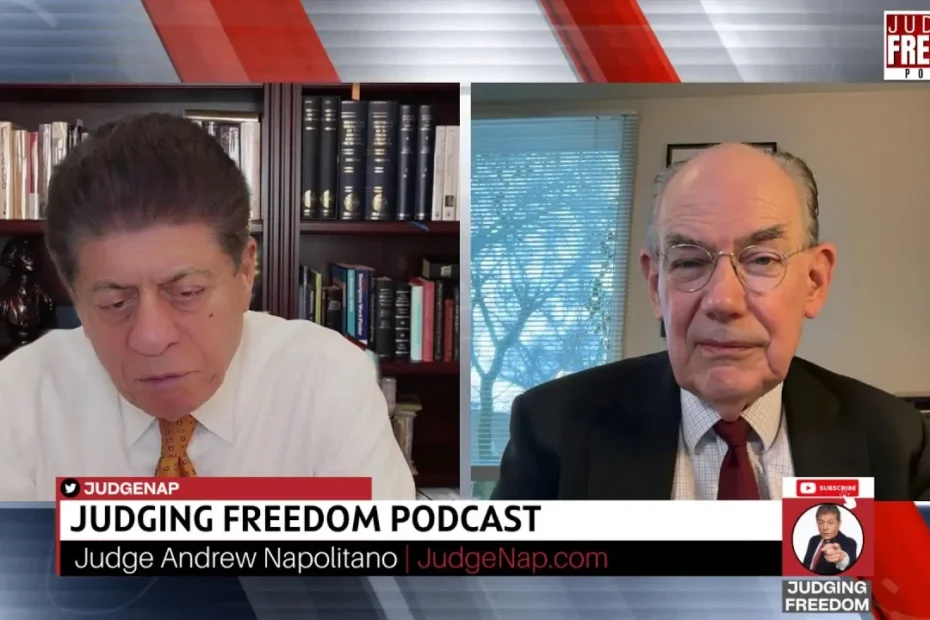
Here is the full transcript of renowned political scientist Prof. John Mearsheimer’s interview on Judging Freedom Podcast with host Judge Andrew Napolitano, streamed live December 18, 2025.
Brief Notes: Judge Andrew Napolitano sits down with realist political scientist Prof. John Mearsheimer to unpack what he calls the “unintended consequences of a meaningless war,” focusing on how U.S. policy in Ukraine and Gaza is backfiring on Western power and legitimacy. Mearsheimer argues that NATO’s expansion and Washington’s refusal to accept Ukrainian neutrality helped trigger a grinding conflict that cannot deliver a meaningful strategic victory, yet is draining resources the U.S. needs to contain China. He warns that unconditional U.S. backing for Israel—despite what he describes as genocidal policy in Gaza—is turning much of the Global South against the West and undermining the liberal order Washington claims to defend. Throughout the conversation, he returns to a stark theme: great powers are betting their futures on wars they cannot win, while ignoring realistic diplomatic off‑ramps that could limit the damage for everyone involved.
Introduction
JUDGE ANDREW NAPOLITANO: Hi, everyone. Judge Andrew Napolitano here for Judging Freedom. Today is Thursday, December 18, 2025. Professor John Mearsheimer will be here in just a moment. What are the consequences? The unintended consequences of a thoughtless and needless war.
Professor Mearsheimer, welcome here. My dear friend, thank you for accommodating my schedule. What are the international consequences? Start with geopolitical and perhaps economic, of the American military seizing an oil tanker with 100 million barrels of oil in it and then purporting to blockade the country from which it came, Venezuela.
Venezuela: A Self-Inflicted Crisis
PROF. JOHN MEARSHEIMER: Well, I think what the administration is trying to do here is figure out a way to get out of the corner that they’ve boxed themselves into in this Venezuela situation. I mean, we decided early on that we were going to get tough with Venezuela, that it was this great threat to the United States and that we would be able to deal with it rather easily. But that’s not proved to be the case at all.
And what you see the Trump administration doing is fishing around for a way to deal with this problem. And that basically means getting rid of the Maduro government and taking this huge problem that we’ve created off the table. And you remember at first, Trump was talking about the fact that the CIA was operating inside Venezuela. Then he escalated further and we started destroying those boats and killing innocent people on board those boats. Then he started talking about a land invasion or hinting at a land invasion. Then he said that the airspace over Venezuela was closed, and now they’re seizing tankers and they’re talking about putting some form of blockade on Venezuela.
All these different approaches are due to the fact that the Trump administration is unable to figure out how to deal with the Maduro government in a way that they can save face. They are in a real pickle. The administration is in a real pickle. And that’s what explains what’s going on with the seizing of this particular ship and the blockade that’s now been announced by Trump.
JUDGE ANDREW NAPOLITANO: You know, you mentioned the changing, I wouldn’t even call them theories, the changing arguments advanced for the interference with Venezuela. In 2017, his first year of his first term, when he addressed the joint session of Congress, he famously introduced the person he said was the president of Venezuela. And it was this young man, Juan Guaidó, who, by the way, today is a grad student in Miami, Florida.
Anyway, at the time, introduced him as the true president. The Congress gave him a profound and lengthy standing ovation. And we were going to get him back there because he’s the one who won the election. All right, fast forward. And, well, it’s fentanyl. Well, it turns out the Drug Enforcement Administration of his own says no, fentanyl is made in Mexico. Then it’s cocaine. Then his Drug Enforcement Administration said, no, Venezuela once did send cocaine here, but they don’t anymore.
Then two days ago, he said Venezuela stole our land and stole our oil. Could he possibly think that a natural resource under Venezuela belongs to the United States? My point is, you’re right. He’s boxed in and now scrambling for a justification for the boxing in. The boxing in, according to Col. Wilkerson, is costing a billion dollars a day.
PROF. JOHN MEARSHEIMER: But I just want to say what you said is very important and what I said is very important, but we’re talking about two different things. And it just shows you how desperate the administration is. You were talking about the rationale or the different rationales, plural, for what they’re doing and how that shifts and talking about the different strategies that they’re using and how that has over time. And what you see is that they’re flailing. He’s boxed himself into a corner.
You know, when I see this case of Venezuela, for some reason, I always think of his campaign in the Middle East against, what’s that small country that was lobbying missiles at Israel and in the Red Sea. The Houthis.
JUDGE ANDREW NAPOLITANO: Yemen. Right.
The Limits of Military Power
PROF. JOHN MEARSHEIMER: Campaigning against the Houthis. You remember he said earlier this year that Joe Biden just hadn’t been tough enough with the Houthis and he was going to get tough with the Houthis and he was going to finish them off quickly. And after a month, he quit. And he admitted that Houthis were tough hombres and we couldn’t defeat the Houthis.
JUDGE ANDREW NAPOLITANO: Oh, you’re omitting something. $500 million later, a half a billion dollars later, he quit.
PROF. JOHN MEARSHEIMER: Yes, exactly. But it’s just the Houthis case is another instance of where he backed himself into a corner. Right. It’s, you know, you’re talking about unintended consequences.
He thought the consequence of attacking the Houthis would be that we would decisively defeat them quickly and cheaply, and that proved not to be the case. And this is exactly the box that he’s in in Venezuela.
The Trump administration, and this is true of American national security elites in general, do not have a very healthy sense of the limits of what you can do with military power. And that involves threatening to use military power, which is what you’ve seen pretty much up to now vis-à-vis Venezuela, or even using military power. And this goes to the case of the Houthis. Right. They’re just real limits to what you can do.
And we constantly get ourselves into these messes thinking that we’re going to be able to use military force to solve a political problem that really at heart needs a political solution, not a military solution.
JUDGE ANDREW NAPOLITANO: But you travel the world, you speak to world leaders, you speak to and interact with academics. What is their reaction to murdering people on the high seas, stealing an oil tanker with 100 million gallons of crude oil in it, and a naval blockade, which, under the Geneva Convention, is an act of war?
Global Perception: The Gang That Can’t Shoot Straight
PROF. JOHN MEARSHEIMER: Well, I think that most people around the world and many people in the United States, think the Trump administration is out of control when it comes to foreign policy. It just doesn’t know what it’s doing. It’s the gang that can’t shoot straight. This applies to Ukraine, it applies to Venezuela, it applies to Iran, to the whole Palestinian issue.
You know, President Trump likes to advertise the fact that he’s been a great success in foreign policy, that he’s shut down eight wars. He should get a Nobel Prize. This is just not a serious argument. The guy has actually failed at almost every turn. There are hardly any cases where he’s been successful.
You know, you look at the Iran situation. The Israelis and the Americans are threatening to attack Iran again. I thought they told us that in June they produced a great success. They had solved the Iran problem. Well, if they had solved the Iran problem, why are we talking about attacking Iran again?
Ukraine, it’s obvious to almost everybody that we have not found a solution there. And this is a bad situation. It just gets worse with time. The Gaza situation, that one hasn’t been shut down. The idea that there’s a ceasefire in Gaza is a joke. The Israelis don’t believe in ceasefires, and that applies not only to Gaza, it applies to Lebanon as well. And then we go to Venezuela, which we were just talking about, where they’re boxed in.
So the idea that President Trump has the magic touch is not a serious argument.
JUDGE ANDREW NAPOLITANO: Well, whatever became of Tony Blair as the Governor General of Gaza and Donald Trump as the president of the Gaza Peace? Trump was more concerned with changing the name of the Kennedy Center, which they purportedly did today, to the Trump Kennedy Center.
Gaza: No Peace on the Horizon
PROF. JOHN MEARSHEIMER: I mean, you know, this peace board that he was going to set up to run Gaza, that’s nowhere, right? And then he was talking about bringing in an international force to maintain peace in Gaza. And they can’t get any country to ante up troops to send in until Hamas is disarmed. And they can’t disarm Hamas because Hamas won’t disarm until there’s a meaningful Palestinian political authority in control in Gaza.
And there’s some sort of meaningful political horizon at the end of this diplomatic process, and there is none. So Hamas is not going to disarm, and it’s highly unlikely that any country is going to put peacekeepers in there. And the end result is we’re nowhere inside of Gaza, which is exactly what you’d expect.
And again, as I said a few minutes ago, the Israelis violate this ceasefire on a daily basis as they violate the ceasefire in Lebanon on a daily basis.
Ukraine: The Absurd Ceasefire Proposal
JUDGE ANDREW NAPOLITANO: Let’s switch over to Ukraine. Two days ago or earlier this week, Chancellor Merz at a meeting in Berlin in the presence of President Macron, Prime Minister Starmer and Steve Witkoff, Jared Kushner and others pronounced a proposal for a ceasefire in Ukraine.
Now, as soon as I heard him say ceasefire, I knew immediately, no matter what followed it, it would be rejected by the Russians. You know that. They’ve been very clear. How many times did Dmitry Peskov and Sergey Lavrov have to say, “We’re not interested in a ceasefire. We know what happens in a ceasefire. The enemy regroups and rearms. We’re not interested in a ceasefire.” Okay?
But what followed was even more absurd. A Ukrainian military of 800,000 troops, supported by US intelligence, no NATO, but EU troops in a neutral Ukraine. And are you ready for this? Russian demilitarization into Russia, 150 miles along the Russia-Ukraine common border. And when he said this, not a peep out of the mouths of Kushner or Witkoff. What does that mean?
PROF. JOHN MEARSHEIMER: It’s very hard to say. I mean, it’s just so, this is all just so nutty. I mean, Witkoff has visited Putin in person probably five times now.
JUDGE ANDREW NAPOLITANO: Yeah.
PROF. JOHN MEARSHEIMER: On December 2nd of this year, Witkoff and Kushner spent five hours with Putin. They spent five hours, and Putin surely told him what the Russian demands are. The Russian demands have not changed since the beginning of this war. Okay, so Kushner and Witkoff surely know what the Russian demands are. That’s December 2nd.
Then December 14th and 15th, you have these meetings in Berlin, and the Americans are there, Witkoff is there, and they come out of the meetings with some sort of set of proposals that is 180 degrees out from what the Russians want and is an in-your-face statement to the Russians. Why would you do that?
I mean, what’s the purpose of Witkoff going to talk to Putin if he’s going to completely ignore what he says and then come up with opposing proposals? It just makes no sense at all. This negotiation, negotiating process is going nowhere. It’s a farce. It really is a farce.
Real Estate Agents as Diplomats
JUDGE ANDREW NAPOLITANO: While Trump has boxed himself in, he has a Secretary of State whom he won’t let negotiate with the Russians because they know, and he knows that the Secretary of State is a neocon who would like to see the war continue. Instead, he sends two real estate agents who can’t have a grasp of the nuances of diplomacy and history and culture.
And when dealing with the Russians, is it any wonder President Putin is fed up? I’m going to run a clip. And where he really is fed up in the clip, there’s two translations of this Russian word. I don’t want to get too deep into the grammar, but one translation is “political lackeys,” and the other translation is “piglets.” Watch this.
VIDEO CLIP BEGINS:
VLADIMIR PUTIN: Everyone universally believed and thought that they would utterly destroy and completely break up the vast nation of Russia in a very short period of time, expecting a swift and decisive outcome. And the European political lackeys immediately joined in this work of the previous American administration, hoping to profit from the collapse of our country, to take back for themselves something that had been lost in previous historical periods and try to take revenge.
As has now become abundantly clear to everyone in recent times, all these numerous attempts and all these profoundly destructive plans against Russia have completely and utterly failed. Without exception.
VIDEO CLIP ENDS:
Putin’s Anger at European “Piglets”
JUDGE ANDREW NAPOLITANO: Angry, probably angrier and getting fed up. Professor Mearsheimer.
PROF. JOHN MEARSHEIMER: Yeah, I find it hard to believe that it’s taken him this long to get this angry. It should have happened much earlier. These shenanigans have been going on for so long now that it’s hard to believe. It’s hard to believe that Putin has put up with this.
You can see from his comments that he really is much angrier at the Europeans than he is at the Americans. I think that he believes that Trump was genuinely interested in reaching some sort of peace agreement. And I think it is true that Trump was genuinely interested. It’s just that Trump can’t execute, and the Europeans made sure that he did not execute.
The Europeans have played their hand very well, as has Zelensky, and they’ve thrown all sorts of monkey wrenches in the diplomatic process, and the end result is there’s no deal. But Putin is really angry, as are his lieutenants, with the Europeans, and that’s reflected in his calling them a bunch of piglets.
Lavrov on U.S. Actions in the Caribbean
VIDEO CLIP BEGINS:
FOREIGN MINISTER SERGEY LAVROV: As for the United States behavior, including in the Caribbean, well, of course, we, almost all of the countries cannot accept that, apart from the Europeans. We are very much concerned by the actions of the navy and by the jingoistic statements by the Pentagon that in addition to the unlawful actions on striking the civilian vessels, without any judicial actions in the Caribbean, they now plan the land operation.
Of course, all of that undermines the hopes that one can try to have a settlement under the current international system. Russians speak for grand reset between the United States and Russia. Disturbed by what’s happening in the Caribbean.
VIDEO CLIP ENDS:
PROF. JOHN MEARSHEIMER: I don’t think what’s happening in the Caribbean matters that much. It matters on the margins. I think the Russians know from their dealings in Ukraine with the Europeans, with the Americans and with the Ukrainians that this one has to be settled on the battlefield. I think the Russians are fully aware of that. There’s not going to be any diplomatic solution to this war. It’s going to be settled on the battlefield.
And the Russians have very powerful incentives, as I’ve said numerous times, to take as much territory as possible and to make sure that Ukraine is a dysfunctional rump state so that it can’t cause Russia much trouble moving forward. And I also think, and there’s all sorts of evidence, if you listen to what the Russians are saying, that they believe that even after you get a frozen conflict, there are going to be poisonous relations between Russia on one side and Ukraine and the West on the other.
In a very important way, they’re preparing for a long war. That war will not be hot all of the time. It will be a cold war for a substantial portion of the time, at least after you get a frozen conflict. But you’re going to have terribly nasty relations in Europe between the Russians on one side and the Ukrainians and the Europeans on the other for a long, long time.
This is a disastrous situation. The fact that President Trump was unable to shut this war down is disastrous. It would have been so good if he could have done that. I’m not sure that he could have done it under the circumstances. It was a Herculean task to shut this war down. But there’s no question that he didn’t even come close because he really just didn’t know what he was doing from the beginning and were inept in the extreme.
The $400 Million Ukraine Allocation
JUDGE ANDREW NAPOLITANO: Yesterday, the United States Senate passed the same NDAA National Defense Authorization Act that the House passed. I won’t get into it. There’s a lot of controversial things in there, including a 25% hold back on the funds until the Secretary of Defense, who calls himself the Secretary of War, releases the videos of all the killings in the Caribbean. That’s not my point.
My point is that in there is $400 million for Ukraine, and Trump’s going to sign it. Chris has a funny full screen of Trump giving a speech, and all of a sudden Joe Biden is right there on his shoulder. I mean, this is shades of Joe Biden. Why is the federal government of the United States borrowing $400 million? Because they don’t have the cash and sending it to Ukraine.
PROF. JOHN MEARSHEIMER: Well, Congress allocated the money. It’s not clear that Trump asked for the money. As you know, Congress, in the form of Lindsey Graham, Mitch McConnell, and others, is super hawkish on Ukraine. So I’m sure they put the money in there. And $400 million is actually not a lot of money.
JUDGE ANDREW NAPOLITANO: Well, you’re right. You’re right. Under Joe Biden, we gave them $265 billion.
PROF. JOHN MEARSHEIMER: Yeah, right.
JUDGE ANDREW NAPOLITANO: Trump with his least favorite predecessor standing behind him. Because they often argue the same things, but in different words. Yeah, in different terms. But this is cash, by the way, the $400 million to the most corrupt country in Europe. The corruption is rampant, is understood by children, by academics, by religious, by journalists, by everybody. And they’re sending more cash there.
The Battle Over Russian Assets
PROF. JOHN MEARSHEIMER: But the really important question is whether Europe can successfully steal those Russian assets in Euroclear, and give Ukraine over $100 billion to help it stay afloat for the next two years. That’s the big issue. $400 million just doesn’t matter that much.
JUDGE ANDREW NAPOLITANO: Our intrepid correspondent in Brussels, Dr. Gilbert Doctorow, reports that notwithstanding, as of the end of the day in Brussels, notwithstanding enormous pressure put on him, the Prime Minister of Belgium has not yielded and will not permit an invasion of his banks. I don’t know what his politics are, but he obviously understands the banking system and what would happen to it if this money was stolen. And he understands private property.
PROF. JOHN MEARSHEIMER: Yeah, well, he’s also well aware that Euroclear, where the money is located, is in Belgium.
JUDGE ANDREW NAPOLITANO: Right.
PROF. JOHN MEARSHEIMER: If there are legal consequences down the road and somebody has to pay back the money, he lives in mortal fear that that country will be Belgium. And a number of the other European countries, the bigger European countries, have assured him that wouldn’t be the case. But in this day and age, does anybody believe what another country says?
JUDGE ANDREW NAPOLITANO: No, of course not.
PROF. JOHN MEARSHEIMER: Of course not. I would also note, just quickly, Judge, I count about seven different countries that are opposed, seven European countries that are opposed to stealing the money. The United States has made it clear it’s opposed to Europe stealing the money, as has the IMF. So there are a lot of forces arrayed against this scheme, but it still may go through.
JUDGE ANDREW NAPOLITANO: So Von der Leyen and Kaja Kallas changed the voting system. It’s not one vote per country. It’s now weighted votes based on your population. So their hope is that France, Germany, Great Britain, whoever else is on their side, will outweigh the votes of Hungary and the Baltic states or wherever else is opposed to it. But I don’t think it matters because the Belgians are just not going to do it.
PROF. JOHN MEARSHEIMER: I’m not sure how that works. I think the major countries that are pushing this scheme forward are just very fearful that if there’s that much opposition, including from Belgium, which houses Euroclear, this will cause all sorts of problems down the road. My sense is they can ram it through anyway, even if Belgium doesn’t agree.
JUDGE ANDREW NAPOLITANO: Well, how are they going to get it out of Euroclear? They’d have to hire bank robbers.
PROF. JOHN MEARSHEIMER: I wouldn’t put that beyond them.
Venezuela and Unintended Consequences
JUDGE ANDREW NAPOLITANO: If the United States invades Venezuela, do you think that the Trump administration and the Hegseth Pentagon have thought about the unintended consequences?
PROF. JOHN MEARSHEIMER: I think they’ve thought about the consequences. You don’t even have to go down the road of unintended consequences. The consequences are pretty obvious. It would be disastrous. It’s a huge piece of real estate. There are a lot of people there. The terrain is not exactly ideal terrain for invading and conquering a country. There would be a lot of resistance.
And furthermore, once we got in there, how would we get out? As you and I know from much experience, over time, it’s very easy for the United States to get into places like Vietnam, Iraq and Afghanistan. But getting out is another matter.
And I think getting involved in a place like Venezuela and then trying to do social engineering, because you want to understand that if we invade Venezuela, our goal is not to sort of go in and capture some trophy and then get out. Our goal is to go in and do social engineering. Social engineering at the end of a rifle barrel. We know what the historical record tells us about how successful we are at doing that sort of thing. And the answer is that we hardly ever succeed. We fail almost every time.
So I think it’s extremely unlikely that we will invade with large scale ground forces. I mean, they may send in small teams of special force units, but it’s hard for me to imagine they’d be foolish enough to invade with a large scale ground force. And if they do, we will pay a significant price, to put it mildly, for doing that.
Closing Remarks
JUDGE ANDREW NAPOLITANO: Professor Mearsheimer, this morning Judging Freedom had in 2025 99.5 million views. So we are on the cusp of breaking that 100 million mark for the second consecutive year. It’ll probably happen either over the weekend or sometime on Monday or maybe Tuesday. Thank you so much for the substantial, material, selfless contributions that you have made to that.
I hope this will continue in the new year. I hope we see you again before Christmas. We’re only on for a short week next week as Christmas is Thursday, but I hope that I can pick your brain one more time in 2025.
PROF. JOHN MEARSHEIMER: Yeah, I’d be glad to talk before Christmas. And I would just say to you, I commend you for running this show. You’re providing a tremendous public service given that we live in a world where the mainstream media does not serve us well, does us one disservice after another.
I think it’s just wonderful that there are people out there like you who have platforms that invite all sorts of people like me, Jeff Sachs, Max Blumenthal, Aaron Maté, and so forth and so on onto the show. We, I think, collectively do a lot of good.
JUDGE ANDREW NAPOLITANO: I think we do. We do have our detractors, though, but I think we do collectively a lot of good. Thank you, Professor Mearsheimer. Have a great weekend. And Chris will find a way for us to do this one more time in the first half. Chris can do anything. He’ll find a way for us to do one more segment in the first half of next week.
PROF. JOHN MEARSHEIMER: Okay, Judge, have a good day.
JUDGE ANDREW NAPOLITANO: Thanks. You as well. All the best. Tomorrow, Friday, the end of the day, the end of the week at 4 p.m. with Larry Johnson and Ray McGovern. This will be the last one of the year. The Intelligence Community Roundtable. Justin Napolitano for Judging Freedom.
Related Posts