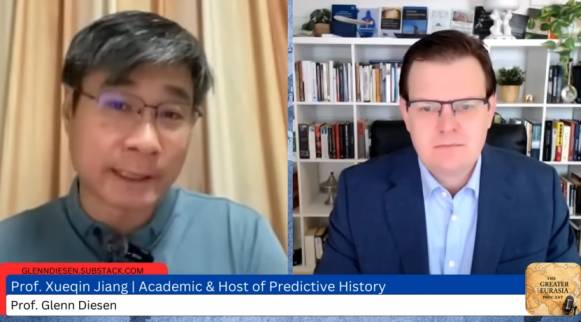
Editor’s Notes: In this episode of The Greater Eurasia Podcast, Prof. Glenn Diesen hosts Prof. Xueqin Jiang for a wide-ranging discussion on how historical patterns and game theory can be used to anticipate the next phase of global conflict and cooperation. Together they explore the US imperial model in decline, Europe’s crisis of relevance, and the brewing political and demographic turmoil across Asia. Jiang also examines why Iran now faces what he calls an existential showdown with the US–Israel axis, and how this could trigger a second, far more dangerous war. This conversation is for viewers interested in how shifting power centers may shape a fractured new world order over the coming decade. (Jan 26, 2026)
TRANSCRIPT:
GLENN DIESEN: Welcome back. We are very privileged today to be joined by Professor Jiang, who has been spot on in several of his predictions, looking at historical patterns and game theory to predict the direction of geopolitics. So thank you as always for coming back on.
PROF. XUEQIN JIANG: Thanks, Glenn.
The Unprecedented Peaceful Rise of China
GLENN DIESEN: So we see a massive change now in the international system, but usually the big changes in world order, they tend to come after major wars or sometimes with other major disruptions, such as the collapse of the Soviet Union. But what we’re witnessing now is quite remarkable with this spectacular rise of China over the past decades, which has been quite unprecedented in human history.
Also, because it’s been peaceful, it has spearheaded this massive shift of power from the west to the east, essentially ending 500 years of western leadership since the age of exploration. And in the last centuries, of course, the Western dominance, which has all now come to an end.
My concern though, and the question to you is: how likely is it that such a major shift in international distribution can occur without triggering major wars between the great powers?
Mark Carney’s Challenge to Trump’s Narrative
PROF. XUEQIN JIANG: Right, so let’s go to Mark Carney’s speech at the World Economic Forum at Davos this past week because it went viral and it got a lot of attention. So there’s direct response to Donald Trump’s argument that for the longest time, NATO, Europe, Canada have been free riding off of America’s generosity and goodwill. It is America that provides defense for Europe. It’s American consumers that have made Europe wealthy. So Europe is freeloading off American generosity.
And in his speech, Mark Carney had a counter argument. He had a rebuttal to Trump’s viewpoint. Basically what he said is that this rules-based international order, it was established for the benefit of the American empire. And so for the longest time, it was hypocritical, it was inconsistent. And the Western allies went along with this because they benefit from it.
But now America has changed its attitude. It is no longer focused on consensus, it no longer cares about multilateralism. And so now if the middle powers like Canada are to survive, they need to really develop a rules-based natural order.
And I think that’s a framework for Europe to now merge with BRICS. Because BRICS, the very idea of BRICS, is a win-win cooperation where everyone is an equal and there’s no dominant power. An example, of course, is the Shanghai Gold Exchange or the Gold Corridor, where the gold is distributed throughout the world, in Dubai, in Shanghai, wherever. But it’s like a blockchain. It’s a ledger, open ledger, where gold becomes the basis for a new financial system.
And so China is very much focused on multilateralism, on win-win cooperation, on reciprocity. And that’s the future that Mark Carney believes the middle powers should strive for. And that’s a framework that Mark Carney and the other middle powers, the Europeans, would like to implement.
The problem, as you say, is there is no way that American empire will just fade away and let BRICS, this new multilateral system, develop. And so in the national security strategy, it’s very explicit in that America will not give up its empire, but it will change the tactics by which it rules the empire. So no more multilateralism, no more liberal order, just pure focus on national best interests. That’s number one.
Number two is that it will from now on perceive its allies as vassals. So all these US Treasuries that Europe holds, Japan holds, South Korea holds, it actually belongs to America. It is America that controls the resources and the wealth of its allies. So basically, the vassalization of the American empire. That’s number two.
Number three, and this is most crucial, is that it will challenge China wherever it can. So even though America will remove its military from East Asia, it will continue to challenge China in Africa, in Europe, in South America. It claims hegemony over the Western Hemisphere, and it will embargo China’s economic development from now on.
So we are seeing right now a clash of titans, where on one hand, China is leading a new international order that is multilateral, reciprocal, and win-win. And then the Americans want to maintain their empire. So that’s a conflict that we’re seeing right now.
The Illusion of Benign Hegemony
GLENN DIESEN: Well, since 1945, though, this system of consensus and multilateralism, it was managed under declared leadership of the United States. I mean, there was no illusions that it was not the dominant power, the hegemon. So once you’re the only game in town, there’s no competitors. It’s easier to be a benign hegemon because they will naturally gravitate towards the United States.
But as the US now has China as the main rival, it has to use harder tools. But the harder or more aggressively the US uses economic coercion to both weaken adversaries and ensure the obedience of allies in this system, or let’s call them vassals, which probably is more correct, the more you incentivize the allies to decouple or diversify and for adversaries to collectively balance.
And, well, from my impression of the Canadian prime minister, this is part of the thing that he was communicating as well.
The Cozy Club and Trump the Outsider
PROF. XUEQIN JIANG: So I think that for the longest time, the American empire was able to make an illusion that it is a multilateral consensus, because the people in charge were good friends with each other. They went to the same schools, the same universities, where they learned the same manners, the same values, the same ideologies. The children then went to the same schools. They hang out in the same places, like the Davos World Economic Forum. They summer in the Hamptons, they skied in Aspen.
So it was a very small, cozy club. And they made a lot of decisions behind the scenes, and they maintained the illusion that it was very multilateral and everyone had consensus. But you’re absolutely right in that it was an empire. Only a few people had the privilege of making the major decisions, but they maintain the illusion of this hypocrisy for public consumption.
Now, the problem with Trump is that he’s an outsider. He’s not part of this club. He went to the wrong schools, he hanged out with the wrong people, and he’s like a mafioso. He’s come in, he wants to wreck things and make things the way he wants them to be. He’s very dictatorial. He doesn’t understand the manners, the ideologies, the values of this system. And so everyone feels under threat.
And the Davos crowd, led by Mark Carney, they feel as though they need to find a new protector in China. The problem, though, is that, first of all, the system that we have today is extremely fragile because of the economic instability created by empire.
And what I mean by that is the inequality, where maybe 1% of the population control most of the wealth. So a classic anecdote is during New Year’s at St. Bart’s in the Caribbean, a few dozen yachts, mega yachts, converge for New Year’s party. And these are people like Miriam Adelson, Jeff Bezos, and there’s only a few dozen of them, but they control 80% of the world’s wealth. So the massive inequality in this world needs to be addressed. That’s number one.
Number two is the corruption of the political system, where in Washington, D.C., in Brussels, the bureaucrats are no longer accountable to the electorate. There’s this disconnect between the political class and Main Street. And that’s a huge problem.
And so there are problems with the empire, with a system that needs to be addressed right now. And because these politicians, these leaders are not able to address these issues, that allows for the rise of Trump. So, in theory, yes, if these people were to align with China, then we could have a new world order.
The problem is that even though you have this new world order, the problem still persists. How do you deal with inequality? How do you deal with the corruption? How do you deal with the disconnect, the alienation of the people? And that’s a fundamental issue that needs to be addressed and which is not being addressed right now.
The Fake Consensus and Russia’s Exclusion
GLENN DIESEN: Like what you said about the fake consensus. Because after the Cold War came to an end and then two years later, the Soviet Union collapsed, the argument by the, I think it was the US Ambassador to NATO, was that Russia couldn’t become part of NATO because it would not fit into the consensus culture which we have in NATO. Which is a nice way of saying that the allies do as they’re told.
Well, the main thought was, I guess, the power distribution, that the Russians are simply too big. And also the whole political culture is less likely to subordinate their decisions to the US. So they would want to be partners, not vassals.
But this kind of begs the question. If the US wants to be a hegemon, it does have to divide and rule. That is, you impose this alliance system where you weaken your adversaries and you make your allies dependent, like the war in Ukraine. I thought this is a way of weakening the Russians and making Europeans more obedient. And this is more or less the objective.
But how do you make sense then of Trump’s seeming desire to just throw away NATO as it is? Because it does seem that you do need this kind of aligned systems if you want to weaken adversaries and make sure that your vassals toe the line. So why this rejection of such an alliance system when this is what you should be pursuing as a hegemonic instrument?
Trump’s Vision: A New Elite and a Reshaped Europe
PROF. XUEQIN JIANG: So Trump’s ultimate ambition is to create a Trump world order. And what he means by that is he wants to replace the old elite, the established elite, the global elite, with a new elite.
So what we’re seeing right now in America is a civil war between left and right. And the ground zero for this, of course, is Minneapolis, where a couple of days ago an American citizen was killed by ICE. So the first was a person who was shot in the face three times by an ICE agent who claimed self-defense. But if you look at the video, that’s debatable.
But the second incident is a man named Alex Priti. He’s 37 years old and he’s a nurse. And he was essentially executed by ICE agents in Minneapolis. And there are thousands of people now converging in Minneapolis. Tim Walz, the governor of Minnesota, has called up the National Guard. So you have the local police, you have ICE agents, and you have the National Guard all converging in Minneapolis.
So it’s almost like a ground zero for a new civil war. The question then is, why is this happening? It’s happening because you have two major factions in America fighting for supreme power. You have the old elite, who is like Wall Street. This is the global financial elite, as represented by Wall Street.
But then you have a new elite that’s up and coming, they’re new money. So Silicon Valley, Palantir, as represented by Elon Musk and Peter Thiel, and they are the ones backing Trump. So the goal of Trump is to replace the federal bureaucrats in Washington and make it obedient and subservient to him. And that’s why you’re seeing all this conflict in the United States.
But zoom out. The entire world is like this, where Trump’s ambition is not to replace NATO per se, but to change the leadership of NATO and make NATO much more subservient to him. So in his national security strategy, he’s talked about backing politicians in Europe that are more amenable to American values, who believe in free speech, who believe in nationalism, who believe in the people. And these states are Poland, Austria, Hungary.
So it’s not that Trump is turning away from Europe. It’s more that he wants to reshape the political landscape of Europe. And Greenland is a very important point of conflict. Because why is Trump so adamant about taking over Greenland? There are already these agreements in place where Americans can use Greenland for whatever military purpose it deems fit. So there’s actually no reason to take over Greenland. Why not maintain the illusion that NATO is still relevant?
And the answer is because Trump wants the European leaders to lose faith. He wants to embarrass NATO. He wants to show the European people, “Look, your leaders are powerless. Your leaders are useless. So overthrow them and elect leaders that can work with me.”
So in Germany, that’s AfD. In France, that’s Le Pen’s party. In Spain, that’s Vox. So what Trump envisions is a radical political restructuring of Europe that is more right-leaning, anti-immigration, and more nativist. So to overturn the global order, essentially. And that’s the main conflict in the world today.
A Civilizational Struggle?
GLENN DIESEN: Yeah, no, that’s an interesting one. That is not just the loyalty to the US and power, but also seem to have a civilizational interpretation here, because he sees the internal struggle within the west as also being of key importance. As you suggest, this also comes forth in the new national security strategy. So is this a struggle in Trump’s mind for reviving American and Western civilization? Because he talks about more or less saving Europe from the EU.
The Messianic Vision and the Path to Empire
PROF. XUEQIN JIANG:
In his mind, he is the Messiah. In his mind, he believes that he’s come to save America and to save Western civilization from woke politics, from the corruption of the global elite, from just the inequality in this world. So he sees himself as a messianic figure. And quite honestly, there are many in the MAGA movement who do see him as a prophet and who do see him as someone who can fulfill the prophecy of a renewed America, to make America great again.
But ultimately, what this means is that Trump needs to become Emperor of America. His ambition is to become king. That means destroying the constitutional values and norms that underpin American society. And we will know this because he plans to run for a third term, which will be unprecedented in the 20th century. And not only does he plan on a third term, he plans on a fourth term because in his mind, he needs time in order to revamp American society, to make America great again.
And look, if he were not running for a third term, we cannot possibly explain the speed and the force by which he is revamping American society. Think about ICE. Now, what’s interesting about ICE is that it says that ICE exists in order to deport immigrants, right, in order to get rid of illegal immigration, which is destroying the American economy.
But if you look at the statistics, Obama actually deported more illegal immigrants than Trump did, even though Obama didn’t have the budget and the resources that ICE has. And Obama never created conflict with the states. The states worked with Obama to remove the illegal immigrants. So it was clearly about removing illegal immigrants. Then ICE is incompetent.
But you think that, oh, ICE is actually meant to be a Gestapo. It’s meant to be a new secret police that was only loyal to Trump then. That makes a lot of sense. And that helps us explain the incredible, unprecedented violence that is happening in the streets of Minneapolis right now. These are extrajudicial executions.
GLENN DIESEN:
Okay?
PROF. XUEQIN JIANG:
There’s no other word for what’s happening. Meant to incite a civil war, meant to enrage the people in the streets of Minnesota. It’s not illegal immigrants versus ICE. It’s white conservative men in white uniforms versus white liberal Americans. That’s the conflict right now.
And Trump understands that he needs to incite the civil war so he can declare an insurrection. He can have emergency war powers. He can override elections. That is his plan. That’s his plan. And look, the evidence is actually pretty clear about what’s happening.
Europe’s Decline and the Question of Leadership
GLENN DIESEN:
Yeah. On the other hand, when I read the National Security Strategy of the United States, the way they refer to Europe, there was some good points there. I thought that is that Europe is in decline. The demographic, it’s an economic decline, its international relevance, the ability to reproduce its culture, all of the things you would expect from a declining civilization.
So how are you assessing this, though? Because I’m not saying that Trump will rescue or save Europe, as was also suggested in this national security strategy, by cultivating an acceptable opposition. But surely things aren’t going well for Europe.
PROF. XUEQIN JIANG:
Right? So let’s look at why Trump is in power, right? He’s in power because Biden really screwed up. Biden was in power for four years, and in those four years, the world essentially collapsed because there’s a lack of leadership, there’s a lack of strategy, there’s a lack of decision making. And this is true for the entire global Western elite.
You go to Brussels, you go to Washington, D.C. during the Biden years, they had no idea what to do. They were corrupt. They were indifferent. They lived in a bubble. And so people were really angry and people wanted change. And that’s what propelled Trump into the presidency. That’s what’s allowed him to implement Project 2025, which is to radically revamp the federal bureaucracy. This is what’s drawing the Pentagon to be loyal to Trump.
So there are severe problems that need to be addressed. And Trump is using this opportunity. He’s using this opportunity of discontentment, disillusionment, in order to amass personal power to himself. And that’s the great threat, right?
So, yeah, look, I mean, I hate to say this, but Hitler would not have rose to power unless Germany was really suffering. And Germany really wanted massive political change. So I completely agree with you. Europe is in a lot of trouble. But the idea that Trump’s going to come and become your savior, I think that is a bit deluded.
I think Trump’s plan is to destroy the world so he can rule over the ashes. I think that’s what’s going to happen. But you’re right in that you can make a legitimate argument that he really believes he wants to save the world. You can also make the legitimate argument that his followers are true believers and they are trying to make the world a better place. But historically, if you look at historical patterns, when a figure like this emerges, and figures like this include Julius Caesar, they end up destroying the world.
GLENN DIESEN:
No, of course, all these leaders never appear in a vacuum. And there’s, so I do see this being one of the consequences of having horrible leadership. I think Biden definitely fell in that category. But how do you explain this, though, the cause of it? Why are there such terrible leaders at the moment, not just in the United States, but across Europe as well?
I mean, terrible in terms of there’s no vision, there’s no strategy, it’s very dishonest. It’s all about managing narratives. Overall, we don’t see any leaders of the past. And again, this is Europe, where you began with the Peace of Westphalia. You came up with modern diplomacy. This is, yeah, I don’t see any leaders again in Europe today, which seems to be able to get the continent back on track, which, well, then you kind of hand over the mantle to any, well, crazy leader who, any strongman coming along, claiming that he can fix the system if you just, that pushes the old order aside.
The Myth of Meritocracy
PROF. XUEQIN JIANG:
I think one of the greatest lies in our lives is that the meritocracy promotes the best leaders. So if you went to Yale, if you went to Harvard, if you went to Oxbridge, if you went to the Sorbonne, then you are the best and the brightest, and therefore you should rule.
You know, I went to Yale, and I can tell you right now that if you go to a place like Yale, you’re not taught how to think critically. You’re not taught how to be imaginative, how to have empathy, how to be resilient. You’re taught how to speak in a very nice, articulate manner and to conform to the status quo.
So if you look at the ruling class in America, the vast majority of people in Washington, D.C. or the financial elite in Wall Street, Silicon Valley, the media, the universities, they all went to a few schools, and as a result, they live in a bubble. They see the world in a very jaded manner, and so they’re unable to empathize with the suffering of ordinary people. They become disconnected with the ordinary people, and they cannot possibly imagine what life is like for just a blue collar worker. That’s one.
Next, number two is the problem of meritocracy is that if you think that you deserve what you have because you worked hard, then you also believe that other people who are poor deserve what they got because they’re lazy. So the government should not help these people. The government should help immigrants, the government should help minorities, the government should help women because these are historically persecuted groups. But we should not help ordinary white men because they deserve what they got because you’re stupid.
I worked hard in school, and so I got into Yale. You didn’t work hard in school, and so you should be a guardsman making very little money. You should be unemployed. So there’s this contempt, there’s just this visceral discontent for the ordinary people among the elite that drives a lot of their policies.
And then the third thing, and this is the most important, is that when you go to a place like Yale, you’ve succeeded all your life. And so you’re not capable of humility, you’re not capable of self-reflection.
So in 2016, when Trump won, this was a pivotal moment in Western history. At this point, the elite could say, listen, why did Trump win? Well, it was probably because of inequality. It was probably because we bailed out Wall Street in 2008, right? We should have bailed out Main Street. But instead we bailed out Wall Street. So it’s our fault that the people elected Trump. This is a wake-up call for us. It’s time for the elite to start working for the masses again.
Instead, what happened? Instead the elite said, oh, it’s because Trump’s a Putin spy. It’s because he’s a spy. And Russiagate, you know, this hoax will prove that he’s a spy. So it’s not our fault. Oh, also, Trump cheated. You know, it’s because of Facebook. So they found all these pretexts to disguise the fact that Trump won because of mismanagement by the elite.
And so we have this elite class in America and Europe who are extremely arrogant. They live in their own bubble. They’re mediocre, but they think that they’re superior. And they’re incapable of any humility, any empathy. And that’s why we are where we are.
Richard Rorty’s Prophecy
GLENN DIESEN:
Well, when you said this, I just clicked up a quote by Professor Richard Rorty because he was making a similar point, but back in the 90s, because when the economic liberalism and globalism of globalization of the 1990s were gaining speed, he wrote this paragraph in his book, which I thought was great, and essentially this was predicting what excessive economic liberalism under globalization, that it would produce some political radicalism.
So he wrote, there’s a quote: “Members of labor unions and unorganized and unskilled workers will sooner or later realize that their government is not even trying to prevent wages from sinking or to prevent jobs from being exported. Around the same time, they will realize that suburban white collar workers, themselves desperately afraid of being downsized, are not going to let themselves be taxed to provide social benefits for anyone else.
At that point, something will crack. The suburban electorate will decide that the system has failed and start looking around for strong men to vote for, someone willing to assure them that once he’s elected, the smug bureaucrats, tricky lawyers, overpaid bond salesmen, and postmodernist professors will no longer be calling the shots. Once the strongman takes office, no one can predict what will happen.” Unquote.
This is 1998. How can you better describe what happened?
PROF. XUEQIN JIANG:
Yep. This is exactly what happened. Exactly.
GLENN DIESEN:
So this rooted in globalization and the excesses of economic liberalism, is this what caused the problems which introduced the strongman?
The Reagan Revolution and Neoliberalism
PROF. XUEQIN JIANG:
Yeah, you look, I mean, look, you go back to 1970s and you were living in the West at that time, right? Australia, Canada, Europe, America. You had the best life, right? Because you just worked in a factory and your wife could just stay at home and just look after the kids. You have three kids. You have two cars. You could vacation in the winter, and in the summer you had a cottage. Probably all three of your kids could go to university. And we’re talking like just a factory worker. And this is a single household.
But then you had the Reagan revolution, you had the rise of Margaret Thatcher in Britain, and then you had the rise of neoliberalism, which allowed for the consolidation of wealth in the 1%. You also had globalization. So wealth was being transferred from the developing world into the developed world to create these speculative financial products like derivatives.
So it went all wrong with the Reagan revolution and the rise of neoliberalism. And that’s the root of all the issues that we have today.
The Breakdown of the Multilateral World
GLENN DIESEN:
So what are we looking at there then? Because I think people are maybe often they get too focused on whatever Trump says today or this week. But what is in the wider, again, take a step back. Are we looking at the meltdown of the existing international order? The economic, the security aspect, I mean, the political system, what are you seeing here?
PROF. XUEQIN JIANG:
Yeah. So the idea that Mark Carney has, right, like, you know, we’ll just pivot to China. It’s not going to work. And the reason why is that China doesn’t want to be the hegemon of the world. It doesn’t want to be the military superpower. It doesn’t want to control the seas the way America does.
The American empire is a unique time in history. It was really not sustainable. The idea that one country is able to control the entire planet through technology, through the military and through finance, that was just not sustainable in the long term. It really hurt America. It caused America to be overextended, to be overleveraged, and that caused a lot of economic issues in America, which allowed for the rise of Trump.
So we are just witnessing the breakdown of the multilateral world, and there’s no replacement. And what this means is more conflicts around the world, specifically between Russia and America. But, you know, there’s talk of America attacking Iran at any point.
GLENN DIESEN:
Okay.
The Breakdown of Global Trade and Environmental Catastrophes
PROF. XUEQIN JIANG: That’s one thing we’ll see. Second thing is we will see the breakdown of global trade. So, you know, more countries will retreat onto themselves and impose tariffs to protect their local economies.
You will also see environmental catastrophes. You know, so there’s this giant snowstorm that engulfed America, and this is going to be the new normal. You’re going to see radical climate change over the next few years that are going to strain a country’s resources, which forces them to be more militaristic, for example, in the case of Japan, but also much more protectionist.
Okay, so this is the reality that we’re moving towards. And it’s very similar to basically the world in 1930s, the Great Depression, right before the start of World War II. So it seems that all signs are moving towards a major global conflict. And right now it’s really a question of who’s going to take which side.
You have Russia on one side, you have America on another side. It’s really a question of where will the other powers join? And unfortunately, I think what’s going to happen is that it’s going to be complete chaos where the sides won’t be so clear. And it’s really different countries will choose different alliances, but these will be shifting alliances over time. So China will try to play both sides, UK, Europe will try to play both sides. So it’ll be a very dynamic geopolitical struggle.
The Unsustainable Distribution of Global Wealth
GLENN DIESEN: Well, it reminds me about what Kennan wrote in this policy planning staff memorandum in 1948. He was making the point that the US has about 50% of the world’s wealth but only 6% of its population. So this would, well, more or less, it would require some manipulation of the system because people would have been envious and resentful.
And again, it’s not just that they’re resentful, but maintaining this skewed distribution of power, which was extremely skewed because, again, the outcome of World War II. Yeah, it was never meant to endure.
But you did say that China wouldn’t simply be in a position to replace the United States. And this is something Brzezinski wrote in the 1990s as well, that is that the US global hegemon is something the world has never seen and will not likely see after the United States as well. It’s a very unique circumstance in history. The fact that we built a whole ideology around the idea that it would be permanent is just beyond radical, given that it was so unique.
However, how do you see then the rise of China now that, well, not just rise of China, the rise of Asia, but of course, with China spearheading the whole thing. How do you think these Asian economies would behave any differently from the European ones? In other words, is there something about Asia that would do things differently, or is it every state would behave the same way under the same distribution of power?
East Asia’s Demographic Crisis
PROF. XUEQIN JIANG: Yeah, I’m not too optimistic that the century belongs to East Asia. I know there’s a lot of talk about the East Asian century because South Korea, Japan, China, they have the most dynamic economies. They should have the best and most rigorous education systems. So everyone is very jealous of how hardworking, how studious East Asian students are.
But look, the reality is that Westerners like to argue. Westerners are very open. There’s a free media. And so people are aware of the issues in the West, whereas in East Asia, people are much more shy. They’re much more deferential to authority. The media is, East Asians don’t like to debate. So Westerners are less aware of the issues in East Asia.
But let me list some issues facing East Asia that are extremely dire. Okay. The first is the demographic issue. So you have an aging crisis in East Asia where people are living longer. In fact, East Asians probably have the longest lifespan of all demographic groups. Okay, so that’s one. But the other thing is that East Asians aren’t having children.
So the fertility rate in East Asia is the lowest in the world. In South Korea, it’s as low as 0.6, I think it’s gone up, okay? But it went as low as 0.6. Japan is 1. China, it’s 1. Okay? Replacement level, of course, is 2.1. And so in 100 years time, 20 years time, these countries won’t have young people anymore, okay? So that’s a huge, huge problem that needs to be addressed, but which cannot be addressed.
Think about the amount of money that South Korea has thrown at this problem, okay? Offering tens of thousands of dollars to young couples to get married and have children. And it’s still not solving the problem because young people in South Korea look at society and they see a stagnant, corrupt, unequal society that is extremely competitive, extremely hierarchical and extremely unfair.
And so, you know, okay, if I have children, my children are not going to have a better life than me, so what’s the point of having a child? Okay? So, and that’s true throughout East Asia. And I’m sorry, but if young women are not having children, that’s a vote of no confidence in society. So for people to say that East Asia is going to dominate the world, explain to me why and how young women are not getting married and they’re refusing to have children, okay? So I say that’s number one.
Economic Vulnerabilities and Regional Tensions
Number two is that these countries, they are where they are because of a high savings rate. Okay? So South Korea, Japan, China, they export more than they consume. But let’s just assume that these markets in the West, America, Europe can no longer afford these goods from East Asia. What’s going to happen to these East Asian economies? Well, they probably won’t do very well.
And you know, China has been talking for a long, long time about shifting to a consumption-based economy. But look, the Chinese save 40% of their household savings, okay? Why do they do that? Because they have very little faith in the economy and in the growth of their country. They don’t believe in the welfare, pension system. They think that when I get old, the government’s not going to take care of me, I need to take care of myself.
It’s a very pessimistic attitude and that’s why they don’t spend any money. But if people aren’t spending any money, you can’t actually grow the economy. And that’s an issue that the Chinese government has been trying to solve for a long, long time. But they can’t do it because of cultural values and the political system. Okay?
The third thing I’ll point out is that in a world of global conflict, and we can expect that a lot of global conflict will arise in the Middle East, oil will be cut off to East Asia. In East Asia, the economy depends on oil from the Middle East. So East Asia is not as wealthy as other parts of the world. The Americas, okay, the Western Hemisphere is extremely wealthy, but if their economies were to be embargoed, then they would have a lot of issues. Okay, that’s point number three.
And point number four is that South Korea, Japan and China have never gotten along historically. Well, they’ve always been in conflict. So if America were to retreat from Southeast Asia, if there’s no major hegemon to maintain peace in Southeast Asia, then we can expect conflict to arise very quickly between Japan, China and South Korea. And so for these reasons, I’m actually not optimistic about Southeast Asia in the next few decades. In fact, I’m very, very pessimistic.
The Paradox of Modernity and Human Wellbeing
GLENN DIESEN: Yeah, no, the divisions between the countries are quite interesting. Well, it seems as if for the Russians, for example, the most difficult relation to have in Northeast Asia would be Japan. But for Japan, the relationship with Russia seems to be almost the best one by comparison. Just point out the difference to have to do with the South Koreans, North Koreans, Chinese.
However, it is interesting when you look at, when you discuss with political economists, they often make the point that you shouldn’t measure the strength of states only in military power. You have to look at the economy. But if you draw in some sociology there, it also shows that the GDP and economic numbers, they don’t always reflect the health of a country either.
And that’s why South Korea is an interesting example because often hailed as the most modern country in the world, if you do, well, measured by robot density in terms of how many robots per individuals and such. So, well, I would put it on number one in terms of modernity, but you know, we could be at least it’s in the top there.
However, if you look at society, what does this mean? It also means they have the lowest birth rates in the world. I think they’re the one around 0.62. So something horrible rate like this, it might have changed. Of course, they also are top of suicides. And I think they still have a minister of loneliness. And you see the media every now and then write about the crisis and the meaning.
And so it does beg the question, what does this mean? As you thrive the most, you also begin to end your own existence. It reminds me about the work of people like Émile Durkheim, who wrote about the industrialization in France in the 19th century that the areas that industrialized the most, the suicides went up.
So how do you make peace with this, that the more a human being thrived, the worse it does? And it goes back a little bit often to the argument whether or not the excesses of modernity, that human beings aren’t only, you know, rational individuals that we are. We have instincts as well. We’re group animals, essentially, which aren’t being, which doesn’t always do well under this economic liberalism. That is, society essentially becomes an appendage to market forces.
Is this a key issue for Asia? Because as it also, China just storms ahead from being essentially a peasant country in 40 years to being the leading economy at the most scale, extremely modern. I mean, it’s quite shocking when you go there to see where they are now. Is it the human component that gets lost under, I guess, uncontrolled rapid growth?
Reclaiming Meaning Beyond Neoliberal Values
PROF. XUEQIN JIANG: I completely agree. I think that the future, if we are to survive and thrive as a species, we humans need to abandon these neoliberal values that have made us miserable. You know, today, we’re seen as consumers. The more you consume, the more value, the more status you have in society. And that’s completely wrong, okay? Because it’s made us miserable. It’s made us lonely, and it’s made us disconnected. It’s made us alienated, it’s made us depressed.
Think about the mental health crisis consuming the entire world, okay? Especially in China, where you talk about suicide in South Korea, right? The suicide rate among Chinese students is absurd, and the level of depression among Chinese high school students is just off the wall, okay? So clearly the system is not working, as you say.
What we need to do is to recalibrate our values and find what is meaningful and purposeful in our lives. And that means embracing our spirituality. It means embracing our community. And, you know, that’s also what accounts for the rise of Trump, because he is presenting a new vision that gets people excited, okay? Now, you can say it’s racist, you can say it’s fascist, but ultimately, he is addressing fundamental human needs.
And quite honestly, if the elite, if the powers that be, the 1%, refuse to engage the people, if the elite refuse to help people reconnect spiritually as a community, then we’re doomed as a species. And that’s the reality that we live in. If things go the way that, if things just follow current trends, okay, and let’s just ignore war, then eventually we’re going to die off as a species because we won’t have children. And we’re all going to kill ourselves because of our loneliness. Okay?
So we need as a society, as a world, as a species, to come together and talk about what gives us meaning and happiness in the world. And quite honestly, the answer is children. Okay? How can we construct a society around children, around families, around ensuring that children have a happy childhood and become creative individuals who are resilient, who have empathy? Okay, that’s the conversation we should be having right now.
The Iranian Question: Existential Threat and Strategic Miscalculation
GLENN DIESEN: I often think about Solzhenitsyn because you’ve probably seen his Harvard speech in 1978. He was very critical of communism for very good reasons, and he was invited to Harvard to essentially just go after the communists. And then instead he gave this speech where he made the point, well, you know, everything is seen as capitalism versus communism, but they’re both suffering from the same thing, which is to some extent excesses of the modern and ignoring the pre-modern.
So he pointed out that both capitalism and communism was hollowing out the spirituality in man and essentially treating it as more or less a machine. And by doing so, we’re measuring perhaps success with all the wrong indicators.
But this is a last question. If the US would like to restore its dominance, it can, of course, go after China, which it does, but also to reorganize the various regions of the world. And a key target then appears to be Iran. And how are you seeing what is happening there at the moment?
Because it is quite concerning. If you’re in Iran, you see that the United States and Israel, they kind of attacked you, it didn’t work, so then they stopped the war. Now they’re regrouping and they’re preparing for another attack. The assumption is, you know, they will just keep coming for you until they can knock you out.
And the whole idea that this was simply about a nuclear program, they kind of—the Americans kind of pushed it aside and they’re more open now. We want regime change. But if you look at the different political groups they’re supporting, they’re quite contradictory. There’s no consensus between them, which makes me think there’s no realistic opposition they can actually put in power.
So in other words, any person they put in place, it will begin to fragment. It will be a failed state. It would perhaps split up. But is this the objective then? Because if it is the objective to destroy and break up Iran, to make it more manageable, Iran is facing an existential threat, and they should respond very differently. More aggressively when the next attack comes, because they can’t simply push back the Israelis and Americans and then stop the fighting and let them regroup and come back and do it over and over again until they’re able to destroy Iran.
So this is—I think we should be more worried about what’s happening now with Iran.
PROF. XUEQIN JIANG: Yeah. So the intention of the Israelis and the Americans is, as you say, to destroy Iran and break it up into different states because there’s a lot of ethnic diversity in Iran anyway, so it’s pretty easy to do so. Okay, so that’s the plan.
What they are underestimating is the resilience, the resourcefulness and the unity of the Iranian people. So the attitude of the Iranian government is vastly different from last year. Okay? So last year, I think there were a lot of overtures to the Americans and the Israelis. They wanted to sit down and negotiate.
Now the attitude coming from Iran is we’re going to fight and if you hit us, we’re going to fight to the end. Okay? No more compromise, no more reciprocity. You attack us, we will fight to the end.
You know the Ayatollah Khamenei recently trolled Trump, right? Because when these Iranian protests were spreading throughout Iran earlier this month, Trump tweeted out and said that these protesters, we will protect these protesters because they have the right to protest for freedom and democracy. Okay?
Now, Khamenei, I think two days ago, this is what’s happening in Minnesota, tweeted out, these protesters have a right to protest and we will defend these protests. Okay? So he’s just showing the hypocrisy of Donald Trump and Americans. Okay, this is trolling.
So I think the attitude of the Iranians is, you know, we had these illusions before that a peace could be negotiated. We had these illusions that Americans didn’t really want war. Now we’re fully awake, now we know the intentions, and now we’re completely unified and we’ll fight to the end.
Okay, look at the 12-day war. The Israelis really believed that if they decapitate the regime, it would fall. It’s like a house of cards, right? So they went after the senior leaders in Tehran and they were surprised how resilient the regime is because these senior figures were quickly replaced. And the Iranians struck Tel Aviv and Israel really hard. So much so that eventually Israel had to beg. The Americans would come in and negotiate a peace. Okay?
But in the process, Israel basically destroyed its own intelligence network in Tehran. Okay? I mean, after the war, the Iranians really quickly figured out where the intelligence leaks were.
Now you have these protests that were engineered by Mossad. So what started these protests earlier this month is currency speculation. Basically, the speculators working with foreign intelligence or CIA, Mossad, they sunk the Iranian currency, which started these organic protests. Then Mossad agents infiltrated these protests and started to attack security services. They killed a lot of police officers, basically.
And Trump was about to go with airstrikes to back up these protests, because this is a classic color revolution playbook. But what surprised everyone was that the Iranians were able to shut off the Internet, discover the Starlink terminals, and then arrest all the Mossad agents and basically shatter this network that Mossad had spent years and years developing in Iran.
So the last step, really the last thing that the Americans can now do is just stage a false flag to initiate an attack against Iran. The Iranians are prepared for this, and the Israelis and the Americans are desperate.
And you’ll be surprised. I think everyone’s going to be surprised by how forceful the Iranians will be this time. Everyone believes that after decades of sanctions, after decades of embargo, the Iranians are pretty weak. But, you know, if you look at Iranian history, the Persians are different people. The Persians are not the Arabs. Okay? The Shia Muslims are different people. They are not the Sunni Muslims.
These are people who believe in martyrdom. They believe in self-sacrifice. They believe in eschatology. They really believe that this is a war against the great Satan. They really believe that this is a war to save the world. And so I think that the Americans, the Israelis, will be really surprised by what happens when they start to attack Iran.
The End of Diplomatic Illusions
GLENN DIESEN: I was in Iran back in May, right before the Israelis attacked. And I was also struck by when you go to different places, how much the martyrdom is celebrated. And this is not something you want to see in an adversary. I guess you would like to see some more weakness. So this could be a problem for those going after Iran.
But overall, what you’re describing with Iran, though, it’s a wider problem, I think, because I also hear from Moscow that they also no longer believe in any of the peace efforts by the Americans. Even if they put together a peace deal to end the war in Ukraine, most likely they will still, the intelligence agencies will never leave. They will still try to build up. They will prepare just a sea of missiles for whatever comes next.
And this is a problem because if the United States and the Europeans, for our sake, wants peace with Iran, with China, with Russia, you would want to see some diplomatic process. We seek to chart out a new mutually acceptable status quo where we can coexist. So you would have to identify where our competing interests can be harmonized and where interests can’t be harmonized, but we can at least manage the competition in a civilized way.
I don’t see any of this at all. I just see an effort to put a pin in it because we are losing and then regroup and strike later. This is—I mean, I think—are they seeing, you know, if they’re seeing it the same way in Beijing? Because in Tehran and Moscow, this is definitely what I’m picking up.
PROF. XUEQIN JIANG: Yeah. Because when an empire declines, the defining characteristic is hubris. Just blindness to the world as it is. Just complete confidence in your own capacity to impose your will on the world and a disrespect for your opponents, a refusal to engage your opponents in serious discussion. Just conquest.
So America has become just a blatant mafia state. And everyone says it. Even its own allies said this. Right? Mark Carney at the World Economic Forum. There’s no greater American ally than Canada, really, in this world. Because, I mean, Canada’s just a vassal state to America. So for the Prime Minister of Canada to criticize America as a mafia state in such a manner, then I think the entire world sees America as hopeless. Yeah.
The Canadian Question: Sovereignty in the Age of Empire
GLENN DIESEN: It’s almost impressive how Canada, the most loyal, perhaps of all America’s allies, also due to geography, makes sense, but they’re able to alienate the Canadians. This is extraordinary to me, though. Of course, by threatening to annex their whole country, that seems to be a good approach towards doing so.
It does beg the question of this is deliberate, what is being done? Because I have a hard time believing that the US can actually annex Canada. I can’t imagine many Canadians being for this. So how exactly is this going to work out? If we recognize, you know, the appeal of nationalism in human nature, that is, you can’t just shift the country under US rule. I don’t know.
Sorry, just as a last question there, you know, you are Canadian. How do you see this? Is this a genuine idea that they can annex Canada, or is this some game I’m not understanding?
PROF. XUEQIN JIANG: Right. So again, for the longest time, the world was run on consensus. It was just based on shared assumptions and values. Right. And one shared assumption is the idea of national sovereignty. That if it’s a country, then you need to respect that country’s sovereignty and that’s the underlying basis of international law. You don’t have the idea of sovereignty, you can’t have international law. Okay, so for the longest time, that was the idea.
But Trump, being Trump, refuses to acknowledge sovereignty. Okay, so for example, they kidnapped Maduro. Okay, you don’t do that because you’re violating a country’s national sovereignty. And then to take Maduro and then parade him in New York City and then to charge him with American crimes. Okay, this guy is a president of another state. He is head of a nation state. You cannot do this again according to international law. But Trump doesn’t care. Okay, so Trump doesn’t care about international law. He just cares about power.
Now, if he doesn’t care about international law, it’s probably possible for him to go take Greenland. It’s not hard. It’s easy for him to take Canada as well, because Canada doesn’t really have a military. And, you know, the Canadian-US border is the longest border in the world. Plus you have Alberta, which is the real source of the Canadian economy.
So the Canadian economy is about to go bankrupt because of real estate speculation and for a variety of reasons. Okay, so the Canadian economy’s in a lot of trouble. Alberta will probably have a referendum for independence, and then maybe 20% vote for independence. Okay? Not to be unexpected, 60% vote for independence, Trump will say, “Ha. You see, the Albertans want to be independent and the Canadians won’t let them. So we need to defend Alberta. We need to support the sovereignty and the freedom and democracy of Alberta.”
So it’s easy for Trump to do this. He can annex Canada at any point. This has been true for the past 200 years. The reason why America doesn’t do that is because if you do that, the very illusion that America is a force for good in the world would shatter. Okay? The entire world will unify against you. So South America would start to rebel against you. Europe would start to unite against you.
So that’s why you don’t do it, because if you were to do this, you break all international norms and everyone would see you as a major threat. But at the end of the day, Trump’s going to do this because that’s who he is. He wants the facade that he’s the emperor, the God Emperor Trump.
GLENN DIESEN: Alberta is the Greenland of—just not for the Danes, it’s for the—Greenland of the Canadians. This is the weak spot. If you can make the first secede or back secession, then this is how you break it up. Well, perhaps. Let’s see how this plays out.
Anyways, Professor Jiang, as always, thank you so much. I know, not just me, but all the viewers as well. Always appreciate your analysis, so thank you very much.
PROF. XUEQIN JIANG: Thanks a lot.
Related Posts
- Transcript: President Trump Signs the Secure America Act
- Tucker Carlson Show: w/ Ken Silva – Attempts on Trump’s Life (Transcript)
- Pod Force One Interview: w/ Donald Trump – June 2, 2026 (Transcript)
- Jimmy Dore’s Interview on Tucker Carlson Show, June 5, 2026 (Transcript)
- Transcript: Trump Remarks on American Agriculture at Wisconsin Roundtable