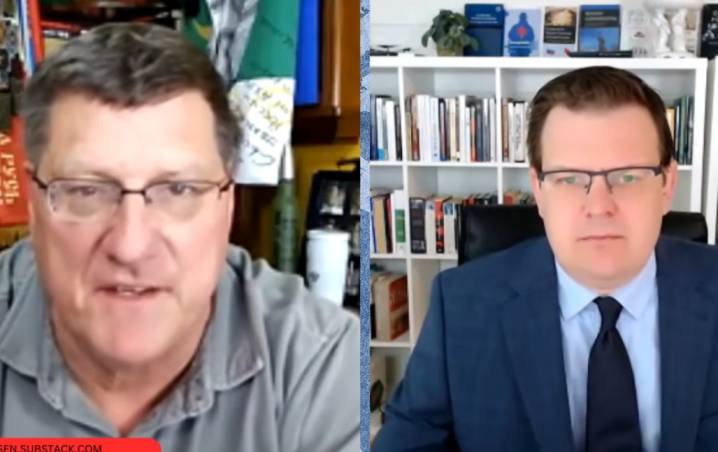
Editor’s Notes: In this episode, Glenn Diesen is joined by former UN weapons inspector Scott Ritter to discuss the escalating tensions between Russia and the West as the conflict in Ukraine reaches a critical turning point. They examine the potential for a decisive Russian strike against NATO members, specifically Finland and the Baltic states, in response to the deployment of long-range drones. The conversation also delves into the fragmenting relationship between Europe and the United States, the collapse of NATO’s deterrent power, and how the broader geopolitical shift is impacting the global economy and energy security. (April 18, 2026)
TRANSCRIPT:
Introduction
GLENN DIESEN: Welcome back. We’re joined today by Scott Ritter, a former UN weapons inspector, a US Marine Corps intelligence officer, and an author. So thank you as always for coming back on the program.
SCOTT RITTER: Thank you very much for having me.
Europe’s Drone Supplies and Russian Warnings
GLENN DIESEN: We see now that the Europeans are speaking quite loudly and proudly, I would add, about all the drones they’re sending to Ukraine to fight Russia. But at the same time, there’s also reports now, as yeah, we all know that some of the drones that have been hitting the Russian Baltic Sea coast is coming from the Baltic States and, and/or Finland.
And we now see that the Russian Defense Ministry, it published this list of European facilities that are now potential targets of Russian strikes as they’re producing drones which are being used to attack Russia. Now, I even saw the Russian Security Council Secretary Sergei Shoigu making the point that Russia has the right for self-defense, given that these are attacks from European territories.
I was wondering what do you make of all of this? Because is this, you know, hot air, or do you think there is, yeah, that they’re actually going to start to step up the efforts to restore their deterrence?
SCOTT RITTER: I think that Russia is looking to bring an end to this conflict this year. I think they have plans in store for this summer. The Russian approach has always been to avoid escalation and focus on mission accomplishment. They’ve allowed so-called red lines to be crossed because strategically you would lose more by being seen as over-responding. You might mobilize or stiffen support for Ukraine that is otherwise diminishing.
I think this time, however, it’s different. We see that what had been done in the shadows is now official policy. We see in Ramstein nations bragging about the role they’re playing, that this has become a de facto proxy conflict. And when we speak of drones, we’re not talking about the tactical drones on the battlefield, we’re talking about drones that are used to carry out strategic strikes in the depth of Russia.
This is an unsustainable model for Russia. And I think that the time has come for Russia to step up and make Europe understand there is a price to be paid for irresponsible activity. What Europe is doing, just so everybody understands, is an act of war. It’s not that Europe’s an innocent party here. They are active participants in a conflict. They are planning these attacks. These drones that are being produced are being produced knowing that they’ll be given to Ukrainians who will then use European-provided intelligence to strike Russia’s depth.
And as I said, I believe that this is an unsustainable model, and I think the Russian Ministry of Defense and the Russian Security Council have made it clear that there will be consequences if this continues. So I think that’s where we’re at right now.
The Possibility of a Russian Strike on Europe
GLENN DIESEN: Yeah, it’s very strange that this is — I made this argument myself because, you know, to be a bit cautious about the path we’re going down, but it’s almost, it’s very easily dismissed these days, which is kind of strange because the reason why most of these European states never supplied weapons to any country in a war would be because that would make the Europeans a participant to the conflict.
Yet now we see the involvement as deep as it can be to the point where, yeah, the Ukrainians will play a very minimal role potentially. And yet the whole idea that the Europeans are becoming participants or have become participants is just rejected as Russian propaganda, which is what you say when you want to make a dissent go away. But, so it is shocking.
But what do you see being the possible — do you see a possible warning strike first against Estonia or Finland, or do you think they will do something larger? Going after the, you know, key logistic nodes in Germany, for example?
SCOTT RITTER: I’m not one to advise the Russian government on anything. I think warning strikes would be inconsequential. And actually, I mean, if you’re going to strike a NATO country, or as they say, if you’re going to strike the king, kill the king, I think Russia gets one shot. And it should be a devastating shot that takes out the totality of the target set identified by the Russian Ministry of Defense in a way that completely obliterates the potential of Europe to carry out their goals, their stated goals and objectives of supplying Ukraine with drones to be used in a proxy manner against Russia’s strategic depth.
It also sets the signal that Russia can change the target deck anytime it wants to and the outcome will be the same. I think that Europe needs to be put on notice that they’re playing in the big boy arena. You decide to step into the ring with a super heavyweight fighter and he just knocked you out. Because otherwise this will just continue to be a war of incrementalism that will solve nothing.
The other thing is by hitting decisively, you fundamentally define the debate. Now it’s a put up or shut time for Europe.
And Europe will find out that they simply cannot go to war with Russia. They’re not positioned to go to war with Russia. They don’t have the resources. And then Europe will also have to have a debate about are they going to drop everything in a time of existential economic crisis and rebuild a European army that cannot exist, does not exist, won’t exist.
The United States is leaving. I don’t think the United States will have any sympathy for the Europeans for doing what they did. This is fundamentally an act of war that is taking place. And so the Europeans, I think, are hoping for incrementalism that can lead to drawing the United States back in. The longer you have a debate that’s open-ended, the more likely bad things are going to happen in terms of the outcome.
But if you present Europe with, you know, a bloody nose and the fact that your hand is cocked to hit them again, and the United States now has to look at this, you make everything very clear with a decisive strike. And so I think the time has come for a decisive strike. I don’t think the Russians would be publishing this list and Sergei Shoigu would be saying what he’s saying if the Russians weren’t prepared for a decisive strike.
What Would the United States Do?
GLENN DIESEN: Well, if it would be a large strike, again, not just the Baltic states and Finland, but again, then primarily Germany as well. The big question is what would the Americans do? So lately we’ve seen all these tweets by Trump that, you know, NATO’s a paper tiger. You haven’t, you know, you didn’t do anything for us. We’re not going to be there for you.
Do you think they would just ignore it altogether, or would it be some — well, what would be the response of the United States? Essentially would be nothing, or would it be going all in? Well, I’m doubting the all in by now, but essentially NATO would be over then if they wouldn’t do anything. Trump might be fine with that. So what do you expect the American reaction to be?
SCOTT RITTER: Well, first of all, this isn’t your classic, you know, we were attacked, we want collective defense. This is selective countries in NATO acting in a manner outside of the NATO framework. NATO as an institution has not made a decision to provide drones. It’s a German decision, it’s a British decision, it’s a decision by individual nations. And so legally, it’s going to be hard to make the case that Article 5 is even triggered.
But at the end of the day, too, the United States knows more than anybody about fool around, find out. And here we have the Europeans fooling around. And if Russia makes them find out, I don’t see the United States rallying to their cause. I actually see Donald Trump saying, “You brought it upon yourself. This was stupid policy. We told you to seek peace. Instead, you promoted this war. And you weren’t there when we needed you. We’re not going to come now.”
I think this is the end of NATO. And I think that’s another thing that’s going to go into the calculation of Russia — the accelerated death of NATO by launching a strike. Of course, it’s a gamble. I mean, who knows how things will happen? Europe may rally and the United States comes back and NATO unifies. But I think all indicators are that that’s not going to be the case.
And I think that the Russians are looking for a decisive summer. The decisive summer will come, I believe, with offensives in the Donbas region that will bring back the totality of the Donbas plus deeper penetrations. And I think it will be putting NATO on notice — or Europe on notice — that Russia’s done playing games. You can only sit there and threaten Russia with war so many times before Russia actually says, “Okay, let’s do it.” I think Russia’s at the “okay, let’s do it” standpoint.
Especially look at their economy — it is doing quite well right now thanks to the global energy crisis. And no matter how this shakes out, Russia now has fixed a lot of their economic problems that might have held the hand of the Russian government before, out of fear that a conflict with Europe could trigger an even deeper economic crisis. I don’t think Russia’s afraid of that right now. I think all conditions are green for Russia to strike Europe if it continues this policy.
Russia’s Spring Offensive in the Donbas
GLENN DIESEN: Well, as all of this is happening, and I think one of the reasons, of course, the Europeans might be escalating now is that the war isn’t going well, and it appears that the spring offensive of the Russian side is now going or has started. Do you see this as well, or is it too premature?
SCOTT RITTER: Well, I see indications. I wouldn’t go to Las Vegas and put my mortgage on anything at this point in time. But Russia has been preparing the battlefield. If you follow what’s going on — I follow a very good Russian journalist who publishes a Substack page that provides updates on the battlefield with very good maps and explanation of what the Russians are doing — and what you see is the Russians have been painstakingly setting up the front for a major effort by taking critical terrain, key terrain, cutting lines of communication.
And by attriting the Ukrainians, luring the Ukrainians into counterattacks, having well-thought-out cause-and-effect actions, doing something on the assumption Ukrainians would then counterattack and then receiving that counterattack and destroying the Ukrainian force and thereby eliminating reserves. Ukraine has no reserves now because of these ridiculous counterattacks that they’ve been undertaking.
And the Russians have continued to prepare the battlefield for what logically would be an offensive designed to capture Sloviansk and Kramatorsk, the last two big populated areas in Donbas. If that urban belt falls, all of Donbas falls. So I think that’s the goal of the summer — to bring an end to the issue of the Donbas, meaning that it’s no longer a question of Ukraine giving up territory. Russia is going to take it.
Hungary’s Political Shift and Its Impact
GLENN DIESEN: Well, I got the feeling that the European enthusiasm about sending more money, weapons, and partaking more and more directly in this war, that part of this was held back by the Hungarians, Orbán specifically, blocking a lot of the military aid which was supposed to be sent to Ukraine. Now that Orbán was defeated, what do you think would be the significance of this?
Because I think some people might have exaggerated how much of a Europhile the new president is — but, sorry, the new prime minister is — but it still is quite significant that the new leadership of Hungary might define Hungary’s national interest somewhat different from what Orbán did.
The €90 Billion Question: European Theater and Ukrainian Reality
SCOTT RITTER: Look, who cares? I mean, I don’t mean to be too— but who cares? So what, Europe now is going to be able to spend €90 billion on Ukraine? Where does that money go? You know, is this money going to actually bolster Ukrainian capabilities? Are they going to provide Ukraine with the Patriot air defense systems Ukraine says they need? Where are the Patriots going to come from? The United States isn’t providing any Patriots to Europe. All Patriots are being diverted to American use. So I just think that this is a lot of talk.
The reality is on the battlefield, and nothing that happened in Hungary is going to impact what’s going on in the battlefield. Nothing whatsoever. This is all in, you know, inside baseball, European wannabeism. The fact of the matter is the Hungarian elections don’t do anything to resolve the fundamental dysfunction of Europe. I mean, yes, so they can pass a $90 billion aid package, but it doesn’t solve France’s problems, Germany’s problems, England’s problems. These problems still exist. It doesn’t bring an end to the economic crisis. It doesn’t resolve the energy security issues.
You know, the International Energy Agency says that Europe runs out of aviation gas in 6 weeks. That’s right in the middle of summer travel season. What happens when the entire European aviation industry is grounded? What’s that do to the economy? How does Orbán affect that? Orbán doesn’t affect anything. Nothing. This is just theater, and it’s always been theater. This is dysfunction in the extreme.
Europe isn’t going to suddenly be united with resolve and going to be able to do things. Still getting that and turning that €90 billion into something. You’re still dealing with an inherently corrupt Ukrainian government that’s falling apart as we speak, fighting amongst themselves. All you do is encourage corruption. I’m glad they got this resolved because now we get to watch what happens to €90 billion and how quickly that disappears and how little impact it has on anything. And then Europe may wake up to the fact that nothing they do is going to turn the situation around in Ukraine.
GLENN DIESEN: Yeah, no, that’s an excellent point. I often made that myself. That is, all this money they don’t really have, but they have to use it for buying American weapons, which Americans can’t sell anymore. If they’re running short before, they have to spend it on the Middle East. Anyways, the key problem in Ukraine appears to be the manpower issue. But the Europeans appear to wanting to help in that area too. There we see Chancellor Merz, seemingly agreeing to Zelensky’s demands of expelling refugees so they can send them back to Ukraine to fill up the trenches, which is another, goes under the label of, or banner of a pro-Ukrainian policy. It’s quite extreme what they’re doing.
But I wanted to ask, though, how overall do you think now the war in Iran has affected the war in Ukraine? Because besides the weapons being diverted, Ukraine being taken out of the headlines, are there any other problems or impacts of the war?
The Iran War’s Impact on Europe: Economy, NATO, and Military Weakness
SCOTT RITTER: The biggest one’s economic. You’ve already taken a very bad energy security situation in Europe and you’ve turned it into an absolute disaster. You know, in order to resolve this, they’re going to have to buy energy that doesn’t exist on a spot market. They’re going to be gouged. So you’re taking a continent that already is knee-deep in economic problems and you’re making it butt-deep in economic problems. And it’s going to make European industry more dysfunctional. It’s going to create internal political rifts inside an already divided Europe.
I think the big thing out of this war for Europe was the economy. The second thing, of course, is that I think the permanent damage that’s been done between the United States and Europe, the end of NATO. I think NATO’s over. I don’t think there’s any trust between Europe and the United States for any number of reasons. I mean, the United States has not been a trustworthy ally, but the United States created an impossible situation for Europe demanding that they respond to the Iranian crisis, a crisis Europe didn’t want. But Trump is holding it against them. He’s literally the boy who’s taking his ball and going home.
And I think that’s problematic too, because now Europe is confronted for the first time with the necessity of having to defend itself. In the past, there were theoretical discussions about what would happen if the United States walked away. Well, the United States is walking away, and Europe knows that. So now they’re having the uncomfortable discussion, and Europe is realizing they don’t have anything. Europe has nothing. There’s no army, there’s no defense industry, there’s no air force. Without the United States, Europe is literally nothing. And now they are involved in a proxy war with Russia using drones. I think this is the other big thing, is the absolute realization of how little power Europe has from a military standpoint.
GLENN DIESEN: Yeah, no, I don’t always understand what the strategy is. You would think at that point in time when the Americans are pulling back and essentially the big American support behind you goes away, you would be a bit more cautious the way you approach other great powers such as Russia. But it doesn’t seem to affect the posture though. They’re still doing the same as they did before.
But on the topic of Iran, do you think this might be coming to an end now? I think we all watched— well, we don’t have to take everything Trump says too seriously, but he seems to think the war is coming to an end. The Iranians did say that the Strait of Hormuz is open, but the way they defined open is very different from what Trump is describing, which sounds like an unconditional surrender for the Iranians. So what do you think is happening at this moment?
Trump’s Political Theater and the Iranian Reality
SCOTT RITTER: What’s happening is exactly what I said is going to be happening. We have two realities in the world. We have the real geopolitical reality that is what the ground truth is in Iran. The United States and Israel lost the war. They didn’t accomplish any of their objectives. They hold no leverage over Iran whatsoever. Iran holds all the cards. The US has reached the capacity of its ability to escalate conventionally without crossing into outright war crimes. This is why Donald Trump chose to move towards a ceasefire, a ceasefire that Iran didn’t want but was pressured into accepting because of China, who is suffering economically from this conflict.
So you have the Iranian reality, then you have the American reality, which is really centered on Donald Trump’s ego. This is a political problem for Donald Trump. This isn’t a national security problem for the United States. We’re not trying to solve a giant international foreign policy crisis. We’re trying to solve a domestic political crisis for the president because he entered a war he said he would never enter and he lost. He can’t admit he lost.
So now what has been happening — I said that the negotiations that took place almost a week ago almost succeeded in having a final treaty. But politically, Trump couldn’t accept this because to accept that treaty during the timing and the conditions put forward would mean that the United States is acknowledging defeat. So Trump scuttled this agreement and then went on a week of posturing, and that posturing was designed to create the perception of American power, that America is compelling Iran to do things.
But what Iran is doing are things that were already agreed to in the Islamabad Memorandum of Understanding that was almost signed, but Trump killed it. This is just a game. This is active political theater. What we see the president doing is trying to create the impression that without his decisive intervention, without his massive blockade, without his threats, none of this would be happening. This is all happening because of him, and the Iranians are just basically concluding the agreement.
I think there are too many people that take a look at what’s happening and accept Trump’s statements at face value. The reality is nothing his statements say conform to reality, to what’s actually going on. The Strait of Hormuz isn’t open. The Strait of Hormuz has been selectively open. The Iranians are in control. They dictate what passes through, how it passes through, and what things are charged. Trump can claim that he’s the one responsible, but the bottom line is the Strait of Hormuz is opened under terms that are acceptable to Iran, terms that Iran put on the table.
The other thing I want to remind people is while all this theater is going on, there are technical teams in Islamabad that have been at work ever since these negotiations began, finalizing, clarifying the technical details of what will be an eventual peace treaty. But again, unless something very bad happens politically to Donald Trump, he can’t go on with this war. It’s politically devastating for him. The American economy will suffer. And we know in elections, it’s the economy, stupid. And so Trump has no choice but to find peace. He’s just finding it in his own little weird Trumpian way. Where he has to convince a portion of the American public that he’s playing 5D chess and that he’s a genius and that everything he does is brilliant and none of this outcome would have happened without his intervention. Meanwhile, the Iranians just deal with reality.
GLENN DIESEN: Yeah, I noticed the way this has been reported on, you see a clear split. That is what can now almost be described as the MAGA cult. They’re confirming it as a massive victory, but it is a good point. I mean, he keeps lying over and over again, and yet we should somehow take everything at face value. It doesn’t really make much sense.
But if the United States under Trump now decides that they will go back to essentially a total war, or at least a full intensive war with Iran, how long can the US go on now? Because from what I understand, there’s been a lot of flights into the region over the ceasefire. A lot of the stocks have been replenished. What is the fighting power versus the restraint on how long the US can keep this going?
The Limits of American Military Power Against Iran
SCOTT RITTER: Well, you know, there’s a saying that’s attributed to Albert Einstein. I don’t know if it’s actually him or not, but the definition of insanity is doing the same thing over and over again and expecting a different outcome. The United States lost the war. Remember, they started with all the precision-guided strike weapons they wanted, all the defense capabilities they had, and they got beat. So you’re telling me they’ve restocked the same capabilities that they just got beat on. And so what are they going to do differently this time?
Their target deck is totally diminished. Anything of value was struck. Anything of retained value has been evacuated. They don’t have a target deck, so they’re just going to blow up buildings to blow up buildings, which is what they were doing near the end of this conflict to begin with. So that’s not victory. They can’t— the more they bomb, the stronger the regime gets. There’s no regime change there. And Iran has shown that these underground missile cities are pretty much invulnerable and that they continue to launch missiles. And there’s nothing the United States can do to prevent that.
And remember, while the United States has been replenishing, so too have the Iranians. They’ve been building more missiles, more missiles, more missiles. They’ve been repairing. And so we’re just going to start where we left off with Iran inflicting huge damage on US bases, on nations that support the United States, on Israel. And then in the end, the United States, confronted with the fact that its normal strike packages don’t cause any change in the Iranian behavior, will threaten to strike energy targets. And then the rest of the Arab world will step in and say, you can’t, because then they’ll strike us and it’s all over. We lose everything.
And the Saudis aren’t happy about this. Nobody is. I think the United Arab Emirates might be the only country that’s happy about what the US is doing, but that’s because they have no choice. They’re facing their own existential crisis. So I just can’t imagine Trump doing this because this would be the war that cements the fact that he lost. There will be no recovery from this. Our economy, the global economy, will collapse.
Again, I just want to ask people to think, what happens when all European airlines shut down? It’s not about tourism, people. That’s how things are moved. That’s how commerce is done. Trade is done. And if you’re shutting down that — remember, as goes aviation fuel, so goes diesel fuel. So you’re going to be seeing a reduction in the ability of trucks to transport. It’s the end of the European economy. The European economy will not function. And the same thing is going to happen to the United States.
So Trump can’t continue this disastrous model in perpetuity. Iran literally holds all the cards. And so Trump has to be smart enough to know that the lies that Pete Hegseth told him in the first phase are still lies today. Nothing’s changed to suddenly make it the truth. This is why I think that you’re seeing Trump be so aggressive, because remember, half the play here is Trump’s ability to convince a significant portion of the American audience that he was this decisive player here, that without him, we wouldn’t have a peaceful outcome. And so there’s this theater taking place right now.
China’s Energy Security and the Iranian Oil Blockade
GLENN DIESEN: Yeah, I think he went on social media, wrote something along those lines. If he wasn’t president now, the world would be ripped apart or something along these lines, which is usually the kind of thing you hear from an arsonist masquerading as a fireman.
But one other area where all of this could spread the war further would be the Chinese aspect, because it seems that the blockade on Iran, to some extent at least, is aimed to target China, given that they are overwhelmingly so the main importer of Iranian oil. And we also heard some comments from an American senator and also Bessent that, yeah, the Chinese shouldn’t get oil. And yeah, this was kind of part of the objective, but also threats of sanctioning Chinese banks for trading with Iran.
It looks whether or not this was initially an objective or if it’s just becoming a side effect. It nonetheless seems to be intensifying or worsening the relations between the US and China as well. Not the best move, probably, given the problems they’re facing already with Russia and Iran. But do you think this is contained, or how do you expect the Chinese to respond to this if the blockade continues?
SCOTT RITTER: Well, first of all, we need to understand that this oil, this issue of oil energy security for China is a very sensitive one because basically this war has exposed the soft underbelly of the Chinese economy, which is sustainable supply of energy. Iran, the lack, the cutting of Iranian oil to China is significant. There haven’t been replacements found. China needs this energy. And this now has caused a different stance.
The Chinese have been quite articulate in saying, do not challenge the dragon on issues of sovereignty. Bessent can say what he wants, they can sanction banks. They have to be careful because China’s loaded for bear. And there’s a lot of cards China can play economically now that this has become an existential issue because, in the past China wanted to avoid causing economic difficulties on the periphery of a larger, well-functioning Chinese economy. But left unaddressed, the issue of energy security could cause great harm to the Chinese economy. So I don’t think the Chinese are messing around.
First of all, how many Chinese tankers has the United States turned around? The answer is none. So I think again, this is rhetoric on the part of the United States. I think the impact is zero. I don’t think we’ve stopped one Chinese-flagged vessel, nor do I think we are going to stop any Chinese-flagged vessels because there is no legal justification for this.
And China has been very strict. The United Arab Emirates sent a team, a high-level delegation, to meet with the Chinese, and they started to lecture the Chinese about Iran and the need to cut back support, and they were cut off. And the Chinese Foreign Ministry said, you don’t get to tell the dragon what to do with its foreign relations. We do what we want to do when we want. We’ve been friends, but not friends enough that you get to tell us what to do. And this is the Chinese approach right now.
So I think, again, Scott Bessent, first of all, you have to understand we don’t have a well-thought-out plan. If we did, we would have executed it up front. This is a plan that’s being made up as it goes along, and again, it’s designed to shape perception, not reality. The perception is that the president put China in its place. The reality is the president’s words and American action haven’t impacted this at all. China continues to get a flow of energy from Iran, and the United States hasn’t been able to stop that.
Diplomacy with Iran and Russia — Is There Any Hope?
GLENN DIESEN: If this is compelling China to take a more forceful stand in the international system, that’s quite a horrible achievement to be made given that for decades now they kind of had as a key strategy not to create too many waves, not to raise their voice too much in the international system in order not to invoke any great power rivalry. But if they’re put in a situation like this where they’re now forced to take some action, this is a disaster if one wanted a benign China.
Just my last question though is about, behind all the bluster, all these statements by Trump — they were going to give up all of their uranium, enriched uranium studies, the Iranians, and we’re going to give them nothing back. They’re not going to get any money, nothing. Behind all this, it doesn’t make much sense. So behind all this, is there any negotiations going on which gives you any reason for optimism, either with Iran or Russia for that sake? Or does diplomacy seem dead at this point?
SCOTT RITTER: Well, we know for a fact that the peace talks in Islamabad never ended. JD Vance and Witkoff and Kushner went home. The senior Iranian delegation went home, but both sides left a number of technical experts who are continuing to work out, to finalize the Islamabad Memorandum of Understanding as a final deal. And so I think there’s a deal here. I think we’re going to see a deal. I think Donald Trump just has to create the perception that this deal wouldn’t have happened without his decisive intervention.
GLENN DIESEN: Well, that would explain often his crazy comments. They seem irrational, but it could be a rational move if it’s in an expectation of a deal being made, because if he thinks a deal is going to be made, one of the biggest constraints would be to sell a defeat to the American public, because here, as I said before, he’s got a midterm coming up. But if he can do enough chest beating and strongman poses before the peace deal, then perhaps this will help him sell a defeat as a victory. So maybe he knows what he’s doing.
I get the impression often that he’s a bit all over the place and getting more erratic, but I’m hoping I’m wrong. But how about the Russian issue then? Because we haven’t really heard much more of the negotiations. There’s still talks, but I get the impression from Moscow that they’re not putting much weight into this anymore, that they don’t really think it’s going to move anywhere significant.
Trump’s Blank Check to Russia and the Path to a Ukrainian Peace Deal
SCOTT RITTER: I think, again, this is analysis done in a vacuum because there’s, as you said, not much data out there to put your hands on. My feeling is that Donald Trump has given the Russians a blank check, and has said do what you need to do to get to where you need to get. And the window is not going to be open forever.
But I think Trump has said you have this year and you have until the November election, or right before the November election, to turn what Trump wants — I believe — into a Ukrainian peace deal that he can present to the American people before the midterm elections. So he can now become the peace— this is his whole theme right now. My decisive intervention leads to world peace. And he keeps talking about, we have overseen the greatest reset of the world, etc.
I think that Trump has a completely hands-off posture on Ukraine and is basically giving the Russians an open door to do whatever they need to do to get this thing wrapped up so that come August, there won’t be a discussion about Ukraine giving up territory because Russia will have taken it. And I think you’ll see a more fundamentally weakened and chastened Ukraine and Europe.
Again, I think a decisive Russian strike against Europe would be extraordinarily demoralizing for Europe and could help push Europe into accepting the necessity of a peace treaty. So that’s what I think is happening right now. Trump wants, Trump needs this war to come to an end politically. And this is all about politics. This is all about the politics of Donald Trump.
So I think he’s basically giving the Russians, just telling the Russians, we’re not interfering. You do what you need to do. And then if the results get to where we can bring — what we hope you do is create the results that will make many of the Ukrainian objections moot, and then we can finalize it.
GLENN DIESEN: Yeah, well, it appears that it might be coming to an end now in Ukraine. Well, it can still go on for many months, but I don’t think it’s going to be possible to — it seems like the advantage is only shifting in Russia’s favor, so it’s going to be impossible to turn this around, especially after the consequences of the Iran War. So it still surprises me that none of the Europeans are picking up the phone to call the Kremlin and at least start to talk about possible solutions. But yeah, here we are. Anyways, thank you very much for taking time.
SCOTT RITTER: Well, thank you very much for having me.
Related Posts