Share & Care!
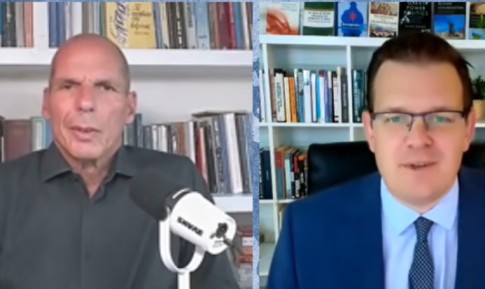
EDITOR’S NOTE: In this episode, economist and former Greek Finance Minister Yanis Varoufakis joins host Glenn Diesen to deliver a sweeping and unflinching assessment of the European Union — its structural failures, democratic deficits, and increasingly dangerous trajectory. From his early hopes for a democratic European federation to his current disillusionment, Varoufakis traces how the EU squandered every opportunity to reform itself, and why he now sees it as a threat to both Europeans and the wider world. This interview episode was premiered September 17, 2026.
TRANSCRIPT:
Introduction
GLENN DIESEN (00:00:00 – 00:00:14): Welcome back everyone. We are joined today by Yanis Varoufakis, an economics professor and former finance minister of Greece, as well as a founder of DiEM25, a Democracy in Europe Movement. So thank you for coming back on the program.
YANIS VAROUFAKIS (00:00:15 – 00:00:16): Thank you very much for having me again.
Assessing the EU Today
GLENN DIESEN (00:00:18 – 00:01:12): So the discourse around the European Union, it’s become, well, very polarized, especially over the past few years. That is, it’s either all good or it’s all bad. And around these positions, we have these competing narratives, well, again, around this binary.
Now, you can argue that, at least I think European cooperation, I think is necessary and ideal, if not only for the collective bargaining power and help to manage relations. But again, like many, I would be a bit sceptical about the very authoritarian development, the warmongering, and also the diminishing geo-economic utility.
But again, the bloc appears to be changing a lot, as well as support for it. I was just wondering if you take a step back, how do you assess the EU today and the direction it’s heading?
From Eurosceptics to Euro-Loyalists: Varoufakis’s Position
YANIS VAROUFAKIS (00:01:14 – 00:09:37): No, I’m very much afraid that it’s increasingly becoming quite farcical. You heard Ursula von der Leyen, the president of the European Commission, only yesterday it was, wasn’t it, in a great party atmosphere when she was hosting Mark Carney, the Canadian prime minister. She brought it upon herself to commit the European Union to associate membership of Canada, which might have been an interesting idea if it existed as a concept. She just made it up. I mean, these people are making things up as they’re going along. It seems to me that they are in a state of very serious confusion.
But allow me to start at the very beginning at something you said in your introduction. When I first started debating the European Union within Europe, here in Greece, in the United States, and so on, I lamented the fact that the debate was polarized. This is a verb you used, the polarization, the polarizing effects of a debate on Europe.
And the polarization was along the lines of the Eurosceptics, people who had good arguments against a pan-European governing entity. These are the Brexiteers, the British Eurosceptics, and other Eurosceptics who believe very strongly that if you’re going to have governance, you need — for it to be democratic, you need a one-to-one correspondence between a culture, a language, a parliament, and a state. And that could not possibly happen at the European level because there was no such thing as a European demos. And if you don’t have a European demos, how can you have a European democracy? So if you end up with a eurocracy, it’s going to be authoritarian.
It’s a very interesting argument, right? I mean, this is a Eurosceptic argument that has underpinned the Brexiteers and quite a few others around Europe. It wasn’t my argument. I never accepted that because I truly believe that the demos is something we create. I mean, you’re a historian more than I am. The history of European nationalism, often the 18th century, the 19th century, proves that a nation is a historical product, is something that is forged. The Americans were not a nation until they created the United States. They didn’t even speak English, most of them. So the idea that, oh, there is no such thing as a European demos, and therefore there can never be such a thing as a democratic European federation, it’s a respectable argument, but it’s not one that I ever adopted.
Then on the other hand, you have what I call the Euro-loyalists, Ursula von der Leyen, the various think tanks, Bruegel, and so on and so forth. Some very smart people, but nevertheless, for them, the European Union can do no wrong. Even when it is messing things up, it’s a Panglossian view that this is the best of all possible Europes, and therefore we have to back it.
So you have the Eurosceptics and the Euro-loyalists, and I was never siding with either of them. I was a Euro critic, but in the ancient Greek version of the word critic, that is somebody who asks the difficult questions. I wanted the European Union to become a democratic federation.
Growing Up Outside the EU: A Personal History
I mean, this is how I was brought up. I was brought up outside the EU, outside the Common Market. I grew up in a fascist dictatorship, which was in NATO, by the way, but not in the European Common Market. And my parents, my social circle, we all craved to become part of the European democratic family.
We knew, especially when I was getting a bit older and I started reading history, I could tell that the European Common Market, the European Union as it’s called today, was created as a cartel of big business. It was not created in any way that resembles a democratic state or a state, any kind of state. It was not the result of some kind of socioeconomic political process that creates tensions between the different social classes, between the aristocracy, the bourgeoisie, the proletariat, and so on. The result of which tension is the creation of some kind of state to ameliorate and to regulate these tensions.
That’s not how the European Union began.
But I still had this hope that from crisis to crisis, the European Union would develop, it would transform itself from a cartel into something that could become eventually a democratic federation.
Finance Minister, DiEM25, and the Collapse of Hope
Even when I became finance minister, you mentioned that hat that I wore very, very, very briefly back in 2015. The reason why I was elected to be representing the people of Greece in the parliament and to be their finance minister was because the European Union had exacted a huge pound of flesh from the Greek people. I mean, they were barbarians the way they treated us.
Even though that was very close to my heart, it’s what I was elected to confront, the powers that be in Brussels and Frankfurt and so on. Nevertheless, I still maintained the hope that the European Union, through this kind of — I called it governmental disobedience as opposed to civil disobedience. Here I was a finance minister being disobedient to the Eurogroup, that through this clash we could convert the European Union. We could have a Green New Deal for Europe.
I worked very hard even after I resigned, even though I was crushed by the European Union. I still maintained that progressive radical Europeanism. You mentioned the Democracy in Europe Movement, DiEM25. We created that to contest the European Parliament elections in 2019 on the basis of a program, the Green New Deal for Europe, that would transform the oligarchic neoliberal austerity-prone bankers-driven European Union into a European Union of the peoples.
And of course, we were crushed. And Ursula von der Leyen was elected supposedly in order to effect and enact the — remember the Green Deal, the €1 trillion that she was going to spend on the Green Deal? None of that happened. It was ignored. It was forgotten. And now we have realignment. We have military Keynesianism. And the European Union which is a clear and present danger to Europeans and to the rest of the world.
The EU’s Toxic Trajectory: Franco-German Axis and the Rise of the Far Right
So to cut a very long story short, I no longer am hopeful about this European Union. I think that this European Union didn’t miss an opportunity to miss every opportunity to transform itself. And now it’s so toxic.
It is riven. I mean, look at what’s happening to the main skeleton of the European Union, the Franco-German axis. Germany is now totally ungovernable. The Alternative für Deutschland, which is very anti-European and racist and quasi-fascist, is going from strength to strength. In France, you have Le Pen, who never, never hid her anti-Europeanism.
So even if the radical center reestablishes its control, it will be by emulating the neo-fascist right. By adopting even more austerity, which creates even more deflationary forces. When I say deflationary forces, I mean deflationary regarding wages, not so much prices. And we know that that is a recipe for the rise of Nazism and fascism.
So this European Union, in the end, was the stepping stone that Europe’s failing capitalism stepped on. In order to move towards a new kind of fascism.
Functionalism vs. Federalism: The EU’s Economic Model
GLENN DIESEN (00:09:40 – 00:10:53): Well, I remember in the — well, in 1968, you know how the British scholar David Mitrany, he was writing that the EU would have 2 different futures. That was his analytical approach though. He said it can either be functionalist or federalist.
So functionalism essentially being where we would look towards what function the EU could have in terms of improving security, economy, democracy, and that function should dictate the form of the EU. While the alternative model, he argued, was federalism, where we already decided on the form, which should be decentralization of power, and this would then begin to dictate the function instead.
Well, his concern back then, again, it’s been 60 years, but nonetheless was that the EU would begin to resemble the Soviet Union with this concentration. I guess, very English perspective perhaps.
But the reason I bring it up is I don’t clearly see the EU’s economic model anymore, but, or for that matter, yeah, how it sustains democracy if it concentrates power to this extent. Or do you see the economic problems as going beyond the EU structures?
The European Union as an American Design
YANIS VAROUFAKIS (00:10:56 – 00:21:52): The way I understand it, and this is going to seriously peeve Europeanists, Europe never had an economic model of its own device. Europeanists like to imagine the European Community of Coal and Steel initially, the European Common Market, the European Union as a European design, a European social model. It never was, Glenn. It was always an American design imposed and implemented by the United States of America. We believed that it was our doing.
There’s no doubt that after the Second World War, the vast majority of Europeans wanted a united Europe, a united Europe that makes war irrelevant and peace inevitable. There’s no doubt of that. So there was a thirst for a European Union. But if you look at the cartel of big business that was created, now who designed that?
I spent quite a few of my academic years, years in academia, doing research on that. I wrote a book some time ago called The Global Minotaur. After that, I wrote another book called And the Weak Suffer What They Must? with a question mark at the end. In the context of the research for those books, decades I read extensively from the Library of Congress in Washington, the transcripts of Senate committee meetings back in 1946, ’47, ’48, ’49, ’50. And the blueprint for the European Union was there. It was not devised in Europe, it was devised in Washington.
Because as you very well know, but it’s worthwhile reminding our readers, when the United States was coming out of the Second World War, the New Dealers in power had been people who had suffered massively as younger men, usually men, after the 1929 disaster and the Great Depression. And their great fear was that the Great Depression shouldn’t come back in 1949. And they talked about 1949 because it was 20 years after 1929.
And their fear was, and it was very well-founded fear, that even though in 1944 there was zero unemployment in the United States, their factories had magnificently increased their productivity, they were producing enormous quantities of manufacturing goods, mostly weaponry. The fear was that once the war is over, all these orders would dry up. And in addition to the fall in aggregate demand as a result of the end of the war, there would be the return of the soldiers, of the men, of the male working force. So there would be an increase in the labor supply, there would be a reduction in labor demand that would bring about a slump, and 1949 would be another version of 1929. And they were determined not to let this happen.
So the first task they had was how to convert the factories from making manufacturing bullets and machine guns and aircraft carriers and bomber planes to manufacturing white goods and passenger jets and passenger cars and all that. That was a technical problem, which they overcame very quickly through what John Kenneth Galbraith described as the technostructure, but that’s another story altogether. Let’s not go there.
The second question was, where is the demand going to come for the manufacturers of those factories? Because those factories, once converted from military use to civilian use, they could produce a lot more cars, washing machines, refrigerators, air conditioning units than Americans needed. So the answer was, we have to sell to the Europeans. But then the problem was that the Europeans had no money. We were in ashes and our monetary systems were decimated. There was no way that Europe could provide the requisite aggregate demand that the American economy was missing.
So they decided to dollarize us, effectively to extend us access to the American dollar. And that was the Bretton Woods system. But in order for that to work, they would have to create something like the European Union.
The American Blueprint: Coal, Steel, and the Marshall Plan
So the cartel for coal and steel was an American idea. It had an economic dimension and a military dimension. The military and the political, diplomatic, geopolitical dimension was how to make sure that the French and the Germans don’t fight again. So essentially bind together their big business, create a cartel of steel and coal, that would be co-owned by the Germans, the French, the North Italians, the Dutch, the Belgians. That was the core of the European Economic Community. Co-opt the French farmers there so that they don’t cause trouble when commodities cross the borders. So give them a cut of the cartel’s monopoly profits. This was an American design. And the Marshall Plan had the purpose of actually funding this, kickstarting it, and with the Wall Street bankers coming in to top up all these funds with credit.
So the German miracle, take the German economic miracle. Of course, German engineers have always been brilliant. They’ve been brilliant since Kaiser. This is not a new thing. But what had happened, you’ll recall that after the Second World War, the Allies, particularly the British and the French, had agreed amongst themselves, and the Americans had initially gone along with that, that Germany would be deindustrialized, that it would be turned into a bucolic theme park. They did indeed blow up at least 1,700 factories.
Because the Americans at some point, when they designed this Bretton Woods system that I just described, they said, “No, no, no, no, no, we can’t do that. We need Germany to be the factory of Europe, of this new Europe that we’re creating, and we have the French administer it.” This is why the OECD is in France. This is why the French were given a lot more access to the institutions of — to running the institutions of the European community.
So when we say the economic model of Europe, this is what we’re talking about. We’re talking about an American design. And the reason why I disagree with the idea that in the ’60s Europe had a choice between federation and functionality is that, well, Europe would never have gone for federation. It wasn’t moving towards federation in the 1960s. It was quite happy. Germany was really very happy to be the factory of Europe. And France was quite happy to be running the diplomatic service, to be running the OECD, to be running the vestiges of the European community in Brussels and for French to be a dominant language. We were quite happy with all that.
The Collapse of Bretton Woods and European Monetary Chaos
Now, what happened was that the Bretton Woods system was blown up and it was blown up by the Americans themselves. And the reason why the Americans blew up the Bretton Woods system was because it was no longer sustainable. And why was it no longer sustainable? Because the whole point, remember, from the 1940s onwards, of the Bretton Woods system was to maintain and reproduce American surpluses, the net exports of the American factories that would be coming to Europe, and the Europeans would be given dollars to buy them. Vendor financing, in other words.
But from 1968, ’69 onwards, because of the Vietnam War and the internal tensions, social tensions in the United States, the Great Society program of Lyndon Baines Johnson and so on, America became a deficit country. So given that they were a deficit country, they couldn’t maintain the fixed exchange rates, so they blew them up. And the Europeans were completely aghast. They didn’t know what hit them.
Remember when the Treasury Secretary of Richard Nixon, who blew up Bretton Woods on the 15th of August, 1971, a certain Texan called John Connally, he visited Bonn in Germany. He visited Paris, he visited London with a simple message: “The dollar is our currency and from today it is your problem.” And because of course it was devalued. And then suddenly the French franc and the Deutsche mark were sort of no longer in a fixed exchange rate.
And this is a catastrophe for the cartel because think about it, it’s hard enough for OPEC, the Organization of Petroleum Exporting Countries, to collude as a cartel amongst each other. And they don’t have the problem of the currency because every barrel of oil is denominated in dollars. Imagine if UAE or Saudi Arabian oil was denominated in one currency, Indonesian oil was denominated in another currency, Iranian oil was denominated in a third currency. There would have been no way of maintaining the cartel.
So the Europeans, who needed, who wanted, they were dependent now on this model that the Americans had imposed upon them or actually let them have in the 1950s, by the late ’60s, early ’70s were freaking out as to how to fix the exchange rates again. The Americans didn’t care, didn’t mind the shop anymore because they went their own way with the dollar and the financialization through Wall Street.
So the Europeans from ’70, remember the Werner Report, they start fixing, trying to fix the exchange rates to create a Bretton Woods for Europe. But they didn’t have the expertise of the Americans and didn’t have the surpluses of the Americans, and they didn’t have the federal government that they needed in order to do that. So they kept trying. First they had the Snake, then they had the EMS, the European Monetary System. All those failed. Then they had the ERM, which made George Soros a very rich man in 1990, 1991. When it blew up.
So at some point they gave up and they said, “Okay, we’ll have a single currency.” But they created a federal, a federation, a monetary federation, a single currency without a fiscal federation, without a political federation. And that’s what you do if you want to create a permanent system of austerity, of very low investment, of negative investment, and of stagnation. So this is why in the very foundations of the European Union, you have this process of stagnation disintegration, which explains why people like Ursula von der Leyen sound like such fools today.
The Fundamental Flaw of the Euro
GLENN DIESEN (00:21:56 – 00:22:18): Well, you mentioned the common currency, and this is often criticized for, again, not having a clear — well, for the economic foundations, that it’s often treated as a political project instead. How can, I guess, well, regular people understand the basic flaw of the euro because —
YANIS VAROUFAKIS (00:22:18 – 00:26:22): Okay, so I’m not against having a money system as a political project. Money is political. Anybody who thinks that money is apolitical or could be apolitical needs to seriously consider their understanding of what money is. There’s nothing more political than money. So I don’t blame them for trying to create a monetary system as a political project.
What I’m saying is that they did it in a stupid way. So allow me, because I’m too old to be nuanced, so I’m saying things as I see them. They were absolutely mad, crazy, stupid the way that they did it. And I’ll just answer your question of what is the fundamental flaw in non-technical terms in a way that everyone can understand.
So think about it. In every other country in the world, you have 2 giant pillars supporting the economy. You’ve got the central bank and you have the treasury and they support each other. It’s like a giant with 2 giant legs. The treasury issues debt on behalf of the whole economy of the state. The central bank issues the money and they have each other’s backs. So when there is a monetary issue, a banking problem and so on, the treasury comes to its assistance. It happens in the United States, happens in Russia. It happens in China, it happens in the United Kingdom, it happens in Canada, it happens in Australia, it happens in every country.
What did we do in Europe? Because we put the cart before the horses, that is before we had the fiscal and the political union, we had the monetary union, we created one leg, the European Central Bank, right? But not the second leg. There is no treasury. There’s no treasury.
So in a sense, Glenn, this is how I try to explain to my students and to people on the street, taxi drivers understand really very well. You don’t need to understand to be an academic or to have any political economics background. We created a central bank without a state and the treasury, and we have 20 or so treasuries and states without a central bank.
So when the City of London went pear-shaped in 2008, or Wall Street went pear-shaped in 2008, or in Scandinavian countries in 1992, you had banks failing, or in South Korea in 1998, you had banks failing, private debt going through the stratosphere and so on. What happens is the central bank comes to its assistance, to the assistance of the treasury, to the assistance of the banking sector. So the state can nationalize the banks to save them, to keep them open, keep the ATMs going because the central bank assists the state.
Now, in Europe, we created the European Central Bank with a constitution, a charter, which prohibits it from helping states deal with a banking crisis. That is absurd because if you deny, let’s say, France or Germany, as it happened, or Greece for that matter, the help of the central bank in saving the banking system. The alternative is for a state that has no access to the money of a central bank to have to borrow, to make their taxpayers, the weakest taxpayers, borrow to shift the banking losses from the books of the banks onto the books of the state. And then what you have is a catastrophe.
So this is what we did. Allow me to put it more simply and allegorically. By creating the euro the way we did, I’m not against creating a common currency if you do it properly, but the way we did it, it was like, imagine you take the shock absorbers out of your car, no shock absorbers, and then you drive it into a pothole. This is what we did.
The EU’s Technological Decline and the 2008 Financial Crisis
GLENN DIESEN (00:26:24 – 00:28:39): That analogy summarizes it well. I did want to pivot a bit though towards the technological aspect of it and the industrial policy because, well, you made the point that the EU is to a large extent a US-designed cartel at its origin. But in the 1980s, you saw the EU had some industrial policy which rivaled the United States. So Edward Luttwak, for example, he writes a lot about this, that in the 1980s, the Europeans, through various tariff subsidies, it helped to build very powerful car industries, airlines. But in the ’90s already, in the early ’90s, you saw the European, was it community, issuing these concerning statements that we are at the risk of becoming a technological colony of the US and Japan. Again, early ’90s. Because they didn’t really follow the speed of those countries in the digital development.
But of course, now we jump forward another 30 years, we see technological development in, well, many countries around the world rushing ahead while the EU doesn’t really have its own technological platforms. I mean, it wouldn’t be controversial to say the EU doesn’t have any digital ecosystem of its own platforms. Again, you can argue our close relationship, good relationships with the US could have been a problem because we essentially accepted full dependence on the US platforms.
But how do you see the EU today though? Because it does need, it’s not just about digital technologies anymore, because now that you see the digital technologies moving in, in all industries, the industries which traditionally weren’t digital, be it car industries or anything else, we see the Europeans falling behind. Well, I guess the German car industry would be the best example. If they haven’t followed up on the new technologies, then the car industries can’t survive in addition to the energy problem, of course. But what is the risks now though of the EU becoming, I guess, a technological colony of America or someone else?
Europe Already Colonized: The Reversal of Surplus Recycling
YANIS VAROUFAKIS (00:28:40 – 00:39:24): There are no risks. We are already colonized. Like saying, what is the risk that there will be no oxygen on the moon? There is no oxygen on the moon. Finished. We’re done. We’re toast, Glenn.
But allow me to go a bit further back. You talked about the industrial policy in the 1980s. Well, I don’t believe that this is why our industries in Europe, especially Germany industries, were powerful in the 1980s. I’ll go back to what I was saying before about the blowing up of the Bretton Woods system by the Americans. It was a system, remember, which was predicated upon the United States producing the surplus, the manufacturing commodities, the net exports, which we would be buying with their money. And that ended by 1971 because the Americans no longer had the surplus.
From 1971 onwards, especially the 1980s, from ’79, 1980 onwards, this recycling of surpluses and deficits process was reversed, massively reversed. So what was happening by the 1980s was this: the Americans were having huge deficits. From being the surplus country in the 1950s and ’60s, they became the king and the queen of the deficit countries. Massive federal budget deficit, especially after Reagan with his tax cuts and expenditure on weaponry and all sorts of other things. He massively boosted the American federal budget deficit.
And at the same time, because of tax cuts and so on, the American economy was absorbing, it became a huge vacuum cleaner sucking into American territory, the net exports of Germany, of Italy, of Japan, later China. And how was it paying for this? Well, by IOUs called dollars. They were printing dollars and they were paying for them.
So the reason why the German chemical industry, the German automotive industry, Siemens electrical goods and so on, the reason why they were flying high was because the Americans were providing them with huge demand. They were just buying anything they would produce. And in that context, of course, you had Volkswagen and others regulating their own industries. You remember the scandal with the invention of technology, the purpose of which was to cheat on emission tests. So there was a lot of investment in creating monopoly power and subverting regulation and so on and so forth.
The Single Market, Wall Street, and the Road to 2008
And this was working magnificently for the Europeans up until 2008, even then in the ’90s, on the back of this tsunami of exports to the United States, the European Commission, and by the time Berlin, the capital of Germany, had shifted from Bonn to Berlin, and Paris, they were quite happy to adopt Margaret Thatcher’s ideas of a single market, which effectively would destroy all industrial policy and let industrial capital do whatever it pleased, which was fine as long as the Americans were buying everything that the Europeans were producing.
But then what happened was this. What happened to all the dollars that German capital, French capital, Italian capital, British capital, Spanish capital was amassing from selling all that stuff to the Americans. Well, you can’t do much with dollars in Europe. So those capitalists, the German capitalists, Italian capitalists, the French capitalists, the Greek capitalists, the Greek shipowners, what they did with this money, with their dollars, they sent them to Wall Street. And what did they do with that money on Wall Street? They bought American debt. So they financed the American federal government. They bought shares, and they bought real estate. That’s how the recycling of surpluses and debts was reversed.
Now, that was quite ingenious. It was a remarkable — you and I had talked about this before. It was the reason why the United States became the first hegemonic imperium that became more powerful the more into the red it was. That has never happened before in the history of humanity. But suddenly the Wall Street, the role of the Wall Street bankers becomes gigantic because they’re the ones who are recycling other people’s money into American government debt, into real estate, into the stock exchange in New York. So they had to be totally deregulated. And once they were deregulated, they learned the trick of taking $1 that was sent to them by a German capitalist and through financial engineering, turning it into 100. So that created the huge bubbles which burst in 2008.
The US vs. Europe: Two Very Different Responses to the 2008 Crash
And what happens when those bubbles burst in 2008? Well, compare and contrast what happened in the United States with what happened in Europe. If our audience really wants to know why is the United States not in the dire straits that Europe is in, consider the following scene.
You’ve got the great and the good in New York or Washington, the stock exchange has collapsed, Lehman Brothers has died, the roof is caving in over capitalism. So Ben Bernanke, who was then the head of the Federal Reserve, President Bush initially, and then Obama because it was during the transition, the guys from JP Morgan, from Goldman Sachs, they get together around the table and they ask themselves the pertinent question, Glenn, which is, “How can we save ourselves?” And they come up with, remember TARP? They had $800 billion that was given to the bankers. Then they came up with another sordid plan, the Geithner-Summers plan, that effectively, in my estimation, gave $11 trillion to the bankers to save them. They didn’t do anything about the working class, the middle class, but at least they saved the bankers and so on. And they didn’t tax anyone to do it. They just created the money out of thin air using the shenanigans, the same shenanigans of Wall Street that brought Wall Street down were used in order to refloat it with the help and active participation of the central bank.
So this is what happened in Washington. They asked themselves the question, that cabal of rulers, they asked themselves, “How can we save ourselves?” And they answered.
Europe, I was privy to this, I witnessed it. 28 different prime ministers and ministers and central bankers get together and they ask themselves a very different question. The question was not, “How do we save ourselves?” The question is, “How can we pretend that the rules that no longer work in the European Union are still working?” That’s a different question. If you answer that question, you don’t save yourself.
Austerity, Bailouts, and the Destruction of European Demand
So essentially what they did was they imposed austerity on everyone, massive austerity, because the central bank was not allowed to save anyone, unlike the United States, as I was saying before. So they created huge austerity. They borrowed from the poorest of Europeans, from the Slovenes, from the Slovaks, from the Maltese. They borrowed money to give to the Greek state, which was bankrupt, not to give it to the Greek — no, but to give it to Deutsche Bank. So the Slovene and the Slovak is lending money effectively for the bailout of Deutsche Bank. Right? Now that’s a crime against humanity, or at least against logic.
And in order to justify that, they imposed, they started here in Greece with massive austerity, then they took it to Ireland, Portugal, Spain, Italy, France, and eventually to Germany. I mean, Wolfgang Schäuble said this to me very explicitly. “Pushing austerity down your throat because I want to bring it to Germany because we need to push wages down.”
So what happens is this. On the one hand, you’ve got failing banks, failing states, failing aggregate demand, falling aggregate demand. And then of course, when they panic, they put Mario Draghi into the European Central Bank and they give him the okay, the green light to start printing trillions of euros. And these trillions of euros don’t go to you. They don’t go to the little people who need it. No, you never give money to the people who need it. You give it to the people who don’t need it.
So the phone rings, the CEO of Volkswagen picks it up. It’s somebody from Deutsche Bank who’s been given, let’s say, a billion of free money, zero interest rate, or actually -0.8% interest rate from the ECB. So the Deutsche Bank guy says to the Volkswagen guy, “Would you like a billion free, zero interest rate?” Because he was getting -0.4% or something, right? So he was making the spread, the Deutsche Bank guy. Now the Volkswagen guy says, okay, free money, give it to me. Sure. But then he’s not going to invest it because he looks outside his window and he sees impecunious people, consumers who can’t afford to buy high value-added Tesla-like cars. Okay?
So the guy from Volkswagen takes the money but doesn’t invest anything in production. And what does he do? He goes to Frankfurt and buys Volkswagen shares. So the shares go up, his salary, his bonus is linked to his share price. He’s laughing all the way to the bank, but this is no investment.
Twenty Years Without Investment: Europe’s Industrial Collapse
So to answer a very short answer, which I took ages to answer, but do it briefly now and succinctly, the reason why we’re in such dire straits in Europe is because we haven’t invested for 20 years. So German industry now resembles — remember Olivetti typewriters, electric typewriters back in the late ’70s? Remember the Olivetti typewriters? I mean, you’re old enough to remember them. They were beautiful electric typewriters. But once the PC came out, it was obsolete. And there’s no reduction in the wages of the people that made Olivetti typewriters that could save Olivetti. When the PC arrives, so now have electric vehicles that the Germans forgot to invest in, and that’s it. Kaput. Game over.
Energy, Foreign Wars, and the EU’s Legitimacy Crisis
GLENN DIESEN (00:39:27 – 00:40:51): I like that explanation. Well, it also makes — well, I guess it has wider legitimacy problems for the EU though, because if you do see, I mean, the authority comes from having the rules, the legal aspect. So it is, again, it opens up a huge box of future problems.
But my last question though was just on, well, which impacts the economy, which is these foreign wars. Again, the war against Iran, the EU has less direct involvement in. It started with some initial excitement, but now you can see the Europeans trying to pull a bit away. Not wanting any direct responsibility for the coming disaster. But in the war with Russia, I would say the Europeans have a significant role.
But the commonality between both these wars in the Middle East and with Russia is the energy. First, we cut ourselves off from Russian energy, and now only over the last 2 days you see the Saudi oil burning down in the first exports they’re cutting appears to be to the Europeans. So how will this affect the future of Europe? Because you would think finding a common security architecture with the Russians or stabilizing the Middle East would be in our interest, but we’re not doing either of those.
The EU’s Lack of a Plan: Energy, War, and Peace
YANIS VAROUFAKIS (00:40:53 – 00:45:09): Back in 2009-10, when the Eurozone crisis was flaring up and I was getting involved in the political debates, and then I got involved also as finance minister. I was saying whenever I got a chance and I was talking to a European official, I would say to them, look guys, it’s clear that we have a massive recession. I was calling it a depression after the 2008 GFC, the Great Financial Crisis.
Now, how should we respond to this recession? Clearly we need to boost investment. This is what you need to do when you’ve got a massive recession. Not so much boost spending, but boost investment. This is what the New Deal was all about under Franklin Roosevelt. Hitler boosted investment. It was the wrong investment. He was investing in Panzers and Stukas, and the result was that he killed tens of millions of people. But when you have a Great Depression, you have to respond through investment.
And I was saying, what is the one thing that this European Union should do well now? If you look at the map of Europe, you’ve got all these disparate states. We’re supposed to be a European Union, but what is the number one input into everything that we produce? Energy. And we don’t have an energy union. Shouldn’t we create an energy union?
I mean, I was even trying to be slightly technical. We have lots of wind in the north of Europe, we have ocean waves in the Bay of Biscay and outside of the shores of Portugal. We have lots of sun in Greece. Shouldn’t we have a plan of how to harvest and harness all this free energy as Europeans and then find ways of interlinking so that Greek solar and solar power-produced electricity could travel to Germany and so on and so forth. But that requires an energy union. We still don’t have an energy union, Glenn. Do you realize that? Germany has its own energy plans, Greece its own, Italy its own. We are importing LNG from Texas and New Mexico. We are cutting off ourselves from Russia. We don’t have a plan.
Even when it comes to the war itself, you and I have discussed this many times. What is the plan for winning the war? Let’s say we want to take Moscow and drive Putin into a bunker like Hitler was driven, right? Because they’re making these preposterous parallelisms between Hitler and Putin. Let’s say you do believe that Putin is the new Hitler. What is the plan to take Moscow? There’s no plan. They’re not paying, they have no idea where they’re going to find the money. Even the €800 billion of Ursula von der Leyen for the REARM program is borrowed money that nobody’s going to borrow because they don’t have the fiscal buffers to accommodate it.
How are they going to help Ukraine? They borrowed €90 billion. That’s their limit. They can’t borrow more. They’re already, the European Community budget, is now under a lot of strain. And France wants to reduce its contributions to the European budget, not increase it. So they don’t have a plan for war. Ask them, okay, what’s your plan for peace? They don’t have a plan for peace. They don’t have a plan for the energy union. They don’t have a plan.
And they’re going from announcement to announcement that resembles smoke and mirrors, each announcement is less credible than the previous one. Now they’re going to bring Canada into the European Union, which is preposterous because, you know, I mean, are they going to bring Canada into the single market and charge the Canadians for participating in the creation of rules and regulations that the Canadians will have no authority over? This is absurd. Every single thing that comes out of the lips of Kaja Kallas or of Ursula von der Leyen just reminds us of the fact that the European Union is a figment of our collective imagination.
The Bond Market and the Dollar System
GLENN DIESEN (00:45:13 – 00:45:36): Yeah, no, I’ve also been missing that plan. Well, even with a war, even if you have a strategy, how will you defeat them? What resources can you mobilize towards this? And then some of the basic questions: what does it entail to defeat the world’s largest nuclear power who sees itself fighting for its existence? I mean, I have a lot of questions and they don’t—
YANIS VAROUFAKIS (00:45:36 – 00:45:38): Especially if you are not prepared to put boots on the ground.
GLENN DIESEN (00:45:42 – 00:46:36): Yeah. No, I have some concerns, but there doesn’t seem to be anyone driving this discussion forward though. So I actually did have one last question. We discussed the bonds before, how they were all being recycled and buying the US bonds. But these days, the bond markets in the United States going through a lot of trouble. Initially, we saw that some of the adversaries of the United States, China, Russia, that they stopped buying bonds. But now we see even allies of the United States, not just the Japanese, but Europeans as well, going from buyers to becoming sellers. Where’s this headed? Or how would you, I guess, unpack the consequence of this? Because this seems to, I guess, unravel some of the developments we’ve had over the past, well, let’s say at least the last 50 years.
YANIS VAROUFAKIS (00:46:37 – 00:48:29): You know, I was doing some research in numbers and I looked at the yields on the 10-year treasuries, the bonds of the United States, inflation, the rate of inflation in the United States, the rate of return for investors, that is the overnight rate of the Fed. And you know what? Yesterday, they were exactly the same as they were in the year 2001, in September 2001.
So they’re not, I mean, if you look at it historically, there isn’t that much of a difference. It’s just that we’ve been used during the last 15 years or so because of quantitative easing to very, very low interest rates. And because of the deflationary forces at work to very low levels of inflation, actually we had deflation.
But you know what? I don’t buy it that the Europeans are going to stop buying bonds. What are they going to do? When BMW or BASF sell stuff to the Americans and they make dollars. What are they going to do with their dollars? Are they going to convert it to euros? Under no circumstance. They will buy bonds. They will keep buying bonds.
The Chinese stopped buying US Treasuries, but they haven’t sold their stock. They still have a huge stock. And you know what, Glenn? Now there is another game in town, stablecoins. US dollar-denominated stablecoins. The Japanese halved their holdings in bonds, but you know what they did with their money? They bought Tether and Circle, US dollar-denominated crypto. And what did Tether do with the money that they got from the Japanese? They bought American bonds.
GLENN DIESEN (00:48:33 – 00:48:34): So the system still works.
YANIS VAROUFAKIS (00:48:35 – 00:49:06): The system still works until it will stop working. But it won’t stop working because of something that the Europeans do, or because of something the Russians do. It will only stop working when the Chinese decide to decouple from the American dollar system. And they have not decided that. They have $4.5 trillion worth of investments in dollars. So, you know, if you had $4.5 trillion in a Swiss bank account, would you decouple from the Swiss bank system?
Stablecoins, Sanctions, and the Dollar’s Resilience
GLENN DIESEN (00:49:09 – 00:49:32): No, I guess not. But you do see that even as the Russians, Chinese are decoupling a bit from the US, they’re still working with these US stablecoins. That is the Russian A7 payment system, for example. I forget exactly how it works, but it’s connected to Tether. In order to circumvent the sanctions.
YANIS VAROUFAKIS (00:49:32 – 00:49:33): Yeah, you are.
GLENN DIESEN (00:49:33 – 00:49:39): But so, you know, maybe it doesn’t decouple completely. Maybe it just transforms to—
YANIS VAROUFAKIS (00:49:41 – 00:50:42): Indeed. Let me make a prediction as to when American hegemony is going to die. It’ll die when Beijing decides to turn BRICS+ into a Bretton Woods system. Remember how I was describing the Bretton Woods system? As a system of fixed exchange rates, or quasi-fixed exchange rates, where the hegemon, the surplus power, which would now be China, recycles its surpluses to the other countries within this new Bretton Woods, within this BRICS+ system, and maintains the fixed exchange rates using the power of its own surpluses.
When China decides to do that, to play the role within the BRICS+ countries that the United States played within the Bretton Woods system after 1944, then the United States is going to be in serious trouble, and they know it. This is one of the fundamental reasons why they’re upping the tensions with the Chinese.
China’s Long Game: BRICS+ and the End of American Hegemony
GLENN DIESEN (00:50:47 – 00:51:01): Well, why haven’t they done it yet though? I mean, because they just met the BRICS now in India in that summit, and many people comment that they’re moving very slowly forward.
YANIS VAROUFAKIS (00:51:01 – 00:53:04): Look, the Chinese have a 300-year horizon. They’re not in a hurry. They’re creating the infrastructure for that with M-Pay and with the blockchain-based alternative to SWIFT, with the Chinese central bank’s digital currency, they’re creating the infrastructure together with AI, AI-enhanced robotics that will enhance the productivity of agricultural production in Indonesia, in Malaysia, in the other big BRICS+ countries. They are building it up. And they’re not prepared to stir the pot yet. They want to make sure that the infrastructure is in place before they go in that direction.
And my understanding, or at least my speculation if you want, is that they want to let the Americans cross the Rubicon. The Americans have not crossed the Rubicon yet. Initially, Trump 2.0. Last year, he came out and he threatened 150% tariffs on the Chinese. He tried to impose some of them, then they responded very mildly by saying, you know, in that case, forget access to critical metals. So he took it all back. So they are waiting for the next move by the American president, specifically Trump.
I mean, the Democrats are just as bad. Remember, Biden was the one that introduced that ridiculous Microchip Act, the purpose of which was to effectively signal to the Chinese, you will not be allowed to become technologically advanced. And that was the greatest geoeconomic error in the history of humanity.
So I think that the Chinese are letting— you remember, of course, the old adage, never interfere when your enemy is making mistakes. Let them make another mistake and another mistake. At some point, we’ll be ready to do it.
GLENN DIESEN (00:53:08 – 00:53:17): Well, Yanis, thank you so much for taking the time and also for laying out how the Chinese will pull the plug on the US economy. So thanks again for your time.
YANIS VAROUFAKIS (00:53:18 – 00:53:28): Well, thank you. Doesn’t mean I’m right, okay? This is my speculation, but it’s the best I can do given the facts that are as I see them.
Related Posts
- John Mearsheimer: Ukraine May Cease to Exist – The Coming Ugly Victory (Transcript)
- Richard Wolff: U.S.-Israel Divorce as U.S. Economy is on the Brink of Collapse (Transcript)
- Douglas Macgregor: Ukraine Endgame Is Here — West Will Fragment (Transcript)
- Jeffrey Sachs: BRICS Builds a New World – Without the West (Transcript)
- Lawrence Wilkerson: Saudi Arabia & Israel Could Disappear Soon (Transcript)