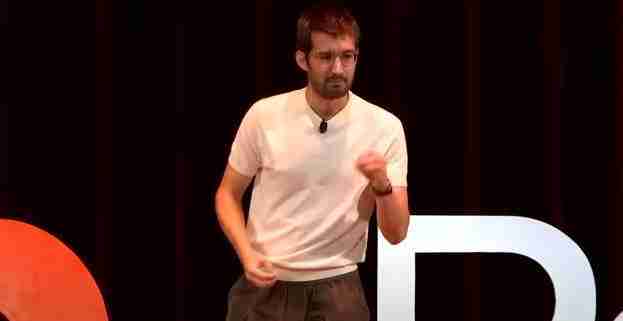
Read the full transcript of linguist Adam Aleksic’s talk titled “How Social Media Is Changing How You Talk” at TEDxPenn 2025 conference.
Listen to the audio version here:
TRANSCRIPT:
Familiarity with the Word “Unalive”
ADAM ALEKSIC: How many of you are familiar with the word unalive as a synonym of kill? Show of hands. Okay, like 80% of you. Great.
For our follow-up question, how many of you have heard the word unalive being used in person? Okay, I’m getting like 40, 50%. Great. Those of you that said no clearly aren’t middle school teachers.
If you spend enough time around 7th and 8th graders, you will hear them using the word. It’ll mostly be in informal situations, but could show up in contexts like a student’s essay on Hamlet’s contemplation of unaliving himself, or a classroom discussion on the unaliving that happens in Dr. Jekyll and Mr. Hyde.
And these aren’t hypothetical situations. These are actual examples drawn from the thousand plus middle school teachers I’ve surveyed about this word. It’s a weird hobby of mine, I don’t know. Clearly for such a recent word, unalive shows up in an impressive range of scenarios.
The Euphemistic Function of “Unalive”
But the main function appears to be euphemistic. Many kids use the word when they’re uncomfortable talking about topics like death, since unalive sounds like a less scary word. And in many ways, this is nothing new. We’ve been euphemizing death as long as we’ve had language.
The word deceased, for example, comes from Latin decesus, which was a euphemism for the previous Latin word for death, mors. Apparently even the Stoic Romans were as queasy about death as today’s middle schoolers. But there is a crucial difference between unalive and deceased. And that’s that we only got the word unalive because you can’t say kill on TikTok.
They have a mysterious algorithm that removes or suppresses any post that might violate their community guidelines. So people got around with that with the word unalive. The middle schoolers don’t know this. They see the word online or hear it from friends and assume it’s a word like any other.
And fair enough, you probably didn’t know where the word deceased came from, unless you’re some kind of etymology nerd. But deceased didn’t happen because it was impossible to carve the word mors into an ancient Roman tablet. We are entering an entirely new era of language change driven by social media algorithms. As a linguist and content creator, I’ve been in a unique position to see this happen from the inside.
It’s almost paralyzing. I constantly feel how my own language is being affected. And judging from the 40% of you who answered both of my questions, it’s beginning to change your language too. And it’s not just new words to avoid algorithmic censorship.
The Influence of Social Media on Language
The very structure of social media is changing where words come from, how words get popular, and how quickly those words spread. I believe some of you might be familiar with this song. “Freaking out, you’re gyaat for the Rizzler. You’re so skibbity. You’re so phantom tax. I just want to be your sigma. Freaking come here, give me your Ohio.”
For those of you out of the loop, these are the lyrics to the Rizzler song, a meme created by a 13-year-old that went massively viral last year. It’s full of current middle school slang words like Riz, gyaat, and skibbity, and was instrumental in popularizing those words to a broader audience. This is because social media algorithms reward repetition. If a song is funny or catchy and people interact with it, the algorithm will then push that song to more people, since it’s proven to drive engagement on the app. The same is true of memes or words in general, since trending metadata like hashtags will also be pushed to people who previously showed interest in similar content.
Creators are very aware of this, and we actively use trending audios or hashtags to make our videos perform better. In the wake of the Rizzler song, for example, we saw an explosion of people making videos with the words Riz, gyaat, and skibbity, because they knew those videos would do well. And as a result, the word spread.
Language has always been a little bit like a virus. Words are transmitted from one host to another, reproducing and changing as they infect different people along social networks. But now the literally viral nature of social media is accelerating this process from start to finish. In the span of just a year, a word like Riz can go from complete obscurity to becoming the Oxford English Dictionary Word of the Year. The algorithm is the culprit, but influencers are the accomplices.
We use whatever tricks we can to keep you entertained, because that makes our videos do better, which helps us earn a living. This means that we often end up creating and spreading words that help the system. For example, the suffix core has recently gotten very popular in Gen Z slang to describe specific aesthetics, like cottage core, or goblin core, or angel core. And on the surface level, these are cute.
The Commercialization of Identity
You watch a cottage core video, you like it, later on you get more cottage core content. You might even start to identify with the cottage core aesthetic. But here’s the thing. It’s all fake.
The entire reason these aesthetics exist is because TikTok algorithm has decided that words like cottage core qualify as trending metadata. So creators respond by making more cottage core content that propagates the word, and then more people interact with it, which makes the word trendier. And this happens because social media algorithms want to make you identify with hyper-compartmentalized labels, since they can then give you extremely specific, commercialized content catering to that identity. Now that you’re a cottage core person, you feel special every time you get a cottage core video.
You’re like, “cottage core?
The algorithm really knows me.” The algorithm gave you that identity. You might even start buying cottage core clothing, or cottage core decorations to fit your new lifestyle as a cottage core person, and that’s exactly what they want.
The craziest part is, they’re not even trying to hide this. TikTok’s business platform openly claims that subcultures are the new demographics, and then gives businesses ideas for how to profit off the cottage core aesthetic. Essentially, they’re driving the mass production of identity-building labels in order to profit off all of us. And while there’s nothing wrong with being on cottage core TikTok, it is a kind of echo chamber that affirms your cottage core personality.
The Spread of Harmful Language
The same is true of any niche community created on social media, and on one hand, this is great for linguistics, because language change is always driven by groups with shared interests that have a shared need to invent new words. Unalive, for example, became a thing because mental health communities on TikTok needed a way to share their stories and spread resources. On the other hand, some of the linguistic communities created by the algorithm can be actively harmful. Many younger people have started using the suffix “-pilled” to mean convinced into a lifestyle.
If I recently discovered that I really like eating burritos, for example, I can say, “I’m so burrito-pilled.” But that word was formed through an analogy with blackpilled, a term meaning convinced into incel ideology. Now incels are a dangerous, misogynistic group. They’ve perpetrated multiple terrorist attacks that have killed dozens of people, and yet somehow the vocabulary is filtering into Gen Z slang because the algorithm gave these hate groups a space.
I like to consume videos about urban design. And a few months back, I got a video about how great it is to be a “parking lot-pilled pavement princess.” Admittedly, I found the video pretty funny, and I liked it, which ended up giving me more urban design incel-themed meme videos, like one about being “fossil-fuel-pilled and bad to the bone,” and another about being a “walk-pilled cardiomaxxer.” And a lot of people similarly encounter these words as they spread in ironic or meme contexts.
Let’s take another look at the Rizzler song. The lyric, “I just want to be your sigma,” refers to the concept of a sigma male, which incels use to describe their desired position outside of the social hierarchy. And again, on the surface level, it’s a funny meme. It’s innocent.
Many people don’t even know where it came from. But for the few people who might be interested in the underlying idea, it’s now more accessible to them because of the way that slang spreads on the internet. It starts in some corner of social media, becomes a viral meme, and along the way, the etymology is lost to a lot of people. And this doesn’t only allow communities to harm us.
Appropriation of Marginalized Language
It allows us to harm communities. Two of the main demographics that come up with modern slang are the gay and black communities, since marginalized groups consistently use language as a way to reclaim power. All of our most popular internet slang words, slay, serve, bustin, queen, cooked, ate, yacht, many, many others, all come from queer or black culture. These words originated as a form of creative expression independent from the straight white norms of the English language.
But when those words began to be used online, they were quickly taken by people who wanted to capitalize on the perceived coolness or comedic value of black and queer culture. When a word like yacht goes from an African American English pronunciation of “goddamn” to being used as a noun for “butt” in memes like the Rizzler song, it’s ultimately exaggerated in a way that makes a farce of its pronunciation and meaning. Its original importance is diluted as it becomes widespread, and you can be sure that none of the middle schoolers saying yacht are aware of its etymology. Unfortunately, just like the euphemization of unalive isn’t new, the appropriation of African American English also isn’t new.
We’ve been whitewashing black slang since the days of cool and high five, which at this point have become so mainstream they’re just seen as regular words. But once again, social media algorithms are a vehicle enabling and accelerating this process from start to finish. They create communities that feel like they have a space to use their words and then open up those communities just enough to allow those words to spread. That’s how we got unalive. That’s how we got cottagecore. That’s how we got sigma. And that’s how we got yacht.
Whenever I post a video talking about one of these topics, I inevitably get the exact same comment: “We’re so cooked,” meaning we’re so screwed. Ironically, this is also TikTok slang coming from African American English, but I wanted to address it. Are we, in fact, cooked? I know I’ve just painted a very bleak picture of the future of the English language and there are a lot of concerning trends to unpack.
But these trends all do follow the same historical patterns that we’ve seen time and time again. I don’t think we’re sliding into a dystopian 1984 scenario because we’re always coming up with new ways around media censorship. If a word gets banned, we’ll just come up with another word, like we did with unalive. I don’t think middle schoolers are suffering from brain rot because younger generations always latch on to new slang as a way to build identity and the older generations always say, “ah, you’re ruining the language.”
But just like the people who were saying cool and high five back in the day, the middle schoolers saying riz, yacht, and skibbity toilet aren’t going to be incapable of writing an essay. I don’t think our vocabulary is being corrupted by the commercialization of our language. We’ve already been using brand names like Kleenex and Google in everyday conversations, so cottagecore isn’t about to turn us into mindless consumer drones. I don’t even think we’re dangerously normalizing incel rhetoric.
If anything, our slang is built on a shared mockery of incel ideas. When a kid says something like, “I’m so burrito-pilled,” they’re not saying that because they’re black-pilled, but because the underlying idea is making fun of how incels talk. In fact, I think each of these words is a beautiful, colorful addition to the English language that reflects the diverse cultural moment we’re all in. But I do think we should be aware.
We should be aware when the way we’re talking may have been conditioned by the algorithm. We should be aware when the words we’re using may have been engineered to sell us things. We should be aware when our language regurgitates extremist rhetoric, and we should be aware when that language can be used to harm other people. We should be aware of etymology in general because it helps us better understand who we are today.
We should be aware. And with that, I have just one final piece of slang for you. It’s a common phrase used by younger people when we finish a long-winded explanation of something. Thanks for coming to my TED Talk.