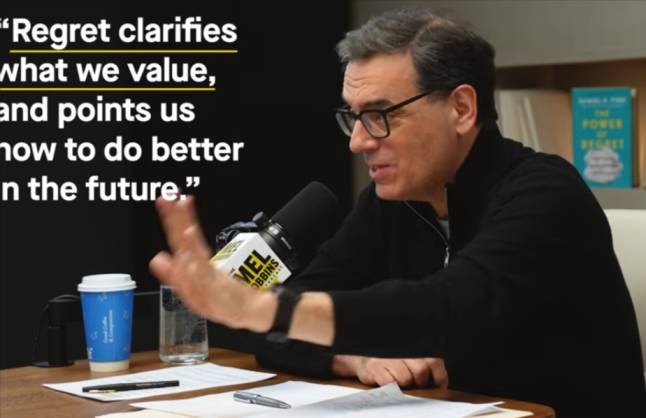
Read the full transcript of author Daniel Pink’s interview on The Mel Robbins Podcast, May 25, 2026.
Editor’s Note: We all carry moments we wish we could redo — the job we didn’t take, the call we never made, the relationship we let drift away. In this talk, Mel Robbins sits down with bestselling author Daniel Pink, who analyzed 26,000 regrets from 134 countries to reveal the four core types of regret and how they quietly point to what makes a good life. Their conversation turns regret from something you avoid into a practical roadmap for deeper relationships, stronger foundations, and bolder choices in the future.
Introduction: A Global Study on Regret
MEL ROBBINS: Today, you and I are talking about a global study about regret.
DANIEL PINK: What we discovered is that around the world, people seem to have the same 4 kinds of regrets. Foundation regrets: if only I’d done the work. Boldness regrets: if only I’d taken the chance. Moral regrets: if only I’d done the right thing. Connection regrets: if only I’d reached out. So these 4 regrets are telling us what makes a good life.
MEL ROBBINS: Daniel Pink is one of the most influential thinkers of our time. He’s a multiple New York Times bestselling author. His TED Talk has been viewed more than 12 million times. Daniel Pink led one of the largest studies ever conducted on the topic of regret, and what he discovered is extraordinary.
DANIEL PINK: No one’s taught us this. This is the thing. Somehow we’ve been taught the idea that you should be positive all the time and never be negative and always look forward and never look back. And that’s bad advice. And you don’t want to have the conversation where 10 years from now you have to tell the you of 2036, “Hey, I blew it.” What you should be doing is saying regret is part of the human experience. It’s a signal. It’s a knock at the door. Answer the door. See what it has to tell you. And in the systematic way, approach it, draw a lesson from it, and you’re going to be better off.
MEL ROBBINS: Why do we regret the things we didn’t do rather than the things we did?
DANIEL PINK: Everybody has regret. And you have a choice. You can ignore your regrets, or you can wallow in your regrets, or you can confront your regrets. And when we do that in a kind way toward ourselves, it makes us better. We get more out of life. We deepen our relationships. We find a greater sense of meaning, and we don’t waste our precious time on this planet.
Welcome: Dan Pink Joins the Mel Robbins Podcast
MEL ROBBINS: Dan Pink, welcome to the Mel Robbins Podcast.
DANIEL PINK: Thank you. Thank you. Thank you. It’s great to be with you.
MEL ROBBINS: It’s so great to see you. So I have here in my hands a huge stack of regrets.
DANIEL PINK: That is a huge stack.
MEL ROBBINS: We polled our global audience. I want to read some of these to you.
DANIEL PINK: Okay.
MEL ROBBINS: Here we go. I’m just turning to a page. “Not talking to my father before he passed. We weren’t on speaking terms for over 2 years.” “Quitting my career due to burnout instead of asking my family for help.”
DANIEL PINK: Okay.
MEL ROBBINS: “Not being more patient with my kids.”
DANIEL PINK: Okay.
MEL ROBBINS: “When they were younger. Why was I always rushing?” “Not standing up for myself or listening to myself, allowing others to influence my choices.” “Not prioritizing my children, choosing a relationship over my kids.”
DANIEL PINK: Yeeps.
MEL ROBBINS: “Not believing in myself when I was younger, not going to medical school.” “I regret not realizing my worth and allowing disrespect because of it.” “Wishing I did better in high school, dating the wrong men. I always sort of knew it.” “I didn’t have therapy sooner.” “The career I loved, I wanted to pursue, I didn’t.” It just goes on and on and on.
And where I want to start is, if I take everything to heart that you are about to share with us — that you have researched regarding regret, what it can teach us — how might my life change?
What Regret Can Do For You
DANIEL PINK: Well, first of all, you’re going to know what to do with that kind of emotion. You’re going to take that emotion which feels bad. You’re going to be able to take that negative sentiment and turn it into something positive. And when you do that, you do some other things. You actually understand what you value in life, you actually find more meaning in life.
But wait, there’s more. For some of those, there’s actually some evidence out there in the research that says that you can become better at your job. You can become a better negotiator. You can become a better problem solver. You can become a better thinker. So the key here is to look those regrets in the eye, not to flinch from them, not to ignore them, not to wallow in them, but to look them in the eye. And that pile there, Mel.
MEL ROBBINS: Yes, it is heavy, Dan.
DANIEL PINK: But you know what? It’s heavy, but it’s also positive. Let me tell you why. Because what we think is — we think that — and this is how I got into this topic — we think that nobody wants to talk about regrets. That’s proof that that’s wrong. People do want to talk about regrets.
MEL ROBBINS: Everybody, I think, wants to talk about regrets. We quietly carry them with us. And I just want to hover on something that you just said, that we can’t avoid it, we can’t run from it, we need to face it, and that there is something that regret is trying to teach us about how we should be living our life.
And I love that, but when I read something like, “Marrying my first husband after he cheated on me, I really regret that,” or “Not talking to my mother and then she died,” just all this wishing I should have — can you really flip this weight and turn it into something that makes your life better?
DANIEL PINK: Yes, you can.
MEL ROBBINS: Regret.
DANIEL PINK: Yes. It is ubiquitous in the human experience. People talk about, say, “I don’t have any regrets. Everything happens for reasons.” That’s utter BS. The only people who don’t have regrets are little kids because their brains haven’t developed the cognitive capacity to do it. People with certain kinds of neurodegenerative disorders. And sociopaths. Otherwise, everybody has regrets.
So the question is why? Why would something that makes us feel so bad be so widespread? And the answer is because it’s useful if we treat it right. And here’s the problem — here’s the heart of it. No one ever taught us how to do that. So what happens is that we basically plug our ears and say, “Blah, blah, blah, blah, blah, no regrets.” Or we get buried by it. What we want to do is just chill out, look at it, think about it, stare it in the eye. And when we do that, it’s transformative.
Facing Your Own Regrets
MEL ROBBINS: I believe you. And when you read these, you feel the weight. “Letting my best friend and I drift apart, not taking chances, playing secure.” “Not staying longer and holding my dying grandma’s hand.” “Securing financial freedom for my future.” “Wishing I got a lump in my breast checked out sooner instead of feeling like I was just overthinking it.” “Staying in a relationship longer than I wanted, not having more kids, and my husband rubs my face in it.”
And I want you, as you’re listening to Dan or you’re watching right now, to think about some regret that you have. We’re going to get into these frameworks and this research. And I want you to be selfish right now. I want you to really hold on to that regret that you’ve not wanted to talk about, you try to push off in the past, and I want you to use this conversation to set yourself free.
Dan, what made you want to lean into and do the biggest research project ever done on regrets?
Why Daniel Pink Wrote This Book
DANIEL PINK: Because I had regrets.
MEL ROBBINS: Really?
DANIEL PINK: Yeah. And I had a moment. I’ve lived 6 decades without epiphanies, except for one case, one time where it sort of — I felt like the universe was opening up to me. And that was a few years ago at my elder daughter’s college graduation.
MEL ROBBINS: Okay.
DANIEL PINK: So it’s a long day. She’s graduating from college, and I’m sort of having an out-of-body experience. I’m watching her in the cap and gown, and I started thinking about my own college experience, which was actually quite positive, but I had some regrets. I wish I were kinder to people, big time. I wish I had taken more risks. I actually wish I had worked a little harder. And so it sort of stuck with me.
Came back to Washington where I live, and I knew that nobody wanted to talk about regret. And I was like, very sheepishly said, “You know what? I just went to Sophia’s graduation and I was thinking about my own college. And I kind of regret this. I kind of regret that.” And I realized that everybody wanted to talk about it, that once I sort of let loose, they let loose. And you ended up having these very rich, generative conversations — that people were bottling these things up.
To make a long story longer, I actually was working on an entirely different book at the time. And so I took this other book, put it aside, spent a month just doing the basic research on regret, spent another month writing an entirely new book proposal, which I sent to my very surprised editor who thought I was working on this one book and said, “Hey, I think I want to write this book.”
Now, there’s also a personal side of this. Not only was the impulse me, but also, there’s a stage of life thing going on here. I am 61 years old. I am in the — to use a golf term — the back nine of life. I got more of my life behind me than ahead. So there’s more to look back and regret, but also there’s a sense of urgency going forward. And so this is not a book I would have written when I was 31. But at this stage in my life, there’s something about it that felt kind of inevitable because I’m at the perfect point — because I got a lot of room to look back, but knock wood, room to look forward and do better.
The Gift Inside the Suitcase
MEL ROBBINS: I love this. First of all, he’s the perfect guy to talk about this because even in the example that you just sort of dropped in there about sitting at a graduation and automatically time shrinks — yes, you start to look at time through a different lens. I’m sure as you were listening, you were thinking back to moments in your past where you wish you wouldn’t have wasted time, or you wish you would have been kinder, or — I felt I said the same thing about college. I drank too much. I didn’t take advantage of the opportunity. I didn’t seek help for the mental health issues because I didn’t know what they were. Just the way I treated people, on and on and on and on.
I also loved — and I want to make sure you caught it — whether you’re in your 20s or your 60s or 70s or 40s, we’re going to benefit from what Dan’s talking about, which is there’s something funny about what happens when you get older. The aperture of what you’re looking ahead at suddenly comes into focus, and all of the crap that you put up with, the things you wasted time on, also come into focus. And you say, “Well, if I only have 10 years or 20, or heck, even another 50, I want to do it differently.”
And so if I’m hearing you correctly, the first thing to really embrace is that as much as regret may be crushing you or you’re dragging it around like a 20-year-old suitcase, that it has something to teach you that can put more life into the years ahead.
DANIEL PINK: Absolutely. Open the suitcase because there’s a gift inside. You’re freaked out by that suitcase that you’ve been — but open it up. It’s less menacing than you think. And that’s true at any stage of our lives.
What Exactly Is Regret?
MEL ROBBINS: So let’s start with what the heck is regret? And what’s the difference between something you regret versus something that you kind of feel sad about and kind of wish didn’t happen? Or are those the same things?
What Is Regret, and Why Does It Feel So Bad?
DANIEL PINK: They’re not the same thing. Regret is a terrible feeling. This is really important. It’s an emotion. It’s a feeling we have when we look backward and wish we had done something differently, wish we hadn’t done something, wish we had done something in a different way. We look backward and we think about a decision or an action, and it makes us feel bad. That’s what regret is.
Now, it is very different from other kinds of emotions. You can have an emotion like disappointment if you wish something didn’t happen. I was on a trip last week and they were on the East Coast. There was a massive snowstorm and I basically had to leave early. I can’t regret that. I didn’t make it snow. But I can be disappointed.
Regret has to have agency. It’s something that you did. You can’t regret something someone else did. It’s all about agency. That’s why it feels so bad, because we know deep down it’s your fault. It’s on you.
But that bad feeling is a signal. It’s data. It’s information. It’s a knock at the door. Clunk, clunk, clunk, clunk, clunk, clunk, clunk, clunk. What do we do when there’s a knock on the door? You can say, “I don’t hear anything.” Or you can dive under the couch. Or you can say, “Huh, I wonder who’s there. Oh, it’s a regret. What do you got to tell me?” That’s how we have to start thinking about it.
The other thing that comes out in these regrets, though, Mel, which is interesting, is people sort of between the lines, you almost hear them saying or feeling that there’s something wrong with them because they have that. And that’s a huge mistake because everybody has regrets. Everybody has regrets. It doesn’t make you bad. It doesn’t make you weak. It doesn’t make you broken. It makes you human.
The 26,000 Regrets Study: What the Research Revealed
MEL ROBBINS: I want to just talk first about this research that you did, because you’ve done the biggest research study on regrets. 26,000 regrets, 134 countries. What shocked you the most when you dug into the research?
DANIEL PINK: We started something called the World Regret Survey, where we invited people around the world to submit their big regret. We have a very, very large database of regret. And I think the most surprising thing about it is how much they sound exactly like the regrets that you got and exactly like the regrets that other people got.
If I were to block out all the fields except for the regret and say to you, Mel, where’s this from? One of these regrets is from Milwaukee. Another one is from Copenhagen, and this one is from Taipei. Which is which? You wouldn’t know. If I say, “I had a chance to take a really challenging, demanding job, but I didn’t believe in myself, and I regret not taking the shot,” and I say to you, is this person a man or a woman? You don’t know. It’s the universality of it that surprised me the most.
MEL ROBBINS: And what were some other things that popped up to you, other than the fact that we all live with and feel burdened by regret, and none of us have been taught how to flip regret as a very universal experience, being human, into something that can change our lives for the better.
DANIEL PINK: I’ll give you one small example of this, which is that similar to your pile right there, as I mentioned, I wanted to give people anonymity because I felt like they were going to be more forthright about it all. But I also said, if you’re interested in doing a follow-up interview, “Leave your email address.” I figured we’d get maybe 5% of people. We had nearly a third of people leave their email address and say, “Yeah.” It’s like, not only do I want to tell you as a complete stranger my big regret, but here is my email address so you can talk to me some more about it.
MEL ROBBINS: Why did that surprise you so much?
DANIEL PINK: Because there is this kind of yearning to unburden yourself, to make sense of it, to talk about it — I like your metaphor — to open up that suitcase.
MEL ROBBINS: Yeah.
DANIEL PINK: And actually see what’s in it. And when people do open that up, the act of opening it makes it less menacing.
What Is Regret Actually For?
MEL ROBBINS: Given that you are the director of the world’s largest study and database on regret, is regret for teaching? What is it for exactly?
DANIEL PINK: It is for understanding what we care about and telling us how to do better in the future. This is not only research that I’ve done. Social psychologists and neuroscientists and other cognitive scientists have been studying regret for 60 years. And they found, again, regret is one of the most ubiquitous emotions that human beings have.
But we also have data showing that when you actually systematically interrogate your regrets, think about your regrets, try to learn from your regrets, it makes you better at stuff. We have all kinds of evidence from negotiation. You go into a negotiation session, people come out, the researchers say, “Tell me what you regret doing or not doing in that negotiation.” They invite the bad emotion. Then they go to a next negotiation, they do better.
Regret is actually a tool. And it goes back to the idea that negative emotions have a purpose. They’re there for a reason. And if we try to extinguish them, forget about them, we’re making a colossal mistake.
MEL ROBBINS: And we—
DANIEL PINK: And I don’t think we would do it with other negative emotions.
MEL ROBBINS: Because I don’t like feeling sad. I don’t like feeling frustrated or pissed off or disappointed. I definitely do not like feeling regret at all.
DANIEL PINK: Nobody does.
MEL ROBBINS: I don’t like—
DANIEL PINK: You’re not supposed to like it. You’re supposed to learn from it.
MEL ROBBINS: What the hell are— okay, so what is the point of a negative emotion? Let’s just go there.
The Purpose of Negative Emotions
DANIEL PINK: Okay, here we go. We’re going to do a little experiment here.
MEL ROBBINS: That’s okay.
DANIEL PINK: You don’t like your negative emotions? Okay. You don’t like feeling sad?
MEL ROBBINS: No.
DANIEL PINK: Do you like feeling grief?
MEL ROBBINS: Well, no, but I—
DANIEL PINK: Okay, talk to me. Do you like being—
MEL ROBBINS: Well, I don’t like feeling grief, but if I don’t feel grief, then I’m not like— that’s part of loving somebody that’s gone, I guess.
DANIEL PINK: Oh, there you go. How about that? I could say we could bring in some neuroscientist down the road at MIT and say, “We’re going to give you a magic pill and it’s going to extinguish your ability to feel grief.” Would you want that?
MEL ROBBINS: I don’t think so. I don’t think you would have thought about that.
DANIEL PINK: I don’t think you would. Because grief feels terrible. Grief is a terrible emotion. It makes you feel bad. But it’s there because it reminds us that we love and why we love.
Let’s take fear, another negative emotion. I don’t like being scared. But I don’t want that MIT magic pill that says, “Take this pill, you’ll never feel fear the rest of your life.” You know what’s going to happen? I’m going to be in a burning building and everyone else is going to get out because I’m not scared. These negative emotions are there for a reason. They’re adaptive. They helped us evolve.
Now, you don’t want a lot of negative emotions.
MEL ROBBINS: No.
DANIEL PINK: But you want some. You want lots and lots of positive emotions. You want to feel love and awe and excitement and growth. And you want to have a lot of those. And you actually want a decent amount of regret because regret helps you learn.
A Personal Story: Regret, Money, and Shame
MEL ROBBINS: Well, I’ll give you one that can prove this. I was ridiculously irresponsible with money.
DANIEL PINK: Uh-huh.
MEL ROBBINS: You and I went to college when you would check in to registration and there were tables with credit card companies just passing them out. And I just spent money. And then I developed a habit where I just spent money that I didn’t have. And I entered my marriage with like $20,000 in secret credit card debt that I couldn’t pay off. And it became this thing that I deeply regret.
DANIEL PINK: Yeah.
MEL ROBBINS: And when I listen to you now, I’m realizing I hid in shame and embarrassment for probably 20 years through my 20s and 30s and continued to make stupid decisions. Which ultimately led me to being in a situation where my husband and I were $800,000 in debt in our early 40s with liens on the house. That was so painful that it fundamentally altered the way I approach money because I didn’t want to feel that bad anymore.
DANIEL PINK: There you go.
MEL ROBBINS: But I dragged it around for probably 2 to 3 decades, Dan, before I unpacked that and said, okay, it’s gotten painful enough. I can let it get worse before it gets better.
DANIEL PINK: We can analogize to going to the doctor. Do you say, “Oh, I’ve had a really bad headache for 3 weeks,” or do you wait till 2 years from now when you’re doubled over and can’t breathe? No, you address it then, because like a headache, a headache is a signal — hey, something’s off.
We have a lot of regrets in the database that are very much like that. And I think that part of it in your case and in the case of these other folks is that when we don’t talk about our regrets, when we don’t share them, when we don’t actively try to make sense of them, we feel like we’re the only one. And we’re not. That’s the thing. Remember, it’s universal.
You Are Not a Horrible Person: What the Data Says
MEL ROBBINS: Can you talk to the person listening who just heard you say, “We feel like we’re the only one,” and they’re saying to themselves, “But the thing that I did is really bad, Dan. I am a horrible person.” What does your data say and what do you want to say to them?
DANIEL PINK: Okay, so what I want to say to them is practice self-compassion. There’s a powerful strand of research on the need to be compassionate to ourselves. This is not some kind of gooey woo-woo kind of thing. Essentially, here’s what I would tell you. Treat yourself with kindness rather than contempt. The way we talk to ourselves internally — “You idiot” — swearing at ourselves internally is lacerating and mean-spirited. Don’t do that. There’s no evidence that—
MEL ROBBINS: Easier said than done.
DANIEL PINK: What would you say to a friend in that situation? Would you say, “You freaking idiot, you’re a moron, you don’t know what you’re doing, you’re a terrible person?” You wouldn’t say that. It’s preposterous. You wouldn’t say that to a friend. So treat yourself with kindness rather than contempt. Treat yourself the way you would treat a friend.
Second thing is, what often happens is that when we make a mistake, when we screw up, when we do something that feels shameful, we think that it constitutes the full measure of our life. And it’s not. It’s a moment in your life. It’s not the full measure of your life. If you think about this timeline, it’s like, okay, during this period you messed up, but the rest of the stuff, you’re a decent person.
MEL ROBBINS: It’s like a scene in the movie.
DANIEL PINK: Yeah, it’s a scene. It’s a scene in a decade-long movie, and it doesn’t fully define you unless you keep replaying the scene.
MEL ROBBINS: Is that the biggest mistake?
DANIEL PINK: Unless you keep rewinding and watching that scene over and over and over again.
The Two Mistakes We Make With Regret
MEL ROBBINS: Well, Dan, I’m just going to keep on dragging around the suitcase. I cheated, I squandered my finances, I was a jerk to people, I was unkind. If I had just shown up earlier, I regret not showing up earlier or picking up the phone because then the person died. I’ve been dragging this, or I just keep replaying the scene. Is that the biggest mistake that we’re making, is wallowing in it and replaying it?
DANIEL PINK: Absolutely. We make two different kinds of mistakes. We ignore it or we wallow in it, and both are really bad. What we should be doing is, oh wow, this feels crappy. What is this regret telling me? And if we treat ourselves— the other thing that I would say with a little bit of tough love on this—
MEL ROBBINS: Yes, hit me, let’s go.
DANIEL PINK: You got to— any of these regrets, I mean, I’ll be a compassionate person, but you don’t have to be— you’re not that special. You tell me about— give me one of these regrets. It’s like, oh wow, you’re the really only person in the world who squandered their money. Oh wow, you’re the only person in the world who cheated on their— it’s like, you’re not that special. It’s part of the human experience. You’re a human being.
It’s not like— narcissists believe they’re singularly excellent, but some of these people are almost reverse narcissists, feeling like they’re singularly bad. You’re not that special. You’re a human being who’s living an experience, and at a moment you have a scene where things went off the rails. All right, that feels terrible. I get it. Treat yourself with kindness rather than contempt. Treat yourself like you would a friend and recognize it’s a moment in your life rather than the full measure of your life. And when we do that, we can begin to make sense of regret. We can begin to draw lessons from it.
MEL ROBBINS: I love that because it certainly defines how you handled yourself in that moment. But if you really are willing to use the research that you’re about to unpack with us, you can allow it to teach you to become who you want to become in the future.
I’d love to hear more about this huge research study that you did on regret. Dan, what’s the most common type of regret that you found when you dug into the research?
The 4 Types of Regret
DANIEL PINK: Well, what we discovered is that around the world, people seem to have the same 4 kinds of regrets.
MEL ROBBINS: So these fall in buckets, right?
DANIEL PINK: So there are 4 categories all over the world. Foundation regrets: “if only I’d done the work.” Boldness regrets: “if only I’d taken the chance.” Moral regrets: “if only I’d done the right thing.” And connection regrets: “if only I’d reached out.”
The most common regret was a regret of connection. And so typically the story was this: you had a relationship, or should have had a relationship, that was intact, and it comes apart, usually in undramatic ways. There’s very little— there’s less drama than you would think.
Hey, I went to college with my friend Mel, and we were really tight, and then I haven’t seen her for 10 years. I should really give her a call, see how she’s doing. Oh no, it’s going to be so awkward, and she’s not going to care, so I don’t do it. And sometimes it’s too late.
There’s one woman I interviewed who had a friend who was deeply ill, and she hemmed and hawed about reaching out to her because she thought it was going to be awkward. And when she finally did call, the friend had died that morning.
MEL ROBBINS: That morning.
DANIEL PINK: That morning. There are other people who— one woman named Cheryl, who I interviewed, had this great friend from college who she drifted apart from for 20 years, 25 years, and she didn’t call her. She wanted to call her, but she didn’t call her.
MEL ROBBINS: And what happened next?
DANIEL PINK: So I got kind of frustrated with her because it was a classic example of a connection regret. But as I have these interviews, I’m getting to know this person better and I’m thinking to myself, Cheryl, you know what to do here. And so finally I get an email maybe 5 days later. She sent an email to her friend— her friend’s name was Jen. She sent an email to Jen and she was so happy to hear from her. And then they ended up having a phone conversation and then they ended up meeting up. And now, I swear, I get a photograph every 6 months of, “Hey, I just saw Jen, here’s a photo of us together.”
And so that’s what happens. This woman was living with this regret for 20 years, and all she had to do was reach out. And once she did, things were better.
When in Doubt, Reach Out
MEL ROBBINS: So I’ve got a story like this. When you and I were in elementary school and high school, we’re talking ’70s and early ’80s— no social media, no cell phones, absolutely not. I went east for college. I grew up in the Midwest. My best friend, Jodi Brickin, stayed in the Midwest, and our two paths separated.
DANIEL PINK: Okay.
MEL ROBBINS: And I stayed out east. She moved to Chicago. She then moved out west. We spent the next 20-some years not talking for no reason.
DANIEL PINK: Right.
MEL ROBBINS: For no reason. We just had no cell phones. I didn’t even think to follow her because once I got social media, we hadn’t talked in like 10 years, just because we didn’t see each other again because I moved far away. She moved far, far away. And then we ended up bumping into each other one summer, I think in my mid-40s. And I immediately was flooded with how much I missed her.
And we started making these dates, Dan, that whenever we would both travel for work, we would try to line up our calendars, and then we’d stay in a hotel room together. She’d be at her business conference, I’d be at mine. It’s one of the greatest joys of my life. Just took a second, Dan.
DANIEL PINK: It takes a second to reconnect. And what I have found in interviewing people like this is that the relationship restarts almost instantly.
MEL ROBBINS: Oh my God. We text every week. I talk to her on the phone. We see each other many times a year, even though we live in completely different parts of the country. I’m in Vermont, she’s in Arizona. But it has brought so much joy to my life.
DANIEL PINK: And that’s how a lot of these relationships come apart. We think that relationships come apart because there’s some kind of explosion. And in this case, and in many cases, it’s just a drift. That was the case with Cheryl and Jen. That was the case with you and Jodi. It just drifts. And all you have to do is reach out.
MEL ROBBINS: I cannot tell you how much joy it will bring you if there’s somebody on your mind that you’re thinking about. As I tell you the story of Jodi, call them, text them, send them this episode and say, “You just listened to this episode with Mel and Dan, and you were the first person that popped into my mind, and I just had to reach out to you. I miss you. I was just thinking about you.”
DANIEL PINK: It’s a life lesson. When in doubt, reach out.
MEL ROBBINS: When in doubt, reach out.
Why We Hesitate to Reconnect
MEL ROBBINS: Why are we so hesitant? Why do we wait so long to reconnect, Dan?
DANIEL PINK: Okay, because— here we go. I’m going to just drop another nugget of tough love here, because we think we’re more special than we really are. We think it’s going to be awkward and we think the other side’s not going to care. That’s the most important thing. But if you give me the reverse— suppose that my old friend Mel called me after 15 years. Would you say that’s really weird? I can’t believe she did that.
MEL ROBBINS: I would say thrilled.
DANIEL PINK: Exactly. So why wouldn’t the other person be thrilled? We think somehow we’re entirely different from everybody else. Of course we’d be thrilled if somebody reached out, but no one else would. Because we’re so special.
And so there is a great degree, particularly on connection regrets— and this is actually a big lesson for me personally— about feelings of awkwardness as a barrier to doing things. Awkwardness is the most papery of paper tigers. I mean it. I’m dead serious.
MEL ROBBINS: I love “the most papery of paper tigers.”
DANIEL PINK: It’s a paper tiger. It’s not a real tiger. It’s a paper tiger, but it’s really paper. You go right through it. It’s like in those cartoons where somebody comes and sees this giant shadow and the person looks huge, and then you realize there’s this little bitty thing right there. Yeah, that’s what that is.
MEL ROBBINS: So there’s awkwardness in thinking about the reconnection, and we overestimate—
DANIEL PINK: What am I going to say? It’s going to— I haven’t talked to them. I don’t know what they’re like. We over-index on the words we use and don’t realize that simply the warmth and the overture is what matters.
There’s research on this. Vanessa Bonds at Cornell has done a lot of this research on compliments. It’s the same thing with compliments. We don’t give enough compliments. And the reason we don’t give compliments is we say, oh, it’s going to be really awkward if I give a compliment because I’m not going to say it right, and the other side’s not going to care— when in fact it’s not awkward and they do care. So push past that. Awkwardness is not an excuse. Cringe is not an excuse. Call it whatever you want. It is not an excuse. So I think that’s the reason why.
The Regret of Not Saying “I Love You”
MEL ROBBINS: Well, I love this topic, and let me tell you why. As you were just talking, and I’m sure as you’re listening or watching, you’re probably thinking about people that you really miss or you haven’t thought of, and you’re thinking, well, maybe I should reach out.
I have a friend that I regret having a falling out with right after college. It was due to my mental health issues and gossip that I engaged in. And I really regret it. And it’s the awkwardness and the cringe and also this fear of rejection that keeps me from reaching out. And what I’m getting in the middle of this conversation is I need to, because I know I value connection, I know I value acceptance, I know I value these things. And I too am guilty. We’re talking 30-plus years of missing that connection, or at least just not ever checking back in.
Can we unpack this regret of not saying “I love you”?
DANIEL PINK: Yeah.
MEL ROBBINS: It’s very striking to me. How many people have either never heard one of their parents tell them they love them?
DANIEL PINK: Yeah.
MEL ROBBINS: Or you hear it on the deathbed.
DANIEL PINK: Yeah.
MEL ROBBINS: Or you’re waiting for somebody to say it to you.
DANIEL PINK: Yep.
MEL ROBBINS: Can you talk a little bit about this particular regret? Because I see it a lot. “I didn’t tell my mom or dad how they felt, or my brother or my sister, and then they died.”
Foundation Regrets: The Small Decisions That Add Up
DANIEL PINK: It is— the solution is very, very simple. Say it now. Period. Full stop. That’s all that it is. And if it feels a little awkward, fine. Push past that awkwardness. The feeling of awkwardness you’re experiencing now is nothing compared to the feeling of regret you might feel 5 years from now, 10 years from now. And just say it. And the thing is, this is also learned behavior, because once you do it, the next one becomes easier. Once you do that, it becomes easier and easier and easier and easier.
Listen, this is not natural. I’m like a straight white man in my early 60s. It’s not natural for me to text a buddy of mine and say, hey, I’m thinking of you. That is learned behavior. That is not natural behavior. But when you do that the second time, it’s not as awkward. And there’s not been a single time I’ve done something like that where someone said, ooh, that’s weird. Instead, it’s the exact opposite. Oh my God, so nice of you. Fantastic. Hey, that was so nice of you to text. Like, what’s going on with you?
MEL ROBBINS: One of the other buckets is foundation regrets. What are those?
DANIEL PINK: Your regret about debt is a foundation regret.
MEL ROBBINS: Meaning I was spending too much. I was very irresponsible with money, spent money that I didn’t have, racked up all— that’s a foundation regret.
DANIEL PINK: Yeah. I’ll tell you why. Because each individual act of spending was not itself cataclysmic. It’s small decisions that you make early in life that accumulate to terrible consequences later on. So I spent too much and saved too little, and now I’m broke. Hugely common regret. I didn’t exercise or eat right. Now I’m profoundly unhealthy. You smoke one cigarette, it’s fine. You do it for 20 years, it’s not so fine. And so these are regrets that accumulate and then have terrible consequences. And that’s how these things catch up on us.
I had a guy who talked about this, a lovely guy from Tennessee who had a tough background but did very well in his career, but never saved money because he ate out all the time and he felt good about taking people out to dinner, picking up the check all the time. And you go out to eat 5 times a week for 10 years, it’s going to add up, man. And so suddenly he’s like, oh my God, I’m 40 years old. I have no savings. And I’m living paycheck to paycheck even though I have a good job.
So it’s those kinds of things. That one time you go out to dinner and treat your friends, it’s all cool. It’s the accumulation of it all that really does it. And again, it erodes the foundation of our lives. And one of the things about regret is that regret is telling us what constitutes a good life. So these 4 regrets are telling us what makes a good life. And one of the things that makes a good life, but I think sometimes gets short shrift, is that a good life has some stability. A good life has a foundation to it. A good life is not precarious. We can talk about self-actualizing and feeling a sense of purpose and meaning, but if you can’t pay your rent, your life is less good.
MEL ROBBINS: So it sounds like foundational regrets, these things that sneak up on us, and then all of a sudden we’ve fallen off a cliff and our health is— we have no money. We’re addicted to alcohol or smoking. We’ve been a workaholic and never made time for friends and now have no idea where all our friends are. That these are kind of like the little daily habits that either lead you to building the foundation of a good life or that have you constantly putting it off for a rainy day.
DANIEL PINK: In that famous fable, you had the grasshopper who was spending all summer playing the fiddle and dancing around. Or you had the ant who was assiduously gathering food for the dark winter. And here’s the thing, you don’t want to live your entire life as an ant. You don’t want to always prepare for gloom or doom, but you want to be a little ant-like because your life is going to be better if you take responsibility, if you build that foundation.
Boldness Regrets: The Chances We Didn’t Take
MEL ROBBINS: Let’s talk about one of the other categories of regrets, which is boldness.
DANIEL PINK: Yes.
MEL ROBBINS: What does that mean?
DANIEL PINK: Okay. This is a really big category and it spreads throughout all of our lives. And I think it tells us something really, really important. Boldness regrets are this. You look back on your life and you have two choices. You play it safe, take the chance. Play it safe, take the chance. Hey, I can study abroad even though I’ve never been out of the country, or I can just go and do my thing for another semester. Hey, this person I’m really attracted to, I want to ask him or her out on a date, or I can just wimp out and not do it. I’m so deadened by this job. I can either stay in it and continue the deadening, or I can take a risk and start a business.
Overwhelmingly, when people don’t take the shot, they regret it. Overwhelmingly. And it doesn’t matter the domain of life. When we look back on our lives, what really bums us out is not taking the chance, not speaking up for something we care about, not standing up for ourselves, not starting that business. I got hundreds of regrets about dating. It’s like, oh my God, there was this guy or this gal and I really liked them, and this is 30 years ago and I really wish I’d asked them out on a date. Regrets of boldness. If only I’d taken the shot.
MEL ROBBINS: I’m so happy that you said it was overwhelmingly focused on things that you didn’t do, because I do believe there’s kind of two ways to go through life. You either are going to be saying, “Boy, I wish I had,” or “Boy, I’m so glad I did.” And as I went through even our own thousands and thousands, I didn’t really see a lot of regret saying, “I really regret quitting that job and starting the business even though it failed.” I really regret selling everything and figuring out how to travel full-time. I really regret moving. I didn’t see really anybody reporting that boldness, when it was a decision aligned with something that they yearned for, ended up being a regret.
DANIEL PINK: Amen on that one, man.
“I Wish I Had Done This Sooner”: The Double Regret
MEL ROBBINS: Can we talk about a common phrase that we saw, and I know it showed up profoundly in this massive research study that you did on regrets, which is, “I wish I had done this sooner.” So it’s almost like this two-pronged regret where you regretted something and then you have the double regret of wishing once you caught it that you caught it sooner.
DANIEL PINK: Yeah.
MEL ROBBINS: What keeps people in this waiting period? Because I do feel like there is, at least in the— “I wish I’d gotten out of the relationship sooner. I wish I would have quit this. I wish I would have gone back to nursing school sooner.” That it’s almost an admission to yourself that those years you spent talking yourself out of it, you knew the truth all the time.
DANIEL PINK: You might have. You might have. But sometimes the timing isn’t right. I’d give yourself a lot of grace on that.
MEL ROBBINS: How come?
DANIEL PINK: Because you did something. You took the action. There’s an old Chinese proverb, which is, the best time to plant a tree was 20 years ago. Second best time is now. And so that’s what you— I just have to think about it that way. So if you stop smoking, that’s fantastic. Yeah, maybe you should have stopped 5 years ago, but you didn’t. And so give yourself some grace because you did something really hard that is actually valuable for yourself and your family.
I really think you have to treat yourself with grace and not obsess over doing something sooner. A lot of us are kind of risk-averse. And Daniel Kahneman, the great Nobelist, he has research basically distilling to this: “Quitting at the right time always feels like quitting too early.” That’s just the way that it is. Quitting at the right time always feels like quitting too early.
MEL ROBBINS: I think it’s really helpful to hear that when it’s time to quit, you’re typically not going to feel ready.
DANIEL PINK: Exactly. Quitting at the right time always feels like quitting too early. So if you say, “Oh, this is too early for me to quit,” that might be a signal that it’s the right time.
MEL ROBBINS: It’s almost how we gain surety in the decision is by kind of knowing, okay, it’s time, but you build up a little bit more friction and then just say, now it’s time.
DANIEL PINK: Right, right.
Giving Yourself Grace: Judging Your Past Self Fairly
MEL ROBBINS: Here’s how I kind of think about it, if I’m trying to extend myself some grace. When we look back on decisions that we’ve made and then we regret not making them sooner, we forget that we’re looking back from our future self.
DANIEL PINK: Very good.
MEL ROBBINS: And we did not have the information that we have as we’re looking at the past. What I know about myself and what I’m capable of as a 57-year-old woman is very different than what I knew about myself and the resources and understanding that I had when I was in my 20s, 30s, 40s. And it’s not very fair to hold the 57-year-old version of me, who by the way is different because of the things I regret—
DANIEL PINK: Good point—
MEL ROBBINS: and hold that knowledge over myself 20 years ago.
DANIEL PINK: Right. And so when we scrutinize our past behavior, we have to think about that person, not this person today. What did that person know?
MEL ROBBINS: One thing that really strikes me is how many people talked about how they stayed in relationships too long or stayed in relationships with somebody that was disrespectful or abusive or treating them poorly. And when you are in a relationship where you’re being disrespected or worse, abuse—
DANIEL PINK: Oh my God. Yeah.
MEL ROBBINS: You don’t feel safe. You don’t have the perspective that you will be able to leave it, which explains why you hedge on the decision to do so at the time. And so I love that piece of this, Dan, to help relieve you of continuing to make yourself wrong for not being ready or able at the time that you now think you should have been.
DANIEL PINK: Absolutely right.
MEL ROBBINS: Because of what you know now.
DANIEL PINK: And remember, regret requires agency. And what does that mean? Agency means you have control over what you do.
MEL ROBBINS: Okay.
DANIEL PINK: I can’t regret that it’s raining outside. I can be disappointed if I want to go outside. I can’t regret that because I don’t have control over that. But if I go outside in the rain and don’t bring my umbrella, I can regret that. And there are people in relationships out there who actually don’t have agency. And so you can’t beat yourself up for not making decisions when you didn’t have the agency. It’d be like beating yourself up for raining outside.
So you have to scrutinize the person that you were at that time and treat that person again, not better than anybody else, but not worse than anybody else. This is the mistake that we make. We treat ourselves worse than we treat other people, and we shouldn’t do that.
The Regret of Caring Too Much About What Others Think
MEL ROBBINS: Let’s talk about the big regret of worrying too much about what other people think.
DANIEL PINK: Lord have mercy. We have so many of those.
MEL ROBBINS: Let’s talk about that.
DANIEL PINK: Yeah. There are a lot of people who have those kinds of regrets. And it is another case where our view of the world is distorted. When I was younger, I actually cared what other people thought in a way that was probably not particularly healthy. And then I actually discovered what people thought about me, and it was this: nobody was thinking about me. They were thinking about themselves. No one was thinking about me. And it’s what in social psychology is called the spotlight effect. We think that we’re constantly in the spotlight. Everybody’s watching us. And they’re not. So go do your thing. And the other thing— okay, here we go. I’ll give you something else. I’ll see you and raise you. If they do care, there’s a two-word answer.
The Four Core Regrets: What They Reveal About Human Nature
MEL ROBBINS: Let them. What you can’t control. It’s been very liberating to create that theory and use it and recognize how much time and energy I’ve wasted and how much power I gave away to worrying about what other people were thinking and how that held me back from doing things that I wish I had done sooner.
DANIEL PINK: Absolutely. And it’s true for most human beings who walk the planet. That is true of— and if we can get people past that, people are going to act more boldly. They’re going to speak up for things that they care about.
Why We Regret What We Didn’t Do More Than What We Did
MEL ROBBINS: Why do we regret the things we didn’t do rather than the things we did?
DANIEL PINK: Hugely important question. And this is a big, big deal. There’s a lot of existing research on this. In the architecture of regret, there are two kinds of regrets. There are regrets of action, regrets of inaction. I regret something I did. I regret something I didn’t do.
Now, what you see over and over again is that with action regrets, I regret something I did. “If only I had married Fred instead of Ed, I would be much happier.” So we say, “If only.” That’s what’s called in the literature an upward counterfactual. We think about how things could have been better.
MEL ROBBINS: And that’s the dating one.
DANIEL PINK: That’s the— well, yeah, that’s if only I had married Fred instead of Ed. But with action regrets, we can do what’s called a downward counterfactual. We imagine how things could have turned out worse. And there’s some really super cool research on this.
But here’s where it comes up in the database. Legions of people, all women, saying essentially, “I shouldn’t have married that idiot, but at least I have these two great kids.” Downward counterfactual.
There’s a famous piece of research. I love it. They showed photographs of the three medalists on the Olympic medal stand in a number of different situations, but they didn’t show what medal they got. And they asked people, based on their facial expressions, how happy are they?
Not surprisingly, the happiest looking people were the gold medalists. The second happiest people were the bronze medalists, not the silver medalists. Because the silver medalists were doing an upward counterfactual. “If only I had pedaled 0.4 of a second faster, I’d have the gold.” The bronze medalists were doing a downward counterfactual. “At least I have a bronze, not like this schmo who’s 0.4 of a second behind me, who doesn’t get a medal at all.”
And so for action regrets, we can at least them.
MEL ROBBINS: So I married the wrong person and I regret doing that, but at least I have these two great kids. Okay.
DANIEL PINK: So it makes us feel better. Doesn’t necessarily do better, but it makes us feel better. With inaction regrets, we can’t do that stuff.
MEL ROBBINS: That’s true. You can’t undo it.
DANIEL PINK: You didn’t do it. You can’t undo something you didn’t do. It’s metaphysically impossible. You can’t do it.
Using Future Regret to Make Better Decisions Today
MEL ROBBINS: Let’s say the person who’s listening or watching right now is sitting on a big decision. Maybe it’s about their career. Maybe it’s about the next big step in a relationship. Maybe it’s about a big move. And they’re stuck in that overthinking, not quite sure what to do in terms of taking this risk or making this decision. What does your research suggest?
DANIEL PINK: So if you’re thinking about that, you’re not sure what to do. You can imagine having a conversation with someone who you haven’t met yet, but who cares deeply about you. And that is the you of 10 years from now.
MEL ROBBINS: So 10 years from now.
DANIEL PINK: Imagine you’re having a conversation with the you of 2036. What does that person want you to do? It’s pretty freaking clear to me what that person is going to want you to do, because that’s what all the people in your list and all the people in my database want you to do. They want you to build a solid foundation for yourself and for your family. They want you to take that shot. They want you to do the right thing, and they want you to reach out.
And so have that conversation. You know what that person 10 years from now wants you to do. And you don’t want to have the conversation where 10 years from now you have to tell the you of 2036, “Hey, I wimped out.”
MEL ROBBINS: I blew it.
DANIEL PINK: I blew it. I chickened out. You don’t want to have that conversation.
The Fourth Bucket: Moral Regrets
MEL ROBBINS: I love that. Let’s move on to the final bucket of regrets that you found in your research. We have talked about connection, foundation, boldness. The fourth one is moral. What is moral regret?
DANIEL PINK: You’re at a juncture in your life. You have two choices. You can take the high road. You can take the low road. And when you take the low road, when you do the wrong thing, most of us, most of the time, regret it.
And in this category, it was the smallest category, but very, very, very deeply held. And this is sort of a weird thing about this topic of regret — the more you go into it, at least for me, the better I feel about human beings. Because what this suggests to us is that most of us are good. Most of us want to be good, and most of us feel shitty when we’re not good.
I think that like 95% or 98% of us are good people who want to do the right thing. And when we don’t do the right thing, we feel bad about that. So 98% of people want to do the right thing and feel bad. That’s good. Those 2% mess things up for everybody else. But that’s what— so moral regrets are, “If only I’d done the right thing.”
MEL ROBBINS: And so if the person who’s listening right now is feeling that weight, what’s the first step to take in order to free themself of this burden that they’ve been carrying around?
DANIEL PINK: So one thing, as I’ve mentioned before, is to treat yourself with kindness rather than contempt. Treat yourself with compassion. You are not the only person who has a moral regret. Every single human being has a moral regret. It doesn’t mean that you’re a shameful, terrible person. It means that you might have done a bad thing.
And so it’s also a kind of a moment in your life, a scene in your life, rather than the full measure of your life. So there are different things that you can do if you’ve hurt somebody. If you have cheated somebody, if you have harmed somebody in a way, go make amends.
MEL ROBBINS: How do you do that if the person isn’t here and you cannot forgive yourself? You play it over. You hold on to the regret about what happened.
DANIEL PINK: First of all, you can talk about your regret. And the other thing, especially as we get older, we can instruct other people who are younger how to live better than we did.
The Three-Stage Process for Dealing With Regret
MEL ROBBINS: So let’s talk about just how we deal with the regret we haven’t dealt with. Let’s go through the process based on this research. Now that we know that we’re dealing with whether it’s a connection or foundation or boldness or a moral regret, let’s look at your research and unpack for a stand. How do we actually face a regret that we haven’t dealt with?
DANIEL PINK: Okay. So I look at it as three stages.
MEL ROBBINS: Okay.
DANIEL PINK: Inward, outward, forward.
MEL ROBBINS: Inward, outward, forward.
DANIEL PINK: Right. So inward. Inward is basically how you treat yourself. And as I’ve mentioned, the way we talk to ourselves in the face of screw-ups is brutal and cruel. If you were to sort of implant in my head and broadcast my self-talk out there, if I would do that in a workplace, HR would be intervening immediately.
MEL ROBBINS: I’d drive you to the 7th floor over at Mass General Brigham right now.
DANIEL PINK: Exactly.
MEL ROBBINS: He’s nuts.
DANIEL PINK: Get him out of here. This is a madman, the way he’s talking to other people. So don’t do that, please.
And here’s the thing. It’s not only because it’s not nice, because we have piles of evidence showing that that kind of horrifying, lacerating self-criticism doesn’t improve your performance. What does improve your performance is self-compassion, which is treating yourself with kindness rather than contempt, treating yourself the way you would treat a friend.
And when we do that, okay, so that’s inward. Treat yourself with kindness rather than contempt. Recognize that regrets are part of the human experience — you’re not that special. And also, and this is super important, it’s a moment in your life. It’s not the full measure of your life.
And so when we do that, that opens the way to the second stage, which is outward. There is a very, very strong argument here for writing about and talking about our regrets.
MEL ROBBINS: Why does writing about or talking about your regrets help you?
DANIEL PINK: It does a few things. First, it’s an unburdening because we’re carrying something and you sort of say, “Oh, I got this heavy backpack on. Let me just put it on the table here.” You’re putting it on the table.
But more important than that, I think this is the really interesting thing. There’s a guy at the University of Texas, Jamie Pennebaker, who’s done a lot of research on this. If you write about a big regret you have for 15 minutes a day for 3 days, you feel better about it. It’s less—
MEL ROBBINS: Why do you think that works?
DANIEL PINK: Because what you’re doing is you’re taking something blobby, you’re taking this phantom that is stalking you, and you’re saying, “Okay, come here, sit down here, let’s see what you’re really made of.” And you’re converting this blobby thing into concrete words, and that helps you make sense of it. It makes it less menacing. We go from abstract to so much more concrete.
MEL ROBBINS: So we start with the inward, which is you got to shift your self-talk. And one of the ways to really leverage this research is to say, “I’m not the only person who’s done this.”
DANIEL PINK: No way.
MEL ROBBINS: And if I can really embrace that I did the best that I could at the time and I’m going to stop beating myself up, that the inward is how you talk to yourself. It’s like dropping the sword against yourself. Outward is get it out of your head.
DANIEL PINK: Exactly.
MEL ROBBINS: And get it on paper or go talk to somebody about it. And I love the exercise of just 3 days in a row for 15 minutes, write about it, and suddenly, based on the research, you’re going to have this shift. But what happens after you write about it?
DANIEL PINK: Okay, this is the key. So the third part is forward. You gotta actually think hard and draw a lesson from it and say, “What is this lesson telling me and what should I do next?”
There’s some interesting research about self-talk where we’re actually more clear-headed when we talk to ourselves in the third person.
MEL ROBBINS: It’s crazy.
DANIEL PINK: As crazy as it sounds. So instead of me saying, “What should I do?” — “What should Dan do?”
MEL ROBBINS: Oh, so use your own name.
DANIEL PINK: Yeah, use your own name.
MEL ROBBINS: “Mel, what should you do?”
DANIEL PINK: Right. And so—
MEL ROBBINS: “But idiot, you should reach out if you’re thinking about it.”
DANIEL PINK: But also on the lesson, it’s like, “Okay, what lesson is this teaching Mel? What lesson is this teaching Mel?” All right, explain it in a sentence. And in most cases, people know, because none of this is super complex. “Okay, what should Mel do next?”
So what is this in a sentence? What is this teaching Mel, José, Fred, Maria, whoever? Use your name in it. “What lesson is this teaching fill in the blank? Okay, what should fill in the blank do next?”
Okay, so let’s go back— give me any kind of regret.
MEL ROBBINS: I am just flipping through 100+ pages. “Marrying the man who left me and my kids in a terrible divorce.”
DANIEL PINK: Okay.
MEL ROBBINS: That’s one.
DANIEL PINK: Okay.
Turning Regret Into a Tool for Growth
MEL ROBBINS: I’ll give you a couple more. Living with so many limitations. Waiting for a better time to call my best friend. She passed away. Oh, I regret living away from my parents and siblings. Not trusting myself. Not taking my small children to see my parents more. Fell in love with a married man, thought he’d leave his wife. Regret not working harder in my 20s. I’m reading through all of these regrets.
DANIEL PINK: So let’s pick any one. Okay, so let’s take—
MEL ROBBINS: We all know they’re not unique and you’re not special.
DANIEL PINK: You’re not the only idiot. Let’s take the, I didn’t call my friend, then they passed away.
MEL ROBBINS: Yeah. And here’s— yes, absolutely, there’s that one. Letting my best friend and I drift apart.
DANIEL PINK: Okay, here we go. So let’s take that one. That’s an easy one. All right.
MEL ROBBINS: I love that. Hey, Dan’s like, that’s an easy one. You’ve been torturing yourself for a decade, but that’s an easy—
DANIEL PINK: They’re all relatively— they’re not easy.
MEL ROBBINS: They’re simple.
DANIEL PINK: They’re simple. And here’s the thing. It’s much easier for me to look at it from the outside than it is for the person who’s inhabiting that body and soul and heart to see that.
And so one of the things you want to do is you want to kind of get outside of yourself. This is why the way we talk to ourselves is incredibly important. If somebody comes to me saying, Dan, I need advice, I don’t know what I should do. I say, well, what would you tell your friend to do in that situation? You tell your friend, another friend, pick up the phone, send a text, send an email.
MEL ROBBINS: Well, every time I go to a funeral when somebody dies unexpectedly or they die young, I sit at their celebration of life service and I think about how I wish I would have stayed in closer contact. I think about how I wish I would have reached out more. And it was attending a number of funerals that made me start this habit where I just have a habit of texting a friend every day, just randomly.
DANIEL PINK: I think that is a great strategy. Now here’s the thing, I think it’s great for your friends, I think it’s great for you.
MEL ROBBINS: Of course it is, because I feel like even though I can’t reach out to everybody every single day, and I’m not the greatest in getting back on text right away, but I feel like I’m the kind of person who makes an effort to proactively reach out because connection and friendship matters to me.
DANIEL PINK: Have you always done that?
MEL ROBBINS: No, I’ve let work and I’ve let worries and I’ve let feelings of being like a bad person or beliefs that people maybe don’t like me or whatever else keep me from doing that.
DANIEL PINK: What allowed you to push past it?
MEL ROBBINS: Sitting at funerals.
DANIEL PINK: There you go.
Processing Regret Without Letting It Define You
MEL ROBBINS: And feeling like I wish I would have reached out more. Even things, Dan— and it’s weird because I don’t know that I regret it. Maybe— actually, here’s what I’m going to say. I don’t regret it now because I’ve moved through it.
So, when my career really began, it was beginning kind of like a phoenix rising from the ashes of financial distress. I often joke that I’m not positively motivated. I need a negative motivation. Like, it’s pretty amazing how talented you can be when you got problems to solve, like paying your bills and putting food on the table.
DANIEL PINK: Necessity is a mother.
MEL ROBBINS: Yes, it is. I worked and worked and worked and worked and worked and worked and worked because my highest value was safety and security. And I basically missed out on our daughter’s middle school and high school. And at the time, I regretted it. And at the time, it was painful to see how much I was missing out on and all the games that I missed.
But I’ve really looked at that period of my life and said to myself, yes, and I am so glad I put my head down and got us out of debt, and I did what I needed to do. And knowing what the situation was, I could have made a different choice, but that would have come with different consequences. And so I can see it fully, which relieved me of the burden.
And so I used to make myself wrong for having, quote, let friendships go, or not, quote, being a good friend, or not keeping up with friends. But I just look through the last two decades of my life as, well, you had a lot going on.
DANIEL PINK: Yeah.
MEL ROBBINS: And it wasn’t your top priority, and that’s okay. But now you realize that this actually really matters to you. And so you got to figure out, woman, how to insert this in small ways, because this is a core value.
DANIEL PINK: How is your relationship with that daughter?
MEL ROBBINS: My daughter’s fantastic. Yeah. And it was good then because Dad was staying at home. And so they have an amazing relationship with both of us. But I just felt like I was missing out and I had resentment around it. And I felt like I couldn’t be everywhere at once. And so I sort of regretted that.
DANIEL PINK: You know why you felt that way?
MEL ROBBINS: Why?
DANIEL PINK: Because you couldn’t be everywhere at once.
MEL ROBBINS: That’s true.
DANIEL PINK: And so you apply the lesson going forward. And so now that I’m at a different point in my life, I can actually have the freedom, the bandwidth, the wherewithal to reach out. You have to do that.
What to Say to Someone Struggling With Regret
MEL ROBBINS: Dan, I would just love for you to talk to the person who’s listening or watching right now. And if they’re thinking of somebody that they care deeply about who is really struggling with regret, what do you want them to do or know?
DANIEL PINK: I want you to convey to the person who is struggling with regret that, number one, they’re not alone, that this is one of the most common experiences that human beings have, and it’s telling you something important. And if you just listen to it, you’re going to be better off, that it’s not something that can bring you down, that when you do it right, it’s something that can lift you up.
MEL ROBBINS: Well, what I love about the fact that you made time to come here today is that one thing you can do is share this conversation with them and let Dan get through to them.
DANIEL PINK: Sure.
MEL ROBBINS: With the research, because I think it’s one of those things that you sit with alone, but when you hear the research and these frameworks, you immediately feel a little lighter.
DANIEL PINK: Because here’s the thing, no one’s taught us this. Somehow we’ve been taught the idea that, as I said, you should be positive all the time and never be negative and always look forward and never look back. And that’s bad advice.
What you should be doing is saying regret is part of the human experience. It’s a signal, it’s a knock at the door. Answer the door, see what it has to tell you, and in the systematic way approach it, draw a lesson from it, and you’re going to be better off. You’re going to find more meaning in life, you’re going to be happier in life, and for a lot of stuff on the job, you’re going to perform better on the job too.
The Single Most Important Takeaway on Regret
MEL ROBBINS: Whether that job is being a parent, whatever the job is, or being married. I don’t know if you can do this because you poured so much into us today and taught us so much. But if you had to distill everything down about all this research on regret— yeah, Dan Pink— what do you think the single most important takeaway is for the person listening?
DANIEL PINK: Regret makes us human, and regret makes us better.
MEL ROBBINS: Dan Pink, what are your parting words?
DANIEL PINK: I thought those are pretty good parting words. I mean, if this is a handheld mic, I would have dropped it. That’s it.
The parting words are, regret is part of the human experience. It’s one of the things that makes us human. Everybody has regret. And you have a choice. You can ignore your regrets, or you can wallow in your regrets, or you can confront your regrets. And when we do that in a kind way toward ourselves, it makes us better. We get more out of life. We deepen our relationships. We find a greater sense of meaning, and we don’t waste our precious time on this planet.
MEL ROBBINS: Dan Pink, thank you for all the work you’re doing. Thank you for this research. Thank you for making the time to come to Boston.
DANIEL PINK: What a pleasure to come to Boston.
MEL ROBBINS: It was—
DANIEL PINK: And come here and talk to you.
MEL ROBBINS: Well, thank you. And here’s what I appreciate about you. I appreciate that you took a topic that most of us don’t know how to talk about, that is universal, and you didn’t just come in and tell us about it. You gave us a framework to better understand this universal human experience, to put our regrets in these 4 buckets of boldness, foundation, moral connection, and then based on understanding what we’re dealing with, you gave us very specific tools based on the research to set ourselves free from the prison that we put ourselves in.
And on behalf of the person that’s listening, on behalf of everybody that they will share this with, I want to thank you for the gift of all these tools and for giving us a way to think about, process, and move through one of the most common and universal experiences that we will have as human beings. Thank you.
DANIEL PINK: It’s been a joy. Thank you.
MEL ROBBINS: You’re welcome. And thank you. It has been a joy to be here with you. I’m so excited for you, and I’m excited for everybody that you share this extraordinary conversation and research with.
I mean, just imagine how incredible it’s going to feel to relieve yourself of the burden of carrying these regrets and instead use the research you just learned about to learn from them, to create a better future, to continue becoming the kind of person that you really want to become. I loved this. I loved being here with you.
And one more thing, in case nobody else tells you this today, as your friend, I would regret not telling you this. I want you to know that I love you and I believe in you and I believe in your ability to create a better life. And one of the reasons why we just had to talk about this extraordinary research is because everything that we learned today using regret as a teacher, as a signal to help us make changes that will make our lives better. That is how you create a better life. Alrighty, I will see you in the very next episode.
Related Posts
- Transcript: Dr. Jordan B. Peterson Interviews Megyn Kelly # EP 552
- Mel Robbins Podcast: Dr. Leanne ten Brinke Interview (Transcript)
- Arthur Brooks on Happiness: Triggernometry Interview (Transcript)
- Transcript: The Real Reason You Never Feel Present Anymore – Michael Pollan
- Transcript: Victor Glover Interview at ARC 2026