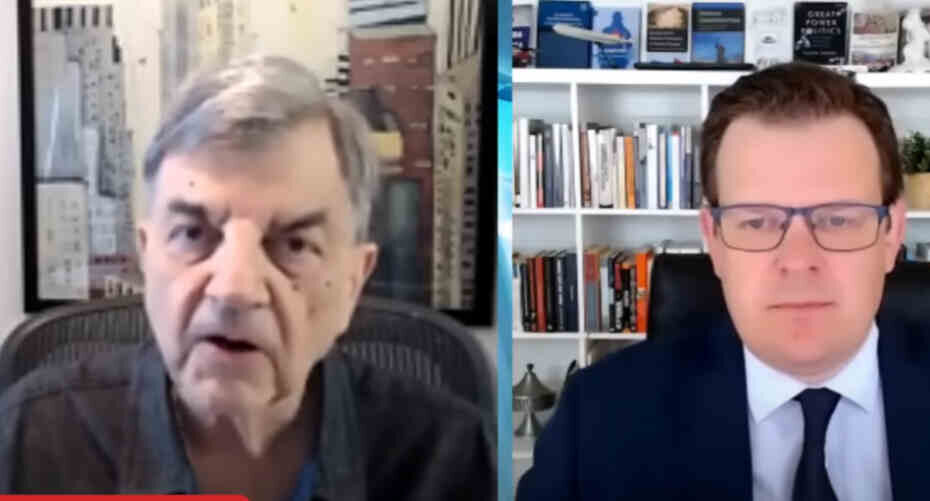
Read the full transcript of world-renowned classical economist Prof. Michael Hudson in conversation with Norwegian writer and political activist Prof. Glenn Diesen on “The Economics of a Civilizational Conflict”, July 17, 2025.
PROF. GLENN DIESEN: We are joined today by Professor Michael Hudson, world famous and best selling economist. So welcome back to the program.
PROF. MICHAEL HUDSON: Well, thanks for having me back, Glenn.
The Post-War Global Order: Obsolete or Working as Intended?
PROF. GLENN DIESEN: So recently the Secretary of State Marco Rubio explained that the post war global order is not just obsolete, it is now being used against us. And it is, that’s what it means, obsolete.
PROF. MICHAEL HUDSON: It’s working just the way it was supposed to. But America’s no longer the beneficiary.
PROF. GLENN DIESEN: Oh, exactly. And for me I thought a bit about the whole what was previously referred to as “free trade empire.” If you are in the hegemonic position, often this system can work to your advantage. If it’s not, free trade is expected to be replaced with what can be called “fair trade.”
But it is interesting about the post war global order because there is a growing sentiment that the post World War II economic order has indeed come to an end and the US is therefore pursuing its own alternative. It’s unclear in more precise terms what this exactly entails, while at the other end we’re developing also on the other side, the BRICS as an alternative to transition away from the seemingly failed or post World War II economic order that has ended.
Two Pathways Forward: US vs BRICS
So it might be an oversimplification, but there seems to be at least these two different pathways. So I really want to explore with you what both the United States and BRICS envision to replace this post World War II era with.
And indeed you wrote or sent me recently a chapter on this and you referred to a similar problem as a “civilizational conflict.” I was wondering if you can flesh out this idea.
The Post-War Economic Order and Industrial Capitalism’s Revolutionary Origins
PROF. MICHAEL HUDSON: Well, by civilizational conflict I mean the way in which society and the economy are going to be organized. And you begin your question with the 1944, 1945 post-war order.
The United States at Bretton Woods designed the International Monetary Fund and the World Bank and the British loan and British diplomacy as a means of absorbing the British Empire and later the rest of the European former empires into the United States sphere of influence. So the rules-based order that the United States created were rules that favored the United States.
The origins of this, to really understand the split in the kind of world that the western industrial economies have relative to the 85% of the world majority, goes back really two centuries to the very takeoff of industrial capitalism in Britain, France, Germany and later the United States.
The Revolutionary Nature of Industrial Capitalism
I think in many ways you can say that the takeoff of industrial capitalism was revolutionary for the countries that were industrializing. And it was revolutionary because the basic principle of industrial capitalism was to lower the cost of production so that industrialists in Britain and other countries could undersell competitors abroad.
How did you undersell them? Well, there were three ways.
# First: Eliminating the Landed Aristocracy
The first way was to get rid of the carryover from feudalism, the landed aristocracy that controlled parliaments with the aim of increasing their land rents, and with their land rents, the price of food.
The industrialists by 1815, led by David Ricardo, the banker, said, “Well, Britain cannot compete with other countries if we have to pay our wage labor so much that it pays exorbitant agricultural rents to the landlord class,” which had imposed the corn laws, the agricultural tariffs, in 1815, to block foreign imports.
Ricardo said, “The first precondition of having an industrial country overtake it and out-compete its competitors is to minimize the cost of living for the labor that it employs. And that means we need free trade in grain and food and raw materials so we can import them from abroad.” And that entails freeing the economy from economic rent.
Rent is the increase in price, the excess of price over the actual cost value. And Ricardo and the whole school of classical political economy aimed at keeping prices in the economy in line with the actual cost of production and getting rid of all of the special privileges.
# Second: Breaking Monopoly Privileges
The second privilege were monopoly privileges. From the 14th to the 18th century, Europe’s kings had needed to increase taxes to pay their bankers, to lend them the money to go to war with each other. And the parliaments of Britain and other countries obviously opposed paying taxes, especially during the crusades when they opposed the kings of England imposing taxes to pay the bankers to fight wars on behalf of Rome in its sort of internecine fights with Germany and countries that didn’t accept Roman domination.
So the bankers helped the Kings in the 14th, 15th and 16th centuries, organized trade monopolies. You don’t need parliamentary approval to make a trade monopoly, and that will yield money. And you, the king, as recipient of these monopolies, can pay us, the bankers.
So the industrial capitalists of England said, “We have to get rid of these monopolies. Let’s have a free market free of economic rent, free from land rent, free from monopoly rent.”
# Third: Reforming the Financial Class
The third thing they needed was to take the financial class in general and bring it into the industrial capitalist order. The role of bankers should be to make productive loans to finance capital formation.
Banks in England and other countries had not been lending to finance industrial capital formation.
So these three forms – land rent, monopoly rent and interest, which is a form of monopoly rent – had to be freed. And that was really the task of classical economics in the 19th century, was to create that streamlined market free of all the costs that were not really costs of production, but were cost of the privileges inherited from the medieval period.
The Global Division: Industrial vs. Raw Materials Producers
Well, things were very different in the rest of the world. England took 30 years to get rid of the Corn Laws, which it did in 1846. And that committed Britain to free trade with other countries.
The British strategists and diplomats went to other countries and said, “We’ll give you access to the British market. You can buy your manufacturers from Britain much cheaper than you can make them yourself. We’ll buy raw materials from you, your food, your minerals, others, and it’ll be a happy exchange.”
Well, they convinced America, at least the southern states of America, not the northern states, and they convinced most of the world to agree to this specialization of production between the industrial capitalist countries on the one hand and the raw materials producers, host economies on the other.
What happened was that the industrial countries ran trade surpluses, went far ahead. They bought low-priced raw materials, they worked them up into manufacturers and they sold them at a profit. And together, the European countries and later the United States had a monopoly in industrial products.
The Debt Trap of the Global South
Well, the problem is that the rest of the world producing raw materials ran trade deficits. And to make matters even worse, beginning in the 1820s, the newly independent former colonies from Haiti, in the Caribbean, Mexico, Brazil and then the Ottoman colonies, Greece, Egypt and Tunisia all won their independence.
But they had to borrow money from creditors in order to remake the economy and to begin to develop their own industry and their self-sufficiency. Well, almost immediately every country that borrowed defaulted.
By the end of the 19th century the debts had grown and the defaults had mounted up so that the creditor countries were able to appoint central banks or national monetary commissions to manage the fiscal policy of these countries that had won their development. And of course in the colonies you had Britain and Germany and France, the colonizing powers running things.
The industrial countries used their trade surpluses to invest in the raw materials producers. They invested in railroads and communications. They bought out public infrastructure, monopolies. They especially bought land and plantations and natural resource rights, forests, minerals for themselves.
The Creation of Dual Economies
The result is that all of these rent-yielding resources that the classical economists said should be the natural tax base – they were the equivalent of feudalism as a burden to the raw materials exporters in the sense that here you had the governments and the domestic economy having to pay heavy rent or land rent, natural resource rent, which is a kind of land rent monopoly rent and financial debt service, all to the creditor countries.
So the fight that had been against feudalism in Britain and France and Germany, for the rest of the world, for the global majority, was a fight against foreign rentier interests, not only their own rentier interests. And this created a kind of dual economy, as it came to be called.
By the 1950s, for instance, Latin America, Africa, much of Asia were called developing countries. But they were not developing in the way that the European industrial nations developed. They were not developing free of economic rent, but as subject to economic rent.
Their governments did not have enough domestic tax returns to be able to make the public infrastructure spending and subsidy of industry that was absolutely critical to Britain, France and Germany and the United States that had a mixed economy.
Industrial Socialism in the West
In these industrial countries, industrial capitalism was evolving into industrial socialism. It was a mixed economy in all of these countries because the industrial class said, “Well, apart from feeding our wage earners at lower-priced food that we import, we’re going to minimize their cost of living by providing basic needs, basic services, education, healthcare, transportation, natural monopolies at minimum cost prices or at subsidized prices, or even freely for education.”
So they were going to make their European economies, and later the US economy, the lowest cost economies in the world so that they could out-compete any potential competition from North America, South America, the Global South, basically.
That was a situation that existed right through World War II.
The Post-1945 Bretton Woods System
During World War II, many of these raw materials exporters actually had accumulated large amounts of their own foreign reserves by selling minerals and oil and other inputs to the fighters in World War II. And they emerged in 1945 in a very strong position.
Well, at that point, the United States imposed its IMF rules and the World Bank rules. And these claimed to have a doctrine of economic development that would help these countries develop. It actually prevented them from developing.
So instead of being developing countries, they were warped into dependency countries, not developing countries, but host economies in the sense of host to – you could even call it a parasite.
The World Bank’s Anti-Development Policies
The World Bank, for instance, would make loans to global south countries not for their own food production, to make themselves supply their own food so they didn’t have to import it, but only to export plantation crops and to pick up all of the infrastructure costs. The port costs and the transportation to export their raw materials.
They fought against land reform and any attempt to produce food that would have rivaled the market and displaced American farmers and farm exports. And the same thing happened after the Common Market was formed with its common agricultural policy, which also had very heavy government supports, price supports, suspension of free trade in order to support a farm investment that vastly increased European farm productivity.
Just as President Roosevelt’s Agricultural Adjustment Act in the United States in the 1930s increased American agricultural productivity by being very protectionist. Nothing like this occurred in countries that were clients of the World Bank.
The IMF’s Austerity Doctrine
Pretty soon these countries lapsed back into the condition that they’d been in since the 19th century. They ran trade deficits, they had to borrow money. That meant they ran into debt.
At that point the International Monetary Fund came in and it said, “The only way you can get rich is by impoverishing yourself.” This is a theory that David Ricardo had developed. The spokesman of bankers for the bullion committee in 1809, 1810 in Britain, they said, “Well, why don’t you get rich in the way that Britain and Europe got rich? Lower the wage cost.”
But they didn’t lower the wage cost by lowering the cost of living. They lowered it by preventing labor unions by just lowering wages and not providing any of the social support for wages that Europe had. And basically imposing austerity programs that had one purpose: to prevent governments from having the money to invest in subsidizing their industry and agriculture to be independent of the European countries.
So basically these were anti-development institutions. The World Bank published a report under McNamara, “Partners in Development,” but it was really partners in dependency, partners in underdevelopment, because it was all based on the diametric opposite principles of classical economics and the way that the European countries had developed by raising living standards.
High Wages vs. Low Wages: The Productivity Paradox
The World Bank and the IMF aimed at lowering living standards, claiming that this would make them more competitive. But this ignored the fact that American economists pointed out that high-wage labor was so much more productive than low-wage pauper labor that it paid for itself.
So you had Western European and North American labor, high productivity supported by heavy government subsidy and provision of basic needs and unproductive labor that did not have any government or social support in the global south countries.
Today’s Crisis: Two Critical Factors
That’s the problem that has led to today’s problem. The crisis has now this year come to a head. And it’s come to a head for two reasons.
# First: Trump’s Tariff Policy
The most obvious reason is the tariff policy that’s imposed by Donald Trump prevents other countries, especially the Global South countries, from earning the money, the dollars to pay their debts by exporting to the United States market.
Now, if their debts are denominated in dollars and the only way they can earn dollars is by exporting to the US or Europe and they’re blocked from doing this, how can they pay? The only way for the last 50 years they’ve been able to pay is by being forced to sell off and privatize even more of their natural resources, their mineral rights, sell off their monopolies, essentially Thatcherize their economy.
And Thatcherizing their economy has been just as devastating to the Global South countries as it was to Britain. That’s the crisis.
# Second: The BRICS Alternative
The second crisis is the fact that for the first time the Global South countries and Asia and the BRICS countries as a whole have an alternative to avoid the dependency trap that they’ve been caught in since 1945. And that’s largely because of China.
Ever since the Bandung Conference in 1955 in Indonesia, the non-aligned countries got together and said, “We’ve got to have an alternative to the US and European designed economic order that is not in our interest.” But they couldn’t go it alone. They were just individual.
The United States and Britain and Europe were able to divide and conquer them to regime change, to basically overthrow governments that were not US-friendly. And the result was this dual economy structure that you have.
The Chinese Model and Revolutionary Change
Well, they’re stuck with Thatcherized economies, with not being able to have the fiscal resources that Europe developed with. They don’t have sovereignty to impose their own rent tax on land, natural resources and to create their own monetary systems that would finance their own industry.
China did that. But it took a revolution in 1945 under Mao, just as in Russia, it took a revolution that got rid of the landlord class and the financial class.
The question is, how are the BRICS countries going to emulate the Chinese industrial capitalist model or industrial socialist model with Chinese characteristics that basically are – the Chinese characteristics are those of Adam Smith, John Stuart Mill, Marx, the whole classical economic school that developed the whole idea of freeing industrial economies from economic rent, from special privilege and making them efficient industrial economies.
The Real Nature of the “Civilizational Conflict”
That’s the crisis. And the fact that these countries are now able to have an alternative model is what the Americans claim is a clash in civilization. And it’s really not a clash of civilization.
It’s a fight against the attempt by the Global South and BRICS and global majority to follow the same path of civilization that industrial capitalism began to develop in the 19th century. And that the classical economic ideology was all about.
The Rentier System and America’s Economic War
PROF. GLENN DIESEN: If we relate this back to the statement by Marco Rubio that the post-war global order is now used against us, is this then a reference to the rentier system? The idea that the currency, technologies, banking system, all these finances, all these things offered by the United States which it extracts rent from – in other words, money without contributing to the productive process.
Is this eliminating America in this role? Is this what Rubio is referring to when he says that the system is being used against us, or is it just the general trade rules? How can we interpret the statement of Rubio?
PROF. MICHAEL HUDSON: Well, it’s not the system that’s changed, it’s the United States and the European economies that have changed. What began as industrial capitalism under the classical economics of freeing economies from rent didn’t really win the fight. By the 20th century, the rentier interests fought back.
And you had a replacement of classical value, price and rent theory with an idea that, well, price equals value. There’s no such thing as economic rent. Everybody earns whatever they can get, whether it’s landlords earn all the rent they can take. The banks earn whatever they charge, including late fees. All of these are counted in GDP today.
If you look at the GDP of America and Europe, you have most of it being rentier charges, monopoly rents, but especially interest charges, financial charges, real estate, land rent. Banks have lent more and more credit relative to the price of the buyers on mortgage. More and more of the housing costs in America and Europe are paid to the bank.
The Rise of Finance Capitalism
So there’s still economic rent in the US and the European economies, but the recipients are no longer the feudal landlord class, they’re the banking class. And you have had the bank class become the main rentier, not the landlords and not the monopolists. But the banking class has been the mother of monopoly, the mother of trusts organizing them and then lending buyers and organizers of trusts and corporate takeovers the money to create monopolies and pay out the monopoly rents as interest.
So what began as industrial capitalism that made the United States and the European economies so wealthy and so productive has ended up being parasitized by turning into finance capitalism. That’s the central thesis of almost all of the books and all of the articles that I’ve written.
And so it’s the United States that has lost its industrial power by deciding we’re going to deindustrialize. We’re going to essentially put the class war back in business under President Clinton in the 1990s by “let’s shift our industrial production out of the United States to the foreign affiliates of multinational corporations. Let’s let foreign labor do the work.”
And then that will prevent American labor from unionizing and raising its wages because we’re replacing it with immigrant labor or with Mexican and Canadian labor at first, and then with Chinese and other foreign labor. So the United States took a decision to literally deindustrialize.
The Shift to Financial Planning
And this deindustrialization has become financialization as well. So you’ve replaced an industrial economy with a bank-centered Wall Street-centered financial economy whose central planning has shifted from governments to the financial centers in New York, London, Paris, Frankfurt, Tokyo.
And the economic development of the 15% “global garden” and its allies basically have stopped developing and have sort of lapsed into the same kind of rentier economy that the whole fight to create industrial power in the 19th century was fought against.
Well, that’s led the United States all of a sudden to find, “well, we can’t afford to create our own industrial self-sufficiency anymore, so how are we going to compete?”
Trump’s Economic Strategy
Well, President Trump says there are two ways we can compete. We can either force other countries to pay US tribute by creating an empire, or we can make monopoly rent and financial rent. We can make monopoly rent by monopolizing the new technology and information technology, computer chip technology, and especially military technology.
“We’ll tell Europe, increase your military spending from 1.5% of GDP to 5%. But you have to buy all your military goods from the United States.” And that will help us balance our international trade and finance our budget deficit at the same time.
And you also have to remain in the dollar system so that whatever surplus that foreign countries are able to save out of their trade surplus or investment surplus or domestic earnings, all their monetary savings have to be invested in U.S. treasury securities or other U.S. securities in the dollar area. And so the wealth and accumulation of all the world is to be sent to the United States.
And Trump says he’s going to impose 100%, maybe 500% tariffs on countries that try to use their income and their trade surpluses and their tax surpluses to develop their own economy rather than subsidize the United States economy.
Economic War Against Allies
So this is a war of the United States not only against the global majority, but especially against its own allies in Europe and also in Japan and North Korea. As you’ve just seen, America’s moves against Japan to end its ability to sell its automobiles in the United States, same thing with Korea’s inability to sell their industrial products here – it’s a declaration of economic war against these other countries.
And the US diplomacy has sort of fixed the outcome by its political interference and regime change pressure. And the non-government organizations that have provided a huge source of funding to promote individuals, opportunists as politicians or industrial leaders who are favorable to the United States and owe their loyalty really to the United States or United States companies – like I suppose you’d say Merz in Germany.
So you have European political leaders supporting policies that add to the United States domination of Europe. While the voters of these European countries do not support this, the voters of Germany, France, other countries are voting against spending their money on war in Ukraine, against fighting against Russia.
They want to be able to buy in the cheapest market, just like England wanted to buy in the cheapest market back in 1815. But they’re blocked. Instead of buying inexpensive Russian oil and gas, they’re supposed to buy American liquefied natural gas at four or five times the price, as you and I have spoken about before.
Europe as Dependency
So Europe has been turned into a dependency and the United States is trying to achieve that same hegemony over the BRICS and Global South countries. Well, the problem is that the BRICS and Global South countries themselves not only have governments that are very largely supported by the United States.
For instance, the African representatives to the International Monetary Fund and the World Bank are thoroughly neoliberal. So their managerial class has been educated in the United States or Britain in neoliberal Thatcherite or similar US laws. They’re not even familiar with the policy debates that underlay the emergence of industrial capitalism that made Europe so successful originally.
China’s Alternative Model
So they don’t have a model. The only model that they have is that of China, which independently has reinvented the wheel, the same wheel that Adam Smith and John Stuart Mill, the British economists and the other classical economists developed of a mixed economy where the government is in control of its own money creation and the allocation of money.
So you will have, for instance, China doing what any country that’s trying to develop and being competitive should do. You create money and credit to finance tangible capital formation. Not only private capital formation and innovation, but basic infrastructure like high-speed railways, port development or the Belt and Road initiative that China is trying to make in order to create a structure of international trade and investment that will make Asia independent of the United States.
The Fight for Sovereignty
And Russia’s President Putin had said, this is really what the fight is all about. The fight is to make other countries sovereign nations in charge of their own fiscal policy and investment policy and government policy. But they can’t be independent unless they tax away the resource rent from their own – that is now foreign-owned companies that produced by oil, raw materials production, mineral production, forests – attacks away essentially nationalize the monopolies and make them public monopolies, not foreign-owned rentier monopolies. They have to de-rentierize their economy. That’s their policy.
Well, they don’t really have to nationalize these foreign-owned oil and mineral companies. They simply have to tax the economic rent and as sovereign countries they should be able to tax the economic rent. But this is treated as a civilizational conflict, as an attack on Western civilization and democracy itself, where actually it’s an expression of democracy, an expression of their own domestic national sovereignty.
Internal Class Conflicts
So this is the fight they have. But their own ruling class, their own political class and the wealthiest class that they have are themselves rentiers and are part of the rentier economy. A huge amount of Argentina’s and Brazil’s foreign debt is owned by Argentinians and Brazilians because they know that they’re the upper classes and they know that the government is going to pay the dollar debt to themselves and not default on it.
So you have a class conflict within the BRICS countries themselves very similar but with key differences to the class conflict between labor and capital in the West. That’s a complicating factor in all this. And the question is how are you going to get the BRICS countries and other countries to pursue the same kind of economic reform that China has done so efficiently without having an actual revolution?
Because the United States has said if you try to make a reform, we’re going to do to you what we did to Venezuela, what we did to Iran, what we did to Libya. We’re going to do what we did to Chile, we’re going to overthrow you. “We don’t want reform. We’re trying to keep Western power in control.”
Putin’s Revelation
And President Putin gave another speech just a week ago saying, “you know, all along we thought since the 1990s that the anti-Russian feeling that Europe and the United States had really was ideological. It was a fight between capitalism and the Soviet ideology. And it turns out that certainly that was an element, but they really were just anti-Russian. They wanted to conquer us. They wanted to break us up into five different countries or six countries and divide and conquer us and make us their colonies.”
That it really is all about an attempt by the United States and Europe to control the world. Just as under industrial capitalism they tried to control the world by industrial power and productivity and controlling the rentier surpluses, financial surpluses and rent surpluses of raw materials exporters – that it turns out to be just a raw power grab and that’s what it’s turned into today.
Europe’s Dilemma
PROF. GLENN DIESEN: So you have then the split between the more financialized economies of the west versus the more aspiring, at least industrial, capitalist economies of BRICS. So I guess what frustrates me with Europe a lot is there’s a reluctance to accept that they’ve gone from being the subject to the object, that somehow reluctance to see that the Europeans are the one now being cannibalized by their American partners.
Because I think the political leadership sees the future of Europe, its greatness or relevance, to be tied up with this transatlantic partnership, while at the same time there’s some recognition that they’re being cannibalized by the Americans.
So you end up with politicians such as Macron of France who pivots back and forth between, you know, “we can’t allow ourselves to be vassals of America.” And the next day it’s, “we have to have solidarity with the US in order to preserve the West.” So they want to be in the political west, but they’re very uncomfortable or reject the acknowledgment that they have now become an object effectively.
But what can BRICS do now, though, in terms of providing an alternative? Because the monopolistic system you present as the option of the United States, it doesn’t seem like a very stable or even sustainable option. It seems very extractive, disruptive, chaotic, and doomed for failure down the road. So what would be, what in your opinion, should BRICS be striving for then?
Europe’s Structural Constraints and NATO Dependency
PROF. MICHAEL HUDSON: Well, let me talk about Europe first. People like Macron and his counterparts in England, Starmer and Germany, Merz, they’re demagogues. They see on the one hand that the population of Europe wants prosperity. They don’t want the budget to be limited in money creation and running a deficit. They want the government to run deficits, to spend on social spending, especially to support living standards, or at least to prevent the disaster of living standards that have been caused by breaking trade with energy, trade with Russia.
So what the voters want is one thing, but the leaders are not responsive to the voters. They’re just like Donald Trump here. They’re serving basically their American sponsors. And the problem is, I guess for Europe, the whole way in which the European Union is structured to guarantee failure.
The European Union is run by NATO. Its foreign policy heads are military hawks whose only interest is basically willing to impoverish the European economies in order to fight Russia and try to drain it in this mythical hope that somehow if they drain Russia enough, Russia will be unable to fight the war in Ukraine, against Europe and America any longer and there will be a regime change. The Europeans and Americans can come up and carve up Russia as they began to do under Yeltsin in the 1990s.
European voters do not have a role to play in European politics under a condition where Europe is part of NATO and where its countries are prevented from doing what any sovereign country should do: creating its own money to fund its own spending to subsidize its industry and rising living standards. The European Union’s monetary policy was created to prevent running a budget deficit in a Keynesian type economic stimulus.
The American Model of “Democracy”
So Europe is, and as long as European policy is run from a basement office in the Pentagon saying, “Well, you have to bankrupt your industry by not importing Russian energy anymore, you can move your industrial companies to America, maybe bring your skilled labor here too, but you’re going to have to sacrifice in order to defend democracy.” Democracy, like Zelensky is imposed in Ukraine. The American model of democracy, I mean, this is a travesty.
And this blocks Europe from working, from saying, “Well, we really, we’re not going to be part of an island off the coast of Rhode Island. We’re going to be part of Asia. That’s our natural trade partner.” The whole German prosperity came from an integration of trade and investment with Russia. They’ll have to go back to unifying with the rest of Asia and being just another country of equals.
But they say we don’t want to be equals, we want to dominate. If we can’t control another economy that we trade with, we feel insecure, we feel threatened. And if America cannot control these economies, we feel the threat because we’re dependent on the United States.
Europe’s Economic Choices
Europe will have to realize that its economic enemy is not Russia and China, but China and the rest of Asia are the most rapidly growing area economies in the world. So who is Europe to look for its long term trade and investment development with: a shrinking economy in the United States or a growing economy in East Asia?
Europe’s leaders say we’re with the shrinking economy, we’re going to lower our living standards just as rapidly as American living standards are being lowered. And we’re going to impose austerity because that’s where our loyalty lies. What can the voters of Europe do against that, given the way in which the European Union’s politics are organized?
The BRICS Challenge
Well, the same problem occurs in the BRICS countries. I’m sure the BRICS voters would love to say, “Why can’t our country in Africa or South Asia or Latin America follow the same policy of China? Why can’t we throw off what for us is the equivalent of European feudalism?”
We have to say that this whole two centuries of warped development making us subsidiary dependencies of the industrial creditor nations has not worked out. Our sovereignty is to go to work with each other. We have to make a clean slate. The debts cannot be paid unless we forego all of our investment in growth.
Who are we going to put first? Are we going to put the foreign bondholders first as a claim on our tax revenues? Or are we going to put our own economic growth first and our own domestic investment in achieving economic self-sufficiency and rising living standards first?
Well, the BRICS countries say forget living standards, we’re going to follow the IMF, we’re going to impose austerity because we in the ruling class, the client oligarchy, are doing very well ourselves. We’re really an extension of the US finance capitalist economy. So this is the ruling class of Argentina, much of Brazil under Bolsonaro. That’s what the whole fight in Brazil is all about.
This is the whole problem. You not only need a revolution by the BRICS countries and global majority countries in terms of their philosophy of economic development, to adopt classical economics and its freeing economies from rent, you need a political revolution against its own client oligarchies that have been put in place by this dependency system that’s been imposed over the last two centuries, often by force and violence.
Political Upheaval and National Interest
PROF. GLENN DIESEN: Well, I fear that, almost a law of nature is that a political elite which is no longer delivering on the desires of its public. But if they don’t, there will always be this political upheaval. I think so far the political caste has simply dismissed all reactions to its failure to pursue basic national interest as being populists. And populists are illegitimate and should be countered almost in any possible way.
Now this only works for so long though, because if they do not respond to national interests, there will be some massive political instability or upheaval coming. But responding to national interest depends on how the distribution of power is organized. And in a multipolar system, that is the actual realities of the distribution of power not being concentrated in the United States anymore. The policies have to reflect this in some way.
It seems, as you say, the political elites in Europe only pursuing essentially doing America’s bidding while its national interests are ignored. I’m wondering how long this can actually go on and if there will be some pursuit of if not joining BRICS, some similar alternative at least.
The End of the Post-War Era
Because I think the Europeans, while the Americans, they at least think what you will about Trump and his terrible solutions to this. Well, trying to pursue a new system at least. He recognizes that the post World War II era is over. I think the Europeans are still in denial. If they can only do enough self-sacrifice, enough war, enough bootlicking of Trump, then somehow they can bring back this or restore this era.
I think this is what the Americans, the Chinese, Russians all have in common. I think they realized that this era is over and now of course split interest. Do you have any final thoughts on this? I would say very important topic. It seems as if we have an era over the past 80 years. Economic system is coming to an end and there’s no real consensus. And even among the different alternatives, it doesn’t seem to be the conceptual clarity I would like to see in for example BRICS to have a sustainable alternative and even less so with the Trump administration.
The Materialist Approach to History
PROF. MICHAEL HUDSON: Well, what you’ve described, Glenn, is the materialist approach to history and that history believes that countries are going to do what ultimately is in their natural interest. There’s a kind of survival of the fittest and the fittest ultimately are going to work out. But that’s not what’s happened in a lot of history. It’s not the fittest to survive. And the materialist approach to history has left out the reasons why the race is not always to the swift, as the Bible puts it. And so we really don’t know what’s going to happen today.
For Germany, for instance, it’s not just that the post war era is over. World War II is not over. It’s still on. Merz says we want to make the German army the dominant army as it just was before the dominant army. He means it’s only one army, the Wehrmacht, the Nazi army. You’re having a revival of what really is Nazism in Germany. It’s like all of a sudden we’re going back to the World War II period.
We’re having a dictatorship in France where despite all of the demonstrators, the yellow vests and the demonstrations throughout France hasn’t been able to get rid of Macron. You have a whole obsolescence of the political constitution and the politics that have led to Starmer in Britain just following Tony Blair as part of the super Thatcherite development.
The Catalyst for Change
None of this is in the national interest of these countries. They’re not what the voters want. But the political system has become dissociated from what the voters want. It may be that the only catalyst for this is not going to be in Europe, but it’s going to be in other countries that especially former present allies of the United States such as Japan, South Korea, that decide, “Well, now that we can’t run trade surpluses with the United States anymore, now that it’s doing to us in Japan what it did with the Plaza and Louvre accords in the 1980s, now maybe we’ve got to make a rapprochement with China.”
I think as Western Europe sees other Asian countries joining China and one after another by China, its overall development plan, Belt and Road and overall trading and investment area, Europe is going to see they’re pulling further and further ahead of us. They’ve left us behind. How long can we agree to be left behind and what can we do to make a change?
Well, the question is, can this be done without a revolution? I don’t know. How do you make will it be a peaceful revolution? How do you change a constitution that has left Europe and client oligarchies in this position? It’s as much a political question as it is an economic question. So while we talk in terms of economic self determination, how do you deal with the fact that there’s this political distortion of what you and I would think is the natural materialist logic of history?
Signs of Change in East Asia
PROF. GLENN DIESEN: Well, on those great final words we can wrap it up. But I like that possibility at least though, because I do see some optimistic signs coming out of East Asia, both from South Korea and Japan. It looks as if they also come to realize that as the post World War II era or system is coming to an end, that the American role will change fundamentally in terms of also cannibalizing allies. Something by the way, also evident in the rhetoric towards Taiwan.
So as this is happening, if they make this shift, it remains to be seen if the Europeans will still throw themselves on the sword in this way. But I don’t know, I’m very disillusioned by the Europeans at the moment, so I remain pessimistic. But at least that’s a source of optimism though.
PROF. MICHAEL HUDSON: Yeah, optimism, yes. There will be a revolution.
PROF. GLENN DIESEN: Well, Professor Hudson, thank you as always. It’s always fascinating to speak with you, so thanks again.
PROF. MICHAEL HUDSON: Thank you, Glenn.
Related Posts
- Transcript: Secretary Marco Rubio Speaks At Freedom 250 Reception In Mumbai, India
- Transcript: President Trump Remarks at Wichita, Kansas Rally – 10/19/26
- Transcript: President Trump & First Lady Melania Trump Sign an Executive Order – Oct 19, 2026
- Tucker Carlson on Iran War, Trump’s Diesel Deal – Jimmy Dore Show (Transcript)
- Transcript of Jonathan Gross Interview: Tucker Carlson Show