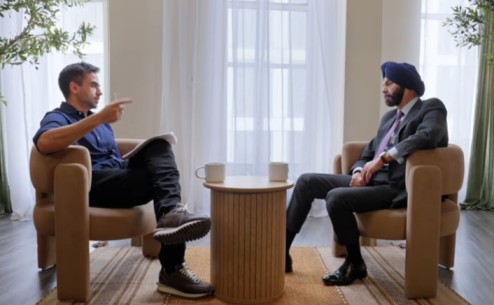
Editor’s Notes: In this insightful episode of People by WTF, host Nikhil Kamath sits down with Ajay Banga, the President of the World Bank, to explore the critical intersection of global economics and human progress. Banga shares his remarkable journey from an “army brat” in India to leading global giants like Mastercard, emphasizing the values of flexibility, adaptability, and a “decency quotient” in leadership. The conversation dives deep into the World Bank’s evolving mission to eradicate poverty by creating jobs, particularly for the 1.2 billion young people entering the workforce in emerging markets. They further discuss the transformative potential of “small AI” in development, the future of energy security, and why fostering optimism is the ultimate key to a prosperous global future. (April 20, 2026)
TRANSCRIPT:
Introduction
NIKHIL KAMATH: Thank you, Ajay, for taking the time to do this.
AJAY BANGA: Pleasure to be here.
NIKHIL KAMATH: I think we’ve been planning to catch up for a while now, but we’ve always missed each other by a short margin. I know you’re a very busy man. Maybe we can start today by giving our audience— our audience is largely Indian origin, trying to be entrepreneur, the young person under the age of 30, around 25, I would say, on average.
AJAY BANGA: Just like you.
NIKHIL KAMATH: I wish I was that young. Not anymore, unfortunately. But they all want to figure out what to build, how to start something. Like you were telling me about your daughters, a lot of them have a job right now, they want to transition into owning a business. There is a lot of uncertainty about AI and which job will remain, which will not. You speak a lot about jobs. So maybe we start with you and you tell us a bit about your career. I mean, I know a lot about you, but for the few people in our audience who might not, could you start by giving us a couple of minutes on your life, how it began, context.
Ajay Banga’s Early Life and Career Journey
AJAY BANGA: Sure, sure. So I’m 66, so it began a long time ago compared to the audience you’re talking to, right? My dad was in the Army and we kind of moved every 2, 3 years. What you would call an army brat in that sense, living a relatively sheltered upbringing because of that surrounding of being in a cantonment with the people who came from a similar background of some type. And then there was an elder sister. She’s the eldest, an older brother who was 5 years older than me. So 10, 5, 0, kind of 3 of us.
NIKHIL KAMATH: Which city was this?
AJAY BANGA: I’m sorry?
NIKHIL KAMATH: Which part of India?
AJAY BANGA: Oh, all over the place. I was born in Pune, and my sister and brother were born, you know, 10 years and 5 years earlier. My brother was born in Shimla. My sister was born in Delhi. And so they’ve kind of been all over the place. And then we moved every couple of years.
So I started schooling in my early days in Jhansi, then Jalandhar, and then came to Delhi and then went to Hyderabad. Then from Hyderabad went to Shimla and finished schooling in Shimla. And then did college in Delhi at the Economics in St. Stephen’s College. And then went to Ahmedabad to do my MBA, which is where I met my wife. We were classmates in business school.
And then joined Nestlé and worked in Nestlé for the better part of 13, 14 years in India, all over the place, moved from Delhi to Mumbai to Calcutta, and then joined PepsiCo to start KFC and Pizza Hut in India at that time, and then left and joined Citibank and spent 14 years with them, starting in India, London, Brussels, London, New York, Hong Kong, and then back to New York. And then joined Mastercard as CEO and spent 14 years there, and then now here.
I’ve got sort of— there were 3 of us. My wife also has 2 siblings and one, so all girls in her case. And then we’ve got 2 kids and my kids have kids. So now I got 3 grandkids.
The FMCG Landscape and Shifting Consumer Behavior
NIKHIL KAMATH: So you spent a fair amount of time at Nestlé. Do you see that business model of a large FMCG company selling across the world— do you think that’s breaking? You see a lot of the multiples of companies in FMCG are coming down. They’ve been historically very expensive. Is the consumer moving to independent brands from large conglomerates?
AJAY BANGA: Not really. I think that movement began quite some time ago. It started for value at a point of time, but it moved to these private labels in the case of some of the larger locations. But in the case of India, for example, Amul was a big breakthrough in milk, right? So you got brands that came up locally, but it’s not as though the multinational brands aren’t strong and high quality with high perceived advantages.
The only difference is in the emerging markets, years back, if you were a global multinational brand, you had a halo which you didn’t feel you could get domestically. That certainly has changed. And Amul is an example of that high-quality product, whether it’s powder or yogurt or desserts or ghee or anything else. Today, Amul has a product that is as good as anybody else’s. And I think that change definitely leads to a lower dominance level for multinationals.
But otherwise, the idea of a global company which has global standards but locally executed with great delivery— it’s still a very popular model. The issue of earning multiples and share pricing coming down, that’s a whole other thing. I think there’s a lot going on in the markets where people are putting money into new technologies, new industries, AI, finance.
Consumption Patterns and India’s Growth Trajectory
NIKHIL KAMATH: Do you think consumer behavior and consumption— if I were to say a big part of American consumption is, say, QSR, for example. In India, the same thing could be grocery. A lot of us are betting on the fact that grocery, as GDP per capita goes up, will convert into eating out in restaurants and QSR and the likes. Do you think the pace of consumption is going to continue to grow like it has in the last decade?
AJAY BANGA: In India in particular?
NIKHIL KAMATH: Yeah.
AJAY BANGA: Yeah, I think so. What happens typically with the growth of the middle class— and you can define the middle class in all kinds of ways— but with the growth of increased, let’s say, prosperity or better spread of prosperity in the system, you do get consumption. You know, it’s the old story of you have a scooter, you buy a car, you buy a car, you buy a bigger car, you get a bigger car, you buy a second one. That consumption has to play out.
When it stops playing out is when you get a concentration of wealth at a certain level. And you’ll find if you already got 4 cars, there isn’t going to be a 5th car bought. If you already got 4 TVs in your house, you’re unlikely to buy a 5th one. So there is a change in consumption patterns as incomes increase beyond a point.
But till you get to that point, and India is still on that journey, you’ll get pretty good expansion of consumption. The nature of things consumed may change. The perceived advantages of a luxury good may change. The willingness to pay more for quality and pricing may change, which you’ve already seen in India in the last 20 years. I think that could keep happening, but I don’t think consumption won’t keep growing for a while.
The one thing that could impact consumption is insecurity. So if people get insecure about jobs or insecure about savings or insecure about their future, then that leads to an inward turn on consumption. That’s got nothing to do with prosperity and growth. It’s got to do with the topic you started with about how do you feel about your future. So long as you’re optimistic, you tend to be willing to spend.
NIKHIL KAMATH: When you’re no longer optimistic, does the nature of consumption change or do you stop consuming?
AJAY BANGA: A little bit of both. You might downtrade in prices. You might downtrade in some things. You may leave certain things that you feel were luxuries that you don’t need to consume. Now I’ll give you a crazy example, but here in New York City, the day the stock market does well, if you go to the average upmarket restaurant here, you will find the price of wine purchased that day at dinner goes up. It’s the same day.
NIKHIL KAMATH: Really?
AJAY BANGA: And now if it goes down, you will find it has an impact. It’s how people feel. Consumption is not just about your material need. That is true when you’re at a lower income level. At a higher income level, consumption is also about how you feel in your head. And that’s very different.
NIKHIL KAMATH: So in times of uncertainty like today, by virtue of what’s happening in geopolitics and stock markets having corrected, if I were to correlate that not just in America and wine prices, do you think—
AJAY BANGA: I gave you that to show you how crazy it can be.
NIKHIL KAMATH: Do you think in India, for example, the real estate market will follow the stock market? Will purchase of high-end cars go down?
AJAY BANGA: No, I don’t think so. I think that India is still at a stage where the optimism of its population in terms of the future of India, in terms of its growth potential, and therefore their belief that they will have a better life than their parents— I still think India is going through that growth phase. And so you may have ups and downs. I cannot predict either stock or real estate prices anywhere. I gave up that long back. If I could do that, I would be doing something completely different.
But I think you can’t predict short-term changes or even medium-term. If you look at the trajectory, I don’t think India has reached that point yet where its trajectory needs to be doubted in that sense. And if you look at the way India is building infrastructure, right, whether it’s bridges, roads, airports, fixing up its port system, power, water systems and so on, it’s not that there isn’t work to do. And it’s not that there isn’t more work to do, but it is very different from 25 years ago, 20 years ago.
And without infrastructure, without healthcare, education, and skilling, you can’t create the first foundational pillar of prosperity. Then you need the right governance and policies and rules and laws and regulations and transparency and all that. And then you need the financing for the private sector, small new entrepreneurs all the way to large companies. That’s the process by which prosperity comes. I think India is still doing pretty well on that trajectory.
The Origins and Purpose of the World Bank
NIKHIL KAMATH: So coming to what is the World Bank, Ajay, I’m a little bit of a fan of history. When I was younger, I spent a lot of time on the Second World War and German history. One were to say that the World Bank was created post-World War II because rich developed countries arrived at the conclusion that instability is generally a symptom of things not working well in economics and giving money to poorer countries makes the world more stable, which in turn prevents war. Would you say that’s why the World Bank in a way was created?
The World Bank: Structure and Purpose
AJAY BANGA: So the original creation was the International Bank of Reconstruction and Development, IBRD. That’s the Bretton Woods thing you hear about. That institution got created to help rebuild Europe and Japan after the Second World War. And so it was a way to not really— they weren’t really thinking about the developing world at that time because remember that time these areas of Europe and Japan had been decimated by the war. And so this started for that.
In fact, interestingly enough, the bullet trains of Japan were financed by the World Bank. Nuclear power plants in France were financed by the World Bank early on. By the time 15, 20 years went away from the end of the war— so you’re in the early ’60s— it became pretty clear that Europe and Japan were back into a rebuilding and growth phase. And attention began to focus into the rest of the world, in the so-called emerging world at that time.
And more parts of the bank got created, one called the International Development Association, IDA, which caters for what is the poorest countries on the planet. Today, 78 countries are in that category. And essentially the difference between that and the IBRD is that those countries get one-third roughly of the money we give as free — no repayment of interest or principal — whereas IBRD is closer to commercial market terms. But the concessionality of IBRD comes from the fact that you give long-term loans, longer than what you could get from a bank or from markets in your country.
The third thing that got created was the International Finance Corporation. That goes to the private sector, and enables the private sector to invest by de-risking in emerging markets. India is a classic example of that. Most people don’t know, but HDFC originally started with an IFC investment. And today it is your largest private bank and has got an enormous footprint both in mortgages and helped to create the mortgage market in some ways in India, but also did a great job in the private banking side of financial services.
And then the fourth part that got created was MIGA — the Multilateral Insurance Guarantee Agency. And the idea there is to provide political risk insurance to a company or an entrepreneur, so that even if a government makes you a commitment and they don’t live by it, could you go for an arbitration and get settlement? So we do both insurance guarantees through MIGA and then the arbitration through ICSID, which is our settlement of investor disputes — the 5th part — which settles between sovereigns and investors.
So think about the bank as having 5 parts. And only the first part started soon after the Second World War. Then came these add-ons over time. And today, when you step back and look at the totality, it’s $120-odd billion that gets put into the marketplace every year. There’s about 25,000 to 30,000 people working across the world on this.
It runs the full gamut from the poorest countries getting one-third of money as grants all the way to the middle-income countries like IBRD, like India. India was an IDA country once upon a time and now is a donor to IDA. Turkey, China, South Korea were all IDA countries, now donors. IBRD is still what India does get, but India is pivoting more and more towards the private sector with IFC and MIGA. And so you could see the evolution of growth in countries through the manner in which the bank deals with them. It’s quite interesting.
NIKHIL KAMATH: So if I were to say the biggest chunk of the money flowing through the World Bank, does it go to IFC? I have some numbers saying $70 billion to IFC, $40 billion to IDA.
AJAY BANGA: No. So the way it goes every year — you’re counting private sector capital mobilization. Look at the $120 billion I talked about: about $35 to $40 billion comes from IBRD. About $35 billion comes from IDA. Now it depends on the year, right? So let’s say $70 to $80 billion is coming from the public sector part of the institution. About $25 to $30 billion comes from IFC. MIGA has $15-odd billion that it mobilizes. That’s your $120 billion. But if you also add private capital mobilization, like last year we mobilized almost $70 billion of private capital, up from say $40 billion 2 to 3 years ago.
NIKHIL KAMATH: That’s not in this number. Is this private capital chasing a return?
AJAY BANGA: Yes, it is. So the real issue is it’s a risk-reward relationship. Like in my old job at Mastercard, I took decisions to invest capital in a country or an economy based on my risk-reward calculation. So does every investor, whether you’re a hedge fund or you’re a furniture manufacturer. And so in a sense, you’re looking for that. The question really is, if I can buy down your risks in some way, or I can create the opportunity for you to feel more confident about the return you’re likely to make, then that’s a risk you’ll play with.
Hence, one of IFC’s jobs is to help you reduce that risk perception. The second is why MIGA gets you the insurance guarantee. And the third is, if you get into a dispute with the sovereign, can I help you? Those three together create the platform for a private sector player to be able to invest for return in these places.
NIKHIL KAMATH: And these guys are not coming in as equity partners, but as debt partners? You raise a bond and they—
Equity, Debt, and the Role of Small Enterprises
AJAY BANGA: You can also do equity. We do, actually. So IFC used to do much more equity back pre the financial crisis. During the financial crisis, they pivoted towards more debt than equity. And I’m in the process currently of pivoting to a balance between equity and debt, where maybe we’ll end up at 25-75 — 25% of the investment going into equity, 75% into debt. That’s not where we are today. We’re lower than that in equity terms today.
But my belief is that equity runs the whole gamut. And I’m not talking about investing only in large projects. I’m very keen to provide equity to small and medium and micro enterprises because that’s where the jobs come from. And you started our conversation by talking about jobs, right? We’ll come to that.
Young people, entrepreneurs — they need a certain kind of capital, a certain kind of equity as well. Most of them don’t have equity to start with. Women in particular don’t have equity to start with. And so if I’m going to try and use a development bank rather than a commercial enterprise as the methodology of trying to drive jobs, then you have to start thinking about the impact you want to have on the ground for people who haven’t got the opportunity that they could have got had they just gone to the private market. My job is not to compete with the private market. My job is to create additionality, and do it differently.
NIKHIL KAMATH: And I read somewhere that most of the capital is actually repaid. Can you attribute an IRR to the different buckets?
AJAY BANGA: Yeah, although we don’t discuss that for a reason. We’re basically profitable across the institution. We don’t need capital injections every year or 3 years. We don’t need money for our administrative expenses every year or 3 years. And the reason for that is because we don’t actually lose money. We don’t, actually.
So the part of the bank that isn’t that way is IDA, where, as I told you, one-third of the money gets given away every year. The moment you do that, that’s a melting ice cream cone — you’re going to end up having to refinance that. We have a AAA rating, so we can go to the private bond markets and raise very attractively priced money, long term, which allows us to do the work we do at better prices than others.
NIKHIL KAMATH: This is like 3 to 4%?
AJAY BANGA: We can raise money at anything from — depending on the interest rates at the time — 2.5% all the way up to higher than that, depending on what you’re raising it for.
NIKHIL KAMATH: So if I have to summarize in really layman terms, the World Bank is a place where developed countries are giving money to poor countries, plus there is leverage because of your rating and you’re able to raise money from bonds and private capital as well.
AJAY BANGA: Yeah, so a part of it, you’re right — the part about the developed countries going to the developing world, that’s the IDA part. The rest of it goes into capital and retained earnings with us, which we leverage up through the bond market, which is mostly about 50% to 60% private money, as in insurance companies and pension funds and asset managers. But 40% could be central banks parking reserves into bonds and the like as well.
Why Jobs Fix Everything
NIKHIL KAMATH: And what is the point of the World Bank, Ajay, if you have to simplify it to somebody who has no context?
AJAY BANGA: Make jobs for young people, create jobs, help to do that. It’s very simple — it’s to kill poverty. That’s the idea, get rid of poverty. The best way to get rid of poverty, the best way to put a nail in the coffin of poverty, is to give somebody a job, because then you get not only the earnings that allow them to subsist and have a family and care for them, but you get them hope and optimism.
You will hear me talk about hope and optimism as a very important driver of human behavior. And a job gives you that. And a job doesn’t mean working for somebody. It could also be being an entrepreneur. It could be a small farmer, it could be a large entrepreneur, it could be someone with a successful business like yours, or it could be somebody who’s working like me for somebody else. It doesn’t matter. The idea of having earnings is what I’m talking about.
NIKHIL KAMATH: When I think about poverty and income inequality, it almost appears to me like the world does have enough. The distribution of what the world already has is not equal, and hence there is poverty and there is excess on the other side. Do you think that’s right?
AJAY BANGA: Yeah, I don’t think like that because I think you’re looking at a utopian system where somehow you could wave a magic wand and take from Peter to feed Paul. And I’d be a little careful about that thinking. That’s not the way I believe.
I believe that what creates wealth, first of all, is entrepreneurship and the private sector. I believe government’s role is to create the infrastructure and the ability and the human capital and the rules and governance that enable the private sector to create jobs. I mean, 85 to 90% of jobs in the world are created in some form or the other in the private sector or in private sector-oriented enterprises in the state-owned sector. That’s kind of how this happens. And most of those are created with medium and small and micro enterprises.
And so that cycle, that virtuous cycle of enabling these people to succeed so all of us can also be that way — I think that’s an important thing to remember. So I don’t believe that the way to think about this is that if you can redistribute all the wealth, it’ll be fine. I just think you need to find a way to not lower the water in the river, but to actually raise the water in the river so boats can float higher.
Keynesian Economics and the Capital vs. Labor Divide
NIKHIL KAMATH: I’m with you. I’m capitalistic as well. But if I was reading a bit about Bretton Woods and why the meeting was called upon and the 44 people who came in — I think even if you don’t attribute what was the outcome to Keynes or Keynesian way of economics, I think he had a large part in how it was conceived. Do you think the John Maynard Keynes model, where the government comes in to stabilize by spending money, will always have a trickle-down effect from the top, where the top of every ecosystem gets more of that money that is being printed or thrown into an economy?
AJAY BANGA: Not really. Again, so if you look back over time, I think what happens is when interest rates go down, the reality is that capital benefits in terms of its returns for the next few years, and labor gets a lower share of the outcomes in that period.
Now, why does that actually happen? Because what happens when interest rates are going down is it’s reflective of complicated economic dynamics. When there are complicated economic dynamics, businesses are less predictable and people start getting reduced number of jobs, layoffs happen, businesses constrict before they’re able to again put money back to work and come out of the cycle and grow again. And at that time, therefore, capital gets an outsized return and labor gets a lower return.
There are cycles in the system overall. And in that process, you will find the Gini coefficient in countries will change, which is kind of what you’re getting at. But those cycles do change as well. And if you look at the way inequality in the world has gone — in fact, in the last 15 to 20 years, it has increased because of this exact reason. Very low interest rates for a long period of time has created this kind of growth of capital return. Those who have money have made even more, and those who haven’t have had to find their way through it.
NIKHIL KAMATH: And that’s the issue. At the very core, if I have to simplify the idea, I could say that as long as wage price growth doesn’t keep up with asset price inflation, inequality is bound to continue to go up.
AJAY BANGA: That’s the capital versus labor thing.
The World Bank’s Mission: Jobs, Opportunity, and Reducing Inequality
NIKHIL KAMATH: Exactly correct. Considering where the world is right now, it does not look like governments across the world can afford to raise interest rates beyond a certain point. And say the World Bank, for instance, is putting top-down money into different economies, which are again kind of saturating in the top and not really trickling down to the bottom in a fair manner. Why do we then make the case for income inequality really going down over the next decade or two?
AJAY BANGA: 600 million people in Africa don’t have electricity today, and I don’t mean inadequate electricity— none, black, no electricity. What I’m talking about is not giving them one light, one fan with a solar cell on their roof. That to me is useful for quality of life, basic. But not useful for productive use. We’re talking about productive use of energy.
And so we’ve committed to connect 300 million people with the African Development Bank by 2030. As of June, we would be at 50 already. We got a line of sight to 200 or so. We’ll find our way to, if not 300, 250. That would be 2.5 times what we connected in the last 10 years. That’s not only at the top, that’s going right to the people who want to set up a barber shop or a chicken hatchery or a farmer. You see what I mean?
And so actually our money doesn’t go to the top of the pyramid. Our money is being oriented towards this or healthcare. We’re talking about getting 1.5 billion people access to better primary healthcare by 2030. Again, by this middle of this year, we would be at 400 million.
Now what does that mean by primary healthcare? A clinic near you where you can go, where there’s a nurse, a medical diagnostic technician, and a midwife. So you can actually, with technology, get access to a doctor who may be remote. Gaon mein hi nahi hai, but he’s there, shared by bees. Right, think of it that way, right? And that guy can be reached through that technology.
You’re the nurse, I walk in, I show you a rash, you look at it and say I don’t know what this is, but you can take a photograph of it, and between simple AI and the doctor, you can conclude whether it’s an eczema, give me an ointment and send me home, or give me an appointment at a regional hospital because there’s something about it that doesn’t look good, right?
Things like that. Or a farmer who can use this to be able to think about— which I’m doing in the case of agriculture for small farmers, giving them tools. In UP, in fact, if you Google what I was doing in UP last year, this is what I was doing. Going to farmers who have set up cooperatives, and technology can be used with a Google open platform where you can use that technology to tell an illiterate farmer what that disease is at the back of a leaf. Forget the name, but what insecticide do you need that’s available for ₹25 with your cooperative?
So what I’m trying to get at is our money in that question doesn’t actually go to the top of the pyramid. We don’t do much financing of large companies, right? We’re much more focused on getting the public sector to set up the right infrastructure and the right human and physical infrastructure.
And then we’re very focused— and I think a large part of our bank, which we haven’t yet talked about, is what I call the knowledge bank. We talked money, right? We’re a money bank, right? Santa Claus in some cases, maybe not in other cases. Depending on what you think about us. But we’re also a knowledge bank, right? What do I mean by that? We have years of experience, 80 years of comprehending what has worked and hasn’t worked. If you use that wisely, which we try and do, then we can be very constructive in helping you do everything from building municipal financing markets for cities in India, which I’m trying to do.
As compared to relying only on government financing, but get private sector financing in through municipal bond markets or figuring out how to build skilling centers. So we just visited a location in Orissa where we saw skilling centers at work and what they could do to make 1-micron parts for your satellites and your fighter jets from tribal girls who were learning. That kind of success transfer is a huge part of what we do. And so that’s not oriented at big companies either. That’s oriented at the foundation.
And so why do I believe your third part of your question, that you could see inequality reduce over time? Because if you help to create jobs and opportunities for young people, that’s the only way to get them on the ladder and climbing the ladder. You can’t possibly say that the way I’m going to do this is to make everybody a millionaire overnight. Not going to work, right? You have to get them onto the ladder, right? Give them the skills to climb that ladder, just as I did in my life.
And those who win will win, others will do less well, but that’s the way you’ll get everybody a fair shake. I’ve always told people what everyone wants is a fair opportunity. They don’t— nobody’s looking for a handout. This is looking for the chance to run and win against the other. But you’ve got to start at the same place and you’ve got to start with the same assets. That’s what I’m trying to help do.
Geopolitics, World Trade, and the Future of the Dollar
NIKHIL KAMATH: So you’re making a case for equanimity in opportunity, not in outcome, which is 100% fair. If I were to leave Ajay, World Bank aside. Say the $120 billion is out. Let’s say the US— let’s also then say because the Americans are the biggest donors, World Bank in a way is— I would not like to say largely an American institution, but I think America is the largest shareholder, if that makes sense.
AJAY BANGA: America is the largest single country shareholder. Actually, the European Union is bigger than America, but it doesn’t vote as one country on our board. And therefore, yes, America is 17% of the shares. That’s their share of the capital they’ve contributed over time.
NIKHIL KAMATH: This is advice to me for a young man trying to understand geopolitics of the world. Let’s say the share of American trade in the world has come to like 10-11%. It’s come down progressively in the last couple of decades. Their GDP is still higher for different reasons. They’re a high-service economy. Services are a big part of the economy.
Even when I went back in time and I read about Bretton Woods, I was comparing what Keynes thought of economy versus Hayek versus different people. I think Keynes even back then wanted a currency which is not the dollar to be created in Bretton Woods. Finally, the dollar got pegged to gold and then the gold standard got taken off.
But what do you think will happen in that realm? For somebody who’s a financial investor, that’s my full-time job. If I have to look at the world, which is suddenly in a very tumultuous place. Everybody seems to be fighting with everyone. And people, when I look online, people in positions of great power are saying things like, “I will take over another country, I will do this in that country and that country.”
And I take cognizance of the fact that this is a very tough question for you to answer. So you can euphemize it if you so choose. But what happens now to world trade? What happens to currency? What happens if interest rates remain low? Income inequality can’t practically go down because outside of the $120 billion World Bank is putting out in the world, doing probably the right thing.
AJAY BANGA: Much more than that. We are one player in the game.
NIKHIL KAMATH: Yeah, absolutely. So income inequality is going to continue to go up. And if memory serves me right, when I read old history books, when a king— when a society has 100 in assets and the king has 90 and the people have 10, society is okay. But when the king has 99 and the society has 1 left, the 99 people show up at the king’s door with axes to take over. So where do you see the world going?
Wealth Concentration vs. Wealth Distribution
AJAY BANGA: I know it’s a broad question. I’m a little less despondent than you are, clearly. And for someone so young, I gotta get you off this. The first thing I would say is that remember trade, when you said 10% America is of trade, you’re counting trade the way it’s counted with goods and of a certain type. Remember services trade isn’t properly valued.
NIKHIL KAMATH: I agree. If you were to value it, I would say there would be 25% of world GDP.
AJAY BANGA: That’s roughly their current share of GDP as well. Actually interesting, the European Union is very similar in size, 24, 25% of GDP as well. And when you take those two, that gives you half the world’s consumption and GDP in some form or the other.
The point about concentration of wealth— I think if it’s one person who collects the wealth, it’s very different. But if what you mean by inequality is only one person, that’s a problem. But if it’s a very large entrepreneurial class or a bunch of people who have done very well, if you look at America, yes, there is concentration of wealth in the last 10 years between— if you look at the 0.2% of Americans who have even more money than they did, it’s correct. But look at the number of millionaires that have expanded in this country. And so actually in a strange way, the diversification of that concentration is also something to be kept in mind.
NIKHIL KAMATH: Wouldn’t you say the top 1% has more?
AJAY BANGA: The top X percent does have more, but the number of millionaires being created is very different. The same is true of India, where yes, I would argue that 5, 7, 8, 10 families have even more wealth than they used to, including newly created wealthy families because of the boom in entrepreneurship that has taken place over the last 20 years in India. But there is also a very large collection of wealthier people across.
And so, concentration— the point you were making is if it’s 1, 2, 3, 4 people, yes. The moment it becomes hundreds and thousands of people who not only— some of whom become incredibly rich, but others of whom become rich enough to be able to afford a much better life. I don’t think you run the same risk as what history would tell you. Was the king controlling 99 and the people having 1, right? You see what I mean?
Now it is that a bunch of very rich people have 30, a bunch of less rich people have 30, a bunch of other people have 30, and then the poor have 10. That is a different definition of a societal risk than the 99 and the 1. And that’s the point I’m making to you, why I’m less despondent. That doesn’t mean inequality is not an issue.
NIKHIL KAMATH: The way I’m putting it, Ajay, is when I say 99 and 1, if the society had 100 people, the 1 today does own 70-75% of the assets at least.
The Demographic Dividend: Boon or Bane?
AJAY BANGA: When does that break? No, I mean, I don’t know that number. Yeah, I don’t know that number. But yes, that concentration break, I don’t understand myself. But I do know that the ballast against that argument is the spread of prosperity at a fairly high level of prosperity among a lot of people. And that, I think, is a very different thing from the old world thinking of concentration in very few hands. There is a difference. That’s the point I’m making.
Now, I don’t think that reduces the role of all of us in terms of trying to help young people break through the system. In fact, one of the things I discuss all the time when I travel, and this is the issue of young people — 1.2 billion young people in the emerging markets are going to become 18 years of age in the coming 15 years, right? Currently, the same markets — currently, this is pre-AI, and we can talk about AI’s impacts on the developed world versus the developing world — currently, those countries are projected to create 400 million jobs. That’s a very large gap. Those numbers could all be wrong by estimates. They’re all made by economists. And I’m a recovering economist, so who knows? It could be 600 million, it could be 200 million, but it’s not wrong by 800 million.
And the real challenge therefore is, if you can get those people to have hope, optimism, and be productive parts of their society, then you get the growth opportunity that I think Asia provided the world for the last 30, 40 years. But if you don’t do that, then I think you get instability, you get fragility, conflict, violence, you get international refugees illegally moving around. You get all the things you don’t want to hear about. And so I’m very focused on, can you give young people a chance? Because then I think you change the tide.
Small things like being entrepreneurs. You can set up an entrepreneurial center. I was in Egypt, we’ve got partnerships with people who create entrepreneurial centers. Young people go there, meet others like themselves, get access to some accounting help, some legal help to create a business. What they really need is capital, seed capital. And I’m saying, why can’t the bank take $50 million, the government of Egypt take $50 million and create a corpus of $100 million? And give that to a professional venture capitalist to manage. Not us, we’re not professionals in that space. Let that person look at the young kids coming through this entrepreneurial center and decide to fund 10,000 of them over the next 3 years with $100,000 each to use that $100 million, right? And of that $100,000, $50,000 is pure grant, an equity startup for the person given. $50,000 you earn your 2 and 20 on, you change everything. You change everything.
NIKHIL KAMATH: We’re trying this in some form in a very small space, and that’s what I think is—
AJAY BANGA: So if you can do it personally, both through your own interest as a businessman and your interest in giving back as a philanthropist because of the good fortune you have had, and like I have done in my family, the question is, can we systematize this at scale to enable young people to have the opportunity to do what I don’t think could have been done when I was younger.
I think the internet and technology has broken through the arbitrage that incumbency has in a business. And so if you were there earlier, you scored. But what the technology and the internet have done is they’ve broken that cycle and they’ve allowed people to come in later and still score. And I think if we can fund those people and give them the chance to grow, then we can change this cycle. That’s what I’m very focused on. It’s one of the most important aspects of what we are trying to do.
NIKHIL KAMATH: I agree with you 100%. I feel like to some part, the joblessness that you are forecasting, one can witness already. And I think a lot of the revolutions in different of these sectors, some of these countries could be a byproduct of that. Now, would you also say the demographic dividend that we all spoke about for so long, if a country has a big young population, it goes from being a boon to a bane, wherein if they don’t have jobs, the same thing is a problem like we thought it was a privilege?
AJAY BANGA: Yeah, I think at the end of the day, you used the words boon and bane, which is very smart. I use the idea that this could be, instead of being a light at the end of the tunnel, it could be a freight train coming your way. And the purpose I say that is the light at the end of the tunnel is the optimism and the opportunity. And by the way, everybody benefits, right? Companies will benefit, their technology will be used, their products will be bought, their IP will be utilized. Everybody will have an opportunity.
On the other hand, if you don’t, then you create this insecurity matrix that we started discussing with. And I think that’s a real issue. You have to worry about this. Unless, there are those who say that if you could create a universal basic income, somehow you would solve for this. I don’t think this is about income alone. I think this is about productive use of your mind and feeling that you’re a part of society in a constructive way. It’s not just about money. Of course it’s about money. If you’re starving, it’s really about money. But it’s beyond that. And it’s about using your mind to do things as well.
Five Pillars of Job Creation
And I believe this to be a real issue which we need to take on. How do you create jobs in an economy? And I told you about the pillars of infrastructure, both physical and human capital, and then the right rules and governance, and then the right availability of private capital. The sectors we’re focused on don’t rely on that.
And what are those? First is infrastructure itself. It’s construction, but then what it enables — bridges, roads, airports, digitization, all that kind of stuff. Second is the idea of working with smallholder farmers and enabling them to remain productive and remain on their farms, and then create jobs, therefore, not only by avoiding their job destruction, but upstream and downstream of that, you create the job impact of a good agribusiness ecosystem. That’s the second part.
And I gave you the example of Amul. Why was that? I worked at Nestlé. I admired Amul even then. Amul is — I’ve talked about this very openly — it is one of the most interesting ways of getting small farmers to access large scale through a cooperative that has enabled them to win where they otherwise would have lost, and therefore kept them in their land and their property working there, as compared to selling it, becoming rich for a short while, running out of that money and becoming urban poor in a shantytown outside of Delhi and Chandigarh. That’s not what you want.
So the third is primary healthcare. I was in Egypt the other day. You don’t build a pyramid from the tip. You build a pyramid from the foundation, and the foundation is primary healthcare. If you get that done right, you can not only make people healthier, you bend the curve on future diagnosis of diseases. So India’s got a diabetic issue. India has a stunting of children issue in parts of it. How do you fix all that? Through these kinds of things. And you employ many people of different skills, from the doctors and the specialized ones all the way to the medical diagnostic technician and the midwife.
Then the fourth category is tourism. And if you again talk India for a minute, the number of tourists you get into India in a year is under 20 million, which is crazy, right? For a country with what India has to offer — beaches, mountains, culture, history, food, cool people, shopping.
NIKHIL KAMATH: Did you say cool people? Yeah, cool people. Why?
AJAY BANGA: Because I think India is very attractive if you come there as a tourist, right? India’s hospitality, its vibrancy, its culture, its music, its variety across the country. India has many different languages and cultures all blended into this thing that you and I have grown up with, right?
And then the last one is value-added manufacturing, not just of minerals and metals that everybody’s talking about, but creative industries. I mean, look at India’s creative industries. We were in Calcutta for that wedding recently, Kolkata now. And we went to Aviva’s Cooperative, run by this lady who sources amazing stuff, right? I mean, if you look at the opportunity that exists for that kind of growth—
NIKHIL KAMATH: So you said infra, pharma, primary healthcare, tourism, and the fifth one, value-added manufacturing.
AJAY BANGA: Now, what do I mean by value-added? Why do I use the word value-added? I’m not interested in extractive industries which take what you have in India and then take cotton and break it somewhere else for processing — that’s not what I’m talking about. Take fruits and move them somewhere else for processing — not what I’m talking about. You create local value because that’s where the jobs and the better jobs will come from. And all this either working for somebody or as an entrepreneur.
And if you look at all of these, very little of this is reliant on global trade, other than the manufacturing part. And even there, let’s talk about regional and intra-regional trade for a minute before we discuss global trade. East Asia, Southeast Asia, ASEAN — 60-odd percent of their trade is internal to themselves. What do you think the number is in South Asia?
NIKHIL KAMATH: No idea.
AJAY BANGA: Under 10. What do you think the number is in Africa? Under 20. If you think about the potential to trade with your neighbors — politics notwithstanding — and create prosperity for all of you, think that through and what that could do. And that doesn’t require the reliance on the same methodology of global trade as you always got used to. And it allows you to reduce your own tariff and non-tariff barriers to enable that to happen. Because normally in these regional trade blocs, one of the problems is not just the availability of infrastructure, but also tariff and non-tariff barriers.
And so I speak to all this because I am trying to give you a different way of thinking — one that talks the way you and I are, which is capitalist, but talks about them with the responsibility of creating guardrails around capitalism in the right way. The rules, the processes, the opportunity, but then let it run. So the horse can win, right? That’s the idea. Lagao madho all the time, what I’m saying.
NIKHIL KAMATH: So Ajay’s advice to governments is to focus on infra, farming, primary healthcare, tourism, and value-added manufacturing today, especially in the developing region, because the 1.2 billion people are coming and they’re coming soon.
AJAY BANGA: And I would say not just those 5, but also for entrepreneurs, for young people, that you would add that through risk capital. And do it through 3 things. Build your own infrastructure, both physical and human capital. If you don’t get education, skilling, and healthcare right, you can build all the bridges and roads you want, you won’t have the people to manage this growth.
The second part is get your governance right, which covers everything from land law, labor law, bankruptcy law, digitization, anti-corruption — a lot of things you are doing today, they need to keep happening at pace. And then the third part is risk capital for small and medium enterprises, for women, for larger capital as well, for companies to grow. Very often companies grow into medium size and then don’t know how to break through because they don’t get access to capital. So you’ve got to create that ladder of capital as well.
On Kids, Optimism, and Society
NIKHIL KAMATH: This is a little bit of a funny digression, but I don’t have kids. Wouldn’t the world be better if more people didn’t have kids?
AJAY BANGA: Oh no, that’d be really bad. In a Malthusian theory, yes, but I think it’s the end of the world. I mean, so here’s the thing. Yes, there are more people today than there ever were. And if you keep these projections going, you’ll get to 10 billion. And then you’ve got to create the food for them to live and all the opportunities. You can see that the projections are changing already where a number of countries have peaked. But I do know that you can’t find a way to not have kids and still have a productive society at the end.
I think kids are a part of your optimism and your hope and your joy. And I don’t think optimism, hope, and joy comes without that younger generation around you. I just think it’s so much a part of who you are. Even if you don’t have kids yourself, your sister has kids, your brother has kids, or your friend has kids, and you see kids and you interact with them. It’s what drives you. That’s what I mean. It’s not the individual.
NIKHIL KAMATH: There’s some irony in that, right? The richer somebody is, the less kids they’re having as a country.
AJAY BANGA: Although it’s changing in a number of societies. Right.
Capitalism, Communism, and Redesigning Society
NIKHIL KAMATH: You know, the cynic in me has kind of resigned to the fate that the world invariably will move to socialism. I believe these are cycles. I’m reading one book right now. It’s the transition of Mao to Deng Xiaoping and how China evolved. It feels like so much that I read in that book, when I look around me in the world, seems to be happening all over again.
AJAY BANGA: Cycles do come and go. No system is perfect. That’s why I talk about capitalism with the guardrails that allow it to work the right way. I think you have to create win-wins, and win-win comes from allowing the animal energy, right, to work, but not in a way that has no control. You know, even a racehorse wears blinkers when it’s running, and there’s a reason for that, right?
NIKHIL KAMATH: Yesterday I went for a walk in Central Park with a couple of American boys, like mid-20s to late 20s, and they were speaking about how every movie they watched growing up, the villain was always a communist country in a way. And communism was such a bad thing. But when somebody actually thinks about it, not how it turned out, or not how it played out, but the concept of communism, if you were to go back to the Marx school of thinking, inherently it’s not the most illogical thing in the world to think that way.
AJAY BANGA: But the problem is that you’re mixing two things, right? The outcome orientation, which is a fair shake for everyone and everybody gets a decent life, versus how do you get there? And the how you get there is where all the issues are. That’s the problem with that theory of the case.
The outcome is what you all want, which is give everybody a fair opportunity and let them give a good productive life of joy and happiness. I mean, that’s utopia, right? But how do you get from here to there is the issue. And that’s where society either wins some or loses some.
NIKHIL KAMATH: And if Ajay had to redraw society, say the world has the same number of people, how many ever billion, and you have to say 3 tenets or 5 tenets of how you would redraw society, what would you say?
AJAY BANGA: Way past my pay grade, right? Way past my pay grade.
NIKHIL KAMATH: But you’re probably— the amount of experience you have in really eclectic fields from FMCG to payments to World Bank to so many things you have done, you’re probably better placed to answer this than anyone.
Education, Opportunity, and the Decency Quotient
AJAY BANGA: Yeah, well, the only thing I’ll just tell you as a person, as an individual, my first belief is that you have to give people in society the right building blocks to be productive. And by that I mean education. And I don’t mean higher education. I mean just get them through the right quality of schooling. Give them good schooling. It changes everything. Good primary and secondary education is foundational to everyone’s future.
If I had to redraw myself, I’d say education would be terrific, but I would say some basic human tenets of healthcare and bijli and pani are kind of important, right? And then the third part of this, which I’d like to put to work, is that talent is everywhere, but opportunity is not. Because capital is not everywhere. So if there was a way to facilitate the flow of capital to be closer to where opportunity is, then I think you create a much better chance for those people to win. Hence that idea about the entrepreneurial centers and the venture capital.
I’m trying to show you that the way I think is the outcomes are these programs the bank is pushing, because I think that is where life can go and that’s how I think could get to a better place.
You know, long back when I was early days in MasterCard, I was at a town hall once and I told my colleagues that, look, when I was young, what mattered for you to succeed was your IQ, your intelligence quotient. And people felt that was really important. By the time I sort of went to business school, this concept of EQ was being taught, emotional quotient. You couldn’t choose your boss or your colleagues, but you had to get along and find ways to navigate difficult things with equanimity and the like.
And I said, I think in our time, what will be the determining factor will be your DQ, and that’s your decency quotient. Are you seen as somebody who people want to follow because you give them a fair chance, who people want to be with because your hand is on their back? You’re still pushing people, but you’re pushing them forward. It’s not in their face. Holding them back.
This idea of fairness, of decency, of openness, to me— I don’t mean this in a traditional liberal order versus conservative order. That’s not what I mean. But I do mean it in terms of being fair to people and being open and honest with them and giving them a chance to win. This idea of DQ to me is really important.
NIKHIL KAMATH: I was reading somewhere, kisi ne toh kahata ki because the definition of intelligence is changing so quickly in the AI world. The alpha of being able to regurgitate information is no longer as high. People were saying the intelligence of tomorrow might be metacognition in a way where you can look at yourself from the third person’s lens, and kind of like step out of the world which is so cluttered with the noise of today. That’s an interesting way to—
Simplicity as a Weapon
AJAY BANGA: It is, it is interesting. I think the different way of discussing that same point is that are you able to take very complex things, even today in today’s world, and convert them into the few simple things that need to get done?
You know, people think simplicity— you’ll get lectures in corporate life that “the devil is in the details.” But it is the devil. And you need to think about whether the details will drag you into the devil’s world, or are you able to find the simple things in those details that are actually the game changers that lead you to a world that is away from the devil? And I think that’s just worth keeping in mind. Simplicity is your single biggest weapon in changing things.
And my answer to you when you ask me, “What does the bank do?” and I said, “I want to kill jobs. I want to create jobs. I want to kill poverty.” It’s because I could describe our mission and vision in long words. And will I take you with me or not? I don’t know. But I know that if I focus all of these smart people and the capital they have into a simple mission of trying to find ways to create jobs for people, the complexity is inside that. There’s a lot of complexity in that.
What we just discussed, what you said, can think of 3 or 4 things. That’s a very complicated topic, right? But in my own simple way of thinking, I’m trying to focus on the ones that I think would be the big game changers. And that’s kind of not different to what you’re saying. It’s also one of the topics to do with what AI may enable or not enable. And we’ll see, we’ll see.
Energy Transition and Investment Opportunities
NIKHIL KAMATH: So when you spoke about electrification, Ajay— I’ve been an investor. I’ve been in the stock markets all my life. Broking, asset management, things like that. I spent a big part of the last 2 years investing in green energy, energy transition, storage, everything which is a part of that overall grid, including electric vehicles. Now, the country we sit in, when the narrative seems to have become anti-green in a way. I mean, I don’t know how far whoever is saying it means it, but they are saying it a lot. Where do you think the opportunity lies in here from a capitalistic lens?
AJAY BANGA: Yeah, so I think that you shouldn’t think of it as green or— because green makes it sound like the other stuff is bad. These value judgments are what you got to stay away from. And you come to the underlying opportunity here.
Look at today with a crisis in the Middle East, in the Strait of Hormuz. Let’s assume for a minute that this is fixable in a relatively short time, whatever your timeframes are, as compared to a relatively longer time. If it’s a relatively longer time and there is infrastructural damage at high levels, then there’s a whole other problem to think about, right? But if it’s a relatively shorter time, then the issue is of volatility and instability for a while, which eventually allows you to go back somewhere.
The question is, what lesson will be learned from this? And the lesson to me is twofold. One is fossil fuels aren’t going away in a hurry, because the mix of energy you need and the quantum of energy you need— AI is even more so, right? You’re not going to get that easily only with renewables because of various aspects to do with the cycle as well as the storage capacity and the like. You do need base load power from either fossil fuels or nuclear or hydroelectric, which is also a problem in many countries these days, or geothermal. That’s your sources.
The question is, shouldn’t you diversify your sources of those various elements you’re coming from? Why would you be 70% reliant on 3 countries in one place where to get things out of the water you need to go through a 25-kilometer-wide stretch? That’s one issue. The second is, would you not also be thinking about diversifying the types of energy you possess? And the more you can do without importing, the more energy secure you are. And therefore, is energy security a part of your national security framework is another lesson that most people will come to at the end of this conversation.
NIKHIL KAMATH: Where would I allocate money to make the most alpha in the energy grid?
AJAY BANGA: A private sector guy will play into that thinking.
NIKHIL KAMATH: That’s the point. Where would it be though, if I were to ask you for—
AJAY BANGA: So I think there are 3 aspects in energy, right? There’s generation, there’s transmission, and then there’s the actual distribution. And the problem in figuring this game out is the following: the actual distribution, if it’s not privatized and if it’s controlled by government and pricing is controlled and utilities are controlled, you end up with unpredictable revenue streams for both transmission and generation.
India has actually really tried to solve for that by privatizing distribution in a lot of places. And I think that was, in retrospect, a big game changer in the electrification market. And that has made a lot of sense. If that works well, then generation is where you’ll get a lot of opportunity. Generation, transmission, storage, that space. And that’s where a lot of the green opportunities are as well. Do you think it still makes sense?
NIKHIL KAMATH: Oh yeah, for sure. Not going after the baseload, but the top and the bottom has enough alpha.
Nuclear Energy and Small Modular Reactors
AJAY BANGA: Baseload tends to be dominated by large institutional organizations and companies and countries. And therefore, for a private entrepreneur to enter into oil and gas or to enter into nuclear or to enter into geothermal is interesting but hard.
Nuclear, for example, if you believe that small modular reactors could be a real opportunity in the coming decade or two, then I think that’s a real— I know people, private entrepreneurs who are going into it quite deep. Is it coming? The issue is there are anywhere between 6 and 8 technologies depending on who you speak to today, but nobody’s pragmatically running it right now. Are you going to get to scale?
And the only way you’ll get— it’s like, you know, in the old days— this tells you how old I am— but VHS and Betamax. If one hadn’t won, the cost of tapes would never have come down, right? You have to find scale. If you end up with 8 technologies, you’re not going to get there. And so figuring out a way to get to scale and focus on a few and then invest in those so you can create the cost synergies that come with it is going to be key to SMRs. And I think that may happen over the coming years.
The World Bank has gone back into nuclear energy after 40 years. And we are starting with refinancing existing nuclear fleet, whether it’s in countries like India or Brazil or Romania or somebody who already have nuclear plants, by helping to extend their life, which is a cheaper way to do it, or through SMRs. That’s what we think we can help with. Or of course, our knowledge to help create the right regulatory policies and safety and so on around nuclear.
NIKHIL KAMATH: And you speak a lot about climate change, Ajay. Do you think we are one adversity in a rich country away from taking climate more seriously?
Climate, Energy Security, and the Future of Jobs
AJAY BANGA: No, I think the issue is of two parts. Climate is a word that has become politicized. So if you step away from the politics of climate and you start thinking about what’s going on for people’s lives, and that’s where we are having this conversation come from, the concept of resiliency, of adaptation, should never be neglected in favor of the concept of mitigation. They’re both important.
And what do I mean by that? In the case of resiliency and adaptation, if you build a school that is hurricane-resistant or homes that are flood-resistant or roads that can resist monsoons or seeds that are heat adaptive or drip irrigation instead of the old-fashioned form of flooding irrigation, which of these don’t make sense? They all make sense to do. I was in Pakistan. We are financing 2.5 million homes that were impacted by floods in Sindh. They’ve all been built on a higher plinth with thicker walls. Common sense stuff.
NIKHIL KAMATH: No, they make sense to do, but I’m asking for the lens of my audience who want to start a business. Is this a place where they could achieve a high return of capital if they start something now?
AJAY BANGA: Yes, because technology and the growth of technology in this space has still a long way to run. I think that the overall impetus towards energy security will lead to people focusing on what they can control within their borders. And that will lead to these kinds of sources of energy becoming— everybody has wind, sun. Some have water. And some have geothermal. Where only a few have oil and gas and coal.
So the reality of this is that you will find energy security to become a big player in the coming 10, 15, 20 years. I continue to believe that that’s an opportunity.
NIKHIL KAMATH: Do you think this war would trigger it in a big way, the current conflict?
AJAY BANGA: If we pick up learnings from it, like I started talking to you about, which is that will we learn from this that managing and diversifying your energy sources into what you can control better. Countries conclude that the United States has now, over the last 20 years, become a net exporter of oil and gas. If you think back to the 1973-74 oil shock time when America had to rely on imports, the big difference between then and today is that America is self-reliant for that fuel. It changes everything. And all countries need to find their own mix of the right level of reliance on import versus what you can control. That I think is where the drive will change over the coming 10 and 20 years.
Jobs Data, Measurement, and the Global Conversation
NIKHIL KAMATH: You put out a lot of interesting data. I remember speaking with your colleague Tanvir about this. You do a lot of research around jobs. Yes, but it doesn’t track. Not enough people are seeing the data you put out. Any unique insight that you would like to give our audience about something that you have learned about jobs, the ecosystem today, that you have maybe put out but not enough people have picked up?
AJAY BANGA: The data on jobs that you’re going to get in the coming period of time will become systematized into reporting out of the bank in such a way that a lot of governments will begin to pick it up. That’s not yet happened because we’re actually going through the process of agreeing with the ILO and the other multilateral development banks on how would you measure both the number of jobs and the quality of jobs. Because that’s why we’ve talked about the number, but we also talked about quality when we say climbing up the ladder. And so you got to do both.
And I want to make sure that we measure it the same way across the ILO and the other multilateral banks and us so that people don’t start thinking we are gaming the system. To me, that discipline is important. We’re going through that as we speak. And in the upcoming spring meetings next month, the plan is for us to be able to explain to wider populations how we will do that as a group. Once we do that, we can start reporting on this data.
What right now we are doing is we’re focusing on those three pillars of infrastructure, reforms and governance and private sector capital, and then those five sectors, and trying to get that out into the lexicon in the system.
The one thing I will tell you is that 2, 3 years ago, rarely would I go to a meeting of large government groupings like the G20 or the G7, where everyone was discussing jobs. They would be discussing agriculture, green technology, climate, water, trade, food, that kind of stuff. Now, the last couple of meetings, you can see, you go talk to a country head, start talking about jobs, they start focusing on you. Because everybody gets elected for two things: quality of life and jobs. You can use whatever words you want. What people want is quality of life and jobs. And I think that’s the focal sector that we’re trying to push on.
On Ordinary People, History, and the Courage to Act
NIKHIL KAMATH: Ajay, this question is for me. I read somewhere that the greatest evils of history are not committed by evil people doing evil things, but when ordinary people stop thinking. Why is the world where it is at today?
AJAY BANGA: Why is everyone fighting with everyone? Again, beyond my pay grade. You ask questions that I wish I could give you the right answers to. You asked a very good question. I don’t know the answer to, is what I’m saying to you. And I’m struggling with it myself because I see it now for my kids and grandkids, and I worry about it. And all I want is for them to have an opportunity like I did. That’s the most important thing.
There are two things I tell everybody who ever asks me about family. I tell them that you need to want your daughters— my daughters and my grandkids— to believe that I was not an armchair critic, that I didn’t sit outside and point to how those guys should have done this, they should have done that, they should have done that, but that I was willing to roll up my sleeves and try and make a difference. And that’s the uncomfortable place to be. Because sometimes it’s easier to not be. “Oh, main daan mein aanaa zoorat nahi.” It’s easier to not be there. But it’s a very deep issue for me, and I’ve been saying it for 15, 20 years.
And the second thing is that people ask me what my religion means to me because I’m so obviously a Sikh. But in reality, it’s not as though I go to the Gurdwara every day or every week even. Do I think that there is a God? Yes. Do I care whether you follow the same one or not? No. Because the fundamental premise of the Sikh religion is that there is only one God and that God is truth. Ek Onkar Sat Nam. And the second part of the Sikh religion that’s important is that you reward yourself by serving others. Seva.
Everything else is aspects that are part of my religion, but these two are foundational to me. And so all the things I do, all the answers I give, all the work I do, all the way I conduct myself, I try and keep these tenets of decency, of serving not just for yourself but for others, of not being an armchair critic. I’m trying to answer with honesty and decency all I can, but it’s a very difficult time with a lot of currents everywhere around you, and you just need to be careful how you swim.
Moving Forward: Young People and the Stories They Choose
NIKHIL KAMATH: If I had no filter and I really wanted to say one thing, I would say, if you go back to the stories of yesterday, remind people of that today, and either act like you’re wrong and you have to make up for it. There’s no end to that. I think young people today should make up the stories that they believe in by virtue of their experiences and not stories of the past. Because then where does that end? Like, hum, Indians, we would probably have to hate the Britishers. Somebody else would have to hate somebody. The Native Americans probably have to hate the immigrants. There’s no end to old stories.
AJAY BANGA: Actually, to me, one of the big things that made India what it is, even after independence, is that very rarely do you find Indians complaining about what the British did not do, which is why they can’t do well today. Indians tend to— of course, there is some degree of that, because after all, how can you ignore being colonized for that long. But it’s not that topic du jour in Indians. Not even when I was young, let alone today.
The topic du jour in India today is how do you do well, how do you get ahead. And I’m telling you, that optimism is what I feel. That feeling of tomorrow’s prosperity is what drives India. You can go to many parts of the world where even now the conversation is, “Arrey, aar woh esse na karte toh main yaan aao tha.” If my grandmother had wheels, she’d be an ambulance. You can’t think like that. You have to think forward. You can’t drive a car looking in the rearview mirror. And that’s what you’re saying, and I completely agree with that. And if young people don’t do it, who else will?
What Makes Indians Succeed on the World Stage
NIKHIL KAMATH: I think stop caring about stories of older people, for the lack of a better way to put it. Otherwise, buddho ke sabal chhoti badi badi. You might be of age, but you have a young heart. As an Indian man, we’re alike, you’re 100 times more accomplished than I am, but as an Indian man, people like you, Satya, Sundar, all the names that we see in the Western world have elevated our status in society to a certain extent. I don’t mean inside of India, but across the world. Even in your own personal career, you went from one profession to another to another to another in completely diverse fields. What do you think is working for this small subset of Indians who are doing well internationally?
AJAY BANGA: Well, I don’t know. I think you’ve got to remember that we’re a small subset, but we have self-selected because we were fortunate enough to get the right education and the right opportunities. I mean, if you look at a lot of the Indian CEOs who set examples around the world, a number of them studied overseas as well. I didn’t. I’m one of the only ones I think you’d find who did all his education in India. I once cracked this joke with the Prime Minister. I said, “My ultimate make in India.” I was conceived in India, educated in India, and then I came out much after working there. So I think that does change things, and it’s a self-selected group.
But Nikhil, growing up in India and working there, a couple of things you learn when you work there and grow up there, and it comes in use. For me, I can tell you my own, but growing up in the army housing system and education system and where you lived and who you met, I took diversity for granted. We would go to Eid celebrations and Janmashtami, and Christmas and Guru Nanak’s birthday without thinking kiya alag hai. I completely took it for granted. I didn’t understand the concept of caste and tribe. Kuch nahi samajh aaya. Until I went to college and I saw a different world outside of my sheltered world. But that first 16, 18 years of my life and that exposure and the values and the principles— my dad used to talk to the sentry at our gate with the same interest as a visiting general. These attributes are very useful no matter where you go to work, but even more so in the Western world where the respect for different people of different backgrounds was ingrained into your success here. That’s one.
The second is because India had no infrastructure when I was growing up. Bijli jatati, sarkhe karab thi, baare shaayi, the bridges get washed away. That’s the world I lived in. And I was at Nestlé where I had to get food and product across from various places to elsewhere in order to be able to succeed. You kind of learn the concept of Plan B and Plan C. Jugad. The idea of being flexible, adaptable, and capable of moving quickly into a Plan B and a Plan C is inbuilt in you. It’s a very useful asset in a career. There’s very little rigidity in what we learn. That’s the second thing that I see for myself.
The third part of this is, I mean this with complete humility, life is 50% luck. The other 50% is what you do with the luck. Are you hanging around there saying ‘Jin main train mein passenger hoon ka,’ or do you plan to be in the engine room managing where that train is going? That’s up to you. Will you take the risks you need to take to make something out of that luck. But it is 50% luck for everyone. And I would argue that a lot of people leave their luck on the station platform and forget about it. That’s a problem.
NIKHIL KAMATH: They don’t take cognizance. And you have to take—
Risk, AI, and the Future of Jobs
AJAY BANGA: You got to take that risk when it comes your way. And so you could argue that in my career, going from Nestlé to banking — most people would think I was nuts. And then from there, I had a chance to be one of the candidates to be the next CEO of Citi, which was 250,000 people. And I quit and became the CEO of MasterCard with 4,000 people.
But when I left, MasterCard’s market cap was $360 billion and Citi’s was less than $100 billion. And now everybody says, “Oh, look at that, you must have been smart.” Not really. It’s risks you take and opportunities you make out of the cards you’re dealt. And so in addition to that diversity, that flexibility, you have to be willing to be humble enough to recognize that you don’t control everything. But what you do control, you better do something about.
Will AI Make Jobs Irrelevant?
NIKHIL KAMATH: Wouldn’t AI — I don’t know how much you buy into AI. I’ve watched a lot of your interviews where you say it will change a lot. Won’t AI make many of the jobs that we all are trying to create challenged, inconsequential in a way?
AJAY BANGA: So I think in the developed world, large language models of the type and generational AI, which is kind of what everybody’s discussing, will probably create challenges in the services sector first, because that’s where the obvious repetitive tasks were that can be replaced — code writing and so on. Even when I was at MasterCard, by the time I left, more than half our code was being written through machines. My successor has probably taken it much further.
But if you look at the developing world, I’m not so sure that large language models and generational AI are so easily available to the developing world. What do you need for that? You need computing power — lots of it. You need electricity — lots of it. You need data — lots of it, kept in its simplest form and safe and private. And fourth, you need people who know how to use it. There are very few emerging markets that have that combination. I would argue there are very few developed countries that have enough flexibility to do what AI would need in the coming period.
And so I think LLMs and relying on global companies to somehow do everybody’s AI — the other problem will be when do countries start saying that my data is my national asset? Soon.
So therefore, I think the kind of AI that will make a big difference to the developing world is what I call small AI as compared to big AI. Now, just a simple term, it’s not a fair term, but big AI is LLM and generational. Small AI is the examples I was giving you — the doctor being able to assess, is it eczema or something else? The farmer realizing that I just need this insecticide for that disease. Or in education and skilling, that kind of use.
I think those applications, locally delivered on a phone — not even a smartphone — with local compute at the edge, that to me is transformational. And I think therefore this application use of AI for the developing world is a huge opportunity.
The Case for Indian IT Services
NIKHIL KAMATH: I believe in a weird counter thesis around this. I feel like — what is that law called where you can’t put more transistors on a chip? Like it happened and we have slowed down in putting the number of transistors on a chip. I feel like that will also happen to the cost of compute, to the point that at some point these subsidies of large Western companies artificially subsidizing the cost of compute will go away one day.
And services companies in India, the big ones, which are still employing people at $300 to $500 a month, will come to the realization that the labor arbitrage still plays when the difference in the cost of labor is that much. Like I would probably buy a stock of a large IT services company in India, which is trading at 15 times, versus buying the stock of a large AI company in the US today.
AJAY BANGA: Well, so you’re answering a slightly different question from the one I was answering, which is more about big and small AI. You’re answering a very interesting point, which is those companies in India which have developed into that space and today have been sold off because of fears that they would be easily replaceable by machines — is there a great opportunity there?
And you’re back because you’re in the stock business. This is all about the PE you see today versus the PE you perceive them to be capable of getting. And I think that’s a very good topic, but that’s again way beyond my competency.
Closing Thoughts
NIKHIL KAMATH: Any last message, Ajay, for our audience?
AJAY BANGA: Just that every young person has to be optimistic. You got to think about your future and realize that you can make a difference by embracing your own optimism. You have to have that.
NIKHIL KAMATH: Thank you for doing this. I hope you had a fun time.
AJAY BANGA: Absolutely. Thanks a lot. Thank you. See you again. Cheers.
Related Posts
- Transcript of Mohandas Pai Interview: Raj Shamani FO539 – Truth About India’s Tax System
- Transcript of Alex Hormozi Interview: The Diary Of A CEO – Jul 20, 2026
- Transcript of Scott Bessent Interview: The Way I Heard It with Mike Rowe
- How To Buy A Used Luxury Car Safely
- Only In America Interview: w/ Indra Nooyi (Transcript)