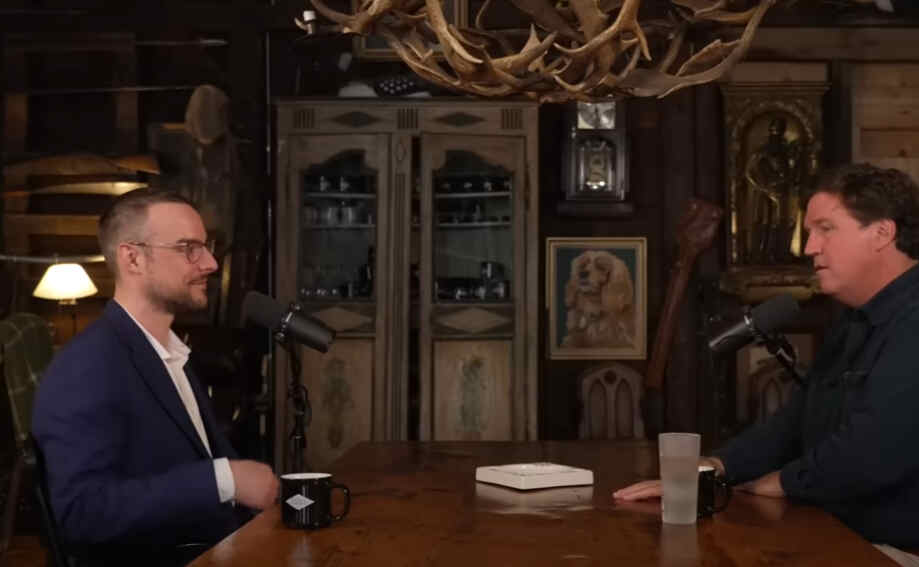
Read the full transcript of journalist Steve Robinson’s interview on The Tucker Carlson Show episode titled “Steve Robinson Exposes the Chinese Mafia’s Drug Empire Flooding the US & Politicians Covering It Up”, premiered July 10, 2025.
The Scale of Chinese Drug Cartel Operations in Maine
TUCKER CARLSON: We recently had a remarkable conversation with a man called Steve Robinson, one of the last independent journalists in the state of Maine. And he told us a story that stunned us. It’s about the Chinese takeover, the takeover by Chinese drug cartels of the largest state in the Northeast. It’s a story about what happens when immigration laws are ignored, when state and local governments fail to do their duty.
We have a documentary out about this right now. It’s on TCN. The documentary is called “High Crimes: The Chinese Mafia’s Takeover of Rural America.” It’s shocking. Watch it now. It’s available only at tuckercarlson.com. Thank you for doing this. You’re the best journalist in Maine. You’re one of about six journalists in Maine. So I don’t know, but if it weren’t for you, I don’t think anybody would have any idea what was happening in the state of Maine.
So let’s go to the story that has kind of defined your coverage over the last couple of years, and that is the – I don’t think it’s too strong to say – the takeover of rural Maine by Chinese drug cartels. I’ll stand back and let you describe the scale of this and what it is.
STEVE ROBINSON: Well, I mean, it’s shocking. I would say there’s probably 300 to 400 properties throughout the state of Maine that are under the control of what the Department of Homeland Security under President Biden called “Asian transnational criminal organizations.” Chinese mafia, I think is a better term and an easier way to understand it.
This first came to light in the end of 2023 when a reporter from the Daily Caller News Foundation, Jenny Taer, who’s a fantastic reporter, got a leaked memo that said, “Hey, there’s 270 plus of these sites in Maine and there’s another 800 in other parts of the country.” And that caught my eye. I grew up in Maine, spent my whole life in Maine, and I figured if there were 270 sites in Maine where this criminal activity was occurring, I would be able to find it.
So I contacted Jenny and I worked with her and eventually got more information about some of these sites that she knew about, identified the property owners and we visited some of the sites, started identifying some of the patterns. I basically looked at every mortgage record for the past six or seven years in every county in the state of Maine, and all the electrical records for electrical upgrades for commercial grade power which is required for these marijuana grows.
So some other financial records and mortgage documents and was able to identify well over 300 Chinese marijuana grows – unlicensed, operating in the state of Maine – just from looking at records and piecing the puzzle together, and then decided I need to go visit them to see what the story is and to confirm it. And so I drove, I mean, easily 10,000 or more miles around the state of Maine to very, very distant, remote places. Schools, factories, former shoe factories, farms, former scrap metal yards.
TUCKER CARLSON: You know, there’s the detritus of the industrial economy.
The Infiltration of Rural Communities
STEVE ROBINSON: Yeah, yeah. You know, there’s one of these next to my high school basketball coach’s house. One of these next to, you know, the guy who ended up marrying my high school girlfriend. He’s got a Chinese marijuana grow next to him. There’s a Chinese marijuana grow next to the first place that I got drunk with my high school friends. There’s a Chinese marijuana grow on my camp road that has since been busted. There’s a Chinese marijuana grow on my dad’s road in St. Albans. They’re everywhere. They’re in former schools, former nursing homes, and we were able to find them. It was easy to find.
And it turned out that one of the first things I would do when I showed up and scoped something out, I mean, you can smell it. You can see the upgraded electrical work. You can see the license plate out front from New York City. And you go and you talk with the neighbors, and the neighbors, you know, you just knock on the door and say, “Hey, I’d like to talk to you about your neighbors.” And they kind of get this look in their eye, like, finally. Like finally somebody wants to come, like, hear what we’ve been going through and what we’ve been seeing. And they’re eager to share their story.
And the story is always that in the middle of COVID a young couple that spoke decent English, were of Asian descent, showed up, bought the house, came over, introduced themselves, gave them a bottle of wine or a bottle of cognac, and introduced themselves and said, “You know, we’re getting away from Boston or we’re getting away from New York because of COVID and this is just going to be our family getaway.” And then they never saw that couple again.
And from then on, it was a steady stream of other individuals of Asian descent who did not speak English, were not personable, seldom left the house. And every 30 to 40 days, a U-Haul would arrive, usually at dark hours, you know, 3:00 AM, 4:00 AM and be there for about an hour, and leave. Then there obviously was the smell of cannabis, very pungent, and all the windows blacked out, and the electrical work and odd chemicals being dumped in the backyard and some other indicators. Sometimes they would burn to the ground because they were trying to pass through too much electricity through.
But it was – I guess it was a period of seven or eight months I spent driving all around the state of Maine and seeing story after story after story and interviewing all of these people and seeing how scared people were, how terrified people were, how well known the story was amongst people.
Why Communities Remained Silent
TUCKER CARLSON: Why were people afraid?
STEVE ROBINSON: They were for a number of reasons, I think.
TUCKER CARLSON: Everyone in Maine is afraid of being called racist. I’ve noticed. It’s the main weakness of the state.
STEVE ROBINSON: Which is what I found was the exact opposite. I found that they were willing to tolerate behavior from their Chinese neighbors that they would never have tolerated from Irish or French or English neighbors. Like, absolutely illegal dumping, breaking the transformer every other week and causing blackouts in the neighborhood. They would never have tolerated this behavior from white neighbors. But because of this inclination to not be smeared as a racist, they were willing to tolerate it.
But they were also scared because they knew the signs of a criminal organization. They knew what was going on. And the marijuana economy in Maine is big. It’s bigger than blueberries, potatoes, and lobsters. So there are enough people in the industry who are talking about this, and so there was this kind of secret, hidden knowledge of what was happening in this state, but it was like, you can’t talk about it.
The Failure of Marijuana Legalization
TUCKER CARLSON: I’m a little bit confused for a couple – I mean, there’s so many questions. I’m glad we have time. Maine has effectively legalized marijuana. Okay. So there are weed and some kind of criminal enterprise has funded all these weed dispensaries. Medical marijuana dispensaries are in every town. They’re the only new buildings in those towns, as you well know. And the idea, the way that was sold – your dog’s getting mad about this.
STEVE ROBINSON: Yes. He’s very upset with what’s happening to Maine.
TUCKER CARLSON: The way this was sold to Maine voters was, “We’re going to take the crime out of marijuana. Like, we’re going to regulate it. It’s going to – if you want marijuana, you want cannabis, you can go and get it. It’s got nowhere to be safer. It’s going to be safer.”
STEVE ROBINSON: Yeah. And the tax money, too. The tax money is – “Our schools are going to be so much better. Our streets will be safer. There’ll be so much more revenue.”
TUCKER CARLSON: No bigger liars than the marijuana peddlers after. They’re liars. I know a lot of them are liars anyway. Whatever. This is the opposite of what was promised, correct?
STEVE ROBINSON: Yes. I think that they’re – we unintentionally created a system that was so ripe for exploitation by criminal groups that you have to wonder if it was done intentionally.
The Economics of Illegal Operations
TUCKER CARLSON: Because why would they? I mean, there’s so much marijuana in Maine. You know, everyone you know grows marijuana in Maine. Its value’s fallen dramatically. I don’t know if they’re selling an ounce of weed for right now, but like not – you can stuff your mattress.
STEVE ROBINSON: Forty or fifty dollars.
TUCKER CARLSON: That’s crazy.
STEVE ROBINSON: If it’s triad weed, forty or fifty dollars.
TUCKER CARLSON: An ounce if it’s tried. I don’t smoke marijuana, but I did as a child and in 1983 it was one hundred dollars an ounce.
STEVE ROBINSON: Yeah.
TUCKER CARLSON: And that in 1983 dollars. So it’s dramatically cheaper than it ever was. So why, what’s the motive for illegal weed grows?
STEVE ROBINSON: Well, they have the advantage of not paying taxes, no regulatory compliance, they’re not paying their labor a significant amount of money. They’re using pesticides and fungicides illegally that reduce their product loss. They can also export marijuana. About two thirds of the product that they grow illegally leaves the state of Maine. Legal growers aren’t allowed to do that because it’s not federally legal yet.
So they can sell into black markets like New York for a period of time, which was a black market. You know, early on into Maine’s development of triad weed later was a gray market where they legalized it, but didn’t really have a formal system for the sale of marijuana products. So anytime you can bring your product from Maine to a black market state, you’re going to get three or four times the price. And this is something that a Chinese criminal organization can do, but the mom and pop trying to run a cannabis edible store or whatever can’t do. They can’t export their product out of state.
So if you have all these built in cost advantages, you can get a significant amount of money off of it. And they also consider it very low risk. And they were right to consider it low risk because when the state of Maine legalized marijuana, just like what happened in Washington state and in Oklahoma and in California, it created, it changes the culture in law enforcement. We sent a signal to law enforcement that marijuana was no longer a problem. It was legal. People voted, stopped paying attention to marijuana, and cops who busted significant marijuana busts were kind of laughed at. Like, “That’s just pot. That’s legal. Why are you doing that? Fentanyl is the priority.”
And we also have all kinds of legal marijuana grows happening, and that functions as camouflage for what the Chinese are doing. So it might not be the most lucrative activity, but it’s priority. It’s pretty lucrative. But it’s low risk, very low risk for them because at worst, you know, they’re going to, you know, you’re going to get arrested, you’re going to get mugshot taken, you’re going to get two thousand dollars bail and you’ll be released and probably never have to show up at court. Go to New York, get a new driver’s license with a new name, come back and find a different marijuana grow to work at. So really, no one suffers any consequences from this incredibly lucrative activity that they’re engaged in.
Personal Background and Industrial Decline
TUCKER CARLSON: You said there were illegal Chinese cartel grows all around where you grew up. Where did you grow up and what did your family do?
STEVE ROBINSON: I grew up in Dexter, Maine. It’s kind of in the, like the center of the state, Southwest Penobscot county on the border of Somerset. And my mom worked in hospital. She was a medical assistant. And my dad worked for a period of time at Dexter Shoe until our good friend Warren Buffett bought it and closed it and ruined the town of Dexter. And then he worked in car sales for pretty much the rest of my life.
TUCKER CARLSON: Your father worked in the shoe plant. Your grandfather worked in the shoe…
STEVE ROBINSON: Yeah, my grandfather also worked in the shoe factory as well. Yeah. Dexter Shoes, it used to be a prestige brand. You know, probably 800 to maybe even – maybe even higher than that if you include the Milo factory. So probably well over a thousand union jobs making shoes. But Warren Buffett thought that he could do it better, did he? No.
TUCKER CARLSON: And what happened to Dexter Maine?
The Economic Collapse of Small-Town America
STEVE ROBINSON: The town has collapsed. It’s scary, it’s sad, it’s heartbreaking to return to. The public school is the largest employer in the town. My high school or my little league baseball coach used to own one of the general convenience stores in town. Not anymore. It’s owned by a member of the Patel family, Crazy Bob’s Discount Tobacco, also owned by a member of the Patel family.
TUCKER CARLSON: Have they made it a lot better?
STEVE ROBINSON: No. No.
TUCKER CARLSON: I knew that.
STEVE ROBINSON: Yeah. I mean, there’s, I think, seven Chinese marijuana grows that were operating in Dexter, despite the fact that Dexter opted out of the state’s legal programs. So these were de facto illegal. You could look at them and tell that they were illegal, that they weren’t licensed, because Dexter did not participate in that marijuana program. Yet for some mysterious reason, the Dexter police know where they are and haven’t taken any action on them.
TUCKER CARLSON: Wait, so the town’s economy collapsed when Warren Buffett came in and over time, shut down the factory, and then it was invaded by people from Asia who took over the businesses and then started seven illegal marijuana grows. Seven in the town.
STEVE ROBINSON: Didn’t happen that fast. Didn’t happen exactly that fast. So I think Buffett’s acquisition of Dexter Shoe was in, like, ’96 or ’97. I remember it. Yeah. And it kind of limped along for a little while. And there were some other attempts. There were some other businesses in Dexter. It was a town of about 4,000 people at the time. I think it’s now down to 3,500.
But when I go home, I don’t recognize anybody in Dexter anymore. And my family, my friends, for the most part, have all moved away. I see Dexter in the headlines a lot for fentanyl raids and busts, but the town has really been hollowed out. And I think it was the collapse, the economic collapse, and the despair in the town just created low real estate prices for entrepreneurs from foreign countries to take advantage of.
TUCKER CARLSON: And just bleed it of whatever was left.
Government Programs Enabling Foreign Takeover
STEVE ROBINSON: Yeah. And we’ve actually, we as in the United States have created programs that help them. We’ve taken money from United States taxpayers to help both the… I mean, we don’t necessarily need to get into the Patel Hotel cartel, but they’re taking advantage of Small Business Administration loans. And it took until just recently with the election of Trump, to stop SBA loans to foreign nationals and non-citizens. I don’t know why we were giving SBA loans to non-citizens. That’s interesting.
TUCKER CARLSON: I just want to… Because I’m familiar with what you’re talking about. I just want to say emphatically that there’s been not only no improvement. So these stores, which are often, very often the only store in a town.
STEVE ROBINSON: Best pizza. Best pizza, coffee. You know, the centerpiece of the town, the town common.
TUCKER CARLSON: It’s the town hall. Yeah, of course, everybody’s there. And they’ve been taken over almost exclusively by foreigners from the subcontinent. And they have, I’ve been to many of them. They’ve all gotten much worse, much worse. Selling drug paraphernalia, just garbage products, hostile. Have you seen any improvement?
STEVE ROBINSON: No. And they’re also, I mean, they’re selling cannabis product derivatives that were legalized by the farm bill, that legalized hemp, and unintentionally created this huge world of dodgy unregulated drugs that are available for minors. And in many instances, it’s these specific convenience stores that are selling these hemp derived products which are, I guess THC or marijuana adjacent will give you kind of the similar experience, but are wildly under regulated and untested, dangerous.
The Degradation of Rural Commerce
TUCKER CARLSON: Every illegal Chinese vape is for sale. I mean, it’s the most degrading thing I’ve ever seen. It makes me want to get a gun every time I walk into one of these places. It’s such a, it’s just parasitic behavior in the most obvious way and a hostile.
STEVE ROBINSON: So, and there’s no, there’s… We have no immune system as a state to repel what’s happening because there’s not enough capital to come in. There’s no competitor to foreign money coming in with an SBA loan and buying up Toots Delicatessen and Dexter. There’s no one else who could possibly buy that store. And there’s no one who would want to, frankly.
TUCKER CARLSON: So I’ve seen, and I hate to get sidetracked, but it’s such a big question in rural America, who runs the general store, the convenience store, the gas station store, whatever you call it, it’s the center of every little town. And if all of a sudden in the space of five years, they’re all run by non-citizens from India and they’re all getting worse and they’re all engaging in business practices that are almost intentionally degrading of the people who live there. Like no, we only sell generic cigarettes, illegal Chinese vapes, and some kind of weird non-regulated narcotic and bongs and crack pipes. That’s literally what’s happening.
STEVE ROBINSON: Yes.
TUCKER CARLSON: And there’s garbage piled up outside. I mean the whole thing is like beyond belief. You have to sort of wonder like, what actually is this? Are these incredibly profitable businesses? This seems like a scam of some kind. But last thing I’ll say, I know this for a fact. A lot of these places, if you look at the tax records, they trade for, you know, 300 grand or something, but most of the transaction is off the books in cash. So they’re dodging taxes actually.
STEVE ROBINSON: And they shift around from one trust to another trust and then back to another trust. There’s very complicated, very complex financial schemes at play.
The Immigration Visa Scam
TUCKER CARLSON: So what is this is clearly a scam. There’s a criminal scam. I don’t think it’s just in the state of Maine. I think it’s probably all throughout. I know it’s in New Hampshire as well, in Vermont. What is this scam?
STEVE ROBINSON: Well, they’re certainly not making money off the hotels that they operate in the general stores. If you look at a town like Lincoln, Maine, something similar has happened where one family from away from out of state has come in and purchased competing rival gas stations. But there’s one gas station that’s still owned by a local. And so naturally the people who know the guy who owns the store and don’t know the guy who owns the other stores will go and patronize the guy that they still know.
So as business has declined to these other general stores, somehow they’re still thriving. And initially their employees are locals and Mainers, but then eventually there’s a new class of employees who are brought in, who are brought in very likely on visas, who are also from away. So I think that if you look at some of the…
TUCKER CARLSON: From India.
STEVE ROBINSON: Yeah, I think that if you look at some of the cases that have been filed even under the Biden administration against operations that look a lot like what’s happening in Maine. They’re immigration scams. They’re using these businesses as a pretext to get SBA loans and also to get access to visa programs so that they can sell legal entry into the country to people back in.
TUCKER CARLSON: So they’re selling those visas.
STEVE ROBINSON: To be clear, I don’t have proof that that’s happening in Lincoln or Dexter, but there are indictments. There’s one I know of very well in Texas that’s exactly what was happening.
TUCKER CARLSON: Made every town where I’ve seen it. And it’s, you know, a dozen or more worse.
STEVE ROBINSON: Yeah.
TUCKER CARLSON: So that’s kind of, you know, okay, there are a million scams, but like, if you roll into somebody’s town and degrade it on purpose and make it much worse, you know, I think that’s a moral crime. And there’s been no response at all. Okay.
STEVE ROBINSON: Yeah. And I was actually asked about a food pantry operation that they were trying to set up in Dexter. They’re trying to raise some money to help give out food to poor people. And I asked how much of the new owners of Dexter Variety and Toots Delicatessen contributed to this charity operation, their new pillars of our community and small business owners, how much have they given? And I was never given a very good answer on that.
TUCKER CARLSON: Yeah, the answer is zero, of course.
Government Subsidized Property Purchases
STEVE ROBINSON: But that’s only one aspect of how the United States taxpayer is subsidizing this. What’s happening here about, I would say a third of the properties in the state of Maine that would go on to become illegal Chinese marijuana grow houses were purchased using mortgages through a program called the Community Development Finance Institution. It’s a designation that you give to banks. The entire purpose of the program is to help marginalized communities access financing.
The idea is that if you were an immigrant in the 1980s, 1990s, you couldn’t prove regular income. You had irregular finances and trouble accessing a mortgage. So they created this special program to take away some of the risk from the lender. So there’s one bank in New York, Quantic bank, that has the CDFI designation. And on their website they advertise that they’ll help non-citizens, foreign nationals, buy property in the United States. This bank advertised on…
TUCKER CARLSON: I’m trying not to use the F word. Why would we be helping foreign nationals buy in places where there’s a housing crisis and the people who are born there can’t find a house to live in? And what is going on?
STEVE ROBINSON: And then why, under Covid, would we supercharge the program with an additional tranche of funding? Why would we put that program on steroids? I don’t know, but I know that it…
TUCKER CARLSON: Was kill the people because you want to kill and replace the people who populate your country. That’s why. Replace them with other people.
Chinese Gang Operations Exposed Through Banking Records
STEVE ROBINSON: Obviously, in looking at the mortgage records, having to actually look at the physical records themselves, I cottoned onto this Quantic bank pattern. And it’s just a quirk of how the registry of deeds records work that you can search by the lender. And so I searched Quantic bank just to see, do they loan to everybody or are they just suddenly a new domain?
And I would say 95% of their loans were post-2019 and exclusively people with Chinese names from New York and from Boston. And in further reviewing those records, I found there were two individuals, two loan officers who were originating almost all of those loans, 95% of those loans. And one was a Taiwanese national and the other was a Chinese national who graduated from a university in China that’s affiliated with the PRC’s economic warfare program.
And I actually got phone interviews with them. They’re on our X page. You can go listen to them. I asked Ying Chan Wang, I said, “Did you know that these properties of all these loans that you’re doing were becoming illegal marijuana grow houses?” She said, “What? No. No way. Well, I’ll have to say something about this. We’ll have to put a stop to this.” Did they not? I don’t know. I’m unaware. I am unaware.
I know that there’s been a lot of letters written by politicians about the CDFI program about why we’re doing this. But the horses left the barn at this point. I mean, they have the properties now, and they have the means to generate as much cash as they want. This was a gold rush in Maine. That’s what it was.
Maine’s Marijuana Legalization Creates Criminal Opportunity
STEVE ROBINSON: When we legalized marijuana, there was a vote in 2016. The state came out and said, yes, we want adult use marijuana legalized. They formalized the program in 2020 and created an adult use program and a medicinal program, which are very distinct. And the medicinal program is vastly under regulated compared to the adult use recreational program, which is counterintuitive, but the medicinal program is like the wild, wild West.
But when we did this, we created just a pig scramble for a 5 to 10 billion dollar market for this drug. And the forces that we unleashed and the forces that were brought to bear on Maine to access that money, we weren’t prepared for. The local police weren’t prepared for it. The sheriffs weren’t prepared for it.
TUCKER CARLSON: They were told this was going to solve the crime problem associated with illegal drugs. If you legalize something, there’s no more crime.
Police Encounters with Chinese Gang Operations
STEVE ROBINSON: Yeah. In 2021, in Turner, Maine, at 57 Conant Road, there’s a hangar right next to Twitchell Airport. It’s a disused airport.
TUCKER CARLSON: I know it.
STEVE ROBINSON: The police have been there many, many times. We got police records from early 2021 where they had been called there for what they were told was a hostage situation. And when the police show up, there’s Chinese individuals who only speak Cantonese running out in the woods. Total chaos. They can’t really discern what exactly is going on, but it’s a civil dispute, and they decide it’s not their problem. But in their notes, they say that they believe the property is under the control of a, quote, “Chinese gang from New York” that was in early 2021.
TUCKER CARLSON: That was in their notes?
STEVE ROBINSON: In the incident report. They say that they wasn’t their job.
TUCKER CARLSON: To do something about it.
STEVE ROBINSON: You think there’s never been any arrest made in connection with that facility, which functioned according to the state police as an illicit marijuana grow controlled by Chinese gangs from New York. The Office of Cannabis Policy, which regulates all of this, has suspended numerous licenses for Chinese marijuana growers from out of state who are affiliated with that property. There’s never been any arrests made at that property until December.
Last December, a guy named William Robinson, no relation, was shot in the head there by a drug dealer. And the guy who shot him allegedly was later arrested hiding at a marina in San Diego.
Scale of Chinese Gang Operations in Maine
TUCKER CARLSON: You say there are, you believe around 300 Chinese gang controlled drug operations in Maine.
STEVE ROBINSON: There are grow houses, there are flop houses, there are prostitution houses masquerading as massage parlors. There are some, I guess, financial hubs that you might say in Kittery and Old Orchard beach in southern parts of the state. There are other facilities that seem distinctly militaristic in character.
TUCKER CARLSON: What does that mean?
STEVE ROBINSON: Your hair stands up on end when you go by. I’ve knocked on the doors of a lot of marijuana facilities, but in Greenbush, Maine. It’s about 35 minutes north of Bangor. Very rural, but there’s an area where there are multiple adjacent properties, all controlled, all fenced off. Motion sensors on the road so that they know if someone’s coming well in advance.
And blue collar workers I’ve talked with who have had to come out and do some service at those properties have talked about being surveilled by crews of eight young Chinese men, close crop haircuts, fatigues.
TUCKER CARLSON: Fatigues.
STEVE ROBINSON: What there was described to me as fatigues standing around the perimeter of the property. And when they need to access the property to do some load testing, if they’re, for example, an electrical worker physically stopped and prevented from accessing the property and they’re escorted off the property and two crisp $100 bills tucked into their back pocket. And they say, “Coffee money, coffee money, coffee money.” And they push them off the property.
TUCKER CARLSON: Things are completely out of control in Maine, obviously. Yeah, completely out of control.
STEVE ROBINSON: Yeah.
Law Enforcement’s Ineffective Response
TUCKER CARLSON: I should just say, for the record, it’s pretty state. Out of 50 nicest people, lowest crime rate for my whole life. I’m 56, so a long time. And you’re describing like something’s really, really dark. How many of those facilities have been shut down by state or local law enforcement?
STEVE ROBINSON: It depends on what you mean by shut down. You can execute a search warrant on one of these facilities. You can go in, you can arrest some people, you can destroy their plants, but the very next day, it can get spun up. And all they have to say is that they’re getting a license. They’re in the process of getting a license to operate legally, and then law enforcement can’t touch them.
I saw this exact same thing happened in Franklin County. There was a raid at a location in New Sharon. And I showed up the following day because I wanted to document it. And there was a big white truck from Grow Generation, which is a marijuana growing supply company, a fairly big one in Maine, backed up, and there was a crew of workers offloading material. So it’d been raided the day before by the sheriffs. And the following day, they’re spinning it right back up.
And I emailed the sheriff and said, “Hey, just so you know, like, these guys are right back at it. I’m watching them. You can come over here.” And he said, “They say they’re getting a license now, so I can’t touch them.”
TUCKER CARLSON: So if I get pulled over without a driver’s license and I say I’m going to get a driver’s license, they let me go. I don’t think so.
STEVE ROBINSON: No.
TUCKER CARLSON: No, they take my car, actually. So how is that. I mean, with respect. With actually with no respect at all to the sheriff you’re referring to. How is that like, how is that.
The Property Owner Loophole
STEVE ROBINSON: So it’s kind of genius, the way they’ve set up the scheme in that the property owner is never the one who is there growing the marijuana or picking up the marijuana or trafficking the marijuana. And so they’re never held culpable for the activity happening at their property, because they can always have plausible deniability. “Oh, I was renting to my cousin. I was renting to a stranger. You know, I just found this guy on WeChat and rented the property to him. I had no idea this was going on. I’m so upset that this is happening. Thank you, law enforcement for doing this for us.”
So in January, the director of the Office of Cannabis Policy, handpicked by Governor Janet Mills, a guy named John Hudak, admitted.
TUCKER CARLSON: What’s his name?
STEVE ROBINSON: John Hudak.
TUCKER CARLSON: John Hudak.
STEVE ROBINSON: He came from Colorado. He has a long career, been a huge success there.
TUCKER CARLSON: The cannabis legalization.
STEVE ROBINSON: He’s been involved in cannabis. Brookings totally destroyed Denver. He came from the Brookings Institute.
TUCKER CARLSON: How do you spell his last name?
STEVE ROBINSON: Hudak. H-U-D-A-K. John Hudak.
TUCKER CARLSON: Okay.
State Officials Admit Licensing Known Criminal Operations
STEVE ROBINSON: And he is in front of the Veterans and Legal Affairs Committee testifying for the first time this year of this session. And he admits that he’s been giving licenses, medicinal marijuana licenses, to individuals that he suspects have ties to Chinese organized crime. Or he’s giving licenses to people who provide addresses for their grows at properties that have been previously raided for their connections to Chinese organized crime. And that his hands are tied. There’s nothing that he can do about it.
TUCKER CARLSON: How about say no?
STEVE ROBINSON: That would be racist.
TUCKER CARLSON: The state has no immune system. That’s it.
Jurisdictional Challenges Enable Criminal Operations
STEVE ROBINSON: You’re exactly right. There’s no immune system. We have no defense. And if you look at like, you know where I’m from, Dexter, you had Dexter, Ripley, Cornet, Cambridge, all these towns, three different counties represented. But you’ve got one criminal group that’s operating in three different counties. So three different sheriffs have jurisdiction and multiple different local police departments. And some of these towns don’t even have police departments.
But they’re not, as a matter of course, sharing intelligence. So in order to take down a criminal operation that’s straddling three counties, you need to get cooperation amongst these three sheriffs who don’t just always cooperate. So it requires a herculean effort amongst law enforcement to coordinate one of these crackdowns or one of these raids that are going to be effective at actually arresting people, detaining people who could be witnesses, who could explain more about what’s ultimately happening.
But by and large, there’s no effective enforcement. And the Maine State Police have been AWOL. Totally, totally AWOL. The one police force.
Federal Intelligence Confirms Criminal Operations
TUCKER CARLSON: Okay, so just to be. I just want to make sure I understand this. You were tipped off this story by a Daily Caller News foundation reporter who had a state generated list, CBP.
STEVE ROBINSON: This was generated by Customs and Border Protection.
TUCKER CARLSON: I’m so sorry. Okay, so it was the feds, but it was. I mean, a government agency identified these places, so it’s not like you’re just guessing.
STEVE ROBINSON: Yeah.
TUCKER CARLSON: And the Maine state police, that was a couple years ago, they’ve done nothing.
STEVE ROBINSON: They’ve been involved in three raids and two of them were in Belgrade about a mile from the state police headquarters. And the reason they raided those is because six months before we started drawing attention to them, one of their troopers had been inside, seen 500 or 600 marijuana plants, talked to the Chinese individual who voluntarily let the trooper in. So all this is admissible. Talked to the Department of Agriculture, talked to the Office of Cannabis Policy, confirmed that it was an illegal grow and didn’t do anything to it for six months and allowed it to continue to operate.
So it’s my belief that those two operations in Belgrade were CYA. They didn’t want it later to look like a cover up on their part.
TUCKER CARLSON: So this is just corruption. I mean, you’re describing corruption.
STEVE ROBINSON: I mean, what else explains it? The governor of this state has yet to utter a single word about a vast criminal conspiracy operating in her state.
TUCKER CARLSON: As a result of this conspiracy, we.
Chinese Criminal Organizations Operating Across Maine
STEVE ROBINSON: Don’t even know how many people have been killed in Freedom, Maine. There was a house, 555 Belfast Road, been busted by the sheriff out there for functioning as an illegal marijuana grow, subsequently turned into a flop house. And there was a carbon monoxide poisoning incident.
There were, we think, about four or five Chinese migrants living there, poisoned by carbon monoxide, hospitalized, two of them died. Somehow the exhaust of the heater just piped back in through the window. It was an accident. Officially on paper is what law enforcement have determined. Somehow the propane heater, the breeze must have caught it and piped it back in through the window.
And there was no outpouring of progressive goodwill or mourning for these poor Chinese migrants who died at a flop house in Freedom, Maine. But, I mean, it was an attempted mass murder, in my opinion. There’s no way the exhaust just accidentally pipes back into the house. No, this was an attempted hit on Chinese migrant workers at a flop house. This was triad on triad violence which we’ve seen, we’ve documented.
There have been burglaries. There was the shooting I just talked about at the marijuana grow in Turner. And that individual, after he shot his friend in the head, turned to one of the witnesses who I’ve talked with and said that he was a hired hitman for the triad and that there were 40 more just like him. Maybe he watched too many video games or too many movies or whatever, and he was lying. Or maybe he was telling the truth. I don’t know.
TUCKER CARLSON: So there’s more than one Chinese criminal organization?
STEVE ROBINSON: There are multiple families, for sure. Multiple regions, I think is safe to say. Yeah.
Governor Janet Mills’ Silence on the Crisis
TUCKER CARLSON: And the governor’s not said one word about this?
STEVE ROBINSON: No.
TUCKER CARLSON: Who is the governor?
STEVE ROBINSON: Janet Mills. She was an attorney general under Governor Paul LePage. She was a district attorney before that. She’s been a government employee for basically her entire life. Came out of Farmington, dropped out of Colby, she claims on her own free will, and then graduated from the University of Massachusetts in 1970, although she’s not listed in the program for that graduation ceremony. It’s the weirdest thing, but she’s been governor now for about six, seven years.
TUCKER CARLSON: So it makes you wonder, like, what is her position on illegal drugs, which are destroying the state? I think any fair person would say that.
STEVE ROBINSON: The state under Governor Mills has embraced restorative justice and harm reduction and the idea that if you stop enforcing laws against drugs and you pass out needles and Narcan, that that is going to be good for society. I think the plain, objective evidence is that that’s been a complete failure.
But on the Chinese criminal conspiracy in the state, we’ve approached her at events and tried to ask her about it, and she won’t answer questions directly. So that is the million dollar question.
TUCKER CARLSON: So do you have any evidence that suggests a motive for ignoring something this destructive?
STEVE ROBINSON: Well, part of it could just be ego. It could just be that it’s the main wire and we are the conservative outlet in the state. And maybe if she acknowledges the problem of Chinese criminal organizations in this state, it’s in some way validating the work that we’ve done to expose the problem.
And if you accept that the work that we’ve done on Chinese criminal organizations in the state is legitimate, valuable journalism, then you have to ask, well, what about the other investigative projects that we’ve worked on, which I also think are valuable journalism for the state? So maybe it’s just a…
TUCKER CARLSON: The only journalism in the state. Let me just correct you. The only journalism in the state.
STEVE ROBINSON: With all due respect to your friend Steve Collins, there’s really…
TUCKER CARLSON: There’s no journalism in Maine at all. 1.3 million people. Largest state in New England. Bigger than the other five New England states combined. I mean, it’s a real place. No journalism.
STEVE ROBINSON: A lot of stenography, what you’re doing. Yeah.
TUCKER CARLSON: And propaganda. But so I’m just, but I’m interested. Like that’s a huge footprint across a huge state. So a lot of people know this is going on. And she hasn’t said word one, much less done anything to stop. Does feel like someone’s getting paid.
Evidence of Corruption and Bribery
STEVE ROBINSON: I am increasingly of the belief that there’s a lot of bribes being paid in the state. Small stuff to code enforcement officers, police departments. It’s really the only way that explains the lack of action.
And we did discover in reviewing property records there was a raid, this was in 2024, in February, that kind of targeted the area around my hometown, the town that my mom grew up in. I mean, from this marijuana house that was raided in Corinna, you can see the church that my brother was married in and that my grandmother used to go to.
It’s a big beautiful main house that will probably have to be destroyed now because of the poisons and the mold and everything that afflicted the house as a result of it becoming a marijuana grow. But there was this coordinated raid with the sheriff’s very effective law enforcement action.
And in the days after that, there was a real estate transfer done for a property in Corinna, Maine, in the same town for a 12 acre property. A tear down, really like a hunting camp. And it was a transfer of a property from a Chinese woman living in Massachusetts to another Chinese person living in Guangdong Province, China. So it struck me as unusual.
TUCKER CARLSON: Oh, did it?
STEVE ROBINSON: Yes.
TUCKER CARLSON: A little weird.
The Governor’s Brother Connection
STEVE ROBINSON: It was a little weird. And then on the real estate transfer document, it said that this was a “gift to mother” and my mom was from Corinna. And so I thought to myself, if I told my mom that for Mother’s Day I was giving her 12 acres and a tear down in Corinna, Maine, she would probably slap me. So, again, this is an unusual gift to your mother.
But what really struck me as unusual about it was the fact that the attorney who processed the real estate transfer was Paul Mills of Farmington, Maine, who is the older brother of Governor Janet Mills.
TUCKER CARLSON: What? Wait, the governor’s brother is involved in this?
STEVE ROBINSON: The governor’s brother has been involved in notarizing deeds for individuals connected to Chinese organized crime and was the real estate transfer attorney specifically for this property, which he helped transfer as a “gift” to the ownership of a Chinese national who owns multiple marijuana grows in the state of Maine. And it was done days after a law enforcement action in that area.
TUCKER CARLSON: That’s shocking. That’s shocking.
STEVE ROBINSON: I don’t know what the fee on a real estate transfer document is, but I’ll tell you. I called Paul Mills and told him that I was from Massachusetts. I was looking to do a gift transfer in Corinna and I was wondering if he’d help process this real estate transfer for me. And he told me that he didn’t do work in that area.
TUCKER CARLSON: But you had evidence he’d just done work in that area.
STEVE ROBINSON: Exactly.
TUCKER CARLSON: So if you had said “I’m calling from Guangdong Province and I’d like to open another illegal drug operation in the state.” You think that would have been different?
STEVE ROBINSON: I don’t know. I don’t know who called him. I don’t know if he was maybe a useful idiot or maybe it was an element of Chinese culture where they think that they need to pay some kind of a tribute to the elected official in charge to their family members in order to get some kind of…
TUCKER CARLSON: We’ve actually done that before.
STEVE ROBINSON: Right. But I actually called Paul Mills as myself and gave… We had a 10 minute interview about this property and he said their friend asked him to do it and couldn’t remember who.
TUCKER CARLSON: Couldn’t remember who? Couldn’t remember who the…
STEVE ROBINSON: Friend was who asked him to do it, but he remembered a lot of details about…
TUCKER CARLSON: He’s the governor’s brother.
STEVE ROBINSON: Yes.
TUCKER CARLSON: The sitting governor.
STEVE ROBINSON: Yes. And I printed off copies of the real estate transfer record with his name on it with the address in Guangdong Province, China, where this new owner of 12 acres and a tear down in Corinna, Maine. And I have the code enforcement officer on the record saying this is an illegal marijuana grow. And we would not authorize it because Corinna opted out.
We went to the State House and we passed out… I printed out 50 copies of this real estate transfer record and I passed them out to politicians, I passed them out to other reporters. I sat in the governor’s lobby with a camera focused right on the door, just waiting for an interview. And they actually canceled one of her meetings with school board members and snuck her out the side door so that she wouldn’t have to answer questions.
And even though I scattered, I blanketed that place. I was like South Korea flying over North Korea, dropping flyers, trying to get people to pay attention to this stuff. And no other outlet in the state of Maine covered it.
TUCKER CARLSON: Nobody else covered it but you.
STEVE ROBINSON: No one.
Personal Safety Concerns
TUCKER CARLSON: I have so many questions. Okay. I just want to sort of pause and ask the obvious question. So that suggests such a deep level of coordination and terrifying corruption. I mean, are you worried for your safety?
STEVE ROBINSON: Yeah, I… Yeah, yeah. I mean, it’s difficult to… It’s difficult to know how worried you should be in a situation like this. What exactly is the…
TUCKER CARLSON: If they’re allowing Chinese drug cartels to control huge swaths of rural Maine and people are dying, the governor herself is saying not one thing to try to stop it. And the entire rest of the state’s media is ignoring it. That sounds like a level of corruption that would have been unimaginable in this country five years ago even.
STEVE ROBINSON: Yeah.
TUCKER CARLSON: And if you’re the one guy saying something about it, which you are, I don’t know, I mean, where does that leave you?
Media Blackout and Corruption
STEVE ROBINSON: Before I’d even reported anything on this, I had a Excel spreadsheet working on a database keeping track of records of sites we’d flagged from financial records, tax records, electrical records, sites we’d visited and confirmed, sites where we talked with the neighbors. And at that point I’d identified maybe 150 or 175 of these sites and actually sent it to the Bangor Daily News because I hadn’t reported anything about it.
But I was scared and I thought that if we all reported it at the same time, it would kind of diffuse the attention. And I was willing to give up the, I guess, whatever, the prestige of being the one who gets the scoop to have us all come forward and report on this problem. And they’ve never used it, they’ve never reported on it, they’ve never touched it.
I don’t know. I mean, it’s just maybe their pride of not relying on… I’m not a journalism school graduate, so maybe they don’t want to use it or some dirty trick by the conservative media that I’m trying to pull on them. But they haven’t used it. And I, at the same time, because…
TUCKER CARLSON: It reflects poorly on the Democratic administration that runs the state. Maybe that’s…
STEVE ROBINSON: That’s it.
TUCKER CARLSON: Yeah, yeah.
The Simplest Explanation
STEVE ROBINSON: I mean, that’s sometimes the simplest explanation is the correct one. It also could just be laziness, a lack of curiosity. And this is a story that can’t be told merely sitting or discovered merely sitting behind your computer. You know, you have to actually be able to be going out and talking to people and knocking on doors and taking some risks.
But it was around the same time though, that after I’d been out like the entire day, knocking on fields a lot in Madison and that area – beautiful town used to be – and I realized I was like, man, this is a real vast conspiracy. And it just kind of dawned on me how insane this entire thing was that this was being allowed to happen in Maine.
And I was like, the law enforcement has to be on this and I don’t want to be the guy who comes along and reports on this and messes up this big investigation that they’re about to close the loop on. So I drove to the Maine State Police headquarters, and I walked in with my laptop, and I told the receptionist, “I have evidence of a vast criminal conspiracy currently operating in the state of Maine. And I would just like to turn over some information to somebody, to anybody, because I don’t want to interfere with some active criminal investigation.”
And I waited in the lobby for 15 minutes, and then some woman came out and said, “There’s nobody here who can talk to you.” And I contacted the…
TUCKER CARLSON: Where was this?
STEVE ROBINSON: This is right in Augusta, the Department of Public Safety building.
TUCKER CARLSON: Augusta is the capital of the state.
STEVE ROBINSON: Yeah. And then I contacted the…
TUCKER CARLSON: “There’s nobody here who can talk to you.” This is in the Public Safety building in the state Capitol. And you say, “I have evidence of a vast criminal conspiracy.” And you’re a sober, sane person, probably the single most famous journalist in the state of Maine at this point. In fact, you are, and no one can talk to you.
STEVE ROBINSON: Granted, it was 4:25.
TUCKER CARLSON: Oh, yeah, right. Okay.
STEVE ROBINSON: It might have been a Friday, so they’d probably clocked out by that time. But I contacted the director of communications for the State Police and reiterated what I’d said. And I contacted some other members of the state police that I knew through family connections, some fairly high ranking who used to be very big fans of mine when they heard me on conservative talk radio but don’t want to talk to me anymore and reiterated what I’d said.
And, you know, I was… The communications director told me somebody would call me on Monday, and that was must be 120 Mondays ago at this point. So they have no interest, no interest in talking to me or hearing from me. The troopers I’ve talked with are mystified by the decisions that their leadership are making as well.
TUCKER CARLSON: Who’s making those decisions?
STEVE ROBINSON: Well, Michael Sauschuck, former police chief of Portland, who everybody in Portland was glad to see him leave when he got picked to be the head of the Department of Public Safety. So he runs the Maine State Police. And the main name of the… Michael Sauschuck. Yep. And he runs the main drug enforcement agency and the Maine State Police. And he’s a cabinet nominee of Governor Janet Mills. He also has yet to utter a single word about this criminal conspiracy.
A Great Evil in Plain Sight
TUCKER CARLSON: I mean, just hearing this story, which is one of the most shocking stories I’ve ever heard in a lifetime of hearing shocking stories, makes the hair on your arm stand up because it feels like there’s this great evil, there’s this great destruction of human life. There’s this great crime taking place in public. Everyone can see it. Chinese drug cartels control a lot of the state of Maine, and it feels like everybody’s in on it, and you’re the only person saying anything about it. I mean, do you have trouble sleeping?
STEVE ROBINSON: Sometimes? Yeah. I mean, it’s been a battle for sure.
TUCKER CARLSON: Why are you doing this?
STEVE ROBINSON: I feel like I owe it to my state. You know, I feel like I had such a great childhood, a wonderful childhood as a latchkey kid. And I loved Maine, and I loved being able to grow up and ride my bike anywhere and be safe. And I feel like the people, my people, are being taken advantage of by powerful forces that they’re unequipped to repel. We don’t have an immune system for this.
And the only thing that I can do to fight back is to put a spotlight on it and to expose it. It’s like my riding around with my grandfather in a pickup truck in Ripley, Maine, and he sees some garbage on the side of the road, and we stop and I ask him, “What are we stopping for?” He’s like, “This garbage, we had to pick it up.” “It’s not our garbage. We didn’t leave it there.” He’s like, “Yeah, but I get trash bags, and we get time. And this our town, this is our community.”
You know, it’s my version of that. We’re taking out the trash. We’re picking up our backyard. That’s what needs to be done. And there’s no one else who’s doing it. You know, I love this state. I don’t want it to become just like a festering gang bang for third world criminals.
Where Are the Watchdogs?
TUCKER CARLSON: And so it’s becoming very fast. Faster than I’ve ever seen anything change. Okay, so now to the question of the watchdogs, the constitutionally protected watchdog class we call the media in Maine. There are three big papers. One in Bangor, one in Lewiston, one in Portland – Press Herald, Daily News, Sun Journal. And they, you know, they’ve been around a long time. They had big staffs at one point. Like, where are they? Why no coverage? I can’t. It’s blowing my mind.
STEVE ROBINSON: I mean, they’ll cover something if there’s a press release. You know, if there’s a raid that a sheriff does. I mean, Sheriff Dale Lancaster in Somerset county is probably the best sheriff in the state of Maine, probably the best law enforcement official in the state of Maine. Old School, no excuses, no BS, kicking doors in. You know, he’s been responsible for the vast majority of the successful search warrants that have been executed and a lot of the arrests. He’s been very successful.
And he’ll put out a press release and there’ll be some coverage, but they, you know, they’ll be very careful not to note any of the patterns. You know, they’re very diligent about not recognizing the patterns.
TUCKER CARLSON: But you’ve already done the reporting, like you’ve put online. And unfortunately, since it’s Maine and it’s considered far away and remote and people don’t pay attention, it hasn’t gotten the coverage it deserves, in my opinion. But you’ve put the facts out there like they could follow up on that at any moment, and they’ve decided not to. So reprinting press releases is not journalism, of course. It’s a transcription service. Who owns the media in Maine? Who’s responsible for this? Deliberately ignoring a crisis.
George Soros Controls Maine Media
STEVE ROBINSON: So the largest newspaper company currently is owned by the Maine Trust for Local News, which is a subsidiary of the National Trust for Local News, which is a nonprofit funded by George Soros.
TUCKER CARLSON: Oh, so George Soros controls the media in Maine.
STEVE ROBINSON: He funds it. He specifically funded the transaction to acquire these papers from Reed Brower, along with Hans Jorg Weiss, who’s a Swiss national who made his fortune doing illegal bone cement experiments on humans, who’s been in trouble in the past for illegally donating as a foreign national to US Political candidates. So has a knack for trying to influence American politics.
TUCKER CARLSON: Why would George Soros want to control the media in Maine?
STEVE ROBINSON: Yeah, so Maine’s going back to the 1980s. Maine’s been a cheap date for people looking to trial political ideas, you know, beginning with the shutdown of Maine Yankee, our nuclear power plant. There’s really just three media markets, like you said, just a handful of newspapers. And if you want to get a ballot initiative done or something like that, it doesn’t take a lot of money.
So you can come to Maine and you can close a nuclear plant. You can get gay marriage referendum passed. You can get marijuana legalized as a referendum for a small amount of money. And then you can go to another state and say, “Well, we’ve already done it in Maine. We can do it in this state.” And so we become kind of a petri dish for political experimentation that particularly the progressive left has taken advantage of in a very successful way. Very successful.
Maine: Targeted for Being Too White
TUCKER CARLSON: Maine was always the whitest state in the United States has long been and was a target for that reason too. And they said that out loud. “Maine’s too white.” And so there is a sense in which it was targeted because of its demographics. I mean, they’ve said that. I’m not guessing at all.
STEVE ROBINSON: Yeah, I mean, going back 30 years, under Governor John Baldacci, Lewiston famously became a sanctuary city for Somalis.
TUCKER CARLSON: Can you describe Lewiston? What does Lewiston mean?
STEVE ROBINSON: The Atlantic, I think, described it as “Little Mogadishu.”
TUCKER CARLSON: Lewiston, it’s on the… It was a mill town.
STEVE ROBINSON: Yeah, it used to be a… It was a Franco American town defined by the immigration of French Canadians coming down to work in factories. So it was an urban Franco town.
TUCKER CARLSON: Textiles and paper.
STEVE ROBINSON: Yeah.
TUCKER CARLSON: And biggest mills in New England there right on the Androscoggin river.
STEVE ROBINSON: Working class people. And then an adjacent town, Auburn, frequently referred to as LA – Lewiston Auburn, it’s, you know, I would say it’s the second biggest metropolitan area in the state. But now I would say it’s a no go zone. It’s not something that people feel safe. You know, the people who supported turning Lewiston into a sanctuary city for Somalis have now spent as much money as they can to get as far away from Lewiston as they can.
TUCKER CARLSON: When was the last time you moved to Camden?
STEVE ROBINSON: I have to drive through it frequently for work.
TUCKER CARLSON: How’s it look?
Third World Transformation
STEVE ROBINSON: Third World? I mean, it’s not doing great. And there are people who will be partisans for Lewiston that it’s on the verge of a comeback and you get in trouble if you criticize Lewiston. But we cover police reports, we cover crime reports, we talk to Lewiston police officers. We know what’s happening in Lewiston.
There are 16 and 17 year olds engaging in gunfights on the streets. And when the police show up to talk to people, nobody will talk. People are getting shot and nobody will talk. People who get shot won’t talk about who shot them. So the police are frustrated and they’re all just, you know, looking at the clock and wondering when they can start collecting their pension.
But it’s just a symptom of the law enforcement is just retreating across the board. Whether it’s the crime that’s happening, the drug crime that was happening in Portland, when they’re basically allowing open opioid use and not arresting people, including people who are selling narcotics, whether it’s the gun crime in Lewiston or the Chinese organized crime, all of this. There’s just law enforcement. Have they pulled back?
Republicans Avoiding the Real Issues
TUCKER CARLSON: What’s so scary to me is that Maine is now considered a blue state. A lot of the state is not blue at all. Is not in favor of this. It’s the southern parts of the states, coastal parts of the state’s. The first district that has been, you know, completely changed demographically and now is, you know, totally in the hands of the Democratic Party.
But what’s interesting is the Republican candidates in Maine, the ones who are lining up to run for governor, for example, in this coming election, none of them, from what I can tell, have even mentioned demographic change, crime and drugs. Those are not issues that Republicans want to talk about. Even though they are the issues. They’re the only issues.
STEVE ROBINSON: I think drugs that I’ve seen. A lot of them have talked about drugs. But there’s a lot of focus on the culture war issues. You know, trans athletes. You know, the governor is very focused on making sure that boys can participate in girls sports and dominate girls. But again, this is an…
TUCKER CARLSON: I’m against that. Okay. Obviously, I think it’s, you know, it’s a humiliation ritual, like so many of these things, however, is that what destroyed Lewiston?
STEVE ROBINSON: No, that’s exactly. That’s not the big issue.
TUCKER CARLSON: Right. So how many Republicans are willing to say, like, “Hey, how about no more Somalis in our state?” Like, no one voted for that.
STEVE ROBINSON: Why?
TUCKER CARLSON: What do you do? Why are you doing that, by the way? There are no jobs here. So, like, why are you bringing poor people into a place with no jobs?
The Social Cost of Political Participation
STEVE ROBINSON: Yeah, that’s a fringe, radical opinion that there is, again, there is a tremendous fear of being socially ostracized. I think what happened to these people – I mean, I think you kind of popularized the term “gay race communists.”
TUCKER CARLSON: I stole it from someone else, but I do love it.
STEVE ROBINSON: Okay, well, I love it, too. I think that the gay race communists increased the social cost of participating in the public sphere during COVID, helped by Covid, to such a significant degree that good conservative people who might not be explicitly political, but who just are conservative inclined, they have a conservative disposition, withdrew from politics.
Because if you went to a school board or you went to a town council meeting and you spoke out, spoke your mind about what you wanted to see happen in your community, it wasn’t just that you disagreed with somebody, it was that you were a bad person. And if you owned a business, well, there’s going to be a Facebook mob that was going to go give you one star reviews and you were a bad person, we’re going to drive you into the ground.
If you don’t want porn books with cartoon blow jobs in them in your kindergarten classroom, if you don’t want that, you’re a bad person. And so conservatives just said, “You know what? Screw it. This is, it’s not worth my time. The cost is too high. I’m just going to go take care of my family and my church. I’m going to go fishing. I’m going to hang out with my Rotary club.” We ceded the public square to the gay race communists and they took over with zeal.
Maine’s Government Intimidation Tactics
TUCKER CARLSON: I think that’s a really crisp and accurate analysis. But there’s also the problem of how the state of Maine’s government acted. Right. So I have a friend, lifelong friend here, who got into an argument with the state about COVID regulations. He had a restaurant and he came on my show on Fox and mentioned Janet Mills and she and the other women who run the state. I think the state is run entirely by women.
STEVE ROBINSON: Pretty much it’s a matriarchy.
TUCKER CARLSON: Almost every single official in the state is a left wing woman, angry left wing white woman, some angry left wing Somali woman.
STEVE ROBINSON: And gay white men from…
TUCKER CARLSON: And gay white. The same, same thing.
STEVE ROBINSON: The rainbow bullies.
TUCKER CARLSON: Yeah, they descended on him and drove him out of the state. They sent inspectors armed to shut down his business for criticizing her. And he’s now operating in business in another state. He’s been here his whole life. Multi generational. So they’re like people are afraid of the state government under Janet Mills.
STEVE ROBINSON: Do you think that it’s the biggest problem in our state? I mean there’s, there is a…
TUCKER CARLSON: But it’s a… It seems like a… She seems… Janet Mills seems like a criminal. The state seems to be run like a criminal enterprise.
Reporting on a Criminal Organization
STEVE ROBINSON: That’s my view. Every Maine Wire reporter gets the spiel: “Forget what you learned in civics class. We’re reporting on a criminal organization. They steal from people and then they hand out money to their friends and to a dependent class in order to buy votes.” That’s how you approach reporting on state government in Maine if you’re a reporter from the Maine Wire.
TUCKER CARLSON: How many reporters do you have working for you?
STEVE ROBINSON: We have eight. We have nine full time employees, including myself at this point.
TUCKER CARLSON: So I’m not overstating because probably unlike a lot of people watching this, I actually follow news from the state. I’m interested and horrified. You really are the only organization covering not… So you came from talk radio where you’re like giving opinions. Now you’re really just a pretty straight news reporter. Like, “Here are the facts that we found. We got in the truck, we drove around, here’s what we saw.”
STEVE ROBINSON: Yeah, I mean, I’m an opinionated guy, you know, I can’t… But I try to… Yeah, I try to… I try to do the investigative journalism, but I also just try to be honest about my opinions about it. Yeah, you know, I try to… I try to be, you know, yes, I’m… Yes, I’m conservative. Yes, I think it’s a bad thing that Chinese criminal organizations have taken over my state. Yes, I think that’s a bad thing. But I’m also going to be able to report facts objectively.
The Challenge of Hiring Reporters
TUCKER CARLSON: So how hard is it to hire reporters? Where do you get your reporters? You know, could you be bigger? I mean, why wouldn’t you have 100 reporters working for you? Could you do that?
STEVE ROBINSON: Yeah, I mean, if we had the resources and could find the people, I could keep a team of 15, 20 reporters busy around the clock full time and pursuing stories. A list of investigative stories that we have to work on that are not maybe not the same size and scope as Triad Weed is long. But there’s so much organized crime and it’s so overlapped with government. Virtually every government program is being taken advantage of. The government itself is handing out no bid contracts in a way that’s hard to separate from organized crime.
Yeah, I mean, it’s been very difficult to find people to move to Maine. I had really a heartbreaking moment hiring my most recent producer to do our own podcast and substack project. And I’m talking with him. He grew up in Bangor, did everything right, went to high school, stayed out of trouble, went to Husson, learned, got a degree in film production and is getting ready to propose to his girlfriend. They’ve already proposed, so I’m not spilling the beans here.
And I said, “So what’s keeping you in Maine?” And he said, “We just haven’t been able to save up enough money to get out.” And that was like a dagger in my heart. Imagine that. “Just haven’t been able to save up enough money to escape Maine.” And it’s like, where do you escape to even? I guess Texas, Florida, Tennessee, some red states, some free states maybe you can get to.
But hearing that from him was like, man, you know, so, I mean, that’s, I think that’s part of, you know, I would like Maine to be a place where people want to live. But right now it’s not. And it’s very hard to hire people who want to come here. It’s like a deployment to a war zone. One of my reporters lives in Portland. I gave him a gun when I hired him, and he said he was going to be living in Portland. All legally transferred, by the way.
Selective Law Enforcement
TUCKER CARLSON: Yeah, whatever. I mean, when your government is committing crimes like this, it’s hard to take seriously their laws, which is part of the problem. Everything degrades. It’s like, really, you’re totally corrupt. You’re allowing Chinese drug cartels to control my state, and you’re worried about whether I have the right license to carry a firearm. Up yours.
STEVE ROBINSON: But that phenomenon, by the way, has trickled down into all of the legal marijuana businesses who invested, in some cases their life savings to build a business, do it legally, do things the right way. Now they’re seeing that the laws are being enforced only against white people. The marijuana laws are only being enforced against white people.
So increasingly, you’re seeing more people adopt the same tactics that the Chinese mafia is: shipping out of state, growing more than their licenses allow, cutting corners. There’s a pretty famous case, a guy named Lucas Roy in Farmington, Maine, who set up a business called the Shoe Factory, which was in an old shoe factory building where he built these rooms. And people who wanted to grow marijuana could rent from him and they would grow their marijuana at this property.
And he got reported to the Office of Cannabis Policy, and the Office of Cannabis Policy immediately referred him to the Drug Enforcement Agency, the Federal Drug Enforcement Agency. And the DOJ got on top of him, and they wiretapped his phones, recorded his conversations with his father, and are still to this day pursuing a case to try to send him to prison for doing a smaller scale version of what they knew was… they knew. And I can prove they knew because there’s public documents and documents I’ve obtained through Freedom of Access act requests what they knew the Chinese organizations were doing at the same time, including at that facility in Turner where William Robinson was shot in the head in December.
So if you’ve got a French Canadian last name, they’re going to sic the DOJ after you. They’re going to try to lock you in a cage. But if your last name is Wu or Huang or Chen, you don’t get the laws applied to you. You get arrested, you get $500 bail, maybe $10,000 or $20,000 if it’s Somerset County. And then who knows if you show up at your trial or if you show up.
Media Silence on Governor’s Brother
TUCKER CARLSON: You’re making me really radical to the governor’s brother who’s profiting, who has provably profited from this. Is anybody in Maine state media mentioning this? Is anyone following up on this? The governor’s never responded to this. It’s just like you report this and then it just disappears.
STEVE ROBINSON: National media reported on it. Yeah, I mean plenty. I mean they’ve got plenty of attention in the national media. You know, I’ve done a segment with CBS to their credit. Peter Schweitzer, who’s a great author, journalist who’s spent a lot of time working on the China topic and the drug topic, helped me get in touch with CBS and they came up and did a segment on it. NBC later ripped off that segment and basically plagiarized all of my journalism. But that’s fine.
It’s gotten national attention, but not the Paul Mills part of it. And the local newspaper reporters don’t seem to be interested in it. It’s weird. I was… I’ve been accused of xenophobia for reporting on this huge criminal organization that took over my state and that’s ruining all of these buildings. That’s one thing. Oh, just idiots. Online progressives, elected officials.
You know, I actually the only time I’ve ever testified on a bill was when there was a lawmaker who introduced a bill that would have given Maine a little RICO statute to help crack down on organized crime operations like this. And I figured I’d testify because I’ve seen more of these than anybody in the state at this point. You know, I could be a self anointed expert witness in Chinese marijuana. I’ve got a degree in Chinese marijuana.
And so I testified neither for or against this bill and just was there to answer questions about how this operates. And as we included the clip in our documentary, they didn’t want to hear, they shut down my testimony and said “Can we hear from an actual expert about this?” And they pushed me out and they voted down the bill, voted against the only piece of legislation that would have empowered law enforcement to do anything about this.
So they’ve reacted very negatively and hostilely to my attempts to just show them what’s happening in the state. With I think we’ve gone above and beyond in terms of the evidence that we’ve provided, the documentation that we’ve provided because we know that not being an established, being independent media, being conservative media there’s going to be a higher standard of proof that we have to meet. And I think that we’ve met it and gone way beyond it over and over and over and over and over again and still they will not acknowledge it.
And specifically, when it comes to Paul Mills, whose clients are involved in more marijuana grows than the one we’ve reported on. There’s a building in Sangerville, Maine right now. It’s the biggest building in Sangerville. It started construction in August of last year and it’s just now finished and it’s coming online and it’s going to be a big, big productive marijuana grow owned by the client that Paul Mills transferred the property.
Environmental Destruction
TUCKER CARLSON: So the point of Maine is its majestic nature. The governor, Janet Mills, who really can’t overstate, really, it’s shocking the more you know about Janet Mills. But they have bulldozed, chainsawed, flattened clear cut forests in Maine for solar panels because that’s like environmentally positive or something. I mean, it’s like deranged.
STEVE ROBINSON: It’s part of the criminal organization.
TUCKER CARLSON: It is. And they hate nature. They hate nature. Amazingly. What’s the environmental impact of these grows?
Environmental Contamination and Health Hazards
STEVE ROBINSON: Every single house that has had one of these Chinese marijuana grows. The best use for it is potentially practice for the fire department. They all need to be torn down. They’re super sites, Superfund sites.
We don’t even know the extent of the damage that’s been done as a result of the Chinese pesticides and fungicides that have been imported from China illegally into California and then shipped to Maine and used at these sites as fumigants.
California has a really bad problem with this. In the Siskiyou National Forest, they have what they call hoop houses, massive greenhouses, and they are operated by Chinese criminal organizations there, often in concert with the Central American cartels. And they’ve been investigating these from an environmental perspective because they’ve weakened their drug laws so much that no one cares about illegal marijuana. But they do care about water diversion to supply the cannabis and they care about the contamination of these pristine wildlife environments with the chemical runoff.
So they have the environment police out there working to fight the Chinese mafia. They’ve found pesticides, fungicides, fumigants in Chinese labeled Mylar bags. And they found some shipping labels that they were able to trace back to a property in California which they obtained a postal warrant on and found that this particular house was also shipping to a gross supply store in Massachusetts and a house in Monmouth, Maine, which is in Kennebec county, maybe 20 miles away from the Augusta, the state’s capital.
It’s on Academy Road. It’s about maybe a thousand feet from a school. We went to the house and knocked on the door to try to see if the owner wanted to talk. No one was there. It very clearly had been turned into a marijuana grow at one point, but was not active. And we went and talked with the neighbor who was a firefighter, and he said, “Oh, no, it’s active. There’s people there in the mornings, around, you know, 2 o’clock in the morning to 5 o’clock in the morning, and there’s activity there.”
So he kind of drew the conclusion that potentially this was a shipping hub or receiving hub for these pesticides and fumigants and chemicals that were being sent imported from China to California and distributed to Chinese marijuana.
TUCKER CARLSON: And they’re not legal here because they’re poison.
Deadly Chemical Combinations
STEVE ROBINSON: They’re not. There’s no licensed regulated use for many of these pesticides and fungicides. Because they’re so deadly for humans, but it’s even worse than that. So they’re using chemicals that are not licensed for use in the United States and are deadly. Sometimes some of them aren’t even licensed for use in China, which is not notorious for their concern for environmental rights, human rights, environmental degradation.
But they’re also not very well studied, used together in like 8 of them together, 12 of them together. They’re not studied when you burn them. They’re not studied when you apply them to marijuana and eat the marijuana. They’re not studied when you apply them to marijuana and smoke the marijuana. They’re not studied when you use them in all these different combinations and then do a gas extraction process to extract the THC oil and a more potent version of this pesticide fumigant. They’re not studied at all. They were unknown.
They only identified a lot of these chemicals. Seriously. They only identified a lot of these chemicals in California because they brought in the Weapons of Mass Destruction Unit from the Army National Guard because the conventional labs couldn’t test for them. And there’s no lab in the state of Maine that can test for them that I know of.
None of the cannabis labs can take cannabis grown at a Chinese marijuana grow that has used these pesticides and test it and determine that it’s contaminated. They may be now, because I’ve shared the information with them directly from the chemists in California who are identifying them and trying to lead the fight against them. They may be able to test for them now, but the consequence of it is that you could take a bit of marijuana from one of these grows that’s been treated with these heinous, deadly chemicals and test it at one of the labs and get an A plus tested, approved. No bad chemicals. This is safe for consumption because you’re…
TUCKER CARLSON: Not capable of testing these chemicals.
STEVE ROBINSON: Yeah, because it’s just a different process. Each pesticide or bacterium or arsenic. There’s different processes to test what’s…
TUCKER CARLSON: And people are putting this in their bodies.
Contaminated Properties and Health Risks
STEVE ROBINSON: Yeah, well, they don’t know. They don’t know. And these Mylar bags. Well, first of all, the house where we knew these products were being shipped, we knock on the door and do a story about it. And a week later, the house hits the market for sale, not suspicious at all.
And the following week, I get a call from a grandmother who had just taken a tour of the house as a prospective buyer with her two grandchildren. And she was calling me because she and her grandchildren immediately developed respiratory symptoms after walking through the house. And they were concerned enough that they Googled it and they found my article and they called me and they wanted to know, “What do we do? We’ve just been exposed to dangerous, unknown Chinese neurotoxins. What do we do?” Like, I don’t know, man. I’m just a journalist.
TUCKER CARLSON: Janet Mills is the steward of the environment, the big environmentalist governor.
STEVE ROBINSON: Sure, sure. Yeah. I mean, if she’s supported by the Natural Resources Council of Maine and the Maine Renewable Energy association and all the other corrupt trade groups that turn around and profit from the sale of solar panels made by Chinese slaves in western China. Yeah, sure, she would position herself that way, and presumably future Democrats will position themselves that way.
But these same Mylar bags, by the way, that we’ve seen in California, that we’ve identified, we know to a certain extent what these chemicals are. Thanks to the Weapons of Mass Destruction lab, the most recent bust in Somerset county by Sheriff Dale Lancaster. He had photographs that he distributed with his press release, the same exact bags. They’re coming here from California, shipped here illegally from China, being distributed here.
And if they’re in that one grow in Somerset county, you could assume that they’re in all these grows and they dump mad science concoctions of pesticides with sawdust and ammonium nitrate and a little fuse and a half cup beer can, and they let it smolder and the smoke fills the house and it covers the marijuana plants, and so the mites won’t grow and the mildew won’t grow. So you have minimal product loss.
TUCKER CARLSON: Are you serious?
STEVE ROBINSON: It’s very effective at mitigating any kind of pesticide or pest damage to your marijuana product, but it coats every corner of the house and these dangerous chemicals, so we have no way of testing for them. There’s no real estate disclosure.
There are houses right now for sale by the same real estate agent who sold, tried to sell this house to the grandmother I talked with. There are houses that are for sale right now on the market that have very likely been contaminated with these pesticides, or at a minimum, the black mold that comes with a house that’s kept at 99% humidity and 80 degrees so that marijuana can grow. They’re on the market right now being sold with no disclosure whatsoever.
Housing Crisis and Environmental Destruction
TUCKER CARLSON: And this is a state with one of the most profound housing crises in the country because of immigration and Airbnb and big companies buying up residential real estate. Like, people can’t afford houses here, period.
STEVE ROBINSON: Also just assholes from Massachusetts and New York moving here.
TUCKER CARLSON: Well, I didn’t want to say that, but. Yeah, true.
STEVE ROBINSON: So I’ll just say for the record, right, if we’re talking about mass deportation, like. Yeah, the Massachusetts mass. Exactly.
TUCKER CARLSON: Yeah, I get it. I’ve got some dirty jokes on that subject, but I’m not going to share them. So it’s reducing the amount of available housing for Maine people. It is poisoning the state’s environment, which the government claims to be a steward of. And they know it’s happening. Right.
I just want to be totally clear on this one. You’re a journalist working with other journalists, trying to expose the scale of this disaster, this crime. But it’s not like government officials don’t know. I’m not going to talk about the governor. Like, people who run the town managers in all these little towns, the selectmen, all these little towns, they’ve got to know, too, right?
Government Knowledge and Inaction
STEVE ROBINSON: Yeah, I would assume. I mean, I know that the Lincoln county sheriff has videotaped surveillance evidence of illegal dumping going out behind these sites. There’s Machias out in Washington county and a marijuana grow I visited there. You could almost study the ages of marijuana cultivation there by looking at the strata of the Styrofoam, or I guess fiberglass substrate that they start the marijuana plants in because they were just layers and layers and layers and layers where they’d been growing marijuana. Because they just take it, when they’re done with it, they throw it out in the backyard.
And so just the entire property is a beautiful farm in Machias that overlooks the water. Just like could be someone’s paradise. And the soil will be permanently contaminated with God knows what chemicals. And fiberglass. It’s everywhere, distributed throughout the property. Every single one of these places has like an unknown level of contamination, water contamination, soil contamination, the danger to people.
The processes that are used to extract the THC and the CBD, the psychoactive useful chemicals in marijuana. These same processes also can collect the oil soluble pesticides and fungicides in higher concentrations. So when you concentrate the vape pen to 99% THC, you’re also concentrating some of these pesticides and fungicides.
And then those are being sold, I mean from the Chinese grows to, two thirds of them are leaving the state, they’re being sold. New York, Massachusetts, the southeast United States, all over the place. And people are unknowingly consuming these substances that have just not been studied at all. So we wouldn’t even really know if somebody was experiencing side effects of unintentional exposure to some of these carbamate poisons.
I mean, there’s so much that we don’t know about the dangers of these chemicals. And you can’t help but wonder if that’s intentional.
TUCKER CARLSON: Of course it’s intentional.
Chinese Communist Party Connections
STEVE ROBINSON: I’ve read Unrestricted Warfare. They explicitly contemplate environmental destruction and unrestricted warfare. The book written by Chinese colonels in 1999, which basically laid out exactly what they would do to us over the next 25 years.
And we know thanks to Philip Lenzicki from the Daily Caller News foundation, who reported just last week that there was reporting we did in Dexter, my hometown, about a mile from where I grew up at a illegal marijuana row. We found an abandoned BMW there. And there were two shirts over the driver’s seat in the passenger seat that had Chinese writing on them for the Sichuan association of New York. I was like, “Huh, that’s weird.” Took some pictures of it, didn’t really think anything of it. This by this place, by the way, is like a mile from a military facility, a U.S. army Reserve garrison.
And later Philip was able to connect the dots between two individuals arrested in Carmel, Maine. One of them was Weison Huang and film from a Chinese Communist Party event in New York where two of these individuals who were arrested, their mugshots, they’re on video at this event. And then Wei Zhan Huang is featured while he’s out on bail, by the way, is featured in Chinese state run media back in his hometown doing classic united front work, talking about how he’s going to come back to the United States and he’s going to bring home the bacon for his hometown, bring home American investment for his people based.
And he is the executive director of the association that those shirts were linked to. So thanks to the work we did on the ground and Philip’s advanced knowledge of Cantonese, Mandarin, the culture, the language and how these Chinese benevolent associations work. They’re all front groups. By the way, the Chinese consulate in New York should be gone. It should not be allowed to be operating in the United States like the President of the United States should close it down immediately.
All those Chinese consulates, they’re like military bases from a hostile foreign power. They should be gone. And New York should not be allowed to issue licenses to foreign nationals because it’s hurting every other state. But thanks to driver’s licenses, their identity documents, the state of New York is printing false identity documents for criminal organizations, aiding and abetting them. They’re all coming here with driver’s licenses from New York and a month later they get a license to grow marijuana here in the state of Maine. And it’s a mess.
TUCKER CARLSON: But we’re spending our time arguing about Israel and Iran and all the rest. When the country is dying, it’s the amount of energy that’s being expended on things that don’t really matter that much. The exclusion of things that really do matter. Life and death questions like the ones you’re describing is really upsetting.
STEVE ROBINSON: And Iranians never come taking a dump in my hometown like the Chinese communists are.
TUCKER CARLSON: Yeah.
The Unequal Application of Law
STEVE ROBINSON: You know, nobody from my high school class has died from Iranian fentanyl. I guess if we take out their nuclear program, are we committing ourselves to a permanent technological subjugation of the Iranians forever? Are we going to forever, a hundred, a thousand years from now, be keeping them with no nuclear weapons? Is that what we’re going to do? Because they’re going to be pretty pissed off if you go take them out now. Is that the position? Not to stray outside of my lane of expertise.
TUCKER CARLSON: I don’t think that anybody advocating for this cares. Because they don’t care about the country in the first place.
STEVE ROBINSON: Yeah, well, war is profitable. I wish that it was as profitable to just enforce the laws that we already have here in the state of Maine. How do you make it profitable to just enforce the laws against people who are engaging in tax evasion? They’re breaking the marijuana laws, they’re breaking the environmental laws. In some cases, they’re jumping their meter to steal electricity.
TUCKER CARLSON: You know, there’s not one Indian owned convenience store that I’ve ever been to in Maine that’s following tax laws. I mean, that’s just a fact.
STEVE ROBINSON: So why aren’t they being audited? We have the Maine Revenue Services, you know, they should be following up on that.
The Double Standard of Justice
TUCKER CARLSON: Yeah. So here’s my question. You were speaking earlier about the unequal application of the law in the state along racial lines. So these grows are just proceeding unimpeded. There’s no real penalty. People are dying, nobody cares. State’s being poisoned, nobody cares. Janet Mills’s brother’s making money from it. It’s great. Media won’t report on it.
What would happen to you if you torched one of these places? Like it’s in your town, it’s next to your house, there’s a grow, you burn it down, no one’s hurt. But you eliminate that problem from your town. What would happen to you if you did that?
STEVE ROBINSON: I would have a very good alibi.
TUCKER CARLSON: I guess.
STEVE ROBINSON: Let me…
TUCKER CARLSON: Let me rephrase. And I want to say I’m not even going to bother to save the record. I’m not encouraging that. It’s not up to me. So I’m not getting involved in what people would do or not do.
STEVE ROBINSON: One of them burnt down, by the way. Just last Friday. In Wilton. A big one. And I was inside it after it burned. I have an alibi for the time.
TUCKER CARLSON: Wait, let me finish my question.
STEVE ROBINSON: I’m just saying anytime something happens to one of these, I have an alibi. I’ll just state that. I don’t know what it is yet. You’re out of state. I was with Tucker.
TUCKER CARLSON: But if you were caught doing that, I guess, let me just say you’re busted by the police. The same police who didn’t bust the Chinese drug cartel that was running the police. What would happen to you?
STEVE ROBINSON: I think I would go to jail for a very long time. And probably under hate crime statutes, my jail sentence would be increased. You know, it would be a racist act of violence against a marginalized community.
TUCKER CARLSON: Marginalized community being the Chinese drug cartel.
STEVE ROBINSON: Yeah. I mean, that’s what I think would happen.
Generational Roots vs. Foreign Invasion
TUCKER CARLSON: How long’s your family been in Maine?
STEVE ROBINSON: Six, seven generations. I mean, since it was Massachusetts.
TUCKER CARLSON: I mean, as far back as the 1820s, 200 years ago.
STEVE ROBINSON: Yeah, I mean, as far back as we care to look at that stuff. I don’t know, one of my grandfathers, my grandfather’s father was adopted, so there’s some empty spaces there. So we don’t know. But I mean, as far back as we’ve been able to research.
TUCKER CARLSON: So a foreign drug cartel can come to your town, destroy the town.
STEVE ROBINSON: Yeah.
TUCKER CARLSON: Commit crimes in plain sight.
STEVE ROBINSON: Yeah.
TUCKER CARLSON: There’s nothing anybody can do about it. But if, having watched the total collapse of law enforcement, you decide to enforce the law informally by getting rid of the drug house, not hurting anyone, but just destroying the property, you go to jail. That’s tyranny.
The Economic Impact and Vigilante Temptation
STEVE ROBINSON: Or what would happen if I went to China and decided, “Hey, I’m going to go grow a bunch of pot and sell it illegally all around. Oh, and it’s going to be poisoned too, with poisons that I’ve illegally shipped in from the United States.” Not saying we want to become any more like China, but the unequal application of the laws is so obvious that it is going to encourage what you’re talking about – vigilantism.
Marijuana in Maine is such a huge business. You know, we’re known for lobsters, blueberries, whatever. But if you look at it in terms of economic value, and if you add the gray market and the black market to what’s actually being taxed, it’s way bigger than blueberries, lobster and potatoes combined in terms of its economic value for the state.
And there are a lot of people who spend considerable amounts of their time, energy and treasure trying to build businesses around this, following the rules, doing the right thing, trying to follow these weird, murky, hard to follow regulations that change all the time. And the regulators are punitive. And if you complain about them on Instagram, they’re going to give you a surprise inspection and write you a ticket. Only if you’re white.
All of these business owners are being put under because of the unequal enforcement of the laws, because of the dumping of the Chinese grown marijuana, which comes with all these built-in cost advantages. You don’t have to pay your laborers. You can steal electricity, you can use pesticides and fungicides. You can grow way over the plant limits. You have no regulatory compliance costs. So you can go sell your product for half what the legal Maine business owners can sell.
So they’re going bankrupt and they’re looking at a government that’s not enforcing the laws equally. And if you don’t think that they’re contemplating vigilantism, you’re crazy. They absolutely are.
TUCKER CARLSON: Why wouldn’t they just pay off Janet Mills’s brother even more than the Chinese drug cartels are paying him?
STEVE ROBINSON: I don’t know. I don’t know what that would accomplish. I don’t know if they’ve considered it. I don’t know if she’s open to bribes from the other side. I do know that the highest ranking official in the Chinese New York consulate was here for her inauguration in 2019.
Chinese Officials at the Governor’s Inauguration
TUCKER CARLSON: What? Can you restate that?
STEVE ROBINSON: The highest ranking official for the Chinese consulate in New York was at her inauguration.
TUCKER CARLSON: Janet Mills’s inauguration. What would a communist Chinese official from New York be doing at Janet Mills’s inauguration as governor of Maine? That doesn’t make any sense at all.
STEVE ROBINSON: According to Chinese state-run media, taking meetings with Senate President Troy Jackson, Matt Dunlap, the current state auditor, former Secretary of State, had just returned from a trip to China, hailing the inauguration of the first female governor of the state of Maine.
TUCKER CARLSON: How’s that gone, by the way?
STEVE ROBINSON: Objectively, I think that we have yet to devise a measure of political science or social science by which you could say this state has improved under Janet Mills. If they found one, I can’t tell you. Nothing’s gotten better.
The Woodville Case Study
I think that the best example of the people of Maine lacking the immune system to repel something like this is Woodville, Maine, which is a town of maybe 300, 350 people. It’s in Penobscot County, northern Penobscot County, maybe 45 minutes to an hour north of Bangor.
TUCKER CARLSON: Pretty town.
STEVE ROBINSON: Pretty, very rural, you know, really just like one road going through it and a lot of dirt roads. And they’ve got a three-person selectboard. Manfred’s the chief selectman. Great guy, no-nonsense manner. You’d love him. He’d fit in around here.
And they had an obnoxious Chinese marijuana grow right next to their town office. Right next to their town office. You can smell it.
TUCKER CARLSON: In Woodville, Maine.
STEVE ROBINSON: Yeah.
TUCKER CARLSON: An hour north of Bangor, which itself is like far from the Massachusetts border. It’s a long way.
STEVE ROBINSON: Yeah. And this used to be a lumber mill or a sawmill. It was like the Days Mill back in former Maine. It was a prosperous business that made lumber and wood for people to build homes so that middle-class families could live in them instead of growing marijuana in them.
And this place was obnoxious. There was effluent always running across the road. The people were angry and mean and nasty and they wouldn’t pay their taxes. And then someone would show up from New York and just slap hundred-dollar bills on the counter until the clerk said, “Okay, the taxes are paid,” and then leave.
At one point they had to call the animal control officer because there was a Cantonese-speaking individual out in the front yard beating a border collie with a stick.
TUCKER CARLSON: And so why didn’t the townspeople shoot him?
STEVE ROBINSON: You’d have to ask Manfred.
TUCKER CARLSON: Look, I’m not, I don’t want to be judgmental, but you can’t… I mean that crosses so many lines that you give up your right to life at that point.
The Lack of Community Immune System
STEVE ROBINSON: I would say they took the dog away. I mean the dog was clearly very severely abused. When the animal control officer showed up, the guy just picked up the dog, threw him over and said, “Take him. No good. No good.”
And I could see going into the town council meetings that I could see this happening, like the lack of an immune system to repel what was happening. And I crossed the line from journalist to, I don’t know, local activist. And I was like, “Why don’t you guys just write an ordinance that says that you can declare that an illegal cannabis business and start fining them ten thousand dollars a day until they shut it down? And if they don’t pay the fine, then you put a lien against the property and turn off the electricity. Because if they can’t have electricity, they can’t grow marijuana. If they can’t grow marijuana, they can’t make money. They will leave. Just write an ordinance and do that.”
They were like, “Geez, that’s not a bad idea.” And they wrote the ordinance and they passed the ordinance. And then 30 days later I reached out and they were like, “Well, how do we enforce the ordinance?”
“Your code enforcement officer, as the ordinance says, get your code enforcement officer to go declare it from an exterior inspection an illegal cannabis business and start issuing the fines.”
They’re like, “Well, geez, I don’t know if our code enforcement officer will do that. She’s got a couple of towns she deals with. I don’t know.” I still don’t know what the status of it is.
But these guys, this particular marijuana grow, ended up applying for a license with the Office of Cannabis Policy to grow legally. And when the inspector showed up, they were already growing hundreds of plants, and they couldn’t explain to them that that’s illegal and you’re disqualified from getting a license. But this is like the one place that ended up not getting a legal license after being caught growing marijuana illegally.
But it’s still owned by Chinese nationals because these are effective real estate investments, too. The real estate’s an effective way to hide capital from the Chinese government itself.
Real Estate as Money Laundering
TUCKER CARLSON: That’s happening all over the United States, and it’s really affecting residential real estate prices, of course. And it’s not just China that’s dumping money here as a safe haven and destroying the ability of our kids to buy houses.
You said something off camera, which I hope you will elaborate on a little bit. So people listening to this who aren’t familiar with northern New England might say, “Well, wow, the people sound pretty passive in the face of the total destruction of their state, their way of life, their culture, their economy, the land itself. How could they put up with that?”
And you said something. I think this is fair. You said, “The best part of Maine is that people are instinctively hesitant to bother other people. But that’s also a weakness.”
STEVE ROBINSON: Yeah. I mean, Mainers don’t want people up in their business. So they don’t get up in other people’s business.
TUCKER CARLSON: Right.
The Human Cost of Chinese Operations
STEVE ROBINSON: You know, and I’ll say that there are. I was more scared knocking on some of the doors that I knew Mainers owned the properties because they might answer with a gun. You know, for sure.
The Chinese, the individuals who are at these facilities growing marijuana, it’s my belief most of. In most cases, they are victims of exploitation by criminal organizations. They’re being paid maybe a thousand dollars a month. You know, they’re being exposed to chemicals that they have no idea what the consequences of that will be. The mold. They’re living in conditions that any American would look at and be like, “that’s slavery” or “that’s human trafficking.” That is unreal.
But they could be doing it voluntarily. I still think that they’re victims. But they’re very servile in most cases when you try to ask them questions or interview them and they can’t speak English or they pretend they can’t speak English and they call someone in New York and do an interview over the phone and they don’t want to answer any questions.
But they very much, the people who are operating this know about that culture in Maine and they exploit it for a reason. They’re very like. They came, they came to Maine with a playbook that they’d run previously in Washington state, in California, in Oklahoma, to camouflage themselves with illegal marijuana programs. But they knew that once they got to Maine, there was going to be this “live and let live” type culture. Yes. And they took advantage of it. And that’s what pisses me off so much.
Exploiting Anglo Politeness
TUCKER CARLSON: The Yankee reserve that, you know, it’s got the highest incidence of English ancestry of any state is what the world has done to Great Britain. You know, in the same dynamic. Like you come in living off the charity of the people who built the country and then you give them the finger, then you destroy what they built, then you take more money from them, and then they don’t. They do nothing.
And the only people who speak up about it get arrested for speaking about it, like, because it’s. You’re leveraging Anglo politeness against the Anglos is what you’re doing.
STEVE ROBINSON: And I mean, they even have a word for. What is it like baizuo, the white liberals, they strategically taking advantage of this hesitant, this deep seated fear amongst white people in Maine to be labeled as a racist or described as a racist.
And there’s this, even the stereotype about this, you know, rural redneck. And it’s true of Maine and it’s true of any other state. Like these rural. These people are just racist. And I encountered over and over and over again in every county that I went to, people who went out of their way to be as nice to these people as they possibly could.
In Franklin county, there was a guy who plowed them out for like two years because they needed to have the driveway clean.
TUCKER CARLSON: Explain what “plow out” means.
STEVE ROBINSON: Yes, sorry. It snows in Maine. For people who are unfamiliar, it snows. The Chinese were apparently unfamiliar with that. So this was what a challenge they had to surmount as they’re trying to make a marijuana pickup when the U-Haul or the sprinter van is coming to up, you know, 500 pounds of marijuana. You can’t have two feet of snow in the driveway.
So there was actually a marijuana grow that was on the Department of Homeland Security’s list. And this is in Chesterville, Maine. It was, I think 200 West Road. And they needed help plowing. So this Chinese guy walks up the driveway of their neighbors and holds out a phone and it’s a woman in New York who negotiates an arrangement where they plow the guy out.
And so they’d bring their tractor down and plow the driveway. And they did that for them for free. Like they didn’t even negotiate like a price. They were just like, “yeah, we’ll go plow you out. You’re our neighbor.” They did that for them.
TUCKER CARLSON: That’s what they’re.
STEVE ROBINSON: Because they were just like, it was a guy who.
TUCKER CARLSON: And in return, the Chinese poison their children.
STEVE ROBINSON: Right.
TUCKER CARLSON: Yeah, sorry. It’s just true. I mean, but you’ve described the way every rural community, probably in the country, but certainly no, they later, they later.
STEVE ROBINSON: Abused that relationship to the point where the woman who was living at that property, I think she’s in her 60s, young, a young Chinese man, maybe 20s or 30s, came over and asked the elderly Chinese woman if she would go mow the lawn for them.
Federal Response and National Security Threats
TUCKER CARLSON: So, last question. It doesn’t seem like, and you’re the expert on politics in the state, but it seems like it’s pretty hard to make a change. You know, the governor’s leaving in the next election, thank God. However, there are a lot of people like the governor in state government. Like the whole state government, not the whole, but a lot of it is truly corrupt.
So I don’t know. I’m not that confident that anyone in Maine is going to fix Maine’s problems. Can the feds do anything? Can the Trump Justice Department begin to fix this problem?
STEVE ROBINSON: Yes, absolutely. And I think that you’re seeing glimmers of that.
TUCKER CARLSON: I mean, it’s fun to fight about the tranny stuff. Okay.
STEVE ROBINSON: Yeah.
TUCKER CARLSON: But if you’ve got military age male Chinese in uniform, you know, throughout the state, you’ve got thousands of Chinese here illegally working for drug cartels. Like that’s a national security threat.
STEVE ROBINSON: No, they control the former Maine National Guard base in Gardiner.
TUCKER CARLSON: What?
STEVE ROBINSON: Yeah, it’s a former Maine National Guard base. It was decommissioned and sold. It’s a big brick military garrison surrounded by barbed wire. But there’s an illegal Chinese marijuana grow operating out of that. It’s about two miles from the State House.
TUCKER CARLSON: Actually.
STEVE ROBINSON: Yeah. And just down the road from there, there’s another one that is operating out of an old meat packer, used to be run by Johnny Woo. Johnny Wu lost his license, Ben Wang came in and now it’s operating under her license.
TUCKER CARLSON: Okay, sorry, we’ve been talking for almost two hours and every sentence shocks me. Okay. I think you’ve established this a national is an imminent national security threat. So what could the feds do and why haven’t they done anything?
Maine’s Strategic Importance
STEVE ROBINSON: They need to treat it like a national security threat. First of all, you know, I think that there’s maybe an illusion that Maine isn’t, doesn’t have anything that’s a vital national security interest. But there are, you know, there are Internet lines that run, you know, international Internet lines that run through Maine. There’s Bath Ironworks, defense contractor here. There’s some military facilities and there’s a huge, like a 5,000 acre, I guess a National Guard complex in Woodville, the town where the border collie was being beat.
TUCKER CARLSON: So I know there are also like training facilities in Maine that are not like widely known.
STEVE ROBINSON: Yeah.
TUCKER CARLSON: There’s the longest runway, I think in North America, bomber runway in Bangor. It’s also as a incredibly long international border.
STEVE ROBINSON: Yeah.
TUCKER CARLSON: Plus it’s an American state.
STEVE ROBINSON: Yeah. So there’s one of the oldest Americans. It needs to be treated like a national security threat. And the northern border needs to be treated with the same seriousness that the southern border is, particularly our northeast border.
Right now we have basically the thin blue line protecting America from illegal aliens from Jordan or from Algeria or from China from sneaking across the Maine border are like 19 and 20 year old cops from Fort Fairfield, Maine happening to pull somebody over and see something that’s not right and bring in CBP.
TUCKER CARLSON: Well, yeah, especially China controls Canada. I mean, Canada is now a colony of China, which can be used for its resources, obviously.
STEVE ROBINSON: And they’re exploiting that border. So to answer the question about what can the feds do, treat it like a national security issue. That’s what you can do. They’ve moved to seize.
TUCKER CARLSON: Is that more effective than fighting about trainings?
STEVE ROBINSON: You know, a trainee has never, you know, tried to kill me.
TUCKER CARLSON: Yeah. I mean, I’m not for trainings.
STEVE ROBINSON: I mean, not that I know of. Not that I know.
TUCKER CARLSON: Hours on TV barking about trainees but.
STEVE ROBINSON: Yeah, yeah, okay, I know, I know. Yeah. Now this is real in the scale of, in the scope of things that are affecting the quality of life and the people of Maine, the transgender athletes, with all due respect to the female athletes who lose to the male athletes who are pretending to be women. It’s not as big as this. Not at all.
TUCKER CARLSON: No, it’s not. And yeah, exactly.
A Whole-of-Government Response
STEVE ROBINSON: And it needs to be treated like a national security threat and there needs to be a whole of government response to it. You need to use the Environmental Protection Agency to go after these facilities that we know are using unregistered poisons.
TUCKER CARLSON: The problem is, is that the weed scammers are not just Chinese, they’re American too. And there’s so much.
STEVE ROBINSON: I know.
TUCKER CARLSON: Money.
STEVE ROBINSON: I know. I mean, I know. Yeah.
TUCKER CARLSON: I have a million friends who grow marijuana. I’m not against everyone who grows marijuana. I’m saying I know a lot of people grow marijuana, I think because they’re afraid to smoke marijuana from the Chinese.
STEVE ROBINSON: Drug cartels because it’s poison, with good reason or whatever.
TUCKER CARLSON: This is an agricultural state. A lot of people grow marijuana. Yeah, I don’t use it, but I get it. I’m talking about like the organized money interests in the United States who are constantly lobbying the federal government for their own economic benefit.
STEVE ROBINSON: Yeah, right.
TUCKER CARLSON: Yeah, a lot of that.
STEVE ROBINSON: Yeah.
TUCKER CARLSON: Billions of dollars of that.
The National Health Emergency
STEVE ROBINSON: Well, I would say, you know, Bobby Kennedy should treat this like a national health emergency. It is. Whatever your feelings are on legal marijuana, it’s here, it’s happening, people are consuming it, it’s more popular. There are more daily active marijuana users than daily active alcohol users. This happened just I think within the last year or two. So it’s happening.
And to the extent that these illicit Chinese poisons are making it into that supply, it is a national health emergency and it needs to be responded to it just like that. But there’s also, there are powerful economic interests that align with what the Chinese are doing in the “Baptists and bootleggers” fashion.
Like there are marijuana companies that want to become the Bud Light or Coors Light of marijuana. What do they benefit from? A harsh, strict regulatory environment that they can comply with easily. Costs that they have the capital to deal with. But the little mom and pop cannabis producers don’t.
So they tolerate and allow and maybe encourage this kind of wild, wild west of which the Chinese marijuana growers are part. Because they know that the Chinese criminal organizations polluting the marijuana environment in Maine will lead to calls for greater regulatory crackdown and a compliance regime that works favorable to their long term economic interests.
So there are wealthy companies that give a lot of money to politicians. I would look into who are the biggest donors to Governor Janet Mills inaugural committee in 2019. Who were they? Big cannabis companies.
Personal Sacrifice for Public Service
TUCKER CARLSON: I should just say. You have your, you know, the son of a man who worked at the shoe factory, but you have a fancy college degree, you’ve got a million different potential life paths, and you’ve chosen to stay in Maine and do this job making much less than you could have made if you’d left with your college degree. And I’m just grateful that you did that.
STEVE ROBINSON: Well, thank you.
TUCKER CARLSON: This is making a difference.
STEVE ROBINSON: Thank you. Well, I’m grateful for the help and encouragement that you’ve given me and the attention to.
TUCKER CARLSON: Well, no one else is doing it.
STEVE ROBINSON: I know.
TUCKER CARLSON: Why is it falling to you to do this?
The Personal Cost of Investigative Journalism
STEVE ROBINSON: Honestly? Honestly, Tucker, you’re like my psychotherapist. Because, you know, I feel like I’m Mugatu in Zoolander. I feel like I’m taking crazy pills as I drive around and I see all these marijuana sites. I’m like, “How has it taken this long for somebody to tell this story?”
So finally for somebody else to be like, “Yeah, that is a fascinating story,” it feels gratifying to the work that we’ve done. And I have to say that, I mean, it’s been like a team-wide effort that my reporters have had to tolerate me just disappearing into the woods of Maine where there’s no cell phone signal for days at a time to do some of this work.
And our digital media producer, Graham Pollard, is one of the best in the country and he single-handedly put together the documentary that we made on this. And he’s just so wildly talented. A lot of this I don’t think I could have done without their help and their assistance.
And also the readers and supporters of our organization, the Maine Wire, and a lot of the people who were very brave and gave us tips anonymously – people in government, people who work for utility companies, town officials. You know, once the initial story started coming out, people came to us with a lot of harrowing information that they were too scared to put their name to, but ended up being very useful to us in connecting the dots and being able to tell the story that we’ve told.
TUCKER CARLSON: Godspeed, man. I think you’re in danger. And I know that you are in danger. So thank you for doing this anyway.
STEVE ROBINSON: Thank you.
Related Posts
- Transcript of Elizabeth Lane Interview on Propaganda Network: Tucker Carlson Show
- Transcript of Justice Ketanji Brown Jackson Interview: IMO Podcast
- Transcript: Mary Talley Bowden Interview on Tony Fauci’s Diary @ Tucker Carlson Show
- Transcript of CIA Whistleblower Jim Erdman Interview: Tucker Carlson Show
- Transcript of Shawn Ryan Interview: Trump’s Betrayal – Tucker Carlson Show