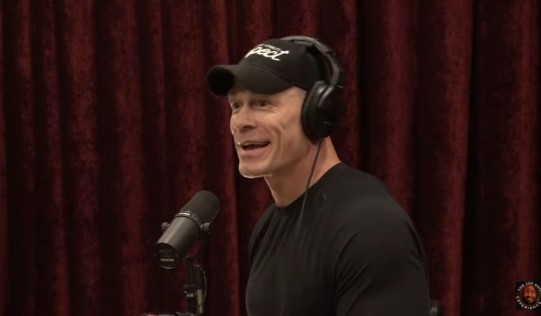
Here is the full transcript of WWE 17-time World Champion wrestler and actor John Cena’s interview on The Joe Rogan Experience #2423, December 5, 2025.
BRIEF NOTES: In this episode, John Cena reflects on how fans initially rejected his flashy WWE persona and what that felt like behind the curtain. He explains the pressure of playing a character that split the audience and how he learned to handle the boos and criticism over time. The conversation also dives into the craft of turning heel and the way crowd reactions can completely redirect a wrestler’s career. It is a candid look at the psychology of wrestling, fame, and reinvention from one of WWE’s biggest stars.
The Joe Rogan Experience with John Cena
JOE ROGAN: What’s up? John Cena in the house. Let’s put these on, pretend we’re professional. What’s up? Good to see you.
JOHN CENA: Thanks so much for having me.
JOE ROGAN: My pleasure being here. And there’s no way I’m having a pro wrestler on without Tony Hinchcliffe. Impossible. He’s the expert. He knows more about pro wrestling than I know about UFC.
JOHN CENA: Yeah. Sometimes I translate little things here and there.
JOE ROGAN: That’s cool. It’s all right. Yeah, he has to. And he’s a giant fan of yours, too. The giant fan of yours is Brian Simpson. Brian Simpson was going on last night about how intelligent you are. It was really interesting.
JOHN CENA: Sure. It was me.
JOE ROGAN: Yeah, man. Well, you do speak Mandarin, which is kind of crazy.
JOHN CENA: Yeah.
Learning Mandarin: A Decade-Long Journey
JOE ROGAN: How long did it take you to learn that?
JOHN CENA: Man, I was doing that for quite a long time. I’ve since kind of declined on the studies. A wonderful takeaway from the study of Mandarin: just because you know a language doesn’t mean you know the culture. So that was a fantastic experience. But I studied Mandarin for like a decade, and I would say not even conversationally fluent. It was a really tough hill to climb for me.
JOE ROGAN: It seems like a really big hill.
JOHN CENA: It’s just different. You get used to language and the structure.
JOE ROGAN: Read it, you know?
JOHN CENA: No, I didn’t bother to read. Like, reading all the characters, understanding everything.
JOE ROGAN: How long did it take you to learn?
JOHN CENA: Around 10 years. Yeah. And then I would dream in Mandarin and have conversations and kick down and that. So it became like a second language. But I lived in China for a little bit. I filmed a movie with Jackie Chan. So I was there for like six or seven months. I lived there. And man, we were Inner Mongolia, Yinchuan Province. So like in China. And it was fun.
JOE ROGAN: You were in Mongolia?
JOHN CENA: Inner Mongolia, yeah.
JOE ROGAN: What’s the difference?
JOHN CENA: I don’t know, because I’ve never been in Mongolia, but Inner Mongolia was… Man, I was the only person that looked like me there. And everyone would say, “Look, it’s big white guy.” Hyundai by Ren. Hyundai. That would call me.
JOE ROGAN: Wow. So what motivated you to learn that? It seems like such a task.
Breaking Into the Chinese Market
JOHN CENA: Honestly, man, everything in my life seems to be wrestling related. It was wrestling related. Like WWE’s reach spread everywhere. I mean, I’ve been lucky enough to perform everywhere from Moscow, Philippines, South Africa, Bangor, Maine, every place in between. Except China.
China was like the one place that didn’t understand what we did. It’s literally like a universal language because you can turn… It’s like UFC. You turn the volume down, but you can see like, “Oh, this is two guys. Best guy wins. I get it.” The Chinese just didn’t get it.
So I figured if one of our superstars spoke the language, maybe that would help break down the barrier. And we got in.
JOE ROGAN: Your idea?
JOHN CENA: It was my idea. But the WWE offers, and I think they still offer it, they offer a free second language program. So when they rolled out the initiative of financial advice and they’ll pay for portions of your secondary education and free second language, this is like 2011, 2012, big talent meeting in an auditorium.
I’m one of the old guys at the time sitting in the front being like, “These kids don’t know how good they have it. I should stand up and tell them to…” Nah, f*. I’m actually going to lead by example and take a language. So I signed up right then and there for Chinese because I wanted to get us into China.
And like I said, it worked, but it kind of only worked. And I think actually right now China is experiencing what wrestling is to them because there’s, I’ve read articles that there’s promotions over there that are thriving. So now they get it.
JOE ROGAN: Oh, so they have their own promotions.
JOHN CENA: Yeah.
JOE ROGAN: This is a fairly recent thing, I think.
JOHN CENA: So I just read recent articles that pro wrestling is thriving in China and they have their own way of doing it.
JOE ROGAN: Wow. That’s wild. It’s wild how expansive the pro wrestling business is that they would be that open minded to say, “Let’s give second language programs to the athletes.”
The Evolution of WWE
JOHN CENA: Well, you know, it’s weird. The origins of the business are carnival related. It is like a carnival attraction. And then it was ruthlessly territorial. And then when it became national, I was still trying to find its way. It’s almost like you see pro sports doing it. The more a sport succeeds, the more benefits they offer to their competitors and athletes. So WWE kind of hit that stride.
JOE ROGAN: Yeah, it’s just such a smart thing to do.
JOHN CENA: Well, you give your talent the opportunities to gain knowledge and wisdom. And the sad thing is, I don’t know how many people did it or do it still.
JOE ROGAN: Was there anybody other than you?
JOHN CENA: I know of two other people.
JOE ROGAN: Wow. Yeah, that’s it.
JOHN CENA: Everybody else is like, “Not going to do it.”
JOE ROGAN: Too much work.
The Taiwan Controversy
JOE ROGAN: What was the not knowing the culture aspect?
JOHN CENA: So man, I got put in a bit of a hotspot. I made a pact to myself when I was like, “Okay, I feel fluent.” We would do these global press tours. And I just happened to be on a global press tour. I’m like, “You know what? I’m going to do 70% of my media in Mandarin, in dialogue.”
And I got to say, I did it. I went over there, spoke. People were taking off the translator headphones. Life was good. Everything was great. At the very end of the day, as with all these press tours, you do a bunch of prompter reads. So I’m doing prompter reads for everywhere and it’s like, “Hey, go this place and see this movie. Go this place and see this movie.”
And nope, my bad. I didn’t check the reads because it’s like an end of a 10-hour day. You do a million of these things and one of them said, “Hey, Taiwan, see this.” And it was all in Mandarin. And the opinion described Taiwan as a country. So be the first country to see this.
Now over there, they look through a different lens. Geopolitics are murky waters, man. And that’s when I learned. I just said it. Left. Everybody was cool. I did my thing.
JOE ROGAN: I read the prompt.
JOHN CENA: It was like a Ron Burgundy moment. Like, “Go f* yourself, San Diego.” It’s like the most offensive thing you can say. So I’m like, “Man, good job, John. You said you did 70% and people understood what you were talking about.”
And then they put that out and everybody was like, “What the f* did you just say? We don’t… That’s not how we do it over here.” And again, just because… My takeaway, and it was a pretty tense moment for me. I had to apologize to China. And in apologizing to China, I pissed off my home country.
I’m a patriot. I love the United States of America and everything it stands for. But no one, it was never enough. Nobody was happy. Everybody was f*ed up. And it was murky waters for me personally. And it was weird. I think I might have been the only guy almost to get canceled for doing his homework, trying to learn and try to do something.
But the cool takeaway, we can learn from every mistake. My mistake was just because you know the language doesn’t mean you know the culture.
JOE ROGAN: Did they even refer to it as Taiwan? I think they referred to as Chinese Taipei.
JOHN CENA: Right. Man. What was in the… I know what I read in the thing. So that’s… Again, I don’t know enough depth to know that. And now people like, “Oh man, can you speak Mandarin for this?” I just won’t do it.
It’s a skill that I have, but it’s a skill that’s going to remain with me because I don’t have the depth of field to know what to call that place in that region of the world. And I haven’t done enough research, and I don’t have the wisdom, and I don’t have the cultural fluency. So it was a cool lesson. It sucked because I thought I was just trying to do something good, but it was a cool lesson.
The Fallout
JOE ROGAN: Was it really that big of…
JOHN CENA: Man, I thought… I was filming Peacemaker Season 1, and when they came out with all of this stuff, I went directly to James Gunn and was like, “Hey man, if you have to fire me, I understand.”
JOE ROGAN: Wow.
JOHN CENA: And it was that serious. Yeah.
JOE ROGAN: But it wasn’t even words that you wrote. Someone else. The WWE wrote it.
JOHN CENA: No, no, it was for the movie I was promoting.
JOE ROGAN: Right. So the movie. The people that made the movie wrote it.
JOHN CENA: So I don’t know. When you do these press tours, let’s say if I’m doing a movie for Warner Brothers, let’s use Peacemaker as an example. I’m doing a global Peacemaker tour, and we go into China or we go into South America. You meet the PR person there, and they have all the stuff you’re supposed to do, and they curate your experience and they hold your hand.
You’re like, “Okay, now we’re going to this station. And by the way, they just want you to do some shout outs.” So anytime I go anywhere globally now, as much as I want to thank fans for their attention and investing in the product, I really shy away from speaking the language because I don’t understand the cultural nuance.
I just want to be like, “Yo man, thanks for watching what we do, and I love the fact that you’re entertained.” But I want to speak to you at a level that I understand that I’m fluent because your boots on the ground here every day, and I might say something that’s a nice gesture but completely f*ing offend you, and that’s not good. That’s not good for anybody.
JOE ROGAN: So was the teleprompter in English and you translate to Chinese?
JOHN CENA: No, everything was in Mandarin. And in Chinese, they have the characters which are virtually impossible for me to learn. There’s an infinite number, but they also have what’s called pinyin, which is spelled out in English with phonetics, so it has the four tones.
So if you were to put something in front of me in Pinyin right now, I could definitely read it. And I got good at reading Pinyin, so I was like, “Man, I could send all these messages in Mandarin and more people will know about this movie, and more people will know about me, and more people will know about wrestling, and more people will be excited.”
Looked good on paper. Just my follow through was a bit weak. It doesn’t even seem…
JOE ROGAN: Like that was your fault. Right? Well, probably a PR’s assistant. Assistant. That’s typed. That’s probably in charge of doing the grunt work of typing in all the different languages and the different countries.
Taking Responsibility
JOHN CENA: It’s tedious. From what I know, I know I’m going to learn a lot about you guys in this episode, but from what I know about you, you’re into looking at things through different lenses and different perspectives. It also could have been somebody being like, “I’m going to get this kid.”
But here’s the thing. I do appreciate you saying it’s not your fault. That’s not true. It was my fault. And I think that’s when I can start to work on, “Well, what did I learn from this?” And I could easily blame a PR, an assistant. I could say somebody had a target on my back, all that stuff. I f*ed up.
The Taiwan Incident
JOE ROGAN: Did you suspect that somebody might have set you up?
JOHN CENA: No.
JOE ROGAN: Well, you’re saying it like it’s a possibility.
JOHN CENA: Well, man, when it happened, every theory came. Like, here’s the thing. The world doesn’t revolve around me, but my little world, everybody was like, “They f*ed up. They did this on purpose.” I was like, well, first of all, who’s they?
So I was able to kind of eliminate all that. And once I realized I could still go on working, I really made a lot of people angry. And for that, I’m sorry. I was just trying to…
JOE ROGAN: That’s crazy. Just by saying that Taiwan’s a country.
JOHN CENA: In Chinese, though, right? Those are murky waters to begin with. I’m not even thoroughly fluent on the U.S. policy. I think it’s territorial ambiguity or some shit like that. It’s so weird and it’s so fragile.
I got into some water I shouldn’t have been swimming in, but that’s on me. It was my fault. And I think that’s important for me to bear the burden of that and be like, “How can I course correct? What did I learn? Who do I really, really genuinely have to apologize for offending?”
The biggest thing that was a kick to the nuts is when people stateside got pissed off because you apologized. Yes, in Chinese. And I understand it. I mean completely, bowing down to the demand of this… what a shitty move by me.
I just should have taken a breath. Again, what did I learn? Don’t be reactive. Take a breath. Find out what’s going on. Find out the best path of action. Maybe give it a few days. Maybe give it a hot second.
And then move forward. But immediately I was like, “Oh, they’re mad. You want us to do this?”
JOE ROGAN: Fine, no problem.
JOHN CENA: I’ll fix it right now, man. Not only did I not try to fix the hole in the boat, I sunk the Titanic. So it was… but again, it was a learning experience.
JOE ROGAN: Well, it speaks to your character that you don’t blame anybody else, because I blame everybody else. I’d be like, who f*ing wrote that? Don’t you know what you’re saying or what you’re making me say?
JOHN CENA: The release you guys have for the show, I read it.
JOE ROGAN: You might be the only person.
JOHN CENA: So that was… whoever handed it to me, that was what they said. I think you might be the only person that’s ever read it. Yeah, man, if you’re going to take liberties with me, at least I want to be able to read that you are. Right. You know what I’m saying?
And I can’t say I’m perfect with doing that. But I was handed a release. I’m like, “Oh, man. Can I just glance this over for… oh, this says what I think it says. Okay, let’s go.”
JOE ROGAN: Trump didn’t even read it.
JOHN CENA: To each their own.
JOE ROGAN: Yeah, no, it’s very smart of you to read it. Who knows?
JOHN CENA: You know, who knows?
Wrestling Legends and Vince McMahon
JOE ROGAN: So this is Tony. Is this the full trifecta now? If you’ve gotten all of your heroes on this podcast now?
JOHN CENA: There’s a couple more we can knock off out of the pro wrestling world. There’s a couple more, if you don’t mind. If I could indulge. Talk pro wrestling heroes. Who do we need to knock off?
JOE ROGAN: Well, I mean, in all reality, and it’s diabolical…
JOHN CENA: He can kind of invite… you can invite anyone you want in here. You just kind of got to get him the wish list.
JOE ROGAN: I mean, you got to start with the number one, without a doubt, Vince McMahon, who started this gangster shit and spread it around. I would definitely have him as a…
JOHN CENA: Yeah, he would be great. Yes. Whatever magic you have out there and you have a lot of gravity.
JOE ROGAN: Do you think he’d be interested in doing it?
JOHN CENA: Are you kidding me? I think he would love it.
JOE ROGAN: Really?
JOHN CENA: I think he would love it. I don’t know when the right time is, but, man, don’t miss out on that. At least send it out to the universe.
JOE ROGAN: Yeah, well, I would definitely… Vince, if you’re listening, Vince, if you’re listening, let’s go.
JOHN CENA: I think this would be a great… I think this experience would be a great one for you.
JOE ROGAN: Is he still involved? Is he out? Is he in? He’s out.
JOHN CENA: He’s out.
JOE ROGAN: He’s out.
JOHN CENA: He’s out. Totally. Yep.
JOE ROGAN: It seems like he’s the guy that’ll be out for a little while and then something will happen. They’ll bring him back in.
JOHN CENA: No. Well, I don’t know. Again, that’s… that’s way… we were talking about why is your last event in this place? I’m like, man, because I don’t choose the events. All that stuff is so far above me, but I know now he’s out.
In my eyes, I’d like to think that time heals everything. And I believe in forgiveness and I also believe in looking at the body of work, but I also know there’s a lot of fragile stuff going on there. I don’t know, man. I don’t know.
JOE ROGAN: Yeah, it’s a hot subject. It get us into another Chinese Taipei incident?
JOHN CENA: Well, no, no, man, I’m… again, I’ve learned to become a little bit more accountable for what I say and just how… just because I feel a certain way about a person doesn’t exonerate them from being accountable for their actions.
JOE ROGAN: Right.
JOHN CENA: And just because he did start, quote unquote, “all this gangster shit,” that doesn’t mean he doesn’t need to be accountable for his actions. So let’s figure out what that means and then figure out if we can move forward and bring that back in the fold or if it stays the way it is.
JOE ROGAN: What do you think, Tony? You think he’s coming back?
JOHN CENA: I think he would come here.
JOE ROGAN: Yeah. I think he would come here too. And I think he, you know, that’s one of the more entertaining people of all time. He created the entire universe. You got to remember, Hogan’s Hogan because of him.
JOHN CENA: Cena. I’m me because of him.
JOE ROGAN: Yeah. Every single Stone Cold, he’s like, “That sounds good. Yeah, keep it going. We’ll do the glass breaks thing and they’ll throw you beers. I like it. Let’s do it again next week.” So everything that we think when he…
JOHN CENA: When he sits here, you got to do that impression.
JOE ROGAN: Yeah.
Yeah, yeah. Stone Cold’s another one that hasn’t been on.
JOHN CENA: Steve would be great. I think you would dig Steve.
JOE ROGAN: Oh, yeah, I’m sure. Yeah. He lives out here too, doesn’t he?
JOHN CENA: Yep.
JOE ROGAN: Does he? Well, actually, doesn’t he have a ranch out here? I think he does somewhere.
JOHN CENA: I think he does, yeah.
JOE ROGAN: But I think he’s based out of somewhere else now. New Mexico or Arizona. He’s on the…
JOHN CENA: He…
JOE ROGAN: He’s kind of cool and reclusive. He doesn’t really do a lot. It’s amazing.
JOHN CENA: He’d be a good get, and I’m pretty sure, I guarantee he would do it. Yeah. Steve, if you’re listening, I know you’re watching. Come on, come on. Come on in. Let’s talk some wrestling.
JOE ROGAN: I mean, everyone has him on the Mount Rushmore. Triple H, who runs it now? The son-in-law of Vince McMahon. Yeah, I mean, he runs the entire thing.
JOHN CENA: I mean, you want answers to those high level questions?
JOE ROGAN: Yeah.
JOHN CENA: There’s your guy. Yeah, that’s the guy. You need to get in a lot of the stuff you probably ask today, I’ll be like, that’s way above my pay grade.
Tony’s WWE Writing Opportunity
JOE ROGAN: Well, if you don’t know the history, Tony at one point in time was offered a job with the WWE before he really made it.
JOHN CENA: No way. Yeah, yeah, yeah.
JOE ROGAN: He was offered a job to write for the WWE because, you know, Tony was a giant pro wrestling fan and you know, he already had a Netflix special, so he was known as a comic.
JOHN CENA: It was before that.
JOE ROGAN: Was it before the Netflix special? Yeah, the first one. The one that you released yourself?
JOHN CENA: Yeah.
JOE ROGAN: Really?
JOHN CENA: Yeah.
JOE ROGAN: It was only a couple years into me doing stand up seven nights a week at the Comedy Store all the time. And somehow I ended up… someone’s like, “Hey, I have a friend in WWE if you want to have a meeting with them and just talk.”
And I went in with straight up ideas. This, that, the Undertaker’s Brother comes back again. This, that, the next… everything back and forth. I can’t even remember any of them. It’s been so long. But I went in with the whole thing. This guy’s like, “Where the hell did you… what? This is crazy.”
JOHN CENA: You just did this.
JOE ROGAN: I’m like, yeah, I found out a couple days ago we were going to talk. So… but yeah, they offered it, but I would have had to move to Connecticut and take a train to New York every night to go do stand up and that would have just been exhausting.
And everything I heard, because Patrice O’Neal, the late, great Patrice O’Neal, wrote for WWE for a while.
JOHN CENA: Did he really?
JOE ROGAN: Yeah, yeah, for a couple of years, I think. What did… he just wrote lines for them. What did he do? The whole shebang. When you’re a WWE writer, they make you write. It’s not a cute job at all.
JOHN CENA: No, there’s a lot of… there’s a lot of television or there’s a lot of content every week.
JOE ROGAN: Yeah.
JOHN CENA: Right now I think they got… they have three weekly shows, so that’s… I think one of them’s going back to three hours. It’s 50 segments of TV.
JOE ROGAN: Yeah.
JOHN CENA: Every week.
JOE ROGAN: Yeah. But I remember when you were talking about it. Yeah. When you’re talking about potentially doing it, I was like, yeah, it was tricky. I was like, dude, you do not want to live in Connecticut. No, that’s the main thing. If it was anywhere else other than Connecticut, it kind of would have made more sense. If it was in New York City, it would have been a no brainer. If it was in LA, definitely.
JOHN CENA: But fast forward now, you’re more and more involved. Yes.
The Dream Job Becomes Reality
JOE ROGAN: Well, this is the crazy thing. We had talked during the old days in the green room. I’d be like, that would be your ultimate dream job, to make it as a comedian and somehow be involved in the UFC the way, or excuse me, in WWE the way I’m involved in the UFC. Very similar.
JOHN CENA: Yeah.
JOE ROGAN: And look, it’s insane. I’m going tomorrow night. I’m going to be in the front row at the arena in my hometown.
JOHN CENA: Are they here tomorrow? Oh, man.
JOE ROGAN: Are you messing with me? Are you going to… Is your music going to hit?
JOHN CENA: No, I’m not there. I got one more left.
JOE ROGAN: This is what they do, by the way. Oh, yeah. I didn’t even know they were going to be in town.
JOHN CENA: He’s correct. There’s a lot of… You mess with people. You’re right. But then somebody like me will actually shoot you straight and be like, I’m not going to be there. And I won’t be there. And you’ll be like, oh, now I’m just building the equity for people to mess with people.
JOE ROGAN: I’m giving 20 mulligans out there tomorrow.
JOHN CENA: Exactly.
The Undertaker’s Secret WrestleMania Appearance
JOE ROGAN: I heard a great story.
JOHN CENA: You’ll probably love this.
JOE ROGAN: You might even know this story, but the Undertaker, his wife and his podcast co-host went to WrestleMania. They’re up in a fancy suite.
JOHN CENA: This was… Which one was it?
JOE ROGAN: The Rock made an appearance. You were there, right? This huge finish at WrestleMania, like three years ago, it was just boom, boom, boom, boom. And all these legends were coming out.
JOHN CENA: This huge finish, just like, they can’t…
JOE ROGAN: Even follow it. The ultimate climax of a WrestleMania. And one wrestler comes out, interrupts this huge main event. Then another one, then another one. Anyway, the Undertaker, his wife and his podcast co-host were up in the suite. Undertaker goes, “I’m going to go use the restroom.” They’re like, he’s been gone… The lights go out, the bell tolls. They’re watching from the suite. He’s been gone for like 10 minutes, 20 minutes. He went and changed real quick and…
JOHN CENA: Now he came out as the Undertaker.
JOE ROGAN: Yeah, came out as the Undertaker. They’re in the suite, like, “Oh my God, it’s the Undertaker.” They don’t tell anybody. It’s so old school and awesome that they keep secrets so locked up that their own loved ones… His wife didn’t even know. That’s hilarious.
JOHN CENA: Yeah.
JOE ROGAN: That is so crazy.
JOHN CENA: It’s fun to be able to surprise the live audience.
From Gold’s Gym to WWE Superstar
JOE ROGAN: Oh, yeah. I mean, it’s got to be a big part of it. How did you get involved in pro wrestling? Were you a fan as a kid?
JOHN CENA: I sure was. I think we have the same gravity of like, man, I was a super fan as a kid, but then I fell out of it, admittedly kind of when Hogan went to WCW.
So I was into wrestling and then I wasn’t. Then I got into sports or whatever and then I got back into wrestling when everyone else did. When Stone Cold Steve Austin became big, the Rock became big, the Attitude era hit and I was just working a dead end job over at Gold’s Gym, Venice, and didn’t know what I wanted to do with my life.
JOE ROGAN: How old were you?
JOHN CENA: 21. I’d moved out to California. Not to be famous or anything. My degree was in Kinesiology and I wanted to… that was the center of the fitness universe in ’99, 2000. So all equipment manufacturers are there. I’m like, man, I’ll go get a job with Hammer Strength or Cybex or maybe Gold’s or put that piece of paper on the wall to get a good paying job. It did not work.
So I ended up front desk, cleaning toilets, selling protein bars in that order. So don’t ever buy a protein bar. I’m just kidding. But no, I was kind of the jack of all trades over there. And a friend of mine, Chris Bell and Mark Bell…
JOE ROGAN: Oh, I know those guys. Yeah.
JOHN CENA: Yeah. They literally were like, “Dude, you talk about WWF all the time. We train down in Orange County.” And at that time, Chris Bell was kind of writing for this promotion. Like, “Would you want to do it?” And I… Man, that doesn’t happen without them accidentally saying, “Yo, we trained to do this.”
JOE ROGAN: His documentaries are fing incredible. “Bigger, Stronger, Faster.” And then the other one, the pill one. What was that one called? Magic Pill. No, what was the one… The addiction one that Chris released. But “Bigger, Stronger, Faster,” such a fing great documentary.
JOHN CENA: The Bell family, I’ve been friends with them for a long time.
JOE ROGAN: Great guys.
JOHN CENA: Yeah.
JOE ROGAN: That documentary blew the lid off of the reality of steroids. “Prescription Thugs,” another great one. Crazy thing is, he got addicted to pills while he was doing that, because he had surgery while he was doing that and got addicted to pills while he’s making a fing documentary on people being addicted to pills. That’s how potent pills are. A guy making a documentary about addiction, he just thinks, “Well, I’m just taking these because I got hip surgery and I’m in fing agony,” and then gets hooked. That’s how crazy it is.
Pain Management and Surgery
JOHN CENA: Yeah, they’re strong.
JOE ROGAN: Yeah, I would imagine. Did you ever have an issue?
JOHN CENA: No. No. As a matter of fact, I’ve had fusion in my neck, right pec completely detached, reattached, both triceps reattached, both triceps scoped. Nose relocated. I got… I’m in 10 physical surgeries where they got to go and correct something. Never taken one pain pill.
JOE ROGAN: Wow.
JOHN CENA: I have all the prescriptions in the bottom drawer of my house filled. And it’s weird because at every facility, the first thing they… The first hill they climb is pain management. You wake up from anesthesia, you’re gray and murky. And I’ve been in a bunch of surgeries, a bunch of different facilities. The protocol is always the same. “Do you want something for the pain? Here, we got to make sure you take this with you because you’re not in any pain.”
Yeah, I understand. Because if you leave, if you’re feeling okay, maybe you’re high off adrenaline, I don’t know. And then the operation sets in of, “Holy f*, this is a 10 out of 10. I can’t… I need something.” I get that, but I guess from falling down and hurting my body a lot, I know my pain threshold.
JOE ROGAN: Yeah.
JOHN CENA: And when I… The worst one was probably the putting the whole pec back on and then attaching it. But when I woke up, I was able to mess around with a stress ball. And I never took one pill.
JOE ROGAN: That’s amazing.
JOHN CENA: And I still have the full bottles of… Some are labeled 2008 is when I had my first surgery. And they’re just all there.
JOE ROGAN: There’s a…
JOHN CENA: Right now. Going to count them all. Yeah.
JOE ROGAN: Find out what John Cena hoards them.
JOHN CENA: It was weird because the medical staff couldn’t believe it. They’re like, “You don’t want anything?” Nah. Because, man, it’s… I know how I am with this.
JOE ROGAN: Yeah, it’s a f*ing slippery…
JOHN CENA: And I would just… I’d be high on opiates, opioids all the time.
JOE ROGAN: I got my first knee surgery, I think, in ’93 or ’94. And they gave me… I got an ACL reconstruction and they gave me Vicodin. I think pretty sure it was Vicodin. I took one one day, and I felt so stupid. I was lying on my couch watching TV and I felt so dumb, and my knee still hurt. It was just distracting me from the fact that my knee hurt. But I’m like, I can’t be this dumb. I’m dumb enough as it is. I can’t add to my dumbness with pills.
I just saw it coming. I also knew a bunch of guys who had pill problems. I wound up selling my pills to a friend of mine that would sell pills.
JOHN CENA: I should have taken your idea.
JOE ROGAN: I only made like a couple hundred bucks or something. I don’t even remember. It was like in the ’90s, but I remember just that one pill. And so then every surgery I’ve had ever since then, they always offered me stuff, and I never took anything. I got my other ACL reconstructed in 2003. Never took anything. I got my nose fixed. It’s like 2008. I got my nose reconstructed, deviated septum. The guy was insisting that I… He gave me two prescriptions for pain medicine. And I was like, “I don’t want anything.” I was like, “Is it going to get worse than this?” He’s like, “It could get…” I go, “Right now it feels like nothing.”
JOHN CENA: Yeah.
JOE ROGAN: It’s like… But if you’ve been, again, you’ve been beaten up so many times, your body, you’re so used to just being in pain. And I think for some people, just the daunting anxiety of pain itself is they just want a pill before they even realize, I could kind of just… yeah, it sucks, but it’s not going to suck forever. It’s going to heal. So let’s just deal with the suck and just lay here, put some ice on it or whatever and just relax.
JOHN CENA: And along with that, it’s kind of your body’s natural way of saying, okay, maybe push a little bit more. Try to get a few more degrees of range of motion in physical therapy. If those senses are numbed…
JOE ROGAN: Right.
JOHN CENA: And shut off. First of all, you do feel just like, I don’t want to do anything. So you won’t work. In many cases, you won’t work to do the work to get better.
JOE ROGAN: Or you’re just numb.
JOHN CENA: You don’t know the messaging. You can’t listen to your body. If it’s really, really in pain, maybe your body’s trying to tell you something.
Pain Tolerance and Personal Experience
JOE ROGAN: I always assume that people feel pain differently. I mean, I just would imagine, like people feel hot sauce differently. Some people, they can’t have any spice. Some people f*ing can have death peppers, and they’re fine.
JOHN CENA: All right, I’ll throw that out to the group. Is pain a personal experience?
JOE ROGAN: I mean, there’s no way I’m as tough as you guys, so, yeah, it has to be.
JOHN CENA: But I think in other dimensions you might be way tougher. I don’t know.
JOE ROGAN: Maybe. I think there’s something you don’t know, Tony. I can’t imagine the dimension. I went and visited a firehouse the other day and I was going down the pole going, “Wee.”
JOHN CENA: You guys wouldn’t do that.
JOE ROGAN: I would do that.
JOHN CENA: So in that aspect, you’re tougher than me. Yeah.
JOE ROGAN: You can take ridicule. We can take ridicule really easily, but I don’t know what it feels like for other people. You know what I’m saying? I mean, I would assume that everybody feels the same, but, you know, one of the reasons why I think maybe it is different because my mom, my mom has a crazy tolerance to pain.
My guy, my stem cell guy in LA, my mom had a real knee issue and he was treating her as well. And he goes, “It’s hilarious. Your mother’s just like you. She just takes it. She doesn’t even flinch.” She’s sticking it… He’s like, “That doesn’t happen.” 75-year-old ladies take a needle and shove it in their knee and push it and she just doesn’t move. And you know, she’s like, “Oh, it wasn’t painful. It was no big deal.” It’s like, you know, a lot of 75-year-old ladies would be f*ing sweating and freaking out seeing the needle.
JOHN CENA: Pretty sure I would be, yeah.
ACL Surgery Recovery and Pain Tolerance
JOE ROGAN: But I don’t know, you know, I don’t know what it feels like to other people. Like, when I got my ACL, my right ACL reconstructed, it was a lot easier because it was a cadaver and I recommend it to anybody. The difference between a patella tendon graft recovery and a cadaver recovery is literally like six months. The difference is really, the cadaver was so much quicker.
JOHN CENA: Wow.
JOE ROGAN: Oh my God. Because the cadaver, they take it, I mean, it’s all swollen and everything afterwards, but it’s somebody else’s tendon. They take an Achilles tendon off of a cadaver so it’s 150% stronger than an ACL. They f* screw that sucker in place. Little tiny orthoscopic holes, not nearly as invasive.
And then five days later, you know, Matt Lichtenberg, I went to his party for his birthday party five days later, just walking around and he was like, “did you just have surgery?” I go, “yeah, it’s not that big a deal, man. It feels fine.” You know, it was so much easier.
The left one was brutal because they take a slice out of your patella tendon and then they could take a chunk out of your shin bone and a chunk out of your kneecap. And then they use those to screw this new tendon that they created into the shin bone and into your thigh bone. That was rough. That one was painful as f* and took a long time before it felt normal. Took a long time before I could go down on one knee again.
JOHN CENA: When was that?
JOE ROGAN: In the 90s.
JOHN CENA: And then the other one was early 2000s, 2002-ish.
JOE ROGAN: Somewhere around 2, 3.
JOHN CENA: I mean, 10 more years of performance surgeries, 10 more years of medical.
JOE ROGAN: I just think it’s the difference because they still do that patella tendon graft. And I think George St. Pierre had it done that way. I know a bunch of people that I’m friends with had it done that way. And I was like, “oh, don’t do that one. Do the cadaver.” But people are worried like, “what if you get AIDS?” Like, Jesus Christ, you’re not going to get AIDS from it. Stop.
And it’s also, it’s like, you feel better before you are better, unfortunately, because the way the tendon works. So when they replace a tendon with a cadaver, it’s not like you have this guy’s tendon in your body. What it is like is that tendon is a scaffolding and then your body re-proliferates that with your own cells.
So over the course of six months, my body had filled in all of what used to be a cadaver with my own cells. So you’ll feel like it’s better before it’s better. So a lot of MMA fighters, they start training too quickly and they blow it out again because it’s still soft.
JOHN CENA: That’s always the concern. It’s always concern. You feel good and you’re like, “man, I can do this.”
JOE ROGAN: Especially animals, you know, guys who are just used to pain and used to pushing, you know, and they just pop it out again. I know multiple MMA fighters that have had knee surgery and then blew it out while they were recovering.
JOHN CENA: And just a few months more, it could just be alright. Impatience, you want to get back in there.
JOE ROGAN: And then it’s even worse because you got to drill into the same holes and pull it out and open you up. But it’s more invasive surgery. They got to remove the screws and… F*, yeah.
But I just, I don’t think everybody feels pain the same. I think it’s a genetic thing. It’s just an assumption, obviously, because I don’t feel what other people feel. But I think some people just, any kind of pain, it’s just, they can’t function, they’re just in agony. I think those people are way more vulnerable to the pills. That’s just my assumption.
JOHN CENA: That’s a decent perspective I would agree with. Pain is a personal experience. There are people who… I mean, I’ve seen people like, “I can’t believe you go through that.” And then people will be like, “but you get the s* kicked out of you. I can’t believe you do that.”
It’s all relative. I would be sting cufflinks if you get that stem cell needle out. I would be sweating right until the fing final moment. Like some stuff I can’t take, you know. So I guess it is, it could be combined with like what we fear in life or maybe, maybe fear of hard work or fear of effort, who knows? I don’t know. I don’t know.
JOE ROGAN: I think it’s also being accustomed to pain, you know, so if you… Did you wrestle when you were younger?
JOHN CENA: No, I played football.
JOE ROGAN: You played football? Well, that’s just like that, in that you’re always in pain. I mean, if you’re playing football, you’re always colliding with people. You’re always, you got a shoulder’s fing with you, your back’s f with you. It’s like it’s never ending.
The Value of Losing a Fight
JOHN CENA: I’ve always said that there’s something, there’s some value into losing a fight.
JOE ROGAN: Oh, yeah.
JOHN CENA: I grew up with four brothers and we kicked the s* out of each other, and I was not always on the winning side. So very early on in my life as a young person, you know what it’s like to lose a fight.
JOE ROGAN: Oh, it’s very valuable.
JOHN CENA: And I think that there’s a lot maybe to do with the pain conversation there. If, like, just flat out getting your ass kicked and then being able to dust yourself off and be like, “I’ll get you next time,” you know, like, “it’s not over. You know, we’re brothers, we’re going to fight again.” You know, like, it’s also knowing, like…
JOE ROGAN: Why did he beat me? What can I do to beat him next time? You know, like, if you don’t have that in your life, also, if you don’t know what it feels like to get your ass kicked, you get a little mouthy. I mean, how many mouthy people do we know that have never been f*ed up?
And I think that’s why, like, there’s real consequences. If it actually comes down, you start yelling and you get mouthy. If it actually comes down to it. We’ve all seen many of these videos on the Internet where someone just don’t, they don’t know what the f* they’re asking for, what they’re getting into, and then all sudden they’re getting hit.
JOHN CENA: And, man, I’m not perfect and there are days where I’m short of patience, but when it gets to that weird spot of like, “yo, someone’s going to get hit in the face,” I always try to, like, lean on diplomacy. Always, always, yeah, please, let’s not do that, because that f*ing sucks.
JOE ROGAN: And I bet a lot of people say to you, “if I was you, I’d be f*ing everybody up.” That’s dumb. People always say that. Like, it doesn’t end with that. Then this guy gets his brother or he shoots you or run you over with a car.
JOHN CENA: Or you think you’re going to f somebody up and you get fing handled, right? Like, you never know, man. You never know anybody else’s story, you know? You never know.
JOE ROGAN: So many people out there that train today, it’s so much different than when I was younger. Like, you would assume that, like, I assume that a good, solid 10% of all men you meet have martial arts skills now because of the UFC popularity of it.
JOHN CENA: Yeah, certainly. Certainly in Western society. Yes. You know, the gym, there’s a gym…
JOE ROGAN: Every plaza also, there’s so many kids that like, watch UFC and then play practice with themselves. And you could learn a lot just doing that. Guys learn a lot just watching it on TV and then emulating it at home with their friends can tell those.
JOHN CENA: Who watch WWE because when those moments happen, they try to do some crazy movie, it doesn’t work.
JOE ROGAN: How many guys have f*ing thrown their buddy onto a conference table or something because they thought it was the way to do it?
JOHN CENA: Oh, it’s crazy.
JOE ROGAN: You know, I mean, the f*ing sheer amount of punishment you guys put yourself through is staggering. I mean, it really is staggering.
WWE Career and Performance Schedule
JOHN CENA: But thank you very much. It is all for the, like, it’s like a pro football player, pro hockey player, UFC. I think the beautiful advantage that we have is that we can make choices on what we do. So when you’re in UFC and they close the door, it’s kind of f*ing best person wins, you know, you got… It’s survival.
When we’re in WWE and we both step in the ring and they ring the bell, we’re working together, working together to put on the best show for the audience. And in that process, you can calculate the risks you want to take. And I think that’s what allows somebody to be able to perform for 23 years.
You know, I don’t know. I know that that age old stat that everybody says about, like the average NFL career is what, two and a half years or three and a half years? I don’t know what the stat is. On average UFC career, like, how long, what’s your window to be functionally profitable in UFC.
But I know, because our risks are calculated and we’re working together rather than against each other, the math is way higher for you to have like a 10, 15, 20 year career in WWE. But that also is 10 more years of falling down, 15 more years of falling down. So it’s weird. Like, you can choreograph the risk, but you have to do it time and time again.
And the schedule in WWE just changed. Like to do 70 matches a year now in WWE is like, “man, you’re a workhorse.” We used to do 220, 230, which is so crazy.
JOE ROGAN: 220 days of trauma in a year because you’re getting, no matter what, you’re getting some trauma no matter what. The guy body slams you, something happens, you’re colliding, you go off the ropes, you’re smashing into each other.
JOHN CENA: I get such a warm feeling when you first timers go into the ring for the first time. It’s like, “oh, it’s like a bouncy floor” and they fall down once and like the wind’s knocked out of them. They’re like “my brain moved.” Yeah, yeah. Now you got to do that again and again.
But it’s weird. I’ve gotten to work with a lot of standups and WWE is kind of changing. I would say it’s on the progression of a standup, making it to just like a stadium tour. But man, when I performed my sweet spot, we ran very parallel lives. Like you, I’ve worked every city. Hampton Beach, Casino Ballroom, to Madison Square Garden, like to the Saitama Super Arena, to AT&T Stadium, to Bangor, Maine or to Valparaiso, Indiana.
Like you, you go to all of these places and it’s like, Friday you’re in one place. Saturday you’re in another place. Sunday, you’re in another place. Monday you’re in another place. Tuesday you’re in another place. One day to drop your s*. One day to catch your flight out, do it again. Like it’s kind of, we’re kind of like touring standups in that regard.
JOE ROGAN: Very similar. Yeah, exactly.
JOHN CENA: And you’re responsible for your own trans. And I’m speaking from my day. I don’t know how it is now because I got one left and then I’m done. But you were responsible for your own transportation, booking your own hotels. Like you were, they were just like, “hey, we’re starting here, we’re in here, good luck.”
Which is awesome because you create, people are really independent when they go through that fire. And you weed out the people who don’t want to be there.
JOE ROGAN: Yeah. Because they’re just a sheer work. The sheer workload.
JOHN CENA: Making those clubs and like making, doing a tour.
Life on the Road
JOE ROGAN: Also the adrenaline. Like it’s like, what do you do after a night? Like, dude, most jobs people can’t wait to be done and then go home and relax and fall asleep. Or if you’re doing standup or obviously wrestling, you were just, you’re done late at night and you’re like…
JOHN CENA: Yeah, man, what the water rush? Yeah, f, what can I do better? This fing killed. And then it’s four in the morning.
JOE ROGAN: Yeah, you’re buzzing. Yeah, you’re buzzing. And it’s also, it’s really hard to have any kind of a normal relationship because you’re just constantly not home, you’re constantly gone. Like, even your friends, like, you get you really. As a touring comic, the best thing that I ever did is start taking friends with me on the road.
JOHN CENA: Yeah.
JOE ROGAN: Instead of just working with like random guys that I didn’t know in different towns. Those are fun. Sometimes. Sometimes like, you know, two out of ten times you meet a new friend.
JOHN CENA: Yeah.
JOE ROGAN: Eight out of ten times you’re with some annoying alcoholic.
The Challenges of WWE Life
JOE ROGAN: Who f*ing sucks. And they’re annoying and then they want to take you someplace and you get in trouble.
JOHN CENA: Yeah. I mean, that’s certainly the normal life aspect of it. It’s also at full tilt. It’s a very absorbing thing. It’s a very selfish thing. So I think not only you don’t work regular office hours and you’re a nomad, a gypsy, but especially from a WWE perspective, you’re a startup founder. You have to wake up thinking about it. You have to think about it all day. You have to go to sleep thinking about it. Wake up in the two hours of sleep that you get being like, I remember this line or maybe we can do this stunt or whatever.
JOE ROGAN: Right.
JOHN CENA: And it’s people who are in your sphere, at least through my perspective and my journey. If you were in my gravity from 2002 to 2019, I wasn’t a part of a team. You did it my way. Bus leaves at 10, if you’re there at 10:01, you’re f*ing left. We’re doing this and we’re training here and then we’re doing this. But the end product is good.
So the dream job of, I never… The six year old kid holding the paper belt can be an adult holding the real belt and get shekels for doing that. And I don’t ever want to put that in jeopardy. So you f*ers are going to have to get in line and we’re just going to have to go. I was absent a lot in relationships because if it wasn’t on my terms, it didn’t exist.
JOE ROGAN: Mmm.
JOHN CENA: Because here you got, you catch lightning out of a jar. I’m a kid from West Newberry who’s come from a family of five. There’s always more broken. But we were a good level of broke. And then now, hey, if you just work hard at this thing, you can kind of not ever be that again. All right, f* this. I’m doing this thing all the time.
But that comes with, hey, I’m getting married. Or my grandfather died or I got a birthday coming up, or hey, you missed another Thanksgiving. You’re damn right I did. Because I’m doing the thing.
JOE ROGAN: Yeah.
JOHN CENA: So it’s also for me, at least it was that as well. Laser focus. All things WWE.
The Price of Success
JOE ROGAN: Well, it’s that in everything that you do where you want to really be.
JOHN CENA: Successful, it takes saying yes to the thing means no to everything else.
JOE ROGAN: I had Jensen Huang on the podcast the other day who’s the CEO of Nvidia, one of the biggest companies on planet Earth. Huge company. F*ing dude. Still to this day works seven days a week. And he was talking about when he goes on vacation, I go, do you go on vacation? And just put it all down. He goes, no, I work. He goes, even when I’m with my family, I have to work. I’m working. I work seven days a week. I don’t take a day off. I love it.
And he goes, and I’m terrified of failure. He goes, that’s my motivation. My motivation is not I want to succeed. My motivation is fear of failure. Every day I show up saying, if I don’t do this, we could fail. And I’m going to work seven days a week. Everybody who thinks they want to be a CEO, you think you want to be a billionaire. You want to do that? You want to do that when you’re 60 years old, do you want to be working seven days a week, all day long, from the moment you wake up?
He wakes up at 4:30 in the morning. He says he answers thousands of emails a day. I’m like, what? How are you? How is that even fing possible? Gets up at 4:30 in the morning, answers all these emails, works all day long, constantly problem solving, making AI chips fing crazy, right? But that’s with everything. You want to be at the top of the heap when you see one way.
JOHN CENA: Yeah. When you see something difficult look easy, there’s a bunch of 4:30 in the morning wake ups that made that happen.
JOE ROGAN: I think with everything in life.
JOHN CENA: Yeah.
JOE ROGAN: Anything in life where you really want to excel at it, there’s no shortcuts.
JOHN CENA: Yeah.
JOE ROGAN: Doesn’t exist. That weeds a lot of people out.
JOHN CENA: It does, it does. And there’s a lot of armchair quarterback is the easiest and best position on the field. Yeah, I could do that. All I needed to do is do this. Sure, go right ahead. Yeah, take your best shot.
JOE ROGAN: Yeah. Good luck.
JOHN CENA: Yeah.
JOE ROGAN: It’s interesting because it must weed out so many talented people. There’s probably a lot of talented people that you’ve seen over the years that just didn’t have that drive to constantly improve and succeed and really be thinking about what they’re doing all the time.
Talent Versus Drive
JOHN CENA: I like that statement because I think the talent is doing it all. You could have a…
JOE ROGAN: No, you can have one. You could smoke if you want. I don’t care. We have fans in here. Yeah, with fans that suck out all the smoke.
JOHN CENA: I think the statement of so many talented people didn’t make it. They may have. They may be an acrobat, they may be a fast talker, but that’s not the only attribute that makes one special. You may be a great joke writer, but if you don’t master stage presence, I mean, maybe a great joke writer with stage presence, but if you can’t lug the tour, you’re not talented for it.
JOE ROGAN: Well, it’s really the grind.
JOHN CENA: It is in everything, the all encompassing thing. So when someone with great athletic ability decides that it’s not for them, because eventually that is one thing about WWE. But for all the arguments of backstage politico, everybody understands the sound of money and no one refuses it. I f*ing hate this guy, but I got to give him another match. It may not be, but I now have to give him a 10 year contract.
But when they go out there, if the noise is there, even if they fing hate you, you get another match. I am proof positive of that meritocracy at work. Everybody fing hated me.
JOE ROGAN: Why’d they hate you?
JOHN CENA: I was just real different. I was just really different.
JOE ROGAN: In what way?
The Hip Hop Persona
JOHN CENA: So I didn’t ruffle any feathers when I kind of entered the business, kept quiet, did my stuff. But I also didn’t connect with the audience. And I don’t know, maybe you guys see this in stand up or not. But then I got a personality of the white rap guy, the white hip hop guy.
JOE ROGAN: You know about that.
JOHN CENA: Yeah. I f*ing went all in, urban gear. And I’m a hip hop head. So it’s, oh man, this is my sweet spot. This is the avenue. This isn’t all of my personality. But this is one level that I can show that I think everyone will get. So if you go to Madison Square Garden, you get it. But if we go to Wheeling, West Virginia, you’ll also get it. And you may like it in some places and hate it in some places, but everyone will get it.
I will not be selling apathy, but doing that. I never followed dress code. I was saying disrespectful shit about my peers. I kind of did it my own way. So I was ruffling some feathers backstage or just I was taking big swings because I was going to fing get fired anyway. The alternative was lose my job. So I was, f it. I’m going down swinging.
JOE ROGAN: Yeah.
JOHN CENA: And then the people behind the curtain were like, ah, the kid’s disrespectful to the business. He doesn’t care about the business. All the while I just want to keep my f*ing job. So the they’s behind the curtain weren’t really invested, but they were also humble enough to be like, there’s noise out there. Got to give them another match. And one match at a time times 23 years of compounding interest. We’re here.
JOE ROGAN: What did Vince think about your hip hop?
JOHN CENA: He hated it and then loved it. And I think from his perspective is when I hear somebody’s idea for a personality, I want to be a sports agent guy or whatever. I have the idea of what that is in my head. And if their projection of that idea doesn’t match my projection of that idea, I’m like, ah, f*, I hate it. But that doesn’t mean it can’t work.
So I think what maybe would happen was my perspective of the white hip hop guy from the mean street of West Newberry and Vince’s perspective of John Cena, the rapper. We probably missed. He had an idea and I had an idea. And usually he will craft it to his division. I got to give him respect for allowing me to kind of run with it.
JOE ROGAN: Well, it’s probably that fear of being fired that keeps you on the edge, dude.
JOHN CENA: That was it. Of the Nvidia guy. Of I don’t want to fail.
JOE ROGAN: Yeah.
JOHN CENA: I got the sit down of, hey, we’re cut you. Cause it’s not working. You’re out there for your matches. You hear the same. It’s not working. And there’s no argument there. I’m like, fing all right. I got to touch the sun. I got to make it. I got to play for the Yankees. I got my one at bat. I’m Moonlight Graham. And then they heard me rapping the back of the bus and was like, Stephanie heard me rapping the back of the bus. It was like, yo, you want to do that on TV? I’m like, lose my job or fing rap? Yeah, let’s go. Let’s do this.
The Happy Accident
JOE ROGAN: So it was Stephanie’s idea, and it…
JOHN CENA: Was a f*ing accident, dude. It was an accident. My final, final overseas tour for the WWE. And the boys just spend time, that’s the one time they get the whole group together is overseas because you don’t want to be herding cats in Amsterdam or something. Everybody rides on the bus. You go from town to town. So to pass the time, the boys just do whatever. And they were freestyling the back of the bus.
And I normally just f*ing kept to myself because I was raised in the environment of keep your ears open, keep your mouth shut, don’t do anything less spoken to. So I did that. But I also didn’t make any connections with people who were putting their lives on the line for me. Some of the guys you really beat the shit out of in the rings are your best friends.
So I didn’t have any of those connections. And I heard these guys rapping. I just remember playing Roller Coaster Tycoon on my laptop, folding that shit up, putting it away, and be like, I’m going to the back of the bus and just waited my turn and then filleted 12 guys. And Stephanie was like, how the f* did you remember all that? I’m like, no, no, it’s freestyle. You just make it up.
And she’s like, well, make up something about me. And we were boarding a plane, and I literally utilized the plane. The people getting on the plane, what she was wearing, what she was eating. She’s like, would you do this on TV? And that’s where we got a chance.
JOE ROGAN: Wow, that was crazy.
JOHN CENA: It wasn’t off to the moon. I got a shitty chance on a small spot, and that worked. So then I got moved to the dog shit Saturday Night program that nobody watches. But the cool thing is no one’s watching. So I could do whatever I wanted. So I started saying more racist shit and dressing more outlandish and having more personality and claiming ownership of the show.
I call myself Mr. Saturday Night, and it’s the shitty show. You don’t want to be Mr. Saturday Night. But I did. And then that got another match and got another match, and one by one, it kind of brought me here.
JOE ROGAN: Wow.
JOHN CENA: Just a f*ing happy accident, man.
JOE ROGAN: That’s crazy. All the way to…
JOHN CENA: Even when the bells were like, hey, you want… The whole thing’s a fing accident. You want to start training? F yeah, sure.
JOE ROGAN: All right.
JOHN CENA: You want to start rapping? Yeah, f* it. Sure.
The Iconic Heel Turn
JOE ROGAN: That’s amazing. The happy accident and for it to go all the way to last year’s massive heel turn. Yeah, he went heel, dude.
JOHN CENA: That was this year, by the way.
JOE ROGAN: Yeah, yeah, that was this year.
JOHN CENA: Yeah, it’s been a year.
JOE ROGAN: Yeah, that was. I was at Mania and man, literally, perhaps other than maybe Hogan, right? The greatest heel turn in wrestling history. When a good, good, good, good, good crowd pleasing guy goes bad, bad and dark. You had moments, the things you were saying, the way you were saying them. Epic, iconic, iconic heel turn. Cold, dark. Working with the Rock. He was in cahoots. That’s the good guy, Cody Rhodes.
JOHN CENA: You can see the people’s faces. That’s the fun thing. It’s like the stuff is so simple, but it’s the, if you take out the crowd in that situation and just put those three guys, it is really f*ed up what we do. But when you add the audience in the back and all of their faces and what’s going on, that’s what makes it.
JOE ROGAN: Bro, even your face. You got like a mean guy face. All of a sudden, it’s like you look like a different person. That’s interesting.
JOHN CENA: I was having a bad day.
JOE ROGAN: Well, this is also when you’d already done a bunch of acting.
JOHN CENA: Yes. This is this year. Yeah, yeah, yeah. This is February this year.
Creative Control and Collaboration
JOE ROGAN: How much of the creative control do you have over the aspects of that heel turn? For example, one thing that I thought was the coolest, mind you, I was in the front row of WrestleMania behind the Spanish announce table. So I’m directly across from the entrance. You know, the giant WrestleMania is a football stadium in Las Vegas, and there was no music and it was a black background.
Normally, he’s the most color with the most iconic loud, wild music. No music, black background. And in white letters, it just said “Cena.” And you just walked out with literally the statement was, I’m not here to entertain you people. Basically, is what it felt like. And I loved it. I mean, this is the main event of Mania.
JOHN CENA: You are so entertained. I mean, I want to entertain you. F, I fed up.
JOE ROGAN: Yeah. I have a degree in pro wrestling, but my master’s is in heeldom. I just love a bad guy. And even ever since that bad guy turned, I feel like, and I feel like most bad guy fans do now, newly connected with the back to the return of the good guy Cena.
JOHN CENA: Yeah, there it is.
JOE ROGAN: Oh. I mean, it’s, it was literally just…
JOHN CENA: I used to come out like a Tasmanian devil. Yeah. Just reversed it all.
JOE ROGAN: And it seems like nothing, but it’s iconic.
JOHN CENA: Just cold as ice.
JOE ROGAN: Everyone else for four hours coming out with colorful music and pyro and all this stuff. And there’s the guy that normally did it the best and the biggest, just really not giving a f*.
JOHN CENA: And WrestleMania, if you’re going to do it, you give your best entrance for WrestleMania. And this is, I guess we were going for the shittiest one, but it just rang the opposite.
JOE ROGAN: And simple and true. So, for example, those things, those details, that’s you mostly pitching to the creative team. Even just the white letters, the black entrance, is that, how does that kind of come together?
JOHN CENA: So I think that’s, and I’ve been lucky enough to kind of take this perspective of not knowing everything and realizing that even with 23 years of fluency, I’m not the smartest guy in the room. I don’t know the technology they have and what they can do. Now, granted, a black LED board, I could probably come up with that.
But what I like to do is lean on my resources. Hey, let’s go to production and see what production is thinking. And I don’t want to tell them what to do because I want to hear their ideas first. And production was like, what if we just went basic? I’m like, how basic can you go? Yeah, what if we just blacked everything out? Yeah, but I know from what you guys have said, you also like to light the… No, no. What if we just black everything out? You guys would do that? Oh, that sucks. Yeah, let’s do that.
So it’s not me with all of these things. I don’t have enough depth of field to touch all the bases, but I will go to every department. And say, okay, entrance is a big part of what we do. What do we do for lighting? What do we do for production? Go to camera. How do you guys want to shoot it? And then it trickles down. When you talk to the talent you’re working with, how do we portray this message?
And then, of course, it starts at the top with, creatively, I want to make you a bad guy. So we’re going to do that. Okay, sure, we’re going to do that. How do you want to do that? But it’s, I think it’s getting, we have a lot of talented people and just allowing them to do their job and let you know, oh, I was kind of thinking this. And then tell them, yeah, that’s a good idea. Let’s do that. You know, that’s amazing because I don’t know what I miss if I’m making all the demands.
The Power of Contrast
JOE ROGAN: To show you the contrast, his opponent that night came out to, I think it was 40 people on red, white, and blue dirt bikes, all dressed like American people.
JOHN CENA: Nitro Circus.
JOE ROGAN: He comes up elevated from inside of the stage, wearing this super gaudy mask that he has to take off. Fireworks, fireworks, fire, sparks, smoke, all of these different things. And he just comes out blank faced.
JOHN CENA: I just got my bunk sock on the back, just right on. There you go.
JOE ROGAN: It’s so funny hearing Tony talk about this, because for people who don’t know the way Tony runs Kill Tony is basically a version of a WWE event. I mean, it really is. When he does the arena shows, he has everything set up like a WWE event.
JOHN CENA: Yeah.
JOE ROGAN: I mean, even the thing we did with Shane when Shane was playing, when Shane was playing Trump, when Trump and I were supposedly feuding online, Trump had said something about me online. And then Trump’s talking shit, as Shane’s talking shit. And then the music plays and I show up behind him. It’s pure pro wrestling. It’s pure pro wrestling.
And MSG on their feet. Shocked. You know, you’re surprising this crowd that thinks they’re just there for a comedy show. And, well, there’s the panel. I guess that’s what we’re going to have tonight. But the surprises, the ups, the downs, and then he brings up Joey Diaz. So it’s like boom, boom. Kind of like that big finish at Mania that I was talking about.
JOHN CENA: Yeah.
JOE ROGAN: Superstar bringing up a superstar. You know, music, music, smoke, fire.
JOHN CENA: Yes.
JOE ROGAN: All these little things.
JOHN CENA: The more you make it important, the more important it becomes.
JOE ROGAN: Yeah. As what he’s saying is, when Trump was there, this was as Trump was running for president, and Trump thought that I was endorsing RFK, so he got mad at me. So I said, I am here to endorse someone. And I brought out Joey Diaz, which is great because you’re going to get a…
JOHN CENA: Reveal, but you get a different reveal.
JOE ROGAN: And it’s like everybody went nuts. But it’s like the audience, they’re into it. They’re into pro wrestling. They want all the heel turns. They want all the chaos. They want all the pageantry and the fire and the explosions and all the shit, man, you get any…
The Energy of Live Audiences
JOHN CENA: Live audience, they’re into all that. Watch a college football game, watch a soccer game overseas or football, as they would say. The fans, it’s like a group think of energy. That’s fing nuts. Audiences want it. It doesn’t matter where you’re at. Man, when comics just go out and light up a stage and they have that fing stage presence and they just slay a set. The f*ing audience is rolling in the aisles.
You let them in, and they can help make a joke that might not hit the night before slay. It’s all about the moment. It’s all about being there and reading the people. And the fun thing about WWE is you can go out there with an idea, and I can only imagine this is kind of like stand up, where if you got your set and you tell the first joke to crickets. You may try another joke. And if that’s crickets, you got to f*ing pivot.
JOE ROGAN: Yeah.
JOHN CENA: So we go out. We go out and do something and oh, man, they’re into it. Great. All right, we have them. We just got to maintain their attention until we get to Act 3, essentially. But if you hear f*ing crickets, you’re like, all right, we’re switching it up.
JOE ROGAN: F* it.
JOHN CENA: Pivot right now. And you, that’s the beauty. That’s one of the things that I love the most is the, it’s not just me and the other person out there. The audience is the actual, every, that moment only means something. If you put a blue screen behind the people, it is super fed up. What the f are they doing? And why does that mean anything?
JOE ROGAN: Right?
JOHN CENA: But when you let the level of the audience and everybody’s on their feet, they go, no. It’s f*ing everything. It’s everything.
Universal Human Emotions
JOE ROGAN: That’s why Tony’s so interested in the coordination of it all and the setting and the sabotage and all the chaos that’s involved in all of it.
JOHN CENA: These are human emotions that are universal. Everyone understands betrayal, jealousy, anger, disappointment, failure, excitement. These are universal things that you, if we don’t speak the same language, you still have felt these things. And you could watch that. No one spoke in that clip, but you could watch that anywhere in the world, man, that kid just got f*ed over.
JOE ROGAN: Right?
JOHN CENA: Oh, what’s going to happen next? That’s the beautiful appeal of it. You know, it’s, we don’t hit too far above our weight class. We try to send large scale universal messages based on true, real human emotion that we all know.
The Art of Spontaneous Entertainment
JOE ROGAN: And up to that day, that moment, even that thing that we were just telling you about, me bringing him coming out, that being a reveal, him bringing up Diaz was coordinated. Literally, I think 15 minutes before go time. Like, literally me with a big piece of paper going, “Hey, Joe, what if we did this?” He confirms it.
So I go to hair and makeup where they’re finishing up Shane as Trump, which in itself is just hysterical. I pitch it to him. He loves it. I go to Diaz, I say, “Rogan’s going to bring you up.” And the thing happens quick.
Whereas with every form of entertainment that we’re used to, other than wrestling and Kill Tony, in this instance, everything’s so pre-planned that we over pre-planned it, we wouldn’t have had the topical RFK endorsement. Because it was news that—
JOHN CENA: Yeah, sure.
JOE ROGAN: And so again, that inspiration totally comes from there. Because what else is doing that at MSG 10 minutes before the show, reorganizing things. We have to go to production and go have Rogan’s LED ready and then Diaz in that order. It literally comes from that.
JOHN CENA: And when it goes right, there’s not a better feeling in the world.
Long-Term Storytelling in Entertainment
JOE ROGAN: Exactly. I just get to sit back and watch. Yeah, but it’s so funny that that connection with pro wrestling is really why you’ve made Kill Tony the way it is. Without your love of pro wrestling, it would be such a different show. If it was just run like a traditional stand-up show, there’s so much else going on that makes it the biggest show.
Yeah, well, it’s long-term storytelling. We had a guy on Monday that had been doing it 14 years and man, he just, his timing was off. He struggled even after the minute. I go, “You’ve been doing that 14 years?” He goes, “Yeah, man.” I go, “What do you, how do you make money?” He goes, “I do this.” I go, “You do this for a living?”
JOHN CENA: He goes, “Yeah.”
JOE ROGAN: I go, “You must have better material. I’m going to give you another shot. Do another minute. Here we go, ladies and gentlemen.” And I introduce him again. And he bombs again.
And literally I was talking about it with Stephanie after the show because she just happened to be at Kill Tony on Monday. And she goes, “A guy like that, you know what happens next?” I go, “Hopefully, hopefully the guy gets pulled out of the bucket in a month or two, has a great set, puts it together, realizes all his timing was off. He wasn’t taking a breath, he wasn’t connecting with the crowd. He was memorizing his stuff.” And the story begins to be told about this guy.
And sometimes it happens in reverse. Sometimes somebody starts off fire, hot rocket strapped to the back. And then, and that’s kind of the sadder thing, right? Is starting hot and then never being able to touch that again. Have a moment like your first time.
Well, it’s like we were talking about people with talent. We all know someone who killed during open mic days that we were like, “Wow, this guy’s going to be huge.” They have undeniable talent and they just can’t manage it. They can’t figure it out. They self-sabotage, they get addicted to drugs or alcohol, whatever it is.
The Reality of Success and Failure
JOHN CENA: There’s so many things. It’s not just the ability to go out and do the task. Well, there’s so many variables that will f* you up. Yeah, dude, you’re right. So many, so many gifted people have just had that roadblock in front of them.
JOE ROGAN: Which is why I think conversations with successful people are so important, because you get to hear those stories. You get to hear like with Jensen the other day, he was talking about how Nvidia was basically bankrupt. They were on their way out and someone gave him a chance, some one guy that was an investor gave him a chance. And then they wound up becoming successful.
And then there was this, these moments and people need to know that you’re going to have those hurdles, you’re going to have those roadblocks. You’re going to have to figure out how to adjust. It’s not easy. No one who has been successful at anything will tell you the whole ride was easy.
JOHN CENA: Yeah, but a lot of the times sometimes, man, sometimes they’ll be in it.
JOE ROGAN: I—
JOHN CENA: So I’ve been through three generations of knowledge and learning, 23 years in the business, operating at a high level. I have seen thousands. And it is the man. If you’re a stud in pee wee football league, then you go to junior high school and then you’re the number one player in college, and then you’re the number one player in high school, number one player in college, eek out a spot in the NFL. And then a year later you’re gone because the funnel just gets so thin.
WWE has 200 personnel in their NXT development program right now. Maybe 10 will make it. Maybe. And of those 10, really honestly, maybe one will make it. And what the hope is is over a six-year period, of those classes of 200 that get matriculated, probably every four months. So we’re talking 6,000 people. I’m hoping one makes it. Wow. In five or six years. I need one because my top guy right now, my Roman Reigns and Cody Rhodes and the Charlotte Flairs and Becky Lynches of the world.
They’ll last half a decade to draw. Maybe if we’re lucky, maybe we’ll get it more. They can maybe parlay it into a decade or two, but that’s an anomaly. You got to play the legit math of after five years I better have somebody in the on-deck circle.
JOE ROGAN: Mmm.
JOHN CENA: So out of 5,000 or 6,000, I just need one. But it’s still, everybody’s biting their fingernails of “We don’t have the person yet.” It’s so many folks just don’t make it. Just don’t make it.
JOE ROGAN: Yeah, that’s the parallel to stand-up.
JOHN CENA: Yeah, it’s man.
JOE ROGAN: So that, you know, there’s so many people that we were talking last night.
JOHN CENA: In the green room. Thousands. And when I see them in the ring do stuff, I’m like, I could never do that. But they just won’t. They just don’t make it.
JOE ROGAN: It’s just there’s so many things that f* people up. So much self-sabotage, so much inability.
JOHN CENA: To stay the course, being our own worst enemy, you know? I don’t know.
JOE ROGAN: Yeah, I don’t know.
JOHN CENA: Yeah, happy accidents, though. F* it.
Adaptability and Entertainment
JOE ROGAN: Well, yeah, happy accidents, but not just that. It’s you being able to stay on course and you being able to recognize that, okay, this didn’t work. What do I do? “You want me to rap? Okay, I’ll fing rap.” A lot of people would have been like, “I’m not fing rapping.”
JOHN CENA: That’s beneath me. Yeah, I’m here to be a wrestler.
JOE ROGAN: Yeah.
JOHN CENA: I’m not a gimmick.
JOE ROGAN: I’m not going to be a buffoon.
JOHN CENA: Yeah, I’ll be a buffoon. Because it beats working a real job.
JOE ROGAN: But not only that, it’s part of the entertainment of it all. Even the cringe aspect of it where people like, “What is going on here?” Yeah, it’s great. He loves that shit.
JOHN CENA: Oh, it’s the best. The best.
Dominik Mysterio: The Art of the Heel
JOE ROGAN: You know who my guy is right now? Dominik Mysterio.
JOHN CENA: Love Dom.
JOE ROGAN: Oh, my God. So he’s—
JOHN CENA: Were you—no, you’re here. I was going to—you weren’t at Petco, were you?
JOE ROGAN: No.
JOHN CENA: Oh, gosh. We had fun over there.
JOE ROGAN: I bet I was. I caught a lot of it.
JOHN CENA: Yeah, man, that kid’s good too. Good, good human being.
JOE ROGAN: I happen to be in Salt Lake City doing a gig. I was doing stand-up in one arena, and the WWE happened to be in the other arena in Salt Lake City just a few weeks ago. And I’m like, “Ah, darn.” But I look it up and it’s a 5 p.m. taping of WWE. So I hit up my friends at WWE. I go, “I’m coming in. I’m bringing my openers, right?”
Anyway, Dominik Mysterio is in a triple threat match and his whole thing is he’s wrestling royalty. Rey Mysterio’s son. But he claims that he might be Eddie Guerrero’s son because his father’s one of the ultimate good guys of all time.
So basically, he takes on the traits of Eddie Guerrero, whose whole thing was cheating and lying and stealing, breaking the rules in original ways all the time. And he’s doing a triple threat match, which means there’s three guys at once, right? But if someone beats anybody, you could lose your belt. And his intercontinental champion, I think it’s intercontinental, right? Is on the line.
And he gets thrown outside the ring. And I’m having fun, right? I go, “Dominik, cheat. Do something, right?” And he’s kind of on the other side of the thing. And he lifts up his head and looks at me and goes like that.
JOHN CENA: He gives a big wink and then he goes back down again.
JOE ROGAN: And I’m cracking up. I go, “Did you see that?” I’m next to Pauly Shore. I go, “Did you just see him wink?” He goes, “Yeah, man. What’s he going to do, bro?” “I don’t know.”
But these two guys in the ring are wrestling, and one of them has the other one in a submission hold, a camel clutch. I can’t remember who it was, but anyway. And literally, even me watching since I was a kid, and even though he just winked at me, it was just enough time. I forgot that Dominik was over there because this action in the ring is really happening. Something’s about to happen.
And you hear the bell ring. And I look over and there’s Dominik with the hammer in his hand, ringing the bell. And the guy lets go of the submission. And the referee goes, “What the hell?” And something I hadn’t seen in 35 years of watching this thing. He was—he’s innovative enough to find a brand new way to cheat in this.
Brand new way to cheat. And the crowd, everybody’s cracking up. It’s a whole new—right when you think you’ve seen it all. This guy who you would love, he’s literally built like me.
JOHN CENA: He flexes like Nate Diaz without flexing.
JOE ROGAN: And he’s just bragging.
Oh, yeah. He thinks he won. But the ref’s like, “No.” And they got to cut to Dominik.
JOHN CENA: He just loves it.
Yep.
JOE ROGAN: There’s our guy.
Dirty Dom.
JOHN CENA: Yeah.
JOE ROGAN: And the crowd just loves him. That’s all of us right there. That’s Matty Edgar, Joe DeRosa, Pauly Shore, me. It was DeRosa’s first real wrestling event. He had the time of his life. Childlike wonder.
JOHN CENA: I love getting people in their life for the first time.
JOE ROGAN: There’s something funny about a pro wrestler that’s not built to—
JOHN CENA: Oh.
JOE ROGAN: Oh, yeah. And he’s the champ. And all these other guys.
JOHN CENA: That guy, Penta, man, he just whipped my ass. Dirty Dom. He just whipped my ass for real. I just lost the Intercontinental Championship to that son of a bitch.
JOE ROGAN: Look at him, covered in gold. Yeah, probably what, 5’9″?
JOHN CENA: Well, he’s a tall drink of water. He’s taller than me, but he’s 170 pounds soaking wet. Yeah, exactly.
JOE ROGAN: It’s such a uniquely American form of art. Yeah, it really is.
Wrestling Styles Around the World
JOHN CENA: It’s weird because in pockets of the world it’s—Japan has their own style of doing it, Latin America has their own style of doing it. The UK has their own style of doing it. But this, yeah, the Japanese is very strong style with respect to martial art. The English style is very catch as catch can, a real technical expose. The Latin American style, the Mexican style is high flying.
The American offering of steak sizzle, apple pie, ice cream, Fourth of July, everything huge.
JOE ROGAN: And that’s all Vince, right?
A lot of it.
JOHN CENA: So is it all ever one person?
JOE ROGAN: Right? It’s not.
The Evolution of WWE’s Business Model
JOHN CENA: A lot of it is. A lot of it is. But like promotions like World Class Championship Wrestling were some of the first to use music. Vince was the first to be like rock and roll. Get over here and get on cable and let’s blow this thing out. I want to do it.
It’s not just something we have in a local VFW with cigar smoke and guys taking side action on carnival tricks. No, this is a fing thing and we are going to make this a fing thing.
JOE ROGAN: You know, it’s also a f*ing thing where a lot of it is not televised because you’re just traveling around the country doing these shows.
JOHN CENA: Yes. So that the business model has kind of changed where media content is king now. So from what I understand from TKO and I know their executives will correct me, but from my perspective, we have scaled back on the live event only offerings which helps, you know, lick the wounds.
It’s weird, you don’t bump enough or you don’t bump as much, but you kind of need to get in there and bump to get your callus and to get your wind and timing. So it’s kind of, you get your signals crossed.
But anyhow, the content that is provided is always available for media or 99% where it used to be the opposite. We used to do like four live shows, one TV taping. So you’d have four live shows under your match. You know, you do like Lafayette, Little Rock, Pensacola and then TV in Orlando, you know, and that would be the end of the run.
And then you’d do it again of like Bangor, Portsmouth, Providence, TV in Boston, you know, like, and then you’d go for another week and go somewhere else. But it’s different now. It’s like every piece is televised for the media, which is great because we get a lot out to our fans across the world.
But like, I learned how to fail in those non televised events. I could take big swings. Because it’s like, man, if I’m on the middle of a card in Valparaiso and I kind of f up in a gymnasium with 3,500 people, they might tell me to f off. But there’s also the last match that’s going to send them home happy. So let’s try this new weird thing.
And that’s where like me being invisible starts. You know, it’s just like, ah, f*ing try it. Who cares? It’s an environment where you don’t want to fail. And now it’s, there’s way more advantage on getting our content out there. But production is super slick. It’s like really precise. Everyone’s really good and I don’t know how many people go out there and just like, Dom, like that was an example of swinging, but I’m going to fake ring the bell. Will people even get that? Who cares? Let’s try it.
Like he’s the only one of those guys who will, or very few of those guys will stand on an idea like that where the other guys are like, no, I want to have a good choreographed performance because I want my stuff to look good because it’s on television and going around the world. You know, I loved the non televised events, but there’s just, there’s not, it’s not a good business model.
Learning to Fail in the Modern Era
JOE ROGAN: So how does a young person coming up now learn how to fail?
JOHN CENA: That is, I think, a conundrum that we’re facing because you’re failing in front of the world, right? You know, it’s weird. You can have, it’s like you work out your set, but you can’t do it on small clubs before you go to arena. It’s like you would work out your set at home and then you just play the Intuit Dome or you play Barclays Center.
Like you don’t have a small room to be like, all right, it landed. Oh man, I can rework that one. You don’t ever have that. You just have this. You put it together in your head, you think it’s okay, and then you’re out there.
So I don’t know. I’m not saying it can’t work. I think it can because analytics show that it does work, and we have a lot of people watching now. But from my perspective, I really enjoyed the carefree nature of just going out and being ready for anything. Anything. And it being okay if I f* up and I failed.
If I told some bad jokes, I could come back and be like, that didn’t work. That didn’t work. And then you have a partner to be like, oh, and this didn’t work, but this slayed. Why don’t you do this again? Like, literally, that’s where this came from. Just around at live events and, oh, my God, there’s noise. I’ll do it tomorrow night. We’re in a different town. Let’s see if they can.
JOE ROGAN: How did you come up with that?
The Origin of “You Can’t See Me”
JOHN CENA: It was a dare. My brother, happy accent. My brother dared me to do it. Like, when we, when I was in the middle of the rapping wormhole, I made, I’m a platinum rapper. I made my own album. So, like, in making, yes, this is amazing. Drink it in, drink it in.
In making the album, we would bring home all the tracks and, like, my little brother was our test audience. And he would do this dance where he would, like, shake his head and keep his hand in front of him. I’m like, that is, man, look at you. He’s like, you won’t do that on TV.
And again, I was on the programs that no one was watching, so it’s like, no one’s watching anyway. Yeah, f* you. I will do it on TV. And I did it on some meaningless Saturday show, and there’s a little bit of noise. So I took it with me on the road for the next week and did it on the live events that weren’t televised as a little bit of noise.
Okay. Like, this is my thing. This is my thing. And I just, “You can’t see me.” And, like, that’s, now it’s a thing. Yeah. So it’s, I did it on a dare.
JOE ROGAN: Wow.
JOHN CENA: But, like, I also had, I was in a place to be able to tell my brother, okay, I can waste two seconds on an inside joke between you and I. That’s the dare. It’s not going to ruin the match, but if you’re watching, if you’re the only one person watching Velocity that night, you’ll be like, inside joke. Got it. All right.
It’s like shouting out your gaming group. Like, seven people get the joke. But this is one of those things where it kind of fit and it stuck.
JOE ROGAN: Wow. It’s just so many of those things in your life, so many of those, like, fortuitous moments.
Seizing Opportunities
JOHN CENA: Well, you know, admittedly, I have an optimism bias. I will admit that. But life will deal opportunity. It’s a matter of understanding that it’s happening. You know, don’t get in your own way.
JOE ROGAN: Yeah.
JOHN CENA: Like, say, yeah, come here, sit with you guys. This is a new experience for me. Like, yeah, let’s do it. Okay, great, man. First wrestler to ever retire. Yes, that’s a good idea. We’re just going to do it. Yeah, but you’ll never be able to come back. Yes, but let’s just do this.
Like, life is throwing me an opportunity to create a year’s worth of programming narrative that I think will be interesting. The alternative is to do what everybody else has done and maybe hang on too long. People are like, man, you should have left a few years ago. Now, let’s do this.
Do you want to train? It involves you working at this shitty job where you’re probably going to, I tried to be a cop and failed. I was going to go down and join the Marines. That’s lifelong employment. I’m really good with structure. I dig uniform. Like, give me what to do and, like, a code of conduct to live by. I have a feeling I would have fit in there great. I love being in shape. They feed you over there.
Like, I think I would have done okay, but life put an opportunity in front of me, and I was stupid enough to say yes. Going out naked in the Oscars. I was just on Jimmy Kimmel last night. He’s like, man, you want to do this bit? I’m like, dude, I am super tired. I’m on a different coast. He’s like, let me send you the bit. And I read it, and I’m like, yo, f*. All right, I’m going to do it.
JOE ROGAN: What’d you do?
JOHN CENA: Shuffled out there with an index card over my dick.
JOE ROGAN: Oh, that. That thing. Yeah, that’s.
JOHN CENA: Yeah, but, like, man, in a room full of not even peers or contemporaries, like, the pantheon of the professional goal that you try to reach. I don’t know any of these f*ing people. I don’t belong in that room. Right?
He’s like, yeah, man, just kind of walk out there naked. It’ll be a fun bit. And he’s right. It would be a funny bit, but I could have got in my own way of, like, now I gotta fly. I’m exhausted. I’m going to make a fool of myself. I don’t know any of these people is my first impression. I can, I can sit on the couch. Like, that’s the easy part.
The tough part is like, life has dealt you this opportunity. Fing say yes. Fifteen minutes before the show. When you get a good idea. The easy thing to do is be like, do the show. The hard thing to do is be like, yo, let’s, let’s fing swing. Let’s go for it.
JOE ROGAN: Yeah.
JOHN CENA: So it’s, it’s not like I think those moments happen to a lot of us. And it doesn’t have to be a lottery ticket. Granted, holy hell, I’ve been given a lot of lottery tickets. But it could be something as simple as like, yo, you’re in a crummy mood, find a way to be kind.
Like, life just gave you an opportunity. The person getting your coffee is like, yo, have a nice day. You could stay crummy or you could be like, f*, thank you very much. Appreciate that, appreciate your time. Like, that’s an opportunity. You know, life is just a matter of like us reacting to what life throws at.
JOE ROGAN: Pivotal decisions.
Finding Purpose Through Commitment
JOHN CENA: And it doesn’t need to be a world-changing decision. I think now, I don’t want to say nowadays, I think we always think that the decision needs to change the world. No, you just need to f*ing commit and do something.
As a 12-year-old, I want to start working out and I liked it and I just f*ing keep working out. And now I can’t live without it. It’s part of my life. It’s a fabric of my life. But in working out, I’ve learned structure and discipline, accountability, essentially budget. If you take in too much and you don’t spend enough, you’re going to have some excess.
These lessons that opportunity can teach you if you allow it. Me fing up the thing I spoke about at the beginning, the easiest thing to do is your fault. But if I take it as an opportunity of, “Alright, you missed. What did we learn? Where’s the game?” Yeah, you can move forward and I can move forward and wholeheartedly apologize to those I’ve hurt along the way and they don’t need to forgive me. That’s on their terms. I can’t control that. But man, the sleep is a little more sound at night knowing in learning this lesson or having this opportunity, f dude, I kind of trampled on your sh and I’m so sorry.
Reconciling with His Father
I had such a shy relationship with my dad. And just recently, we’ve mended fences, and he’s 80, so I’m glad I’ve done this because, I mean, we don’t last forever. He’s going. We’re all going in the dirt soon. But I just wanted him to be something else. I always wanted that motherfer to change. I wanted him to be something else.
Finally, I got out of my own way. The hard thing is meeting that guy where he’s at. The hard thing is allowing him to be who he is. Take the weight off my backpack and say, “Yo, I might have needed you to be this in my life, but because you weren’t, man, because of your absence in being the dad that I had in my mind, I got all these fing cool male mentors who kept me, gave me a key to the gym at 15 and said, ‘You better fing be here in the morning.'”
Dude, I still can feel the key in my hand from Dave Knox, the dean of students at Cushing Academy, who bet on me. He was like, “Man, if you get your grades from C’s to A’s and you play two varsity sports, this place cost in ’94, this place costs $35,000 a year. We will give you aid, and you will have a place to learn.” And that allowed me to become an adult.
It allowed me the opportunity of being in a diverse group of students who, man, there’s royalty that goes to that school. And then there’s f*ing poor kids. My roommate was a basketball player from Compton. And then we got kids with generational wealth through their naming buildings after. But when it’s just 450 kids in a social experiment, money goes away, and you just kick it.
So I learned to be friends with everybody. But I wouldn’t have learned that in West Newbury, where it’s 99.9% white, 1,200 people in the small town, no stoplights. You either leave or you never leave. Just little things like that.
Accepting People as They Are
I should do this and deciding to meet my dad where he’s at and be like, “Dude, whatever I thought you were, you’re not. You’re just you. And I love you for you.” And man, when we sit, there’s some sh that he’ll say that’s all fed up. He said some sh* yesterday that I don’t think John’s last opponent should be there. And people listen to him because he’s a wrestling fan. He’s in the kind of weird subculture zeitgeist.
And I want to call my dad and be like, “What the f* are you doing?” But then, no, he’s doing what he does. This is him. This is the dad I, this is the John Cena I love. This is the guy I can sit down with. And part of that is being able to process all that.
But the opportunity I get from that, I’ve learned about my father’s story. I’ve learned about what he wants to do with his life, why he does what he does, maybe what he wanted to do, dreams he didn’t have. So I can gain wisdom from there, but it’s just that’s the hard part, getting out of your own f*ing way to do the thing you really want to do.
The easy thing to do is to hold a grudge against my dad. What I really wanted to do was tell my dad I love him and sit down with him and be like, “Yo, let’s f*ing break bread.”
JOE ROGAN: Talk about whatever you want.
JOHN CENA: And now we do that, and it’s great. But that’s a small example of the easy thing to do is sit on the couch and say, “F* it. Somebody else’s fault.” Right? The tough thing to do is life is handing me a moment right now, and dude, I don’t bat a thousand. I mean, it’s more like Major League baseball. I’m hoping .300 gets me in the Hall of Fame.
If I can capitalize on 30% of the moments that life gives me and squander the other 70%, I believe I will go into the ground being like, “Man, I earned life.”
JOE ROGAN: If you can capitalize on 30% of the moments you are in, the 1% of human beings that have ever lived earned life.
JOHN CENA: So I’m just trying to make it to Cooperstown.
The Gift of Absence
JOE ROGAN: Yeah. That’s the reality. And also the reality is if someone doesn’t give you what you need, it gives you a desire to get what you need. Sometimes it’s a gift to not have doting parents.
JOHN CENA: Oh, my goodness. Like I said, I would never have gotten those, the beautiful guidance I got in life. I always had father figures because I was searching for it, and they found me. And I was also savvy enough to be like, “This guy needs to stick in my life for a little bit. It sucks, and he f*ing pushes me, but I got to keep this guy around.” Just weird stuff like that.
I hear a lot of wrestlers a lot of times, “What do you want to do here?” “I want to be champion.” Okay. The math of that’s really slim. I never wanted to be a fing champion. I just wanted to wrestle. And if you’re good, it’ll take you places where one day you can hold one of those. But if you start with a goal of, “I want to hold one of those,” man, am I pigeonholing my goal? What the f do you really want to do?
I just wanted to wrestle. And if I got fired by WWE, I would have tried to go to Japan, I would have tried to go to Mexico, I would have tried to go to the UK, f* it. Because I just wanted to do it. But that also meant I would put my best foot forward. And I wasn’t shackled to, “I need to be champion or I’m not validated, I’m not successful.”
Just give me a chance to go out there and get the noise and whatever else falls into place, f* it. Cool. Because what I want to do is just go out there and be in the arena.
JOE ROGAN: It’s funny because they talk about the noise the way we talk about the laughs. Yeah, it’s the same thing.
JOHN CENA: It’s the same thing. It’s the same thing.
JOE ROGAN: Yeah.
Building a Legacy Without Trying
JOHN CENA: And I don’t need to be the most decorated person. But it’s weird because in not even trying, I have a resume that people will now measure up against, like, “Oh, that’s, you got to win X amount to pass the hurdle.” So it’s weird. I didn’t even try to do any of that. All I try to do is just get me out there.
And when you look at what I’ve done and you’ve followed a bit, it was weird. I was in the main event of WrestleMania this year and to talk to people, they were like, “Oh, man, that’s crazy.” The last main event of WrestleMania I was in was 2012. So you’d think that, “Oh, John Cena, this guy, everything handed to him, he’s always at the top.” That was my first main event WrestleMania appearance as an attraction in 13 years.
And in that span, I worked new wrestlers, I worked for lower level titles. I sat ringside and crushed three beers and then got fing squashed by the Undertaker as a fan. I did all sorts of sh, but because it was never about, “I’m not a success unless I’m in the main event of WrestleMania.” No, that’s just a position with a ton of stress. Just fing get me out on the course. Just get me in the arena.
JOE ROGAN: Have.
JOHN CENA: Me in section one shaking hands of people from Australia and I’ll make it the best f*ing time they ever had. It doesn’t matter. Just get me out there. What I don’t want to do is sit on the bench.
Transitioning to Acting
JOE ROGAN: Right. How did you go from that into acting? What was your first?
JOHN CENA: So originally it was a business choice. Vince opened WWE Studios with the idea of if we make these guys movie stars, more people come to the arena. Now as a young 20-something on the road, people chant your name every night. I’m like, “More people in the arena. That sounds f*ing great.”
And his first movie was supposed to be with Steve Austin and it fell through. They were about to shoot in two weeks. So movie pre-production is way longer than that. But he was like, “You’re going to Australia to film this movie, The Marine.”
And it was tough. I went from arrive in a town at noon, work out, get a good meal in, crush the show, have some beers on the ride to the next town, fall asleep, do it all again. And it’s like this whirlwind of electricity to, “Okay, you’re in hair and makeup at 6 o’clock. We’re doing an explosion today, so the lights are going to be weird and we probably will get to you around 5:30 p.m.”
“You just said it’s 6 in the morning.”
“Yeah, so what the f* you want me to do from here until 5:30?”
“You just hang out.”
And I couldn’t, as a young 20-something, I wanted to be in the electricity. I couldn’t handle the nature of the business and therefore my passion wasn’t in it. I wasn’t fully invested in it. I am f*ing here with you guys right now. We are talking about this. My mind isn’t elsewhere on other sh. I want this to be, I want to give you all I got. So I’m here with you.
I was never there in those movies. I was always back in, “F, maybe if I had the feud with this guy or if I could have done this.” I was never there and you could see it in the performance. So I kind of got run out of the movie business. I did so many shy movies in 2009, 2010.
My best friend, agent Dan Boehm at the time, I was like, “Man, we’re never doing movies again, right?” And as an agent, he’s supposed to be the guy to pick you up. He looks at me dead. He goes, “Nope, we will find another way though.” He was honest. “We are never doing, we were run out of town, but we’ll find another way.”
So we did. We hosted some live shows, hosted some game shows, did little appearances here and there. And then Judd Apatow and Amy Schumer gave me a chance on, gosh, Trainwreck.
Getting a Second Chance
And it was a very small part, but again, just get out in the arena and do your best. And look, I was in a fing room with comics, funny people. I don’t belong there. But they created an environment where I wasn’t judged. They only showed the good jokes. They didn’t show the fing 20 takes or I tried to tell jokes that sucked. The only ones that made the final cut were the ones that made people laugh.
So they provided an opportunity for failure. And at that point, I’ve been playing the same character in 2014, 2015. I’ve been playing the same character on TV for 15 fing years. And now I’m like, “Yo, I get to do something different. I can do this for 12 hours. You want me to sit? I’ll go fing read a book. I don’t care. I’m in.”
So I accepted the patient process of movies. And then after that, I got a little bit of noise in Trainwreck. And then Judd sent word to Tina Fey and Amy Poehler, who were filming up the road in Long Island, like, “If you got a spot, you should hire the kid.” And they made me a drug dealer in their thing.
And then things started to roll downhill, but it was very, very small parts at a time. And here I am. That was 2015. Here I am a decade later, and I’m still trying to advance to fluency. By no means am I, “I’m the 17-time champ of the acting community.” Those were the motherf*ers I was looking at when I was naked.
JOE ROGAN: Right.
The Power of Commitment and Second Chances
JOHN CENA: I’m aspiring to try to be that. But it’s basically the pivot happened when I was like, if you just invest in this, the hustle and patience you put into wrestling, at least you gave it your all. You know, be coachable, be professional, be reliable, be interested and see where the chips fly and f* say yes.
JOE ROGAN: Well, it’s also, you have the objectivity, like, the introspective objectivity to look at your past performance and say, I wasn’t really in there.
JOHN CENA: I wasn’t. And I got run out of town. Yeah, I lost the job. So here’s that Mulligan. What? F*. I’ll never work in this town again. I will. All right, let’s go. Let’s try. What else could go wrong? They’ve already fired me, you know.
So, again, an environment and no one does it alone. The people I was around, Tina and Amy, are the same way. Like, only show the funny s*, but try whatever you want. Like, fail. It’s okay. And just because you’re around people who do comedy for a living, all we need is three seconds, and we’ll be patient enough to give you what you need to give us that three seconds, you know?
JOE ROGAN: Yeah, it’s just such a fun story, you know, and there’s only a few guys that have managed to make that leap from WWE. Obviously, the Rock is the big one.
JOHN CENA: Sure.
JOE ROGAN: You know, I mean, he’s the biggest one to make that leap and now become a giant movie star.
The WWE Schedule Challenge
JOHN CENA: Well, I think it’s a leap a lot of people can make. It’s not from lack of talent. We talk about obstacles and we’re in our own way. WWE is all consuming. And you got to remember, I was their biggest act. So at 220 shows a year, for me to be like, hey, I need six months off to film this action movie, that really f*s with the bottom line. Like, oh yeah, the answer is no.
JOE ROGAN: Right?
JOHN CENA: You know. And now with less live events, it’s still, you want to be on television. It’s like, okay, I need to somehow leverage my relevance with this to what it’s going to do to film that in WWE if you’re not.
JOE ROGAN: I’m…
JOHN CENA: I’m going to retire on the 13th. They will be moved on by the Royal Rumble, and that is real fact. I will be forgotten. That is not a plea to sympathy of, like, always remember me. By the Royal Rumble and the rogue Wrestlemania, nobody gives a f* because they’re focusing on what the show is. That’s like, three weeks after I retire.
Three weeks after I retire, nobody’s going to give a f*. And that’s not, I’m not saying what I did was meaningless. I’ve lived the moments. They’re great. People move on. So when, if I’m a talent who’s on TV and finally got one of those spots and edged my way in, do I, is this the right time to leverage taking myself off TV to do four months on something that isn’t going to come out for another 18 months?
And then I got to go back to TV, hoping people still care that my ring work is still polished, that I still have my finger on the pulse. Like it is, we can get in our own way sometimes. You know what I’m saying?
JOE ROGAN: Yeah.
JOHN CENA: So I was just at the point in 2015, 2016, 2017 where I was like, man, my body’s kind of banged up, I’m a little older, I would like to take some time off. And how I talked about every five years you needed somebody in the on deck circle. So I’m running at the front for like 15, they needed someone in the on deck circle. And then they finally got some folks.
So like, yo, we got folks. Yeah, go do the thing. It’s fine. Go do it. It’s fine. So my passion for it was ignited at the perfect time when the office side of it was like, that won’t affect our bottom line too much. Go give this thing a try. So again, just happy accident, man. And I’m grateful for it.
Life After Wrestling
JOE ROGAN: So now you’re in the situation, you’re going to retire.
JOHN CENA: Yep.
JOE ROGAN: And then are you just going to go all in on acting now?
JOHN CENA: So that’s again, beyond my control. If I could…
JOE ROGAN: Is that the goal, though? Is that what you would like?
JOHN CENA: The goal is to live useful. That’s it. The goal is to live useful and not lack a depth of purpose in my life, you know. I can’t control if the phone rings and they say we want the kid in the picture. That’s way beyond me.
What I can do is when someone bets on me, do my fing damnedest. For every dollar, I want to give them 10 back. I want to show them that. I want to show you your time was well spent today. I want to give you my heart and soul. And when I leave here, you may be like, not my cup of tea, but the fing kid’s alright, you know. That’s all I’m trying to do.
So if I can do that, maybe I get another match, maybe I get another phone call. But I also realize my mortality in the retirement. Like, it’s over. But also there’ll come a day where y’all out there are like, ah, the kid’s not cool anymore. I’m done. I’m on to the next shiny thing. I’m grateful for what I got. And I know I don’t control how many times the phone rings. I just want to, I never want to phone it in.
JOE ROGAN: Right.
JOHN CENA: And when my time is up, it’s over with, man. I’ll do the rest of whatever life is.
Finding Purpose Beyond the Ring
JOE ROGAN: Do you think about that? Like what the rest of life is? Do you have other interests?
JOHN CENA: Sure do. Sure do. Love messing around with music. I never read as a kid, so I’m reading more than I ever have. Love cars. I’d love to just drive, but just being in a car and driving, not track stuff, just going on long drives. Love that. I see a bunch of sticks. I love an occasional stick with some conversation. I love, boy, did I miss out on loving connections in my life.
So I have them now and they’re fing so cool. So if a day is just spent with friends or a week or like, man, with WWE, I’ve been around the world like 12 times. I haven’t seen s. I’ve seen the inside of arenas, a hotel bar and a fing airport. Yeah, I want to know what Tokyo is all about. I’ve been there like 20 times. I haven’t seen s, you know.
And I don’t know if I’ll ever get tired of that. Like, I always have a curious nature onto what’s next. I don’t know what that’ll be. But I never want to wake up and be like, man, life’s taking forever. You know what I’m saying? I think there’s always something to do with the day.
So I don’t know, would I love to continue to tell stories and get paid for it? F, that’s a great gig. But it’s also beyond my control. So instead of being like, I’m going all in on acting and I want to do this and one day I want to win an Oscar. And we’re not saying that approach is bad. I’m just saying my approach is like, man, when they do call, be grateful and don’t be grateful in the easy times, be grateful when they ask you to work a 16 hour day, or be grateful in that press tour when you have to read off the, or when you get to read off the prompter and you’re doing 86 reads and the reads are so you can dress up in the costume and all that other s. That’s kind of more where I’m at.
The Philosophy of Gratitude
JOE ROGAN: That’s a great approach to life. How did you develop this philosophy?
JOHN CENA: Dude, I’m not supposed to be here. Like, I’m from f*ing West Newbury, Massachusetts. I’m not supposed to be here. And that’s another thing. There’s not a day that doesn’t go by where I look at someone I love and connect with and be like, man, what a life. I understand how lucky I am, and I understand I have been awarded more opportunity than one human being should get.
And it’s, from what I’ve tried to boil down to it, the best way to honor that opportunity is to do your best to try to live a good life. And a good life is, that’s almost like pain. Everybody’s perspective of a good life is different. I’ve come up with core values, and I try to live by those. F*, I’m human. I ain’t perfect.
But again, if when I go into the dirt, I feel as if I didn’t waste it. And I don’t mean grind like homeboy from Nvidia. That’s a grind. And I think a lot of him. There’s fear there, but also a lot of that effort. He loves it, and that’s what an ideal life to him is about. And if he goes in the ground working 70 hours a week, he’ll go in with a smile on his face.
You know, I just want to go in when it’s my time. I want to know that I honored the luck I was given by not fing squandering it, by not wasting it. And that doesn’t mean grind to a monetary number. It just means live a fulfilled life where the sleep is sound, the love is real, and every day, you’re driven with curiosity and purpose, and I don’t know what the f that is. And it could change.
Man, I thought I was born to be a WWE Superstar. And then the elbows start hurting a little bit, and you’re like, ah, man, I’m born to be a storyteller. And then you realize that I’m not in control of any of that s*. This is luck. That’s somebody being like, I liked him in this. Put him in that. Yes. No problem.
JOE ROGAN: I think a key factor you’re talking about here is gratitude.
JOHN CENA: I was born to honor the luck that I’ve been given.
JOE ROGAN: Yeah.
JOHN CENA: And just try to do my best to live a full life. That’s it.
JOE ROGAN: Yeah. And that having gratitude about the life that you live and being happy. God, it’s so hard, but so important.
JOHN CENA: And it’s tough when you use that word because it’s such a…
JOE ROGAN: I know. It’s a new age…
JOHN CENA: Think outside the box. Nah, man. It’s a real, real thanks.
JOE ROGAN: Yes.
JOHN CENA: Is hard.
JOE ROGAN: Yeah.
JOHN CENA: Because you have to be thankful for the suck, for the pain. You have to be thankful for the lesson, for the journey. And these are again, these are all slangy hashtaggy terms. I don’t know what the f* else to call it. So I’m just calling it what it is.
JOE ROGAN: They’ve been co-opted by people that just sort of bulls* and use those words. But the reality of those words is strong. It’s very powerful.
JOHN CENA: It’s like grind. Grind is another hashtag word, you know. But there is some realism to it. But that from what I’ve figured it out thus far, that’s my path. And when the facts change, so does my opinion. So we could come back here in a few years and I’d be on some other s*. But right now that’s kind of where I’m at.
JOE ROGAN: Well, it’s such a, the gratitude word has been really co-opted by goofy people unfortunately. But it doesn’t mean you shouldn’t use it.
JOHN CENA: Yeah, real word. And if the word makes you feel weird, come up with your own word.
JOE ROGAN: Right, thanks.
JOHN CENA: Yeah, whatever.
JOE ROGAN: Having thanks.
JOHN CENA: I’m with you there. Some words make me feel gross just about how overused they’ve been. But I can’t stray away from that one.
JOE ROGAN: Yeah, I mean we talk about gratitude all the time. We’re always talking about how we’re living the dream. Yeah. Just being, just shooting the s*. I know people are paying attention. I know what you guys doing a lot, a lot of people.
JOHN CENA: If you’re still with us, I can’t believe it. This is great.
The Struggle and the Dream
JOE ROGAN: Yeah. I was thinking, talking to my buddy the other day, Peter Shore, the owner of the Comedy Store. And I was telling him about how just a few weeks ago, because I’m now that I have a place that I like and a car that I like and a job and everything. Everything’s finally, it appears how I have always considered what the dream is.
I was saying to my buddy the other day who I came up with, who I really started with. And I’m talking about like 14, 16 hour days at the Comedy Store. I’d answer the phone at 11am because back then they didn’t even have a website. Hello, you want tickets tonight? Blah blah blah blah. Work all night, put on the t-shirt at 8pm, tear tickets and check IDs until 2:30 in the morning.
So I would hit overtime by like Wednesday or Thursday. But they couldn’t pay overtime because the Comedy Store in 2007 was half to quarter empty anyway. So they would cut my hours. And I was paying $400 a month to sleep on my buddy’s couch in his living room. And he had a bedroom, and my other buddy Maddie had a bedroom, but Sandy was like, you know, he was like the apartment was registered in his name.
And I mean, terrible couch, terrible setup. I’d have to go through one of their bedrooms to go to the bathroom. So if you have to pee in the middle of the night, you’re kind of tiptoeing through, you know what you’re going to do. You don’t want to make noise. You don’t know what you’re going to see, whatever.
And I was talking to Matt a month or so ago, and I go, I think I still owe Sandy a little bit of rent money, because I just simply didn’t have it back then. Isn’t that crazy? He goes, you do. He mentioned it last time we were talking about how successful you are.
JOHN CENA: There’s an accountant right there.
JOE ROGAN: So I Venmoed him out of nowhere. I haven’t even, we haven’t even talked since pre-pandemic. He’s got a family. I’m out here, this, that. I Venmoed him a thousand bucks out of nowhere. And I go, 2007 rent money as the memo part of it. And he hits me up saying, thanks, and we’re communicating.
And then I remembered that at one point, I couldn’t even afford the $400 a month for the couch. And there was another comedian that was a door guy at the store that did have the $400 a month because he was getting help from his parents. So I got downgraded to a bean bag for like a month or two.
JOHN CENA: I was sleeping for the spine.
JOE ROGAN: Oh, just horrendous. Exactly. A sore back for two months, just in pain all the time, but doing what I loved. So much of what you’re saying about enjoying the process, enjoy what you’re doing, because I really did back then, and I think about that now more.
I’ve been thinking about that beanbag and that couch and that living room more than ever the last few months. You know, it’s like that’s talking about gratitude. It’s like those are the things that, that’s who you are, is enjoying that process, you know, and making the best out of it.
Choosing the Struggle
JOHN CENA: And in my case of a similar story, and from what I’m hearing from you is like, you wanted to be there. You were not going to give up the bean bag. Oh, yeah, there’s a lot of folks out there who are put behind the eight ball and really have to dig themselves out of a trench.
When I moved out to Venice and I was working at Gold, I was sleeping in the parking lot in my ’91 Continental, and everybody’s like, oh, man, you were homeless. I’m like, no, no choice. It was my choice.
JOE ROGAN: Yeah.
JOHN CENA: I didn’t want to leave. My old man had a room for me. Nobody ever leaves West Newbury. My dad was like, yo, come back. You got a roof over your head. You get some f*ed up job over here, you don’t have to pay rent. So I had choice.
I stayed in the car because I wanted to. Yeah, life was great. I got to see, like, the bodybuilders of the 2000s. I got to train at the gym and shower at the gym, and the Rock came through. There’s like an old picture of me and the Rock somewhere where I’m in my Gold’s Gym club store shirt and he’s f*ing doing this one.
Like, I got to see all these people, and it was f*ing cool. And I wouldn’t have left if they took the car away and I had to sleep in the parking lot. Like, I was by choice, you know. You slept on the beanbag because you wanted to be there.
JOE ROGAN: And the fun fact. Look at that.
JOHN CENA: That’s, that’s, that’s this me in the background right there. No, no, keep that. Hold on. I’m taking the phones off. I’m going in. Yeah, that’s me right there. He had just taken a photo with me, and that’s me. Wow. That’s DJ. Wow. Yeah.
JOE ROGAN: That’s crazy.
JOHN CENA: 1999.
JOE ROGAN: Wow.
JOHN CENA: F*ing Rock was white hot. Selling out every place. Probably Staples Center, Anaheim, coming in to press some weights.
JOE ROGAN: Wow.
JOHN CENA: Yeah.
JOE ROGAN: That’s crazy. Yeah.
JOHN CENA: So, like, that’s where the perspective exists.
JOE ROGAN: Yeah.
JOHN CENA: Because I shouldn’t have even been in the f*ing club store selling candy bars. I should be, you know, in West Newbury doing what everyone else does. Like, that’s the tale, you know? And I’m not, so I’m grateful for. Yeah, yeah.
JOE ROGAN: There’s a lot of people out there on beanbags right now listening to this.
JOHN CENA: You need to hear stay on the beanbag.
JOE ROGAN: 24 more hours.
JOHN CENA: Who knows? 24 more hours, something can happen.
JOE ROGAN: Yeah. And the success will be so much sweeter. All so much sweeter. If you do it that way. I mean, if you were a trust fund kid and you had plenty of money and your parents gave you $100,000 a year to go out and pursue your dreams and they paid for your apartment.
JOHN CENA: And…
Gratitude and Accountability
JOHN CENA: Man, you know, I don’t want to f on anybody’s flex. You’re right. But at the same time, if you understand that, right, if you understand I was put on the board ahead of everybody else, I was born on third base. Again, that s‘s beyond your control, right.
JOE ROGAN: I think you need some failure to understand that.
JOHN CENA: So if you’re grateful for what you have, you will swing and miss and be accountable.
JOE ROGAN: Because you can’t really control what you have.
JOHN CENA: You can’t control where you start.
JOE ROGAN: Right. You can’t control your start. You control where you’re going or how you respond along the way.
JOHN CENA: Yeah. And the kind of person you are to somebody who’s born on third base, I think also will dictate your perception from the eyes of others. If you feel you are greater than, f*, we’re all human beings, dog. Like, nobody greater than nobody. Right. You know, everybody’s out there struggling, and all of us, especially in this area of the pale blue dot, we all believe in capitalism.
So the fact that you were born on third base means everybody’s doing their job and the whole system’s working. Like, you can’t think you’re, when you start getting the, like, I never use this word. I feel bad even saying it. Deserve. When you start getting the deserve mentality of I deserve this, f it. What the f do you deserve, man?
JOE ROGAN: Yeah, that’s crazy.
JOHN CENA: You know, have you earned it? Have you earned it? And if you feel as if you haven’t, what steps are you going to take to earn it? If you’re born on third and you feel bad about it, take some steps to feel good about it. I don’t know what that is, but if you’re born on third and you feel you deserve it, to me, that’s f*ing sprinting through a minefield, dog.
JOE ROGAN: Yeah, that’s not a good path.
JOHN CENA: And I don’t, I don’t ever, I don’t ever want to f* with somebody who turns like a hundred thousand into ten million or a million into a billion. And that’s good investing. I mean, that’s the system. You learned how to work the system. It’s just in the process. If you think you’re better than, yeah, murky waters, man, in my perspective.
JOE ROGAN: Well, it’s just a terrible perspective anyway.
JOHN CENA: Because it’s all kind of fugazi. Like, it’s all just paper IOUs or whatever, digital ones and zeros. Like, if it melts down, are you really better than anybody?
JOE ROGAN: A lot of times it’s also a defense mechanism. You know, you pretend that you deserve it. You pretend you’re better than other people.
JOHN CENA: Because maybe you don’t feel enough. Again, everybody’s walking through their own mile. But, like, I don’t feel validated or I want attention or, I don’t know. I don’t know, man. I don’t know.
Wrestling Dreams and Reality
JOE ROGAN: Yeah. Yeah. It was crazy hanging out with Steph McMahon and how human she was and hilarious and human. I was telling her, because I was telling her, like, man, you know, I always wanted to be a pro wrestler when I was a kid. And then I realized I wasn’t going to be tall enough and I wasn’t going to be big enough.
And then lately, I’ve been meeting these guys, and they’re not that huge. And when I tell them that, they go, look at me. You know, Sami Zayn, hilarious guy, literally told me that. He’s like, you could have done it. I’m like, yeah, I guess I could actually done it. You could probably still do it.
And I was telling Steph that. She goes, do you think you can do a little something? I go, I can hit a super kick on anybody at any time from any place. It’s Shawn Michaels finishing move. You would literally, you would faint from laughter because you actually know how to f*ing kick through a wall. But it’s a, it’s a, it’s a kick, and…
JOHN CENA: And the goal is not to hit the guy, right?
JOE ROGAN: Exactly. Come real close.
JOHN CENA: Yep.
JOE ROGAN: And she’s so cool. She goes, oh, that’d be funny if next time, you know, I’m with Triple H, you just super kick me out of nowhere. I’ll sell it. I’ll fall down, the whole thing. I’m like, Stephanie, this is crazy.
JOHN CENA: There we go. There. It is, man. This is, you’re on it.
JOE ROGAN: Okay, so a guy flies through the air, and you kind of catch him.
JOHN CENA: That’s just one example. Like, that’s a, that’s a really good example right here. But it could be from standing anywhere. It’s just that, pretty much that high. That high.
JOE ROGAN: You can do that?
JOHN CENA: I can do that.
JOE ROGAN: I can. Flexible like that.
JOHN CENA: I’m flexible.
JOE ROGAN: At least I think I am. I don’t know.
JOHN CENA: We’ll see.
JOE ROGAN: I wasn’t throwing, was throwing a rock at the tree the other day for the first time in forever, and I, coming up about 15 feet shorter than before. There it is.
JOHN CENA: That’s what she looks like.
JOE ROGAN: Whoa, that looks real. Yep.
JOHN CENA: Yeah, it’s really hitting it. It’s on there.
JOE ROGAN: Two of the best right there.
JOHN CENA: It’s on there.
JOE ROGAN: Yep. You really got that kind of flexibility. Yep.
JOHN CENA: I don’t.
JOE ROGAN: You slap your leg at the same time, and it makes everybody actually think that you did it. If I did it to somebody, you’d be like, dude, you just f*ing kicked them because, slap the lap. Like, stomping around when you punch. Yeah, yeah.
JOHN CENA: Slide ahead.
There’s magic in the business, man.
JOE ROGAN: Yeah. I want to see you out there. Hey. I wrestled with my pillow for like eight hours a day as a kid. I would do the entrances. I would record off of the cassette player. Remember how you used to have to record?
JOHN CENA: Dude, I had a whole, we had a whole league in our basement.
JOE ROGAN: Yeah.
JOHN CENA: I didn’t need the pillows because I had four brothers. We had belts, a league, personas, like. And in one persona, I would get my a kicked all the time. And then there was one persona that could not f*ing lose. Like, we kept standings and stuff.
JOE ROGAN: Yeah.
JOHN CENA: Yeah. It’s…
JOE ROGAN: Oh, yeah.
JOHN CENA: I don’t know, man. I don’t know.
The Energy of Youth
JOE ROGAN: That’s amazing. My brothers and sisters were all much older, but we had a music class teacher in my grade school that didn’t give a f* about his job. He would just sit in the corner and play piano the whole time and let the kids do whatever we wanted. And again, we had entrance music. We were all different people all the time. We’d run it back again the entire 45 minutes, jumping off of desks, cabinets, chairs. It’s crazy how many injuries didn’t happen. It’s amazing how resilient kids can be.
JOHN CENA: The energy of youth. Just bulletproof.
JOE ROGAN: It doesn’t make sense how arms and legs and heads and necks weren’t broken. You also don’t weigh that much back then.
JOHN CENA: Yeah, that’s a big part of it, man. You’re so full of energy, man. I can tell I’m getting old because I can’t. Like, is that chair okay? I’m going to be sitting for a while. Am I going to be all right? Is it going to be good? I’m like, oh, man, this bed’s going to kill me, just laying down like that. The beanbag. Oh, my God. I’d spend four hours in that thing. You have to cart me off.
JOE ROGAN: I think I’d just sleep on the ground rather than the beanbag. Back then, it seemed like the better option.
JOHN CENA: It was the better option.
JOE ROGAN: Yeah, probably. That’s hilarious, though. Have you talked to them about possibly doing something? I mean, no, not exactly. At one point, there was a little chatter, but come on, dude. I think you can come up with it. Royal Rumble’s right around the corner. I have big shoes to fill over here.
IShowSpeed and the Royal Rumble
JOHN CENA: Sturdy entrance. We need bodies. Yeah. IShowSpeed did a good job at that, man. He got drilled out of his boots.
JOE ROGAN: He took the streamer. Famous streamer Internet guy. He took what’s called a bump from hell. He got speared at the—was that the Rumble? Yeah, yeah, he was. He does some wild s*.
JOHN CENA: He does.
JOE ROGAN: He got in the cage with Dan the Hangman Hooker.
JOHN CENA: Yeah. And he’s game for anything. He has kinesthetic awareness. Like, he’s obviously an athlete.
JOE ROGAN: Yeah.
JOHN CENA: And he’s brave like that. Look at this s*. Watch his mother just leave screen. See you. Oh, man.
JOE ROGAN: Oh, my God. Can’t fake that. Oh, my God.
JOHN CENA: But you also have to—the reason that looks so good, a lot of that is because of Braun, but also a lot of that is because of IShowSpeed. He committed to the fall and really tried to fall with snap and with quickness. Like, he’s good, man. He really is good. And like you said, I’ve seen a lot of the other stuff he does. He does well. He’ll get in there and mess around.
JOE ROGAN: Oh, yeah. Well, he really sparred with Dan Hooker, and Dan beat the s* out of him, but he hung in there.
JOHN CENA: Yeah. Yeah. It’s just crazy enough to try.
The Rise of Content Creators
JOE ROGAN: You know, it’s also interesting. These YouTube guys, they’re just becoming famous, and there was no avenue for them before. They would have had to have been cast in a TV show or become—
JOHN CENA: Something in limited spots.
JOE ROGAN: Yeah. And now they’re doing it completely on their own and becoming huge. I mean, he’s got like 50 million Instagram followers or something.
JOHN CENA: Crazy. Yeah. And a bunch of content and a bunch of revenue to match that.
JOE ROGAN: And always working, always doing something. Puts himself out there.
JOHN CENA: Those guys hustle, all the content creators out there. People don’t understand the hours that they’re—they may end up getting some financial reward, but when you break it down to hourly wage, they’re working 24 hours a day, seven days a week. Like, they don’t stop because a lot of the content they make will have short shelf life.
They’re not essentially putting “Gone with the Wind” out in the universe. Like, you’re only as good as your next one. Not the last one or the one you did. It’s like you’re only as good as what you’re doing five minutes from now.
JOE ROGAN: And if you drop off the map, someone will replace you. Oh, my God. Yeah. There’s so many f*ing streamers. There’s so many people that are doing content.
JOHN CENA: They work hard. They do. They work hard. And even the ones where it seems like, man, to a perspective of like, I don’t understand this, there’s still the effort that goes into that, and it’s not just what you saw. It’s like, okay, you got to have a repeat performance, and then you got to keep coming and keep coming and keep coming.
Like, I do a movie, and like I said, it’s out in 18 months. In 18 months, they’ve already put out 10,000 videos. Right. It’s bananas.
JOE ROGAN: It is interesting that nobody saw that coming. Nobody ever thought that that was going to be a thing.
JOHN CENA: I just think it’s because we get so used to stuff. We get so used to consuming in a certain way. When something is new for us, it’s like, ah, man, I don’t know if that’s going to take off, but there are young people who are experiencing everything at the same time. And like, no, this is cooler. Right. It’s way easier to do this.
JOE ROGAN: Also, he’s really young, and when you start young, there’s not a lot of expectations on you.
JOHN CENA: No.
JOE ROGAN: You can kind of just do whatever you want, and if it works, great.
JOHN CENA: Young and courageous. Like, just go for it.
JOE ROGAN: Yeah. That’s—it’s also a great example for other people that are thinking, like, I’m kind of entertaining. I just don’t have an avenue. Let me just start making videos.
JOHN CENA: You got a phone? Yeah. You got a chance.
IShowSpeed’s Racing Challenges
JOE ROGAN: Isn’t that crazy? That’s all you have to do is have a phone. It’s nuts. You see the videos where he was sprinting with Ashton Forbes? You know that super jacked guy that does that morning routine that everybody made fun of? Because he has this morning routine where he dunks his face in water, and then someone hands him his gold watch and he puts it on. It’s really kind of silly.
And he had a whole series of races with him because he couldn’t believe that this YouTuber guy could beat him because he’s this fing super jacked ripped guy who—a lot of his online content is him running, and he just looks like a force of nature. And IShowSpeed beat him like three times in these races, but he didn’t want to believe that he lost, so he wanted to do it again. Let’s do it again. Let’s do it again. IShowSpeed talking s to him? He did it again.
JOHN CENA: So I see you can find it.
JOE ROGAN: It’s very funny. It’s very funny because when you look at the guy, this guy looks like he could run like a horse. And IShowSpeed is actually faster than him. I think he raced an actual Olympic sprinter.
JOHN CENA: I mean, he started f*ing around a little bit, but he held his own. That’s crazy.
JOE ROGAN: Yeah, that’s crazy. He was right there with an Olympic sprinter. That’s nuts. He won the gold. The guy that he raced, really.
JOHN CENA: That’s—
JOE ROGAN: He’s right next to him. That’s crazy. And he’s not even fing training like that guy is. Imagine if he was like that fing guy if he wanted to fully invest himself into sprinting. He’s only, what, 20 years old. That’s wild.
JOHN CENA: Wow.
JOE ROGAN: Really? Imagine if that kid fully invested in that and then became an Olympic gold medalist as well.
JOHN CENA: So that’s where my mind goes as well.
JOE ROGAN: It seems like you can, but also—why?
JOHN CENA: Why not?
JOE ROGAN: Because it’ll make his dreams even bigger.
JOHN CENA: Will it?
JOE ROGAN: I don’t know. I mean—
JOHN CENA: Or will sprinting against a gold medalist, getting in the cage with a fighter, getting in the ring with a champion, and going to that guy’s house and besting him in his own thing—like, he should keep doing that. He shouldn’t go into one. The lane he’s in, I think he’s doing pretty well, right?
JOE ROGAN: It’s almost better losing to the fastest man alive by that much.
JOHN CENA: Or, so I can tell by watching that I love potential. And you see that and you’re like, oh, my God, potential, right?
JOE ROGAN: This guy could—
JOHN CENA: He could win it all.
JOE ROGAN: Find that video of him sprinting again, that Ashton guy.
JOHN CENA: Yeah, it’s wild for what? This guy’s got the world by the nuts, right? He should do what he’s doing. Exactly.
JOE ROGAN: I only know him from that appearance at the Royal Rumble. Like, he got booked on the Rumble because he has a big following. I’m watching the Rumble. I go, who’s this IShowSpeed guy? I go, wow, that kid took a hell of a bump. Now, I know him from Ashton Forbes guy. Now, look at the way this guy’s built.
JOHN CENA: Oh, my—
JOE ROGAN: He’s talking s* while he’s running.
JOHN CENA: Oh, man, he fell.
JOE ROGAN: He’s yelling, 40 million people.
JOHN CENA: Is that right? The number of views in the corner, 40 million.
JOE ROGAN: Unbelievable. Wow.
JOHN CENA: Oh, man, look at that.
JOE ROGAN: Wow. Yeah, they raced a bunch of times. And the other didn’t—that other guy, he played football, right?
JOHN CENA: Right.
JOE ROGAN: Not in the NFL, but I think like college football or something. Look at this size of him too. The other guy’s super jacked. Like that’s his whole thing. His online content is him running, being super jacked. And he has to deal with IShowSpeed talking to him and he’s saying—play some of this.
JOHN CENA: The first one I slip, second one you barely beat me. Let’s run it again.
JOE ROGAN: Do I got to beat you three times?
JOHN CENA: Come on, let’s do it.
JOE ROGAN: See, when I see that, right?
JOHN CENA: Excuse me. Yeah.
JOE ROGAN: And they said, what is you? 25, 26.
JOHN CENA: That’s hilarious. Talking so much.
WWE Potential
JOHN CENA: So I see this and be like, this kid should be a wrestler, right? Because he is athletic and he can talk and back it up. My God, this kid would—he would be a 20-time champion. Whatever. No, he should do this.
JOE ROGAN: Are they running barefoot on the f*ing concrete?
JOHN CENA: I think so. They have shoes on.
JOE ROGAN: Oh, really?
JOHN CENA: Yeah, that would be bad. Bad decision.
JOE ROGAN: That was pretty close.
JOHN CENA: Yeah, but he started before.
JOE ROGAN: Yeah, started before.
JOHN CENA: Like he should do that. Yeah, but you see the sprinting potential, I see the WWE potential. He should do neither. He should just do that, right?
JOE ROGAN: Well, he’s already done WWE. I guarantee you they’d probably want him to do it again.
JOHN CENA: Oh my—I think he did a thing. He just went to the performance center thing. And he’s really good.
JOE ROGAN: Really good.
JOHN CENA: He’s got great instincts, he’s got great timing.
JOE ROGAN: That’s amazing.
JOHN CENA: Yeah.
JOE ROGAN: And he’s only 20. I mean there’s now—this is full multi-camera.
JOHN CENA: Really good. IShowSpeed versus pros, I think because he’s kind of doing that idea you just said. Yeah. Like where he goes—he goes to people’s—look at that.
JOE ROGAN: 46.2 million subscribers on YouTube. That’s wild.
JOHN CENA: Yeah. So I think he should just do that, you know, whatever.
JOE ROGAN: He’s doing, I mean, he’s obviously doing it. Does he have a team behind him?
JOHN CENA: That’s—
JOE ROGAN: Probably all. Look at that. He’s learning how to do flips. Oh, that’s crazy. So he’s really in it.
JOHN CENA: Yeah. And I think it’s just like show up for a few days and then go on to the next discipline.
JOE ROGAN: Wow.
JOHN CENA: So he does everything.
JOE ROGAN: Smart. Very smart. He spent all summer going to a city every day. Everything was live streamed for like 24 hours straight.
JOHN CENA: They’d go to a city, show up. What’s the coolest thing to do in the city? And do it and go.
JOE ROGAN: It’s like, what kind of shit was he doing? Go to the fair, ride all rides, try all the games.
JOHN CENA: A bunch of kids following around.
JOE ROGAN: Next day, they were here in Austin going to Terry Black’s.
JOHN CENA: I think he went and did stand up with Mark Norman in New York City. Like, that’s it.
JOE ROGAN: On stage for a second. That’s wild that he’s so young, too. Only 20.
JOHN CENA: Yeah. That talented and just brave and courageous and going for it. Like, that’s regardless of what you and I think, he’s doing exactly what he should be doing. He should just keep doing that and obviously not getting in his own way.
JOE ROGAN: Not at all. All things you’re saying, like capitalizing on every opportunity.
JOHN CENA: Story yet to be told.
JOE ROGAN: Yeah.
JOHN CENA: Story. It’s still got a lot of life left.
JOE ROGAN: Oh, yeah. A lot of life left.
Wrapping Up
JOE ROGAN: I think we wrap this up. It’s f*ing awesome podcast. I really enjoyed it. Thank you very much.
JOHN CENA: It is a real big opportunity for you to have me on here. Because the WWE folks that you have had, I think I’m still—I only got one date left, but I still think I’m the active one.
I hope this experience has been good for you guys. I hope you have more of the guys and gals from us on your show.
JOE ROGAN: Absolutely.
JOHN CENA: Every one of them’s got a great story.
JOE ROGAN: Absolutely. And I think your philosophy is contagious, and I think it’s really good for people to hear. And I think there’s a lot of young people out there that are really going to benefit from a lot of the things you said. I think it’s rock solid.
JOHN CENA: That means a lot coming from you. Thank you so much. I appreciate it. Pleasure.
JOE ROGAN: Tony, you’re the man.
JOHN CENA: Awesome. Thank you, guys.
JOE ROGAN: Appreciate you. Bye, everybody.
JOHN CENA: Thank you.
Related Posts
- Call Her Daddy: w/ Jackson White on Toxicity and Tell Me Lies (Transcript)
- This Past Weekend #640: w/ Chris Hemsworth (Transcript)
- Elizabeth Banks’ Interview on Call Her Daddy Podcast (Transcript)
- This Past Weekend: #638 w/ Actor Kevin James (Transcript)
- Louie Spence On Addiction Inside His Family@ We Need To Talk (Transcript)