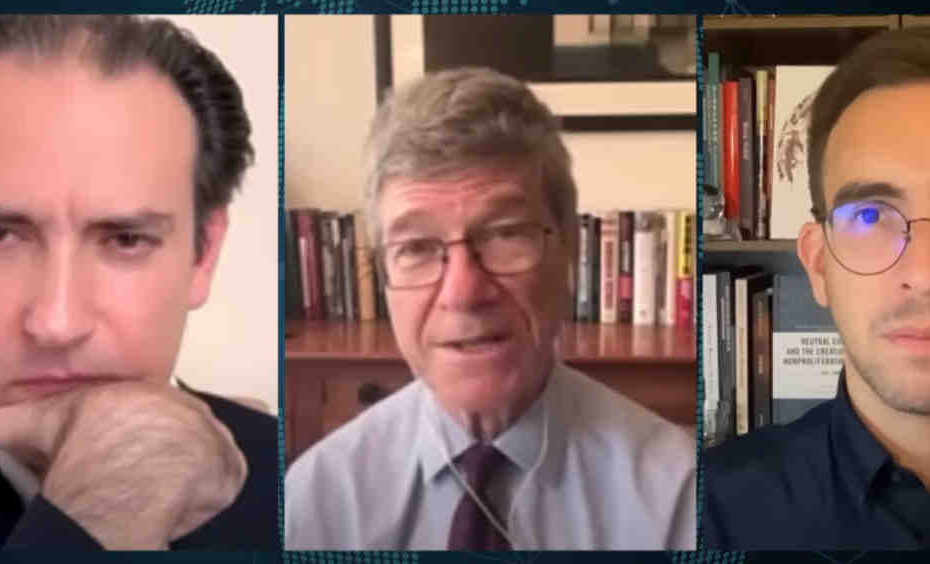
Read the full transcript of host Pascal Lottaz of Neutrality Studies in conversation with guests: economist and public policy analyst Professor Jeffrey Sachs and international relations analyst Lasha Kasradze on “Destabilizing Operation In The Caucasus & Vassalization Of Europe”, August 10, 2025.
INTRODUCTION
Pascal Lottaz: Hello, everybody. This is Pascal from Neutrality Studies. I’m joined today by my co-host, Lasha Kasradze, an international relations analyst specializing in the South Caucasus. We are very honored to welcome Professor Jeffrey Sachs, a professor at Columbia University, adviser to countless governments, and a prolific analyst. Jeffrey, welcome back.
Jeffrey Sachs: Great to be with you again, for both of you.
Pascal Lottaz: Thank you. Well, fantastic to have you, professor. And, you know, we want to ask you first specifically about the South Caucasus because this is a region where we have seen a lot of developments in the recent months. From Azerbaijan support of the US Israeli attack on Iran to a crackdown on political opposition in Armenia and previously an attempt in Georgia to oust the elected government by something very reminiscent of the Euromaidan in Ukraine, although that one is already, like, December, like last year. But still, it’s still quite fresh to me.
What is your reading of these events?
US and European Meddling in the South Caucasus
Jeffrey Sachs: Well, they’re all interconnected in the three South Caucasus regions. This is the US and Europe meddling, trying to make color revolutions, trying to again get to the soft underbelly of Russia. It’s very destabilizing, and it comes from the United States and Europe, especially from the intelligence agencies.
I have no sympathy at all for what Europe and the United States are doing because this is a region that is in between many major powers. Russia, Iran, Turkey, the Gulf countries. It should be handled with care. It is not Europe. Geographically, it is Asia. Europe should get out of there.
It’s not that South Caucasus should have bad relations with Europe or anyone else. It’s that the meddling in the internal politics of these three fragile countries in a very difficult region should be handled with extreme deference and care so that they don’t become the next Ukraine.
Ukraine is ablaze because of United States and European stupidity, and they’re trying to do it again in the South Caucasus. What the hell is Azerbaijan doing as part of the Middle East conflict supporting Israel and its attacks against Iran? Are you kidding? It’s unbelievable. And this is the CIA at work, these geniuses who will destabilize this region and create a massive crisis.
Pascal Lottaz: Do you think even in Azerbaijan, it’s part of CIA work to kind of utilize the country against Iran? Is it not something that is indigenous grown by its leadership?
Jeffrey Sachs: Anything indigenous would start by saying, “We are in the South Caucasus. We are in between a number of powers. We better stick together because that is where our economic and security future lies. We should not antagonize our neighbors. We should find a way to be truly the middle corridor that connects Asia and Europe and the north south corridor that connects Russia and the Middle East. And we should stay out of big power politics and for God’s sake, stay out of Israel’s wars.”
Shame on Israel. But, of course, Israel by itself can’t be doing this. This is Mossad, CIA, and Europe all playing this game in this extremely volatile region.
Georgia’s Pragmatic Approach
Pascal Lottaz: Lasha, you are in Georgia. What’s your impression of where Georgia is taking this? And, you know, because to me, it seems that Georgia is trying to get out of this. And maybe you can follow up on what Jeffrey said.
Lasha Kasradze: Sure. Well, first of all, I understand and agree with what Professor Sachs has just said about surviving in the region. That’s what he was alluding to, I think.
So Georgia is doing a stellar job. The current government in terms of geopolitics, pragmatism and looking after its national security interests as a small state is doing, I think, an excellent job given the reality that it has.
Jeffrey Sachs: I agree with that completely, by the way, completely.
Lasha Kasradze: Great. That’s good to hear. And I’m not sitting trying to exaggerate what’s happening. It’s so extremely politicized these things nowadays that we have to be sort of careful, at least in terms of analyzing it or citing with certain positions. So I’m trying to stick to strictly analysis from an academic perspective.
And there is just no reason to suspect that this government is pursuing some or is hitting above its weight, if you will, or that is acting recklessly, which is a fundamental departure from the previous government that led us to 2008 war and almost sort of ending of the Georgian statehood.
Georgia, I keep saying this and I will continue to say that Georgia came very close in 2008 of August when Russia invaded it from being finished off as a state. And so I think this government has understood the trick where Georgia is in an extremely hostile environment and you have to act accordingly. Be very pragmatic. Have a zero problems policy regionally.
And of course, just like Professor Sachs mentioned earlier, Georgia has and cannot afford to be sort of belligerent against the West. Georgia needs the West, but not in the shape and form with which the West has treated it in the past over a decade or so.
Warning Against US and European Games
Jeffrey Sachs: If I could add, by the way, just for clarity, my admiration goes to the current Georgian government for its common sense and pragmatism. My very deep skepticism is regarding Azerbaijan and the Armenian government right now for playing games, or maybe even that is not quite right by being used by the United States and Europe for geopolitical purposes which do not suit the interests of Azerbaijan and Armenia.
And this is what I really am warning against, just to be clear, which is that it is the long standing practice of the CIA to meddle around Russia’s periphery and now also around Iran’s periphery.
The West, so called, comes and sings a fairy tale to countries like it did to Ukraine. Actually, to be more precise, it overthrew a government in Ukraine so that it could sing its fairy tales to a regime that it installed in February 2014. But the point is that it comes and sings a fairy tale, “We will save you.”
And what I’m saying to friends in the South Caucasus, look at a map, the United States could care less about the South Caucasus. It’s playing games. Be careful.
Brussels, which is completely incompetent and unable to do anything useful, I’m sorry to say because I was a big fan of the European Union at one point. But the European Union does not belong in the South Caucasus. It’s not even Europe. The ridgeline of the great Caucasus Mountains is the ridgeline of Europe and Asia.
So just be careful not to be played. Pay attention to your neighbors. Your neighbors are Russia, Turkey, Iran, Saudi Arabia, other neighbors. That’s what’s important for you. Don’t believe that the United States, especially under Donald Trump, is going to in some way save you from your neighbors. Come on. Are you kidding? They will get you into deep trouble.
Brussels as a US Vassal
The capacity of Brussels to do this is astounding, but you could say Brussels is a kind of vassal of the US. Brussels is not actually representative of Europe, or at least of European interests. It’s a representative of US interests. That’s why both NATO and the European Commission are located colocated together there. They’re playing games.
The South Caucasus has been a place for games for decades. And I could say to Lasha, by the way, just in a personal anecdote on this. In 2008, at this moment that he identifies as the great threat to Georgia, I had the experience of being invited, as a member of the Council on Foreign Relations in New York to a talk by the then leader of Georgia, Saakashvili.
Saakashvili was a puppet of the United States. He was on the payroll of George Soros. He was absolutely a US puppet. Let’s put it that way. And so I went to the talk. I thought the guy was insane, frankly.
He gave a talk at the Council on Foreign Relations. “Georgia is in the middle of Europe. Georgia is a core member will be a core member of NATO. Georgia, this Georgia, that, and Europe.” And I walked out, and, of course, the audience in the United States of New York applauded. “Yes. We love you. We love you.”
And I walked out and I called my wife and I said, “This guy is crazy. He’s going to lose his country.” This was craziness. And a few weeks later came the war. You know, it’s so obvious. Don’t be played. Don’t be owned by the US money.
Don’t be owned by US NGOs, so called, which are not quite NGOs. They are GOs. They are government organizations. Come on. I know it, by the way. I’ve watched this for forty years. These are GOs.
And that’s why when Georgia tried to say, “No, you have to register as a or at least tell us who’s funding you.” Who got so upset? The funders. “You’re going to expose us. You’re going to prove that these are GOs. This is money coming from Washington.” This is a game. Don’t get caught in the game anymore, please.
I love the South Caucasus. What a beautiful region. What great history. What great culture. What wondrous sites. By the way, phenomenal tourism, food, everything. But don’t get caught in a game which is going to make you Ukraine. That’s simple.
And for heaven’s sake, don’t get, like, for Azerbaijan. Stay out of the Middle East wars. Stay out of a genocide taking place in Gaza. Don’t be because Israel gives you security systems or spying systems or something else. For God’s sake, that is not the future of the South Caucasus.
The Deep State’s Permanent Objectives
Pascal Lottaz: Jeffrey, Lasha and I were also discussing before you came online, like, what the role of the deep state is? Because on the one hand, yes, we have the NGOs. You have various ways in which there’s influence being projected into these places, including, of course, the CIA.
But why is it that permanent Washington seems to permanently be interested in these games even when there is somebody like Donald Trump actually rallying on the call against the deep state? But it continues.
Jeffrey Sachs: He’s not rallying against the deep state. The deep state is bigger than Donald Trump. The deep state means the permanent security system of the United States of America. And that since 1947 when it was established, and I would say since 1945 with the OSS, has been organized to defeat Russia. That has been a primary objective.
Now, I would say, the primary objective of the deep state is to defeat Russia and China. And a subsidiary goal of the deep state is to make Israel the local hegemon in its neighborhood in the Eastern Mediterranean. But part of a broader strategy, defeat Russia and defeat China. That’s the deep state.
And the deep state looks at the chessboard, like Brzezinski did in the grand chessboard in 1997 in his book. And the deep state sees every part of the board as part of this game. And it is viewed as a game. It’s viewed as a game in two senses.
One in the game theoretic sense that this is strategy. And we have to put our pieces in different places, our military bases in different places, our color revolutions, our coups, our chosen leaders like Saakashvili and so forth. That’s part of it.
Second, in the more colloquial sense, they view it as a game. These people don’t have their asses on the front line. They’re not the ones being killed. They’re not the ones dying in huge numbers in Ukraine or being slaughtered or starved to death in Gaza. So it’s a game for them, like a video game. It’s a long distance combat where nothing gets too personal for them.
So they are ready to squander places if it weakens their enemy. Remember, what’s the goal of the Ukraine war? Well, our defense secretary, Lloyd Austin, in the spring of 2022 defined it. It is to weaken Russia. It’s to weaken Russia with Ukraine throwing millions of lives into the cauldron. But that’s the idea.
American Primacy and the “Extending Russia” Strategy
So the deep state has an overriding objective, and that is American primacy. And American primacy is threatened by other large powers. America does not care about “kidding places.” I’m putting it in quotation marks. I’m explaining the American security point of view.
Think you think they care about Georgia? You think they care about Armenia? You think they care about Azerbaijan? You think they know even where they are? Well, the only thing they know about them is that the South Caucasus constitutes the soft underbelly of Russia. So we should provoke, extend, antagonize Russia. And we can do it through the neighboring region.
And this is how the US is regarding China. And it’s how the US is regarding Russia. There’s a paper in 2019. It would be humorous if it weren’t so tragic. It’s a paper by the Rand Corporation called “Extending Russia.”
The Rand Corporation makes a list. What are all the things we can do to annoy Russia? Is this really the purpose of the United States of America? To annoy Russia? Well, yes, it is according to their view, because we’re trying to destabilize Russia, keep it on the back foot, prevent it from having economic development, prevent it from developing normal economic relations, including through the South Caucasus.
Because Russia trade with the South Caucasus and with the Gulf region would be highly beneficial, or to prevent the South Caucasus from being the east west corridor, the middle corridor between Asia and Europe. They don’t want that. What they want is to weaken Russia. So that’s the primary aim.
Pascal Lottaz: Lasha, do you want to jump in?
Lasha Kasradze: Sure. I just want to add a comment and then perhaps Professor can answer. So I think one of the biggest problems when you say “don’t get fooled,” right, Professor, “don’t get fooled with these promises, with these narratives.” Part of the problem, part of the reason why they have been fooled is has been historical.
The Historical Context of Georgian Western Aspirations
Lasha Kasradze: It goes back several hundred years, if not more. The idea that in an extreme idealist place somewhere, Georgia always belonged in the West. Even though it was in conflict with material reality, with geopolitics. That try after try and attempt after attempt never landed Georgia in the Western sort of elite club of geopolitics, geoeconomics, etcetera. So Georgia remains to be asking to be admitted.
Continues to ask. But no one seems to be asking why is it that it has not gotten into this club. That’s the first point.
Second point I want to make is just to take, for example, the post Soviet time period, post Cold War period. There has been this wrongheaded irrational expectation that United States would come in and do some sort of a nation building.
Japan, South Korea, Western Europe, correct, after World War II. Even though they have not subconsciously rationalized this rhetoric for the domestic audience in Georgia. That’s the problem. That’s what’s missing. It hasn’t been rationalized.
It hasn’t been analyzed that there is no such plan that exists in the South Caucasus, where not just the collective West, but let’s just say the United States with its leadership and with its enormous resources can come in and rebuild the South Caucasus because of Georgia or just take care of Georgia, rebuild Georgia, and leave everything else the same as it is in the South Caucasus. So logically, nothing is making sense.
And yet this and then and yet there is this rhetoric, this naivete, this confusion, sort of subconscious expectation that America is still coming in with NATO and with encouraging European Union to take care of the South Caucasus as if no other country has ever existed or exists in the South Caucasus against whom these policies will be perceived. Russia, first and foremost. So, you know, this is mental conflict really, sociological conflict with reality.
And this expectation that America is coming in and doing sort of a, you know, Marshall Plan for the South Caucasus, which is nonsense, which never it was even in the plans. Of course. So this is it’s very hard with my colleagues and friends sort of to explain this to them because actually, obviously, they don’t believe in it and they get so surprised that this was the driving force behind these thirty years of naivete and idealism that basically lives in two thousand and eight. And then, you know, and Freedom Agenda and Dick Cheney and Victoria Nuland coming in and telling us that, you know, Georgia was the beacon of liberty and so forth.
So what are your comments on that? What do we know if you could add?
The Marshall Plan Myth and Cold War Legacy
Professor Jeffrey Sachs: Many things come to mind. First of all, the legacy of the Marshall Plan in the late nineteen forties and support for rebuilding Japan in the nineteen forties was specific to the Cold War period when the US positioned itself as the new global hegemon that was challenged by one power, the Soviet Union. And so the US built this alliance or tried to build this alliance against Soviet communism.
This was the idea. There hasn’t been any such thing since then. So first, South Caucasus is not Western Europe in nineteen forty nine. And it’s never going to be again. At that time, there was one dominant power, and one second superpower, the Soviet Union.
And we had this bipolar, very dangerous conflict. But that’s when the deep state idea, which exists now for, as I’ve said, eighty years, to undermine and eventually defeat and even destroy, first, the Soviet Union and then Russia took hold. And that is what is continuing until today, remarkably.
Because even after nineteen ninety one when the Soviet Union ended and the Russian governments were saying, “we just want to cooperate. We just want to have normal relations.” The US said, “no. You have to get down on your knees. You have to be subservient to us.” And more than that, “we’ll break you to pieces, maybe to three pieces,” Brzezinski said. “You know, you’ll be a loose confederation of a European Russia, a Central Asian Russia, and an East Asian Russia.”
It’s a fantasy world, but very, very dangerous.
Pascal Lottaz: I was going to say that the fundamental change in the world since then was not only was it delusional now, but now we are clearly in a multipolar world where the US doesn’t even begin to have the power, the leverage, the interest, the finances to do any of that. We’re a huge debtor country.
We borrow huge amounts every year just to keep our books, you know, our government functioning. The Europe US and Europe are not going to build the South Caucasus. They are wanting to annoy, aggravate, potentially destabilize Russia. That’s the opposite of economic development.
How much weight do you put on the generational aspect? And, you know, just like Japan, when Japan was occupied, MacArthur actually thought new should be neutral. This is, of course, a generation of people who grew up in the nineteen tens and twenties and saw the and grew up in the old United States. Now the people now in power are the people who grew up in the eighties, nineties, came of age eighties, nineties and two thousands.
Right? And they are now in their fifties and sixties. How big is the role of this? Like, when you were young and what you saw, what the world was then?
The American Hegemonic Mentality
Professor Jeffrey Sachs: Actually, I did not know till you just told me that MacArthur advocated neutrality for Japan because definitely US policy became to occupy Japan basically forever and ever as a military outpost of the United States on China’s rim. Maybe the Korean War changed that or maybe the exit of MacArthur, whatever. But definitely, the US would never tolerate a neutral Japan right now, in the ideology of the United States. And I think that’s been true for a long time.
You and I chatted about my recent rereading of the Melian dialogue in Thucydides in the Peloponnesian Wars, which is a incredibly powerful grim dialogue in which the Athenians tell the people of the island of Milos, “you are either with us or you’re against us. And if you try to be neutral, we kill all of the men, and we enslave all of the women and children.” That’s the American mentality right now.
I think it’s been that way basically, at least since John Foster Dulles became secretary of state or since NSC sixty eight in nineteen fifty when the US embarked entirely on the Cold War Crusade, which was a crusade to defeat the enemy and to become the world’s policeman.
After nineteen ninety one, the idea that the US would be the world’s policeman, which when I was growing up was a negative connotation. “Oh, you think you’re the world’s policeman.” But for the neocons, that was the compliment. We will take on, they called it, the constabulary functions of the world, that the United States will be the world’s policeman. What they meant was the US will run the world, and everyone else will cower or bow down or whatever way to show obeisance to the US.
The problem with that is that it’s a delusion because as president Lula recently said, “we don’t need an emperor.” So we don’t want one person dictating to the rest of the world, and we don’t have a sole superpower in the world.
Economic Realities and Regional Alternatives
So to come back to the South Caucuses, look. Good relations with China are even more important for the South Caucus’ economic future than good relations with the United States. Just to put it absolutely bluntly. Why? Because China is the large economy of Asia.
India will also be a major power and, with the important role, by the way, in the South Caucuses in the future. The US is protectionist, slow growing market, and far away. And so for the South Caucuses, the strategy of being a stable, secure, peaceful north, south, and east west corridor, as well as being a great location in its own right for every kind of industry, for advanced technologies, for agriculture, for tourism, for manufacturing. That’s the future. And so the question is how to get there.
And that is not on the basis of NATO. And just to be clear to everybody in the South Caucuses, not a single country in the South Caucuses will ever become part of NATO. Because before that happens, there will be a Ukraine war in the South Caucuses. Russia will never allow that to happen.
And I’ll make a similar statement. There will never be a Mexico Russia military alliance or a Mexico China military alliance, because the United States will invade Mexico before that is allowed. So great powers should not set up their camps on the borders of other great powers. This is the most basic point of survival in this world.
The United States, if it had the slightest sense in the world, and it obviously does not. But if it did, it would not even aim. It would not even have breed the idea of Ukraine or Georgia becoming part of NATO. It would not be arming Taiwan right now. It would be staying out of the lane of other superpowers and telling those other superpowers stay out of our lane, and then we can have a peaceful world where we don’t blow each other up.
Regional Stability and Multiple Stakeholders
The other point I just want to mention, the South Caucasus has other choices, by the way. It’s not as if the security is, “oh, either we have NATO or Russia’s going to invade us.” Russia is not going to invade the South Caucasus unless the United States provokes it. Why? Because there are many important regional powers in the area. Turkey does not want Russia to invade. Iran does not want Russia to invade.
And similarly, Russia would like the South Caucuses to be a bit of a, you know, safe zone in between those other powers. There’s a strong interest in stability. And China, by the way, has a very strong interest in the stability of the South Caucasus because it is a core corridor for east west connectivity, which everybody understands is a major goal of China, by the way, at least since the Han dynasty two thousand years ago, which is to make an east west corridor a Silk Road. Now we call it the Belt and Road.
And so everybody wants stability in the South Caucuses, perhaps with the exception of Brussels and the United States. But there’s no reason why the South Caucuses countries have to say, “oh my god. Either we do this or the Russian empire is going to invade.” This is the kind of delusion that, of course, the US would like to imply, but is completely delusional.
Pascal Lottaz: Jeffrey, we have to be mindful of your time, and we would like to thank you for actually all of these explanations because they’re very valuable. So thank you very much for all of this.
Professor Jeffrey Sachs: Yeah. Great to be with both of you. I really appreciate it. We’ll talk soon.
Lasha Kasradze: Was great. Thank you very much, and great seeing you.
Professor Jeffrey Sachs: Great. Thanks a lot, everybody. Talk to you soon. Bye bye.
Post-Interview Analysis
Pascal Lottaz: Lasha, that was quite something, wasn’t it?
Lasha Kasradze: Yeah, it was great.
Pascal Lottaz: Where I mean, what was let’s discuss this a little bit. I mean, these very clear words of Professor Jeffrey Sachs. There’s not that many people who speak it that straightforwardly. How does this sound to you? Like what how he put the geopolitical, the geo strategic situation of especially Georgia?
Lasha Kasradze: Well, look, to the chagrin of many, this sounds spot on. It is brutal. It is not what many want to hear in Georgia. But this is the harsh reality. And I applaud Jeffrey Sachs for being intellectually brave to come out and say these things, not just in Georgia. We’ve seen the men talk about world politics in this manner. I think that folks like John Mearsheimer is a student of international relations. Jeffrey Sachs, John Mearsheimer, I think, I want to say a stand on their shoulders in many respects.
So yes, they speak the truth. Jeffrey Sachs, what he just told us is exactly what Georgia did not do. And is where and now I’m not saying that if it had done exactly sort of the realpolitik pragmatism had sort of looked at its regional foreign policy you know, from a, you know, a realist point of view that all everything would have been, you know, hunky dory. But I am saying that they could have minimized both separatism, the chances for separatism, even though Russia has played an enormous role in that. But there are reasons why.
And also, they would have minimized the chances, if not eliminated the chances, two thousand and eight invasion of Russia when Moscow recognized South Ossetia and Abkhazia as independent states within the Georgian state. So just think about it. It’s remarkable. Think about that. So Georgia went from bad to worse, geo strategically speaking.
And whether Russia will take those, you know, that recognition back, I would say, you know, that does not look good for Georgia. I don’t think it will. So for a small state like Georgia, Azerbaijan even, even though it’s the most powerful state, let’s just say, in the South Caucasus, right, certainly incomparably more powerful than Georgia and Armenia, it also has to tread very carefully.
And this whole encouragement of Armenia by the collective West to get on their camp, strategic camp, that will join just think about this. They’ve Armenia shaking hands with Erdogan. Pashinyan shaking hands with Erdogan. This is sort of this diplomatic revolution that is taking place of you know, from back into history. But, you know, this does not hold water. This just cannot this is not fundamentally based on strong policy or on sustainable policy, geopolitically speaking. I think this is the Georgianization of Armenia two point zero.
European Strategic Delusions and Regional Pragmatism
Lasha Kasradze: You know, that’s what happened when Saakashvili came to power, supported by neocons in Washington, encouraged and egged on against Russia. And while we don’t see the exact parallels, we see similarities. Yes. The West is not as intense and as aggressive in egging Armenia against Russia, but it is trying to sort of peel it away from Russia somehow. Right?
Try to sort of bring it into the camp of Azerbaijan, Turkey, and Israel. But to what end? That’s the question. What is Pashinyan actually thinking he’s going to accomplish with this? There are no security guarantees, which is the main thing to be concerned about.
And fine, if there is some sort of economic development that this policy is offering Yerevan, then so be it. But in terms of security, there are no guarantees. And Armenia especially, but I think that these policies are somehow going to guarantee security against Russia, provisions against Russia. And then based off of that, sort of make some foolish steps.
Because if anyone thinks that Russia, just because it’s occupied in Ukraine right now, doesn’t have a long memory of what is happening in its strategic underbelly and how, you know, say France, for example, and the collective West are interfering in Armenia. Then they have another thing coming because Russia will remember who stuck to pragmatism and prudence and who decided to, you know, buy into again into these foolish policies of this Western enticement, so to speak.
Pascal Lottaz: Do we currently see any relaxation of the relationship between Russia and Georgia? I mean, the countries, again, we must recall, like they do not have direct diplomatic contact, despite the fact that the west keeps saying, “Oh, Tbilisi is, the Georgia Dream party is so pro Russia.” I mean, they do not even want to establish a direct diplomatic contact. It still goes through the Swiss embassy. Right?
I mean, through Swiss mediation talking officially to each other. Are we seeing any kind of rapprochement at the moment also when it comes to the question of the two breakaway regions, Abkhazia and South Ossetia?
Limited Progress in Georgia-Russia Relations
Lasha Kasradze: No. The short answer is no. There was a conversation that always sort of floats in the background.
But, you know, look, Russia did not do this to rebuild Abkhazia or turn it into some, you know, jewel of the Black Sea. There is enormous corruption, you know, drug addiction. I would imagine the same is happening in South Ossetia. These territories are not being sort of rebuilt by Moscow. That’s not the purpose of Abkhazia for Moscow.
In fact, powerful, rich, wealthy Russians go there to acquire more territories, to buy more land. And so that sort of pokes into the ultranationalists in Abkhazia. And there is a conflict there. But again, they’re powerless. They cannot do anything against Russia about those policies.
But to answer your question, Tbilisi is trying to prolong this as much as possible to be as pragmatic for as long as possible towards Moscow. Because basically, and I hate to say this, but all, you know, it doesn’t matter what we think, to be perfectly honest with you. All the cards are in Moscow’s hand, you know, when it comes to restoration of Georgia’s sovereignty. And in Washington’s, of course, to a certain extent.
But mostly, I think the irony here is that if there is any solution to this is between Tbilisi and Moscow with Washington’s encouragement, help, legitimization of the entire process, of course. But that’s right now, that’s so far away. It’s just dream talk right now. Georgia is nowhere near to establishing.
The relationship between Tbilisi and Moscow are much better, of course. The trade has restarted. The travel has restarted between the two countries. But geostrategically speaking, I think there is still a long way to go.
This is not to say, however, that there is some sort of a nonstarter. Here is what I would say is the difference between the previous government and today’s government without going into sort of conspiracy theories of the fact that, you know, the previous government sort of knew what Russia was going to do if Tbilisi invaded South Ossetia. That’s a different story altogether.
But in terms of developing at least the soft power relationship with Moscow, I think Tbilisi is creating some, you know, almost very light contours of possible rapprochement, which is a remote possibility. I would caution against it, of course, not to get too excited about it. But there could be at least there were third person, fourth person, perhaps conversations that are taking place behind the scenes. But this is nothing, I would argue, close to being formalized yet.
Pascal Lottaz: Okay. Some things just need time, but if things don’t get better, that’s already a good thing for certain circumstances. Right? Well, that’s the choice that Georgia has, unfortunately, in the region.
The Security Equation in the South Caucasus
Lasha Kasradze: Yeah. And, you know, overall speaking, the grand strategy of this is that as long as Moscow, if from the South Caucasus region, there is an elimination of threat, of security threat against Russia as Moscow sees it, because Georgia has never threatened Russia. We know this. It can’t. It’s ridiculous. But we’re talking about the collective West using the region, right, just like the professor was just talking about.
If that threat disappears completely, and it hasn’t, then maybe perhaps there can be a restoration of talks about restoring or going back to the table and the drawing board and figuring out a way how to, at the very least, start the conversation of, you know, rebuilding some sort of a sovereign arrangement for Georgia where these two regions will be part of Georgia, but will have some sort of an internal autonomy.
You know, but so far I think nobody’s sitting around the table there. If a table is in one room, they’re all outside that room, let alone sit around the table. So we’ll see. As long as they don’t abandon the room itself from the outside and just leave the building to rot on its own. I think this is a better situation strategically speaking.
Pascal Lottaz: Right. Because the point is if there is a political solution to Georgia’s sovereignty and the complete withdrawal of Russian forces, then that is actually from the Russian perspective, less of a guarantee that their soft underbelly somehow remains safe. Right? So you would need very, very secure guarantees to Russia in order for them to have the incentive to try to change the status quo because the status quo from Moscow’s perspective at the moment is acceptable. Right?
Lasha Kasradze: That’s the thing. Right. And to that point, actually, it’s not as if Russia wants this. Russia doesn’t want more headaches strategically. Russia never, Putin didn’t wake up and say, “Let me just invade Ukraine out of the blue.” We know how this was being built up against him. This is not to defend Putin. I always underline that. But what I’m saying is he’s a rational actor.
There’s a strategic rationale behind what happened. And unless we understand that rationale, we will not get the possible solutions to it. And that rationale also applies to Georgia and the South Caucasus.
You know, some of my colleagues comment, analysts are getting excited now about, “Oh, they see what’s happening. Russia is losing Azerbaijan.” Well, Azerbaijan was never to be lost. I separate geoeconomic triumph, specifically speaking geopolitical triumph, specifically for Azerbaijan from Russia’s security concerns. As Baku and Aliyev understands, Aliyev understands that geoeconomically in the South Caucasus, you know, Azerbaijan is a necessary state. Right?
Turkey needs it. Turkey supports it. You know, if Israel is looking at Azerbaijan as a possible platform against Iran, but just name the facts here. I’m not saying whether it’s right or wrong for a second. But then yes, it makes Azerbaijan so much more needed, right? So much more necessary as a state in the South Caucasus.
But even so, that has nothing to do with Azerbaijan’s competition in terms of security against Russia. Because when in Yekaterinburg when the scandal happened and, you know, Russians arrested some bad actors, Azerbaijani actors, and then Azerbaijan sort of repaid and arrested Russians who turned out to be, I think, computer programmers or Russians. It’s really, really bizarre because those were Azerbaijanis in Russia, like Russian passport holders, like ethnic Azeris. It’s really bizarre that Azerbaijan would react like that. Right.
And it was just a political game to prove a more fundamental point, saying that Azerbaijan is no longer sort of the younger brother to Moscow and that Azerbaijan can take care of its national economic and sort of security interests without Russia. You know, it won the war. It returned Nagorno-Karabakh, and it’s deciding on its own geoeconomic policies with Turkey and the rest of Europe. Fine.
But that sort of got conflated with, you know, Putin or Russia can no longer handle geopolitics or its security needs and interests in the region. And that’s a very deceptive, if not superficial way of looking at it. Russia will always have enough power to take care of its national security interests in the region militarily. Right? So we’re talking about security here. So I think Aliyev understands that perfectly well.
And I think we are witnessing now that the whole situation has calmed down. And I think Putin also understands that, yes, you know, its adventurism in its invasion of Ukraine has, you know, cost opportunity costs Russia has to undertake. You know, you cannot focus on Armenia or Azerbaijan to the extent that it did, playing the balancing role and providing both countries with weapons and so forth, right, in the early nineties and 2000s.
But I still think that there was a fundamental difference between that and Russia’s security interest. Because if it comes to Russia’s security interest, say, from Azerbaijan or Armenia, Russia will act. There is no doubt in my mind. It has acted before and history is a strong sort of proof of that.
And so Georgia in this respect is playing, again, very smart, clever role. And it’s got this sort of zero problems with neighbors policy. And I think it should continue with that policy because otherwise it just cannot afford to shift the balance or ally with.
And by the way, there is no alliance in a classic sense, there is no alliance structure in the South Caucasus. Right? All these countries, they want their own thing. They want their own interests. They have their own interests.
And besides, who are they going to ally with? If there were a chance of defeating Russia, right, even then they couldn’t ally because combined they would not be able to amass enough security wherewithal, military wherewithal to do anything against Russia.
This is the game between mainly NATO vis-à-vis Turkey in the region historically. This is the game also to weaken Iran, to shave it off from Russia’s strategic interests. You know, and this is the game that also touches on from the Baltic states, geopolitically speaking, through Ukraine.
And as the professor said, you know, we keep forgetting. And Kaliningrad also, by the way, is another flashpoint appearing to be that Königsberg, formerly, as we all know, which is currently the Russian territory, and Belarus. This is the sort of a landmass, if you will, taken collectively that the West has always and the British Empire, I forgot to ask the professor about that. The British Empire sort of historic disdain for Russia in the region.
And so those things, if not repeating themselves in exact sort of historic manner, they certainly rhyme. There are still similar patterns that are playing out that bring back the memories of the great game and strategic competition. But again, the West has not been able to do anything about it for centuries. And it seems to me that is continuing to fail as we speak by engaging in these policies.
Europe’s Strategic Miscalculations
Pascal Lottaz: What is Western Europe thinking? Where is Western Europe now? It sacrifices a lot, you sacrifice a lot for certain beliefs. And we’ve seen it like when powers that we understand from pure economical point of view and a geostrategic point of view when certain powers throw themselves into a desperate fight how it ends.
I mean again this is what happened to Japan. Japan in 1941, a lot of observers in Europe understood very much that they just picked the fight when they did Pearl Harbor that, well, this is probably going to go ugly for Japan, even though, okay, you can expand to a degree in the beginning. But it was clear that you would run out of oil, period.
And you cannot, if you do this contest on all sides, you’re putting yourself up on the losing end. It seems to me that the Europeans are doing exactly that at the moment. They’re throwing themselves into so many fights that from every single aspect you look at it, it’s going to be a losing fight. Yes. You can shed blood over it, but this isn’t going to be pretty.
So I would hope that South Caucasus and especially Georgia do understand that, you know, that’s not the party to be with. It doesn’t mean you have to join Russia. Doesn’t mean you have to join Iran. Just not that party to be with. Just trying to survive as a small state. And there are plenty that history offers for you to follow that lesson.
But quickly, you know, when we talk about, to me, it’s absurd even the conversation that Europe can find, you know, according to Macron, strategic independence or autonomy away from Washington against Russia in terms of what? They’re going to create their own NATO. They cannot even come up with five percent financing of NATO contribution to NATO. Just what is your two cents on this?
The Path Forward: Diplomatic Solutions and Strategic Realities
Pascal Lottaz: Do you honestly think that they can muster up the effort to resist militarily Russia without the United States?
Jeffrey Sachs: No. No. You look, the point is you don’t need to resist Russia if you have a good relationship with Russia.
And actually, I read today again the June 14, 2024 speech, foreign policy speech Putin gave to his entire foreign policy staff in Moscow, where he also laid out what would be needed in order to bring the Ukraine war to an end. And in one of these aspects, he said like, “Yeah, the Europeans are currently in a really bizarre moment and they’re hurting themselves. Maybe at some point they want to partner with us again. And well, we are waiting for that to happen. And we’re here.”
“We are open for that.” And I was like, wow, that is actual strategic common sense. It’s like, “We’re not shutting the door forever. We’re just waiting until there’s common sense again over there because currently, I do think the Russians understand that this has nothing to do with a rational national analysis of what these different places need.”
So in that sense, I do believe that there is a future once Europe understands that it has interests in which it sometimes cooperates with Washington, sometimes with Moscow, sometimes with Beijing. And, you know, it’s one of the poles. Right? I guess that’s the best thing Europe could aspire to, although it might already be well beyond that and have to go through much worse times before some kind of rationality can set in again.
Lasha Kasradze: Yeah. Russia has been, if you notice, they’ve always never shut the door completely against the West. They’re always open. Even now, they’re saying that there’s a conversation to be had. They would never again try to be, you know, another part, you know, Berlin, Paris, Moscow. I don’t think that they view it as that.
But, you know, as a Eurasia and Europe as part of Eurasia, I do think that they have the common sense to actually say, like, “Yeah, that would be good for Russia. Therefore, why not?”
Jeffrey Sachs: Correct. Correct. As long as Putin… but in the long term, though, the question there is still a question about what is Putin going to do long term because it seems to me that the collective west is not going to give up on this war. One way or the other, they’re going to continue to escalate, to instigate.
Putin’s Strategic Calculations
So for Putin, and this is a question to you actually. I want to know what you think about this. For Putin, do you think finishing this off, the earlier he finishes this off, the better off he will be strategically? Or do you think there is some sort of gain to get out of prolonging this thing, knowing that he will win it?
Lasha Kasradze: Just very briefly, I mean, since we do have to end the conversation, but we are speaking on August 7th, and we just had the confirmation that even Vladimir Putin is saying, “Yeah, a direct talk meeting with Donald Trump is on the cards” after having a three hour conversation with Mister Witkoff.
I couldn’t believe it at first, but now that Putin is saying it is okay. Something is happening. So maybe what we are seeing now is some form of disguised debate about a surrender. Right? What is the surrender terms?
Because we see that Russia is definitely winning on the battlefield. Right? But Russia still has an interest in ending this diplomatically because the last thing you want is an eternal guerrilla war. Right? You don’t want that. Occupation, much less.
The Need for Political Settlement
Yeah. Much less occupation. You want some form of settlement that takes into account everything that Russia can possibly get while also preventing eternal guerrilla warfare. And I do believe, in a sense, you know, this is what the Americans also had to, in a sense, negotiate with the Japanese to make sure that they actually lay down the weapons, and then you continue with the political, with the occupation and the political engagement. Right?
So Russia needs to get to that point where they can go to the political engagement without the shooting. And in that sense, I do think that there’s a strong incentive to come to some form of understanding to end the proxy war and then get to a realistic political process in and with Ukraine that resolves this horrible thing.
But the resolution can take twenty, thirty years because these wounds to heal will be very long. Unfortunately, all this could have been avoided. And now we’re sitting here talking about this great tragedy. This is. And, you know, I am very glad that Georgia didn’t go down that very sad route, and I do hope it remains like this.
Pascal Lottaz: And we are nearing the one hour mark. Thank you very much for your time today.
Lasha Kasradze: Pascal, thank you very much for having me.
Related Posts
- Alex Bruesewitz Interview: Tucker Carlson Show (Transcript)
- Transcript: Trump Remarks at the Faith & Freedom Coalition’s 2026 Policy Conference
- Yalda Hakim Interviews Tucker Carlson (Transcript)
- Modern Wisdom: Ezra Klein Interview – Collapse of American Politics (Transcript)
- Transcript: President Trump Signs Executive Orders – Jun. 22, 2026