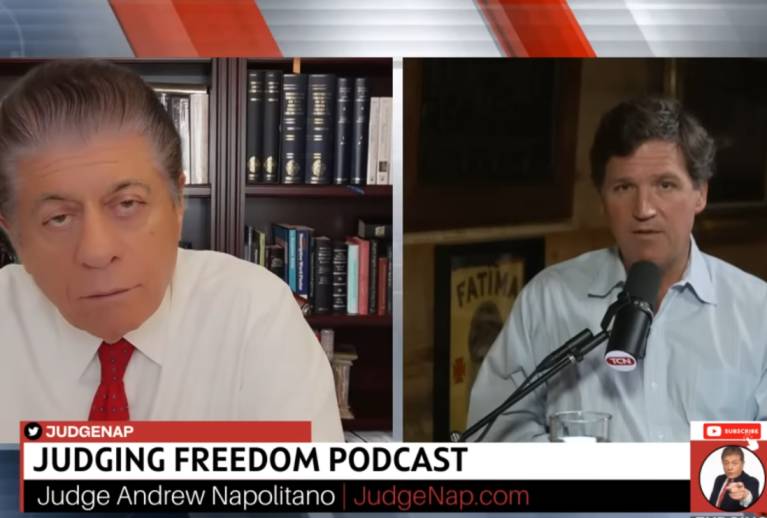
In this Judging Freedom Podcast episode, streamed live December 17, 2025, Judge Andrew Napolitano welcomes Tucker Carlson for a wide-ranging conversation about how America wages war today, what real peace would require, and how far President Trump has already pushed the constitutional limits on executive power.
Carlson describes being told by a sitting member of Congress that lawmakers were briefed on an imminent U.S. military move against Venezuela, and argues that 80 years of regime-change wars—from Iraq to Libya—prove such interventions never benefit ordinary Americans. Together they walk through the War Powers Resolution, the Founders’ intent that Congress—not the president—decide questions of war and peace, and how both parties have quietly normalized unauthorized conflicts under vague “national security” justifications. The discussion also touches on free speech, media propaganda, and why Carlson believes citizens must relearn their own Constitution if they want to stop the next manufactured war before it starts.
Opening Remarks
ANDREW NAPOLITANO: Hi, everyone. Judge Andrew Napolitano here for Judging Freedom. Today is Wednesday, December 17, 2025. My next guest needs no introduction. He is literally the best known media commentator in the Western world. He is also my former colleague and my friend, Tucker Carlson. Tucker, thank you very much for your time today. I have a lot to ask you about and pick your brain on, and I deeply appreciate your time. Thanks.
TUCKER CARLSON: Oh, I appreciate it. Thank you.
The Schumer Censure and Free Speech
ANDREW NAPOLITANO: Thank you. I write a column every Thursday, and my column that comes out late tonight is called “Tucker Carlson and the Freedom of Speech.” It’s about the bizarre efforts of Chuck Schumer and 40 Democrats in the United States Senate to censure you because of what you did not say on your podcast. How dangerous is it for people like you and me that are accustomed to unbridled freedom of speech today? And why is Schumer coming after you? What is he afraid of?
TUCKER CARLSON: Well, there are a couple levels. I mean, on one level, it’s hilarious. I don’t think my interview with Nick Fuentes is like a matter of national concern, really, given everything else that’s going on. So it’s like incredibly small bore.
But yeah, this is not just a foretaste. This is kind of where we are now with speech, where both parties have aligned against the core American freedom. In fact, the thing that makes America exceptional, which is the recognition that our right to say what we really believe comes from God, not government, and it cannot be abridged. And that’s why it’s the first item in the Bill of Rights, of course. So both parties are against that now. So that tells you what the future is going to look like.
It doesn’t reduce our obligation to do it fearlessly anyway, because like the right itself, the obligation itself is something that we’re born with. That’s my view.
But there’s something else that bothers me about this, which is it’s just, it’s of course, identity politics. Now, I said in my interview with Fuentes, I’m totally opposed to anti-Semitism because I think it’s immoral. My religion tells me that. And my sort of civic duty as an American is to say that because if we allow tribalism to take hold here, the country will be destroyed. And I really believe that. So I don’t have any problem at all saying—I say it often, and I mean it—anti-Semitism is immoral.
But so is any kind of hate against any person on the basis of his DNA. Okay, we can’t have blood guilt in the United States. Schumer and the ADL and a lot of the people who were jumping up and down about anti-Semitism—and I’m on their side on that—were the main purveyors of anti-white hate for decades, literally for decades, setting up a system more complex than Jim Crow to keep people down, to prevent people from getting jobs or getting into college or getting federal grants on the basis of their race. Okay, they did that.
So the only way out of this is for people like Schumer and for the ADL to say out loud, “All forms of hate on the basis of DNA blood are immoral and we will join the fight against them,” to repent from what they’ve been doing. And if they do that, of course I will send them money and I will support them because that’s the most important thing.
You see where this is going. Identity politics leads to Rwanda every single time. And it will. That will happen here. And so we need to think bigger. If you’re against anti-Semitism, you have to be precisely as against anti-white hate or anti-black hate, anti-Malaysian hate, whatever. You’re against hating people on the basis of how they were born. You are instead committed to treating people on the basis of how they behave. That we said we believe that. We clearly don’t, but we need to re-establish that. And that’s got to be the baseline.
And anyone who’s been promoting race hate as Chuck Schumer and the ADL and many other groups have—American Jewish Congress, all of them—any person who’s promoting race hate does not have the moral standing to lecture me about race hate because I’m against all of it.
The Chilling Effect on Free Speech
ANDREW NAPOLITANO: Right, but you have an enormous megaphone, universal respect, and the stiffest backbone. I know this is not going to intimidate you. Others that Chuck Schumer may target for political reasons, he may intimidate. That’s called chilling. The First Amendment prohibits anybody in the government from using the levers of governmental power available to them to chill the free speech rights of that speech which they hate or fear.
TUCKER CARLSON: Exactly. And you see it happening. I mean, it happened to the Heritage Foundation, you know, and the guy who runs the Heritage Foundation comes out and issues a statement partly on my behalf, which probably was not wise and I get it, but I was friends with him, so—but really on behalf of the principle of freedom of speech, like, you have a right to say what you think, and then if you don’t like it, we debate it.
And because he said that, he’s been destroyed. The Heritage Foundation itself has been destroyed. And you have to ask why? Why? It’s not a radical position. It’s a core conservative position. It’s a core American position. And the Heritage Foundation is being destroyed. They just said two more trustees resigned last night. Not that anyone cares, because it’s irrelevant already. But the principle matters and the example matters.
And why are they doing that? Why are they destroying Heritage? Because the president dared to defend free speech. Because elements of the right, big elements of the right, are totally opposed to free speech. So that’s been the thing that I’ve learned this year. The people I thought were my allies on a deep level—like, we disagreed, maybe we disagree on Israel. That’s totally fine with me. I don’t mind disagreeing on Israel with anybody. Right.
What I do mind is watching my country’s core promise eradicated. And that’s what they’re doing by getting rid of free speech.
Government Coercion on Campus
ANDREW NAPOLITANO: The administration of Donald Trump has pressured and coerced colleges and universities into suppressing free speech. I mean, two years ago, you and I could have gone to Columbia University and held up a placard saying we’re in favor of the two-state solution. We did it today, they’d throw us off campus. If we were students, they’d kick us out of the school. That is government pressure coercing free speech, forcing people into a box. You can say this because it’s pro-Israel. You can’t say this because it’s pro-two-state solution. When I say pro-Israel, I mean pro-Netanyahu.
TUCKER CARLSON: Well, this is BLM, basically, with a different protagonist. And by the way, the same people who supported BLM, like the ADL, like every major Jewish group supported BLM, which was anti-white. It was designed to hurt white people on the basis of their race. They all supported it, and now they all support this.
So again, no American can be on that side, because that’s what it is to be American. We judge people and we have a monument on the Mall that says this. We judge people on the content of their character. We judge them as individuals. We do not judge them as groups. We do not kill their children because they’ve done something wrong. We do not imprison their whole family.
That’s the Eastern view of justice. The Western view of justice is based on the human soul and the dignity of the individual. You deal with the individual. That’s our justice system, and that’s what’s going away. And this is just yet another example of it. But if the right won’t stand up for that principle, the primacy of the individual, the sovereignty of the individual, the human soul, then what’s the point of having a right? Well, there isn’t one, actually.
Gaza and the Slaughter of Innocents
ANDREW NAPOLITANO: Do you think that Donald Trump understands that in order to please the donor class, he’s funding genocide in Gaza? You talk about killing innocents. This is the slaughter of tens of thousands of innocent people.
TUCKER CARLSON: And not an accidental slaughter. So you often hear people say, “Well, in war, you know, innocents die,” which is obviously true. It’s one of the reasons I think we should think very carefully before joining any war, because the effects are far beyond what they’re advertised to be.
But this is very different in that, and we know this from the public statements of Israeli cabinet ministers, the point is to make the people who live there, the indigenous occupants, leave so their land can be taken. And killing their children and their women and their parents and their grandparents, killing them on purpose is in service of that goal.
So this is not accidental. This is the intentional murder of innocents in order to achieve a goal, which is the theft of land. But whatever the goal is, we can never take the side of the murder of innocents. We are officially opposed to murdering innocents, period. And when we kill innocents by accident, we admit it, we apologize. If we think it was intentional, we punish the person, including countless U.S. soldiers over the years who’ve been court-martialed and imprisoned, in some cases executed for killing innocents in war. That’s why we say we’re better.
And if we sign up for that program and pay for it and endorse it and hurt anyone who criticizes it, which we have done, then how are we not the same morally as the jihadis we claim to hate? And of course, we’re not.
The Ted Cruz Interview and Biblical Justifications
ANDREW NAPOLITANO: I’m chuckling, thinking of your interview with Ted Cruz where he actually told you that God the Father gave Israel to Benjamin Netanyahu. And then, of course, you asked him where he could find it in the Bible, and he was not as literate as you in being charitable in his reading of the scripture. But isn’t Donald Trump funding genocide, as Joe Biden did, to please the donor class?
TUCKER CARLSON: Well, I mean, strictly speaking, the U.S. Congress is funding it enthusiastically, but I think for sure the executive branch is. Seems to be behind this. I don’t think everyone in there is.
But I would just say, look, the obvious point, which is we all get carried away. We’re all prisoners of the moment we live in. It’s happened to me throughout my life. You could find tape of me saying, “The problem is Muslims. The problem is Islam.” I can’t even believe I said something like that. The problem is not a religion. The problem is individuals. The problem is a certain ideology. It’s not—it’s clearly not all Muslims. I can’t—is it all Indonesians, really? But I said that. Why did I say that? I’m ashamed of saying that. And I’ve apologized. Let me apologize again for saying that.
Just as if I ever said “It’s all Jews,” because I don’t like Mark Levin, “It’s all Jews”—that’s a disgusting thing to say. But I have, you know, I’ve said that about Muslims. So all of us are prisoners of whatever hysteria surrounds us. We’re influenced by it. And I think a lot of decent people have been carried away to a point where they’re defending what is genocide in Gaza.
But it doesn’t mean there won’t be massive consequences for the country, for their souls. Honestly, you can’t do that. You need to repent of that. You need to say, “I’m sorry I did that.” You have to do that, or you imperil yourself eternally. But you also risk destroying your own country. And that’s exactly where we are.
Extremism in American Politics
And we also need to call out true radicalism. Laura Loomer, who has a press pass to the Pentagon yesterday, said, “We need more Meir Kahanes,” okay, the founder of the Jewish Defense League, who was a convicted terrorist. I’m not throwing this around like, “Oh, he’s a terrorist.” He was literally a terrorist. He was murdered in 1990. But under U.S. law, he was a terrorist. He admitted he was. He was convicted twice for bombing people. He admitted he did it.
So he was exactly what we say we’re fighting against. He was a terrorist killing innocents to make a political point or achieve a political end. And here you have Laura Loomer endorsing him openly. You’ve got Lindsey Graham saying on tape, “If you don’t do what Israel wants, God will kill you.” You have Mike Huckabee saying exactly the same thing. “America will be destroyed unless we follow the lead of Benjamin Netanyahu.”
This is true extremism. This is what I didn’t like about ISIS. It’s what I disapproved of with Al Qaeda. That’s why I don’t like jihadis. I really don’t like any of that. No American should. And all of a sudden it’s flowering in our country. And these are not small people. Mike Huckabee is the U.S. ambassador to Israel. Lindsey Graham is the senior senator from South Carolina. Laura Loomer is all over the executive branch as like an advisor.
You can’t have this. You have to say that this is wrong. It’s getting too crazy. We’re going to wind up with real violence if people keep talking this way.
AIPAC and Congressional Standing Ovations
ANDREW NAPOLITANO: So why did the Congress give Benjamin Netanyahu 56 standing ovations in a 58-minute speech? Is it because their campaigns are funded by AIPAC?
The Spell of Foreign Influence
TUCKER CARLSON: It’s such a tough question. I had the smartest conversation, deepest conversation I ever had about this was with Jeff Sachs, who I know is your friend and mine. And he said, yeah, it’s the money. Of course there is blackmail, there are threats. That’s all real. It’s real the world over. It’s not just Israel that does that, by the way. Of course not. Lots of different countries do that, lots of different lobbies do that.
But there’s something deeper. There’s like almost a spell. I mean, Huckabee, for example. You really think Huckabee is being threatened?
ANDREW NAPOLITANO: Huckabee, Mike is more the Israeli ambassador to the US than he is the US Ambassador to Israel.
TUCKER CARLSON: You know, he’s become a zealot.
ANDREW NAPOLITANO: On Newsmax that Mike makes while he’s the US Ambassador for selling Israel first trinkets.
TUCKER CARLSON: It’s right. So it’s so degrading to the office, to the State Department, to the US Government, to all of us as Americans. To have someone like Huckabee advocating for a foreign country as he’s supposed to be advocating for ours, like that is degrading.
But then you have to—I know Huckabee well, I’m sure you do too. Nice man. Like, what is this? And I look at him and I see a man under a spell. I mean, I mean this and I’ll be mocked for it. But I mean it. I think—and that’s what Jeff Sachs, who’s pretty secular guy, I think, but he said, I’ve watched this for 40 years. There’s no practical, conventional explanation for some of this behavior.
I mean, I look at Ted Cruz and I’m like, I think I know what’s going on. Lindsey Graham, I think I know what’s going on. But Mike Huckabee, I think he has—he is under a spell. He is not thinking clearly at all. And so when Mike Huckabee says, and I think Mike Huckabee likes America, or did, but when he stands up and says, “God will destroy our country if we don’t support Bibi,” it’s like, how could someone ever say something like that? And I don’t know the answer, but I think it’s more metaphysical than political.
The Jonathan Pollard Case
ANDREW NAPOLITANO: Well, you talk about embracing felons. He embraced Jonathan Pollard, who is the greatest stealer of American secrets in the history of the United States of America. And he stole them and gave them to Israel. And when he got out of jail, he had certain confinements imposed upon him. Trump commuted those confinements. Sheldon Adelson flew him to Israel. Benjamin Netanyahu greeted him. Now Mike greets him in the American Embassy, a guy who probably cost American lives by exposing the names of American agents.
TUCKER CARLSON: And what happened? What did Israel do with those secrets? And it wasn’t just—it’s not like Julian Assange, Ed Snowden, these were actually national secrets. It gave them to the Soviet Union.
ANDREW NAPOLITANO: Correct. Correct. It further developed its nuclear—the security around its nuclear weapons because these secrets were how America spies on other countries. And it gave, it probably sold it to the old Soviet Union. That’s one of the reasons the government was so animated in its prosecution.
You know, I like the little guy. I usually side for the defendant in these criminal cases. Not in this case. The evidence of his guilt was overwhelming. The harm was manifest, and then the United States ambassador treats him royally.
Venezuela: The Next Regime Change War?
Is Trump going to start a war in Venezuela?
TUCKER CARLSON: I don’t know. I don’t know. When this program airs, the one that we’re on right now, we’re live.
ANDREW NAPOLITANO: Now, and then it’ll be posted immediately. So, right.
TUCKER CARLSON: So my sense is I don’t know the answer. I’ve certainly been on the phone a lot about it. I have no power, I’m a podcaster. But I’m very interested. And so here’s what I know so far, which is that members of Congress were briefed yesterday that a war is coming. And it’ll be announced in the address to the Nation tonight at 9 o’clock by the president.
Who knows, by the way, if that will actually happen? I don’t know. And I never want to overstate what I know, which is pretty limited in general, but a member of Congress told me that this morning, so that’s what I know.
My opposition to this, and I’m sure if you oppose this will be like, “Oh, you’re a communist,” which I’m not. My opposition to it comes from what I’ve learned from watching closely for the past 25 years, since I’ve been assigned to cover all these stories, including in Iraq, Afghanistan. I’ve watched and there’s not been a regime change effort that’s benefited the United States or the world in 80 years that I’m aware of. And if there is, tell me what it is. I just don’t see any evidence of that. It all seems like a net loss for us.
And so this is why they’re calling me an anti-Semite, because I was opposed to regime change war in Iran, and I’m opposed to one in Venezuela, particularly Venezuela, because it’s right there and all kinds of things could happen. You say you hate Maduro, we hate Maduro. Imagine what would Venezuela look like without Maduro. And who would replace Maduro? Some absurd, you know, Klaus Schwab acolyte, fake Nobel Prize winner. The abortion lady is going to—I mean, this is all so crazy.
ANDREW NAPOLITANO: Was employed by the Mossad or is at least an asset of the Mossad. I mean, what national security threat to the United States of America is posed by the government of Venezuela? The answer to that is zero.
TUCKER CARLSON: Yep.
ANDREW NAPOLITANO: Is he going to ask the Congress for a declaration of war? Is there going to be some great debate? Will we see Lindsey Graham going toe to toe with Rand Paul? Probably not. He’s probably just going to do it.
The Absence of Congressional Debate
TUCKER CARLSON: Well, there’s never—I mean, of course, I always want debate over everything because I think it helps elucidate what’s at stake. And like, you want to hear everything you can before making a decision in the hope that it’ll be a wise decision. But I doubt there’ll be any debate in the Congress. And there will be a couple libertarians who will stand up and be like, “Oh, you can’t do this.” And they’ll be like, “Shut up, Communist,” just like they were like, “Shut up, anti-Semite. You don’t want a regime change war in Iran.”
So, you know, I just pray that it won’t get to that point. Not because I love Maduro, but because how is that good for the United States? Exactly. And I mean, to be a lot more specific, I think the idea is, you know, of course, Venezuela is the largest proven oil reserves on the planet. So the question is about oil fundamentally, and who gets it, who extracts it?
American companies did. Now they don’t. A lot of that oil goes to our enemies, China and Russia, and that’s infuriating to some people, probably to the president. And I get it, I get it. But what’s the best way? Like, if you want Venezuelan oil to go primarily to the United States, you want to have some influence over it. If you want American companies to extract the oil and improve infrastructure, yeah, probably the last thing you want to do is overthrow the government because then you have chaos, then you have total chaos, and who’s in charge?
There’s—the assets are so profound in Venezuela that it’s not going to remain a vacuum. You’re going to have generals showing up at oil fields or refineries, being like, “This is mine. I’ve got the guns, take it away from me.” Then you have China primarily, but also Russia in the background, and they have every incentive to topple the teetering American empire in Venezuela. It’s right there. It’s in our hemisphere.
So, like, there’s a lot going on here. You could wind up in a super tough spot. So, you know, you hope that there’s a thoughtful approach to this. You know, I don’t know if there will be.
The Peace President Who Funds Wars
ANDREW NAPOLITANO: So Donald Trump ran and he repeated this phrase in his inaugural address a year ago—seems like more than a year ago after all we’ve been through with him—as the peace president. He’s funded a war in Ukraine, he’s funded genocide in Gaza, he’s funding a war in Yemen, he attacked the Houthis. Now he’s going to start a war in Venezuela. What do you think he thinks about? Why do you think he does this? Is it some sort of a macho thing with him? Or is Marco Rubio just whispering in his ear about how dangerous these socialists in Latin America can be?
TUCKER CARLSON: I do think there is a difference internally, from what I can tell, between Eastern Europe, Middle East and Venezuela. So some people who were very opposed to a regime change war in Iran are now advocating for a regime change war in Venezuela. So they’re not all of a piece, from what I can tell. I don’t work there. I don’t go there very often. So there’s that.
I think—I mean the macro and I don’t know the answer to your question. What’s the President thinking? I don’t know. But I think the macro point is that, you know, there are a lot of stakeholders in this conversation and not all of them are elected. And you wonder, how much sovereignty does any Western leader really have? Which is to say, how much ability does any leader have to make independent decisions based on his campaign promises, what he believes, what he thinks is best for his country? You know, I don’t know the answer to that, but maybe less than we imagine.
The Seduction of Military Solutions
And the other point I would make is that it’s pretty easy to subvert a president, any president, on the national security front, because these are problems you’re told you could solve. Like, what do you do about Social Security, the national debt? Nobody has any freaking clue. It’s too hard. No one really wants to try the Senate. This is true.
Also, briefers will come to you and be like, “There’s a bad guy in country X. We can kill him. Our US Military is the most powerful in history. We can kill this guy. You can affect positive change by doing that.” And then you don’t have to worry about like, homelessness or what do you do with the tens of millions of unemployed, working age American men? What do you do about Fentanyl? Like, there are all these problems that are tough if not intractable, but this problem can be solved in one swift stroke.
It’s super simple. No, you don’t speak the language of that country. No, we don’t really understand anything about it. Where is Yemen exactly? Who are the Houthis? What are they fighting for? Has anyone ever defeated them? You don’t have to ask those questions. It’s like, “We’re going to attack the Houthis because they’re bad.”
And you can sort of see the mindset. Even Obama, maybe especially Obama. Clinton, George W. Bush was just like an idiot, so he was taken over immediately. But even people who are like, “I don’t want to get into this,” have gotten into it because it’s the nature of the system.
I’m not giving Trump or anyone a pass. I just have watched this first—well, really since 1985 when I got to D.C.—and it’s always the same story. So you really need to think about what is the role of CIA in this? What is the role of ODNI? And I love Tulsi. I’m not talking Tulsi, but like, you know, the President’s daily brief. Like, is that pushing us toward a foregone conclusion or not? You have to ask these questions at least. It’s—the system is more in control than any elected leader. That’s just clearly true.
Tulsi Gabbard’s Marginalization
ANDREW NAPOLITANO: You mentioned Tulsi. Here’s what she said a few years ago, 2019, about Venezuela: “The United States needs to stay out of Venezuela. Let the Venezuelan people determine their future. We don’t want other countries to choose our leaders so we have to stop trying to choose theirs.”
To me that is as sound, rational, appropriate, correct a two liner as I have heard. And yet is she marginalized in the White House? We are told our mutual friend Max Blumenthal that she was totally marginalized during the 12 day Israeli-Iran war. She wasn’t even in the Situation Room.
TUCKER CARLSON: In the White House.
ANDREW NAPOLITANO: Is she going to be marginalized in the preparation for this absurd invasion of Venezuela? Because that’s her true attitude.
The Cost of Dissent and the Integrity of Tulsi Gabbard
TUCKER CARLSON: I mean, I can’t guess. And I’m almost hesitant to compliment Tulsi, whom I consider an outstanding and honest and thoroughly decent to the bone person, because it doesn’t help Tulsi to have me compliment her. But I do feel that. So of course, you know, a lot is at stake. Everyone’s phone’s being monitored, obviously. And so people sort of know what the players really think because their phones are being read. In a lot of cases, I can’t speak for hers, but that’s a very common thing, as I know, you know.
So it’s like we don’t—they don’t, you know, the opponents of the America First agenda don’t need to guess about what their opponents think because they’re reading their signal. So this is my view. And so yeah, anybody who dissents from the program is going to be marginalized at best. But I think Tulsi’s a very scrappy person with true integrity. So I’m rooting for her. I wish we had a bunch more like her, but boy, it just makes you sad.
Like what? Tulsi Gabbard is nothing to be ashamed of. Tulsi Gabbard has no weird agenda. Tulsi Gabbard is the poorest famous person I have ever met in my entire life. As far as I know, Tulsi Gabbard doesn’t own a house because she’s never made enough money to own a house. And money is the measure. And a lot of these people are incredibly rich relative to their skill.
Like, there are a lot of dumb people. Bill Ackman is worth like $8 billion. He’s an idiot. Like, how did that happen? How did Barry Weiss get control of CBS News? She’s an idiot. You know what I mean? There’s like a lot of that. And it’s not just those two, trust me. There’s a lot of that.
ANDREW NAPOLITANO: Somebody like Tulsi, who’s so smart, so dedicated to first principles. I mean, she was the featured speaker at Ron Paul’s 90th birthday party. I mean, she’s so dedicated to small government, maximum individual liberty, peace principles, and yet they keep her out of the decision making process. Did our former colleague and former friend—I don’t know if you were ever friends with him—who now is the Secretary of Defense, but calls himself the Secretary of War, commit war crimes in the killings of these non-combatants on the high seas as the President ordered him to do?
The Moral Line: Killing Innocents
TUCKER CARLSON: I’ve asked about this and you know, you get all these different answers, so I, you know, I’ll just say this. We are not allowed to kill innocent people. Period. And the consequences for that are eternal. And the consequences in this temporal world are real. So if you go around doing that, you again have to apologize for it. You have to punish the people who did it. That is the line that separates us from the people we say we hate.
Say the Nazis, for example. I’m not calling anyone a Nazi. I’m asking why do we hate the Nazis? Because they’re unfashionable? No, because they did things that we think are immoral. And one of those things, the main thing was killing innocents. So how about we don’t kill innocents?
I mean, I tried to make this point about Hiroshima. Everyone’s like, “Oh, you’re a, you know, I don’t know what, you’re trans or you’re like pro, you’re a communist or you’re pro”—I don’t even know what the answer was. But my only point was I’m not for Imperial Japan at all. I’m glad that we beat them, but why should we be defending the killing—the intentional killing of kids and women and people who have nothing to do with the decision making? People who didn’t do anything wrong, why are we defending the killing of them?
We should say we’re sorry for that and there’s no cost because no one who did it is still alive. Ben Shapiro went ballistic on me. “This guy’s a liberal.” Well, I’m not a liberal in any sense am I a liberal and I never have been. And I’m not the one who was calling for the COVID vaccine or whatever. I’m just saying that’s the line. Of all the things that divide us as a country, the willingness to kill innocents is the one that matters most. That’s where we have to draw the line.
ANDREW NAPOLITANO: I never got in more trouble with Roger Ailes in the 21 years I was at Fox than when I referred to Harry Truman as the greatest mass murderer in the history of the world. If you measure mass murder by the number of deaths per second because of Hiroshima and Nagasaki. I mean, this is profoundly anti-American because you talked about it earlier in the show. It’s the collective punishment. It’s the punishment of A, B and C because of what D did.
TUCKER CARLSON: Exactly.
Truman, the CIA, and the National Security State
ANDREW NAPOLITANO: Profoundly violative of what Madison and Jefferson crafted when they started the country and profoundly violative of what the country believed up until the War between the States. Then we got back on track. Then we had Teddy Roosevelt, and then we had the national security state crafted under Harry Truman in 1947.
In 1963, in June now—so this is the time of Kennedy’s famous American University speech—Truman wrote an editorial in the Washington Post saying, “If I had known that the CIA was going to be overthrowing governments, I never would have signed the legislation into law.” In those days, the Washington Post came out twice a day, morning and evening. The former President of the United States writing an op-ed in one of the nation’s premier newspapers. They banned it in the evening edition because their masters at Langley called them up.
TUCKER CARLSON: And said, “You got to get rid of that.”
ANDREW NAPOLITANO: “It’s killing us.”
TUCKER CARLSON: Is that true? That’s true?
ANDREW NAPOLITANO: You know, somebody told me that—I think it was Jeff Sachs—and I went and looked it up. If you—I forget the date, but it’s June of ’63. You look it up, you’ll see it there in the morning and gone in the afternoon. Now, did the CIA make those phone calls? I believe Jeff’s sources are accurate.
TUCKER CARLSON: Well, I mean, of course, the CIA was all over that newspaper. Ben Bradlee and the Grahams, of course, were affiliated with the CIA and Cord Meyer and, you know, I mean—right, right. Yeah, I know a lot about this topic. But by the way, all of us who are the product of Washington sort of just assumed that was normal. And it’s only with distance from the city and its customs that you realize, no, that’s the opposite of democracy. That’s really dangerous. And maybe that’s why the country’s in such trouble.
Where Is Congress?
ANDREW NAPOLITANO: I don’t even know if we have a Republican lowercase R form of government anymore. Where is the Congress? What the hell does the Congress do? Why does the Congress let the President set taxes, which he calls tariffs? Why does the Congress let the President kill people just because he calls them narco-terrorists? A political term, not a legal term. Why does the Congress look the other way? Why is it just Rand Paul and Thomas Massie making sense down there? And they’re drowned out.
TUCKER CARLSON: I mean, this is just a very recognizable sort of continuum. You know, as the system withers, the legislative branch becomes irrelevant. All power vests with the executive. Like this has happened to other empires before. Of course. Yeah, right. This is the Roman Senate.
And so I try to remind myself of that because I get so frustrated with the behavior and the cowardice of certain members of Congress. Of course I know them because I lived there for so long and I know a lot about it. But I keep reminding myself, including this morning, it doesn’t really matter. The decisions are not made there. This is just performance art.
I mean, by the way, when they ceded their power to the regulators in the executive branch agencies, Congress really kind of ceased to be a player. Certainly not a co-equal branch of government. When you know the EPA makes more laws every month than the Congress makes in a year. It’s like their regulations, they have the force of law. People with guns can enforce them. All of this is performative, it’s just, it’s pretty fake. So I, you know, I just keep that in mind.
Labeling Russia a State Sponsor of Terrorism
ANDREW NAPOLITANO: Senator Graham introduced legislation which was debated yesterday. There’s a couple of great clips of Senator Paul attacking the legislation which would have the public policy of the United States characterize Russia—a country you and I have both visited. I got to interview Sergei Lavrov, you got to interview Vladimir Putin—to label Russia as a state sponsor of terrorism. How preposterous, absurd, counterproductive is that?
TUCKER CARLSON: I mean, it’s basically an effort to thwart the United States. It’s self-harm. I think it’s clearly intentional. I have always liked Lindsey Graham. I always will like Lindsey Graham because he’s just so charming and funny. But I don’t know, I can’t tell. I want to give him the benefit of the doubt and assume that he doesn’t know he’s being used as an instrument of the destruction of the United States. But he is, whether he knows it or not.
And so of course, geopolitically, China is the story because it’s manufacturing power and for a lot of reasons, but it’s growing military power. So the first thing you want to do, and Trump has said this a million times before he became president, the first thing you want to do is make sure that Russia and China don’t align because all of a sudden there’s a bloc much more powerful than you in charge of the world and you do their bidding, which is going to happen at this rate.
And so to make Russia the enemy when there’s absolutely no reason to make Russia the enemy at all, we did it on purpose. We provoked Russia into invading eastern Ukraine by moving NATO eastward. Obviously, they told us this a million times. We did it on purpose. Why? What would be the point of that?
Well, if you’re China, this is the one thing you want. You want the United States to pivot against Russia. What you don’t want is a bloc from Mongolia west against you. You don’t want that. That’s the one thing you don’t want. And they achieved it through the willing or unwitting participation, collaboration of American leaders. And that’s the story.
It’s not about Zelensky stealing money or whatever. Okay, yeah, got it. That’s all true, by the way, but that’s not what this is about. This is about the contest between the United States and China. I don’t think we need to win that. But I would like a sphere of influence where we can make Western decisions and avoid collective punishment, for example, and preserve our system without China being in charge of everything. But once you take Russia and move it into China’s camp, you’re done. And that’s exactly what Lindsey Graham and his friends have done.
The Delusion of Regime Change in Russia
ANDREW NAPOLITANO: But Lindsey Graham and Victoria Nuland and Hillary Clinton all believed that they could use Ukraine as a battering ram with which to drive Vladimir Putin from office. He is so popular, he is so successful in Russia domestically, notwithstanding the crushing sanctions we’ve imposed. They are crazy if they still think they can do it. They were profoundly wrong that they once thought in 2014 that they could get away with it.
TUCKER CARLSON: I mean, just—it’s not my job to defend Putin. And in fact, I’m not defending him. I’m just noting what is true, which is that Putin is the most moderate leader you’re going to get in Russia, which is to say he’s the most pro-Western leader you’re going to get in Russia, the least authoritarian leader you’re going to get in Russia.
And he’s not an absolute leader. I mean, he rules a coalition which is not public, but it’s the obvious stakeholders in Russian society: FSB, military, business. And there is a dance that goes on all the time. He’s a very capable politician, but he’s not an absolute monarch. There are no absolute monarchs in this world, period. That’s not the way it actually works.
So Russia is being led by a guy who asked to join NATO in 2001.
ANDREW NAPOLITANO: He—
TUCKER CARLSON: He asked to join NATO, and we kept him out. And the question is, why? Why do we want to be at war with Russia? We clearly do. And I think big picture, with the vantage of like 100 years from now, you will see we are doing the bidding of China, our leaders are doing the bidding of China.
Because if Western Europe, the Americas and Russia are roughly on one team, aligned at least in trade and also in values—it’s a Christian country. One of the reasons they hate it so much, main reason they hate it so much. But if they’re all aligned, then that’s balance in the world. That’s Iran, Iraq, okay. And we can kind of probably live with that peacefully.
But if you again align Russia with China, there’s no balance. We lose. And we’re going to be ordered around by our Chinese masters who don’t respect the things that we love the most about the United States, its natural resources, its nature, the sort of gentle way we deal with each other. The First Amendment, all that is gone. So that’s our future because of people like Lindsey Graham and, you know, and there are a lot of them. This disaster has many authors, but that’s what’s—my view—that’s what’s actually happening.
Meeting Vladimir Putin
ANDREW NAPOLITANO: When you spent time with Vladimir Putin, did you engage—when you were—
TUCKER CARLSON: With him for a couple of hours.
ANDREW NAPOLITANO: Did you engage in small talk? What was he like?
Putin and Russian Leadership
TUCKER CARLSON: I did, you know I did. Yeah, of course. Off camera for sure. His English is pretty good. Quite good, actually. He’s smart and serious and you know, Russians are not Americans, they’re Europeans, but they’re also part Mongol. And they think a little bit differently. You know, the culture’s recognizable. It’s that you’ve been there. It’s an amazing, amazing country. And I’m not required to pretend it’s not. Because I’ve been there a few times, it is.
But they think differently and there’s a seriousness about them that it’s not American at all. I’m not a very serious person. I’m from California. Like everything’s kind of a joke to me. That’s not the Russian perspective at all. They’re serious and they’re history minded, they’re math minded, and they feel that they’re in a really consequential fight for the future of their country. So it’s like there’s not a lot of bullshitting about women when you’re at least with me, with Putin.
But he’s a serious guy who feels the burden of his office. I mean, leave the United States, leave Western Europe, as I often do, because I think the world is super interesting and important and ask people what they think of Putin and you know, he’s like, the most loved leader in the world, after Modi, I think, is number one. But Putin’s right there with the rest of the world.
Why is that? Because Russia was in terrible shape in 2000. Terrible shape. Just life expectancy alone was, you know, subwestern. And now it’s much, much stronger. And Putin deserves a lot of the credit for that. And so, in the end, leaders are judged by the job they do for their people. That’s how we measure success in leadership.
How do your—you’re a father. How are your kids? You’re an officer. How are your men? You’re a president. How’s your country? It’s super simple. It’s not complicated. Victoria Nuland doesn’t get to design the measure of leadership in a foreign country. The people who live in that country do. And he’s done a pretty darn good job. And the rest of the world sees that.
This is also insane. It’s so crazy to frame it as some Hitler versus Churchill. It’s, like, so dumb. And you were counterproductive.
The Orthodox Church Experience
ANDREW NAPOLITANO: You mentioned Christianity. I was deeply moved. I’ve been to Russia twice. I have two more trips planned next year. I was deeply moved at the Orthodox Church. You know, I’ll give you an example. I went to Mass.
TUCKER CARLSON: It’s a—
ANDREW NAPOLITANO: It’s a valid Mass, as you know, for Catholics there. There’s no pews, so there’s no place to sit. You stand the entire time.
TUCKER CARLSON: You know this as a lazy man. Yes.
ANDREW NAPOLITANO: I really can’t even shuffle on your feet because there are so many people there. Came time to receive communion, and I got online and I said to my translator, “I think you better come with me.” She goes, “Well, I’m not going to receive.” I know, but just in case I need you.
I get to the head of the line, and the guy stops me, and he goes, “Have you confessed your sins?” And I said, “Yes.” “Where?” I said, “I went to confession in New York.” He goes, “You’re Catholic, aren’t you?” I said, “Yes, it’s valid.” He goes, “Not valid here. You’re not receiving communion.”
TUCKER CARLSON: So at this point, I look at—
ANDREW NAPOLITANO: The translator and I go, “I’m going to receive Communion.” She goes, “Judge, I don’t think we—”
TUCKER CARLSON: Should cross the sky.
ANDREW NAPOLITANO: So I didn’t get to receive communion. But it shows you—everybody watching now who’s Catholic, Anglican, Eastern Orthodox, knows what I’m talking about. It shows you the depth and the seriousness of it. It was a truly—notwithstanding what happened to me, truly magnificent Mass that thousands of people would stand up for three hours for this beautiful mass was just not even in Russian. It’s in Old Slavonic.
TUCKER CARLSON: I don’t know how many human beings—
ANDREW NAPOLITANO: In that cathedral understood a word of it. More magnificent than the traditional Latin mass, which I’m fond of attending up here. Let me switch gears, if I could. We got a couple of minutes left. My dear friend, why are we in Syria? Why were American troops there to be killed two weeks ago?
American Presence in Syria
TUCKER CARLSON: Well, that, of course, they’re there to be vulnerable in order to pull the United States ever more deeply into that region, the Levant, which is, you know, not that relevant to American national interests. There is, you know, no meaningful natural resources, tiny populations, lots of sectarian violence. That’s hard to understand. It has nothing to do with us. And there’s no reason that we should be heavily involved there. It doesn’t affect trade routes in a meaningful way. Like, the whole thing is just crazy.
The only reason that we’re so focused on it is because we’ve made a security guarantee to Israel. Not officially, but in effect, with the complicity of the US Congress because of a lot of the reasons we discussed. And so we’re there because of Israel is the truth. And it couldn’t be more counter to our national interest. It couldn’t be worse for the Christian population, the Alawites, and other religious minorities in Syria.
And so now you’ve got some ISIS guy running the country, showing up at the White House. And that’s totally cool because I guess we’re admitting that the war on terror wasn’t right. I don’t really know. This is all so bonkers. At the same time, you’ve got Randy Fine and Lumra and all these other haters saying we need to ban all Muslims for the United States. We’re also saying, well, it’s totally cool to be allied with a former ISIS leader, because I guess jihadis aren’t dangerous if they’re allied with Israel or whatever.
None of it makes any sense. It’s actually getting to, like, a hallucinogenic stage. And I’m also losing confidence that our arguments—I think you and I make similar arguments from the same place, which is not one of hate, but just the opposite. I think those arguments are becoming impossible for policymakers to hear. I think those positions are hardening. People are getting crazier endorsing Meir Kahane all of a sudden, like, for real. Like, this is not going in the right direction at all, in my view.
Netanyahu and Antisemitism
ANDREW NAPOLITANO: Israeli Prime Minister Netanyahu has argued in the past two days, that the principal reason for the slaughter of innocents on a beach in Australia last week was because the Australian government is in favor of a two state solution. Ambassador Chaz Freeman, who’s a big fan of yours and who I think you know, says Netanyahu himself is more the cause of antisemitism than any other figure in the modern era.
TUCKER CARLSON: I think that’s right. I mean, clearly, clearly. And I think this is—look, I don’t understand motives and I don’t want to impugn people’s motives when I can’t know them. Not in their heads. But the decision by Netanyahu’s government to claim that all criticism of Israel is anti Semitism, that his government represents all Jews globally, when that’s just a full on lie, it’s a total lie.
But the decision to say that and keep saying it and get the US Congress to endorse that definition and get all of our puppet politicians to stand up and repeat that definition, “criticism of Israel is criticism of all Jews. All Jews are the same as Bibi Netanyahu’s government.” Like, that’s insane. I can’t believe I’m not Jewish. I have a million Jewish friends who feel threatened by that, implicated by it.
Imagine if somebody said, you know, all middle-aged Italian guys from New Jersey are represented by, I don’t know, Mussolini or—right. Or some mafia don. You’d be like, “Hey man, you’re not speaking for me,” right? He’s basically like the Al Sharpton. You know, Al Sharpton would get up and be like, “I speak for all black people.” Can you imagine? And I would always think to myself, if I was a black person, I would be very offended. You don’t speak for me, are you? I’m an adult man. I’ll speak for myself.
Government Coercion and Free Speech
ANDREW NAPOLITANO: I agree with everything you’re saying. But the danger is, under the Trump administration, this attitude is weaving its way into the positive law of the land. Princeton University, Columbia University, NYU, they lost money that they were contractually guaranteed from the federal government and another administration. And maybe the government shouldn’t be giving money to education. Another story for another time.
Until they agreed to accept this attitude that arguing for a Palestinian state or being overtly critical of the Netanyahu regime is speech that cannot be tolerated on their campuses. And they did that because the government coerced them into it. Back where we started, Schumer, trying to coerce you, not going to get the first space with you. But they got there with Princeton, they got there with Columbia, they got there with MIT.
TUCKER CARLSON: Meanwhile, those institutions are all actively discriminated against white men. So they’re not against hate. They promote hate. They’ve encoded hate in their policies. But no one, none of these people have a problem with it. It’s pure identity politics. It’s tribal politics. And again, that will destroy this country flat out. And if doesn’t matter what tribe you’re in, you can recognize that.
I’m not saying this because I’m white. I’m saying this because I’m an American. This is the most dangerous thing we could do. And so all decent people who want a future in this country for all of us need to stand up and say, this is completely wrong, and here’s why. It’s not because you’re Jewish, I’m not. I’m black, you’re white. It’s nothing to do with that.
It has to do with the core question, which is how does 350 million people live together when there’s no working majority of anything? What is our common culture? And our common culture has to be rooted in the Western understanding of justice, which is it applies to the individual, not the group.
And if we fall for this nonsense that it’s only group rights exist and you’re only to criticize Israel or the Jews, but you can criticize everybody else, because whatever, if we fall for that, we’re done. And I think we’re really close to that. We cannot allow that. This is the principle worth dying for, actually worth defending, because a future is impossible without it.
ANDREW NAPOLITANO: So eloquent. I’m going to end with that. I had a few more questions, but we’ll save them for the next time. Thank you, Tucker. Thank you for letting me pick your brain. Unrehearsed.
TUCKER CARLSON: Oh, I love it.
ANDREW NAPOLITANO: Unbridled. I know you do. I love it as well. Maybe we can do it again. God love you. Merry Christmas to you and your family.
TUCKER CARLSON: Merry Christmas. God bless. Thank you, judge. Thank you.
ANDREW NAPOLITANO: All the best. A great human being, the most recognizable media figure in the Western world.
Related Posts
- Transcript: Mary Talley Bowden Interview on Tony Fauci’s Diary @ Tucker Carlson Show
- Transcript of CIA Whistleblower Jim Erdman Interview: Tucker Carlson Show
- Transcript of Shawn Ryan Interview: Trump’s Betrayal – Tucker Carlson Show
- Transcript of Manish Tewari Interview: ANI Podcast with Smita Prakash
- Transcript of Annie Jacobsen Interview: Biological Warfare on Shawn Ryan Show #323