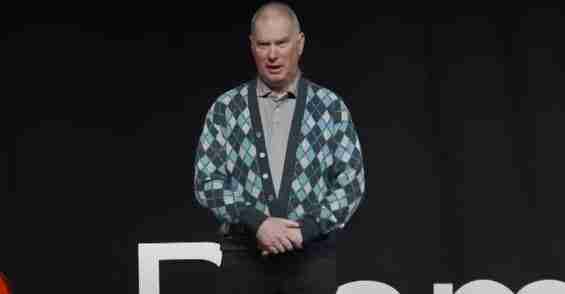
Read the full transcript of Jim Enderle’s talk titled “What My Worst Enemy Taught Me About Gratitude” at TEDxBismarck 2021 conference.
Listen to the audio version here:
TRANSCRIPT:
Seeking Revenge
JIM ENDERLE: I was there to kill him. I was a Navy hospital corpsman deployed to Iraq when an al-Qaeda militant we detained had somehow obtained an envelope with my family’s address. He joyously taunted me by waving the precious envelope. He threatened my family. I planned my revenge and waited for a chance and three weeks later when enemy mortars and rockets accidentally struck where he was housed, I found my way into his compound, its fence ripped open by one of the rockets.
But instead of confrontation, I found him grievously wounded. As I came into his view and he looked up at me, I realized that any chance at survival he had depended on me. Should I use a tourniquet in my left cargo pocket or the pistol in my right hand? His skin was dark and weathered. His arm was broken in at least two places and with his good arm he tried desperately to pull himself away from me. A hopeless task.
Right then I was surprised to feel grief, sorrow. To be in such a condition yet be so terrified is to try to pull himself away from me. Selfishly I didn’t want to be seen as the murderer I went to his compound to be. Suddenly I felt responsible for his fear, for the perpetuation of war. I wished I could stop it.
I felt an unexplainable empathy. He had been sweating and then he wasn’t. It seemed to take all the energy he had just to breathe. His fingers didn’t penetrate the concrete-like desert ground and finally the wince, painful wince on his face just faded. Finally he reached toward me with his hand, palm up, and I wondered what it was that he was looking for. Help? Forgiveness? He seemed so different than three weeks earlier.
We were close enough to hear each other breathe and he seemed to be muttering some kind of a prayer in Arabic. I found myself praying too and neither of us broke eye contact before he died moments later. Our interpreter, Sayyid, approached the body and knelt slowly. It was like a genuflection. Two soldiers and I turned the militant onto his back, straightening broken limbs.
Sayyid noticed and then pulled a piece of paper from the pocket over his heart. There was Arabic writing on it but he read it aloud in English. “If I told the sea what I felt for you, it would have left its shores, its shells, its fish, and followed me.”
Learning About Munawwar
I knelt at the man’s head and put my hands under his shoulders, keeping my elbows together like this so when we put him in the body bag his head wouldn’t just drop. Later when I thought about the beautiful words he read, I asked Sayyid if I could learn more about the man. And on my last day in Iraq, he walked up to me with a thick manila envelope of the man’s translated personal effects.
The man’s name was Munawwar, Sayyid told me, and in one of these letters he wrote, “The world is comprised of two kinds of people. Those who see a miracle in nothing and those who see a miracle in everything. Let’s be a part of the second group, you and I.” Sayyid handed me the envelope and said, “I wish you gratitude.”
I returned from my deployment and over the next four years I didn’t think very much about miracles or gratitude. By then I was separated with my family and I believed if I lied down, pain and sleep medications and alcohol would have spilled out and stained the sheets. I was crawling away from all I feared, a hopeless task.
I spent nights sitting up with the lights on, awake for days at a time, hunting knife in hand, thinking about the monsters in the closet I feared as a child. Only then I thought I had become the monster in the closet. Like so many before me, I had survived war only to give it birth again, beginning in my home and working outward.
But one day I walked by my closet and I reached into Sayyid’s envelope, which hung there untouched for four years. I pulled out a random piece of paper. Written across the top was one of Munawwar’s quotes. “If your heart is a volcano, how shall you expect flowers to bloom?”
In the middle of the page was biographical information. Munawwar, as it turned out, had been refugee twice in the 15 months before his detention. He had lost both parents and his only sibling, a sister, in the crossfire of two battles in the face of American Marine advances in Iraq’s Al Anbar province. The closest thing they owned to a weapon was a slingshot and a fishing pole.
At the bottom of the page, he recounted an old folk tale in which a tree sitting in the middle of a devastating forest fire questions Mother Earth on its imminent death. To which Mother Earth responds, “You’ll return to the ashes from whence you came, where you’ll become the world’s greatest fertilizer, and you’ll have a hand in a more green and lush forest for all the generations that follow you.” In the tree, although melancholy, felt her a new sense of purpose and even gratitude.
A Judge’s Ultimatum
My troubles persisted, and after a police incident, I found myself before a judge who slammed his gavel in a standing room only courtroom. He offered me a simple choice. I would go to counseling or I would go to jail. And because I loved simple choices, I chose jail. Because jail meant I was free, free of dispiriting intake forms and tests and evaluations, and counselors looking at their computer screen the entire appointment.
I could hear the judge’s fingers tapping on this huge wooden desk.