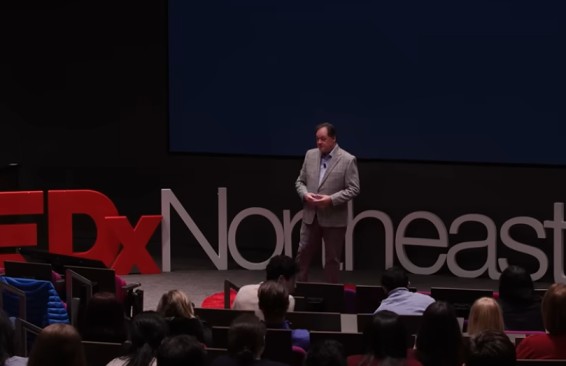
Read the full transcript of food policy expert Dr. Darin Detwiler’s talk at TEDxNortheasternU, June 14, 2026.
Editor’s Note: In this compelling talk, Dr. Darin Detwiler examines the “Certainty Gap”—the dangerous space between recognizing a risk and summoning the courage to act. Drawing on his unique background as a former nuclear submariner and a food safety expert, he reveals the profound, often tragic, human costs of leadership hesitation and issues a powerful call for decisive, ethical action.
The Fear That Doesn’t Scare Me
DR. DARIN DETWILER: So a few weeks ago, I was talking with our neighbor Kim about how I was preparing for this TED Talk. And I think she was trying to mess with me because she started talking about how public speaking ranks pretty high on people’s lists of scariest things. However, it didn’t really have an effect on me because I have already lived through some experiences that forever changed how I define scary.
Lessons From a Nuclear Submarine
During the Cold War, I served aboard a nuclear submarine. Tight spaces, no windows, we breathed recycled air. And there was no easy way out if something went wrong.
One day, deep below the surface of the ocean, a seawater pipe ruptured. At hundreds of feet down, the ocean doesn’t argue. It doesn’t ask for permission. But it does tell you one thing. You’re running out of time.
The water surged in. It was splashing relentlessly. And I rushed back to the scene, grabbing a handset for a communication system. And I announced, “Flooding in the engine room.” Immediately, I heard the commanding officer’s order, “Emergency surface.”
We didn’t just rise to the surface. We launched. Another operator and I, we went quickly to isolate the system. We stopped the flooding before it was too late, before the compartment filled up, before lives were lost.
We didn’t wait for more data. We didn’t ask for permission. We acted. We weren’t just trained and certified. We practiced and drilled for such emergencies. We learned and lived by a truth that still guides me today. In real dangerous situations, hesitation can be fatal.
The Two Dosimeters
If the seawater flooding wasn’t enough of a threat, there was also radiation, also real, yet silent and invisible. Each and every time I entered the reactor compartment to inspect equipment or to inspect work, I would wear two dosimeters to measure my radiation exposure. Think of them as like miniature personal Geiger counters.
One dosimeter was not very accurate, but it gave feedback in real time. The other dosimeter was extremely accurate. However, it could only be read after you left the compartment. In a risky situation like this, accuracy is meaningless if it’s too late to help anyone.
The Certainty Gap
After I left the Navy, I remember thinking back that on that submarine would have been some of the scariest situations I would ever have been in. But I was wrong, because everywhere you look, there are invisible threats, and there are leaders who delay.
As a professor today, I teach future leaders about the certainty gap. This is the span of time between when someone realizes they need to do something and when they finally feel confident enough to act. To close the certainty gap requires courage, humility, and the will to put people over profits.
But unfortunately, too many leaders will hesitate. They’ll delay. They look for confirmation. They look for consensus. They look for cover. And by the time they take action, it’s too late. The harm is already done. And when the harm becomes publicly visible, for instance, headlines of recalls and outbreaks, the public always asks the same question, “Why didn’t anyone stop this?”
The Loss of Riley
In 1993, I asked that same question, not as a professor, but as a father. My 16-month-old son, Riley, had just learned how to walk. One day, he got sick with E. coli. It started with an outbreak tied to contaminated fast food hamburgers, but my son never ate one. He got sick from another child in his daycare class. They call it person-to-person exposure, something we didn’t even know was possible at the time.
The events that happened after that were the scariest things that I have ever experienced in my life. I remember his first night in the hospital. I was sitting on the edge of his bed, and he was sitting on my lap and pointing up at an IV bag hanging from a pole. And he said, “Baba,” which were his little toddler words for a baby bottle. He wanted comfort and normalcy, but I couldn’t give it to him because he was in renal failure.
I remember seeing him being loaded onto a helicopter because they were going to take him to a larger hospital about 90 miles south. He was strapped in under a teddy bear that seemed larger than him. And I saw his wide eyes and a little tuft of his blonde hair sticking out from under the silver space blanket.
I remember looking for him in the pediatric intensive care unit. This little boy’s body dwarfed by wires and tubes and monitors. The surgeons explained why they had to remove the majority of his intestines, because they were completely destroyed by the pathogen. And the doctors explained why he was going to have to be in a coma for the next few weeks.
And I will never forget seeing him again outside the hospital, being carried in the world’s smallest coffin. Riley was the fourth and final child to die in the 1993 landmark Jack in the Box E. coli outbreak.
A Mission I Never Asked For
That crisis shattered my family. It gave me a mission I never asked for. And it ultimately changed food safety culture in America. But perhaps the hardest lesson I had to accept was that it was not caused because leaders lacked tools or data.