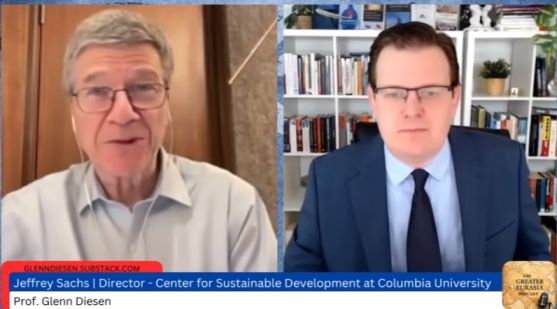
Editor’s Notes: In this episode, Professor Jeffrey Sachs joins Glenn Diesen to analyze the rapidly escalating tensions between Israel and Iran and the growing risk of nuclear conflict. Sachs discusses his proposed five-step plan for regional peace, which includes recognizing the security interests of all parties and establishing a Palestinian state based on 1967 borders. He also critiques the current U.S. approach to foreign policy, arguing that a reliance on military hegemony and “improvisational” leadership is leading toward global economic and security disasters. (March 16, 2026)
TRANSCRIPT:
Introduction
GLENN DIESEN: Welcome back. We are joined by Professor Jeffrey Sachs to discuss how the war in Iran may be spiraling out of control, but also how it’s possible to put an end to it. So thank you very much for joining us again from Malaysia.
PROFESSOR JEFFREY SACHS: Great to be with you, Glenn, as always.
The Samson Option and the Risk of Nuclear Escalation
GLENN DIESEN: So Israel has what is often referred to as the Samson option. That is, it’s considered to be the last resort if Israel faces an existential threat, that is to use nuclear weapons against its enemies. So this is dangerous because the US and Israel seems to be exhausting their arsenals, including their interceptors. And the situation is not just deteriorating, but it’s escalating very quickly.
And I saw that the Israeli newspaper Haaretz, they reported that one of Trump’s top advisers, David Sacks, warned that Israel could be destroyed. And under these conditions, Israel could use nuclear weapons against Iran. So I was wondering how you see this spiral of escalation and the possibility of this actually going — falling into a nuclear war.
PROFESSOR JEFFREY SACHS: Yes. David Sacks — no relation to me, by the way, but a friend — said a couple of days ago that Trump should declare victory and go home. And he was speaking essentially as a Trump advisor. He’s the AI czar in the White House. So he advises on digital and AI policies, and he’s an influential observer.
He wasn’t predicting a nuclear war, and he wasn’t saying we’re at that juncture. But what he was saying is, if this just continues, it will be awful. And he was saying to his boss, Donald Trump, just go home. That was the message. Just end this. This is a debacle, but call it a victory. Trump easily does that. But don’t pursue this more. It’s leading to worse and worse for the reasons that you said.
On the economic side, the risk of global calamity is absolutely growing day by day. No matter how they try to talk calm to the markets, no matter how they talk about releasing emergency reserves from the strategic oil reserves, the fact of the matter is people can do arithmetic. The Strait of Hormuz is closed. The release of 400 million barrels of oil, which was what was announced, is roughly 20 days of normal flow through the Strait of Hormuz. Not very impressive, actually, for what looks like could be a deadly long crisis and disaster — not only because the straits are closed, but because production of oil and gas is shutting down. And the physical facilities, one after another, are being destroyed right now in the tit for tat fire between the US and Iran.
And so this is why David Sacks advised his president, whom he serves: just stop and go home. Since Trump lives in a delusional world to begin with, we can declare victory. He can say how wonderful it is. Look at how many people we murdered. Look at how many leaders we killed. Look at how much infrastructure we destroyed. Remember last summer, he declared victory and went home. Of course, it was absurd then as well, but this is the option.
What David Sacks was saying is that that is actually the best security for Israel as well. That’s not only the right thing to do from the point of view of the world economy, the right thing to do from the point of view of US security, but the thing that would keep Israel safest as well. In other words, this war is to nobody’s advantage. It’s a pure lose, lose, lose all around. Lose for Israel, lose for the United States, and lose for the rest of the world, and especially, of course, Iran and the Gulf countries.
The Economic Consequences of Escalation
GLENN DIESEN: Yeah, I’ve spoken a bit with David Sacks on email. I’ve been trying to get him on the program. He seems like a good guy. But I was thinking as well that if the US actually escalates one step further and goes after Kharg Island and Iran retaliates against the energy installations across the Gulf states, it doesn’t really matter anymore if the Strait of Hormuz is open, if everything is in flames and destroyed. And of course it’s going to take much more than 20 days.
And I also thought the same about opening the strategic reserves — it doesn’t communicate a lot of confidence either when one is willing to deplete it to such an extent. But about you, with your colleague — you and Sybil Ferris — you wrote about the five steps which Trump could take to put an end to this war, essentially an off-ramp, which David Sacks advocated for. So if Trump reads it or calls you or listens to this podcast, what are these five steps you would advise?
Five Steps to End the War
PROFESSOR JEFFREY SACHS: Well, one thing is he’s not going to call. Maybe David Sacks will read it.
GLENN DIESEN: If I could interject very quickly — at one point before he got elected, he actually tweeted out a video of you when you were talking about the Middle East. So he listens to reason, but sorry for interrupting.
PROFESSOR JEFFREY SACHS: Yes.
And that was a video that warned about Netanyahu. I said, “That is one dark person.” I used a little bit less temperate language, but I said that this is one big problem. And Trump tweeted that out. At the time, a mystery. But what I said turned out to be absolutely right, which is that not only is Netanyahu Mr. Genocide, but now he is putting the whole Middle East in flames. And the whole world is going to come very soon to understand Israel created our global economic crisis. It’s not going to be good for Israel’s security, this kind of approach.
So, yes, Mr. Trump did tweet that out. Maybe he can listen to somebody to tell him, cut your losses, declare them a victory in your own way — that’s your business — but don’t drag us into disaster. This is the point.
# Step One: End Armed Aggression Against Iran
Now, what I and my colleague Sybil Ferris recommend is a real end to the conflict in the Middle East. Because we say that there are interlocking parts, it probably won’t happen. We stress that in the article. We’re not naive optimists. We’re just saying that the way you make peace is to recognize everybody’s security interests. That is also the point about Ukraine. Since Russia’s security interests are never recognized, there’s no peace. The same in the Middle East.
If you want peace — which most normal people in the world, I’d say all normal people in the world do — then you recognize everybody’s security interests. What are Iran’s security interests? Not to be bombed repeatedly by Israel and the United States, and not to have Netanyahu say, for 30 years, “Overthrow that government.” It can’t be more simple than that. The US and Israel need to stop their brazen, blatant, illegal, armed aggression against Iran. This is not even a preemptive attack because Iran wasn’t attacking anybody. This is just brazen, naked aggression, and it’s the essence of the violation of international law. So that was point number one.
# Step Two: Restore the Nuclear Agreement
Point number two — Trump says every day, “I need to stop Iran from getting a nuclear weapon.” I don’t know whether this is fatuous, whether he’s so ignorant he doesn’t understand what he does, or whether it’s a game. But the simple point is there was such an agreement, and you, Mr. Trump, ripped it up.
Of course, that was the Joint Comprehensive Plan of Action, negotiated in 2015 between Iran and the permanent five members of the UN Security Council — not just the United States, but Russia and China, Britain, France and the US, and Germany — and then ratified unanimously by the UN Security Council. And the essence of it was to underpin the Supreme Leader’s religious command that Iran would not get a nuclear weapon, because the Supreme Leader said, “This is against our faith.” And so Iran put itself under scrupulous inspection and honored the agreement. It was the US that ripped it up. Trump in 2018.
I don’t know if he remembers — the man on the surface remembers nothing, learns nothing, knows nothing. But I don’t really know whether he remembers that he ripped up the agreement that accomplished exactly what he said. Maybe he can remember that the Iranians said again last year and this year, they don’t want a nuclear weapon. They want to have a negotiated agreement. They want to be under UN scrutiny.
Maybe — I doubt it, but maybe — he could find an aide to let him know what the Omani mediator said the day before they killed all the leadership, which was, “We made great progress and we’re going on to a next round of negotiations in Vienna,” because the Iranians don’t want a nuclear weapon.
And so this is the second point: yes, it’s not even hard, Mr. Trump. It’s never been the issue with Netanyahu. It’s not about the nuclear weapons. It’s about overthrowing the Iranian government. That has always been his dream.
# Step Three: Open the Strait of Hormuz
The third point is to open up the Strait of Hormuz. And that is not by Trump pitifully, pathetically demanding NATO do this, China do this, to get him out of the incredible mess that he and Netanyahu have created for the world. It’s something for the Gulf Cooperation Council — that is the countries of the Arabian Peninsula — and Iran, to work out bilaterally.
And what is needed is for the Gulf countries to say that they are taking sovereignty of the military bases in their territory, and those bases will never be allowed to be used in aggression against Iran. So that’s how to get the Strait of Hormuz opened up. Again, it’s the Gulf countries on one side, it’s Iran on the other. All Islamic nations, all part of the Organization of Islamic Cooperation. In fact, both the United Arab Emirates and Iran are part of the BRICS countries. It’s not even hard for them to agree with each other.
The mistake that the Gulf countries made was to hand over their sovereignty to the United States, as if that’s some kind of protection for them. But what they should do now, seeing that there’s no protection to having these bases, is to reassert sovereignty over the bases in their country and to agree with Iran: the strait will open and these bases will never be used against Iran.
# Step Four: Establish a State of Palestine
The fourth plank is the one that is so obvious, but the one that is actually the cause of all the wars of the last 30 years — and that is that Israel needs to return to its borders of 4 June 1967, so that a state of Palestine is created in Gaza, the West Bank and East Jerusalem on the internationally recognized borders. And this is what Israel has gone to war repeatedly to block. And this is the basic point of all of these wars, including this one.
Why has Netanyahu dreamt for 40 years of overthrowing the Iranian regime? Why has Netanyahu been part of every war in the Middle East? Because his doctrine is that Israel will control all of Palestine — and with some of his zealot partners, even more: part of Syria, part of Lebanon, part of who knows what. Because according to the US Ambassador Mike Huckabee — who’s another part of this disaster — “Israel has the right to all the land from the Nile to the Euphrates,” says Ambassador Huckabee.
The whole reason for all these wars, from the Israeli point of view, is they’ve said there will never be a state of Palestine. “We’ll kill them, we’ll expel them, we’ll rule over them in an apartheid state, but there will never be a state of Palestine. And any government in this region that backs the Palestinians, we will overthrow.” That is the so-called Clean Break doctrine of Netanyahu that has been in place for 30 years.
So the fourth plank is a state of Palestine alongside the state of Israel. And you know what? Israel has no veto over that. The reason it doesn’t happen is the US, and the US alone. This was voted on in the Security Council last year and the year before — the US blocks this. This is simple. People should understand: almost every country in the world says, “Of course there should be a state of Palestine alongside the state of Israel.” But the US uses its veto in the UN Security Council to block that. So that’s the fourth plank.
Enough of this. This is the most basic point. And Israel got insanely greedy, or insanely zealous — depending on who exactly we’re talking about — to say, “We get 100% of the land.” You know what we’re talking about? For Palestine right now, it’s 22% of what was British Mandatory Palestine. And Israel says no — not even 22% for what is half the population. Not even 22%. “We demand everything.” That’s why we’re in non-stop war. So that’s the fourth point.
# Step Five: Disarmament of Militant Groups
And the fifth point is that with a state of Palestine established and welcomed into the United Nations as the 194th member state, Hamas, Hezbollah and any other militant groups will be disarmed. They will disarm because all of the region will insist that they disarm, and so will the UN Security Council. They will disarm because the state of Palestine will be created. And this is how to make peace.
The Root Cause: Israeli Supremacism and the Likud Doctrine
So what blocks this? What blocks this is a coalition of Israeli supremacism, of Israeli apartheid, of Israeli violence that goes back to Netanyahu and his party, the Likud, which in its founding charter in 1977 says that all the territory from the Jordan River to the Mediterranean Sea will be Israeli sovereignty.
That’s why all of these wars across the region have raged — because that basic fact is against every standard of international law and decency. And countries have supported the Palestinian cause, and therefore Netanyahu and the United States have gone to war to overthrow those governments that have supported the Palestinian cause.
The Illusion of Hegemonic Peace and Indivisible Security
GLENN DIESEN: I like this five step, but also like your focus on indivisible security, though, because I think this goes at the heart of what is required as well. Because, you know, states, they compete for security. And weapons for one state is often security for one is insecurity for another.
So you have two ways of producing security. Either you have indivisible security where we elevate our common security. In other words, I don’t point a gun at you to have more security. For me, this is one indivisible security. Alternatively, one can pursue hegemonic peace in this. You don’t care about indivisible security. You have one dominate to such an extent no one can even dream of challenging it.
I think this is the Iran source of the Iran war, but it’s also the Ukraine war. If we just accept that the hegemonic era is over, just as a matter of fact, the distribution of power has shifted, then we would have to essentially restore the principle of indivisible security. Otherwise, if one wants hegemonic peace again like the 90s, one has to restore it. That means defeat Russia, defeat Iran, defeat China.
And you know, I would read Israel’s clean break into this because, you know, when it merged in 96, this is part of the hegemonic era that is abandoned diplomacy and compromise, instead go for everything because you’re backed up with overwhelming military force.
PROFESSOR JEFFREY SACHS: And that is exactly right. And this is the delusion that such overwhelming force exists. It’s immoral. That’s another matter. But it turns out to be disastrous to hold such delusions.
The United States held those delusions in Ukraine because we should remember the Ukraine war started with the United States attempt to assert its hegemony over Ukraine. Zbigniew Brzezinski spelled it out. It was the doctrine of the neocons. We’re going to expand NATO anywhere we want, up to Russia’s borders, surrounding Russia in Georgia, in the south Caucasus, in Ukraine, around the Black Sea. That’s our business. We are the superpower. Well, Russia had different thoughts about that, but that’s where that war came from because no one cared to listen to Russia’s security concerns at all. And that’s still true today. It’s a blank wall to talk to any European leader that Russia has legitimate security concerns.
Okay, and now in the Middle East, it’s exactly what you say. Netanyahu thought, well, I got the easy plan. I don’t have to compromise on anything. We win because we have the United States. And there are famous clips of Netanyahu explaining to, I don’t even know who he’s talking to, “We own the Senate, we own the Congress. We can get the United States to do what we want.”
The truth is our crazy CIA and military as well have delusions. So they see Israel’s hegemony in the Middle East as just fine because it’s part of America’s global hegemony. What’s happening right now in part is Trump thinks, “I’m going to corner every export of oil, Venezuela. I’m going to demand that Mexico behave itself. I’m going to take over the Americas, as he’s explained. I’m going to take over the Middle East. I’m going to choke off Russian oil through sanctions. I’m going to decide who gets energy in this world.”
Well, this is a madman’s thought. It leads to global disaster, but it’s exactly that hegemonic idea. “I don’t have to deal with anybody. We don’t have to discuss with Iran. We just have to kill them, that’s all.” And that’s what they think they’re doing right now. And it, not only is it murder, but it doesn’t work to achieve your own security.
Israel is at far graver risk than it’s ever been because of this. And so is the United States at graver risk because our risk is nuclear war. And we keep pushing the world closer to nuclear war through these actions of not respecting, even in discussion, the security interests of the other side.
It’s the same in Taiwan. We say we’re going to send arms as we like to Taiwan. China says, “Excuse me, Taiwan is part of China. Do not send arms on your own. That for us is a red line.” The United States, filled with the idiocy that it is, the recklessness that it is, says, “We don’t have to listen to them. It’s our business. We are the United States of America.”
And by the way, it’s Trump. But it’s also the CIA, it’s also the Congressional Armed Services Committees, it’s also the arms contractors, it’s also Silicon Valley. They all have this delusion of “We don’t have to take into account anyone else’s concerns,” and that’s what’s leading us to disaster.
Hubris and Strategic Miscalculation: How Iran Was Underestimated
GLENN DIESEN: Just as a last question, how do you make sense of the way that Iran was underestimated? Because, you know, you worked with a lot of state leaders around the world to see how they work, their strategic thinking, their considerations.
How could it be that we have the reports suggesting that Trump dismissed the likelihood of Iran closing the Strait of Hormuz, which should have been the most predictable thing. The attacks on the US bases seems to be underestimated. The weapons that Iran has at its disposal, or the belief that killing Khamenei would collapse the government and make people pour into the streets with American flags. And essentially also now the assumption that the threats will make Iran capitulate, even though they see this in an existential fight.
I’m just wondering how they got it this wrong. Is this just hubris or is this a disconnect with the intelligence community? I just, I haven’t seen this in previous wars. There have always been mistakes, but this seems to be something very, very different.
PROFESSOR JEFFREY SACHS: Well, remember the Iraq war, for example, how every single thing was wrong, every prediction about the cakewalk that we were going to have and how democracy was going to come and so on.
And there was an interesting interview in 2004, I think it was a Time magazine reporter, if I remember correctly, and a White House official, maybe Carl Rove, I’m not absolutely sure, but he was asked about the reality of the situation. And the response from the White House was, “Excuse me, we create our own reality.” And this is part of the issue, which is when you are so powerful and arrogant, you just think, “We’ll make it work.” Trump didn’t know what he was going to do after the first hour, but he said, “We’ll make it work.” It’s complete improvisation.
Of course, the real lessons are that these are disasters. It is said that it took 20 years for the United States to go from the Taliban regime in Afghanistan to the Taliban regime in Afghanistan. So that was a 20 year effort. And they credit Trump that it took nine days to go from Khamenei to Khamenei. So this is American efficiency. In other words, we’re not accomplishing anything. We’re going around in circles, killing a lot of people, spending a lot of money. Maybe that’s part of the point because they want to spend a lot of money. That is profits for somebody and losses for all the rest of us.
But I think the main point is we don’t even have a process in the security state right now. The United States planning on anything has collapsed. We’re just in improv mode. We have a psychologically unstable president. We have a constitutional process that is over because Congress does not use its constitutional — I mean it rejects using its constitutional authority and responsibility.
And I can tell you in every area that I know of, there’s no thinking going on. There are no reports, there are no studies, there’s no careful scrutiny, there’s no review. It’s improvisation, it’s flailing around. So frankly, none of this surprises me. We don’t even have minimal processes of thought. We have a president who just makes up things as they go along and you end up with everything fake and then desperation. “Oh, NATO has to come to our aid. Even China, which was the target of much of this, has to come to our aid. Where are our friends?” says Donald Trump. My God, a five year old would show more self awareness and responsibility, frankly.
GLENN DIESEN: Yeah. And I’m thinking with all the religious advisors who come to his office, he should have known that, you know, “pride comes before the fall” or that God opposes arrogance. But he has different religious advisors, it seems. So anyways, it’s late over there in Kuala Lumpur, so thank you very much for taking the time. I very much appreciate you.
PROFESSOR JEFFREY SACHS: We’ll see you soon. Thanks.
Related Posts