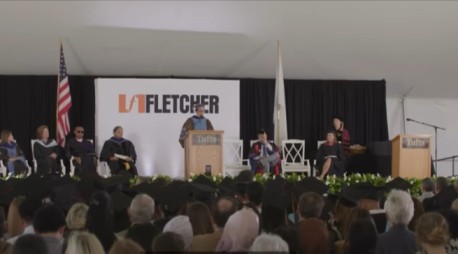
Read the full transcript of Dr. Shashi Tharoor’s keynote address at The Fletcher School’s 2026 Commencement ceremony on Sunday, May 17.
INTRODUCTION
DR. SHASHI THAROOR: Thank you, Dean Gallagher, and distinguished members of the faculty, the people on the podium, and this wonderful audience, the class of 2026, their friends and family, greetings to everyone. It’s a profound honor and privilege to address you today at the 92nd commencement of the Fletcher School.
I must say, to today’s graduates, this occasion marks a significant milestone in your lives, one that reflects both what you have achieved and what now lies ahead. And of course, that is not a neatly scripted future, but a series of unfolding questions to which you will be expected to supply your own answers.
On such a day, therefore, one does not presume to instruct, but to reflect and to offer a few insights shaped by experience. And I stand before you today in that spirit, with the extra satisfaction of it being the 50th reunion year for my class as well here at Fletcher.
To find myself back here 51 years after I first navigated these corridors as a student is to be reminded how profoundly a place can imprint itself upon a life. Fletcher did not merely equip me with credentials. It furnished me with a way of thinking about the world and my place within it. To stand before you now at the threshold of your own journeys is both a joy and a deeply personal homecoming.
I first arrived at the Fletcher School as a 19-year-old from India in 1975, full of curiosity and not entirely sure what lay ahead. Like many of you, I was stepping into a new world, one that was at once exciting and at times a little daunting.
I was by far the youngest student at the school and the only one with no work experience other than a long list of extracurricular activities and published articles. But that made me all the more receptive to new learning. Fletcher did what the best institutions do. It altered the way I thought about the world and quietly instilled in me in that process a sense that learning must ultimately serve a larger public purpose.
I still remember the culture shock of coming from a country where a car was a luxury for most adults to seeing the number of vehicles in the students’ parking lot, of rushing out with an Egyptian classmate to gamble in the first snowfall either of us had ever seen, discovering as a vegetarian that my only dining options at Fletcher were the boiled peas and carrots that were served on the side of the real meals. My first lesson here was to learn to adjust, but Kelly, I did become an amoeba.
In the years that followed, as Kelly told you, I completed not one but three degrees here and she has graciously listed my milestones. But in many ways, as I say, beyond those milestones, those credentials, what Fletcher gave me is because in many ways it’s a rare institution, one that combined both intellectual rigor with a genuine engagement with the world as it is and as it ought to be. It’s no exaggeration to say that whatever I’ve been able to accomplish since, whether at the United Nations or in Indian politics, has its roots in the education I received here. Those lessons have stayed with me ever since in every role I’ve been fortunate enough to undertake.
An Act of Hope in a Time of Despair
Now, this school was founded in 1933 as, and I quote from the founding document, “an act of hope in a time of despair and a boost to internationalism at a time of isolationism.” Fletcher described its students as, and I quote again, “committed to maintaining the stability and prosperity of a complex, challenging, and increasingly global society.” Ninety-three years later, that mission statement still holds up pretty well.
Fletcher is a place where you study the world as it is while being trained to think about the world it’s becoming. Fletcher taught us to make sense of the world and it must be said today that the world is offering rather more to make sense of than it once did, for we are living through a period of turbulence and transition in the global order, as Professor Chidi has already said.
An Interregnum in the Global Order
What we are witnessing is not merely change, but an interregnum, an uneasy passage between an old order that is fading and a new one that has yet to coherently take shape. The rules-based system that many of us once took for granted is no longer as stable or as universal as it appeared. Norms that once restrained power are increasingly treated as optional, and the language of international law now sounds more like aspiration than obligation.
We inhabit an age in which principles are often proclaimed universally and applied selectively. The certainties that underpinned international relations for decades are giving way to a more fluid and at times more unpredictable landscape. In this changing environment, where international relations are less often guided by shared norms, we are witnessing a renewed emphasis on power and competition in pursuit of strategic advantage.
Increasingly, domains that were once seen as neutral are being drawn into the logic of reality of rivalry, with economic choices and technological capabilities alike acquiring strategic weight and political consequence. States are acting with greater assertiveness, sometimes taking risks that would once have seemed unthinkable, and employing every instrument at their disposal, economic, technological and political, to secure advantage. It is in many ways a return to a more transactional and perhaps more brutal form of global politics.
The Paradox of Interconnection
At the same time, the forces of globalisation have drawn us closer together than ever before. Our economies, our technologies, even our societies are deeply interconnected. This interdependence has brought immense opportunity, but it has also introduced new vulnerabilities.
A World of Interdependence Without Trust
What was once seen as mutual dependence is now often viewed as strategic exposure, prompting nations to rethink supply chains, partnerships and long-held economic assumptions.
We are both more interconnected and more divided than ever. The old idea of du commerce, that trade would promote good relations between countries because of mutual economic benefits and mutual dependency, has given way to nearshoring tariffs and the weaponising of dependencies. The belief that the accountant’s ledger could finally replace the soldier’s bayonet has given way to one where the handshake has been replaced by the chokehold. This is a world, as I argue in the latest issue of the Fletcher Forum, of interdependence without trust.
A Convergence of Crises
Overlaying all of this is a convergence of crises that define our present moment. What we are witnessing is not a series of discrete crises, but a pattern where disruption in one corner of the world reverberates in another, where global shocks increasingly overlap, testing the resilience of our institutions and our societies. We inhabit a world of what my late boss, Kofi Annan, once described as problems without passports — pandemics, climate change, cyber threats, financial contagion — challenges that no nation, however powerful, can resolve alone. Their impact is profound and their scale serves as a reminder that we still need to find ways to cooperate in the interests of our common humanity.
And yet the mechanisms of collective action are themselves under strain. Multilateralism, which once offered a means of addressing shared challenges, now struggles to command the same confidence or cohesion. Institutions and norms created in another era are being questioned not only for their effectiveness but for their legitimacy, even as the need for cooperation has never been greater. Nations are, more often than ever before, turning inward or choosing more selective forms of engagement. The result is a more fragmented system of global governance, where cooperation is harder to sustain.
Is There an Alternative to the UN System?
Some people rashly speak of tossing aside the UN system and all that underpins it. I am reminded of a story I did tell yesterday to a smaller audience, of a former Soviet ambassador to the UN when confronted with the same proposition — the UN isn’t working, let’s shut it down — said he was reminded of a story of Adam and Eve in the Garden of Eden, when Adam found that Eve was becoming somewhat indifferent to him. And Adam said to Eve, “Eve, is there someone else?” Now you think about that for a minute, because that is the question we have to ask about the UN system and multilateralism. Is there anything else? Is there an alternative?
The Rise of Strategic Autonomy
Yes, in response to this uncertainty we are seeing in many countries a growing emphasis on self-reliance and strategic autonomy. Countries are seeking to strengthen their domestic capacities, to reduce dependencies and to assert greater control over critical sectors. This reflects a quiet but significant shift in thinking, where resilience is beginning to matter as much as efficiency, and where the ability to withstand disruption is seen as a form of power in its own right. This instinct is understandable, but it also reflects a world in which trust is more fragile and the future seems less assured.
The World the Class of 2026 Is Graduating Into
This class of 2026 is the world you are graduating into, one not easily defined by clear alliances or simple narratives. It is a world of blurred alignments, where nations pursue pragmatic partnerships rather than fixed loyalties, and where it sometimes seems that the only rule is that there are no rules. This world demands an ability to navigate ambiguity, to hold competing ideas in tension, and to make decisions in the absence of complete certainty. Adaptability, awareness, and a willingness to engage with complexity will not be merely useful qualities, they will be essential ones.
The Battle Over Ideas and Narratives
There’s also a subtler shift underway, one that is less visible but no less consequential. The contest today is not only over territory or trade, but over ideas, narratives, and the authority to define them. Information travels faster than ever, but so too does disinformation and fake news. It’s said that if you’re not on social media, you’re uninformed.
Navigating a World of Misinformation and Blurred Boundaries
If you are on social media, you’re misinformed. In such an environment, the ability to discern, to question, and to hold on to your intellectual integrity becomes indispensable. The challenge is not merely to know more, but to understand better, to be able to relate claims to context, to have the substantive knowledge to separate fact from fiction, propaganda from prejudice.
At the same time, the lines between the domestic and the international have grown increasingly blurred. Decisions taken within nations now carry immediate global consequences, just as global developments shape domestic realities in profound ways. The challenges we face do not respect borders, yet the solutions we pursue are too often limited by them.
The issues you will confront, whether in public policy, in business, or in civil society, will demand an ability to think across boundaries, to connect the local with the global, and to recognize that the two are, in truth, inseparable.
A Moment of Possibility Amid Disruption
And yet, for all its uncertainty, this is also a moment of possibility. Periods of transition, however unsettling, create space for renewal and for new forms of leadership. As a good professor said, don’t waste a great crisis. This calls for individuals who are willing not only to respond to change, but to shape it. For if this era is defined by disruption, it is equally defined by the opportunity to rebuild a more balanced and more inclusive order.
Lessons from Hammarskjöld and Annan: Unscripted Interventions That Shaped History
When the Suez Crisis erupted 70 years ago, and the UN Security Council was bitterly divided — that must sound familiar to many of us today — Secretary-General Dag Hammarskjöld invented peacekeeping, using the neutral armies of the smaller and middle powers. It wasn’t mentioned in the UN Charter, but it saved the day.
When the US first threatened to bomb Baghdad in 1998 over non-compliance with weapons inspections, Kofi Annan got onto a plane and flew there to persuade Saddam Hussein to comply. He did it at 24 hours’ notice. I was with him on that trip.
In both cases, by giving the antagonists a ladder to climb down, these unscripted interventions diffused crises. Not everyone can be in the position of a Hammarskjöld or an Annan, nor be inclined to risk their positions by attempting something unprecedented. Many would have considered such efforts delusional. Still, in your own areas of work, you can vow not to be custodians of paralysis, but agents of imaginative action. Push the envelope.
Much of your finest work might never make the headlines, but it will endure in solutions found and quiet compromises away from the flash bombs. Wear, in those cases, your anonymity as a badge of honour, but never stop trying.
Why Fletcher Matters More Than Ever
The Fletcher School is today, in my view, more necessary than ever. It’s a place that insists on looking outward, on engaging with difference rather than retreating from it, on understanding that complexity is not an obstacle to be avoided, but a reality to be navigated. It brings together people from different countries, disciplines and perspectives, and asks them not merely to learn, but also to learn from one another. That is no small thing.
In a world easily tempted by simple answers and narrower horizons, an education that teaches you to think globally, to listen carefully, and to act with a sense of responsibility beyond yourself is not just valuable, it’s indispensable. And that, to my mind, is why Fletcher matters.
Standing at the Threshold: A Message to the Class of 2026
As you leave these portals, you stand at a threshold. Behind you lie years of structured learning; before you stretches the far less predictable terrain of lived experience. There will be moments of triumph and moments of uncertainty, and in navigating both you will draw not only upon the knowledge you’ve acquired here, but upon the values you choose to uphold.
If there’s one lesson I’ve learned over the years, it’s that the world will rarely conform to your expectations. It will surprise you, unsettle you, and at times disappoint you. But it will also offer moments of possibility that you could not have anticipated. The task before you is not to control that uncertainty, but to engage with it thoughtfully and with purpose. Knowledge alone is not enough.
On Choosing Purpose Over Convenience
The world is already full of intelligent people who can identify problems from a safe distance. What matters is the willingness to take responsibility for solving them. In the years ahead, difficult choices will inevitably arise. When they do, I hope you will choose not only what is convenient, but what is right.
You will at times be wrong, occasionally even spectacularly so. You will misjudge people, misunderstand problems, perhaps find yourself wondering whether you’ve taken an entirely wrong turn. This is not failure. It is the price of engagement. The true failure lies in withdrawing, in retreating into cynicism, or worst of all, into indifference.
You will also discover that progress is seldom linear. There will be setbacks, frustrations, and moments when the distance between aspiration and reality seems unbridgeable. I’ll say it again, keep trying. Change more often than not is incremental. The result of sustained effort rather than sudden transformation. What matters is not that you succeed at every step, but that you remain committed to the direction in which you are moving.
Defining Success as Fulfillment
As you move forward, I would also urge you to define success as fulfillment. The world will offer you ready-made metrics for success, titles, salaries, designations, and medals, but these are external validations that can neither fully capture nor sustain a sense of fulfillment. It is important to ask yourself what kind of impact you wish to have, the problems you want to solve, the communities you want to engage with, and the values you refuse to compromise. A career built solely on accumulation may impress others. A career built on purpose will sustain you.
Gratitude as a Sustained Ethic
Equally important is the cultivation of a parallel virtue, gratitude. Not as a fleeting sentiment, but as a sustained ethic. The journey that has brought you here has not been yours alone. It has been enabled by the patience of parents, the dedication of teachers, and the solidarity of peers. To acknowledge this is important, but to embody it is far more consequential.
For gratitude, when translated into action, becomes responsibility, the responsibility to extend opportunities when you can, to mentor those who will still follow in your footsteps, and to ensure that the doors that open for you are not quietly closed behind you. In doing so, you move beyond the narrow confines of individual achievement and participate in the creation of something larger, a continuum of support, aspiration, and shared progress.
The true measure of success then lies not only in what you accomplish, but in what you enable others to achieve. It’s in this quiet but enduring transformation, from personal advancement to collective uplift, that your education will find its most meaningful expression.
Go Out and Engage With the World
So go out into the world, not to control it because you cannot, but to engage with it, often in the company of those who do not entirely agree with you, to help shape it, and when necessary, to challenge it.
And so, as you step forward into the next chapter of your lives, allow me to leave you with one more simple but enduring thought. The future is not something that happens to you, it’s something you help create. You will, in the years ahead, encounter choices that test your judgment, your courage, and your character. In those moments, resist the temptation to drift with circumstance. Instead, choose deliberately, act conscientiously, and remain anchored in the values you carry from here.
And if years from now someone were to ask what you did with your time at Fletcher, I hope your answer will not rest solely on what you achieved, but on what you changed, what changed you, and what you refused to ignore. If you ever find yourself entirely certain of something, take that as a sign that you may not be thinking deeply enough. So stay curious, stay open, stay DeLulu.
I wish you courage in the face of uncertainty, clarity in moments of doubt, and above all, the wisdom to recognize that the most meaningful journeys are those undertaken not for oneself alone, but for the world we all share.
Congratulations, Class of 2026. All the very best to you. Give yourselves a hand. Thank you.
Related Posts